
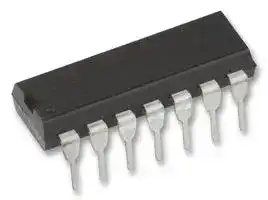


TS556CN
IC, TIMER DUAL CMOS, DIP14, 556
- Manufacturer: STMICROELECTRONICS
- Product type: Timers, Oscillators & Pulse Generators
- Frequency: 2.7MHz
- No. of Pins: 14Pins
- Digital IC Case: DIP
- Supply Voltage Max: 16V
- Supply Voltage Min: 2V
- Operating Temperature Max: 70°C
- Operating Temperature Min: 0°C
| Delivery and price | |
|---|---|
| Units per pack | 9000 |
| Price | 0.334 € |
| Current stock | 10+ |
| Lead time | 30 days |

**TS556**

Low-power dual CMOS timer

**==> picture [61 x 39] intentionally omitted <==**

## **Features**

- Very low power consumption: 220 µA typ at VCC = 5 V 180 µA typ  at VCC = 3 V

- High maximum astable frequency 2.7 MHz

- Pin-to-pin and functionally compatible with bipolar NE556

- Wide voltage range: 2 V to 16 V

- Supply current spikes reduced during output transitions

- High input impedance: 10[12] Ω

- Output compatible with TTL, CMOS and logic MOS

**==> picture [46 x 39] intentionally omitted <==**

**==> picture [102 x 137] intentionally omitted <==**

**----- Start of picture text -----**<br>
N<br>DIP14<br>(Plastic package)<br>D<br>SO14<br>(Plastic micropackage)<br>**----- End of picture text -----**<br>


## **Description**

The TS556 is a dual CMOS timer which offers a very low consumption:

(Icc(TYP) TS556 = 220 µA at VCC = +5 V versus Icc(TYP) NE556 = 6 mA), and high frequency: (f(max.) TS556 = 2.7 MHz versus f(max.) NE556 = 0.1 MHz).

In both monostable and astable modes, timing remains very accurate.

The TS556 provides reduced supply current spikes during output transitions, which enable the use of lower decoupling capacitors compared to those required by bipolar NE556.

**Pin connections** (top view)

**==> picture [151 x 112] intentionally omitted <==**

**----- Start of picture text -----**<br>
Discharge 1 14 +VS<br>Threshold 2 13 Discharge<br>Control 3 12 Threshold<br>Voltage<br>Control<br>Reset 4 11 Voltage<br>Output 5 10 Reset<br>Trigger 6 9 Output<br>GND 7 8 Trigger<br>**----- End of picture text -----**<br>


Due to the high input impedance (10[12] Ω), timing capacitors can also be minimized.

October 2008

1/19

Rev 2

_www.st.com_

**TS556**

**Absolute maximum ratings and operating conditions**

## **1 Absolute maximum ratings and operating conditions**

## **Table 1. Absolute maximum ratings**

|**Symbol**|**Parameter**|**Value**|**Unit**|
|---|---|---|---|
|VCC|Supply voltage|+18|V|
|IOUT|Output current|± 100|mA|
|Rthja|Thermal resistance junction to ambient<br>DIP14(1)<br>SO14(2)|80<br>105|°C/W|
|Rthjc|Thermal resistance junction to case<br>DIP14(1)<br>SO14(2)|33<br>31|°C/W|
|Tj|Junction Temperature|+150|°C|
|Tstg|Storage Temperature Range|-65 to +150|°C|
|ESD|Human body model (HBM)(3)|1200|V|
||Machine model (MM)(4)|200||
||Charged device model (CDM)(5)|1000||


1. Short-circuits can cause excessive heating. These values are typical and specified for a single layer PCB.

2. Short-circuits can cause excessive heating. These values are typical and specified for a four layers PCB.

3. Human body model: a 100 pF capacitor is charged to the specified voltage, then discharged through a 1.5kΩ resistor between two pins of the device. This is done for all couples of connected pin combinations while the other pins are floating.

4. Machine model: a 200 pF capacitor is charged to the specified voltage, then discharged directly between two pins of the device with no external series resistor (internal resistor < 5 Ω). This is done for all couples of connected pin combinations while the other pins remain floating.

5. Charged device model: all pins plus package are charged together to the specified voltage and then discharged directly to the ground.

## **Table 2. Operating conditions**

|**Symbol**|**Parameter**|**Value**|**Unit**|
|---|---|---|---|
|VCC|Supply voltage|2 to 16|V|
|IOUT|Output sink current<br>Output source current|10<br>50|mA|
|Toper|Operating free air temperature range:<br>TS556C<br>TS556I<br>TS556M|0 to +70<br>-40 to +125<br>-55 to +125|°C|


2/19

**TS556**

**Schematic diagram**

## **2 Schematic diagram**

**==> picture [205 x 11] intentionally omitted <==**

**----- Start of picture text -----**<br>
Figure 1. Schematic diagram (1/2 TS556)<br>**----- End of picture text -----**<br>


**==> picture [319 x 480] intentionally omitted <==**

**----- Start of picture text -----**<br>
Output<br>Τ35<br>Τ33<br>Τ34<br>Discharge<br>Τ31 Τ32<br>Τ30 Τ29<br>Τ27 Τ28<br>Τ26 Τ24<br>Τ25 Τ23 Τ22<br>Τ21 Trigger<br>Τ19 Τ17 RESET<br>CC Τ20 Τ16<br>V GND<br>Τ18<br>Τ13<br>Τ15<br>Τ12<br>Τ14<br>R7 Τ9 Τ7<br>Τ11<br>Τ10 Τ8<br>Τ6<br>Threshold<br>Τ4 Τ5<br>Τ2<br>Τ1<br>R1 50k Ω R2 50k Ω R3 50k Ω R4 50k Ω R5 50k Ω R6 50k Ω<br>Control Voltage<br>**----- End of picture text -----**<br>


3/19

**Schematic diagram**

**TS556**

## **Figure 2. Block diagram**

**==> picture [218 x 138] intentionally omitted <==**

**----- Start of picture text -----**<br>
VCC Reset<br>14 4 / 10 TS556<br>R<br>Threshold 2 / 12 + R1 Q 5 / 9 Output<br>VoltageControl 3 / 11 - A R<br>R S<br>+<br>6 / 8<br>Trigger -<br>B<br>R<br>1 / 13<br>7 Discharge<br>Ground<br>**----- End of picture text -----**<br>


## **Table 3. Functions table**

|**Reset**|**Trigger**|**Threshold**|**Output**|
|---|---|---|---|
|Low|x|x|Low|
|High|Low|x|High|
|High|High|High|Low|
|High|High|Low|Previous State|


_Note: LOW: level voltage_ ≤ _minimum voltage specified HIGH: level voltage_ ≥ _maximum voltage specified x: irrelevant._

4/19

**TS556**

**Electrical characteristics**

## **3 Electrical characteristics**

## **Table 4. Static electrical characteristics**

**VCC = +2 V, Tamb = +25 °C, Reset to VCC (unless otherwise specified)**

|**Symbol**|**Parameter**|**Min.**|**Typ.**|**Max.**|**Unit**|
|---|---|---|---|---|---|
|ICC|Supply current (no load, high and low states)<br>Tmin. ≤Tamb ≤Tmax||130|400<br>400|µA|
|VCL|Control voltage level<br>Tmin. ≤Tamb ≤Tmax|1.2<br>1.1|1.3|1.4<br>1.5|V|
|VDIS|Discharge saturation voltage (Idis= 1 mA)<br>Tmin. ≤Tamb ≤Tmax||0.05|0.2<br>0.25|V|
|IDIS|Discharge pin leakage current||1|100|nA|
|VOL|Low level output voltage (Isink= 1 mA)<br>Tmin. ≤Tamb ≤Tmax||0.1|0.3<br>0.35|V|
|VOH|High level output voltage (Isource= -0.3 mA)<br>Tmin. ≤Tamb ≤Tmax|1.5<br>1.5|1.9||V|
|VTRIG|Trigger voltage<br>Tmin. ≤Tamb ≤Tmax|0.4<br>0.3|0.67|0.95<br>1.05|V|
|ITRIG|Trigger current||10||pA|
|ITH|Threshold current||10||pA|
|VRESET|Reset voltage<br>Tmin. ≤Tamb ≤Tmax|0.4<br>0.3|1.1|1.5<br>2.0|V|
|IRESET|Reset current||10||pA|


5/19

**TS556**

**Electrical characteristics**

**Table 5.**

**Static electrical characteristics**

**VCC = +3 V, Tamb = +25 °C, Reset to VCC (unless otherwise specified)**

|**Symbol**|**Parameter**|**Min.**|**Typ.**|**Max.**|**Unit**|
|---|---|---|---|---|---|
|ICC|Supply current (no load, high and low states)<br>Tmin ≤Tamb ≤Tmax||180|460<br>460|µA|
|VCL|Control voltage level<br>Tmin ≤Tamb ≤Tmax|1.8<br>1.7|2|2.2<br>2.3|V|
|VDIS|Discharge saturation voltage (Idis= 1 mA)<br>Tmin≤Tamb ≤Tmax||0.05|0.2<br>0.25|V|
|IDIS|Discharge pin leakage current||1|100|nA|
|VOL|Low level output voltage (Isink= 1 mA)<br>Tmin. ≤Tamb ≤Tmax||0.1|0.3<br>0.35|V|
|VOH|High level output voltage (Isource= -0.3 mA)<br>Tmin. ≤Tamb ≤Tmax|2.5<br>2.5|2.9||V|
|VTRIG|Trigger voltage<br>Tmin. ≤Tamb ≤Tmax|0.9<br>0.8|1|1.1<br>1.2|V|
|ITRIG|Trigger current||10||pA|
|ITH|Threshold current||10||pA|
|VRESET|Reset voltage<br>Tmin. ≤Tamb ≤Tmax|0.4<br>0.3|1.1|1.5<br>2.0|V|
|IRESET|Reset current||10||pA|


6/19

**TS556**

**Electrical characteristics**

**Table 6.**

**Dynamic electrical characteristics**

**VCC = +3 V, Tamb = +25 °C, Reset to VCC (unless otherwise specified)**

|**Symbol**|**Parameter**|**Min.**|**Typ.**|**Max.**|**Unit**|
|---|---|---|---|---|---|
||Timing accuracy (monostable)(1)<br>R = 10 kΩ, C = 0.1 µF<br>VCC=+2 V,<br>VCC= +3 V||1<br>1||%|
||Timing shift with supply voltage variations<br>(Monostable)(1)<br>R = 10 kΩ, C = 0.1 µF, VCC= +3 V ±0.3 V||0.5||%/V|
||Timing shift with temperature(1)<br>Tmin.≤Tamb ≤Tmax||75||ppm/°C|
|fmax|Maximum astable frequency(2)<br>RA= 470Ω, RB= 200Ω, C = 200 pF||2||MHz|
||Astable frequency accuracy(2)<br>RA= RB= 1 kΩto 100 kΩ, C = 0.1 µF||5||%|
||Timing shift with supply voltage variations<br>(astable mode)(2)<br>RA= RB= 10 kΩ, C = 0.1 µF, VCC= +3 to +5 V||0.5||%/V|
|tR|Output rise time (Cload= 10 pF)||25||ns|
|tF|Output fall time (Cload= 10 pF)||20|-|ns|
|tPD|Trigger propagation delay||100||ns|
|tRPW|Minimum reset pulse width (Vtrig= +3 V)||350||ns|


1. See _Figure 4_ .

2. See _Figure 6_ .

7/19

**TS556**

**Electrical characteristics**

**Table 7. Static electrical characteristics**

**VCC = +5 V, Tamb = +25 °C, Reset to VCC (unless otherwise specified)**

|**Symbol**|**Parameter**|**Min.**|**Typ.**|**Max.**|**Unit**|
|---|---|---|---|---|---|
|ICC|Supply current (no load, high and low states)<br>Tmin. ≤Tamb ≤Tmax||220|500<br>500|µA|
|VCL|Control voltage level<br>Tmin. ≤Tamb ≤Tmax|2.9<br>2.8|3.3|3.8<br>3.9|V|
|VDIS|Discharge saturation voltage (Idis= 10 mA)<br>Tmin. ≤Tamb ≤Tmax||0.2|0.3<br>0.35|V|
|IDIS|Discharge pin leakage current||1|100|nA|
|VOL|Low level output voltage (Isink= 8 mA)<br>Tmin. ≤Tamb ≤Tmax||0.3|0.6<br>0.8|V|
|VOH|High level output voltage (Isource= -2 mA)<br>Tmin. ≤Tamb ≤Tmax|4.4<br>4.4|4.6||V|
|VTRIG|Trigger voltage<br>Tmin. ≤Tamb ≤Tmax|1.36<br>1.26|1.67|1.96<br>2.06|V|
|ITRIG|Trigger current||10||pA|
|ITH|Threshold current||10||pA|
|VRESET|Reset voltage<br>Tmin. ≤Tamb ≤Tmax|0.4<br>0.3|1.1|1.5<br>2.0|V|
|IRESET|Reset current||10||pA|


8/19

**TS556**

**Electrical characteristics**

**Table 8.**

## **Dynamic electrical characteristics**

**VCC = +5 V, Tamb = +25 °C, Reset to VCC (unless otherwise specified)**

|**Symbol**|**Parameter**|**Min.**|**Typ.**|**Max.**|**Unit**|
|---|---|---|---|---|---|
||Timing accuracy (monostable)(1)<br>R = 10 kΩ, C = 0.1 µF||2||%|
||Timing shift with supply voltage variations<br>(monostable)(1)<br>R = 10 kΩ, C = 0.1 µF, VCC= +5 V ±1 V||0.38||%/V|
||Timing shift with temperature(1)<br>Tmin.≤Tamb ≤Tmax||75||ppm/°C|
|fmax|Maximum Astable Frequency(2)<br>RA= 470Ω, RB= 200Ω, C = 200 pF||2.7||MHz|
||Astable Frequency Accuracy(2)<br>RA= RB= 1 kΩto 100 kΩ, C = 0.1 µF||3||%|
||Timing shift with supply voltage variations<br>(astable mode)(2)<br>RA= RB= 1 kΩto 100 kΩ, C = 0.1 µF,<br>VCC= +5 to +12 V||0.1||%/V|
|tR|Output rise time (Cload= 10 pF)||25||ns|
|tF|Output fall time (Cload= 10 pF)||20|-|ns|
|tPD|Trigger propagation delay||100||ns|
|tRPW|Minimum reset pulse width (Vtrig= +5 V)||350||ns|


1. See _Figure 4_ .

2. See _Figure 6_ .

9/19

**TS556**

**Electrical characteristics**

**Table 9. Static electrical characteristics VCC = +12 V, Tamb = +25 °C, Reset to VCC (unless otherwise specified)**

|**Symbol**|**Parameter**|**Min.**|**Typ.**|**Max.**|**Unit**|
|---|---|---|---|---|---|
|ICC|Supply current (no load, high and low states)<br>Tmin. ≤Tamb ≤Tmax||340|800<br>800|µA|
|VCL|Control voltage level<br>Tmin. ≤Tamb ≤Tmax|7.4<br>7.3|8|8.6<br>8.7|V|
|VDIS|Discharge saturation voltage (Idis= 80 mA)<br>Tmin. ≤Tamb ≤Tmax||0.09|1.6<br>2.0|V|
|IDIS|Discharge pin leakage current||1|100|nA|
|VOL|Low level output voltage (Isink= 50 mA)<br>Tmin. ≤Tamb ≤Tmax||1.2|2<br>2.8|V|
|VOH|High level output voltage (Isource= -10 mA)<br>Tmin. ≤Tamb ≤Tmax|10.5<br>10.5|11||V|
|VTRIG|Trigger voltage<br>Tmin. ≤Tamb ≤Tmax|3.2<br>3.1|4|4.8<br>4.9|V|
|ITRIG|Trigger current||10||pA|
|ITH|Threshold current||10||pA|
|VRESET|Reset voltage<br>Tmin. ≤Tamb ≤Tmax|0.4<br>0.3|1.1|1.5<br>2.0|V|
|IRESET|Reset current||10||pA|


|**Table 10.**<br>**Dynamic electrical characteristics**<br>**VCC = +12 V, Tamb = +25 °C, Reset to VCC (unless otherwise specified)**|**Table 10.**<br>**Dynamic electrical characteristics**<br>**VCC = +12 V, Tamb = +25 °C, Reset to VCC (unless otherwise specified)**|**Table 10.**<br>**Dynamic electrical characteristics**<br>**VCC = +12 V, Tamb = +25 °C, Reset to VCC (unless otherwise specified)**|**Table 10.**<br>**Dynamic electrical characteristics**<br>**VCC = +12 V, Tamb = +25 °C, Reset to VCC (unless otherwise specified)**|**Table 10.**<br>**Dynamic electrical characteristics**<br>**VCC = +12 V, Tamb = +25 °C, Reset to VCC (unless otherwise specified)**|**Table 10.**<br>**Dynamic electrical characteristics**<br>**VCC = +12 V, Tamb = +25 °C, Reset to VCC (unless otherwise specified)**|
|---|---|---|---|---|---|
|**Symbol**|**Parameter**|**Min.**|**Typ.**|**Max.**|**Unit**|
||Timing accuracy (monostable)(1)<br>R = 10 kΩ, C = 0.1 µF||4||%|
||Timing shift with supply voltage variations<br>(monostable)<br>R = 10 kΩ, C = 0.1 µF, VCC= +5 V ±1 V||0.38||%/V|
||Timing shift with temperature<br>Tmin. ≤Tamb ≤Tmax.,VCC= +5 V||75||ppm/°C|
|fmax|Maximum astable frequency<br>RA= 470Ω, RB= 200Ω, C = 200 pF, VCC= +5 V||2.7||MHz|
||Astable frequency accuracy(2)<br>RA= RB= 1 kΩto 100 kΩ, C = 0.1 µF||3||%|
||Timing shift with supply voltage variations<br>(astable mode)<br>RA= RB= 1 kΩto 100 kΩ, C = 0.1 µF,<br>VCC= 5 to +12 V||0.1||%/V|


1. See _Figure 4_ .

2. See _Figure 6_ .

10/19

**TS556**

**Electrical characteristics**

## **Figure 3. Supply current (per timer) versus supply voltage**

**==> picture [140 x 116] intentionally omitted <==**

**----- Start of picture text -----**<br>
300<br>200<br>100<br>0                 4              8             12             16<br>SUPPLY VOLTAGE, V     (V)CC<br>μ<br>CC<br>SUPPLY CURRENT, I     (  A)<br>**----- End of picture text -----**<br>


11/19

**TS556**

**Application information**

## **4 Application information**

## **4.1 Monostable operation**

In the monostable mode, the timer operates like a one-shot generator. Referring to figure 2, the external capacitor is initially held discharged by a transistor inside the timer, as shown in _Figure 4_ .

## **Figure 4. Application schematic**

**==> picture [154 x 117] intentionally omitted <==**

**----- Start of picture text -----**<br>
VCC<br>Reset<br>R<br>Trigger<br>1/2<br>C<br>TS556<br>Out<br>Control Voltage<br>0.01  Fμ<br>**----- End of picture text -----**<br>


The circuit triggers on a negative-going input signal when the level reaches 1/3 VCC. Once triggered, the circuit remains in this state until the set time has elapsed, even if it is triggered again during this interval. The duration of the output HIGH state is given by t = 1.1 R x C.

It can be noticed that since the charge rate and the threshold level of the comparator are both directly proportional to the supply voltage, the timing interval is independent of the supply. Applying a negative pulse simultaneously to the Reset terminal (pin 4) and the Trigger terminal (pin 2) during the timing cycle discharges the external capacitor and causes the cycle to start over. The timing cycle now starts on the positive edge of the reset pulse. While the reset pulse is applied, the output is driven to the LOW state.

When a negative trigger pulse is applied to pin 2, the flip-flop is set, releasing the short circuit across the external capacitor and driving the output HIGH. The voltage across the capacitor increases exponentially with the time constant τ = R x C.

When the voltage across the capacitor equals 2/3 VCC, the comparator resets the flip-flop which then discharges the capacitor rapidly and drives the output to its LOW state. _Figure 5_ shows the actual waveforms generated in this mode of operation. When Reset is not used, it should be tied high to avoid any possible or false triggering.

## **Figure 5. Timing diagram**

**==> picture [92 x 119] intentionally omitted <==**

**----- Start of picture text -----**<br>
t = 0.1 ms / div<br>INPUT = 2.0V/div<br>OUTPUT VOLTAGE = 5.0V/div<br>CAPACITOR VOLTAGE = 2.0V/div<br>R = 9.1k   ,  C = 0.01   F  ,  R   = 1.0kΩ μ L Ω<br>**----- End of picture text -----**<br>


12/19

**TS556**

**Application information**

## **4.2 Astable operation**

When the circuit is connected as shown in _Figure 6_ (pins 2 and 6 connected) it triggers itself and runs as a multivibrator. The external capacitor charges through RA and RB and discharges through RB only. Thus the duty cycle may be precisely set by the ratio of these two resistors.

In the astable mode of operation, C charges and discharges between 1/3 VCC and 2/3 VCC. As in the triggered mode, the charge and discharge times and therefore frequency, are independent of the supply voltage.

## **Figure 6. Application schematic**

**==> picture [136 x 114] intentionally omitted <==**

**----- Start of picture text -----**<br>
VCC<br>Reset<br>R A<br>Out<br>1/2 RB<br>TS556<br>Control<br>Voltage<br>0.01   Fμ C<br>**----- End of picture text -----**<br>


_Figure 7_ shows actual waveforms generated in this mode of operation.

The charge time (output HIGH) is given by:

t1 = 0.693 (RA + RB) C

and the discharge time (output LOW) by:

t2 = 0.693 x  RB  x C

Thus the total period T is given by:

T = t1 + t2 = 0.693 (RA + 2RB) C

The frequency of oscillation is then:

**==> picture [79 x 18] intentionally omitted <==**

The duty cycle is given by:

**==> picture [54 x 17] intentionally omitted <==**

## **Figure 7. Timing diagram**

**==> picture [104 x 119] intentionally omitted <==**

**----- Start of picture text -----**<br>
t = 0.5 ms / div<br>OUTPUT VOLTAGE = 5.0V/div<br>CAPACITOR VOLTAGE = 1.0V/div<br>R   =  R   = 4.8 k   ,  C = 0.1   F  ,  R   = 1.0kA B Ω μ L Ω<br>**----- End of picture text -----**<br>


13/19

**TS556**

**Package information**

## **5 Package information**

In order to meet environmental requirements, STMicroelectronics offers these devices in ECOPACK[®] packages. These packages have a lead-free second level interconnect. The category of second level interconnect is marked on the package and on the inner box label, in compliance with JEDEC Standard JESD97. The maximum ratings related to soldering conditions are also marked on the inner box label. ECOPACK is an STMicroelectronics trademark. ECOPACK specifications are available at: www.st.com.

14/19

**TS556**

**Package information**

## **5.1 DIP14 package information**

## **Figure 8. DIP14 package mechanical drawing**

**==> picture [370 x 233] intentionally omitted <==**

**Table 11. DIP14 package mechanical data**

|**Table 11.**<br>**DIP14package mechanical data**|**Table 11.**<br>**DIP14package mechanical data**|**Table 11.**<br>**DIP14package mechanical data**|**Table 11.**<br>**DIP14package mechanical data**|**Table 11.**<br>**DIP14package mechanical data**|**Table 11.**<br>**DIP14package mechanical data**|**Table 11.**<br>**DIP14package mechanical data**|
|---|---|---|---|---|---|---|
||||||||
||**Dimensions**||||||
|**Ref.**|**Millimeters**|||**Inches**|||
||**Min.**|**Typ.**|**Max.**|**Min.**|**Typ.**|**Max.**|
|A|||5.33|||0.21|
|A1|0.38|||0.015|||
|A2|2.92|3.30|4.95|0.11|0.13|0.19|
|b|0.36|0.46|0.56|0.014|0.018|0.022|
|b2|1.14|1.52|1.78|0.04|0.06|0.07|
|c|0.20|0.25|0.36|0.007|0.009|0.01|
|D|18.67|19.05|19.69|0.73|0.75|0.77|
|E|7.62|7.87|8.26|0.30|0.31|0.32|
|E1|6.10|6.35|7.11|0.24|0.25|0.28|
|e||2.54|||0.10||
|e1||15.24|||0.60||
|eA||7.62|||0.30||
|eB|||10.92|||0.43|
|L|2.92|3.30|3.81|0.11|0.13|0.15|


_Note: D and E1 dimensions do not include mold flash or protrusions. Mold flash or protrusions shall not exceed 0.25 mm._

15/19

**TS556**

**Package information**

## **5.2 SO-14 package information**

## **Figure 9. SO-14 package mechanical drawing**

**==> picture [286 x 221] intentionally omitted <==**

## **Table 12. SO-14 package mechanical data**

|**Table 12.**<br>**SO-14package mechanical data**|**Table 12.**<br>**SO-14package mechanical data**|**Table 12.**<br>**SO-14package mechanical data**|**Table 12.**<br>**SO-14package mechanical data**|**Table 12.**<br>**SO-14package mechanical data**|**Table 12.**<br>**SO-14package mechanical data**|**Table 12.**<br>**SO-14package mechanical data**|
|---|---|---|---|---|---|---|
||||||||
||**Dimensions**||||||
|**Ref.**|**Millimeters**|||**Inches**|||
||**Min.**|**Typ.**|**Max.**|**Min.**|**Typ.**|**Max.**|
|A|1.35||1.75|0.05||0.068|
|A1|0.10||0.25|0.004||0.009|
|A2|1.10||1.65|0.04||0.06|
|B|0.33||0.51|0.01||0.02|
|C|0.19||0.25|0.007||0.009|
|D|8.55||8.75|0.33||0.34|
|E|3.80||4.0|0.15||0.15|
|e||1.27|||0.05||
|H|5.80||6.20|0.22||0.24|
|h|0.25||0.50|0.009||0.02|
|L|0.40||1.27|0.015||0.05|
|k|8° (max.)||||||
|ddd|||0.10|||0.004|


_Note: D and F dimensions do not include mold flash or protrusions. Mold flash or protrusions must not exceed 0.15 mm._

16/19

**TS556**

**Ordering information**

## **6 Ordering information**

**Table 13. Order codes**

|**Order code**|**Temperature range**|**Package**|**Packaging**|**Marking**|
|---|---|---|---|---|
|TS556CN|0°C, +70°C|DIP14|Tube|TS556CN|
|TS556CD<br>TS556CDT||SO-14|Tube or<br>Tape & reel|556C|
|TS556IN|-40°C, +125°C|DIP14|Tube|TS556IN|
|TS556ID<br>TS556IDT||SO-14|Tube or<br>Tape & reel|556I|
|TS556MN|-55°C, +125°C|DIP14|Tube|TS556MN|
|TS556MD<br>TS556MDT||SO-14|Tube or<br>Tape & reel|556M|


17/19

**TS556**

**Revision history**

## **7 Revision history**

## **Table 14. Document revision history**

|**Date**|**Revision**|**Changes**|
|---|---|---|
|01-Feb-2003|1|Initial release.|
|28-Oct-2008|2|Document reformatted.<br>Added output current, ESD and thermal resistance values in<br>_Table 1: Absolute maximum ratings_.<br>Added output current values in_Table 2: Operating conditions_.<br>Updated_Section 5.1: DIP14 package information_and<br>_Section 5.2: SO-14 package information_.|


18/19

**TS556**

## **Please Read Carefully:**

Information in this document is provided solely in connection with ST products. STMicroelectronics NV and its subsidiaries (“ST”) reserve the right to make changes, corrections, modifications or improvements, to this document, and the products and services described herein at any time, without notice.

All ST products are sold pursuant to ST’s terms and conditions of sale.

Purchasers are solely responsible for the choice, selection and use of the ST products and services described herein, and ST assumes no liability whatsoever relating to the choice, selection or use of the ST products and services described herein.

No license, express or implied, by estoppel or otherwise, to any intellectual property rights is granted under this document. If any part of this document refers to any third party products or services it shall not be deemed a license grant by ST for the use of such third party products or services, or any intellectual property contained therein or considered as a warranty covering the use in any manner whatsoever of such third party products or services or any intellectual property contained therein.

**UNLESS OTHERWISE SET FORTH IN ST’S TERMS AND CONDITIONS OF SALE ST DISCLAIMS ANY EXPRESS OR IMPLIED WARRANTY WITH RESPECT TO THE USE AND/OR SALE OF ST PRODUCTS INCLUDING WITHOUT LIMITATION IMPLIED WARRANTIES OF MERCHANTABILITY, FITNESS FOR A PARTICULAR PURPOSE (AND THEIR EQUIVALENTS UNDER THE LAWS OF ANY JURISDICTION), OR INFRINGEMENT OF ANY PATENT, COPYRIGHT OR OTHER INTELLECTUAL PROPERTY RIGHT.**

**UNLESS EXPRESSLY APPROVED IN WRITING BY AN AUTHORIZED ST REPRESENTATIVE, ST PRODUCTS ARE NOT RECOMMENDED, AUTHORIZED OR WARRANTED FOR USE IN MILITARY, AIR CRAFT, SPACE, LIFE SAVING, OR LIFE SUSTAINING APPLICATIONS, NOR IN PRODUCTS OR SYSTEMS WHERE FAILURE OR MALFUNCTION MAY RESULT IN PERSONAL INJURY, DEATH, OR SEVERE PROPERTY OR ENVIRONMENTAL DAMAGE. ST PRODUCTS WHICH ARE NOT SPECIFIED AS "AUTOMOTIVE GRADE" MAY ONLY BE USED IN AUTOMOTIVE APPLICATIONS AT USER’S OWN RISK.**

Resale of ST products with provisions different from the statements and/or technical features set forth in this document shall immediately void any warranty granted by ST for the ST product or service described herein and shall not create or extend in any manner whatsoever, any liability of ST.

ST and the ST logo are trademarks or registered trademarks of ST in various countries.

Information in this document supersedes and replaces all information previously supplied.

The ST logo is a registered trademark of STMicroelectronics. All other names are the property of their respective owners.

© 2008 STMicroelectronics - All rights reserved

STMicroelectronics group of companies

Australia - Belgium - Brazil - Canada - China - Czech Republic - Finland - France - Germany - Hong Kong - India - Israel - Italy - Japan - Malaysia - Malta - Morocco - Singapore - Spain - Sweden - Switzerland - United Kingdom - United States of America

**www.st.com**

19/19
Updated at February 9, 2023
STMicroelectronics is a global leader in the semiconductor industry, recognized for developing highly integrated, energy-efficient solutions that power modern electronics. With a strong focus on innovation, ST provides a comprehensive portfolio of microelectronics that address the demanding requirements of industrial, automotive, communications, and consumer applications. Our extensive selection of STMicroelectronics components is built around a robust lineup of discrete semiconductors and circuit protection devices. We offer a wide variety of single MOSFETs, Schottky diodes, and fast and ultrafast recovery rectifier diodes, designed to deliver exceptional efficiency and thermal performance in power management and conversion systems. For robust circuit protection, our inventory features hundreds of transient voltage suppressors and TVS diodes that safeguard sensitive electronic components against destructive voltage spikes. In addition to core power discretes like TRIACs, SCRs, bipolar transistors, and single IGBTs, our STMicroelectronics range includes specialized integrated passive filters and MEMS sensors. Furthermore, ST offers advanced integrated passive devices, such as baluns and RF filters, which utilize high-quality monolithic RF IPD processes on glass or high-resistance silicon substrates. These components provide competitive cost structures, reduced power losses, and simplified RFIC-to-antenna matching, ensuring optimal system performance and delivering the reliability required for next-generation wireless and power designs.
About Novapart
Novapart is a B2B electronic component broker specialising in stock shortages and cost reduction. We source hard-to-find parts and identify compliant alternatives across a catalogue of 410,000+ components from 500+ manufacturers.
Learn more →Stock Shortage Specialist
When a component is unavailable, discontinued or has an unacceptable lead time, we tap into our network of vetted European and Asian distributors to source what you need — without compromising on quality or traceability.
Request a quote →Compliant Alternatives
We identify pin-to-pin, electrically equivalent substitutes that meet the same certifications (RoHS, AEC-Q100, REACH) as your original specification — validated against datasheets, not just part numbers. Often at a lower cost.
BOM Analysis service →