
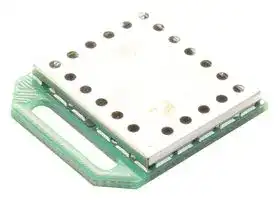


SC14CVMDECT SF02T
Cordless Intercom Module, 54Kbps, 1.93 GHz, -92dBm, 2.1V to 3.42V Supply, UART
- Manufacturer: RENESAS
- Product type: RF Transceivers - Sub 2.4GHz ISM Band
- Data Rate Max: 54Kbps
- Frequency Max: 1.93GHz
- Supply Current: 47mA
- Transmit Power: 23dBm
- Sensitivity dBm: -92dBm
- Module Interface: UART
- Supply Voltage Max: 2.1V
- Supply Voltage Min: 3.45V
- RF Transceiver Applications: Cordless Intercom, Baby Monitor, Wireless Data Applications
| Delivery and price | |
|---|---|
| Units per pack | 50 |
| Price | 14.88 € |
| Current stock | 1000+ |
| Lead time | 7 days |

**FINAL**
## **SC14CVMDECT SF**
## **Cordless Voice Module**
## **General description**
The SC14CVMDECT SF is a member of the Cordless Module family with integrated radio transceiver and baseband processor in a single package. It is designed for hosted and embedded cordless voice and data applications in the DECT frequency band. Its simple to use API commands allow easy setup of a wireless link between two or more nodes.
## **Features**
- Supports EU-DECT (CAT-iq V2.0, v3.0 partly), DECT6.0 for North America and Japan DECT
- ETSI (EU-DECT) and FCC (DECT 6.0) certified
- Receiver sensitivity < -93 dBm
- Transmit power
- EU: 23 dBm: 1881 MHz - 1897 MHz
- USA: 20 dBm: 1921 MHz - 1928 MHz
- JP: 23 dBm: 1895 MHz - 1903 MHz
- Antenna embedded, supports external antennas
- Contains both PP and FP functionality
- Program memory available for custom software
- Supports both internal and external (hosted) applications
- Power supply voltage: 2.1 V to 3.45 V
- Supports NiMH and Alkaline batteries
- Small form factor (19.6 mm x 18.0 mm x 2.7 mm)
- Operating temperature range: -40 °C to +85 °C
- J-DECT pre-certified
- ETSI 300 444 (DECT GAP) compliant
- Up to 64 Portable Parts or ULE devices registered per Fixed Part
- UART interface to external host
- Controllable via API command set
- Supports voice and data
## **Applications**
- Cordless intercom
- Cordless baby monitor
- Wireless data applications up to 54 kbit/s
- FP supports ULE sensors and actuators
- RF range: 1870 MHz to 1930 MHz
## **________________________________________________________________________________________________**
## **System diagram**
**==> picture [422 x 214] intentionally omitted <==**
**----- Start of picture text -----**<br>
US/EU/JP [*]<br>DECT<br>Voice + data<br>Voice + data: 32 kbit/s + 1.6 kbit/s Host SC14CVMDECT<br>Data: 54 kbit/s Data<br>Portable Part 0<br>Voice<br>Host SC14CVMDECT<br>Data Voice + data<br>Host SC14CVMDECT<br><= > Fixed Part we «><br>Data<br>* Portable Part 1<br>= |<br>Our |<br>Voice + data<br>* Only end-products Host SC14CVMDECT<br>can be CAT-iq certified<br>Data<br>Portable Part 5<br>**----- End of picture text -----**<br>
**Revision 3.0**
**28-Jul-2015**
**Datasheet**
CFR0011-120-00-FM Rev 5
1 of 57
© 2013 Dialog Semiconductor
**SC14CVMDECT SF**
**FINAL**
## **Cordless Voice Module**
## **Table of Contents**
||**Table of Contents**|
|---|---|
|**1.0 **|**Connection diagram. . . . . . . . . . . . . . . . . . . . . . . . 4**|
||1.1 PIN DESCRIPTION. . . . . . . . . . . . . . . . . . . . . . 5|
|**2.0 **|**Introduction . . . . . . . . . . . . . . . . . . . . . . . . . . . . . . 8**|
||2.1 SCOPE . . . . . . . . . . . . . . . . . . . . . . . . . . . . . . . 8|
||2.2 REFERENCES . . . . . . . . . . . . . . . . . . . . . . . . . 8|
||2.3 GLOSSARY AND DEFINITIONS . . . . . . . . . . . 8|
|**3.0 **|**Cordless Voice Module functions. . . . . . . . . . . . 10**|
||3.1 MODULE HARDWARE . . . . . . . . . . . . . . . . . . 10|
||3.2 SOFTWARE CONTROL . . . . . . . . . . . . . . . . . 10|
||3.3 DECT PROTOCOL STACK. . . . . . . . . . . . . . . 10|
||3.4 PORTABLE PART CONFIGURATION . . . . . . .11|
||3.5 FIXED PART CONFIGURATION . . . . . . . . . . .11|
||3.6 VOICE COMMUNICATION . . . . . . . . . . . . . . . 12|
||3.7 LIGHT DATA APPLICATION. . . . . . . . . . . . . . 12|
||3.8 LU10 DATA APPLICATION. . . . . . . . . . . . . . . 12|
||3.9 GENERAL FEATURES . . . . . . . . . . . . . . . . . . 14|
|**4.0 **|**Functional description. . . . . . . . . . . . . . . . . . . . . 15**|
||4.1 UART INTERFACE . . . . . . . . . . . . . . . . . . . . . 15|
||4.2 VES (VIRTUAL EEPROM STORAGE) . . . . . . 15|
||4.2.1 VES layout . . . . . . . . . . . . . . . . . . . . . . . 15|
||4.2.2 VES access by MCU . . . . . . . . . . . . . . . 15|
||4.3 AUDIO CONFIGURATIONS . . . . . . . . . . . . . . 15|
||4.3.1 Audio connection . . . . . . . . . . . . . . . . . . 16|
||4.4 AUDIO ROUTING . . . . . . . . . . . . . . . . . . . . . . 16|
||4.4.1 FP audio routing . . . . . . . . . . . . . . . . . . 17|
||4.4.2 FP audio level adjustment . . . . . . . . . . . 17|
||4.4.3 PP audio routing . . . . . . . . . . . . . . . . . . 17|
||4.4.4 PP audio codec adjustment . . . . . . . . . . 17|
||4.4.5 General audio adjustment . . . . . . . . . . . 17|
||4.4.6 PP volume . . . . . . . . . . . . . . . . . . . . . . . 17|
||4.4.7 PP audio equalization . . . . . . . . . . . . . . 17|
||4.5 PP AUDIO MODES . . . . . . . . . . . . . . . . . . . . . 19|
||4.5.1 Power management. . . . . . . . . . . . . . . . 19|
||4.5.2 Earpiece mode. . . . . . . . . . . . . . . . . . . . 20|
||4.5.3 Alert mode . . . . . . . . . . . . . . . . . . . . . . . 20|
||4.6 CALL HANDLING . . . . . . . . . . . . . . . . . . . . . . 20|
||4.6.1 FP to PP call . . . . . . . . . . . . . . . . . . . . . 20|
||4.6.2 PP to FP call . . . . . . . . . . . . . . . . . . . . . 20|
||4.6.3 Intercom. . . . . . . . . . . . . . . . . . . . . . . . . 20|
||4.6.4 Conference . . . . . . . . . . . . . . . . . . . . . . 20|
||4.6.5 Page call . . . . . . . . . . . . . . . . . . . . . . . . 20|
||4.7 TONE/MELODY HANDLING . . . . . . . . . . . . . . 20|
||4.8 DATE AND REAL-TIME CLOCK. . . . . . . . . . . 20|
||4.9 BATTERY MANAGEMENT . . . . . . . . . . . . . . . 21|
|---|---|
||4.10 PROTOCOL STACK . . . . . . . . . . . . . . . . . . . 21|
||4.10.1 DECT TBR22. . . . . . . . . . . . . . . . . . . . 21|
||4.10.2 Out-of-Range handling. . . . . . . . . . . . . 22|
||4.10.3 Preamble antenna diversity . . . . . . . . . 22|
||4.10.4 Broadcasting messages. . . . . . . . . . . . 22|
||4.10.5 IWU to IWU messaging . . . . . . . . . . . . 22|
||4.11 REGISTRATION . . . . . . . . . . . . . . . . . . . . . . 22|
||4.11.1 Handling product identities. . . . . . . . . . 22|
||4.11.2 Deregistration. . . . . . . . . . . . . . . . . . . . 23|
||4.12 PCM INTERFACE . . . . . . . . . . . . . . . . . . . . . 23|
||4.12.1 PCM Interface for FP . . . . . . . . . . . . . . 23|
||4.12.2 PCM_FSC frequency. . . . . . . . . . . . . . 23|
||4.12.3 Length of PCM_FSC . . . . . . . . . . . . . . 23|
||4.12.4 Start position of FSC . . . . . . . . . . . . . . 23|
||4.12.5 PCM clock frequency. . . . . . . . . . . . . . 23|
||4.12.6 PCM data mode. . . . . . . . . . . . . . . . . . 24|
||4.12.7 PCM Interface for PP. . . . . . . . . . . . . . 27|
||4.13 ANTENNA OPERATION . . . . . . . . . . . . . . . . 27|
||4.13.1 Internal antenna only . . . . . . . . . . . . . . 28|
||4.13.2 Internal and external antenna with FAD 28|
|**5.0 **|**CAT-iq . . . . . . . . . . . . . . . . . . . . . . . . . . . . . . . . . . 29**|
||5.1 INTRODUCTION. . . . . . . . . . . . . . . . . . . . . . . 29|
||5.2 CAT-IQ PROFILE OVERVIEW . . . . . . . . . . . . 29|
||5.2.1 Supported main features . . . . . . . . . . . . 29|
|**6.0 **|**Register descriptions. . . . . . . . . . . . . . . . . . . . . . 30**|
|**7.0 **|**Specifications. . . . . . . . . . . . . . . . . . . . . . . . . . . . 36**|
||7.1 GENERAL . . . . . . . . . . . . . . . . . . . . . . . . . . . . 36|
||7.2 ABSOLUTE MAXIMUM RATINGS . . . . . . . . . 36|
||7.3 OPERATING CONDITIONS . . . . . . . . . . . . . . 36|
||7.4 SUPPLY CURRENTS . . . . . . . . . . . . . . . . . . . 37|
||7.5 DIGITAL INPUT/OUTPUT PINS . . . . . . . . . . . 38|
||7.6 ANALOG FRONT END . . . . . . . . . . . . . . . . . . 39|
||7.7 BATTERY MANAGEMENT . . . . . . . . . . . . . . . 43|
||7.8 BASEBAND PART . . . . . . . . . . . . . . . . . . . . . 43|
||7.9 RADIO (RF) PART . . . . . . . . . . . . . . . . . . . . . 44|
||7.10 RF POWER SUPPLY . . . . . . . . . . . . . . . . . . 45|
||7.11 RF CHANNEL FREQUENCIES. . . . . . . . . . . 46|
|**8.0 **|**Design guidelines. . . . . . . . . . . . . . . . . . . . . . . . . 47**|
||8.1 APPLICATION SOFTWARE FOR PP . . . . . . 47|
||8.2 APPLICATION SOFTWARE FOR FP . . . . . . 47|
||8.3 HARDWARE DESIGN GUIDELINES . . . . . . . 47|
||8.3.1 Circuit design guidelines . . . . . . . . . . . . 47|
**Revision 3.0**
**28-Jul-2015**
**Datasheet**
CFR0011-120-00-FM Rev 5
2 of 57
© 2013 Dialog Semiconductor
**SC14CVMDECT SF**
**FINAL**
## **Cordless Voice Module**
## **Table of Contents**
**==> picture [219 x 345] intentionally omitted <==**
**----- Start of picture text -----**<br>
|||
|---|---|
|8.3.2|PCB Design Guidelines . . . . . . . . . . . . . 48|
|8.4|MODULE PLACEMENT ON THE MAIN BOARD|
|. . . . . . . . . . . . . . . . . . . . . . . . . . . . . . . . . . . 49|
|8.5|PATTERN FOR PIN 79 ON THE MAIN BOARD|
|. . . . . . . . . . . . . . . . . . . . . . . . . . . . . . . . . . . 49|
|8.6|PRECAUTIONS REGARDING UNINTENDED|
|COUPLING . . . . . . . . . . . . . . . . . . . . . . . . . . . 49|
|9.0|Example application diagram . . . . . . . . . . . . . . . 50|
|10.0|Notices to OEM. . . . . . . . . . . . . . . . . . . . . . . . . . 51|
|10.1|FCC REQUIREMENTS REGARDING THE END|
|PRODUCT AND THE END USER. . . . . . . . . . 51|
|10.2|INDUSTRY CANADA REQUIREMENTS RE-|
|GARDING THE END PRODUCT AND THE END|
|USER . . . . . . . . . . . . . . . . . . . . . . . . . . . . . . . 51|
|10.3|END APPLICATION APPROVAL . . . . . . . . . 52|
|10.4|SAFETY REQUIREMENTS. . . . . . . . . . . . . . 52|
|11.0|Package information . . . . . . . . . . . . . . . . . . . . . 53|
|11.1|SOLDERING PROFILE . . . . . . . . . . . . . . . . . 53|
|11.2|MOISTURE SENSITIVITY LEVEL (MSL) . . . 53|
|11.3|COPPER PAD, SOLDER OPENING AND|
|STENCIL . . . . . . . . . . . . . . . . . . . . . . . . . . . . . 54|
|11.4|MECHANICAL DIMENSIONS . . . . . . . . . . . . 56|
|12.0|Revision history . . . . . . . . . . . . . . . . . . . . . . . . . 57|
**----- End of picture text -----**<br>
**Revision 3.0**
**28-Jul-2015**
**Datasheet**
CFR0011-120-00-FM Rev 5
3 of 57
© 2013 Dialog Semiconductor
**FINAL**
## **SC14CVMDECT SF**
## **Cordless Voice Module**
## **1.0 Connection diagram**
**==> picture [395 x 360] intentionally omitted <==**
**----- Start of picture text -----**<br>
L] 79 TP1<br>GND 1 78 GND<br>| | |<br>P0 2 77 GND<br>81<br>RFP0 FL 3 oo = 76 GND<br>P0n oa 4 82 = 75 RF0<br>| | |<br>RFP0n 5 74 GND<br>| | |<br>GND | 6 |_| 73 RF1<br>VREFp | 7 |_| 72 GND<br>MICp/CIDINn | 8 |_| 71 GND<br>MICn/CIDOUT 9 70 GND<br>| | |<br>MICh/LINEIN 10 69 PARADET/P3[4]<br>| | |<br>VREFm 11 68 RINGOUT/RINGING/P3[5]<br>LSRp/LINEOUT/AGND 12 67 RINGn/P3[6]<br>=<br>LSRn/LINEOUT/AGND | 13 GND80 66 RINGp/P3[7]<br>GND 14 65 CIDINp/P3[2]<br>= a |-|<br>ADC0/P3[3] | 15 |_| 64 VBATIN<br>ADC1/INT0/P1[0] | 16 |_| 63 VBATIN<br>SOCp | 17 |_| 62 VBATSW<br>SOCn 18 61 VDDOUT<br>| | |<br>DC_SENSE 19 60 GND<br>| | |<br>DC_I | 20 |_| 59 P2[0]/ECZ1/PWM0/LED3<br>DC_CTRL | 21 |_| 58 P2[1]/ECZ2/PWM1/LED4<br>CHARGE_CTRL 22 57 CLK100/P2[2]/PCM_CLK<br>CHARGE/P1[7] 23 56 DP2/P2[3]/SDA1/PCM_DI<br>DP1/PAOUTp/P3[1] 24 55 DP3/P2[4]/SCL1/PCM_DO<br>VDDPA = 25 920 54 SF/P2[5]/PCM_FSC<br>CP_VOUT1 26 53 JTAG<br>DP0/PAOUTn/P3[0] 27 52 RSTn<br>= U E<br>PEELE [LELELEEELLLLLELELL] LI<br>85 87<br>83 88<br>84 86<br>28 29 30 31 32 33 34 35 36 37 38 39 40 41 42 43 44 45 46 47 48 49 50 51<br>GND PON/P1[6] ULP_XTAL ULP_PORT BXTAL/INT7/P2[7] VDDE/RDI/INT5/P1[5] TDOD/INT4/P1[4] SIO/INT3/P1[3] SK/INT2/P1[2] LE/INT1/P1[1] GND WTF_IN/P2[6] P0[7]/PWM1SPI_DI P0[6]/SPI_DO P0[5]/SPI_CLK P0[4]/SPI_EN P0[3]/SCL2/URX2 GND P0[2]/SDA2/UTX2 P0[1]/PWM0/URX P0[0]/UTX GND GND GND<br>**----- End of picture text -----**<br>
**Figure 1: Connection diagram (top view, leads face down)**
**Table 1: Ordering information**
|**Part number**|**Package**|**Size (mm)**|**Shipment form**|**Pack quantity**|
|---|---|---|---|---|
|SC14CVMDECT SF01T<br>**(Note 2)**|MOD88|18 x 19.6|Tray|60**(Note 1)**|
|SC14CVMDECT SF02T<br>**(Note 3)**|MOD88|18 x 19.6|Tray|60**(Note 1)**|
**Note 1:** MOQ = 600 pcs.
**Note 2:** Up to 6 PPs can be registered.
**Note 3:** Up to 64 PPs can be registered.
**Revision 3.0**
**28-Jul-2015**
**Datasheet**
CFR0011-120-00-FM Rev 5
4 of 57
© 2013 Dialog Semiconductor
**SC14CVMDECT SF**
**FINAL**
## **Cordless Voice Module**
## **1.1 PIN DESCRIPTION**
**Table 2: Pin description**
|**Pin**<br>~~fot~~|**Module**<br>**Pin name**<br>**(Note 4)**<br>~~fot~~|**In/**<br>**Out**<br>~~fot tp~~|**Iout**<br>**Drive**<br>**(mA)**<br>~~tp~~|**Reset**<br>**State**<br>**(Note 5)**<br>~~tp~~|**Description**|
|---|---|---|---|---|---|
|1<br>~~fot~~<br>~~a~~|GND<br>~~fot~~<br>~~es~~|-<br>~~fot tp~~<br>~~es Re~~|-<br>~~tp~~<br>~~Re es~~|-<br>~~tp~~<br>~~es~~|Ground|
|2<br>~~fot~~<br>~~a~~|P0<br>~~fot~~<br>~~es~~|O<br>~~fot tp~~<br>~~es Re~~|8<br>~~tp~~<br>~~Re es~~|Hi-Z<br>~~tp~~<br>~~es~~|Control port for FAD. See4.13|
|3<br>~~a~~<br>~~—————~~|RFP0<br>~~es ~~<br>~~—————~~|O<br> ~~es Re~~<br>~~—————~~|8<br>~~Re es~~<br>~~—————~~|Hi-Z<br>~~es~~<br>~~—————~~|Control port for FAD. See4.13<br>~~—————~~|
|4<br>~~—————~~|P0n<br>~~—————~~|O<br>~~—————~~|8<br>~~—————~~|Hi-Z<br>~~—————~~|Control port for FAD. See4.13<br>~~—————~~|
|5<br>~~—————~~|RFP0n<br>~~—————~~|O<br>~~—————~~|8<br>~~—————~~|Hi-Z<br>~~—————~~|Control port for FAD. See4.13<br>~~—————~~|
|6|GND|-|-|-|Ground|
|7<br>~~————~~|VREFp<br>~~————~~|O<br>~~————~~|-<br>~~————~~|I<br>~~————~~|Positive microphone supply voltage<br>~~————~~|
|8<br>~~————~~|MICp<br>~~————~~|I<br>~~————~~|-<br>~~————~~|I<br>~~————~~|Positive microphone input<br>~~————~~|
|9<br>~~SE~~|MICn<br>~~SE~~|I<br>~~SE~~|-<br>~~SE~~|I<br>~~SE~~|Negative handset microphone input<br>~~SE~~|
|10<br>~~SE~~|MICh<br>~~SE~~|I<br>~~SE~~|-<br>~~SE~~|I<br>~~SE~~|Headset microphone input with fixed input protection<br>~~SE~~|
|11<br>~~SE~~|VREFm<br>~~SE~~|-<br>~~SE~~|-<br>~~SE~~|-<br>~~SE~~|Negative microphone reference (star point), connect to GND.<br>~~SE~~|
|12<br>~~SE~~|LSRp<br>~~SE~~|O<br>~~SE~~|-<br>~~SE~~|O<br>~~SE~~|Positive loudspeaker output<br>~~SE~~|
|13<br>~~—————~~|LSRn<br>~~—————~~|O<br>~~—————~~|-<br>~~—————~~|O<br>~~—————~~|Negative loudspeaker output<br>~~—————~~|
|14<br>~~—————~~|GND<br>~~—————~~|-<br>~~—————~~|-<br>~~—————~~|-<br>~~—————~~|Ground<br>~~—————~~|
|15<br>~~—————~~<br>~~—————~~|P3[3]<br>~~—————~~<br>~~—————~~|IO<br>~~—————~~<br>~~—————~~|8<br>~~—————~~<br>~~—————~~|I<br>~~—————~~<br>~~—————~~|I/O Port<br>~~—————~~<br>~~—————~~|
|16<br>~~—————~~|P1[0]<br>~~—————~~|IO<br>~~—————~~|2<br>~~—————~~|I-PU<br>~~—————~~|I/O Port<br>~~—————~~|
|17<br>~~—————~~<br>~~TOTTI~~|SOCp<br>~~—————~~<br>~~TOTTI~~|I<br>~~—————~~<br>~~TOTTI~~|-<br>~~—————~~<br>~~TOTTI~~|I<br>~~—————~~<br>~~TOTTI~~|Battery state of charge positive input.<br>Connect to GND if not used. See4.9<br>~~—————~~<br>~~TOTTI~~|
|18<br>~~TOTTI~~<br>~~TTI~~<br>~~a~~|SOCn<br>~~TOTTI~~<br>~~TTI~~<br>~~es~~|I<br>~~TOTTI~~<br>~~TTI~~<br>~~rs i~~|-<br>~~TOTTI~~<br>~~TTI~~<br>~~i~~|I<br>~~TOTTI~~<br>~~TTI~~<br>~~Ss~~|Battery state of charge negative input. Star point connected to the<br>SOC resistor. Connect to GND if not used. See4.9<br>~~TOTTI~~<br>~~TTI~~|
|19<br>~~a~~<br>~~TTT~~|DC_SENSE<br>~~es~~<br>~~TTT TIT~~|I<br>~~rs i~~<br>~~TIT~~|~~i~~<br>~~TIT~~|I<br>~~Ss~~<br>~~TIT~~|Voltage sense input. Connect to GND if not used.<br>~~TIT~~|
|20<br>~~a~~<br>~~TTT~~<br>~~a~~|DC_I<br>~~es ~~<br>~~TTT TIT~~<br>~~es~~|I<br> ~~rs i~~<br>~~TIT~~<br>~~i~~|~~i ~~<br>~~TIT~~<br>~~Re~~|I<br> ~~Ss~~<br>~~TIT~~<br>~~ts~~|Current sense input of DC/DC converter. Connect to GND if not<br>used<br>~~TIT~~|
|21<br>~~TTT~~<br>~~a~~|DC_CTRL<br>~~TTT TIT~~<br>~~es~~|O<br>~~TIT~~<br>~~i~~|2<br>~~TIT~~<br>~~Re~~|O-0<br>~~TIT~~<br>~~ts~~|Switching clock for the DC/DC converter.<br>~~TIT~~|
|22<br>~~a~~<br>~~TIT~~|CHARGE_CTRL<br>~~es ~~<br>~~TIT~~|O<br> ~~i ~~<br>~~TIT~~|1<br> ~~Re ~~<br>~~TIT~~|O-0<br> ~~ts~~<br>~~TIT~~|Charge control pin.<br>Leave unconnected if not used. See4.9<br>~~TIT~~|
|23<br>~~TIT~~|CHARGE<br>~~TIT~~|I<br>~~TIT~~|-<br>~~TIT~~|I-PD<br>(270k<br>fixed<br>pull-<br>down)<br>~~TIT~~|Charger connected indication. Switches on the device if voltage ><br>1.5 V. Must be connected to charger via resistor R ><br>(Vcharger_max-3 V)/10 mA (round to next largest value in range).<br>See4.9<br>~~TIT~~|
|24<br>~~TTT~~|PAOUTp<br>~~TTT TIT~~|IO<br>~~TIT~~|500<br>~~TIT~~|O-0 (5k<br>fixed<br>pull-<br>down)<br>~~TIT~~|CLASSD loudspeaker positive outputs<br>~~TIT~~|
|25<br>~~TTT~~|VDDPA<br>~~TTT TIT~~|I<br>~~TIT~~|-<br>~~TIT~~|-<br>~~TIT~~|CLASSD Audio Amplifier supply voltage up to 3.45 V.<br>GND or leave unconnected if CLASSD Audio Amplifier is not used.<br>~~TIT~~|
|26<br>~~TTT~~<br>~~TTI~~|CP_VOUT1<br>~~TTT TIT~~<br>~~TTI~~|O<br>~~TIT~~<br>~~TTI~~|-<br>~~TIT~~<br>~~TTI~~<br>~~tp~~|I<br>~~TIT~~<br>~~TTI~~<br>~~tp~~|Charge Pump Output 1.<br>A capacitor of 1F to GND is internally connected to this pin.<br>~~TIT~~<br>~~TTI~~<br>~~tp~~|
|27<br>~~fott~~|PAOUTn<br>~~fott~~|IO<br>~~fott~~|500<br>~~fott~~<br>~~tp~~|O-0 (5k<br>fixed<br>pull-<br>down)<br>~~fott~~<br>~~tp~~|CLASSD loudspeaker positive output<br>~~fott~~<br>~~tp~~|
|28<br>~~fott~~|GND<br>~~fott~~|-<br>~~fott~~|-<br>~~fott~~<br>~~tp~~|-<br>~~fott~~<br>~~tp~~|Ground<br>~~fott~~<br>~~tp~~|
**28-Jul-2015** © 2013 Dialog Semiconductor
**SC14CVMDECT SF**
**FINAL**
## **Cordless Voice Module**
**Table 2: Pin description (Continued)**
|**Pin**<br>~~et~~|**Module**<br>**Pin name**<br>**(Note 4)**<br>~~etott~~|**In/**<br>**Out**<br>~~ott~~|**Iout**<br>**Drive**<br>**(mA)**<br>~~ottEE~~|**Reset**<br>**State**<br>**(Note 5)**<br>~~EE~~|**Description**<br>~~EE~~|
|---|---|---|---|---|---|
|29<br>~~et~~|PON<br>~~et ott~~|I<br>~~ott~~|-<br>~~ott~~|I (270k<br>fixed<br>pull-<br>down)<br>|Power on, Switches on the device if Voltage > 1.5 V.<br>May be directly connected to VBAT, also with Li-Ion batteries.<br>After startup the software takes over then PON pin to keep the<br>device on after which the PON pin may be released.<br>|
|30|ULP_XTAL|I|-|I|32.768 kHz XTAL clock input. Connect to GND if not used.**(Note 6)**|
|31|ULP_PORT|I|-|I|Ultra Low Power Port Pin. Connect to GND if not used.**(Note 6)**|
|32|P2[7]|IO|8|I-PU|I/O port|
|33|P1[5]|IO|8|O-1|I/O Port|
|34|P1[4]|IO|1/2|I-PD|I/O port|
|35|P1[3]|IO|1/2|I-PD|I/O Port|
|36|P1[2]|IO|2|I-PD|I/O Port|
|37|P1[1]|IO|2|I-PU|I/O Port|
|38|GND|-|-|-|Ground|
|39|P2[6]|IO|2|I-PU|I/O port|
|40<br>~~TTT~~<br>~~Oe~~|P0[7] / SPI_DI<br>~~TTT~~|IO<br>~~TTT ~~<br>~~OO~~|8<br> ~~IL~~<br>~~OO~~|I-PU<br>~~IL~~<br>~~OO~~|I/O Port<br>SPI Data Input<br>~~IL~~|
|41<br>~~Oe~~<br>~~Oe~~|P0[6] / SPI_DO|IO<br>~~OO~~<br>~~OO~~|8<br>~~OO~~<br>~~OO~~|I-PU<br>~~OO~~<br>~~OO~~|I/O Port<br>SPI Data Out|
|42<br>~~Oe~~<br>~~Oe~~|P0[5] / SPI_CLK|IO<br>~~OO~~<br>~~OO~~|8<br>~~OO~~<br>~~OO~~|I-PU<br>~~OO~~<br>~~OO~~|I/O Port<br>SPI Clock|
|43<br>~~Oe~~<br>~~TTI~~|P0[4] / SPI_EN<br>~~TTI~~|IO<br>~~OO~~<br>~~TTI~~|8<br>~~OO~~<br>~~TTI~~|I-PU<br>~~OO~~<br>~~TTI~~|I/O port<br>SPI_EN: Active low.<br>~~TTI~~|
|44<br>~~ToT~~<br>~~a~~|P0[3] / SCL2 /<br>URX2<br>~~ToT~~<br>~~es~~|IO<br>~~ToT~~<br>~~es Pe~~|8<br>~~ToT~~<br>~~Pe Ss~~|I-PU<br>~~ToT~~<br>~~Ss~~|I/O port<br>Access bus clock, UART Serial In.<br>~~ToT~~|
|45<br>~~a~~|GND<br>~~es~~|-<br>~~es Pe~~|-<br>~~Pe Ss~~|-<br>~~Ss~~|Ground|
|46<br>~~a~~<br>~~OO~~|P0[2] / SDA2 /<br>UTX2<br>~~es ~~<br>~~OO~~|IO<br> ~~es Pe~~|8<br>~~Pe Ss~~|I-PU<br>~~Ss~~|I/O port<br>Access bus data, UART Serial Out.|
|47<br>~~TTI~~|P0[1] / URX<br>~~TTI~~|IO<br>~~TTI~~|8<br>~~TTI~~|I-PD<br>(10k)<br>~~TTI~~|I/O port<br>UART Serial In<br>~~TTI~~|
|48<br>~~ToT~~<br>~~a~~|P0[0] / UTX<br>~~ToT~~<br>~~es~~|O<br>~~ToT~~<br>~~es i~~|8<br>~~ToT~~<br>~~i~~|I-PU<br>~~ToT~~<br>~~Ss~~|I/O Port<br>UART Serial Out<br>~~ToT~~|
|49<br>~~a~~|GND<br>~~es~~|-<br>~~es i~~|-<br>~~i~~|-<br>~~Ss~~|Ground|
|50<br>~~a~~|GND<br>~~es ~~|-<br> ~~es i~~|-<br>~~i ~~|-<br> ~~Ss~~|Ground|
|51<br>~~ee~~|GND<br>~~ee~~|-<br>~~ee~~|-<br>~~ee~~|-<br>~~ee~~|Ground<br>~~ee~~|
|52<br>~~ee~~|RSTn<br>~~ee~~|I<br>~~ee~~|1<br>~~ee~~|I-PU<br>(200k)<br>~~ee~~|Active low Reset input with Schmitt-trigger input, open-drain output.<br>Input may not exceed 2.0 V. An internal capacitor of 47 nF is<br>mounted on this pin.<br>~~ee~~|
|53<br>~~ee~~<br>~~ToT~~<br>~~Oe~~|JTAG<br>~~ee~~<br>~~ToT~~|IO<br>~~ee~~<br>~~ToT~~<br>~~OO~~|8<br>~~ee~~<br>~~ToT~~<br>~~OO~~|I-PU<br>(1k)<br>~~ee~~<br>~~ToT~~<br>~~OO~~|JTAG-SDI+; one wire Debug interface with open-drain.<br>~~ee~~<br>~~ToT~~|
|54<br>~~Oe~~<br>~~|~~|P2[5]/PCM_FSC<br>~~[tt~~|IO<br>~~OO~~<br>~~[tt~~|8<br>~~OO~~<br>~~[tt~~|I-PU<br>~~OO~~<br>~~[ttfoo~~|I/O Port<br>PCM_FSC: PCM Frame Sync<br>~~foo~~|
|55<br>~~Oe~~<br>~~|~~|P2[4]/SCL1/<br>PCM_DO<br>~~[tt~~|IO<br>~~OO~~<br>~~[tt~~|8<br>~~OO~~<br>~~[tt~~|I-PU<br>~~OO~~<br>~~[ttfoo~~|I/O port<br>SCL1; I2C clock<br>PCM_DO: PCM Data output<br>~~foo~~|
**Revision 3.0**
**28-Jul-2015**
**Datasheet**
CFR0011-120-00-FM Rev 5
6 of 57
© 2013 Dialog Semiconductor
**SC14CVMDECT SF**
**FINAL**
## **Cordless Voice Module**
**Table 2: Pin description (Continued)**
|**Pin**<br>~~FL~~<br>~~PL~~|**Module**<br>**Pin name**<br>**(Note 4)**<br>~~FLttt~~<br>~~PLott~~|**In/**<br>**Out**<br>~~ttt~~<br>~~ott~~|**Iout**<br>**Drive**<br>**(mA)**<br>~~ttt~~<br>~~ott~~<br>~~LE~~|**Reset**<br>**State**<br>**(Note 5)**<br>~~ttt~~<br>~~LE~~|**Description**<br>~~ttt~~|
|---|---|---|---|---|---|
|56<br>~~FL~~<br>~~PL~~|P2[3]/SDA1 /<br>PCM_DI<br>~~FL~~<br>~~PLott~~|IO<br><br>~~ott~~|8<br><br>~~ott~~<br>~~LE~~|I-PU<br><br>~~LE~~|I/O Port<br>SDA1: I2C Data<br>PCM_DI: PCM Data input<br>|
|57<br>~~PL~~<br>~~TPP~~|P2[2]/PCM_CLK<br>~~PL ott~~<br>~~TPP~~|I/O<br>~~ott~~<br>~~TPP~~|8<br>~~ott~~<br>~~LE~~<br>~~TPP~~|I-PD<br>~~LE~~<br>~~TPP~~|I/O Port<br>PCM_CLK: PCM clock input/output<br>~~TPP~~|
|58<br>~~i~~|P2[1] / PWM1 /<br>LED4<br>~~i ee~~|IO<br>~~ee~~|8<br>~~ee~~|I<br>~~ee~~|I/O Port<br>PWM1: Pulse Width Modulation output<br>LED4: 2.5 mA/5 mA LED current sink<br>~~ee~~|
|59<br>~~i~~<br>~~a~~|P2[0]/ PWM0 /<br>LED3<br>~~i ee~~<br>~~ss~~|IO<br>~~ee~~<br>~~ss ee~~|8<br>~~ee~~<br>~~ee~~|I<br>~~ee~~<br>~~es~~|I/O Port<br>PWM0: -<br>LED3: 2.5 mA/5 mA LED current sink<br>~~ee~~|
|60<br>~~a~~<br>~~a~~|GND<br>~~ss~~<br>~~ee~~|-<br>~~ss ee~~<br>~~es Ge~~|-<br>~~ee~~<br>~~Ge~~|-<br>~~es~~<br>~~ies~~|Ground<br>~~ee~~|
|61<br>~~a~~<br>~~a~~<br>~~a~~|VDDOUT<br>~~ss~~<br>~~ee~~<br>~~es~~|-<br>~~ss ee~~<br>~~es Ge~~<br>~~es~~|-<br>~~ee~~<br>~~Ge~~<br>~~es es~~|-<br>~~es~~<br>~~ies~~<br>~~es~~|Test purpose only. Must be left unconnected.<br>~~ee~~|
|62<br>~~a~~<br>~~a~~<br>~~a~~|VBATSW<br>~~ee ~~<br>~~es~~<br>~~ee~~|~~es Ge~~<br>~~es~~<br>~~ee~~|~~Ge~~<br>~~es es~~<br>~~ee~~|~~ies~~<br>~~es~~<br>~~es~~|Test purpose only. Must be left unconnected.<br>~~ee~~|
|63<br>~~a~~<br>~~a~~<br>~~a~~|VBATIN<br>~~es~~<br>~~ee~~<br>~~ee~~|I<br>~~es ~~<br>~~ee~~<br>~~ee~~|-<br> ~~es es~~<br>~~ee~~<br>~~ee~~|-<br>~~es~~<br>~~es~~<br>~~es~~|Main supply voltage < 3.45 V.<br>~~ree~~|
|64<br>~~a~~<br>~~a~~<br>~~a~~|VBATIN<br>~~ee~~<br>~~ee~~<br>~~es~~|I<br>~~ee ~~<br>~~ee~~<br>~~es~~|-<br> ~~ee~~<br>~~ee~~<br>~~ee~~|-<br>~~es~~<br>~~es~~<br>~~es~~|Main supply voltage < 3.45 V.<br>~~ree~~<br>~~er~~|
|65<br>~~a~~<br>~~a~~<br>~~a~~|P3[2]<br>~~ee ~~<br>~~es~~<br>~~ee~~|IO<br> ~~ee ~~<br>~~es~~<br>~~es~~|8<br> ~~ee~~<br>~~ee~~<br>~~ee~~|I<br>~~es~~<br>~~es~~<br>~~es~~|I/O Port<br>~~ree~~<br>~~er~~<br>~~rere~~|
|66<br>~~a~~<br>~~a~~<br>~~a~~|P3[7]<br>~~es~~<br>~~ee~~<br>~~es~~|IO<br>~~es~~<br>~~es~~<br>~~es~~|4<br>~~ee~~<br>~~ee~~<br>~~es es~~|I<br>~~es~~<br>~~es~~<br>~~es~~|I/O Port<br>~~er~~<br>~~rere~~|
|67<br>~~a~~<br>~~a~~<br>~~a~~|P3[6]<br>~~ee ~~<br>~~es~~<br>~~ee~~|IO<br> ~~es ~~<br>~~es~~<br>~~es Ge~~|4<br> ~~ee~~<br>~~es es~~<br>~~Ge~~|I<br>~~es~~<br>~~es~~<br>~~ies~~|I/O Port<br>~~rere~~<br>~~ee~~|
|68<br>~~a~~<br>~~a~~<br>~~a~~|P3[5]<br>~~es~~<br>~~ee~~<br>~~ee~~|IO<br>~~es ~~<br>~~es Ge~~<br>~~es Ge~~|4<br> ~~es es~~<br>~~Ge~~<br>~~Ge~~|I<br>~~es~~<br>~~ies~~<br>~~es~~|I/O Port<br>~~ee~~<br>~~ee~~|
|69<br>~~a~~<br>~~a~~<br>~~a~~|P3[4]<br>~~ee ~~<br>~~ee~~<br>~~es~~|IO<br> ~~es Ge~~<br>~~es Ge~~<br>~~es~~|8<br>~~Ge~~<br>~~Ge~~<br>~~ee~~|I<br>~~ies~~<br>~~es~~<br>~~es~~|I/O Port<br>~~ee~~<br>~~ee~~|
|70<br>~~a~~<br>~~a~~<br>~~a~~|GND<br>~~ee~~<br>~~es~~<br>~~ee~~|-<br>~~es Ge~~<br>~~es~~<br>~~ee Ge~~|-<br>~~Ge~~<br>~~ee~~<br>~~Ge~~|-<br>~~es~~<br>~~es~~<br>~~rs~~|Ground<br>~~ee~~<br>~~ene~~|
|71<br>~~a~~<br>~~a~~<br>~~a~~|GND<br>~~es~~<br>~~ee~~<br>~~ss~~|-<br>~~es ~~<br>~~ee Ge~~<br>~~ss ee~~|-<br> ~~ee~~<br>~~Ge~~<br>~~ee~~|-<br>~~es~~<br>~~rs~~<br>~~es~~|Ground<br>~~ene~~|
|72<br>~~a~~<br>~~a~~<br>~~a~~|GND<br>~~ee~~<br>~~ss~~<br>~~ee~~|-<br>~~ee Ge~~<br>~~ss ee~~<br>~~es Ge~~|-<br>~~Ge~~<br>~~ee~~<br>~~Ge~~|-<br>~~rs~~<br>~~es~~<br>~~ies~~|Ground<br>~~ene~~<br>~~ee~~|
|73<br>~~a~~<br>~~a~~<br>~~a~~|RF1<br>~~ss~~<br>~~ee~~<br>~~es~~|-<br>~~ss ee~~<br>~~es Ge~~<br>~~es~~|-<br>~~ee~~<br>~~Ge~~<br>~~es es~~|-<br>~~es~~<br>~~ies~~<br>~~es~~|RF signal for external antenna. See4.13<br>~~ee~~|
|74<br>~~a~~<br>~~a~~<br>~~a~~|GND<br>~~ee ~~<br>~~es~~<br>~~ee~~|-<br> ~~es Ge~~<br>~~es~~<br>~~ee~~|-<br>~~Ge~~<br>~~es es~~<br>~~ee~~|-<br>~~ies~~<br>~~es~~<br>~~es~~|Ground<br>~~ee~~|
|75<br>~~a~~<br>~~a~~<br>~~a~~|RF0<br>~~es~~<br>~~ee~~<br>~~ee~~|-<br>~~es ~~<br>~~ee~~<br>~~ee Ge~~|-<br> ~~es es~~<br>~~ee~~<br>~~Ge~~|-<br>~~es~~<br>~~es~~<br>~~rs~~|RF signal for external antenna. See4.13<br>~~eee~~|
|76<br>~~a~~<br>~~a~~<br>~~a~~|GND<br>~~ee~~<br>~~ee~~|-<br>~~ee ~~<br>~~ee Ge~~|-<br> ~~ee~~<br>~~Ge~~|-<br>~~es~~<br>~~rs~~<br>~~es~~|Ground<br>~~eee~~|
|77<br>~~a~~<br>~~eee~~<br>~~a~~<br>~~a~~|GND<br>~~ee ~~<br>~~eee~~<br>~~ee~~|-<br> ~~ee Ge~~<br>~~eee~~<br>~~es~~|-<br>~~Ge ~~<br>~~eee~~<br>~~ee~~|-<br> ~~rs~~<br>~~eee~~<br>~~es~~<br>~~es~~|Ground<br>~~eee~~<br>~~eee~~<br>~~rere~~|
|78<br>~~a~~<br>~~a~~<br>~~a~~|GND<br>~~ee~~<br>~~es~~|-<br>~~es~~<br>~~es~~|-<br>~~ee~~<br>~~es es~~|-<br>~~es~~<br>~~es~~<br>~~es~~|Ground<br>~~rere~~|
|79<br>~~a~~<br>~~a~~<br>~~a~~|TP1<br>~~ee ~~<br>~~es~~<br>~~**e**e~~|-<br> ~~es ~~<br>~~es~~<br>~~**e**s Ge~~|-<br> ~~ee ~~<br>~~es es~~<br>~~Ge~~|-<br> ~~es~~<br>~~es~~<br>~~ies~~|Tuning point for internal antenna. Follow instructions of Section8.5.<br>~~rere~~<br>~~ee~~|
|80<br>~~a~~<br>~~a~~|GND<br>~~es ~~<br>~~**e**e~~<br>~~s~~|-<br> ~~es ~~<br>~~**e**s Ge~~<br>~~e~~|-<br> ~~es es~~<br>~~Ge~~<br>~~re~~|-<br>~~es~~<br>~~ies~~<br>~~ns~~|Ground<br>~~ee~~|
|81-88 <br>~~a~~|TP2 to TP9<br>~~**e**e ~~<br>~~s~~|NC<br> ~~**e**s Ge~~<br>~~e~~|~~Ge~~<br>~~re~~|~~ies~~<br>~~ns~~|Must be left unconnected. See section8.3.2andFigure 36.<br>~~ee~~|
- **Note 4:** “NC” means: leave unconnected.
- “GND” means internally connected to the module ground plane. Every GND pin should be connected to the main PCB.ground plane.
- **Note 5:** All digital inputs have Schmitt trigger inputs. After reset all I/Os are set to input and all pull-up or pull-down resistors are enabled unless otherwise specified.
PU = Pull-up resistor enabled, PD = Pull-down resistor enabled, I = input,
- O = output, Hi-Z = high impedance, 1 = logic HIGH level, 0 = logic LOW level
Refer also to Px_DIR_REGs for INPUT/OUTPUT and Pull-up/Pull-down configurations
- **Note 6:** All ULP pins use snap-back devices as ESD protection, which (when triggered) have a holding voltage below the typical battery voltage. This means that the snap-back device of a ULP pin may remain conductive, when triggered while the pin is directly connected to the battery voltage. If any of the ULP pins are directly or indirectly electrically accessible on the outside of the application, system level ESD precautions must be taken to ensure that the snap-back device is not triggered while in active mode, to prevent the chip from being damaged.
**Revision 3.0**
**28-Jul-2015**
**Datasheet**
CFR0011-120-00-FM Rev 5
7 of 57
© 2013 Dialog Semiconductor
**FINAL**
## **SC14CVMDECT SF**
## **Cordless Voice Module**
## **2.0 Introduction**
## **2.1 SCOPE**
The SC14CVMDECT SF is a programmable DECT module for voice and data services. The internal software stack receives commands and data from the application, for instance to set up a link to other modules. The application software can be implemented on the module itself or on an external host processor. The internal FLASH provides user space where custom applications can be located.
The module converts analog signals to a digital stream, compresses/decompresses them according to the DECT standards and transmits/receives them over the air interface. The DECT protocol stack in each module supports both PP and FP functionality.
The embedded software running on the internal microcontroller (CR16) supports all protocol layers up to the network layer. The module can be controlled by software running on the internal controller as well as from an external controller via the UART.
## **2.2 REFERENCES**
1. CVM FP API Documentation package.
2. CVM PP API Documentation package.
3. Athena Eclipse User Manual, v1.02, Dialog Semiconductor, Cordless Software and Tools.
4. SC14CVMDECT EEPROM (VES) map for PP (NatalieV3PpCvm Eeprom_vXXXX.html).
5. AN-D-174, SC14480 Battery Management; using the State of Charge function, Application Note, Dialog Semiconductor.
6. AN-D-212, SC14CVMDECT_SFxx_DB External Antenna Design and Leveraging Modular Approval, Application Note, Dialog Semiconductor.
7. AN-D-222, SC14CVMDECT production pairing, Application Note, Dialog Semiconductor.
## **2.3 GLOSSARY AND DEFINITIONS**
AFE Analog Front End API Application Programming Interface Baby monitor Same as intercom but optionally voice activated CAT-iq Cordless Advanced Technology, Internet and Quality CODEC COder and DECoder CoLA Co-Located Application Conference Same as intercom, but including an external party CRC Cyclic Redundancy Check CVM Cordless Voice Module DECT Digital Enhanced Cordless Telephone
DSP Digital Signal Processor EMC Equipment Manufacturer’s Code ESD ElectroStatic Discharge FAD Fast Antenna Diversity FP Fixed Part GAP Generic Access Profile (DECT) GFSK Gaussian Frequency Shift Keying HPM High Power Mode Inband tones Tones played by the application itself and not from external e.g. line. Intercom Internal call between FP and PP(s) IPEI International Portable Equipment Identity (ETSI EN 300 175-6) IWU InterWorking Unit (ETSI EN 300 1751) LCD Liquid Crystal Display LDO Low Drop Out (regulator) LDR Low Data Rate LPM Low Power Mode MCU Micro Controller Unit MMI Man Machine Interface (keypad, LCD, buzzer, microphone, earpiece, etc.) NTP Normal Transmitted Power PAEC Perceptual Acoustic Echo Canceller PC Personal Computer, IBM compatible PCB Printed Circuit Board PP Portable Part PSTN Public Switched Telephone Network RF Radio Frequency RFPI Radio Fixed Part Identity (ETSI EN 300 175-6) RLR Receive Loudness Rating RSSI Radio Signal Strength Indication (ETSI EN 300 175-1) Sidetone Feedback of microphone signal to earpiece SLR Sending Loudness Rating SPI Serial Peripheral Interface Bus UART Universal Asynchronous Receiver and Transmitter ULE Ultra Low Energy VAD Voice Activity Detection VES Virtual EEPROM Storage Walkie Talkie Call between two PPs without an FP
**Revision 3.0**
**28-Jul-2015**
**Datasheet**
CFR0011-120-00-FM Rev 5
8 of 57
© 2013 Dialog Semiconductor
**SC14CVMDECT SF**
**FINAL**
## **Cordless Voice Module**
## **3.0 Cordless Voice Module functions**
This section describes the key functions and features supported by the SC14CVMDECT SF as shown in Figure 2.
**==> picture [279 x 279] intentionally omitted <==**
**----- Start of picture text -----**<br>
UART interface to host<br>API commands<br>FLASH User SW UART XTAL<br>Phoenix Host API<br>SPI<br>Protocol<br>DSP<br>Stack<br>Radio CODEC / PCM Ports<br>DECT RF Head Set PCM Port Port Pins<br>**----- End of picture text -----**<br>
**Figure 2: SC14CVMDECT SF functional overview**
## **3.1 MODULE HARDWARE**
The SC14CVMDECT SF internal hardware consists of:
- An internal microprocessor is running from FLASH and handles the API call coming from UART or embedded user software.
- A 4 kB VES (Virtual EEPROM Storage) used by the protocol stack and for user variables.
- A DSP for the audio signal processing like ADPCM voice compression towards the CODEC.
- A CODEC converts the analog signals to digital signals and vise versa.
- Input/Output ports which can be toggled high/low as an output or a high/low digital level can be read as an input.
- A 20.736 MHz XTAL. This crystal is automatically tuned by the PP module software for optimal radio performance.
- Voltage regulators convert the external supply voltage (VBAT) to stable supply voltages for the core and the I/Os.
- A DECT radio transceiver with a built-in antenna cir-
cuit. The antenna itself is integrated into the module, relieving the product designer from RF expertise.
- A full duplex UART for communication with an optional host processor.
## **3.2 SOFTWARE CONTROL**
The application software is written by the customer and has to manage the call control and also the MMI functions. The supported API software includes the Network layer that is defined in figure 1 of the EN300 1753 document, which describes the DECT protocol stack. Detailed functions and data flows, including some example sequences, can be found in document reference [1] for FP and [2] for PP.
The default configuration of the SC14CVMDECT SF module software is: US DECT, FP and CoLA enabled.
## **3.3 DECT PROTOCOL STACK**
The SC14CVMDECT SF internal protocol stack is based on the ETSI DECT specifications and is compliant with ETSI 300 444 (GAP).
The product supports up to 6 DECT GAP compliant PP units to one FP station.
**Revision 3.0**
**28-Jul-2015**
**Datasheet**
CFR0011-120-00-FM Rev 5
9 of 57
© 2013 Dialog Semiconductor
**SC14CVMDECT SF**
**FINAL**
## **Cordless Voice Module**
## **3.4 PORTABLE PART CONFIGURATION**
A Portable Part configuration with SC14CVMDECT SF requires additional external parts as shown in Figure 3.
.
**==> picture [196 x 95] intentionally omitted <==**
**----- Start of picture text -----**<br>
Ports PCM<br>Loudspeaker<br>UART<br>MCU SC14CVMDECT Earpiece (handset)<br>MIC (handset)<br>Headset<br>**----- End of picture text -----**<br>
**Figure 3: PP configuration**
Table 3 provides an overview of the supported interfaces for a portable part.
**Table 3: PP support overview**
|**Item**|**Supported**|**Remark**|
|---|---|---|
|Battery management|Yes|Supported by API|
|Keypad|No|On external MCU|
|Display|No|On external MCU|
|I/O Ports|Yes|All digital I/O port pins can be controlled by API|
|PCM interface|Yes|1x 16 bits serial I/O, PCM_FSC 8 kHz/16 kHz|
|UART|Yes|115.2 kbit/s, used for API-commands|
|Headset detection|Yes|Supported by API|
|LSR (Earpiece, headset)|Yes|Connected to LSRp and/or LSRn<br>supports single-end and differential**(Note 7)**|
|MIC (Earpiece, headset,<br>handsfree)|Yes|Connected to MICp and/or MICn and/or MICh<br>supports single-ended and differential**(Note 7)**|
|Handsfree speaker|Yes|Connected to PAOUTp/n**(Note 7)**|
|Radio|Yes|Integrated single antenna and support for external antenna(s)|
**Note 7:** AFE setting is configurable, refer to document [2].
**Revision 3.0**
**28-Jul-2015**
**Datasheet**
CFR0011-120-00-FM Rev 5
10 of 57
© 2013 Dialog Semiconductor
**SC14CVMDECT SF**
**FINAL**
## **Cordless Voice Module**
## **3.5 FIXED PART CONFIGURATION**
A Fixed Part configuration with SC14CVMDECT SF . requires additional external parts as shown in Figure 4.
**==> picture [196 x 137] intentionally omitted <==**
**----- Start of picture text -----**<br>
Ports PCM<br>Loudspeaker<br>UART<br>MCU SC14CVMDECT Earpiece (handset)<br>MIC (handset)<br>Headset<br>Supply |<br>Regulator<br>Le<br>**----- End of picture text -----**<br>
## **Figure 4: FP configuration**
Table 4 provides the overview of required and available interfaces for a basic or a feature rich cordless FP with the SC14CVMDECT SF. .
**Table 4: FP support overview**
|**Item**|**Supported**|**Remark**|
|---|---|---|
|Supply Regulator|No|Use external 3.3 V LDO|
|Keypad|No|On external MCU|
|Display|No|On external MCU|
|I/O Ports|Yes|All digital I/O port pins can be controlled via API|
|PCM interface|Yes|4x 16 bits serial I/O, PCM_FSC 8 kHz/16 kHz|
|UART|Yes|115.2 kbit/s, used for API-commands|
|Headset detection|No|Not supported by API|
|LSR (Earpiece, headset)|Yes|Connected to LSRp and/or LSRn<br>supports single-end and differential**(Note 8)**|
|MIC (Earpiece, headset,<br>handsfree)|Yes|Connected to MICp and/or MICn and/or MICh<br>supports single-end and differential**(Note 8)**|
|Handsfree speaker|Yes|Connected to PAOUTp/n**(Note 8)**|
|PSTN Line interface|No|Not supported by API|
|Radio|Yes|Integrated single antenna and support for external antenna(s)|
**Note 8:** AFE setting is configurable, refer to document [1].
**Revision 3.0**
**28-Jul-2015**
**Datasheet**
CFR0011-120-00-FM Rev 5
11 of 57
© 2013 Dialog Semiconductor
**SC14CVMDECT SF**
**FINAL**
## **Cordless Voice Module**
## **3.6 VOICE COMMUNICATION**
An FP supports up to 64 registered PPs, where 4 of these PPs can be in a call at the same time. Multiple simultaneous calls are supported. Supported voice codec is G.726 (32 kbit/s ADPCM) and G.722 (64 kbit/s ADPCM). See Figure 5.
## **3.8 LU10 DATA APPLICATION**
The SC14CVMDECT SF supports CAT-iq LU10 data transmission up to 54 kbit/s. Since LU10 data communication uses the B-Field it cannot be used in combination with voice communication. See Figure 6.
## **3.7 LIGHT DATA APPLICATION**
The SC14CVMDECT SF supports Low Data Rate (LDR) transmission up to 1.6 kbit/s with IWU to IWU messaging. The LDR can be used in combination with voice communication. See Figure 5.
**==> picture [321 x 453] intentionally omitted <==**
**----- Start of picture text -----**<br>
SC14CVMDECT<br>G.726 + 1.6 kbit/s<br>PP<br>SC14CVMDECT<br>G.722 + 1.6 kbit/s<br>FP<br>m e -<br>SC14CVMDECT<br>PP<br>S L<br>Figure 5: Voice and LDR data communication<br>SC14CVMDECT<br>G.722 + 1.6kbit/s<br>PP<br>SC14CVMDECT<br>54 kbit/s<br>FP<br>m e -<br>SC14CVMDECT<br>PP<br>S L<br>**----- End of picture text -----**<br>
**Figure 6: LU10 data application**
**Revision 3.0**
**28-Jul-2015**
**Datasheet**
CFR0011-120-00-FM Rev 5
12 of 57
© 2013 Dialog Semiconductor
**SC14CVMDECT SF**
**FINAL**
## **Cordless Voice Module**
## **3.9 GENERAL FEATURES**
**Table 5: Supported general features**
|**Functionality(Note 9)**<br>~~[|~~|**PP**<br>**support**<br>~~[|~~<br>~~|~~|**FP**<br>**support**<br>~~[|~~<br>~~|ltl...~~|**Remark**<br>~~[|~~<br>~~ltl...~~|
|---|---|---|---|
|**Call handling**<br>~~[|~~<br>~~| ltl...~~<br>~~ee~~||||
|Conferencing<br>~~ee~~<br>~~PO~~|-<br>~~ee~~<br>~~PO~~<br>~~en~~|Yes<br>~~ee~~<br>~~PO~~|Call between FP and 4x PP<br>~~ee~~<br>~~PO~~|
|Intercom<br>~~rn~~|Yes<br>~~rn~~<br>~~en~~|Yes<br>~~rn~~|Call between FP and 4x PP<br>~~rn~~|
|Walkie Talkie mode<br>~~rn~~<br>~~Po~~|Yes<br>~~rn~~<br>~~en~~<br>~~Po~~<br>~~nts~~|-<br>~~rn~~<br>~~Po~~<br>~~nts~~|Call between PP and PP without FP<br>~~rn~~<br>~~Po~~|
|Baby monitor<br>~~es~~|Yes<br>~~es~~<br>~~nts~~|-<br>~~es~~<br>~~nts~~|Voice Activated PP. See document reference [2]<br>~~es~~|
|Voice over PCM interface<br>~~es~~<br>~~es~~|Yes<br>~~es~~<br>~~nts~~<br>~~es~~|Yes<br>~~es~~<br>~~nts~~<br>~~es~~|-law (64 kbit/s), A-law (64 kbit/s), G.726 ADPCM<br>(32 kbit/s), G.722 ADPCM (64 kbit/s), Linear (128 kbit/s)<br>~~es~~<br>~~es~~|
|Call transfer<br>~~es~~<br>~~Po~~|Yes<br>~~es~~<br>~~Po~~<br>~~i~~|Yes<br>~~es~~<br>~~Po~~<br>~~ns~~|Transfer call between PPs on FP<br>~~es~~<br>~~Po~~|
|Page call<br>~~rs~~|Yes<br>~~rs~~<br>~~i~~|Yes<br>~~rs~~<br>~~ns~~|FP pages all PPs (PP locator)<br>~~rs~~|
|**Protocol**<br>~~rs~~<br>~~i~~<br>~~ns~~<br>~~en~~<br>~~rn~~||||
|Manual registration<br>~~rr~~|Yes<br>~~rr~~|Yes<br>~~rr~~<br>~~rn~~|~~rr~~|
|Wire registration<br>~~rr~~<br>~~Po~~|Yes<br>~~rr~~<br>~~Po~~|Yes<br>~~rr~~<br>~~rn~~<br>~~Po~~|See document reference [7]<br>~~rr~~<br>~~Po~~|
|Number of CVM PP registrations<br>per FP|-|Yes|1 to 6 for SF01|
||||1 to 64 for SF02**(Note 10)**|
|Number of ULE PP registrations<br>per FP<br>~~ee~~|-<br>~~ee~~|Yes<br>~~ee~~|1 to 180 for SF01<br>~~ee~~<br>~~ee~~|
||||1 to 64 for SF02**(Note 10)**<br>~~ee~~|
|**Audio and tone**<br>~~eee~~<br>~~Psnetnn~~||||
|Microphone mute<br>~~eee~~<br>~~ne~~|Yes<br>~~eee~~<br>~~ne~~<br>~~Ps~~|Yes<br>~~eee~~<br>~~ne~~<br>~~net~~|~~eee~~<br>~~ne~~<br>~~nn~~|
|Tone generation<br>~~PO~~|Yes<br>~~Ps ~~<br>~~PO~~|No<br> ~~net~~<br>~~PO~~<br>~~nnn St~~|Melody generator with 7 polyphonic tones<br>~~nn~~<br>~~PO~~<br>~~St~~|
|Audio Volume control<br>~~Res~~|Yes<br>~~Res~~|Yes<br>~~Res~~<br>~~nnn St~~|~~Res~~<br>~~St~~|
|Tone Volume control<br>~~Po~~|Yes<br>~~Po~~<br>~~nts~~|No<br>~~nnn St~~<br>~~Po~~<br>~~nts~~|~~St~~<br>~~Po~~|
|Headset support<br>~~es~~|Yes<br>~~es~~<br>~~nts~~|Yes<br>~~es~~<br>~~nts~~|~~es~~|
|Handsfree/Speakerphone<br>~~es~~<br>~~Po~~|Yes<br>~~es~~<br>~~nts~~<br>~~Po~~|No<br>~~es~~<br>~~nts~~<br>~~Po~~|~~es~~<br>~~Po~~|
|**General**<br>~~ee~~||||
|Real time clock<br>~~Pe~~|Yes<br>~~Pe~~<br>~~nts~~|Yes<br>~~Pe~~<br>~~nts~~|Accuracy depending directly on crystal<br>~~Pe~~|
|Real time clock synchronization<br>~~es~~|Yes<br>~~es~~<br>~~nts~~|Yes<br>~~es~~<br>~~nts~~|All PP clocks are kept in synchronization with the FP<br>~~es~~|
|SW EEPROM (VES) Storage<br>~~Po~~|Yes<br>~~nts~~<br>~~Po~~<br>~~nts~~|Yes<br>~~nts~~<br>~~Po~~<br>~~nts~~|Internal on module<br>~~Po~~|
|Battery Charge Management<br>~~es~~|Yes<br>~~es~~<br>~~nts~~<br>~~rs~~|No<br>~~es~~<br>~~nts~~<br>~~te~~|~~es~~|
|PSTN line interface support<br>~~ne~~|-<br>~~nts~~<br>~~ne~~<br>~~rs~~|No<br>~~nts~~<br>~~ne~~<br>~~te~~|PSTN software on request<br>~~ne~~|
|I/O port support<br>~~PO~~|Yes<br>~~rs ~~<br>~~PO~~<br>~~Ge~~|Yes<br> ~~te~~<br>~~PO~~<br>~~nr~~|~~PO~~|
|Port Interrupt support<br>~~rr~~|No<br>~~rr~~<br>~~Ge~~|No<br>~~rr~~<br>~~nr~~|~~rr~~|
|Automatic headset detection<br>~~Po~~|Yes<br>~~Ge~~<br>~~Po~~<br>~~nts~~|No<br>~~nr~~<br>~~Po~~<br>~~nts~~|~~Po~~|
|Low speed data<br>~~es~~|Yes<br>~~es~~<br>~~nts~~|Yes<br>~~es~~<br>~~nts~~|1.6 kbit/s<br>~~es~~|
|LU10 data channel<br>~~Po~~|Yes<br>~~nts~~<br>~~Po~~|Yes<br>~~nts~~<br>~~Po~~|54 kbit/s**(Note 11)**<br>~~Po~~|
|CAT-iq up to version 2.0, 3.0<br>~~Pe~~|Yes<br>~~Pe~~|Yes<br>~~Pe~~|~~Pe~~|
**Note 9:** These features can be supported by combined API commands in user software. **Note 10:** The number of PP registrations includes both CVMDECT PP and ULE PP devices. **Note 11:** SF02 supports one channel LU10 simultaneously.
**Revision 3.0**
**28-Jul-2015**
**Datasheet**
CFR0011-120-00-FM Rev 5
13 of 57
© 2013 Dialog Semiconductor
**FINAL**
## **SC14CVMDECT SF**
## **Cordless Voice Module**
## **4.0 Functional description**
The UART hardware interface uses only TX/RX (see Figure 7).
## **4.1 UART INTERFACE**
The UART is normally used for API commands, but can also be used for software upgrades and debugging.
The UART is a full duplex UART with frame type:
1 start bit, 8 data bits (LSB first), 1 stop bit, no parity, up to 115.2 kBd.
**==> picture [328 x 75] intentionally omitted <==**
**----- Start of picture text -----**<br>
TX (serial out), module pin 48<br>RX (serial in), module pin 47<br>SC14CVMDECT MCU<br>GND<br>**----- End of picture text -----**<br>
**Figure 7: UART hardware configuration**
**Caution:** All UART signals are 1.8 V, input max. 3.45 V (see Table 18, Table 21 and Table 22). An external V.24 line driver must be provided if the UART port of the module is connected to a standard V.24 device (±12 V). Connecting the module without a driver may damage the module.
## **4.2 VES (VIRTUAL EEPROM STORAGE)**
## **4.2.1 VES layout**
The SC14CVMDECT SF PP and FP include a 4 kB VES which is divided into two areas (see Table 6).
**Table 6: VES map**
|**Table 6: VES map**|||
|---|---|---|
|**VES space**|**Size**|**Usage**|
|SC14CVMDECT<br>SF|3.6 kB|Used for RF, audio,<br>battery, tone setup,<br>data base, etc.|
|User|0.4 kB|Can be used for<br>MMI applications<br>such as User infor-<br>mation.|
are used by the SC14CVMDECT SF software during execution.
The VES parameters are divided into two types:
- Factory type
- Normal type
The “factory” type is specific for the SC14CVMDECT SF and should only be set by production. The “factory” type parameters are either adjustments used by the baseband or the radio interface, or are used to set up the SC14CVMDECT SF into special modes. The “factory” type parameters will only be modified by changing the factory programmed default value. See document reference [4].
The “normal” VES parameters can be reset to their default values via software.
## **4.2.2 VES access by MCU**
The host is able to read or modify the VES parameters or limited free VES areas via API command.
VES is supported as virtual EEPROM with the internal FLASH.
A detailed overview of the VES parameters can be found in document reference [4].
Some parts of the VES parameters are read into the SC14CVMDECT SF during the start up and other parts
**Datasheet**
**Revision 3.0**
**28-Jul-2015**
CFR0011-120-00-FM Rev 5
14 of 57
© 2013 Dialog Semiconductor
**SC14CVMDECT SF**
**FINAL**
## **Cordless Voice Module**
## **4.3 AUDIO CONFIGURATIONS**
The SC14CVMDECT SF audio supports standard DECT audio qualities. The audio gain and volume parameters are placed in the VES. The DECT gains can be adjusted to meet the TBR38 and TBR10 audio level requirements by using the SC14CVMDECT SF application reference design. For other line and acoustic designs it is required to adjust and tune the audio setup.
## **4.3.1 Audio connection**
The SC14CVMDECT SF PP audio connections are shown in Figure 8. Refer to "Example application diagram" on page 49 for detailed component values.
.
**==> picture [18 x 196] intentionally omitted <==**
**----- Start of picture text -----**<br>
VREFp<br>VREFm<br>MICp<br>MICn<br>MICh<br>LSRp<br>LSRn<br>**----- End of picture text -----**<br>
**Figure 8: Audio connections**
## **Microphone supply connection**
For active microphones a voltage source with high supply voltage rejection ratio is provided on supply pins VREFp/VREFm. Filtering of internal and external reference voltages is provided by an internal capacitor. No external capacitor shall be connected to pin VREFp. To avoid audible switching noise it is important that the ground supply signals are directly “star point” connected to the VREFm and **not** via a common ground plane. From this VREFm star point, one connection is made to the common ground plane.
## **Loudspeaker connection**
For the handsfree operation a 4 loudspeaker must be connected to the PAOUTp and PAOUTn pins as shown in Figure 9. The VDDPA is the supply pin.
**==> picture [112 x 181] intentionally omitted <==**
**----- Start of picture text -----**<br>
PAOUTp ]<br>| Rs_PAOUT<br>Cs_PAOUT<br>?<br>VDDPA |<br>C_VDDPA<br>VSS/GND<br>PAOUTn<br>Rs_PAOUT<br>Cs_PAOUT<br>tL<br>**----- End of picture text -----**<br>
**Figure 9: Loudspeaker connection**
Refer to Table 31 for a detailed specification of the external components around the loudspeaker. These components are necessary to guarantee the lifetime of the module.
## **Earpiece or small loudspeaker connection**
The earpiece loudspeaker can be connected either differentially or single-ended. Dynamic loudspeakers with an impedance of 30 can be connected, as well as ceramic loudspeakers equivalent to 600 and 30 F. Refer to Table 28 for a detailed specification or the earpiece loudspeakers.
The earpiece is connected to the LSRp and LSRn pins.
## **Microphone connection**
The microphone can be connected either single-ended via MICp or differentially to MICp and MICn.
## **Headset connection**
The headset microphone must be connected to the MICh pin. The headset earpiece is connected to the LSRp.
**Revision 3.0**
**28-Jul-2015**
**Datasheet**
CFR0011-120-00-FM Rev 5
15 of 57
© 2013 Dialog Semiconductor
**SC14CVMDECT SF**
**FINAL**
**==> picture [447 x 400] intentionally omitted <==**
**----- Start of picture text -----**<br>
Cordless Voice Module<br>4.4 AUDIO ROUTING<br>EncoderEncoderG726EncoderG726EncoderG726G726 MacRx<br>PCMx<br>-— CodecInIn Mask &Mask &ShiftMask &ShiftMask &ShiftShift UnpackUnpackCWBUnpackCWBUnpackCWBCWB DecoderDecoderG711DecoderG711DecoderG711G711 IoCtrlIoCtrlIoCtrlIoCtrl MacUnit DecoderEncoderG726EncoderG726EncoderG726G726 MacTx<br>PCMx = | = EncoderEncoderG722EncoderG726EncoderG726G726 MacRx<br>| Out IoCtrlIoCtrlIoCtrlIoCtrl<br>— CodecOut Mask &Mask &ShiftMask &ShiftMask &ShiftShift UnpackCWBPackUnpackCWBUnpackCWBCWB EncoderDecoderG711DecoderG711DecoderG711G711 DecoderEncoderG722EncoderG726EncoderG726G726 MacTx<br>Th J<br>Soft Mute<br>ede (bit errors on air interface)<br>Figure 10: FP audio routing<br>4.4.1 FP audio routing Audio.SpkPh.xxx<br>Figure 10 shows the audio routing for an FP. Input and have a default value and maybe fine-tuned for the<br>output signals are supported both for the internal codec application. See document reference [4].4].].<br>and the PCM, and the Air interface supports G.726<br>(32 kbit/s ADPCM) and G.722 (64 kbit/s ADPCM). The 4.4.5 General audio adjustment<br>internal software supports up to 4 audio channels<br>For each audio mode, the receive (RLR) and transmit<br>simultaneously. Supported sample rates are 8 kHz and<br>(SLR) audio paths must be adjusted. RLR and SLR are<br>16 kHz.<br>**----- End of picture text -----**<br>
have a default value and maybe fine-tuned for the application. See document reference [4].4].].
For each audio mode, the receive (RLR) and transmit (SLR) audio paths must be adjusted. RLR and SLR are adjusted in the registers in the VES for each audio state; see document reference [4]. Figure 13 shows this image.
FP does not support acoustic or line echo cancellation.
## **4.4.2 FP audio level adjustment**
The internal codec audio levels can be controlled with the parameters MicGain and LsrGain.
The MicGain range is 0 to 30 dB in steps of 2 dB and a value of -128 will mute the input signal, default is 0 dB.
The LsrGain range is +2 dB to -12 dB in steps of 2 dB, default is +2 dB. See document reference[1].
## **4.4.6 PP volume**
The PP supports 6 volume steps, which are VES configurable through parameter fields Audio.Earp.Vol.xxx, the Audio.Heads.Vol.xxx and Audio.SpkPh.Vol.xxx. The volume steps must be set initially in the VES during production; see document reference [4].
## **4.4.7 PP audio equalization**
## **4.4.3 PP audio routing**
Figure 11 and Figure 12 show the different audio routing modes of a PP. Figure 11 shows an overall audio routing and Figure 12 shows the detailed audio routing for the speakerphone of PP (FP does not support speakerphone).
## **4.4.4 PP audio codec adjustment**
The audio codec settings for the loudspeaker and microphone must be pre-configured in the VES for each mode. The VES parameter fields for
To enable adjustments of the frequency response the PP contains four programmable filters: 2 in RX direction and 2 in TX direction (see Figure 11).
By default these filters are loaded with bypass coefficients. These can be modified by loading new coefficients via API commands.
Equalizer filters are part of the audio routes for all audio modes and are placed as shown in Figure 11.
For a detailed description of the filter functionality refer to the API documentation; see document reference [2].
Audio.Earp.xxx Audio.Heads.xxx
**Revision 3.0**
**28-Jul-2015**
**Datasheet**
CFR0011-120-00-FM Rev 5
16 of 57
© 2013 Dialog Semiconductor
**SC14CVMDECT SF**
**FINAL**
## **Cordless Voice Module**
**==> picture [397 x 349] intentionally omitted <==**
**----- Start of picture text -----**<br>
Idle Mode VolSideToneUnit SumUnit<br>Rx Filters VolSideTone Mix_Ain_Tone<br>digitaloutgain<br>PFILT 1-3 orIIRSOS 1-3 VOLCTRL Limiter summ2 summ1<br>RMSdetector<br>ToneGen<br>ee<br>EqUnit_0<br>Earpiece/Headset Mode EqUnit_0 ECUnit VolSideToneUnit SumUnit<br>Pass Through Rx Filters Echo Canceller VolSideTone Mix_Ain_Tone<br>FIL PFILT 1-3 orIIRSOS 1-3 n] B1_OUT A1_IN LimiterGain &Digital summ2 summ1<br>Plvl<br>ToneGen<br>EC1<br>type 2<br>Analog AGC Tx Filters RFI Canceller<br>MicLevel<br>PFILT 1-3 orIIRSOS 1-3 NC100Hz B2_IN A2_OUT<br>o e e re |<br>AnAgc<br>eS<br>CodecUnit EqUnit_1 RfiSuppUnit<br>Noise Gate only used together with PAEC<br>Handsfree Mode EqUnit_0 ECUnit VolSideToneUnit NoiseGateUnit SumUnit<br>Pass Through Rx Filters Echo Canceller VolSideTone Noise Gate Mix_Ain_Tone<br>PFILT 1-3 orIIRSOS 1-3 B1_OUT A1_IN LimiterGain &Digital summ2 NoiseGate summ1<br>Plvl<br>ToneGen<br>AEC/PAEC/<br>Handsfree<br>Analog AGC Tx Filters RFI Canceller Comfort Noise<br>Generator<br>MicLevel<br>Se PFILT 1-3 orIIRSOS 1-3 ) NC100Hz B2_IN A2_OUT Spo. CNG<br>AnAgc S a ree lr i<br>CodecUnit EqUnit_1 RfiSuppUnit CngUnit<br>Comfort Noise Generator only used together with PAEC<br>ieceEarp<br>TonegenAu_0<br>ieceEarp<br>TonegenAu_0<br>Speaker<br>TonegenAu_0<br>**----- End of picture text -----**<br>
**Figure 11: PP audio routing**
**==> picture [3 x 2] intentionally omitted <==**
**----- Start of picture text -----**<br>
.<br>**----- End of picture text -----**<br>
**==> picture [426 x 139] intentionally omitted <==**
**----- Start of picture text -----**<br>
PAEC UNIT VolSideTone<br>3 x biquadFilters x DigitalGain limiterPeak Rx NoiseGate<br>PAEC RMS RMS 2 x<br>Biquad<br>PAEC Rx Gain<br>LMS<br>PAEC engine switchHfree<br>FIR<br>EC RMS RMS<br>gains<br>+ FFT iFFT x ComfortNoise<br>Post gain<br>3 x biquadFilters FFT<br>Pre gain<br>Speaker ClassD<br>Air Interface<br>Microphone<br>**----- End of picture text -----**<br>
**Figure 12: Extended speakerphone for PP**
**Revision 3.0**
**28-Jul-2015**
**Datasheet**
CFR0011-120-00-FM Rev 5
17 of 57
© 2013 Dialog Semiconductor
**SC14CVMDECT SF**
## **Cordless Voice Module**
**==> picture [33 x 8] intentionally omitted <==**
**----- Start of picture text -----**<br>
FINAL<br>**----- End of picture text -----**<br>
**Figure 13: Handset volume configuration**
## **4.5 PP AUDIO MODES**
The PP audio handling consists of four audio states (see Figure 14). In these states the audio subsystem is configured for a certain audio mode:
1. Idle mode (not relevant for microphone configuration)
2. Earpiece mode (Handset speaker)
## 4. Headset mode
Selection between the modes is done via API calls; see document reference [2].
The Alert state is for tone playing and is entered automatically when tones are played using the API calls. The Alert state can originate from idle, earpiece, handsfree or headset mode.
3. Handsfree or Speakerphone mode
**==> picture [311 x 208] intentionally omitted <==**
**----- Start of picture text -----**<br>
Idle<br> API_PP_ AUDIO_SET_ MODE_REQ<br>(API_ AUDIO_ MODE_ EARPIECE)<br> API_PP_ AUDIO_SET_ MODE_REQ<br>(API_ AUDIO_ MODE_ HANDSFREE )<br>Earpiece Handsfree<br>Audio Audio<br> API_PP_ AUDIO_SET_ MODE_REQ<br>(API_ AUDIO_ MODE_ EARPIECE )<br> API_PP_ AUDIO_SET_ MODE_REQ API_PP_ AUDIO_SET_ MODE_REQ<br>(API_ AUDIO_ MODE_ EARPIECE ) (API_ AUDIO_ MODE_ EARPIECE [)]<br> API_PP_ AUDIO_SET_ MODE_REQ API_PP_ AUDIO_SET_ MODE_REQ<br>(API_ AUDIO_ MODE_ HEADSET [)] Headset Audio (API_ AUDIO_ MODE_ HEADSET)<br>**----- End of picture text -----**<br>
**Figure 14: PP audio modes**
## **4.5.1 Power management**
To minimize the current consumption the PP will shut down all codec amplifiers in Idle mode. This means that all reference voltages in the analog front-end will
be disabled. This feature can be disabled in the VES if the reference voltages for some reasons are needed in Idle mode.
**Revision 3.0**
**28-Jul-2015**
**Datasheet**
CFR0011-120-00-FM Rev 5
18 of 57
© 2013 Dialog Semiconductor
**SC14CVMDECT SF**
**FINAL**
## **Cordless Voice Module**
## **4.5.2 Earpiece mode**
In Earpiece mode (Handset speaker) an artificial sidetone is generated. The level of the sidetone can be adjusted and setup in the VES through parameter fields Audio.Earp.Vol.Elementx, SideToneGain and Audio.Heads. Elementx.SideToneGain. In Earpiece mode it is possible to adjust the volume in the Earpiece via API calls. In Earpiece mode the PP audio is routed as shown in Figure 11.
## **4.5.3 Alert mode**
The Alert mode is for generating tones and melodies on the Speakerphone loudspeaker. In Alert mode it is possible to adjust the volume in the speaker via API calls. Inband tones will be affected by the volume adjustments, since the volume control takes place after tones are added to the signal. Figure 11 shows the Audio flow.
## **4.6.4 Conference**
Figure 16 shows the audio routing of a 9-party conference call.
**==> picture [181 x 106] intentionally omitted <==**
**----- Start of picture text -----**<br>
CVMDECT<br>PP1<br>CVMDECT FP<br>I<br>I 4CH PCM<br>I MIX<br>I<br>I<br>CVMDECT<br>PP4 .<br>Analog<br>**----- End of picture text -----**<br>
## **4.6 CALL HANDLING**
## **4.6.1 FP to PP call**
When the FP initializes a call to a PP, a radio connection is set up to all PP applications to make it possible for the PP application software to indicate that there is an incoming call.
It is possible to configure the ringing indication using broadcast to make all 64 PPs ringing.
## **4.6.2 PP to FP call**
When the MMI software signals the PP to establish a call, the PP opens the radio connection to the FP.
## **4.6.3 Intercom**
Figure 15 shows the audio routing of an internal call between PP1 and PP2. In the FP no transcoding takes place.
**Figure 16: Conference connection**
## **4.6.5 Page call**
The Page call is an FP functionality used to locate the registered PPs. FP paging does not establish a normal audio connection and is terminated when answered by the PP.
## **4.7 TONE/MELODY HANDLING**
The tone component handles the generation of various tones in the device. Both tones/melodies in a PP configuration are supported.
The main features of the tone component are:
- Ringer tones and melodies (7-tone polyphonic)
- Alert tones (key sound, error tones, confirmation tones, etc.)
- Inband tones (dial tone, net-congestion tone, busy tone, etc.)
**==> picture [180 x 104] intentionally omitted <==**
**----- Start of picture text -----**<br>
CVMDECT<br>PP1<br>CVMDECT PCM<br>FP<br>A<br>CVMDECT AL<br>PP2 ZA<br>**----- End of picture text -----**<br>
**Figure 15: Intercom connection**
- Single tone generation
## **4.8 DATE AND REAL-TIME CLOCK**
The FP has a real-time clock feature, which (when activated) broadcasts the date and time of day to the PPs. Activation of the date and real-time clock is done by setting the date and time via the PP.
The clock supports hours, minutes and date. The date supports leap years. Daylight saving time is not supported and must be handled by the MMI application.
The PP clock is synchronized with the FP every time a broadcast is received. If the PP goes out-of-lock, the PP itself calculates the clock time until the PP is again within the range of the FP. The updated clock time can be read locally via the MMI software.
To adjust the clock in the FP, a service connection can be set up via commands from the PP.
**Revision 3.0**
**28-Jul-2015**
**Datasheet**
CFR0011-120-00-FM Rev 5
19 of 57
© 2013 Dialog Semiconductor
**SC14CVMDECT SF**
## **Cordless Voice Module**
## **FINAL**
The clock can also be read and set directly from an external microprocessor or through the MMI software on the FP.
The real-time clock accuracy depends directly on the SC14CVMDECT SF crystal.
When the PP synchronises with an FP, the PP crystal is synchronized with the FP crystal and the PP clock will change accordingly.
The accuracy is expected to be within 1 minute for up to 6 weeks without being locked to an FP.
When the SC14CVMDECT SF is configured as a PP, the clock has the same accuracy as the FP clock.
**Figure 17: Clock synchronization**
## **4.9 BATTERY MANAGEMENT**
**==> picture [192 x 99] intentionally omitted <==**
**----- Start of picture text -----**<br>
Vsupply VBAT IN<br>1k a<br>0.1<br>1k<br>100<br>SOC<br>—é m<br>SOCp SOCn<br>CHARGE CHARGE_CTRL<br>**----- End of picture text -----**<br>
**==> picture [193 x 89] intentionally omitted <==**
**----- Start of picture text -----**<br>
Vsupply LDO VBAT IN<br>_— _——<br>1k<br>SOC<br>SOCp SOCn<br>CHARGE CHARGE_CTRL<br>**----- End of picture text -----**<br>
**Figure 19: Base station (FP) application**
**Figure 18: Handset (PP) application with 2x NiMH**
Figure 18 shows a handset application with NiMH. SOC (State Of Charge) is used to measure the amount of charge in the rechargeable batteries.
Figure 19 shows an FP application. The FP uses an external LDO, so the SOC pins are not used and can be connected to GND.
The PP API supports battery management to calculate the battery capacity and to indicate charge status. Refer to API document [2].
The SOC circuit is used to very accurately determine the amount of charge in rechargeable batteries as well as the discharge state of Alkaline batteries. This information is essential for the battery charging algorithm and necessary for battery status indication to the user. Battery status information is supported by the API. Detailed information can be found in AN-D-174 (Battery Management) [5].
Pin CHARGE_CTRL is driven high when either the “sensed voltage on the VBAT pin” is lower than the voltage setting or “sensed current via SOCp” is lower than the current setting. Pin CHARGE_CTRL can drive up to 500 A as source current (see Table 32). Detailed setting information can be found in document [4] under “Battery settings”.
## **4.10 PROTOCOL STACK**
The protocol stack handles the RF interface, the MAC-, DLC-, NWK-layer and encryption according to the DECT standard EN300 175 1-9.
## **4.10.1 DECT TBR22**
The SC14CVMDECT SF supports the DECT GAP standard according to EN300 444. For TBR22 type approval (optional) switching off the authentication and encryption is required, which can be done with the VES parameter Tbr_22.
**Revision 3.0**
**28-Jul-2015**
**Datasheet**
CFR0011-120-00-FM Rev 5
20 of 57
© 2013 Dialog Semiconductor
**SC14CVMDECT SF**
**FINAL**
## **Cordless Voice Module**
## **4.10.2 Out-of-Range handling**
When the PP goes in-range or out-of-range a signal is sent from the PP to the MMI software indicating whether the PP is in-lock or is out-of-lock with the FP.
## **4.10.3 Preamble antenna diversity**
To optimise the audio quality caused by rapidly changing radio paths (fading), the SC14CVMDECT SF supports preamble antenna diversity. The preamble diversity algorithm uses RSSI measurements to judge the radio signal strength on both antennas and, as a result, the choice of the best performing antenna is determined. This antenna will then be used for the receive slot and the next transmit slot.
The preamble antenna diversity is supported with two antennas. The preamble diversity can be controlled by VES. See document reference [4] and section 4.13 for more information about antenna diversity.
the complete packet is retransmitted. The packet will be retransmitted until it is received correctly, or until the link is closed.
More transmitted packets will be received in the same order as they were transmitted. The application must handle flow control, if needed.
## **4.11 REGISTRATION**
The PP and the FP must be paired using a procedure called Registration. Without Registration, the PP will be out-of-lock and will not be able to establish a link to an FP and therefore not be able to make a call. The registration uses the unique product identities and secures the PP and FP to allow no cross-communication.
The PP can be de-registered from an FP either via the FP or PP MMI Software using the command interface. It is also possible to deregister a PP from another registered PP.
It is possible to pair a PP and FP during the production.
## **4.10.4 Broadcasting messages**
Messages consisting of up to 19 bytes can be broadcasted from FP to all registered PPs. Broadcasting does not require an active connection. Broadcasting does not use retransmission, therefore broadcasting is not secured. If the real time clock is enabled this data is also broadcasted to all PPs.
## **4.10.5 IWU to IWU messaging**
The protocol in the SC14CVMDECT SF module is made according to the DECT/GAP standard as defined in EN 300 175 and EN 300 444.
The DECT standard defines an EMC code (see EN 300 175-5, chapter 7.7.23.). This code is unique for a DECT product and must be programmed by the DECT manufacturer to the correct manufacturer code.
The EMC code must be the same for SC14CVMDECT SF based product families when using the IWU to IWU messaging.
If the Dialog default EMC VES value is changed the IWU to IWU messaging may not operate correctly.
IWU data is transferred in a FA format frame; see chapter 6.1 in EN 300 175-4. This frame has an information field of maximum 63 bytes of which maximum 52 bytes can be used for IWU data. With the SC14CVMDECT SF it is only possible to send 5 frames in a row without pause. The following frame must be an acknowledgeframe to secure that the internal buffers within the SC14CVMDECT SF are emptied.
The FA frame is segmented in 5 byte fragments and transferred over the air-interface in the A-field. The 2- bytes CRC is used to determine if the data is received correctly. If the data is not received correctly this is signalled back to the transmitter by the Q2 bit, and the data is retransmitted.
The FA frame has a 2 bytes checksum, used to determine if the complete packet is received correctly. If A checksum error is signalled back to the transmitter and
**Revision 3.0**
**28-Jul-2015**
**Datasheet**
CFR0011-120-00-FM Rev 5
21 of 57
© 2013 Dialog Semiconductor
**SC14CVMDECT SF**
**FINAL**
## **Cordless Voice Module**
## **4.11.1 Handling product identities**
To secure that the FP and PPs do not make crosscommunications a unique ID must be entered into the VES of an FP or PP. For the DECT version the ID for the FP is named RFPI and for the PP the ID is named IPEI. These numbers are factory settings.
parts are known to each other and are allowed to make connections. The registration data are automatically stored in VES of the FP and PP while making the registration.
It is possible to register the same PP to 2 FPs, but it can only be used in one FP at the same time.
After a successful registration, the IPEI is stored in the FP and the RFPI is stored in the PP. In this way the two
**Figure 20: Handling product identities**
## **4.11.2 Deregistration**
There are two ways of deregistering a PP from an FP:
- Remote FP and PP deregistration The correct way to deregister a PP from an FP is to deregister it remotely in the FP. If this is done over a service connection from the PP to the FP, the FP actually performs the deregistration and then it is automatically signalled to the PP which in turn will drop out-of-lock. Using this method it is also possible to deregister other PPs registered to the FP from one PP.
- Removing all registrations at once from the FP (e.g. in case the original PPs are lost).
## **4.12 PCM INTERFACE**
The PCM supports the following modes:
- SLAVE mode clock sync. In this mode the clock of the module will be adjusted to follow the PCM provided by the external PCM master clock. All audio samples are kept if the provided PCM clock accuracy is +/- 5 ppm, which is a DECT radio requirement.
- SLAVE no clock sync. In this mode the clock of the module is not synchronized. This means audio sample will be discarded in case the master PCM clock is faster than the clock of the module or samples will be repeated in case the master PCM clock is slower.
- MASTER mode. The FP is master on PCM interface
and therefore provides PCM clock and PCM_FSC to an external device.
## **4.12.1 PCM Interface for FP**
The SC14CVMDECT SF supports PCM interface functionality to connect to an external audio source/destination.
The different PCM interface modes and timings are shown in Figure 21 to Figure 26. Refer to document [1] for detailed information.
## **4.12.2 PCM_FSC frequency**
The PCM interface supports the following options:
- 8 kHz
- 16 kHz
## **4.12.3 Length of PCM_FSC**
The PCM interface supports the following options:
- 1: The length of PCM_FSC pulse is equal to 1 data bit.
- 8: The length of PCM_FSC pulse is equal to 8 data bits.
- 16: The length of PCM_FSC pulse is equal to 16 data bits.
- 32: The length of PCM_FSC pulse is equal to 32 data bits.
**Revision 3.0**
**28-Jul-2015**
**Datasheet**
CFR0011-120-00-FM Rev 5
22 of 57
© 2013 Dialog Semiconductor
**FINAL**
## **SC14CVMDECT SF**
## **Cordless Voice Module**
## **4.12.4 Start position of FSC**
The PCM interface supports the following options:
- The FSC pulse starts 1 data bit before the MSB bit of the PCM channel 0 data.
- The FSC pulse starts at the same time as the MSB bit of the PCM channel 0 data.
## **4.12.5 PCM clock frequency**
The PCM interface supports the following options in master mode:
- 1.152 MHz
- 2.304 MHz
- 4.608 MHz
- 1.536 MHz
- Linear PCM, 8 kHz sample rate. Used for narrowband calls (G.726).
- Linear PCM, 16 kHz sample rate. Used for wideband calls (G.722).
- G.711 – A-law, 8 kHz sample rate. Used for narrowband calls (G.726).
- G.711 – -law, 8 kHz sample rate. Used for narrowband calls (G.726).
- Compressed wideband using A-law, 16 kHz sample rate. The 16 bit PCM data is encoded as two 8 bit audio samples if 8 kHz frame sync is used. Used for wideband calls (G.722).
- Compressed wideband using -law, 16 kHz sample rate. The 16 bit PCM data is encoded as two 8 bit audio samples if 8 kHz frame sync is used. Used for wideband calls (G.722).
## **4.12.6 PCM data mode**
The PCM interface supports the following PCM data formats:
|PCM_CLK|||||||||||||||||||
|---|---|---|---|---|---|---|---|---|---|---|---|---|---|---|---|---|---|---|
|PCM_CLK|WHI|||||||||||||||||||||<br>|<br>|||
||||||~~**C**~~**hannel**~~**0**~~|||||||~~**C**~~**hannel**~~**1**~~|||||~~**C**~~**hannel**~~**3**~~<br>~~**C**~~**hannel**~~**2**~~||
|PCM_DI PCM_DO||||D15|D8||D7|D0|||||||||||
|PCM_FSC (input)||||||||||||||||||DSP_PCM_CTRL_REG[5]=0||
|PCM_FSC (input)||||||||||||||||||DSP_PCM_CTRL_REG[5]=1||
||||||||||||||||PCM Slave mode||||
|PCM_FSC||||||||||||||||||DSP_PCM_CTRL_REG[5,4,3] = 000|DSP_PCM_CTRL_REG[5,4,3] = 000|
|PCM_FSC|||||||||||||||||DSP_PCM_CTRL_REG[5,4,3] = 001|DSP_PCM_CTRL_REG[5,4,3] = 001|
|PCM_FSC|||||||||||||||||DSP_PCM_CTRL_REG[5,4,3] = 010|DSP_PCM_CTRL_REG[5,4,3] = 010|
|PCM_FSC|||||||||||||||||DSP_PCM_CTRL_REG[5,4,3] = 011|DSP_PCM_CTRL_REG[5,4,3] = 011|
|PCM_FSC||||||||||||||||||DSP_PCM_CTRL_REG[5,4,3] = 100|DSP_PCM_CTRL_REG[5,4,3] = 100|
|PCM_FSC|||||||||||||||||||DSP_PCM_CTRL_REG[5,4,3] = 101|DSP_PCM_CTRL_REG[5,4,3] = 101|
|PCM_FSC|||||||||||||||||||DSP_PCM_CTRL_REG[5,4,3] = 110|DSP_PCM_CTRL_REG[5,4,3] = 110|
|PCM_FSC||||||||||||||||||DSP_PCM_CTRL_REG[5,4,3] = 111|DSP_PCM_CTRL_REG[5,4,3] = 111|
|||||||||||||||||PCM Master|||
**Figure 21: PCM interface formats**
**Revision 3.0**
**28-Jul-2015**
**Datasheet**
CFR0011-120-00-FM Rev 5
23 of 57
© 2013 Dialog Semiconductor
**SC14CVMDECT SF**
**FINAL**
## **Cordless Voice Module**
**==> picture [382 x 68] intentionally omitted <==**
**----- Start of picture text -----**<br>
A P _ D A T A _ F O R M A T _ L IN E A R _ 8 k H z w ith 8 k H z fra m e s yn c :<br>P C M C L K<br>8 K H z F S C<br>1 [s t] fra m e 1 [s t] fr a m e 2 [nd] fra m e 2 [n d] fra m e<br>P C M in C h a n ne l 0 C ha n n el 1 C ha n n el 0 C h an n e l 1<br>1 [s t] fra m e 1 [s t] fr a m e 2 [nd] fra m e 2 [n d] fra m e<br>P C M o u t C h a n ne l 0 C h a n ne l 1 C ha n n el 0 C ha n n el 1<br>**----- End of picture text -----**<br>
**==> picture [383 x 68] intentionally omitted <==**
**----- Start of picture text -----**<br>
A P _ D A T A _ F O R M A T _ L IN E A R _ 8 k H z w ith 1 6 k H z fra m e s yn c :<br>P C M C L K<br>1 6 K H z F S C<br>1 [s t] fra m e 1 [s t] fra m e 1 [s t] fra m e 1 [s t] fra m e<br>P C M in C h an n e l 0 C h a n ne l 1 C ha n n el 0 C ha n n el 1<br>1 [s t] fra m e 1 [s t] fra m e 1 [s t] fra m e 1 [st] fra m e<br>P C M o u t C h an n e l 0 C h a n ne l 1 C h a nn e l 0 C h a n ne l 1<br>**----- End of picture text -----**<br>
**Figure 22: PCM bus with linear PCM, 8 kHz sample rate**
**==> picture [383 x 88] intentionally omitted <==**
**----- Start of picture text -----**<br>
AP_DATA_FORMAT_LINEAR_16kHz with 16 kHz frame sync:<br>PCM CLK<br>16 KHz FSC<br>1 [st] frame 1 [st] frame 2 [nd] frame 2 [nd] frame<br>PCM in Channel 0 Channel 1 Channel 0 Channel 1<br>1 [st] frame 1 [st] frame 2 [nd] frame 2 [nd] frame<br>PCM out Channel 0 Channel 1 Channel 0 Channel 1<br>**----- End of picture text -----**<br>
**Figure 23: PCM bus with linear PCM, 16 kHz sample rate**
**Revision 3.0**
**28-Jul-2015**
**Datasheet** CFR0011-120-00-FM Rev 5
24 of 57
© 2013 Dialog Semiconductor
**SC14CVMDECT SF**
**FINAL**
## **Cordless Voice Module**
|**AP_DATA_FORMAT_G711A / AP_DATA_FORMAT_G711U with 8 kHz frame sync:**|**AP_DATA_FORMAT_G711A / AP_DATA_FORMAT_G711U with 8 kHz frame sync:**|**AP_DATA_FORMAT_G711A / AP_DATA_FORMAT_G711U with 8 kHz frame sync:**|**AP_DATA_FORMAT_G711A / AP_DATA_FORMAT_G711U with 8 kHz frame sync:**|**AP_DATA_FORMAT_G711A / AP_DATA_FORMAT_G711U with 8 kHz frame sync:**|**AP_DATA_FORMAT_G711A / AP_DATA_FORMAT_G711U with 8 kHz frame sync:**|**AP_DATA_FORMAT_G711A / AP_DATA_FORMAT_G711U with 8 kHz frame sync:**|**AP_DATA_FORMAT_G711A / AP_DATA_FORMAT_G711U with 8 kHz frame sync:**|**AP_DATA_FORMAT_G711A / AP_DATA_FORMAT_G711U with 8 kHz frame sync:**|**AP_DATA_FORMAT_G711A / AP_DATA_FORMAT_G711U with 8 kHz frame sync:**|**AP_DATA_FORMAT_G711A / AP_DATA_FORMAT_G711U with 8 kHz frame sync:**|**AP_DATA_FORMAT_G711A / AP_DATA_FORMAT_G711U with 8 kHz frame sync:**|**AP_DATA_FORMAT_G711A / AP_DATA_FORMAT_G711U with 8 kHz frame sync:**|**AP_DATA_FORMAT_G711A / AP_DATA_FORMAT_G711U with 8 kHz frame sync:**|**AP_DATA_FORMAT_G711A / AP_DATA_FORMAT_G711U with 8 kHz frame sync:**|**AP_DATA_FORMAT_G711A / AP_DATA_FORMAT_G711U with 8 kHz frame sync:**|**AP_DATA_FORMAT_G711A / AP_DATA_FORMAT_G711U with 8 kHz frame sync:**|**AP_DATA_FORMAT_G711A / AP_DATA_FORMAT_G711U with 8 kHz frame sync:**|**AP_DATA_FORMAT_G711A / AP_DATA_FORMAT_G711U with 8 kHz frame sync:**|**AP_DATA_FORMAT_G711A / AP_DATA_FORMAT_G711U with 8 kHz frame sync:**|**AP_DATA_FORMAT_G711A / AP_DATA_FORMAT_G711U with 8 kHz frame sync:**|**AP_DATA_FORMAT_G711A / AP_DATA_FORMAT_G711U with 8 kHz frame sync:**||||||||||||
|---|---|---|---|---|---|---|---|---|---|---|---|---|---|---|---|---|---|---|---|---|---|---|---|---|---|---|---|---|---|---|---|---|
|**PCM CLK**|||||||||||||||||||||||||||||||||
|**8 KHz FSC**|||||||||||||||||||||||||||||||||
||1stframe||||||||1stframe||||||||||||2ndframe||||||||2ndframe||||
|**PCM in**|Channel 0||||||||Channel 1||||||||||||Channel 0||||||||Channel 1||||
||1stframe||||||||1stframe||||||||||||2ndframe||||||||2ndframe||||
|**PCM out**|Channel 0||||||||Channel 1||||||||||||Channel 0||||||||Channel 1||||
|**AP_DATA_FORMAT_G711A / AP_DATA_FORMAT_G711U with 16 kHz frame sync:**|**AP_DATA_FORMAT_G711A / AP_DATA_FORMAT_G711U with 16 kHz frame sync:**|**AP_DATA_FORMAT_G711A / AP_DATA_FORMAT_G711U with 16 kHz frame sync:**|**AP_DATA_FORMAT_G711A / AP_DATA_FORMAT_G711U with 16 kHz frame sync:**|**AP_DATA_FORMAT_G711A / AP_DATA_FORMAT_G711U with 16 kHz frame sync:**|**AP_DATA_FORMAT_G711A / AP_DATA_FORMAT_G711U with 16 kHz frame sync:**|**AP_DATA_FORMAT_G711A / AP_DATA_FORMAT_G711U with 16 kHz frame sync:**|**AP_DATA_FORMAT_G711A / AP_DATA_FORMAT_G711U with 16 kHz frame sync:**|**AP_DATA_FORMAT_G711A / AP_DATA_FORMAT_G711U with 16 kHz frame sync:**|**AP_DATA_FORMAT_G711A / AP_DATA_FORMAT_G711U with 16 kHz frame sync:**|**AP_DATA_FORMAT_G711A / AP_DATA_FORMAT_G711U with 16 kHz frame sync:**|**AP_DATA_FORMAT_G711A / AP_DATA_FORMAT_G711U with 16 kHz frame sync:**|**AP_DATA_FORMAT_G711A / AP_DATA_FORMAT_G711U with 16 kHz frame sync:**|**AP_DATA_FORMAT_G711A / AP_DATA_FORMAT_G711U with 16 kHz frame sync:**|**AP_DATA_FORMAT_G711A / AP_DATA_FORMAT_G711U with 16 kHz frame sync:**|**AP_DATA_FORMAT_G711A / AP_DATA_FORMAT_G711U with 16 kHz frame sync:**|**AP_DATA_FORMAT_G711A / AP_DATA_FORMAT_G711U with 16 kHz frame sync:**|**AP_DATA_FORMAT_G711A / AP_DATA_FORMAT_G711U with 16 kHz frame sync:**|**AP_DATA_FORMAT_G711A / AP_DATA_FORMAT_G711U with 16 kHz frame sync:**|**AP_DATA_FORMAT_G711A / AP_DATA_FORMAT_G711U with 16 kHz frame sync:**|**AP_DATA_FORMAT_G711A / AP_DATA_FORMAT_G711U with 16 kHz frame sync:**|**AP_DATA_FORMAT_G711A / AP_DATA_FORMAT_G711U with 16 kHz frame sync:**|**AP_DATA_FORMAT_G711A / AP_DATA_FORMAT_G711U with 16 kHz frame sync:**|||||||||||
|---|---|---|---|---|---|---|---|---|---|---|---|---|---|---|---|---|---|---|---|---|---|---|---|---|---|---|---|---|---|---|---|---|
|**PCM CLK**|||||||||||||||||||||||||||||||||
|**16 KHz FSC**|||||||||||||||||||||||||||||||||
||1stframe||||||||1stframe||||||||||||1stframe||||||||1stframe||||
|**PCM in**|Channel 0||||||||Channel 1||||||||||||Channel 0||||||||Channel 1||||
||1stframe||||||||1stframe||||||||||||1stframe||||||||1stframe||||
|**PCM out**|Channel 0||||||||Channel 1||||||||||||Channel 0||||||||Channel 1||||
**Figure 24: PCM bus with G.711 – A-law/** **-law, 8 kHz sample rate**
|**AP_DATA_FORMAT_CWB_ALAW / AP_DATA_FORMAT_CWB_ULAW with 8 kHz frame sync (G.722 used on air):**|**AP_DATA_FORMAT_CWB_ALAW / AP_DATA_FORMAT_CWB_ULAW with 8 kHz frame sync (G.722 used on air):**|**AP_DATA_FORMAT_CWB_ALAW / AP_DATA_FORMAT_CWB_ULAW with 8 kHz frame sync (G.722 used on air):**|**AP_DATA_FORMAT_CWB_ALAW / AP_DATA_FORMAT_CWB_ULAW with 8 kHz frame sync (G.722 used on air):**|**AP_DATA_FORMAT_CWB_ALAW / AP_DATA_FORMAT_CWB_ULAW with 8 kHz frame sync (G.722 used on air):**|**AP_DATA_FORMAT_CWB_ALAW / AP_DATA_FORMAT_CWB_ULAW with 8 kHz frame sync (G.722 used on air):**|**AP_DATA_FORMAT_CWB_ALAW / AP_DATA_FORMAT_CWB_ULAW with 8 kHz frame sync (G.722 used on air):**|**AP_DATA_FORMAT_CWB_ALAW / AP_DATA_FORMAT_CWB_ULAW with 8 kHz frame sync (G.722 used on air):**|**AP_DATA_FORMAT_CWB_ALAW / AP_DATA_FORMAT_CWB_ULAW with 8 kHz frame sync (G.722 used on air):**|**AP_DATA_FORMAT_CWB_ALAW / AP_DATA_FORMAT_CWB_ULAW with 8 kHz frame sync (G.722 used on air):**|**AP_DATA_FORMAT_CWB_ALAW / AP_DATA_FORMAT_CWB_ULAW with 8 kHz frame sync (G.722 used on air):**|**AP_DATA_FORMAT_CWB_ALAW / AP_DATA_FORMAT_CWB_ULAW with 8 kHz frame sync (G.722 used on air):**|**AP_DATA_FORMAT_CWB_ALAW / AP_DATA_FORMAT_CWB_ULAW with 8 kHz frame sync (G.722 used on air):**|**AP_DATA_FORMAT_CWB_ALAW / AP_DATA_FORMAT_CWB_ULAW with 8 kHz frame sync (G.722 used on air):**|**AP_DATA_FORMAT_CWB_ALAW / AP_DATA_FORMAT_CWB_ULAW with 8 kHz frame sync (G.722 used on air):**|**AP_DATA_FORMAT_CWB_ALAW / AP_DATA_FORMAT_CWB_ULAW with 8 kHz frame sync (G.722 used on air):**|**AP_DATA_FORMAT_CWB_ALAW / AP_DATA_FORMAT_CWB_ULAW with 8 kHz frame sync (G.722 used on air):**|**AP_DATA_FORMAT_CWB_ALAW / AP_DATA_FORMAT_CWB_ULAW with 8 kHz frame sync (G.722 used on air):**|**AP_DATA_FORMAT_CWB_ALAW / AP_DATA_FORMAT_CWB_ULAW with 8 kHz frame sync (G.722 used on air):**|**AP_DATA_FORMAT_CWB_ALAW / AP_DATA_FORMAT_CWB_ULAW with 8 kHz frame sync (G.722 used on air):**|**AP_DATA_FORMAT_CWB_ALAW / AP_DATA_FORMAT_CWB_ULAW with 8 kHz frame sync (G.722 used on air):**|**AP_DATA_FORMAT_CWB_ALAW / AP_DATA_FORMAT_CWB_ULAW with 8 kHz frame sync (G.722 used on air):**|**AP_DATA_FORMAT_CWB_ALAW / AP_DATA_FORMAT_CWB_ULAW with 8 kHz frame sync (G.722 used on air):**|**AP_DATA_FORMAT_CWB_ALAW / AP_DATA_FORMAT_CWB_ULAW with 8 kHz frame sync (G.722 used on air):**|**AP_DATA_FORMAT_CWB_ALAW / AP_DATA_FORMAT_CWB_ULAW with 8 kHz frame sync (G.722 used on air):**|**AP_DATA_FORMAT_CWB_ALAW / AP_DATA_FORMAT_CWB_ULAW with 8 kHz frame sync (G.722 used on air):**|**AP_DATA_FORMAT_CWB_ALAW / AP_DATA_FORMAT_CWB_ULAW with 8 kHz frame sync (G.722 used on air):**|**AP_DATA_FORMAT_CWB_ALAW / AP_DATA_FORMAT_CWB_ULAW with 8 kHz frame sync (G.722 used on air):**|**AP_DATA_FORMAT_CWB_ALAW / AP_DATA_FORMAT_CWB_ULAW with 8 kHz frame sync (G.722 used on air):**|**AP_DATA_FORMAT_CWB_ALAW / AP_DATA_FORMAT_CWB_ULAW with 8 kHz frame sync (G.722 used on air):**|**AP_DATA_FORMAT_CWB_ALAW / AP_DATA_FORMAT_CWB_ULAW with 8 kHz frame sync (G.722 used on air):**|**AP_DATA_FORMAT_CWB_ALAW / AP_DATA_FORMAT_CWB_ULAW with 8 kHz frame sync (G.722 used on air):**|**AP_DATA_FORMAT_CWB_ALAW / AP_DATA_FORMAT_CWB_ULAW with 8 kHz frame sync (G.722 used on air):**|**AP_DATA_FORMAT_CWB_ALAW / AP_DATA_FORMAT_CWB_ULAW with 8 kHz frame sync (G.722 used on air):**||||
|---|---|---|---|---|---|---|---|---|---|---|---|---|---|---|---|---|---|---|---|---|---|---|---|---|---|---|---|---|---|---|---|---|---|---|---|---|
|**PCM CLK**|||||||||||||||||||||||||||||||||||||
|**8 KHz FSC**|||||||||||||||||||||||||||||||||||||
||2ndframe||||1stframe||||2ndframe||||1stframe||||||||4thframe||||3rdframe||||4thframe||||3rdframe||||
|**PCM in**|Channel 0||||Channel 0||||Channel 1||||Channel 1||||||||Channel 0||||Channel 0||||Channel 1||||Channel 1||||
||2ndframe||||1stframe||||2ndframe||||1stframe||||||||4thframe||||3rdframe||||4thframe||||3rdframe||||
|**PCM out**|Channel 0||||Channel 0||||Channel 1||||Channel 1||||||||Channel 0||||Channel 0||||Channel 1||||Channel 1||||
|**AP_DATA_FORMAT_CWB_ALAW / AP_DATA_FORMAT_CWB_ULAW with 16 kHz frame sync (G.722 used on air):**|**AP_DATA_FORMAT_CWB_ALAW / AP_DATA_FORMAT_CWB_ULAW with 16 kHz frame sync (G.722 used on air):**|**AP_DATA_FORMAT_CWB_ALAW / AP_DATA_FORMAT_CWB_ULAW with 16 kHz frame sync (G.722 used on air):**|**AP_DATA_FORMAT_CWB_ALAW / AP_DATA_FORMAT_CWB_ULAW with 16 kHz frame sync (G.722 used on air):**|**AP_DATA_FORMAT_CWB_ALAW / AP_DATA_FORMAT_CWB_ULAW with 16 kHz frame sync (G.722 used on air):**|**AP_DATA_FORMAT_CWB_ALAW / AP_DATA_FORMAT_CWB_ULAW with 16 kHz frame sync (G.722 used on air):**|**AP_DATA_FORMAT_CWB_ALAW / AP_DATA_FORMAT_CWB_ULAW with 16 kHz frame sync (G.722 used on air):**|**AP_DATA_FORMAT_CWB_ALAW / AP_DATA_FORMAT_CWB_ULAW with 16 kHz frame sync (G.722 used on air):**|**AP_DATA_FORMAT_CWB_ALAW / AP_DATA_FORMAT_CWB_ULAW with 16 kHz frame sync (G.722 used on air):**|**AP_DATA_FORMAT_CWB_ALAW / AP_DATA_FORMAT_CWB_ULAW with 16 kHz frame sync (G.722 used on air):**|**AP_DATA_FORMAT_CWB_ALAW / AP_DATA_FORMAT_CWB_ULAW with 16 kHz frame sync (G.722 used on air):**|**AP_DATA_FORMAT_CWB_ALAW / AP_DATA_FORMAT_CWB_ULAW with 16 kHz frame sync (G.722 used on air):**|**AP_DATA_FORMAT_CWB_ALAW / AP_DATA_FORMAT_CWB_ULAW with 16 kHz frame sync (G.722 used on air):**|**AP_DATA_FORMAT_CWB_ALAW / AP_DATA_FORMAT_CWB_ULAW with 16 kHz frame sync (G.722 used on air):**|**AP_DATA_FORMAT_CWB_ALAW / AP_DATA_FORMAT_CWB_ULAW with 16 kHz frame sync (G.722 used on air):**|**AP_DATA_FORMAT_CWB_ALAW / AP_DATA_FORMAT_CWB_ULAW with 16 kHz frame sync (G.722 used on air):**|**AP_DATA_FORMAT_CWB_ALAW / AP_DATA_FORMAT_CWB_ULAW with 16 kHz frame sync (G.722 used on air):**|**AP_DATA_FORMAT_CWB_ALAW / AP_DATA_FORMAT_CWB_ULAW with 16 kHz frame sync (G.722 used on air):**|**AP_DATA_FORMAT_CWB_ALAW / AP_DATA_FORMAT_CWB_ULAW with 16 kHz frame sync (G.722 used on air):**|**AP_DATA_FORMAT_CWB_ALAW / AP_DATA_FORMAT_CWB_ULAW with 16 kHz frame sync (G.722 used on air):**|**AP_DATA_FORMAT_CWB_ALAW / AP_DATA_FORMAT_CWB_ULAW with 16 kHz frame sync (G.722 used on air):**|**AP_DATA_FORMAT_CWB_ALAW / AP_DATA_FORMAT_CWB_ULAW with 16 kHz frame sync (G.722 used on air):**|**AP_DATA_FORMAT_CWB_ALAW / AP_DATA_FORMAT_CWB_ULAW with 16 kHz frame sync (G.722 used on air):**|**AP_DATA_FORMAT_CWB_ALAW / AP_DATA_FORMAT_CWB_ULAW with 16 kHz frame sync (G.722 used on air):**|**AP_DATA_FORMAT_CWB_ALAW / AP_DATA_FORMAT_CWB_ULAW with 16 kHz frame sync (G.722 used on air):**|**AP_DATA_FORMAT_CWB_ALAW / AP_DATA_FORMAT_CWB_ULAW with 16 kHz frame sync (G.722 used on air):**|**AP_DATA_FORMAT_CWB_ALAW / AP_DATA_FORMAT_CWB_ULAW with 16 kHz frame sync (G.722 used on air):**|**AP_DATA_FORMAT_CWB_ALAW / AP_DATA_FORMAT_CWB_ULAW with 16 kHz frame sync (G.722 used on air):**|**AP_DATA_FORMAT_CWB_ALAW / AP_DATA_FORMAT_CWB_ULAW with 16 kHz frame sync (G.722 used on air):**|**AP_DATA_FORMAT_CWB_ALAW / AP_DATA_FORMAT_CWB_ULAW with 16 kHz frame sync (G.722 used on air):**|**AP_DATA_FORMAT_CWB_ALAW / AP_DATA_FORMAT_CWB_ULAW with 16 kHz frame sync (G.722 used on air):**|**AP_DATA_FORMAT_CWB_ALAW / AP_DATA_FORMAT_CWB_ULAW with 16 kHz frame sync (G.722 used on air):**|**AP_DATA_FORMAT_CWB_ALAW / AP_DATA_FORMAT_CWB_ULAW with 16 kHz frame sync (G.722 used on air):**|**AP_DATA_FORMAT_CWB_ALAW / AP_DATA_FORMAT_CWB_ULAW with 16 kHz frame sync (G.722 used on air):**|
|---|---|---|---|---|---|---|---|---|---|---|---|---|---|---|---|---|---|---|---|---|---|---|---|---|---|---|---|---|---|---|---|---|---|
|**PCM CLK**||||||||||||||||||||||||||||||||||
|**16 KHz FSC**||||||||||||||||||||||||||||||||||
||1stframe||||||||1stframe||||||||||||2ndframe||||||||2ndframe|||||
|**PCM in**|Channel 0||||||||Channel 1||||||||||||Channel 0||||||||Channel 1|||||
||1stframe||||||||1stframe||||||||||||2ndframe||||||||2ndframe|||||
|**PCM out**|Channel 0||||||||Channel 1||||||||||||Channel 0||||||||Channel 1|||||
**Figure 25: PCM bus with compressed wideband using A-law/** **-law, G722 used on air interface**
**Revision 3.0**
**28-Jul-2015**
**Datasheet**
CFR0011-120-00-FM Rev 5
25 of 57
© 2013 Dialog Semiconductor
**SC14CVMDECT SF**
**FINAL**
## **Cordless Voice Module**
|**AP_DATA_FORMAT_CWB_ALAW / AP_DATA_FORMAT_CWB_ULAW with 8 kHz frame sync (G.726 on air):**|**AP_DATA_FORMAT_CWB_ALAW / AP_DATA_FORMAT_CWB_ULAW with 8 kHz frame sync (G.726 on air):**|**AP_DATA_FORMAT_CWB_ALAW / AP_DATA_FORMAT_CWB_ULAW with 8 kHz frame sync (G.726 on air):**|**AP_DATA_FORMAT_CWB_ALAW / AP_DATA_FORMAT_CWB_ULAW with 8 kHz frame sync (G.726 on air):**|**AP_DATA_FORMAT_CWB_ALAW / AP_DATA_FORMAT_CWB_ULAW with 8 kHz frame sync (G.726 on air):**|**AP_DATA_FORMAT_CWB_ALAW / AP_DATA_FORMAT_CWB_ULAW with 8 kHz frame sync (G.726 on air):**|**AP_DATA_FORMAT_CWB_ALAW / AP_DATA_FORMAT_CWB_ULAW with 8 kHz frame sync (G.726 on air):**|**AP_DATA_FORMAT_CWB_ALAW / AP_DATA_FORMAT_CWB_ULAW with 8 kHz frame sync (G.726 on air):**|**AP_DATA_FORMAT_CWB_ALAW / AP_DATA_FORMAT_CWB_ULAW with 8 kHz frame sync (G.726 on air):**|**AP_DATA_FORMAT_CWB_ALAW / AP_DATA_FORMAT_CWB_ULAW with 8 kHz frame sync (G.726 on air):**|**AP_DATA_FORMAT_CWB_ALAW / AP_DATA_FORMAT_CWB_ULAW with 8 kHz frame sync (G.726 on air):**|**AP_DATA_FORMAT_CWB_ALAW / AP_DATA_FORMAT_CWB_ULAW with 8 kHz frame sync (G.726 on air):**|**AP_DATA_FORMAT_CWB_ALAW / AP_DATA_FORMAT_CWB_ULAW with 8 kHz frame sync (G.726 on air):**|**AP_DATA_FORMAT_CWB_ALAW / AP_DATA_FORMAT_CWB_ULAW with 8 kHz frame sync (G.726 on air):**|**AP_DATA_FORMAT_CWB_ALAW / AP_DATA_FORMAT_CWB_ULAW with 8 kHz frame sync (G.726 on air):**|**AP_DATA_FORMAT_CWB_ALAW / AP_DATA_FORMAT_CWB_ULAW with 8 kHz frame sync (G.726 on air):**|**AP_DATA_FORMAT_CWB_ALAW / AP_DATA_FORMAT_CWB_ULAW with 8 kHz frame sync (G.726 on air):**|**AP_DATA_FORMAT_CWB_ALAW / AP_DATA_FORMAT_CWB_ULAW with 8 kHz frame sync (G.726 on air):**|**AP_DATA_FORMAT_CWB_ALAW / AP_DATA_FORMAT_CWB_ULAW with 8 kHz frame sync (G.726 on air):**|**AP_DATA_FORMAT_CWB_ALAW / AP_DATA_FORMAT_CWB_ULAW with 8 kHz frame sync (G.726 on air):**|**AP_DATA_FORMAT_CWB_ALAW / AP_DATA_FORMAT_CWB_ULAW with 8 kHz frame sync (G.726 on air):**|**AP_DATA_FORMAT_CWB_ALAW / AP_DATA_FORMAT_CWB_ULAW with 8 kHz frame sync (G.726 on air):**|**AP_DATA_FORMAT_CWB_ALAW / AP_DATA_FORMAT_CWB_ULAW with 8 kHz frame sync (G.726 on air):**|**AP_DATA_FORMAT_CWB_ALAW / AP_DATA_FORMAT_CWB_ULAW with 8 kHz frame sync (G.726 on air):**|**AP_DATA_FORMAT_CWB_ALAW / AP_DATA_FORMAT_CWB_ULAW with 8 kHz frame sync (G.726 on air):**|**AP_DATA_FORMAT_CWB_ALAW / AP_DATA_FORMAT_CWB_ULAW with 8 kHz frame sync (G.726 on air):**|**AP_DATA_FORMAT_CWB_ALAW / AP_DATA_FORMAT_CWB_ULAW with 8 kHz frame sync (G.726 on air):**|**AP_DATA_FORMAT_CWB_ALAW / AP_DATA_FORMAT_CWB_ULAW with 8 kHz frame sync (G.726 on air):**|**AP_DATA_FORMAT_CWB_ALAW / AP_DATA_FORMAT_CWB_ULAW with 8 kHz frame sync (G.726 on air):**|**AP_DATA_FORMAT_CWB_ALAW / AP_DATA_FORMAT_CWB_ULAW with 8 kHz frame sync (G.726 on air):**|**AP_DATA_FORMAT_CWB_ALAW / AP_DATA_FORMAT_CWB_ULAW with 8 kHz frame sync (G.726 on air):**|**AP_DATA_FORMAT_CWB_ALAW / AP_DATA_FORMAT_CWB_ULAW with 8 kHz frame sync (G.726 on air):**||||||
|---|---|---|---|---|---|---|---|---|---|---|---|---|---|---|---|---|---|---|---|---|---|---|---|---|---|---|---|---|---|---|---|---|---|---|---|---|
|**PCM CLK**|||||||||||||||||||||||||||||||||||||
|**8 KHz FSC**|||||||||||||||||||||||||||||||||||||
||1stframe||||1stframe||||1stframe||||1stframe||||||||2ndframe||||2ndframe||||2ndframe||||2ndframe||||
|**PCM in**|Channel 0||||Channel 0||||Channel 1||||Channel 1||||||||Channel 0||||Channel 0||||Channel 1||||Channel 1||||
||1stframe||||1stframe||||1stframe||||1stframe||||||||2ndframe||||2ndframe||||2ndframe||||2ndframe||||
|**PCM out**|Channel 0||||Channel 0||||Channel 1||||Channel 1||||||||Channel 0||||Channel 0||||Channel 1||||Channel 1||||
|**AP_DATA_FORMAT_CWB_ALAW / AP_DATA_FORMAT_CWB_ULAW with 16 kHz frame sync (G.726 on air):**|**AP_DATA_FORMAT_CWB_ALAW / AP_DATA_FORMAT_CWB_ULAW with 16 kHz frame sync (G.726 on air):**|**AP_DATA_FORMAT_CWB_ALAW / AP_DATA_FORMAT_CWB_ULAW with 16 kHz frame sync (G.726 on air):**|**AP_DATA_FORMAT_CWB_ALAW / AP_DATA_FORMAT_CWB_ULAW with 16 kHz frame sync (G.726 on air):**|**AP_DATA_FORMAT_CWB_ALAW / AP_DATA_FORMAT_CWB_ULAW with 16 kHz frame sync (G.726 on air):**|**AP_DATA_FORMAT_CWB_ALAW / AP_DATA_FORMAT_CWB_ULAW with 16 kHz frame sync (G.726 on air):**|**AP_DATA_FORMAT_CWB_ALAW / AP_DATA_FORMAT_CWB_ULAW with 16 kHz frame sync (G.726 on air):**|**AP_DATA_FORMAT_CWB_ALAW / AP_DATA_FORMAT_CWB_ULAW with 16 kHz frame sync (G.726 on air):**|**AP_DATA_FORMAT_CWB_ALAW / AP_DATA_FORMAT_CWB_ULAW with 16 kHz frame sync (G.726 on air):**|**AP_DATA_FORMAT_CWB_ALAW / AP_DATA_FORMAT_CWB_ULAW with 16 kHz frame sync (G.726 on air):**|**AP_DATA_FORMAT_CWB_ALAW / AP_DATA_FORMAT_CWB_ULAW with 16 kHz frame sync (G.726 on air):**|**AP_DATA_FORMAT_CWB_ALAW / AP_DATA_FORMAT_CWB_ULAW with 16 kHz frame sync (G.726 on air):**|**AP_DATA_FORMAT_CWB_ALAW / AP_DATA_FORMAT_CWB_ULAW with 16 kHz frame sync (G.726 on air):**|**AP_DATA_FORMAT_CWB_ALAW / AP_DATA_FORMAT_CWB_ULAW with 16 kHz frame sync (G.726 on air):**|**AP_DATA_FORMAT_CWB_ALAW / AP_DATA_FORMAT_CWB_ULAW with 16 kHz frame sync (G.726 on air):**|**AP_DATA_FORMAT_CWB_ALAW / AP_DATA_FORMAT_CWB_ULAW with 16 kHz frame sync (G.726 on air):**|**AP_DATA_FORMAT_CWB_ALAW / AP_DATA_FORMAT_CWB_ULAW with 16 kHz frame sync (G.726 on air):**|**AP_DATA_FORMAT_CWB_ALAW / AP_DATA_FORMAT_CWB_ULAW with 16 kHz frame sync (G.726 on air):**|**AP_DATA_FORMAT_CWB_ALAW / AP_DATA_FORMAT_CWB_ULAW with 16 kHz frame sync (G.726 on air):**|**AP_DATA_FORMAT_CWB_ALAW / AP_DATA_FORMAT_CWB_ULAW with 16 kHz frame sync (G.726 on air):**|**AP_DATA_FORMAT_CWB_ALAW / AP_DATA_FORMAT_CWB_ULAW with 16 kHz frame sync (G.726 on air):**|**AP_DATA_FORMAT_CWB_ALAW / AP_DATA_FORMAT_CWB_ULAW with 16 kHz frame sync (G.726 on air):**|**AP_DATA_FORMAT_CWB_ALAW / AP_DATA_FORMAT_CWB_ULAW with 16 kHz frame sync (G.726 on air):**|**AP_DATA_FORMAT_CWB_ALAW / AP_DATA_FORMAT_CWB_ULAW with 16 kHz frame sync (G.726 on air):**|**AP_DATA_FORMAT_CWB_ALAW / AP_DATA_FORMAT_CWB_ULAW with 16 kHz frame sync (G.726 on air):**|**AP_DATA_FORMAT_CWB_ALAW / AP_DATA_FORMAT_CWB_ULAW with 16 kHz frame sync (G.726 on air):**|**AP_DATA_FORMAT_CWB_ALAW / AP_DATA_FORMAT_CWB_ULAW with 16 kHz frame sync (G.726 on air):**|**AP_DATA_FORMAT_CWB_ALAW / AP_DATA_FORMAT_CWB_ULAW with 16 kHz frame sync (G.726 on air):**|**AP_DATA_FORMAT_CWB_ALAW / AP_DATA_FORMAT_CWB_ULAW with 16 kHz frame sync (G.726 on air):**|**AP_DATA_FORMAT_CWB_ALAW / AP_DATA_FORMAT_CWB_ULAW with 16 kHz frame sync (G.726 on air):**|**AP_DATA_FORMAT_CWB_ALAW / AP_DATA_FORMAT_CWB_ULAW with 16 kHz frame sync (G.726 on air):**|**AP_DATA_FORMAT_CWB_ALAW / AP_DATA_FORMAT_CWB_ULAW with 16 kHz frame sync (G.726 on air):**||
|---|---|---|---|---|---|---|---|---|---|---|---|---|---|---|---|---|---|---|---|---|---|---|---|---|---|---|---|---|---|---|---|---|
|**PCM CLK**|||||||||||||||||||||||||||||||||
|**16 KHz FSC**|||||||||||||||||||||||||||||||||
||1stframe||||||||1stframe||||||||||||1stframe||||||||1stframe||||
|**PCM in**|Channel 0||||||||Channel 1||||||||||||Channel 0||||||||Channel 1||||
||1stframe||||||||1stframe||||||||||||1stframe||||||||1stframe||||
|**PCM out**|Channel 0||||||||Channel 1||||||||||||Channel 0||||||||Channel 1||||
## **Figure 26: PCM bus with compressed wideband using A-law/** **-law, G726 used on air interface**
## **4.12.7 PCM Interface for PP**
The SC14CVMDECT SF supports PCM interface functionality to connect to an external audio source/destination. Refer to document [2] for detailed information.
- PCM interface mode
- PCM clock
PCM clock is delivered to an external slave PCM device from SC14CVMDECT SF.
- PCM Data mode
Supports only linear 16 bit PCM.
supports only master mode.
- PCM_FSC frequency
supports 8 kHz and 16 kHz.
- LENGTH of PCM_FSC
The PCM interface supports the following options:
- 1: The length of PCM_FSC pulse is equal to 1 data bit.
- 8: The length of PCM_FSC pulse is equal to 8 data bits.
- 16: The length of PCM_FSC pulse is equal to 16 data bits.
- 32: The length of PCM_FSC pulse is equal to 32 data bits.
- Start position of FSC
The PCM interface supports the following options:
- The FSC pulse starts 1 data bit before MSB bit of the PCM channel 0 data.
- The FSC pulse starts at the same time as the MSB bit of the PCM channel 0 data.
**Revision 3.0**
**28-Jul-2015**
**Datasheet**
CFR0011-120-00-FM Rev 5
26 of 57
© 2013 Dialog Semiconductor
**SC14CVMDECT SF**
**FINAL**
## **Cordless Voice Module**
## **4.13 ANTENNA OPERATION**
**==> picture [176 x 105] intentionally omitted <==**
**----- Start of picture text -----**<br>
RF1<br>P0n<br>RFP0n TP1<br>TX<br>RX<br>P0<br>RFP0<br>RF0<br>Internal antenna<br>**----- End of picture text -----**<br>
**==> picture [90 x 44] intentionally omitted <==**
**----- Start of picture text -----**<br>
External<br>Antenna<br>RF1<br>**----- End of picture text -----**<br>
**Figure 28: One external antenna**
**Figure 27: Internal circuit of the SC14CVMDECT SF**
Figure 27 shows the internal circuit of the SC14CVMDECT SF. Pin RF0 is used for two external antennas and can also be used for RF test purposes. Therefore it is recommended to add a 10 pF capacitor as reserve pattern, even when the two external antennas are not used.
Re-certification of the SC14CVMDECT SF is required if at least one external antenna is added. On request, Dialog Semiconductor can provide a pre-certified PCB layout for an external antenna circuit.
RF1 is also recommended to use and can be connected to the RF cable to be able to do the JPN DECT type approval test.
## **4.13.1 Internal antenna only**
The FAD function is not enabled if only the internal antenna is used. In this case pins RFP0, RFP0n, P0 and P0n must be left unconnected.
## **4.13.2 Internal and external antenna with FAD**
Figure 28 shows one external antenna that is connected to RF1 of the SC14CVMDECT SF. This configuration supports the FAD function. In this case pins RFP0, RFP0n, P0 and P0n must be left unconnected.
**Revision 3.0**
**28-Jul-2015**
**Datasheet**
CFR0011-120-00-FM Rev 5
27 of 57
© 2013 Dialog Semiconductor
**FINAL**
## **SC14CVMDECT SF**
## **Cordless Voice Module**
## **5.0 CAT-iq**
## **5.1 INTRODUCTION**
C AT-iq stands for Cordless Advanced Technology, Internet and Quality. It is the new global technology initiative from the DECT Forum, designed for IP-voice services in the next generation networks. CAT-iq is based on the regulatory framework of the mature and reliable DECT technology. It is fully backward compatible to DECT GAP and, as the new cordless phone standard, focuses on high definition VoIP (HD voice) as well as data applications as the next generation Cordless Phone standard.
- DTMF and tones
- Headset support
- Easy PIN code registration
- Easy pairing
- handset location
- Supports SUOTA (Software Update Over The Air) and LU10 (max 54 kbit/s).
## **5.2 CAT-IQ PROFILE OVERVIEW**
The CAT-iq profiles are split between voice and data services, with CAT-iq 1.0 and CAT-iq 2.0 providing features to support key voice enhancements, and CAT-iq 3.0 and CAT-iq 4.0 providing features to support data.
## **5.2.1 Supported main features**
- Narrowband (G.726) and wideband (G.722) audio and switching between these two codecs is supported.
- CLIP, CNIP, CLIR: Calling Line Identification Presentation, Calling Name Identification, Calling Line Identity Restriction for internal and external calls.
- Synchronization of call lists and telephone books, missed calls list, incoming accepted calls list, internal names list (unique identifier of each handset), base telephone book
- Synchronization of system settings: PPs are enabled to change partly the configuration of the system consisting of FP and PPs, these system settings are handled using the list access method. Using this method, the FP and the PPs support:
- Synchronization of time and date for FP and PPs, that FP is enabled to transmit time and date to the PPs.
- Reset to factory settings, means that PP is enabled to reset the FP configuration to its factory setting.
- Obtaining FP versions, means that a PP can obtain the software release of the FP.
- Multiple lines handling: The behaviour of DECT systems connected to multiple network lines. These lines may be of different types (VoIP and PSTN for example). This feature details how calls are placed in a multiple lines context. This feature also impacts the behaviour of other services in order to ensure attachment of PPs to a line, line settings and several lists properly.
- Parallel calls: initiating a second call in parallel to the first call, toggling between calls, putting a call on hold, resuming calls from on hold, call transfer, 3- party conference with established external and/or internal calls
**Revision 3.0**
**28-Jul-2015**
**Datasheet**
CFR0011-120-00-FM Rev 5
28 of 57
© 2013 Dialog Semiconductor
**SC14CVMDECT SF**
**FINAL**
## **Cordless Voice Module**
## **6.0 Register descriptions**
Register access requires the use of the API functions API_HAL_READ_REQ and API_HAL_WRITE_REQ. The register address is shown in the table title.
**Table 7: PAD_CTRL_REG (0xFF481E)**
|**BIT**<br>~~ee~~<br>~~a~~|**MODE**<br>~~ee~~<br>~~es~~|**SYMBOL**<br>~~ee~~<br>~~nt~~|**DESCRIPTION**<br>~~Re~~<br>~~Gr~~|**RESET**<br>~~Re~~<br>~~Gr~~|
|---|---|---|---|---|
|15<br>~~ee~~<br>~~a~~|-<br>~~ee~~<br>~~es~~|~~ee~~<br>~~nt~~|Reserved<br>~~Re~~<br>~~Gr~~|0<br>~~Re~~<br>~~Gr~~|
|14<br>~~a~~<br>~~a~~|R/W<br>~~es~~<br>~~a~~|LED34_C_MODE<br>~~nt~~|0 = 2.5 mA/5 mA mode select for LED3/LED4<br>1 = 5 mA/10 mA mode select for LED3/LED4<br>~~Gr~~|0<br>~~Gr~~|
|13<br>~~a~~<br>~~fn~~|R/W<br>~~a~~|LED4_PWM|0 = Timer 0 PWM control on LED4 disabled<br>1 = TImer 0 PWM control on LED4 enabled|0|
|12<br>~~fn~~|R/W|LED3_PWM|0 = Timer 0 PWM control on LED3 disabled<br>1 = TImer 0 PWM control on LED3 enabled|0|
|11<br>~~fn~~|-||Reserved, keep0|0|
|10|-||Reserved, keep0|0|
|9|R/W|LED4_CUR|If LED34_C_MODE = 0<br>0 = 2.5 mA<br>1 = 5 mA<br>If LED34_C_MODE = 1<br>0 = 5 mA<br>1 = 10 mA|0|
|8<br>~~ee~~|R/W<br>~~ee~~|LED3_CUR<br>~~ee~~|If LED34_C_MODE = 0<br>0 = 2.5 mA<br>1 = 5 mA<br>If LED34_C_MODE = 1<br>0 = 5 mA<br>1 = 10 mA<br>~~ee~~|0<br>~~ee~~|
|7<br>~~ee~~<br>~~ee~~|R/W<br>~~ee~~<br>~~ee~~|P20_OD<br>~~ee~~<br>~~ee~~|0 = P2[0] normal mode.<br>1 = P2[0] is forced to open drain if output and pull-up resistor is<br>always disabled if input<br>~~ee~~<br>~~ee~~|1<br>~~ee~~<br>~~ee~~|
|6<br>~~ee~~<br>~~ee~~<br>~~ee~~|R/W<br>~~ee~~<br>~~ee~~<br>~~ee~~|P21_OD<br>~~ee~~<br>~~ee~~<br>~~ee~~|0 = P2[1] normal mode.<br>1 = P2[1] is forced to open drain if output and pull-up resistor is<br>always disabled if input<br>~~ee~~<br>~~ee~~<br>~~ee~~|1<br>~~ee~~<br>~~ee~~<br>~~ee~~|
|5<br>~~ee~~<br>~~ee~~<br>~~ee~~|R/W<br>~~ee~~<br>~~ee~~<br>~~ee~~|P234_OD<br>~~ee~~<br>~~ee~~<br>~~ee~~|0 = P2[3-4] normal mode<br>1 = P2[3-4] is forced to open drain if output and pull-up resistor<br>is always disabled if input<br>~~ee~~<br>~~ee~~<br>~~ee~~|0<br>~~ee~~<br>~~ee~~<br>~~ee~~|
|4<br>~~ee~~<br>~~ee~~|R/W<br>~~ee~~<br>~~ee~~|P225_OD<br>~~ee~~<br>~~ee~~|0 = P2[2,5] normal mode<br>1 = P2[2.5] is forced to open drain if output and pull-up resistor<br>is always disabled if input<br>~~ee~~<br>~~ee~~|0<br>~~ee~~<br>~~ee~~|
|3<br>~~ee~~<br>~~ee~~|R/W<br>~~ee~~<br>~~ee~~|P27_OD<br>~~ee~~<br>~~ee~~|0 = P2[7] normal mode<br>1 = P2[7] is forced to open drain if output and pull-up resistor is<br>always disabled if input<br>~~ee~~<br>~~ee~~|0<br>~~ee~~<br>~~ee~~|
|2<br>~~ee~~|R/W<br>~~ee~~|P001_OD<br>~~ee~~|0 = P0[0-1] normal mode<br>1 = P0[0-1] is forced to open drain if output and pull-up resistor<br>is always disabled if input<br>~~ee~~|0<br>~~ee~~|
|1<br>~~ee~~<br>~~ee~~|R/W<br>~~ee~~<br>~~ee~~|P023_OD<br>~~ee~~<br>~~ee~~|0 = P0[2-3] normal mode<br>1 = P0[2-3] is forced to open drain if output and pull-up resistor<br>is always disabled if input<br>~~ee~~<br>~~ee~~|0<br>~~ee~~<br>~~ee~~|
|0<br>~~ee~~|R/W<br>~~ee~~|P04567_OD<br>~~ee~~|0 = P0[4-7] normal mode<br>1 = P0[4-7] is forced to open drain if output and pull-up resistor<br>is always disabled if input<br>~~ee~~|0<br>~~ee~~|
**Revision 3.0**
**28-Jul-2015**
**Datasheet**
CFR0011-120-00-FM Rev 5
29 of 57
© 2013 Dialog Semiconductor
**SC14CVMDECT SF**
**FINAL**
## **Cordless Voice Module**
**Table 8: P0_DATA_REG, P1_DATA_REG, P2_DATA_REG, P3_DATA_REG (0xFF4830, 0xFF4840, 0xFF4850,**
**0xFF4860)**
|**Bit**<br>~~Os~~<br>~~a~~|**Mode**<br>~~Os~~<br>~~ee~~|**Symbol**<br>~~Os~~<br>~~ns~~|**Description**<br>~~Os~~<br>~~I~~|**Reset**<br>**P0-P3**<br>~~Os~~<br>~~I~~|
|---|---|---|---|---|
|15-8<br>~~Os~~<br>~~a~~<br>~~ee~~|-<br>~~Os~~<br>~~ee~~<br>~~ee~~|~~Os~~<br>~~ns~~<br>~~nn~~|~~Os~~<br>~~I~~<br>~~nn~~|0<br>~~Os~~<br>~~I~~<br>~~nn~~|
|7<br>~~a~~<br>~~ee~~<br>~~ae~~|R/W<br>~~ee~~<br>~~ee~~<br>~~ee~~|Px_7_DATA<br>~~ns~~<br>~~nn~~|If output, set Px[7], else returns the value of Px[7]<br>~~I~~<br>~~nn~~|0<br>~~I~~<br>~~nn~~|
|6<br>~~ee ~~<br>~~ae~~<br>~~a~~|R/W<br> ~~ee~~<br>~~ee~~<br>~~es~~|Px_6_DATA<br>~~nn~~<br>~~tn~~|If output, set Px[6], else returns the value of Px[6]<br>~~nn~~<br>~~I~~|0<br>~~nn~~<br>~~I~~|
|5<br>~~ae ~~<br>~~a~~<br>~~ee~~|R/W<br> ~~ee~~<br>~~es~~<br>~~ee~~|Px_5_DATA<br>~~tn~~<br>~~nn~~|If output, set Px[5], else returns the value of Px[5]<br>~~I~~<br>~~nn~~|0,1,0,0<br>~~I~~<br>~~nn~~|
|4<br>~~a~~<br>~~ee~~<br>~~ae~~|R/W<br>~~es~~<br>~~ee~~<br>~~ee~~|Px_4_DATA<br>~~tn~~<br>~~nn~~|If output, set Px[4], else returns the value of Px[4]<br>~~I~~<br>~~nn~~|0<br>~~I~~<br>~~nn~~|
|3<br>~~ee ~~<br>~~ae~~<br>~~a~~|R/W<br> ~~ee~~<br>~~ee~~<br>~~es~~|Px_3_DATA<br>~~nn~~<br>~~tn~~|If output, set Px[3], else returns the value of Px[3]<br>~~nn~~<br>~~I~~|0<br>~~nn~~<br>~~I~~|
|2<br>~~ae ~~<br>~~a~~<br>~~ee~~|R/W<br> ~~ee~~<br>~~es~~<br>~~ee~~|Px_2_DATA<br>~~tn~~<br>~~nn~~|If output, set Px[2], else returns the value of Px[2]<br>~~I~~<br>~~nn~~|0<br>~~I~~<br>~~nn~~|
|1<br>~~a~~<br>~~ee~~|R/W<br>~~es~~<br>~~ee~~|Px_1_DATA<br>~~tn~~<br>~~nn~~|If output, set Px[1], else returns the value of Px[1]<br>~~I~~<br>~~nn~~|0<br>~~I~~<br>~~nn~~|
|0<br>~~ee ~~<br>~~a~~|R/W<br> ~~ee~~<br>~~ee~~|Px_0_DATA<br>~~nn~~<br>~~ee~~|If output, set Px[0], else returns the value of Px[0]<br>~~nn~~|0<br>~~nn~~|
|NOTE: x = 0, 1, 2, 3 These registers are not reset with a SW reset<br>~~a~~<br>~~ee~~|||||
**Table 9: P0_SET_DATA_REG, P1_SET_DATA_REG, P2_SET_DATA_REG, P3_SET_DATA_REG (0xFF4832, 0xFF4842, 0xFF4852, 0xFF4862)**
|**Bit**<br>~~a~~<br>~~ee~~|**Mode**<br>~~es es~~<br>~~ee~~|**Symbol**<br>~~es~~<br>~~ee ey~~|**Description**<br>~~nn~~|**Reset**<br>~~nn~~|
|---|---|---|---|---|
|15-8<br>~~a~~<br>~~ee~~<br>~~Fn~~|-<br>~~es es~~<br>~~ee~~<br>|~~es~~<br>~~ee ey~~|~~nn~~|0<br>~~nn~~|
|7<br>~~ee~~<br>~~Fn~~|R0/W<br>~~ee~~<br>|Px_7_SET<br>~~ee ey~~|If Px[7] output, writing a 1 sets Px[7] to 1. Writing 0 is discarded,<br>Readingreturns 0<br>~~nn~~|0<br>~~nn~~|
|6<br>~~FnFs~~|R0/W<br>~~Fs~~|Px_6_SET|If Px[6] output, writing a 1 sets Px[6] to 1. Writing 0 is discarded.<br>Readingreturns 0|0|
|5<br>~~Fs~~|R0/W<br>~~Fs a~~|Px_5_SET<br>~~a~~|If Px[5] output, writing a 1 sets Px[5] to 1. Writing 0 is discarded.<br>Readingreturns 0|0|
|4<br>~~aa~~|R0/W<br>|Px_4_SET|If Px[4] output, writing a 1 sets Px[4] to 1. Writing 0 is discarded.<br>Readingreturns 0|0|
|3<br>~~aa~~|R/0W<br>~~a~~|Px_3_SET|If Px[3] output, writing a 1 sets Px[3] to 1. Writing 0 is discarded.<br>Readingreturns 0|0|
|2<br>~~aa ~~<br>~~aa~~|R0/W<br> ~~a~~<br>~~aa~~|Px_2_SET<br>~~aa~~|If Px[2] output, writing a 1 sets Px[2] to 1. Writing 0 is discarded.<br>Readingreturns 0|0|
|1<br>~~a~~|R0/W<br>~~a~~a|Px_1_SET|If Px[1] output, writing a 1 sets Px[1] to 1. Writing 0 is discarded.<br>Readingreturns 0|0|
|0<br>~~a~~|R0/W|Px_0_SET|If Px[0] output, writing a 1 sets Px[0] to 1. Writing 0 is discarded.<br>Readingreturns 0|0|
|NOTE:<br>x = 0, 1, 2, 3 These registers are not reset with a SW reset|||||
**Table 10: P0_RESET_DATA_REG, P1_RESET_DATA_REG, P2_RESET_DATA_REG, P3_RESET_DATA_REG (0xFF4834, 0xFF4844, 0xFF4854, 0xFF4864)**
|**Bit**|**Mode**|**Symbol**|**Description**|**Reset**|
|---|---|---|---|---|
|15-8|-|||0|
|7|R0/W|Px_7_RESET|If Px[7] output, writing a 1 resets Px[7] to 0. Writing 0 is discarded.<br>Readingreturns 0|0|
|6|R0/W|Px_6_RESET|If Px[6] output, writing a 1 resets Px[6] to 0. Writing 0 is discarded.<br>Readingreturns 0|0|
|5|R0/W|Px_5_RESET|If Px[5] output, writing a 1 resets Px[5] to 0. Writing 0 is discarded.<br>Readingreturns 0|0|
|4|R0/W|Px_4_RESET|If Px[4] output, writing a 1 resets Px[4] to 0. Writing 0 is discarded.<br>Readingreturns 0|0|
**Datasheet Revision 3.0**
**28-Jul-2015**
CFR0011-120-00-FM Rev 5
30 of 57
© 2013 Dialog Semiconductor
**SC14CVMDECT SF**
**FINAL**
## **Cordless Voice Module**
**Table 10: P0_RESET_DATA_REG, P1_RESET_DATA_REG, P2_RESET_DATA_REG, P3_RESET_DATA_REG (0xFF4834, 0xFF4844, 0xFF4854, 0xFF4864)**
|**Bit**|**Mode**|**Symbol**|**Description**|**Reset**|
|---|---|---|---|---|
|3|R0/W|Px_3_RESET|If Px[3] output, writing a 1 resets Px[3] to 0. Writing 0 is discarded.<br>Readingreturns 0|0|
|2|R0/W|Px_2_RESET|If Px[2] output, writing a 1 resets Px[2] to 0. Writing 0 is discarded.<br>Readingreturns 0|0|
|1|R0/W|Px_1_RESET|If Px[1] output, writing a 1 resets Px[1] to 0. Writing 0 is discarded.<br>Readingreturns 0|0|
|0|R0/W|Px_0_RESET|If Px[0] output, writing a 1 resets Px[0] to 0. Writing 0 is discarded.<br>Readingreturns 0|0|
|NOTE:<br>x = 0, 1, 2, 3 These registers are not reset with a SW reset|||||
**Table 11: P0_DIR_REG, P1_DIR_REG, P2_DIR_REG, P3_DIR_REG (0xFF4836, 0xFF4846, 0xFF4856, 0xFF4866)**
|**Bit**|**Mode**|**Symbol**|**Description**|**Reset**<br>**P0-P5**|
|---|---|---|---|---|
|15-14|R/W|Px_7_DIR|00 = Input, no resistors selected<br>01 = Input, pull-up selected<br>10 = Input, Pull-down selected<br>11 = Output, no resistors selected<br>In analog mode, these bits must be set to 0 to disable resistors<br>and digital output mode.|1,-,1,0|
|13-12|R/W|Px_6_DIR||1,-,1,0|
|11-10|R/W|Px_5_DIR||1,3,1,0|
|9-8|R/W|Px_4_DIR||1,2,1,0|
|7-6|R/W|Px_3_DIR||1,2,1,0|
|5-4|R/W|Px_2_DIR||1,1,1,0|
|3-2|R/W|Px_1_DIR||1,1,1,-|
|1-0|R/W|Px_0_DIR||1,1,1,-|
|NOTE:x = 0,1,2,3,4,5 These registers are not reset with a SW reset|||||
**Note 12:** P1[5] is output from reset to supply an external EEPROM. P1[6] and P1[]7 are pull-down only., P3[0], P3[1] are output only P2[0], P2[1] pull-up resistors are disabled in PAD_CTRL_REG[P20_OD, P21_OD] = 1. If P3[3] and P1[0] are set to output, the ADC0 and ADC1 inputs are automatically disabled.
**Table 12: P0_MODE_REG (0xFF4838)**
|**Bit**|**Mode**|**Symbol**|**Description**|**Reset**|
|---|---|---|---|---|
|15-14|-|||0|
|13-12|R/W|P0_7_MODE|00 = P0_OUT_DATA_REG[7] on P0[7]<br>01 = SPI_DI on P0[7] (don’t care)<br>10 = Timer 0 PWM1 on P0[7]<br>11 = Reserved|0|
|11-10|R/W|P0_6_MODE|00 = P0_OUT_DATA_REG[6] on P0[6]<br>01 = SPI_DO on P0[6]<br>10 = Reserved<br>11 = Reserved|0|
|9-8|R/W|P0_5_MODE|00 = P0_OUT_DATA_REG[5] on P0[5]<br>01 = SPI_CLK on P0[5]<br>10 = Reserved<br>11 = Reserved|0|
|7-6|R/W|P0_4_MODE|00 = P0_OUT_DATA_REG[4] on P0[4]<br>01 = SPI_EN**input**on P0[4] (don’t care)<br>10 = Reserved<br>11 = Reserved|0|
**Revision 3.0**
**28-Jul-2015**
**Datasheet**
CFR0011-120-00-FM Rev 5
31 of 57
© 2013 Dialog Semiconductor
**SC14CVMDECT SF** ~~ial~~ **Cordless Voice Module FINAL**
**FINAL**
**Table 12: P0_MODE_REG (0xFF4838)**
||**Bit**|**Mode**<br>**Symbol**<br>**Description**|**Reset**|
|---|---|---|---|
||5-4|R/W<br>P0_3_MODE<br>00 = P0_OUT_DATA_REG[3] on P0[3]|0|
|||01 = SCL2 on P0[3]**(Note 14)**||
|||1x = Reserved||
||3-2|R/W<br>P0_2_MODE<br>00 = P0_OUT_DATA_REG[2] on P0[2]|0|
|||01 = SDA2 on P0[2]**(Note 14)**||
|||10 = UART UTX2 on P0[2]||
|||1x = Reserved||
||1|R/W<br>P0_1_MODE<br>0 = P0_OUT_DATA_REG[1] on P0[1]|0|
|||1 = Timer 0 PWM0 on P0[1]||
||0|R/W<br>P0_0_MODE<br>0 = P0_OUT_DATA_REG[0] on P0[0]|0|
|||1 = UART UTX on P0[0]||
||NOTE: This re|NOTE: This register is not reset with a SW reset||
||**Table 13: P1_MODE_REG (0xFF4848)**|**Table 13: P1_MODE_REG (0xFF4848)**||
||**Bit**<br>**Mode**<br>**Symbol**<br>**Description**<br>**Reset**<br>15-10<br>-<br>0<br>~~a~~|||
||9-8<br>R/W<br>RF_BB_MODE<br>00<br>01<br>10<br>P1[5]<br>See P1_5_MODE<br>RDI output<br>RDI input<br>P1[4]<br>See P1_4_MODE<br>TDOD output TDOD output<br>P1[3]<br>See P1_3_MODE<br>SIO output<br>SIO input/output<br>P1[2]<br>See P1_2_MODE<br>SK output<br>SK output<br>P1[1]<br>See P1_1_MODE<br>LE output<br>LE output<br>0<br>7-5<br>-<br>P1_5_MODE<br>Reserved<br>0<br>~~{jf~~|||
|4<br>R/W<br>P1_4_MODE<br>0 = P1_OUT_DATA_REG[4] on P1[4] (2 mA drive)<br>1 = P1_OUT_DATA_REG[4] on P1[4] (1 mA drive) for direct connec-<br>tion to base of external NPN transistor.<br>0<br>3<br>R/W<br>P1_3_MODE<br>0 = P1_OUT_DATA_REG[3] on P1[3] (2 mA drive)<br>1 = P1_OUT_DATA_REG[3] on P1[3] (1 mA drive) for direct connec-<br>tion to base of external NPN transistor.<br>0<br>2<br>-<br>P1_2_MODE<br>Reserved<br>0<br>1<br>-<br>P1_1_MODE<br>Reserved<br>0<br>0<br>R/W<br>P1_0_MODE<br>0 = P1_OUT_DATA_REG[0] on P1[0]<br>ADC1 input disabled, input up-to VDD+0.3 V<br>1 = Analog ADC1 mode, input up to 1.98 V!!<br>P1_DIR_REG[0] must be set to 0, to disable Pull-up, pull-down and<br>digital output mode.<br>1<br>NOTE: This register is not reset with a SW reset<br>~~ee~~<br>~~pj ff~~<br>~~a~~<br>~~**j**j} t~~||||
## **Table 14: P2_MODE_REG (0xFF4858)**
|**BIT**|**MODE**|**SYMBOL**|**DESCRIPTION**|**RESET**|
|---|---|---|---|---|
|15|R/W|P2_7_MODE|0 = P2_OUT_DATA_REG[7] on P2[7]<br>1 = BXTAL on P2[7] (Can be used as RFCLK for external RF)|0|
|14|R/W|INT7_MODE|0 = P2[7] input to INT7<br>1 = P1[2]input to INT7|0|
|13|R/W|P2_6_MODE|0 = P2_OUT_DATA_REG[6] on P2[6]<br>1 = WTF_IN on P2[6] (monitor Gen2DSP load)|0|
|12|R/W|INT6_MODE|0 = P2[6] to INT6<br>1 = P1[1]to INT6|0|
**Revision 3.0**
**28-Jul-2015**
**Datasheet**
CFR0011-120-00-FM Rev 5
32 of 57
© 2013 Dialog Semiconductor
**SC14CVMDECT SF**
**FINAL**
## **Cordless Voice Module**
**Table 14: P2_MODE_REG (0xFF4858)**
|**BIT**|**MODE**|**SYMBOL**|**DESCRIPTION**|**RESET**|
|---|---|---|---|---|
|11-10|R/W|P2_5_MODE|00 = P2_OUT_DATA_REG[5] on P2[5]<br>01 = PCM_FSC on P2[5]<br>10 = SF on P2[5]<br>11 = Reserved|0|
|9-8|R/W|P2_4_MODE|00 = P2_OUT_DATA_REG[4] on P2[4]<br>01 = PCM_DO on P2[4]**(Note 13)**<br>10 = SCL1 on P2[4]**(Note 14)**<br>11 = DP3 on P2[4]|0|
|7-6|R/W|P2_3_MODE|00 = P2_OUT_DATA_REG[3] on P2[3]<br>01 = PCM_DI input on P2[3]<br>10 = SDA1 on P2[3]**(Note 14)**<br>11 = DP2 on P2[3]|0|
|5-4|R/W|P2_2_MODE|00 = P2_OUT_DATA_REG[2] on P2[2].<br>01 = PCM_CLK on P2[2]<br>10 = CLK100 on P2[2]<br>11 = Reserved|0|
|3-2|R/W|P2_1_MODE|00 = P2_OUT_DATA_REG[1] on P2[1]<br>01 = ECZ2 (from DSP) on P2[1]<br>10 = Timer 0 PWM1 on P2[1]<br>11 = LED4 mode on P2[1]. PAD_CTRL_REG[P21_OD] must kept<br>‘1’ if LED is connected to VBAT. Set PAD_CTRL_REG<br>[LED4_PWM]= 1 for PWM on LED4 current source.|0|
|1-0|R/W|P2_0_MODE|00 = P2_OUT_DATA_REG[0] on P2[0]<br>01 = ECZ1 (from DSP) on P2[0]<br>10 = Timer0 PWM0 on P2[0]<br>11 = LED3 mode on P2[0]. PAD_CTRL_REG[P20_OD] must kept<br>‘1’ if LED is connected to VBAT. Set PAD_CTRL_REG<br>[LED3_PWM]=1 for PWM on LED4 current source.|0|
|NOTE: This register is not reset with a SW reset|||||
**Note 13:** Push/pull or open drain function is controlled from the sub-block’s DSP_PCM_CTRL_REG, resp. ACCESSx_CTRL_REG. **Note 14:** To enable outputs, the corresponding P2_DIR_REG[y] bit(s) do **not** have to be controlled, this is done by the sub block.
**Table 15: P3_MODE_REG (0xFF4868)**
|**Bit**|**Mode**|**Symbol**|**Description**|**Reset**|
|---|---|---|---|---|
|15-14|R/W|P3_7_MODE|00 = P3_OUT_DATA_REG[7] on P3[7]<br>01 = Analog mode RINGp on P3[7]**(Note 15)**<br>1x = Reserved|1|
|13-12|R/W|P3_6_MODE|00 = P3_OUT_DATA_REG[6] on P3[6]<br>01 = Analog mode RINGn on P3[6]**(Note 15)**<br>1x = Reserved|1|
|11-10|R/W|P3_5_MODE|00 = P3_OUT_DATA_REG[5] on P3[5]<br>01= Analog mode RINGING/RINGout on P3[5]**(Note 15)**<br>1x = Reserved|1|
|9-8|R/W|P3_4_MODE|00 = P3_OUT_DATA_REG[4] on P3[4].<br>01 = Analog mode PARAdet on P3[4]<br>1x = Reserved|1|
|7-6|R/W|P3_3_MODE|00 = P3_OUT_DATA_REG[2] on P3[3]<br>ADC0 input disabled, input up to VDD+0.3 V<br>01 = Analog ADC0 mode, input up to 1.98 V!!<br>1x = Reserved|1|
|5-4|R/W|P3_2_MODE|00 = P3_OUT_DATA_REG[2] on P3[2]<br>01 = Analog mode CIDINp on P3[2]<br>1x = Reserved|1|
**Datasheet Revision 3.0**
**28-Jul-2015**
CFR0011-120-00-FM Rev 5
33 of 57
© 2013 Dialog Semiconductor
**SC14CVMDECT SF**
**FINAL**
## **Cordless Voice Module**
**Table 15: P3_MODE_REG (0xFF4868)**
|**Bit**|**Mode**|**Symbol**|**Description**|**Reset**|
|---|---|---|---|---|
|3-2|R/W|P3_1_MODE|00 = P3_OUT_DATA_REG[1] on P3[1].<br>01 = PAOUTp on P3[1]<br>10 = DP1 on P3[1]<br>11 = DCACHE_HIT on P3[1]/PAOUTp|1|
|1-0|R/W|P3_0_MODE|00 = P3_OUT_DATA_REG[0] on P3[0].<br>01 = PAOUTn on P3[0]<br>10 = DP0 on P3[0]<br>11 = ICACHE_HIT on P3[0]/PAOUTn|1|
|NOTE: This register is not reset with a SW reset|||||
**Note 15:** For the RINGp, RINGn, RINGout function, the Ringing opamp must be enabled with CODEC_TONE_REG[RNG_PD]. For the RINGING input, the RINGING comparator must be enabled CODEC_TONE_REG[RNG_CMP_PD]
**Note 16:** In analog mode make sure P3_DIR_REG[7-3] is set to 0 to disable Pull-up, pull-down and digital output mode.
**Revision 3.0**
**28-Jul-2015**
**Datasheet**
CFR0011-120-00-FM Rev 5
34 of 57
© 2013 Dialog Semiconductor
**FINAL**
## **SC14CVMDECT SF** ~~_~~ **Cordless Voice Module**
## **7.0 Specifications**
## **All MIN/MAX specification limits are guaranteed by design, or production test, or statistical methods unless note 17 is added to the parameter description. Typical values are informative.**
**Note 17:** This parameter will not be tested in production. The MIN/MAX values are guaranteed by design and verified by characterization.
## **7.1 GENERAL**
**Table 16: SC14CVMDECT SF module**
|**ITEM**|**CONDITIONS**|**VALUE**|**UNIT**|
|---|---|---|---|
|Dimensions|l x w x h|**18.0 x 19.6 x 2.7**|**mm**|
|Weight||**1.5**|**g**|
|Temperature range||**-40 to +85**|**°C**|
|Frequencyrange|Accordingto DECT standard|**1870 to 1930**|**MHz**|
|Antenna range|Accordingto DECT standard;**(Note 18)**|||
||- typical outdoor|**350**|**m**|
||- typical indoor|**75**|**m**|
|Standards compliancy|ETS 300 444 (DECT GAP), former TBR2214<br>FCCpart 15|||
|Power supply|2 cell NiCd/NiMH<br>Note: for 1 Li-Ion batteryan external LDO is required.|**2.10 to 3.45**|**V**|
|Maximum PCB warpage|For entire reflow range|**0.1**|**mm**|
**Note 18:** The resulting range is very dependent of the mechanical design. Dialog Semiconductor is not responsible for this design and as such Dialog Semiconductor is not responsible for the resulting performance range of the final product.
## **7.2 ABSOLUTE MAXIMUM RATINGS**
**Table 17: Absolute Maximum Ratings (Note 19)**
|**PARAMETER**<br>~~i~~|**DESCRIPTION**<br>~~i~~|**CONDITIONS**<br>~~i~~|**MIN**<br>~~i~~|**MAX**<br>~~i~~|**UNIT**<br>~~i~~|
|---|---|---|---|---|---|
|Vbat_max<br>~~i~~|Max voltage onpin VBATIN, VDDPA<br>~~i~~|~~i~~|~~i~~|**3.45**<br>~~i~~|**V**<br>~~i~~|
|Vpon_max|Max voltage onpin PON|||**5.5**|**V**|
|Vled_max<br>~~eee~~|Max voltage onpin LED4, LED3<br>~~e~~|~~e~~~~**e**~~<br>~~e~~|~~**e**~~|**3.6**<br>~~**e**~~|**V**<br>~~**e**~~|
|Vdig_bp_max<br>~~eee~~|Max voltage on digital pins with back drive<br>protection;ports P0 and P2(except P2.6)<br>~~e~~|~~e~~~~**e**~~<br>~~e~~|~~**e**~~|**3.6**<br>~~**e**~~|**V**<br>~~**e**~~|
|Vdig_max<br>~~eee~~|Max voltage on other digitalpins<br>~~e~~|~~e~~~~**e**~~<br>~~e~~|~~**e**~~|**2.0**<br>~~**e**~~|**V**<br>~~**e**~~|
|Vana_max<br>~~a~~|Max voltage on analog pins|~~ee~~||**2.2**|**V**|
|Vesd_hbm<br>~~a ee~~<br>~~a~~|ESD voltage according to human body<br>model; allpins<br>~~ee~~<br>~~es~~|~~ee~~<br>~~ee~~|~~ee~~|**2000**<br>~~ee~~|**V**<br>~~ee~~|
|Vesd_mm<br>~~a~~|ESD voltage according to machine model;<br>allpins<br>~~es~~|~~ee~~||**150**|**V**|
**Note 19:** Absolute maximum ratings are those values that may be applied for maximum 50 hours. Beyond these values, damage to the device may occur.
## **7.3 OPERATING CONDITIONS**
**Table 18: Operating conditions (Note 20)**
|**PARAMETER**|**DESCRIPTION**|**CONDITIONS**|**MIN**|**TYP**|**MAX**|**UNIT**|
|---|---|---|---|---|---|---|
|Vbat|Supplyvoltage onpin VBATIN||**2.1**||**3.45**|**V**|
|Vdd_pa|CLASSD supplyvoltage onpin VDDPA||**2.1**||**3.45**|**V**|
|Vpon|Voltage onpin PON||||**5.5**|**V**|
|Vdig_bp|Voltage on digital pins with back drive<br>protection;ports P0 and P2(except P2.6)||||**3.45**|**V**|
CFR0011-120-00-FM Rev 5
35 of 57
© 2013 Dialog Semiconductor
**SC14CVMDECT SF**
**FINAL**
## **Cordless Voice Module**
**Table 18: Operating conditions (Note 20)**
|**PARAMETER**<br>~~eeen~~<br>~~es~~|**DESCRIPTION**<br>~~en~~<br>|**CONDITIONS**<br>~~en~~<br>~~ts~~<br>|**MIN**<br>~~en~~<br>~~(I~~<br><br>~~Ue~~|**TYP**<br>~~en~~<br><br>~~ED~~|**MAX**<br>~~en~~<br><br>~~I~~|**UNIT**<br>~~en~~<br>|
|---|---|---|---|---|---|---|
|Vdig<br>~~eeen~~<br>~~es(rn~~|Voltage on other digitalpins<br>~~en~~<br>~~(rn~~|VDD = 1.8 V<br>~~en~~<br>~~ts~~<br>~~(rn~~|~~en~~<br>~~(I~~<br>~~(rn~~<br>~~Ue~~|~~en~~<br>~~(rn~~<br>~~ED~~|**1.98**<br>~~en~~<br>~~(rn~~<br>~~I~~|**V**<br>~~en~~<br>~~(rn~~|
|Vana<br>~~es(rn~~|Voltage on analog pins<br>~~(rn~~|AVD = 1.8 V<br>~~ts~~<br>~~(rn~~|~~(I~~<br>~~(rn~~<br>~~Ue~~|~~(rn~~<br>~~ED ~~<br>~~ee~~|**2.1**<br>~~(rn~~<br> ~~I~~<br>~~ee~~|**V**<br>~~(rn~~<br>~~ee~~|
|Icharge<br>~~a ee~~|Current through pin CHARGE<br>~~ee~~|Rseries ><br>(Vcharge-3 V)/<br>10 mA<br>~~ee~~|~~ee~~|~~ee~~<br>~~ee~~|**10**<br>~~ee~~<br>~~ee~~|**mA**<br>~~ee~~<br>~~ee~~|
|Ipa<br>~~Poe~~<br>~~ee(OO~~<br>~~Po~~|Current throughpin PAOUTp, PAOUTn<br>~~Poe~~<br>~~(OO~~<br>|**(Note 21)**<br>~~Poe~~<br>~~(OO~~<br>|~~Poe~~<br>~~(OO~~<br>|~~ee~~<br>~~Poe~~<br>~~(OO~~<br>~~I~~<br>|**500**<br>~~ee~~<br>~~Poe~~<br>~~(OO~~<br>~~I~~<br>|**mA**<br>~~ee~~<br>~~Poe~~<br>~~(OO~~<br>|
|Iout_vrefp<br>~~ee(OO~~<br>~~Po~~|Output current throughpin VREFp<br>~~(OO~~<br>|~~(OO~~<br>|~~(OO~~<br>|~~(OO~~<br>~~I~~<br>|**1**<br>~~(OO~~<br>~~I~~<br>|**mA**<br>~~(OO~~<br>|
|TA<br>~~ee(OO~~<br>~~Po eee~~|Ambient temperature<br>~~(OO~~<br>~~eee~~|**(Note 22)**<br>~~(OO~~<br>~~eee~~|**-40**<br>~~(OO~~<br>~~eee~~|~~(OO~~<br>~~I~~<br>~~eee~~|**+85**<br>~~(OO~~<br>~~I~~<br>~~eee~~|**°C**<br>~~(OO~~<br>~~eee~~|
## **7.4 SUPPLY CURRENTS**
**Table 19: Supply currents (full slot)**
|**PARAMETER**<br>~~PT~~|**DESCRIPTION**<br>~~PT~~|**CONDITIONS(Note 23)**<br>~~PT~~<br>~~ee~~|**MIN**<br>~~PT~~<br>~~ee~~<br>~~es~~|**TYP**<br>~~PT~~|**MAX**<br>~~PT~~|**UNIT**<br>~~PT~~|
|---|---|---|---|---|---|---|
|Ibat_FP_stby|standby supply current|FP; HPM; Vbat = 2.6 V<br>~~ee~~<br>~~es~~|~~ee~~<br>~~es~~<br>~~es~~<br>~~es~~|**60**<br>~~es~~<br>~~es ee~~|~~es~~<br>~~ee~~|**mA**<br>~~es~~|
|||FP; HPM/U; Vbat = 2.6 V<br>~~es~~<br>~~es~~|~~es~~<br>~~es~~<br>~~es~~<br>~~es~~<br>~~es~~|**59**<br>~~es~~<br>~~es~~<br>~~es ee~~<br>~~ee es~~|~~es~~<br>~~es~~<br>~~ee~~<br>~~es~~|**mA**<br>~~es~~<br>~~es~~|
|||FP; HPM/J; Vbat = 2.6 V<br>~~es~~|~~es~~<br>~~es~~<br>~~es~~<br>~~es es~~|**80**<br>~~es ee~~<br>~~es~~<br>~~ee es~~<br>~~es~~|~~ee~~<br>~~es~~<br>~~es~~<br>~~ee~~|**mA**<br>~~es~~|
|Ibat_FP_talk<br>~~es~~|talk supply current<br>|FP; HPM; Vbat = 2.6 V<br>~~es~~|~~es ~~<br>~~es~~<br>~~es es~~<br>~~es~~|**87**<br> ~~ee es~~<br>~~es~~<br>~~es~~<br>~~es ee~~|~~es~~<br>~~es~~<br>~~ee~~<br>~~ee~~|**mA**<br>~~es~~|
|||FP; HPM/U; Vbat = 2.6 V<br>~~es~~<br>~~es~~<br>|~~es~~<br>~~es es~~<br>~~es~~<br>~~es~~<br>~~es~~<br>|**80**<br>~~es~~<br>~~es ~~<br>~~es~~<br>~~es ee~~<br>~~ee~~<br>|~~es~~<br> ~~ee~~<br>~~es~~<br>~~ee~~<br>~~es~~<br>|**mA**<br>~~es~~<br>~~es~~<br>|
|||FP; HPM/J; Vbat = 2.6 V<br>~~es~~<br>|~~es~~<br>~~es~~<br>~~es~~<br><br>~~I~~|**110**<br>~~es ee~~<br>~~es~~<br>~~ee~~<br>|~~ee~~<br>~~es~~<br>~~es~~<br>|**mA**<br>~~es~~<br>|
|Ibat_PP_stby<br>~~es~~|standbysupplycurrent<br>~~(nD~~|PP; Vbat = 2.6 V<br>~~(nD~~|~~es~~<br>~~(nD~~<br>~~I~~<br>~~es~~|**10**<br>~~ee~~<br>~~(nD~~<br>~~es~~|~~es~~<br>~~(nD~~<br>~~ee~~|**mA**<br>~~(nD~~|
|Ibat_PP_talk<br>~~es~~|talk supply current<br>~~(nD~~|PP; LPM; Vbat = 2.6 V<br>~~(nD~~<br>~~es~~|~~es ~~<br>~~(nD~~<br>~~I~~<br>~~es~~<br>~~es~~<br>~~es~~|**34**<br> ~~ee ~~<br>~~(nD~~<br>~~es~~<br>~~es~~<br>~~ee ee~~|~~es~~<br>~~(nD~~<br>~~es~~<br>~~ee~~<br>~~ee~~|**mA**<br>~~(nD~~<br>~~es~~|
|||PP; HPM; Vbat = 2.6 V<br>~~es~~|~~es~~<br>~~es~~<br>~~es~~<br>~~es~~|**47**<br>~~es ~~<br>~~es~~<br>~~ee ee~~<br>~~ee es~~|~~ee~~<br>~~es~~<br>~~ee~~<br>~~es~~|**mA**<br>~~es~~|
|||PP; HPM/U; Vbat = 2.6 V<br>~~es~~|~~es ~~<br>~~es~~<br>~~es~~<br>~~es~~|**42**<br> ~~ee ee~~<br>~~es~~<br>~~ee es~~<br>~~es~~|~~ee~~<br>~~es~~<br>~~es~~<br>~~ee~~|**mA**<br>~~es~~|
|||PP; HPM/J; Vbat = 2.6 V<br>~~es~~<br>~~es~~|~~es~~<br>~~es ~~<br>~~es~~<br>~~es~~|**49**<br>~~es~~<br> ~~ee es~~<br>~~es~~<br>~~es~~|~~es~~<br>~~es~~<br>~~es~~<br>~~ee~~|**mA**<br>~~es~~<br>~~es~~|
**Note 23:** RF output power settings for full-slot operation: see Table 36.
**Table 20: Supply currents (long slot)**
|**PARAMETER**<br>~~Pee~~|**DESCRIPTION**<br>~~Pee~~|**CONDITIONS(Note 24)**<br>~~Pee~~<br>~~ee~~|**MIN**<br>~~Pee~~<br>~~ee~~<br>~~es~~|**TYP**<br>~~Pee~~<br>~~ee ee~~|**MAX**<br>~~Pee~~<br>~~ee~~|**UNIT**<br>~~Pee~~|
|---|---|---|---|---|---|---|
|Ibat_FP_stby|standby supply current|FP; HPM; Vbat = 2.6 V<br>~~ee~~<br>~~es~~|~~ee~~<br>~~es~~<br>~~es~~<br>~~es~~|**60**<br>~~es~~<br>~~ee ee~~<br>~~ee~~|~~es~~<br>~~ee~~<br>~~ee~~|**mA**<br>~~es~~|
|||FP; HPM/U; Vbat = 2.6 V<br>~~es~~|~~es ~~<br>~~es~~<br>~~es~~<br>~~es~~|**59**<br> ~~ee ee~~<br>~~es~~<br>~~ee~~<br>~~ee ee~~|~~ee~~<br>~~es~~<br>~~ee~~<br>~~ee~~|**mA**<br>~~es~~|
|||FP; HPM/J; Vbat = 2.6 V<br>~~es~~|~~es ~~<br>~~es~~<br>~~es~~<br>~~es ee~~|**80**<br> ~~ee ~~<br>~~es~~<br>~~ee ee~~<br>~~ee es~~|~~ee~~<br>~~es~~<br>~~ee~~<br>~~es~~|**mA**<br>~~es~~|
|Ibat_FP_talk<br>~~ey~~|talk supply current<br>~~ns~~|FP; HPM; Vbat = 2.6 V<br>~~es~~|~~es~~<br>~~es~~<br>~~es ee~~<br>~~es~~|**107**<br>~~ee ee~~<br>~~es~~<br>~~ee es~~<br>~~ee~~|~~ee~~<br>~~es~~<br>~~es~~<br>~~ee~~|**mA**<br>~~es~~|
|||FP; HPM/U; Vbat = 2.6 V<br>~~es~~|~~es ee~~<br>~~es~~<br>~~es~~<br>~~es~~|**96**<br>~~ee es~~<br>~~es~~<br>~~ee~~<br>~~ee~~|~~es~~<br>~~es~~<br>~~ee~~<br>~~ee~~|**mA**<br>~~es~~|
|||FP; HPM/J; Vbat = 2.6 V<br>~~es~~<br>~~nen~~|~~es ~~<br>~~es~~<br>~~es~~<br>~~I~~|**117**<br> ~~ee ~~<br>~~es~~<br>~~ee~~<br>~~I~~|~~ee~~<br>~~es~~<br>~~ee~~<br>~~EU~~|**mA**<br>~~es~~|
|Ibat_PP_stby<br>~~ey~~|standbysupplycurrent<br>~~ns~~|PP; Vbat = 2.6 V<br>~~nen~~|~~es~~<br>~~I~~<br>~~es~~|**10**<br>~~ee~~<br>~~I~~<br>~~ne es~~|~~ee~~<br>~~EU~~<br>~~es~~|**mA**|
|Ibat_PP_talk<br>~~ey~~|talk supply current<br>~~ns ~~|PP; LPM; Vbat = 2.6 V<br> ~~nen~~<br>~~es~~|~~es ~~<br>~~I~~<br>~~es~~<br>~~es~~<br>~~es ee~~|**55**<br> ~~ee~~<br>~~I ~~<br>~~es~~<br>~~ne es~~<br>~~ee es~~|~~ee~~<br> ~~EU~~<br>~~es~~<br>~~es~~<br>~~es~~|**mA**<br>~~es~~|
|||PP; HPM; Vbat = 2.6 V<br>~~es~~|~~es~~<br>~~es~~<br>~~es ee~~<br>~~es ee~~|**80**<br>~~ne es~~<br>~~es~~<br>~~ee es~~<br>~~ee~~|~~es~~<br>~~es~~<br>~~es~~<br>~~es~~|**mA**<br>~~es~~|
|||PP; HPM/U; Vbat = 2.6 V<br>~~es~~|~~es ee~~<br>~~es~~<br>~~es ee~~<br>~~es ee~~|**66**<br>~~ee es~~<br>~~es~~<br>~~ee~~<br>~~ee~~|~~es~~<br>~~es~~<br>~~es~~<br>~~ee~~|**mA**<br>~~es~~|
|||PP; HPM/J; Vbat = 2.6 V<br>~~es~~|~~es ee~~<br>~~es~~<br>~~es ee~~|**66**<br>~~ee~~<br>~~es~~<br>~~ee~~|~~es~~<br>~~es~~<br>~~ee~~|**mA**<br>~~es~~|
**Note 24:** RF output power settings for long-slot operation: see Table 36. Japan DECT uses the HPM/U settings for long-slot operation.
**Revision 3.0**
**28-Jul-2015**
**Datasheet**
CFR0011-120-00-FM Rev 5
36 of 57
© 2013 Dialog Semiconductor
**SC14CVMDECT SF**
**FINAL**
## **Cordless Voice Module**
## **7.5 DIGITAL INPUT/OUTPUT PINS**
**Table 21: Digital input levels**
|**PARAMETER**<br>~~ee~~|**DESCRIPTION**<br>~~Ce~~|**CONDITIONS**<br>~~rn~~|**MIN**<br>~~I~~|**TYP**<br>~~I~~|**MAX**|**UNIT**|
|---|---|---|---|---|---|---|
|Vil_dig<br>~~ee~~|Logic 0 input level; all digital<br>input pins except PON,<br>CHARGE and RSTn<br>~~Ce~~|VDD = 1.8 V<br>~~rn~~|~~I~~|~~I~~|**0.3*VDD**|**V**|
|Vil_pon|Logic 0 input level;pin PON||||**0.9**|**V**|
|Vil_charge<br>~~a~~<br>~~es~~|Logic 0 input level; pin<br>CHARGE<br>~~a~~<br>~~Dt~~|~~a~~<br>~~Dt~~|~~a~~|~~a~~|**0.9**<br>~~a~~|**V**<br>~~a~~|
|Vil_rst<br>~~es~~|Logic 0 input level;pin RSTn<br>~~Dt~~|VDD = 1.8 V<br>~~Dt~~|||**0.2*VDD**|**V**|
|Vih_dig<br>~~es~~|Logic 1 input level; all digital<br>input pins except PON,<br>CHARGE and RSTn<br>~~Dt~~|VDD = 1.8 V<br>~~Dt~~|**0.7*VDD**|||**V**|
|Vih_pon|Logic 1 input level;pin PON||**1.5**|||**V**|
|Vih_charge<br>~~a~~<br>~~es~~|Logic 1 input level; pin<br>CHARGE<br>~~a~~<br>~~nD nT~~|~~a~~<br>~~nT~~|**1.5**<br>~~a~~<br>~~(I~~|~~a~~|~~a~~|**V**<br>~~a~~|
|Vih_rst<br>~~a~~<br>~~es~~|Logic 1 input level;pin RSTn<br>~~a~~<br>~~nD nT~~|VDD = 1.8 V<br>~~a~~<br>~~nT~~|**0.8*VDD**<br>~~a~~<br>~~(I~~|~~a~~|~~a~~|**V**<br>~~a~~|
**Note 25:** For output drive capability, see section "Pin Description" on page 5.
**Revision 3.0**
**28-Jul-2015**
**Datasheet**
CFR0011-120-00-FM Rev 5
37 of 57
© 2013 Dialog Semiconductor
**SC14CVMDECT SF**
**FINAL**
## **Cordless Voice Module**
## **7.6 ANALOG FRONT END**
**Table 23: Microphone amplifier**
|**PARAMETER**|**DESCRIPTION**|**CONDITIONS**|**MIN**|**TYP**|**MAX**|**UNIT**|
|---|---|---|---|---|---|---|
|Vmic_0dB_unt|Untrimmed differen-<br>tial RMS input volt-<br>age between MICp<br>and MICn (0 dBm0<br>reference level)<br>**(Note 17)**|0 dBm0 on COUT<br>**(Note 27)**<br>MIC_GAIN[3:0] = 0,<br>@ 1020 Hz;<br>Tolerance:<br>• 13% when untrimmed<br>(BANDGAP_REG=8)<br>**(Note 26)**<br>• 6% when trimmed<br>**(Note 28)**|**114**|**131**|**149**|**mV**|
|Rin_mic|Resistance of acti-<br>vated microphone<br>amplifier inputs<br>(MICp, MICn and<br>MICh) to internal GND<br>**(Note 17)**||**75**|**150**||**k**|
|Vmic_offset|Input referred DC-off-<br>set**(Note 17)**|MIC_GAIN[3..0] = 1111<br>3 sigma deviation limits|**-2.6**||**+2.6**|**mV**|
**Note 26:** BANDGAP_REG will be tuned at the factory. **Note 27:** 0 dBm0 on COUT = -3.14 dB of max PCM value. COUT is CODEC output in test mode **Note 28:** Trimming possibility is foreseen. At system production the bandgap reference voltage can be controlled within 2% accuracy and data can be stored in Flash. Either AVD or VREF can be trimmed within 2% accuracy. If AVD is trimmed VREF will be within 2% accuracy related to either AVD. Or vice versa VREF can be trimmed. For Vref trimming measure VREFp, VREFm) and update BANDGAP_REG[3..0].
**Table 24: Microphone amplifier (Operating Condition)**
|**PARAMETER**|**DESCRIPTION**|**CONDITIONS**|**MIN**|**TYP**|**MAX**|**UNIT**|
|---|---|---|---|---|---|---|
|Vmic_cm_level|MICp and MICn com-<br>mon mode voltage|MICp and MICn are set to<br>GND with internal resistors<br>(Rin_mic). If DC coupled<br>the input voltage must be<br>equal to this voltage.||**(0.9 V/1.5)***<br>**VREFp**||**V**|
**Table 25: Microphone supply voltages**
|**PARAMETER**|**DESCRIPTION**|**CONDITIONS**|**MIN**|**TYP**|**MAX**|**UNIT**|
|---|---|---|---|---|---|---|
|Vref_unt|VREFp-VREFm<br>untrimmed<br>**(Note 29)**|ILOAD= 0 mA<br>BANDGAP_REG = 8<br>**(Note 28)**|**1.41**|**1.5**|**1.59**|**V**|
|Rout_vrefp|VREFp output<br>resistance|Figure 29||**1**|||
|Nvrefp_idle|Peak noise on<br>VREFp-VREFm<br>**(Note 17)**|CCITT weighted|||**-120**|**dBV**|
|PSRRvrefp|Power supply rejec-<br>tion Vref output<br>**(Note 17)**|SeeFigure 29, AVD to<br>VREFp/m, f = 100 Hz to 4 kHz<br>BANDGAP_REG[5:4]= 3|**40**|||**dB**|
**Note 29:** Vrefm is a clean ground input and is the 0 V reference.
**Revision 3.0**
**28-Jul-2015**
**Datasheet**
CFR0011-120-00-FM Rev 5
38 of 57
© 2013 Dialog Semiconductor
**SC14CVMDECT SF**
**FINAL**
## **Cordless Voice Module**
**Table 26: VREFp load circuit**
|**PARAMETER**|**DESCRIPTION**|**CONDITIONS**|**MIN**|**TYP**|**MAX**|**UNIT**|
|---|---|---|---|---|---|---|
|Cload_vrefp|VREFp (parasitic) load<br>capacitance||||**20**|**pF**|
|Iout_vrefp|VREFpoutput current||||**1**|**mA**|
**==> picture [175 x 66] intentionally omitted <==**
**----- Start of picture text -----**<br>
Rout_vrefp VREFp<br>Iout_vrefp<br>C<br>load_vrefp<br>VREFm<br>**----- End of picture text -----**<br>
**Figure 29: VREFp load circuit**
**Table 27: LSRp/LSRn outputs**
|**PARAMETER**|**DESCRIPTION**|**CONDITIONS**|**MIN**|**TYP**|**MAX**|**UNIT**|
|---|---|---|---|---|---|---|
|Vlsr_0dB_unt|Untrimmed differen-<br>tial RMS output volt-<br>age between LSRp<br>and LSRn in audio<br>mode (0 dBm0 refer-<br>ence level)|0 dBm0 on CIN**(Note 30)**,<br>LSRATT[2:0] = 001,<br>@ 1020 Hz Load circuit A (see<br>Figure 30,Table 28) with RL1=<br> , Cp1 or load circuit B (see<br>Figure 31) with RL2, Cp2 and<br>Cs2<br>Tolerance:<br>• 13% when untrimmed<br>(BANDGAP_REG=8)<br>• 6% when trimmed<br>**(Note 28)**|**621**|**714**|**807**|**mV**|
|Rout_lsr|Resistance of acti-<br>vated loudspeaker<br>amplifier outputs<br>LSRpand LSRn|||**1**|||
|Vlsr_dc|DC offset between<br>LSRp and LSRn<br>**(Note 17)**|LSRATT[2:0] = 3<br>RL1= 28<br>3 sigma deviation limits|**-20**||**20**|**mV**|
**Note 30:** 0 dBm0 on CIN = -3.14 dB of max PCM value.
**Table 28: LSRp/LSRn load circuits**
|**PARAMETER**|**DESCRIPTION**|**CONDITIONS**|**MIN**|**TYP**|**MAX**|**UNIT**|
|---|---|---|---|---|---|---|
|Cp1_Rl1_inf|Load capacitance|seeFigure 30, RL1=|||**30**|**pF**|
|Cp1_Rl1_1k|Load capacitance|seeFigure 30, RL1 1 k|||**100**|**pF**|
|Rl1|Load resistance||**28**||||
**Revision 3.0**
**28-Jul-2015**
**Datasheet**
CFR0011-120-00-FM Rev 5
39 of 57
© 2013 Dialog Semiconductor
**SC14CVMDECT SF** ~~ial~~
## **Cordless Voice Module**
**FINAL**
**Table 28: LSRp/LSRn load circuits**
|**PARAMETER**<br>**DESCRIPTION**|**CONDITIONS**|||**MIN**|||**TYP**|**TYP**|||**MAX**|**UNIT**|
|---|---|---|---|---|---|---|---|---|---|---|---|---|
|Cp2<br>Parallel load|seeFigure 31||||||||||**30**|**pF**|
|capacitance|||||||||||||
|Cs2<br>Serial load capacitance|||||||||||**30**|**F**|
|Rl2<br>Load resistance||||**600**|||||||||
|RL1<br>Cp1<br>LSRp<br>LSRn<br>Cs2<br>LSRp<br>LSRn<br>RL2<br>~~e~~e~~!~~|||||||||||Cp2||
|**Figure 30: Load circuit A: Dynamic loudspeaker**|**Figure 30: Load circuit A: Dynamic loudspeaker**|**Figure 31: Load circuit B: Piezo loudspeaker**||||**Figure 31: Load circuit B: Piezo loudspeaker**|||||**Figure 31: Load circuit B: Piezo loudspeaker**||
## **Figure 30: Load circuit A: Dynamic loudspeaker**
**Table 29: PAOUTp, PAOUTn outputs**
|**PARAMETER**|**DESCRIPTION**|**CONDITIONS**|**MIN**|**TYP**|**MAX**|**UNIT**|
|---|---|---|---|---|---|---|
|Vpa_4v|Differential rms output<br>voltage between<br>PAOUTp and PAOUTn|Trimmed bandgap<br>input = 0 dBm0, 1 kHz<br>**(Note 27)**<br>Output low-pass filtered<br>CLASSD_VOUT = 0||**0.985**||**Vrms**|
|Vpa_6v||As above<br>CLASSD_VOUT = 1||**1.478**||**Vrms**|
|Zload_pa_4v|Speaker impedance,<br>connected between<br>PAOUTpand PAOUTn|With these values, the peak cur-<br>rents stays within the operating<br>range.|**4**||||
|Zload_pa_6v|||**6**||||
## **Table 30: PAOUTp, PAOUTn outputs (Note 31)**
|**Table 30: PAOUTp, PAOUTn outputs (Note 31)(Note 31)**|**Table 30: PAOUTp, PAOUTn outputs (Note 31)(Note 31)**|**Table 30: PAOUTp, PAOUTn outputs (Note 31)(Note 31)**|**Table 30: PAOUTp, PAOUTn outputs (Note 31)(Note 31)**|
|---|---|---|---|
|**Note 31:** Clipping of the outputs occurs when the VDDPA drops and the following conditions becomes true. If CLASSD_CTRL_REG[CLASSD_CLIP]<br>**PARAMETER**<br>**DESCRIPTION**<br>**CONDITIONS**<br>**MIN**<br>**TYP**<br>**MAX**<br>**UNIT**<br>Rout_pa<br>Differential output<br>resistance between<br>PAOUTpand PAOUTn<br>See**(Note 31)**<br>**1**<br><br>~~es~~||||
|is not equal to zero then upon a programmable number of clipping occurrences a CLASSD_INT is generated:||||
|The software can stop clipping by reducing the gain via the GENDSP:||||
Clipping occurs if peak-------------------------------------------------------------------------------------------------------------------------- LowPassFilteredVDDPA –PAOUTpVSSPA – PAOUTm **-** ----------------------------------------ZloadZload+ Rout_pa **-**
**Revision 3.0**
**28-Jul-2015**
**Datasheet**
CFR0011-120-00-FM Rev 5
40 of 57
© 2013 Dialog Semiconductor
**SC14CVMDECT SF**
**FINAL**
## **Cordless Voice Module**
**Table 31: PAOUTp, PAOUTn external components**
|**PARAMETER**|**DESCRIPTION**|**CONDITIONS**|**MIN**|**TYP**|**MAX**|**UNIT**|
|---|---|---|---|---|---|---|
|C_VDDPA|Decoupling capacitor on<br>VDDPA|Required when Class-D is used<br>and guaranteed life time.<br>(see Figure 32)||**1**||**F**|
|Cs_PAOUT|Snubber capacitor (to<br>reduce ringing at<br>PAOUTp/n)|Required when Class-D is used<br>to prevent EMI and guaranteed<br>life time.(see Figure 32)||**1**||**nF**|
|Rs_PAOUT|Snubber resistor (to<br>reduce ringing at<br>PAOUTp/n)|Required when Class-D is used<br>to prevent EMI and guaranteed<br>life time.(see Figure 32)||**1**|||
**==> picture [111 x 125] intentionally omitted <==**
**----- Start of picture text -----**<br>
PAOUTp Oo<br>Rs_PAOUT<br>Cs_PAOUT<br>+<br>VDDPA<br>|<br>C_VDDPA<br>VSS/GND oO<br>PAOUTn Oo<br>Rs_PAOUT<br>**----- End of picture text -----**<br>
**Figure 32: Class-D external components**
Efficiency 75% at 300 mW@2 V, 500 mW@2.5 V into a 4 transducer.
**==> picture [438 x 184] intentionally omitted <==**
**----- Start of picture text -----**<br>
2.5 V (= VBAT) dummy load<br>(models typical speaker) AP-system2, settings:<br>resistors reduce bw = <10 Hz until 30 kHz<br>O} VDDPA influence from filter = A-weighting<br>P GND (2x) measurement on detection = 4/s RMS<br>DUT input = high-ohmic<br>7<br>DUT N 100 in<br>y = |<br>PAOUTp 15 H<br>1 F ceramic 4 in out<br>PAOUTn 15H<br>i— “ AP AUX-0025<br>\o7<br>100 passive switching ampli-<br>fier measurement filter<br>**----- End of picture text -----**<br>
**Figure 33: CLASS-D amplifier measurement setup**
**Revision 3.0**
**28-Jul-2015**
**Datasheet**
CFR0011-120-00-FM Rev 5
41 of 57
© 2013 Dialog Semiconductor
**SC14CVMDECT SF**
**FINAL**
## **Cordless Voice Module**
## **7.7 BATTERY MANAGEMENT**
**Table 32: CHARGE_CTRL pin**
|**PARAMETER**|**DESCRIPTION**|**CONDITIONS**|**MIN**|**TYP**|**MAX**|**UNIT**|
|---|---|---|---|---|---|---|
|Voh_charge_ctrl|Drive capability of pin<br>CHARGE_CTRL|sourcing500A|**1.6**|||**V**|
|Vol_charge_ctrl||sinking100A|||**0.2**|**V**|
**Table 33: State of charge circuit (SoC) (Operating condition)**
|**PARAMETER**|**DESCRIPTION**|**CONDITIONS**|**MIN**|**TYP**|**MAX**|**UNIT**|
|---|---|---|---|---|---|---|
|Vsocp_socn|Input voltage<br>between SOCp and<br>SOCn|With the prescribed 0.1sense<br>resistor this results in the usable cur-<br>rent range|**-100**||**+100**|**mV**|
**==> picture [254 x 159] intentionally omitted <==**
**----- Start of picture text -----**<br>
A ee. SoC_asym_err<br>-1000 mA -100 mA<br>100 mA 1000 mA<br>input current<br>B SoC_sym_err: A - |B|<br>Counter ticks/s 100 mA extrapolation<br>**----- End of picture text -----**<br>
**Figure 34: State of charge (SOC) counter accuracy**
## **7.8 BASEBAND PART**
**Table 34: Baseband specifications**
|**PARAMETER**|**DESCRIPTION**|**CONDITIONS**|**MIN**|**TYP**|**MAX**|**UNIT**|
|---|---|---|---|---|---|---|
|Fbit_uart|Serial interface bit rate|UART; Interface for external<br>microprocessor or PC|||**115.2**|**kbit/s**|
|Fbit_flash|Flash download bit rate|Via UART|||**115.2**|**kbit/s**|
**Revision 3.0**
**28-Jul-2015**
**Datasheet**
CFR0011-120-00-FM Rev 5
42 of 57
© 2013 Dialog Semiconductor
**SC14CVMDECT SF**
**FINAL**
## **Cordless Voice Module**
## **7.9 RADIO (RF) PART**
Standards compliancy: ETS 301 406 (former TBR6).
**Table 35: Radio specifications**
|**PARAMETER**<br>**DESCRIPTION**<br>**CONDITIONS**<br>**MIN**<br>**TYP**<br>**MAX**<br>**UNIT**<br>P_Rx<br>Receiver sensitivity<br>BER = 0.001; TA = 25 °C<br>**-93**<br>**-92**<br>**-89**<br>**dBm**<br>P_Rx_T<br>Receiver sensitivity, full<br>temperature range<br>BER = 0.001;<br>-40 °CTA85 °C<br>**-87**<br>**dBm**<br>IPL<br>Intermodulation perfor-<br>mance level (EN 301 406<br>section 4.5.7.6)<br>TA = 25 °C;<br>Pw = -80 dBm;<br>f = 2 channels<br>**-35**<br>**dBm**<br>NTP<br>Normal transmitted power<br>HPM (DECT);<br>HPM/J(J-DECT)<br>**21**<br>**23**<br>**24.5**<br>**dBm**<br>HPM/U(DECT6.0)<br>**20.0**<br>**dBm**<br>LPM(anyDECT mode)<br>**12**<br>**dBm**<br>dPrfpa_T<br>RFPA power variation, full<br>temperature range<br>-40 °CTA+85 °C<br>**2.5**<br>**4**<br>**dB**<br>Fbit<br>Bit rate<br>GFSK modulation<br>**1.152**<br>**Mbit/s**<br>BW_Tx<br>Transmitter bandwidth<br>DECT GFSK;<br>NTP = 20 dB<br>**1.728**<br>**MHz**<br>~~sD~~<br>~~Rn~~<br>~~(OU (OO~~<br>~~a~~<br>~~a~~<br>~~ee~~<br>~~ee ee ee ee~~<br>~~|. LE~~<br>~~pf a~~<br>~~a eses~~<br>~~es~~<br>~~a nD~~<br>~~I I~~<br>~~a es~~<br>~~ee es es~~|
|---|
|**Table 36: RFPA preferred settings for various power modes**|
|**Address**<br>**(VES)**<br>**Register / Parameter**<br>**HPM/U**<br>**(USA)**<br>**HPM**<br>**(Europe)**<br>**HPM/J**<br>**(Japan)(Note 32)**|
|0x39<br>RF_PA_CTRL1_REG<br>0x09A0<br>0x0CF0<br>0x2CE0|
|0x3B<br>RF_TEST_MODE2_REG<br>0x0056<br>0x0062<br>0x0068|
|0x3D<br>RF_BBADC_CTRL_REG<br>0x0380<br>0x03A0<br>0x0398|
|0x05<br>RF_PLL_CTRL2_REG[MODINDEX]<br>0x25<br>0x25<br>0x23|
|0x23<br>Upper RSSI threshold<br>0x2C<br>N/A<br>0x28|
|0x24<br>Lower RSSI threshold<br>0x22<br>N/A<br>0x1E|
**Note 32:** This power setting is used only for full-slot operation. Japan DECT uses the HPM/U settings for long-slot and double-slot operation.
**Revision 3.0**
**28-Jul-2015**
**Datasheet**
CFR0011-120-00-FM Rev 5
43 of 57
© 2013 Dialog Semiconductor
**SC14CVMDECT SF**
**FINAL**
## **Cordless Voice Module**
## **7.10 RF POWER SUPPLY**
**Table 37: Requirements for linear supply regulator**
|**PARAMETER**|**DESCRIPTION**|**CONDITIONS**|**MIN**|**TYP**|**MAX**|**UNIT**|
|---|---|---|---|---|---|---|
|VBAT IN|Voltage at VBAT SW|Unloaded VB<br>Loaded VB-V1-V2-V3|**2.1**|**3**|**3.45**|**V**|
|V1|Settling time|I = 50 mA|||**20**|**mV**|
|V2|Receive period|I = 130 mA|||**100**|**mV**|
|V2|Transmit period|I = 550 mA|||**200**|**mV**|
|V3|Drop during transmit||||**25**|**mV**|
**==> picture [12 x 8] intentionally omitted <==**
**----- Start of picture text -----**<br>
Ve B<br>**----- End of picture text -----**<br>
**Figure 35: RF power supply**
**Revision 3.0**
**28-Jul-2015**
**Datasheet**
CFR0011-120-00-FM Rev 5
44 of 57
© 2013 Dialog Semiconductor
## **SC14CVMDECT SF**
## **Cordless Voice Module**
**==> picture [33 x 8] intentionally omitted <==**
**----- Start of picture text -----**<br>
FINAL<br>**----- End of picture text -----**<br>
## **7.11 RF CHANNEL FREQUENCIES**
**Table 38: RF frequencies and channel numbers**
**Frequency (MHz) DECT CH J-DECT CH DECT6.0 CH** ~~Poe ts~~ 1881.792 ~~My~~ 9 ~~tt Pe~~ 1883.520 8 ~~es~~ 1885.248 7 ~~Pe~~ 1886.976 6 ~~Pe~~ 1888.704 5 ~~rs~~ 1890.432 ~~Mn~~ 4 ~~tt rs~~ 1892.160 ~~nner~~ 3 ~~ttn ns~~ 1893.888 ~~Mn~~ 2 ~~tt Pe~~ 1895.616 1 4 ~~es~~ 1897.344 0 3 **(Note 33)** ~~rs~~ 1899.072 ~~nnn nt~~ 2 **(Note 33)** ~~rs~~ 1900.800 ~~nner ttn~~ 1 **(Note 33)** ~~rs~~ 1902.528 ~~Mn tt~~ 0 ~~Pe~~ 1921.536 4 ~~es~~ 1923.264 3 ~~Pe~~ 1924.992 2 ~~Pe~~ 1926.720 1 ~~Pee~~ 1928.448 0
**Note 33:** For J-DECT the use of this channel is not allowed when a PHS signal is detected.
**The RF setting values according to Table 36 must be followed when the DECT country is changed.**
**Revision 3.0**
**28-Jul-2015**
**Datasheet**
CFR0011-120-00-FM Rev 5
45 of 57
© 2013 Dialog Semiconductor
**SC14CVMDECT SF**
**FINAL**
## **Cordless Voice Module**
## **8.0 Design guidelines**
This section describes the software and hardware considerations to be taken into account when designing the target application.
The SC14CVMDECT SF can be used standalone or next to an MCU that controls the module. In case the module is used standalone the application will be stored in its on-board Flash. In total 324 kB of Flash is available for this purpose.
Applications can be developed with the Athena software development environment (see reference [3]).
## **8.1 APPLICATION SOFTWARE FOR PP**
In a PP application the following software tasks must be handled by the MCU or within the module itself:
- UART communication (external microprocessor only)
- PP MMI
- Display interface (optional)
- Keyboard interface (optional)
- Battery Charge interface (optional)
- Audio handling
2. Earpiece mode
3. Handsfree mode (Speakerphone)
4. Headset mode
Shifting between modes is done through the API.
## **Tone handling**
The Application Software state machine must control when to play tones and the volume setting. Custom melodies can be defined in the VES.
## **8.2 APPLICATION SOFTWARE FOR FP**
In an FP application the following software tasks must be handled by the MCU or within the module itself:
- UART communication (external microprocessor only)
- FP MMI
- Display interface (optional)
- Keyboard interface (optional)
- Audio handling
- Tone / Melodies handling
For control commands see document reference [1].
## **UART communication**
- Tone / Melodies handling
For control commands see document reference [2].
## **UART communication**
The UART communication is the main control interface of the SC14CVMDECT SF.
## **PP MMI**
The MMI state machine must handle the call setup and call termination on the PP.
## **Display Interface**
The MCU / PP handles the display interface including the display driver.
## **Keyboard Interface**
The MCU/ PP handles the keyboard interface including the keyboard driver.
## **Audio handling**
The Application Software state machine must control when to open and close the audio. The headset plug-in detection must handled by the host, and a status is send to the PP MMI from the PP stack software. The PP MMI must handle the volume control.
Headset detection boundaries can be adjusted in VES. When headset indication is received from the PP Headset detection logic, the Application Software can decide if audio should be switched to the headset and sends a request to the PP stack software.
The PP audio handling basically consists of 4 audio modes (see Figure 14):
1. Idle (Alert) mode
The UART communication forms the basic of the FP operation because via this interface the SC14CVMDECT SF is controlled.
## **FP MMI**
The MMI state machine must handle the call setup and call termination on the FP.
## **Display interface**
The MCU/ FP handles the display interface including the display driver.
## **Keyboard interface**
The MCU/ FP handles the keyboard interface including the keyboard driver.
## **Audio handling**
The Application Software state machine must control when to open and close the audio. The FP MMI must handle the volume control.
## **Tone handling**
The Application Software state machine must control when to play tones and the volume setting. Custom melodies can be defined in VES.
## **8.3 HARDWARE DESIGN GUIDELINES**
Within this section general design guidelines for SC14CVMDECT SF FP and PP applications are given.
## **8.3.1 Circuit design guidelines**
For a reference schematic refer to the SC14CVMDECT SF reference kit. With the reference kit package a noncost optimised reference design is presented.
**Revision 3.0**
**28-Jul-2015**
**Datasheet**
CFR0011-120-00-FM Rev 5
46 of 57
© 2013 Dialog Semiconductor
**FINAL**
## **SC14CVMDECT SF**
## **Cordless Voice Module**
For an FP hardware design the following hardware parts will be needed besides the SC14CVMDECT SF:
- Microphone(s)
- Headset microphone and speaker
- Supply voltage
- Speakerphone (signal grounds)
- Battery charge
Depending on the layout it may also be necessary to bypass a number of the audio signals listed above to avoid humming, noise from RF radiation and TDD noise with. It is also important to choose a microphone of appropriate quality with a high RF immunity (with built-in capacitor).
- LED and buttons
- Audio:
- Headset
- External PCM device.
- ESD performance
For a PP hardware design the following hardware parts will be needed besides the SC14CVMDECT SF:
Besides TDD noise, the ESD performance is important for the end-application. In order to achieve a high ESD performance supply lines should be placed with a large distance from charging terminals, display, headset connector and other electrical terminals with direct contact to the ESD source. On a two-layer PCB application it is important to keep a simulated one layer ground. With a stable ground ESD and TDD noise performance will always improve.
- Power
- Battery Charger
- Audio:
- Microphone
- Earpiece
- Speaker
- Clearance around test patterns Pin number 81 to 88 are used for production test purposes. In order to avoid any interference or disturbance the area around these signal pins must be kept clear of any signal and/or GND. The recommended clearance is at least 1 mm as shown in Figure 36.
- Headset
## **8.3.2 PCB Design Guidelines**
- Because of the presence of the digital radio frequency burst with 100 Hz time division periods (TDD noise), supply ripple and RF radiation, special attention is needed for the power supply and ground PCB layout.
**==> picture [417 x 164] intentionally omitted <==**
**----- Start of picture text -----**<br>
• Power supply considerations<br>Both high and low frequency bypassing of the supply<br>line connections should be provided and placed as<br>close as possible to the SC14CVMDECT SF. In<br>order to get the best overall performance for both FP 0.9mm<br>and PP applications, a number of considerations for<br>the PCB has to be taken into account.<br>• Make angle breaks on long supply lines to avoid Test<br>resonance frequencies in respect to DECT fre- pattern<br>quencies. Maximum 8 cm before an angle break<br>is recommended.<br>•<br>Supply lines should be placed as far as possible @<br>away from sensitive audio circuits. If it is neces- 1.0mm<br>sary to cross supply lines and audio lines, it<br>GND Pattern<br>0.6mm<br>1.0mm<br>**----- End of picture text -----**<br>
- Supply lines should be placed as far as possible away from sensitive audio circuits. If it is necessary to cross supply lines and audio lines, it should be done with right angles between supply and audio lines/circuits (microphone, ear-speaker, speakerphone, etc.)
- Ground plane considerations In order to achieve the best audio performance and to avoid the influence of power supply noise, RF radiation, TDD noise and other noise sources, it is important that the audio circuits on both FP and PP applications boards are connected to the VREFM pin (analog ground: AGND, see Figure 38) on the SC14CVMDECT SF with separate nets in the layout.
**Figure 36: Clearance around test patterns**
It is advised to provide the following audio circuits with separate ground nets connected to the VREFM pin:
**Revision 3.0**
**28-Jul-2015**
**Datasheet**
CFR0011-120-00-FM Rev 5
47 of 57
© 2013 Dialog Semiconductor
**SC14CVMDECT SF**
**FINAL**
## **Cordless Voice Module**
## **8.4 MODULE PLACEMENT ON THE MAIN BOARD**
In order to ensure FCC compliance, proper coverage and to avoid detuning of the antennas, it is required to place the module free on the main board in relation to other surrounding materials.
Keep a distance of at least 10 mm from the antenna elements to conducting objects and at least 5 mm to non-conducting objects.
Place the module at the edge of the main-board as shown in Figure 37.
If the module has to be placed away from the edge of the main board, then avoid conducting areas in front of the antennas and make a cut-out in the main board underneath the antennas as shown in the figure.
Keep solid ground on layer 2 out to the edges of the main board as shown in the figure.
Keep in mind that electrical shielding objects, even partly surrounding the antennas, will normally cause a significant degradation of the coverage.
**==> picture [342 x 151] intentionally omitted <==**
**----- Start of picture text -----**<br>
No PC B area > 10 m m<br>> 10 m m<br>> 10 m m<br>79<br>M odule M ain board<br>| antenna extension |<br>SSR ae eases ee e | 1 , O PO MO OO ESOL OLOL OLS LALO OHOHOLO | 78 RERRRRARARS<br>G ND G ND<br>|| REEOAECTESSREEOAECTESSESTES G ND TESTES CESSES S|<br>Bees<br>[| 2 RECAROREREOAECTECS ESTES TESTES CS ESS ESES S| 77<br>RECARO ECT ES TESTES TESST SS ES SES.<br>RECARO ECT ESS ESTES CESSES SES SES.<br>3 76<br>tT _ ECT ESS ESTES CESSES SES SES. Cf<br>**----- End of picture text -----**<br>
**Figure 37: Module placement on the main board (top view)**
## **8.5 PATTERN FOR PIN 79 ON THE MAIN BOARD**
The copper pattern for pin 79 on the main board is very important because it is part of the internal antenna of the module. It is used to extend the internal antenna for optimum RF performance.
The PCB pattern shown in Figure 41 under “pads C” for pin 79 on the main board was used during module certification.
## **8.6 PRECAUTIONS REGARDING UNINTENDED COUPLING**
The SC14CVMDECT SF includes an internal antenna, so at integration on the main board precautions shall be taken in order to avoid any kind of coupling from the main board to the RF part of the module.
If there is any doubt about this, a brief radio test should be performed.
**Revision 3.0**
**28-Jul-2015**
**Datasheet**
CFR0011-120-00-FM Rev 5
48 of 57
© 2013 Dialog Semiconductor
**SC14CVMDECT SF**
**FINAL**
## **Cordless Voice Module**
**==> picture [623 x 410] intentionally omitted <==**
**----- Start of picture text -----**<br>
9.0 Example application diagram<br>5 4 3 2 1<br>J1<br>2<br>1 C1+ 1 C12<br>22uF 10pF<br>R9<br>D J2 C15 C13 D<br>1234 1K U1SC14WSMDATA_SF01 10pF 1uF<br>5<br>o JTAG ff 5352 JTAGRSTn azt RF0RF1 7573<br>C UTXURXP0[2]P0[3]P0[4]P0[5]P0[6]P0[7]P1[0P1[1]P1[2]P1[3]P1[4]P1[5]PONCHARGEP2[0]P2[1]P2[2]P2[3]P2[4]P2[5]P2[6]P2[7] 484746444342414016373635343329235958575655543932 P0[0]/UTXP0[1]/URXP0[2]/UTX2/SDA2P0[3]/URX2/SCL2P0[4]/SPI_ENP0[5]/SPI_CLKP0[6]/SPI_DOP0[7]/SPI_DI/PWM1P1[0]/INT0/ADC1P1[1]/INT1/LEP1[2]/INT2/SKP1[3]/INT3/SIOP1[4]/INT4/TDODP1[5]/INT5/RDI/VDDEP1[6] / PONP1[7] / CHARGEP2[0]/ECZ1/PWM0/LED3P2[1]/ECZ2/PWM1/LED4P2[2]/PCM_CLK/CLK100P2[3]/SDA1/PCM_DI/DP2P2[4]/SCL1/PCM_DO/DP3P2[5]/PCM_FSC/SFP2[6]WTF_INP2[7]/BXTAL SC14CVMDECT SF01 MICn/CIDOUTMICp/CIDINnVREFpRFP0nRFP0LSRnLSRpP0nP0 24735131298 RRRRR12534 0R0R1K0R0R C7C8 0,.1uF0,.1uF C4DNA R6C5DNA 10R C10DNA 1C6DNA112 12 LSR1MIC1 C<br>B PAOUTnPAOUTpP3[2]P3[3]P3[4]P3[5]P3[6]P3[7] 2724651569686766 P3[0]/PAOUTn/DP0P3[1]/PAOUTp/DP1P3[2]/CIDINpP3[3]/ADC0P3[4]/PARADETP3[5]/RINGING/RINGOUTP3[6]RINGnP3[7]/RINGp VREFmMICh 1110 MICh AGND C9DNA R81K B<br>R7<br>3130 ULP_PORTULP_XTAL 0R<br>26 CP_VOUT1<br>internal C3<br>- 1uF PLETE<br>A A<br>Dialog Semiconductor .Het Zuiderkruis 53<br>5215 MV 's-Hertogenbosch<br>tel. (+31) 73 6408822<br>fax. (+31) 73 6408823<br>@dialog<br>Title : SC14CVMDECT_SF01_RD <OrgName><br>Doc. Nr. Designer: F v D Rev: 0.1<br>5 4 3 2 Date: Wednesday, November 28, 2012 Sheet: of 1 1 1<br>22 18 17 21 19 20 64 63 25 62 61<br>CHARGE_CTRL SOCn/GND SOCp DC_CTRL DC_SENSE DC_I VBATIN VBATIN VDDPA VBATSW VDDOUT<br>2<br>2<br>GND GND GND GND GND GND GND GND GND GND GND GND GND GND GND GND GND GND<br>1 6 14 28 38 45 49 50 51 60 70 71 72 74 76 77 78 80<br>**----- End of picture text -----**<br>
**Figure 38: Example application diagram**
**Datasheet**
**Revision 3.0**
**28-Jul-2015**
CFR0011-120-00-FM Rev 5
49 of 57
© 2013 Dialog Semiconductor
**FINAL**
## **SC14CVMDECT SF**
## **Cordless Voice Module**
## **10.0 Notices to OEM**
## **The end product has to be certified again if it has been programmed with other software than Dialog standard software stack for portable part and/or uses one or two external antenna(s). (See [6] for more detailed information).**
## **10.1 FCC REQUIREMENTS REGARDING THE END PRODUCT AND THE END USER.**
The end product that the module is integrated into must be marked as follows:
“Contains Transmitter Module FCC ID: Y82-SC14S / IC: 9576A-SC14S”
The literature provided to the end user must include the following wording:
## **FCC compliance statement**
This device complies with Part 15 of the FCC Rules for **only portable part** .
Operation is subject to the following two conditions: (1) this device may not cause harmful interference, and (2) this device must accept any interference received, including interference that may cause undesired operation of the device.
## Module transmetteur ID IC: 9576A-SC14S.
Son fonctionnement est soumis aux deux conditions suivantes: (1) cet appareil ne doit pas causer d’interférences nuisibles et (2) appareil doit accepter toute interférence reçue, y compris les interférences qui peuvent perturber le fonctionnement.
Changes or modifications to the equipment not expressly approved by the Party responsible for compliance could void the user's authority to operate the equipment.
NOTE: This equipment has been tested and found to comply with the limits for a Class B digital device, pursuant to Part 15 of the FCC Rules. These limits are designed to provide reasonable protection against harmful interference in a residential installation.
This equipment generate, uses and can radiate radio frequency energy and, if not installed and used in accordance with the instructions, may cause harmful interference to radio communications. However, there is no guarantee that interference will not occur in a particular installation.
If this equipment does cause harmful interference to radio or television reception, which can be determined by turning the equipment off and on, the user is encouraged to try to correct the interference by one or more of the following measures:
- Increase the separation between the equipment and receiver
- Connect the equipment into an outlet on a circuit different from that to which the receiver is connected.
- Consult the dealer or an experienced radio/TV technician for help.
Privacy of communications may not be ensured when using this phone.
## **10.2 INDUSTRY CANADA REQUIREMENTS REGARDING THE END PRODUCT AND THE END USER**
The host device shall be properly labelled to identify the modules within the host device. The Industry Canada certification label of a module shall be clearly visible at all times when installed in the host device, otherwise the host device must be labelled to display the Industry Canada certification number of the module, preceded by the words "Contains transmitter module", or the word "Contains", or similar wording expressing the same meaning, as follows:
## Contains transmitter module IC: 9576A-SC14S
L'appareil hôte doit être étiqueté comme il faut pour permettre l'identification des modules qui s'y trouvent. L'étiquette de certification d'Industrie Canada d'un module donné doit être posée sur l'appareil hôte à un endroit bien en vue en tout temps. En l'absence d'étiquette, l'appareil hôte doit porter une etiquette donnant le numéro de certification du module d'Industrie Canada, précédé des mots " Contient un module d'émission ", du mot " Contient " ou d'une formulation similaire exprimant le même sens, comme suit :
## Contient le module d'émission IC: 9576A-SC14S
This device complies with Industry Canada licenceexempt RSS standard(s). Operation is subject to the following two conditions: (1) this device may not cause interference, and (2) this device must accept any interference, including interference that may cause undesired operation of the device.
Le présent appareil est conforme aux CNR d'Industrie Canada applicables aux appareils radio exempts de licence. L'exploitation est autorisée aux deux conditions suivantes : (1) l'appareil ne doit pas produire de brouillage, et (2) l'utilisateur de l'appareil doit accepter tout brouillage radioélectrique subi, même si le brouillage est susceptible d'en compromettre le fonctionnement.
## CAN ICES-3 (B)/NMB-3(B)
- Reorient or relocate the receiving antenna
**Revision 3.0**
**28-Jul-2015**
**Datasheet**
CFR0011-120-00-FM Rev 5
50 of 57
© 2013 Dialog Semiconductor
**SC14CVMDECT SF**
**FINAL**
## **Cordless Voice Module**
## **10.3 END APPLICATION APPROVAL**
The module is intended to be used in an end application. Type approval concerning the end product, except for the module, should of cause be done. Please contact a test house in order to clarify what is needed.
## **10.4 SAFETY REQUIREMENTS**
This section provides of an overview of the safety requirements that must be adhered to when working with the SC14CVMDECT SF.
- The specific external power supply for the SC14CVMDECT SF has to fulfil the requirements according to clause 2.5 (Limited power source) of this standard EN 60950-1:2006.
- Interconnection circuits shall be selected to provide continued conformance to the requirements of clause 2.2 for SELV (Safety Extra Low Voltage) circuits according to EN 60950-1:2006 after making connections.
- Interface type: not subjected to overvoltages (i.e. does not leave the building).
- Requirements additional to those specified in this standard may be necessary for:
- Equipment intended for operation in special environments (for example, extremes of temperature, excessive dust, moisture or vibration, flammable gases and corrosive or explosive atmospheres).
- Equipment intended to be used in vehicles, on board ships or aircraft, in tropical countries or at altitudes greater than 2000 m.
- Equipment intended for use where ingress of water is possible.
- Installation by qualified personnel only!
- The product is a component intended for installation and use in complete equipment. The final acceptance of the component is dependent upon its installation and use in complete equipment.
**Revision 3.0**
**28-Jul-2015**
**Datasheet**
CFR0011-120-00-FM Rev 5
51 of 57
© 2013 Dialog Semiconductor
**SC14CVMDECT SF**
## **Cordless Voice Module**
**==> picture [33 x 8] intentionally omitted <==**
**----- Start of picture text -----**<br>
FINAL<br>**----- End of picture text -----**<br>
## **11.0 Package information**
## **11.1 SOLDERING PROFILE**
The SC14CVMDECT SF should be soldered using a lead-free reflow soldering profile as shown below. Adjustments to the profile may be necessary depending on process requirements.
Recommended solder paste for lead-free soldering: Sn 96.5 % - Ag 3.0 % - Cu 0.5 %.
**==> picture [391 x 279] intentionally omitted <==**
**----- Start of picture text -----**<br>
Temperature<br>Slope: 1~2 °C/s max. Peak temperature:<br>(217 °C to peak) 250 °C +5/-0 °C<br>245 °C<br>Ramp down rate:<br>max. 3 °C/s<br>217 °C<br>Preheat:<br>150 ~ 200 °C<br>>30 s<br>60 ~ 120 s 60 ~ 150 s<br>25 °C<br>Time<br>**----- End of picture text -----**<br>
**Figure 39: Reflow profile (lead-free)**
## **11.2 MOISTURE SENSITIVITY LEVEL (MSL)**
The MSL is an indicator for the maximum allowable time period (floor life time) in which a moisture sensitive plastic device, once removed from the dry bag, can be exposed to an environment with a maximum temperature of 30°C and a maximum relative humidity of 60% RH. before the solder reflow process.
The SC14CVMDECT SF is qualified to MSL 3.
|**MSL Level**|**Floor Life Time**|
|---|---|
|MSL 4|72 hours|
|MSL 3|168 hours|
|MSL 2A|4 weeks|
|MSL 2|1 year|
|MSL 1|Unlimited at 30 °C/85 % RH|
**Revision 3.0**
**28-Jul-2015**
**Datasheet**
CFR0011-120-00-FM Rev 5
52 of 57
© 2013 Dialog Semiconductor
**SC14CVMDECT SF**
**FINAL**
## **Cordless Voice Module**
## **11.3 COPPER PAD, SOLDER OPENING AND STENCIL**
For the stencil a thickness of 0.130 mm is recommended. Recommended copper pad, solder mask opening and stencil are shown below.
**Figure 40: Pad dimensions**
**Revision 3.0**
**28-Jul-2015**
**Datasheet**
CFR0011-120-00-FM Rev 5
53 of 57
© 2013 Dialog Semiconductor
**SC14CVMDECT SF**
**FINAL**
## **Cordless Voice Module**
**Figure 41: Copper pad, Solder mask opening and Stencil**
**Figure 42: Solder stencil**
**Revision 3.0**
**28-Jul-2015**
**Datasheet**
CFR0011-120-00-FM Rev 5
54 of 57
© 2013 Dialog Semiconductor
**FINAL**
## **SC14CVMDECT SF**
## **Cordless Voice Module**
## **11.4 MECHANICAL DIMENSIONS**
**Figure 43: Package outline drawing**
**Revision 3.0**
**28-Jul-2015**
**Datasheet**
CFR0011-120-00-FM Rev 5
55 of 57
© 2013 Dialog Semiconductor
## **SC14CVMDECT SF**
## **Cordless Voice Module**
## **12.0 Revision history**
## **FINAL**
- Supply currents moved from section 7.8 to new section 7.4.
**09-Jul-2013 v1.0:**
- Initial version.
**12-Sep-2013 v1.1:**
- Ordering code for tray version corrected.
- Ordering code for tape-on-reel version removed.
**08-Nov-2013 v1.2:**
- Added section 10.2 (Industry Canada requirements regarding the end product and the end user).
**31-Jan-2014 v1.3:**
- Updated section 11.3 (Copper pad, solder opening and stencil).
1 **1-Feb-2014 v1.4:**
- Corrected section 11.3 (Copper pad, solder opening and stencil).
**16-Apr-2014 v1.5:**
- Added an explanation for RF1 in section 4.13.
**29-Aug-2014 v1.6:**
- Changed RF output power specification.
- Added SF02 description.
- Updated supply currents for full-slot operation (Table 19) and for long-slot operation (Table 20).
- Table 35 (Radio specifications):
- Added HPM to conditions for NTP.
- Added NTP specification for LPM.
- Table 36 (RFPA preferred settings):
- Removed ‘(PP application)’ from title, because RFPA settings are valid for both FP and PP.
- Note 32: added Japan DECT specification for long-slot operation.
- Table 38 (RF frequencies and channel numbers):
- Note 33 added for J-DECT channels 1, 2 and 3.
- Section 10.0: added link to reference [6].
- Section 11.0:
- Reflow soldering profile updated (Figure 39).
- Soldering stencil thickness changed to 0.130 mm.
- Package outline drawing updated (Figure 43).
- Back page:
- Status definition table updated.
**24-Dec-2014 v1.7:**
- Contact information updated.
- Updated section 4.13.2 (Internal and external antenna with FAD).
- Template updated to latest version.
## **28-Jul-2015 v3.0 (Final):**
- Product status: Production.
- Features:
- Added support for NiMH and Alkaline batteries.
- Section 1.0:
- Ordering information table added (Table 1).
- Section 2.2:
- Reference to AN-D-204 removed.
- Reference [4] updated with file name.
- Reference [6] changed from AN-D-211 to AN-D-212.
- Reference [7] corrected to AN-D-222.
- Section 3.2:
- Added default configuration: US DECT, FP and CoLA enabled.
- Section 4.1 (Caution):
- Added max. UART input voltage (3.45 V).
- Section: 3.9:
- Number of PP registrations per FP rephrased (Table 5).
- Section 6.0 (Register descriptions) added.
**Revision 3.0**
**28-Jul-2015**
**Datasheet**
CFR0011-120-00-FM Rev 5
56 of 57
© 2013 Dialog Semiconductor
**SC14CVMDECT SF**
**FINAL**
**Cordless Voice Module**
## **Status definitions**
|**Version**|**Datasheet status**|**Product status**|**Definition**|
|---|---|---|---|
|1.<n>|Target|Development|This datasheet contains the design specifications for prod-<br>uct development. Specifications may change in any manner<br>without notice.|
|2.<n>|Preliminary|Qualification|This datasheet contains the specifications and preliminary<br>characterisation data for products in pre-production. Specifi-<br>cations may be changed at any time without notice in order<br>to improve the design.|
|3.<n>|Final|Production|This datasheet contains the final specifications for products<br>in volume production. The specifications may be changed<br>at any time in order to improve the design, manufacturing<br>and supply. Relevant changes will be communicated via<br>Customer Product Notifications.|
|4.<n>|Obsolete|Archived|This datasheet contains the specifications for discontinued<br>products. The information is provided for reference only.|
## **Disclaimer**
Information in this document is believed to be accurate and reliable. However, Dialog Semiconductor does not give any representations or warranties, expressed or implied, as to the accuracy or completeness of such information. Dialog Semiconductor furthermore takes no responsibility whatsoever for the content in this document if provided by any information source outside of Dialog Semiconductor.
Dialog Semiconductor reserves the right to change without notice the information published in this document, including without limitation the specification and design of the related semiconductor products, software and applications.
Applications, software, and semiconductor products described in this document are for illustrative purposes only. Dialog Semiconductor makes no representation or warranty that such applications, software and semiconductor products will be suitable for the specified use without further testing or modification. Unless otherwise agreed in writing, such testing or modification is the sole responsibility of the customer and Dialog Semiconductor excludes all liability in this respect.
Customer notes that nothing in this document may be construed as a license for customer to use the Dialog Semiconductor products, software and applications referred to in this document. Such license must be separately sought by customer with Dialog Semiconductor.
All use of Dialog Semiconductor products, software and applications referred to in this document are subject to Dialog Semiconductor's Standard Terms and Conditions of Sale, unless otherwise stated. © Dialog Semiconductor. All rights reserved.
## **RoHS compliance**
Dialog Semiconductor complies to European Directive 2001/95/EC and from 2 January 2013 onwards to European Directive 2011/65/EU concerning Restriction of Hazardous Substances (RoHS/RoHS2). Dialog Semiconductor’s statement on RoHS can be found on the customer portal https://support.diasemi.com/. RoHS certificates from our suppliers are available on request.
## **Contacting Dialog Semiconductor**
|**United Kingdom (Headquarters)**|**North America**|**Singapore**|**China (Shenzhen)**|
|---|---|---|---|
|_Dialog Semiconductor (UK) LTD_|_Dialog Semiconductor Inc._|_Dialog Semiconductor Singapore_|_Dialog Semiconductor China_|
|Phone: +44 1793 757700|Phone: +1 408 845 8500|Phone: +65 64 8499 29|Phone: +86 755 2981 3669|
|**Germany**|**Japan**|**Hong Kong**|**China (Shanghai)**|
|_Dialog Semiconductor GmbH_|_Dialog Semiconductor K. K._|_Dialog Semiconductor Hong Kong_|_Dialog Semiconductor China_|
|Phone: +49 7021 805-0|Phone: +81 3 5425 4567|Phone: +852 3769 5200|Phone: +86 21 5424 9058|
|**The Netherlands**|**Taiwan**|**Korea**||
|_Dialog Semiconductor B.V._|_Dialog Semiconductor Taiwan_|_Dialog Semiconductor Korea_||
|Phone: +31 73 640 8822|Phone: +886 281 786 222|Phone: +82 2 3469 8200||
|**Email:**|**Web site:**|||
|enquiry@diasemi.com|www.dialog-semiconductor.com|||
**Datasheet Revision 3.0**
**28-Jul-2015**
CFR0011-120-00-FM Rev 5
57 of 57
© 2013 Dialog Semiconductor
Updated at February 9, 2023
Renesas Electronics is a premier global supplier of advanced semiconductor solutions, driving innovation across automotive, industrial, infrastructure, and Internet of Things (IoT) applications. Recognized for a comprehensive portfolio that spans the entire signal chain, Renesas empowers engineers to design secure, intelligent, and highly efficient embedded systems for a rapidly evolving technological landscape. Our selection of Renesas components features a strong emphasis on precision timing and frequency management solutions. We offer a robust range of standard oscillators, timers, and pulse generators engineered to deliver exceptional accuracy and stability. These reliable clocking devices are essential for synchronizing complex digital operations and ensuring optimal performance in demanding circuit designs. In addition to timing components, our inventory includes essential discrete semiconductors and interface solutions. This encompasses high-performance single MOSFETs and bipolar transistors for efficient power routing, alongside versatile I/O expanders that simplify system connectivity. To support modern wireless integration, we also provide select Renesas RF transceivers, WLAN adaptors, and Bluetooth modules, equipping developers with the critical building blocks needed for advanced communication systems.
About Novapart
Novapart is a B2B electronic component broker specialising in stock shortages and cost reduction. We source hard-to-find parts and identify compliant alternatives across a catalogue of 410,000+ components from 500+ manufacturers.
Learn more →Stock Shortage Specialist
When a component is unavailable, discontinued or has an unacceptable lead time, we tap into our network of vetted European and Asian distributors to source what you need — without compromising on quality or traceability.
Request a quote →Compliant Alternatives
We identify pin-to-pin, electrically equivalent substitutes that meet the same certifications (RoHS, AEC-Q100, REACH) as your original specification — validated against datasheets, not just part numbers. Often at a lower cost.
BOM Analysis service →