
Image not available
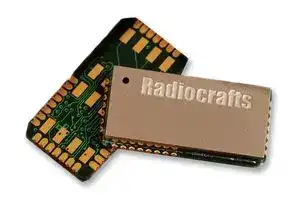
Illustrative purposes only

RC1140-RC232
RF MODULE, TXRX, FSK, UART, WHIP ANT
⚠️ Reference pricing provided. In case of supply shortages, we will connect you with our trusted procurement partners to ensure your project's continuity.
- Manufacturer: RADIOCRAFTS
- Product type: RF Transceivers - Sub 2.4GHz ISM Band
- Data Rate Max: 100Kbps
- Frequency Max: 434.79MHz
- RF Modulation: FSK
- Supply Current: 35mA
- Transmit Power: 10dBm
- Sensitivity dBm: -110dBm
- Module Interface: UART
- Supply Voltage Max: 3.7V
- Supply Voltage Min: 2V
- RF Transceiver Applications: Industrial RF Communication
| Delivery and price | |
|---|---|
| Units per pack | 1 |
| Price | 32.53 € |
| Current stock | 10+ |
| Lead time | 30 days |
Datasheet

## Radiocrafts

## Embedded Wireless Solutions **RC11xx-RC232**

## **Low Cost Multi-Channel RF Transceiver Module**

## **Product Description**

The RC11XX-RC232 RF Transceiver Modules are compact surface-mounted high performance modules for FSK operation with embedded protocol. The modules are completely shielded and pre-certified for operation under the European radio regulations for license-free use. RC1170- and RC1190-RC232 conforms with regulations for operation under FCC (USA and Canada) and under the directives given by G.S.R. (India) respectively.

## **Applications**

- Wireless Sensor Networks

- Automatic Meter Reading

- Alarm and security systems

- Point-of-sales terminals

- Bar code scanners

- Telemetry stations

- Fleet management

## **Features**

- Small size (12.7 x 25.4 x 3.3 mm), shielded and optimized for SMD mounting

- Low sleep current consumption, well suited for battery operated equipment

- Embedded RC232™ protocol with Addressing and Error check

- Up to 1018 byte data buffer

- Two-wire UART interface for easy RS232/422/485 wire replacement (handshake optional)

- No external components

- No configuration required for single-channel use

- Easy to use data interface

- Wide supply voltage range, 2.0 – 3.9 V

- RC1140/80-RC232 conforms with EU R&TTE directive (EN 300 220, EN 301 489, EN 60950)

- RC1190-RC232 conforms with regulations for operation under FCC CFR 47 part 15

- RC1170-RC232 complies with G.S.R.564(E) (G.S.R.168(E)).

## **Quick Reference Data**

|**Parameter**|**RC1140-**<br>**RC232 **|**RC1170-**<br>**RC232 **|**RC1180-**<br>**RC232 **|**RC1190-**<br>**RC232 **|**Unit**|
|---|---|---|---|---|---|
|Frequency bands<br>~~ee~~|433.05 –<br>433.79<br>~~ee~~|865.0 – 867.0|868.0 – 870.0|902 – 915|MHz|
|Numberofchannels<br>~~ee~~<br>~~re~~|17<br>~~ee~~<br>|15<br>|16<br>|50|~~|~~|
|Datarate<br>~~ee ~~<br>~~re~~<br>~~Se~~|1.2 - 100<br> ~~ee~~<br>~~GQ~~<br>|1.2 - 100<br>~~GQ~~<br>|1.2 - 100<br>~~GQ~~|1.2 - 100|kbit/s<br>~~|~~|
|Maxoutput power<br>~~re~~<br>~~Se~~<br>~~Se~~|10<br>~~GQ~~<br>~~A~~<br>|10<br>~~GQ~~<br>~~A~~<br>|10<br>~~GQ~~|-1|dBm<br>~~|~~|
|Sensitivity<br>~~re ~~<br>~~Se~~<br>~~Se~~<br>~~nn~~|-110<br> ~~GQ~~<br>~~A~~<br>~~A~~|-110<br>~~GQ~~<br>~~A~~<br>~~A~~|-110<br>~~GQ~~|-110|dBm<br>~~|~~|
|Supplyvoltage<br> <br>~~Se ~~<br>~~Se~~<br>~~nn~~|2.0–3.9<br> ~~GQ~~<br> ~~A~~<br>~~A~~|2.0–3.9<br>~~GQ~~<br>~~A~~<br>~~A~~|2.0–3.9<br>~~GQ~~|2.0–3.9|Volt|
|Current consumption,<br>RX/TX<br> <br>~~Se ~~<br>~~nn~~|24 / 35<br> ~~A~~<br> ~~A~~|24 / 35<br>~~A~~<br>~~A~~|24 / 37|24 / 37|mA|
|Current consumption,<br>SLEEP<br> <br>~~nn~~|Typ. 0.3<br> ~~A~~<br>~~es~~|Typ. 0.3<br>~~A~~|Typ 0.3|Typ 0.3|uA|
|Temperature range<br>~~es~~|-40 to +85<br>~~es~~<br>~~es~~|-40 to +85<br>~~es~~|-40 to +85<br>~~es~~|-40 to +85|C|


2010 Radiocrafts AS

RC11xx-RC232 Data Sheet (rev. 1.44)

Page 1 of 25

## Radiocrafts

## Embedded Wireless Solutions **RC11xx-RC232**

## **Typical application circuit**

**==> picture [18 x 7] intentionally omitted <==**

**----- Start of picture text -----**<br>
VCC<br>**----- End of picture text -----**<br>


**==> picture [400 x 88] intentionally omitted <==**

**----- Start of picture text -----**<br>
Optional<br>GND GND<br>a ne CTS VCC 7 Antenna<br>To host meter or  RTS RESET<br>RS232/422/485  wocrtaspoccssscs CONFIG NC NC<br>driver TXD GND<br>{ RXD RF<br>GND GND<br>**----- End of picture text -----**<br>


See page 19 for additional schematic information regarding recommended Reset and Power supply filtering, and how to include a firmware upgrade connector.

## **Quick Product Introduction**

## _How do I transmit data?_

Send your data to the RXD pin on the module. Use the UART format with settings (19200, 8, 1, N, no flow control). Up to 1018 of payload bytes are buffered in the module (total of 1024 including header bytes). The module will transmit the data when

- the max packet length is reached

- the unique end character is sent

- the modem timeout limit is reached

The packet length, end character and timeout limit are configurable in-circuit.

## _How do I receive data?_

Any received data packet with correct address and check sum will be sent on the TXD pin using the same UART format as for transmit.

## _What about the antenna?_

In most cases a simple quarter wavelength wire or a PCB track will do. Connect a piece of wire to the RF pin with length corresponding to the quarter of a wavelength. For space limited products, contact Radiocrafts and we will recommend the best antenna solution for your application.

## _How do I change the RF channel or any other parameter?_

To change configurable parameters, assert the CONFIG pin, and send the command string using the same serial interface as for transmitting data. Parameters can be changed permanently and stored in non-volatile memory in the module.

## **RCTools**

RCTools is a powerful and easy to use PC suite that helps you during test, development and deployment of the RC11XX-RC232. Visit www.radiocrafts.com for a free download and full documentation.

2010 Radiocrafts AS

RC11xx-RC232 Data Sheet (rev. 1.44)

Page 2 of 25

## Radiocrafts

## Embedded Wireless Solutions **RC11xx-RC232**

## **Pin Assignment**

**==> picture [426 x 128] intentionally omitted <==**

**----- Start of picture text -----**<br>
GND 30      29      28      27      26      25      24      23<br>1  14 GND<br>CTS/RXTX 2  13 VCC<br>RTS/SLEEP 3  12 RESET<br>CONFIG 4  11 NC<br>TXD 5  10<br>GND<br>RXD 6  9<br>RF<br>GND 7  8<br>15      16      17      18      19      20      21      22 GND<br>**----- End of picture text -----**<br>


## **Pin Description**

**Pin no Pin name Pin type Description Equivalent circuit** 1 GND System ground GND 2 CTS/RXTX Output UART Clear to Send or VCC ~~{ff~~ UART RXTX Input: 3 RTS/SLEEP Input UART Request to Send. Set low to enter Sleep 20k ~~*~~ mode if RTS handshake is not in use. (See Note 2) ~~imo~~ 4 CONFIG Input Configuration Enable. Active low. Should VCC normally be set high. Output: (See Note 2) 5 TXD Output UART TX Data 6 RXD Input UART RX Data. Use external max 8k2 kohm pull-up resistor if ~~a~~ connected to an open collector output from a host MCU or other high impedance circuitry like level shifters. (See Note 1) 7 GND System ground GND

2010 Radiocrafts AS

RC11xx-RC232 Data Sheet (rev. 1.44)

Page 3 of 25

## Radiocrafts

## Embedded Wireless Solutions **RC11xx-RC232**

|8|GND||Systemground||~~Ts~~|
|---|---|---|---|---|---|
|9|RF||RF I/O connection to<br>antenna|10k<br>RF||
|10|GND||System ground|GND||
|11|NC||Not connected|||
|12<br>~~Ts~~|RESET<br>~~Ts~~|Input<br>~~Ts~~|Main reset (active low).<br>Should normally be left<br>open. Internal 12 kΩ pull-<br>up resistor.<br>~~Ts~~|VCC<br>RESET<br>12k<br>~~Ts~~||
|13<br>~~Ts~~<br>~~ines~~|VCC<br>~~Ts~~<br>~~ines~~|~~Ts~~<br>~~ines~~|Supply voltage input.<br>Internally regulated.<br>~~Ts~~<br>~~ines~~|1.8 V<br>**VREG**<br>2u2<br>VCC<br>~~Ts~~<br>~~ines~~||
||||||~~Ts~~|
|14<br>~~ines~~<br>~~-+—_}—_}+——~~|GND<br>~~ines~~<br>~~-+—_}—_}+——~~|~~ines~~<br>~~-+—_}—_}+——~~|System ground<br>~~ines~~<br>~~-+—_}—_}+——~~|GND<br>~~ines~~<br>~~-+—_}—_}+——~~||
|15-22<br>~~ines~~<br>~~-+—_}—_}+——~~|RESERVED<br>~~ines~~<br>~~-+—_}—_}+——~~|~~ines~~<br>~~-+—_}—_}+——~~|Test pins or pins<br>reserved for future use.<br>_Do not connect!_<br>~~ines~~<br>~~-+—_}—_}+——~~|~~ines~~<br>~~-+—_}—_}+——~~||
|23-30<br>~~-+—_}—_}+——~~|RESERVED<br>~~-+—_}—_}+——~~|~~-+—_}—_}+——~~|Test pins or pins<br>reserved for future use.<br>_Do not connect!_<br>~~-+—_}—_}+——~~|~~-+—_}—_}+——~~||


2010 Radiocrafts AS

RC11xx-RC232 Data Sheet (rev. 1.44)

Page 4 of 25

## Radiocrafts

## Embedded Wireless Solutions **RC11xx-RC232**

## **Block Diagram**

**==> picture [392 x 108] intentionally omitted <==**

**----- Start of picture text -----**<br>
GND GND<br>CTS Voltage Regulator VCC<br>RTS Communication RESET<br>controller<br>CONFIG NC<br>TXD RF Transceiver GND<br>RXD RF<br>GND GND<br>**----- End of picture text -----**<br>


## **Circuit Description**

The module contains a communication controller with embedded RC232™ protocol software, a high performance RF transceiver and an internal voltage regulator.

The communication controller handles the radio packet protocol, the UART interface and controls the RF transceiver. Data to be sent by the host is received at the RXD pin and buffered in the communication controller. The data packet is then assembled with preamble, start-of-frame delimiter (SOF), address information and CRC check sum before it is transmitted on RF. The preamble and SOF is always used. The address and CRC are optional.

The RF transceiver modulates the data to be transmitted on RF frequency, and demodulates data that are received.

Received data are checked for correct address and CRC by the communication controller. If the address matches the modules own address, and no CRC errors were detected, the data packet is sent to the host on the TXD line after removing the header.

The asynchronous UART interface consists of RXD and TXD. Optionally CTS, RTS can be used for hardware handshake flow control. RXTX can be used to control the direction of an RS485 driver circuit.

When the CONFIG pin is asserted the communication controller interprets data received on the RXD pin as configuration commands. There are commands to change the radio channel, the output power, the destination address etc. Permanent changes of the configuration is also possible and are then stored in internal non-volatile memory.

The RF protocol and the configuration commands are described in detail in the RC232™ User Manual.

The supply voltage is connected to the VCC pin. The module contains an internal voltage regulator and can therefore operate over a wide supply voltage range.

2010 Radiocrafts AS

RC11xx-RC232 Data Sheet (rev. 1.44)

Page 5 of 25

## Radiocrafts

## Embedded Wireless Solutions **RC11xx-RC232**

## **RC232™ Embedded Protocol**

The module offers a buffered packet radio in the RC232™ embedded protocol. Using the buffered packet radio mode, all data to be sent is stored in the module before they are transmitted by the RF circuitry. Likewise, when data is received they are stored in the module before they are sent to the host. This allows the communication controller to add address information and to do error check of the data. In buffered mode the UART interface is used to communicate with the host.

The embedded protocol, configuration commands and configuration memory is described in the RC232™ User Manual. This protocol is used in a wide range of RF modules available from Radiocrafts. Please refer to the latest revision available on Radiocrafts web-site.

## **Power Management**

The module can be set in SLEEP mode in order to reduce the power consumption.

When the SLEEP pin is not enabled (RF_SLEEP_MODE = 0x00) the module can be set in Sleep mode by activating CONFIG and sending a ‘Z’ command. The module is woken up when CONFIG is deactivated (goes high). Note: During Sleep the CONFIG pin does not have any internal pull-up, so the CONFIG pin must be driven high in order to wake the module. Any activity on the RXD pin will make the module wake up, but immediately return to Sleep as long as CONFIG is kept low. Such activity on the RXD pin should be avoided in order to reduce current consumption.

When the SLEEP pin is enabled (RF_SLEEP_MODE = 0x02) the module can be set in Sleep mode by activating RTS/SLEEP (asserting low). The module is woken up when RTS/SLEEP is deactivated (goes high). Note: During Sleep the RTS/SLEEP pin does not have any internal pullup, so the RTS/SLEEP pin must be driven high in order to wake up the module. Any activity on the RXD or CONFIG pins will not make the module wake up. Activity on module pin 16 and 17 can wake the module and must be avoided (do not connect, as previously stated in this document). CONFIG must be high when awakening the module to avoid setting the module directly in configuration mode.

All configuration settings and RAM values are retained during Sleep. The pull-ups on RTS/SLEEP and CONFIG pin are disabled during sleep mode in order to minimise the sleep current consumption. If the module is shut completely off, all configuration settings in non-volatile memory is restored, but values in RAM are overwritten with default settings.

2010 Radiocrafts AS

RC11xx-RC232 Data Sheet (rev. 1.44)

Page 6 of 25

## Radiocrafts

## Embedded Wireless Solutions **RC11xx-RC232**

Enter SLEEP Mode Using RTS/SLEEP pin

**==> picture [259 x 140] intentionally omitted <==**

**----- Start of picture text -----**<br>
RTS/SLEEP ——————<—<br>MODE eS IDLE SLEEP IDLE<br>Enter SLEEP Mode Using CONFIG and Z Comand<br>CONFIG<br>SS<br>UART Comand Z<br>a<br>MODE eS IDLE  SS CONFIG SLEEP IDLE<br>**----- End of picture text -----**<br>


2010 Radiocrafts AS

RC11xx-RC232 Data Sheet (rev. 1.44)

Page 7 of 25

## Radiocrafts

## Embedded Wireless Solutions **RC11xx-RC232**

## **Timing Information**

The figure and table below shows the timing information for the module when changing between different operating states.

The IDLE state is the normal state where the module search for preamble on the air and wait for a character to be received on the UART. RXD is the state when receiving characters from the host filling up the internal buffer. TX state is when the data is transmitted on the air. RX state is when data is received from the air after preamble detection. TXD is the state where the received data is sent to the host on the UART.

CONFIG is the state entered by asserting the CONFIG pin and used during parameter configuration, while MEMORY CONFIG is the sub-state entered by the ‘M’ command where the configuration memory is being programmed. Note the limitation on maximum number of write cycles using the ‘M’ command, see Electrical Specifications.

**==> picture [401 x 212] intentionally omitted <==**

**----- Start of picture text -----**<br>
tTXD<br>tRX-TXD tTXD-IDLE<br>RX<br>IDLE TXD IDLE<br>—— —_ I<br>Preamble detected First character on  Last character on<br>UART TXD UART TXD<br>tRXD-CTS tTX<br>RXD tPACKET_TIMEOUT tRXD-TX tTX-IDLE<br>IDLE TX IDLE<br>rf<br>First character on  Last character on<br>UART RXD  UART RXD<br>**----- End of picture text -----**<br>


2010 Radiocrafts AS

RC11xx-RC232 Data Sheet (rev. 1.44)

Page 8 of 25

## Radiocrafts

## Embedded Wireless Solutions **RC11xx-RC232**

tOFF-IDLE ~~a~~ OFF IDLE tRESET-IDLE ~~a~~ RESET IDLE tSLEEP-IDLE ~~a~~ SLEEP IDLE

|**Symbol **|**Value**|**Description / Note**<br>||
|---|---|---|
|tRX-TXD<br>~~a~~|180 us<br>~~a~~|Time from last byte is received from the air until first character is sent<br>onthe UART|
|tTXD<br>~~a~~|Min 590 us<br>~~a~~|tTXD= # bytes received x 590 us/char (10 bits at 19.2 kBd + 70 us<br>delay percharacter)|
|tTXD-IDLE<br>~~a~~|900 us<br>~~a~~|Time from last character is sent on the UART until module is in IDLE<br>mode (readyfor RXDandRX)|
|TRXD-CTS<br>~~a~~|20 us<br>~~a~~|Time from last character is received by the UART (including any<br>timeout) untilCTSis activated|
|tRXD-TX<br>~~a~~|960 us<br>~~a~~|Time from last character is received by the UART (including any<br>timeout) until the module sends the first byte on the air.|
|TTX-IDLE<br>~~a~~<br>~~a~~|960 us<br>~~a~~<br>~~a~~|Time from last character is sent on the air until module is in IDLE<br>mode (readyfor RXDandRX)|
|tOFF-IDLE<br>~~a~~<br>~~a~~|3.2 ms<br>~~a~~<br>~~a~~||
|tRESET-IDLE<br>~~a~~<br>~~a~~|3.0ms<br>~~a~~<br>~~a~~||
|tSLEEP-IDLE<br>~~a~~<br>~~a~~|1.28ms<br>~~a~~<br>~~a~~||
|tCONFIG-<br>PROMPT<br>~~a~~<br>~~a~~|590 us<br>~~a~~<br>~~a~~|Time from CONFIG pin is set low until prompt (“>”)|
|tC#-CONFIG<br>~~a~~<br>~~a~~|1.1 ms<br>~~a~~<br>~~a~~|Delay after channel-byte is sent until prompt (“>”). (For other<br>commandslike’M’,’T’thereisno delay butimmediate prompt)|
|tMEMORY-<br>CONFIG<br>~~a~~|30.52 ms<br>~~a~~|In this period the internal flash is programmed._Do not reset, turn the_<br>_module off, or allow any power supply dips in this period as it may_<br>_cause permanent error in the Flash configuration memory. After 0xFF_<br>_the host should wait for the ‘>’ prompt before any further action is_<br>_done to ensure correct re-configuration._|
|TCONFIG-<br>IDLE<br>~~a~~|1.42 ms<br>~~aa ~~|~~ee~~|
|tTX<br>~~a~~|Min 20 ms<br>~~ee~~|tTX= # bytes to send x 1.67 ms/byte (at 4.8 kbit/s) + 7 bytes preamble,<br>sync andlength+2bytes address +2bytes CRC<br>~~ee~~|
|TRSSI<br>~~eG~~|4 ms<br>~~eG~~|Timefromend ofS command to start of RSSIbytereceived onUART<br>~~eG~~|


2010 Radiocrafts AS

RC11xx-RC232 Data Sheet (rev. 1.44)

Page 9 of 25

## Radiocrafts

## Embedded Wireless Solutions **RC11xx-RC232**

## **RF Frequency, Output Power Levels and Data Rates**

The following table shows the available RF channels and their corresponding frequencies, nominal output power levels and available data rates.

|**Model **|**RFchannel **|**Output power **|**Data rate**|
|---|---|---|---|
|**RC1140-RC232**|1:  433.100 MHz<br>2:  433.200 MHz<br>3:  433.300 MHz<br>**4:  433.400 MHz**<br>5:  433.500 MHz<br>6:  433.600 MHz<br>7:  433.700 MHz<br>8:  433.800 MHz<br>9:  433.900 MHz<br>10: 434.000 MHz<br>11: 434.100 MHz<br>12: 434.200 MHz<br>13: 434.300 MHz<br>14: 434.400 MHz<br>15: 434.500 MHz<br>16: 434.600 MHz<br>17: 434.700MHz|1:  -20 dBm<br>2:  -10 dBm<br>3:     0 dBm<br>4:     5 dBm<br>**5:     10 dBm**|1: 1.2 kbit/s<br>2: 4.8 kbit/s<br>**3: 19.0 kbit/s**<br>4: 32.768 kbit/s<br>5: 76.8 kbit/s<br>6: 100 kbit/s<br>7: For future use|
|**RC1170-RC232**|1:  865.100 MHz<br>2:  865.300 MHz<br>3:  865.500 MHz<br>**4:  865.700 MHz**<br>5:  865.900 MHz<br>6:  866.100 MHz<br>7:  866.300 MHz<br>8:  866.500 MHz<br>9:  866.700 MHz<br>10: 866.900 MHz<br>11: 867.100 MHz<br>12: 867.300 MHz<br>13: 867.500 MHz<br>14: 867.700 MHz<br>15:867.900MHz|1:  -20 dBm<br>2:  -10 dBm<br>3:     0 dBm<br>4:     5 dBm<br>**5:     10 dBm**|1: 1.2 kbit/s<br>2: 4.8 kbit/s<br>**3: 19.0 kbit/s**<br>4: 32.768 kbit/s<br>5: 76.8 kbit/s<br>6: 100 kbit/s<br>7: For future use|


2010 Radiocrafts AS

RC11xx-RC232 Data Sheet (rev. 1.44)

Page 10 of 25

## Radiocrafts

## Embedded Wireless Solutions **RC11xx-RC232**

|**RC1180-RC232**|1:  868.050 MHz<br>2:  868.150 MHz<br>3:  868.250 MHz<br>**4:  868.350 MHz**<br>5:  868.450 MHz<br>6:  868.550 MHz<br>7:  868.650 MHz<br>8:  868.750 MHz<br>9:  868.850 MHz<br>10: 868.950 MHz<br>11: 869.050 MHz<br>12: 869.150 MHz<br>13: 869.525 MHz<br>14: 869.750 MHz<br>15: 869.850 MHz<br>16: 869.950 MHz|1:  -20 dBm<br>2:  -10 dBm<br>3:     0 dBm<br>4:     5 dBm<br>5:**9 dBm**|1: 1.2 kbit/s<br>2: 4.8 kbit/s<br>**3: 19.0 kbit/s**<br>4: 32.768 kbit/s<br>5: 76.8 kbit/s<br>6: 100 kbit/s<br>7: For future use|
|---|---|---|---|
|**RC1190-RC232**|50 channels:<br>902+nx0.5 MHz<br>for n = [1, 50]<br>default:<br>**1:902.5 MHz**|1:  -20 dBm<br>2:  -10 dBm<br>3:**0 dBm**<br>4:     not recommended*<br>5**:**not recommended*|1: 1.2 kbit/s<br>2: 4.8 kbit/s<br>**3: 19.0 kbit/s**<br>4: 32.768 kbit/s<br>5: 76.8 kbit/s<br>6: 100 kbit/s<br>7: For future use|


_* Not recommended due to higher output power than the FCC limit._

RF channel and output power level can be set using the configuration commands ‘C’ and ‘P’ respectively. The data rate can _only_ be changed in configuration memory by using the ‘M’ command setting RF_DATA_RATE. The _default_ RF channel and output power level can be set in the configuration memory by using the ‘M’ command setting RF_CHANNEL and RF_POWER. The default values are used after power ON and RESET. The default factory settings are shown in **bold** in the table above.

For channels 1, 6, 7, 12, 14 and 16 the maximum RF data rate is 19.2 kbit/s due to limitations in modulation bandwidth at the given sub band-edge.

For more details on changing the RF channel, output power or data rate, refer to the description of the configuration commands.

The use of RF frequencies, maximum allowed RF power and duty-cycles are limited by national regulations. The RC1180-RC232 and RC1140-RC232 is complying with the applicable directives within the European Union when used within these limitations.

RC1190-RC232 is pending approval under FCC for use in the US and Canada. For more information see section “Regulatory Compliance Information”.

2010 Radiocrafts AS

RC11xx-RC232 Data Sheet (rev. 1.44)

Page 11 of 25

## Radiocrafts

## Embedded Wireless Solutions **RC11xx-RC232**

## **RSSI Reading**

The module provides a digital Received Signal Strength Indicator (RSSI) through the ‘S’ command, or attached to received messages. The module returns an 8 bit character (one byte) indicating the current input signal strength (followed immediately by a second character which is the prompt (‘>’) when in command mode). The signal strength can be used as an indication of fading margin, or as a carrier sense signal to avoid collisions.

The signal strength measure by the S command is the instantaneous value. The RSSI value appended to a received message (RSSI_MODE = 1) is the signal strength of that received packet.

The RSSI value increases with increased input signal strength in 0.5 dB steps. Input signal strength is given by (typ.):

P =  - RSSI / 2 [dBm]

The dynamic range of the RSSI (P) goes from the Sensitivity level up to typical -30 dBm (RSSI saturation level).

## **Temperature Reading**

The module provides readings of a digital temperature monitoring sensor (TEMP) through the ‘U’ command. The module returns an 8 bit character (one byte) indicating the current temperature in degrees Celsius (°C) followed immediately by a second character which is the prompt (‘>’).

The TEMP value increases with increased temperature in 1 °C steps and accuracy of +/- 2 °C. Temperature is given by:

T = TEMP(dec) – 128  [°C]  (example: TEMP=0x98 equals +24 °C)

## **Power Supply voltage Reading**

The module provides readings of an internal power supply voltage monitoring sensor (VCC) through the ‘V’ command. The module returns an 8 bit character (one byte) indicating the current power supply voltage level followed immediately by a second character which is the prompt (‘>’). The command can be useful for battery power monitoring.

The VCC value increases with increased power supply voltage in 30 mV steps. The power supply voltage is given by:

V = VCC(dec)*0.030 [V]  (example: VCC=0x68 equals 3.12 V)

2010 Radiocrafts AS

RC11xx-RC232 Data Sheet (rev. 1.44)

Page 12 of 25

## Radiocrafts

## Embedded Wireless Solutions **RC11xx-RC232**

## **Module Configuration**

The configuration of the module can be changed in-circuit from the host during operation, at the time of installation of the equipment, at the manufacturing test, or even as a standalone module. The configuration is changed sending commands on the UART interface after the module is set in configuration mode. The configuration mode is entered by asserting the CONFIG pin (set low).

In command mode the module will respond by sending a ‘>’ prompt on the TXD pin. This indicates that the module is ready to receive commands. The CONFIG pin can then be deasserted. Note that the CONFIG pin must be de-asserted _before_ the Exit command (‘X’) is sent to the module in order to return to normal operation.

After a command is executed, the module responds with the ‘>’ prompt character again indicating it is ready for a new command. Do not send a new command before the ‘>’ prompt is received. The time required to execute a command can vary depending on the command (see the Timing Information section). There is no ‘>’ prompt after the ‘X’ exit command.

The parameters that are set by commands directly take immediate effect after returning to normal operation (IDLE), but will not be stored in non-volatile memory, and will be lost in case the supply power is turned off or if the module is reset. These parameters are for example the radio channel and output power.

A list of commands is shown in the table below.

|**Parameter **<br>~~e_~*7F~~|**Command**<br>~~e_~*7F~~|**Argument in hex (decimal)**<br>~~e_~*7F~~|**Note**<br>~~e_~*7F~~|
|---|---|---|---|
|Channel|‘C’ – 0x43|0x01-0x0C (1-12)|Data is stored in volatile<br>memory only.|
|Output power|‘P’ – 0x50|0x01-0x05 (1-5)|Data is stored in volatile<br>memory only.|
|Signal<br>Strength<br>(RSSI)|‘S’ – 0x53|Returns one byte indicating<br>the signal strength|See page 10 for details|
|Destination<br>address|‘T’ – 0x54|0x00 – 0xFF (0-255)|Data is stored in volatile<br>Memory only.|
|Temperature<br>monitoring|‘U’ – 0x55|Returns one byte indicating<br>the temperature.|See page 10 for details|
|Battery<br>monitoring|‘V’ – 0x56|Returns one byte indicating<br>the power supply voltage.|See page 10 for details|
|Memory Read<br>one byte|‘Y’ – 0x59|0x00 – 0x7F<br>(The argument is the address<br>inthe configuration memory.)|Return one byte value<br>from the configuration<br>memory.|
|Memory<br>configuration|‘M’ – 0x4D (Address, Data): see list of|‘M’ – 0x4D (Address, Data): see list of<br>parameters below.<br>0xFF exits memory<br>configuration.|Used to enter memory<br>configuration menu.<br>Parameters changed are<br>stored in non-volatile<br>memory.|
|Memory Reset ‘@RC’|Memory Reset ‘@RC’|No arguments, but CONFIG<br>must be low for this<br>command.|Resets the configuration<br>memory back to factory<br>default values in the whole<br>non-volatilememory.|
|Exit command|‘X’ – 0x58|(none)<br>~~Ge~~|Exit to normal operation<br>mode. All changes of<br>parameters take effect.|
|Sleepmode<br>~~ee~~|‘Z’ –0x5A<br>~~ee~~|(none)<br>~~ee~~<br>~~Ge~~|CONFIG pin must be<br>~~ee~~|


2010 Radiocrafts AS

RC11xx-RC232 Data Sheet (rev. 1.44)

Page 13 of 25

## Radiocrafts

## Embedded Wireless Solutions **RC11xx-RC232**

||||asserted while in SLEEP<br>mode. Exit sleep mode by<br>releasing CONFIG pin.|
|---|---|---|---|
|Test mode 0|‘0’ – 0x30|(none)|List all configuration<br>memory parameters|
|Testmode1|‘1’ –0x31|(none)|TXcarrier|
|Test mode 2|‘2’ – 0x32|(none)|TX modulated signal<br>PN9 sequence|
|Test mode 3|‘3’ –0x33|(none)|RX mode|
|Test Mode 4|‘4’ – 0x34|(none)|Radio off mode<br>(RXandTXoff)|


_Note:_ ASCII characters are written as ‘X’, hexadecimal numbers are written like 0x00, and decimal numbers are written like 10 throughout the text. A table of ASCII characters and their respective hex and decimal values are found in the Appendix.

Commands must be sent as ASCII characters or their corresponding binary value. All arguments must be sent as binary values to the module (not as ASCII representation for hex or decimal). Any invalid command will be ignored and the ‘>’ prompt will be re-sent. The CONFIG line must be de-asserted after the first ‘>’ prompt was received, but before the ‘X’ command.

To make permanent changes to default values and other parameters, the Memory Configuration command ‘M’ is used. This command should be followed by pairs of byte being the memory address and the new value to be stored at that address. In order to exit the Memory Configuration mode command ‘X’ must be sent.

## _Example:_

To select RF channel 3, send the follow sequence after asserting the CONFIG line and the ‘>’ prompt is received:

|**Command**|**Hex**|**Response**|**Comment/Note**|
|---|---|---|---|
|CONFIG asserted||‘>’|De-assert CONFIG after ‘>’ prompt|
|‘C’|0x43|‘>’||
|3|0x03|‘>’|Wait for ‘>’ prompt|
|[A new command could be issued here]||||
|‘X’|0x58|(none)|Module returns to IDLE state|


It is important to enter Test mode 3 before exiting the configuration mode (‘X’) if Test mode 1 or 2 has been used. This will ensure proper operation in normal mode.

2010 Radiocrafts AS

RC11xx-RC232 Data Sheet (rev. 1.44)

Page 14 of 25

## Radiocrafts

## Embedded Wireless Solutions **RC11xx-RC232**

## **Configuration Memory**

The table below shows the complete list of configurable parameters stored in non-volatile memory. These values can be changed using the ‘M’ command. All addresses and arguments must be sent as binary values to the module (not as ASCII representation for hex or decimal).

|**Parameter**|**Description**|**Address**<br>**hex**|**Argument**<br>**(dec)**|**Factory**<br>**setting**<br>**hex (dec)**|**Comment**|
|---|---|---|---|---|---|
|**Radio configuration**<br>~~|~~||||||
|RF_CHANNEL|Default RF<br>channel|0x00|RC1140: 1-17<br>RC1180: 1-16<br>RC1190: 1-50|0x01 (1)|See table page 10 for details|
|RF_POWER|Default RF<br>output power|0x01|1-5|0x05 (5)|See table page 10 for details|
|RF_DATA_RATE|Default RF data<br>rate|0x02|1-7|0x03 (3)|See table page 10 for details|
|SLEEP_MODE|Sleep Mode|0x04|0: SLEEP pin<br>disabled<br>1: reserved<br>2: SLEEP pin<br>enabled|0x00 (0)|When enabled, the module<br>will enter sleep mode by<br>asserting sleep pin low.<br>Do not use in combination<br>with enabled UART flow<br>control.|
|RSSI_MODE|Append RSSI|0x05|0-1|0x00 (0)|0: No RSSI append No<br>1: RSSIappend|
|**Radio packet configuration **<br>~~PT~~||||||
|PACKET_LENGTH_H Max packet|PACKET_LENGTH_H Max packet<br>length high<br>byte.|0x0E|0x01-0x03<br>(0-3)|0x00<br>(0)|Packet length > 128 was<br>introduced in FW rev 1.28.<br>For older revisions always<br>use<br>PACKET_LENGTH_H=0.<br>If PACKET_LENGHT_H=0<br>for FW rev 1.28 and newer,<br>then the packet format is<br>backward compatible with<br>FW rev 1.27and older.|
|PACKET_LENGTH_L|Max packet<br>length low byte.|0x0F|0x01-0x80<br>(1-128)|0x80<br>(128)||
|PACKET_TIMEOUT|Time before<br>modem time-<br>out and<br>transmitting the<br>buffer|0x10|0x00-0xFE<br>(0-254)<br>0x00 (0): None<br>0x01 (1): 32 ms<br>0x02 (2): 48 ms<br>0x03 (3): 64 ms<br>0x7C (124): 2 s<br>0xF9 (249): 4 s|0x7C<br>(124)|None means packet timeout<br>is disabled (not 0 s).<br>Timeout value is<br>(PACKET_TIMOEOUT x 16<br>ms) + 0/16 ms min/max<br>0xFE (254) is max, giving<br>4.080 sec.<br>Defaultis2s=0x7C (124)|
|PACKET_END_<br>CHARACTER||0x11|0x00: Off<br>0x01-0xFF: On|0x00|0: No end character<br>1-255: Use value as end<br>character|
|**Medium access, addressing and network management**<br>~~PT~~||||||
|ADDRESS_MODE<br>~~PT~~|~~PT~~|0x14<br>~~PT~~|0, 2, 8<br>~~PT~~|0x02 (2)<br>~~PT~~|0: No addressing<br>2: 1 byte addressing<br>8: 4 byte addressing (FW<br>rev 1.28 and newer)<br>Using addressing adds the<br>SID and DID bytes to the<br>radio packet.<br>~~PT~~|
|CRC_MODE||0x15||0x02 (2)|0: None<br>2:CRC16|
|UNIQUE_ID1(UID1)<br>~~es~~|~~es~~|0x19<br>~~es~~|0-255<br>~~es~~|0x01(1)<br>~~es~~|ADDRESS_MODE=8<br>UID=UID4:UID3:UID2:UID1<br>SID=SID4:SID3:SID2:SID1<br>DID=DID4:DID3:DID2:DID1|
|SYSTEM_ID1(SID1)<br>~~es~~<br>~~GG~~|~~es~~<br>~~GG~~|0x1A<br>~~es~~<br>~~GG~~|0-255<br>~~es~~<br>~~GG~~|0x01(0)<br>~~es~~<br>~~GG~~||
|UNIQUE_ID2(UID2)<br>~~GG~~|~~GG~~|0x1B<br>~~GG~~|0-255<br>~~GG~~|0x01(1)<br>~~GG~~||
|SYSTEM_ID2(SID2)<br>~~es~~|~~es~~|0x1C<br>~~es~~|0-255<br>~~es~~|0x01(0)<br>~~es~~||
|UNIQUE_ID3 (UID3)<br>~~CG~~|~~CG~~|0x1D<br>~~CG~~|0-255<br>~~CG~~|0x01(1)<br>~~CG~~||


2010 Radiocrafts AS

RC11xx-RC232 Data Sheet (rev. 1.44)

Page 15 of 25

## Radiocrafts

## Embedded Wireless Solutions **RC11xx-RC232**

|SYSTEM_ID3 (SID3)<br>~~Ge~~|~~Ge~~|0x1E<br>~~Ge~~|0-255<br>~~Ge~~|0x01(0)<br>~~Ge~~|BID=BID:BID:BID:BID<br>ADDRESS_MODE=2<br>UID=UID1<br>SID=SID1<br>DID=DID1<br>BID=BID|
|---|---|---|---|---|---|
|UNIQUE_ID4(UID4)<br>~~a~~||0x1F|0-255|0x01(1)||
|SYSTEM_ID4(SID4)||0x20|0-255|0x01(0)||
|DESTINATION_ID1(D<br>ID1)<br>~~a~~|~~ee~~|0x21<br>~~ee~~|0-255|0x01 (1)||
|DESTINATION_ID2(D<br>ID2)||0x22|0-255|0x01 (1)||
|DESTINATION_ID3(D<br>ID3)||0x23|0-255|0x01 (1)||
|DESTINATION_ID4(D<br>ID4)||0x24|0-255|0x01 (1)||
|BROADCAST_<br>ADDRESS||0x28|0-255|0xFF<br>(255)||
|**Data and configuration interface, UART Serial Port**<br>~~PT~~||||||
|UART_BAUD_RATE<br>~~PT~~|Baud rate<br>~~PT~~|0x30<br>~~PT~~|0x00: Not used<br>0x01: 2400<br>0x02: 4800<br>0x03: 9600<br>0x04. 14400<br>0x05: 19200<br>0x06: 28800<br>0x07: 38400<br>0x08: 56700<br>0x09: 76800<br>0x0A: 115200<br>0x0B: 230400<br>~~PT~~|0x05 (5)<br>~~PT~~|BE CAREFUL<br>IFCHANGING AS HOST<br>MAY LOOSE CONTACT<br>WITH MODULE!<br>Does not take effect until<br>module is re-booted / reset.<br>~~PT~~|
|UART_NUMBER_OF<br>_BITS||0x31|8: 8 bits<br>9:8 bits+1parity|0x08 (8)|BE CAREFUL IF<br>CHANGING AS HOST MAY<br>LOOSE CONTACT WITH<br>MODULE! Parity bit only an<br>option when address<br>0x31=0x09 (9 bits)<br>Does not take effect until<br>moduleisre-booted /reset.|
|UART_PARITY||0x32|0: even parity<br>1:odd parity|0x00 (0)||
|UART_STOP_BITS||0x33|1: 1 stop bit<br>2: 2 stop bits|0x01 (1)||
|UART_FLOW_CTRL|UART flow<br>control|0x35|0: None<br>1:CTS only<br>3:CTS/RTS<br>4:RXTX(RS485)|0x00 (0)||
|PART_NUMBER||0x3C-<br>0x49||RCxxxx<br>RC232||
|HW_REV_NO||0x4B-<br>0x4E||x.yz|x, y and z; Any number 0d-<br>9d|
|FW_REV_NO||0x50-<br>0x53||x.yz|x, y and z; Any number 0d-<br>9d|


_**Note:** Address location not listed should not be changed from the default value._

## **Antenna Connection**

The antenna should be connected to the RF pin. The RF pin is matched to 50 Ohm. If the antenna connector is placed away from the module at the motherboard, the track between the RF pin and the connector should be a 50 Ohm transmission line.

On a two layer board made of FR4 the width of a microstrip transmission line should be 1.8 times the thickness of the board, assuming a dielectric constant of 4.8. The line should be run at the top of the board, and the bottom side should be a ground plane.

Example: For a 1.6 mm thick FR4 board, the width of the trace on the top side should be 1.8 x 1.6 mm = 2.88 mm.

2010 Radiocrafts AS

RC11xx-RC232 Data Sheet (rev. 1.44)

Page 16 of 25

## Radiocrafts

## Embedded Wireless Solutions **RC11xx-RC232**

The simplest antenna to use is the quarter wave whip antenna. A quarter wave whip antenna above a ground plane yields 37 Ohm impedance and a matching circuit for 50 Ohm are usually not required.

A PCB antenna can be made as a copper track where the ground plane is removed on the back side. The rest of the PCB board should have a ground plane as large as possible, preferably as large as the antenna itself, to make it act as a counterweight to the antenna. If the track is shorter than a quarter of a wavelength, the antenna should be matched to 50 ohms.

The lengths of a quarter wave antenna for different operational frequencies are given in the table below.

|**Frequency**<br>**[MHz]**|**Length**<br>**[cm]**|
|---|---|
|433|16.4|
|865-867|8.2|
|868|8.2|
|915|7.8|


2010 Radiocrafts AS

RC11xx-RC232 Data Sheet (rev. 1.44)

Page 17 of 25

## Radiocrafts

## Embedded Wireless Solutions **RC11xx-RC232**

## **PCB Layout Recommendations**

The recommended layout pads for the module are shown in the figure below. All dimensions are in thousands of an inch (mil). The circle in upper left corner is an orientation mark only, and should not be a part of the copper pattern.

A PCB with two or more layers and with a solid ground plane in one of the inner- or bottom layer(s) is recommended. All GND-pins of the module shall be connected to this ground plane with vias with shortest possible routing, one via per GND-pin.

On the back side of the module there are several test pads. These test pads shall not be connected, and the area underneath the module should be covered with solder resist. If any routing or vias is required under the module, the routing and vias must be covered with solder resist to prevent short circuiting of the test pads. It is recommended that vias are tented.

Reserved pins should be soldered to the pads but the pads must be left floating.

Note that Radiocrafts technical support team is available for schematic and layout review of your design.

2010 Radiocrafts AS

RC11xx-RC232 Data Sheet (rev. 1.44)

Page 18 of 25

## Radiocrafts

## Embedded Wireless Solutions **RC11xx-RC232**

## **Mechanical Drawing**

**==> picture [398 x 336] intentionally omitted <==**

**----- Start of picture text -----**<br>
1.9 mm<br>Part nr: RCXXXX<br>Lot code: YYYYWW (YYYY=prod. year, WW= prod. week)<br>Radiocrafts Hardware revision: A.BB<br>Top view Approval marking: NN = CE, FCC or others<br>RCXXXX    YYYYWW<br>NN A.BB<br>= End view<br>3.2 mm<br>Side view<br>23.6 mm 10.9 mm<br>3.3 mm<br>0.38 mm<br>Bottom view 25.4 mm 12.7 mm 2.1 mm<br>1.4 mm<br>2.1 mm<br>8.5 mm<br>0.9 mm<br>a 13.6 mm<br>Mechanical Dimensions<br>The module size is 12.7 x 25.4 x 3.3 mm.<br>Carrier Tape and Reel Specification<br>**----- End of picture text -----**<br>


Carrier tape and reel is in accordance with EIA Specification 481.

**==> picture [376 x 93] intentionally omitted <==**

**----- Start of picture text -----**<br>
Tape width  Component  Hole pitch  Reel  Units per<br>pitch  diameter  reel<br>Ss 44 mm  16 mm  4 mm  13”  Max 1000<br>Soldering Profile Recommendation<br>JEDEC standard IEC/JEDEC J-STD-020B (page 11 and 12), Pb-Free Assembly is<br>recommended.<br>**----- End of picture text -----**<br>


The standard requires that the heat dissipated in the “surroundings” on the PCB is taken into account. The peak temperature should be adjusted so that it is within the window specified in the standard for the actual motherboard.

Aperture for paste stencil is normally areal-reduced by 20-35%. Nominal stencil thickness of 0.1 - 0-12 mm is recommended. Consult your production facility for best experience aperture reduction.

Drawings are not to scale

2010 Radiocrafts AS

RC11xx-RC232 Data Sheet (rev. 1.44)

Page 19 of 25

## Radiocrafts

## Embedded Wireless Solutions **RC11xx-RC232**

**Absolute Maximum Ratings**

|**Parameter **<br>~~po~~|**Min**<br>~~po~~|**Max **<br>~~po~~|**Unit**<br>~~po~~|
|---|---|---|---|
|Supplyvoltage,VCC<br>~~po~~|-0.3<br>~~po~~<br>~~ee~~|3.9<br>~~po~~<br>~~ee~~|V<br>~~po~~|
|Voltage on any pin<br>~~ee~~|-0.3<br>~~ee~~<br>~~ee~~|VCC+0.3V<br>max3.9V<br>~~ee~~<br>~~ee~~|V<br>~~ee~~|
|InputRF level<br>~~ee~~|~~ee ~~<br>~~ee~~|10<br> ~~ee~~<br>~~ee~~|dBm<br>~~ee~~|
|Storage temperature|-50|150|C|
|Operatingtemperature|-40|85|C|


_**Caution !** ESD sensitive device. Precaution should be used when handling the device in order to prevent permanent damage._

Under no circumstances the absolute maximum ratings given above should be violated. Stress exceeding one or more of the limiting values may cause permanent damage to the device.

## **Electrical Specifications**

T=25 C, VCC = 3.0V if nothing else stated.

|**Parameter**|**Min**|**Typ. **|**Max**|**Unit**|**Condition / Note**|
|---|---|---|---|---|---|
|Operating frequency<br>RC1140<br>RC1170<br>RC1180<br>RC1190|433.05<br>865.0<br>868.0<br>902.0||434.79<br>868.0<br>870.0<br>928.0|MHz||
|Number of channels<br>RC1140<br>RC1170<br>RC1180<br>Rc1190||17<br>15<br>16<br>50||||
|Input/output impedance||50||Ohm||
|Data rate||1.2<br>4.8<br>19.0<br>32.768<br>76.8<br>100|~~OO~~|kbit/s<br>~~OO~~||
|Frequency stability<br>~~OO~~|~~OO~~|~~OO~~|+/-40<br>~~OO~~<br>~~OO~~|ppm<br>~~OO~~<br>~~OO~~|Including10 years ofaging.<br>~~OO~~|
|Frequency stability aging<br>~~re~~|~~eee~~|~~eee~~|1<br>~~OO~~<br>~~eee~~|ppm/year<br>~~OO~~<br>~~eee~~|Starting after 10 years<br>~~eee~~|
|Transmit power<br>~~re~~|-20<br>~~eee~~|~~eee~~|9<br>~~eee~~|dBm<br>~~eee~~|~~eee~~|
|FSKdeviation<br>~~re~~|5.2<br>~~eee~~|~~eee~~|127<br>~~eee~~|kHz<br>~~eee~~|Depends ondatarate<br>~~eee~~|
|Channel Filter bandwidth<br>~~re ~~<br>~~ee~~|58<br> ~~eee~~<br>~~ee~~|~~eee~~<br>~~ee~~|540<br>~~eee~~<br>~~ee~~|kHz<br>~~eee ~~<br>~~ee~~|Depends on data rate<br> ~~eee~~<br>~~ee~~|
|Spurious emission, TX<br>< 1 GHz<br>> 1 GHz<br>47 – 74 MHz<br>87.5 – 118 MHz<br>174 – 230 MHz<br>470–862 MHz<br>~~ee~~|~~ee~~|~~ee~~|-36<br>-30<br>-54<br>-54<br>-54<br>-54<br>~~ee~~|dBm<br>~~ee~~|~~ee~~|
|Sensitivity<br>1.2 kbit/s<br>4.8 kbit/s<br>19.0 kbit/s<br>32.768 kbit/s<br>76.8 kbit/s<br>100kbit/s||-110<br>-106<br>-104<br>-101<br>-99<br>-97||dBm|1% packet error rate,<br>20 bytes packet length|
|Adjacent channel rejection||29||dB||
|Alternate channel selectivity<br>~~a~~|~~Ca~~|53<br>~~CCC~~|~~CCC~~|dB<br>~~CCC~~|~~CCC~~|
|Image channel rejection<br>~~a~~|~~Ca~~|28<br>~~CCC~~|~~CCC~~|dB<br>~~CCC~~|~~CCC~~|


2010 Radiocrafts AS

RC11xx-RC232 Data Sheet (rev. 1.44)

Page 20 of 25

## Radiocrafts

## Embedded Wireless Solutions **RC11xx-RC232**

|Blocking / Interferer rejection /<br>desensitization<br>+/- 1 MHz<br>+/- 2 MHz<br>+/- 5 MHz<br>+/- 10 MHz|30<br>35<br>50<br>60|43<br>49<br>68<br>72||dB|Wanted signal 3 dB above<br>sensitivity level, CW<br>interferer.<br>Minimum numbers<br>corresponds to class 2<br>receiver requirements in<br>EN300220.|
|---|---|---|---|---|---|
|Saturation<br>~~pT~~|~~pT~~|-14<br>~~pT~~|~~pT~~|dBm<br>~~pT~~|~~pT~~|
|Spurious emission,RX<br>~~GC~~|~~GC~~|~~GC~~|-57<br>~~GC~~|dBm<br>~~GC~~|~~GC~~|
|Supplyvoltage|2.0||3.9|V||
|Current consumption, RX/IDLE<br>~~es~~|~~es~~|24<br>~~es~~|~~es~~|mA<br>~~es~~|Apply over entire supply<br>voltagerange<br>~~es~~|
|RC1140 TX<br>Current consumption, TX<br>-20 dBm<br>-10 dBm<br>0 dBm<br>5 dBm<br> 9 dBm||18<br>20<br>22<br>25<br> 35||mA|Apply over entire supply<br>voltage range|
|RC1170/1180/1190 TX<br>Current consumption, TX<br>-20 dBm<br>-10 dBm<br>0 dBm<br>5 dBm<br> 9 dBm||16<br>17<br>22<br>30<br> 37||mA||
|Current consumption, SLEEP||0.3|1.0|uA||
|Digital I/O<br>Input logic level, low<br>Input logic level, high<br>Output logic level, low (1µA)<br>Output logic level, high(-1µA)|70 %<br>0||30 %<br>VCC|V|Of VCC<br>Of VCC|
|RESET pin<br>Input logic level, low<br>Inputlogiclevel,high|70 %||30 %|V|Minimum 250 ns pulse<br>width|
|UART Baud Rate tolerance||+/- 2||%|UART receiver and<br>transmitter|
|Configuration memory write<br>cycles|1000||||The guaranteed number of<br>write cycles using the ‘M’<br>commandislimited|


## **Regulatory Compliance Information**

The use of RF frequencies and maximum allowed RF power is limited by national regulations. The RC1140-RC232 and RC1180-RC232 has been designed to comply with the R&TTE directive 1999/5/EC. According to R&TTE directives, it is the responsibility of Radiocrafts’ customers (i.e. RC11XX-RC232 end user) to check that the host product (i.e. final product) is compliant with R&TTE essential requirements. The use of a CE marked radio module can avoid re-certification of the final product, provided that the end user respects the recommendations given by Radiocrafts. A Declaration of Conformity is available from Radiocrafts on request.

The RC1190-RC232 has been tested towards FCC regulations for license free operation under part 15. However, a final approval is required by FCC for the end product.

The RC1170-RC232 has been tested towards G.S.R.564(E) and G.S.R.168(E) for license free use in India. The Gazettes are available from Radiocrafts on request.

The relevant regulations are subject to change. Radiocrafts AS do not take responsibility for the validity and accuracy of the understanding of the regulations referred above. Radiocrafts only guarantee that this product meets the specifications in this document. Radiocrafts is exempt from any responsibilities related to regulatory compliance.

2010 Radiocrafts AS

RC11xx-RC232 Data Sheet (rev. 1.44)

Page 21 of 25

## Radiocrafts

## Embedded Wireless Solutions **RC11xx-RC232**

## **Power Supply**

Noisy external circuitry may under certain scenarios affect the transmitted signal on RC11XX-RC232 and precaution should be taken for EU R&TTE conformity. Example of circuits that can generate noise on the RC11XX-RC232 transmitted spectrum may be DC/DC converters and some level converters like RS232 and RS485. To increase spectrum margin it is important to add an EMI filter bead on the VCC pin of the RC11XX-RC232 module. Alternatively the RC11XX-RC232 may be powered form a separate voltage regulator. This will ensure that potential switching noise is filtered out from the power supply to the RC11XX-RC232. A block diagram of a typical PC serial port interface is illustrated below.

Suggested part numbers:

**Component Manufacturer Part number** EMI filter bead Murata BLM11A102S, ordering code ~~Se~~ BLM18xx102xN1D

## **Programming Interface**

For future firmware updates and possible custom variants it is recommended to include a 2x5 pins programming connector to the module programming pins. The connector should be a 2.54 mm pitch pin-row (same pitch in both directions), SMD or through-hole version, with the connections shown below.

## **Reset connection**

To minimize effect of noise on the Reset-line, the Reset pin on the module (pin 12) must be connected to external circuitry via an RC-network. It is recommended to connect Reset to either a supervisory circuit or microcontroller I/O-pin. If the Reset is driven by a push-pull output, an additional series resistor of 5k6 shall be inserted as shown in the figure, to allow an external programmer used for firmware upgrade to assert Reset low. In noisy surroundings and where Reset is not driven by a pushpull output, it is recommended that the connection ‘A’ below is pulled to VCC via one or more resistors where the equivalent pull-up resistor is close to 5k6

**==> picture [415 x 250] intentionally omitted <==**

**----- Start of picture text -----**<br>
VCC<br>EMI filter bead, Place directly<br>place close to  on Reset-pin as<br>VCC pin close as possible<br>on pin<br>VCC<br>RS232-, RS485-,RS422- or USB RTSCTSCONFIG RESETVCC 2k7 A 5k6 supervisoryConnect to circuit or<br>levelshifter or  TXD 1nF MCU I/O-pin<br>microcontroller RXD<br>(MCU) Connect to<br>GND programming<br>connector<br>pin Reset<br>To programming connector<br>GND          1 2  To VCC<br>To Pin 20,        3             4  To Pin 19, Debug Data<br>Debug clock<br>7<br>To Pin 12, Reset<br>i<br>**----- End of picture text -----**<br>


2010 Radiocrafts AS

RC11xx-RC232 Data Sheet (rev. 1.44)

Page 22 of 25

## Radiocrafts

## Embedded Wireless Solutions **RC11xx-RC232**

## **Appendix: ASCII Table**

|**HEX**<br>**0**<br>**1**<br>**2**<br>**3**<br>**4**<br>**5**<br>**6**<br>**7**<br>**8**<br>**9**<br>**0A**<br>**0B**<br>**0C**<br>**0D**<br>**0E**<br>**0F**<br>**10**<br>**11**<br>**12**<br>**13**<br>**14**<br>**15**<br>**16**<br>**17**<br>**18**<br>**19**<br>**1A**<br>**1B**<br>**1C**<br>**1D**<br>**1E**<br>**1F**<br>**20**<br>**21**<br>**22**<br>**23**<br>**24**<br>**25**<br>**26**<br>**27**<br>**28**<br>**29**<br>**2A**<br>**2B**<br>**2C**<br>**2D**<br>~~ee~~<br>~~ee~~<br>~~es~~<br>~~ee~~<br>~~a~~<br>~~ee~~<br>~~a~~<br>~~ee~~<br>~~ee~~<br>~~ee~~<br>~~ee~~<br>~~ee~~<br>~~ee~~<br>~~ee~~<br>~~ee~~<br>~~a~~<br>~~ee~~<br>~~a~~<br>~~ee~~<br>~~a~~<br>~~ee~~<br>~~ee~~<br>~~ee~~<br>~~ee~~<br>~~a~~<br>~~ee~~<br>~~ee~~<br>~~re ~~<br>~~re~~<br>~~re~~<br>~~ee~~<br>~~ee~~<br>~~ee~~<br>~~re~~<br>~~ee~~<br>~~re~~<br>~~ee~~<br>~~rs~~<br>~~ee~~<br>~~a~~<br>~~ee~~<br>~~rs~~<br>~~re~~<br>~~a~~<br>~~re~~|**HEX**<br>**0**<br>**1**<br>**2**<br>**3**<br>**4**<br>**5**<br>**6**<br>**7**<br>**8**<br>**9**<br>**0A**<br>**0B**<br>**0C**<br>**0D**<br>**0E**<br>**0F**<br>**10**<br>**11**<br>**12**<br>**13**<br>**14**<br>**15**<br>**16**<br>**17**<br>**18**<br>**19**<br>**1A**<br>**1B**<br>**1C**<br>**1D**<br>**1E**<br>**1F**<br>**20**<br>**21**<br>**22**<br>**23**<br>**24**<br>**25**<br>**26**<br>**27**<br>**28**<br>**29**<br>**2A**<br>**2B**<br>**2C**<br>**2D**<br>~~ee~~<br>~~ee~~<br>~~es~~<br>~~ee~~<br>~~a~~<br>~~ee~~<br>~~a~~<br>~~ee~~<br>~~ee~~<br>~~ee~~<br>~~ee~~<br>~~ee~~<br>~~ee~~<br>~~ee~~<br>~~ee~~<br>~~a~~<br>~~ee~~<br>~~a~~<br>~~ee~~<br>~~a~~<br>~~ee~~<br>~~ee~~<br>~~ee~~<br>~~ee~~<br>~~a~~<br>~~ee~~<br>~~ee~~<br>~~re ~~<br>~~re~~<br>~~re~~<br>~~ee~~<br>~~ee~~<br>~~ee~~<br>~~re~~<br>~~ee~~<br>~~re~~<br>~~ee~~<br>~~rs~~<br>~~ee~~<br>~~a~~<br>~~ee~~<br>~~rs~~<br>~~re~~<br>~~a~~<br>~~re~~|**DEC**<br>**0**<br>**1**<br>**2**<br>**3**<br>**4**<br>**5**<br>**6**<br>**7**<br>**8**<br>**9**<br>**10**<br>**11**<br>**12**<br>**13**<br>**14**<br>**15**<br>**16**<br>**17**<br>**18**<br>**19**<br>**20**<br>**21**<br>**22**<br>**23**<br>**24**<br>**25**<br>**26**<br>**27**<br>**28**<br>**29**<br>**30**<br>**31**<br>**32**<br>**33**<br>**34**<br>**35**<br>**36**<br>**37**<br>**38**<br>**39**<br>**40**<br>**41**<br>**42**<br>**43**<br>**44**<br>**45**<br>~~ee~~<br>~~ee~~<br>~~ee~~<br>~~ee~~<br>~~ee~~<br>~~ee~~<br>~~ee~~<br>~~ee~~<br>~~ee~~<br>~~**ee**~~<br>~~**ee**~~<br>~~ee~~<br>~~ee~~<br>~~**ee**~~<br>~~ee~~<br>~~ee~~<br>~~ee~~<br>~~**ee**~~<br>~~**ee**~~<br>~~**ee**~~<br>~~ee~~<br> ~~**ee**~~<br>~~ee~~<br>~~ee ~~<br>~~ee~~<br>~~ee ~~<br>~~ee~~<br>~~ee~~<br>~~**ee** ~~<br>~~ee~~<br>~~ee~~<br>~~**ee**~~<br>~~ee~~<br>~~ee~~<br>~~ee~~<br>~~ee ~~|**CHR**<br>**NUL**<br>**SOH**<br>**STX**<br>**ETX**<br>**EOT**<br>**ENQ**<br>**ACK**<br>**BEL**<br>**BS**<br>**HT**<br>**LF**<br>**VT**<br>**FF**<br>**CR**<br>**SO**<br>**SI**<br>**DLE**<br>**DC1**<br>**DC2**<br>**DC3**<br>**DC4**<br>**NAK**<br>**SYN**<br>**ETB**<br>**CAN**<br>**EM**<br>**SUB**<br>**ESC**<br>**FS**<br>**GS**<br>**RS**<br>**US**<br>**SP**<br>**!**<br>**"**<br>**#**<br>**$**<br>**%**<br>**&**<br>**'**<br>**(**<br>**)**<br>*****<br>**+**<br>**,**<br>~~ee~~<br>~~ee~~<br>~~ee~~<br>~~ee~~<br>~~ee~~<br>~~ee~~<br>~~ee~~<br>~~ee~~<br>~~ee~~<br>~~e~~~~**e**~~<br>~~e~~<br>~~**ee**~~<br>~~ee~~<br>~~ee~~<br>~~**ee** ~~<br>~~ee~~<br>~~ee~~<br>~~ee~~<br>~~**ee**~~<br>~~**ee** ~~<br>~~**ee** ~~<br>~~ee~~<br>~~ee~~<br>~~ee~~<br> ~~ee~~<br>~~ee~~<br> ~~eee~~<br>~~ee~~<br> ~~ee~~<br>~~ee~~<br>~~ee~~<br>~~ee~~<br> ~~ee~~|**CHR**<br>**NUL**<br>**SOH**<br>**STX**<br>**ETX**<br>**EOT**<br>**ENQ**<br>**ACK**<br>**BEL**<br>**BS**<br>**HT**<br>**LF**<br>**VT**<br>**FF**<br>**CR**<br>**SO**<br>**SI**<br>**DLE**<br>**DC1**<br>**DC2**<br>**DC3**<br>**DC4**<br>**NAK**<br>**SYN**<br>**ETB**<br>**CAN**<br>**EM**<br>**SUB**<br>**ESC**<br>**FS**<br>**GS**<br>**RS**<br>**US**<br>**SP**<br>**!**<br>**"**<br>**#**<br>**$**<br>**%**<br>**&**<br>**'**<br>**(**<br>**)**<br>*****<br>**+**<br>**,**<br>~~ee~~<br>~~ee~~<br>~~ee~~<br>~~ee~~<br>~~ee~~<br>~~ee~~<br>~~ee~~<br>~~ee~~<br>~~ee~~<br>~~e~~~~**e**~~<br>~~e~~<br>~~**ee**~~<br>~~ee~~<br>~~ee~~<br>~~**ee** ~~<br>~~ee~~<br>~~ee~~<br>~~ee~~<br>~~**ee**~~<br>~~**ee** ~~<br>~~**ee** ~~<br>~~ee~~<br>~~ee~~<br>~~ee~~<br> ~~ee~~<br>~~ee~~<br> ~~eee~~<br>~~ee~~<br> ~~ee~~<br>~~ee~~<br>~~ee~~<br>~~ee~~<br> ~~ee~~|**CTRL**<br>**^@**<br>**^A**<br>**^B**<br>**^C**<br>**^D**<br>**^E**<br>**^F**<br>**^G**<br>**^H**<br>**^I**<br>**^J**<br>**^K**<br>**^L**<br>**^M**<br>**^N**<br>**^O**<br>**^P**<br>**^Q**<br>**^R**<br>**^S**<br>**^T**<br>**^U**<br>**^V**<br>**^W**<br>**^X**<br>**^Y**<br>**^Z**<br>~~ee~~<br>~~ee~~<br>~~ee~~<br>~~ee~~<br> ~~ee~~<br>~~ee~~<br>~~ee~~<br> ~~ee~~<br> ~~ee~~<br>~~ee~~|**CTRL**<br>**^@**<br>**^A**<br>**^B**<br>**^C**<br>**^D**<br>**^E**<br>**^F**<br>**^G**<br>**^H**<br>**^I**<br>**^J**<br>**^K**<br>**^L**<br>**^M**<br>**^N**<br>**^O**<br>**^P**<br>**^Q**<br>**^R**<br>**^S**<br>**^T**<br>**^U**<br>**^V**<br>**^W**<br>**^X**<br>**^Y**<br>**^Z**<br>~~ee~~<br>~~ee~~<br>~~ee~~<br>~~ee~~<br> ~~ee~~<br>~~ee~~<br>~~ee~~<br> ~~ee~~<br> ~~ee~~<br>~~ee~~|**HEX**<br>**DEC**<br>**CHR**<br>**40**<br>**64**<br>**@**<br>**41**<br>**65**<br>**A**<br>**42**<br>**66**<br>**B**<br>**43**<br>**67**<br>**C**<br>**44**<br>**68**<br>**D**<br>**45**<br>**69**<br>**E**<br>**46**<br>**70**<br>**F**<br>**47**<br>**71**<br>**G**<br>**48**<br>**72**<br>**H**<br>**49**<br>**73**<br>**I**<br>**4A**<br>**74**<br>**J**<br>**4B**<br>**75**<br>**K**<br>**4C**<br>**76**<br>**L**<br>**4D**<br>**77**<br>**M**<br>**4E**<br>**78**<br>**N**<br>**4F**<br>**79**<br>**O**<br>**50**<br>**80**<br>**P**<br>**51**<br>**81**<br>**Q**<br>**52**<br>**82**<br>**R**<br>**53**<br>**83**<br>**S**<br>**54**<br>**84**<br>**T**<br>**55**<br>**85**<br>**U**<br>**56**<br>**86**<br>**V**<br>**57**<br>**87**<br>**W**<br>**58**<br>**88**<br>**X**<br>**59**<br>**89**<br>**Y**<br>**5A**<br>**90**<br>**Z**<br>**5B**<br>**91**<br>**[**<br>**5C**<br>**92**<br>**\**<br>**5D**<br>**93**<br>**]**<br>**5E**<br>**94**<br>**^**<br>**5F**<br>**95**<br>**_**<br>**60**<br>**96**<br>****<br>**61**<br>**97**<br>**a**<br>**62**<br>**98**<br>**b**<br>**63**<br>**99**<br>**c**<br>**64**<br>**100**<br>**d**<br>**65**<br>**101**<br>**e**<br>**66**<br>**102**<br>**f**<br>**67**<br>**103**<br>**g**<br>**68**<br>**104**<br>**h**<br>**69**<br>**105**<br>**i**<br>**6A**<br>**106**<br>**j**<br>**6B**<br>**107**<br>**k**<br>**6C**<br>**108**<br>**l**<br>**6D**<br>**109**<br>**m**<br>~~a a~~<br>~~ee~~<br>~~ee~~<br>~~rs~~<br>~~**e**e ee~~<br>~~eee~~<br>~~re~~<br>~~**e**e eee~~<br>~~ree ee~~<br>~~es~~<br>~~**e**e eee~~<br>~~r~~~~**e**e ee~~<br>~~eee~~<br>~~a~~<br>~~ee ee~~<br>~~ee~~<br>~~ee~~<br>~~a~~<br>~~eeee~~<br>~~ee~~<br>~~ee~~<br>~~rs~~<br>~~**e**e~~<br>~~eee~~<br>~~a~~<br>~~**e**eee~~<br>~~ree~~<br>~~ee~~<br>~~ee~~<br>~~**e**e eee~~<br>~~eee ee~~<br>~~ee~~<br>~~ee ee~~<br>~~a~~<br>~~**e**eee~~<br>~~eee~~<br>~~a~~<br>~~**e**eee~~<br>~~eee~~<br>~~a~~<br>~~**e**e~~<br>~~e~~~~**e**e ee~~<br>~~eee ee~~<br>~~a~~<br>~~ee ee~~<br>~~es~~<br>~~ee eee~~<br>~~re~~<br>~~**e**e ee~~<br>~~eee eee~~<br>~~ee~~<br>~~**e**e eee~~<br>~~e~~~~**e**e ee~~<br>~~e~~~~**e**e ee~~<br>~~eee~~<br>~~a~~<br>~~ee ee~~<br>~~ee~~<br>~~ee ee~~<br>~~rs~~<br>~~**e**e~~<br>~~eee~~<br>~~a~~<br>~~**e**e~~<br>~~eee~~<br>~~es~~<br>~~ee ee~~<br>~~ee~~<br>~~ee~~<br>~~ee~~<br>~~a~~<br>~~**ee** eee~~<br>~~re~~<br>~~eee~~|
|---|---|---|---|---|---|---|---|
|**2E**<br>**2F**<br>**30**<br>**31**<br>**32**<br>**33**<br>**34**<br>**35**<br>**36**<br>**37**<br>**38**<br>**39**<br>**3A**<br>**3B**<br>**3C**<br>**3D**<br>~~re~~<br>~~ee~~<br>~~rs ~~<br>~~ee~~<br>~~a~~<br>~~re~~<br>~~es ~~<br>~~re~~<br>~~es~~<br>~~a~~<br>~~re~~<br>~~a~~<br>~~ee~~<br>~~re~~<br>~~ee~~<br>~~es~~||**46**<br>**47**<br>**48**<br>**49**<br>**50**<br>**51**<br>**52**<br>**53**<br>**54**<br>**55**<br>**56**<br>**57**<br>**58**<br>**59**<br>**60**<br>**61**<br>~~ee ~~<br>~~ee~~<br> ~~**ee** ~~<br>~~e~~~~**e** ee~~<br>~~e~~<br> ~~**ee** ~~<br>~~ee ~~<br>~~e~~~~**e**~~<br>~~e~~<br>~~ee ~~<br>~~ee~~<br>~~**ee**~~<br>~~ee~~|**.**<br>**/**<br>**0**<br>**1**<br>**2**<br>**3**<br>**4**<br>**5**<br>**6**<br>**7**<br>**8**<br>**9**<br>**:**<br>**;**<br>**<**<br>**=**<br> ~~ee~~<br> ~~**ee**~~<br>~~ee~~<br>~~ee~~<br> ~~ee~~~~**e**~~<br>~~e~~<br> ~~eee~~<br> ~~ee~~||||**6E**<br>**110**<br>**n**<br>**6F**<br>**111**<br>**o**<br>**70**<br>**112**<br>**p**<br>**71**<br>**113**<br>**q**<br>**72**<br>**114**<br>**r**<br>**73**<br>**115**<br>**s**<br>**74**<br>**116**<br>**t**<br>**75**<br>**117**<br>**u**<br>**76**<br>**118**<br>**v**<br>**77**<br>**119**<br>**w**<br>**78**<br>**120**<br>**x**<br>**79**<br>**121**<br>**y**<br>**7A**<br>**122**<br>**z**<br>**7B**<br>**123**<br>**{**<br>**7C**<br>**124**<br>**|**<br>**7D**<br>**125**<br>**}**<br>~~a~~<br>~~eeee~~<br>~~ee~~<br>~~ee~~<br>~~a~~<br>~~**e**e~~<br>~~eee~~<br>~~a~~<br>~~**e**eee~~<br>~~ree ee~~<br>~~a~~<br>~~ee eee~~<br>~~re~~<br>~~ee ee~~<br>~~a~~<br>~~ee~~<br>~~eee~~<br>~~a~~<br>~~eeee~~<br>~~ee~~<br>~~ee~~<br>~~a~~<br>~~**e**eee~~<br>~~eee~~<br>~~a~~<br>~~**e**eee~~<br>~~eee~~<br>~~a ee~~|
||**3E**|**62**|**>**||||**7E**<br>**126**<br>**~**|
|**3F**<br>~~re~~||**63**<br>~~ee~~|**?**||||**7F**<br>**127**<br>**DEL**<br>~~ee~~<br>~~ee~~|


2010 Radiocrafts AS

RC11xx-RC232 Data Sheet (rev. 1.44)

Page 23 of 25

## Radiocrafts

## Embedded Wireless Solutions **RC11xx-RC232**

**Document Revision History Document Revision Changes** 1.0 First release 1.1 Pull-up description during sleep and additional info regarding channel selection is added. 1.2 Updated timing table, Reset connection. 1.21 Minor correction 1.30 Mechanical drawing update, Product status change and minor corrections 1.40 New commands added (U, V, Y and @RC). Sensitivity corrected. I/O pin direction and stencil thickness included. RSSI timing added. Updated application circuit. 1.41 Minor text correction 1.42 RTS/SLEEP pin info and configuration added.  VCC range clarified to be max 3.9 V. RSSI dynamic range added and minor corrections. 1.43 -Max packet length increased to 1024 bytes. -New address mode option for 4 byte addressing -UART number of bits and parity option added -Introduced part number RC1170-RC232 Changes harmonize to RC232 firmware revision 1.28 1.44 -Clarification of data rate limitations for EN300-220-2 V2.4.1 compliance **Product Status and Definitions Current Data Sheet Identification Product Status Definition Status** Advance Information Planned or under This data sheet contains the design development specifications for product development. Specifications may change in any manner without notice. Preliminary Engineering Samples This data sheet contains preliminary and First Production data, and supplementary data will be published at a later date. Radiocrafts reserves the right to make changes at any time without notice in order to improve design and supply the best possible product. **No Identification Noted Full Production This data sheet contains final specifications. Radiocrafts X reserves the right to make changes at any time without notice in order to improve design and supply the best possible product.** Obsolete Not in Production This data sheet contains specifications on a product that has been discontinued by Radiocrafts. The data sheet is printed for ~~a~~ reference information only. ~~[=]~~ 2010 Radiocrafts AS RC11xx-RC232 Data Sheet (rev. 1.44) Page 24 of 25

Page 24 of 25

## Radiocrafts

## Embedded Wireless Solutions **RC11xx-RC232**

## **Disclaimer**

Radiocrafts AS believes the information contained herein is correct and accurate at the time of this printing. However, Radiocrafts AS reserves the right to make changes to this product without notice. Radiocrafts AS does not assume any responsibility for the use of the described product; neither does it convey any license under its patent rights, or the rights of others. The latest updates are available at the Radiocrafts website or by contacting Radiocrafts directly.

As far as possible, major changes of product specifications and functionality, will be stated in product specific Errata Notes published at the Radiocrafts website. Customers are encouraged to check regularly for the most recent updates on products and support tools.

## **Trademarks**

RC232™ is a trademark of Radiocrafts AS. The RC232™ Embedded RF Protocol is used in a range of products from Radiocrafts. The protocol handles host communication, data buffering, error check, addressing and broadcasting. It supports point-to-point, point-to-multipoint and peer-to-peer network topologies.

All other trademarks, registered trademarks and product names are the sole property of their respective owners.

## **Life Support Policy**

This Radiocrafts product is not designed for use in life support appliances, devices, or other systems where malfunction can reasonably be expected to result in significant personal injury to the user, or as a critical component in any life support device or system whose failure to perform can be reasonably expected to cause the failure of the life support device or system, or to affect its safety or effectiveness. Radiocrafts AS customers using or selling these products for use in such applications do so at their own risk and agree to fully indemnify Radiocrafts AS for any damages resulting from any improper use or sale.

© 2010, Radiocrafts AS. All rights reserved.

Contact Information Web site: www.radiocrafts.com

Address:

**Radiocrafts AS** Sandakerveien 64 NO-0484 OSLO NORWAY

Tel: +47 4000 5195 Fax: +47 22 71 29 15 E-mail: radiocrafts@radiocrafts.com sales@radiocrafts.com support@radiocrafts.com

2010 Radiocrafts AS

RC11xx-RC232 Data Sheet (rev. 1.44)

Page 25 of 25
Updated at February 9, 2023
About Novapart
Novapart is a B2B electronic component broker specialising in stock shortages and cost reduction. We source hard-to-find parts and identify compliant alternatives across a catalogue of 410,000+ components from 500+ manufacturers.
Learn more →Stock Shortage Specialist
When a component is unavailable, discontinued or has an unacceptable lead time, we tap into our network of vetted European and Asian distributors to source what you need — without compromising on quality or traceability.
Request a quote →Compliant Alternatives
We identify pin-to-pin, electrically equivalent substitutes that meet the same certifications (RoHS, AEC-Q100, REACH) as your original specification — validated against datasheets, not just part numbers. Often at a lower cost.
BOM Analysis service →