
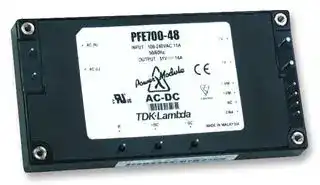


PFE1000F-28
AC/DC PCB Mount Power Supply (PSU), ITE, 1 Output, 1.8 kW, 28 VDC, 36 A
- Manufacturer: TDK-LAMBDA
- Product type: AC / DC PCB Mount Power Supplies
- No. of Outputs:1 Output; Output Power Max:1.8kW; Output Voltage - Output 1:28V; Output Current - Output 1:36A; Output Voltage - Output 2:-; Output Current - Output 2:-; Output Voltage - Ou
- SVHC: No SVHC (15-Jan-2018)
- Depth: 160mm
- Width: 100mm
- Height: 13.4mm
- Product Range: PFE Series
- No. of Outputs: 1 Output
- Output Power Max: 1.8kW
- Input Voltage VAC: 85V AC to 265V AC
- Input Voltage AC Max: 265V
- Input Voltage AC Min: 85V
- Power Supply Output Type: Adjustable, Fixed
- Output Current - Output 1: 36A
- Output Current - Output 2: -
- Output Current - Output 3: -
- Output Voltage - Output 1: 28VDC
- Output Voltage - Output 2: -
- Output Voltage - Output 3: -
- Power Supply Applications: ITE
| Delivery and price | |
|---|---|
| Units per pack | 10 |
| Price | 378.18 € |
| Current stock | 10+ |
| Lead time | 30 days |

AC-DC Single Output Power Module

## **PFHC (AC-DC Conversion) and DC-DC Conversion Integrated in One Package.**

## 2-in-1 Design Concept

One module now contains the functions previously only obtainable by combining a front-end module with a high voltage input DC-DC converter. The product is made using a wide range input AC-DC front end function (harmonic current control and power factor correction) and DC-DC back-end (voltage conversion and isolation) in 1 package).

【Huge reduction in space】 o ~~op~~ OL” ~~a~~ (old product)

(PFE Series)

## Enhanced Surge Immunity Level

It is possible to clear 6kV surge voltage in normal and common mode (absorber is installed in the input filter).

## Full Function (F type)

- By utilizing output current balancing function, parallel operation up to 6 units is possible.

- ON/OFF Control. ON/OFF control is possible even there is no ON/OFF in input circuit. ON/OFF control circuit is in between primary & secondary isolation.

- Inverter Operation Good signal

- Auxiliary Supply available

## High Power Density:0.95/ High Efficiency:89%/ Input Voltage:85~265VAC

PFHC is provided, primary and secondary isolation for better safety and wide input range. High efficiency with up to 100 ℃ base plate temperatures. ( PFE500S-12, PFE500F-12: Up to 85 ℃)

## Solution to Serve Different Kinds of Market Demands

PFE series features offer many reliable solutions Thanks to its compact size and reduction in cost, power distribution is easier to construct than before. More over, high power density and  N+1 redundant parallel operation increase the reliability. High base plate temperature and 6kV surge immunity level makes PFE series suitable to be used in harsh outdoor environment. After all, new functions are added to each models to give reliable solution to many market demands.

**==> picture [208 x 218] intentionally omitted <==**

**----- Start of picture text -----**<br>
PFE Series<br>AC Input Regulated Output<br>EMI Filter Lo ad<br>12V,28V,48V<br>【Application Example】<br>OL HE: fe<br>**----- End of picture text -----**<br>


## PFE-F **SERIES**

## **AC-DC Single Output Power Module**

## **■ Features**

- PFHC &DC-DC conversion integrated in one package

- Wide input voltage range: 85-265VAC

- High power factor: 0.95, meet PFHC standard (EN-61000-3-2)

- High efficiency: max. 86%

- Wide base plate temperatures: -40℃ to +100℃

- Full function model

- N+1 Redundant parallel operation

Current sharing (load current balancing)

**2** YEARS mi **UL60950-1** ~~vi~~ **EN60950-1** cel **Low Voltage Directive** ff **CSA C22.2 No.60950-1** warranty **■ Model naming method - PFE 500 F 12 / □** Option Blank: standard type T: mounting standφ3.3 (non-thread,through hole) FG: 1.5kVDC (output-base plate); 48V output only Output voltage Function F: Full Function Output power j {le Series name

- IOG (Inverter Operation Good signal)

- Auxiliary supply available

- ON/OFF control

Power ON signal

- Built-in capacitor: ceramic capacitors only (high reliability)

## **■ Applications**

## **■ Product Line up**

## **■ Conformity to RoHS Directive**

This means that, in conformity with EU Directive 2002/95/EC, lead, cadmium, mercury, hexavalent chromium, and specific bromine-based flame retardants, PBB and PBDE, have not been used, except for exempted applications.

## PFE-F.(AC85-265Vin)

|Output Voltage|500W|500W|1000W|1000W|
|---|---|---|---|---|
||Output Current|Model|Output Current|Model|
|12V|42A|PFE500F-12|60A|PFE1000F-12|
|28V|18A|PFE500F-28|36A|PFE1000F-28|
|48V|10.5A|PFE500F-48|21A|PFE1000F-48|


3

・All contents are subject to change without notice.

**PFE500F**

## **PFE500F Specifications**

|**ITEMS/UNITS**<br>**MODEL**|**ITEMS/UNITS**<br>**MODEL**|**ITEMS/UNITS**<br>**MODEL**|**PFE500F-12**|**PFE500F-28**|**PFE500F-48**|
|---|---|---|---|---|---|
|Input|Voltage Range<br>(*2) (*5)|V||85 - 265 VAC||
||Frequency<br>(*2)|Hz||47 - 63||
||Power Factor<br>(*1)(*5)|||0.95||
||Efficiency (Typ)<br>(*1)|%|81 / 83|84 / 86||
||Current<br>(*1)|A|6.8 / 3.4|6.4 / 3.2||
||Inrush Current (Typ)<br>(*1)(*5)|A||20 / 40peak||
|Output|Nominal Voltage<br>(*1)|VDC|12|28|48|
||Maximum Current|A|42|18|10.5|
||Maximum Power|W||504||
||Voltage SettingAccuracy|%||+/-2||
||Maximum Line Regulation|mV|48|56|96|
||Maximum Load Regulation|mV|48|56|96|
||Maximum Ripple & Noise(*5)|mVp-p|120|280|480|
||Voltage Adjustable Range|%||-20 / +20||
|Function|Over Current Protection||105% -|140% (Automatic recovery method)||
||Over Voltage Protection(*8)||125%|- 145% (Inverter shutdown method)||
||Remote Sensing<br>(*6)|||Possible||
||Remote ON/OFF Control(*6)|||Possible||
||Parallel  Operation<br>(*6)|||Possible||
||Series Operation<br>(*6)|||Possible||
|Environment|OperatingTemperature(*3)(*7)|℃|-40 - +85(Baseplate)|-40 - +100(Baseplate)||
||Storage Temperature|℃||-40 - +100||
||OperatingHumidity|%RH||20 - 95 (No Dewdrop)||
||Storage Humidity|%RH||10 - 95 (No Dewdrop)||
||Vibration||At no operating, 10-55Hz (Sweep for 1min.)<br>Amplitude 0.825mm constant (Maximum 49.0m/s²)   X,Y,Z 1 hour each|||
||Shock||196.1m/s²|||
||Cooling<br>(*4)||Conduction Cooled|||
|Standards|Safety Standards||Approved by UL60950-1, CSA C22.2 No.60950-1,  EN60950-1|||
|Isolation|Withstand Voltage||Input-Baseplate : 2.5kVAC, Input-Output : 3.0kVAC for 1min.<br>Output-Baseplate : 500VDC for 1min.|||
||Isolation Resistance||Output-Baseplate 500VDC more than 100MΩ(25°C,70%RH)|||
|Mechanical|Weight(Typ)|g|300|||
||<br>Size (W x H x D)|mm|70 x 12.7 x 122 (Refer to Outline Drawing)|||


(*1) At 100VAC/200VAC and maximum output power. (Baseplate Temperature = +25°C.)

(*2) For cases where conformance to various safety specs (UL, CSA, EN) are required, input voltage range will be 100 - 240VAC(50/60Hz).

(*3) Ratings - refer to Derating Curve on the right.

(*4) Heatsink has to be chosen according to Instruction manual.

(*5) External components are needed for operation. (Refer to basic connection and instruction manual.)

(*6) Refer to Instruction manual.

(*7) Ambient Temperature min=-40°C

(*8) OVP reset : Line off or Control off. (Refer to instruction manual.)

**==> picture [486 x 161] intentionally omitted <==**

**----- Start of picture text -----**<br>
Derating Curve<br>100<br>80<br>60<br>40<br>PFE500F-12<br>20<br>PFE500F-28、48<br>0<br>85<br>-40 -20 0 20 40 60 80 100<br>Baseplate Temperature(℃)<br>Load(%)<br>**----- End of picture text -----**<br>


4

・All contents are subject to change without notice.

**PFE500F**

## **PFE500F Outline Drawing**

**==> picture [481 x 370] intentionally omitted <==**

**----- Start of picture text -----**<br>
CL<br>see note D see note A see note C<br>AC(N) AC (N) PFE500F-48 -V -V<br>INPUT:100-240VAC  8A<br>50/60Hz<br>OUTPUT:48V   10.5A<br>AC(L) AC (L) +V +V<br>-S +S -S +S<br>AC-DC BAR CODE E N6 0 9 +ON/OFF-ON/OFF 5 0 PC TRIMIOGENA +ON/OFF-ON/OFF PC TRIMIOGENA<br>AUX COM AUX COM<br>R +BC -BC<br>MADE IN JAPAN 2.54 3.7<br>R +BC<br>see note E<br>5.26<br>15.0 15.0 see note B<br>54.12<br>111.8±0.5<br>122.0±0.5<br>Lot No. seal<br>-BC<br>+0.7 -0.3<br>12.7<br>5.0±0.5<br>12.0 12.0<br>5.78 5.78<br>LC 70.0±0.5 59.7±0.5 9.93<br>2.54 2.54<br>29.73<br>2.54<br>2.54<br>**----- End of picture text -----**<br>


## NOTES:

- A: Model name, input voltage range, Nominal output voltage, Maximum output current, country of manufacture and safety marking

- (C-UL-US, BSI & CE marking) are shown here in accordance with the specifications.

- B: M3 tapped holes 4 for customer chassis mounting (FG).

- C: Output terminal : 2-Φ2

- D: Input and Intermediate terminal : 5-Φ1

- E: Signal pin (+S, -S, TRIM, ENA, IOG, AUX, +ON/OFF, -ON/OFF, PC, COM) : 10-□0.64

- F: Unless otherwise specified dimensional tolerance : ±0.3

5

・All contents are subject to change without notice.

**PFE500F**

## **Basic Connection**

**==> picture [481 x 308] intentionally omitted <==**

**----- Start of picture text -----**<br>
L=50mm<br>+s<br>F1 L1 L2<br>AC(L) +v<br>*1 C2 C6<br>C1 C4 C5 *5 C13 + C15 +<br>C3 R1 *2,3 C7 PFE500F C14 *6 C16 *6 C17<br>AC(N) -v<br>-s<br>TRIM<br>AUX<br>IOG<br>PC<br>ENA<br>+ON/OFF<br>BASE-<br>PLATE -ON/OFF<br>COM<br>R +BC -BC<br>C8<br>*2,3 C9 C12<br>Input Filter *2,3<br>(For VCCI-classA)<br>TFR1<br>*5 C10<br>+ *4<br>C11<br>+<br>INPUT<br>OUTPUT<br>**----- End of picture text -----**<br>


|F1|AC250V 15A|C12|2200pF|
|---|---|---|---|
|R1|0.5W 470kΩ|C13|0.033uF|
|C1|AC250V 1uF(Film)|C14|0.033uF|
|C2|2200pF|C15|12V: 25V 1000uF(Elec.)|
|C3|2200pF||28V: 50V 470uF(Elec.)|
|C4|AC250V 1uF(Film)||48V: 100V 220uF(Elec.)|
|C5|AC250V 1uF(Film)|C16|100V 2.2uF(Ceramic)|
|C6|2200pF|C17|12V: 25V 1000uF(Elec.)|
|C7|2200pF||28V: 50V 470uF(Elec.)|
|C8|450V 1uF(Film)||48V: 100V 220uF(Elec.)|
|C9|450V 1uF(Film)|TFR1|10Ω139°C(Res.,Thermal fuse)|
|C10|450V 390uF(Elec.)|L1|6mH|
|C11|450V 390uF(Elec.)|L2|6mH|


(*1) Use an external fuse of fast blow type for each unit.

(*2) The allowable ripple current of capacitor must be more than 3A(rms).

(*3) Put this capacitor near the terminal as close as possible.

(*4) The maximum capacitance that can be used is less than 1200uF(Rated capacitance).

Avoid the connection of capacitance which is more than above, else it will lead to module to damage.

(*5) The inrush current at AC throw in can be suppressed by the external Resistor (Built-in thermal fuse) connected between the R and +BC terminals.

(*6) If the ambient temperature is less than -20°C, use twice the recommended capacitor above.

(*7) Refer to instruction manual for further details.

6

・All contents are subject to change without notice.

**PFE500F**

## **Block Diagram**

**==> picture [477 x 247] intentionally omitted <==**

**----- Start of picture text -----**<br>
PFHC R +BC -BC DC/DC Converter<br>AC(L) +V<br>PFHC circuit<br>AC(N) -V<br>IOG<br>TRIM<br>+S<br>-S<br>COM<br>PC<br>ENA<br>+ON/OFF<br>-ON/OFF<br>AUX<br>Filter<br>Rectifier  Rectifier<br>Inrush current limiting circuit Output filter<br>Switching circuit<br>OVP OCP<br>OVP OCP<br>Iutput voltage detector Iutput current detector OCP OTP(PFHC) OTP(DC-DC) Iutput voltage etector(DC-DC) d<br>Boost voltage detector Secondary Control Output voltage detector<br>PFHC & BPS Control circuit Bias power supply DC-DC Control circuit<br>**----- End of picture text -----**<br>


Switching Frequency

PFHC circuit (fixed) : 100kHz DC/DC converter (fixed) : 230kHz (primary),460kHz (secondary)

7

・All contents are subject to change without notice.

**PFE500F**

## **Sequence Time Chart**

**==> picture [505 x 286] intentionally omitted <==**

**----- Start of picture text -----**<br>
Input Voltage<br>(AC)<br>390VDC<br>(typ)<br>BC Terminal Voltage<br>(Boost Voltage)<br>H<br>Output Voltage<br>L<br>H<br>ON/OFF<br>Comtrol<br>L<br>H<br>IOG<br>L<br>H<br>ENA<br>L<br>H<br>AUX<br>L<br>Input Line  ON Control  OFF  Control  ON  OVP Trip Control  OFF  Control  ON  OCP Active OCP Release Input Line OFF Input Line ON OTP Trip Control  OFF  Control  ON<br>**----- End of picture text -----**<br>


V* voltage level: Refer to Application Notes “13.Power ON Signal” section.

8

・All contents are subject to change without notice.

**PFE1000F**

## **PFE1000F Specifications**

|**ITEMS/UNITS**<br>**MODEL**|**ITEMS/UNITS**<br>**MODEL**|**ITEMS/UNITS**<br>**MODEL**|**PFE1000F-12**|**PFE1000F-28**|**PFE1000F-48**|
|---|---|---|---|---|---|
|Input|Voltage Range<br>(*2)(*3)|V|85 - 265 VAC|||
||Frequency<br>(*2)|Hz|47 - 63|||
||Power Factor<br>(*1)(*3)||0.95|||
||Efficiency (Typ)<br>(*1)|%|80 / 82|84|/ 86|
||Current<br>(*1)|A|9.8 / 4.8|13.6 / 6.6|13.4 / 6.5|
||Inrush Current (Typ)<br>(*1)(*3)|A|20 / 40 peak|||
|Output|Nominal Voltage<br>(*1)|VDC|12|28|48|
||Maximum Current|A|60|36|21|
||Maximum Power|W|720|1008||
||Voltage SettingAccuracy|%|+/-2|||
||Maximum Line Regulation|mV|48|56|96|
||Maximum Load Regulation|mV|48|56|96|
||Maximum Ripple & Noise(*3)|mVp-p|120|280|480|
||Voltage Adjustable Range|%|-20 / +20|||
|Function|Over Current Protection(*4)(*5)||105% - 140%|||
||Over Voltage Protection(*5)||125% - 145% (Inverter shutdown method)|||
||Remote Sensing<br>(*6)||Possible|||
||Remote ON/OFF Control(*6)||Possible|||
||Parallel  Operation<br>(*6)||Possible|||
||Series Operation<br>(*6)||Possible|||
|Environment|OperatingTemperature(*7)(*8)|℃|-40 - +100(Baseplate)|||
||Storage Temperature|℃|-40 - +100|||
||OperatingHumidity|%RH|20 - 95 (No Dewdrop)|||
||Storage Humidity|%RH|10 - 95 (No Dewdrop)|||
||Vibration||At no operating, 10-55Hz (Sweep for 1min.)<br>Amplitude 0.825mm constant (Maximum 49.0m/s²)   X,Y,Z 1 hour each|||
||Shock||196.1m/s²|||
||Cooling<br>(*9)||Conduction Cooled|||
|Isolation|Withstand Voltage||Input-Baseplate : 2.5kVAC, Input-Output : 3.0kVAC for 1min.<br>Output-Baseplate : 500VDC for 1min.|||
||Isolation Resistance||Output to Baseplate 500VDC more than 100MΩ(25°C,70%RH)|||
|Standards|Safety Standards||Approved by UL60950-1, CSA60950-1, EN60950-1|||
|Mechanical|Weight(Typ)|g|500|||
||<br>Size (W x H x D)|mm|100 x 13.4 x 160 (Refer to Outline Drawing)|||


(*1) At 100VAC/200VAC and maximum output power. (Baseplate Temperature = +25°C.)

(*2) For cases where conformance to various safety specs (UL, CSA, EN) are required, input voltage range will be 100 - 240VAC(50/60Hz).

(*3) External components are needed for operation. (Refer to basic connection and instruction manual.)

(*4) Constant current limiting. (The unit automatically shutdown when left in OCP condition, with the output voltageless than the LVP level. Refer to instruction manual.)

(*5) Reset : Line off or Control off. (Refer to instruction manual.)

(*6) Refer to Instruction manual.

(*7) Ambient Temperature min=-40°C

(*8) Ratings - refer to Derating Curve.

(*9) Heatsink has to be chosen according to Instruction manual.

## **Derating Curve**

**==> picture [52 x 7] intentionally omitted <==**

**----- Start of picture text -----**<br>
PFE1000F-12<br>**----- End of picture text -----**<br>


**==> picture [233 x 127] intentionally omitted <==**

**----- Start of picture text -----**<br>
(720W)<br>100<br>80<br>60<br>40<br>20<br>0<br>-40 -20 0 20 40 60 80 100<br>Baseplate Temperature(℃)<br>Load(%)<br>**----- End of picture text -----**<br>


**==> picture [236 x 140] intentionally omitted <==**

**----- Start of picture text -----**<br>
PFE1000F-28,48<br>(1008W)<br>100<br>80<br>60<br>40<br>85VAC≦Vin<170VAC<br>20<br>170VAC≦Vin<265VAC<br>0<br>85<br>-40 -20 0 20 40 60 80 100<br>Baseplate Temperature(℃)<br>Load(%)<br>**----- End of picture text -----**<br>


9

・All contents are subject to change without notice.

**PFE1000F**

## **PFE1000F Outline Drawing**

**==> picture [458 x 363] intentionally omitted <==**

**----- Start of picture text -----**<br>
CL<br>73.7<br>147.7±0.5<br>see note D see note A 2.54<br>see note E<br>3.7<br>-S +S<br>PC TRIM<br>AC(N) +ON/OFF IOG<br>-ON/OFF ENA<br>AUX COM<br>AC(L) AC (N) PFE1000F-48 -S +S<br>INPUT : 100-240VAC  16A    50/60Hz +ON/OFFPC TRIMIOG -V<br>OUTPUT : 48V       21A -ON/OFF ENA<br>AC (L) AUX COM -V<br>-V-V -V<br>-V<br>AC-DC +V+V +V<br>BAR CODE E N6 0 9 5 0 +V +V<br>R +BC -BC MADE IN JAPAN +V<br>see note C<br>R +BC -BC<br>see note B<br>15.0 15.0 16.2 71.7<br>148.5±0.5<br>160.0±0.5<br>Lot No. seal<br>13.4±0.5<br>05.<br>±<br>05.<br>2.54<br>2.54<br>12.0 2.54 2.54<br>CL 19.0 00005±1.. 0885±5.. 10.42±0.5 6.356.3510.156.35 8.75<br>43.7 6.35<br>**----- End of picture text -----**<br>


## NOTES:

- A: Model name, input voltage range, Nominal output voltage, Maximum output current, country of manufacture and safety marking

- (C-UL-US, BSI & CE marking) are shown here in accordance with the specifications.

- B: M3 tapped holes 4 for customer chassis mounting (FG).

- C: Output terminal : 6-Φ2

- D: Input and Intermediate terminal : 5-Φ2

- E: Signal pin (+S, -S, TRIM, ENA, IOG, AUX, +ON/OFF, -ON/OFF, PC, COM) : 10-□0.64

- F: Unless otherwise specified dimensional tolerance : ±0.3

10

・All contents are subject to change without notice.

**PFE1000F**

## **Basic Connection**

**==> picture [474 x 281] intentionally omitted <==**

**----- Start of picture text -----**<br>
L=50mm<br>+s<br>F1 L1 L2 L3<br>*1 C2 C6 AC(L) +v<br>C1 C4 C5 R1 C8 *3 C15 + C17 +<br>C3 C7 *2,3 PFE1000F C16 *6 C18 *6 C19<br>AC(N) -v<br>-s<br>TRIM<br>AUX<br>IOG<br>BASE- PC<br>PLATE ENA<br>+ON/OFF<br>-ON/OFF<br>COM<br>R +BC -BC<br>C9*2,3<br>C10 *2,3<br>+ C11 *4<br>TFR2<br>(For VCCI-classA)Input Filter *5 + C12 *4<br>TFR1 *5 + C13 *4<br>+ C14 *4<br>INPUT<br>OUTPUT<br>**----- End of picture text -----**<br>


|F1|F25AH250V|C15|0.033uF|
|---|---|---|---|
|C1|AC250V 1uF(Film)|C16|0.033uF|
|C2|470pF|C17|12V:25V 1000uF(Elec.)|
|C3|470pF||28V:50V 470uF(Elec.)|
|C4|AC250V 1uF(Film)||48V:100V 220uF(Elec.)|
|C5|AC250V 1uF(Film)|C18|100V 2.2uF(Ceramic)|
|C6|4700pF|C19|12V:25V 1000uF(Elec.)|
|C7|4700pF||28V:50V 470uF(Elec.)|
|C8|AC250V 1uF(Film)||48V:100V 220uF(Elec.)|
|C9|450V 1uF(Film)|R1|0.5W470kΩ|
|C10|450V 1uF(Film)|TFR1|5.1Ω139℃ (Res.,Thermal fuse)|
|C11|450V 390uF(Elec.)|TFR2|5.1Ω139℃ (Res.,Thermal fuse)|
|C12|450V 390uF(Elec.)|L1|2mH|
|C13|450V 390uF(Elec.)|L2|2mH|
|C14|450V 390uF(Elec.)|L3|2mH|


(*1) Use an external fuse of fast blow type for each unit.

- (*2) The allowable ripple current of capacitor must be more than 3A(rms).

- (*3) Put this capacitor near the terminal as close as possible.

(*4) The maximum capacitance that can be used is less than 2300uF(Rated capacitance).

Avoid the connection of capacitance which is more than above of else it will lead to module damage.

(*5) The inrush current at AC throw in can be suppressed by the external Resistor (Built-in thermal fuse) connected between the R and +BC terminals.

(*6) If the ambient temperature is less than -20°C, use twice the recommended capacitor above.

- (*7) Refer to instruction manual for further details.

11

・All contents are subject to change without notice.

**PFE1000F**

## **Block Diagram**

**==> picture [481 x 242] intentionally omitted <==**

**----- Start of picture text -----**<br>
PFHC R +BC -BC DC/DC Converter<br>AC(L) +V<br>PFHC circuit<br>AC(N) -V<br>IOG<br>TRIM<br>+S<br>-S<br>COM<br>PC<br>ENA<br>+ON/OFF<br>-ON/OFF<br>AUX<br>Filter<br>Rectifier  Rectifier<br>Inrush current limiting circuit Output filter<br>Switching circuit<br>OVP LVP OCP<br>OVP OCP<br>Iutput voltage detector Iutput current detector OCP OTP(PFHC) OTP(DC-DC) Iutput voltage etector(DC-DC) d<br>Boost voltage detector Secondary Control Output voltage detector<br>PFHC & BPS Control circuit Bias power supply DC-DC Control circuit<br>**----- End of picture text -----**<br>


Switching Frequency PFHC circuit (fixed) : 100kHz DC/DC converter (fixed) : 230kHz (primary),460kHz (secondary)

12

・All contents are subject to change without notice.

**PFE1000F**

## **Sequence Time Chart**

**==> picture [505 x 286] intentionally omitted <==**

**----- Start of picture text -----**<br>
Input Voltage<br>(AC)<br>390VDC<br>(typ)<br>BC Terminal Voltage<br>(Boost Voltage)<br>OVP Trip Point OCP Trip Point<br>LVP Trip Point<br>H V* V*<br>Output Voltage<br>V**<br>L<br>H<br>ON/OFF<br>Comtrol<br>L<br>H<br>IOG<br>L<br>H<br>ENA<br>L<br>H<br>AUX<br>L<br>Input Line  ON Control  OFF  Control  ON  OVP Trip Control  OFF  Control  ON  OCP Active LVP Trip Control  OFF  Control  ON  Input Line OFF Input Line ON OTP Trip Control  OFF  Control  ON<br>**----- End of picture text -----**<br>


- V* voltage level: Refer to Application Notes “13.Power ON Signal” section.

- V** voltage level: Refer to Application Notes “6.Over Current Protection” section.

13

・All contents are subject to change without notice.

・ **PFE500F 1000F SERIES**

## **PFE500F, 1000F SERIES Instruction Manual**

## **BEFORE USING THE POWER SUPPLY UNIT**

Be sure to read this instruction manual thoroughly before using this product. Pay attention to all cautions and warnings before using this product. Incorrect usage could lead to an electrical shock, damage to the unit or a fire hazard

## **DANGER**

- Never use this product in locations where flammable gas or ignitable substances are present.

## **WARNING**

- Do not make unauthorized changes to power supply unit, otherwise you might have electric shock and void your warranty.

- Do not touch this unit and the internal components in operation or shortly after shut down. They might have high voltage or high temperature and as the unit dissipates its heat so the surface of the unit is hot. You might receive electric shock or burn.

- When the unit is operating, keep your hands and face away from it; you might be injured by an accident.

- Do not use unit under unusual condition such as emission of smoke or abnormal smell and sound etc. It might cause fire and electric shock. In such case, please contact us; do not repair by yourself, as it is dangerous for the user.

- Do not drop or insert anything into unit. It might cause failure

- Do not operate these units under condensation condition. It might cause fire and electric shock.

## **CAUTION**

- As a component part, compliance with the standard will be based upon installation in the final application. This product must be installed in a restricted access location, accessible to authorized competent personnel only. These AC to DC converters have reinforced insulation between the input and the output. The outputs of these products are energy hazards. All models with an output greater than 48V model are considered to be non-SELV. As such, the instructions for use must refer to these energy hazardous outputs and Non-SELV outputs in that the outputs must not be accessible to the operator. The installer must also provide protection against inadvertent contact by a service engineer.

   - Input voltage, Output current, Output power, ambient temperature and ambient humidity should be used within specifications, otherwise the unit will be damaged.

   - For application equipment, which requires very high reliability (Nuclear related equipment, traffic control equipment, medical equipment, etc.), please provide fail safety function in the equipment.

   - Do not use the product in environment with strong electromagnetic field, corrosive gas and conductive substance.

   - Do not operate and store this unit at an environment where condensation occurs. In such case, waterproof treatment is necessary

   - Never operate the unit under over current or shorted conditions for 30 seconds or more and out of Input Voltage Range as specification. Insulation failure, smoking, burning or other damage might occur to the unit.

   - The output voltage of this power supply unit is considered to be a hazardous energy level (The voltage is 2V or more and the electric power is 240VA or more). Prevention from direct contact with output terminal is highly necessary. While installing or servicing this power supply unit, avoid dropping tools by mistake or direct contact with output terminal. This might cause an electrical shock. While repairing this power supply unit, the AC input power must be switched off and the input and output voltage should be level.

   - To maintain the SELV output for outputs less than 28VDC, under fault conditions, the output must be connected to earth in the final application.

   - The application circuits and their parameter are for reference only. Be sure to verify effectiveness of application circuits and their parameters before finalizing circuit design.

   - Do not inject abnormal voltage to output terminal and signal terminal from the outside. The injection of reverse voltage or over voltage exceeding nominal output voltage to output terminals might cause damage to internal components.

   - This information in this document is subject to change without prior notice. For actual design-in, please refer to the latest publications of data sheet, etc., for the most up-to date specifications of the unit.

   - Design the board of an application circuit implementing this product in consideration of components layout, pattern layout and pattern width.

   - No part of this document might be copied or reproduced in any form without prior written consent of TDK-Lambda.

- The equipment has been evaluated for use in a Pollution Degree 2 environment.

- This power supply is primarily designed and manufactured to be used and enclosed in other equipment.

- Confirm connections to input/output terminals and signal terminals are correct as indicated in the instruction manual.

- Attach a fast acting external fuse to each module to ensure safety operation and compliance to each safety standard approval. The recommended input fuse rating within the instructions manual. The breaking capacity and voltage rating of this fuse might be subject to the end use application.

## **Note : CE MARKING**

CE Marking when applied to a product covered by this handbook indicates compliance with the low voltage directive (2006/95/ EC) in that it complies with EN60950-1.

14

・All contents are subject to change without notice.

・ **PFE500F 1000F SERIES**

## 1. Terminal Explanation

## **■PFE500F Series**

**==> picture [309 x 174] intentionally omitted <==**

**----- Start of picture text -----**<br>
AC(N) -V<br>AC(L) +V<br>Name Plate<br>-S +S<br>PC TRIM<br>+ON/OFF IOG<br>-ON/OFF ENA<br>AUX COM<br>R +BC -BC<br>**----- End of picture text -----**<br>


[Input side terminals]

[Output side terminals]

AC(L) : Input terminal live line AC(N) : Input terminal neutral line

+V : +Output terminal -V : -Output terminal

+BC : +Boost voltage terminal -BC : -Boost voltage terminal R : External inrush current limiting resistor terminal

+S : +Remote sensing terminal

-S : -Remote sensing terminal PC : Output current balance terminal TRIM : Output voltage trimming terminal IOG : Inverter operation good terminal ENA : Power on signal terminal +ON/OFF : +ON/OFF control terminal -ON/OFF : -ON/OFF control terminal

AUX :  Auxiliary power supply terminal for external circuits COM : Common ground terminal

・Baseplate can be connected to FG through M3 mounting tapped holes.

・Consider contact resistance when connecting AC (L), AC (N), R, +BC, -BC, +V, -V. ・Note that +BC and -BC terminals is a primary voltage with high voltage (390VDC). Do not connect load to these terminals. It might result in power module damage.

15

・All contents are subject to change without notice.

## ・ **PFE500F 1000F SERIES**

## **■PFE1000F Series**

**==> picture [308 x 174] intentionally omitted <==**

**----- Start of picture text -----**<br>
-S +S<br>AC(N) +ON/OFFPC TRIMIOG<br>-ON/OFF ENA<br>AUX COM<br>AC(L)<br>-V<br>-V<br>Name Plate -V<br>+V<br>+V<br>+V<br>R +BC -BC<br>**----- End of picture text -----**<br>


[Input side terminals] [Output side terminals]

AC(L) : Input terminal live line +V : +Output terminal AC(N) : Input terminal neutral line -V : -Output terminal +BC : +Boost voltage terminal +S : +Remote sensing terminal -BC : -Boost voltage terminal -S : -Remote sensing terminal R : External inrush current limiting resistor PC : Output current balance terminal terminal TRIM : Output voltage trimming terminal IOG : Inverter operation good terminal ENA : Power on signal terminal +ON/OFF : +ON/OFF control terminal -ON/OFF : -ON/OFF control terminal AUX :  Auxiliary power supply terminal for external circuits COM : Common ground terminal

・Baseplate can be connected to FG through M3 mounting tapped holes.

・Consider contact resistance when connecting AC (L), AC (N), R, +BC, -BC, +V, -V. ・Note that +BC and -BC terminals is a primary voltage with high voltage (390VDC). Do not connect load to these terminals. It might result in power module damage.

16

・All contents are subject to change without notice.

## ・ **PFE500F 1000F SERIES**

## 2. Explanations on Specifications

## **1 Input Voltage Range**

Input voltage range is indicated below. Take care not to apply input voltage which is above this specified range or under this specified range for more than 30 seconds. Nor

should a DC input voltage be applied as this would result into power module damage.

Input Voltage Range : Single Phase 85 to 265VAC Line Frequency Range : 47 to 63Hz

● Basic Connection

**==> picture [387 x 249] intentionally omitted <==**

**----- Start of picture text -----**<br>
L=50mm<br>+S<br>Fuse L1 L2<br>AC(L) +V +<br>C2 C6<br>C1 C4 R1 C5 C13 + C15 + C17<br>Load<br>C3 C7 C14 C16<br>AC(N) -V -<br>PFE500F<br>-S<br>TRIM<br>AUX<br>IOG<br>PC<br>ENA<br>+ON/OFF<br>BASE-<br>PLATE -ON/OFF<br>COM<br>R +BC -BC<br>C8<br>C9 C12<br>Input Filter<br>(For VCCI-classA) TFR1 C10<br>+<br>C11<br>+<br>**----- End of picture text -----**<br>


**Fig. 1-1-(1) Basic Connection for PFE500F Series**

**==> picture [429 x 286] intentionally omitted <==**

**----- Start of picture text -----**<br>
L=50mm<br>+S<br>Fuse L101 L102 L103<br>AC(L) +V +<br>C102 C106 C115<br>C101 C104 C105 R101 C108 + C117 + C119<br>Load<br>C103 C107 C116 C118<br>AC(N) -V -<br>PFE1000F<br>-S<br>TRIM<br>AUX<br>IOG<br>PC<br>ENA<br>+ON/OFF<br>BASE-<br>PLATE -ON/OFF<br>COM<br>R +BC -BC<br>C109<br>C110<br>Input Filter<br>(For VCCI-classA) C111<br>TFR101<br>+<br>C112<br>+<br>C113<br>TFR102<br>+<br>C114<br>+<br>**----- End of picture text -----**<br>


**Fig. 1-1-(2) Basic Connection for PFE1000F Series**

Note)  To meet the surge immunity, evaluate the addition of the surge protection components. Refer to separate document“PFE500F Series IEC Data”and“PFE1000F Series IEC Data”.

17

・All contents are subject to change without notice.

## ・ **PFE500F 1000F SERIES**

## F1 : External Input Fuse

This power module has no internal fuse. Use external fuse to acquire each Safety Standard and to further improve safety. Further, Fast-Blow type fuse must be used per one module. Also, in-rush surge current flows during line throwin. Be sure to check I[2] t capability of external switch and fuse.

Recommended External Fuse PFE500F : F15AH, 250V PFE1000F : F25AH, 250V

## C2, C3, C6, C7, C12: 2,200pF (Ceramic Capacitor)

## C102, C103 : 470pF (Ceramic Capacitor)

## C106, C107 : 4,700pF (Ceramic Capacitor)

Connect ceramic capacitor to conform to EMI/EMS standard. Be sure to note the leakage current of your equipment when connecting this capacitor.

High withstand voltage are applied across this capacitor depending on the application. Select capacitors with high withstand voltage rating.

## R1, R101 : 470kohm

## Note)Select fuse based on rated voltage, rated current and breaking capacity.

Connect bleeder resistor across AC(L) and AC(N) terminals.

- (1)Voltage Ratings

100VAC line : AC125V

200VAC line : AC250V

- (2)Current Ratings

Rated current is selected by the maximum input current based on operating conditions and can be calculated by the following formula.

Pout Iin (max)= (Arms) (Formula 1-1)

## C8, C9 : 1uF (Film Capacitor)

## C109, C110 : 1uF (Film Capacitor)

Ripple current flows through this capacitor. When selecting capacitor, be sure to check the allowable maximum ripple current rating of this capacitor. Verify the actual ripple current flowing through this capacitor by doing actual measurement.

Recommended Voltage Rating : 450VDC

Iin (max):Maximum Input Current

Pout : Maximum Output Power Vin : Minimum Input Voltage Eff : Efficiency PF : Power Factor

- (3)Breaking Capacity

The breaking capacity may be subject to the end use application. Please select a suitably rated breaking capacity fuse for end use application. For Efficiency and Power Factor values, refer to separate document “PFE500F Series Evaluation Data” and “PFE1000F Series Evaluation Data”.

- Note) Select Capacitor with more than 3A (rms) rating. Connect C8, C9, C109, C110 as near as possible towards the terminals of this power module.

## C10, C11: 390uF (Electrolytic Capacitor)

## C111, C112, C113, C114 : 390uF (Electrolytic Capacitor)

Refer to “Selection Method of External Bulk Capacitor for Boost Voltage”.

Allowable External Capacitance at nominal capacitor value is shown below.

Recommended Voltage Rating : 450VDC

## C1, C4, C5 : 1uF (Film Capacitor)

## C101, C104, C105, C108 : 1uF (Film Capacitor)

Ripple current flows through this capacitor. When selecting capacitor, be sure to check the allowable maximum ripple current rating of this capacitor. Verify the actual ripple current flowing through this capacitor by doing actual measurement.

Recommended Voltage Rating : 250VAC

Note)Connect C5, C108 as near as possible towards the input terminals of this power module.

- Audible noise may occur depending on type of film capacitor.

## L1, L2 : 6mH

## L101, L102, L103 : 2mH

Add common mode choke coil to conform to EMI/EMS standard. When using multiple modules, connect coil to each module.

- Note) Depending on the input filter used, noise might increase or power module might malfunction due to filter resonance.

Recommended Total Capacitor :

390uF to 1,200uF (PFE500F Series)

780uF to 2,300uF (PFE1000F Series)

- Note)1. Do not connect capacitors with more than the above capacitance value as this might result in power module damage.

2. When using module between 390uF ‒ 600uF for PFE500F Series, 780uF ‒ 1,200uF for PFE1000F Series total capacitor value, it is necessary to reduce output power as shown in Fig1-3.

3. When using module below -20 deg C ambient temperature,

- AC ripple of boost voltage, output ripple voltage and start up characteristics might be affected by ESR characteristics of the bulk capacitors.

- Therefore, be sure to verify characteristics by actual evaluation.

## C13, C14, C115, C116 : 0.033uF

Connect ceramic or film capacitor to conform to EMI/EMS standard and to reduce output spike noise voltage.

Note)High Voltage is applied across this capacitor during withstand voltage test depending on the application.

- Connect C13, C14, C115, C116 as near as possible towards the terminals of this power module.

18

・All contents are subject to change without notice.

## ・ **PFE500F 1000F SERIES**

## C15, C117 : Refer to Table 1-1

To reduce output ripple voltage and to stabilize operation, connect electrolytic capacitors across +V and ‒V terminals.

Note)Connect C15, C117 as near as possible to the +V and -V terminals of this power module.

|Vout|C15,C117|
|---|---|
|12V|25V 1,000uF|
|28V|50V 470uF|
|48V|100V 220uF|


**Table 1-1 C15, C117:Recommended external capacitance**

## C16, C118 : 2.2uF (Ceramic Capacitor)

Connect ceramic capacitor within 50mm from the output terminals +V and -V of the power module to reduce output spike noise voltage.

Also, note that output spike noise voltage might vary depending on the wiring pattern of the printed circuit board.

(Nippon Chemi-con LXY Series or equivalent)

(Nichicon PM Series or equivalent)

2. For module operation at ambient temperature -20 deg C or less, output ripple voltage might be affected by ESR characteristics of the electrolytic capacitors. Increase the capacitor values shown in Table 1-1 and 1-2 according to the table below.

|Vout|C15 , C17 , C117 , C119|
|---|---|
|12V|25V 1,000uF x 2 parallel|
|28V|50V 470uF x 2 parallel|
|48V|100V 220uF x 2 parallel|


**Table 1-3 C15, C17, C117, C119 : Recommended external capacitance (Ambient Temperature < -20 deg C)**

3. Take note of the allowable maximum ripple current of the electrolytic capacitor used. Especially, for sudden load current changes, verify actual ripple current and make sure that allowable maximum ripple current is not exceeded.

## C17, C119 : Refer to Table 1-2

Connect C17, C119 within 50mm from the output terminals +V and -V of the power module to stabilize operation and to reduce output ripple noise voltage.

Note that the output ripple and line turn off characteristics of the power module might be affected by the ESR and ESL of the electrolytic capacitor.

Also, note that output ripple voltage might vary depending on the wiring pattern of the printed circuit board.

Fluctuation in output voltage due to sudden load change or sudden input voltage change can be reduced by increasing external output capacitor value.

|Vout|C17 , C119|
|---|---|
|12V|25V 1,000uF|
|28V|50V 470uF|
|48V|100V 220uF|


**Table 1-2 C17, C119:Recommended external capacitance**

Note) 1. Use low-impedance electrolytic capacitors with excellent temperature characteristics.

## ●Selection Method of External Bulk Capacitor for Boost Voltage

Boost voltage bulk capacitor is selected by ripple voltage, ripple current and output hold-up time.

- Select capacitor value such that boost voltage ripple voltage does not exceed 15Vp-p.

Note) When ambient temperature is -20 deg C or less, ripple voltage of the boost voltage might increase due to ESR characteristics. Therefore, verify above characteristics by actual evaluation.

For output hold-up time, refer to separate document “PFE500F Series Evaluation Data” or “PFE1000F Series Evaluation Data” and use appropriate capacitor up to 1,200uF maximum for PFE500F Series, 2,300uF maximum for PFE1000F Series. (It is recommended that verification should be done through actual evaluation).

For allowable ripple current value, refer to Fig. 1-2 and select a capacitor with higher ripple current rating.

19

・All contents are subject to change without notice.

## ・ **PFE500F 1000F SERIES**

**==> picture [213 x 314] intentionally omitted <==**

**----- Start of picture text -----**<br>
2000<br>1600<br>1200 100VAC<br>800 200VAC<br>400<br>0<br>0 20 40 60 80 100<br>Load Current(%)<br>Fig. 1-2-(1)  Ripple current value for PFE500F Series<br>(A value per one of Fig. 1-1-(1) connection)<br>2000<br>1600<br>1200 100VAC<br>800 200VAC<br>400<br>0<br>0 20 40 60 80 100<br>Load Current(%)<br>Ripple Current(mA rms)<br>Ripple Current(mA rms)<br>**----- End of picture text -----**<br>


## **Fig. 1-2-(1)  Ripple current value for PFE500F Series (A value per one of Fig. 1-1-(1) connection)**

**Fig. 1-2-(2)  Ripple current value for PFE1000F Series (A value per one of Fig. 1-1-(2) connection)**

The recommended boost voltage bulk capacitor value range is 390uF-1,200uF for PFE500F Series, 780uF2,300uF for PFE1000F Series.

When using with reduced the bulk capacitor value, it is necessary to reduce output power as shown in Fig1-3. Note that reducing the bulk capacitance affects output hold-up time, dynamic line response and dynamic load response characteristics.

It is recommended that verification should be done through actual evaluation.

## TFR1 : 10 to 100 ohm

## TFR101, TFR102 : 10 to 50 ohm (Total value)

By connecting resistor across R and +BC terminals as shown in Fig. 1-1, in-rush current during line throw-in can be suppressed. Failures due to in-rush current such as melting of external fuse, welding of relay or switch connecting joints or shutdown of No-Fuse Breakers (NFB) might occur. Therefore, select TFR1, TFR101, TFR102 in consideration of the surge current capability of the external components. (TFR1, TFR101, TFR102 are recommended to use the Thermal Fuse Resistor.)

**==> picture [214 x 133] intentionally omitted <==**

**----- Start of picture text -----**<br>
100<br>1200uF<br>80<br>60<br>40<br>20<br>390uF Tbp:25℃<br>0<br>0 200 400 600 800 1000 1200<br>Bulk Cap.(uF)<br>Output Power(%)<br>**----- End of picture text -----**<br>


## **Fig. 1-3-(1) Output Power v.s. Boost Voltage Bulk Capacitance For PFE500F Series**

**==> picture [213 x 133] intentionally omitted <==**

**----- Start of picture text -----**<br>
100<br>2300uF<br>80<br>60<br>40<br>20<br>780uF Tbp:25℃<br>0<br>0 500 1000 1500 2000 2500<br>Bulk Cap.(uF)<br>Output Power(%)<br>**----- End of picture text -----**<br>


**Fig. 1-3-(2) Output Power v.s. Boost Voltage Bulk Capacitance For PFE1000F Series**

## **●Selection Method of External Resistor**

- (1)Calculating Resistance Value for External Resistor Resistance can be calculated by the formula below.

   - Vin

   - R= Ω (Formula 1-2) Irush

   - R : Resistance Value for External resistor

   - Vin : Input Voltage converted to DC value =Input Votlage (rms)×√2

Irush : Input surge current value

- (2)Required Surge Current Rating Sufficient surge current withstand capability is required for external resistor.

- Required Surge Current Rating can be selected by I[2] t. (Current squared multiplied by time)

   - Co×Vin[2]

   - I[2] t= (A[2] s) (Formula 1-3) 2×R

   - I[2] t :  Current-squared multiplied by time

   - Co :  Boost Voltage Bulk Capacitance

Vin :  Input Voltage converted to DC value

   - =Input Voltage (rms)×√2

- Note) 1.Do not connect resistors that is out of range from the values shown above as this might result in power module damage.

- 2.Note that this module will not operate without this external resistor.

- R : Resistance Value for External Resistor

## **2 Output Voltage Adjustment Range(TRIM terminal)**

Output voltage can be adjusted within the range below by connecting fixed and variable resistors or applying external

20

・All contents are subject to change without notice.

## ・ **PFE500F 1000F SERIES**

## voltage.

However, take care not to exceed the output voltage range shown below because OVP function will activate.

In the PFE1000F Series, be careful not to drop from the following range, because a Low Voltage Protection (LVP) function will be activate.

Output Voltage Adjustment Range : +/-20% of the typical voltage rating

When increasing or decreasing output voltage, it must not exceed maximum output current and power.

Even if the output voltage is adjusted using external circuit shown in Fig. 2-1, remote sensing can be done. For details on Remote Sensing function, refer to“9. Remote Sensing”.

Output Voltage = TRIM Terminal Voltage x Nominal Output Voltage

**==> picture [200 x 164] intentionally omitted <==**

**----- Start of picture text -----**<br>
+S<br>+V +<br>+ +<br>Load<br>-V -<br>-S<br>-<br>TRIM<br>+<br>**----- End of picture text -----**<br>


## Output Voltage Adjustment using Fixed and Variable Resistors

External resistor (R1) and variable resistor (VR) values, as well as, circuit connection is shown below.

For this case, remote programming of the output voltage can be done through the remote programming resistor VR. Be sure to connect the remote programming resistor between +S and +V terminals

||12V|28V|48V||
|---|---|---|---|---|
|R1|18k|18k|18k||
|VR|10k|20k|50k||


unit:[ohm] External Resistor : Tolerance +/-5% or less Variable Resistor : Total Tolerance +/-20% or less Remain Resistance 1% or less

**Table 2-1**

## **External Resistor and Variable Resistor Value (For +/-20% Output Adjustment)**

**==> picture [192 x 144] intentionally omitted <==**

**----- Start of picture text -----**<br>
VR<br>+S<br>+V +<br>+ +<br>Load<br>-V -<br>-S<br>R1<br>TRIM<br>**----- End of picture text -----**<br>


**Fig. 2-1 External Resistor Connection Example**

## Output Voltage Adjustment by applying external

## voltage

By applying external voltage at the TRIM terminal, output voltage can be adjusted within the same output voltage adjustment range as the output voltage adjustment by external resistor or variable resistor. For this case, output voltage can be determined by the formula shown below.

**Fig. 2-2 Output Voltage Adjustment by applying external voltage**

For applications other than the above, refer to the TRIM circuit as shown in fig.2-3 and determine external circuit and components values.

**==> picture [169 x 114] intentionally omitted <==**

**----- Start of picture text -----**<br>
Error amplifier<br>+S<br>7.32kΩ<br>TRIM<br>1.225V<br>Reference 32.4kΩ 1kΩ<br>voltage<br>-S<br>**----- End of picture text -----**<br>


**Fig.2-3 Internal TRIM Circuit (For the Reference)**

## **3 Maximum Ripple and Noise**

This value is measured according to the description below in accordance with JEITA-9131B(Section 7.16, 7.17 and 7.18).

In the basic connection shown in Fig. 1-1, additional connection shown in Fig. 3-1 is done for measurement. Capacitor (Ceramic Capacitor : 2.2µF and Electrolytic Capacitor : Refer to Table 1-2) must be connected within 50mm from the output terminals. Then, connect coaxial cable with JEITA attachment across the ceramic capacitor electrodes. Use 100MHz bandwidth oscilloscope or equivalent.

Also, note that output ripple voltage and output spike noise voltage might vary depending on the wiring pattern of the printed circuit board.

In general, output ripple voltage and output spike noise voltage can be reduced by increasing external capacitance

21

・All contents are subject to change without notice.

## ・ **PFE500F 1000F SERIES**

**==> picture [202 x 122] intentionally omitted <==**

**----- Start of picture text -----**<br>
Wires must be as short as possible<br>+V +<br>+ +<br>Load<br>-V -<br>50mm Coaxial Cable1.5m 50Ω R Oscilloscope<br>JEITA<br>Attachment C<br>R:50Ω<br>C:4700pF<br>**----- End of picture text -----**<br>


**Fig. 3-1 Output Ripple Voltage (including Spike Noise) Measurement Method**

## **4 Maximum Line Regulation**

Maximum line regulation is defined as the maximum output voltage change when input voltage is gradually changed (Steady-State) within specification range.

## **5 Maximum Load Regulation**

Maximum load regulation is defined as the maximum output voltage change when output load current is gradually changed (Steady-State) within specification range.

When using power module in dynamic load mode, audible sound could be heard from the power module or large output voltage change might occur. Make prior evaluation thoroughly before using this power module.

## **6 Over Current Protection (OCP)**

This module is equipped with OCP function. Constant current limiting with automatic recovery for PFE500F Series. Output will automatically recover when short circuit or overload condition is released.

Constant current limiting with delay shutdown for PFE1000F Series. Output will be shutdown when output about under 70 % by short circuit or overload condition that continue about 0.5s. When the shutdown function activates, first cut off input line and verify that boost voltage has dropped down to 20V or less. Then, recover output by recycling input line. In other method,  reset to ON/OFF control. OCP value is fixed and cannot be adjusted externally.

Note that continuous short circuit or overload condition more than 30s, might result in power module damage.

## **7 Over Voltage Protection (OVP)**

This module is equipped with OVP function. This value is set between 125% to 145% of nominal output voltage. When the OVP function activates, first cut off input line and verify that boost voltage has dropped down to 20V or less. Then, recover output by recycling input line. In other method, reset to ON/OFF control. OVP value is fixed and cannot be set externally.

## **8 Over Temperature Protection (OTP)**

This module is equipped with OTP function. This function activates and shuts down the output when ambient temperature or internal temperature abnormal rises. OTP activates at following baseplate temperature.

PFE500F-12 :   90 to 115 deg C PFE500F-28, 48 :  105 to 130 deg C PFE1000F-* :  105 to 130 deg C

When OTP function operates, output can be recovered by cooling down the baseplate sufficiently and letting the boost voltage drop down to 20V or less before recycling the input line. In other method, reset to ON/OFF control.

## **9 Remote Sensing (+S, -S terminals)**

This module has remote sensing terminals to compensate for voltage line drop from the output terminals to the output load. When remote sensing is not required, (local sensing) short +S to +V and -S to  -V terminals respectively.

Note that line drop (voltage drop due to wiring ) compensation voltage range must be such that the output voltage is within the output voltage adjustment range and that the voltage between -V and -S must be within 0.5V.

Consider power loss due to line drop and use power module within the maximum allowable output power. Reduce the effect of noise to the remote sensing line by using a shield line, a twist pair, or a parallel pattern, etc. When remote sensing line is long, add the electrolytic capacitor as shown in Fig 9-1.

**==> picture [200 x 113] intentionally omitted <==**

**----- Start of picture text -----**<br>
Stabilize the output voltage<br>+S at load terminal<br>+<br>+V +<br>+ + +<br>Load<br>Twist pair<br>-V -<br>-S +<br>**----- End of picture text -----**<br>


**Fig. 9-1 Remote Sensing is used**

**==> picture [199 x 117] intentionally omitted <==**

**----- Start of picture text -----**<br>
Stabilize the output voltage<br>at output terminal<br>+S<br>+V +<br>+ +<br>Load<br>-V -<br>-S<br>**----- End of picture text -----**<br>


**Fig. 9-2 Remote Sensing is not used (Local Sensing)**

22

・All contents are subject to change without notice.

## ・ **PFE500F 1000F SERIES**

## **10 ON/OFF Control (+ON/OFF, -ON/OFF terminal)**

This module is equipped with ON/OFF control function. Without turning the input supply on and off, the output can be enabled and disabled using this function.

The ON/OFF control circuit is isolated from input circuit of the power supply by photo-coupler.

Fig. 10-1 and Fig. 10-2 is connection example of ON/ OFF control. When the ON/OFF control is not used, short +ON/OFF to AUX and -ON/OFF to COM terminals respectively.

**==> picture [199 x 162] intentionally omitted <==**

**----- Start of picture text -----**<br>
AUX<br>11V<br>COM<br>External<br>+ON/OFF R voltage<br>4.7k<br>OFF<br>-ON/OFF<br>ON<br>**----- End of picture text -----**<br>


**Fig. 10-1 ON/OFF Control Connection Example 1 (ON/OFF Control by External Voltage)**

Select the external voltage and external resistance, as the ON/OFF terminals current is shown below.

|ON/OFF terminal current|Output Voltage|
|---|---|
|2.5mA (+/-0.5mA)|ON|
|Less than 0.15mA|OFF|


**Table 10-1 Recommended ON/OFF Terminal Current**

**==> picture [202 x 181] intentionally omitted <==**

**----- Start of picture text -----**<br>
AUX<br>11V<br>COM<br>OFF<br>+ON/OFF<br>4.7k<br>ON<br>-ON/OFF<br>**----- End of picture text -----**<br>


**Fig. 10-2 ON/OFF Control Connection Example 2 (ON/OFF Control by Built-in AUX)**

**==> picture [128 x 180] intentionally omitted <==**

**----- Start of picture text -----**<br>
AUX<br>11V<br>COM<br>+ON/OFF<br>4.7k<br>-ON/OFF<br>**----- End of picture text -----**<br>


**Fig. 10-3 ON/OFF Control Connection Example 3 (ON/OFF Control is not used)**

## **11 Series Operation**

Series operation is possible for PFE500F Series and PFE1000F Series. Connections shown in Fig. 11-1 and Fig. 11-2 are possible.

**==> picture [184 x 130] intentionally omitted <==**

**----- Start of picture text -----**<br>
+S<br>+V +<br>+<br>-V<br>-S<br>Load<br>+S<br>+V<br>+<br>-V -<br>-S<br>**----- End of picture text -----**<br>


**Fig. 11-1 Series Operation for High Output Voltage Applications**

**==> picture [182 x 144] intentionally omitted <==**

**----- Start of picture text -----**<br>
+S<br>+V +<br>+<br>Load<br>-V -<br>-S<br>+S<br>+V +<br>+<br>Load<br>-V -<br>-S<br>**----- End of picture text -----**<br>


**Fig. 11-2 +/-Output Series Applications**

## **12 Parallel Operation (PC terminal)**

By connecting the PC terminal of each power module, output current can be equally drawn from each module. A maximum of 6 units of the same model can be connected.

23

・All contents are subject to change without notice.

## ・ **PFE500F 1000F SERIES**

However, maximum output current is derated by parallel operation units as shown in Table 12-1.

Note that usage of power module at out-of-rated condition might result in power module temperature abnormal rise or damage.

|Parallel units|Maximum output current|
|---|---|
|~3 units|90% of nominal output current|
|4 ~6 units|85% of nominal output current|


**Table 12-1 Condition for Parallel Operation**

Set the accuracy of the output voltage within +/-1% when adjust the output voltage for parallel operation.

When adjust the output voltage by applying external voltage at the TRIM terminal, insert a about 10k ohm resistor between TRIM terminal and external source.

Moreover, external circuits are necessary for TRIM terminal at each individual module.

**==> picture [177 x 138] intentionally omitted <==**

**----- Start of picture text -----**<br>
+S<br>+V +<br>+ +<br>Load<br>-V -<br>-S<br>-<br>TRIM<br>+<br>PC<br>**----- End of picture text -----**<br>


**Fig. 12-1 Output Voltage Adjustment by applying external voltage (For parallel operation)**

At parallel operation, +BC, -BC and R terminals must not be connected in parallel with other modules. It might result in power module damage.

Refer to “Parallel Operation” of the PH-Series Application Notes for details.

## **13 Power ON Signal (ENA terminal)**

This signal is located at the secondary side (output side) and it is an open collector output. (Maximum sink current is 10mA and maximum applied voltage is 75V.) Return line for ENA terminal is the COM terminal. When output voltage goes over a specified voltage level at start up, Power ON signal is LOW. Output voltage threshold level is as follows.

PFE500F・1000F-12 : 8V (TYP) PFE500F・1000F-28 : 19V (TYP) PFE500F・1000F-48 : 33V (TYP)

PFE500F・1000F-12 : 6V (TYP) PFE500F・1000F-28 : 15V (TYP) PFE500F・1000F-48 : 28V (TYP)

## **14 I.O.G signal (IOG terminal)**

Normal or abnormal operation of the power module can be monitored by using the IOG terminal. Output of this signal monitor is located at secondary side (output side) and is an open collector output.

This signal is LOW when inverter is normally operating and HIGH when inverter stops or when inverter is operating abnormally. (maximum sink current is 5mA, maximum applied voltage is 35V)

Ground for the IOG terminal is the COM terminal. Also note that IOG becomes unstable for following conditions:

・Operation of Over Current Protection (OCP) ・Light load conditions at parallel operation ・Dynamic load operation

## **15Auxiliary power supply for external circuits (AUX terminal)**

For AUX terminal, output voltage value is within 10 ~ 14VDC range, maximum output current is 20mA. Ground for the AUX terminal is COM terminal.

Avoid short circuit of AUX terminal with other terminals as this would lead to power module damage.

## **16 Operating Temperature Range**

These products can be used in any mounting direction but be sure to consider enough airflow to avoid heat accumulation around the module.

Consider surrounding components layout and set the PCB mounting direction such that air can flow through the heatsink by forced or convection cooling .

This product can operate at actual mounting condition when baseplate temperature is maintained at or below the following baseplate temperature.

PFE500F-12:85℃ PFE500F-28,48:100℃ PFE1000F-12:100℃ PFE1000F-28,48:85℃(85VAC≦Vin<170VAC) 100℃(170VAC≦Vin≦ 265VAC)

Verify baseplate temperature at worst case operating condition at the measuring point as shown in Fig. 16-1. For Thermal Design details, refer to Power Module Application Notes “Thermal Design” section.

On the other hand, output voltage threshold level for Power ON signal to turn HIGH is as follows.

24

・All contents are subject to change without notice.

・ **PFE500F 1000F SERIES**

To further improve the reliability, it is recommended to use this module with baseplate temperature derating.

**==> picture [54 x 26] intentionally omitted <==**

**----- Start of picture text -----**<br>
Baseplate<br>Tenperature<br>Measuring Point<br>**----- End of picture text -----**<br>


**Fig. 16-1 Baseplate Measuring Point**

Baseplate temperature range is limited according to Fig. 16-2.

**==> picture [225 x 177] intentionally omitted <==**

**----- Start of picture text -----**<br>
100<br>80<br>60<br>40<br>PFE500F-12<br>20<br>PFE500F-28、48<br>0<br>85<br>-40 -20 0 20 40 60 80 100<br>Base-plate temperature(℃)<br>Load(%)<br>**----- End of picture text -----**<br>


## **17 Operating Humidity**

Note that dewdrop might cause power module abnormal operation or damage.

## **18 Storage Temperature**

Note that rapid temperature change causes dewdrop causing harmful effect on soldering condition of the terminal pins.

## **19 Storage Humidity**

Storage under high temperature and high humidity causes rust on terminal pins that causes deterioration of soldering conditions. Take enough caution when storing this module.

## **20 Cooling Method**

For details of thermal design, refer to Power Module Application Notes “Thermal Design” section.

**Fig. 16-2-(1) PFE500F Series Derating Curve**

**==> picture [225 x 177] intentionally omitted <==**

**----- Start of picture text -----**<br>
100<br>80<br>60<br>40<br>20<br>0<br>-40 -20 0 20 40 60 80 100<br>Base-plate temperature(℃)<br>Load(%)<br>**----- End of picture text -----**<br>


**Fig. 16-2-(2) PFE1000F-12 Derating Curve**

**==> picture [225 x 177] intentionally omitted <==**

**----- Start of picture text -----**<br>
100<br>80<br>60<br>40<br>85VAC≦Vin<170VAC<br>20<br>170VAC≦Vin<265VAC<br>0<br>85<br>-40 -20 0 20 40 60 80 100<br>Base-plate temperature(℃)<br>Load(%)<br>**----- End of picture text -----**<br>


## **21 Withstand Voltage**

This module is designed to withstand applied voltage 2.5kVAC between input and baseplate, 3kVAC  between input and output for a duration of 1 minute. When doing this test during incoming inspection, set the current limit of test equipment to 20mA.

This module is designed to withstand applied voltage 500VDC between output and baseplate for 1 minute. When doing this test during incoming inspection, be sure to apply DC voltage only. Avoid applying AC voltage during this test because this will damage the module.

Refrain from injecting high test voltage suddenly. Be sure to gradually increase the applied voltage during testing and gradually reduce the voltage after the test.

Especially, when using timer switch of the test equipment, impulse voltage which is higher than the applied set voltage, is generated when the timer switch is cut off. This causes damage to the power module. Connect each terminal according to the circuit diagram shown below.

For basic connection shown in Fig. 1-1, do the same terminal connections.

**Fig. 16-2-(3) PFE1000F-28,48 Derating Curve**

25

・All contents are subject to change without notice.

## ・ **PFE500F 1000F SERIES**

**==> picture [200 x 122] intentionally omitted <==**

**----- Start of picture text -----**<br>
Withstand voltage<br>tester<br>BASE-PLATE +V<br>-V<br>AC(N) +S<br>AC(L) -S<br>PC<br>PFE500F TRIM<br>PFE1000F IOG<br>ENA<br>AUX<br>+ON/OFF<br>-ON/OFF<br>COM<br>R +BC -BC<br>**----- End of picture text -----**<br>


## **2.5kVAC  1 minute  (20mA)**

**Fig. 21-1 Input to Baseplate Withstand Voltage Test Method**

**==> picture [223 x 103] intentionally omitted <==**

**----- Start of picture text -----**<br>
BASE-PLATE -V<br>+V<br>AC(N) -S<br>AC(L) +S<br>PC<br>PFE500F TRIM<br>PFE1000F IOG<br>ENA<br>AUX<br>+ON/OFF Withstand voltage<br>-ON/OFF tester<br>COM<br>R +BC -BC<br>**----- End of picture text -----**<br>


## **22 Insulation Resistance**

Use DC Insulation Resistance test equipment (MAX.500V) between output and baseplate.

Insulation Resistance must be 100Mohm or more at 500VDC. Take caution that some types of test equipment generate high pulse voltage when switching applied voltage. After test, discharge this module using resistor, etc.

**==> picture [217 x 103] intentionally omitted <==**

**----- Start of picture text -----**<br>
BASE-PLATE -V<br>+V<br>AC(N) -S<br>AC(L) +S<br>PC<br>PFE500F TRIM Isolation tester<br>IOG<br>PFE1000F<br>ENA<br>AUX<br>+ON/OFF<br>-ON/OFF<br>COM<br>R +BC -BC<br>**----- End of picture text -----**<br>


**100Mohm or more at 500VDC Fig. 22-1 Insulation Resistance Test Method**

## **23 Recommended Soldering Condition**

## **3kVAC  1 minute  (20mA) Fig.21-2 Input to Output Withstand Voltage Test Method**

Recommended soldering temperature is as follows.

- (1)Soldering Dip : 260℃, within 10 seconds Preheat : 130℃, within 60 seconds

- (2)Soldering iron : 350℃, within 3 seconds

**==> picture [224 x 104] intentionally omitted <==**

**----- Start of picture text -----**<br>
BASE-PLATE -V<br>+V<br>AC(N) -S<br>AC(L) +S<br>PC<br>PFE500F TRIM Withstand voltage<br>PFE1000F IOG tester<br>ENA<br>AUX<br>+ON/OFF<br>-ON/OFF<br>COM<br>R +BC -BC<br>**----- End of picture text -----**<br>


**500VDC  1 minute**

**Fig.21-3 Output to Baseplate Withstand Voltage Test Method**

26

・All contents are subject to change without notice.

## ・ **PFE500F 1000F SERIES**

## 3. Before Concluding Power Module Damage

Verify following items before concluding power module damage.

- 1)  No output voltage

   - ●Is specified input voltage applied?

   - ●During output voltage adjustment, is the fixed resistor or variable resistor setting correct?

   - ●Is there no abnormality with the output load?

   - 3)  Output voltage is low

      - ●Is specified input voltage applied?

      - ●Are the remote sensing terminals (+S, -S) correctly connected?

      - ●Is the measurement done at the sensing points?

      - ●During output voltage adjustment, is the fixed resistor or variable resistor setting correct?

      - ●Is there no abnormality with the output load?

- ●Is the actual baseplate temperature within the specified operating temperature of this module?

- ●Are the ON/OFF control terminals (+ON/OFF,-ON/ OFF) correctly connected?

- 4)  Load regulation or line regulation is large

   - ●Is specified input voltage applied?

   - ●Are the input or output terminals firmly connected? ●Is the measurement done at the sensing points?

## 2)  Output voltage is high

   - ●Are the input and output wires too thin?

- ●Are the remote sensing terminals (+S, -S) correctly connected?

- ●Is the measurement done at the sensing points?

- ●During output voltage adjustment, is the fixed resistor or variable resistor setting correct?

- 5)  Large output ripple

   - ●Is the measurement done according to methods described Application Notes or is it an equivalent method?

27

・All contents are subject to change without notice.

・ **PFE500F 1000F SERIES**

## **Option Standard heat sinks**

## **■Heat sink for[PFE500F](HAL-F12T) ■Heat sink for[PFE1000F](HAM-F10T)**

**==> picture [219 x 233] intentionally omitted <==**

**----- Start of picture text -----**<br>
[C] L<br>122.0<br>111.8<br>P3.5x28=98.0<br>1.2<br>4-Ø3.5<br>R0.5<br>R0.5<br>69.9 59.7<br>)<br>35.0<br>(4.5<br>**----- End of picture text -----**<br>


**==> picture [216 x 243] intentionally omitted <==**

**----- Start of picture text -----**<br>
[C] L<br>160.0<br>148.5<br>P4x34= 136.0<br>1.8<br>4-Ø3.5<br>R0.5<br>R0.5<br>88.5<br>100.0<br>33.4 )(8.0<br>**----- End of picture text -----**<br>


## **■Adaptution**

|Model<br>Si|ze(W×H×Dmm)Standa|rd heat sinks<br>Thermal resistance|
|---|---|---|
|PFE500F<br>1|22×35×69.9<br>HA|L-F12T<br>0.97℃/W|
|PFE1000F 1|60×33.4×100<br>HA|M-F10T<br>0.78℃/W|


28

・All contents are subject to change without notice.

## PFE-S **SERIES**

## **Single Output AC-DC Power Module**

**==> picture [128 x 40] intentionally omitted <==**

**----- Start of picture text -----**<br>
m o te] 2 YEARS<br>CSA C22.2 No.60950-1UL60950-1/ EN60950 Low Voltage Directive warranty f<br>**----- End of picture text -----**<br>


## **■ Features**

- PFHC and DC/DC conversion integrated into a full brick package

- Wide input voltage range: 85-265VAC

- High power factor: 0.95, meeting PFHC standard (EN610003-2)

- High efficiency: 86% max (PFE300S,500S), 89% max (PFE700S)

- Wide operating temperature

Baseplace temperature: -40℃ to +100℃

- Stable output voltage type (PFE300S,500S) and high power semi-regulated type (PFE700S) in the line-up

- Parallel operation supported (PFE700S only)

- Built-in capacitor: Ceramic type only (high reliability)

## **■ Applications**

## **■ Model naming method**

**- PFE 500 S 12 / □** Option None: Standard type T: Mounting stand φ3.3 (Non-thread, Through hole) Output voltage Function S: Simple Function Output power je Series name **■ Conformity to RoHS Directive** This means that, in conformity with EU Directive 2002/95/EC, lead, cadmium, mercury, hexavalent chromium, and specific bromine-based flame retardants, PBB and PBDE, have not been used, except for exempted applications.

## **■ Product Line up**

## PFE-S.(AC85-265Vin)

|Output Voltage|300W|300W|500W|500W|700W|700W|
|---|---|---|---|---|---|---|
||Output Current|Model|Output Current|Model|Output Current|Model|
|12V|25A|PFE300S-12|33A|PFE500S-12|-|-|
|28V|10.8A|PFE300S-28|18A|PFE500S-28|-|-|
|48V|6.3A|PFE300S-48|10.5A|PFE500S-48|-|-|
|50-57V<br>(Semi-regulated)|-|-|-|-|14A|PFE700S-48|


Note) PFE300S/PFE500S are of the stable output voltage type, and they are constant-voltage power supplies as they are. PFE700S is of the semiregulated type, and a multiple-output power supply can be configured by connecting other multiple DC/DC converters on the back of PFE700S.

29

・All contents are subject to change without notice.

**PFE300S**

## **PFE300S Specifications**

|**ITEMS/UNITS**<br>**MODEL**|**ITEMS/UNITS**<br>**MODEL**|**ITEMS/UNITS**<br>**MODEL**|**PFE300S-12**|**PFE300S-28**|**PFE300S-48**||
|---|---|---|---|---|---|---|
|Input|Voltage Range<br>(*2)(*5)|V|AC85 - 265||||
||Frequency<br>(*2)|Hz|47 - 63||||
||Power Factor (min)<br>(*1)(*5)||0.95||||
||Efficiency (typ)<br>(*1)|%|81 / 83|83 / 85|||
||Current<br>(*1)|A|4.0 / 2.0||||
||Inrush Current (typ)<br>(*1)(*5)|A|20 / 40 peak||||
|Output|Nominal Voltage<br>(*1)|VDC|12|28|48||
||Maximum Current|A|25|10.8|6.3||
||Maximum Power|W|300|302.4|||
||Voltage Setting Accuracy|%|±2||||
||Maximum Line Regulation|mV|48|56|96||
||Maximum Load Regulation|mV|48|56|96||
||Maximum Ripple Voltage (*5)|mVp-p|120|280|480||
||Voltage Adjustable Range||-20% / +20%||||
|Function|Over Current Protection||105% - 140% (Automatic recovery method)||||
||Over Voltage Protection||125% - 145% (Inverter shutdown method)||||
||Parallel Operation||-||||
||Series Operation<br>(*6)||Possible||||
|Environment|Operating Temperature (*3)(*7)|℃|-40 to +100 (Baseplate)||||
||Storage Temperature|℃|-40 to +100||||
||Operating Humidity|%RH|20 - 95 (No dewdrop)||||
||Storage Humidity|%RH|10 - 95 (No dewdrop)||||
||Vibration||At no operating, 10-55Hz (sweep for 1min.)<br>Amplitude 0.825mm constant (maximum 49.0m/s²)   X, Y, Z 1 hour each||||
||Shock||196.1m/s²||||
||Cooling<br>(*4)||Conduction cooled||||
|Isolation|Withstand Voltage||Input-Baseplate : 2.5kVAC, Input-Output : 3.0kVAC for 1min.<br>Output-Baseplate : 1.5kVDC for 1min.||||
||Isolation Resistance||Output to Baseplate 500VDC more than 100MΩ(25℃, 70%RH)||||
|Standards|Safety Standards||Approved by UL60950-1, CSA C22.2 No.60950-1, EN60950-1||||
|Mechanical|Weight (typ)|g|250||||
||<br>Size (W x H x D)|mm|61 x 12.7 x 116.8 (Refer to outline drawing.)||||


(*1) At 100VAC/200VAC and maximum output power. (Baseplate temperature = +25℃.)

(*2) For cases where conformance to various safety specs  (UL, CSA, EN) are required, input voltage range will be 100 - 240VAC (50/60Hz).

(*3) Ratings - refer to derating curve below.

(*4) Heatsink has to be chosen according to instruction manual.

(*5) External components are needed for operation. (Refer to basic connection and instruction manual.)

(*6) Refer to instruction manual.

(*7) Ambient temperature min=-40℃

## **Derating Curve**

**==> picture [210 x 167] intentionally omitted <==**

**----- Start of picture text -----**<br>
100<br>80<br>60<br>40<br>20<br>0<br>-40     -20     0     20     40     60     80    100<br>Baseplate Temperature(℃)<br>Load(%)<br>**----- End of picture text -----**<br>


30

・All contents are subject to change without notice.

**PFE500S**

## **PFE500S Specifications**

|**ITEMS/UNITS**<br>**MODEL**|**ITEMS/UNITS**<br>**MODEL**|**ITEMS/UNITS**<br>**MODEL**|**PFE500S-12**|**PFE500S-28**|**PFE500S-48**||
|---|---|---|---|---|---|---|
|Input|Voltage Range<br>(*2)(*5)|V|AC85 - 265||||
||Frequency<br>(*2)|Hz|47 - 63||||
||Power Factor (min)<br>(*1)(*5)||0.95||||
||Efficiency (typ)<br>(*1)|%|82 / 83|84 / 86|||
||Current<br>(*1)|A|5.0 / 3.0|6.2 / 3.2|||
||Inrush Current (typ)<br>(*1)(*5)|A|20 / 40 peak||||
|Output|Nominal Voltage<br>(*1)|VDC|12|28|48||
||Maximum Current|A|33|18|10.5||
||Maximum Power|W|396|504|||
||Voltage Setting Accuracy|%|±2||||
||Maximum Line Regulation|mV|48|56|96||
||Maximum Load Regulation|mV|48|56|96||
||Maximum Ripple & Noise (*5)|mVp-p|120|280|480||
||Voltage Adjustable Range||-20% / +20%||||
|Function|Over Current Protection||105% - 140% (Automatic recovery method)||||
||Over Voltage Protection||125% - 145% (Inverter shutdown method)||||
||Parallel Operation||-||||
||Series Operation<br>(*6)||Possible||||
|Environment|Operating Temperature (*3)(*7)|℃|-40 to +85 (Baseplate)|-40 to +100 (Baseplate)|||
||Storage Temperature|℃|-40 to +100||||
||Operating Humidity|%RH|20 - 95 (No dewdrop)||||
||Storage Humidity|%RH|10 - 95 (No dewdrop)||||
||Vibration||At no operating, 10-55Hz (sweep for 1min.)<br>Amplitude 0.825mm constant (maximum 49.0m/s²)   X, Y, Z 1 hour each||||
||Shock||196.1m/s²||||
||Cooling<br>(*4)||Conduction cooled||||
|Isolation|Withstand Voltage||Input-Baseplate : 2.5kVAC, Input-Output : 3.0kVAC for 1min.<br>Output-Baseplate : 1.5kVDC for 1min.||||
||Isolation Resistance||Output to Baseplate 500VDC more than 100MΩ(25℃, 70%RH)||||
|Standards|Safety Standards||Approved by UL60950-1, CSA C22.2 No.60950-1, EN60950-1||||
|Mechanical|Weight (typ)|g|250||||
||<br>Size (W x H x D)|mm|61 x 12.7 x 116.8 (Refer to outline drawing.)||||


(*1) At 100VAC/200VAC and maximum output power. (Baseplate temperature = +25℃.)

(*2) For cases where conformance to various safety specs  (UL, CSA, EN) are required, input voltage range will be 100 ~ 240VAC (50/60Hz).

(*3) Ratings - refer to derating curve on the right.

(*4) Heatsink has to be chosen according to instruction manual.

(*5) External components are needed for operation. (Refer to basic connection and instruction manual.)

(*6) Refer to instruction manual.

(*7) Ambient temperature min=-40℃

## **Derating Curve**

**==> picture [211 x 168] intentionally omitted <==**

**----- Start of picture text -----**<br>
100<br>80<br>60<br>40<br>20 PFE500S-12<br>PFE500S-28,48<br>0<br>85<br>-40     -20     0     20     40     60     80    100<br>Baseplate Temperature(℃)<br>Load(%)<br>**----- End of picture text -----**<br>


31

・All contents are subject to change without notice.

**PFE300S, 500S**

## **Outline Drawing**

**==> picture [493 x 303] intentionally omitted <==**

**----- Start of picture text -----**<br>
[C] L<br>(unit : mm)<br>See note D<br>See note C<br>AC(N) AC (N) PFE500S-48INPUT:100-240VAC  8A -V -V<br>50/60Hz<br>OUTPUT:48 V        10.5A<br>AC(L) AC (L) +V +V<br>AC-DC E N60950 +S-S -S+S<br>BAR CODE TRIM TRIM<br>ENA ENA<br>R +BC -BC<br>MADE IN JAPAN<br>R +BC -BC<br>5.7<br>See note A<br>15.0 15.0<br>See note B<br>106.7±0.5 NOTES:<br>116.8±0.5<br>A: Model name, input voltage range, nominal<br>output voltage, maximum output current,<br>country of manufacture and safety marking<br>(C-UL-US, BSI & CE marking) are shown<br>here in accordance with the specifications.<br>B: M3 tapped holes 4 for customer chassis<br>Lot No. Seal mounting (FG).<br>C: Output terminal : 2-Φ2<br>12.7±0.5<br>5.0±0.5<br>10.0 10.0<br>LC 5.2 9.0 5.2<br>61.0±0.5 50.8±0.5<br>4.0<br>4.0<br>25.3 4.0<br>**----- End of picture text -----**<br>


- D: Input, Intermediate terminal and signal pin: 9-Φ1

E: Unless otherwise specified dimensional tolerance : ±0.3

## **Basic Connection**

**==> picture [341 x 185] intentionally omitted <==**

**----- Start of picture text -----**<br>
L=50mm<br>F1 L1 L2 +S<br>AC(L) +V<br>C2 C6 C12<br>C1 C4 R1 PFE300S<br>PFE500S C15 C16 Load<br>C3 C5 C7 C14<br>C13<br>AC(N) -V<br>-S<br>BASE- TRIM<br>PLATE<br>ENA<br>R +BC -BC<br>C8<br>Input Filter C11<br>(For VCCI-classA)<br>C9<br>TFR1<br>C10<br>**----- End of picture text -----**<br>


|F1|AC250V 15A|C9<br>4|50V 1uF (Film)|C15|100V 2.2uF (Ceramic)|
|---|---|---|---|---|---|
|C1|AC250V 1uF (Film)|C10 P<br>P|FE300S:450V 470uF  x1 (Elec.)|C16|<br> 12V: 25V 1000uF (Elec.)|
|C2|4700pF||FE500S:450V 390uF x2 (Elec.)||<br>28V: 50V 470uF (Elec.)|
|C3|4700pF|C11 1|000pF||<br>48V: 100V 220uF (Elec.)|
|C4|AC250V 1uF (Film)|C12 0.|033uF|R1|<br>2W 470kΩ|
|C5|AC250V 1uF (Film)|C13 0.|033uF|TFR1|10Ω139℃(Res., Thermal fuse)|
|C6|1000pF|C14 1<br>2<br>4|2V: 25V 1000uF (Elec.)|L1|<br>6mH|
|C7|1000pF||<br>8V: 50V 470uF (Elec.)|L2|6mH|
|C8|450V 1uF (Film)||<br>8V: 100V 220uF (Elec.)|||


Note: Except C10, above components list is for both PFE300S and PFE500S Series Please select component standards, withstand voltage, etc based on the application.

32

・All contents are subject to change without notice.

**PFE700S**

## **PFE700S Specifications**

|**ITEMS/UNITS**<br>**MODEL**|**ITEMS/UNITS**<br>**MODEL**|**ITEMS/UNITS**<br>**MODEL**|**PFE700S-48**|
|---|---|---|---|
|Input|Voltage Range<br>(*2)(*5)|V|AC 85 - 265|
||Frequency<br>(*2)|Hz|47 - 63|
||Power Factor(min)<br>(*1)(*5)||0.95|
||Efficiency (typ)<br>(*1)|%|86 / 89|
||Current<br>(*1)|A|8.8 / 4.4|
||Inrush Current (typ)<br>(*1)(*5)|A|20 / 40peak|
|Output|Nominal Voltage<br>(*1)|VDC|51|
||Voltage Regulation Range(*7)|V|50 - 57|
||Maximum Current|A|14|
||Maximum Power|W|714|
||Voltage SettingAccuracy (*1)||±1 V|
||Maximum Ripple & Noise (*5)||4 Vp-p|
|Function|Over Current Protection||105% - 140%(Automatic recoverymethod)|
||Over Voltage Protection|VDC|60.0 - 69.6(Inverter shutdown method)|
||Parallel Operation<br>(*6)||Possible|
||Series Operation<br>(*6)||Possible|
|Environment|OperatingTemperature<br>(*3)|℃|-40 to +100(Baseplate),Ambient temperature min=-40℃|
||Storage Temperature|℃|-40 to +100|
||OperatingHumidity|%RH|20 - 95(No dewdrop)|
||Storage Humidity|%RH|10 - 95(No dewdrop)|
||Vibration||At no operating, 10-55Hz (sweep for 1min.)<br>Amplitude 0.825mm constant(maximum 49.0m/s²)X,Y,Z 1 hour each|
||Shock||196.1m/s²|
||Cooling<br>(*4)||Conduction cooled|
|Isolation|Withstand Voltage||Input-Baseplate : 2.5kVAC, Input-Output : 3.0kVAC for 1min.<br>Output-Baseplate : 1.5kVDC for 1min.|
||Isolation Resistance||Output to baseplate 500VDC more than 100MΩ (25℃,70%RH)|
|Standards|Safety Standards||Approved byUL60950-1,CSA C22.2 No.60950-1,EN60950-1|
|Mechanical|Weight(typ)|g|250|
||<br>Size (W x H x D)|mm|61 x 12.7 x 116.8(Refer to outline drawing.)|


(*1) At 100VAC/200VAC and maximum output power. (Baseplate temperature = +25℃.)

(*2) For cases where conformance to various safety specs (UL, CSA, EN) are required, input voltage range will be 100 ~ 240VAC (50/60Hz).

(*3) Ratings - refer to Derating Curve on the right.

(*4) Heatsink has to be chosen according to Instruction manual.

(*5) External components are needed for operation. (Refer to basic connection and instruction manual.)

(*6) Refer to Instruction manual.

(*7) For all input voltage, output load and temperature range.

## **Derating Curve**

**==> picture [477 x 168] intentionally omitted <==**

**----- Start of picture text -----**<br>
85℃ Tbp:85℃<br>100 100<br>85% 85% Tbp:100℃<br>80 80<br>70%<br>60 60<br>40 40<br>20 20<br>0 0<br>85 265<br>-40     -20     0     20     40     60     80   100 80     100    120      140     160    180     200      220     240    260<br>Baseplate Temperature(℃) Input Voltage(VAC)<br>Load(%) Load(%)<br>**----- End of picture text -----**<br>


33

・All contents are subject to change without notice.

**PFE700S**

## **Outline Drawing**

**==> picture [397 x 297] intentionally omitted <==**

**----- Start of picture text -----**<br>
CL<br>See note D<br>See note C<br>AC(N) AC (N) PFE700S-48INPUT:100-240VAC  11A -V -V<br>50/60Hz<br>OUTPUT:51 V        14A<br>AC(L) AC (L) +V +V<br>-VM -VM<br>AC-DC E N60950 +VM +VM<br>BAR CODE NC NC<br>ENA ENA<br>R +BC -BC MADE IN JAPAN<br>R +BC -BC<br>5.7<br>See note A<br>15.0 15.0<br>See note B<br>106.7±0.5<br>NOTES:<br>116.8±0.5<br>the specifications.<br>(FG).<br>Lot No. Seal C: Output terminal : 2-Φ2<br>12.7±0.5<br>5.0±0.5<br>10.0 10.0<br>CL 5.2 9.0 5.2<br>61.0±0.5 50.8±0.5<br>4.0<br>25.3 4.04.0<br>**----- End of picture text -----**<br>


- A: Model name, input voltage range, Nominal output voltage, Maximum output current, country of manufacture and safety marking (C-UL-US, BSI & CE marking) are shown here in accordance with the specifications.

- B: M3 tapped holes 4 for customer chassis mounting (FG).

- C: Output terminal : 2-Φ2

- D: Input, Intermediate terminal and signal pin: 9-Φ1 (NC : Make no external connection)

- E: Unless otherwise specified dimensional tolerance : ±0.3

## **Basic Connection**

**==> picture [410 x 222] intentionally omitted <==**

**----- Start of picture text -----**<br>
L=50mm<br>F1<br>+VM<br>L1 L2<br>AC(L) +V<br>C2 C6 C12<br>C1 C4 R1 PFE700S<br>C15 C16<br>Load<br>C3 C5 C7 C14<br>C13<br>AC(N) -V<br>-VM<br>BASE- NC<br>PLATE<br>ENA<br>R +BC -BC<br>C8<br>C11<br>Input Filter<br>(For VCCI-classA)<br>C9<br>TFR1<br>C10<br>**----- End of picture text -----**<br>


|F1|AC250V 15A|C7<br>1|000pF|C14|48V: 100V 220uF (Elec.)|
|---|---|---|---|---|---|
|C1|AC250V 1uF (Film)|C8<br>4|50V 1uF (Film)|C15|100V 2.2uF (Ceramic)|
|C2|4700pF|C9<br>4|50V 1uF (Film)|C16|<br> 100V 220uF (Elec.)|
|C3|4700pF|C10 4|50V 390uF  x2 Parallel (Elec.)|R1|2W 470kΩ|
|C4|AC250V 1uF (Film)|C11 1|000pF|TFR1|10Ω139℃(Res., Thermal fuse)|
|C5|AC250V 1uF (Film)|C12 0.|033uF|L1|<br>6mH|
|C6|1000pF|C13 0.|033uF|L2|6mH|


Note: Please select component standards, withstand voltage, etc based on the application.

34

・All contents are subject to change without notice.

**PFE300S, 500S**

## **Block Diagram**

**==> picture [489 x 639] intentionally omitted <==**

**----- Start of picture text -----**<br>
PFHC Circuit DC/DC Converter Circuit<br>R +BC ‒BC<br>AC (L) +V<br>Inrush<br>Rectifier PFHC circuit Filter current<br>limiting<br>circuit<br>AC (N) ‒V<br>Input  Input<br>voltage  current  OVP Boosted OCP ENA<br>detector  detector  voltage<br>detector<br>OVP<br>TRIM<br>Control  OTP Control<br>circuit circuit Output +S<br>Bias power voltage<br>supply detector<br>‒S<br>Switching Frequency<br>PFHC circuit (fixed) :   100kHz<br>DC/DC converter (fixed) : 230kHz (primary),460kHz (secondary)<br>Sequence Time Chart<br>Input Voltage<br>(AC)<br>385VDC (Typ)<br>BC Terminal Voltage<br>(Boosted Voltage)<br>H<br>Output Voltage<br>L<br>H<br>ENA Signal<br>L<br>Note : This product has no remote ON/OFF function.<br>Rectifier<br>Output filter<br>Switching circuit<br>Input Line  Throw-in OVP  Activate Input Line Cut-off Input Line Throw-in OCP Activate OCP Release Input Line Cut-off Input Line Throw-in OTP Circuit Activate Input Line Cut-off Input Line Throw-in<br>**----- End of picture text -----**<br>


35

・All contents are subject to change without notice.

**PFE700S**

## **Block Diagram**

**==> picture [526 x 626] intentionally omitted <==**

**----- Start of picture text -----**<br>
PFHC Circuit DC/DC Converter<br>R +BC ‒BC<br>AC(L) +V<br>Inrush<br>Rectifier PFHC circuit Filter current<br>limiting<br>circuit<br>AC(N) ‒V<br>Input<br>voltage  Boosted OCP ENA<br>detector  voltage<br>detector<br>+VM<br>OVP<br>‒VM<br>Control  OTP Control<br>circuit circuit Output<br>Bias power voltage<br>supply detector<br>Switching Frequency<br>PFHC circuit (fixed) :        100kHz<br>DC/DC converter (fixed) : 180kHz (primary), 360kHz (secondary)<br>Sequence Time Chart<br>Input Voltage<br>(AC)<br>385VDC (Typ)<br>BC Terminal Voltage<br>(Boosted Voltage)<br>H<br>Output Voltage<br>L<br>H<br>ENA Signal<br>L<br>Rectifier<br>Output filter<br>Switching circuit<br>OVP<br>Input current detector<br>Input Line  Throw-in OVP  Activate Input Line Cut-off Input Line Throw-in OCP Activate OCP Release Input Line Cut-off Input Line Throw-in OTP Circuit Activate Input Line Cut-off Input Line Throw-in<br>**----- End of picture text -----**<br>


Note : This product has no remote ON/OFF function.

36

・All contents are subject to change without notice.

**PFE300S, 500S**

## **PFE300S, 500S Instruction Manual**

## **BEFORE USING THE POWER SUPPLY UNIT**

Be sure to read this instruction manual thoroughly before using this product. Pay attention to all cautions and warnings before using this product. Incorrect usage could lead to an electrical shock, damage to the unit or a fire hazard.

## **WARNING**

- Do not make unauthorized changes to power supply unit, otherwise you may have electric shock and void your warranty.

- Do not touch this unit and the internal components in operation or shortly after shut down. They may have high voltage or high temperature and as the unit dissipates its heat so the surface of the unit is hot. You may receive electric shock or burn.

- When the unit is operating, keep your hands and face away from it; you may be injured by an accident

- Do not use unit under unusual condition such as emission of smoke or abnormal smell and sound etc. It might cause fire and electric shock. In such case, please contact us; do not repair by yourself, as it is dangerous for the user.

- Do not drop or insert anything into unit. It might cause failure

- Do not operate these units under condensation condition. It may cause fire and electric shock.

## **CAUTION**

- As a component part, compliance with the standard will be based upon installation in the final application. This product must be installed in a restricted access location, accessible to authorized competent personnel only. These AC to DC converters have reinforced insulation between the input and the output. The outputs of these products are energy hazards. All models with an output greater than 48V model are considered to be non-SELV. As such, the instructions for use must refer to these energy hazardous outputs and Non-SELV outputs in that the outputs must not be accessible to the operator. The installer must also provide protection against inadvertent contact by a service engineer.

- The equipment has been evaluated for use in a Pollution Degree 2 environment.

- This power supply is primarily designed and manufactured to be used and enclosed in other equipment.

- Confirm connections to input/output terminals and signal terminals are correct as indicated in the instruction manual.

- Attach an HBC external fuse to each module to ensure safety operation and compliance to each safety standard approval. The recommended input fuse rating within the instructions is as follows: -15AHBC, 250V fast acting fuse. The breaking capacity and voltage rating of this fuse may be subject to the end use application.

- Input voltage, output current, output power, ambient temperature and ambient humidity should be used within specifications, otherwise the unit will be damaged.

- For application equipment, which requires very high reliability (nuclear related equipment, traffic control equipment, medical equipment, etc.), please provide fail safety function in the equipment.

- Do not use the product in environment with strong electromagnetic field, corrosive gas and conductive substance.

- Do not operate and store this unit at an environment where condensation occurs. In such case, waterproof treatment is necessary

- Never operate the unit under over current or shorted conditions for 30 seconds or more and out of Input Voltage Range as specification. Insulation failure, smoking, burning or other damage may occur to the unit.

- The output voltage of this power supply unit is considered to be a hazardous energy level. (The voltage is 2V or more and the electric power is 240VA or more.) Prevention from direct contact with output terminal is highly necessary. While installing or servicing this power supply unit, avoid dropping tools by mistake or direct contact with output terminal. This might cause an electric shock. While repairing this power supply unit, the AC input power must be switched off and the input and output voltage should be level.

- To maintain the SELV output for outputs less than 28VDC, under fault conditions, the output must be connected to earth in the final application.

- The application circuits and their parameter are for reference only. Be sure to verify effectiveness of application circuits and their parameters before finalizing circuit design.

- Do not inject abnormal voltage to output terminal and signal terminal from the outside. The injection of reverse voltage or over voltage exceeding nominal output voltage to output terminals might cause damage to internal components.

- This information in this document is subject to change without prior notice. For actual design-in, please refer to the latest publications of data sheet, etc., for the most up-to-date date specifications of the unit.

- No part of this document may be copied or reproduced in any form without prior written consent of TDK-Lambda.

## **Note : CE MARKING**

CE Marking when applied to a product covered by this handbook indicates compliance with the low voltage directive (2006/95/ EC) in that it complies with EN60950-1.

37

・All contents are subject to change without notice.

**PFE300S, 500S**

## 1. Terminal Explanation

**==> picture [362 x 192] intentionally omitted <==**

**----- Start of picture text -----**<br>
AC(N) -V<br>AC(L) +V<br>Name Plate<br>-S<br>+S<br>TRIM<br>ENA<br>R +BC -BC<br>**----- End of picture text -----**<br>


[Input side terminals]

[Output side terminals]

AC(L) : Input terminal live line +V : +Output terminal AC(N) : Input terminal neutral line -V : -Output terminal +BC : +Boosted voltage terminal +S : +Remote sensing terminal -BC : -Boosted voltage terminal -S : -Remote sensing terminal R : External inrush current limiting resistor TRIM : Output voltage trimming terminal ENA : Power on signal terminal

・Baseplate can be connected to FG through M3 mounting tapped holes.

- ・Consider contact resistance when connecting AC(L), AC(N), R, +BC, -BC, +V, -V.

・Note that +BC and -BC terminals is a primary voltage with high voltage (385VDC). Do not connect load from these terminals.

## 2. Explanations on Specifications

This manual explains based on “Fig.1-1 Basic Connection”. Please do actual evaluation when changing circuit from Fig.1-1.

## **1 Input Voltage Range**

Input voltage range is indicated below. Take care not to apply input voltage which is out of this specified range nor should a DC input voltage be applied as this would result into power module damage.

Input Voltage Range:    Single Phase 85 to 265VAC Line Frequency Range: 47 to 63Hz

**==> picture [486 x 221] intentionally omitted <==**

**----- Start of picture text -----**<br>
L=50mm<br>F1 +S<br>L1 L2<br>AC(L) +V<br>C2 C6 C12<br>C1 C4 R1 PFE300S<br>PFE500S C15 C16<br>Load<br>C3 C5 C7 C14<br>C13<br>AC(N) -V<br>-S<br>BASE- TRIM<br>PLATE<br>ENA<br>R +BC -BC<br>C8<br>Input Filter C11<br>(For VCCI-classA)<br>C9<br>TFR1<br>C10<br>**----- End of picture text -----**<br>


**Fig. 1-1 Basic Connection**

38

・All contents are subject to change without notice.

**PFE300S, 500S**

## F1: External Input Fuse

This power module has no internal fuse. Use external fuse to acquire each safety standard and to further improve safety. Further, Fast-Blow type fuse must be used per one module. Also, in-rush surge current flows during line throwin. Be sure to check I2t rating of external switch and external fuse.

## **Recommended External Fuse: 15A**

Select fuse based on rated voltage, rated current and surge current capability.

- (1)Voltage Ratings

   - 100VAC line: AC125V

   - 200VAC line: AC250V

- (2)Current Ratings

   - Rated current is determined by the maximum input current based on operating conditions and can be calculated by the following formula.

Pout lin(max) = (Arms) (Formula 1-1)

Iin (max): Maximum Input Current Pout: Maximum Output Power Vin: Minimum Input Voltage Eff: Efficiency PF: Power Factor

For efficiency and power factor values, refer to separate "Evaluation Data of each product".

## C1, C4, C5: 1uF (Film Capacitor)

Ripple current flows through this capacitor. When selecting capacitor, be sure to check the allowable maximum ripple current rating of this capacitor. Verify the actual ripple current flowing through this capacitor by doing actual measurement.

## **Recommended Voltage Rating: 250VAC**

Note)Connect C5 as near as possible towards the input terminals of this power module.

## L1, L2: 6mH

Add common mode choke coil as EMI/EMS counter-measure.  When using multiple modules, connect coil to each module.

Note)Depending on the input filter used, noise might increase or power module might malfunction due to filter resonance.

## C6, C7: 1000pF (Ceramic Capacitor)

Add ceramic capacitor as EMI/EMS countermeasure. Be sure to consider leakage current of your equipment when adding this capacitor.

High withstand voltage are applied across this capacitor during withstand voltage test depending on the application. Select capacitors with high withstand voltage rating. Also, connect C6, C7 as close as possible to the terminals.

## C8, C9: 1uF (Film Capacitor)

Ripple current flows through this capacitor. When selecting capacitor, be sure to check the allowable maximum ripple current rating of this capacitor. Verify the actual ripple current flowing through this capacitor by doing actual measurement.

## **Recommended Voltage Rating : 450VDC**

Note)Select Capacitor with more than 3A (rms) rating. Connect C8, C9 as near as possible towards the output terminals of this power module.

## C10: Electrolytic Capacitor

## PFE300S: 470μF×1

## PFE500S: 390μF×2 pcs in parallel

Refer to "Selection Method of External Bulk Capacitor for Boost Voltage" below.

Allowable External Capacitance at nominal capacitor value is shown below.

## **Recommended Voltage Rating:  450VDC Recommended Total Capacitor: 390uF to 1,200uF**

- Note)1. Do not connect capacitors with more than the above capacitance value as this would result into power module damage.

   2. When using module below -20℃ ambient temperature, AC ripple of boost voltage, output ripple voltage and stand up characteristics might be affected by ESR characteristics of the bulk capacitor. Therefore, be sure to verify characteristics by actual evaluation.

## C11: 1000pF (Ceramic Capacitor)

Add ceramic capacitor as EMI/EMS countermeasure. High withstand voltage are applied across this capacitor during withstand voltage test depending on the application. Select capacitors with high withstand voltage rating. Also, connect C11 as close as possible to the terminals.

## C2, C3: 4,700pF (Ceramic Capacitor)

Add ceramic capacitor as EMI/EMS countermeasure. Be sure to consider leakage current of your equipment when adding this capacitor.

High withstand voltage are applied across this capacitor depending on the application. Select capacitors with high withstand voltage rating.

## C12, C13: 0.033uF

Connect ceramic or film capacitor as EMI/EMS countermeasure and to reduce spike noise.

Note)High Voltage is applied across this capacitor during withstand voltage test depending on the application. Connect C12, C13 as near as possible towards the output  terminals of this power module.

## R1: 470kΩ

Connect bleeder resistor across AC(L) and AC(N) terminals.

39

・All contents are subject to change without notice.

**PFE300S, 500S**

## C14: Refer to Table 1-1

To reduce output ripple noise voltage, connect electrolytic capacitors across +V and -V.

Note)Connect C14 as near as possible to the +V and -V out-

put terminals of this power module.

|Vout|C14|
|---|---|
|12V|25V 1,000uF|
|28V|50V 470uF|
|48V|100V 220uF|


**Table 1-1  C14 : Recommended external capacitance**

## C15: 2.2uF

Connect chip ceramic capacitor within 50mm from the output terminals +V and -V of the power module to reduce output spike noise.

Also, note that output spike voltage may vary depending on the wiring pattern of the printed circuit board.

## C16 : Refer to Table 1-2

Connect C16 within 50mm from the output terminals +V and -V of the power module to stabilize operation. Note that the output ripple and line turn off characteristics of the power module might be affected by the ESR and ESL of the electrolytic capacitor.

Also, note that output ripple voltage may vary depending on the wiring pattern of the printed circuit board.

Sudden change in output voltage due to sudden load change or sudden input voltage change can be reduced by increasing external output capacitor value.

|Vout|C16|
|---|---|
|12V|25V 1,000uF|
|28V|50V 470uF|
|48V|100V 220uF|


**Table 1-2   C16 : Recommended external capacitance**

- Note)1. Use low-impedance electrolytic capacitors with excellent temperature characteristics. (Nihon Chemi-con LXY Series or equivalent) (Nichicon PM Series or equivalent)

   2. For module operation at ambient temperature -20℃ or less, output ripple voltage might be affected by ESR characteristics of the electrolytic capacitors. Increase the capacitor values shown in Table 1-1 and 1-2  according to the table below.

load current changes, verify actual ripple current and make sure that allowable maximum ripple current is not be exceeded.

## ● Selection Method of External Bulk Capacitor for Boost Voltage

Boost voltage bulk capacitor is determined by boost voltage ripple voltage, ripple current and hold-up time.

Select capacitor value such that boost voltage ripple voltage does not exceed 15Vp-p.

Note)When ambient temperature is -20℃ or less,

- Boost voltage might increase due to ESR characteristics. Therefore, verify above characteristics by actual evaluation.

For output hold-up time, refer to separate document "PFE 300S Series Evaluation Data" or "PFE500S Series Evaluation Data" and use appropriate capacitor up to 1,200uF maximum. (It is recommended that verification should be done through actual evaluation).

For allowable ripple current value, refer to Fig. 1-2 and select a capacitor with higher ripple current rating.

**==> picture [179 x 132] intentionally omitted <==**

**----- Start of picture text -----**<br>
2500<br>2000<br>100VAC<br>1500<br>1000 200VAC<br>500<br>0<br>0 20 40 60 80 100<br>Load current (%)<br>Ripple Current (mA rms)<br>**----- End of picture text -----**<br>


**Fig. 1-2  Allowable ripple current value**

## TFR1 : 10 to 100Ω

By connecting thermal fuse resistor across R and +BC terminals as shown in Fig.1-1, in-rush current during line throw-in can be suppressed. Failures due to in-rush current such as melting of external fuse, welding of relay or switch connecting joints or shutdown of No-Fuse Breakers (NFB) can occur. Therefore, be sure to connect this external thermal fuse resistor.

Note that this module will not operate without this external resistor.

## ● Selection Method of External Resistor

- (1)Calculating Resistance Value for TFR1

Resistance can be calculated by the formula below.

|Vout|C14,C16|
|---|---|
|12V|25V 1,000uF x 2parallel|
|28V|50V 470uF x 2parallel|
|48V|100V 220uF x 2parallel|


**Table 1-3   C14, C16 : Recommended  external**

**capacitance**

**(Ambient Temperature < -20 deg C)**

3. Take note of the maximum allowable ripple current of the electrolytic capacitor used. Especially, for sudden

Vin R= (Ω) (Formula 1-2) lrush

   - R:     Resistance Value for External TFR1

   - Vin:  Input Voltage converted to DC value =Input Votlage (rms) ×√‾2 Irush: Input surge current value

- (2)Required Surge Current Rating Sufficient surge current withstand capability is required for external TFR1. Required Surge Current Rating can be selected by I2t. (Current squared multiplied by time).

40

・All contents are subject to change without notice.

**PFE300S, 500S**

**==> picture [132 x 21] intentionally omitted <==**

I2t:     Current-squared multiplied by time Co:    Booster Voltage Bulk Capacitance Vin:   Input Voltage converted to DC value = Input Voltage (rms) x √‾2 R:     Resistance Value for External TFR1

## **2 Output Voltage Adjustment Range**

Output Voltage can be adjusted within the range below by connecting fixed and variable resistors. However, take care not to exceed the output voltage range shown below because OVP function will activate.

## **Output Voltage Adjustment Range :**

## **±20% of the typical voltage rating**

When increasing output voltage, reduce output current so as not to exceed maximum output power.

Even if the output voltage is adjusted using external circuit shown in Fig.2-1, remote sensing can be done. For details on remote sensing function, refer to "9. Remote Sensing".

Capacitor: Refer to Table 1-2) must be connected within 50mm from the output terminals. Then, connect coaxial cable with JEITA attachment across the ceramic capacitor electrodes. Use 100MHz bandwidth oscilloscope or equivalent.

Also, note that output ripple voltage and output spike noise may vary depending on the wiring pattern of the printed circuit board.

In general, output ripple voltage and output spike noise can be reduced by increasing external capacitor value.

**==> picture [217 x 134] intentionally omitted <==**

**----- Start of picture text -----**<br>
Wires must be as short as possible<br>+V +<br>Load<br>-V -<br>1.5m 50Ω R Oscilloscope<br>50mm Coaxial Cable<br>JEITA<br>Attachment C<br> R: 50Ω<br> C: 4700pF<br>**----- End of picture text -----**<br>


**Fig. 3-1  Output Ripple Voltage (including Spike Noise)**

## Output Voltage Adjustment using Fixed and Variable

**Measurement Method**

## Resistors

External resistor (R1) and variable resistor (VR) values, as well as, circuit connection is shown below.

For this case, remote programming of the output voltage can be done through the remote programming resistor VR. Be sure to connect the remote programming resistor between +S and +V terminals.

||12V|28V|48V|
|---|---|---|---|
|R1|10k|47k|100k|
|VR|10k|20k|30k|
|unit: [Ω]||||


External Resistor: Tolerance ±5% or less Variable Resistor: Total Tolerance ±20% or less End Resistance 1% or less

## **Table 2-1  External Resistor and Variable Resistor Value (For ±20% Output Adjustment)**

**==> picture [155 x 97] intentionally omitted <==**

**----- Start of picture text -----**<br>
VR<br>+S<br>+V +<br>+ +<br>Load<br>-V -<br>-S<br>R1<br>TRIM<br>**----- End of picture text -----**<br>


**Fig. 2-1  External Resistor Connection Example**

## **3 Maximum Ripple and Noise**

This value is measured according to the description below in accordance with JEITA-9131A (Section 7.12 and Section 7.13).

In the basic connection shown in Fig.1-1, additional connection shown in Fig.3-1 is done for measurement. Capacitor (Ceramic Capacitor: 2.2μF and Electrolytic

## **4 Maximum Line Regulation**

Maximum line regulation is defined as the maximum output voltage change when input voltage is gradually changed (Steady-State) within specification range.

## **5 Maximum Load Regulation**

Maximum load regulation is defined as the maximum output voltage change when output load current is gradually changed (Steady-State) within specification range. When using power module in dynamic load mode, audible sound could be heard from the power module or large output voltage change can occur. Make prior evaluation thoroughly before using this power module.

## **6 Over Current Protection (OCP)**

This module is equipped with OCP function. Output will automatically recover when short circuit or overload condition is removed. OCP value is fixed and cannot be adjusted externally.

Note that continuous short circuit or overload condition might result in power module damage.

## **7 Over Voltage Protection (OVP)**

This module is equipped with OVP function. This value is set between 125% to 145% of nominal output voltage. When the OVP function activates, first cut off input line and verify that boost voltage has dropped down to 20V or less. Then, recover output by recycling input line. OVP value is fixed and cannot be set externally.

41

・All contents are subject to change without notice.

**PFE300S, 500S**

## **8 Over Temperature Protection (OTP)**

This module is equipped with OTP function. This function will activate and shutdown the output when ambient temperature or internal temperature abnormally rises. OTP activates at following baseplate temperature.

|**PFE300S-12,**|**28,**|**48:**|**105 to 130℃**|
|---|---|---|---|
|**PFE500S-12:**||**90 to 115℃**||
|**PFE500S-28,**|**48:**|<br>**105 to 130℃**||


When OTP function operates, output can be recovered by cooling down the baseplate sufficiently and letting the boost voltage drop down to 20V or less before recycling the input line.

## **9 Remote Sensing (+S, -S Terminals)**

This module has remote sensing terminals to compensate for voltage line drop from the output terminals to the output load. When remote sensing is not required (local sensing) short +S to +V and -S to -V terminals respectively. Note that line drop (voltage drop due to wiring ) compensation voltage range must be such that the output voltage is within the output voltage adjustment range and that the voltage between -V and -S must be within 2V.

Consider power loss due to line drop and use power module within the maximum allowable output power.    Reduce the effect of noise to the remote sensing line by using a shield line, a twist pair, or a parallel pattern, etc.

**==> picture [191 x 93] intentionally omitted <==**

**----- Start of picture text -----**<br>
Output Voltage stable<br>+S at Load Terminal<br>+V +<br>Load<br>Twisted Pair<br>(Example)<br>-V -<br>-S<br>**----- End of picture text -----**<br>


**Fig. 9-1 Remote Sensing is used**

**==> picture [193 x 97] intentionally omitted <==**

**----- Start of picture text -----**<br>
Output Voltage stable at<br>Power Module Output Terminals<br>+S<br>+V +<br>+ +<br>Load<br>-V -<br>-S<br>**----- End of picture text -----**<br>


**Fig. 9-2 Remote Sensing is not used (Local Sensing)**

## **10 Series Operation**

Series operation is possible for PFE300S, 500S Series. Connections shown in Fig.10-1 and Fig.10-2 are possible.

**==> picture [166 x 120] intentionally omitted <==**

**----- Start of picture text -----**<br>
+S<br>+V +<br>-V<br>-S<br>Load<br>+S<br>+V<br>-V -<br>-S<br>**----- End of picture text -----**<br>


**Fig. 10-1  Series Operation for High Output Voltage Applications**

**==> picture [166 x 120] intentionally omitted <==**

**----- Start of picture text -----**<br>
+S<br>+V +<br>Load<br>-V -<br>-S<br>+S<br>+V +<br>Load<br>-V -<br>-S<br>**----- End of picture text -----**<br>


**Fig. 10-2  ±Output Series Applications**

## **11 Power ON Signal (ENA Terminal)**

This signal is located at the secondary side (output side) and is an open collector output. (Maximum sink current is 10mA and maximum applied voltage is 75V.)

Return line for ENA terminal is the -V terminal. When output voltage goes over a specified voltage level at start up, Power ON signal is "Low level". Output voltage threshold level is as follows.

**PFE300S or PFE500-12:9V (TYP) PFE300S or PFE500-28:21V(TYP) PFE300S or PFE500-48:37V(TYP)**

On the other hand, output voltage threshold level for Power ON signal to turn high level at shutdown varies according to output condition. Therefore, be sure to do actual verification.

## **12 Operating Ambient Temperature Range**

These products can be used in any orientation but be sure to consider enough airflow to avoid heat accumulation around the module. Consider surrounding components layout and set the PCB mounting direction such that air can flow through the heatsink by forced or convection cooling. This product can operate at actual mounting condition when baseplate temperature is maintained at or below the following baseplate temperature:

**PFE300S-12, 28, 48: 100℃ PFE500S-12: 85℃ PFE500S-28, 48: 100℃**

42

・All contents are subject to change without notice.

**PFE300S, 500S**

Verify baseplate temperature at worst case operating condition at the measuring point shown in Fig. 12-1. For Thermal Design details, refer to Application Notes "Thermal Design" section.

**==> picture [96 x 53] intentionally omitted <==**

**==> picture [55 x 25] intentionally omitted <==**

**----- Start of picture text -----**<br>
Baseplate<br>Temperature<br>Measuring Point<br>**----- End of picture text -----**<br>


**Fig. 12-1  Baseplate Measuring Point**

Baseplate temperature range is limited according to  Fig. 12-2.

**==> picture [204 x 156] intentionally omitted <==**

**----- Start of picture text -----**<br>
100<br>80<br>60<br>40<br>PFE 500S-12<br>20 PFE 500S-28, 48<br>PFE 300S-12, 28, 48<br>0<br>85<br>-40 -20 0 20 40 60 80 100<br>Baseplate Temperature (℃)<br>Load Current (%)<br>**----- End of picture text -----**<br>


**Fig. 12-2  Derating Curve**

To further improve the reliability, it is recommended to use this module with baseplate temperature derating.

## **13 Operating Ambient Humidity**

Note that dewdrop might cause power module abnormal operation or damage.

## **14 Storage Ambient Temperature**

Note that rapid temperature change causes dewdrop. causing harmful effect on soldering condition of the terminal pins.

## **15 Storage Ambient Humidity**

Storage under high temperature and high humidity causes rust on terminal pins that causes deterioration of soldering conditions. Take enough caution when storing this module.

## **16 Cooling Method**

For details of thermal design, refer to Application Notes "Thermal Design" section.

## **17 Withstand Voltage**

This module is designed to withstand applied voltage 2.5kVAC between input and baseplate, 3kVAC between

input and output for a duration of 1 minute. When doing this test during incoming inspection, set the current limit of test equipment to 20mA.

This module is designed to withstand applied voltage 1.5kVDC between output and baseplate for 1 minute. When doing this test during incoming inspection, be sure to apply DC voltage only. Avoid applying AC voltage during this test because this will damage the module.

Refrain from injecting high test voltage suddenly. Be sure to gradually increase the applied withstand voltage during testing and gradually reduce the voltage after the test.

Especially, when using timer switch of the test equipment, impulse voltage which is higher than the applied set voltage, is generated when the timer switch is cut off.  This causes damage to the power module. Connect each terminal according to the circuit diagram shown below.

For basic connection shown in Fig.1-1, do the same terminal connections.

**==> picture [199 x 128] intentionally omitted <==**

**----- Start of picture text -----**<br>
Withstand<br>Voltage Tester<br>BASE-PLATE<br>AC(N) -V<br>AC(L) PFE300S, PFE500S +V<br>(Top View) -S<br>+S<br>TRIM<br>ENA<br>R +BC -BC<br>2.5kVAC  1 minute  (20mA)<br>**----- End of picture text -----**<br>


**Fig. 17-1  Input to Baseplate Withstand Voltage Test Method**

**==> picture [196 x 118] intentionally omitted <==**

**----- Start of picture text -----**<br>
BASE-PLATE<br>AC(N) -V<br>AC(L) PFE300S, PFE500S +V<br>(Top View) -S<br>+S<br>TRIM<br>ENA<br>R +BC -BC<br>Withstand<br>Voltage Tester<br>**----- End of picture text -----**<br>


**3kVAC 1 minute (20mA) Fig.17-2  Input to Output Withstand Voltage Test Method**

**==> picture [217 x 115] intentionally omitted <==**

**----- Start of picture text -----**<br>
Withstand<br>Voltage Tester<br>BASE-PLATE<br>AC(N) -V<br>AC(L) PFE300S, PFE500S +V<br>(Top View) -S<br>+S<br>TRIM<br>ENA<br>R +BC -BC<br>**----- End of picture text -----**<br>


**1.5kVDC  1 minute**

**Fig.17-3  Output to Baseplate Withstand Voltage Test Method**

43

・All contents are subject to change without notice.

**PFE300S, 500S**

## **18 Insulation Resistance**

Use DC Insulation Resistance test equipment (MAX.500V) between output and baseplate.

Insulation Resistance must be 100MΩ or more at 500VDC. Take caution that some types of test equipment generate high pulse voltage when switching applied voltage. After test, discharge this module using resistor, etc.

## **19 Recommended Soldering Condition**

Recommended soldering temperature is as follows. (1)Soldering Dip : 260℃, within 10 seconds Preheat : 130℃, within 60 seconds (2)Soldering iron : 350℃, within 3 seconds

**==> picture [217 x 107] intentionally omitted <==**

**----- Start of picture text -----**<br>
Insulation Resistance Tester<br>BASE-PLATE<br>AC(N) -V<br>AC(L) PFE300S, PFE500S +V<br>(Top View) -S<br>+S<br>TRIM<br>ENA<br>R +BC -BC<br>**----- End of picture text -----**<br>


**100MΩ or more at 500VDC Fig. 18-1  Insulation Resistance Test Method**

## 3. Before Concluding Power Module Damage

Verify following items before concluding power module damage.

## 1)No output voltage

- Is specified input voltage applied?

- During output voltage adjustment, is the fixed resistor or variable resistor setting correct?

- Is there no abnormality with the output load?

- Is the actual baseplate temperature within the specified operating temperature of this module?

## 2)Output voltage is high

- Are the remote sensing terminals (+S, -S) correctly connected?

      - 4)Load regulation or line regulation is large

         - Is specified input voltage applied?

         - Are the input or output terminals firmly connected?

         - Is the measurement done at the sensing points?

         - Are the input and output wires too thin?

      - 5)Large output ripple

         - Is the measurement done according to methods described Application Notes or is it an equivalent method?

   - Is the measurement done at the sensing points?

   - During output voltage adjustment, is the fixed resistor or variable resistor setting correct?

- 3)Output voltage is low

   - Is specified input voltage applied?

   - Are the remote sensing terminals (+S, -S) correctly connected?

   - Is the measurement done at the sensing points?

   - During output voltage adjustment, is the fixed resistor or variable resistor setting correct?

   - Is there no abnormality with the output load?

44

・All contents are subject to change without notice.

**PFE700S**

## **PFE700S Instruction Manual**

## **BEFORE USING THE POWER SUPPLY UNIT**

Be sure to read this instruction manual thoroughly before using this product. Pay attention to all cautions and warnings before using this product. Incorrect usage could lead to an electric shock, damage to the unit or a fire hazard.

## **WARNING**

- Do not make unauthorized changes to power supply unit, otherwise you may have electric shock and void your warranty.

- Do not touch this unit and the internal components in operation or shortly after shut down. They may have high voltage or high temperature and as the unit dissipates its heat so the surface of the unit is hot. You may receive electric shock or burn.

- When the unit is operating, keep your hands and face away from it; you may be injured by an accident.

- Do not use unit under unusual condition such as emission of smoke or abnormal smell and sound etc. It might cause fire and electric shock. In such case, please contact us; do not repair by yourself, as it is dangerous for the user.

- Do not drop or insert anything into unit. It might cause failure

- Do not operate these units under condensation condition. It may cause fire and electric shock.

## **CAUTION**

- As a component part, compliance with the standard will be based upon installation in the final application. This product must be installed in a restricted access location, accessible to authorized competent personnel only. These AC to DC converters have reinforced insulation between the input and the output. The outputs of these products are energy hazards. This model is considered to be non-SELV. As such, the instructions for use must refer to these energy hazardous outputs and Non-SELV outputs in that the outputs must not be accessible to the operator. The installer must also provide protection against inadvertent contact by a service engineer.

- The equipment has been evaluated for use in a Pollution Degree 2 environment.

- This power supply is primarily designed and manufactured to be used and enclosed in other equipment.

- Confirm connections to input/output terminals and signal terminals are correct as indicated in the instruction manual.

- Attach an HBC external fuse to each module to ensure safety operation and compliance to each safety standard approval. The recommended input fuse rating within the instructions is as follows: -15AHBC, 250V fast acting fuse. The breaking capacity and voltage rating of this fuse may be subject to the end use application.

- Input voltage, output current, output power, ambient temperature and ambient humidity should be used within specifications, otherwise the unit will be damaged.

- For application equipment, which requires very high reliability (nuclear related equipment, traffic control equipment, medical equipment, etc.), please provide fail safety function in the equipment.

- Do not use the product in environment with strong electromagnetic field, corrosive gas and conductive substance.

- Do not operate and store this unit at an environment where condensation occurs. In such case, waterproof treatment is necessary.

- Never operate the unit under over current or shorted conditions for 30 seconds or more and out of input voltage range as specification. Insulation failure, smoking, burning or other damage may occur to the unit.

- The output voltage of this power supply unit is considered to be a hazardous energy level. (The voltage is 2V or more and the electric power is 240VA or more.) Prevention from direct contact with output terminal is highly necessary. While installing or servicing this power supply unit, avoid dropping tools by mistake or direct contact with output terminal. This might cause an electric shock. While repairing this power supply unit, the AC input power must be switched off and the input and output voltage should be level.

- To maintain the SELV output for outputs less than 28VDC, under fault conditions, the output must be connected to earth in the final application.

- The application circuits and their parameter are for reference only. Be sure to verify effectiveness of application circuits and their parameters before finalizing circuit design.

- Do not inject abnormal voltage to output terminal and signal terminal from the outside. The injection of reverse voltage or over voltage exceeding nominal output voltage to output terminals might cause damage to internal components.

- This information in this document is subject to change without prior notice. For actual design-in, please refer to the latest publications of data sheet, etc., for the most up-to-date specifications of the unit.

- No part of this document may be copied or reproduced in any form without prior written consent of TDK-Lambda.

## **Note:CE MARKING**

CE Marking when applied to a product covered by this handbook indicates compliance with the low voltage directive (2006/95/ EC) in that it complies with EN60950-1.

45

・All contents are subject to change without notice.

**PFE700S**

## 1. Terminal Explanation

AC(N) –V AC(L) +V Name Plate –VM +VM NC ENA R +BC –BC [Input side terminals] [Output side terminals] AC(L): Input terminal live line +V : +Output terminal AC(N): Input terminal neutral line -V : -Output terminal +BC : +Boost voltage terminal +VM : +VOutput monitor terminal -BC : -Boost voltage terminal -VM : -VOutput monitor terminal R : External inrush current limiting resistor NC : Make no external connection ENA : Power on signal terminal

- ・ Baseplate can be connected to FG through M3 mounting tapped holes.

- ・ Consider contact resistance when connecting AC(L), AC(N), R, +BC, -BC, +V, -V.

- ・  Note that +BC and -BC terminals are primary voltage with high voltage (385VDC).

   - Do not connect load from these terminals.

- ・ Do not make external connection to NC terminal.

## 2. Explanations on Specifications

This manual explains based on "Fig. 1-1 Basic Connection." Please do actual evaluation when changing circuit from Fig.1-1.

## **1 Input Voltage Range**

Input voltage range is indicated below. Take care not to apply input voltage which is out of this specified range nor should a DC input voltage be applied as this would result into power module damage.

Input Voltage Range: Single Phase 85 to 265VAC Line Frequency Range : 47 to 63Hz

**==> picture [486 x 212] intentionally omitted <==**

**----- Start of picture text -----**<br>
L=50mm<br>F1 +VM<br>L1 L2<br>AC(L) +V<br>C2 C6 C12<br>C1 C4 R1 PFE700S<br>C15 C16<br>Load<br>C3 C5 C7 C14<br>C13<br>AC(N) -V<br>-VM<br>BASE- NC<br>PLATE<br>ENA<br>R +BC -BC<br>C8<br>Imput Filter C11<br>(For VCCI-classA)<br>C9<br>TFR1<br>C10<br>**----- End of picture text -----**<br>


**Fig. 1-1 Basic Connection**

46

・All contents are subject to change without notice.

**PFE700S**

## F1: External Input Fuse

This power module has no internal fuse. Use external fuse to acquire each safety standard and to further improve safety. Further, Fast-Blow type fuse must be used per one module. Also, in-rush surge current flows during line throwin. Be sure to check I2t rating of external switch and external fuse.

## **Recommended External Fuse:15A**

Select fuse based on rated voltage, rated current and surge current capability.

- (1)Voltage Ratings

   - 100VAC line:AC125V

   - 200VAC line:AC250V

- (2)Current Ratings

   - Rated current is determined by the maximum input current based on operating conditions and can be calculated by the following formula.

Pout ~~(~~ Arms)(Formula 1-1)

lin(max)=

Iin(max):Maximum Input Current Pout:       Maximum Output Power Vin:         Minimum Input Voltage Eff:          Efficiency PF:          Power Factor

For efficiency and power factor values, refer to separate document "PFE700S Series Evaluation Data".

## C1, C4, C5:1μF(Film Capacitor)

Ripple current flows through this capacitor. When selecting capacitor, be sure to check the allowable maximum ripple current rating of this capacitor. Verify the actual ripple current flowing through this capacitor by doing actual measurement.

## **Recommended Voltage Rating: 250VAC**

Note)Connect C5 as near as possible towards the input terminals of this power module.

## L1, L2:6mH

Add common mode choke coil as EMI/EMS counter-measure. When using multiple modules, connect coil to each module.

Note)Depending on the input filter used, noise might increase or power module might malfunction due to filter resonance.

## C6, C7: 1000pF(Ceramic Capacitor)

Add ceramic capacitor as EMI/EMS countermeasure. Be sure to consider leakage current of your equipment when adding this capacitor.

High withstand voltage are applied across this capacitor during withstand voltage test depending on the application. Select capacitors with high withstand voltage rating. Also, connect C6, C7 as close as possible to the terminals.

## C8, C9:1μF(Film Capacitor)

Ripple current flows through this capacitor. When selecting capacitor, be sure to check the allowable maximum ripple current rating of this capacitor. Verify the actual ripple current flowing through this capacitor by doing actual measurement.

## **Recommended Voltage Rating:450VDC**

Note) Select Capacitor with more than 3A (rms) rating. Connect C8, C9 as near as possible towards the output terminals of this power module.

## C10:780μF(390μF×2 pcs. in parallel) (Electrolytic Capacitor)

Refer to "Selection Method of External Bulk Capacitor for Boost Voltage" below.

Allowable external capacitance at nominal capacitor value is shown below.

## **Recommended Voltage Rating:450VDC**

## **Recommended Total Capacitor** : **390uF to 1,200uF**

- Note)1. Do not connect capacitors with more than the above capacitance value as this would result into power module  damage.

   2. When using module below -20 deg C ambient temperature, AC ripple of boost voltage, output ripple voltage and start up characteristics might be affected by ESR characteristics of the bulk capacitors. Therefore, be sure to verify characteristics by actual evaluation.

## C11: 1000pF(Ceramic Capacitor)

Add ceramic capacitor as EMI/EMS countermeasure. High withstand voltage are applied across this capacitor during withstand voltage test depending on the application. Select capacitors with high withstand voltage rating. Also, connect C11 as close as possible to the terminals.

## C12, C13:0.033μF

## C2, C3: 4,700pF(Ceramic Capacitor)

Add ceramic capacitor as EMI/EMS countermeasure. Be sure to consider leakage current of your equipment when adding this capacitor.

High withstand voltage are applied across this capacitor depending on the application. Select capacitors with high withstand voltage rating.

Connect ceramic or film capacitor as EMI/EMS countermeasure and to reduce spike noise.

- Note)High voltage is applied across this capacitor during withstand voltage test depending on the application. Connect C12, C13 as near as possible towards the output terminals of this power module.

## C14:220μF

## R1:470kΩ

Connect bleeder resistor across AC(L) and AC(N) terminals.

To reduce output ripple noise voltage, connect electrolytic capacitors across +V and -V.

- Note)Connect C14 as near as possible to the +V and -V output terminals of this power module.

47

・All contents are subject to change without notice.

**PFE700S**

## **Recommended Voltage Rating:100VDC**

## C15:2.2μF

Connect chip ceramic capacitor within 50mm from the output terminals +V and -V of the power module to reduce output spike noise.

Also, note that output spike voltage may vary depending on the wiring pattern of the printed circuit board.

**==> picture [120 x 87] intentionally omitted <==**

**----- Start of picture text -----**<br>
2500<br>2000<br>100VAC<br>1500<br>1000 200VAC<br>500<br>0<br>0 20 40 60 80 100<br>Load Current (%)<br>Ripple Current (mA rms)<br>**----- End of picture text -----**<br>


**Fig. 1-2  Allowable ripple current value**

## C16:220μF

Connect C13 within 50mm from the output terminals +V and -V of the power module to stabilize operation. Note that the output ripple and line turn off characteristics of the power module might be affected by the ESR and ESL of the electrolytic capacitor.

Also, note that output ripple voltage may vary depending on the wiring pattern of the printed circuit board.

Sudden change in output voltage due to sudden load change or sudden input voltage change can be reduced by increasing external output capacitor value.

## **Recommended Voltage Rating:100VDC**

- Note)1. Use low-impedance electrolytic capacitors with excellent temperature characteristics.

   - (Nichicon PM Series or equivalent)

   2.  For module operation at ambient temperature -20 deg C or less, output ripple voltage might be affected by ESR characteristics of the electrolytic capacitors. Increase the capacitor values shown below.

      - **C14, C16: 100V 220μF x 2 parallel**

      - **(Ambient Temperature<-20 deg C)**

   3.  Take note of the maximum allowable ripple current of the electrolytic capacitor used. Especially, for sudden load current changes, verify actual ripple current and make sure that allowable maximum ripple current is not be exceeded.

## ● Selection Method of External Bulk Capacitor for

## Boost Voltage

Boost voltage bulk capacitor is determined by boost voltage ripple voltage, ripple current and hold-up time.

Select capacitor value such that boost voltage ripple voltage does not exceed 15Vp-p.

- Note) When ambient temperature is -20 deg C or less, Boost voltage might increase due to ESR characteristics. Therefore, verify above characteristics by actual evaluation.

For output hold-up time, refer to separate document "PFE700S Series Evaluation Data" and use appropriate capacitor up to 1,200uF maximum. (It is recommended that verification should be done through actual evaluation).

For allowable ripple current value, refer to Fig.1-2 and select a capacitor with higher ripple current rating.

## TFR1:10 to 100 ohm

By connecting thermal fuse resistor across R and +BC terminals as shown in Fig.1-1, in-rush current during line throw-in can be suppressed. Failures due to in-rush current such as melting of external fuse, welding of relay or switch connecting joints or shutdown of No-Fuse Breakers (NFB) might occur. Therefore, be sure to connect this external thermal fuse resistor.

Note that this module will not operate without this external resistor.

## ● Selection Method of External Resistor

- (1)Calculating Resistance Value for TFR1 Resistance can be calculated by the formula below.

- Vin

- R= ~~(~~ Ω)(Formula 1-2) lrush

   - R: Resistance Value for External TFR1 Vin: Input Voltage converted to DC value

   - = Input Voltage(rms)×√‾2

   - Irush:Input surge current value

- (2)Required Surge Current Rating

- Sufficient surge current withstand capability is required for external TFR1. Required surge current rating can be selected by l2t. (Current squared multiplied by time) 2

- l2t=[ Co×Vin] ~~(~~ A2s)(Formula 1-3) 2×R

   - I2t:  Current-squared multiplied by time Co: Boost Voltage Bulk Capacitance Vin:Input Voltage converted to DC value = Input Voltage(rms)×√‾2

   - R:   Resistance Value for External TFR1

## **2 Maximum Ripple and Noise**

This value is measured according to the description below in accordance with JEITA-9131A (Section 7.12 and Section 7.13).

In the basic connection shown in Fig.1-1, additional connection shown in Fig.2-1 is done for measurement. Capacitor (ceramic capacitor 2.2μF and electrolytic capacitor: 220μF) must be connected within 50mm from the output terminals. Then, connect coaxial cable with JEITA attachment across the ceramic capacitor electrodes. Use 100MHz bandwidth oscilloscope or equivalent.

Also, note that output ripple voltage and output spike noise may vary depending on the wiring pattern of the printed circuit board.

In general, output ripple voltage and output spike noise can be reduced by increasing external capacitor value.

48

・All contents are subject to change without notice.

**PFE700S**

**==> picture [149 x 92] intentionally omitted <==**

**----- Start of picture text -----**<br>
Wires must be as short as possible<br>+V +<br>Load<br>-V -<br>50mm Coaxial Cable1.5m 50Ω R Oscilloscope<br>JEITA<br>Attachment C<br> R: 50Ω<br> C: 4700pF<br>**----- End of picture text -----**<br>


**Fig. 2-1  Output Ripple Voltage (including Spike Noise) Measurement Method**

## **3 Maximum Line Regulation**

Maximum line regulation is defined as the maximum output voltage change when input voltage is gradually changed (steady-state) within specification range.

## **4 Maximum Load Regulation**

Maximum load regulation is defined as the maximum output voltage change when output load current is gradually changed (steady-state) within specification range.

When using power module in dynamic load mode, audible sound could be heard from the power module or large output voltage change can occur. Make prior evaluation thoroughly before using this power module.

## **5 Over Current Protection (OCP)**

## **8 Parallel Operation**

Current share parallel operation is possible for PFE700S Series by connecting the output terminal of each power module. Verify the allowable maximum total output current by actual evaluation such that maximum output current rating of each module is not exceeded.

Consult us for details when using PFE700S Series at parallel operation.

## **9 Series Operation**

Series operation is possible for PFE700S Series. Connections shown in Fig.9-1 and Fig.9-2 are possible.

**==> picture [117 x 70] intentionally omitted <==**

**----- Start of picture text -----**<br>
+V +<br>-V<br>Load<br>+V<br>-V -<br>**----- End of picture text -----**<br>


**Fig. 9-1  Series Operation for High Output Voltage Applications**

**==> picture [94 x 55] intentionally omitted <==**

**----- Start of picture text -----**<br>
+V +<br>Load<br>-V -<br>+V +<br>Load<br>-V -<br>**----- End of picture text -----**<br>


**==> picture [129 x 7] intentionally omitted <==**

**----- Start of picture text -----**<br>
Fig. 9-2  +/-Output Series Applications<br>**----- End of picture text -----**<br>


This module is equipped with OCP function.

Output will automatically recover when short circuit or overload condition is removed. OCP value is fixed and cannot be adjusted externally.

Note that continuous short circuit or overload condition might result in power module damage.

## **6 Over Voltage Protection (OVP)**

This module is equipped with OVP function. This value is set between 60.0V to 69.6V.

When the OVP function activates, first cut off input line and verify that boost voltage has dropped down to 20V or less. Then, recover output by recycling input line. OVP value is fixed and cannot be set externally.

## **7 Over Temperature Protection (OTP)**

This module is equipped with OTP function. This function will activate and shut down the output when ambient temperature or internal temperature abnormally rises. OTP activates at following baseplate temperature.

## **OTP operating temperature:105 to 130 deg C**

When OTP function operates, output can be recovered by cooling down the baseplate sufficiently and letting the boost voltage drop down to 20V or less before recycling the input line.

## **10 Power ON Signal (ENA Terminal)**

This signal is located at the secondary side (output side) and is an open collector output. (Maximum sink current is 10mA and maximum applied voltage is 75V.)

When output voltage goes over 46V(TYP) at start up, Power ON signal is "Low Level".

On the other hand, output voltage threshold level for Power ON signal to turn "High Level" at shutdown varies according to output condition.

Therefore, be sure to do actual verification.

## **11 Operating Ambient Temperature Range**

These products can be used in any orientation but be sure to consider enough airflow to avoid heat accumulation around the module. Consider surrounding components layout and set the PCB mounting direction such that air can flow through the heatsink by forced or convection cooling. This product can operate at actual mounting condition when baseplate temperature is maintained at or below the 100 deg C.

Verify baseplate temperature at worst case operating condition at the measuring point shown in Fig.11-1.

For Thermal Design details, refer to Application Notes "Thermal Design" section.

49

・All contents are subject to change without notice.

**PFE700S**

**==> picture [168 x 63] intentionally omitted <==**

**----- Start of picture text -----**<br>
Baseplate Temperature<br>Measuring Point<br>Fig.11-1  Baseplate Measuring Point<br>**----- End of picture text -----**<br>


Baseplate temperature range is limited according to Fig. 11-2.

**==> picture [123 x 181] intentionally omitted <==**

**----- Start of picture text -----**<br>
100<br>85<br>80<br>60<br>40<br>20<br>0 85<br>-40 -20 0 20 40 60 80 100<br>Baseplate temperature (℃)<br>100<br>85<br>80<br>70<br>60<br>40<br>20 TbTbp:100℃p:85℃<br>0 85 265<br>80 100 120 140 160 180 200 220 240 260<br>Input Voltage (VAC)<br>Load current (%)<br>Load current (%)<br>**----- End of picture text -----**<br>


**Fig. 11-2  Derating Curve**

To further improve the reliability, it is recommended to use this module with baseplate temperature derating.

## **12 Operating Ambient Humidity**

Note that dewdrop might cause power module abnormal operation or damage.

to apply DC voltage only. Avoid applying AC voltage during this test because this will damage the module. Refrain from injecting high test voltage suddenly. Be sure to gradually increase the applied withstand voltage during testing and gradually reduce the voltage after the test. Especially, when using timer switch of the test equipment, impulse voltage which is higher than the applied set voltage, is generated when the timer switch is cut off. This causes damage to the power module. Connect each terminal according to the circuit diagram shown below. For basic connection shown in Fig.1-1, do the same terminal connections.

## **Withstand Voltage Tester**

**==> picture [139 x 78] intentionally omitted <==**

**----- Start of picture text -----**<br>
BASE-PLATE<br>AC(N) -V<br>AC(L) PFE700S +V<br>(Top View) -VM<br>+VM<br>NC<br>ENA<br>R +BC -BC<br>**----- End of picture text -----**<br>


**2.5kVAC  1 minute  (20mA) Fig. 16-1  Input to Baseplate Withstand Voltage Test Method**

**==> picture [139 x 78] intentionally omitted <==**

**----- Start of picture text -----**<br>
BASE-PLATE<br>AC(N) -V<br>AC(L) PFE700S +V<br>(Top View) ーVM<br>+VM<br>NC<br>ENA<br>R +BC -BC<br>**----- End of picture text -----**<br>


**==> picture [36 x 60] intentionally omitted <==**

Withstand Voltege Tester

## **13 Storage Ambient Temperature**

Note that rapid temperature change causes dewdrop causing harmful effect on soldering condition of the terminal pins.

## **14 Storage Ambient Humidity**

Storage under high temperature and high humidity causes rust on terminal pins that causes deterioration of soldering conditions. Take enough caution when storing this module.

## **15 Cooling Method**

**3kVAC  1 minute  (20mA) Fig.16-2  Input to Output Withstand Voltage Test Method**

**==> picture [197 x 96] intentionally omitted <==**

**----- Start of picture text -----**<br>
Withstand Voltage Tester<br>BASE-PLATE<br>AC(N) -V<br>AC(L) PFE700S +V<br>(Top View) -VM<br>+VM<br>NC<br>ENA<br>R +BC -BC<br>**----- End of picture text -----**<br>


**==> picture [81 x 7] intentionally omitted <==**

**----- Start of picture text -----**<br>
1.5kVDC  1 minute<br>**----- End of picture text -----**<br>


**Fig.16-3  Output to Baseplate Withstand Voltage Test Method**

For details of thermal design, refer to Application Notes "Thermal Design" section.

## **16 Withstand Voltage**

This module is designed to withstand applied voltage 2.5kVAC between input and baseplate, 3kVAC between input and output for a duration of 1 minute. When doing this test during incoming inspection, set the current limit of test equipment to 20mA.

This module is designed to withstand applied voltage 1.5kVDC between output and baseplate for 1 minute. When doing this test during incoming inspection, be sure

50

・All contents are subject to change without notice.

**PFE700S**

## **17 Insulation Resistance**

Use DC Insulation Resistance test equipment (MAX.500V) between output and baseplate.

Insulation Resistance must be 100Mohm or more at 500VDC. Take caution that some types of test equipment generate high pulse voltage when switching applied voltage. After test, discharge this module using resistor, etc.

## **18 Recommended Soldering Condition**

Recommended soldering temperature is as follows. (1)Soldering Dip : 260℃, within 10 seconds Preheat : 130℃, within 60 seconds

(2)Soldering iron : 350℃, within 3 seconds

**==> picture [196 x 134] intentionally omitted <==**

**----- Start of picture text -----**<br>
Insulation Resistance Tester<br>BASE-PLATE<br>AC(N) -V<br>AC(L) PFE700S +V<br>(Top View) ーVM<br>+VM<br>NC<br>ENA<br>R +BC -BC<br>100M ohm or more at 500VDC<br>Fig. 17-1  Insulation Resistance Test Method<br>**----- End of picture text -----**<br>


## 3. Before Concluding Power Module Damage

Verify following items before concluding power module damage.

   - 3)Load regulation or line regulation is large

      - Is specified input voltage applied?

      - Are the input or output terminals firmly connected?

- 1)No output voltage

   - Are the input and output wires too thin?

- Is specified input voltage applied?

- Is there no abnormality with the output load?

- Is the actual baseplate temperature within the specified operating temperature of this module?

      - 4)Large output ripple

         - Is the measurement done according to methods described Application Notes or is it an equivalent method?

- 2)Output voltage is low

   - Is specified input voltage applied?

   - Is there no abnormality with the output load?

51

・All contents are subject to change without notice.

52

## Precautions for Use

## **WARNING**

- Do not modify, disassemble, or open this product. Failure to do so can cause electric shock hazard. TDK-Lambda cannot be held responsible for damage caused by modifications to this product.

- Internal voltage can be retained inside the product. Do not touch any parts inside the product because there can be high-voltage and high-temperature parts even when the electric current is not applied. This can cause an electric shock hazard or burn injury.

- There can be high-voltage and high-temperature parts even in products without a cover. Do not touch them. Touching them can cause an electric shock hazard or burn injury.

- While electric current is being applied, keep your hands and face away from it. This may cause injury or an unexpected accident.

## **CAUTION**

- Be sure to read the catalogue and instruction manual before using this product. For strictly accurate information, request the specifications of the delivered product to check the information. Incorrect usage could lead to an electric shock, damage to the product or a fire hazard.

- If there are differences between the specific information given for your product and this document, the specific information given for your product has priority.

- Use this product within the specified input voltage, output power, output voltage, output current, and range of ambient temperature/ambient humidity. Using this product in conditions beyond the specification limits can shorten the lifetime of the product, or can cause, damage to the product, electric shock, or a fire hazard.

   - Also, measure the temperature inside the device to check that there are no problems.

- Check the direction the product should face and the conditions for ventilation in the specifications of the delivered product, and use the product in the correct manner.

- Disconnect the power input before connecting inputs and outputs.

- If an internal fuse becomes burned out, do not use the unit by replacing the fuse. This can cause trouble inside the unit. Be sure to request us to repair the unit.

- Insert fuses in the input circuit for products in which protection circuits (elements, fuses, etc.) are not installed, to prevent smoking or burning. Also for products with protection circuits installed inside, an appropriate use of protection circuits is recommended as there is possibility that the internal protection circuit may not operate depending on the usage conditions.

- Use only the fuses specified or recommended by TDK-Lambda for external fuses.

- This product is designed and manufactured as a component part to be installed in electronic devices. Attach the warning label to the unit and insert the notes in the instruction manual.

- Malfunction and failure may be caused if this product is used in a strong electromagnetic field.

- Failure may be caused in the power supply unit due to corrosion if used in environments with corrosive gas (hydrogen sulfide, sulfur dioxide, etc.).

- Malfunction and failure may be caused if this product is used in environments with conductive substances or dust.

- Be sure to take protective measures against the surge voltage caused by lightning, etc. Damage to the unit may be caused due to irregular voltage.

- Connect the frame ground terminal of the power supply unit to the earth terminal of the device, for safety and to reduce noise. If grounding is not made, it may cause an electric shock hazard.

- It is necessary to exchange consumable parts (built-in fan, electrolytic capacitor) periodically. Set an appropriate overhaul interval period for the performance of maintenance. There may be some cases where overhaul maintenance cannot be conducted due to unavailability of parts due to production discontinuation.

- This product might fail accidentally or through unexpected conditions. When using this product with application devices, in which an extremely high reliability is required (Nuclear-related devices, traffic control devices, medical devices, etc.), be sure to ensure that the fail-safe function is effective in the devices.

- As for EMI or immunity, they are measured in the TDK-Lambda standard conditions. It is not guaranteed that this product meets industry standards or regulations when being used in different conditions of mounting and wiring. Assess and evaluate values on the actual device before use.

- To export this product, follow the necessary procedures of application for the export license by the government of Japan, etc., complying with the regulations of the Foreign Exchange and Foreign Trade Control Law.

- The information in this catalogue is subject to change without prior notice.

53

・All specifications are subject to change without notice.
Updated at June 3, 2026
TDK-Lambda is globally recognized as a premier manufacturer of highly reliable power supply solutions and power management equipment. With a strong engineering heritage, the company is a trusted partner for mission-critical applications across the industrial, medical, telecommunications, and test and measurement sectors, delivering components that meet stringent international performance and safety standards. Our extensive portfolio of TDK-Lambda products is heavily focused on comprehensive power and line protection, highlighted by a vast selection of industry-leading AC/DC converters. Engineered to deliver exceptional efficiency and stable performance in demanding environments, these power supplies form the backbone of our offering and are built to support the rigorous power demands of modern electronic infrastructure. To complement these primary power solutions, we also offer a targeted range of high-performance DC/DC converters designed for precise, board-level voltage regulation. Furthermore, to ensure the optimal performance and longevity of these power systems, our catalog includes specialized cooling and thermal management components, such as natural convection heat sinks, providing complete thermal stability for your most critical designs.
About Novapart
Novapart is a B2B electronic component broker specialising in stock shortages and cost reduction. We source hard-to-find parts and identify compliant alternatives across a catalogue of 410,000+ components from 500+ manufacturers.
Learn more →Stock Shortage Specialist
When a component is unavailable, discontinued or has an unacceptable lead time, we tap into our network of vetted European and Asian distributors to source what you need — without compromising on quality or traceability.
Request a quote →Compliant Alternatives
We identify pin-to-pin, electrically equivalent substitutes that meet the same certifications (RoHS, AEC-Q100, REACH) as your original specification — validated against datasheets, not just part numbers. Often at a lower cost.
BOM Analysis service →