
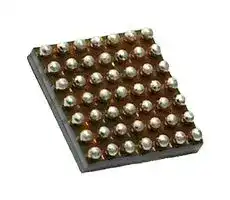


LTM8078IY
DC/DC POL Converter, Adjustable, Buck, 3 to 40V in, 0.8 to 10V / 1.4A Out, BGA-49
- Manufacturer: ANALOG DEVICES
- Product type: DC / DC Non Isolated Board Mount Converters - Adjustable Output
- SVHC: No SVHC (07-Jul-2017)
- Depth: 6.25mm
- Width: 6.25mm
- Height: 2.22mm
- Topology: Buck (Step Down)
- No. of Pins: 49Pins
- Product Range: LTM8078 Series
- No. of Outputs: 2 Output
- Output Current: 1.4A
- Output Power Max: -
- Input Voltage Max: 40V
- Input Voltage Min: 3V
- Output Current Max: 1.4A
- Output Voltage Max: 10V
- Output Voltage Min: 800mV
- Switching Frequency: 3MHz
- Input Voltage DC Max: 40V
- Input Voltage DC Min: 3V
- DC / DC Converter Type: BGA-49, Micro Module
- DC / DC Converter IC Case: BGA
- Operating Temperature Max: 125°C
- Power Supply Applications: Medical & Industrial
- DC / DC Converter Output Type: Adjustable
| Delivery and price | |
|---|---|
| Units per pack | 520 |
| Price | 16.63 € |
| Current stock | 50+ |
| Lead time | 30 days |

LTM8078 Dual 1.4A or Single 2.8A Step-Down Silent Switcher μModule Regulator ## **FEATURES** ## **DESCRIPTION** - n **Two Complete Step-Down Switching Power Supplies** - n **Low Noise Silent Switcher[®] Architecture** - n **CISPR22 Class B Compliant** - n **CISPR25 Class 5 Compliant** - n **Wide Input Voltage Range: 3V to 40V** - n **Wide Output Voltage Range: 0.8V to 10V** - n **1.4A Continuous Output Current per Channel at 24VIN, 3.3VOUT, TA = 85°C** - n **Multiphase Parallel Operation to Increase Current** - n Selectable Switching Frequency: 300kHz to 3MHz - n Compact Package (6.25mm × 6.25mm × 2.22mm) Surface Mount BGA - n AEC-Q104 Qualified (LTM8078#3PP) - n Automotive Production Flow (LTM8078#3PP) - n Automotive Grade Components (LTM8078#3PP) ## **APPLICATIONS** - n Automated Test Equipment - n Distributed Supply Regulation - n Industrial Supplies - n Medical Equipment **Click to view associated Video Design Idea.** The LTM[®] 8078 is 40VIN, dual 1.4A/single 2.8A step-down Silent Switcher μModule[®] regulator. The Silent Switcher architecture minimizes EMI while delivering high efficiency at frequencies up to 3MHz. Included in the package are the controllers, power switches, inductors, and support components. Operating over a wide input voltage range, the LTM8078 supports output voltages from 0.8V to 10V, and a switching frequency range of 300kHz to 3MHz, each set by a single resistor. Only the bulk input and output filter capacitors are needed to finish the design. The LTM8078 product video is available on website. LTM8078#3PP is an AEC-Q104 qualified automotive grade μModule regulator. The production is compliant to Analog Devices automotive assemble flow. All components integrated in the package are AEC-Q100 or AEC-Q200 qualified. The LTM8078 is packaged in a compact (6.25mm × 6.25mm × 2.22mm) over-molded Ball Grid Array (BGA) package suitable for automated assembly by standard surface mount equipment. The LTM8078 is available with SnPb (BGA) or RoHS compliant. All registered trademarks and trademarks are the property of their respective owners. ## **TYPICAL APPLICATION** **==> picture [458 x 210] intentionally omitted <==** **----- Start of picture text -----**<br> 3.3VOUT and 5VOUT from 7V to 40V Dual Step-Down Converter Efficiency, VIN = 24V, BIAS = 5V<br>95<br>7V TO 40VVIN VIN1<br>LTM8078<br>RUN<br>1µF VOUT1 V3.3VOUT1 90<br>1.4A<br>100µF<br>17.8k 78.7k 85<br>RT FB1<br>(1.6MHz)<br>GND<br>VOUT2 80<br>OM VOUT2 5V TA = 25°C<br>OMC BIAS 1.4A 3.3VOUT<br>5.0VOUT<br>47.5k 47 µF 75 0 0.5 1 1.5 2 2.5<br>VIN2 FB2 LOAD CURRENT (A)<br>8078 TA01b<br>1µF 8078 TA01a<br>PINS NOT USED:<br>TRSS1, TRSS2, PG1, PG2, CLKOUT, SYNC<br>EFFICIENCY (%)<br>**----- End of picture text -----**<br> Rev. B 1 For more information www.analog.com Document Feedback ## LTM8078 ## **ABSOLUTE MAXIMUM RATINGS** ## **PIN CONFIGURATION** ## **(Note 1)** VIN _n_ , RUN, PG _n_ ........................................................42V VOUT _n_ , BIAS .............................................................10V FB _n_ , OM, OMC, TRSS _n_ , RT ........................................4V SYNC ..........................................................................6V Maximum Internal Temperature (Note 2) .............. 125°C Storage Temperature ............................. –55°C to 125°C Peak Solder Reflow Package Body Temperature ..260°C **==> picture [176 x 231] intentionally omitted <==** **----- Start of picture text -----**<br> GND RT FB2 FB1 BIAS<br>7<br>BANK 2<br>TRSS2 TRSS1 OM OMC VOUT2<br>6<br>RUN<br>5<br>VIN2 BANK 3<br>4<br>VIN1 GND<br>3<br>PG2<br>2<br>BANK 1<br>PG1 SYNC CLKOUT VOUT1<br>1<br>A B C D E F G<br>BGA PACKAGE<br>49-PIN (6.25mm × 6.25mm × 2.22mm)<br>TJMAX = 125°C, θJA = 31.3°C/W, θJCtop = 30.5°C/W,<br>θJCbot = 10.6°C/W, WEIGHT = 0.23g<br>θ VALUES DETERMINED PER JESD 51-9, 51-12<br>**----- End of picture text -----**<br> ## **ORDER INFORMATION** |**PART NUMBER**|**PAD OR BALL FINISH**|**PART MARKING**|**PART MARKING**|**PACKAGE**<br>**TYPE**|**MSL**<br>**RATING**|**TEMPERATURE RANGE**<br>**(SEE NOTE 2)**| |---|---|---|---|---|---|---| |||**DEVICE**|**FINISH CODE**|||| |LTM8078EY#PBF|SAC305(RoHS)|8078|1|BGA|3|–40°C to 125°C| |LTM8078IY#PBF|SAC305(RoHS)|8078|1|BGA|3|–40°C to 125°C| |LTM8078IY#3PPPBF|SAC305(RoHS)|8078|1|BGA|4|–40°C to 125°C| |LTM8078IY|SnPb(63/37)|8078|0|BGA|3|–40°C to 125°C| - Device temperature grade is indicated by a label on the shipping container. - Pad or ball finish code is per IPC/JEDEC J-STD-609. - This product is not recommended for second side reflow. This product is moisture sensitive. For more information, go to Recommended BGA PCB Assembly and Manufacturing Procedures. - BGA Package and Tray Drawings Rev. B 2 For more information www.analog.com LTM8078 **ELECTRICAL CHARACTERISTICS The** l **denotes the specifications which apply over the specified operating internal temperature range, otherwise specifications are at TA = 25°C. VIN1 = VIN2 = 12V, RUN = 2V unless otherwise noted (Note 2).** |**PARAMETER**|**CONDITIONS**|**CONDITIONS**|**MIN**<br>**TYP**<br>**MAX**|**UNITS**| |---|---|---|---|---| |Minimum VIN1Input Voltage<br>Minimum VIN2Input Voltage|VIN1= 3V|l<br>l|3.0<br>2.0|V<br>V| |Output DC Voltage|FB_n_Open<br>FB_n_= 21.5k||0.8<br>10|V<br>V| |Maximum Output DC Current|(Note 3)||2.5|A| |Quiescent Current into VIN_n_|RUN = 0V<br>BIAS = 5V, SYNC = 0V, No Load<br>BIAS = 5V, SYNC = 3.3V, No Load||2<br>60<br>10<br>4|μA<br>µA<br>mA| |Current into BIAS|RUN = 0V, BIAS = 5V<br>BIAS = 5V, SYNC = 3.3V, No Load||7<br>1|μA<br>mA| |Line Regulation|5V < VIN_n_<40V, IOUT_n_= 0.5A||0.1|%| |Load Regulation|12VIN_n_, 0.1A < IOUT_n_< 2A||0.2|%| |Output RMS Ripple|3.3VOUT_n_||10|mV| |FB_n_Voltage||l|792<br>784<br>800<br>808<br>816|mV<br>mV| |Current out of FB_n_|VOUT_n_= 1V, FB_n_= 0V||4|µA| |Minimum BIAS for Proper Operation|||3.2|V| |Switching Frequency|RT= 113k<br>RT= 30.9k<br>RT= 7.15k||300<br>1<br>3|kHz<br>MHz<br>MHz| |RUN Threshold|||0.74|V| |RUN Input Current|RUN = 0V||1|μA| |PG_n_Threshold at FB_n_|FB_n_Rising<br>FB_n_Falling||740<br>860|mV<br>mV| |PG_n_Output Sink Current|PG_n_= 0.1V||100|μA| |CLKOUT VOL|||0|V| |CLKOUT VOH|||3.3|V| |SYNC Input High Threshold|||1.5|V| |SYNC Input Low Threshold|||0.8|V| |SYNC Threshold to Enable Spread Spectrum|||2.8<br>4|V| |SYNC Current|SYNC = 6V||65|μA| |TRSS_n_Source Current|TRSS_n_= 0V||2|μA| |TRSS_n_Pull-Down Resistance|Fault Condition, TRSS_n_= 0.1V||170|Ω| **Note 1:** Stresses beyond those listed under Absolute Maximum Ratings may cause permanent damage to the device. Exposure to any Absolute Maximum Rating condition for extended periods may affect device reliability and lifetime. **Note 2:** The LTM8078 is tested under pulsed load conditions such that TJ ≈ TA. The LTM8078E is guaranteed to meet performance specifications from 0°C to 125°C internal. Specifications over the full –40°C to 125°C internal operating temperature range are assured by design, characterization and correlation with statistical process controls. The LTM8078I is guaranteed to meet specifications over the full –40°C to 125°C internal operating temperature range. Although the LTM8078IY#3PP is qualified as an AEC-Q104 Grade 2 device, it is 100% tested and guaranteed to meet specifications over the full –40°C to 125°C internal operating temperature range. Note that the maximum internal temperature is determined by specific operating conditions in conjunction with board layout, the rated package thermal resistance and other environmental factors. Use output current derating curves as a guideline to determine the expected maximum output current that yields a maximum internal temperature of 125°C for a given ambient temperature. **Note 3:** The maximum current out of either channel may be limited by the internal temperature of the LTM8078. See output current derating curves for different VIN, VOUT and TA. Rev. B 3 For more information www.analog.com ## LTM8078 ## **TYPICAL PERFORMANCE CHARACTERISTICS** ## **TA = 25°C, operating per Table 1,unless otherwise noted.** **==> picture [514 x 621] intentionally omitted <==** **----- Start of picture text -----**<br> Efficiency, VOUT = 0.8V Efficiency, VOUT = 1.0V Efficiency, VOUT = 1.2V<br>BIAS = 5V BIAS = 5V BIAS = 5V<br>85 85 90<br>75 75 80<br>65 65 70<br>55 55 60<br>12VIN 12VIN 12VIN<br>24VIN 24VIN 24VIN<br>36VIN 36VIN 36VIN<br>45 45 50<br>0 0.5 1 1.5 2 2.5 0 0.5 1 1.5 2 2.5 0 0.5 1 1.5 2 2.5<br>LOAD CURRENT (A) LOAD CURRENT (A) LOAD CURRENT (A)<br>8078 G01 8078 G02 8078 G03<br>Efficiency, VOUT = 1.5V Efficiency, VOUT = 1.8V Efficiency, VOUT = 2.0V<br>BIAS = 5V BIAS = 5V BIAS = 5V<br>90 90 90<br>80 80 80<br>70 70 70<br>60 60 60<br>12VIN 12VIN 12VIN<br>24VIN 24VIN 24VIN<br>36VIN 36VIN 36VIN<br>50 50 50<br>0 0.5 1 1.5 2 2.5 0 0.5 1 1.5 2 2.5 0 0.5 1 1.5 2 2.5<br>LOAD CURRENT (A) LOAD CURRENT (A) LOAD CURRENT (A)<br>8078 G04 8078 G05 8078 G06<br>Efficiency, VOUT = 2.5V Efficiency, VOUT = 3.3V Efficiency, VOUT = 3.3V<br>BIAS = 5V BIAS = 5V BIAS = 5V, fSW = 2MHz<br>95 95 95<br>85 85 85<br>75 75 75<br>65 65 65<br>12VIN 12VIN 12VIN<br>24VIN 24VIN 24VIN<br>36VIN 36VIN 36VIN<br>55 55 55<br>0 0.5 1 1.5 2 2.5 0 0.5 1 1.5 2 2.5 0 0.5 1 1.5 2 2.5<br>LOAD CURRENT (A) LOAD CURRENT (A) LOAD CURRENT (A)<br>8078 G07 8078 G08 8078 G09<br>Rev. B<br>EFFICIENCY (%) EFFICIENCY (%) EFFICIENCY (%)<br>EFFICIENCY (%) EFFICIENCY (%) EFFICIENCY (%)<br>EFFICIENCY (%) EFFICIENCY (%) EFFICIENCY (%)<br>**----- End of picture text -----**<br> 4 For more information www.analog.com LTM8078 ## **TYPICAL PERFORMANCE CHARACTERISTICS** **TA = 25°C, operating per Table 1,unless otherwise noted.** **==> picture [526 x 656] intentionally omitted <==** **----- Start of picture text -----**<br> Efficiency, VOUT = 5V Efficiency, VOUT = 5V Efficiency, VOUT = 8V<br>BIAS = 5V BIAS = 5V, fSW = 2MHz BIAS = 5V<br>95 95 100<br>85 85 90<br>75 75 80<br>65 65 70<br>12VIN 12VIN 12VIN<br>24VIN 24VIN 24VIN<br>36VIN 36VIN 36VIN<br>55 55 60<br>0 0.5 1 1.5 2 2.5 0 0.5 1 1.5 2 2.5 0 0.5 1 1.5 2 2.5<br>LOAD CURRENT (A) LOAD CURRENT (A) LOAD CURRENT (A)<br>8078 G10 8078 G11 8078 G12<br>Efficiency, VOUT = 10V Power Loss, VOUT = 0.8V Power Loss, VOUT = 1V<br>BIAS = 5V BIAS = 5V, Burst Mode Operation BIAS = 5V, Burst Mode Operation<br>100 2.0 2.0<br>12VIN 12VIN<br>24VIN 24VIN<br>36VIN 36VIN<br>90 1.5 1.5<br>80 1.0 1.0<br>70 0.5 0.5<br>12VIN<br>24VIN<br>36VIN<br>60 0 0<br>0 0.5 1 1.5 2 2.5 0 0.5 1 1.5 2 2.5 0 0.5 1 1.5 2 2.5<br>LOAD CURRENT (A) LOAD CURRENT (A) LOAD CURRENT (A)<br>8078 G13 8078 G14 8078 G15<br>Power Loss, VOUT = 1.2V Power Loss, VOUT = 1.5V Power Loss, VOUT = 1.8V<br>BIAS = 5V, Burst Mode Operation BIAS = 5V, Burst Mode Operation BIAS = 5V, Burst Mode Operation<br>2.0 2.0 2.0<br>12VIN 12VIN 12VIN<br>24VIN 24VIN 24VIN<br>36VIN 36VIN 36VIN<br>1.5 1.5 1.5<br>1.0 1.0 1.0<br>0.5 0.5 0.5<br>0 0 0<br>0 0.5 1 1.5 2 2.5 0 0.5 1 1.5 2 2.5 0 0.5 1 1.5 2 2.5<br>LOAD CURRENT (A) LOAD CURRENT (A) LOAD CURRENT (A)<br>8078 G16 8078 G17 8078 G18<br>Rev. B<br>For more information www.analog.com 5<br>EFFICIENCY (%) EFFICIENCY (%) EFFICIENCY (%)<br>EFFICIENCY (%) POWER LOSS (W) POWER LOSS (W)<br>POWER LOSS (W) POWER LOSS (W) POWER LOSS (W)<br>**----- End of picture text -----**<br> LTM8078 ## **TYPICAL PERFORMANCE CHARACTERISTICS** ## **TA = 25°C, operating per Table 1,unless otherwise noted.** **==> picture [516 x 621] intentionally omitted <==** **----- Start of picture text -----**<br> Power Loss, VOUT = 2V Power Loss, VOUT = 2.5V Power Loss, VOUT = 3.3V<br>BIAS = 5V, Burst Mode Operation BIAS = 5V, Burst Mode Operation BIAS = 5V, Burst Mode Operation<br>2.0 2.0 2.5<br>12VIN 12VIN 12VIN<br>24VIN 24VIN 24VIN<br>36VIN 36VIN 2.0 36V IN<br>1.5 1.5<br>1.5<br>1.0 1.0<br>1.0<br>0.5 0.5<br>0.5<br>0 0 0<br>0 0.5 1 1.5 2 2.5 0 0.5 1 1.5 2 2.5 0 0.5 1 1.5 2 2.5<br>LOAD CURRENT (A) LOAD CURRENT (A) LOAD CURRENT (A)<br>8078 G19 8078 G20 8078 G21<br>Power Loss, VOUT = 3.3V, 2MHz Power Loss, VOUT = 5V Power Loss, VOUT = 5V, 2MHz<br>BIAS = 5V, Burst Mode Operation BIAS = 5V, Burst Mode Operation BIAS = 5V, Burst Mode Operation<br>2.5 2.5 2.5<br>12VIN 12VIN 12VIN<br>24VIN 24VIN 24VIN<br>2.0 36V IN 2.0 36V IN 2.0 36V IN<br>1.5 1.5 1.5<br>1.0 1.0 1.0<br>0.5 0.5 0.5<br>0 0 0<br>0 0.5 1 1.5 2 2.5 0 0.5 1 1.5 2 2.5 0 0.5 1 1.5 2 2.5<br>LOAD CURRENT (A) LOAD CURRENT (A) LOAD CURRENT (A)<br>8078 G22 8078 G23 8078 G24<br>Power Loss, VOUT = 8V Power Loss, VOUT = 10V Input vs Load Current<br>BIAS = 5V, Burst Mode Operation BIAS = 5V, Burst Mode Operation VOUT = 0.8V<br>3.0 3.0 0.3<br>12VIN 12VIN 12VIN<br>24VIN 24VIN 24VIN<br>2.5 36V IN 2.5 36V IN 36VIN<br>2.0 2.0 0.2<br>1.5 1.5<br>1.0 1.0 0.1<br>0.5 0.5<br>0 0 0<br>0 0.5 1 1.5 2 2.5 0 0.5 1 1.5 2 2.5 0 0.5 1 1.5 2 2.5<br>LOAD CURRENT (A) LOAD CURRENT (A) LOAD CURRENT (A)<br>8078 G25 8078 G26 8078 G27<br>Rev. B<br>POWER LOSS (W) POWER LOSS (W) POWER LOSS (W)<br>POWER LOSS (W) POWER LOSS (W) POWER LOSS (W)<br>POWER LOSS (W) POWER LOSS (W) INPUT CURRENT (A)<br>**----- End of picture text -----**<br> 6 For more information www.analog.com LTM8078 ## **TYPICAL PERFORMANCE CHARACTERISTICS** **TA = 25°C, operating per Table 1,unless otherwise noted.** **==> picture [518 x 621] intentionally omitted <==** **----- Start of picture text -----**<br> Input vs Load Current Input vs Load Current Input vs Load Current<br>VOUT = 1V VOUT = 1.2V VOUT = 1.5V<br>0.4 0.4 0.6<br>12VIN 12VIN 12VIN<br>24VIN 24VIN 24VIN<br>36VIN 36VIN 36VIN<br>0.3 0.3<br>0.4<br>0.2 0.2<br>0.2<br>0.1 0.1<br>0 0 0<br>0 0.5 1 1.5 2 2.5 0 0.5 1 1.5 2 2.5 0 0.5 1 1.5 2 2.5<br>LOAD CURRENT (A) LOAD CURRENT (A) LOAD CURRENT (A)<br>8078 G28 8078 G29 8078 G30<br>Input vs Load Current Input vs Load Current Input vs Load Current<br>VOUT = 1.8V VOUT = 2V VOUT = 2.5V<br>0.6 0.6 0.8<br>12VIN 12VIN 12VIN<br>24VIN 24VIN 24VIN<br>36VIN 36VIN 36VIN<br>0.6<br>0.4 0.4<br>0.4<br>0.2 0.2<br>0.2<br>0 0 0<br>0 0.5 1 1.5 2 2.5 0 0.5 1 1.5 2 2.5 0 0.5 1 1.5 2 2.5<br>LOAD CURRENT (A) LOAD CURRENT (A) LOAD CURRENT (A)<br>8078 G31 8078 G32 8078 G33<br>Input vs Load Current Input vs Load Current Input vs Load Current<br>VOUT = 3.3V VOUT = 5V VOUT = 8V<br>1.00 1.2 2.0<br>12VIN 12VIN 12VIN<br>24VIN 24VIN 24VIN<br>36VIN 36VIN 36VIN<br>0.75 0.9 1.5<br>0.50 0.6 1.0<br>0.25 0.3 0.5<br>0 0 0<br>0 0.5 1 1.5 2 2.5 0 0.5 1 1.5 2 2.5 0 0.5 1 1.5 2 2.5<br>LOAD CURRENT (A) LOAD CURRENT (A) LOAD CURRENT (A)<br>8078 G34 8078 G35 8078 G36<br>Rev. B<br>INPUT CURRENT (A) INPUT CURRENT (A) INPUT CURRENT (A)<br>INPUT CURRENT (A) INPUT CURRENT (A) INPUT CURRENT (A)<br>INPUT CURRENT (A) INPUT CURRENT (A) INPUT CURRENT (A)<br>**----- End of picture text -----**<br> 7 For more information www.analog.com LTM8078 ## **TYPICAL PERFORMANCE CHARACTERISTICS** ## **TA = 25°C, operating per Table 1,unless otherwise noted.** **==> picture [515 x 621] intentionally omitted <==** **----- Start of picture text -----**<br> Input vs Load Current Input Current vs VIN Dropout Voltage vs Load Current<br>VOUT = 10V VOUT Short Circuited VOUT = 5V, BIAS = 5V<br>2.4 2000 1600<br>12VIN<br>24VIN<br>36VIN<br>1.8 1500 1200<br>1.2 1000 800<br>0.6 500 400<br>0 0 0<br>0 0.5 1 1.5 2 2.5 0 10 20 30 40 0 0.5 1 1.5 2 2.5<br>LOAD CURRENT (A) VIN (V) LOAD CURRENT (A)<br>8078 G37 8078 G38 8078 G39<br>BIAS Current vs Frequency Derating, VOUT = 0.8V Derating, VOUT = 1.0V,<br>VIN = 12V, VOUT = 3.3V, BIAS = 5V BIAS = 5V, DC2777A Demo Board BIAS = 5V, DC2777A Demo Board<br>Forced Continuous Mode Both Channels at Same Load Both Channels at Same Load<br>15 2.5 2.5<br>12 2.0 2.0<br>9 1.5 1.5<br>6 1.0 1.0<br>0LFM 0LFM<br>3 0.5 12VIN 0.5 12VIN<br>24VIN 24VIN<br>36VIN 36VIN<br>0 0 0<br>0 1 2 3 0 25 50 75 100 125 0 25 50 75 100 125<br>SWITCHING FREQUENCY (MHz) AMBIENT TEMPERATURE (°C) AMBIENT TEMPERATURE (°C)<br>8078 G40 8078 G41 8078 G42<br>Derating, VOUT = 1.2V Derating, VOUT = 1.5V Derating, VOUT = 1.8V,<br>BIAS = 5V, DC2777A Demo Board BIAS = 5V, DC2777A Demo Board BIAS = 5V, DC2777A Demo Board<br>Both Channels at Same Load Both Channels at Same Load Both Channels at Same Load<br>2.5 2.5 2.5<br>2.0 2.0 2.0<br>1.5 1.5 1.5<br>1.0 1.0 1.0<br>0LFM 0LFM 0LFM<br>0.5 0.5 0.5<br>12VIN 12VIN 12VIN<br>24VIN 24VIN 24VIN<br>36VIN 36VIN 36VIN<br>0 0 0<br>0 25 50 75 100 125 0 25 50 75 100 125 0 25 50 75 100 125<br>AMBIENT TEMPERATURE (°C) AMBIENT TEMPERATURE (°C) AMBIENT TEMPERATURE (°C)<br>8078 G43 8078 G44 8078 G45<br>Rev. B<br>INPUT CURRENT (A) INPUT CURRENT (mA)<br>DROPOUT VOLTAGE (mV)<br>BIAS CURRENT (mA)<br>MAXIMUM LOAD CURRENT PER CHANNEL (A) MAXIMUM LOAD CURRENT PER CHANNEL (A)<br>MAXIMUM LOAD CURRENT PER CHANNEL (A) MAXIMUM LOAD CURRENT PER CHANNEL (A) MAXIMUM LOAD CURRENT PER CHANNEL (A)<br>**----- End of picture text -----**<br> 8 For more information www.analog.com LTM8078 ## **TYPICAL PERFORMANCE CHARACTERISTICS** **TA = 25°C, operating per Table 1,unless otherwise noted.** **==> picture [516 x 632] intentionally omitted <==** **----- Start of picture text -----**<br> Derating, VOUT = 2.0V, Derating, VOUT = 2.5V, Derating, VOUT = 3.3V,<br>BIAS = 5V, DC2777A Demo Board BIAS = 5V, DC2777A Demo Board BIAS = 5V, DC2777A Demo Board<br>Both Channels at Same Load Both Channels at Same Load Both Channels at Same Load<br>2.5 2.5 2.5<br>2.0 2.0 2.0<br>1.5 1.5 1.5<br>1.0 1.0 1.0<br>0LFM 0LFM 0LFM<br>0.5 12V 24V36V IN ININ 0.5 12V 24V36VINININ 0.5 12V 24V36VINININ<br>0 0 0<br>0 25 50 75 100 125 0 25 50 75 100 125 0 25 50 75 100 125<br>AMBIENT TEMPERATURE (°C) AMBIENT TEMPERATURE (°C) AMBIENT TEMPERATURE (°C)<br>8078 G46 8078 G47 8078 G48<br>Derating, VOUT = 3.3V, BIAS = 5V, Derating, VOUT = 5V, Derating, VOUT = 5V<br>DC2777A Demo Board Both Channels BIAS = 5V, DC2777A Demo Board BIAS = 5V, DC2777A Demo Board<br>at Same Load, fSW = 2MHz Both Channels at Same Load Both Channels at Same Load<br>2.5 2.5 2.5<br>2.0 2.0 2.0<br>1.5 1.5 1.5<br>1.0 1.0 1.0<br>0LFM 0 LFM<br>fSW = 2MHz 0LFM fSW = 2MHz<br>0.5 12VIN 0.5 12V IN 0.5 12VIN<br>24VIN 24VIN 24VIN<br>36VIN 36VIN 36VIN<br>0 0 0<br>0 25 50 75 100 125 0 25 50 75 100 125 0 25 50 75 100 125<br>AMBIENT TEMPERATURE (°C) AMBIENT TEMPERATURE (°C) AMBIENT TEMPERATURE (°C)<br>8078 G49 8078 G50 8078 G51<br>Derating, VOUT = 8V Derating, VOUT = 10V Derating, VIN = 12V, VOUT = 1.5V<br>BIAS = 5V, DC2777A Demo Board BIAS = 5V, DC2777A Demo Board BIAS = 5V, DC2777A Demo Board<br>Both Channels at Same Load Both Channels at Same Load Both Channels at Same Load<br>2.5 2.5 2.5<br>2.0 2.0 2.0<br>1.5 1.5 1.5<br>1.0 1.0 1.0<br>0LFM 0LFM<br>0.5 12V IN 0.5 12V IN 0.5<br>24VIN 24VIN 0LFM<br>36VIN 36VIN 400LFM<br>0 0 0<br>0 25 50 75 100 125 0 25 50 75 100 125 0 25 50 75 100 125<br>AMBIENT TEMPERATURE (°C) AMBIENT TEMPERATURE (°C) AMBIENT TEMPERATURE (°C)<br>8078 G52 8078 G53 8078 G54<br>Rev. B<br>MAXIMUM LOAD CURRENT PER CHANNEL (A) MAXIMUM LOAD CURRENT PER CHANNEL (A) MAXIMUM LOAD CURRENT PER CHANNEL (A)<br>MAXIMUM LOAD CURRENT PER CHANNEL (A) MAXIMUM LOAD CURRENT PER CHANNEL (A) MAXIMUM LOAD CURRENT PER CHANNEL (A)<br>MAXIMUM LOAD CURRENT PER CHANNEL (A) MAXIMUM LOAD CURRENT PER CHANNEL (A) MAXIMUM LOAD CURRENT PER CHANNEL (A)<br>**----- End of picture text -----**<br> 9 For more information www.analog.com LTM8078 ## **TYPICAL PERFORMANCE CHARACTERISTICS** **TA = 25°C, operating per Table 1,unless otherwise noted.** **==> picture [513 x 623] intentionally omitted <==** **----- Start of picture text -----**<br> Derating, VIN = 24V, VOUT = 1.5V Derating, VIN = 36V, VOUT = 1.5V Derating, VIN = 12V, VOUT = 3.3V<br>BIAS = 5V, DC2777A Demo Board BIAS = 5V, DC2777A Demo Board BIAS = 5V, DC2777A Demo Board<br> Both Channels at Same Load Both Channels at Same Load Both Channels at Same Load<br>2.5 2.5 2.5<br>2.0 2.0 2.0<br>TT) Eo oo<br>1.5 1.5 1.5<br>CTR) PORE) FER<br>1.0 1.0 1.0<br>PONG) EEN EEN<br>0.5 POPPA 0.5 Eee) 0.5 Eee<br>0LFM 0LFM 0LFM<br>400LFM 400LFM 400LFM<br>0 e OOO 0 EoCeo 0 ESE<br>0 25 50 75 100 125 0 25 50 75 100 125 0 25 50 75 100 125<br>AMBIENT TEMPERATURE (°C) AMBIENT TEMPERATURE (°C) AMBIENT TEMPERATURE (°C)<br>8078 G55 8078 G56 8078 G57<br>Derating, VIN = 24V, VOUT = 3.3V Derating, VIN = 36V, VOUT = 3.3V<br>BIAS = 5V, DC2777A Demo Board BIAS = 5V, DC2777A Demo Board<br>Both Channels at Same Load Both Channels at Same Load<br>2.5 2.5<br>2.0 TT 2.0 TT<br>1.5 TT 1.5 TEAC<br>1.0 1.0<br>OEE San<br>0.5 aan 0.5 aa7am<br>0LFM 0LFM<br>400LFM 400LFM<br>0 = Coe 0 =Cor<br>0 25 50 75 100 125 0 25 50 75 100 125<br>AMBIENT TEMPERATURE (°C) AMBIENT TEMPERATURE (°C)<br>8078 G58 8078 G59<br>CISPR22 Class B Emissions<br>24VIN, fSW = 1.6MHz<br>5VOUT1 at 1.4A, 3.3VOUT2 at 1.4A Output Voltage Ripple DC2777A<br>Spread Spectrum On, No EMI Filter Demo Board<br>70<br>HORIZONTAL<br>60 VERTICAL<br>CLASS B 3M RADIATED LIMIT<br>50<br>40 5mV/DIV<br>AC-COUPLED<br>30<br>ot [||]<br>20<br>| Aah<br>10<br>8078 G61<br>0 |Wet Hn 1µs/DIV<br>–10 VIN = 12V, VOUT = 3.3V<br>0 | ot 200 400 | 600 || | 800 1000 IOUT = 1.4A, fSW = 1.2MHz<br>FREQUENCY (MHz)<br>8078 G60<br>MAXIMUM LOAD CURRENT PER CHANNEL (A) MAXIMUM LOAD CURRENT PER CHANNEL (A) MAXIMUM LOAD CURRENT PER CHANNEL (A)<br>MAXIMUM LOAD CURRENT PER CHANNEL (A) MAXIMUM LOAD CURRENT PER CHANNEL (A)<br>AMPLITUDE (dBuV/m)<br>**----- End of picture text -----**<br> Rev. B 10 For more information www.analog.com LTM8078 ## **TYPICAL PERFORMANCE CHARACTERISTICS** **TA = 25°C, operating per Table 1,unless otherwise noted.** **==> picture [517 x 463] intentionally omitted <==** **----- Start of picture text -----**<br> Output Noise Spectrum DC2777A, Output Noise Spectrum DC2777A, Output Noise Spectrum DC2777A,<br>100kHz Span 10MHz Span 500MHz Span<br>VIN = 12V, VOUT = 3.3V VIN = 12V, VOUT = 3.3V VIN = 12V, VOUT = 3.3V<br>IOUT = 1.4A, fSW = 1.2MHz IOUT = 1.4A, fSW = 1.2MHz IOUT = 1.4A, fSW = 1.2MHz<br>100 100 100<br>90 90 90<br>80 80 80<br>70 70 70<br>60 60 60<br>50 50 50<br>40 40 40<br>30 30 30<br>20 20 20<br>10 10 10<br>0 0 0<br>–10 –10 –10<br>–20 –20 –20<br>10 20 30 40 50 60 70 80 90 100 0 1 2 3 4 5 6 7 8 9 10 0 100 200 300 400 500<br>FREQUENCY (kHz) FREQUENCY (MHz) FREQUENCY (MHz)<br>8078 G62 8078 G63 8078 G64<br>Radiated EMI Performance (CISPR25 Radiated Radiated EMI Performance (CISPR25 Radiated<br>Emission Test with Class 5 Peak Limits) Emission Test with Class 5 Average Limits)<br>50 40<br>45 35<br>40 30<br>35 25<br>30 20<br>25 15<br>20 10<br>15 5<br>10 0<br>CLASS 5 PEAK LIMIT CLASS 5 AVERAGE LIMIT<br>5 SPREAD SPECTURM MODE –5 SPREAD SPECTRUM MODE<br>FIXED FREQUENCY MODE FIXED FREQUENCY MODE<br>0 –10<br>0 200 400 600 800 1000 0 200 400 600 800 1000<br>FREQUENCY (MHz) FREQUENCY (MHz)<br>DC2777A DEMO BOARD 8078 G65 DC2777A DEMO BOARD 8078 G66<br>VIN = 12V, VOUT = 3.3V VIN = 12V, VOUT = 3.3V<br>TWO CHANNELS PARALLELED, IOUT = 2.8A, fSW = 1MHz TWO CHANNELS PARALLELED, IOUT = 2.8A, fSW = 1MHz<br>OUTPUT NOISE (dBuV) OUTPUT NOISE (dBuV) OUTPUT NOISE (dBuV)<br>AMPLITUDE (dBuV/m) AMPLITUDE (dBuV/m)<br>**----- End of picture text -----**<br> **==> picture [18 x 6] intentionally omitted <==** **----- Start of picture text -----**<br> Rev. B<br>**----- End of picture text -----**<br> 11 For more information www.analog.com LTM8078 ## **PIN FUNCTIONS** **VOUT1/VOUT2 (Banks 1 and 2):** Power Output for channels 1 and 2, Respectively. Apply the output filter capacitor and the output load between these pins and GND pins. **GND (Bank 3, Pin A7):** Tie these GND pins to a local ground plane below the LTM8078 and the circuit components. In most applications, the bulk of the heat flow out of the LTM8078 is through these pads, so the printed circuit design has a large impact on the thermal performance of the part. See the PCB Layout and Thermal Considerations sections for more details. Return the feedback divider (RFB) to this net. **VIN1 (Pin A3):** Input Power for the Channel 1 Regulator. The VIN1 bank powers the internal control circuitry for both channels and is monitored by under voltage lockout circuitry. The VIN1 voltage must be greater than 3.0V for either channel of the LTM8078 to operate. Decouple VIN1 to ground with an external, low ESR capacitor. See Table 1 for recommended values. **VIN2 (Pin A4):** Input Power for the Channel 2 Regulator. The VIN2 pin is monitored by under voltage lockout circuitry. The VIN1 voltage must be greater than 3.0V and VIN2 must be greater than 2V for proper VIN2 operation. Decouple VIN2 to ground with an external, low ESR capacitor. See Table 1 for recommended values. **RUN (Pin A5):** The LTM8078 is shut down when this pin is low and active when this pin is high. Tie to VIN _n_ if shutdown feature is not used. An external resistor divider from VIN _n_ can be used to program a VIN _n_ threshold below which the corresponding channel of the LTM8078 will shut down. Do not float this pin. **PG1/PG2 (Pins B1, A2):** The PG _n_ pins are the open-drain outputs of an internal comparator. PG _n_ remains low until the FB _n_ pin is within ±7.5% of the final regulation voltage, and there are no fault conditions. PG _n_ is pulled low during VIN1 UVLO, VIN2 UVLO, thermal shutdown, or when the RUN pin is low. **TRSS1/TRSS2 (Pin B6, A6):** Output Tracking and SoftStart Pins. These pins allow user control of the output voltage ramp rate during startup. A TRSS _n_ voltage below 0.8V forces the LTM8078 to regulate the FB _n_ pin to equal the TRSS _n_ pin voltage. When TRSS _n_ is above 0.8V, the tracking function is disabled and the internal reference resumes control of the error amplifier. An internal 2μA pull-up current on this pin allows a capacitor to program output voltage slew rate. This pin is pulled to ground during shutdown and fault conditions; use a series resistor if driving from a low impedance output. This pin may be left floating if the soft-start feature is not being used. **RT (Pin B7):** Connect a resistor between RT and ground to set the switching frequency of both channels. Do not drive this pin. **SYNC (Pin C1):** External Clock Synchronization Input. Ground this pin for low ripple Burst Mode operation at low output loads; this will also disable the CLKOUT function. Apply a DC voltage between 2.8V and 4V for spread spectrum modulation. Float the SYNC pin for forced continuous operation without spread spectrum modulation. Apply a clock source to the SYNC pin for synchronization to an external frequency. The LTM8078 will be in forced continuous mode when an external frequency is applied. **OM (Pin C6):** Output Mode. Tie this pin to the adjacent OMC pin when the two LTM8078 outputs are regulating at different voltages. Float this pin when the two LTM8078 outputs are in parallel. **CLKOUT (Pin D1):** Synchronization Output. When SYNC > 2.8V, the CLKOUT pin provides a waveform about 90 degrees out-of-phase with Channel 1. This allows synchronization with other regulators with up to four phases. When an external clock is applied to the SYNC pin, the CLKOUT pin will output a waveform with about the same phase, duty cycle, and frequency as the SYNC waveform. In Burst Mode operation, the CLKOUT pin will be internally grounded. Float this pin if the CLKOUT function is not used. Do not drive this pin. Rev. B 12 For more information www.analog.com LTM8078 ## **PIN FUNCTIONS** **OMC (Pin D6):** Output Mode Control. Float this pin when the two outputs of the LTM8078 are load sharing. Connect this pin to the OMC pin of other LTM8078s when multiple LTM8078s are load sharing. When not load sharing, tie this pin to the adjacent OM pin. That is, when the VOUT1 and VOUT2 are independent voltages, connect OM to OMC. If VOUT1 and VOUT2 are independent and OM and OMC are not connected together, the LTM8078 will not regulate properly. **FB1/FB2 (Pins D7, C7):** The LTM8078 regulates the FB _n_ pins to 800mV. Connect the feedback resistor to this pin to set the output voltage. **BIAS (Pin E7):** The internal regulator will draw current from BIAS instead of VIN1 when BIAS is tied to a voltage higher than 3.2V. For output voltages of 3.3V and above this pin should be tied to VOUT. If this pin is tied to a supply other than VOUT connect a local bypass capacitor to this pin. ## **BLOCK DIAGRAM** **==> picture [317 x 297] intentionally omitted <==** **----- Start of picture text -----**<br> VIN1<br>HOUSEKEEPING<br>0.2µF CIRCUITRY<br>RUN CURRENT 2.2µH VOUT1<br>MODE<br>CONTROLLER<br>TRSS1 249k 10pF<br>±1% 3.3nF<br>FB1<br>SYNC UVLO<br>PG1<br>RT<br>PG2<br>VIN2<br>CLKOUT<br>0.1µF<br>CURRENT 2.2µH VOUT2<br>MODE<br>TRSS2 CONTROLLER<br>249k 10pF BIAS<br>±1% 3.3nF<br>FB2<br>OMC<br>GND<br>OM<br>8078 BD<br>**----- End of picture text -----**<br> Rev. B 13 For more information www.analog.com LTM8078 ## **OPERATION** The LTM8078 is a dual standalone non-isolated stepdown switching DC/DC power supply that can deliver a peak current of up to 2.5A per channel. The continuous current is determined by the internal operating temperature. It provides a precisely regulated output voltage programmable via one external resistor from 0.8V to 10V. The input voltage range for channel 1 is 3V to 40V, while the input voltage range for channel 2 is 2V to 40V. VIN1 must be 3V or above for either channel to operate. Given that the LTM8078 is a step-down converter, make sure that the input voltage is high enough to support the desired output voltage and load current. See simplified Block Diagram. The LTM8078 contains two current mode controllers, power switching elements, power inductors and a modest amount of input and output capacitance. The LTM8078 is a fixed frequency PWM regulator. The switching frequency is set by simply connecting the appropriate resistor value from the RT pin to GND. An internal regulator provides power to the control circuitry. This bias regulator normally draws power from the VIN1 pin, but if the BIAS pin is connected to an external voltage higher than 3.2V, bias power is drawn from the external source (typically the regulated output voltage). This improves efficiency. Tie BIAS to GND if it is not used. The TRSS _n_ node acts as an auxiliary input to the error amplifier. The voltage at FB servos to the TRSS voltage until TRSS goes above 0.8V. Soft-start is implemented by generating a voltage ramp at the TRSS pin using an external capacitor which is charged by an internal constant current. Alternatively, driving the TRSS pin with a signal source or resistive network provides a tracking function. Do not drive the TRSS pin with a low impedance voltage source. See the Applications Information section for more details. The LTM8078 contains a power good comparator which trips when the FB _n_ pin is at about 92% to 108% of its regulated value. The PG _n_ output is an open-drain transistor that is off when the output is in regulation, allowing an external resistor to pull the PG _n_ pin high. The PG1 signal is valid when VIN1 is above 3V. Similarly, the PG2 signal is valid when VIN2 is above 2V. The LTM8078 is equipped with a thermal shutdown that inhibits power switching at high junction temperatures. The activation threshold of this function is above the maximum temperature rating to avoid interfering with normal operation, so prolonged or repetitive operation under a condition in which the thermal shutdown activates may damage or impair the reliability of the device. To enhance efficiency, the LTM8078 automatically switches to Burst Mode[®] operation in light or no load situations. Between bursts, all circuitry associated with controlling the output switch is shut down reducing the input supply current to just a few µA. Rev. B 14 For more information www.analog.com LTM8078 ## **APPLICATIONS INFORMATION** For most applications, the design process is straightforward, summarized as follows: 1. Look at Table 1 and find the row that has the desired input range and output voltage. 2. Apply the recommended CIN, COUT, RFB and RT values. 3. Connect BIAS as indicated. When using the LTM8078 with two different output voltages, the higher frequency recommended by Table 1 will usually result in the best operation. While these component combinations have been tested for proper operation, it is incumbent upon the user to verify proper operation over the intended system’s line, load and environmental conditions. Bear in mind that the maximum output current is limited by junction temperature, the relationship between the input and output voltage magnitude and other factors. Please refer to the graphs in the Typical Performance Characteristics section for guidance. The maximum frequency (and attendant RT value) at which the LTM8078 should be allowed to switch is given in Table 1 in the Maximum fSW column, while the recommended frequency (and RT value) for optimal efficiency over the given input condition is given in the fSW column. There are additional conditions that must be satisfied if the synchronization function is used. Please refer to the Synchronization section for details. ## **Capacitor Selection Considerations** The CIN and COUT capacitor values in Table 1 are the minimum recommended values for the associated operating conditions. Applying capacitor values below those indicated in Table 1 is not recommended and may result in undesirable operation. Using larger values is generally acceptable, and can yield improved dynamic response. Again, it is incumbent upon the user to verify proper operation over the intended system’s line, load and environmental conditions. Ceramic capacitors are small, robust and have very low ESR. However, not all ceramic capacitors are suitable. X5R and X7R types are stable over temperature and applied voltage and give dependable service. Other types, including Y5V and Z5U have very large temperature and voltage coefficients of capacitance. In an application circuit they may have only a small fraction of their nominal capacitance resulting in much higher output voltage ripple than expected. Ceramic capacitors are also piezoelectric. In Burst Mode operation, the LTM8078’s switching frequency depends on the load current, and can excite a ceramic capacitor at audio frequencies, generating audible noise. Since the LTM8078 operates at a lower current limit during Burst Mode operation, the noise is typically very quiet to the casual ear. **Table 1. Recommended Component Values and Configuration (TA = 25°C)** |**VIN***|**VOUT**|**RFB**<br>**(kΩ)**|**CIN****|**COUT**|**BIAS**|**fSW**<br>**(kHz)**|**RT **<br>**(kΩ)**|**MAX fSW**<br>**(MHz)**|**MIN RT **<br>**(kΩ)**| |---|---|---|---|---|---|---|---|---|---| |3V to 40V|0.8V|Open|1µF 50V X5R 0805|100µF ×2 4V X5R 0805|3.2V to 10V|500|68.1|1.2|24.9| |3V to 40V|1V|1000|1µF 50V X5R 0805|100µF ×2 4V X5R 0805|3.2V to 10V|600|54.9|1.4|21.0| |3V to 40V|1.2V|499|1µF 50V X5R 0805|100µF ×2 4V X5R 0805|3.2V to 10V|700|46.4|1.4|21.0| |3.2V to 40V|1.5V|287|1µF 50V X5R 0805|100µF 4V X5R 0805|3.2V to 10V|900|34.8|1.4|21.0| |3.2V to 40V|1.8V|200|1µF 50V X5R 0805|100µF 4V X5R 0805|3.2V to 10V|900|34.8|1.8|15.0| |3.6V to 40V|2V|165|1µF 50V X5R 0603|100µF 4V X5R 0805|3.2V to 10V|1000|30.9|1.8|15.0| |4.2V to 40V|2.5V|118|1µF 50V X5R 0603|47µF 4V X5R 0805|3.2V to 10V|1100|28.0|2|13.3| |5V to 40V|3.3V|78.7|1µF 50V X5R 0603|22µF 6.3V X5R 0805|3.2V to 10V|1200|24.9|2.8|8.06| |7V to 40V|5V|47.5|1µF 50V X5R 0603|10µF 6.3V X7R 0603|3.2V to 10V|1400|21.0|3|7.15| |10.5V to 40V|8V|27.4|1µF 50V X5R 0805|10µF 10V X5R 0805|3.2V to 10V|2000|13.3|3|7.15| |12V to 40V|10V|21.5|1µF 50V X5R 0805|10µF 16V X5R 1206|3.2V to 10V|2200|11.5|3|7.15| *The LTM8078 may be capable of the operating at lower input voltages but may skip switching cycles. **A bulk input capacitor is required. Rev. B 15 For more information www.analog.com LTM8078 ## **APPLICATIONS INFORMATION** If this audible noise is unacceptable, use a high performance electrolytic capacitor at the output. It may also be a parallel combination of a ceramic capacitor and a low cost electrolytic capacitor. A final precaution regarding ceramic capacitors concerns the maximum input voltage rating of the LTM8078. A ceramic input capacitor combined with trace or cable inductance forms a high-Q (underdamped) tank circuit. If the LTM8078 circuit is plugged into a live supply, the input voltage can ring to twice its nominal value, possibly exceeding the device’s rating. This situation is easily avoided; see the Hot-Plugging Safely section. ## **Frequency Selection** The LTM8078 uses a constant frequency PWM architecture that can be programmed to switch from 300kHz to 3MHz by using a resistor tied from the RT pin to ground. Table 2 provides a list of RT resistor values and their resultant frequencies. The resistors in the table are standard 1% E96 values. **Table 2. Switching Frequency vs RT Value** |**Table 2. Switching Frequency vs**|**RT Value**| |---|---| |**fSW**<br>**(MHz)**|**RT**<br>**(kΩ)**| |0.3|113| |0.4|86.6| |0.5|68.1| |0.6|54.9| |0.7|46.4| |0.8|40.2| |0.9|34.8| |1.0|30.9| |1.2|24.9| |1.4|21.0| |1.6|17.8| |1.8|15.0| |2.0|13.3| |2.2|11.5| |2.4|10.2| |2.6|9.09| |2.8|8.06| |3.0|7.15| ## **Operating Frequency Trade-Offs** It is recommended that the user apply the optimal RT value given in Table 1 for the input and output operating condition. When using the LTM8078 with two different output voltages, the higher frequency recommended by Table 1 will usually result in the best operation. System level or other considerations, however, may necessitate another operating frequency. While the LTM8078 is flexible enough to accommodate a wide range of operating frequencies, a haphazardly chosen one may result in undesirable operation under certain operating or fault conditions. A frequency that is too high can reduce efficiency, generate excessive heat or even damage the LTM8078 if the output is overloaded or short-circuited. A frequency that is too low can result in a final design that has too much output ripple or too large of an output capacitor. ## **BIAS Pin Considerations** The BIAS pin is used to provide drive power for the internal power switching stage and operate other internal circuitry. For proper operation, it must be powered by at least 3.2V. If the output voltage is programmed to 3.2V or higher, BIAS may be simply tied to VOUT. If VOUT is less than 3.2V, BIAS can be tied to VIN or some other voltage source. If the BIAS pin voltage is too high, the efficiency of the LTM8078 may suffer. The optimum BIAS voltage is dependent upon many factors, such as load current, input voltage, output voltage and switching frequency. In all cases, ensure that the maximum voltage at the BIAS pin is less than 10V. If BIAS power is applied from a remote or noisy voltage source, it may be necessary to apply a decoupling capacitor locally to the pin. A 1µF ceramic capacitor works well. The BIAS pin may also be tied to GND at the cost of a small degradation in efficiency. ## **Maximum Load** The maximum practical continuous load that the LTM8078 can drive per channel, while rated at 1.4A, actually depends upon both the internal current limit and the internal temperature. The internal current limit is designed to prevent damage to the LTM8078 in the case of overload or short-circuit. The internal temperature of the LTM8078 depends upon operating conditions such as the ambient Rev. B 16 For more information www.analog.com LTM8078 ## **APPLICATIONS INFORMATION** temperature, the power delivered, and the heat sinking capability of the system. For example, if a single LTM8078 is configured to regulate at 1V, and channel 2 is turned off, channel 1 may continuously deliver 2.5A from 12VIN if the ambient temperature is controlled to less than 60°C. This is quite a bit higher than the 1.4A continuous rating. Please see graphs in the Typical Performance Characteristics section. Similarly, if both channels of the LTM8078 are delivering 8VOUT and the ambient temperature is 100°C, each channel will deliver at most 0.6A from 24VIN, which is less than the 1.4A continuous rating. ## **Load Sharing** The two LTM8078 channels may be paralleled to produce higher currents. To do this on two or more LTM8078, tie the VIN, VOUT, FB and OMC pins of all the paralleled channels/modules together (see Figure 7). If only the two channels of a LTM8078 are paralleled, leave OMC and OM floating. To ensure that paralleled channels start up together, the TRSS pins may be tied together, as well. If it is inconvenient to tie the TRSS pins together, make sure that the same value soft-start capacitors are used for each µModule regulator. When load sharing among _n_ units and using a single RFB resistor, the value of the resistor is: **==> picture [185 x 30] intentionally omitted <==** When the LTM8078 outputs regulate independently, tie OM to OMC. Examples of load sharing applications are given in Figure 4 through Figure 6. ## **Burst Mode Operation** To enhance efficiency at light loads, the LTM8078 automatically switches to Burst Mode operation which keeps the output capacitor charged to the proper voltage while minimizing the input quiescent current. During Burst Mode operation, the LTM8078 delivers single cycle bursts of current to the output capacitor followed by sleep periods where most of the internal circuitry is powered off and energy is delivered to the load by the output capacitor. During the sleep time, VIN and BIAS quiescent currents are greatly reduced, so, as the load current decreases towards a no load condition, the percentage of time that the LTM8078 operates in sleep mode increases and the average input current is greatly reduced, resulting in higher light load efficiency. Burst Mode operation is enabled by tying SYNC to GND. ## **Minimum Input Voltage** The LTM8078 is a step-down converter, so a minimum amount of headroom is required to keep the output in regulation. Keep the input above 3V to ensure proper operation. Voltage transients or ripple valleys that cause the input to fall below 3V may turn off the LTM8078. VIN1 must be above 3V for either channel to operate. If VIN1 is above 3V, channel 2 will operate as long as VIN2 is above 2V. ## **Output Voltage Tracking and Soft-Start** The LTM8078 allows the user to adjust its output voltage ramp rate by means of the TRSS pin. An internal 2μA pulls up the TRSS _n_ pin to about 2.4V. Putting an external capacitor on TRSS _n_ enables soft starting the output to reduce current surges on the input supply. During the soft-start ramp the output voltage will proportionally track the TRSS _n_ pin voltage. For output tracking applications, TRSS _n_ can be externally driven by another voltage source. From 0V to 0.8V, the TRSS _n_ voltage will override the internal 0.8V reference input to the error amplifier, thus regulating the FB _n_ pin voltage to that of the TRSS _n_ pin. When TRSS _n_ is above 0.8V, tracking is disabled and the feedback voltage will regulate to the internal reference voltage. The TRSS _n_ pin may be left floating if the function is not needed. An active pull-down circuit is connected to the TRSS _n_ pin which will discharge the external soft-start capacitor in the case of fault conditions and restart the ramp when the faults are cleared. Fault conditions that clear the softstart capacitor are the RUN _n_ pin transitioning low, VIN _n_ voltage falling too low, or thermal shutdown. Rev. B 17 For more information www.analog.com LTM8078 ## **APPLICATIONS INFORMATION** ## **Pre-Biased Output** As discussed in the Output Voltage Tracking and SoftStart section, the LTM8078 regulates the output to the FB voltage determined by the TRSS _n_ pin whenever TRSS _n_ is less than 0.8V. If the LTM8078 output is higher than the target output voltage, and SYNC is not held below 0.8V, the LTM8078 will attempt to regulate the output to the target voltage by returning a small amount of energy back to the input supply. If there is nothing loading the input supply, its voltage may rise. Take care that it does not rise so high that the input voltage exceeds the absolute maximum rating of the LTM8078. If SYNC is grounded, the LTM8078 will not return current to the input. ## **Synchronization** To select low ripple Burst Mode operation, tie the SYNC pin below about 0.8V (this can be ground or a logic low output). To synchronize the LTM8078 oscillator to an external frequency, connect a square wave (with about 20% to 80% duty cycle) to the SYNC pin. The square wave amplitude should have valleys that are below 0.8V and peaks above 1.5V. The LTM8078 may be synchronized over a 300kHz to 3MHz range. The LTM8078 will not enter Burst Mode operation at light output loads while synchronized to an external clock. The RT resistor should be chosen to set the switching frequency equal to or below the lowest synchronization input. For example, if the synchronization signal will be 500kHz and higher, the RT should be selected for 500kHz or lower. The LTM8078 features spread spectrum operation to further reduce EMI/EMC emissions. To enable spread spectrum operation, apply between 2.8V and 4V to the SYNC pin. In this mode, triangular frequency modulation is used to vary the switching frequency between the value programmed by RT to about 20% higher than that value. The modulation frequency is about 5kHz. For example, when the LTM8078 is programmed to 2MHz, the frequency will vary from 2MHz to 2.4MHz at a 5kHz rate. When spread spectrum operation is selected, Burst Mode operation is disabled, and the part may run in discontinuous mode. ## **Shorted Input Protection** Care needs to be taken in systems where the output is held high when the input to the LTM8078 is absent. This may occur in battery charging applications or in battery backup systems where a battery or some other supply is diode OR’ed with the LTM8078’s output. If the VIN pin is allowed to float and the RUN pin is held high (either by a logic signal or because it is tied to VIN), then the LTM8078’s internal circuitry pulls its quiescent current through its internal power switch. This is fine if your system can tolerate a few milliamps in this state. If you ground the RUN pin, the internal current drops to essentially zero. However, if the VIN pin is grounded while the output is held high, parasitic diodes inside the LTM8078 can pull large currents from the output through the VIN pin. Figure 1 shows a circuit that runs only when the input voltage is present and that protects against a shorted or reversed input. **==> picture [142 x 73] intentionally omitted <==** **----- Start of picture text -----**<br> VIN VIN<br>LTM8078<br>RUN<br>8078 F01<br>**----- End of picture text -----**<br> **Figure 1. The Input Diode Prevents a Shorted Input from Discharging a Backup Battery Tied to the Output. It Also Protects the Circuit from a Reversed Input. The LTM8078 Runs Only When the Input Is Present** Rev. B 18 For more information www.analog.com LTM8078 ## **APPLICATIONS INFORMATION** ## **PCB Layout** Most of the headaches associated with PCB layout have been alleviated or even eliminated by the high level of integration of the LTM8078. The LTM8078 is nevertheless a switching power supply, and care must be taken to minimize EMI and ensure proper operation. Even with the high level of integration, you may fail to achieve specified operation with a haphazard or poor layout. See Figure 2 for a suggested layout. Ensure that the grounding and heat sinking are acceptable. A few rules to keep in mind are: 1. Place the RFB and RT resistors as close as possible to their respective pins. 2. Place the CIN capacitor as close as possible to the VIN and GND connection of the LTM8078. 3. Place the COUT capacitor as close as possible to the VOUT and GND connection of the LTM8078. 4. Place the CIN and COUT capacitors such that their ground current flow directly adjacent to or underneath the LTM8078. 5. Connect all of the GND connections to as large a copper pour or plane area as possible on the top layer. Avoid breaking the ground connection between the external components and the LTM8078. 6. Use vias to connect the GND copper area to the board’s internal ground planes. Liberally distribute these GND vias to provide both a good ground connection and thermal path to the internal planes of the printed circuit board. Pay attention to the location and density of the thermal vias in Figure 2. The LTM8078 can benefit from the heat sinking afforded by vias that connect to internal GND planes at these locations, due to their proximity to internal power handling components. The optimum number of thermal vias depends upon the printed circuit board design. For example, a board might use very small via holes. It should employ more thermal vias than a board that uses larger holes. **==> picture [250 x 250] intentionally omitted <==** **----- Start of picture text -----**<br> GND PLANE<br>RT FB2 FB1 BIAS COUT2<br>TRSS2 TRSS1 OM OMC VOUT2<br>RUN<br>CIN2<br>VIN2<br>VIN1<br>CIN1 PG2<br>PG1 SYNC CLKOUT VOUT1<br>COUT1<br>GND PLANE<br>GND/THERMAL VIA<br>8078 F02<br>**----- End of picture text -----**<br> **Figure 2. Layout Showing Suggested External Components, GND Plane and Thermal Vias** ## **Hot-Plugging Safely** The small size, robustness and low impedance of ceramic capacitors make them an attractive option for the input bypass capacitor of LTM8078. However, these capacitors can cause problems if the LTM8078 is plugged into a live supply (see Application Note 88 for a complete discussion). The low loss ceramic capacitor combined with stray inductance in series with the power source forms an underdamped tank circuit, and the voltage at the VIN pin of the LTM8078 can ring to more than twice the nominal input voltage, possibly exceeding the LTM8078’s rating and damaging the part. If the input supply is poorly controlled or the LTM8078 is hot-plugged into an energized supply, the input network should be designed to prevent this overshoot. This can be accomplished by installing a small resistor in series to VIN, but the most popular method of controlling input voltage overshoot is add an electrolytic bulk cap to the VIN net. This capacitor’s relatively high equivalent series resistance damps the circuit and eliminates the voltage overshoot. The extra capacitor improves low frequency ripple filtering and can slightly improve the efficiency of the circuit, though it is likely to be the largest component in the circuit. Rev. B 19 For more information www.analog.com LTM8078 ## **APPLICATIONS INFORMATION** ## **Thermal Considerations** The LTM8078 output current may need to be derated if it is required to operate in a high ambient temperature. The amount of current derating is dependent upon the input voltage, output power and ambient temperature. The derating curves given in the Typical Performance Characteristics section can be used as a guide. These curves were generated by the LTM8078 mounted to a 58cm[2] 4-layer FR4 printed circuit board. Boards of other sizes and layer count can exhibit different thermal behavior, so it is incumbent upon the user to verify proper operation over the intended system’s line, load and environmental operating conditions. For increased accuracy and fidelity to the actual application, many designers use FEA (Finite Element Analysis) or CFD (Computational Fluid Dynamics) to predict thermal performance. To that end, the Pin Configuration typically gives three dominant thermal coefficients: 1. θJA – Thermal resistance from junction to ambient 2. θJCbot – Thermal resistance from junction to the bottom of the product case 3. θJCtop – Thermal resistance from junction to top of the product case While the meaning of each of these coefficients may seem to be intuitive, JEDEC has defined each to avoid confusion and inconsistency. These definitions are given in JESD 51-12, and are quoted or paraphrased below: 1. θJA is the natural convection junction-to-ambient air thermal resistance measured in a one cubic foot sealed enclosure. This environment is sometimes referred to as “still air” although natural convection causes the air to move. This value is determined with the part mounted to a JESD 51-9 defined test board, which does not reflect an actual application or viable operating condition. 2. θJCbot is the junction-to-board thermal resistance with all of the component power dissipation flowing through the bottom of the package. In the typical µModule regulator, the bulk of the heat flows out the bottom of the package, but there is always heat flow out into the ambient environment. As a result, this thermal resistance value may be useful for comparing packages but the test conditions don’t generally match the user’s application. 3. θJCtop is determined with nearly all of the component power dissipation flowing through the top of the package. As the electrical connections of the typical µModule regulator are on the bottom of the package, it is rare for an application to operate such that most of the heat flows from the junction to the top of the part. As in the case of θJCbot, this value may be useful for comparing packages but the test conditions don’t generally match the user’s application. Given these definitions, it should now be apparent that none of these thermal coefficients reflects an actual physical operating condition of a µModule regulator. Thus, none of them can be individually used to accurately predict the thermal performance of the product. Likewise, it would be inappropriate to attempt to use any one coefficient to correlate to the junction temperature vs load graphs given in the product’s data sheet. The only appropriate way to use the coefficients is when running a detailed thermal analysis, such as FEA, which considers all of the thermal resistances simultaneously. A graphical approximation of these dominant thermal resistances is given in Figure 3. Some thermal resistance elements, such as heat flow out the side of the package, are not defined by the JEDEC standard and are not shown. The blue resistances are contained within the µModule regulator, and the green are outside. The die temperature of the LTM8078 must be lower than the maximum rating, so care should be taken in the layout of the circuit to ensure good heat sinking of the LTM8078. The bulk of the heat flow out of the LTM8078 is through the bottom of the package and the pads into the printed circuit board. Consequently a poor printed circuit board design can cause excessive heating, resulting in impaired performance or reliability. Please refer to the PCB Layout section for printed circuit board design suggestions. Rev. B 20 For more information www.analog.com LTM8078 ## **APPLICATIONS INFORMATION** **==> picture [404 x 147] intentionally omitted <==** **----- Start of picture text -----**<br> µModule DEVICE θJA JUNCTION-TO-AMBIENT RESISTANCE<br>θJCtop JUNCTION-TO-CASE CASE (TOP)-TO-AMBIENT<br>(TOP) RESISTANCE RESISTANCE<br>JUNCTION AMBIENT<br>θJCbot JUNCTION-TO-CASE CASE (BOTTOM)-TO-BOARD BOARD-TO-AMBIENT<br>(BOTTOM) RESISTANCE RESISTANCE RESISTANCE<br>8078 F03<br>**----- End of picture text -----**<br> **Figure 3. Graphical Representation of Thermal Coefficients, Including JESD51-12 Terms** ## **TYPICAL APPLICATION** **==> picture [510 x 179] intentionally omitted <==** **----- Start of picture text -----**<br> 7V TO 40VVIN VIN1 VIN1 LTM8078<br>LTM8078<br>RUN RUN<br>1µF VOUT1 V3.3VOUT1 1µF VOUT1 V1.2VOUT3<br>78.7k 22µF 1.4A 249k 100µF 2.8A<br>24.9k FB1 46.4k FB1<br>RT RT<br>FB2<br>(1.2MHz) GND (700kHz)<br>GND<br>VOUT2 OM<br>OM 5V<br>VOUT2 OMC VOUT2<br>OMC<br>BIAS BIAS 100µF<br>10µF<br>47.5k<br>VIN2 FB2 VIN2<br>1µF 1µF 8078 F04<br>PINS NOT USED: TRSS1, TRSS2, PG1, PG2, CLKOUT, SYNC<br>**----- End of picture text -----**<br> **Figure 4. Cascade Two LTM8078 to Produce 3.3V, 1.4A, 1.2V, 2.8A from 7V to 40VIN, Both BIAS Pins Are Connected to VOUT2** Rev. B 21 For more information www.analog.com LTM8078 ## **TYPICAL APPLICATIONS** **==> picture [292 x 190] intentionally omitted <==** **----- Start of picture text -----**<br> 5V TO 40VVIN VIN1<br>LTM8078<br>RUN<br>1µF VOUT1 V1.8VOUT1<br>200k 100µF 1.4A<br>24.9k FB1<br>RT<br>(1.2MHz)<br>GND<br>OM VOUT2<br>VOUT2 3.3V<br>OMC 1.4A<br>BIAS<br>78.7k 22µF<br>VIN2 FB2<br>1µF 8078 F05<br>PINS NOT USED:<br>TRSS1, TRSS2, PG1, PG2, CLKOUT, SYNC<br>**----- End of picture text -----**<br> **Figure 5. 1.8V, 1.4A and 3.3V, 1.4A from 5V to 40VIN, BIAS Is Connected to VOUT2** **==> picture [311 x 191] intentionally omitted <==** **----- Start of picture text -----**<br> 3.2V TO 40VVIN VIN1<br>RUN LTM8078<br>1µF VOUT1 V1.5VOUT<br>FB2 143k 100µF 2.8A<br>34.8k FB1<br>RT<br>(900kHz)<br>GND<br>OM<br>OMC VOUT2<br>EXT. 3.3V BIAS 100µF<br>VIN2<br>1µF 8078 F06<br>PINS NOT USED:<br>TRSS1, TRSS2, PG1, PG2, CLKOUT, SYNC<br>**----- End of picture text -----**<br> **Figure 6. Parallel Two Channels to Produce 1.5V, 2.8A from 3.2V to 40VIN, BIAS Is Connected to External 3.3V** Rev. B 22 For more information www.analog.com LTM8078 ## **TYPICAL APPLICATION** **==> picture [300 x 376] intentionally omitted <==** **----- Start of picture text -----**<br> VIN VIN1<br>5V TO 40V<br>LTM8078<br>RUN<br>1µF VOUT<br>VOUT1 3.3V<br>5.6A<br>BIAS<br>24.9k RT 39.2k 22µF<br>FB1<br>(1.2MHz)<br>FB2<br>OM<br>CLKOUT<br>VOUT2<br>OMC 22µF<br>VIN VIN2 GND<br>1µF<br>PINS NOT USED:<br>TRSS1, TRSS2, PG1, PG2, SYNC<br>VIN<br>VIN1<br>LTM8078<br>RUN<br>1µF VOUT1<br>BIAS<br>24.9k 39.2k 22µF<br>RT<br>FB1<br>(1.2MHz) FB2<br>OM<br>OMC<br>VOUT2<br>CLKOUT<br>22µF<br>VIN<br>VIN2 GND<br>1µF 8078 F07<br>PINS NOT USED:<br>TRSS1, TRSS2, PG1, PG2, CLKOUT<br>**----- End of picture text -----**<br> **Figure 7. Parallel All Channels of Two LTM8078 to Produce 3.3V, 5.6A from 5V to 40V Input, BIAS Connected to VOUT** ## **PACKAGE DESCRIPTION** **Table 3. LTM8078 Pinout (Sorted by Pin Number)** |**Pin**|**Pin**|**Pin Name**|**Pin**|**Pin**|**Pin Name**|**Pin**|**Pin**|**Pin Name**|**Pin**|**Pin**|**Pin Name**|**Pin**|**Pin**|**Pin Name**|**Pin**|**Pin**|**Pin Name**|**Pin**|**Pin**|**Pin Name**| |---|---|---|---|---|---|---|---|---|---|---|---|---|---|---|---|---|---|---|---|---| |A|1|GND|B|1|PG1|C|1|SYNC|D|1|CLKOUT|E|1|GND|F|1|VOUT1|G|1|VOUT1| |A|2|PG2|B|2|GND|C|2|GND|D|2|GND|E|2|GND|F|2|VOUT1|G|2|VOUT1| |A|3|VIN1|B|3|GND|C|3|GND|D|3|GND|E|3|GND|F|3|GND|G|3|GND| |A|4|VIN2|B|4|GND|C|4|GND|D|4|GND|E|4|GND|F|4|GND|G|4|GND| |A|5|RUN|B|5|GND|C|5|GND|D|5|GND|E|5|GND|F|5|GND|G|5|GND| |A|6|TRSS2|B|6|TRSS1|C|6|OM|D|6|OMC|E|6|GND|F|6|VOUT2|G|6|VOUT2| |A|7|GND|B|7|RT|C|7|FB2|D|7|FB1|E|7|BIAS|F|7|VOUT2|G|7|VOUT2| Rev. B 23 For more information www.analog.com ## LTM8078 ## **PACKAGE DESCRIPTION** **==> picture [518 x 625] intentionally omitted <==** **----- Start of picture text -----**<br> Rev. B<br>6<br>SEE NOTES<br>PIN 1<br>A B C D E F G<br>1<br>BGA 49 0418 REV B<br>DETAIL A 2<br>e<br>3<br>4 G<br>5<br>µModule<br>6 b PACKAGE BOTTOM VIEW LTMXXXXXX<br>7 PACKAGE IN TRAY LOADING ORIENTATION<br>PACKAGE ROW AND COLUMN LABELING MAY VARY AMONG µModule PRODUCTS. REVIEW EACH PACKAGE LAYOUT CAREFULLY<br>!<br>3 b e DETAILS OF PIN #1 IDENTIFIER ARE OPTIONAL, BUT MUST BE LOCATED WITHIN THE ZONE INDICATED. THE PIN #1 IDENTIFIER MAY BE EITHER A MOLD OR MARKED FEATURE<br>SEE NOTES F BEVEL<br>NOTES: 1. DIMENSIONING AND TOLERANCING PER ASME Y14.5M-1994 2. ALL DIMENSIONS ARE IN MILLIMETERS 3 BALL DESIGNATION PER JEP95 4 5. PRIMARY DATUM -Z- IS SEATING PLANE 6 PIN “A1”<br>COMPONENT TRAY PIN 1<br>A<br> 2.22mm) A2<br>×<br>DETAIL B<br>NOTES BALL HT BALL DIMENSION PAD DIMENSION SUBSTRATE THK MOLD CAP HT<br>PACKAGE SIDE VIEW<br> 6.25mm MAX 2.42 0.50 1.92 0.55 0.43 0.15 0.10 0.20 0.15 0.08<br>×<br>Y<br>H1 X<br>BGA Package A1 SUBSTRATE Z Z<br>M M DIMENSIONS NOM 2.22 0.40 1.82 0.50 0.40 6.25 6.25 0.80 4.80 4.80<br>ddd eee 0.32 REF 1.50 REF<br>b1<br>H2 TOTAL NUMBER OF BALLS: 49<br>ccc Z MOLD CAP DETAIL B DETAIL A MIN 2.02 0.30 1.72 0.45 0.37<br>(Reference LTC DWG# 05-08-1518 Rev B)<br>49-Lead (6.25mm<br>Øb (49 PLACES)<br>A A1 A2 b b1 D E e F G H1 H2 aaa bbb ccc ddd eee<br>SYMBOL<br>aaa Z<br>2× D X<br>Y 2.4 1.6 0.8 0.000 0.8 1.6 2.4<br>E<br>TOP VIEW<br>PACKAGE TOP VIEW<br>SUGGESTED PCB LAYOUT<br>4<br>PIN “A1” CORNER<br>0.40 ±0.025 Ø 49x<br>Z<br>Z// bbb<br>2.4<br>1.6<br>0.8<br>0.000<br>0.8<br>1.6<br>2.4<br>aaa Z 2×<br>**----- End of picture text -----**<br> 24 For more information www.analog.com LTM8078 ## **REVISION HISTORY** |**REV**|**DATE**|**DESCRIPTION**|**PAGE NUMBER**| |---|---|---|---| |A|03/20|Added LTM8078IY in Order Information.<br>Added more power loss graphs.<br>Added Bias Current (mA) vs Switching Frequency (MHz) graph.<br>Added Output Voltage Ripple DC2777A Demo Board graph.<br>Added Output Noise Spectrum DC2777A, 100kHz, 10MHz and 500MHz Span Performance graphs.<br>Added CISPR25 Radiated Emission Test with Class 5 Limits DC2777A Demo Board graphs.|2<br>5-6<br>8<br>10<br>11<br>11| |B|1/24|Added LTM8078#3PP.<br>Updated Electrical Characteristics table Note 2.<br>Changed curve color in G61.<br>Updated Block Diagram.<br>Modified Figure 2.<br>Added ink marking statement to package photos.|1, 2, 26<br>3<br>10<br>13<br>19<br>26| Rev. B 25 Information furnished by Analog Devices is believed to be accurate and reliable. However, no responsibility is assumed by Analog Devices for its use, nor for any infringements of patents or other rights of third parties that may result from its use. Specifications subject to change without notice. No license is granted by implicatiFor more informati **on** or otherwise under any patent or patent rights of Analog Devices.www.analog.com LTM8078 ## **PACKAGE PHOTOS** ## **Part marking is either ink mark or laser mark** ## **RELATED PARTS** |**PART NUMBER**|**DESCRIPTION**<br>~~Pe~~|**COMMENTS**| |---|---|---| |LTM8074|40V, 1.2A Silent Switcher µModule Regulator<br>~~Pe~~<br>~~PO~~|3.2V ≤ VIN≤ 40V, 0.8V ≤ VOUT≤ 12V, 4mm×4mm×1.82mm BGA| |LTM8063|40V, 2A Step-Down Silent Switcher µModule Regulator<br>~~PO~~|3.2V ≤ VIN≤ 40V, 0.8V ≤ VOUT≤ 15V, 4mm × 6.25mm × 2.22mm BGA<br>Package| |LTM8065|40V, 2.5A Step-Down Silent Switcher µModule Regulator|3.4V ≤ VIN≤ 40V, 0.97V ≤ VOUT≤ 18V, 6.25mm × 6.25mm × 2.32mm<br>BGA Package| |LTM8053|40V, 3.5A Step-Down μModule Regulator<br>~~PO~~|3.4V ≤ VIN≤ 40V, 0.97V ≤ VOUT≤ 15V, 6.25mm×9mm×3.32mm BGA| |LTM8003|40V, 3.5A, H-Grade, 150°C Operation, FMAE-Compliant Pinout|3.4V ≤ VIN≤ 40V, 0.97V ≤ VOUT≤ 15V, IOUT= 3.5A,<br>6.25mm×9mm×3.32mm BGA| |LTM8052|36V, 5A CVCC Step-Down μModule Regulator|6V ≤ VIN≤ 36V, 1.2V ≤ VOUT≤ 24V, Constant Voltage Constant Current,<br>11.25mm×15mm×2.82mm LGA, 11.25mm×15mm×3.42mm BGA| |LTM4613|36V, 8A Low EMI Step-Down μModule Regulator|5V ≤ VIN≤ 36V, 3.3V ≤ VOUT≤ 15V, EN55022B Compliant,<br>15mm×15mm×4.32mm LGA, 15mm×15mm×4.92mm BGA| |LTM8073|60V, 3A Step-Down µModule Regulator<br>~~PO~~|3.4V ≤ VIN≤ 60V, 0.85V ≤ VOUT≤ 15V, 6.25mm×9mm×3.32mm BGA| |LTM8071|60V, 5A Silent Switcher µModule Regulator<br>~~Po~~|3.6V ≤ VIN≤ 60V, 0.97V ≤ VOUT≤ 15V, 9mm×11.25mm×3.32mm BGA| |LTM4622|Dual 2.5A, 20V Step-Down µModule Regulator|3.6V ≤ VIN≤ 20V, 0.6V ≤ VOUT≤ 5.5V, 6.25mm×6.25mm×1.82mm<br>LGA, 6.25mm×6.25mm×2.42mm BGA| |LTM4642|Dual 4A, 20V Step-Down µModule Regulator<br>~~ee~~|4.5V ≤ VIN≤ 20V, 0.6V ≤ VOUT≤ 5.5V, 9mm×11.25mm×4.92mm BGA| |LTM4643|Quad 3A, 20V Step-Down µModule Regulator|4V ≤ VIN≤ 20V, 0.6V ≤ VOUT≤ 3.3V, 9mm×15mm×1.82mm LGA,<br>9mm×15mm×2.42mm BGA| |LTM4644|Quad 4A, 14V Step-Down µModule Regulator<br>~~PO~~|4V ≤ VIN≤ 14V, 0.6V ≤ VOUT≤ 5.5V, 9mm×15mm×5.01mm BGA| |LTM8024|40VIN, Dual 3.5A or Single 7A Silent Switcher μModule Regulator<br>~~PO~~|3V ≤ VIN≤ 40V, 0.8V ≤ VOUT≤ 8V, 9mm × 11.25mm × 3.32mm<br>BGA Package| Rev. B 1/24 www.analog.com ANALOG DEVICES, INC. 2020-2024 26 > For more information > FaarwasDEVICES www.analog.com
Updated at April 10, 2026
Since its inception in 1965, Analog Devices has established itself as a global leader in the design and manufacturing of high-performance analog, mixed-signal, and digital signal processing (DSP) integrated circuits. The company is renowned for solving complex engineering challenges by providing critical technologies that seamlessly convert real-world phenomena into precise electrical signals for the industrial, automotive, communications, and consumer markets. Within its extensive portfolio, Analog Devices provides highly reliable clock, timing, and frequency management solutions, featuring a comprehensive array of precision timers, oscillators, and pulse generators. Complementing this core lineup is a robust offering of driver and interface ICs, particularly high-performance I/O expanders that enable seamless connectivity and streamline complex electronic system architectures. Beyond these foundational integrated circuits, Analog Devices leads the industry in sensor innovation, delivering advanced MEMS accelerometers and integrated MEMS modules designed for exceptional precision in motion sensing. To support complete hardware designs, the company's specialized offerings also encompass discrete bipolar transistors, sub-2.4GHz RF transceivers, temperature-compensated oscillators, and dedicated power management components such as DC/DC converters and LED driver ICs.
About Novapart
Novapart is a B2B electronic component broker specialising in stock shortages and cost reduction. We source hard-to-find parts and identify compliant alternatives across a catalogue of 410,000+ components from 500+ manufacturers.
Learn more →Stock Shortage Specialist
When a component is unavailable, discontinued or has an unacceptable lead time, we tap into our network of vetted European and Asian distributors to source what you need — without compromising on quality or traceability.
Request a quote →Compliant Alternatives
We identify pin-to-pin, electrically equivalent substitutes that meet the same certifications (RoHS, AEC-Q100, REACH) as your original specification — validated against datasheets, not just part numbers. Often at a lower cost.
BOM Analysis service →