
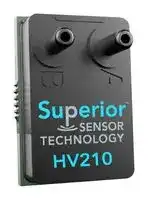
Image not available
Illustrative purposes only

HV210
Pressure Switch, Multi-range, 7 Pressure Ranges, 10 Inch-H2O
⚠️ Reference pricing provided. In case of supply shortages, we will connect you with our trusted procurement partners to ensure your project's continuity.
- Manufacturer: SUPERIOR SENSORS
- Product type: Pressure Switches
- SVHC: To Be Advised
- Port Style: Dual Axial Barbless
- Product Range: HV Series
- Supply Current: 4.5mA
- Voltage Rating: 3.5V
- Sensor Output Type: I2C Digital, SPI
- Operating Pressure Max: 10Inch-H2O
- Pressure Measurement Type: Differential
| Delivery and price | |
|---|---|
| Units per pack | 50 |
| Price | 30.84 € |
| Current stock | 50+ |
| Lead time | 30 days |
Datasheet

## HV Series

## Differential Low Pressure Sensors HVAC Applications

- Highly integrated sensor with ADC and DSP

- Selectable pressure range from 0.1 to 60 inH2O

- Integrated 50/60Hz Notch Filter

- Selectable Bandwidth Filter from 0.1Hz to 10Hz

- Very High Accuracy +/‐ 0.1% of Selected Range

- Long Term Stability +/‐ 0.1% FSS

- Temperature Compensated 0°C to 50°C

- Supply Voltage Compensation

- Fully Integrated Compensation Math

- Standard I[2] C and SPI Interface

## Product Summary

Superior Sensor Technology's HV Series Family offers the industry's highest performing and most flexible Differential Low Pressure Sensors for HVAC (Heating, Ventilation, and Air Conditioning) applications.  Targeting pressure ranges from as low as 0.1" inH2O (Water Column) to 60"  inH2O with industry leading 16 bits of resolution for each range supported.  Competing solutions degrade as the pressure range is lowered; but, Superior's HV Series with the Multi‐Range capability enabled maintains optimal performance from 60" inH2O down to even 0.1"  inH2O.

The HV Series family employs Superior's proprietary NimbleSense™ architecture to create the industry's first generation of "Smart Sensors."   NimbleSense™ provides very high dynamic range to enable a single device to cover the entire range of HVAC pressure requirements.  For example, one Multi‐Range enabled Superior Sensor device can replace three to five (or more) competing products greatly simplifying installation requirements and significantly lowering inventory costs.  As an

example, an HV Series device installed in the ceiling vent can now be programmed to accommodate any pressure requirement without additional installation charges. For added performance, the HV Series has incorporated a 50/60Hz notch filter to minimize the impact of power noise spikes. The HV Series family provides a new level of integration combining an advanced piezoresistive sensing element with integrated amplification, ADC, DSP and digital interface which greatly simplifies customer integration efforts.  The incorporation of advanced digital signal processing enables new functionality thus simplifying system development, manufacturing ease and increased reliability.

Constructed with a high reliability plastic enclosure, the HV Series family provides the ideal combination of very high performance and reliability while ensuring customers have a high volume cost effective solution optimized for their HVAC requirements.

1

www.SuperiorSensors.com

DS‐0001G.DOCX

## HV Series

## Differential Low Pressure Sensors

## Table of Contents

|1|Maximum Ratings ................................................................ 2|
|---|---|
|2|Suggested Operating Conditions ......................................... 2|
|3|Environmental ..................................................................... 2|
|4|Equivalent Circuit ................................................................. 2|
|5|Feature List .......................................................................... 3|
|6|Performance Characteristics ............................................... 3|
|7|Electrical Characteristics ...................................................... 4|
||7.1 Supply Characteristics ................................................. 4|
||7.2 Reset Characteristics .................................................. 4|
||7.3 DAV Characteristics .................................................... 4|
||7.4 SPI Characteristics ...................................................... 5|
||7.5 I2C Characteristics ....................................................... 5|
|8|Materials .............................................................................. 5|
||8.1 Wetted Materials ........................................................ 5|
||8.2 Material Compliance .................................................. 6|
|9|System Overview ................................................................. 6|
|10|Interface .............................................................................. 7|
||10.1 Reset ........................................................................... 7|
||10.2 Communication Interface Selection ........................... 7|
||10.3 SPI Interface ................................................................ 7|
||10.4 I2C Interface ................................................................ 8|
||10.4.1 I2C Address ....................................................... 8|
||10.4.2 I2C Communications Model ............................. 8|
||10.4.3 I2C Clock Stretching .......................................... 9|
||10.4.4 I2C Bus Compatibility ........................................ 9|
||10.5 Extended Data Acquisition ......................................... 9|
||10.5.1 Available Extended Data .................................. 9|
||10.5.2 SPI Extended Data Read ................................... 9|
||10.5.3 I2C Extended Data Read ................................... 9|
||10.6 Control Registers ...................................................... 10|
||10.6.1 Mode Control Register ................................... 10|
||10.6.2 Rate Control Register ..................................... 11|
||10.7 Computing Pressure ................................................. 11|
|11|Mechanical and Manufacturing ......................................... 12|
||11.1 Package Dimensions ................................................. 12|
||11.2 Suggested Pad Layout ............................................... 12|
||11.3 Pinout ....................................................................... 13|
||11.4 Reflow Soldering and Handling Conditions .............. 13|
||11.5 Pick and Place Pick‐up Zone ..................................... 13|
||11.6 Packaging Options .................................................... 14|
||11.6.1 Tray Packaging ............................................... 14|
||11.6.2 Tape and Reel ................................................ 15|
||11.7 Part Identification ..................................................... 16|
|12|Ordering Information ........................................................ 16|
|13|Packaging Labeling............................................................. 16|
|14|Revisions ............................................................................ 17|
|15|Warranty ............................................................................ 17|


## 1 Maximum Ratings

|**Parameter**|**Sym**|**Min**|**Max**|**Units**|
|---|---|---|---|---|
|Supply Voltage|VDDM|Gnd‐0.3|4.0|V|
|Voltage on I/O Pins<br>VDD> 3.3V<br>VDD≤ 3.3V|VIOML<br>VIOMH|Gnd‐0.3<br>Gnd‐0.3|5.8<br>VDD+2.5|V<br>V|
|I/O Current|IIOM|‐25|25|mA|


## 2 Suggested Operating Conditions

|**Parameter**|**Sym**|**Min**|**Max**|**Units**|
|---|---|---|---|---|
|Supply Voltage|VDDOP|2.8|3.5|V|
|Temperature|TA|0|50|°C|


## 3 Environmental

|**Parameter**|**Sym**|**Min**|**Max**|**Units**|
|---|---|---|---|---|
|Temperature Range<br>Compensated<br>Operating<br>Storage|TCMP<br>TOP<br>TSTG|0<br>‐20<br>‐40|50<br>85<br>85|°C<br>°C<br>°C|
|Humidity<br>(Non‐condensing)|RHOP|0|95|% RH|
|Vibration<br>(10Hz‐2kHz)|GVIBE|‐|15|g|
|Shock (6 ms)|GSHOCK|‐|100|g|
|Life|CYLIFE|1M|‐|Pressure<br>Cycles|


## 4 Equivalent Circuit

HV‐Series Equivalent Circuit

**==> picture [256 x 104] intentionally omitted <==**

**----- Start of picture text -----**<br>
DAV DAV<br>nRST nRST<br>PLOW Port A PLOW Port A<br>MISO/SDA MISO/SDA<br>PHIGH Port B Sensor MOSI/SCL PHIGH Port B Sensor MOSI/SCL<br>(SPI) SCK (I [2] C) SCK VI2C Address<br>nSS nSS<br>VDD VDD<br>Gnd Gnd<br>FIG‐0026B<br>**----- End of picture text -----**<br>


2

www.SuperiorSensors.com

DS‐0001G.DOCX

## HV Series

## Differential Low Pressure Sensors

## 5 Feature List

|**Parameter**<br>~~a~~|**Sym**<br>~~Gs~~|**HV160**|**HV120**|**HV110**|**HV210**|**Units**|**Notes**|
|---|---|---|---|---|---|---|---|
|Number of FS Pressure Ranges<br>~~ee~~<br>~~a~~|PNUM<br>~~ee~~<br>~~Gs~~|8<br>~~ee~~|4<br>~~ee~~|5<br>~~ee~~|7<br>~~ee~~|Each<br>~~ee~~|~~ee~~|
|Specified FS Range Extents<br>~~a~~|PEXT<br>~~Gs~~<br>~~ss~~|±2.5 to ±60<br>~~ss~~|±2.5 to ±20<br>~~ss~~|±0.5 to ±10<br>~~ss~~|±0.1 to ±10<br>~~ss~~|inH2O<br>~~ss~~|~~ss~~|
|Number of BW Filter Corners<br>~~ee~~|BWNUM<br>~~ee~~|7<br>~~ee~~||||Each<br>~~ee~~|~~ee~~|
|BW Corner Frequency Extents<br>~~ne~~|fBWEXT<br>~~ne~~|0.1 to 10<br>~~ne~~||||Hz<br>~~ne~~|~~ne~~|
|Common Mode Pressure<br>~~Pd~~|PCM<br>~~Pd~~<br>~~Ps en~~|700<br>~~Pd~~<br>~~en~~|500<br>~~Pd~~|500<br>~~Pd~~|500<br>~~Pd~~|inH2O<br>~~Pd~~|1<br>~~Pd~~|
|Proof Pressure<br>~~Pd~~<br>~~re~~|PPROOF<br>~~Pd~~<br>~~re~~<br>~~Ps en~~<br>~~se~~|400<br>~~Pd~~<br>~~re~~<br>~~en~~<br>~~se~~|40<br>~~Pd~~<br>~~re~~|40<br>~~Pd~~<br>~~re~~|40<br>~~Pd~~<br>~~re~~|inH2O<br>~~Pd~~<br>~~re~~|2<br>~~Pd~~<br>~~re~~|
|Burst Pressure<br>~~re~~<br>~~ee~~|PBURST<br>~~re~~<br>~~Ps en~~<br>~~ee~~<br>~~se~~|480<br>~~re~~<br>~~en~~<br>~~ee~~<br>~~se~~|120<br>~~re~~<br>~~ee~~|120<br>~~re~~<br>~~ee~~|120<br>~~re~~<br>~~ee~~|inH2O<br>~~re~~<br>~~ee~~|3<br>~~re~~<br>~~ee~~|


1) Pressure applied to both ports simultaneously without incurring part damage.

2) Pressure at which the sensor will not suffer permanent damage.

3) Pressure if exceeded could cause permanent damage to the sensor.

## 6 Performance Characteristics

Note: Unless otherwise specified, characteristics specified with VDD = 3.3V, TA = 25C

|**Parameter**<br>~~|~~|**Sym**<br>~~|~~|**HV160**<br>~~|~~|**HV110/HV120**|**HV210**<br>~~——eeeeesSEe~~|**Units**<br>~~——eeeeesSEe~~|**Notes**|
|---|---|---|---|---|---|---|
|||**Min**<br>**Typ**<br>**Max**<br>~~|~~<br>~~Po~~|**Min**<br>**Typ**<br>**Max**<br>~~Po~~|**Min**<br>**Typ**<br>**Max**<br>~~——eeeeesSEe~~<br>~~Po~~|||
|Accuracy<br>~~|~~<br>~~ss~~|PACC<br>~~|~~<br>~~ss~~|‐<br>0.05<br>0.1<br>~~|~~<br>~~ss~~|‐<br>0.05<br>0.1<br>~~ss~~|‐<br>0.05<br>0.1<br>~~——eeeeesSEe~~<br>~~ss~~|% RNG<br>~~——eeeeesSEe~~<br>~~ss~~|1, 2<br>~~ss~~|
|Total Error Band<br>~~ss~~|TEB<br>~~ss~~|‐<br>0.1<br>0.3<br>~~ss~~|‐<br>0.1<br>0.3<br>~~ss~~|‐<br>0.05<br>0.15<br>~~ss~~|% FSS<br>~~ss~~|3<br>~~ss~~|
|Long Term Stability<br>~~ss~~|LTS<br>~~ss~~|‐<br>0.1<br>0.25<br>~~ss~~|‐<br>0.1<br>0.25<br>~~ss~~|‐<br>0.05<br>0.1<br>~~ss~~|% FSS/Yr<br>~~ss~~|~~ss~~|
|Thermal Hysteresis<br>~~ss~~|THYS<br>~~ss~~|‐<br>0.05<br>‐<br>~~ss~~|‐<br>0.05<br>‐<br>~~ss~~|‐<br>0.025<br>‐<br>~~ss~~|% FSS<br>~~ss~~|~~ss~~|
|Pressure Hysteresis<br>~~ss~~|PHYS<br>~~ss~~|‐<br>0.05<br>‐<br>~~ss~~|‐<br>0.05<br>‐<br>~~ss~~|‐<br>0.05<br>‐<br>~~ss~~|% RNG<br>~~ss~~|1<br>~~ss~~|
|Position Sensitivity<br>~~ss~~|PPS<br>~~ss~~|‐<br>2.0<br>‐<br>~~ss~~|‐<br>2.0<br>‐<br>~~ss~~|‐<br>0.25<br>‐<br>~~ss~~|Pa<br>~~ss~~|~~ss~~|
|Supply Rejection<br>~~ss~~|PSR<br>~~ss~~|‐<br>0.0005<br>‐<br>~~ss~~|‐<br>0.0005<br>‐<br>~~ss~~|‐<br>0.0005<br>‐<br>~~ss~~|Pa/mV<br>~~ss~~|~~ss~~|
|Resolution<br>~~ss~~|RES<br>~~ss~~|‐<br>16<br>‐<br>~~ss~~|‐<br>16<br>‐<br>~~ss~~|‐<br>16<br>‐<br>~~ss~~|bit<br>~~ss~~|4<br>~~ss~~|
|System ENOB<br>~~ss~~|ENOB<br>~~ss~~|‐<br>17<br>‐<br>~~ss~~|‐<br>19<br>‐<br>~~ss~~|‐<br>19<br>‐<br>~~ss~~|BitRMS<br>~~ss~~|5<br>~~ss~~|
|Data Update Rate<br>~~ss~~|fUPDATE<br>~~ss~~|108<br>111<br>114<br>~~ss~~|108<br>111<br>114<br>~~ss~~|108<br>111<br>114<br>~~ss~~|Hz<br>~~ss~~|6<br>~~ss~~|


1) Percentage of selected range.

2) Uncertainty limited by system noise for ranges of 0.5 inH2O and below.

3) Includes errors of offset, span and thermal effects.

4) Each selected range has the specified resolution

5) ENOB stated for fBW set to 0.1 Hz.

6) The internal update rate is fixed and does not change with range or filter settings. Sampling at lower data rates are possible provided the Nyquist frequency is observed. It is suggested to sample at least 3x the set fBW frequency.

3

www.SuperiorSensors.com

DS‐0001G.DOCX

## HV Series

## Differential Low Pressure Sensors

## 7 Electrical Characteristics

## 7.1 Supply Characteristics

|**Parameter**|**Sym**|**HV110/HV120/HV160**|**HV210**|**Units**|**Notes**|
|---|---|---|---|---|---|
|||**Min**<br>**Typ**<br>**Max**|**Min**<br>**Typ**<br>**Max**|||
|Supply Current|IDD|‐<br>3.5<br>3.8|‐<br>4.5<br>4.8|mA||
|Supply Capacitance|CDD|‐<br>10<br>‐|‐<br>10<br>‐|uF|1|


1) Supply capacitance is provided within the part however it is recommended to include a 0.1 uF decoupling cap near the supply pads.

## 7.2 Reset Characteristics

|**Parameter**<br>~~S|~~|**Sym**<br>~~S|~~|**Condition**<br>~~S|~~|**HV110/ HV120/HV160/ HV210**<br>~~S|~~|**Units**<br>~~S|~~|**Notes**<br>~~S|~~|
|---|---|---|---|---|---|
||||**Min**<br>**Typ**<br>**Max**<br>~~S|~~|||
|Power‐On Reset<br>Threshold<br>~~S|~~<br>~~a ~~<br>~~a~~|VPORR<br>VPORF<br>~~S|~~<br> ~~ee~~<br>~~ee~~|Rising Voltage on VDD<br>FallingVoltage on VDD<br>~~S|~~<br>~~ee~~<br>~~ee~~|‐<br>0.75<br>1.4<br>‐<br>‐<br>1.36<br>~~S|~~<br>~~ee~~<br>~~ee~~|V<br>V<br>~~S|~~<br>~~ee~~<br>~~ee~~|~~S|~~<br>~~ee~~<br>~~ee~~|
|Interface Detect<br>Delay<br>~~a~~<br>~~a~~|tIOD<br>~~ee~~<br>~~ee ee~~|From POR or External<br>Reset<br>~~ee~~<br>~~ee~~|‐<br>‐<br>40<br>~~ee~~<br>~~ee~~|ms<br>~~ee~~<br>~~ee~~|~~ee~~<br>~~ee~~|
|First Response<br>SettlingTime<br>~~a~~<br>~~a~~<br>~~ee~~|tFRD<br>~~ee~~<br>~~ee ee~~<br>~~es~~|From POR or External<br>Reset<br>~~ee~~<br>~~ee~~|‐<br>‐<br>150<br>~~ee~~<br>~~ee~~|ms<br>~~ee~~<br>~~ee~~|1<br>~~ee~~<br>~~ee~~|
|External Reset Low<br>~~a~~<br>~~ee~~<br>~~ee~~|tRSTL<br>~~ee ee~~<br>~~es~~<br>~~es~~|~~ee~~|15<br>‐<br>‐<br>~~ee~~|us<br>~~ee~~|~~ee~~|
|Input High Voltage<br>~~ee~~<br>~~ee~~<br>~~ee~~|VIH<br>~~es~~<br>~~es~~||VDD‐0.6<br>‐<br>‐||2|
|Input Low Voltage<br>~~ee ~~<br>~~ee~~<br>~~ee~~|VIL<br> ~~es~~<br>~~ee~~|~~ee~~|‐<br>‐<br>0.6<br>~~ee~~|~~ee~~|2<br>~~ee~~|
|Internal Pull‐Up<br>Current<br>~~ee~~<br>~~ee~~<br>~~ee ee~~|IPU<br>~~ee~~<br>~~ee~~|VIN= 0V<br>~~ee~~|‐<br>‐10<br>‐30<br>~~ee~~|uA<br>~~ee~~|2<br>~~ee~~|
|Input Capacitance<br>~~ee ~~<br>~~ee ee~~|CIN<br> ~~ee~~<br>~~ee~~|~~ee~~|‐<br>7<br>‐<br>~~ee~~|pF<br>~~ee~~|2<br>~~ee~~|


1) The filter settling time to ensure the first reading is completely settled.

2) Input nRST

## 7.3 DAV Characteristics

|**Parameter**|**Sym**|**Condition**|**HV110/ HV120/HV160/ HV210**|**Units**|**Notes**|
|---|---|---|---|---|---|
||||**Min**<br>**Typ**<br>**Max**|||
|Output High Voltage|VOH|IO= ‐3 mA|VDD‐0.7<br>‐<br>‐|V||
|Output Low Voltage|VOL|IO= 8 mA|‐<br>‐<br>0.6|V||


4

www.SuperiorSensors.com

DS‐0001G.DOCX

## HV Series

## Differential Low Pressure Sensors

## 7.4 SPI Characteristics

|**Parameter**<br>~~se~~|**Sym**<br>~~se~~|**Condition**<br>~~se~~|**HV110/ HV120/HV160/ HV210**<br>~~se~~|**Units**<br>~~se~~|**Notes**<br>~~se~~|
|---|---|---|---|---|---|
||||**Min**<br>**Typ**<br>**Max**<br>~~se~~|||
|Output High Voltage<br>~~a~~|VOH|IO= ‐3 mA|VDD‐0.7<br>‐<br>‐|V|1|
|Output Low Voltage<br>~~a~~|VOL|IO= 8 mA|‐<br>‐<br>0.6|V|1|
|Input High Voltage<br>~~a~~<br>~~ee~~|VIH<br>~~es~~||VDD‐0.6<br>‐<br>‐||2, 3|
|Input Low Voltage<br>~~ee~~<br>~~a~~|VIL<br>~~es~~<br>~~ee~~|~~ee~~|‐<br>‐<br>0.6<br>~~ee~~|~~ee~~|2, 3<br>~~ee~~|
|Internal Pull‐Up<br>Current<br>~~ee~~<br>~~a~~<br>~~ee~~|IPU<br>~~es~~<br>~~ee~~<br>~~ee~~|VIN= 0V<br>~~ee~~<br>~~ee~~|‐<br>‐10<br>‐30<br>~~ee~~<br>~~ee~~|uA<br>~~ee~~<br>~~ee~~|2, 3<br>~~ee~~<br>~~ee~~|
|Time nSS to First<br>SCK Edge<br>~~a~~<br>~~ee~~<br>~~ee~~|tSC<br>~~ee~~<br>~~ee~~|~~ee~~<br>~~ee~~|150<br>‐<br>‐<br>~~ee~~<br>~~ee~~|us<br>~~ee~~<br>~~ee~~|~~ee~~<br>~~ee~~|
|Clock Cycle Time<br>~~ee ~~<br>~~ee~~<br>~~ee~~|tCC<br> ~~ee~~<br>~~ee~~|~~ee~~<br>~~es~~|8<br>‐<br>‐<br>~~ee~~<br>~~es~~|us<br>~~ee~~<br>~~es~~|~~ee~~<br>~~es~~|
|Byte to Byte Cycle<br>Time<br>~~ee~~<br>~~ee~~<br>~~a~~|tBC<br>~~ee~~<br>~~ee ee~~|~~es~~<br>~~ee~~|150<br>‐<br>‐<br>~~es~~<br>~~ee~~|us<br>~~es~~<br>~~ee~~|~~es~~<br>~~ee~~|
|Time Last Clock to<br>nSS High<br>~~ee ~~<br>~~a~~<br>~~ee~~|tCN<br> ~~ee~~<br>~~ee ee~~|~~es~~<br>~~ee~~|25<br>‐<br>‐<br>~~es~~<br>~~ee~~|us<br>~~es~~<br>~~ee~~|~~es~~<br>~~ee~~|
|Cycle Time nSS<br>~~a~~<br>~~ee~~<br>~~ee~~|tCS<br>~~ee ee~~<br>~~es~~|~~ee~~|8<br>‐<br>‐<br>~~ee~~|us<br>~~ee~~|~~ee~~|
|Input Capacitance<br>~~ee~~<br>~~ee~~|CIN<br>~~es~~||‐<br>7<br>‐|pF|2|


2) Inputs MISO, SCK, nSS

3) Inputs are 5V compliant.

## 7.5 I[2] C Characteristics

|**Parameter**|**Sym**|**Condition**|**HV110/ HV120/HV160/ HV210**|**Units**|**Notes**|
|---|---|---|---|---|---|
||||**Min**<br>**Typ**<br>**Max**|||
|SCL Clock Frequency|fSCL||100<br>‐<br>400|kHz||
|Clock Stretch Time|tCKSTR||‐<br>15<br>150|us||
|Input High Voltage|VIH||VDD‐0.6<br>‐<br>‐|||
|Input Low Voltage|VIL||‐<br>‐<br>0.6|||
|Output Low Voltage|VOL|IO= 8 mA|‐<br>‐<br>0.6|V||
|Input Capacitance|CIO||‐<br>7<br>‐|pF||


## 8 Materials

## 8.1 Wetted Materials

|**Parameter**|**Sym**|**HV110/HV120/HV160**|**HV110/HV120/HV160**|**HV210**|**HV210**|**Units**|**Notes**|
|---|---|---|---|---|---|---|---|
|||**PA**|**PB**|**PA**|**PB**|||
|Wetted Materials|MATWET|Epoxy<br>Nylon<br>RTV<br>Silicon|Epoxy<br>Nylon<br>RTV<br>Silicon<br>Gold<br>Aluminum|Epoxy<br>Nylon<br>RTV<br>Silicon<br>Gold<br>Aluminum|Epoxy<br>Nylon<br>RTV<br>Silicon<br>Gold<br>Aluminum|||


5

www.SuperiorSensors.com

DS‐0001G.DOCX

## HV Series

## Differential Low Pressure Sensors

## 8.2 Material Compliance

|**Parameter**|**Sym**|**HV110 / HV120 /HV160/ HV210**|**Units**|**Notes**|
|---|---|---|---|---|
|RoHS|REGRoHS|RoHS Compliant|||
|REACH|REGREAC|REACH Compliant|||


## 9 System Overview

The HV Series pressure sensor is a fully integrated pressure acquisition system in a sensor module. The acquisition system includes anti‐alias filters, data acquisition, 50/60Hz notch filter, sensor compensation, bandwidth limiting and I/O functions. Refer to the figure below for the HV Series block diagram.

**==> picture [504 x 180] intentionally omitted <==**

**----- Start of picture text -----**<br>
User Control Registers<br>Pressure Anti‐Alias  Δ‐Sigma  Mode Control Rate Control<br>Sensor Filter Modulator<br>OK == DAV<br>1b Enable 3b Range Control 3b BW Control ControllerRate  InterfaceHW  nRST<br>Va Anti‐Alias  Δ‐Sigma<br>Filter Modulator MISO/SDA<br>oo o Decimation 4 50/60HzNotch [ 4 t CompensationFPU with t 4 BW LimitIIR iT SPI/I [2] C  MOSI/SCLSCK<br>(Sinc [2] ) Linearization (2 [nd]  Order) Interface nSS<br>T [o] SAR ADC<br>5p PLL<br>26 Term<br>Compensation<br>_ Coefficients<br>Vs<br>SAR ADC<br>MCU<br>OK<br>**----- End of picture text -----**<br>


**==> picture [4 x 21] intentionally omitted <==**

**----- Start of picture text -----**<br>
FIG‐0011A<br>**----- End of picture text -----**<br>


There are also two user controlled registers that tune the sensor to the specific user requirements.  The first register is the Mode Control register that determines the output pressure range, the corner frequency of the bandwidth limiting filter and enables or disables the 50/60Hz notch filter.

The second register is the Rate Control register which controls the rate at which the Data Available (DAV) pin is asserted. The internal sensor data update rate is 111 Hz. This is generally much faster than the requirements of an HVAC transmitter so the Rate Control register will throttle down the rate at which the Data Available pin (DAV) is asserted. The DAV is reset upon each read of the pressure sensor. An internal model of the Rate Controller is illustrated in the figure to the right.

**==> picture [263 x 98] intentionally omitted <==**

**----- Start of picture text -----**<br>
Rate Control<br>Register<br>Reload Value<br>Internal Update  Overflow DAV<br>Rate Counter S Q<br>(111Hz Rate)<br>Data Read<br>R FIG‐0012A<br>**----- End of picture text -----**<br>


6

www.SuperiorSensors.com

DS‐0001G.DOCX

## HV Series

## Differential Low Pressure Sensors

## 10 Interface

## 10.1 Reset

Reset timing is shown in the diagram below.

The communications method (SPI or I[2] C) is established during the time just after reset. During this time (tIOD), no communications should take place.

Also, the internal filters are settling during the time tFRD and data acquired during this time may not be fully settled.

**==> picture [411 x 195] intentionally omitted <==**

**----- Start of picture text -----**<br>
 Reset Timing Diagram<br>VDD VPORR VPORF<br>Internal Reset<br>tRSTL<br>_RST<br>tIOD tIOD<br>Communications<br>Available<br>tFRD tFRD<br>Filters Settled<br>FIG‐0021A<br>**----- End of picture text -----**<br>


## 10.2 Communication Interface Selection

The communications interface is selected by interrogating the nSS pin after the internal power on reset delay. If nSS is high, the SPI interface will be selected otherwise (if low) the I[2] C interface will be selected. Grounding the nSS pin is an acceptable method for selecting the I[2] C interface. NOTE: The I[2] C interface supports 10 interface addresses. Refer to section 10.4.1 for the details on I[2] C address selection.

## 10.3 SPI Interface

The SPI interface uses a 16 bit transfer for all communications. Data is MSB first for both MOSI and MISO data transfers. Refer to the figure below for specific timing requirements.

**==> picture [459 x 125] intentionally omitted <==**

**----- Start of picture text -----**<br>
 SPI Timing Diagram<br>tsc tcc tbc tcn tcs<br>SCK<br>MOSI OOO Bit 7 OCX Bit 6 CXLCUXLCUXCX Bit 5 Bit 4 Bit 3 Bit 2 CX Bit 1 CX Bit 0 CXLX Bit 7 LX Bit 6 CX Bit 5 XX Bit 4 Bit 3 KK Bit 2 Bit 1 KF Bit 0<br>MISO ee Bit 7 Bit 6 Bit 5 Bit 4 Bit 3 Bit 2 Bit 1 Bit 0 Bit 7 Bit 6 Bit 5 Bit 4 Bit 3 Bit 2 Bit 1 Bit 0 ee<br>nSS OLLU_ FIG‐0013A<br>**----- End of picture text -----**<br>


The data communications has been reduced to a simple 16 bit transfer model for reading the pressure output. Each communication cycle consists of master sending the Mode and Rate data to be placed into the sensor Mode Register and Rate Registers respectively. Simultaneously, the sensor sends the pressure data for the master to receive. Refer to the figure below for the data communication model of the HV Series sensor.

7

www.SuperiorSensors.com

DS‐0001G.DOCX

## HV Series

## Differential Low Pressure Sensors

The requirement to send the Mode and Rate bytes on each data read cycle is intentional. The purpose is to force the master to send specific data for each communication and prevent inadvertent data from being sent to the sensor. Since a SPI interface will generally re‐circulate data through its shift register, the intention is to prevent the pressure output from the sensor from being re‐circulated back to the sensor and potentially causing unintended corruption of manufacturing data.

**==> picture [459 x 111] intentionally omitted <==**

**----- Start of picture text -----**<br>
 SPI Data Diagram<br>SCK ___FTLFL LIL LF LF LU LVL _FLI LUF F LW LU LW LU LF WV _____L___<br>MOSI XXX  User Mode Byte  User Rate Byte<br>MISO F Pressure Output High Byte FF Pressure Output Low Byte }<br>nSS a cn A FIG‐0014A<br>**----- End of picture text -----**<br>


## 10.4 I[2] C Interface

The HV Series is compatible with the I[2] C protocol. For detailed information regarding the I[2] C protocol, please refer to the Philips I[2] C Bus Specification, Version 2.

## 10.4.1 I[2] C Address

|I2C Address Selection Table|I2C Address Selection Table|I2C Address Selection Table|I2C Address Selection Table|
|---|---|---|---|
|R1 (kΩ)|R2 (kΩ)|Address<br>(decimal)|Address<br>)<br>Address<br>(hex)|
|120|5.6|49|0x31|
|120|12|48|0x30|
|120|27|47|0x2F|
|120|51|46|0x2E|
|120|100|45|0x2D|
|56|100|44|0x2C|
|30|100|43|0x2B|
|15|100|42|0x2A|
|5.6|100|41|0x29|
|0|NoPop|40|0x28|


The I[2] C address is set to 0x28 by grounding the SCK line. Other I[2] C addresses can be established by applying a voltage to the SCK line by use of a resistor divider across the sensor supply voltage. The suggested resistor values and the respective I[2] C address are shown in the table to the left.

Note: R1 is the lower resister of the divider where R2 is the upper resistor of the divider.

## 10.4.2 I[2] C Communications Model

The sensor is configured as a slave device and as such, the communicating host must be configured as a master. There are two types of possible data transfers, data transfers from the master transmitter to an addressed sensor (WRITE), and data transfers from an addressed sensor to a master receiver (READ).  The master device initiates both types of data transfers and provides the serial clock pulses on SCL.

The communications model for I[2] C is similar to that of SPI however, since I[2] C is a half‐duplex protocol, the transfer of

information to and from the sensor is separated into two separate communications. This is in contrast to the SPI interface where the transmitted and received data occurs simultaneously to and from the host. Refer to the figure to the right for the data communication model for the HV Series sensors.

8

www.SuperiorSensors.com

DS‐0001G.DOCX

## HV Series

## Differential Low Pressure Sensors

## 10.4.3 I[2] C Clock Stretching

The figure to the right illustrates the I[2] C 12C Clock Stretching clock stretching by the sensor. At times, the sensor requires additional time to respond to the host and utilizes the clock stretching oe LE feature of the I[2] C protocol. This is accomplished by holding the SCL low after the ACK cycle of a data transfer. Refer to Section 7.5 for the clock stretching timing. Note, the maximum clock stretch time will generally only occur once during the three ACK cycles of a two byte transfer. That is, the balance of ACK's during a multi‐byte transfer will generally include the typical clock stretching time.

## 10.4.4 I[2] C Bus Compatibility

The I[2] C specification allows any recessive voltage between 3.0 and 5.0 V. Different devices on the bus may operate at different voltage levels. However, the maximum voltage on any port pin must conform to the electrical characteristics specifications (See section 1). The bi‐directional SCL (serial clock) and SDA (serial data) lines must be connected to a positive power supply voltage through a pull‐up resistor or similar circuit. Every device connected to the bus must have an open‐drain or open‐collector output for both the SCL and SDA lines, so that both are pulled high (recessive state) when the bus is free.

## 10.5 Extended Data Acquisition

## 10.5.1 Available Extended Data

For either the SPI or I[2] C interface, additional data is available beyond the pressure. The means to access this extended data is to continue reading data (either SPI or I[2] C) beyond the first 16 bits of pressure information. The following table defines the order of the available data and respective format.

|**Data**|**Bytes**|**Format**|**Interpretation**|**Example**|
|---|---|---|---|---|
|Pressure|1‐2|2 byte, Signed Int|See Section 10.7|See Section 10.7|
|Temperature|3‐4|2 byte, Signed Int|Fixed Decimal [8.8 bits], Upper 8 bits<br>integer, lower 8 bits fractional.<br>Temperature in °C|1880H (18.80H) = 24.5°C|
|Model|5‐10|6 byte, ASCII, null<br>terminated|Right reading ASCII with null<br>termination|48H,56H,32H,31H,30H,00H = HV210|
|Serial Number|11‐14|4 byte, Hex|Unique 4 byte serial for each part|2FD627A4H|
|Build Number|15‐20|6 byte, ASCII, null<br>terminated|Right reading ASCII with null<br>termination|30H,30H,30H,33H,43H,00H = 0003C|


## 10.5.2 SPI Extended Data Read

Reading the extended data while using the SPI interface is the same as shown in Section 10.3 with exception that the master continues to read during the same nSS sequence to read all 20 bytes of the extended data. Any portion of the 20 bytes can be read during the transfer. That is, for example, 4 bytes could be read to acquire only the pressure and temperature information.  When reading the extended data, only the first two bytes sent to the sensor (User Mode and User Rate) are used to set the internal registers. The subsequent bytes (bytes 5 through 20) are ignored. Data read following the first 20 bytes is undefined.

## 10.5.3 I[2] C Extended Data Read

Reading the extended data via the I[2] C interface is similar to using the SPI interface where the master can simply continue to reading the sensor during the pressure reading transfer. The master continues Ack'ing until the number of desired bytes are read.

9

www.SuperiorSensors.com

DS‐0001G.DOCX

## HV Series Differential Low Pressure Sensors

## 10.6 Control Registers

## 10.6.1 Mode Control Register

Default Value: 0xF6

Details of the Mode Control register are illustrated in the figure to the right.

Bits 0‐2 control the output pressure range.

Bit 3 is the I/O Watchdog Enable bit. When set, the I/O watchdog is enabled. When enabled, the I/O watchdog will monitor the I/O activity. If I/O activity is not detected for the I/O Watchdog timeout time, the pressure sensor will reset itself. The I/O watchdog timeout time is determined by the currently active bandwidth setting. This is whether the bandwidth is selected directly or by using the Auto Select bandwidth.

Bits 4‐6 control the BW Limit Filter. Note: When the BW bits are all set, the BW is automatically selected according to the selected pressure range (see table to right).

Bit 7 is the Notch Filter Enable bit. When enabled, the 50/60Hz notch filter is active.

Please note the available pressure ranges for the different sensor models are indicated in the table. For values where the pressure range is not available for the given sensor (high or low), the table is highlighted in light orange and indicates the given full scale value to use for pressure conversion. It is possible to use these values however, since they do effect the set sensor bandwidth when the Auto Select bandwidth value (BW Limit Select = 111b) is used.

It should also be noted that upon changing the Mode Control value, there is a one cycle latency before the new Mode Control value becomes valid. That is, the data of the communication cycle following a change to

## Mode Control Register Detail

**==> picture [335 x 472] intentionally omitted <==**

**----- Start of picture text -----**<br>
Mode Register (General)<br>b7 b6 b5 b4 b3 b2 b1 b0<br>Pressure Range Select<br>I/O Watchdog Enable<br>BW Limit Select<br>Notch Enable<br>Mode Register (Detail)<br>b7 b6 b5 b4 b3 b2 b1 b0<br>Pressure Range Select (by Model)<br>HV160 HV120 HV110 HV210 Auto Select BW Limit<br>0 0 0 2.5 inH2O 2.5 inH2O 0.5 inH2O 0.1 inH2O 0.1 Hz<br>0 0 1 5.0 inH2O 2.5 inH2O 0.5 inH2O 0.25 inH2O 0.25 Hz<br>0 1 0 10.0 inH2O 2.5 inH2O 0.5 inH2O 0.5 inH2O 0.5 Hz<br>0 1 1 20.0 inH2O 2.5 inH2O 1.0 inH2O 1.0 inH2O 1.0 Hz<br>1 0 0 30.0 inH2O 2.5 inH2O 2.5 inH2O 2.5 inH2O 2.5 Hz<br>1 0 1 40.0 inH2O 5.0 inH2O 5.0 inH2O 5.0 inH2O 5.0 Hz<br>1 1 0 50.0 inH2O 10.0 inH2O 10.0 inH2O 10.0 inH2O 10.0 Hz<br>1 1 1 60.0 inH2O 20.0 inH2O 10.0 inH2O 10.0 inH2O 10.0 Hz<br>ee =<br>I/O Watchdog Enable<br>0 Disabled<br>1 Enabled<br>= |<br>BW Limit Select I/O Watchdog Timeout<br>0 0 0 0.1 Hz 10 sec<br>0 0 1 0.25 Hz 4 sec<br>0 1 0 0.5 Hz 2 sec<br>0 1 1 1.0 Hz 1 sec<br>1 0 0 2.5 Hz 400 ms<br>1 0 1 5.0 Hz 200 ms<br>1 1 0 10.0 Hz 100 ms<br>1 1 1 Auto Select<br>==<br>Notch Enable<br>0 Notch Filter Disabled<br>1 Notch Filter Enabled FIG‐0023C<br>**----- End of picture text -----**<br>


the Mode Control register will not reflect the change. It is not until the second communication cycle that the change in the Mode Control register will be reflected in the output data.

10

www.SuperiorSensors.com

DS‐0001G.DOCX

## HV Series

## Differential Low Pressure Sensors

## 10.6.2 Rate Control Register

## Default Value: 0x00

The Rate Control Register controls the rate at which the DAV pin is asserted indicating new data is available. This register is primarily used to throttle down the actual data transfer rate (when using the DAV as the trigger to sample) since the general HVAC requirement is less than the internal 111Hz update rate.

The function of this register is that it is the reload value of a data rate counter. The value of the Rate Control Register is the divisor of the 111 Hz internal data rate. Since a divisor of zero is not possible, a zero value will select the auto‐select rate mode. In this mode, the rate is selected based on the selected bandwidth limit. The auto rate value is 11.1 times the corner frequency of the bandwidth limit in all auto selected rates.

Note: Start‐up time for the sensor is approximately 250ms for the first sample to be settled. Requesting data during this time will result in invalid information. However, this start‐up time can be used for configuring the Mode and Rate registers by performing a transfer with the desired Mode and Rate register values and discarding the received pressure data. After waiting the required start‐up time, the sensor will respond with desired data since the Mode and Rate registers have been pre‐established.

**==> picture [255 x 273] intentionally omitted <==**

**----- Start of picture text -----**<br>
Rate Control Register Detail<br>Rate Control Register<br>b7 b6 b5 b4 b3 b2 b1 b0<br>0 0 0 0 0 0 0 0 Auto Select<br>0 0 0 0 0 0 0 1 111 Hz<br>0 0 0 0 0 0 1 0 55.5 Hz<br>0 0 0 0 0 0 1 1 37 Hz<br>1 1 1 1 1 1 1 0 0.437 Hz<br>1 1 1 1 1 1 1 1 0.435 Hz<br>Selected BW Limit Auto Select Rate<br>0.1 Hz 1.11 Hz<br>0.25 Hz 2.77 Hz<br>0.5 Hz 5.55 Hz<br>1.0 Hz 11.1 Hz<br>2.5 Hz 27.7 Hz<br>5.0 Hz 55.5 Hz<br>10.0 Hz 111 Hz<br>**----- End of picture text -----**<br>


## 10.7 Computing Pressure

The pressure data is in the form of 16 bit signed integer sent in high byte then low byte order. This is a differential output by definition and the data range is ±2[15] . There is a 10% margin in the output scaling and the selected full scale will reside in the 90% band of the total available output data range. Refer to Equation 1 (below) for the general model for computing the output pressure. As an example, if the sensor output is 3,647 counts and the selected pressure range is 1.0 inH2O, then the output pressure is 0.124 inH2O. Conversely, for a ‐3,647 count with the selected pressure range of 1.0 inH2O, the computed output pressure is ‐0.124 inH2O. Refer to Example 1 (below) for the specific example computation.

11

www.SuperiorSensors.com

DS‐0001G.DOCX

## HV Series Differential Low Pressure Sensors

## 11 Mechanical and Manufacturing

## 11.1 Package Dimensions

## 11.2 Suggested Pad Layout

The suggested pad layout is shown in the figure below. An Eagle PCB symbol library is available with the shown pad dimensions. Please consult the factory to obtain the library.

12

www.SuperiorSensors.com

DS‐0001G.DOCX

## HV Series

## Differential Low Pressure Sensors

## 11.3 Pinout

|**Pin**|**Sym **|**SPI**|**I2C**|
|---|---|---|---|
|1|nSS|Slave Select<br>(active low)|Tie to Ground|
|2|MOSI/SCL|MOSI|SCL|
|3|MISO/SDA|MISO|SDA|
|4|SCK|Serial Clock|See Section 10.4.1|
|5|DNC|Do Not Connect||
|6|DNC|Do Not Connect||
|7|DNC|Do Not Connect||
|8|Gnd|Ground||
|9|VDD|Sensor Supply||
|10|nRST|Reset(active low)||
|11|DAV|Data Available||


## 11.4 Reflow Soldering and Handling Conditions

|**Parameter**|**Sym **|**Val**|**Units**|
|---|---|---|---|
|Soldering Specifications (Max)<br>Preheat Ramp Rate<br>Soak Time<br>Time Above 217C<br>Time Above 230C<br>Time Above 250C<br>Peak Temperature<br>CoolingRampRate|tPHRR<br>tSOAK<br>tGT217<br>tGT230<br>tGT250<br>tPT<br>tCRR|3<br>3<br>50<br>40<br>15<br>255<br>‐4|°C/s<br>min<br>s<br>s<br>s<br>°C<br>°C/s|
|Weight|WPRT|3.5|gm|
|Moisture Sensitivity|MSL|3||
|ESD (Human Body Model)|ESD|2|kV|


## 11.5 Pick and Place Pick-up Zone

13

www.SuperiorSensors.com

DS‐0001G.DOCX

## HV Series Differential Low Pressure Sensors

## 11.6 Packaging Options

## 11.6.1 Tray Packaging

14

www.SuperiorSensors.com

DS‐0001G.DOCX

## HV Series Differential Low Pressure Sensors

## 11.6.2 Tape and Reel

15

www.SuperiorSensors.com

DS‐0001G.DOCX

## HV Series

## Differential Low Pressure Sensors

## 11.7 Part Identification

## 12 Packaging Labeling

Packaging labels are provided with barcode Code 128 symbology. The provided fields are Company Name, Part Number, Packaging ID and Quantity. The  Packaging ID traces back to the Lot Number (or Lot Numbers) contained in the package. The purpose is to eliminate multiple labels (one for each included Lot Number) in the event of multiple Lot Numbers within a single package. This is for ease of customer tracking and maintenance. The Packaging ID is a 24 bit value printed in hexadecimal format.

## 13 Ordering Information

|**Part Number**|**Part**<br>**Package **|**Packaging**|**Packaging**<br>**Qty**|**Order Number**|
|---|---|---|---|---|
|HV160‐SM02|SM02|Tape and Reel<br>Multi‐Tray<br>Single Tray<br>Quarter Reel<br>Cut Tape|256<br>512<br>64<br>64<br>1‐63|HV160‐SM02‐R<br>HV160‐SM02‐M<br>HV160‐SM02‐T<br>HV160‐SM02‐Q<br>HV160‐SM02‐C|
|HV120‐SM02|SM02|Tape and Reel<br>Multi‐Tray<br>Single Tray<br>Quarter Reel<br>Cut Tape|256<br>512<br>64<br>64<br>1‐63|HV120‐SM02‐R<br>HV120‐SM02‐M<br>HV120‐SM02‐T<br>HV120‐SM02‐Q<br>HV120‐SM02‐C|
|HV110‐SM02|SM02|Tape and Reel<br>Multi‐Tray<br>Single Tray<br>Quarter Reel<br>Cut Tape|256<br>512<br>64<br>64<br>1‐63|HV110‐SM02‐R<br>HV110‐SM02‐M<br>HV110‐SM02‐T<br>HV110‐SM02‐Q<br>HV110‐SM02‐C|
|HV210‐SM02|SM02|Tape and Reel<br>Multi‐Tray<br>Single Tray<br>Quarter Reel<br>Cut Tape|256<br>512<br>64<br>64<br>1‐63|HV210‐SM02‐R<br>HV210‐SM02‐M<br>HV210‐SM02‐T<br>HV210‐SM02‐Q<br>HV210‐SM02‐C|


16

www.SuperiorSensors.com

DS‐0001G.DOCX

## HV Series

## Differential Low Pressure Sensors

## 14 Revisions

|**Rev**|**Change Description(s)**|**Date**|**By**|
|---|---|---|---|
|A|Initial Release|3/25/18|T.S.|
|B|1) Revised web address from SuperiorSensorTechnology.com to SuperiorSensors.com<br>2) Revise ordering information to include single tray and cut tape<br>3) Add multiple I2C address feature<br>4) Add extended data availability<br>5) Add I/O Watchdog feature<br>6) Revise TEB (all parts)<br>7) Revise Position Sensitivity (all parts)<br>8) Revise multi‐tray box dimensions<br>9) Revise packaging label for more reliable barcode reading<br>10) Correct port pressure assignments in FIG‐0026<br>11)Correct various typo's|1/17/2019|T.S.|
|C|1)Correction of contact address and typo's. No material change|3/25/2019|T.S.|
|D|1)Add HV160|5/20/2019|T.S.|
|E|1)Correct I2C Address Selection Table|3/31/2020|T.S.|
|F|1)Revise I2C Address Selection Table Resistor Values|2/4/2021|T.S.|
|G|1) Updated OrderingInformation|9/27/2021|A.G.|


## 15 Warranty

Superior Sensor Technology and its subsidiaries warrant goods of its manufacture as being free of defective materials and faulty workmanship during the applicable warranty period. In all cases, Superior Sensor Technology's standard product warranty applies; please refer to your order acknowledgement or consult your local sales office for specific warranty details.

If warranted goods are returned to Superior Sensor Technology during the period of coverage, Superior Sensor Technology will repair or replace, at its option, without charge those items that Superior Sensor Technology, in its sole discretion, finds defective. **The foregoing is buyer’s sole remedy and is in lieu of all other warranties, expressed or implied. In no event shall Superior Sensor Technology be liable for consequential, special, or indirect damages.**

While Superior Sensor Technology may provide application assistance personally, through literature or the Superior Sensor Technology web site, it is buyer's sole responsibility to determine the suitability of the product in their application.  Superior Sensor Technology assumes no liability for applications assistance or customer product design.

Superior Sensor Technology reserves the right to make corrections, modifications, enhancements, improvements and other changes to its products and services at any time and to discontinue any product or service without notice.  Customers should obtain the latest relevant information before placing orders and should verify that such information is current and complete.

**SENSOR TECHNOLOGY Superior** 3080 Oakmead Village Road Santa Clara, CA 95051

www.SuperiorSensors.com info@SuperiorSensors.com +1.408.703.2950

NimbleSense is a trademark of Superior Sensor Technology

17

www.SuperiorSensors.com

DS‐0001G.DOCX
Updated at June 9, 2026
About Novapart
Novapart is a B2B electronic component broker specialising in stock shortages and cost reduction. We source hard-to-find parts and identify compliant alternatives across a catalogue of 410,000+ components from 500+ manufacturers.
Learn more →Stock Shortage Specialist
When a component is unavailable, discontinued or has an unacceptable lead time, we tap into our network of vetted European and Asian distributors to source what you need — without compromising on quality or traceability.
Request a quote →Compliant Alternatives
We identify pin-to-pin, electrically equivalent substitutes that meet the same certifications (RoHS, AEC-Q100, REACH) as your original specification — validated against datasheets, not just part numbers. Often at a lower cost.
BOM Analysis service →