
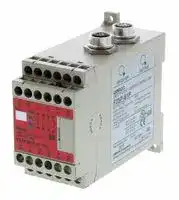


F3SP-B1P
Safety Relay, 24 VDC, 3PST-NO, DIN Rail, 5 A
- Manufacturer: OMRON INDUSTRIAL AUTOMATION
- Product type: Safety Relays
- SVHC: To Be Advised
| Delivery and price | |
|---|---|
| Units per pack | 1 |
| Price | 449.36 € |
| Current stock | 10+ |
| Lead time | 30 days |

## **Safety Light Curtain/Multi-beam Safety Sensor F3SN-A/F3SN-B/F3SH-A** ee ■ Lineup includes Type-4 Sensors (F3SN-A/F3SH-A) and Type-2 Sensors (F3SN-B) with IEC, EN, and JIS standard certification.

EC Machine Directive compliance (from DEMKO).

USA UL compliance for applications for the USA or Canada.

■ Protective height equals the Sensor length to perfectly meet user needs.

- Protective height: 189 to 1,822 mm

Operating range: 7 or 10 m

- Setting Console enabling setting parameters for any model.

- LED bar for beam alignment or easy confirmation in error mode.

■ A complete lineup of accessories.

Be sure to read the _“Safety Precautions”_ on page 28 and the _“Precautions for All Safety Sensores”_ .

## **Features**

**Two Forms of Safety from OMRON: Safety Light Curtains and Multibeam Safety Sensors**

## **Safety Light Curtains for Finger Protection**

## **F3SN-A** @@@@ **P14**

Operating range: 7 m Smallest detectable object: 14 mm dia. (beam gap: 9 mm) Protective height: 189 to 1,125 mm

## **Presence Detection in Danger Zones (Horizontal Installation)**

## **F3SN-A** @@@@ **P40/P70**

## **F3SN-B** @@@@ **P40/P70**

## **Safety Light Curtains for Hand Protection**

## **F3SN-A** @@@@ **P25**

## **F3SN-B** @@@@ **P25**

Operating range: 10 m Smallest detectable object: 25 mm dia. (beam gap:15 mm) Protective height: 217 to 1,822 mm

## **Multi-beam Safety Sensor for Body Protection**

## **F3SN-A09P03**

Operating range: 10 m

Number of beams: 4 (beam gap: 300 mm)

Operating range: 10 m

Smallest detectable object: 40 mm dia. (beam gap: 30 mm) or 70 mm dia. (beam gap: 60 mm) Protective height: F3SN-A: 217 to 1,822 mm F3SN-B: 217 to 1,777 mm

(c)Copyright OMRON Corporation 2007   All Rights Reserved. **1** a

http://www.ia.omron.com/

**F3SN-A/F3SN-B/F3SH-A**

## **A New Concept to Meet User Needs**

## **Connect Up To Three Sets in Series without Mutual Interference**

Combine Standard Models with Linking Models with Connectors to connect up to three sets in series. Wiring is required only for one set instead of wiring all three sets, as would have been required previously, to enable protecting all sides of hazardous areas. Mutual interference protection is also provided.

## **Various Safety Functions Built into the Sensor. Supports Many Safety Circuit Configurations**

- Interlocks

- Auto-reset or manual reset

- External relay monitoring

## **Select the Safety Circuits for the Required Safety Standards**

**Build Circuits for Type 4 (F3SN-A/F3SH-A) or Type 2 (F3SN-B) with No Relay Units (2 Relays with Forcibly Guided Contacts)**

- Reduced Costs and Reduced Space Requirements

**==> picture [485 x 526] intentionally omitted <==**

**----- Start of picture text -----**<br>
A built-in external relay monitor function eliminates the need for Safety Relay Units.<br>™ No Safety Relay Units<br>if —<br>Ln OO a {<br>ta =j| Safety LightCurtainsF3SN-AF3SH-AF39-JC@A Diy, G7SA Welded relay detection circuit is possiblewith two Relays withForcibly Guided Contacts. <i Contactors 7 Motor =<br>F3SN-B<br>● Reduced Wiring and Easy Maintenance<br>One-touch connection with connectors on both end to prevent wiring mistakes.<br>fw| Connectors<br>7 ie ny obo=—a00 way Ee<br>Li eI ‘ ||0S Safety LightF39-JC@B Plirrhytires,'..mn, | OT) ———— J Contactors ‘ Motor g € a<br>ll, Note:  Use models with the following model  CurtainsF3SN-A Special Relay Unit<br>number suffixes for series  F3SH-A F3SP-B1P<br>connection: -01, -03, -04, and -05 F3SN-B<br>LED Bars for Easier Application<br>Align Beams with the LED Bar for Easier Installation<br>● Beam Alignment Indicators (Green Only)<br>oa JA Test LocKout Interlock POWER ERROR AB cut 2 3 4 5 LEVEL<br>Application not possible.<br>HUE | ees = Test LocKout Interlock POWER ERROR A B C831 2 3 4 5 LEVEL 3<br>Sensor ON but not stable.<br>a UA Cel gt. eee i9 : |<br>Win : Se a, Mase = Test LocKout Interlock POWER ERROR A B C31 2 3 4 5 LEVEL 3<br>2 —— eet Ly, = [eee @ & 8<br>= = - | :0 Dependable application possible. :<br>7<br>| —— rae Easily Discern Error Mode  Leek c cece ee ne ence eee enseee ene eeeneenen<br>Displays to Back Up  | cie-rii--1<br>Mj---2---r--<br>Select the type of connector that best suits the machine. (Consult your  Safety i —_-7 Le<br>● Error Indication Example I-- > _4 i<br>(Red Only) | ---_---_--i er |}<br>mi|--_---__--<br>== — 14 — = Mt--22---~Le |<br>i g = mw -- Ww<br>Confirmation from<br>\s two directions.<br>—al | — | Ij -- S == °<br>Interlock input line or reset input line<br>wiring mistake or broken line.<br>Model No.  Model No.  Model No.  Model No.  Model No.  Test LocKout Interlock POWER 2% ERROR A B c 1 2 3 4 5 LEVEL<br>suffix: -01 suffix: -02 suffix: -03 suffix: -04 suffix: -05<br>Relay welded, return time too long, or external relay<br>monitor line wiring mistake or broken line.<br>Communications line (RS-485) wiring mistake,<br>broken line, or other error.<br>Control output short, wiring mistake, or control<br>output circuit fault.<br>**----- End of picture text -----**<br>


## **Many Connector Variations**

Select the type of connector that best suits the machine. (Consult your OMRON representative.)

**==> picture [220 x 16] intentionally omitted <==**

**----- Start of picture text -----**<br>
No model Standard: Model No.  Model No.  Model No.  Model No.  Model No.<br>No. suffix suffix: -01 suffix: -02 suffix: -03 suffix: -04 suffix: -05<br>**----- End of picture text -----**<br>


**2**

(c)Copyright OMRON Corporation 2007   All Rights Reserved.

http://www.ia.omron.com/

**F3SN-A/F3SN-B/F3SH-A**

## **Ordering Information**

**Main Units** (Connecting Cables are not included with the Main Units. The connecting cables must be purchased separately.)

## **F3SN-A Safety Light Curtains (Type 4)**

**==> picture [508 x 175] intentionally omitted <==**

**----- Start of picture text -----**<br>
|||||||||
|---|---|---|---|---|---|---|---|
|Infrared|
|Connector|
|Detection|Beam|Number of|Protective|
|capability|gap|Appearance|Operating range|beams|height|connectionfor series-|Model *1 *2|
|14 mm-dia.|21 to 125|189 to 1125|No|F3SN-A@@@@P14|
|(for finger|9 mm|0.2 to 7 m|(odd|mm|
|protection)|numbers only)|(every 18 mm)|Yes|F3SN-A@@@@P14-01|
|25 mm-dia.|217 to 1822|No|F3SN-A@@@@P25|
|(for hand|15 mm|13 to 120|mm|
|protection)|(every 15 mm)|Yes|F3SN-A@@@@P25-01|
|40 mm-dia.|No|F3SN-A@@@@P40|
|0.2 to|217 to 1807|
|(for presence|30 mm|10 m|7 to 60|mm|
|protection)|Yes|F3SN-A@@@@P40-01|
|70 mm-dia.|No|F3SN-A@@@@P70|
|277 to 1777|
|(for presence detection)|60 mm|5 to 30|mm|Yes|F3SN-A@@@@P70-01|

**----- End of picture text -----**<br>


- *1.The @@@@ in the model numbers indicates the protective height (in mm). Refer to _“Safety Light Curtain Model List”_ on page 4 for model number details.

- *2.Safety Light Curtains with model numbers ending in -02 through -05, provided with different connector configurations, are also available as options. Consult with your dealer or OMRON representative when ordering these models.

## **F3SN-B Safety Light Curtains (Type 2)**

Infrared

**==> picture [508 x 156] intentionally omitted <==**

**----- Start of picture text -----**<br>
||||||||||
|---|---|---|---|---|---|---|---|---|
|Connector|
|capabilityDetection|Beam gap|Appearance|Operating range|of beamsNumber|Protective height|Output *1|connectionfor series-|Model *2 *3|
|25 mm-dia.|13 to 119|No|F3SN-B@@@@P25|
|217 to|
|(for hand|15 mm|(non-|
|1807 mm|
|protection)|continuous)|Yes|F3SN-B@@@@P25-01|
|40 mm-dia.|7 to 60|PNP|No|F3SN-B@@@@P40|
|0.2 to|217 to|
|(for presence|30 mm|(non-|transistor|
|10 m|1807 mm|
|detection)|continuous)|output|Yes|F3SN-B@@@@P40-01|
|70 mm-dia.|No|F3SN-B@@@@P70|
|277 to|
|(for presence|60 mm|5 to 30|1777 mm|
|detection)|Yes|F3SN-B@@@@P70-01|

**----- End of picture text -----**<br>


- *1.Models with NPN transistor outputs are also available as options. For details on the method for securing safety by using an NPN transistor for output, contact your OMRON representative.

- *2.The @@@@ in the model numbers indicates the protective height (in mm). Refer to _“Safety Light Curtain Model List”_ on page 4 for model number details.

- *3.Safety Light Curtains with model numbers ending in -02 through -05, provided with different connector configurations, are also available as options. Consult with your dealer or OMRON representative when ordering these models.

## **F3SH-A Multi-beam Safety Sensors (Type 4)**

**==> picture [508 x 148] intentionally omitted <==**

**----- Start of picture text -----**<br>
||||||||
|---|---|---|---|---|---|---|
|Infrared|
|Connector|
|Number of|Outermost|
|Beam gap|Appearance|Operating range|beams|beam gap|connectionfor series-|Model *|
|No|F3SH-A09P03|
|300 mm|0.2 to|
|4|900 mm|
|(for whole body protection)|10 m|
|Yes|F3SH-A09P03-01|

**----- End of picture text -----**<br>


*Safety Light Curtains of model numbers ending in -02 through -05, provided with different connector configurations, are also available as options. Consult with your dealer or OMRON representative when ordering this model.

**3**

(c)Copyright OMRON Corporation 2007   All Rights Reserved.

http://www.ia.omron.com/

**F3SN-A/F3SN-B/F3SH-A**

## **Safety Light Curtain Model List**

: F3SN-B@@@@P@@ safety light curtains are also available.

## **F3SN-A** @@@@ **P14(-01)**

|**Model**|**Protective**<br>**height**|**Number**<br>**of beams**||**Model**|**Protective**<br>**height**|**Number**<br>**of beams**|
|---|---|---|---|---|---|---|
|F3SN-A0189P14(-01)|189|21||F3SN-A0513P14(-01)|513|57|
|F3SN-A0207P14(-01)|207|23||F3SN-A0531P14(-01)|531|59|
|F3SN-A0225P14(-01)|225|25||F3SN-A0549P14(-01)|549|61|
|F3SN-A0243P14(-01)|243|27||F3SN-A0567P14(-01)|567|63|
|F3SN-A0261P14(-01)|261|29||F3SN-A0585P14(-01)|585|65|
|F3SN-A0279P14(-01)|279|31||F3SN-A0603P14(-01)|603|67|
|F3SN-A0297P14(-01)|297|33||F3SN-A0621P14(-01)|621|69|
|F3SN-A0315P14(-01)|315|35||F3SN-A0639P14(-01)|639|71|
|F3SN-A0333P14(-01)|333|37||F3SN-A0657P14(-01)|657|73|
|F3SN-A0351P14(-01)|351|39||F3SN-A0675P14(-01)|675|75|
|F3SN-A0369P14(-01)|369|41||F3SN-A0693P14(-01)|693|77|
|F3SN-A0387P14(-01)|387|43||F3SN-A0711P14(-01)|711|79|
|F3SN-A0405P14(-01)|405|45||F3SN-A0729P14(-01)|729|81|
|F3SN-A0423P14(-01)|423|47||F3SN-A0747P14(-01)|747|83|
|F3SN-A0441P14(-01)|441|49||F3SN-A0765P14(-01)|765|85|
|F3SN-A0459P14(-01)|459|51||F3SN-A0783P14(-01)|783|87|
|F3SN-A0477P14(-01)|477|53||F3SN-A0801P14(-01)|801|89|
|F3SN-A0495P14(-01)|495|55||F3SN-A0819P14(-01)|819|91|


|**Model**|**Protective**<br>**height**|**Number**<br>**of beams**|
|---|---|---|
|F3SN-A0837P14(-01)|837|93|
|F3SN-A0855P14(-01)|855|95|
|F3SN-A0873P14(-01)|873|97|
|F3SN-A0891P14(-01)|891|99|
|F3SN-A0909P14(-01)|909|101|
|F3SN-A0927P14(-01)|927|103|
|F3SN-A0945P14(-01)|945|105|
|F3SN-A0963P14(-01)|963|107|
|F3SN-A0981P14(-01)|981|109|
|F3SN-A0999P14(-01)|999|111|
|F3SN-A1017P14(-01)|1017|113|
|F3SN-A1035P14(-01)|1035|115|
|F3SN-A1053P14(-01)|1053|117|
|F3SN-A1071P14(-01)|1071|119|
|F3SN-A1089P14(-01)|1089|121|
|F3SN-A1107P14(-01)|1107|123|
|F3SN-A1125P14(-01)|1125|125|


## **F3SN-A@@@@P25(-01), F3SN-B@@@@P25(-01)**

|**Model**|**Protective**<br>**height**|**Number**<br>**of beams**||**Model**|**Protective**<br>**height**|**Number**<br>**of beams**|
|---|---|---|---|---|---|---|
|F3SN-A0217P25(-01)|217|13||F3SN-A0757P25(-01)|757|49|
|F3SN-A0232P25(-01)|232|14||F3SN-A0772P25(-01)|772|50|
|F3SN-A0247P25(-01)|247|15||F3SN-A0787P25(-01)|787|51|
|F3SN-A0262P25(-01)|262|16||F3SN-A0802P25(-01)|802|52|
|F3SN-A0277P25(-01)|277|17||F3SN-A0817P25(-01)|817|53|
|F3SN-A0292P25(-01)|292|18||F3SN-A0832P25(-01)|832|54|
|F3SN-A0307P25(-01)|307|19||F3SN-A0847P25(-01)|847|55|
|F3SN-A0322P25(-01)|322|20||F3SN-A0862P25(-01)|862|56|
|F3SN-A0337P25(-01)|337|21||F3SN-A0877P25(-01)|877|57|
|F3SN-A0352P25(-01)|352|22||F3SN-A0892P25(-01)|892|58|
|F3SN-A0367P25(-01)|367|23||F3SN-A0907P25(-01)|907|59|
|F3SN-A0382P25(-01)|382|24||F3SN-A0922P25(-01)|922|60|
|F3SN-A0397P25(-01)|397|25||F3SN-A0937P25(-01)|937|61|
|F3SN-A0412P25(-01)|412|26||F3SN-A0952P25(-01)|952|62|
|F3SN-A0427P25(-01)|427|27||F3SN-A0967P25(-01)|967|63|
|F3SN-A0442P25(-01)|442|28||F3SN-A0982P25(-01)|982|64|
|F3SN-A0457P25(-01)|457|29||F3SN-A0997P25(-01)|997|65|
|F3SN-A0472P25(-01)|472|30||F3SN-A1012P25(-01)|1012|66|
|F3SN-A0487P25(-01)|487|31||F3SN-A1027P25(-01)|1027|67|
|F3SN-A0502P25(-01)|502|32||F3SN-A1042P25(-01)|1042|68|
|F3SN-A0517P25(-01)|517|33||F3SN-A1057P25(-01)|1057|69|
|F3SN-A0532P25(-01)|532|34||F3SN-A1072P25(-01)|1072|70|
|F3SN-A0547P25(-01)|547|35||F3SN-A1087P25(-01)|1087|71|
|F3SN-A0562P25(-01)|562|36||F3SN-A1102P25(-01)|1102|72|
|F3SN-A0577P25(-01)|577|37||F3SN-A1117P25(-01)|1117|73|
|F3SN-A0592P25(-01)|592|38||F3SN-A1132P25(-01)|1132|74|
|F3SN-A0607P25(-01)|607|39||F3SN-A1147P25(-01)|1147|75|
|F3SN-A0622P25(-01)|622|40||F3SN-A1162P25(-01)|1162|76|
|F3SN-A0637P25(-01)|637|41||F3SN-A1177P25(-01)|1177|77|
|F3SN-A0652P25(-01)|652|42||F3SN-A1192P25(-01)|1192|78|
|F3SN-A0667P25(-01)|667|43||F3SN-A1207P25(-01)|1207|79|
|F3SN-A0682P25(-01)|682|44||F3SN-A1222P25(-01)|1222|80|
|F3SN-A0697P25(-01)|697|45||F3SN-A1237P25(-01)|1237|81|
|F3SN-A0712P25(-01)|712|46||F3SN-A1252P25(-01)|1252|82|
|F3SN-A0727P25(-01)|727|47||F3SN-A1267P25(-01)|1267|83|
|F3SN-A0742P25(-01)|742|48||F3SN-A1282P25(-01)|1282|84|


|**Model**|**Protective**<br>**height**|**Number**<br>**of beams**|
|---|---|---|
|F3SN-A1297P25(-01)|1297|85|
|F3SN-A1312P25(-01)|1312|86|
|F3SN-A1327P25(-01)|1327|87|
|F3SN-A1342P25(-01)|1342|88|
|F3SN-A1357P25(-01)|1357|89|
|F3SN-A1372P25(-01)|1372|90|
|F3SN-A1387P25(-01)|1387|91|
|F3SN-A1402P25(-01)|1402|92|
|F3SN-A1417P25(-01)|1417|93|
|F3SN-A1432P25(-01)|1432|94|
|F3SN-A1447P25(-01)|1447|95|
|F3SN-A1462P25(-01)|1462|96|
|F3SN-A1477P25(-01)|1477|97|
|F3SN-A1492P25(-01)|1492|98|
|F3SN-A1507P25(-01)|1507|99|
|F3SN-A1522P25(-01)|1522|100|
|F3SN-A1537P25(-01)|1537|101|
|F3SN-A1552P25(-01)|1552|102|
|F3SN-A1567P25(-01)|1567|103|
|F3SN-A1582P25(-01)|1582|104|
|F3SN-A1597P25(-01)|1597|105|
|F3SN-A1612P25(-01)|1612|106|
|F3SN-A1627P25(-01)|1627|107|
|F3SN-A1642P25(-01)|1642|108|
|F3SN-A1657P25(-01)|1657|109|
|F3SN-A1672P25(-01)|1672|110|
|F3SN-A1687P25(-01)|1687|111|
|F3SN-A1702P25(-01)|1702|112|
|F3SN-A1717P25(-01)|1717|113|
|F3SN-A1732P25(-01)|1732|114|
|F3SN-A1747P25(-01)|1747|115|
|F3SN-A1762P25(-01)|1762|116|
|F3SN-A1777P25(-01)|1777|117|
|F3SN-A1792P25(-01)|1792|118|
|F3SN-A1807P25(-01)|1807|119|
|F3SN-A1822P25(-01)|1822|120|


**4**

(c)Copyright OMRON Corporation 2007   All Rights Reserved.

http://www.ia.omron.com/

**F3SN-A/F3SN-B/F3SH-A**

**F3SN-A@@@@P40(-01), F3SN-B@@@@P40(-01)**

**F3SN-A** @@@@ **P70(-01), F3SN-B** @@@@ **P70(-01)**

|**Model**|**Protective**<br>**height**<br>**Number**<br>**of beams**<br>**Model**<br>**Protective**<br>**height**<br>**Number**<br>**of beams**<br>**Model**<br>**Protective**<br>**height**<br>**Number**<br>**of beams**<br>~~|~~<br>~~|~~<br>~~aa~~|
|---|---|
|F3SN-A0217P40(-01)<br>F3SN-A0247P40(-01)<br>F3SN-A0277P40(-01) 277|F3SN-A0217P40(-01)<br>217<br>7<br>F3SN-A0247P40(-01)<br>247<br>8<br>F3SN-A0277P40(-01) 277<br>9<br>F3SN-A1027P40(-01)<br>1027<br>34<br>F3SN-A1057P40(-01) 1057<br>35<br>F3SN-A1087P40(-01)<br>1087<br>36<br>F3SN-A0277P70(-01)<br>277<br>5<br>F3SN-A0337P70(-01)<br>337<br>6<br>F3SN-A0397P70(-01)<br>397<br>7<br>~~—~~<br>~~—~~<br>~~ao~~<br>~~———~~<br>~~—~~<br>~~——~~<br>~~a~~<br>~~——~~|
|F3SN-A0307P40(-01)<br>F3SN-A0337P40(-01) 337<br>F3SN-A0367P40(-01)<br>F3SN-A0397P40(-01) 397<br>F3SN-A0427P40(-01)<br>F3SN-A0457P40(-01) 457<br>F3SN-A0487P40(-01)<br>F3SN-A0517P40(-01) 517<br>F3SN-A0547P40(-01)|F3SN-A0307P40(-01)<br>307<br>10<br>F3SN-A0337P40(-01) 337<br>11<br>F3SN-A0367P40(-01)<br>367<br>12<br>F3SN-A0397P40(-01) 397<br>13<br>F3SN-A0427P40(-01)<br>427<br>14<br>F3SN-A0457P40(-01) 457<br>15<br>F3SN-A0487P40(-01)<br>487<br>16<br>F3SN-A0517P40(-01) 517<br>17<br>F3SN-A0547P40(-01)<br>547<br>18<br>F3SN-A1117P40(-01) 1117<br>37<br>F3SN-A1147P40(-01)<br>1147<br>38<br>F3SN-A1177P40(-01) 1177<br>39<br>F3SN-A1207P40(-01)<br>1207<br>40<br>F3SN-A1237P40(-01) 1237<br>41<br>F3SN-A1267P40(-01)<br>1267<br>42<br>F3SN-A1297P40(-01) 1297<br>43<br>F3SN-A1327P40(-01)<br>1327<br>44<br>F3SN-A1357P40(-01) 1357<br>45<br>F3SN-A0457P70(-01)<br>457<br>8<br>F3SN-A0517P70(-01)<br>517<br>9<br>F3SN-A0577P70(-01)<br>577<br>10<br>F3SN-A0637P70(-01)<br>637<br>11<br>F3SN-A0697P70(-01)<br>697<br>12<br>F3SN-A0757P70(-01)<br>757<br>13<br>F3SN-A0817P70(-01)<br>817<br>14<br>F3SN-A0877P70(-01)<br>877<br>15<br>F3SN-A0937P70(-01)<br>937<br>16<br>~~a~~<br>~~—~~<br>~~a~~<br>~~|~~<br>~~ao~~<br>~~**a**~~<br>~~a~~<br>~~—~~<br>~~|~~<br>~~oo~~<br>~~ao~~<br>~~oo~~<br>~~-~~<br>~~ao~~<br>~~PY~~<br>~~ao~~<br>~~-~~<br>~~lo~~<br>~~a~~<br>~~rs~~<br>~~oo~~<br>~~——~~<br>~~—~~<br>~~—~~<br>~~——~~|
|F3SN-A0577P40(-01) 577|F3SN-A0577P40(-01) 577<br>19<br>F3SN-A1387P40(-01)<br>1387<br>46<br>F3SN-A0997P70(-01)<br>997<br>17<br>~~a~~<br>~~——~~|
|F3SN-A0607P40(-01)|F3SN-A0607P40(-01)<br>607<br>20<br>F3SN-A1417P40(-01) 1417<br>47<br>F3SN-A1057P70(-01)<br>1057<br>18<br>~~a~~<br>~~—~~<br>~~——~~|
|F3SN-A0637P40(-01) 637|F3SN-A0637P40(-01) 637<br>21<br>F3SN-A1447P40(-01)<br>1447<br>48<br>F3SN-A1117P70(-01)<br>1117<br>19<br>~~a~~<br>~~——~~|
|F3SN-A0667P40(-01)<br>F3SN-A0697P40(-01) 697<br>F3SN-A0727P40(-01)<br>F3SN-A0757P40(-01) 757<br>F3SN-A0787P40(-01)<br>F3SN-A0817P40(-01) 817<br>F3SN-A0847P40(-01)<br>F3SN-A0877P40(-01) 877<br>F3SN-A0907P40(-01)|F3SN-A0667P40(-01)<br>667<br>22<br>F3SN-A0697P40(-01) 697<br>23<br>F3SN-A0727P40(-01)<br>727<br>24<br>F3SN-A0757P40(-01) 757<br>25<br>F3SN-A0787P40(-01)<br>787<br>26<br>F3SN-A0817P40(-01) 817<br>27<br>F3SN-A0847P40(-01)<br>847<br>28<br>F3SN-A0877P40(-01) 877<br>29<br>F3SN-A0907P40(-01)<br>907<br>30<br>F3SN-A1477P40(-01) 1477<br>49<br>F3SN-A1507P40(-01)<br>1507<br>50<br>F3SN-A1537P40(-01) 1537<br>51<br>F3SN-A1567P40(-01)<br>1567<br>52<br>F3SN-A1597P40(-01) 1597<br>53<br>F3SN-A1627P40(-01)<br>1627<br>54<br>F3SN-A1657P40(-01) 1657<br>55<br>F3SN-A1687P40(-01)<br>1687<br>56<br>F3SN-A1717P40(-01) 1717<br>57<br>F3SN-A1177P70(-01)<br>1177<br>20<br>F3SN-A1237P70(-01)<br>1237<br>21<br>F3SN-A1297P70(-01)<br>1297<br>22<br>F3SN-A1357P70(-01)<br>1357<br>23<br>F3SN-A1417P70(-01)<br>1417<br>24<br>F3SN-A1477P70(-01)<br>1477<br>25<br>F3SN-A1537P70(-01)<br>1537<br>26<br>F3SN-A1597P70(-01)<br>1597<br>27<br>F3SN-A1657P70(-01)<br>1657<br>28<br>~~a~~<br>~~—~~<br>~~a~~<br>~~|~~<br>~~ao~~<br>~~**a**~~<br>~~a~~<br>~~—~~<br>~~|~~<br>~~oo~~<br>~~ao~~<br>~~oo~~<br>~~-~~<br>~~ao~~<br>~~PY~~<br>~~ao~~<br>~~-~~<br>~~lo~~<br>~~a~~<br>~~rs~~<br>~~oo~~<br>~~——~~<br>~~—~~<br>~~—~~<br>~~——~~|
|F3SN-A0937P40(-01) 937<br>F3SN-A0967P40(-01)<br>F3SN-A0997P40(-01) 997|F3SN-A0937P40(-01) 937<br>31<br>F3SN-A0967P40(-01)<br>967<br>32<br>F3SN-A0997P40(-01) 997<br>33<br>F3SN-A1747P40(-01)<br>1747<br>58<br>F3SN-A1777P40(-01) 1777<br>59<br>F3SN-A1807P40(-01)<br>1807<br>60<br>F3SN-A1717P70(-01)<br>1717<br>29<br>F3SN-A1777P70(-01)<br>1777<br>30<br>~~a~~<br>~~——~~<br>~~lo~~<br>~~—~~<br>~~ES~~<br>~~4~~|


## **Accessories (Optional) Control Unit**

|**Appearance**|**Output**|**Model**|**Remarks**|
|---|---|---|---|
||Relay, 3NO + 1NC|**F3SP-B1P**|For connection with the F3SN-A, F3SN-B,<br>and F3SH-A, use F39-JC@B cables fitted<br>with connectors at both ends.|


**5**

(c)Copyright OMRON Corporation 2007   All Rights Reserved.

http://www.ia.omron.com/

**F3SN-A/F3SN-B/F3SH-A**

## **Setting Console**

|**Appearance**||**Model**|**Accessories**|
|---|---|---|---|
||||Branching Connector (1),|
||**F39-MC11**||Connector Cap (1),<br>Special Cable (2 m),|
||||Instruction Manual|


## **Maintenance Tool ***

|**Appearance**|**Model**|**Applicable Sensors**|**Accessories**|
|---|---|---|---|
|vf s. FG<br>A|**F39-MT11**|F3SN-A series<br>F3SN-B series<br>F3SH-A series|Branching Connector (1),<br>Connector Cap (1),<br>Special Cable (2 m),<br>Special Cable with Plug (0.3 m),<br>Instruction Manual|


*For detail, see the product datasheet (Cat. No. E355).

## **Branching Connector**

|**Appearance**|**Model**|**Remarks**|
|---|---|---|
|~~=~~|**F39-CN1**|Purchase this connector when needed additionally for installing the<br>F39-MC11.|


## **Cable with Connector on One End (for Emitter and Receiver Set)**

|**Appearance**|**Cable length**|**Specification**|**Model**|
|---|---|---|---|
|“OO<br>wr|3 m|M12 connector (8 pin)|**F39-JC3A**|
||7 m||**F39-JC7A**|
||10 m||**F39-JC10A**|
||15 m||**F39-JC15A**|


## **Cables with Connectors on Both Ends (for Emitter and Receiver Set)**

|**Appearance**|**Cable length**|**Specification**|**Model**|**Application**|
|---|---|---|---|---|
|a|0.2 m|M12 connector<br>(8 pins)|**F39-JCR2B**|Series connection or<br>connection with F3SP-B1P|
||0.5 m||**F39-JCR5B**||
||3 m||**F39-JC3B**||
||5 m||**F39-JC5B**|Connection with F3SP-B1P *1|
||7 m||**F39-JC7B**||
||10 m||**F39-JC10B**||
||15 m||**F39-JC15B**||
||20 m||**F39-JC20B**||
||0.2 m|M12 connector<br>(8 pins)|**F39-JCR2C**|Connection with G9SA-300-SC *1 *2|
||1 m||**F39-JC1C**||
||3 m||**F39-JC3C**||
||7 m||**F39-JC7C**||
||10 m||**F39-JC10C**||
||15 m||**F39-JC15C**||


- *1.Cannot be used for series-connection purpose.

- *2.When two or more cables have to be used for connection with the G9SA-300-SC, connect the necessary number of F39-JC@B cables to one F39-JC@C cable.

(Example) When a 35 m long cable is required, connect two F39-JC10B cables to one F39-JC15C.

**6**

(c)Copyright OMRON Corporation 2007   All Rights Reserved.

http://www.ia.omron.com/

**F3SN-A/F3SN-B/F3SH-A**

## **External Indicators (Separate Models for Emitters and Receivers)**

**==> picture [426 x 68] intentionally omitted <==**

**----- Start of picture text -----**<br>
||||||
|---|---|---|---|---|
|Appearance|Specification|Indicator|Type|Model|
|Emitter|F39-A01PR-L|
|Red|
|Receiver|F39-A01PR-D|
|M12 connector for|
|PNP output|Emitter|F39-A01PG-L|
|Green|
|Receiver|F39-A01PG-D|

**----- End of picture text -----**<br>


**Note:** These indicators are used for connecting with series-connection type emitters/receivers (models ending in -01). (The Indicator must be secured separately for models ending in -04 or -05.) The desired turn-ON timing (type of signal) can be selected on setting console.

## **Mirrors (Reduce Operating Range by 12% with Each Unit)**

**Mirror material Width (mm) Depth (mm) Length (mm) Model** 406 **F39-MLG0406** 610 **F39-MLG0610** 711 **F39-MLG0711** 914 **F39-MLG0914** 1,067 **F39-MLG1067** Glass mirror 145 32 1,219 **F39-MLG1219** 1,422 **F39-MLG1422** 1,626 **F39-MLG1626** 1,830 **F39-MLG1830** ~~|~~ 2,134 **F39-MLG2134**

**==> picture [512 x 296] intentionally omitted <==**

**----- Start of picture text -----**<br>
||||
|---|---|---|
|Spatter Protection Covers (Include Two Pieces for Emitter and Receiver)|
|(Reduces Operating Range by 10% with Each Unit)|
|Appearance|Applicable sensor|Model|
|F3SN-A@@@@P14|F39-HN@@@@-14|
|F3SN-A@@@@P25(-01)|
|F3SN-A@@@@P40(-01)|
|F3SN-A@@@@P70(-01)|F39-HN@@@@-25|
|F3SN-B@@@@P25|
|F3SN-B@@@@P40|
|F3SN-B@@@@P70|
|>|F3SH-A09P03(-01)|F39-HH09-03|
|Note:|The same 4-digit numbers as the protective heights (@@@@ in the light curtain type names) are substituted by @@@@ in the model names.|
|Spatter Protection Slit Covers (Include Two Pieces for Emitter and Receiver) *|
|Model|
|Appearance|Applicable sensor|
|Slit width: 1.15 mm|Slit width: 0.6 mm|
|F3SN-A@@@@P14(-01)|F39-HS@@@@A-14|F39-HS@@@@B-14|
|F3SN-A@@@@P25(-01)|
|F3SN-A@@@@P40(-01)|
|F3SN-A@@@@P70(-01)|F39-HS@@@@A-25|F39-HS@@@@B-25|
|F3SN-B@@@@P25|
|F3SN-B@@@@P40|
|F3SN-B@@@@P70|
|F3SH-A09P03(-01)|F39-HSH09A-03|F39-HSH09B-03|
|47|
|*Operating range will decrease substantially. Refer to|“Specifications|” on page 12 for details.|
|Environment-resistant Enclosures (Package of a Pipe, Gasket, and Bracket) *|

**----- End of picture text -----**<br>


**==> picture [297 x 91] intentionally omitted <==**

**----- Start of picture text -----**<br>
||||
|---|---|---|
|Appearance|Applicable sensor|Model|
|F3SN-A@@@@P14(-01)|F39-HP@@@@-14|
|F3SN-A@@@@P25(-01)|
|F3SN-A@@@@P40(-01)|
|F3SN-A@@@@P70(-01)|F39-HP@@@@-25|
|F3SN-B@@@@P25|
|F3SN-B@@@@P40|
|F3SN-B@@@@P70|
|F3SH-A09P03(-01)|F39-HPH09-03|

**----- End of picture text -----**<br>


*Purchase 2 sets when using both an emitter and a receiver.

**7**

(c)Copyright OMRON Corporation 2007   All Rights Reserved.

http://www.ia.omron.com/

|||||**F3SN-A/F3SN-B/F3SH-A**|
|---|---|---|---|---|
||**Multi-beam Sensor Support Stands/Mirror Stands**||||
|**Mounting Brackets for Sensors (Optional)**<br>**Appearance**<br>**Specification**<br>**Model**<br>**Remarks**<br>Stand unit<br>Materials<br>Base:STKM (base)<br>SUS304 (leaf spring)<br>Pipe, bolts and nuts: SUS304<br>Weight: 11.8 kg<br>**F39-ST1**<br>Minimum order quantity: 1 pc.<br>(In total, 2 stands are required for each F3SH-A:<br>one for the emitter and the other for the receiver.)<br>Mounting bracket<br>Materials: Aluminum<br>Weight: 250 g<br>**F39-L22**<br>Minimum order quantity: 1 pc.<br>(In total, 6 brackets are required for each F3SH-A:<br>3 units each for emitter and receiver. These<br>brackets are not required for the F39-MLG series<br>reflection mirrors, since these mirrors are supplied<br>together with a speciallydesigned adapter.)<br>**Appearance**<br>**Specification**<br>**Model**<br>**Remarks**<br>~~bo~~|||||
|||Wall mounting bracket<br>Material: Iron (zinc plating) *|**F39-L18**|For emitter: 2 pcs.<br>For receiver: 2 pcs.<br>Total: 4pcs./set|
|||Free-location bracket|||
|||Materials: Zinc die-cast (zinc plating)<br>**Note:**Not provided with an angle deflection|**F39-L19**|Minimum order quantity: 1 pc.|
|||mechanism for beam control.|||
|||Free-location bracket|||
|||Materials|||
|||Sensor fixing element:|||
|||Zinc die-cast (zinc plating)<br>Mounting bracket: Iron (zinc plating)|**F39-L20**|Minimum order quantity: 1 pc.|
|||**Note:**Provided with an angle deflection|||
|||mechanism for beam control|||


* Use these brackets for sensors having an operating range where no intermediate bracket is required (with an operating range of less than 640 mm). **Test Rods (Optional) Appearance Applicable sensor Specification Model** 14 mm-dia. (provided with the sensor) **F39-TR14** Used for checking the setting condition of **F39-TR23** F3SN-A@@@@P14(-01) single-beam floating blanking Used for checking the setting condition of **F39-TR32** two-beam floating blanking 25 mm-dia. (provided with the sensor) **F39-TR25 *1** F3SN-A@@@@P25(-01) Used for checking the setting condition of **F39-TR40 *2** ~~_——~~ single-beam floating blanking *1.Also provided with the F3SN-B@@@@P25. *2.Also provided with the F3SN-A@@@@P40 and F3SN-B@@@@P40.

**8**

(c)Copyright OMRON Corporation 2007   All Rights Reserved.

http://www.ia.omron.com/

**F3SN-A/F3SN-B/F3SH-A**

**Specifications** (For details, refer to the instruction manual.)

## **Main Units**

## **F3SN-A/F3SH-A**

|**Model**<br>***8**|**Stand-**<br>**alone**|**F3SN-A**@@@@**P14**<br>***1**|**F3SN-A**@@@@**P25**<br>***1**|**F3SN-A**@@@@**P40**<br>***1**|**F3SN-A**@@@@**P70**<br>***1**|**F3SH-A09P03**|
|---|---|---|---|---|---|---|
|**Item**|**Series**<br>**connection**|**F3SN-A**@@@@**P14-01**<br>***1 *2**|**F3SN-A**@@@@**P25-01**<br>***1**|**F3SN-A**@@@@**P40-01**<br>***1**|**F3SN-A**@@@@**P70-01**<br>***1**|**F3SH-A09P03-01**|
|**Sensor type**||Type 4 Safety Light Curtain|||||
|**Applicable safety**<br>**category**||Category 4, 3, 2, 1, or B|||||
|**Operating range**||0.2 to 7 m|0.2 to 10 m||||
|**Beam gap (P)**||9 mm|15 mm|30 mm|60 mm|300 mm|
|**Number of beams (n)**||21 to 125<br>(odd numbers only)|13 to 120|7 to 60|5 to 30|4|
|**Protective height (PH)**||189 to 1125 mm<br>PH = n�P|217 to 1822 mm<br>PH = (n – 1)�P + 37|217 to 1807 mm<br>PH = (n – 1)�P + 37|277 to 1777 mm<br>PH = (n – 1)�P + 37|---|
|**Outermost beam gap**||---||||900 mm|
|**Detection capability**||Opaque objects:<br>14 mm in diameter|Opaque objects:<br>25 mm in diameter|Opaque objects:<br>40 mm in diameter|Opaque objects:<br>70 mm in diameter|---|
|**Effective aperture angle**<br>**(EAA)**||Within ±2.5° for the emitter and receiver at a detection distance of at least 3 m according to IEC 61496-2|||||
|**Light source**<br>**(emitted wavelength)**||Infrared LED (870 nm)|||||
|**Power supply voltage (Vs)**||24 VDC ±10% (ripple p-p 10% max.)|||||
|**Current**<br>**consumption**<br>**(no load)**|**Emitter**|Up to 50 beams: 140 mA max., 51 to 85 beams: 155 mA max., 86 beams and more: 170 mA max.||||140 mA max.|
||**Receiver**|Up to 50 beams: 100 mA max., 51 to 85 beams: 110 mA max., 86 beams and more: 120 mA max.||||100 mA max.|
|**Control outputs (OSSD)**||Two PNP transistor outputs, load current 300 mA max., residual voltage 2 V max.<br>(except for voltage drop due to cable extension)|||||
|**Auxiliary output**<br>**(non-safety output)**||One PNP transistor output, load current 50 mA max., residual voltage 2 V max.<br>(except for voltage drop due to cable extension)|||||
|**External indicator output**<br>**(non-safety output) *3**||One PNP transistor output, load current 40 mA max., residual voltage 2 V max.<br>(except for voltage drop due to cable extension)|||||
|**Output operation mode**||Control output: Light-ON<br>Auxiliary output: Dark-ON (can be changed by the F39-MC11)<br>External indicator output: Light-ON (can be changed by the F39-MC11) *3|||||
|**Input voltage**||Test input, interlock selection input, reset input, and external relay monitor input voltages; ON voltage: 9 to 24 V (with a sink current<br>3 mA max.), OFF voltage: 0 to 1.5 V or open|||||
|**Test functions**||�Self test (when power is turned ON and while power is supplied, one cycle during response time)<br>�External test (emission stop function by test input)|||||
|**Mutual interference**<br>**prevention function *3**||Time-shared beam projection system by series connection<br>�Number of series connected light curtains: Up to 3 sets<br>�Number of beams: Up to 240 beams<br>�Length of the series connection cable: 3 m max.|||||
|**Safety functions**||�Auto-reset/manual reset (interlock) *4<br>�EDM (External Device Monitor)<br>�Fixed blanking *5<br>�Floating blanking *5||||�Auto-reset mode/<br>manual reset mode<br>(interlock) *4<br>�EDM<br>(External Device<br>Monitor)|
|**Protective circuits**||Output short-circuit protection, power supply reverse polarity protection|||||
|**Response time**<br>**(under stable light**<br>**incident condition)**||ON to OFF: 10 to 15.5 ms max.<br>OFF to ON: 40 to 62 ms max.||||ON to OFF: 10 ms max.<br>OFF to ON: 40 ms max.|
|**Startup waiting time**||1 s max.|||||
|**Ambient operating light**<br>**intensity**||Incandescent lamp: 3000 Ix max. (light intensity on the receiver surface)<br>Sunlight: 10000 Ix max. (light intensity on the receiver surface)|||||
|**Ambient temperature**||Operating:�10 to 55°C, storage:�30 to 70°C (with no icing or condensation)|||||
|**Ambient humidity**||Operating/storage: 35% to 95% (with no condensation)|||||
|**Insulation resistance**||20 M�min. (at 500 VDC)|||||
|**Dielectric strength**||1000 VAC 50/60 Hz 1 min.|||||
|**Vibration resistance**<br>**(malfunction)**||10 to 55 Hz, 0.7-mm double amplitude, 20 sweeps in X, Y and Z directions|||||
|**Shock resistance**<br>**(malfunction)**||100 m/s2, 1000 times in X, Y and Z directions|||||
|**Degree of protection**||IP65 (IEC60529)|||||
|**Connection method**||M12 connector (8 pins)|||||


**9**

(c)Copyright OMRON Corporation 2007   All Rights Reserved.

http://www.ia.omron.com/

**F3SN-A/F3SN-B/F3SH-A**

|**Model**<br>***8**|**Stand-**<br>**alone**|**F3SN-A**@@@@**P14**<br>***1**|**F3SN-A**@@@@**P25**<br>***1**|**F3SN-A**@@@@**P40**<br>***1**|**F3SN-A**@@@@**P70**<br>***1**|**F3SH-A09P03**|
|---|---|---|---|---|---|---|
|**Item**|**Series**<br>**connection**|**F3SN-A**@@@@**P14-01**<br>***1 *2**|**F3SN-A**@@@@**P25-01**<br>***1**|**F3SN-A**@@@@**P40-01**<br>***1**|**F3SN-A**@@@@**P70-01**<br>***1**|**F3SH-A09P03-01**|
|**Weight (packed state)**||Weight (g) = (Detection width) × 2.4 +�+�<br>Detection width of 189 to 639 mm:�= 700, Detection width of 652 to 1,267 mm:�= 800,<br>Detection width of 1,282 to 1,822 mm:�= 900,<br>Model with no suffix or�01:�= 0, Model with suffix�02,�03, or�05:�= 100, Model with suffix�04:�= 200|||||
|**Materials**||Case: Aluminum, cap: Zinc die-cast, optical cover: PMMA (acrylic resin), Cable: Oil-resistant PVC|||||
|**Accessories**||Test rod *6, instruction manual, error mode label, mounting brackets (top and bottom),<br>mounting brackets (intermediate) *7|||||
|**Applicable standards**||IEC61496-1, EN61496-1 Type 4 ESPE (Electro-Sensitive Protective Equipment)<br>IEC61496-2 Type 4 AOPD (Active Opto-electronic Protective Devices)|||||


- *1.The 4 digits in @@@@ in the model number represent the protective height. Use the formula given in the information on protective height specifications to calculate the height.

   - For example, if the beam gap is 9 mm, and the No. of beams is 21, the protective height will be 9 × 21 = 189 mm. The model with this protective height is F3SN-A0189P14.

- *2.F3SN-A@@@@P14-01 is a customized model. Consult with your dealer or OMRON representative when ordering this model.

- *3.Only models ending in -01, -03, -04, or -05 have this output and functionality.

- *4.For the factory setting, the manual reset mode is set to the “start/restart” interlock.

Using the F39-MC11 can select either the start interlock or the restart interlock.

- *5.For the factory setting, the function is not set. It can be enabled with the F39-MC11.

- *6.Not provided with the F3SN-A@@@@P70 and F3SH-A.

- *7.The intermediate mounting bracket is supplied with the following types:

Types which have the total length of the light curtain from 640 mm to 1280 mm: 1 set for each of emitter and receiver. Types which have the total length of the light curtain over 1280 mm: 2 sets for each of emitter and receiver.

- *8.Models with different connector configurations are also available as options. Refer to _“Many Connector Variations”_ on page 2.

**10**

(c)Copyright OMRON Corporation 2007   All Rights Reserved.

http://www.ia.omron.com/

**F3SN-A/F3SN-B/F3SH-A**

**F3SN-B** ( Different from specifications of F3SN-A)

|**Model**<br>***6**<br>**Item**|**Model**<br>***6**<br>**Item**|**F3SN-B**@@@@**P25**|**F3SN-B**@@@@**P40**|**F3SN-B**@@@@**P70**|
|---|---|---|---|---|
|**Sensor type**||Type 2 Safety Light Curtain|||
|**Applicable safety category**||Category 2, 1, or B|||
|**Operating range**||0.2 to 10.0 m|||
|**Beam gap (P)**||15 mm|30 mm|60 mm|
|**Number of beams (n)**||13 to 119 (noncontinuous)|7 to 60 (noncontinuous)|5 to 30|
|**Protective height (PH)**<br>**(PH = (n – 1) × P + 37)**||217 to 1807 mm|217 to 1807 mm|277 to 1777 mm|
|**Detection capability**||Opaque objects:<br>25 mm in diameter|Opaque objects:<br>40 mm in diameter|Opaque objects:<br>70 mm in diameter|
|**Effective aperture angle (EAA)**<br>**(beam spread angle)**||Within ±5° for the emitter and receiver at a detection distance of at least 3 m according to IEC 61496-2|||
|**Light source**<br>**(emitted wavelength)**||Infrared LED (870 nm)|||
|**Power supply voltage (Vs)**||24 VDC ±10% (ripple p-p 10% max.)|||
|**Current**<br>**consumption**<br>**(no load)**|**Emitter**|Up to 50 beams: 140 mA max., 51 to 85 beams: 155 mA max., 86 beams and more: 170 mA max.|||
||**Receiver**|Up to 50 beams: 100 mA max., 51 to 85 beams: 110 mA max., 86 beams and more: 120 mA max.|||
|**Control outputs (OSSD) *1**||Two PNP transistor outputs, load current 300 mA max., residual voltage 2 V max.<br>(except for voltage drop due to cable extension)|||
|**Auxiliary output**<br>**(non-safety output)**||One PNP transistor output, load current 50 mA max., residual voltage 2 V max.<br>(except for voltage drop due to cable extension)|||
|**Output operation mode *1**||Control output: Light-ON, Auxiliary output: Dark-ON|||
|**Input voltage**||For test input, interlock selection input, reset input, and external relay monitor input voltages;<br>ON voltage: 9 to 24 V (sink current: 3 mA max.), OFF voltage: 0 to 1.5 V or open|||
|**Test functions**||�Self test (when power is ON and period is 1 s or less)<br>�External test (light emission stop function by test input)|||
|**Safety functions *2 *3**||�Auto-reset/manual reset (start/restart interlock)<br>�EDM (External Device Monitor)|||
|**Protective circuits**||Output short-circuit protection, reverse polarity protection|||
|**Response time (under stable**<br>**light incident condition)**||ON to OFF: 10 to 15 ms max.<br>OFF to ON: 40 to 60 ms max.|||
|**Startup waiting time**||1 s max.|||
|**Ambient operating light**<br>**intensity**||Incandescent lamp: 3000 Ix max. (light intensity on the receiver surface)<br>Sunlight: 10000 Ix max. (light intensity on the receiver surface)|||
|**Ambient temperature**||Operating:�10 to 55°C, storage:�30 to 70°C (with no icing or condensation)|||
|**Ambient humidity**||Operating/storage: 35% to 95% (with no condensation)|||
|**Insulation resistance**||20 M�min. (at 500 VDC)|||
|**Dielectric strength**||1000 VAC 50/60 Hz 1 min.|||
|**Vibration resistance**<br>**(malfunction)**||10 to 55 Hz, 0.7-mm double amplitude, 20 sweeps in X, Y and Z directions|||
|**Shock resistance (malfunction)**||100 m/s2, 1000 times in X, Y and Z directions|||
|**Degree of protection**||IP65 (IEC60529)|||
|**Connection method**||M12 connector (8 pins)|||
|**Weight (packed state)**||Weight (g) = (Detection width) × 2.4 +�+�<br>Detection width of 189 to 639 mm:�= 700, Detection width of 652 to 1,267 mm:�= 800,<br>Detection width of 1,282 to 1,822 mm:�= 900,<br>Model with no suffix or�01:�= 0, Model with suffix�02,�03, or�05:�= 100, Model with suffix�04:�= 200|||
|**Materials**||Case: Aluminum, cap: Zinc die-cast, optical cover: PMMA (Acrylic resin)|||
|**Accessories**||Test rod *4, instruction manual, mounting brackets (top and bottom),<br>mounting brackets (intermediate) *5, error mode label|||
|**Use of setting console**||Not permitted|||
|**Applicable standards**||IEC61496-1, EN61496-1 Type 2 ESPE (Electro-Sensitive Protective Equipment)<br>IEC61496-2 Type 2 AOPD (Active Opto-electronic Protective Devices)|||


- *1.A safety circuit has been adopted. Please note that the control logic (ON/OFF) may differ from conventionally used logic.

- *2.The manual reset mode is set to the “start/restart” interlock. It is impossible to select interlock only or restart interlock only.

- *3.No floating blanking or fixed blanking function is provided.

- *4.Not provided with the F3SN-B@@@@P70.

- *5.The intermediate mounting bracket is supplied with the following types:

Types which have the total length of the light curtain from 640 mm to 1280 mm: 1 set for each of emitter and receiver. Types which have the total length of the light curtain over 1280 mm: 2 sets for each of emitter and receiver.

- *6.Models with different connector configurations are also available as options. Refer to _“Many Connector Variations”_ on page 2.

**11**

(c)Copyright OMRON Corporation 2007   All Rights Reserved.

http://www.ia.omron.com/

**F3SN-A/F3SN-B/F3SH-A**

## **Accessories**

## **Control Units**

|**Item**<br>**Model**|**Item**<br>**Model**|**F3SP-B1P**|**G9SA-300-SC ***|
|---|---|---|---|
|**Applicable sensor**||F3SN-A, F3SN-B, F3SH-A||
|**Supply voltage**||24 VDC ±10%||
|**Power consumption**||1.7 W DC max. (does not include the sensor’s<br>current consumption)|24 VDC: 0.7 W DC max. (does not include the<br>sensor’s current consumption)|
|**Operating time**||100 ms max. (does not include the sensor’s<br>response time)|300 ms max. (does not include the sensor’s<br>response time and bounce time)|
|**Response time**||10 ms max. (does not include the sensor’s<br>response time)|10 ms max. (does not include the sensor’s<br>response time and bounce time)|
|**Relay output**|**No. of contact**|3 NO + 1 NC|3 NO|
||**Rated load**|25 VAC, 5 A (cos diameter = 1), 30 VDC, 5 A L/R = 0 ms|250 VAC, 5 A|
||**Rated carry voltage**|5 A||
|**Connection**<br>**method**|**Between sensor’s**|M12 connector (8 pins)||
||**Other**|Terminal block||
|**Weight (packed state)**||Approx. 280 g|Approx. 300 g|
|**Accessory**||Instruction manual||


*For further details on the G9SA-300-SC, refer to G9SA-300-SC.

## **Setting Console**

|**Item**<br>**Model**|**F39-MC11**|
|---|---|
|**Applicable sensor**|F3SN-A, F3SH-A|
|**Supply voltage**|24 VDC ±10% (provided from the sensor)|
|**Connection method**|Cable (included)|
|**Weight (packed state)**|360 g|
|**Accessories**|One branching connector, 2-m cable,<br>one connector cap, instruction manual|


**For details on the setting console, refer to the instruction manual provided with the product.**

## **External Indicators**

|**Item**<br>**Model**|**F39-A01PR-L**<br>**(Emitter)**<br>**F39-A01PR-D**<br>**(Receiver)**|**F39-A01PG-L**<br>**(Emitter)**<br>**F39-A01PG-D**<br>**(Receiver)**|
|---|---|---|
|**Applicable sensor**|F3SN-A@@@@P@@-01(-03, -04, -05) *<br>F3SH-A09P03-01||
|**Light source**|Red LED|Green LED|
|**Supply voltage**|24 VDC ±10% (provided from the sensor)||
|**Current consumption**|50 mA max. (provided from the sensor)||
|**Connection method**|M12 connector (8 pins)||
|**Weight (packed state)**|Approx. 80 g||


*The indicator must be secured separately for models ending in “-04” or “-05.” For the F3SN-B, only light-ON mode can be used.

## **Spatter Protection Slit Covers**

|**Item**|**Model**|**F39-HS**@@@@**A-14**|**F39-HS**@@@@**B-14**|**F39-HS**@@@@**A-25**<br>**F39-HSH09A-03**|**F39-HS**@@@@**B-25**<br>**F39-HSH09B-03**|
|---|---|---|---|---|---|
|**Applicable sensor**||F3SN-A@@@@P14(-01)||F3SN-A@@@@P@@(-01), F3SN-B@@@@P@@(-01),<br>F3SH-A09P03(-01)||
|**Operating range**<br>**(typical value) ***|**When one cover is**<br>**used**|3 m|2 m|5.5 m|3.5 m|
||**When two covers are**<br>**used**|1 m|0.5 m|2 m|1 m|
|**Distance that does**<br>**not cause mutual**<br>**interference**<br>**(typical value)**|**When one cover is**<br>**used**|6.5 m|4.8 m|12.2 m|7.8 m|
||**When two covers are**<br>**used**|2.4 m|1.2 m|4.4 m|2.1 m|
|*The maximum distance that can turn ON all of the five light intensity level indicators.<br>**Environment-resistant Enclosures**||||||
|**Item**<br>**Model**||**F39-HP**@@@@**-14**||**F39-HP**@@@@**-25**<br>**F39-HPH09-03**||
|**Applicable sensor**||F3SN-A@@@@P14(-01)||F3SN-A@@@@P@@(-01), F3SN-B@@@@P@@(-01),<br>F3SH-A09P03(-01)||
|**Operating range characteristics**||0.2 to 6 m||0.2 to 10 m||
|**Degree of protection ***||IP67 (IEC60529)||||
|**Materials**||Case: Acrylic resin, rubber: NBR60, mounting bracket: SUS316L, screw: SUS316L||||


*To conform to IP67, tighten the screws according to the “Cautions for Use” as described in the manual packaged together with the product.

**12**

(c)Copyright OMRON Corporation 2007   All Rights Reserved.

http://www.ia.omron.com/

**F3SN-A/F3SN-B/F3SH-A**

## **Connections**

## **Wiring for Sensor Only Configuration**

## **Wiring for the Manual Reset Mode and the EDM Function**

**==> picture [271 x 226] intentionally omitted <==**

**----- Start of picture text -----**<br>
Emitter Receiver<br>Emitter cable Receiver cable<br>F39-JC@A-L F39-JC@A-D<br>RS-485(A) (Gray)<br>RS-485(B) (Pink)<br>K1<br>S1 S2 K2<br>(See (See K3 K1 K2<br>note 1.) note 1.)<br>+24 VDC<br>Power<br>0 V supply<br>Shield 0 V (Blue) (Red) 0 V (Blue) Shield<br>Open<br>Test input (Green) Reset input (Yellow) Interlock selection input (White) +24 V (Brown) +24 V (Brown) EDM input (Red) Auxiliary output (Yellow) OSSD 1 (Green) OSSD 2 (White)<br>**----- End of picture text -----**<br>


- S1: External test switch

- S2: Interlock/lockout reset switch

S3: Lockout reset switch (If the switch is not necessary, connect between the reset input and +24 VDC.)

- K1, K2: Relay that control the dangerous zone, etc.

- K3: Load, PLC, etc. (used for monitoring)

## **Wiring for the Auto-reset Mode**

**==> picture [175 x 137] intentionally omitted <==**

**----- Start of picture text -----**<br>
Emitter Receiver<br>S1 S3 K1<br>(See (See<br>note 1.) note 1.)<br>(See note 2.) K3<br>Shield 0 V (Blue) (Red)<br>Open Test input (Green) Reset input (Yellow) Interlock selection  input (White) +24 V (Brown) +24 V (Brown) EDM input (Red) OSSD 1 (Green)<br>Auxiliary output (Yellow)<br>Open<br>**----- End of picture text -----**<br>


## **When the EDM is Not Used**

When the EDM is not necessary

- (1) Use the F39-MC11 to disable the EDM.

- or (2) Disable the EDM by changing the wiring as shown in the figure below, when the auxiliary output is Dark ON.

**Note: 1.** Use very low load type switches. **2.** If K3 is not necessary, short-circuit the auxiliary output with the EDM input.

## **Series Connection (Up to 3 Sets)**

Using series connection models (model numbers ending in -01, -03, -04, -05) enables series connection as shown in the figure at the right. Either stand-alone models and the series connection models can be used for the light curtains located at the top end.

- **Note: 1.** To maintain performance characteristics, use the F39JCR2B or the F39-JC3B to connect light curtains in series. The F39-JC7B, F39-JC10B, or F39-JC15B cannot be connected in series.

   **2.** The F3SN and F3SH cannot be connected in series.

   **3.** Series connection is possible for model numbers ending in -04 or -05 (with 0.2 m cable with connectors). Refer to page 2.

**==> picture [211 x 231] intentionally omitted <==**

**----- Start of picture text -----**<br>
Emitter Receiver<br>F3SN-A@@@@P@@(-@@)*<br>Cable with Connectors  Cable with Connectors<br>on Both Ends (for Emitter) on Both Ends (for Receiver)<br>F39-JCR2B-L, F39-JCR2B-D,<br>F39-JCR5B-L, F39-JCR5B-D,<br>or or<br>F39-JC3B-L F39-JC3B-D<br> (See notes 1 and 3.) (See notes 1 and 3.)<br>Emitter Receiver<br>F3SN-A@@@@P@@-01<br>(or -03, -04, -05) *<br>Cable with Connector  Cable with Connector<br>on One End  on One End<br>(for Emitter) (for Receiver) *  Series connection is<br>F39-JC@A-L F39-JC@A-D possible for the F3SN-B.<br>**----- End of picture text -----**<br>


**13**

(c)Copyright OMRON Corporation 2007   All Rights Reserved.

http://www.ia.omron.com/

**F3SN-A/F3SN-B/F3SH-A**

## **An Example of Safety Circuits Where the F3SP-B1P Controller is Used**

## **For category 4 rating (F3SN-A, F3SH-A)/category 2 rating (F3SN-B)**

**==> picture [310 x 254] intentionally omitted <==**

**----- Start of picture text -----**<br>
Emitter Receiver<br>PLC<br>IN1 IN2 OUT<br>KM3<br>S1<br>S2<br>A1 H1 L1 J1 H1 X1 P1 13 23 33 41<br>Interlock  Test Reset Auxiliary<br>selection output<br>OSSD 1 OSSD 2 K1 KM1<br>K2 KM2<br>K1 K2 EDM<br>(External device<br>monitoring)<br>M<br>A2 PE T31 T32 14 24 34 42<br>+24 VDC F3SP-B1P KM1 KM1 KM2<br>E1<br>0 V KM2<br>**----- End of picture text -----**<br>


## **Applicable operation mode**

- Manual reset mode

S1: External test switch

S2: Interlock/lockout reset switch

S3: Lockout reset switch (If the switch is not necessary, connect between X1 and H1.)

KM1, KM2: Magnetic contactor

- KM3: Solid-state contactor (G3J)

- M: 3-phase motor

- E1: 24 VDC power supply (S82K)

- PLC: Programmable controller (Used for monitoring. This is not a part of a safety system.)

## **Wiring for the Auto-reset mode**

**==> picture [104 x 72] intentionally omitted <==**

**----- Start of picture text -----**<br>
S1<br>S3<br>H1 L1 J1 H1 X1<br>Interlock  Test Reset<br>selection<br>**----- End of picture text -----**<br>


- **Note: 1.** If the EDM is not necessary, short-circuit T31 and T32.

   **2.** For the number and arrangement of all terminals on the F3SP-B1P, see the instruction manual packaged together with the F3SP-B1P.

**14**

(c)Copyright OMRON Corporation 2007   All Rights Reserved.

http://www.ia.omron.com/

**F3SN-A/F3SN-B/F3SH-A**

**I/O Circuit Diagrams**

## **Internal Circuit Diagram**

**==> picture [434 x 350] intentionally omitted <==**

**----- Start of picture text -----**<br>
*3 Display Brown +24 V<br>2<br>External indicator  Green<br>output 4 3 Test input *1<br>Emitter main<br>circuit White<br>Load 1<br>Interlock selection input *2<br>Yellow<br>7 4<br>0 V Reset input *2<br>Blue 0 V<br>7<br>5 6<br>Gray Pink<br>RS-485(A) RS-485(B)<br>Gray Pink<br>5 6<br>Brown<br>2<br>Red<br>8<br>EDM input *2<br>Receiver main<br>circuit 2 Green<br>3<br>OSSD 1<br>Load<br>Connector Pins Arrangement<br>White<br>1 OSSD 2 6 5 4<br>*3<br>Receiver main 7 8 3<br>External indicator  circuit 1 Load 1 2<br>output<br>8<br>Yellow<br>4<br>Load Auxiliary<br>output Load<br>Display Blue<br>7 7<br>0 V<br>**----- End of picture text -----**<br>


**Note:** The numbers in ❍ indicate pin numbers of the connectors.

The numbers in ● indicate pin numbers of the series connection connectors.

- *1.Open: normal light emission, short to the +24 VDC: stops light emission

- *2.Refer to _“Connections”, “Wiring for Sensor Only Configuration”_ on page 13.

- *3.The section encircled with the dashed line is applied for models ending in -01, -03, -04, or -05  only.

## **Cables with Connector on One End**

|**Model**|**Internal wiring**|**Pin No.**|**Wire**<br>**color**|**Signal name**|**Signal name**|
|---|---|---|---|---|---|
|||||**Receiver**|**Emitter**|
|F39-JC3A (3 m)<br>F39-JC7A (7 m)<br>F39-JC10A (10 m)<br>F39-JC15A (15 m)|4<br>8<br>7<br>5<br>3<br>2<br>4<br>6<br>1<br>5<br>6<br>7<br>3<br>2<br>1<br>8<br>Wire color<br>White<br>Brown<br>Green<br>Yellow<br>Gray<br>Pink<br>Blue<br>Red|1|White|OSSD 2|Interlock selection<br>input|
|||2|Brown|+24 V|+24 V|
|||3<br>4|Green<br>Yellow|OSSD 1<br>Auxiliaryoutput|Test input<br>Reset input|
|||5<br>6|Gray<br>Pink|RS-485(A)<br>RS-485(B)|RS-485(A)<br>RS-485(B)|
|||7|Blue|0 V|0 V|
|||8|Red|EDM input|N.C.|


**15**

(c)Copyright OMRON Corporation 2007   All Rights Reserved.

http://www.ia.omron.com/

**F3SN-A/F3SN-B/F3SH-A**

## **Output waveform of the OSSD outputs**

The OSSD outputs will be OFF as shown in the following figure in order to perform the OSSD circuit self-test when the light curtain is in the ON-state.

The OSSD circuit diagnosis is correct when this OFF signal is fed back. If the output signal does not contain an OFF signal, the receiver determines that there is an output circuit or wiring failure and goes into the lockout condition.

connected in series. (See the chart at left.)

In the same way, the OSSD outputs will be ON as shown in the following figure, to perform the OSSD circuit self-test when the light curtain is in the OFF-state. (See the chart below.)

Check the input response time of a machine connected to the F3SN-A carefully to ensure the machine will not malfunction due to the OFF signal.

The number of OFF signals depends on the number of light curtains

**==> picture [140 x 138] intentionally omitted <==**

**----- Start of picture text -----**<br>
Response time<br>ON<br>OSSD1, 2<br>OFF<br>OFF signal<br>Approx. 25 μs<br>160 to 200 μs<br>**----- End of picture text -----**<br>


**==> picture [133 x 129] intentionally omitted <==**

**----- Start of picture text -----**<br>
Response time<br>ON<br>OSSD1, 2<br>OFF<br>OFF signal<br>Approx. 130 μs<br>**----- End of picture text -----**<br>


**Note:** This chart indicates the instance of 2 light curtains series connection.

|**No. of light curtains**<br>**connected in series**|**No. of OFF signals within the**<br>**response time**|
|---|---|
|No|1|
|2 light curtains|2|
|3 light curtains|3|


|**No. of light curtains**<br>**connected in series**|**No. of ON signals within the**<br>**response time**|
|---|---|
|No|1|
|2 light curtains|2|
|3 light curtains|3|


**16**

(c)Copyright OMRON Corporation 2007   All Rights Reserved.

http://www.ia.omron.com/

**F3SN-A/F3SN-B/F3SH-A**

**Names and Functions of Parts**

## **Emitter (F3SN-A/ F3SN-B/ F3SH-A)**

-

Test indicator (Orange) Lockout indicator (Red) Interlock indicator (Yellow) Power indicator (Green)

Error mode Light intensity level indicator (Red) indicator (Green)

## **Receiver (F3SN-A)**

OFF-state indicator (Red) ON-state indicator (Green) Lockout indicator (Red)

Blanking indicator (Green)

*

Error mode Light intensity indicator (Red) level indicator (Green)

## **Receiver (F3SN-B)**

OFF-state indicator (Red) ON-state indicator (Green) Lockout indicator (Red) Optional function indicator (Green)

*

Error mode Light intensity level indicator (Red) indicator (Green)

## **Receiver (F3SH-A)**

OFF-state indicator (Red)

ON-state indicator (Green) Lockout indicator (Red) Power indicator (Green)

Error mode Light intensity level indicator (Red) indicator (Green)

*

*These indicators flash to indicate the need for preventive maintenance when the total ON time exceeds 30,000 hours. (Models without this flashing function are also available as options. An “-NT” to the model number. Ask your OMRON representative for details.)

**17**

(c)Copyright OMRON Corporation 2007   All Rights Reserved.

http://www.ia.omron.com/

**F3SN-A/F3SN-B/F3SH-A**

## **Function**

|**Function**||
|---|---|
|**Power indicator**|Lit when power is supplied (always lit):<br>F3SN-A, F3SH-A Emitter<br>Lit when power is supplied, flashingwhen the F39-MC11 is connected: F3SH-A Receiver *|
|**Interlock indicator**|Lit duringinterlock condition|
|**Lockout indicator**|Flashingduringlockout condition|
|**Test indicator**|Lit duringexternal test *|
|**ON-state indicator**|Lit when OSSD outputs are in ON-state|
|**OFF-state indicator**|Lit when OSSD outputs are in OFF-state|
|**Blanking indicator (F3SN-A only)**|Lit when blankingis set, flashingwhen the F39-MC11 is connected *|
|**Optional function indicator**<br>**(F3SN-B only)**|Flashing after a lapse of 30,000 hours|


*These indicators flash to indicate the need for preventive maintenance when the total ON time exceeds 30,000 hours. (Models without this flashing function are also available as options. An “-NT” to the model number. Ask your OMRON representative for details.)

||**1**<br>**2**<br>**3**<br>**4**<br>**5**|**Light intensity level**|
|---|---|---|
|Light intensity level indicator<br>Not lit<br>Lit|2|00% and above of ON threshold level|
||1|50 to 200% of ON threshold level|
||1|00 to 150% of ON threshold level|
||<br>7|<br>5 to 100% of ON threshold level|
||5|0 to 75% of ON threshold level|
||L|ess than 50% of ON threshold level|


||**A**<br>**B**<br>**C**|**A**<br>**B**<br>**C**|**A**<br>**B**<br>**C**|**A**<br>**B**<br>**C**|**Cause of error**|
|---|---|---|---|---|---|
|Error mode indicator<br>Not lit<br>Flashing|||||The Interlock selection input line or the reset input line is not wired correctly or became<br>open.|
||||||Relay contact is welded. Releasing time of the relay takes too long.<br>The EDM input line is not wired correctlyor became open.|
||||||Communication line (RS-485) is not wired correctly, became open, or causes other errors.|
||||||One of the OSSD outputs is shorted or is not wired correctly.<br>Other failure in OSSD outputs.|
||||||Mutual interference. Interference light is received.|
||||||Types of the receiver and emitter are not the same.<br>Numbers of the receiver and emitter connected in series are not the same.|
||||||External noise. Internal hardware failure of the receiver or the emitter.|


## **Engineering Data (Typical Examples)**

**==> picture [511 x 251] intentionally omitted <==**

**----- Start of picture text -----**<br>
Parallel operating range Angular range  Angular range<br>(Angle of elevation) (Angle of rotation)<br>F3SN-A1107P14 F3SN-A1107P14 F3SN-A1107P14<br>300 4 4<br>3 Positive direction  3<br>200 for receiver Positive direction<br>for receiver<br>Positive vertical direction 2 2<br>100 Positive direction<br>Positive horizontal direction 1 for emitter 1 Positive direction  for emitter<br>0 0 0<br>2 4 6 8 10 2 4 6 8 2 4 6 8<br>−100 Negativehorizontal directionDistance X (m) −1 Negative direction  for emitter Distance X (m) −1 Nefor emittergative direction  Distance X (m)<br>−2 −2<br>Negative vertical<br>−200 direction Negative direction<br>−3 Negative direction for receiver −3 for receiver<br>−300 −4 −4<br>Horizontal direction Vertical direction<br>Y θ θ<br>Y<br>X<br>X X<br>X<br>) (° ) (°<br> θ  θ<br>Angle Angle<br>Distance Y (mm)<br>**----- End of picture text -----**<br>


**18**

(c)Copyright OMRON Corporation 2007   All Rights Reserved.

http://www.ia.omron.com/

**F3SN-A/F3SN-B/F3SH-A**

**(Unit: mm)**

## **Dimensions**

**Main Units** Refer to the User’s Manual (SCEE-713) for the dimensions of models with different connector configurations (model numbers ending in “-02” to “-05”).

**==> picture [468 x 396] intentionally omitted <==**

**----- Start of picture text -----**<br>
F3SN-A @@@@ P @@ (-01) F3SN-A @@@@ P @@ -01<br>F3SN-B @@@@ P @@ (-01) 1 4 Connector cap<br>17.3 20.8<br>: oe Pry<br>Mounting screw holes<br>2 mounting holes 6. 5 dia. 20<br>2 mounting brackets 8 (16) 22 Four, M5<br>2<br>Le ae<br>P<br>><br>F<br>30 ><br>28<br>27<br>22 Two, M5<br>: 5.5 Ll db Two, M5<br>9.25<br>(41.8) 38 15 15<br>E 11 B A B<br>Intermediate bracket 2 mounting holes<br>M5 up-sethexagon bolt ©<br>,<br>><br>¢ F | | |<br>| Beam ¢<br>1<br>| Ss<br>1 5 11 D<br>13.5<br>32<br>16<br>46.945 4 mounting holes2 mounting holes 205.5 9 dia.<br>30<br>C1 (Protective height)<br>C2 (Protective height)<br>**----- End of picture text -----**<br>


Dimensions according to the model can be calculated by using the following equations. F3SN-A@@@@P14(-01) F3SN-A@@@@P25(-01)/P40(-01)/P70(-01), F3SN-B@@@@P25(-01)/

F3SN-A@@@@P25(-01)/P40(-01)/P70(-01), F3SN-B@@@@P25(-01)/ P40(-01)/P70(-01)

Dimension C2 (protective height): 4 digits in the model name Dimension A = C2 + 86 Dimension B = C2 + 54 Dimension D = 15.5

Dimension C1 (protective height): 4 digits in the model name Dimension A = C1 + 64 Dimension B = C1 + 32 Dimension D = 18.5 Dimension E = C1 – 37

Dimension E = C2 – 9 Dimension F: See the table below. Dimension P = 9

Dimension F: See the table below.

|**C2 (protective height)**|**Number of**<br>**intermediate**<br>**Mounting Bracket**|**Dimension F**<br>**(See note.)**|
|---|---|---|
|to 0620|0|---|
|0621 to 1125|1|F = B/2|


|**C1 (protective height)**|**Number of**<br>**intermediate**<br>**Mounting Bracket**|**Dimension F**<br>**(See note.)**|
|---|---|---|
|to 0640|0|---|
|0641 to 1280|1|F = B/2|
|1281 to 1822|2|F = B/3|
|Dimension P: See the table below.|Dimension P: See the table below.||
|**Detection capability**|**Dimension P**||
|25|15||
|40|30||
|70|60||


**Note:** If value F obtained from the above equation is not used, set F to 670 mm or less.

**19**

(c)Copyright OMRON Corporation 2007   All Rights Reserved.

http://www.ia.omron.com/

**F3SN-A/F3SN-B/F3SH-A**

## **F3SH-A09P03 F3SH-A09P03-01**

**==> picture [336 x 451] intentionally omitted <==**

**----- Start of picture text -----**<br>
F3SH-A09P03-01<br>1 4 Connector cap<br>17.3 20.8<br>2 mounting brackets Mounting screw holes<br>2 mounting holes 6.5 dia.<br>20<br>8 (16) 22 Four, M5<br>4 beam mark<br>= a 2<br>484.5<br>30 L ae l<br>28<br>27<br>22 Two, M5<br>5.5 Two, M5<br>9.25<br>(41.8) 38 15 15<br>937 900 11 969 1001 969<br>Intermediate 2 mounting holes<br>bracket<br>M5 up-set<br>hexagon bolt<br>484.5<br>300<br>4 beams<br>1<br>1 5 18.5<br>13.5<br>32<br>16<br> —| 46.945 4 mounting holes2 mounting holes Ale 205.5 9 dia.<br>30<br>**----- End of picture text -----**<br>


## **Mounting Precautions**

**1.** The intermediate bracket (3) (see Mounting brackets (intermediate)) is shown on the left-hand side of the sensor as an example. If the intermediate bracket (3) is on the right-hand side of the sensor then the mounting holes must also be on the right-hand side.

**2.** When using with the cable bent, allow at least the dimensions shown on the right. (Minimum bending radius of cable: R36 mm.)

**==> picture [211 x 125] intentionally omitted <==**

**----- Start of picture text -----**<br>
Connector cable<br>R36 mm<br>ia a 80 mm min.<br>80 mm min.<br>R36 mm<br>Connector cable<br>Xe ] fel<br>**----- End of picture text -----**<br>


(c)Copyright OMRON Corporation 2007   All Rights Reserved. **20** a

http://www.ia.omron.com/

**F3SN-A/F3SN-B/F3SH-A**

## **Accessories**

**==> picture [180 x 11] intentionally omitted <==**

**----- Start of picture text -----**<br>
Mounting Bracket (Top and Bottom)<br>**----- End of picture text -----**<br>


**==> picture [433 x 320] intentionally omitted <==**

**----- Start of picture text -----**<br>
5.5<br>6.5 dia.<br>14 pet 9.25<br>24<br>32 13.5<br>9 dia. 20<br>14.2 dia. 4-30°<br>22 dia.<br>Y aPSa s Four, R2.15<br>Material: Iron (zinc plating) 4.3 30 45<br>L o } + |<br>Note:  Provided with the product. IE 30 4 2 R2 max.<br>Mounting Brackets (Intermediate) 25 11<br>16 2<br>1<br>i<br>22<br>17<br>12<br>. ue 4— +t ;<br>22 10<br>\ ak _ 30 | 42<br>Material: Iron (zinc plating) 1 622 2.3 M5 × 8 bracket fixing screwIntermediate bracket (3) 22 20 6.5 dia.<br>18 13.75 11 11 21.25<br>Note:  Provided with the product. 33 38 15<br>The number of brackets  11 19<br>required depends on the total length of the Sensor.  E 30 x Intermediate  LL Intermediate bracket (2) M4 × 6 sensor fixing screw ON = 5.5 9 dia. 5.5<br>bracket (1)<br>**----- End of picture text -----**<br>


## **Accessories (Optional)**

## **Cables with Connector on One End**

**==> picture [441 x 268] intentionally omitted <==**

**----- Start of picture text -----**<br>
F39-JC3A (L = 3 m) F39-JC10A (L = 10 m)<br>F39-JC7A (L = 7 m) F39-JC15A (L = 15 m)<br>15 dia. a 39.5 iM L * =—=<br>Waterproof connector Vinyl insulated round cable 6.6 mm dia.<br>8 cores (4 twisted pairs) (conductor cross sectional area: 0.3 mm [2] /<br>insulation outside diameter: 1.15 mm dia.)<br>Standard length: L<br>Color: Emitter (gray)  *  L = 3, 7, 10, 15 m<br>Receiver (black)<br>Cables with Connectors on Both Ends<br>F39-JCR2B (L = 0.2 m) F39-JC7B (L = 7 m) F39-JCR2C (L = 0.2 m) F39-JC10C (L = 10 m)<br>F39-JCR5B (L = 0.5 m) F39-JC10B (L = 10 m) F39-JC1C (L = 1 m) F39-JC15C (L = 15 m)<br>F39-JC3B (L = 3 m) F39-JC15B (L = 15 m) F39-JC3C (L = 3 m)<br>F39-JC5B (L = 5 m) F39-JC20B (L = 20 m) F39-JC7C (L = 7 m)<br>39.5 L 43<br>15 dia. 15 dia.<br>Waterproof connector Waterproof connector<br>Vinyl insulated round cable 6.6 mm dia.<br>8 cores (4 twisted pairs) (conductor cross sectional area: 0.3 mm [2] /<br>insulation outside diameter: 1.15 mm dia.)<br>Standard length: L<br>Color: Emitter (gray)<br>Receiver (black)<br>**----- End of picture text -----**<br>


**21**

(c)Copyright OMRON Corporation 2007   All Rights Reserved.

http://www.ia.omron.com/

**F3SN-A/F3SN-B/F3SH-A**

## **Control Unit F3SP-B1P**

**==> picture [380 x 254] intentionally omitted <==**

**----- Start of picture text -----**<br>
Tog Emitter Terminal Allocations<br>13 23 33 41 H1 J1<br>(ES COOOCO<br>Receiver NC NC L1 H1 X1 A1<br>91 | ©: COOOCO<br>Indicators:<br>PWR (green), K1 (orange), K2 (orange)<br>NC NC T31 T32 PE A2<br>10.5 24, M3<br>14 24 34 42 NC P1<br>picts SooCOO000<br>a7 i [ og 5.9 Mounting screw holes<br>7 × 5 = 35<br>4.6 dia. Two, 4.2 dia. or M4<br>9 13 max.<br>76 max. 63 43 => I] 84 [±][0.3]<br>5.6<br>9 | +e -E c c - .<br>45 max. 5 35 [±][0.3]<br>R2.3<br>111 max.<br>**----- End of picture text -----**<br>


**22**

(c)Copyright OMRON Corporation 2007   All Rights Reserved.

http://www.ia.omron.com/

**F3SN-A/F3SN-B/F3SH-A**

**Branching Connector (supplied with F39-MC11) F39-CN1**

**==> picture [499 x 321] intentionally omitted <==**

**----- Start of picture text -----**<br>
Setting Console Branching Connector<br>F39-MC11 (supplied with F39-MC11)<br>F39-CN1<br>wy KF<br>2 1 3<br>4<br>8<br>M12<br>7 6 5<br>Communications<br>jack 1 8 13.6 32.1<br>CN1<br>17.7<br>4 M12<br>3 1 CN3 12 24.7 56<br>Communications e 2 at<br>22 52.8 connection indicator 13.6<br>Function indicator CN2 Two, 8 dia.<br>10 (spot facing depth: 2 mm)<br>Channel display 15 Two, 4.5 dia.<br>+ = z a Channel keys Ti M12 3 SS 4 5<br>Ca t ao<br>8<br>Mode display<br>6<br>2<br>Up key 1 7<br>136 l l<br>Right key CN1 Connector cable<br>CN2 Sensor<br>| 5 % oh<br>Left key Down key CN3 Setting console<br>Enter key<br>Cancel key<br>50 =|<br>**----- End of picture text -----**<br>


**==> picture [419 x 357] intentionally omitted <==**

**----- Start of picture text -----**<br>
Mirrors<br>F39-MLG @<br>145 Eight, 7 dia.<br>102<br>52<br>Can be fitted to the F39-ST1 cylindrical  J<br>mounting rod (42 dia. ±1) (accessory).<br>32<br>Al<br>30 dia. L<br>24<br>Lighting part<br>M<br>M ie <|<br>104.3 [96] iE<br>fi 34<br>13<br>9.2 LI<br>Waterproof connector<br>Model L (mm) M (mm)<br>F39-MLG0406 445 487<br>F39-MLG0610 648 690<br>F39-MLG0711 749 792<br>F39-MLG0914 953 995<br>F39-MLG1067 1105 1148<br>F39-MLG1219 1257 1300<br>F39-MLG1422 1461 1503<br>F39-MLG1626 1664 1706<br>F39-MLG1830 1867 1910<br>F39-MLG2134 2172 2214<br>**----- End of picture text -----**<br>


**External Indicators F39-A01PR-L/-D F39-A01PG-L/-D**

**23**

(c)Copyright OMRON Corporation 2007   All Rights Reserved.

http://www.ia.omron.com/

**F3SN-A/F3SN-B/F3SH-A**

**==> picture [130 x 11] intentionally omitted <==**

**----- Start of picture text -----**<br>
Spatter Protection Covers<br>**----- End of picture text -----**<br>


**==> picture [494 x 649] intentionally omitted <==**

**----- Start of picture text -----**<br>
Protection cover<br>F39-HN@@@@-14<br>F39-HN@@@@-25 32<br>F39-HH09-03<br>——— L *<br>10<br>* L is as follows.<br>Materials: PC (transparent area)<br>F39-HN@@@@-14<br>L = @@@@ mm ABS (non-transparent area)<br>F39-HS@@@@A(B)-14<br>F39-HN@@@@-25 L = @@@@ – 22 mm<br>Spatter Protection Slit Covers F39-HS@@@@A(B)-25<br>F39-HS @@@@ A(B)-14 F39-HH09-03 L = 915 mm<br>F39-HS @@@@ A(B)-25 F39-HS09A(B)-03<br>F39-HS09A(B)-03 Mounting dimensions Fixing bracket<br>32.6<br>37.3<br>37.3<br>iL i i L Z; Materials: SUS<br>9.87 14<br>Water-resistant Case Multi-beam Sensor Support Stand/Mirror Stand<br>F39-HP @@@@ -14 F39-ST1<br>F39-HP @@@@ -25 156<br>F39-HPH09-03 32<br>156<br>61 dia.<br>57.5 dia.<br>Four, 14-dia. drillings<br>Mounting bracket 8<br>M4 × 12 screw<br>42.7 dia.<br>Ge a+ J<br>110 dia. 1300<br>Case<br>180<br>L<br>| (depends on  180 dia. 12<br>the length of<br>housing of<br>each model) Mounting Bracket<br>F39-L22 M8 × 30 3<br>Hexagon socket head screw +<br>28<br>32.5 26<br>3<br>42.9 dia.<br>8 Two, M5 M6 hexagon socket<br>20 head check bolt<br>16<br>2 24<br>8 34 16<br>32<br>R2.8<br>i 30 9 dia. = 74 dia. Two, R3<br>**----- End of picture text -----**<br>


(c)Copyright OMRON Corporation 2007   All Rights Reserved. **24** a

http://www.ia.omron.com/

**F3SN-A/F3SN-B/F3SH-A**

**==> picture [506 x 604] intentionally omitted <==**

**----- Start of picture text -----**<br>
Wall Mounting Bracket<br>F39-L18 90°<br>33<br>18<br>15.5 12.25<br>2 5.5<br>9 dia.<br>30 30° 20<br>22 dia.<br>4.3 14.2 dia. 30<br>Eight, R2.15 —_ 38<br>Free-location Bracket<br>Mounting<br>F39-L19<br>| i 5 8.55 30 : Emitter cover or receiver cover<br>11 18 [3.3]<br>(6.4) 1.5<br>30<br>5.5 dia. (40)<br>24 20<br>10 5 10.8 10<br>15 M5 up-sethexagon bolt 7 37 M5 up-set (32.3)<br>net (4.7)(15.5) ms hexagon bolt 1 8 !<br>Free-location Bracket 25.5<br>F39-L20 10.5<br>5.5 dia.<br>24<br>43<br>17.7532.75 M4 up-set<br>30.5 12 hexagon bolt<br>19.3<br>e e 5 12 6.5<br>6<br>20 [(15.5)] [(14)]<br>15.5 1 el 23<br>9 dia.<br>20<br>(4.7)<br>6.5 dia. | e g<br>M5 up-set<br>hexagon bolt (4.7) 11 5.5 0.8 10<br>25.25<br>(15)<br>Side mounting<br>(43) (30.5) (30) M4 up-set hexagon bolt<br>(14)<br>23<br>tot (44) — cab<br>30<br>ee M5 up-set hexagon bolt |_|.Ry (15) 30<br>Emitter cover or receiver cover<br>Back mounting<br>M4 up-set hexagon bolt (15) 30 Emitter cover or receiver cover<br>Sean ja 30 r<br>(44) (44)<br>(23)<br>(14)<br>ie<br>(4.7) (43) M5 up-set hexagon bolt<br>**----- End of picture text -----**<br>


**25**

(c)Copyright OMRON Corporation 2007   All Rights Reserved.

http://www.ia.omron.com/

**F3SN-A/F3SN-B/F3SH-A**

**Connection Circuit Examples**

## **An Example of Safety Circuits Where No Controller Is Used For Category 4 Rating (F3SN-A, F3SH-A)/Category 2 Rating (F3SN-B)**

**==> picture [507 x 265] intentionally omitted <==**

**----- Start of picture text -----**<br>
Emitter Receiver Applicable operation mode<br>• Manual reset mode<br>• Using the EDM function<br>S1:  External test switch<br>S2:  Interlock/lockout reset switch<br>KM1, KM2: Safety relay with forcibly guided contacts (G7SA) or<br>magnetic contactor<br>KM3:  Solid-state contactor (G3J)<br>M:  3-phase motor<br>RS-485(A) (Gray) E1:  24 VDC power supply (S82K)<br>PLC: Programmable controller<br>RS-485(B) (Pink) (Used for monitoring. This is not a part of a safety system.)<br>KM3<br>Timing Chart<br>Light incident<br>Light interrupted<br>KM1 External test switch(S1)<br>KM1 Reset switch<br>S1 S2 KM1 KM2 (S2)<br>KM2 KM2<br>OSSD<br>KM1, KM2<br>N.O. contact<br>M KM1, KM2<br>N.C. contact<br>+24 VDC IN OUT<br>E1 PLC input *<br>0 V PLC<br>PLC output<br>*  The output operation mode of the auxiliary<br>  output is the Dark-ON output mode.<br>Shield 0 V (Blue) (Red) (White) (Yellow) 0 V (Blue) Shield<br>Open<br>Test input (Green) Reset input (Yellow) Interlock selection input  +24 V (Brown) +24 V (Brown) EDM input (Red) Auxiliary output  OSSD 1 (Green) OSSD 2 (White)<br>**----- End of picture text -----**<br>


## **An Example of Safety Circuits Where the G9SA-301 Safety Relay Unit is Connected For category 4 rating (F3SN-A, F3SH-A)/category 2 rating (F3SN-B)**

**==> picture [494 x 381] intentionally omitted <==**

**----- Start of picture text -----**<br>
Emitter Receiver Applicable operation mode *1.The F39-MC11 setting console cannot be<br>• For sensor connected to the F3SN-B. Therefore, short-<br>• Auto-reset mode circuit the auxiliary output terminal and the<br>• Disable the EDM monitor function  EDM input.<br>(by setting on the F39-MC11, *1.) *2.If emergency stop switch is not necessary,<br>• For safety relay unit connect the OSSD 1 directly to T12 terminal<br>• Manual reset mode and connect the OSSD 2 directly to T23<br>• Use the feedback loop terminal.<br>• Use the emergency stop switch *2<br>S1:  External test switch<br>RS-485(A) (Gray) S2:  Reset switch<br>RS-485(B) (Pink) PLC S3:  Emergency stop switch<br>IN1 IN2 OUT (direct opening contacts)<br>(A165E or A22E)<br>KM3 KM1, KM2: Magnetic contactor<br>KM3:  Solid-state contactor (G3J)<br>M:  3-phase motor<br>S1 E1:  24 VDC power supply (S82K)<br>PLC:  Programmable controller<br>(Used for monitoring.<br>12 22 *2 KM1 This is not a part of a safety system.)<br>+24 VDC 11 21 S3 KM2 Timing Chart<br>E1 0 V KM1 Light incident<br>S2 Light interrupted<br>KM2 M External test switch<br>(S1)<br>A1 A2 T11 T12 T31 T32 13 23 33 41 Reset switch<br>1 3 (S2)<br>4 Emergency stop switch<br>a K1 K2 K1 1 (S3)<br>K2 23 OSSD<br>K1 JP 45 K1, K2 N.O. contact<br>6<br>b K2 ab ControlCircuit 25 KM1, KM2 N.O. contact<br>K1, K2<br>PE T21 6 T23 T22 A B 14 24 34 42 N.C. contact<br>G9SA-301 KM1, KM2<br>N.C. contact<br>KM1 KM2<br>PLC input 1 Depends on the operation mode of the auxiliary output<br>PLC input 2<br>PLC output<br>Shield 0 V (Blue) (Red) 0 V (Blue) Shield<br>Open Open Open<br>Test input (Green) Reset input (Yellow) Interlock selection input  (White) +24 V (Brown) +24 V (Brown) EDM input (Red) Auxiliary output (Yellow) OSSD 1 (Green) OSSD 2 (White)<br>**----- End of picture text -----**<br>


- *1.The F39-MC11 setting console cannot be connected to the F3SN-B. Therefore, shortcircuit the auxiliary output terminal and the EDM input.

- *2.If emergency stop switch is not necessary, connect the OSSD 1 directly to T12 terminal and connect the OSSD 2 directly to T23 terminal.

**26**

(c)Copyright OMRON Corporation 2007   All Rights Reserved.

http://www.ia.omron.com/

**F3SN-A/F3SN-B/F3SH-A**

## **Examples of Safety Circuits Where G9SA-300-SC Safety Relay Unit is Connected**

## **(1) For only safety light curtain in auto-reset mode**

## **For category 4 rating (F3SN-A, F3SH-A)/category 2 rating (F3SN-B)**

**==> picture [510 x 243] intentionally omitted <==**

**----- Start of picture text -----**<br>
Emitter Receiver S1:  External test switch<br>KM1, KM2: Magnetic contactor<br>M:  3-phase motor<br>E1:  24 VDC power supply (S82K)<br>Note: 1. F3SN-A’s EDM function and auxiliary output cannot be used.<br>F3SN-A/F3SN-B/F3SH-ASeries 2. Normal operation is performed when the switch S1 is released,<br>F39-JC@@C-L KM1 and external diagnosis is performed when it is short-circuited.<br>F39-JC@@C-D KM2 3. Do not connect anything to the C1, D1, D2, E1, and E2<br>terminals.<br>E1<br>S1 (See note 2.) Timing Chart<br>Vcc J1 A1 A2 T11 T12 H1 Y1 X1 13 23 33<br>Vcc External diagnosis F OSSD 1 OSSD 2 KM1 E1 +24 V0 V<br>Black Receiver connector K3 K1 K3 K2 K3 K1 KM2 Light interruptedLight incident<br>K2 External test switch<br>Emitter connector K3 (S1)<br>Gray GND K1 K2 K3 F3SN-A/-B/F3SH-AOSSD<br>M<br>GND C1 G1 D1 D2 E1 E2 T21 T22 14 24 34 K3 N.C. contact<br>G9SA-300-SC KM1 KM2 K3 N.O. contact<br>K1, K2 N.C. contact<br>K1, K2 N.O. contact<br>KM1, KM2 N.C. contact<br>KM1, KM2 N.O. contact<br>**----- End of picture text -----**<br>


## **(2) Safety light curtain connected with two channel emergency stop switch inputs in manual reset mode For category 4 rating (F3SN-A, F3SH-A)/category 2 rating (F3SN-B)**

S1: Emergency stop switch S2: Reset switch (momentary action switch) S3: External test switch KM1, KM2: Magnetic contactor

**==> picture [354 x 256] intentionally omitted <==**

**----- Start of picture text -----**<br>
Emitter Receiver M:<br>E1:<br>Emergency stop switch Note: 1.<br>S1 11 21 be used.<br>12 22 2.<br>F3SN-A/F3SN-B/F3SH-A<br>Series<br>F39-JC@@C-L KM1<br>F39-JC@@C-D S2 KM2 3.<br>terminals.<br>E1<br>S3 (See note 2.)<br>Vcc J1 A1 A2 T11 T12 H1 Y1 X1 13 23 33<br>Black Receiver connectorVcc External diagnosis F K3OSSD 1K1 K3OSSD 2K2 K3 K1 KM1KM2 Light incidentE1 +24 V0 V<br>Light interrupted<br>K2 Reset switch<br>Gray Emitter connectorGND K1 K2 K3 K3 External test switch(S2)(S3)<br>Limit switch<br>M (S1, S2)<br>GND C1 G1 D1 D2 E1 E2 T21 T22 14 24 34<br>OSSD<br>G9SA-300-SC KM1 KM2<br>K3 N.C. contact<br>K3 N.O. contact<br>K1, K2 N.C. contact<br>K1, K2 N.O. contact<br>KM1, KM2 N.C. contact<br>KM1, KM2 N.O. contact<br>**----- End of picture text -----**<br>


- M: 3-phase motor

- E1: 24 VDC power supply (S82K)

- **Note: 1.** F3SN-A’s EDM function and auxiliary output cannot be used.

   **2.** Normal operation is performed when the switch S3 is released, and external diagnosis is performed when it is short-circuited.

   **3.** Do not connect anything to the C1, D1, D2, E1, and E2 terminals.

## **Timing Chart**

**==> picture [151 x 126] intentionally omitted <==**

**27**

(c)Copyright OMRON Corporation 2007   All Rights Reserved.

http://www.ia.omron.com/

**F3SN-A/F3SN-B/F3SH-A**

## **Safety Precautions**

This catalog is intended as a guide for product selection. Be sure to use the instruction manual provided with the product for actual operation.

## **Regulations and Standards F3SN-A/F3SH-A**

**1.** “Type Certification” specified in the Chapter 44. 2 of the Industrial Safety and Health Law in Japan does not apply to independent F3SN-A/F3SH-A Sensors. This law applies to systems incorporating the Sensor. When using the F3SN-A/F3SH-A Sensor in Japan as a “safety device for presses or shearing machines,” as specified in the Chapter 42 of the same law, apply for certification for the overall system.

**2.** (1) The F3SN-A/F3SH-A is electro-sensitive protective equipment (ESPE) in accordance with European Union (EU) Machinery Directive Annex IV, B, Safety Components, Item 1.

- (2) The F3SN-A/F3SH-A complies with the following regulations and standards:

   1. EU Regulations

      - Machinery Directive: Directive 98/37/EC

   - EMC Directive: Directive 89/336/EEC

   - 2. European standards: EN61496-1 (TYPE 4 ESPE), prEN61496-2 (TYPE 4 AOPD)

## **F3SN-B**

         **1.** “Type Certification” specified in the Chapter 44. 2 of the Industrial Safety and Health Law in Japan does not apply to independent units of the F3SN-B sensor. This law applies to systems incorporated with the sensors.

         - When using the F3SN-B sensor in Japan as a “safety device for presses or shearing machines” as specified in the Chapter 42 of the same law, apply for certification as a system.

         **2.** (1) The F3SN-B is electro-sensitive protective equipment (ESPE) in accordance with European Union (EU) Machinery Directive Annex IV, B, Safety Components, Item 1.

         - (2) The F3SN-B complies with the following regulations and standards:

         1. EU Regulations

            - Machinery Directive: Directive 98/37/EC

         - EMC Directive: Directive 89/336/EEC

         - 2. European standards: EN61496-1 (TYPE 2 ESPE), prEN61496-2 (TYPE 2 AOPD)

   3. International standards: IEC61496-1 (TYPE 4 ESPE), 3. International standards: IEC61496-1 (TYPE 2 ESPE), IEC61496-2 (TYPE 4 AOPD) IEC61496-2 (TYPE 2 AOPD)

   4. American standards: UL61496-1 (TYPE 4 ESPE), 4. American standards: UL61496-1 (TYPE 2 ESPE), UL61496-2 (TYPE 4 AOPD), UL61496-2 (TYPE 2 AOPD), UL508, UL1998, UL508, UL1998, CAN/CSA22.2 No. 14, CAN/CSA22.2 No. 14, CAN/ CAN/CSA22.2 No. 0.8 CSA22.2 No. 0.8

   5. JIS standards: JIS B9704-1 (TYPE 4 ESPE), 5. JIS standards: JIS B9704-1 (TYPE 2 ESPE), JIS B9704-2 (TYPE 4 AOPD) JIS B9704-2 (TYPE 2 AOPD)

- (3) The F3SN-A/F3SH-A received the following certification from the EU accredited body DEMKO A/S:

      - EC Type-Examination in accordance with the EU Machinery Directive (TYPE 4 ESPE)

      - Certificate of a competent body for EMC

      - DEMKO Type Certification

Type 4 ESPE (EN61496-1) Type 4 AOPD (prEN61496-2)

- (4) The F3SN-A/F3SH-A received the following certification from the Third Party Assessment Body UL:

   - Certificate of UL listing for US and Canadian safety standards Both of which are: TYPE 4 ESPE (UL61496-1), TYPE 4 AOPD (UL61496-2)

- (5) The F3SN-A/F3SH-A received the following certification from BG-PRUFZERT of Germany:

   - BG test and certification mark License Type 4 ESPE (EN61496-1) Type 4 AOPD (prEN61496-2)

**3.** The F3SN-A/F3SH-A is designed according to the following standards. To make sure that the F3SN-A/F3SH-A complies with the following standards and regulations, you are asked to design and use it as provided by any other related standards, laws, and regulations. (Underlined regulations are applicable to the F3SN-A only.)

Consult UL or other standardization bodies if you have any questions.

- EN415-4, prEN691, EN692, prEN693 (European standards)

- OSHA 29 CFR 1910.212 (US Industrial Safety and Health Regulation)

- OSHA 29 CFR 1910.217 (US Industrial Safety and Health Regulation)

- ANSI B11.1 - B11.19 (US standard)

- ANSI/RIA 15.06 (US standard)

- (3) The F3SN-B received the following certification from the EU accredited body DEMKO A/S:

   - EC Type-Examination in accordance with the EU Machinery Directive (TYPE 2 ESPE)

   - Certificate of a competent body for EMC

   - DEMKO Type Certification

      - Type 2 ESPE (EN61496-1) Type 2 AOPD (prEN61496-2)

Use: EN954-1 Category B, 1, 2

- (4) The F3SN-B received the following certification from the Third Party Assessment Body UL:

   - Certificate of UL listing for US and Canadian safety standards Both of which are: Type 2 ESPE (UL61496-1), Type 2 AOPD (UL61496-2)

- (5) The F3SN-B received the following certification from BG-PRUFZERT of Germany:

   - BG test and certification mark

License

Type 2 ESPE (EN61496-1)

Type 2 AOPD (prEN61496-2)

   **3.** The F3SN-B is designed according to the following standards. To make sure that the F3SN-B complies with the following standards and regulations, you are asked to design and use it as provided by any other related standards, laws, and regulations. Consult UL or other standardization bodies if you have any questions.

      - EN415-4 (European standard)

      - OSHA 29 CFR 1910.212 (US Industrial Safety and Health Regulation)

      - ANSI/RIA 15.06 (US standard)

      - Guideline Concerning Failsafe Methods for Control Mechanisms in Machine Tools, 28 September 1998 (The Announcement No. 464, Ministry of Health, Labour and Welfare)

- Guideline Concerning Failsafe Methods for Control Mechanisms in Machine Tools, 28 July 1998 (The Announcement No. 464, Ministry of Health, Labour and Welfare)

**28**

(c)Copyright OMRON Corporation 2007   All Rights Reserved.

http://www.ia.omron.com/

**F3SN-A/F3SN-B/F3SH-A**

## ! **WARNING**

## **Detection Zone and Intrusion Path**

Refer to “ _Precautions for All Safety Sensors_ ” for the installation conditions of Safety Light Curtains.

## **F3SH-A Multi-beam Safety Sensor**

Install protective structures around the machine so that you must pass through the detection zone of the F3SH-A to reach a hazardous part of the machine. If it is possible for an operator to get between the sensor’s detection zone and the hazardous part of the machine, design the system so that machinery cannot start up automatically. Make sure that machinery cannot restart while the operator is in the hazardous area. Position the switch for restarting machinery in a location from which the status of the hazardous area can be seen clearly. The switch position location must be a place where the switch cannot be operated from within the hazardous area. Failure to do so may result in serious injury.

## **Safety Distance**

Always maintain a safe distance (S) between the light curtain and a hazardous part of a machine. Failure to do so causes the machine to fail to stop before an operator reaches the dangerous area and may result in serious injury.

Use of the floating blanking increases the size of the detection capability. To calculate a safety distance, be sure to use the increased size of the detection capability. Failure to do so causes the machine to fail to stop before an operator reaches the dangerous area and may result in serious injury.

## · **Use of the Fixed Blanking Function (F3SN-A only)**

After setting the fixed blanking, check that the F3SN-A detects a test rod at any position in the detection zone through which a person can reach the hazardous part of the machine. If any positions are found by check above, install protective structures to prevent intrusion, which the F3SN-A can not detect. Failure to do so may result in serious injury.

**29**

(c)Copyright OMRON Corporation 2007   All Rights Reserved.

http://www.ia.omron.com/

**F3SN-A/F3SN-B/F3SH-A**

## **F3SN-A/F3SN-B Safety Light Curtains**

## **<Reference>**

## **Method for calculating safety distance as provided by International Standard ISO 13855-2002 (European Standard EN 999-1999) (for intrusion perpendicular to the detection zone)**

## **System that has detection capability of 40 mm max.**

Substitute K = 2,000 mm/s and C = 8 (d – 14 mm) in equation (1) and calculate as shown below.

S = 2,000 mm/s × (Tm + Ts) + 8 (d – 14 mm) ........................... (2) Where: S = Safety distance (mm)

- Tm = Machine response time (s) *1

- Ts = Light curtain response time (s) *2

- d = Detection capability of the light curtain (mm)

**==> picture [177 x 145] intentionally omitted <==**

**----- Start of picture text -----**<br>
Safety distance<br>Beam center-line<br>mark<br>Hazardous part<br>Intrusion direction<br>Detection zone<br>**----- End of picture text -----**<br>


Example:

Tm = 0.05 s, Ts = 0.01 s, d = 14 mm:

- S = 2,000 mm/s × (0.05 s + 0.01 s) + 8 (14 mm – 14 mm) = 120 mm

Use S = 100 mm if the result of equation (2) is less than 100 mm. Recalculate using the following equation with K = 1,600 mm/s if the result is over 500 mm.

S = 1,600 mm/s × (Tm + Ts) + 8 (d – 14 mm) ........................... (3)

Use S = 500 mm if the result from equation (3) is less than 500 mm.

## **Systems with a Smallest Detectable Object Size (Diameter) Greater than 40 mm**

Substitute K = 1,600 mm/s and C = 850 mm in equation (1) and calculate as shown below.

S = 1,600 mm/s × (Tm + Ts) + 850

Where: S = Safety distance (mm)

Tm = Machine response time (s) *1 Ts = Light curtain response time (s) *2

Example:

Tm = 0.05 s, Ts = 0.01 s: S = 1,600 mm/s × (0.05 s + 0.01 s) + 850 mm = 946 mm

- *1.The machine response time refers to the maximum time from the moment the machine receives a stop signal to the moment the hazardous part of the machine stops.   The machine response time should be measured on actual machines. The machine response time should be measured and confirmed periodically.

- *2.The light curtain response time refers to the time required for output to change from ON to OFF.

## **Response Time Table**

|**Model**|**Protective**<br>**height**<br>**(mm)**|**Number of**<br>**beams**|**Response time**|**Response time**|
|---|---|---|---|---|
||||**ON to**<br>**OFF**|**OFF to**<br>**ON**|
|**F3SNA**@@@@<br>**P14(-01)**|180 to 450|20 to 50|10.0|40|
||459 to 765|51 to 85|12.5|50|
||774 to 1,080|86 to 120|15.0|60|
||1,089 to 1,125|121 to 125|15.5|62|
||||||
|**Model**|**Protective**<br>**height**<br>**(mm)**|**Number of**<br>**beams**|**Response time**||
||||**ON to**<br>**OFF**|**OFF to**<br>**ON**|
|**F3SN-A**@@@@<br>**P25(-01)**<br>**F3SN-B**@@@@<br>**P25**|217 to 772|13 to 50|10.0|40|
||787 to 1,297|51 to 85|12.5|50|
||1,312 to 1,822|86 to 120|15.0|60|
||||||
|**Model**|**Protective**<br>**height**<br>**(mm)**|**Number of**<br>**beams**|**Response time**||
||||**ON to**<br>**OFF**|**OFF to**<br>**ON**|
|**F3SN-A**@@@@<br>**P40(-01)**<br>**F3SN-B**@@@@<br>**P40**|217 to 757|7 to 25|10.0|40|
||787 to 1,297|26 to 43|12.5|50|
||1,327 to 1,807|44 to 60|15.0|60|
||||||
|**Model**|**Protective**<br>**height**<br>**(mm)**|**Number of**<br>**beams**|**Response time**||
||||**ON to**<br>**OFF**|**OFF to**<br>**ON**|
|**F3SN-A**@@@@<br>**P70(-01)**<br>**F3SN-B**@@@@<br>**P70**|277 to 757|5 to 13|10.0|40|
||817 to 1,297|14 to 22|12.5|50|
||1,357 to 1,777|23 to 30|15.0|60|


- Response time for series connected types is calculated as follows: (F3SN-A) For 2 sets:

Response time (ON to OFF): Response time of Light curtain 1 + Response time of Light curtain 2 + 3 ms

Response time (OFF to ON): Response time of Light curtain 1 + Response time of Light curtain 2 + 12 ms

For 3 sets:

Response time (ON to OFF): Response time of Light curtain 1 + Response time of Light curtain 2 + Response time of Light curtain 3 + 4 ms

Response time (OFF to ON): Response time of Light curtain 1 + Response time of Light curtain 2 + Response time of Light curtain 3 + 16 ms

- Response time of F3SP-B1P is 10 ms, operation time is 100 ms.

- **Note:** When using the F3SP-B1P, determine the safety distance by adding the response time of the F3SP-B1P to that of the F3SN given in the table above.

**30**

(c)Copyright OMRON Corporation 2007   All Rights Reserved.

http://www.ia.omron.com/

**F3SN-A/F3SN-B/F3SH-A**

## **<Reference>**

## **Method for calculating the safety distance as provided by ANSI B11. 19 (US)**

Safety distance (S) = Intrusion speed into the detection zone (K) Response time (Ts + Tc + Tr + Tbm) + Additional distance (Dpf) Where:

- K = Intrusion speed (Recommended value in OSHA standards is 1,600 mm/s)

   - ANSI B11. 19. does not define Intrusion speed (K). When determining K, consider possible factors including physical ability of operators.

- Ts = Time required for machine to stop (s)

- Tr = Light curtain response time (s) *

- Tc = Maximum response time required for machine control circuit to apply brake (s)

- Tbm = Additional time (s)

   - If the machine is provided with a brake monitor, Tbm = brake monitor setting time – (Ts + Tc). If not provided with a brake monitor, it is recommended to determine a value more than 20% of (Ts + Tc) as the additional time.

- Dpf = Additional distance. Dpf is calculated as follows based on ANSI standards. Dpf = 3.4 × (d – 7.0)

## **F3SH-A Multi-beam Safety Sensors**

## **<Reference>**

## **Method for calculating safety distance as provided by European Norm EN999 (for intrusion perpendicular to the detection zone)**

- Substitute K = 1,600 mm/s and C = 850 mm in equation (1) and calculate as shown below.

- S = 1,600 mm/s × (Tm + Ts) + 850

Where:

- S = Safety distance (mm)

- Tm = Machine response time (s) *1 Ts = Sensor response time (s) *2

Example:

Tm = 0.05 s, Ts = 0.01 s:

   - S = 1,600 mm/s × (0.05 s + 0.01 s) + 850 mm = 946 mm

   - *1.The machine response time refers to the maximum time from the moment the machine receives a stop signal to the moment the hazardous part of the machine stops. The machine response time should be measured on actual machines. The machine response time should be measured and confirmed periodically.

   - *2.The sensor response time refers to the time required for output to change from ON to OFF.

- : d is the detection capability of the light curtain (mm).

Example:

Assume that: K = 1,600 mm/s, Ts + Tc = 0.06 s, Brake monitor setting time = 0.1s, Tr = 0.01s, d = 14 mm. Then:

Tbm = 0.1 – 0.06 = 0.04 s Dpf = 3.4 – (14 – 7.0) = 23.8 mm

S = 1,600 × (0.06 + 0.01 – 0.04) + 23.8 = 199.8 mm

- *The light curtain response time refers to the time required for output to change from ON to OFF.

## **<Reference>**

## **Method for calculating the safety distance as provided by ANSI/RIA R15.06 (US) (for intrusion perpendicular to the detection zone)**

Safety distance (Ds) = K × (Ts + Tc + Tr) + Dpf

Where:

K = Intrusion speed: 1,600 mm/s min.

Ts = Maximum stop time of machine/equipment (s)

Tc = Maximum stop time of control system (s)

Tr = Light curtain response time (s) * Os = Diameter of the smallest detectable object (mm) Dpf = Additional distance (mm)

Assume that the sensor is installed with the lowest beam height above the floor at 300 mm and the highest beam height above the floor at 1,200 mm, with the diameter of the smallest detectable object being 64 mm or less. Then, Dpf is determined from: Dpf = 3.4 × (Os – 6.875 mm).

If the diameter of the smallest detectable object is more than 64 mm, Dpf is calculated to be 900 mm.

Example:

� F3SN-B@@@@P40 Safety Light Curtain Assume that K = 1,600 mm/s, Ts + Tc = 0.06 s, Tr = 0.01 s, and Os = 40 mm.

Then:

S = 1,600 × (0.06 + 0.01) + Dpf

- = 1,600 × (0.06 + 0.01) + 3. 4 (40 – 6.875)

- = 225 mm

� F3SN-B@@@@P70 Safety Light Curtain Assume that K = 1,600 mm/s, Ts + Tc = 0.06 s, Tr = 0.01 s, and Dpf = 900 mm.

Then:

S = 1,600 × (0.06 + 0.01) + 900 = 1,012 mm

*The light curtain response time refers to the time required for output to change from ON to OFF.

**31**

(c)Copyright OMRON Corporation 2007   All Rights Reserved.

http://www.ia.omron.com/

**F3SN-A/F3SN-B/F3SH-A**

## **Precautions for Correct Use**

Do not use the product in atmospheres or environments that exceed product ratings.

## **Installation**

## **How to Prevent Mutual Interference**

## **Series connection (Up to 3 sets, 240 beams, sensor models ending in -01, -03, -04, and -05 are required for series connection)**

Two or more pairs of the F3SN-A can be connected in series. When connected in series, the F3SN-A sensors generate beams in a time-sharing manner. Thus, they prevent mutual interference and ensure safety.

**==> picture [241 x 315] intentionally omitted <==**

**----- Start of picture text -----**<br>
Correct<br>Emitter 1 Receiver 1<br>Cable for<br>connection<br>F39-JCR2B or<br>F39-JCR5B or<br>F39-JC3B<br>Emitter 2 Receiver 2 Receiver<br>Emitter<br>Incorrect Incorrect<br>Emitter 1 Receiver 1 Emitter 1 Receiver 2<br>Receiver 2 Emitter 2 Emitter 2 Receiver 1<br>Do not connect the emitter and  Do not combine an emitter with a<br>receiver in series, or a lockout receiver of a different pair.<br>condition will result. This will cause a lockout condition<br>and detection of objects will be<br>disabled.<br>**----- End of picture text -----**<br>


## **When not connected**

Refer to “ _Precautions for All Safety Sensors_ ” for information on preventing mutual interference of Safety Light Curtains that are not connected in series.

## **Installation**

## **How to attach Mounting Bracket (F39-L19/L20)**

To fully utilize the performance of B/2 sensors, locate the F39-L19/L20 A/2 mounting brackets in the number satisfying the dimensions “A” and “B” in the sensor longitudinal direction. B � For the F39-L19 A Spacing “A”: 670 mm max. � For the F39-L20 Spacing “B”: 400 mm max. **Note:** When installing sensors at locations susceptible to vibration and shock, increase the number of mounting brackets. B A B/2 A/2

**==> picture [242 x 220] intentionally omitted <==**

**----- Start of picture text -----**<br>
Mounting bracket Screw × length (mm) Tightening torque<br>F39-L19 M5 × 12 screw 2.0 N·m<br>F39-L20 M4 × 8 screw 1.2 N·m<br>F39-L19 F39-L20<br>Emitter/<br>receiver-mountedface Mountingbracket (1) M4 × 8 screw Mounting<br>Toothed washer bracket (3)<br>(2 pcs.)<br>Emitter/<br>receiver-mounted<br>face<br>M5 × 12<br>screw<br>Mounting bracket (2)<br>Brackets and screws included in one set<br>• Mounting bracket (1) .....1<br>• Mounting bracket (2) .....1 F39-L19<br>• M5 × 12 screw ..............1 [Brackets (1) and (2), M5 × 12 screw]<br>Brackets and screws included in one set<br>• Mounting bracket (1) .....1<br>• Mounting bracket (2) .....1<br>**----- End of picture text -----**<br>


- M5 × 12 screw ..............1 • Mounting bracket (3) .....1

- M4 × 8 screw ................1

- Toothed washer ............2

**32**

(c)Copyright OMRON Corporation 2007   All Rights Reserved.

http://www.ia.omron.com/

**F3SN-A/F3SN-B/F3SH-A**

## **Safety-related Functions Interlock Function**

The auto-reset mode and the manual reset mode are wire selectable features of the F3SN-A/F3SN-B/F3SH-A.

## **Auto-reset Mode**

After the power is turned ON and none of the beams are interrupted, the OSSD (Output Signal Switching Device) outputs will go to their ON-state.

## **Manual Reset Mode**

For the factory setting, the start/restart interlock is selected in the manual reset mode. When the light curtain enters the interlock condition, it keeps the OSSD outputs in the OFF-state. Even if all beams become free, the OSSD outputs will not go to the ON-state. When none of the beams are interrupted in the detection zone, applying the reset input resets the interlock condition and the OSSD outputs go to the ON-state.

- Start/restart interlock

After the power is turned ON, or when at least one beam is interrupted, the light curtain enters the interlock condition.

- Start interlock

Only after power ON, the light curtain enters the interlock condition.

## **Fixed Blanking Function (F3SN-A only)**

This function is set with the F39-MC11 setting console. This is a function provided to disable a specific area of the light curtain’s detection zone. Fixed blanking can be set for any desired number of beams. If an object enters the disabled detection zone, the OSSD outputs status will not change. This function is used when there is a stationary object in the detection zone that needs to be ignored.

## **Floating Blanking Function (F3SN-A only)**

This function is set with the F39-MC11 setting console. During normal operation when floating blanking is disabled, and at least one beam is interrupted, the light curtain will go to the OFF-state. However, using this function prevents the light curtain from going to the OFF-state until multiple beams (*1, *2, and *3) are interrupted.

   - *1.The number of the floating blanking beams can be selected in the range of 1 to 3 beams.

   - *2.This function can be set to be active only if the interrupted beams are adjacent to each other.

   - *3.This function can be set so that the top and bottom beams cannot be set for the function.

- Restart interlock

Only when at least one beam is interrupted, the light curtain enters the interlock condition.

## **Diagnostic Functions**

## **Self-test**

After power ON, the F3SN-A/F3SN-B/F3SH-A performs a complete self-test within 1 second. In addition, it performs a self-test (within response time) periodically during operation.

## **External Test**

This function stops the emission of light from the light curtain using an external signal and checks that the light curtain operates properly.

## **Lockout Condition**

If an error is detected by the self-test, the light curtain enters the lockout condition, keeps the OSSD outputs in their OFF state and displays the error mode. Lockout condition can be cleared either by resetting the power or by changing the setting of the reset switch from closed to open (open to closed for auto-reset). (With some errors, the lockout condition is automatically reset when the light curtain confirms that the cause of the error has been removed.)

## **EDM (External Device Monitoring)**

This function monitors the state of the NC contacts. Connect the NC contact of the MPCEs to the EDM input line of the receiver. If the correct logical relationship between the OSSD outputs and the EDM input is not kept, the light curtain immediately enters the lockout condition and the OSSD outputs will go to their OFF-state. The light curtain’s normal operation is up to 300 ms max. (*), this allows for the delay time caused by the release of the MPCEs. To ensure the correct usage of this function, the MPCEs must be safety-certified types with forcibly guided contacts.

## **When the EDM is not used**

In the case the EDM input is not used, connect the auxiliary output in the Dark-ON output mode to the EDM input line, or disable the EDM with the F39-MC11 setting console.

- *The value can be changed by the F39-MC11.

- (It is impossible to connect the F39-MC11 to the F3SN-B.)

**33**

(c)Copyright OMRON Corporation 2007   All Rights Reserved.

http://www.ia.omron.com/

**F3SN-A/F3SN-B/F3SH-A**

## **Non-safety Output**

## **Auxiliary Output**

The default of this output is the reverse signal of the safety outputs (Dark-ON output). This output can be used for monitoring purposes by connecting it to a device such as a PLC.

The auxiliary output can be selected to give one of the following output operation modes by the F39-MC11. (No selection can be made by the F3SN-B.)

## **External Indicator Output (Series-connection type only)**

This output can be connected to an external indicator to display one of the operation modes as selected by the F39-MC11. The default of this output is Light-ON output. A desired output operation mode can be selected by using the F39-MC11.

- Dark-ON output mode (fixed for the F3SN-B)

- Light-ON output mode

- Light diagnosis mode

- Lockout mode

- Outermost-beam monitoring mode

- Specified-beam mode

- Blanking monitoring mode (F3SN-A only)

## **Beam Center-line**

The beam center-line is the line going through all of the beams. (See diagram below.) This position is a reference line for measuring safety distance. Use the line closer to the hazardous area as a reference line for the safety distance.

**==> picture [184 x 143] intentionally omitted <==**

**----- Start of picture text -----**<br>
Safety distance<br>Beam<br>center-line<br>mark<br>1 mm<br>**----- End of picture text -----**<br>


**34**

(c)Copyright OMRON Corporation 2007   All Rights Reserved.

http://www.ia.omron.com/

## **Precautions for All Safet Sensors y**

## **Note: Refer to the “** _**Safety Precautions**_ **” section for each Sensor for specific precautions applicable to each Sensor.**

## ! **WARNING**

## **Installation Conditions**

## **Detection Zone and Intrusion Path**

Install a protective structure so that the hazardous part of a machine can only be reached by passing through the sensor's detection zone. Install the sensors so that part of the person is always present in the detection zone when working in a machine's hazardous areas. If a person is able to step into the hazardous area of a machine and remain behind the Safety Light Curtain's detection zone, configure the system with an interlock function that prevents the machine from being restarted. Otherwise it may result in heavy injury.

## Correct Installation

Correct Installation

**==> picture [75 x 75] intentionally omitted <==**

**==> picture [75 x 75] intentionally omitted <==**

A person can only reach the hazardous part of the machinery by passing through the sensor's detection zone.

A person enters the detection zone during operation.

## Incorrect Installation

## Incorrect Installation

**==> picture [199 x 75] intentionally omitted <==**

A person can reach the hazardous part of the machinery without passing through the sensor's detection zone.

A person is between the sensor's detection zone and the hazardous part of the machinery.

Install the interlock reset switch in a location that provides a clear view of the entire hazardous area and where it cannot be activated from within the hazardous area.

**==> picture [34 x 68] intentionally omitted <==**

The Safety Light Curtain cannot protect a person from an object flying from a hazardous area. Install protective cover(s) or fence(s).

Make sure to secure the safety distance (S) between the Safety Light Curtain and the hazardous part. Otherwise, the machine may not stop before a person reaches the hazardous part, resulting in serious injury.

- **Note:** The response time of a machine is the time period from when the machine receives a stop signal to when the machine's hazardous part stops. Measure the response time on the actual system. Also, periodically check that the response time of the machine has not changed.

## **How to calculate the safety distance specified by International standard ISO13855-2002 (European standard EN999-1999) (Reference)**

If a person approaches the detection zone of the Safety Light Curtain perpendicularly, calculate the safety distance as shown below. S = K x T + C . . . Eq. (1)

- S: Safety distance

- K: Approach speed to the detection zone

- T: Total response time of the machine and Safety Light Curtain

- C: Additional distance calculated by the detection capability of the Safety Light Curtain

<System that has detection capability of 40 mm max.>

Use K = 2,000 mm/s and C = 8 x (d - 14 mm) in equation (1) for the calculation.

S = 2,000 mm/s x (Tm + Ts) + 8 x (d - 14 mm)

- S = Safety distance (mm)

- Tm = Machine's response time (s)

- Ts = Response time of the Safety Light Curtain from ON to OFF (s) *

- d = Size of Safety Light Curtain‘s detection capability (mm) *

- *These values differ depending on the Switch. Refer to the

- “ _Precautions for Correct Use_ ” for the Switch you are using.

[Calculation example]

When Tm = 0.05 s, Ts = 0.01 s, and d = 14 mm: S = 2,000 mm/s x (0.05 s  + 0.01 s) + 8 x (14 mm - 14 mm) = 120 mm . . . Eq. (2)

If the result is less than 100 mm, use S = 100 mm. If the result exceeds 500 mm, use the following equation where K = 1,600 mm/s.

S = 1,600 mm/s x (Tm + Ts) + 8 x (d - 14 mm) . . . Eq. (3) If the result of this Eq. (3) is less than 500 mm, use S = 500 mm.

## **Safety Distance**

The safety distance is the distance that must be set between the Safety Light Curtain and a machine's hazardous part to stop the hazardous part before a person or object reaches it. The safety distance varies according to the standards of each country and the individual specifications of each machine. In addition, the calculation of the safety distance differs if the direction of approach is not perpendicular to the detection zone of the Safety Light Curtain. Always refer to relevant standards.

**==> picture [92 x 94] intentionally omitted <==**

**----- Start of picture text -----**<br>
Safety distance (S)<br>Hazardous<br>area<br>**----- End of picture text -----**<br>


**C-1**

(c)Copyright OMRON Corporation 2007   All Rights Reserved.

http://www.ia.omron.com/

Precautions for All Safety Sensors

<Systems with a Smallest Detectable Object Size (Diameter) Greater than 40 mm or Systems Using Multi-beam Safety Sensors>

Assuming K = 1,600 mm/s and C = 850 mm, the following calculation is made using Eq. (1).

- S = 1,600 mm/s x (Tm + Ts) + 850 … Eq. 4,

- S = Safety distance (mm)

- Tm = Machine's response time (s)

- Ts = Response time of the Safety Light Curtain from ON to OFF (s)

- Calculation example:

When Tm = 0.05 s and Ts = 0.01 s,

S = 1,600 mm/s x (0.05 s + 0.01 s) + 850 mm = 946 mm

## **How to calculate the safety distance specified by American standard ANSI B11.19**

## **(Reference)**

<Systems with a Smallest Detectable Object Size (Diameter) Less than 64 mm>

If a person approaches the detection zone of the Safety Light Curtain perpendicularly, calculate the safety distance as shown below. S = K x (Ts + Tc + Tr + Tbm) + Dpf

- S: Safety distance

- K: Approach speed to the detection zone (the value recommended by OSHA standard is 1,600 mm/s)

Approach speed K is not specified in the ANSI B.11.19 standard. To determine the value of K to apply, consider all factors, including the operator's physical ability.

## **Method for Calculating the Safety Distance as Provided by ANSI/RIA R15.06 (USA)**

## **(Reference)**

<Systems with a Smallest Detectable Object Size (Diameter) Greater than 64 mm and Less than 600mm>

The safety distance is calculated based on the following concepts when the human body intrudes perpendicular to the detection zone of the Safety Light Curtain.

S = K x (Ts + Tc + Tr ) + Dpf

- S: Safety distance

- K = Intrusion speed into detection zone (1,600 mm/s min. recommended by OSHA)

- Ts = Stop time of machine/equipment (s)

- Tr = Light curtain ON-to-OFF response time (s)

- Tc = Maximum response time of the machine/equipment braking circuit required to operate the brake (s)

- Dpf = Additional distance (mm)

If the Sensor is installed with the lowest beam height above the floor at 300 mm or lower and the highest beam height above the floor at 1,200 mm or higher, the Dpf will be 900 mm.

If the Sensor is installed with the lowest beam height above the floor at 300 mm or lower and the highest beam height above the floor at 900 mm or higher, the Dpf will be 1,200 mm.

## [Calculation example]

K = 1,600 mm/s, Ts + Tc = 0.06s,

If Tr = 0.01 s and Dpf = 900 mm:

S = 1,600 x (0.06 + 0.01) + 900 = 1,012 mm

- Ts = Machine's stop time (s)

- Tr = Response time of the Safety Light Curtain from ON to OFF (s)

- Tc = Machine control circuit's maximum response time required to activate its brake (s)

- Tbm = Additional time (s)

If a machine has a brake monitor, "Tbm = Brake monitor setting time - (Ts + Tc)". If it has no brake monitor, we recommend using 20% or more of (Ts + Tc) as additional time.

## � Dpf = Additional distance

According to ANSI's formula, Dpf is calculated as shown below: Dpf = 3.4 x (d - 7.0): Where d is the detection capability of the Safety Light Curtain (unit: mm)

**==> picture [202 x 98] intentionally omitted <==**

**----- Start of picture text -----**<br>
Height of the lowest beam Height of the lowest beam<br>= 300 mm or less = 300 mm or less<br>Height of the highest beam Height of the highest beam<br>= 1,200 mm or greater = 900 mm or greater<br>Dpf=900mm Dpf=1,200mm<br>1,200<br>900<br>300 300<br>**----- End of picture text -----**<br>


## [Calculation example]

When K = 1,600 mm/s, Ts + Tc = 0.06 s, brake monitor setting time = 0.1 s, Tr = 0.01 s, d = 14 mm:

Tbm = 0.1 - 0.06 = 0.04 s Dpf = 3.4 x (14 - 7.0) = 23.8 mm

S = 1,600 x (0.06 + 0.01 + 0.04) + 23.8 = 199.8 mm

**C-2**

(c)Copyright OMRON Corporation 2007   All Rights Reserved.

http://www.ia.omron.com/

Precautions for All Safety Sensors

## **Distance from Glossy Surface**

## **Installation**

## **Prevention of Mutual Interference**

Install the sensor system so that it is not affected by reflection from a glossy surface. Failure to do so may hinder detection, resulting in serious injury.

Install the sensor system at distance D or further from highly reflective surfaces such as metallic walls, floors, ceilings, or workpieces, as shown below.

**==> picture [240 x 112] intentionally omitted <==**

**----- Start of picture text -----**<br>
<Side View> <Top View><br>Reflective ceiling Reflective surface<br>Emitter D Receiver Emitter D Receiver<br>Detection zone<br>L<br>L<br>D =5° (F3SN-A, F3SN-A        F3SH-A, F3SJ) @SS,<br>=10° (F3SN-B)<br>Reflective floor<br>**----- End of picture text -----**<br>


The emitter and the receiver to be set facing each other should be a pair of the same set. Erroneous combination may create a zone where objects cannot be detected.

Do not use a sensor system in a reflective configuration. Doing so may hinder detection. Mirrors can be used change the optical route.

When using more than 1 set of Safety Light Curtain, install them so that mutual interference does not occur, such as by configuring series connections or using physical barriers between adjacent sets.

|**Distance between**<br>**emitter and receiver**<br>**(Detection Distance)**|**Allowable installation distance D**|**Allowable installation distance D**|
|---|---|---|
||**Type 4**|**Type 2**|
|For 0.2 to 3 m|0.13 m|0.26 m|
|For 3 m or more|L/2 x tan5�<br>= L x 0.044 (m)|L/2 x tan10�<br>= L x 0.088 (m)|


## **Others**

To use the Safety Light Curtain in PSDI mode (restart of cycle operation by the sensor), you must configure an appropriate circuit between the Safety Light Curtain and the machine. For details about PSDI, refer to OSHA1910.217, IEC61496-1, and other relevant standards and regulations.

Do not try to disassemble, repair, or modify this product. Doing so may cause the safety functions to stop working properly.

Do not use the Safety Light Curtain in environments where flammable or explosive gases are present. Doing so may result in explosion.

Perform daily and 6-month inspections for the Safety Light Curtain. Otherwise, the system may fail to work properly, resulting in serious injury.

**==> picture [34 x 147] intentionally omitted <==**

**C-3**

(c)Copyright OMRON Corporation 2007   All Rights Reserved.

http://www.ia.omron.com/

Precautions for All Safety Sensors

## **Precautions for Safe Use**

Do not used the product in atmospheres or environments that exceed product ratings

## **Installation**

## **Prevention of Mutual Interference**

## **For series connection**

Refer to the “ _Precautions for Correct Use_ ” for individual models for information on preventing mutual interference of linkable Safety Light Curtains.

## **For no series connection**

When installing two or more pairs of light curtains independently from each other due to inconvenience of wiring or other reason, take proper measures to prevent mutual interference. If mutual interference occurs, a lockout condition will result for the Safety Light Curtain.

- Installation which may cause mutual interference

**==> picture [226 x 169] intentionally omitted <==**

**----- Start of picture text -----**<br>
Incorrect<br>Emitter 1 Receiver 1 Emitter 2 Receiver 2<br>Incorrect Incorrect<br>Emitter 1 Receiver 1 Emitter 1 Receiver 1<br>Emitter 2 Receiver 2<br>Emitter 2 Receiver 2<br>**----- End of picture text -----**<br>


- (2)Install a light interrupting wall in between sensors.

**==> picture [202 x 78] intentionally omitted <==**

**----- Start of picture text -----**<br>
Correct<br>Emitter 1 Receiver 1 Emitter 2 Receiver 2<br>Light interrupting wall<br>**----- End of picture text -----**<br>


- (3)Install the light curtains facing away from the one another to eliminate mutual interference.

**==> picture [238 x 112] intentionally omitted <==**

**----- Start of picture text -----**<br>
Correct Correct<br>Emitter 1 L Receiver 1 Emitter 1 Receiver 1<br>θ<br>D<br>Emitter 2 Receiver 2<br>θ<br>D L<br>Emitter 2 Receiver 2<br>θ = 5° (F3SN-A, F3SN-A@SS,<br>F3SH-A, F3SJ)<br>θ = 10° (F3SN-B)<br>**----- End of picture text -----**<br>


|**Distance between**<br>**emitter and receiver**<br>|**Allowable installation distance D**|**Allowable installation distance D**|
|---|---|---|
||**Type 4**|**Type 2**|
|**(Detection Distance)**<br>For 0.2 to 3 m<br>0.|<br>26 m|<br>0.52 m|
|For 3 m or more<br>L<br>|x tan5�<br>|L x tan10�<br>|


## **Operating range**

Chattering may occur in the output when the distance between the emitter and the receiver is less than 0.2 m. Use only in the rated operating range.

(4)Use a spatter protection slit cover. (F3SN and F3SH)

- (5)Shorten the detection distance by setting with a setting tool. (F3SJ)

## Before changing

- Installation to prevent mutual interference

- (1)Install so that the two light curtains emit in the opposite directions (staggered).

**==> picture [228 x 169] intentionally omitted <==**

**----- Start of picture text -----**<br>
Correct<br>Receiver 1 Emitter 1 Emitter 2 Receiver 2<br>Correct Correct<br>Receiver 1 Emitter 1 Emitter 1 Receiver 1<br>Emitter 2 Receiver 2<br>Receiver 2 Emitter 2<br>**----- End of picture text -----**<br>


**==> picture [209 x 147] intentionally omitted <==**

**----- Start of picture text -----**<br>
Emitter Receiver<br>Ambient light<br>Emitter Receiver<br>After changing<br>Emitter Receiver<br>Ambient light<br>Emitter Receiver<br>**----- End of picture text -----**<br>


**C-4**

(c)Copyright OMRON Corporation 2007   All Rights Reserved.

http://www.ia.omron.com/

## **WARNING**

This catalog is a guide to help customers select the proper safety products. Observe the following items when choosing products, select the right products for your devices or equipment, and develop a safety-related system to fully utilize product functions.

## **Setting Up a Risk Assessment System**

The items listed in this catalog must be used properly in terms of product location as well as product performance and functionality. Part of the process of selecting and using these products should include the introduction and development of a risk assessment system early in the design development stage to help identify potential dangers in your equipment that will optimize safety product selection. A badly designed risk assessment system often results in poor choices when it comes to safety products.

- Related International Standards:

ISO 14121 Principles of Risk Assessment

## **Safety Policy**

When developing a safety system for the devices and equipment that use safety products, make every effort to understand and conform to the entire series of international and industrial standards available, such as the examples given below. • Related International Standards:

ISO 12100 Basic Concepts, General Principles for Design

IEC 61508 Functional Safety of Electrical/Electronic/Programmable Electronic Safety-related Systems

## **Role of Safety Products**

Safety products have functions and mechanisms that ensure safety as defined by standards. These functions and mechanisms are designed to attain their full potential within safety-related systems. Make sure you fully understand all functions and mechanisms, and use that understanding to develop systems that will ensure optimal usage.

- Related International Standards:

ISO 14119 Interlocking Devices Associated with Guards-Principles for Design and Selection

## **Installing Safety Products**

Make sure that properly educated and trained engineers are selected to develop your safety-related system and to install safety products in devices and equipment.

- Related International Standards:

ISO 12100 Basic Concepts, General Principles for Design

IEC 61508 Functional Safety of Electrical/Electronic/Programmable Electronic Safety-related Systems

## **Observing Laws and Regulations**

Safety products should conform to pertinent laws, regulations, and standards, but make sure that they are used in accordance with the laws, regulations, and standards of the country where the devices and equipment incorporating these products are distributed.

- Related International Standards:

IEC 60204 Electrical Equipment of Machines

## **Observing Usage Precautions**

Carefully read the specifications and precautions listed in this catalog for your product as well as all items in the Operating Manual packed with the product to learn usage procedures that will optimize your choice. Any deviation from precautions will lead to unexpected device or equipment failure not anticipated by safety-related systems or fire originating from equipment failure.

## **Transferring Devices and Equipment**

When transferring devices and equipment, be sure to keep one copy of the Operating Manual and pack another copy with the device or equipment so the person receiving it will have no problem operating it.

- Related International Standards:

ISO 12100 Basic Concepts, General Principles for Design

IEC 61508 Functional Safety of Electrical/Electronic/Programmable Electronic Safety-related Systems

(c)Copyright OMRON Corporation 2007   All Rights Reserved.

http://www.ia.omron.com/

## **Read and Understand This Catalog**

Please read and understand this catalog before purchasing the products. Please consult your OMRON representative if you have any questions or comments.

## **Warranty and Limitations of Liability**

## **WARRANTY**

OMRON's exclusive warranty is that the products are free from defects in materials and workmanship for a period of one year (or other period if specifi ed) from date of sale by OMRON.

OMRON MAKES NO WARRANTY OR REPRESENTATION, EXPRESS OR IMPLIED, REGARDING NON-INFRINGEMENT, MERCHANTABILITY, OR FITNESS FOR PARTICULAR PURPOSE OF THE PRODUCTS. ANY BUYER OR USER ACKNOWLEDGES THAT THE BUYER OR USER ALONE HAS DETERMINED THAT THE PRODUCTS WILL SUITABLY MEET THE REQUIREMENTS OF THEIR INTENDED USE. OMRON DISCLAIMS ALL OTHER WARRANTIES, EXPRESS OR IMPLIED.

## **LIMITATIONS OF LIABILITY**

OMRON SHALL NOT BE RESPONSIBLE FOR SPECIAL, INDIRECT, OR CONSEQUENTIAL DAMAGES, LOSS OF PROFITS, OR COMMERCIAL LOSS IN ANY WAY CONNECTED WITH THE PRODUCTS, WHETHER SUCH CLAIM IS BASED ON CONTRACT, WARRANTY, NEGLIGENCE, OR STRICT LIABILITY.

In no event shall responsibility of OMRON for any act exceed the individual price of the product on which liability is asserted.

IN NO EVENT SHALL OMRON BE RESPONSIBLE FOR WARRANTY, REPAIR, OR OTHER CLAIMS REGARDING THE PRODUCTS UNLESS OMRON'S ANALYSIS CONFIRMS THAT THE PRODUCTS WERE PROPERLY HANDLED, STORED, INSTALLED, AND MAINTAINED AND NOT SUBJECT TO CONTAMINATION, ABUSE, MISUSE, OR INAPPROPRIATE MODIFICATION OR REPAIR.

## **Application Considerations**

## **SUITABILITY FOR USE**

OMRON shall not be responsible for conformity with any standards, codes, or regulations that apply to the combination of products in the customer's application or use of the product.

At the customer's request, OMRON will provide applicable third party certifi cation documents identifying ratings and limitations of use that apply to the products. This information by itself is not suffi cient for a complete determination of the suitability of the products in combination with the end product, machine, system, or other application or use.

The following are some examples of applications for which particular attention must be given. This is not intended to be an exhaustive list of all possible uses of the products, nor is it intended to imply that the uses listed may be suitable for the products:

- Outdoor use, uses involving potential chemical contamination or electrical interference, or conditions or uses not described in this catalog.

- Nuclear energy control systems, combustion systems, railroad systems, aviation systems, medical equipment, amusement machines, vehicles, safety equipment, and installations subject to separate industry or government regulations.

- Systems, machines, and equipment that could present a risk to life or property.

Please know and observe all prohibitions of use applicable to the products.

NEVER USE THE PRODUCTS FOR AN APPLICATION INVOLVING SERIOUS RISK TO LIFE OR PROPERTY WITHOUT ENSURING THAT THE SYSTEM AS A WHOLE HAS BEEN DESIGNED TO ADDRESS THE RISKS, AND THAT THE OMRON PRODUCT IS PROPERLY RATED AND INSTALLED FOR THE INTENDED USE WITHIN THE OVERALL EQUIPMENT OR SYSTEM.

## **Disclaimers**

## **CHANGE IN SPECIFICATIONS**

Product specifi cations and accessories may be changed at any time based on improvements and other reasons.

It is our practice to change model numbers when published ratings or features are changed, or when signifi cant construction changes are made. However, some specifi cations of the product may be changed without any notice. When in doubt, special model numbers may be assigned to fi x or establish key specifi cations for your application on your request. Please consult with your OMRON representative at any time to confi rm actual specifi cations of purchased product.

## **DIMENSIONS AND WEIGHTS**

Dimensions and weights are nominal and are not to be used for manufacturing purposes, even when tolerances are shown.

## **ERRORS AND OMISSIONS**

The information in this catalog has been carefully checked and is believed to be accurate; however, no responsibility is assumed for clerical, typographical, or proofreading errors, or omissions.

## **PERFORMANCE DATA**

Performance data given in this catalog is provided as a guide for the user in determining suitability and does not constitute a warranty. It may represent the result of OMRON’s test conditions, and the users must correlate it to actual application requirements. Actual performance is subject to the OMRON Warranty and Limitations of Liability.

## **PROGRAMMABLE PRODUCTS**

OMRON shall not be responsible for the user's programming of a programmable product, or any consequence thereof.

## **COPYRIGHT AND COPY PERMISSION**

This catalog shall not be copied for sales or promotions without permission.

This catalog is protected by copyright and is intended solely for use in conjunction with the product. Please notify us before copying or reproducing this catalog in any manner, for any other purpose. If copying or transmitting this catalog to another, please copy or transmit it in its entirety.

In the interest of product improvement, specifications are subject to change without notice.

2007.11

OMRON Corporation

Industrial Automation Company

http://www.ia.omron.com/

(c)Copyright OMRON Corporation 2007   All Rights Reserved.
Updated at April 23, 2026
With a legacy spanning over 80 years, Omron Industrial Automation is a globally recognized leader in the manufacture of advanced industrial control and automation components. Renowned for their reliability and engineering excellence, Omron delivers comprehensive solutions that enhance efficiency, machine safety, and precision across a wide range of manufacturing environments. Our extensive portfolio of Omron products is heavily focused on their industry-leading sensing and switching technologies. We offer a vast selection of sensors, excelling specifically in high-performance proximity sensors, light sensors, and temperature sensors. Complementing this range are robust switching solutions, featuring a deep inventory of power relays, solid-state relays, safety relays, and essential relay accessories designed for demanding operational requirements. Beyond sensing and switching, Omron is highly regarded for its precision automation and process control equipment. Our selection features highly accurate temperature controllers, versatile process controllers, and sophisticated panel displays and instrumentation. To support these fundamental systems, we also supply dependable Omron power supplies, notably AC/DC converters, alongside vital connectivity components like DIN rail terminal blocks to ensure secure, efficient, and complete industrial setups.
About Novapart
Novapart is a B2B electronic component broker specialising in stock shortages and cost reduction. We source hard-to-find parts and identify compliant alternatives across a catalogue of 410,000+ components from 500+ manufacturers.
Learn more →Stock Shortage Specialist
When a component is unavailable, discontinued or has an unacceptable lead time, we tap into our network of vetted European and Asian distributors to source what you need — without compromising on quality or traceability.
Request a quote →Compliant Alternatives
We identify pin-to-pin, electrically equivalent substitutes that meet the same certifications (RoHS, AEC-Q100, REACH) as your original specification — validated against datasheets, not just part numbers. Often at a lower cost.
BOM Analysis service →