
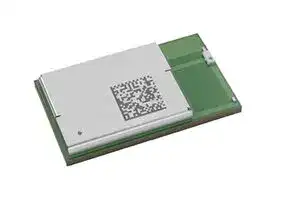


ENWF9408A2EF
Communication Module, WLAN, 5 GHz, GPIO/SDIO/HS UART/PCM, PAN9028 Series
- Manufacturer: PANASONIC
- Product type:
- SVHC: No SVHC (25-Jun-2025)
- Frequency RF: 5GHz
- Product Range: PAN9028 Series
- Module Interface: GPIO, SDIO, HS UART, PCM
- Module Applications: Beacons, Industrial IoT, Medical Devices, Smart Home/Building
| Delivery and price | |
|---|---|
| Units per pack | 250 |
| Price | 13.66 € |
| Current stock | 200+ |
| Lead time | 30 days |

## PAN9028 Wi-Fi Dual Band 2.4 GHz/5 GHz and Bluetooth[®] Module Product Specification Rev. 0.2 Wireless Connectivity PAN9028 Bluetooth Module ## **Overview** The PAN9028 is a 2.4 GHz and 5 GHz ISM band Wi-Fi and Bluetooth radio module, which includes a wireless radio and a power management IC for easy integration of Wi-Fi and Bluetooth connectivity into various electronic devices. ## **Features** - [Dual band 2.4 GHz and 5 GHz 802.11 a/b/g/n/ac ] Wi-Fi/Bluetooth combo module - [Supports 802.11i security standards through AES, ] CCMP, and more security mechanism - [802.11e Quality of Service is supported for ] multimedia application - [IEEE 802.11ac (Wave 2), 1×1 spatial stream with ] data rates up to 433 Mbps (MCS9, 80 MHz channel bandwidth) - [IEEE 802.11ac MU-MIMO beamformee ] - [Bluetooth 5 (includes Low Energy) ] - [Dual simultaneous and independent WLAN and ] Bluetooth operation - [Dynamic Rapid Channel Switching (DRCS) for ] simultaneous operation in 2.4 GHz and 5 GHz bands - [Indoor location and navigation with ] IEEE 802.11mc - [Power management with sleep clock ] - [Coexistence interface for arbitration of ] co-located WLAN, Bluetooth, or mobile wireless system (e.g. LTE or ZigBee[®] ) - [Generic interfaces include SDIO 3.0 and ] high-speed UART for host processor connection - [Software driver Linux][®] ## **Characteristics** - [Surface Mount Type (SMT) ] 24 mm × 12 mm × 2.8 mm - [NXP][®][ 88W8987 WLAN 2.4 GHz and 5 GHz and ] Bluetooth single-chip solution inside - [Single power supply: 3.3 V with Marvell][®] 88PG823 Power Management IC (optional) - [Tx power: 16 dBm at 802.11b ] - [Rx sensitivity: –97 dBm at 802.11b DSSS ] 1 Mbps - [IEEE 802.11ac 20 MHz, 40 MHz, 80 MHz ] channel bandwidth - [Long and Short Guard Interval support ] - [Current consumption Wi-Fi typical 320 mA (at ] Tx) and 60 mA (at Rx) - [SDIO 1 bit or 4 bit ] - [Wide temperature range of -30 °C to 85 °C ] ## **Block Diagram** Product Specification Rev. 0.2 Page 2 of 83 INDUSTRY Panasonic - PAN9028 Bluetooth Module - > ## PAN9028 Bluetooth Module By purchase of any of the products described in this document the customer accepts the document's validity and declares their agreement and understanding of its contents and recommendations. Panasonic Industrial Devices Europe GmbH (Panasonic) reserves the right to make changes as required at any time without notification. Please consult the most recently issued Product Specification before initiating or completing a design. © Panasonic Industrial Devices Europe GmbH 2020. This specification sheet is copyrighted. Reproduction of this document is permissible only if reproduction is without alteration and is accompanied by all associated warranties, conditions, limitations, and notices. Do not disclose it to a third party. All rights reserved. This Product Specification does not lodge the claim to be complete and free of mistakes. ## **Document Acceptance** By signing the Product Specification, you acknowledge that you are a legal representative for your company and that you understand and accept the validity of the contents herein. If the signed version of the Product Specification has not been returned to Panasonic within 30 days after receipt of the product, the specification or approval sheet shall be deemed to be accepted by you. ## **Engineering Samples (ES)** If Engineering Samples are delivered to the customer, these samples have the status “Engineering Samples”. This means that the design of this product is not yet concluded. Engineering Samples may be partially or fully functional, and they may differ from the published Product Specification. Engineering Samples are not qualified and they are not to be used for reliability testing or series production. ## **Disclaimer** The customer acknowledges that samples may deviate from the Product Specification and may bear defects due to their status of development and the lack of qualification mentioned above. Panasonic rejects any liability or product warranty for Engineering Samples. In particular, Panasonic disclaims liability for damages caused by: - The use of the Engineering Sample other than for evaluation purposes, particularly the installation or integration in another product to be sold by the customer, - Deviation or lapse in function of the Engineering Sample, - Improper use of the Engineering Sample. - Panasonic Industrial Devices Europe GmbH disclaims any liability for consequential and incidental damages. In case of any queries regarding the Engineering Samples, please contact your local sales partner or the related product manager. Panasonic Industrial Devices Europe GmbH disclaims any liability for consequential and incidental damages. In case of any queries regarding the Engineering Samples, please contact your local sales partner or the related product manager. Product Specification Rev. 0.2 Page 3 of 83 PAN9028 Bluetooth Module ## - ## INDUSTRY Panasonic ## **Table of Contents** |**1**|**About This Document .................................................................................................................. 6**|**About This Document .................................................................................................................. 6**| |---|---|---| ||1.1|Purpose and Audience ......................................................................................................... 6| ||1.2|Revision History .................................................................................................................. 6| ||1.3|Use of Symbols ................................................................................................................... 6| ||1.4|Related Documents ............................................................................................................. 6| |**2**|**Overview ....................................................................................................................................... 7**|| ||2.1|Block Diagram ..................................................................................................................... 8| ||2.2|Pin Configuration ................................................................................................................. 9| ||2.3|Host Interface .................................................................................................................... 16| ||2.4|Peripheral Bus Interfaces ................................................................................................... 16| ||2.5|PCM Interfaces .................................................................................................................. 17| ||2.6|Coexistence ...................................................................................................................... 17| ||2.7|WLAN ............................................................................................................................... 27| ||2.8|Bluetooth ........................................................................................................................... 32| |**3**|**Detailed Description ................................................................................................................... 35**|| ||3.1|Dimensions ....................................................................................................................... 35| ||3.2|Footprint ............................................................................................................................ 36| ||3.3|Packaging ......................................................................................................................... 37| ||3.4|Case Marking .................................................................................................................... 40| |**4**|**Specification ............................................................................................................................... 41**|| ||4.1|Default Test Conditions ...................................................................................................... 41| ||4.2|Absolute Maximum Ratings ................................................................................................ 41| ||4.3|Recommended Operating Conditions ................................................................................. 42| ||4.4|Current Consumption ......................................................................................................... 44| ||4.5|Internal Operating Frequencies .......................................................................................... 49| ||4.6|External Sleep Clock Specifications (only for Module Variant ENWF940[x]A2EF) ................ 50| ||4.7|Power-up Sequence .......................................................................................................... 50| ||4.8|Power-down Sequence ...................................................................................................... 51| ||4.9|Power Good (only for Module Variant ENWF940[x]A1EF) ................................................... 52| ||4.10|Interfaces .......................................................................................................................... 52| ||4.11|RF Electrical Characteristics .............................................................................................. 62| ||4.12|Reliability Tests ................................................................................................................. 75| ||4.13|Recommended Soldering Profile ........................................................................................ 76| |**5**|**Cautions ..................................................................................................................................... 77**|| ||5.1|Design Notes ..................................................................................................................... 77| ||5.2|Installation Notes ............................................................................................................... 77| ||5.3|Usage Condition Notes ...................................................................................................... 78| ||5.4|Storage Notes ................................................................................................................... 78| ||5.5|Safety Cautions ................................................................................................................. 78| ||5.6|Other Cautions .................................................................................................................. 79| ||5.7|Restricted Use ................................................................................................................... 80| Product Specification Rev. 0.2 Page 4 of 83 **==> picture [120 x 89] intentionally omitted <==** **----- Start of picture text -----**<br> -<br>**----- End of picture text -----**<br> PAN9028 Bluetooth Module ## INDUSTRY Panasonic |**6**|**Regulatory and Certification Information .................................................................................. 81**| |---|---| |**7**|**Appendix .................................................................................................................................... 82**| ||7.1<br>Ordering Information .......................................................................................................... 82| ||7.2<br>Contact Details .................................................................................................................. 83| Product Specification Rev. 0.2 Page 5 of 83 1 About This Document **==> picture [195 x 89] intentionally omitted <==** **----- Start of picture text -----**<br> <br>> PAN9028 Bluetooth Module<br>**----- End of picture text -----**<br> ## 1 About This Document Panasonic ## **1 About This Document** ## **1.1 Purpose and Audience** This Product Specification provides details on the functional, operational, and electrical characteristics of the Panasonic PAN9028 module. It is intended for hardware design, application, and Original Equipment Manufacturers (OEM) engineers. The product is referred to as “the PAN9028” or “the module” within this document. Unless otherwise stated the data in this document is valid for all module variants. ## **1.2 Revision History** |**Revision**|**Date**|**Modifications/Remarks**| |---|---|---| |0.1|2017-09-15|First preliminary version| |0.2|2020-08-28|New design. Added CPU frequencies, chapter “Restricted End Use”,<br>additional module and kit variants and versions, second module variant<br>without PMIC and 32 kHz, module specific parameters, MR variant.<br>Changed storage temperature.<br>Updated disclaimer, product overview, chapter “Overview”, block diagram.<br>Formal changes.| ## **1.3 Use of Symbols** |**Symbol**|**Description**| |---|---| ||**Note**<br>Indicates important information for the proper use of the product.<br>Non-observance can lead to errors.| |A|**Attention**<br>Indicates important notes that, if not observed, can put the product’s functionality<br>at risk.| |[chapter number]<br>[chapter title]|**Cross reference**<br>Indicates cross references within the document.<br>**Example:**<br>Description of the symbols used in this document1.3 Use of Symbols.| ## **1.4 Related Documents** For related documents please refer to the Panasonic website 7.2.2 Product Information. Product Specification Rev. 0.2 Page 6 of 83 INDUSTRY > PAN9028 Bluetooth Module Panasonic 2 Overview ## INDUSTRY Panasonic 2 Overview ## **2 Overview** The PAN9028 is a dual band 2.4 GHz and 5 GHz 802.11 a/b/g/n/ac Wi-Fi radio module with integrated Bluetooth BR/EDR/Low Energy (LE), specifically designed for highly integrated and cost-effective applications. The simultaneous and independent operation of the two standards enables very high data rates (802.11ac) and low-power operation (Bluetooth LE). Integrated power management, a fast dual-core CPU, 802.11i security standard support, and high-speed data interfaces deliver the performance for the speed, reliability, and quality requirements of next generation products. Tx power calibration data, Wi-Fi, and Bluetooth system parameters are pre-stored on the one-time-programmable memory of the PAN9028 during production at Panasonic. This simplifies passing the certification process for PAN9028 customers. Furthermore, the module reduces design, test, and calibration effort resulting in reduced timeto-market compared to discrete solutions. Integrating Wi-Fi and Bluetooth wireless connectivity allows high throughput applications for industrial devices and appliances. The combination of Wi-Fi and Bluetooth provides the highest flexibility for connectivity. For related documents please refer to 7.2.2 Product Information. For further information on the variants and versions please refer to 7.1 Ordering Information. Product Specification Rev. 0.2 Page 7 of 83 2 Overview INDUSTRY PAN9028 Bluetooth Module 2 Overview ## yg ## **2.1 Block Diagram** **For Module Variant ENWF940[x]A1EF:** **For Module Variant ENWF940[x]A2EF:** Product Specification Rev. 0.2 Page 8 of 83 INDUSTRY > PAN9028 Bluetooth Module Panasonic 2 Overview ## INDUSTRY Panasonic 2 Overview ## **2.2 Pin Configuration** ## **Pin Assignment** ## Top View ## **Pin Functions for Module Variant ENWF940[x]A1EF** |**No.**|**Pin Name**|**Pin Type**|**Description**| |---|---|---|---| |A1|GND|Ground pin|Connect to ground| |A2|PMIC_EN|Input signal|Power down of the PMIC, active-low| |A3|VOUT1V1|Power|+1.1 V power supply output, only for internal supply| |A4|IO143|Digital I/O|General Purpose I/O – GPIO [14]| |A5|DNC|NC|Do not connect| |A61|UART_CTS2|Input signal|Clear-to-send input from peripheral device| ||IO103|Digital I/O|General Purpose I/O – GPIO [10]| |A71|UART_RTS|Output signal|Request-to-send output to peripheral device| ||IO113|Digital I/O|General Purpose I/O – GPIO [11]| |A81|UART_SIN|Input signal|Serial data input to peripheral device| ||IO93|Digital I/O|General Purpose I/O – GPIO [9]| - 1 Multi-purpose pins: After the firmware download, the pins (GPIO, Serial Interface, RF control) are programmed in functional mode with dedicated functionality. - 2 UART mode: After the dedicated firmware download, the pin is used as Host Controller Interface (HCI) for Bluetooth. - 3 GPIO Mode: After the dedicated firmware download, the pin is used as Multi-Purpose Interface. Product Specification Rev. 0.2 Page 9 of 83 ## INDUSTRY > PAN9028 Bluetooth Module Panasonic 2 Overview ## INDUSTRY Panasonic 2 Overview |**No.**|**Pin Name**|**Pin Type**|**Description**| |---|---|---|---| |A9|DNC|NC|Do not connect| |A10|IO203|Digital I/O|General Purpose I/O – GPIO [20]| |A11|RF_SW2|Input signal|RF Switch Pin 2 – logical voltage level to activate on-board<br>antenna of RF PadRF-Switch Pin Function| |A12|GND|Ground pin|Connect to ground| |B1|PG1|Output signal|+1.1 V Power Good Output (float when not used)<br>4.9 Power Good| |B2|IO13|Digital I/O|General Purpose I/O – GPIO [1]| |B3|32KHZ_EN|Input signal|Disable internal 32.768 kHz crystal oscillator for LP modes (100<br>to GND)| |B4|IO03|Digital I/O|General Purpose I/O – GPIO [0]| |B5|DNC|NC|Do not connect| |B61|UART_DSR|Input signal|Data set ready from peripheral device| ||IO123|Digital I/O|General Purpose I/O – GPIO [12]| |B71|UART_DTR|Output signal|Data terminal ready to peripheral device| ||IO133|Digital I/O|General Purpose I/O – GPIO [13]| |B81|UART_SOUT|Output signal|Serial data output to peripheral device| ||IO83|Digital I/O|General Purpose I/O – GPIO [8]| |B9|IO153|Digital I/O|General Purpose I/O – GPIO [15]| |B101COEX_OUT|COEX_OUT|Output signal|Serial data output to MWS modem or peripheral device| ||IO173|Digital I/O|General Purpose I/O – GPIO [17]| |B11|RF_SW1|Input signal|RF Switch Pin 1 – logical voltage level to activate on-board<br>antenna of RF PadRF-Switch Pin Function| |B12|GND|Ground pin|Connect to ground| |C1|PGLDO|Output signal|+1.8 V Power Good Output (float when not used)<br>4.9 Power Good| |C6|CNTL2|Input signal|Do not connect| |C11|GND|Ground pin|Connect to ground| |C12|GND|Ground pin|Connect to ground| |D1|PG2|Output signal|+2.2 V Power Good Output (float when not used)<br>4.9 Power Good| |D6|CNTL0|Input signal|Keep open (DNC) if using SDIO interface for Bluetooth or connect<br>with 100 kto GND if using UART interface for Bluteooth<br>Control Pin Function.| |D11|GND|Ground pin|Connect to ground| |D12|GND|Ground pin|Connect to ground| Product Specification Rev. 0.2 Page 10 of 83 ## INDUSTRY > PAN9028 Bluetooth Module Panasonic 2 Overview ## INDUSTRY Panasonic 2 Overview |**No.**|**Pin Name**|**Pin Type**|**Description**| |---|---|---|---| |E11|PCM_CLK|Input/Output|PCM clock signal, output if PCM master, input if PCM slave| ||IO63|Digital I/O|General Purpose I/O – GPIO [6]| |E6|DNC|NC|Do not connect| |E11|GND|Ground pin|Connect to ground| |E12|GND|Ground pin|Connect to ground| |F1|GND|Ground pin|Connect to ground| |F2|VDD3V3|Power|+3.3 V power supply connection| |F3|VDD3V3|Power|+3.3 V power supply connection| |F4|VIOSD|Power|+1.8 V or +3.3 V Digital I/O SDIO power supply| |F51|COEX_SIN|Input signal|Serial data input from MWS modem or peripheral device| ||IO163|Digital I/O|General Purpose I/O – GPIO[16]| |F61|PCM_SYNC|Input/Output|PCM Sync Pulse signal, output if PCM master, input if PCM slave| ||IO73|Digital I/O|General Purpose I/O – GPIO [7]| |F71|PCM_DOUT|Output signal|PCM data output signal| ||IO53|Digital I/O|General Purpose I/O – GPIO [5]| |F81|LED_WLAN|Output pin|WLAN activity LED control| ||IO23|Digital I/O|General Purpose I/O – GPIO [2]| |F91|LED_BT|Output pin|Bluetooth activity LED control| ||IO33|Digital I/O|General Purpose I/O – GPIO [3]| |F101PCM_DIN|PCM_DIN|Input signal|PCM data input signal| ||IO43|Digital I/O|General Purpose I/O – GPIO [4]| |F11|GND|Ground pin|Connect to ground| |F12|GND|Ground pin|Connect to ground| |G1|VOUT2V2|Power|+2.2 V power supply output, only for internal supply| |G2|VOUT2V2|Power|+2.2 V power supply output, only for internal supply| |G3|VIO|Power|+1.8 V or +3.3 V power supply for General Purpose I/O and UART| |G4|VOUT1V8|Power|+1.8 V power supply output, only for internal supply| |G5|SD_CLK|Digital I/O|For SDIO specific terminals please refer toSDIO Pin Functions.| |G6|SD_CMD|Digital I/O|| |G7|SD_DAT0|Digital I/O|| |G8|SD_DAT1|Digital I/O|| |G9|SD_DAT2|Digital I/O|| |G10|SD_DAT3|Digital I/O|| Product Specification Rev. 0.2 Page 11 of 83 **==> picture [195 x 89] intentionally omitted <==** **----- Start of picture text -----**<br> <br>> PAN9028 Bluetooth Module<br>**----- End of picture text -----**<br> ## INDUSTRY Panasonic 2 Overview |**No.**|**Pin Name**|**Pin Type**|**Description**| |---|---|---|---| |G11|GND|Ground pin|Connect to ground| |G12|RF_OUT|RF port|50bottom pad to be activated by RF_SW1/RF_SW2 control<br>voltageRF-Switch Pin Function.| |EP1|EPAD1|Thermal pin|Connect to ground| |EP2|EPAD2|Thermal pin|Connect to ground| |EP3|EPAD3|Thermal pin|Connect to ground| |EP4|EPAD4|Thermal pin|Connect to ground| The VOUT1V1, VOUT1V8 and VOUT2V2 power supply pins are only for internal purpose. VOUT1V8 may be used to power VIO/VIOSD of the module. Do not use them to power external curcuits. ## **Pin Functions for Module Variant ENWF940[x]A2EF** |**No.**|**Pin Name**|**Pin Type**|**Description**| |---|---|---|---| |A1|GND|Ground pin|Connect to ground| |A2|DNC|NC|Do not connect| |A3|VDD1V1|Power|+1.1 V power supply connection| |A4|IO143|Digital I/O|General Purpose I/O – GPIO [14]| |A5|DNC|NC|Do not connect| |A61|UART_CTS2|Input signal|Clear-to-send input from peripheral device| ||IO103|Digital I/O|General Purpose I/O – GPIO [10]| |A71|UART_RTS|Output signal|Request-to-send output to peripheral device| ||IO113|Digital I/O|General Purpose I/O – GPIO [11]| |A81|UART_SIN|Input signal|Serial data input to peripheral device| ||IO93|Digital I/O|General Purpose I/O – GPIO [9]| |A9|DNC|NC|Do not connect| |A10|IO203|Digital I/O|General Purpose I/O – GPIO [20]| |A11|RF_SW2|Input signal|RF Switch Pin 2 – logical voltage level to activate on-board<br>antenna of RF PadRF-Switch Pin Function.| |A12|GND|Ground pin|Connect to ground| |B1|DNC|NC|Do not connect| |B2|IO13|Digital I/O|General Purpose I/O – GPIO [1]| |B3|DNC|NC|Do not connect| Product Specification Rev. 0.2 Page 12 of 83 **==> picture [195 x 89] intentionally omitted <==** **----- Start of picture text -----**<br> <br>> PAN9028 Bluetooth Module<br>**----- End of picture text -----**<br> ## INDUSTRY Panasonic 2 Overview |**No.**|**Pin Name**|**Pin Type**|**Description**| |---|---|---|---| |B4|IO03|Digital I/O|General Purpose I/O – GPIO [0]| |B5|PDn|Input signal|Power Down. Low active| |B61|UART_DSR|Input signal|Data set ready from peripheral device| ||IO123|Digital I/O|General Purpose I/O – GPIO [12]| |B71|UART_DTR|Output signal|Data terminal ready to peripheral device| ||IO133|Digital I/O|General Purpose I/O – GPIO [13]| |B81,4UART_SOUT|UART_SOUT|Output signal|Serial data output to peripheral device| ||IO83|Digital I/O|General Purpose I/O – GPIO [8]| |B91|IO153|Digital I/O|General Purpose I/O – GPIO [15]| |B101COEX_OUT|COEX_OUT|Output signal|Serial data output to MWS modem or peripheral device| ||IO173|Digital I/O|General Purpose I/O – GPIO [17]| |B11|RF_SW1|Input signal|RF Switch Pin 1 – logical voltage level to activate on-board<br>antenna of RF PadRF-Switch Pin Function.| |B12|GND|Ground pin|Connect to ground| |C1|DNC|NC|Do not connect| |C6|CNTL2|Input signal|Connect this pin (with 50 kto 100 k) to GND| |C11|GND|Ground pin|Connect to ground| |C12|GND|Ground pin|Connect to ground| |D1|DNC|NC|Do not connect| |D6|CNTL0|Input signal|Keep open (DNC) if using SDIO interface for Bluetooth or connect<br>with 100 kto GND if using UART interface for Bluetooth<br>Control Pin Function.| |D11|GND|Ground pin|Connect to ground| |D12|GND|Ground pin|Connect to ground| |E11|PCM_CLK|Input/Output|PCM clock signal, output if PCM master, input if PCM slave| ||IO63|Digital I/O|General Purpose I/O – GPIO [6]| |E6|DNC|NC|Do not connect| |E11|GND|Ground pin|Connect to ground| |E12|GND|Ground pin|Connect to ground| |F1|GND|Ground pin|Connect to ground| |F2|VDD3V3|Power|+3.3 V power supply connection| |F3|VDD3V3|Power|+3.3 V power supply connection| 4 Keep this pin open until firmware initialization or reset is finished. The definition of this pin changes immediately after firmware initialization or reset to its usual function Product Specification Rev. 0.2 Page 13 of 83 ## INDUSTRY > PAN9028 Bluetooth Module Panasonic 2 Overview ## INDUSTRY Panasonic 2 Overview |**No.**|**Pin Name**|**Pin Type**|**Description**| |---|---|---|---| |F4|VIOSD|Power|+1.8 V or +3.3 V Digital I/O SDIO power supply| |F51|COEX_SIN|Input signal|Serial data input from MWS modem or peripheral device| ||IO163|Digital I/O|General Purpose I/O – GPIO [16]| |F61|PCM_SYNC|Input/Output|PCM Sync Pulse signal, output if PCM master, input if PCM slave| ||IO73|Digital I/O|General Purpose I/O – GPIO [7]| |F71|PCM_DOUT|Output signal|PCM data output signal| ||IO53|Digital I/O|General Purpose I/O – GPIO [5]| |F81|LED_WLAN|Output pin|WLAN activity LED control| ||IO23|Digital I/O|General Purpose IO – GPIO [2]| |F91|LED_BT|Output pin|Bluetooth activity LED control| ||IO33|Digital I/O|General Purpose I/O – GPIO [3]| |F101PCM_DIN|PCM_DIN|Input signal|PCM data input signal| ||IO43|Digital I/O|General Purpose I/O – GPIO [4]| |F11|GND|Ground pin|Connect to ground| |F12|GND|Ground pin|Connect to ground| |G1|VDD2V2|Power|+2.2 V power supply connection| |G2|VDD2V2|Power|+2.2 V power supply connection| |G3|VIO|Power|+1.8 V or +3.3 V power supply for General Purpose I/O and UART| |G4|VDD1V8|Power|+1.8 V power supply connection| |G5|SD_CLK|Digital I/O|For SDIO specific terminals please refer toSDIO Pin Functions.| |G6|SD_CMD|Digital I/O|| |G7|SD_DAT0|Digital I/O|| |G8|SD_DAT1|Digital I/O|| |G9|SD_DAT2|Digital I/O|| |G10|SD_DAT3|Digital I/O|| |G11|GND|Ground pin|Connect to ground| |G12|RF_OUT|RF port|50bottom pad to be activated by RF_SW1/RF_SW2 control<br>voltageRF-Switch Pin Function.| |EP1|EPAD1|Thermal pin|Connect to ground| |EP2|EPAD2|Thermal pin|Connect to ground| |EP3|EPAD3|Thermal pin|Connect to ground| |EP4|EPAD4|Thermal pin|Connect to ground| Product Specification Rev. 0.2 Page 14 of 83 INDUSTRY > PAN9028 Bluetooth Module Panasonic 2 Overview ## INDUSTRY Panasonic 2 Overview ## **SDIO Pin Functions for all Module Variants** |**No.**|**Pin Name**|**Pin Type**|**Description**|**Description**| |---|---|---|---|---| ||||**4-Bit Mode**|**1-Bit Mode**| |G5|SD_CLK|Digital I/O|Clock|Clock| |G6|SD_CMD|Digital I/O|Command Line|Command Line| |G7|SD_DAT0|Digital I/O|Data Line bit [0]|Data Line| |G8|SD_DAT1|Digital I/O|Data Line bit [1] or Interrupt<br>(optional)|Interrupt| |G9|SD_DAT2|Digital I/O|Data Line bit [2] or Read Wait<br>(optional)|Read Wait (optional)| |G10|SD_DAT3|Digital I/O|Data Line bit [3]|Not used| ## **RF-Switch Pin Functions for all Module Variants** |**No.**|**Pin Name**|**Pin Type**|**Logical Level for Activation**|**Logical Level for Activation**| |---|---|---|---|---| ||||**On-Board Chip Antenna**|**RF OUT Pin**| |B11|RF_SW1|Input signal|GND (0 V)|3.0 V to 3.6 V (typ. 3.3 V)| |A11|RF_SW2|Input signal|3.0 V to 3.6 V (typ. 3.3 V)|GND (0 V)| ## **Control Pin Function for all Module Variants** The control pin is used as configuration input to set parameters following a reset. The definition of the pin changes immediately after a reset to its usual function. To set a configuration bit to “02, attach a 50 k to 100 k resistor from the pin to ground. No external circuitry is required to set a configuration bit to “1”. The configuration of the control pin is used for the firmware boot option. The software reads and boots accordingly. |**No.**|**Pin**<br>**Name**|**Pin Type**|**Strap**<br>**Value**|**WLAN**|**Bluetooth/**<br>**Bluetooth**<br>**LE**|**Firmware Download**|**Firmware Download**|**Number SDIO**<br>**Functions**| |---|---|---|---|---|---|---|---|---| |||||||**Type**|**Mode**|| |D6|CNTL0|Input Signal|0|SDIO|UART|SDIO+UART|Parallel/Serial 1 (WLAN)|Parallel/Serial 1 (WLAN)| ||||1|SDIO|SDIO|SDIO+SDIO|Parallel/Serial 2 (WLAN,|Parallel/Serial 2 (WLAN,<br>Bluetooth)| Product Specification Rev. 0.2 Page 15 of 83 > PAN9028 Bluetooth Module ## INDUSTRY Panasonic 2 Overview ## **2.3 Host Interface** The bus interface connects several host interface bus units to the CPU bus of the device through the internal bus. The connection of each unit is multiplexed with other bus units. The high-speed UART interface is connected to the CPU bus through a separate bus. |**Type**|**Features**| |---|---| |High-speed UART interface|The device supports a high-speed Universal Asynchronous<br>Receiver/Transmitter (UART) interface, compliant with the industry<br>standard 16550 specification.<br>•FIFO mode permanently selected for transmit and receive operations<br>•Two pins for transmit and receive operations<br>•Two flow control pins<br>•Interrupt triggers for low-power, high throughput operation| |SDIO interface|The device supports an SDIO device interface that conforms to the<br>industry standard SDIO full-speed card specification and allows a host<br>controller using the SDIO bus protocol to access the device.<br>•Supports SDIO 3.0 Standard<br>•1-bit SDIO or 4-bit SDIO transfer modes with full clock range up to<br>208 MHz<br>•On-chip memory used for CIS<br>•Special interrupt register for information exchange<br>•Allows card to interrupt host| For further information please refer to 4.10.1 Host Interface. ## **2.4 Peripheral Bus Interfaces** The Peripheral Bus Unit (PBU) connects several low speed peripherals to the internal bus of the device. The device consists of the GPIO Interface and the One Time Programmable Memory (OTP). |**Type **|**Features**| |---|---| |General Purpose I/O (GPIO)<br>Interface|•User-defined GPIOs (each configured to either input or output)<br>•Each GPIO controlled independently<br>•Each I/O configurable to output bit from GPIO_OUT| |One Time Programmable<br>Memory (OTP)|•Storing device-specific calibration data and hardware information like<br>MAC/BD address, WLAN, and Bluetooth parameters<br>•Programmed during production process of device<br>•Device performs calibration when it is powered up| For further information please refer to 4.10.2 Peripheral Interface. Product Specification Rev. 0.2 Page 16 of 83 - - > PAN9028 Bluetooth Module PAN9028 Bluetooth Module ## INDUSTRY Panasonic 2 Overview ## **2.5 PCM Interfaces** The device supports the PCM interface. |**Type **|**Features**| |---|---| |PCM Interface|•Master or slave mode<br>•PCM bit width size of 8 bits or 16 bits<br>•Up to four slots with configurable bit width and start positions<br>•Short frame and long frame synchronization| For further information please refer to 4.10.3 Audio Interface. ## **2.6 Coexistence** The implemented coexistence framework is based on the IEEE 802.15.2 recommended practice Packet Traffic Arbitration (PTA) scheme and the Bluetooth Special Interest Group (Bluetooth) Core Specification Volume 7 (Wireless Coexistence Volume). ## **2.6.1 WLAN and Bluetooth Channel Information Exchange** Since Bluetooth and IEEE 802.11b/g/n WLAN use the same 2.4 GHz frequency band, each can cause interference with the other. The level of interference depends on the respective frequency channel used by Bluetooth and WLAN (other factors can impact interference, like Tx power and Rx sensitivity of the device). In a system with both Bluetooth and WLAN, the common host receives information about WLAN channel usage and passes the information to the Bluetooth device. For Bluetooth 1.2 devices with Adaptive Frequency Hopping (AFH) enabled, the Bluetooth device can block channel usage that overlaps the WLAN channel in use. When the Bluetooth device avoids all channels used by the WLAN, the impact of interference is reduced, but not completely eliminated. For Bluetooth 1.1 devices, the Bluetooth device cannot block WLAN channel usage. In this case, a Bluetooth Coexistence Arbiter (BCA) scheme at MAC level is required. The BCA scheme can also be used with Bluetooth 1.2 devices to further reduce the impact of interference to a minimum. ## **2.6.2 External Mobile Wireless System (LTE or ZigBee) and BCA Exchange** Based on the Bluetooth SIG Wireless Coexistence Volume, the device supports a Wireless Coexistence Interface 2 (WCI-2) protocol for WLAN/Bluetooth coexistence with an external Mobile Wireless System (MWS), such as a Long Term Evolution (LTE) or ZigBee device. WCI-2 is a 2-wire transport interface. An internal coexistence is used to exchange request/grant with the BCA. ## **2.6.3 System Configuration** Product Specification Rev. 0.2 Page 17 of 83 - - > PAN9028 Bluetooth Module ## PAN9028 Bluetooth Module ## INDUSTRY Panasonic 2 Overview ## **External MWS Device** **==> picture [332 x 208] intentionally omitted <==** **----- Start of picture text -----**<br> RF Front End<br>BCA BT<br>CTL<br>Bluetooth<br>BCA WLAN<br>WLAN CTL<br>BCA<br>MAC<br>MWS to BCA COEX SIN<br>External LTE<br>Device<br>BCA to MWS COEX SOUT<br>88W8987 Radio SoC<br>Host<br>**----- End of picture text -----**<br> ## **2.6.4 WCI-2 Interface** The coexistence interface includes a Mobile Wireless System (MWS) transport controller to accommodate a 2-wire, UART-based serial transport interface. This interface is a standard full-duplex UART (TxD and RxD) carrying logical signals framed as UART characters. In addition, it allows support of multiple logical channels. ## **Interface Signals** |**Pin No.**|**Signal Name**|**Specification**<br>**Name**|**Pin Type**|**Description**| |---|---|---|---|---| |F5|COEX_SIN|RxD|Input|Serial data from external MWS device| |B10|COEX_SOUT|TxD|Output|Serial data to external MWS device| ## **Signal Waveform Format** The messaging is based on a standard UART format. The UART signals should be connected like a null-modem. For example, the local TxD connected to the remote RxD and vice versa. Product Specification Rev. 0.2 Page 18 of 83 2 Overview PAN9028 Bluetooth Module ## **Interface Transport Settings** |**Item**|**Range **|**Comment**| |---|---|---| |Baudrate|921 600 ~ 4 000 000|Baud| |Data Bits|8|LSB first| |Parity Bits|0|No parity| |StopBit|1|One stopbit| |Flow Control|No|No flow control| ## **Support Baud Rates** |**Baud**|||| |---|---|---|---| |921 600|2 000 000|3 000 000|4 000 000| ## **Real-Time Signaling Message** The real-time signaling message is used to transport real-time signals over the 2-wire transport interface. The real-time signaling message conveys the real-time signals (Bluetooth Core Specification, Volume 7, Part A) in one message. The time reference point for the real-time signaling message is the end of message bit 5 (transition to stop bit). Defined real-time signaling messages include: - Coexistence Controller to MWS device - MWS device to Coexistence Controller |**Real-Time Signaling**|**MSG[0]**|**MSG[1]**|**MSG[2]**|**MSG[3]**|**MSG[4]**| |---|---|---|---|---|---| |MWS to Coexistence<br>Controller (Signal)|FRAME_SYNC|MWS_RX|MWS_TX|PATTERN [0]|PATTERN [1]| |Coexistence Controller to<br>MWS (Message)|BLUETOOTH<br>_RX_PRI|BLUETOOTH<br>_TX_ON|802_RX_PRI|802_TX_ON|RFU| Product Specification Rev. 0.2 Page 19 of 83 ## INDUSTRY > PAN9028 Bluetooth Module Panasonic 2 Overview ## INDUSTRY Panasonic 2 Overview **Signal Name** FRAME_SYNC MWS_RX MWS_TX PATTERN [1, 0] BT_RX_PRI BT_TX_ON 802_RX_PRI 802_TX_ON MWS_INACTIVITY_DURATION MWS_SCAN_FREQUENCY_OFFSET ## **Transport Control Message** The transport control messages can modify the state and request state information of the MWS coexistence interface. |**Message **|**MSG[0]**|**MSG[1]**|**MSG[2]**|**MSG[3]**|**MSG[4]**| |---|---|---|---|---|---| |Transport Control Message RESEND_REAL|Transport Control Message RESEND_REAL<br>_TIME|RFU|RFU|RFU|RFU| |**Signal Name**|**Description**| |---|---| |RESEND_REAL_TIME|This bit is set if a device wants to get a status update of the real-time signals.<br>The signal is usually used after wake-up from sleep of the transport interface to<br>get an update of the real-time signals.<br>If the receiving device’s transport interface is awake it shall send a real-time<br>message with the current status of the real-time signals within 4 UART<br>character period. If the signal is not transmitted within 4 UART character<br>periods, the device is considered asleep.<br>If the receiving device’s transport interface is not awake it shall not send a real-<br>time message.<br>**Bluetooth initiated:**If the MWS is currently scanning or has an ongoing<br>inactivity duration, the MWS shall send a frequency scan message or an<br>inactivity duration message after transmitting the real-time message.<br>If the receiving device’s transport interface is not awake it shall not send a<br>frequency scan or inactivity duration message.| ## **Transparent Data Message** The transparent control messages can modify the state and request state information of the MWS coexistence interface. Product Specification Rev. 0.2 Page 20 of 83 ## INDUSTRY > PAN9028 Bluetooth Module Panasonic 2 Overview ## INDUSTRY Panasonic 2 Overview **==> picture [408 x 124] intentionally omitted <==** **----- Start of picture text -----**<br> ||||||| |---|---|---|---|---|---| |Message|MSG [0]|MSG [1]|MSG [2]|MSG [3]|MSG [4]| |Transparent Data Message NIBBLE_POSIT|DATA [0]/[4]|DATA [1]/[5]|DATA [2]/[6]|DATA [3]/[7]| |ION| |Signal Name|Description| |NIBBLE_POSITION|0 = least significant nibble| |1 = most significant nibble| |DATA[n]; n=0 .. 7|Data bits of the message octet| **----- End of picture text -----**<br> ## **MWS Inactivity Duration Message** The inactivity duration messages is used to send the MWS_INACTIVITY_DURATION signal from the MWS device to the Coexistence Controller. **==> picture [417 x 37] intentionally omitted <==** **----- Start of picture text -----**<br> ||||||| |---|---|---|---|---|---| |Message|MSG [0]|MSG [1]|MSG [2]|MSG [3]|MSG [4]| |MWS Inactivity Duration|DURATION [0]|DURATION [1]|DURATION [2]|DURATION [3]|DURATION [4]| |Message| **----- End of picture text -----**<br> The idle duration is encoded in 5 bits given by the formula: Inactivity_Duartion = DURATION ∙5 ms Inactivity durarations smaller than 5 ms are not communicated. If all bits are set to “1” the inactivity duration is infinite. If all bits are set to “0” or MWS_RX or MWS_TX are set to “1”, the inactivity period ends. ## **MWS Scan Frequency Offset Message** The MWS scan frequency offset message is used to send the MWS_SCAN_FREQUENCY_ OFFSET signal from the MWS device to the Coexistence Controller. **==> picture [398 x 35] intentionally omitted <==** **----- Start of picture text -----**<br> ||||||| |---|---|---|---|---|---| |Message|MSG [0]|MSG [1]|MSG [2]|MSG [3]|MSG [4]| |MWS Scan Frequency|BAND|FREQ [0]|FREQ [1]|FREQ [2]|FREQ [3]| |Offset| **----- End of picture text -----**<br> The RF scan frequency is encoded in 5 bits given by the formula: RF_FREQ_OFFSET = FREQ ∙ 10 MHz If BAND is set to “0” the RF_FREQ_OFFSET is the negative value from the lower edge of the ISM band and if BAND is set to “1”, RF_FREQ_OFFSET is the positive value from the top edge of the ISM band. FREQ set to all “0” indicates the end of the scan period. ## **2.6.5 Bluetooth Coexistence Arbiter** **Type Features** Product Specification Rev. 0.2 Page 21 of 83 INDUSTRY > PAN9028 Bluetooth Module Panasonic 2 Overview ## INDUSTRY Panasonic 2 Overview |**Type**|**Features**| |---|---| |Capability|•Programmable coexistence interface timing, interface modes, and signal polarity to<br>support a variety of external Bluetooth devices<br>•Programmable decision policies and transaction lock behavior for various use cases<br>•Interface with external or on-chip Bluetooth device<br>•Support Bluetooth 1.1 or Bluetooth 1.2 AFH<br>•WLAN-/Bluetooth-coordinated low-power design<br>•Enhanced information sharing between WLAN and Bluetooth for combo systems<br>•WLAN/Bluetooth/MWS (LTE or ZigBee) coexistence support| |Arbitration|•Contention resolved by a customizable decision matrix that allows independent<br>grant decision for each device<br>•Vectors for the decision matrix:<br>−WLAN priority (2-bit)<br>−WLAN direction<br>−Bluetooth priority (1-bit or 2-bit)<br>−Bluetooth direction<br>−Bluetooth frequency in/out band<br>−MWS priority (2-bit)<br>−MWS direction| |AFH|If AFH is enabled in the Bluetooth device, and there is a sufficient guard-band outside<br>the WLAN operating frequency, the Bluetooth device uses the Out-Of-Band (OOB)<br>channel with respect to the WLAN device. Otherwise, the Bluetooth device uses the In-<br>Band (IB) and OOB channels with respect to the WLAN device.<br>The IB and OOB information is either provided by the Bluetooth device through the<br>coexistence interface, or it can be provided through firmware controls in a shared-host<br>system. IB/OOB is a vector in the decision matrix.| |Decision<br>Policies|System configuration is a major consideration when planning decision policies. The<br>configuration governs how RF paths are shared and how much interference will occur.<br>Interference combinations include:<br>−WLAN Tx and Bluetooth Tx<br>−WLAN Tx and Bluetooth Rx<br>−WLAN Rx and Bluetooth Tx<br>−WLAN Rx and Bluetooth Rx| ||Interference combinations where WLAN and Bluetooth share the same antenna:<br>−WLAN Tx and Bluetooth Tx share same antenna, the decision matrix allows<br>either WLAN or Bluetooth Tx (both OOB and IB), based on relative packet priori-<br>ties.<br>−WLAN Tx and Bluetooth Rx (both OOB and IB) have sizable interference impacts<br>on Bluetooth Rx, the decision matrix grants or denies WLAN Tx based on relative<br>packet priorities.<br>−WLAN Rx and Bluetooth Tx (both OOB and IB) have sizable interference impacts<br>on WLAN Rx, the decision matrix grants or denies Bluetooth Tx based on relative<br>packet priorities.<br>−WLAN Rx and Bluetooth Rx (both OOB and IB) have no impact on each other,<br>the decision matrix grants both.| Product Specification Rev. 0.2 Page 22 of 83 ## INDUSTRY > PAN9028 Bluetooth Module Panasonic 2 Overview ## INDUSTRY Panasonic 2 Overview |**Type**|**Features**| |---|---| ||Interference combinations where WLAN and Bluetooth have their own antenna:<br>−WLAN Tx and Bluetooth Tx in OOB situation have little interference impact on<br>each other, the decision matrix grants both.<br>−WLAN Tx and Bluetooth Tx in IB have sizable interference impact on each other,<br>the decision matrix allows either WLAN or Bluetooth Tx, based on relative packet<br>priorities.<br>−WLAN Tx and Bluetooth Rx in OOB situation have little interference impact on<br>each other, the decision matrix grants both provided there is enough antenna<br>isolation between WLAN and Bluetooth antenna.<br>−WLAN Tx and Bluetooth Rx in IB situation have sizable interference impact on<br>Bluetooth Rx, the decision matrix grants or denies WLAN Tx based on relative<br>packet priorities.<br>−WLAN Rx and Bluetooth Tx in OOB situation have little interference impact on<br>each other, the decision matrix grants both provided there is enough antenna<br>isolation between WLAN and Bluetooth antenna.<br>−WLAN Rx and Bluetooth Tx in IB situation have sizable interference impact on<br>WLAN RX, the decision matrix grants or denies Bluetooth Tx based on relative<br>packet priorities.<br>−WLAN Rx and Bluetooth Rx (both OOB and IB) have no impact on each other,<br>the decision matrix grants both.| |Decision<br>Policies<br>(continued)|For the devices running in a basic shared antenna configuration, the linear switching<br>imposes restrictions on simultaneous transfer. Reasonable policies include:<br>−WLAN and Bluetooth are never granted at the same time<br>−Decision matrix grants a device based on relative packet priorities and direction<br>−Priority order: High > Medium High > Medium > Low<br>−For equal priority contention, select one device to win, that optimizes the usage<br>case<br>For the devices running in an enhanced shared antenna configuration, the linear<br>switching imposes restrictions on some simultaneous transfers.| |Transaction<br>Stopping|The arbiter allows control of what transfers can be stopped after an initial grant. If<br>allowed, a transaction can be stopped for higher priority request. A transaction stop<br>decision is a function of the decision policies and transaction stopping control. The<br>transaction stopping control is configurable per device and direction.| ## **2.6.6 Bluetooth Capability** Product Specification Rev. 0.2 Page 23 of 83 INDUSTRY > PAN9028 Bluetooth Module Panasonic 2 Overview ## INDUSTRY Panasonic 2 Overview |**Type**|**Features**| |---|---| |Request<br>Schemes|The PTA signals are directly controlled by the hardware to meet timing requirements of<br>the Bluetooth radio. The software controls the type of traffic in priority mode.<br>Mechanisms enforced for control include:<br>•Selection of certain types of communication always treated as high priority<br>•Selection of individual frames marked with high priority<br>•Real-time signaling of the next slot marked with high priority<br>•Automatic hardware control based on the grant/denial history of the Bluetooth link| |Timing Control The PTA signal timing scheme is fully programmable relative to the Bluetooth packet|Timing Control The PTA signal timing scheme is fully programmable relative to the Bluetooth packet<br>timing.| ## **2.6.7 WLAN Capability** |**Type**|**Features**| |---|---| |Capability|The WLAN device technology uses an internal coexistence interface to exchange<br>request/grant with the BCA.<br>Features:<br>•Packet-based request signaling with direction and priority information<br>•1-bit or 2-bit priority signaling to support 4 priority levels<br>•Multiple WLAN Rx request trigger sources, including early prediction<br>•WLAN Tx request cancellation and abort if grant denied or revoked in middle of<br>request<br>•802.11n A-MPDU treated as single packet| |Packet<br>Classification|•Programmable mask allows each frame type to be mapped to a priority<br>•Default setting puts response frames (ACK), beacons, and QoS frames as high<br>priority<br>•WLAN Tx and Rx have separate priority masks| |Queue<br>Classification|•Programmable mask allows each transmit queue to be mapped to a priority<br>•Queue-based mapping is optional for software-generated frames only| Product Specification Rev. 0.2 Page 24 of 83 INDUSTRY > PAN9028 Bluetooth Module Panasonic 2 Overview ## INDUSTRY Panasonic 2 Overview ## **2.6.8 LTE (MWS) Capability** The device supports a Bluetooth SIG WCI-2 MWS coexistence signaling interface. The coexistence logical signaling is designed to enable a standard interface to allow an MWS device and a Coexistence Controller to exchange information and support cooperative coexistence. The WCI-2 signals carry time-critical information such as the start point of an MWS frame. The logical coexistence signaling architecture also includes transparent data messaging and vendor specific data messaging mechanism to enable passing information to and from the collocated MWS device and Coexistence Controller when long latency (tens of milliseconds) cannot be tolerated. For further information please refer to 2.6.4 WCI-2 Interface. ## **Coexistence Signals** The logical signals assist in time alignment, protecting MWS from interference and maximizing the usability of the Bluetooth radio. ## **Time-Critical Coexistence Signals** |**Signal Name**|**Direction**| |---|---| |FRAME_SYNC|MWS to Bluetooth| |BT_RX_PRI|Bluetooth to MWS| |BT_TX_ON|Bluetooth to MWS| |802_RX_PRI|Bluetooth to MWS| |802_TX_ON|Bluetooth to MWS| |MWS_PATTERN|MWS to Bluetooth| |MWS_RX|MWS to Bluetooth| |MWS_TX|MWS to Bluetooth| |MWS_INACTIVITY_DURATION|MWS to Bluetooth| |MWS_SCAN_FREQUENCY_OFFSET|MWS to Bluetooth| |MWS_TX_PRIL (MWS TX Priority Level)|MWS to Bluetooth| |MWS_RX_PRIL (MWS RX Priority Level)|MWS to Bluetooth| ## **2.6.9 ZigBee (MWS) Coexistence Capability** ZigBee is based on the IEEE 802.15.4 standard and it is used by a suite of communication protocols to create Personal Area Networks (PANs) supporting home automation, lighting control, etc. ZigBee radios operate in the 2.4 GHz ISM band worldwide. Unlike Bluetooth, the ZigBee specification does not use AFH. When coexisting with WLAN/Bluetooth in the 2.4 GHz band, it is important to avoid co-channel (IB) operation of these radios. Product Specification Rev. 0.2 Page 25 of 83 INDUSTRY Panasonic 2 Overview **==> picture [195 x 89] intentionally omitted <==** **----- Start of picture text -----**<br> <br>> PAN9028 Bluetooth Module<br>**----- End of picture text -----**<br> The device re-uses the MWS coexistence interface to support ZigBee coexistence. The coexistence logical signaling is used to allow a ZigBee device and a WLAN/Bluetooth combo device to exchange information and support cooperative coexistence. ## **Coexistence Signals** The logical signals used for ZigBee and WLAN/Bluetooth coexistence are a subset of the LTE coexistence signaling. Considering the lower data rate of ZigBee packets, a lower baud rate may be chosen for the 2-wire UART physical interface. The BCA supports 3-way arbitration among ZigBee/WLAN/Bluetooth requests. ## **Coexistence Signals** |**Signal Name**|**Direction**| |---|---| |MWS_RX|MWS to Bluetooth| |MWS_TX|MWS to Bluetooth| |MWS_PATTERN|MWS to Bluetooth| |MWS_RX_PRI|MWS to Bluetooth| |MWS_TX_PRI|MWS to Bluetooth| |802_RX_PRI|Bluetooth to MWS| |802_TX_ON|Bluetooth to MWS| |BT_RX_PRI|Bluetooth to MWS| |BT_TX_ON|Bluetooth to MWS| Product Specification Rev. 0.2 Page 26 of 83 INDUSTRY Panasonic 2 Overview - - > PAN9028 Bluetooth Module ## **2.7 WLAN** |**Type**|**Features**| |---|---| |IEEE 802.11/<br>Standards|•802.11 data rates 1 Mbps and 2 Mbps (DSSS)<br>•802.11b data rates 5.5 Mbps and 11 Mbps (CCK)<br>•802.11a/g data rates 6 Mbps, 9 Mbps, 12 Mbps, 18 Mbps, 24 Mbps, 36 Mbps,<br>48 Mbps, and 54 Mbps (OFDM)<br>•802.11b/g performance enhancements<br>•802.11n/ac with maximum data rates up to 86.7 Mbps (20 MHz channel), 200 Mbps<br>(40 MHz channel), 433 Mbps (80 MHz channel)<br>•802.11d international roaming<br>•802.11e quality of service (QoS)<br>•802.11h transmit power control<br>•802.11h DFS radar pulse detection<br>•802.11i enhanced security (WEP, WPA, WPA2)<br>•802.11k radio resource measurement<br>•802.11mc precise indoor location and navigation<br>•802.11n block acknowledgment extension<br>•802.11r fast hand-off for AP roaming<br>•802.11u Hotspot 2.0 (STA mode only)<br>•802.11v TIM frame transmission/reception<br>•802.11w protected management frames<br>•Support clients (stations) implementing IEEE Power Save mode| |WLAN MAC|•Frame exchange at the MAC level to deliver data<br>•Received frame filtering and validation (CRC)<br>•Generation of MAC header and trailer information (MPDUs)<br>•Fragmentation of data frames (MSDUs)<br>•Access mechanism support for fair access to shared wireless medium through:<br>−Distributed Coordination Function (DCF)<br>−Enhanced Distributed Channel Access (EDCA)<br>•A-MPDU aggregation/de-aggregation (supports 802.11ac single-MPDU A-MPDU)<br>•20 MHz, 40 MHz, and 80 MHz channel coexistence<br>•RIFS burst receive<br>•Management information base<br>•Radio resource measurement<br>•Quality of service<br>•Block acknowledgement<br>•802.11ac downlink MU-MIMO (receive)<br>•Dynamic frequency selection<br>•TIM frame Tx and Rx<br>•Multiple BSS/Station<br>•Transmit rate adaption<br>•Transmit power control| Product Specification Rev. 0.2 Page 27 of 83 INDUSTRY Panasonic 2 Overview **==> picture [195 x 89] intentionally omitted <==** **----- Start of picture text -----**<br> <br>> PAN9028 Bluetooth Module<br>**----- End of picture text -----**<br> |**Type**|**Features**| |---|---| |WLAN<br>Baseband|•802.11ac 1×1 SISO (WLAN SoC with SISO RF radio)<br>•Backward compatibility with legacy 802.11a/b/g/n technology<br>•WLAN/Bluetooth LNA sharing<br>•PHY data rates up to 433 Mbps<br>•20 MHz bandwidth/channel, 40 MHz bandwidth/channel, upper/lower 20 MHz<br>bandwidth in 40 MHz channel, and 20 MHz duplicate legacy bandwidth in 40 MHz<br>channel mode operation<br>•80 MHz bandwidth/channel, 4 positions of 20 MHz bandwidth in 80 MHz channel,<br>upper/lower 40 MHz bandwidth in 80 MHz channel, 20 MHz quadruplicate legacy<br>bandwidth in 80 MHz channel mode operation<br>•Modulation and Coding Scheme<br>−802.11n: MCS 0 ~ 7 and MCS 32 (duplicate 6 Mbps)<br>−802.11ac: MCS 0~9 NSTS = 1<br>•Dynamic frequency selection (radar detection)<br>−Enhanced radar detection for short and long pulse radar<br>−Enhanced AGC scheme for DFS channel<br>−Japan DFS requirement for W53 and W56<br>•802.11k Radio resource measurement| ||•802.11n/ac optional features:<br>−20 MHz, 40 MHz, and 80 MHz coexistence with middle-packet detection (GI<br>detection) for enhancd CCA<br>−Space-Time-Block-Coding (STBC) one spatial stream reception<br>−LDPC transmission and reception for both 802.11n and 802.11ac<br>−256 QAM (MCS 8, 9) modulation (optional support for 802.11ac MCS 9 in 20 MHz<br>using LDPC)<br>−Short Guard Interval<br>−RIFS on receive path for 802.11n packets<br>−Explicit Beamformee support<br>−802.11ac multi-user beamformee<br>−802.11n Greenfield Tx/Rx<br>−MU-PPDUs (receive)<br>•802.11mc locationing<br>•Power save features| |WLAN Radio|•Integrated direct-conversion radio<br>•20 MHz, 40 MHz, and 80 MHz channel bandwidth<br>•Shared WLAN/Bluetooth receive input scheme for 2.4 GHz band<br>•Rx Path<br>−On-chip gain selectable LNA with optimized noise figure and power consumption<br>−High dynamic range AGC function in receive mode<br>•Tx Path<br>−Internal PA with power control<br>−Optimized Tx gain distribution for linearity and noise performance<br>•Local Oscillator with fine channel step| Product Specification Rev. 0.2 Page 28 of 83 INDUSTRY Panasonic 2 Overview ## INDUSTRY > PAN9028 Bluetooth Module Panasonic 2 Overview - **Type Features** WLAN •[WEP 64-bit and 128-bit encryption with hardware TKIP processing (WPA) ] Encryption •[AES-CCMP hardware implementation as part of 802.11i security standard (WPA2) ] •[Advanced encryption standard (AES)/Counter-Mode/CBC-MAC Protocol (CCMP) ] - [AES-Cipher-Based Message Authentication Code (CMAC) as part of the 802.11w ] security standard - [WLAN Authentication and Privacy Infrastructure (WAPI) ] ## **Operation Modes** |**Parameter**|**Operation Mode**|**Operation Mode**|**Operation Mode**|**Operation Mode**|**Specification**| |---|---|---|---|---|---| |Standard Conformance|IEEE 802.11/IEEE 802.11b||||| ||IEEE 802.11a||||| ||IEEE 802.11g||||| ||IEEE 802.11n||||| ||IEEE 802.11ac||||| |Modulation|IEEE 802.11a||||OFDM| ||IEEE 802.11b||||DSSS/CCK| ||IEEE 802.11g||||OFDM| ||IEEE 802.11n||||OFDM at MCS0~7 and MCS32 (duplicate<br>6 Mbps)| ||IEEE 802.11ac||||OFDM at MCS0~9| |Physical layer data rates|IEEE 802.11||||1 Mbps, 2 Mbps at DSSS| ||IEEE 802.11b||||5.5 Mbps, 11 Mbps at DSSS/CCK| |Supported data rates|IEEE 802.11g||||[6, 9, 12, 18, 24, 36, 48, 54] Mbps| ||IEEE 802.11a||||[6, 9, 12, 18, 24, 36, 48, 54]Mbps| ||IEEE 802.11n|MCS0~7|HT20|LGI [6.5, 13, 19.5, 26, 39, 52, 58.5, 65] Mbps|LGI [6.5, 13, 19.5, 26, 39, 52, 58.5, 65] Mbps| |||||SGI [7.2, 14.4, 21.7, 28.9, 43.3, 57.8, 65,|SGI [7.2, 14.4, 21.7, 28.9, 43.3, 57.8, 65,<br>72.2] Mbps| ||||HT40|LGI [13.5, 27, 40.5, 54, 81, 108, 121.5,|LGI [13.5, 27, 40.5, 54, 81, 108, 121.5,<br>135] Mbps| |||||SGI|[15, 30, 45, 60, 90, 120, 135, 150]Mbps| ||IEEE 802.11ac MCS0~8|IEEE 802.11ac MCS0~8|HT20|LGI [6.5, 13, 19.5, 26, 39, 52, 58.5, 65,|LGI [6.5, 13, 19.5, 26, 39, 52, 58.5, 65,<br>78] Mbps| |||||SGI [7.2, 14.4, 21.7, 28.9, 43.3, 57.8, 65, 72.2,|SGI [7.2, 14.4, 21.7, 28.9, 43.3, 57.8, 65, 72.2,<br>86.7] Mbps| |||MCS0~9|HT40|LGI [13.5, 27, 40.5, 54, 81, 108, 121.5, 135,|LGI [13.5, 27, 40.5, 54, 81, 108, 121.5, 135,<br>162, 180] Mbps| |||||SGI [15, 30, 45, 60, 90, 120, 135, 150, 180,|SGI [15, 30, 45, 60, 90, 120, 135, 150, 180,<br>200] Mbps| ||||VHT80 LGI [29.3, 58.5, 87.8, 117, 175.5, 234, 263.3,|VHT80 LGI [29.3, 58.5, 87.8, 117, 175.5, 234, 263.3,|VHT80 LGI [29.3, 58.5, 87.8, 117, 175.5, 234, 263.3,<br>292.5, 351, 390] Mbps| |||||SGI [32.5, 65, 97.5, 130, 195, 260, 292.5, 325,|SGI [32.5, 65, 97.5, 130, 195, 260, 292.5, 325,<br>390, 433.3] Mbps| Product Specification Rev. 0.2 Page 29 of 83 ## INDUSTRY > PAN9028 Bluetooth Module Panasonic 2 Overview ## INDUSTRY Panasonic 2 Overview |**Parameter**|**Operation Mode**|**Specification**| |---|---|---| |Supported bandwidth|IEEE 802.11n|20 MHz, 40 MHz(BW)| ||IEEE 802.11ac|20 MHz, 40 MHz, 80 MHz (BW)| |Supported channel mode<br>operation|IEEE 802.11n|20 MHz BW/channel, 40 MHz BW/channel,<br>upper/lower 20 MHz BW at 40 MHz channel,<br>20 MHz duplicate legacy BW at 40 MHz<br>channel| ||IEEE 802.11ac|20 MHz BW/channel, 40 MHz BW/channel,<br>80 MHz BW/channel, upper/lower 20 MHz<br>BW at 40 MHz channel, 20 MHz duplicate<br>legacy BW at 40 MHz channel, 4 positions<br>of 20 MHz BW at 80 MHz channel,<br>upper/lower 40 MHz BW at 80 MHz channel,<br>20 MHz quadruplicate legacy BW at 80 MHz<br>channel| |Supported Guard Interval|IEEE 802.11n|400 ns(SGI), 800 ns(LGI)| ||IEEE 802.11ac|400 ns (SGI), 800 ns (LGI)| ## **Channels and Frequencies (without Regulatory Restrictions)** |**2.4 GHz – IEEE 802.11b/g/n**|**2.4 GHz – IEEE 802.11b/g/n**|**2.4 GHz – IEEE 802.11b/g/n**|**2.4 GHz – IEEE 802.11b/g/n**|**2.4 GHz – IEEE 802.11b/g/n**|**2.4 GHz – IEEE 802.11b/g/n**| |---|---|---|---|---|---| |**20 MHz Channels**|||**40 MHz Channels**||| |**Channel**|**Frequency**|**Unit**|**Channel**|**Frequency**|**Unit**| |1|2 412|MHz|1 to 5|2 422|MHz| |2|2 417|MHz|2 to 6|2 427|MHz| |3|2 422|MHz|3 to 7|2 432|MHz| |4|2 427|MHz|4 to 8|2 437|MHz| |5|2 432|MHz|5 to 9|2 442|MHz| |6|2 437|MHz|6 to 10|2 447|MHz| |7|2 442|MHz|7 to 11|2 452|MHz| |8|2 447|MHz|||| |9|2 452|MHz|||| |10|2 457|MHz|||| |11|2 462|MHz|||| |12|2 467|MHz|||| |13|2 472|MHz|||| |**5 GHz – IEEE 802.11a/n/ac**|**5 GHz – IEEE 802.11a/n/ac**|**5 GHz – IEEE 802.11a/n/ac**|**5 GHz – IEEE 802.11a/n/ac**|**5 GHz – IEEE 802.11a/n/ac**|**5 GHz – IEEE 802.11a/n/ac**| |---|---|---|---|---|---| |**20 MHz Channels**|||**40 MHz Channels**||| |**Channel**|**Frequency**|**Unit**|**Channel**|**Frequency**|**Unit**| |36|5 180|MHz|36 to 40|5 190|MHz| |40|5 200|MHz|44 to 48|5 230|MHz| |44|5 220|MHz|52 to 56|5 270|MHz| Product Specification Rev. 0.2 Page 30 of 83 ## INDUSTRY > PAN9028 Bluetooth Module Panasonic 2 Overview ## INDUSTRY Panasonic 2 Overview |**5 GHz – IEEE 802.11a/n/ac**|**5 GHz – IEEE 802.11a/n/ac**|**5 GHz – IEEE 802.11a/n/ac**|**5 GHz – IEEE 802.11a/n/ac**|**5 GHz – IEEE 802.11a/n/ac**|**5 GHz – IEEE 802.11a/n/ac**| |---|---|---|---|---|---| |**20 MHz Channels**|||**40 MHz Channels**||| |**Channel**|**Frequency**|**Unit**|**Channel**|**Frequency**|**Unit**| |48|5 240|MHz|60 to 64|5 310|MHz| |52|5 260|MHz|||| |56|5 280|MHz|||| |60|5 300|MHz|||| |64|5 320|MHz|||| ||||||| |100|5 500|MHz|100 to 104|5 510|MHz| |104|5 520|MHz|108 to 112|5 550|MHz| |108|5 540|MHz|116 to 120|5 590|MHz| |112|5 560|MHz|124 to 128|5 630|MHz| |116|5 580|MHz|132 to 136|5 670|MHz| |120|5 600|MHz|149 to 153|5 755|MHz| |124|5 620|MHz|157 to 161|5 795|MHz| |128|5 640|MHz|||| |132|5 660|MHz|||| |136|5 680|MHz|||| |140|5 700|MHz|||| |149|5 745|MHz|||| |153|5 765|MHz|||| |157|5 785|MHz|||| |161|5 805|MHz|||| |165|5 825|MHz|||| ## **5 GHz – IEEE 802.11a/n/ac** |**5 GHz – IEEE 802.11a/n/ac**|**5 GHz – IEEE 802.11a/n/ac**|**5 GHz – IEEE 802.11a/n/ac**|**5 GHz – IEEE 802.11a/n/ac**|**5 GHz – IEEE 802.11a/n/ac**|**5 GHz – IEEE 802.11a/n/ac**| |---|---|---|---|---|---| |**80 MHz Channels**|||||| |**Channel**|**Frequency**|**Unit**|**Channel**|**Frequency**|**Unit**| |36 to 48|5 210|MHz|||| |52 to 64|5 290|MHz|||| ||||||| |100 to 112|5 530|MHz|||| |116 to 128|5 610|MHz|||| |132 to 144|5 690|MHz|||| |149 to 161|5 775|MHz|||| Product Specification Rev. 0.2 Page 31 of 83 ## INDUSTRY > PAN9028 Bluetooth Module Panasonic 2 Overview ## INDUSTRY Panasonic 2 Overview **==> picture [399 x 172] intentionally omitted <==** **----- Start of picture text -----**<br> |||||||| |---|---|---|---|---|---|---| |5 GHz – IEEE 802.11a/n/ac (India and additional UNII Channels)| |20 MHz Channels|40 MHz Channels| |Channel|Frequency|Unit|Channel|Frequency|Unit| |144|5 720|MHz|68 to 72|5 350|MHz| |169|[5]|5 845|MHz|76 to 80|5 390|MHz| |173|[5]|5 865|MHz|84 to 88|5 430|MHz| |177|5 885|MHz|92 to 96|5 470|MHz| |181|5 905|MHz|140 to 144|5 710|MHz| |165 to 169|5 835|MHz| |169 to 173|[6]|5 855|MHz| |173 to 177|5 875|MHz| **----- End of picture text -----**<br> ## **5 GHz – IEEE 802.11a/n/ac (India and additional UNII Channels)** **==> picture [375 x 198] intentionally omitted <==** **----- Start of picture text -----**<br> ||||||| |---|---|---|---|---|---| |80 MHz Channels| |Channel|Frequency|Unit|Channel|Frequency|Unit| |68 to 80|5 370|MHz| |84 to 96|5 410|MHz| |165 to 177|5 855|MHz| |Type|Features| |General|•|[Supports Bluetooth 5 ]| |•|[Shared LNA for Bluetooth ]| |•|[Digital Audio Interface including PCM interface for voice application ]| |•|[Bluetooth and WLAN coexistence ]| **----- End of picture text -----**<br> ## **2.8 Bluetooth** > 5 India channels that can be used in other countries as well. > 6 India use only. Product Specification Rev. 0.2 Page 32 of 83 ## INDUSTRY > PAN9028 Bluetooth Module Panasonic 2 Overview ## INDUSTRY Panasonic 2 Overview |**Type**|**Features**| |---|---| |Bluetooth Classic<br>(BR/EDR)|•Bluetooth Classic with Bluetooth Class 1 support<br>•Baseband and radio Basic Rate (BR) and Enhanced Data Rate (EDR) packet<br>types with 1 Mbps (GFSK), 2 Mbps (π/4-DQPSK) and 3 Mbps (8DPSK)<br>•Fully functional Bluetooth baseband with:<br>−Adaptive Frequency Hopping (AFH)<br>−Forward error correction<br>−Header error control<br>−Access code correlation<br>−CRC<br>−Encryption bit stream generation<br>−Whitening<br>•Adaptive Frequency Hopping (AFH) including Packet Loss Rate (PLR)<br>•Interlaced scan for faster connection setup<br>•Simultaneous 7 active ACL connection support<br>•Automatic ACL packet type selection<br>•Full master and slave piconet support<br>•Scatternet support<br>•Standard UART and SDIO HCI transport layer<br>•3 SCO/eSCO links with hardware accelerated audio signal processing and<br>hardware supported PPEC algorithm for speech quality improvement<br>•All standard SCO/eSCO voice coding<br>•All standard pairing, authentication, link key, and encryption operations<br>•Standard Bluetooth power saving mechanism (i.e. hold, sniff modes, and sniff-sub<br>rating)<br>•Enhanced Power Control (EPC)<br>•Channel Quality Driven (CQD) data rate<br>•Wideband Speech (WBS) support (1 WBS link)<br>•Encryption (AES) support<br>•LTE/MWS coexistence<br>•Bluetooth 2.1 to 5.0 Core Specification Support<br>•Packet types<br>−ACL (DM1, DH1, DM3, DH3, DM5, DH5, 2-DH1, 2-DH3, 2-DH5, 3-DH1, 3-DH3,<br>3-DH5)<br>−SCO (HV1, HC3)<br>−eSCO (EV3, EV4, EV5, 2EV3, 3EV3, 2EV5, 3EV5)<br>•Profile Support<br>−A2DP Source/Sink<br>−AVRCP Target/Controller<br>−HFP Dev/gateway<br>−OPP Server/Client<br>−PAN Traffic<br>−SPP<br>−HID<br>−PBAP| ||| Product Specification Rev. 0.2 Page 33 of 83 ## INDUSTRY > PAN9028 Bluetooth Module Panasonic 2 Overview ## INDUSTRY Panasonic 2 Overview |**Type**|**Features**| |---|---| |Bluetooth Low<br>Energy (LE)|•Broadcaster, Observer, Central, and Peripheral roles<br>•Supports link layer topology to be master and slave (connects up to 16 links)<br>•Shared RF with BR/EDR<br>•Encryption AES support<br>•Hardware support for intelligent Adaptive Frequency Hopping (AFH)<br>•LE Privacy 1.2<br>•LE Secure Connection<br>•LE Data Length Extension<br>•LE Advertising Length Extension<br>•High Duty Cycle Directed Advertising<br>•2 Mbps LE Bluetooth Low Energy 4.0 to 5.0 Support<br>•Direction Finding<br>−Connectionless Angle of Departure (AoD)<br>−Connection-oriented Angle of Arrival (AoA)<br>•Profile Support<br>−GATT<br>−HOGP| Product Specification Rev. 0.2 Page 34 of 83 PAN9028 Bluetooth Module 3 Detailed Description ## ## **3 Detailed Description** ## **3.1 Dimensions** All dimensions are in millimeters. ## Top View **==> picture [9 x 145] intentionally omitted <==** **----- Start of picture text -----**<br> 2,73<br>12<br>**----- End of picture text -----**<br> **==> picture [12 x 9] intentionally omitted <==** **----- Start of picture text -----**<br> 24<br>**----- End of picture text -----**<br> |**No.**|**Item**|**Dimension**|**Tolerance**|**Remark**| |---|---|---|---|---| |1 Width|1 Width|12.00|±0.35|±0.35| |2 Len|2 Length|24.00|±0.35|±0.35| |3 Height|3 Height|2.75|±0.20 With case|±0.20 With case| Product Specification Rev. 0.2 Page 35 of 83 3 Detailed Description PAN9028 Bluetooth Module ## **3.2 Footprint** The outer dimensions have a tolerance of 0.35 mm. ## Top View Product Specification Rev. 0.2 Page 36 of 83 3 Detailed Description PAN9028 Bluetooth Module ## **3.3 Packaging** The module is a mass production status product and will be delivered in the package described below. ## **3.3.1 Tape Dimensions** ## **3.3.2 Packing in Tape** Empty spaces in the component packed area shall be less than two per reel and those spaces shall not be consecutive. The top cover tape shall not be found on reel holes and it shall not stick out from the reel. Product Specification Rev. 0.2 Page 37 of 83 PAN9028 Bluetooth Module 3 Detailed Description ## **3.3.3 Component Direction** **==> picture [299 x 67] intentionally omitted <==** **----- Start of picture text -----**<br> Pin 1 Marking<br>(Top Side)<br>Direction of<br>unreeling<br>(for customer)<br>**----- End of picture text -----**<br> ## **3.3.4 Reel Dimension** **==> picture [406 x 10] intentionally omitted <==** **----- Start of picture text -----**<br> eSee eS ce ee ee: ce ce<br>**----- End of picture text -----**<br> Product Specification Rev. 0.2 Page 38 of 83 INDUSTRY 3 Detailed Description Panasonic - - > PAN9028 Bluetooth Module ## **3.3.5 Package Label** ## **Example:** |(1T)|Lot code| |---|---| |(1P)|Customer order number, if applicable| |(2P)|Order number| |(9D)|Date code| |(Q)|Quantity| |(HW/SW)|Hardware/software version| ## **3.3.6 Total Package** Product Specification Rev. 0.2 Page 39 of 83 PAN9028 Bluetooth Module 3 Detailed Description ## **3.4 Case Marking** ## **Example:** **==> picture [331 x 483] intentionally omitted <==** **----- Start of picture text -----**<br> 2 3<br>O O<br>1<br>O PAN9028 HW/SW ES<br>4<br>O M/N: ENWF9401A1EF<br>5<br>C) YYWWDLL ",<br>6 12345678<br>7 0013430B801E<br>8 0013430B801F<br>O<br>9 11<br>O O<br>O eat<br>e<br>10<br>O<br>1 Brand name<br>2 Hardware/software version<br>3 Engineering Sample (optional)<br>4 Order number<br>5 Lot code<br>6 Serial number<br>7 WLAN MAC address<br>8 BD address<br>9 (Reserved)<br>10 Marking for Pin 1<br>11 2D barcode, for internal usage only<br>**----- End of picture text -----**<br> Product Specification Rev. 0.2 Page 40 of 83 4 Specification PAN9028 Bluetooth Module ## **4 Specification** **==> picture [31 x 30] intentionally omitted <==** **----- Start of picture text -----**<br> ©<br>**----- End of picture text -----**<br> All specifications are over temperature and process, unless indicated otherwise. ## **4.1 Default Test Conditions** Temperature: 25 °C ± 10 °C Humidity: 40 to 85 % RH Supply Voltage: +3.3 V (for module variant ENWF490xA1EF) Supply Voltage: +3.3 V / +2.2 V / +1.8 V / +1.1 V (for module variant ENWF490xA2EF) ## **4.2 Absolute Maximum Ratings** The maximum ratings may not be exceeded under any circumstances, not even momentarily or individually, as permanent damage to the module may result. |**Symbol**|**Parameter**|**Condition**|**Min.**|**Typ.**|**Max.**|**Units**| |---|---|---|---|---|---|---| |TSTOR|Storage<br>temperature||-40|-40|+85|°C| |VESD|ESD<br>robustness|All pads, according to human<br>body model (HBM), JEDEC<br>STD 22, method A114|||1 000|V| |||According to charged device<br>model (CDM), JEDEC STD 22,<br>method C101|||500|V| |PRF|RF input level|ut level|||+2|dBm| |VDD3V3|Maximum<br>voltage|Maximum power supply voltage<br>from any pin with respect to<br>VSS(GND)||3.3|4|V| |VDD2V2||||2.2|2.3|V| |VDD1V8||||1.8|1.98|V| |VDD1V1||||1.1|1.21|V| |VIOSD||||1.8|2.2|V| |||||3.3|4|V| |VIO||||1.8|2.2|V| |||||3.3|4|V| |VRF_SW1/2||||3.3|4|V| Product Specification Rev. 0.2 Page 41 of 83 > PAN9028 Bluetooth Module INDUSTRY Panasonic 4 Specification ## **4.3 Recommended Operating Conditions** The maximum ratings may not be exceeded under any circumstances, not even momentarily or individually, as permanent damage to the module may result. |**Symbol**|**Parameter**|**Condition**|**Min.**|**Typ.**|**Max.**|**Units**| |---|---|---|---|---|---|---| |TA|Ambient<br>operating<br>temperature<br>range|Extended grade|-30||+85|°C| |VDD3V3|3.3 V supply<br>voltage|VDDvoltage on pins F2, F3|3.07|3.3|3.53|V| |VDD2V2|2.2 V supply<br>voltage|VDDvoltage on pins G1, G2<br>(only for module variant<br>ENWF940[x]A2EF)|2.09|2.2|2.26|V| |VDD1V8|1.8 V supply<br>voltage|VDDvoltage on pin G4<br>(only for module variant<br>ENWF940[x]A2EF)|1.71|1.8|1.89|V| |VDD1V1|1.1 V supply<br>voltage|VDDvoltage on pin A3<br>(only for module variant<br>ENWF940[x]A2EF)|1.05|1.1|1.15|V| |VIOSD|Digital I/O<br>VIOSD supply<br>voltage7|Pin F4 with 1.8 V operation<br>SDIO Pin Functions|1.67|1.8|1.92|V| |||Pin F4 with 3.3 V operation<br>SDIO Pin Functions|3.07|3.3|3.53|V| |VIO|Digital I/O VIO<br>supply<br>voltage7|Pin G3 with 1.8 V operation|1.67|1.8|1.92|V| |||Pin G3 with 3.3 V operation|3.07|3.3|3.53|V| |VRF_SW1/2|VRF_SW1/2<br>switch voltage|Pin A11, B11 with 3.3 V logical<br>level switch operationRF-<br>Switch Pin Function|3.07|3.3|3.6|V| > 7 1.8 V or 3.3 V supply voltage possible. Product Specification Rev. 0.2 Page 42 of 83 - - > PAN9028 Bluetooth Module ## INDUSTRY Panasonic 4 Specification ## **Digital Pin Characteristics** ## **VIO with 1.8 V Operation[8]** |**Symbol**|**Parameter**|**Condition**|**Min.**|**Typ. **|**Max.**|**Units**| |---|---|---|---|---|---|---| |VIH|High level input<br>voltage|1.8 V operation (VIO= 1.8 V)|0.7 VIO||VIO+ 0.4|V| |VIL|Low level input<br>voltage|1.8 V operation (VIO= 1.8 V)|-0.4|-0.4|0.3 VIO|V| |VHYS|Input hysteresis|steresis|100|100||mV| |VOH|High level<br>output voltage|1.8 V operation (VIO= 1.8 V)|VIO- 0.4|- 0.4||V| |VHO|Low level<br>output voltage|1.8 V operation (VIO= 1.8 V)|||0.4|V| ## **VIO with 3.3 V Operation[8]** |**Symbol**|**Parameter**|**Condition**|**Min.**|**Typ. **|**Max.**|**Units**| |---|---|---|---|---|---|---| |VIH|High level input<br>voltage|3.3 V operation (VIO= 3.3 V)|0.7 VIO||VIO+ 0.4|V| |VIL|Low level input<br>voltage|3.3 V operation (VIO= 3.3 V)|-0.4|-0.4|0.3 VIO|V| |VHYS|Input hysteresis|steresis|100|100||mV| |VOH|High level<br>output voltage|3.3 V operation (VIO= 3.3 V)|VIO- 0.4|- 0.4||V| |VHO|Low level<br>output voltage|3.3 V operation (VIO= 3.3 V)|||0.4|V| ## **VIOSD with 1.8 V Operation for SDIO I/F[8]** |**Symbol**|**Parameter**|**Condition**|**Min.**|**Typ. **|**Max.**|**Units**| |---|---|---|---|---|---|---| |VIH|High level input<br>voltage|1.8 V operation (VIOSD= 1.8 V)|0.7 VIO||VIO+ 0.4|V| |VIL|Low level input<br>voltage|1.8 V operation (VIOSD= 1.8 V)|-0.4|-0.4|0.3 VIO|V| |VHYS|Input hysteresis|steresis|100|100||mV| |VOH|High level<br>output voltage|1.8 V operation (VIOSD= 1.8 V)|VIO- 0.4|- 0.4||V| |VHO|Low level<br>output voltage|1.8 V operation (VIOSD= 1.8 V)|||0.4|V| > 8 The capacitive load should not be larger than 50 pF for all I/Os when using the default driver strength settings. Large capacitive loads increase the overall current consumption. Product Specification Rev. 0.2 Page 43 of 83 INDUSTRY Panasonic 4 Specification - - > PAN9028 Bluetooth Module ## **VIOSD with 3.3 V Operation for SDIO I/F[8]** |**Symbol**|**Parameter**|**Condition**|**Min.**|**Typ.**|**Max.**|**Units**| |---|---|---|---|---|---|---| |VIH|High level input<br>voltage|3.3 V operation (VIOSD= 3.3 V)|0.7 VIO||VIO+ 0.4|V| |VIL|Low level input<br>voltage|3.3 V operation (VIOSD= 3.3 V)|-0.4|-0.4|0.3 VIO|V| |VHYS|Input hysteresis|Input hysteresis|100|100||mV| |VOH|High level<br>output voltage|3.3 V operation (VIOSD= 3.3 V)|VIO- 0.4|- 0.4||V| |VHO|Low level<br>output voltage|3.3 V operation (VIOSD= 3.3 V)|||0.4|V| ## **4.4 Current Consumption** ## **4.4.1 For ENWF940[x]A1EF** The current consumption depends on the user scenario and on the setup and timing in the power modes. Following current consumptions are valid for module variant ENWF940[x]A1EF. Assume VDD = 3.3 V, Tamb = 25 °C, if nothing else stated. |**Parameter**|**Condition**|**Condition**|**Min.**|**Typ. **|**Max.**|**Unit**| |---|---|---|---|---|---|---| |IVDD3V3 @ PMIC_EN|Power Down|Grounding of PMIC_EN pin||TBD||mA| |IVDD3V3 @ DeepSleep|DeepSleep|Low-power state used in sleepstate|state|TBD||mA| |IVDD3V3 @ Firmware Init|Firmware<br>Initialization|Device Initialization|||TBD|mA| ## **WLAN Current Consumption** |**Symbol**|**Parameter**|**Condition**|**Min.**|**Typ. **|**Max.**|**Units**| |---|---|---|---|---|---|---| |IVDD3V3 @ TX|Active<br>Transmit9|PTX= +TBD dBm for 5 GHz band<br>802.11a at 6 Mbps||TBD||mA| |||PTX= +TBD dBm for 5 GHz band<br>802.11n 20 MHz at 72 Mbps||TBD||mA| |||PTX= +TBD dBm for 5 GHz band<br>802.11ac 80 MHz at 433 Mbps||TBD||mA| |||PTX= +TBD dBm for 2.4 GHz band<br>802.11b at 11 Mbps||TBD||mA| |||PTX= +TBD dBm for 2.4 GHz band<br>802.11g at 54 Mbps||TBD||mA| 9 Peak values for specified output power level and data rate with UDP traffic between the AP and Device (STA). Product Specification Rev. 0.2 Page 44 of 83 > PAN9028 Bluetooth Module ## INDUSTRY Panasonic 4 Specification |**Symbol**|**Parameter**|**Condition**|**Min.**|**Typ.**|**Max.**|**Units**| |---|---|---|---|---|---|---| |||PTX= +TBD dBm for 2.4 GHz band<br>802.11n 40 MHz at 150 Mbps||TBD||mA| |IVDD3V3 @ RX|Active Receive95 GHz band 802.11a at 6 Mbps|5 GHz band 802.11a at 6 Mbps||TBD||mA| |||5 GHz band 802.11n 20 MHz<br>at 72 Mbps||TBD||mA| |||5 GHz band 802.11ac 80 MHz<br>at 433 Mbps||TBD||mA| |||2.4 GHz band 802.11b at 11 Mbps||TBD||mA| |||2.4 GHz band 802.11g at 54 Mbps||TBD||mA| |||2.4 GHz band 802.11n 40 MHz<br>at 150 Mbps||TBD||mA| |IVDD3V3 @ IEEE-PS|IEEE Power<br>Save10|DTIM = 1 with beacon interval<br>100 ms||TBD||mA| ## **Bluetooth Current Consumption** |**Symbol**|**Parameter**|**Condition**|**Min.**|**Typ.**|**Max.**|**Units**| |---|---|---|---|---|---|---| |IVDD3V3 @ TX|Peak BR|PTX= +TBD dBm||TBD||mA| ||Peak EDR|PTX= +TBD dBm||TBD||mA| ||Peak LE|PTX= +TBD dBm||TBD||mA| |IVDD3V3 @ RX|Peak BR|||TBD||mA| ||Peak EDR|||TBD||mA| ||Peak LE|||TBD||mA| |ISCAN BT|Page/Inquiry<br>Scan|1.28 s at normal mode||TBD||mA| |IA2DP BT|A2DP|BR/EDR at 330 kbps (3M baud rate)|BR/EDR at 330 kbps (3M baud rate)|TBD||mA| ## **4.4.2 For ENWF940[x]A2EF** The current consumption depends on the user scenario, on the setup, and timing in the power modes. Following current consumptions are valid for module variant ENWF940[x]A2EF. Assume VDD3V3 = 3.3 V, VDD2V2 = 2.2 V, VDD1V8 = 1.8 V, VDD1V1 = 1.1 V and Tamb = 25 °C, if nothing else stated. > 10 In IEEE Power Save the device automatically wakes up on beacons. This is dependent on the DTIM value of the AP it is connected to. If it is a DTIM value of 1 along with a beacon interval of 100 ms, the device wakes up every 100 ms. Product Specification Rev. 0.2 Page 45 of 83 ## INDUSTRY > PAN9028 Bluetooth Module 4 Specification ## INDUSTRY Panasonic 4 Specification |**Symbol**|**Parameter**|**Condition**|**Min.**|**Typ.**|**Max.**|**Units**| |---|---|---|---|---|---|---| |IVDD3V3|Deep Sleep|Low-power state used in sleepstate|state|TBD|TBD|mA| |IVDD2V2||Low-power state used in sleep state|Low-power state used in sleep state|TBD|TBD|mA| |IVDD1V8||Low-power state used in sleep state|Low-power state used in sleep state|TBD|TBD|mA| |IVDD1V1||Low-power state used in sleep state|Low-power state used in sleep state|TBD|TBD|mA| |IVDD3V3|Firmware<br>Initialization|Device Initialization|||TBD|mA| |IVDD2V2||Device Initialization|||TBD|mA| |IVDD1V8||Device Initialization|||TBD|mA| |IVDD1V1||Device Initialization|||TBD|mA| ## **WLAN Current Consumption** |**Symbol**|**Parameter**|**Condition**|**Min.**|**Typ.**|**Max.**|**Units**| |---|---|---|---|---|---|---| |IVDD3V3 @ TX|Active<br>Transmit9|PTX= +TBD dBm for 5 GHz band<br>802.11a at 6 Mbps||TBD|TBD|mA| |||PTX= +TBD dBm for 5 GHz band<br>802.11n 20 MHz at 72 Mbps||TBD|TBD|mA| |||PTX= +TBD dBm for 5 GHz band<br>802.11ac 80 MHz at 433 Mbps||TBD|TBD|mA| |||PTX= +TBD dBm for 2.4 GHz band<br>802.11b at 11 Mbps||TBD|TBD|mA| |||PTX= +TBD dBm for 2.4 GHz band<br>802.11g at 54 Mbps||TBD|TBD|mA| |||PTX= +TBD dBm for 2.4 GHz band<br>802.11n 40 MHz at 150 Mbps||TBD|TBD|mA| |IVDD3V3 @ RX|Active Receive95 GHz band 802.11a at 6 Mbps|5 GHz band 802.11a at 6 Mbps||TBD|TBD|mA| |||5 GHz band 802.11n 20 MHz<br>at 72 Mbps||TBD|TBD|mA| |||5 GHz band 802.11ac 80 MHz<br>at 433 Mbps||TBD|TBD|mA| |||2.4 GHz band 802.11b at 11 Mbps||TBD|TBD|mA| |||2.4 GHz band 802.11g at 54 Mbps||TBD|TBD|mA| |||2.4 GHz band 802.11n 40 MHz<br>at 150 Mbps||TBD|TBD|mA| |IVDD3V3 @ IEEE-PS|IEEE Power<br>Save10|DTIM = 1 with beacon interval<br>100 ms||TBD|TBD|mA| |IVDD2V2 @ TX|Active<br>Transmit9|PTX= +TBD dBm for 5 GHz band<br>802.11a at 6 Mbps||TBD|TBD|mA| |||PTX= +TBD dBm for 5 GHz band<br>802.11n 20 MHz at 72 Mbps||TBD|TBD|mA| |||PTX= +TBD dBm for 5 GHz band<br>802.11ac 80 MHz at 433 Mbps||TBD|TBD|mA| |||PTX= +TBD dBm for 2.4 GHz band<br>802.11b at 11 Mbps||TBD|TBD|mA| |||PTX= +TBD dBm for 2.4 GHz band<br>802.11g at 54 Mbps||TBD|TBD|mA| Product Specification Rev. 0.2 Page 46 of 83 > PAN9028 Bluetooth Module ## INDUSTRY Panasonic 4 Specification |**Symbol**|**Parameter**|**Condition**|**Min.**|**Typ.**|**Max.**|**Units**| |---|---|---|---|---|---|---| |||PTX= +TBD dBm for 2.4 GHz band<br>802.11n 40 MHz at 150 Mbps||TBD|TBD|mA| |IVDD2V2 @ RX|Active Receive95 GHz band 802.11a at 6 Mbps|5 GHz band 802.11a at 6 Mbps||TBD|TBD|mA| |||5 GHz band 802.11n 20 MHz<br>at 72 Mbps||TBD|TBD|mA| |||5 GHz band 802.11ac 80 MHz<br>at 433 Mbps||TBD|TBD|mA| |||2.4 GHz band 802.11b at 11 Mbps||TBD|TBD|mA| |||2.4 GHz band 802.11g at 54 Mbps||TBD|TBD|mA| |||2.4 GHz band 802.11n 40 MHz<br>at 150 Mbps||TBD|TBD|mA| |IVDD2V2 @ IEEE-PS|IEEE Power<br>Save10|DTIM = 1 with beacon interval<br>100 ms||TBD|TBD|mA| |IVDD1V8 @ TX|Active<br>Transmit9|PTX= +TBD dBm for 5 GHz band<br>802.11a at 6 Mbps||TBD|TBD|mA| |||PTX= +TBD dBm for 5 GHz band<br>802.11n 20 MHz at 72 Mbps||TBD|TBD|mA| |||PTX= +TBD dBm for 5 GHz band<br>802.11ac 80 MHz at 433 Mbps||TBD|TBD|mA| |||PTX= +TBD dBm for 2.4 GHz band<br>802.11b at 11 Mbps||TBD|TBD|mA| |||PTX= +TBD dBm for 2.4 GHz band<br>802.11g at 54 Mbps||TBD|TBD|mA| |||PTX= +TBD dBm for 2.4 GHz band<br>802.11n 40 MHz at 150 Mbps||TBD|TBD|mA| |IVDD1V8 @ RX|Active Receive95 GHz band 802.11a at 6 Mbps|5 GHz band 802.11a at 6 Mbps||TBD|TBD|mA| |||5 GHz band 802.11n 20 MHz<br>at 72 Mbps||TBD|TBD|mA| |||5 GHz band 802.11ac 80 MHz<br>at 433 Mbps||TBD|TBD|mA| |||2.4 GHz band 802.11b at 11 Mbps||TBD|TBD|mA| |||2.4 GHz band 802.11g at 54 Mbps||TBD|TBD|mA| |||2.4 GHz band 802.11n 40 MHz<br>at 150 Mbps||TBD|TBD|mA| |IVDD1V8 @ IEEE-PS|IEEE Power<br>Save10|DTIM = 1 with beacon interval<br>100 ms||TBD|TBD|mA| |IVDD1V1 @ TX|Active<br>Transmit9|PTX= +TBD dBm for 5 GHz band<br>802.11a at 6 Mbps||TBD|TBD|mA| |||PTX= +TBD dBm for 5 GHz band<br>802.11n 20 MHz at 72 Mbps||TBD|TBD|mA| |||PTX= +TBD dBm for 5 GHz band<br>802.11ac 80 MHz at 433 Mbps||TBD|TBD|mA| |||PTX= +TBD dBm for 2.4 GHz band<br>802.11b at 11 Mbps||TBD|TBD|mA| |||PTX= +TBD dBm for 2.4 GHz band<br>802.11g at 54 Mbps||TBD|TBD|mA| Product Specification Rev. 0.2 Page 47 of 83 > PAN9028 Bluetooth Module ## INDUSTRY Panasonic 4 Specification |**Symbol**|**Parameter**|**Condition**|**Min.**|**Typ.**|**Max.**|**Units**| |---|---|---|---|---|---|---| |||PTX= +TBD dBm for 2.4 GHz band<br>802.11n 40 MHz at 150 Mbps||TBD|TBD|mA| |IVDD1V1 @ RX|Active Receive95 GHz band 802.11a at 6 Mbps|5 GHz band 802.11a at 6 Mbps||TBD|TBD|mA| |||5 GHz band 802.11n 20 MHz<br>at 72 Mbps||TBD|TBD|mA| |||5 GHz band 802.11ac 80 MHz<br>at 433 Mbps||TBD|TBD|mA| |||2.4 GHz band 802.11b at 11 Mbps||TBD|TBD|mA| |||2.4 GHz band 802.11g at 54 Mbps||TBD|TBD|mA| |||2.4 GHz band 802.11n 40 MHz<br>at 150 Mbps||TBD|TBD|mA| |IVDD1V1 @ IEEE-PS|IEEE Power<br>Save10|DTIM = 1 with beacon interval<br>100 ms||TBD|TBD|mA| ## **Bluetooth Current Consumption** |**Symbol**|**Parameter**|**Condition**|**Min.**|**Typ.**|**Max.**|**Units**| |---|---|---|---|---|---|---| |IVDD3V3 @ TX|Peak BR|PTX= +TBD dBm||TBD||mA| ||Peak EDR|PTX= +TBD dBm||TBD||mA| ||Peak LE|PTX= +TBD dBm||TBD||mA| |IVDD3V3 @ RX|Peak BR|||TBD||mA| ||Peak EDR|||TBD||mA| ||Peak LE|||TBD||mA| |IVDD2V2 @ TX|Peak BR|PTX= +TBD dBm||TBD||mA| ||Peak EDR|PTX= +TBD dBm||TBD||mA| ||Peak LE|PTX= +TBD dBm||TBD||mA| |IVDD2V2 @ RX|Peak BR|||TBD||mA| ||Peak EDR|||TBD||mA| ||Peak LE|||TBD||mA| |IVDD1V8 @ TX|Peak BR|PTX= +TBD dBm||TBD||mA| ||Peak EDR|PTX= +TBD dBm||TBD||mA| ||Peak LE|PTX= +TBD dBm||TBD||mA| |IVDD1V8 @ RX|Peak BR|||TBD||mA| ||Peak EDR|||TBD||mA| ||Peak LE|||TBD||mA| |IVDD1V1 @ TX|Peak BR|PTX= +TBD dBm||TBD||mA| ||Peak EDR|PTX= +TBD dBm||TBD||mA| ||Peak LE|PTX= +TBD dBm||TBD||mA| |IVDD1V1 @ RX|Peak BR|||TBD||mA| ||Peak EDR|||TBD||mA| ||Peak LE|||TBD||mA| |IVDD3V3 SCAN BT|Page/Inquiry<br>Scan|1.28 s at normal mode||TBD||mA| Product Specification Rev. 0.2 Page 48 of 83 ## INDUSTRY > PAN9028 Bluetooth Module 4 Specification ## INDUSTRY Panasonic 4 Specification |**Symbol**|**Parameter**|**Condition**|**Min.**|**Typ.**|**Max.**|**Units**| |---|---|---|---|---|---|---| |IVDD2V2 SCAN BT|Page/Inquiry<br>Scan|1.28 s at normal mode||TBD||mA| |IVDD1V8 SCAN BT|Page/Inquiry<br>Scan|1.28 s at normal mode||TBD||mA| |IVDD1V1 SCAN BT|Page/Inquiry<br>Scan|1.28 s at normal mode||TBD||mA| |IVDD3V3 A2DP BT|A2DP|BR/EDR at 330 kbps (3M baud rate)||TBD||mA| |IVDD2V2 A2DP BT|A2DP|BR/EDR at 330 kbps(3M baud rate)||TBD||mA| |IVDD1V8 A2DP BT|A2DP|BR/EDR at 330 kbps (3M baud rate)||TBD||mA| |IVDD1V1 A2DP BT|A2DP|BR/EDR at 330 kbps (3M baud rate)||TBD||mA| ## **4.5 Internal Operating Frequencies** |**Symbol**|**Parameter**|**Condition**|**Min.**|**Typ.**|**Max.**|**Units**| |---|---|---|---|---|---|---| |fSYSCLK1|CPU1/System/<br>Encryption<br>clock speed|Refers to clock speed of SoC’s<br>CPU1|||256|MHz| |fSYSCLK2|CPU2|Refers to clock speed of SoC’s<br>CPU2|||64|MHz| |fREFCLK1|Crystal<br>fundamental<br>frequency|Frequency tolerance < ±10 ppm<br>over operating temperature and<br>process||26||MHz| |fSLEEPCLK<br>(only for module<br>variant<br>ENWF940[x]A1E<br>F)|Sleep Clock<br>frequency|Frequency tolerance < ±30 ppm<br>over operating temperature, aging<br>and process, CMOS input clock<br>signal type||32.768||kHz| Product Specification Rev. 0.2 Page 49 of 83 4 Specification PAN9028 Bluetooth Module ## **4.6 External Sleep Clock Specifications (only for Module Variant ENWF940[x]A2EF)** An external sleep clock of 32.768 kHz can be used for lowest current consumption in sleep mode. Voltage level of external sleep clock must be the same value which is used for Pin G4 (VIO). |**Parameter**|**Min.**|**Typ.**|**Max.**|**Units**| |---|---|---|---|---| |Clock frequency range/accuracy<br>•CMOS input clock signal type<br>•±250 ppm (initial, aging,<br>temperature)||32.768||kHz| |Phase noise requirement (at 100 kHz)||-125||dBc/Hz| |Cyclejitter||1.5||ns(RMS)| |Slew rate limit (10 % to 90 %)|||100|ns| |Dutycycle tolerance|20||80|%| ## **4.7 Power-up Sequence** ## **For Module Variant ENWF940[x]A1EF:** A minimum time of 100 ms is required after PMIC_EN is de-asserted (low) and before it is asserted (high). Product Specification Rev. 0.2 Page 50 of 83 4 Specification ## PAN9028 Bluetooth Module ## **For Module Variant ENWF940[x]A2EF:** - VIO/VIOSD/VDD3V3 must be good (90 %) before or at the same time all other power supplies start ramping up. - VIO/VIOSD/VDD3V3 must be good (90%) before or at the same time PDn starts ramping up. - VDD2V2 must be good (90 %) before or at the same time VDD1V8 starts ramping up. - It is recommended to start ramping up VDD1V8 ≤ 1ms after VDD2V2 ramps up. - VDD1V8 must be good (90 %) before or at the same time VDD1V1 starts ramping up. - Ramp-up time of VIO/VIOSD/VDD3V3 must be < 100 ms. - Ramp-up time of VDD2V2 / VDD1V8 must be < 100 ms. - Ramp-up time of VDD1V1 must be < 5ms. - All supplies must be monotonic. ## **4.8 Power-down Sequence** ## **For Module Variant ENWF940[x]A1EF:** Power down sequencing is performed from internal power management IC after PMIC_EN pin is pulled to low state. ## **For Module Variant ENWF940[x]A2EF:** - It is recommended to ramp down VDD1V8 after VDD2V2 ramps down. - It is recommended to discharge all of the power supplies to less than 0.2V to reduce leakage - PDn must be asserted when powering down the module Product Specification Rev. 0.2 Page 51 of 83 > PAN9028 Bluetooth Module 4 Specification ## Panasonic 4 Specification ## **4.9 Power Good (only for Module Variant ENWF940[x]A1EF)** Do not connect the power good outputs (PG1, PG2, and PGLDO) if they are not used. The PAN9028 contains power good comparators, which pull the signal to a logical low level, when the associated output voltage drops below 90 % of its regulated value. Also, when the associated rising output voltage is above 95 % of its regulated value, the power good comparators pull the signal to a logical low level. |**No.**|**Pin Name**|**Pin Type**|**Logical Level**|**Logical Level**| |---|---|---|---|---| ||||**Low (typ. 0 V)**|**High (typ. 3.3 V)**| |B1|PG1|Output signal|1.1 V voltage supply not stabilized|1.1 V voltage supply stabilized| |D1|PG2|Output signal|2.2 V voltage supply not stabilized|2.2 V voltage supply stabilized| |C1|PGLDO|Output signal|1.8 V voltage supply not stabilized|1.8 V voltage supply stabilized| ## **4.10 Interfaces** ## **4.10.1 Host Interface** ## **4.10.1.1 SDIO Interface** The SDIO Interface pins are powered from the VIOSD voltage supply with either 3.3 V or 1.8 V. The SDIO electrical specifications are identical for the 1-bit and 4-bit SDIO modes. For DC specifications please refer to “Digital Pin Characteristics” 4.3 Recommended Operating Conditions. **SDIO Timing Data – Default and High-Speed Modes (VIOSD 3.3 V)[11,12]** |**Symbol**|**Parameter**|**Condition**|**Min.**|**Typ. **|**Max.**|**Units**| |---|---|---|---|---|---|---| |fPP|Clock frequency|Normal|0||25|MHz| |||High-speed|0||50|MHz| |TWL|Clock low time|Normal|10|||ns| |||High-speed|7|||ns| 11 For SDIO 2.0 running at 50 MHz clock frequency, a supply voltage VIOSD of 1.8 V is recommended. 12 For SDIO 2.0 running at 25 MHz clock frequency, either 1.8 V or 3.3 V can be used. Product Specification Rev. 0.2 Page 52 of 83 4 Specification PAN9028 Bluetooth Module |**Symbol**|**Parameter**|**Condition**|**Min.**|**Typ.**|**Max.**|**Units**| |---|---|---|---|---|---|---| |TWH|Clock high time|Normal|10|10||ns| |||High-speed|7|7||ns| |TISU|Input setup time|Normal|5|5||ns| |||High-speed|6|6||ns| |TIH|Input hold time|Normal|5|5||ns| |||High-speed|2|2||ns| |TODLY|Output delaytime|Normal|||14|ns| ||CL40 pF (1 card)|High-speed|||14|ns| |TOH|Output hold time|High-speed|2.5|2.5||ns| ## **SDIO Protocol Timing Diagram – Default Speed Mode (VIOSD 3.3 V)** **==> picture [364 x 98] intentionally omitted <==** **----- Start of picture text -----**<br> fPP<br>TWL TWH<br>Clock<br>TISU TIH<br>Input<br>ZZZZL LLL LLL LL<br>Output TODLY<br>**----- End of picture text -----**<br> ## **SDIO Protocol Timing Diagram – High-Speed Mode (VIOSD 3.3 V)** **==> picture [317 x 97] intentionally omitted <==** **----- Start of picture text -----**<br> fPP<br>TWL TWH<br>Clock<br>TISU TIH<br>Input<br>ZZLZL LLL LLL XXL<br>Output TODLY TOH<br>**----- End of picture text -----**<br> Product Specification Rev. 0.2 Page 53 of 83 4 Specification PAN9028 Bluetooth Module ## **SDIO Timing Data – SDR12, SDR25, SDR50 Modes (VIOSD 1.8 V)** |**Symbol**|**Parameter**|**Condition**|**Min.**|**Typ.**|**Max.**|**Units**| |---|---|---|---|---|---|---| |fPP|Clock frequency|SDR12/SDR25/SDR50|25||100|MHz| |TIS|Input setup time|SDR12/SDR25/SDR50|3|||ns| |TIH|Input hold time|SDR12/SDR25/SDR50|0.8|||ns| |TCLK|Clock time|SDR12/SDR25/SDR50|10||40|ns| |TCR, TCF|Rise time, fall time<br>TCR, TCF< 2 ns (max)<br>at 100 MHz<br>CCARD= 10 pF|SDR12/SDR25/SDR50||0.2 T|0.2 TCLK|ns| |TODLY|Output delay time<br>CL30 pF|SDR12/SDR25/SDR50|||7.5|ns| |TOH|Output hold time<br>CL15 pF|SDR12/SDR25/SDR50|1.5|||ns| ## **SDIO Protocol Timing Diagram – SDR12, SDR25, SDR50 Modes (VIOSD 1.8 V)** **==> picture [314 x 109] intentionally omitted <==** **----- Start of picture text -----**<br> TCLK<br>fPP<br>Clock<br>TCR TCF<br>TIS TIH<br>Input<br>LZLLZL ZILLI<br>TODLY TOH<br>Output<br>**----- End of picture text -----**<br> ## **SDIO Timing Data – SDR104 Mode (VIOSD 1.8 V)** |**Symbol**|**Parameter**|**Condition**|**Min.**|**Typ.**|**Max.**|**Units**| |---|---|---|---|---|---|---| |fPP|Clock frequency|SDR104|0||208|MHz| |TIS|Input setup time|SDR104|1.4|||ns| |TIH|Input hold time|SDR104|0.8|||ns| |TCLK|Clock time|SDR104|4.8|||ns| |TCR, TCF|Rise time, fall time<br>TCR, TCF< 0.96 ns<br>(max) at 208 MHz<br>CCARD= 10 pF|SDR104||0.2 T|0.2 TCLK|ns| |TOP|Card outputphase|SDR104|0||10|ns| |TODW|Output timing of<br>variable data window|SDR104|2.88|||ns| Product Specification Rev. 0.2 Page 54 of 83 **==> picture [195 x 89] intentionally omitted <==** **----- Start of picture text -----**<br> <br>> PAN9028 Bluetooth Module<br>**----- End of picture text -----**<br> ## INDUSTRY Panasonic 4 Specification ## **SDIO Protocol Timing Diagram – SDR104 Mode (VIOSD 1.8 V)** **==> picture [310 x 116] intentionally omitted <==** **----- Start of picture text -----**<br> TCLK<br>fPP<br>Clock<br>TCR TCF<br>TIS TIH<br>Input<br>ZZLZLZLL LLL LD<br>TOP TODW<br>Output<br>**----- End of picture text -----**<br> ## **SDIO Timing Data – DDR50 Mode (VIOSD 1.8 V)** |**Symbol**|**Parameter**|**Condition**|**Min.**|**Typ. **|**Max.**|**Units**| |---|---|---|---|---|---|---| |**Clock**||||||| |TCLK|Clock time<br>50 MHz (max) between<br>rising edges|DDR50|20|||ns| |TCR, TCF|Rise time, fall time<br>TCR, TCF< 4.00 ns (max)<br>at 50 MHz<br>CCARD= 10 pF|DDR50||0.2 T|0.2 TCLK|ns| |Clock Duty||DDR50|45||55|%| |**CMD Input (referenced to clock rising edge)**||||||| |TIS|Input setup time<br>CCARD 10 pF (1 card)|DDR50|6|||ns| |TIH|Input hold time<br>CCARD 10 pF (1 card)|DDR50|0.8|||ns| |**CMD Output(referenced to clock rising edge)**||||||| |TOLDY|Output delay time during<br>data transfer mode<br>CL 30 pF (1 card)|DDR50|||13.7|ns| |TOHLD|Output hold time<br>CL 15 pF (1 card)|DDR50|1.5|||ns| |**DAT[3:0] Input (referenced to clock rising and falling edges)**||||||| |TIS2x|Input setup time<br>CCARD 10 pF (1 card)|DDR50|3|||ns| |TIH2x|Input hold time<br>CCARD 10 pF (1 card)|DDR50|0.8|||ns| Product Specification Rev. 0.2 Page 55 of 83 ## INDUSTRY > PAN9028 Bluetooth Module 4 Specification ## INDUSTRY Panasonic 4 Specification **==> picture [414 x 505] intentionally omitted <==** **----- Start of picture text -----**<br> Symbol Parameter Condition Min. Typ. Max. Units<br>DAT[3:0] Output (referenced to clock rising and falling edges)<br>TODLY2x (max) Output delay time during DDR50 7.0 ns<br>data transfer mode<br>CL 25 pF (1 card)<br>TODLY2x (min) Output hold time DDR50 1.5 ns<br>CL 15 pF (1 card)<br>SDIO CMD Timing Diagram – DDR50 Mode (VIOSD 1.8 V, 50 MHz) IOSD 1.8 V, 50 MHz) 1.8 V, 50 MHz)<br>TCLK<br>Clock<br>TCR TCF<br>TIS TIH<br>CMD Input<br>LZLLLLL LILI CLLLILLZ<br>TODLY TOHLD<br>CMD Output<br>“XZZZZZD (CZZZ LLL LL<br>SDIO DAT[3:0] Timing Diagram – DDR50 Mode (VIOSD 1.8 V, 50 MHz) IOSD 1.8 V, 50 MHz) 1.8 V, 50 MHz)<br>TCLK<br>Clock<br>T IS2x T IH2x T IS2x T IH2x<br>DAT[3:0]<br>Input<br>ZD ZZD) (ZZD) Z<br>TODLY2x (max) TODLY2x (max)<br>DAT[3:0]<br>Output<br>CLZZ AXP LLLZLXLXZ<br>TODLY2x TODLY2x<br>(min) (min)<br>**----- End of picture text -----**<br> ## **SDIO CMD Timing Diagram – DDR50 Mode (VIOSD 1.8 V, 50 MHz) IOSD 1.8 V, 50 MHz) 1.8 V, 50 MHz)** ## **SDIO DAT[3:0] Timing Diagram – DDR50 Mode (VIOSD 1.8 V, 50 MHz) IOSD 1.8 V, 50 MHz) 1.8 V, 50 MHz)** Product Specification Rev. 0.2 Page 56 of 83 INDUSTRY > PAN9028 Bluetooth Module 4 Specification INDUSTRY Panasonic 4 Specification ## **4.10.1.2 High-Speed UART Interface** The High-Speed UART Interface pins are powered from the VIO voltage supply with either 3.3 V or 1.8 V. For DC specifications please refer to “Digital Pin Characteristics” 4.3 Recommended Operating Conditions. The UART interface operation includes: - Support data input/output operations for peripheral devices connected through a standard UART interface - 4-wire data transfer (RxD, TxD, RTS and CTS) or 6-wire data transfer (RxD, TxD, RTS, CTS, DSR, and DTR) - Programmable baud rate (1 200 bps to 4 Mbps) - Data format (LSB first) - Data bit: (5 bit to 8 bit) - Parity bit: (0 bit to 4 bit) - Stop bit: (1 bit to 2 bit) ## **Interface Signals** |**Pin No.**|**Signal Name**|**Specification**<br>**Name**|**Type**|**Description**| |---|---|---|---|---| |B8|UART_SOUT TxD|UART_SOUT TxD|Host Controller<br>Interface (HCI)|Transmit data output| |A8|UART_SIN|RxD||Receive data input| |A7|UART_RTS|RTS||Request to send(active low)| |A6|UART_CTS|CTS||Clear to send(active low)| |B6|UART_DSR|DSR|optional|Data set ready (active low)| |B7|UART_DTR|DTR||Data terminal ready (active low)| ## **Interface Transport Settings** |**Item**|**Range**|**Default**|**Comment**| |---|---|---|---| |Baud Rate|1 200 ~ 4 000 000|3 000 000 Baud|3 000 000 Baud| |Data Bits|5 ~ 8|8 LSB first|8 LSB first| |ParityBits|0 ~ 4|0|0| |Stop Bits|1/1.5/2|1|1| Product Specification Rev. 0.2 Page 57 of 83 > PAN9028 Bluetooth Module 4 Specification ## Panasonic 4 Specification ## **Supported Baud Rates** |**Baud Rate**|**Baud Rate**|**Baud Rate**|**Baud Rate**|**Baud Rate**| |---|---|---|---|---| |1 200|2 400|2 400<br>4 800|9 600|19 200| |38 400|57 600|57 600<br>76 800|115 200|230 400| |460 800|500 000|500 000<br>921 600|1 000 000|1 382 400| |1 500 000|1 843 200|1 843 200<br>2 000 000|2 100 000|2 764 800| |3 000 000|3 250 000|3 250 000<br>3 692 300|4 000 000|| ## **UART Timing Diagram** **==> picture [331 x 86] intentionally omitted <==** **----- Start of picture text -----**<br> UART RTS Request to send<br>HOST à UART<br>UART CTS Clear to send Clear to send<br>HOST ß UART<br>UART TXD Data bits Data bits<br>HOST à UART<br>**----- End of picture text -----**<br> ## **4.10.2 Peripheral Interface** The Peripheral Interface pins are powered from the VIO voltage supply with either 3.3 V or 1.8 V. For DC specifications please refer to “Digital Pin Characteristics” 4.3 Recommended Operating Conditions. ## **GPIO Interface** The General-Purpose I/O (GPIO) interface is used to implement user-defined input and output signals to and from the device, such as external interrupts and other user-defined I/Os. ## **Configurable GPIOs** |**Function**|**GPIO Pin Name**|**GPIO Pin Name**|**GPIO Pin Name**|**GPIO Pin Name**|**GPIO Pin Name**|**GPIO Pin Name**|**GPIO Pin Name**|**GPIO Pin Name**|**GPIO Pin Name**|**GPIO Pin Name**| |---|---|---|---|---|---|---|---|---|---|---| ||**IO0**|**IO1**|**IO2**|**IO3**|**IO4**|**IO5**|**IO6**|**IO7**|**IO8**|**IO9**| |GPIO IN|YES|YES|YES|YES|YES|YES|YES|YES|YES|YES| |GPIO OUT|YES|YES|YES|YES|YES|YES|YES|YES|YES|YES| |IRQ IN|YES|YES|YES|YES|YES|YES|YES|YES|YES|YES| |LED|NO|NO|YES|YES|NO|NO|NO|NO|NO|NO| Product Specification Rev. 0.2 Page 58 of 83 INDUSTRY > PAN9028 Bluetooth Module 4 Specification ## INDUSTRY Panasonic 4 Specification |**Function**|**GPIO Pin Name**|**GPIO Pin Name**|**GPIO Pin Name**|**GPIO Pin Name**|**GPIO Pin Name**|**GPIO Pin Name**|**GPIO Pin Name**|**GPIO Pin Name**|**GPIO Pin Name**| |---|---|---|---|---|---|---|---|---|---| ||**IO10**|**IO11**|**IO12**|**IO13**|**IO14**|**IO15**|**IO16**|**IO17**|**IO20**| |GPIO IN|YES|YES|YES|YES|YES|YES|YES|YES|YES| |GPIO OUT|YES|YES|YES|YES|YES|YES|YES|YES|YES| |IRQ IN|YES|YES|YES|YES|YES|YES|YES|YES|YES| |LED|NO|NO|NO|NO|NO|NO|NO|NO|NO| ## **LED Mode** |**Symbol**|**Parameter**|**Condition**|**Typ. **|**Units**| |---|---|---|---|---| |IOH|Switching current high|Tristate on pin (requires pull-up)|Tristate when<br>driving high|mA| |IOL|Switchingcurrent low|At 0.4 V|10|mA| ## **4.10.3 Audio Interface: PCM Interface** ## **Interface Signals** |**Pin No.**|**Signal Name**|**Specification**<br>**Name**|**Type**|**Description**| |---|---|---|---|---| |F7|PCM_DOUT|DOUT|Output|PCM data| |E1|PCM_CLK|CLK|Input/Output|PCM clock signal, output if PCM<br>master, input if PCM slave| |E1|PCM_MCLK|MCLK|Output|PCM clock signal (optional),<br>optional clock used for some codecs,<br>derived from PCM_CLK| |E11|PCM_DIN|DIN|Input|PCM data| |F6|PCM_SYNC|SYNC|Input/Output|PCM Sync pulse signal, output if PCM<br>master, input if PCM slave| ## **Modes of Operation** The PCM Interface supports two modes of operation: - PCM master - PCM slave When in PCM master mode, the interface generates a 2 MHz or a 2.048 MHz PCM_CLK and a 8 kHz PCM_SYNC signal. An alternative PCM master mode is available that uses an externally generated PCM_CLK, but still generate the 8 kHz PCM_SYNC. The external PCM_CLK must have a frequency that is an integer multiple of 8 kHz. Supported frequencies are in the 512 kHz to 4 MHz range. When in PCM slave mode, the interface has both PCM_CLK and PCM_SYNC as inputs, thereby letting another unit on the PCM bus generate the signals. Product Specification Rev. 0.2 Page 59 of 83 > PAN9028 Bluetooth Module INDUSTRY Panasonic 4 Specification The PCM interface consists of up to four PCM slots (time-divided) preceded by a PCM sync signal. Each PCM slot can be either 8 bits or 16 bits wide. The slots can be separated in time, but they are not required to follow immediately after another. The timing is relative to PCM_SYNC. ## **PCM Timing Data – Master Mode** |**Symbol**|**Min.**|**Typ. **|**Max.**|**Units**| |---|---|---|---|---| |FBCLK||2/2.048||MHz| |DutyCycleBLCK|0.4|0.5|0.6|0.6| |TBCLK rise/fall||3||ns| |TDO|||15|15<br>ns| |TDISU|20|||ns| |TDIHO|15|||ns| |TBF|||15|15<br>ns| ## **PCM Timing Diagram – Master Mode** **==> picture [221 x 207] intentionally omitted <==** **----- Start of picture text -----**<br> TBCLK<br>CLK<br>TTDO<br>DOUT<br>TDISU TDIHO<br>DIN<br>TBF<br>SYNC<br>**----- End of picture text -----**<br> Product Specification Rev. 0.2 Page 60 of 83 **==> picture [195 x 89] intentionally omitted <==** **----- Start of picture text -----**<br> <br>> PAN9028 Bluetooth Module<br>**----- End of picture text -----**<br> ## INDUSTRY Panasonic 4 Specification ## **PCM Timing Data – Slave Mode** |**Symbol**|**Min.**|**Typ.**|**Max.**|**Units**| |---|---|---|---|---| |FBCLK||2/2.048||MHz| |Duty CycleBLCK|0.4|0.5|0.6|0.6| |TBCLK rise/fall||3||ns| |TDO|||30|30<br>ns| |TDISU|15|||ns| |TDIHO|10|||ns| |TBFSU|15|||ns| |TBFHO|10|||| ## **PCM Timing Diagram – Slave Mode** **==> picture [221 x 207] intentionally omitted <==** **----- Start of picture text -----**<br> TBCLK<br>CLK<br>TTDO<br>DOUT<br>TDISU TDIHO<br>DIN<br>TBFSU TBFHO<br>SYNC<br>**----- End of picture text -----**<br> ## **4.10.4 Coexistence Interface** The Peripheral Interface pins are powered from the VIO voltage supply with either 3.3 V or 1.8 V. For DC specifications please refer to “Digital Pin Characteristics” 4.3 Recommended Operating Conditions. Product Specification Rev. 0.2 Page 61 of 83 > PAN9028 Bluetooth Module INDUSTRY Panasonic 4 Specification ## **4.11 RF Electrical Characteristics** ## **4.11.1 WLAN Radio Specification** ## **Receive Mode** |**Parameter**|**Condition**|**Min.**|**Typ. **|**Max.**|**Units**| |---|---|---|---|---|---| |RF frequency range|2.4 GHz – IEEE 802.11b/g/n|2 400||2 500|MHz| ||5 GHz – IEEE 802.11a/n/ac|4 900||5 925|MHz| ## **Transmit Mode** |**Parameter**|**Condition**|**Min.**|**Typ.**|**Max.**|**Units**| |---|---|---|---|---|---| |RF frequency range|2.4 GHz – IEEE 802.11b/g/n|2 400||2 500|MHz| ||5 GHz – IEEE 802.11a/n/ac|4 900||5 925|MHz| ## **4.11.2 WLAN RF Characteristics** ## **4.11.2.1 RF Characteristics for IEEE 802.11b** For module variant ENWF940[x]A1EF assume VDD3V3 = 3.3 V, VIOSD = 3.3 V, VIO = 3.3 V and Tamb = 25 °C, if nothing else stated. For module variant ENWF940[x]A2EF assume VDD3V3 = 3.3 V, VDD2V2 = 2.2 V, VDD1V8 = 1.8 V, VDD1V1 = 1.1 V, VIOSD = 3.3 V, VIO = 3.3 V and Tamb = 25 °C, if nothing else stated. 50 Ω terminal load connected to the RF connector. |**Parameter**|**Parameter**|**Condition**|**Min.**|**Typ. **|**Max.**|**Units**| |---|---|---|---|---|---|---| |RF frequency range|||2 400|2 483.5|2 483.5|MHz| |Carrier frequency tolerance|||-25||+25|ppm| |Transmit outputpower||||+16||dBm| |Spectrum mask|fC± 11 MHz||||-30|dBr| ||fC± 22 MHz||||-50|dBr| |Power-on/Power-down ramp|||||2|µs| |RF Carrier suppression|||||-15|dB| |Error Vector Magnitude (EVM)|Peak||||35|%| |Minimum receive sensitivity|1 Mbps (DSSS)|FER8 %||-97||dBm| ||2 Mbps (DSSS)|FER8 %||-93|-80|dBm| ||5.5 Mbps (CCK)|FER8 %||-91||dBm| ||11 Mbps (CCK)|FER8 %||-88|-76|dBm| |Maximum input level||FER8 %|||-10|dBm| |Adjacent channel rejection||FER8 %|35|||dB| Product Specification Rev. 0.2 Page 62 of 83 INDUSTRY > PAN9028 Bluetooth Module 4 Specification INDUSTRY Panasonic 4 Specification ## **4.11.2.2 RF Characteristics for IEEE 802.11g** For module variant ENWF940[x]A1EF assume VDD3V3 = 3.3 V, VIOSD = 3.3 V, VIO = 3.3 V and Tamb = 25 °C, if nothing else stated. For module variant ENWF940[x]A2EF assume VDD3V3 = 3.3 V, VDD2V2 = 2.2 V, VDD1V8 = 1.8 V, VDD1V1 = 1.1 V, VIOSD = 3.3 V, VIO = 3.3 V and Tamb = 25 °C, if nothing else stated. 50 Ω terminal load connected to the RF connector. |**Parameter**|**Parameter**|**Condition**|**Min.**|**Typ.**|**Max.**|**Units**| |---|---|---|---|---|---|---| |RF frequencyrange|2.4 GHz||2 400|2 483.5|2 483.5|MHz| |Carrier frequencytolerance|||-25||+25|ppm| |Transmit output power|6 Mbps ~ 36 Mbps|||+16||dBm| ||48 Mbps ~ 54 Mbps|||+16||dBm| |Spectrum mask|fC± 11 MHz||||-20|dBr| ||fC± 20 MHz||||-28|dBr| ||fC± 30 MHz||||-40|dBr| |Transmitter center frequency<br>leakage|||||-15|dB| |Transmitter Spectral Flatness|||-4||+4|dB| |EVM Constellation Error (EVM)|BPSK, CR 1/2(6 Mbps)||||-5|dB| ||BPSK, CR 3/4 (9 Mbps)||||-8|dB| ||QPSK, CR 1/2 (12 Mbps)||||-10|dB| ||QPSK, CR 3/4(18 Mbps)||||-13|dB| ||16-QAM, CR 1/2(24 Mbps)||||-16|dB| ||16-QAM, CR 3/4 (36 Mbps)||||-19|dB| ||64-QAM, CR 2/3 (48 Mbps)||||-22|dB| ||64-QAM, CR 3/4(54 Mbps)||||-25|dB| |Minimum receive sensitivity|BPSK, CR 1/2 (6 Mbps)|PER10 %||-89|-82|dBm| ||BPSK, CR 3/4 (9 Mbps)|PER10 %||-89|-81|dBm| ||QPSK, CR 1/2 (12 Mbps)|PER10 %||-88|-79|dBm| ||QPSK, CR 3/4 (18 Mbps)|PER10 %||-86|-77|dBm| ||16-QAM, CR 1/2 (24 Mbps)|PER10 %||-83|-74|dBm| ||16-QAM, CR 3/4 (36 Mbps)|PER10 %||-80|-70|dBm| ||64-QAM, CR 2/3 (48 Mbps)|PER10 %||-76|-66|dBm| ||64-QAM, CR 3/4 (54 Mbps)|PER10 %||-74|-65|dBm| |Maximum input level||PER10 %|||-20|dBm| |Adjacent channel rejection||PER10 %|16|||dB| |||PER10 %|-1|||dB| Product Specification Rev. 0.2 Page 63 of 83 INDUSTRY > PAN9028 Bluetooth Module 4 Specification INDUSTRY Panasonic 4 Specification ## **4.11.2.3 RF Characteristics for IEEE 802.11n (BW 20 MHz, 2.4 GHz)** For module variant ENWF940[x]A1EF assume VDD3V3 = 3.3 V, VIOSD = 3.3 V, VIO = 3.3 V and Tamb = 25 °C, if nothing else stated. For module variant ENWF940[x]A2EF assume VDD3V3 = 3.3 V, VDD2V2 = 2.2 V, VDD1V8 = 1.8 V, VDD1V1 = 1.1 V, VIOSD = 3.3 V, VIO = 3.3 V and Tamb = 25 °C, if nothing else stated. 50 Ω terminal load connected to the RF connector. |**Parameter**|**Parameter**|**Condition**|**Min.**|**Typ.**|**Max.**|**Units**| |---|---|---|---|---|---|---| |RF frequencyrange|2.4 GHz||2 400|2 483.5|2 483.5|MHz| |Carrier frequencytolerance|||-25||+25|ppm| |Transmit output power|MCS0 ~ MCS2|||+16||dBm| ||MCS3 ~ MCS4|||+16||dBm| ||MCS5 ~ MCS7|||+16||dBm| |Spectrum mask|fC± 11 MHz||||-20|dBr| ||fC± 20 MHz||||-28|dBr| ||fC± 30 MHz||||-45|dBr| |Transmitter center frequency<br>leakage|||||-15|dB| |Transmitter spectral flatness|||-4||+4|dB| |Constellation Error (EVM)|BPSK, CR 1/2 (MCS0)||||-5|dB| ||QPSK, CR 1/2 (MCS1)||||-10|dB| ||QPSK, CR 3/4(MCS2)||||-13|dB| ||16-QAM, CR 1/2(MCS3)||||-16|dB| ||16-QAM, CR 3/4 (MCS4)||||-19|dB| ||64-QAM, CR 2/3 (MCS5)||||-22|dB| ||64-QAM, CR 3/4(MCS6)||||-25|dB| ||64-QAM, CR 5/6(MCS7)||||-27|dB| |Minimum receive sensitivity13|6.5 Mbps (MCS0)|PER10 %||-89|-82|dBm| ||13 Mbps (MCS1)|PER10 %||-87|-79|dBm| ||19.5 Mbps (MCS2)|PER10 %||-84|-77|dBm| ||26 Mbps (MCS3)|PER10 %||-81|-74|dBm| ||39 Mbps (MCS4)|PER10 %||-78|-70|dBm| ||52 Mbps (MCS5)|PER10 %||-75|-66|dBm| ||58.5 Mbps (MCS6)|PER10 %||-73|-65|dBm| ||65 Mbps (MCS7)|PER10 %||-71|-64|dBm| 13 The minimum sensitivity levels apply only to non-STBC modes, MCS 0~7, 800 ns LGI, and BCC. Product Specification Rev. 0.2 Page 64 of 83 ## INDUSTRY > PAN9028 Bluetooth Module 4 Specification ## INDUSTRY Panasonic 4 Specification |**Parameter**|**Parameter**|**Condition**|**Min.**|**Typ.**|**Max.**|**Units**| |---|---|---|---|---|---|---| |Maximum input level||PER10 %|||-20|dBm| |Adjacent channel rejection14|65 Mbps (MCS7)|PER10 %|-2|||dB| ## **4.11.2.4 RF Characteristics for IEEE 802.11n (BW 40 MHz, 2.4 GHz)** For module variant ENWF940[x]A1EF assume VDD3V3 = 3.3 V, VIOSD = 3.3 V, VIO = 3.3 V and Tamb = 25 °C, if nothing else stated. For module variant ENWF940[x]A2EF assume VDD3V3 = 3.3 V, VDD2V2 = 2.2 V, VDD1V8 = 1.8 V, VDD1V1 = 1.1 V, VIOSD = 3.3 V, VIO = 3.3 V and Tamb = 25 °C, if nothing else stated. 50 Ω terminal load connected to the RF connector. |**Parameter**|**Parameter**|**Condition**|**Min.**|**Typ.**|**Max.**|**Units**| |---|---|---|---|---|---|---| |RF frequency range|2.4 GHz||2 400|2 483.5|2 483.5|MHz| |Carrier frequencytolerance|||-25||+25|ppm| |Transmit output power|MCS0 ~ MCS2|||+14||dBm| ||MCS3 ~ MCS4|||+14||dBm| ||MCS5 ~ MCS7|||+13||dBm| |Spectrum mask|fC± 21 MHz||||-20|dBr| ||fC± 40 MHz||||-28|dBr| ||fC± 60 MHz||||-45|dBr| |Transmitter center frequency<br>leakage|||||-20|dB| |Transmitter spectral flatness|||-4||+4|dB| |Constellation Error (EVM)|BPSK, CR 1/2 (MCS0)||||-5|dB| ||QPSK, CR 1/2 (MCS1)||||-10|dB| ||QPSK, CR 3/4 (MCS2)||||-13|dB| ||16-QAM, CR 1/2(MCS3)||||-16|dB| ||16-QAM, CR 3/4 (MCS4)||||-19|dB| ||64-QAM, CR 2/3 (MCS5)||||-22|dB| ||64-QAM, CR 3/4 (MCS6)||||-25|dB| ||64-QAM, CR 5/6(MCS7)||||-27|dB| |Minimum receive sensitivity13|13.5 Mbps (MCS0)|PER10 %||-83|-79|dBm| ||27 Mbps (MCS1)|PER10 %||-83|-76|dBm| ||40.5 Mbps (MCS2)|PER10 %||-80|-74|dBm| ||54 Mbps (MCS3)|PER10 %||-78|-71|dBm| 14 The adjacent channel rejection levels apply only to non-STBC modes, MCS 0~7, 800 ns LGI, and BCC. Product Specification Rev. 0.2 Page 65 of 83 ## INDUSTRY > PAN9028 Bluetooth Module 4 Specification ## INDUSTRY Panasonic 4 Specification |**Parameter**|**Parameter**|**Condition**|**Min.**|**Typ.**|**Max.**|**Units**| |---|---|---|---|---|---|---| ||81 Mbps (MCS4)|PER10 %||-73|-67|dBm| ||108 Mbps (MCS5)|PER10 %||-70|-63|dBm| ||121.5 Mbps (MCS6)|PER10 %||-68|-62|dBm| ||135 Mbps (MCS7)|PER10 %||-66|-61|dBm| |Maximum input level||PER10 %|||-20|dBm| |Adjacent channel rejection14|135 Mbps (MCS7)|PER10 %|-2|||dB| ## **4.11.2.5 RF Characteristics for IEEE 802.11n (BW 20 MHz, 5 GHz)** For module variant ENWF940[x]A1EF assume VDD3V3 = 3.3 V, VIOSD = 3.3 V, VIO = 3.3 V and Tamb = 25 °C, if nothing else stated. For module variant ENWF940[x]A2EF assume VDD3V3 = 3.3 V, VDD2V2 = 2.2 V, VDD1V8 = 1.8 V, VDD1V1 = 1.1 V, VIOSD = 3.3 V, VIO = 3.3 V and Tamb = 25 °C, if nothing else stated. 50 Ω terminal load connected to the RF connector. |**Parameter**|**Parameter**|**Condition**|**Min.**|**Typ.**|**Max.**|**Units**| |---|---|---|---|---|---|---| |RF frequency range|5 GHz U-NII-1||5 150||5 250|MHz| ||5 GHz U-NII-2A||5 250||5 350|MHz| ||5 GHz U-NII-2C||5 470||5 725|MHz| ||5 GHz U-NII-3||5 725||5 825|MHz| |Carrier frequency tolerance|||-20||+20|ppm| |Transmit output power|MCS0 ~ MCS2|||+16||dBm| ||MCS3 ~ MCS4|||+16||dBm| ||MCS5 ~ MCS7|||+15||dBm| |Spectrum mask|fC± 11 MHz||||-20|dBr| ||fC± 20 MHz||||-28|dBr| ||fC± 30 MHz||||-40|dBr| |Transmitter center frequency<br>leakage|||||-15|dB| |Transmitter spectral flatness|||-4||+4|dB| |Constellation Error (EVM)|BPSK, CR 1/2(MCS0)||||-5|dB| ||QPSK, CR 1/2 (MCS1)||||-10|dB| ||QPSK, CR 3/4 (MCS2)||||-13|dB| ||16-QAM, CR 1/2 (MCS3)||||-16|dB| ||16-QAM, CR 3/4(MCS4)||||-19|dB| ||64-QAM, CR 2/3 (MCS5)||||-22|dB| ||64-QAM, CR 3/4 (MCS6)||||-25|dB| ||64-QAM, CR 5/6 (MCS7)||||-27|dB| Product Specification Rev. 0.2 Page 66 of 83 **==> picture [195 x 89] intentionally omitted <==** **----- Start of picture text -----**<br> <br>> PAN9028 Bluetooth Module<br>**----- End of picture text -----**<br> ## INDUSTRY Panasonic 4 Specification |**Parameter**|**Parameter**|**Condition**|**Min.**|**Typ.**|**Max.**|**Units**| |---|---|---|---|---|---|---| |Minimum receive sensitivity13|6.5 Mbps (MCS0)|PER10 %||-90|-82|dBm| ||13 Mbps (MCS1)|PER10 %||-87|-79|dBm| ||19.5 Mbps (MCS2)|PER10 %||-85|-77|dBm| ||26 Mbps (MCS3)|PER10 %||-82|-74|dBm| ||39 Mbps (MCS4)|PER10 %||-80|-70|dBm| ||52 Mbps (MCS5)|PER10 %||-75|-66|dBm| ||58.5 Mbps (MCS6)|PER10 %||-74|-65|dBm| ||65 Mbps (MCS7)|PER10 %||-72|-64|dBm| |Maximum input level||PER10 %|||-30|dBm| |Adjacent channel rejection14|65 Mbps (MCS7)|PER10 %|-2|||dB| ## **4.11.2.6 RF Characteristics for IEEE 802.11n (BW 40 MHz, 5 GHz)** For module variant ENWF940[x]A1EF assume VDD3V3 = 3.3 V, VIOSD = 3.3 V, VIO = 3.3 V and Tamb = 25 °C, if nothing else stated. For module variant ENWF940[x]A2EF assume VDD3V3 = 3.3 V, VDD2V2 = 2.2 V, VDD1V8 = 1.8 V, VDD1V1 = 1.1 V, VIOSD = 3.3 V, VIO = 3.3 V and Tamb = 25 °C, if nothing else stated. 50 Ω terminal load connected to the RF connector. |**Parameter**|**Parameter**|**Condition**|**Min.**|**Typ.**|**Max.**|**Units**| |---|---|---|---|---|---|---| |RF frequency range|5 GHz U-NII-1||5 150||5 250|MHz| ||5 GHz U-NII-2A||5 250||5 350|MHz| ||5 GHz U-NII-2C||5 470||5 725|MHz| ||5 GHz U-NII-3||5 725||5 825|MHz| |Carrier frequency tolerance|||-20||+20|ppm| |Transmit output power|MCS0 ~ MCS2|||+16||dBm| ||MCS3 ~ MCS4|||+16||dBm| ||MCS5 ~ MCS7|||+15||dBm| |Spectrum mask|fC± 21 MHz||||-20|dBr| ||fC± 40 MHz||||-28|dBr| ||fC± 60 MHz||||-40|dBr| |Transmitter center frequency<br>leakage|||||-20|dB| |Transmitter spectral flatness|||-4||+4|dB| |Constellation Error (EVM)|BPSK, CR 1/2(MCS0)||||-5|dB| ||QPSK, CR 1/2 (MCS1)||||-10|dB| ||QPSK, CR 3/4 (MCS2)||||-13|dB| ||16-QAM, CR 1/2 (MCS3)||||-16|dB| Product Specification Rev. 0.2 Page 67 of 83 **==> picture [195 x 89] intentionally omitted <==** **----- Start of picture text -----**<br> <br>> PAN9028 Bluetooth Module<br>**----- End of picture text -----**<br> ## INDUSTRY Panasonic 4 Specification |**Parameter**|**Parameter**|**Condition**|**Min.**|**Typ.**|**Max.**|**Units**| |---|---|---|---|---|---|---| ||16-QAM, CR 3/4(MCS4)||||-19|dB| ||64-QAM, CR 2/3 (MCS5)||||-22|dB| ||64-QAM, CR 3/4 (MCS6)||||-25|dB| ||64-QAM, CR 5/6 (MCS7)||||-27|dB| |Minimum receive sensitivity13|13.5 Mbps (MCS0)|PER10 %||-87|-79|dBm| ||27 Mbps (MCS1)|PER10 %||-84|-76|dBm| ||40.5 Mbps (MCS2)|PER10 %||-82|-74|dBm| ||54 Mbps (MCS3)|PER10 %||-79|-71|dBm| ||81 Mbps (MCS4)|PER10 %||-77|-67|dBm| ||108 Mbps (MCS5)|PER10 %||-73|-63|dBm| ||121.5 Mbps (MCS6)|PER10 %||-71|-62|dBm| ||135 Mbps (MCS7)|PER10 %||-70|-61|dBm| |Maximum input level||PER10 %|||-30|dBm| |Adjacent channel rejection14|135 Mbps (MCS7)|PER10 %|-2|||dB| ## **4.11.2.7 RF Characteristics for IEEE 802.11ac (BW 20 MHz)** For module variant ENWF940[x]A1EF assume VDD3V3 = 3.3 V, VIOSD = 3.3 V, VIO = 3.3 V and Tamb = 25 °C, if nothing else stated. For module variant ENWF940[x]A2EF assume VDD3V3 = 3.3 V, VDD2V2 = 2.2 V, VDD1V8 = 1.8 V, VDD1V1 = 1.1 V, VIOSD = 3.3 V, VIO = 3.3 V and Tamb = 25 °C, if nothing else stated. 50 Ω terminal load connected to the RF connector. |**Parameter**|**Parameter**|**Condition**|**Min.**|**Typ.**|**Max.**|**Units**| |---|---|---|---|---|---|---| |RF frequency range|5 GHz U-NII-1||5 150||5 250|MHz| ||5 GHz U-NII-2A||5 250||5 350|MHz| ||5 GHz U-NII-2C||5 470||5 725|MHz| ||5 GHz U-NII-3||5 725||5 825|MHz| |Carrier frequency tolerance|||-20||+20|ppm| |Transmit output power|MCS0 ~ MCS2|||+16||dBm| ||MCS3 ~ MCS4|||+16||dBm| ||MCS5 ~ MCS7|||+15||dBm| ||MCS8|||+15||dBm| |Spectrum mask|fC± 11 MHz||||-20|dBr| ||fC± 20 MHz||||-28|dBr| ||fC± 30 MHz||||-40|dBr| |Transmitter center frequency<br>leakage|P is transmit power per<br>antenna in dBm|||P-17.48|P-17.48|dB| Product Specification Rev. 0.2 Page 68 of 83 **==> picture [195 x 89] intentionally omitted <==** **----- Start of picture text -----**<br> <br>> PAN9028 Bluetooth Module<br>**----- End of picture text -----**<br> ## INDUSTRY Panasonic 4 Specification |**Parameter**|**Parameter**|**Condition**|**Min.**|**Typ.**|**Max.**|**Units**| |---|---|---|---|---|---|---| |Transmitter spectral flatness|||-4||+4|dB| |Constellation Error (EVM)|BPSK, CR 1/2 (MCS0)||||-5|dB| ||QPSK, CR 1/2 (MCS1)||||-10|dB| ||QPSK, CR 3/4 (MCS2)||||-13|dB| ||16-QAM, CR 1/2(MCS3)||||-16|dB| ||16-QAM, CR 3/4 (MCS4)||||-19|dB| ||64-QAM, CR 2/3 (MCS5)||||-22|dB| ||64-QAM, CR 3/4 (MCS6)||||-25|dB| ||64-QAM, CR 5/6(MCS7)||||-27|dB| ||256-QAM, CR 3/4 (MCS8)||||-30|dB| |Minimum receive sensitivity13|6.5 Mbps (MCS0)|PER10 %||-90|-82|dBm| ||13 Mbps (MCS1)|PER10 %||-87|-79|dBm| ||19.5 Mbps (MCS2)|PER10 %||-85|-77|dBm| ||26 Mbps (MCS3)|PER10 %||-82|-74|dBm| ||39 Mbps (MCS4)|PER10 %||-80|-70|dBm| ||52 Mbps (MCS5)|PER10 %||-75|-66|dBm| ||58.5 Mbps (MCS6)|PER10 %||-74|-65|dBm| ||65 Mbps (MCS7)|PER10 %||-72|-64|dBm| ||78 Mbps (MCS 8)|PER10 %||-68|-59|dBm| |Maximum input level||PER10 %|||-30|dBm| |Adjacent channel rejection14|78 Mbps (MCS8)|PER10 %|-7|||dB| ## **4.11.2.8 RF Characteristics for IEEE 802.11ac (BW 40 MHz)** For module variant ENWF940[x]A1EF assume VDD3V3 = 3.3 V, VIOSD = 3.3 V, VIO = 3.3 V and Tamb = 25 °C, if nothing else stated. For module variant ENWF940[x]A2EF assume VDD3V3 = 3.3 V, VDD2V2 = 2.2 V, VDD1V8 = 1.8 V, VDD1V1 = 1.1 V, VIOSD = 3.3 V, VIO = 3.3 V and Tamb = 25 °C, if nothing else stated. 50 Ω terminal load connected to the RF connector. |**Parameter**|**Parameter**|**Condition**|**Min.**|**Typ. **|**Max.**|**Units**| |---|---|---|---|---|---|---| |RF frequency range|5 GHz U-NII-1||5 150||5 250|MHz| ||5 GHz U-NII-2A||5 250||5 350|MHz| ||5 GHz U-NII-2C||5 470||5 725|MHz| ||5 GHz U-NII-3||5 725||5 825|MHz| |Carrier frequency tolerance|||-20||+20|ppm| |Transmit output power|MCS0 ~ MCS2|||+16||dBm| Product Specification Rev. 0.2 Page 69 of 83 **==> picture [195 x 89] intentionally omitted <==** **----- Start of picture text -----**<br> <br>> PAN9028 Bluetooth Module<br>**----- End of picture text -----**<br> ## INDUSTRY Panasonic 4 Specification |**Parameter**|**Parameter**|**Condition**|**Min.**|**Typ.**|**Max.**|**Units**| |---|---|---|---|---|---|---| ||MCS3 ~ MCS4|||+16||dBm| ||MCS5 ~ MCS7|||+15||dBm| ||MCS8 ~ MCS9|||+14||dBm| |Spectrum mask|fC± 21 MHz||||-20|dBr| ||fC± 40 MHz||||-28|dBr| ||fC± 60 MHz||||-40|dBr| |Transmitter center frequency<br>leakage|P is transmit power per<br>antenna in dBm|||P-20.57|P-20.57|dB| |Transmitter spectral flatness|||-4||+4|dB| |Constellation Error (EVM)|BPSK, CR 1/2(MCS0)||||-5|dB| ||QPSK, CR 1/2 (MCS1)||||-10|dB| ||QPSK, CR 3/4 (MCS2)||||-13|dB| ||16-QAM, CR 1/2 (MCS3)||||-16|dB| ||16-QAM, CR 3/4(MCS4)||||-19|dB| ||64-QAM, CR 2/3 (MCS5)||||-22|dB| ||64-QAM, CR 3/4 (MCS6)||||-25|dB| ||64-QAM, CR 5/6 (MCS7)||||-27|dB| ||256-QAM, CR 3/4(MCS8)||||-30|dB| ||256-QAM, CR 5/6 (MCS9)||||-32|dB| |Minimum receive sensitivity13|13.5 Mbps (MCS0)|PER10 %||-87|-79|dBm| ||27 Mbps (MCS1)|PER10 %||-84|-76|dBm| ||40.5 Mbps (MCS2)|PER10 %||-82|-74|dBm| ||54 Mbps (MCS3)|PER10 %||-79|-71|dBm| ||81 Mbps (MCS4)|PER10 %||-77|-67|dBm| ||108 Mbps (MCS5)|PER10 %||-73|-63|dBm| ||121.5 Mbps (MCS6)|PER10 %||-71|-62|dBm| ||135 Mbps (MCS7)|PER10 %||-70|-61|dBm| ||162 Mbps (MCS8)|PER10 %||-65|-56|dBm| ||180 Mbps (MCS9)|PER10 %||-64|-54|dBm| |Maximum input level||PER10 %|||-30|dBm| |Adjacent channel rejection14|180 Mbps (MCS9)|PER10 %|-9|||dB| Product Specification Rev. 0.2 Page 70 of 83 INDUSTRY > PAN9028 Bluetooth Module 4 Specification INDUSTRY Panasonic 4 Specification ## **4.11.2.9 RF Characteristics for IEEE 802.11ac (BW 80 MHz)** For module variant ENWF940[x]A1EF assume VDD3V3 = 3.3 V, VIOSD = 3.3 V, VIO = 3.3 V and Tamb = 25 °C, if nothing else stated. For module variant ENWF940[x]A2EF assume VDD3V3 = 3.3 V, VDD2V2 = 2.2 V, VDD1V8 = 1.8 V, VDD1V1 = 1.1 V, VIOSD = 3.3 V, VIO = 3.3 V and Tamb = 25 °C, if nothing else stated. 50 Ω terminal load connected to the RF connector. |**Parameter**|**Parameter**|**Condition**|**Min.**|**Typ.**|**Max.**|**Units**| |---|---|---|---|---|---|---| |RF frequency range|5 GHz U-NII-1||5 150||5 250|MHz| ||5 GHz U-NII-2A||5 250||5 350|MHz| ||5 GHz U-NII-2C||5 470||5 725|MHz| ||5 GHz U-NII-3||5 725||5 825|MHz| |Carrier frequencytolerance|||-20||+20|ppm| |Transmit output power|MCS0 ~ MCS2|||+14||dBm| ||MCS3 ~ MCS4|||+14||dBm| ||MCS5 ~ MCS7|||+12||dBm| ||MCS8 ~ MCS9|||+6||dBm| |Spectrum mask|fC± 41 MHz||||-20|dBr| ||fC± 80 MHz||||-28|dBr| ||fC± 120 MHz||||-40|dBr| |Transmitter center frequency<br>leakage|P is transmit power per<br>antenna in dBm|||P-23.84|P-23.84|dB| |Transmitter spectral flatness|||-4||+4|dB| |Constellation Error (EVM)|BPSK, CR 1/2 (MCS0)||||-5|dB| ||QPSK, CR 1/2 (MCS1)||||-10|dB| ||QPSK, CR 3/4(MCS2)||||-13|dB| ||16-QAM, CR 1/2(MCS3)||||-16|dB| ||16-QAM, CR 3/4 (MCS4)||||-19|dB| ||64-QAM, CR 2/3 (MCS5)||||-22|dB| ||64-QAM, CR 3/4(MCS6)||||-25|dB| ||64-QAM, CR 5/6 (MCS7)||||-27|dB| ||256-QAM, CR 3/4 (MCS8)||||-30|dB| ||256-QAM, CR 5/6 (MCS9)||||-32|dB| |Minimum receive sensitivity13|29.3 Mbps (MCS0)|PER10 %||-83|-76|dBm| ||58.5 Mbps (MCS1)|PER10 %||-81|-73|dBm| ||87.8 Mbps (MCS2)|PER10 %||-78|-71|dBm| ||117 Mbps (MCS3)|PER10 %||-76|-68|dBm| ||175.5 Mbps (MCS4)|PER10 %||-74|-64|dBm| Product Specification Rev. 0.2 Page 71 of 83 > PAN9028 Bluetooth Module ## INDUSTRY Panasonic 4 Specification |**Parameter**|**Parameter**|**Condition**|**Min.**|**Typ.**|**Max.**|**Units**| |---|---|---|---|---|---|---| ||234 Mbps (MCS5)|PER10 %||-69|-60|dBm| ||263.3 Mbps (MCS6)|PER10 %||-68|-59|dBm| ||292.5 Mbps (MCS7)|PER10 %||-66|-58|dBm| ||351 Mbps (MCS8)|PER10 %||-62|-53|dBm| ||390 Mbps (MCS9)|PER10 %||-59|-51|dBm| |Maximum input level||PER10 %|||-30|dBm| |Adjacent channel rejection14|390 Mbps (MCS9)|PER10 %|-9|||dB| ## **4.11.2.10 RF Characteristics for IEEE 802.11a** For module variant ENWF940[x]A1EF assume VDD3V3 = 3.3 V, VIOSD = 3.3 V, VIO = 3.3 V and Tamb = 25 °C, if nothing else stated. For module variant ENWF940[x]A2EF assume VDD3V3 = 3.3 V, VDD2V2 = 2.2 V, VDD1V8 = 1.8 V, VDD1V1 = 1.1 V, VIOSD = 3.3 V, VIO = 3.3 V and Tamb = 25 °C, if nothing else stated. 50 Ω terminal load connected to the RF connector. |**Parameter**|**Parameter**|**Condition**|**Min.**|**Typ.**|**Max.**|**Units**| |---|---|---|---|---|---|---| |RF frequency range|5 GHz U-NII-1||5 150||5 250|MHz| ||5 GHz U-NII-2A||5 250||5 350|MHz| ||5 GHz U-NII-2C||5 470||5 725|MHz| ||5 GHz U-NII-3||5 725||5 825|MHz| |Carrier frequencytolerance|||-20||+20|Ppm| |Transmit output power|6 Mbps ~ 36 Mbps|||+16||dBm| ||48 Mbps ~ 54 Mbps|||+16||dBm| |Spectrum mask|fC± 11 MHz||||-20|dBr| ||fC± 20 MHz||||-28|dBr| ||fC± 30 MHz||||-40|dBr| |Transmitter center frequency<br>leakage|||||-15|dB| |Transmitter spectral flatness|||-4||+4|dB| |Constellation Error (EVM)|BPSK, CR 1/2(6 Mbps)||||-5|dB| ||BPSK, CR 3/4 (9 Mbps)||||-8|dB| ||QPSK, CR 1/2 (12 Mbps)||||-10|dB| ||QPSK, CR 3/4 (18 Mbps)||||-13|dB| ||16-QAM, CR 1/2(24 Mbps)||||-16|dB| ||16-QAM, CR 3/4 (36 Mbps)||||-19|dB| ||64-QAM, CR 2/3 (48 Mbps)||||-22|dB| ||64-QAM, CR 3/4 (54 Mbps)||||-25|dB| Product Specification Rev. 0.2 Page 72 of 83 **==> picture [195 x 89] intentionally omitted <==** **----- Start of picture text -----**<br> <br>> PAN9028 Bluetooth Module<br>**----- End of picture text -----**<br> ## INDUSTRY Panasonic 4 Specification |**Parameter**|**Parameter**|**Condition**|**Min.**|**Typ.**|**Max.**|**Units**| |---|---|---|---|---|---|---| |Minimum receive sensitivity|BPSK, CR 1/2 (6 Mbps)|PER10 %||-90|-82|dBm| ||BPSK, CR 3/4 (9 Mbps)|PER10 %||-90|-79|dBm| ||QPSK, CR 1/2 (12 Mbps)|PER10 %||-89|-77|dBm| ||QPSK, CR 3/4 (18 Mbps)|PER10 %||-87|-74|dBm| ||16-QAM, CR 1/2 (24 Mbps)|PER10 %||-85|-70|dBm| ||16-QAM, CR 3/4 (36 Mbps)|PER10 %||-81|-66|dBm| ||64-QAM, CR 2/3 (48 Mbps)|PER10 %||-77|-65|dBm| ||64-QAM, CR 3/4 (54 Mbps)|PER10 %||-75|-64|dBm| |Maximum input level||PER10 %|||-30|dBm| |Adjacent channel rejection|BPSK, CR 1/2 (6 Mbps)|PER10 %|16|||dB| ||64-QAM, CR 3/4 (54 Mbps)|PER10 %|-1|||dB| ## **4.11.3 Bluetooth RF Characteristics** For module variant ENWF940[x]A1EF assume VDD3V3 = 3.3 V, VIOSD = 3.3 V, VIO = 3.3 V and Tamb = 25 °C, if nothing else stated. For module variant ENWF940[x]A2EF assume VDD3V3 = 3.3 V, VDD2V2 = 2.2 V, VDD1V8 = 1.8 V, VDD1V1 = 1.1 V, VIOSD = 3.3 V, VIO = 3.3 V and Tamb = 25 °C, if nothing else stated. 50 Ω terminal load connected to the RF connector. ## **4.11.3.1 Receiver Section RF Characteristics** |**Parameter**|**Condition**|**Condition**|**Min.**|**Typ. **|**Max.**|**Units**| |---|---|---|---|---|---|---| |RF frequency range|||2 400|2 483.5|2 483.5|MHz| |Interference Performance<br>(Basic Rate)<br>C/I Ratio|GFSK<br>RSL = -67 dBm<br>BER0.1 %|C/I (Co-channel)|||11|dB| |||C/I(1 MHz)|||0|dB| |||C/I (2 MHz)|||-30|dB| |||C/I (3 MHz)|||-40|dB| |||C/I (Image)|||-9|dB| |||C/I(Image ± 1 MHz)|||-20|dB| Product Specification Rev. 0.2 Page 73 of 83 **==> picture [195 x 89] intentionally omitted <==** **----- Start of picture text -----**<br> <br>> PAN9028 Bluetooth Module<br>**----- End of picture text -----**<br> ## INDUSTRY Panasonic 4 Specification |**Parameter**|**Condition**|**Condition**|**Min.**|**Typ.**|**Max.**|**Units**| |---|---|---|---|---|---|---| |Interference Performance<br>(Enhanced Data Rate)<br>C/I Ratio|π/4-DQPSK<br>RSL= -67 dBm<br>BER0.01 %|C/I(Co-channel)|||13|dB| |||C/I (1 MHz)|||0|dB| |||C/I (2 MHz)|||-30|dB| |||C/I (3 MHz)|||-40|dB| |||C/I(Image)|||-7|dB| |||C/I (Image ± 1 MHz)|||-20|dB| ||8-DPSK<br>RSL = -67 dBm<br>BER0.01 %|C/I (Co-channel)|||21|dB| |||C/I (1 MHz)|||5|dB| |||C/I(2 MHz)|||-25|dB| |||C/I (3 MHz)|||-33|dB| |||C/I (Image)|||0|dB| |||C/I (Image ± 1 MHz)|||-13|dB| |Interference Performance<br>(Low Energy)<br>C/I Ratio|GFSK<br>RSL = -67 dBm<br>BER0.1 %<br>1 Mbps|C/I(Co-channel)|||21|dB| |||C/I (1 MHz)|||15|dB| |||C/I (2 MHz)|||-17|dB| |||C/I (3 MHz)|||-27|dB| |||C/I(Image)|||-9|dB| |||C/I (Image ± 1 MHz)|||-15|dB| ||GFSK<br>RSL = -67 dBm<br>BER0.1 %<br>2 Mbps|C/I (Co-channel)|||21|dB| |||C/I (2 MHz)|||15|dB| |||C/I(3 MHz)|||-17|dB| |||C/I (6 MHz)|||-27|dB| |||C/I (Image)|||-9|dB| |||C/I (Image ± 2 MHz)|||-15|dB| |Minimum Receive Sensitivity|BR, DH1|BER ≤ 0.1 %||-94|-70|dBm| ||EDR, 2DH1|BER ≤ 0.01 %||-90|-70|dBm| ||LE, GFSK|BER ≤ 0.1 %||-90|-70|dBm| |Out-of-band blocking<br>(Basic Rate)<br>Interfering Signal Power|GFSK<br>RSL = -67 dBm<br>BER0.1 %|30 MHz to 2 000 MHz|||-10|dB| |||2 GHz to 2.399 GHz|||-27|dB| |||2.484 GHz to 3 GHz|||-27|dB| |||3 GHz to 12.75 GHz|||-10|dB| |Out-of-band blocking<br>(Low Energy)<br>Interfering Signal Power|GFSK<br>RSL = -67 dBm<br>BER0.1 %|30 MHz to 2 000 MHz|||-30|dB| |||2 GHz to 2.399 GHz|||-35|dB| |||2.484 GHz to 3 GHz|||-35|dB| |||3 GHz to 12.75 GHz|||-30|dB| |RSSI Range|Resolution = 1 dB|||-90|0|dB| Product Specification Rev. 0.2 Page 74 of 83 > PAN9028 Bluetooth Module INDUSTRY Panasonic 4 Specification ## **4.11.3.2 Transmitter Section RF Characteristics** |**Parameter**|**Condition**|**Condition**|**Min.**|**Typ.**|**Max.**|**Units**| |---|---|---|---|---|---|---| |RF frequencyrange|||2 400|2 483.5|2 483.5|MHz| |Maximum output power|Basic Rate (BR)|||+8||dBm| ||Enhanced Data Rate (EDR)|||+6||dBm| ||Low energy (LE)|||+6||dBm| |Gain range|Gain Control|||30||dB| |Gain resolution||||0.5||dB| |Spurious emission (BR)<br>(in-band)|± 500 kHz||||-20|dBc| ||± 2 MHz, |M-N| = 2||||-20|dBm| ||± 3 MHz orgreater,|M-N|≥ 3||||-40|dBm| |Spurious emission (EDR)<br>(in-band)|± 1 MHz||||-26|dBc| ||± 1.5 MHz||||-20|dBm| ||± 2.5 MHz||||-40|dBm| |Spurious emission (LE)<br>(in-band)|1 Mbps|± 2 MHz,|M-N|= 2|||-20|dBm| |||± 3 MHz or greater, |M-N| ≥ 3|||-30|dBm| ||2 Mbps|± 4 MHz, |M-N| = 4|||-20|dBm| |||± 5 MHz, |M-N| = 5|||-20|dBm| |||± 6 MHz orgreater,|M-N|≥ 6|||-30|dBm| ## **4.12 Reliability Tests** The measurement should be done after the test device has been exposed to room temperature and humidity for one hour. |**No.**|**Item**|**Limit**|**Condition**| |---|---|---|---| |1 Vibration test|1 Vibration test|Electrical parameter are in<br>specification|Freq.: 10~50 Hz; Amplitude: 1.5 mm;<br>20 min./cycle, 1 h each of XYZ axis| |2 Shock test|2 Shock test||Dropped 3 times onto hard wood from<br>a height of 1 m| |3 Heat cycle test|3 Heat cycle test||-30 °C for 30 min. and 85 °C for<br>30 min.; each temperature 300 cycles| |4 Moisture test|4 Moisture test||60 °C, 90 % RH, 300 h| |5 Low temperature test|5 Low temperature test||-40 °C, 300 h| |6 Hi|6 High temp. test||85 °C, 300 h| Product Specification Rev. 0.2 Page 75 of 83 4 Specification PAN9028 Bluetooth Module ## **4.13 Recommended Soldering Profile** - Reflow permissible cycles: 2 - Opposite side reflow is prohibited due to module weight - More than 75 percent of the soldering area shall be coated by solder - The soldering profiles should be adhered to in order to prevent electrical or mechanical damage - Soldering profile assumes lead-free soldering Product Specification Rev. 0.2 Page 76 of 83 > PAN9028 Bluetooth Module ## INDUSTRY Panasonic 5 Cautions ## **5 Cautions** Failure to follow the guidelines set forth in this document may result in degrading of the module functions and damage to the module. ## **5.1 Design Notes** 1. Follow the conditions written in this specification, especially the control signals of this module. 2. The supply voltage should abide by the maximum ratings ( 4.2 Absolute Maximum Ratings). 3. The supply voltage must be free of AC ripple voltage (for example from a battery or a low noise regulator output). For noisy supply voltages, provide a decoupling circuit (for example a ferrite in series connection and a bypass capacitor to ground of at least 47 µF directly at the module). 4. This module should not be mechanically stressed when installed. 5. Keep this module away from heat. Heat is the major cause of decreasing the life time of these modules. 6. Avoid assembly and use of the target equipment in conditions where the module temperature may exceed the maximum tolerance. 7. Keep this module away from other high frequency circuits. 8. Refer to the recommended pattern when designing a board. ## **5.2 Installation Notes** 1. Reflow soldering is possible twice based on the conditions set forth in 4.13 Recommended Soldering Profile. Set up the temperature at the soldering portion of this module according to this reflow profile. 2. Carefully position the module so that the heat will not burn into printed circuit boards or affect other components that are susceptible to heat. 3. Carefully locate the module, to avoid an increased temperature caused by heat generated by neighboring components. 4. If a vinyl-covered wire comes into contact with the module, the wire cover will melt and generate toxic gas, damaging the insulation. Never allow contact between a vinyl cover and these modules to occur. 5. This module should not be mechanically stressed or vibrated when reflowed. 6. To repair the board by hand soldering, follow the conditions set forth in this chapter. 7. Do not wash this product. 8. Pressing on parts of the metal cover or fastening objects to the metal will cause damage to the module. Product Specification Rev. 0.2 Page 77 of 83 INDUSTRY Panasonic 5 Cautions PAN9028 Bluetooth Module 5 Cautions **==> picture [186 x 89] intentionally omitted <==** **----- Start of picture text -----**<br> <br>> PAN9028 Bluetooth Module<br>**----- End of picture text -----**<br> ## **5.3 Usage Condition Notes** 1. Take measures to protect the module against static electricity. If pulses or transient loads (a large load, which is suddenly applied) are applied to the modules, check and evaluate their operation before assembly of the final products. 2. Do not use dropped modules. 3. Do not touch, damage, or soil the pins. 4. Follow the recommended condition ratings about the power supply applied to this module. 5. Electrode peeling strength: Do not apply a force of more than 4.9 N in any direction on the soldered module. 6. Pressing on parts of the metal cover or fastening objects to the metal cover will cause damage. 7. These modules are intended for general purpose and standard use in general electronic equipment, such as home appliances, office equipment, information, and communication equipment. ## **5.4 Storage Notes** 1. The module should not be stressed mechanically during storage. 2. Do not store these modules in the following conditions or the performance characteristics of the module, such as RF performance will be adversely affected: - Storage in salty air or in an environment with a high concentration of corrosive gas, such as Cl2, H2S, NH3, SO2, or NOX, - Storage in direct sunlight, - Storage in an environment where the temperature may be outside the range of 5 °C to 35 °C, or where the humidity may be outside the 45 % to 85 % range, - Storage of the modules for more than one year after the date of delivery storage period: Please check the adhesive strength of the embossed tape and soldering after 6 months of storage. 3. Keep this module away from water, poisonous gas, and corrosive gas. 4. This module should not be stressed or shocked when transported. 5. Follow the specification when stacking packed crates (max. 10). ## **5.5 Safety Cautions** These specifications are intended to preserve the quality assurance of products and individual components. Before use, check and evaluate the operation when mounted on your products. Abide by these specifications without deviation when using the products. These products may short-circuit. If electrical shocks, smoke, fire, and/or accidents involving human life are anticipated when a short circuit occurs, provide the following failsafe functions as a minimum: Product Specification Rev. 0.2 Page 78 of 83 INDUSTRY > PAN9028 Bluetooth Module 5 Cautions INDUSTRY Panasonic 5 Cautions 1. Ensure the safety of the whole system by installing a protection circuit and a protection device. 2. Ensure the safety of the whole system by installing a redundant circuit or another system to prevent a single fault causing an unsafe status. ## **5.6 Other Cautions** 1. Do not use the module for other purposes than those listed in section 5.3 Usage Condition Notes. 2. Be sure to provide an appropriate fail-safe function on your product to prevent any additional damage that may be caused by the abnormal function or the failure of the module. 3. This module has been manufactured without any ozone chemical controlled under the Montreal Protocol. 4. These modules are not intended for use under the special conditions shown below. Before using these modules under such special conditions, carefully check their performance and reliability under the said special conditions to determine whether or not they can be used in such a manner: - In liquid, such as water, salt water, oil, alkali, or organic solvent, or in places where liquid may splash, - In direct sunlight, outdoors, or in a dusty environment, - In an environment where condensation occurs, - In an environment with a high concentration of harmful gas (e. g. salty air, HCl, Cl2, SO2, H2S, NH3, and NOX). 5. If an abnormal voltage is applied due to a problem occurring in other components or circuits, replace these modules with new modules, because they may not be able to provide normal performance even if their electronic characteristics and appearances appear satisfactory. For further information please refer to the Panasonic website 7.2.2 Product Information. Product Specification Rev. 0.2 Page 79 of 83 > PAN9028 Bluetooth Module INDUSTRY Panasonic 5 Cautions ## **5.7 Restricted Use** ## **5.7.1 Life Support Policy** This Panasonic Industrial Devices Europe GmbH product is not designed for use in life support appliances, devices, or systems where malfunction can reasonably be expected to result in a significant personal injury to the user, or as a critical component in any life support device or system whose failure to perform can be reasonably expected to cause the failure of the life support device or system, or to affect its safety or effectiveness. Panasonic customers using or selling these products for use in such applications do so at their own risk and agree to fully indemnify Panasonic Industrial Devices Europe GmbH for any damages resulting. ## **5.7.2 Restricted End Use** This Panasonic Industrial Devices Europe GmbH product is not designed for any restricted activity that supports the development, production, handling usage, maintenance, storage, inventory or proliferation of any weapons or military use. Transfer, export, re-export, usage or reselling of this product to any destination, end user or any end use prohibited by the European Union, United States or any other applicable law is strictly prohibited. Product Specification Rev. 0.2 Page 80 of 83 INDUSTRY 6 Regulatory and Certification Information Panasonic PAN9028 Bluetooth Module **6 Regulatory and Certification Information**[>] TBD Product Specification Rev. 0.2 Page 81 of 83 INDUSTRY > PAN9028 Bluetooth Module 7 Appendix INDUSTRY Panasonic 7 Appendix ## **7 Appendix** ## **7.1 Ordering Information** ## **Variants and Versions** |**Order Number**|**Brand Name**|**Description**|**MOQ15**| |---|---|---|---| |ENWF9408A1EF16PAN9028|PAN9028|Wi-Fi/Bluetooth radio module IEEE 802.11 a/b/g/n/ac<br>Bluetooth/Bluetooth LE 5 with a ceramic chip-antenna,<br>Multi-region version certified for US, EU, and CA17|1 000| |ENWF9408A2EF16PAN9028|PAN9028|Wi-Fi/Bluetooth radio module IEEE 802.11 a/b/g/n/ac<br>Bluetooth/Bluetooth LE 5 with a ceramic chip-antenna,<br>without PMIC 88PG823 and without 32 kHz crystal,Multi-<br>region version certified for US, EU, and CA17|1 000| |ENWF9408AXEF|PAN9028-IMX|i.MX6+PAN9028 Development Kit:<br>1× PAN9028 MicroSD Adapter,<br>1× Wandboard WBIMX6U,<br>1× MicroSD Card,<br>1× Adapter cable USB-A to DC 5.5/2.5mm plug|1| |ENWF9408AWEF|PAN9028-MSD PAN9028 MicroSD Adapter with module|PAN9028-MSD PAN9028 MicroSD Adapter with module<br>ENWF9408A1EF|1| > 15 Abbreviation for Minimum Order Quantity (MOQ). The default MOQ for mass production is 1000 pieces, fewer only on customer demand. Samples for evaluation can be delivered at any quantity via the distribution channels. > 16 Samples are available on customer demand. > 17 The multi-region version is restricted to FCC, European ETSI, and Canadian ISED regulatory domain with blocked Tx power table, which is stored on the OTP memory of device. The device does not support the channels 12 to13 in the 2.4 GHz band. DFS and passive scanning mechanism are not necessary as only the non-DFS channels in the 5 GHz band are supported. Product Specification Rev. 0.2 Page 82 of 83 **==> picture [127 x 89] intentionally omitted <==** **----- Start of picture text -----**<br> <br>><br>**----- End of picture text -----**<br> PAN9028 Bluetooth Module ## INDUSTRY Panasonic 7 Appendix ## **7.2 Contact Details** ## **7.2.1 Contact Us** Please contact your local Panasonic Sales office for details on additional product options and services: For Panasonic Sales assistance in the **EU** , visit https://eu.industrial.panasonic.com/about-us/contact-us Email: wireless@eu.panasonic.com For Panasonic Sales assistance in **North America** , visit the Panasonic website “Sales & Support” to find assistance near you at https://na.industrial.panasonic.com/distributors Please visit the **Panasonic Wireless Technical Forum** to submit a question at https://forum.na.industrial.panasonic.com ## **7.2.2 Product Information** Please refer to the Panasonic Wireless Connectivity website for further information on our products and related documents: For complete Panasonic product details in the **EU** , visit http://pideu.panasonic.de/products/wireless-modules.html For complete Panasonic product details in **North America** , visit http://www.panasonic.com/rfmodules Product Specification Rev. 0.2 Page 83 of 83
Updated at March 31, 2026
Panasonic Industry is a global leader in the design and manufacture of high-quality electronic components. Renowned for a commitment to continuous innovation, the company provides the essential building blocks that empower modern engineering. From industrial automation to consumer electronics, Panasonic's components are trusted worldwide for their outstanding reliability, efficiency, and long-term performance. The extensive portfolio is anchored by a massive selection of passive components, featuring an industry-leading range of aluminium electrolytic, film, and polymer capacitors. Alongside these advanced capacitance solutions, engineers rely on Panasonic's robust power inductors and a highly versatile array of electromechanical devices, including solid-state, power, and signal relays engineered to excel in demanding environments. Beyond core passives and switching solutions, the offering encompasses critical circuit protection devices such as TVS varistors and NTC thermistors, as well as sophisticated thermal management materials. Panasonic also delivers precision light and motion sensors, highly reliable batteries, and advanced Bluetooth and WLAN connectivity modules, providing a comprehensive ecosystem of components to support next-generation technological design.
About Novapart
Novapart is a B2B electronic component broker specialising in stock shortages and cost reduction. We source hard-to-find parts and identify compliant alternatives across a catalogue of 410,000+ components from 500+ manufacturers.
Learn more →Stock Shortage Specialist
When a component is unavailable, discontinued or has an unacceptable lead time, we tap into our network of vetted European and Asian distributors to source what you need — without compromising on quality or traceability.
Request a quote →Compliant Alternatives
We identify pin-to-pin, electrically equivalent substitutes that meet the same certifications (RoHS, AEC-Q100, REACH) as your original specification — validated against datasheets, not just part numbers. Often at a lower cost.
BOM Analysis service →