
Image not available
Illustrative purposes only

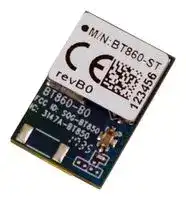
BT860-ST
BLE MODULE, V5.0, CLASS 1, 3MBPS
⚠️ Reference pricing provided. In case of supply shortages, we will connect you with our trusted procurement partners to ensure your project's continuity.
- Manufacturer: EZURIO
- Product type: Bluetooth Modules & Adaptors
- SVHC: To Be Advised
- Interfaces: I2S, UART
- Product Range: BT860 Series
- Certifications: CE, FCC, IC, KC, MIC, RCM
- Bluetooth Class: Class 1
- Bluetooth Version: Bluetooth LE 5.0 + EDR
- Supply Voltage Range: 3 V to 3.6 V
- Receiver Sensitivity Rx: -94 dBm
- Operating Temperature Range: -30 °C to 85 °C
| Delivery and price | |
|---|---|
| Units per pack | 250 |
| Price | 8.3 € |
| Current stock | 10+ |
| Lead time | 30 days |
Datasheet

A _Version 1.2_ |**Version**||**Date**|**Notes**|**Contributor**|**Approver**| |---|---|---|---|---|---| |1.0|12 Jan 2018|12 Jan 2018|Initial Version|Jacky Kuo<br>Raj Khatri|Jonathan Kaye| |1.1|05 Feb 2018|05 Feb 2018|Updated moisture sensitivity level from 4 to 3|Connie Lin|Jonathan Kaye| |1.2|18 Feb 2019|18 Feb 2019|Update BT SIG info with v5.0;<br>Added KC certification info|Sue White|Jonathan Kaye| https://connectivity.lairdtech.com/wirelessmodules/bluetooth-modules **Americas** : +1-800-492-2320 **Europe** : +44-1628-858-940 **Hong Kong** : +852 2923 0610 2 © Copyright 2019 Laird. All Rights Reserved |CONTENTS|CONTENTS| |---|---| |1 Scope ..................................................................................................................................................................................... 4|| |2|Operational Description ....................................................................................................................................................... 4| |3|Block Diagram and Descriptions .......................................................................................................................................... 5| |4|Specifications ...................................................................................................................................................................... 6| |5|Pin Definitions...................................................................................................................................................................... 6| |6|DC Electrical Characteristics ............................................................................................................................................... 8| |7|RF Characteristics ............................................................................................................................................................... 9| |8|Interface ............................................................................................................................................................................ 10| |8.1.|Global Coexistence Interface ................................................................................................................................... 10| |8.2.|UART Interface ........................................................................................................................................................ 10| |8.3.|PCM Interface .......................................................................................................................................................... 11| |8.4.|I2S Interface ............................................................................................................................................................. 17| |8.4.1.<br>I2S Timing ................................................................................................................................................................. 17|| |9|Antenna Performance ........................................................................................................................................................ 19| |10|Mechanical Dimensions and Land Pattern ........................................................................................................................ 21| |11|Implementation Note ......................................................................................................................................................... 22| |11.1.|PCB Layout on Host PCB ........................................................................................................................................ 22| |11.1.1.<br>Antenna Keep-out and Proximity to Metal or Plastic ................................................................................................ 22|| |12|Application Note for Surface Mount Modules .................................................................................................................... 23| |12.1.|Introduction .............................................................................................................................................................. 23| |12.2.|Shipping ................................................................................................................................................................... 23| |12.2.1.<br>Tape and Reel Package Information ........................................................................................................................ 23|| |12.3.|Reflow Parameters ................................................................................................................................................... 25| |13|Japan (MIC) Regulatory .................................................................................................................................................... 26| |14|FCC Regulatory ................................................................................................................................................................. 26| |15|Industry Canada Regulatory .............................................................................................................................................. 27| |16|Korea (KC) Regulatory ...................................................................................................................................................... 29| |17|European Union Regulatory .............................................................................................................................................. 29| |18|Ordering Information .......................................................................................................................................................... 30| |19|Bluetooth SIG Approvals ................................................................................................................................................... 30| |20|Additional Assistance ........................................................................................................................................................ 31| https://connectivity.lairdtech.com/wirelessmodules/bluetooth-modules **Americas** : +1-800-492-2320 **Europe** : +44-1628-858-940 **Hong Kong** : +852 2923 0610 3 © Copyright 2019 Laird. All Rights Reserved This document describes key hardware aspects of the Laird BT860-Sx Bluetooth HCI modules. This document is intended to assist device manufacturers and related parties with the integration of this module into their host devices. Data in this document are drawn from several sources including data sheets for the CYW20704A2. Because the BT860-Sx is currently in development stage, this document is preliminary and the information in this document is subject to change. Please contact Laird Connectivity or visit the Laird website at https://connectivity.lairdtech.com/wirelessmodules/bluetooth-modules/bluetooth-5-modules/bt86x-series to obtain the most recent version of this document. _**BT860-SA module BT860-ST module**_ The BT860-Sx series of UART HCI modules leverage the Cypress CYW20704 A2 chipset to provide exceptionally low power consumption with outstanding range for OEMs needing both Classic Bluetooth and Bluetooth Low Energy support. The Bluetooth v5.0 core specification shortens your development time and provides enhanced throughput, security and privacy. The BT860-Sx modules are ideal when designers need both performance and minimum size. For maximum flexibility in integration, they support a host UART interface, I[2] S and PCM audio interfaces, GPIO, and Cypress’GCI coexistence (2-Wire). The modules provide excellent RF performance and identical footprint options for integrated antenna or an external antenna via a trace pin. These modules present a Bluetooth standard HCI interface with support for Linux / Android and Embedded Bluetooth software stacks for operating system backed devices. Additionally, Laird has partnered with Searan for support of their ultra small, flexible ‘dotstack’ platform for embedded Cortex M3 and M4 implementations. - Bluetooth v5.0 - Dual mode (Classic Bluetooth and BLE) - Compact footprint - 2-wire Cypress Global Coexistence Interface (GCI) - High antenna radiation gain and efficiency - Good interference rejection for multi-com system (GSM/WCDMA) - Class 1 output – 8 dBm - UART, I[2] S, and PCM - Medical devices - ePOS terminals - Barcode scanners - Industrial Cable Replacement - IoT PlatformsAutomotive Diagnostic Equipment - Personal Digital Assistants (PDA) - Industrial Temperature Range - 512 Kbits EEPROM support - Bluetooth Controller subsystem - FCC, IC, CE, RCM, KC, and Giteki approvals https://connectivity.lairdtech.com/wirelessmodules/bluetooth-modules **Americas** : +1-800-492-2320 **Europe** : +44-1628-858-940 **Hong Kong** : +852 2923 0610 4 © Copyright 2019 Laird. All Rights Reserved _**Figure 1: BT860 Module block diagram**_ |**CYW20704A2**|The BT860-Sx is based on CYW20704A2 dual mode chip. The chip is a single-chip radio with on-chip| |---|---| |**(Main chip)**|LDO regulators and baseband IC for Bluetooth 2.4 GHz systems including EDR to| ||3 Mbps.| ||Dedicated signal and baseband processing is included for full Bluetooth operation. The chip provides| ||I2S/PCM and UART interfaces. There are two general purpose I/Os be configured for proprietary of| ||Cypress GCI used and a general purpose I/O can be configured for scan/inquire/paging/data traffic of| ||indicator. These three I/Os pins are controlled by firmware.| |**Antenna**|BT860-SA – The antenna is a ceramic monopole chip antenna.| ||BT860-ST – Trace Pad provision for use with a range of certified External Antennas| |**Band Pass**|The band pass filter filters the out-of-band emissions from the transmitter to meet the specific regulations| |**Filter**|for type approvals of various countries.| |**EEPROM**|There are 512 Kbits EEPROM embedded on the BT860-Sx module which can be used to store| ||parameters, such as BD_ADDR, maximum TX power, PCM configuration.| |**Crystal**|The embedded 40 MHz crystal is used for generating the clock for the entire module.| https://connectivity.lairdtech.com/wirelessmodules/bluetooth-modules **Americas** : +1-800-492-2320 **Europe** : +44-1628-858-940 **Hong Kong** : +852 2923 0610 5 © Copyright 2019 Laird. All Rights Reserved _**Table 1: BT860 specifications**_ |**Categories**|**Feature**|**Implementation**| |---|---|---| ||Bluetooth®|V5.0 Dual Mode (BR / EDR / LE)| ||Frequency|2.402 - 2.480 GHz| |||Class 1| |**Wireless**<br>**Specification**|Maximum Transmit Power|+8 dBm from antenna| ||Receive Sensitivity|-94 dBm| ||Range|Circa 100 meters| ||Data Rates|Up to 3 Mbps (over-the-air)| |**Host Interface**|UART|Up to 4 Mbps| ||GPIO|3.3V for all general purpose I/Os| |**Operational Modes**|HCI|Host Controller Interface over UART| |**EEPROM**|2-wire|512 Kbits| |**Coexistence**|802.11 (Wi-Fi)|2-Wire Cypress Global Coexistence Interface (GCI)| |**Supply Voltage**|Supply|3.0V – 3.6V| |**Power Consumption**|Current|Idle Mode ~8 mA<br>File Transfer ~43 mA| |**Antenna Option**|Internal<br>External|Multilayer ceramic antenna<br>Trace Pad| |**Physical**<br>(Width x Length x Height)|Dimensions|8.5 x 12.85 x 2.2 mm (BT860-SA)<br>8.5 x 12.85 x 1.9 mm (BT860-ST)| |**Environmental**|Operating|-30° C to +85° C| ||Storage|-40° C to +85° C| |**Miscellaneous**|Lead Free|Lead-free and RoHS compliant| ||Warranty|One-Year Warranty| |**Approvals**|Bluetooth®<br>FCC/IC/CE/RCM/KC/Giteki|Controller Subsystem Approved<br>All BT860-Sx series| _**Table 2: BT860 pin definitions**_ |**Pin No.**|**Pin Name**|**I/O**|**Supply**<br>**Domain**|**Description**|**If Unused**| |---|---|---|---|---|---| |1|NC||||NC| |2|GND|GND||Ground|GND| |3|GPIO_5|Bi-directional|3V3|Programmable input/output line|| |4|UART_RTS|Bi-directional|3V3|UART request to send output|NC| |5|UART_TXD|Bi-directional|3V3|UART transmit data|NC| |6|UART_CTS|Bi-directional|3V3|UART clear to send input|NC| 6 **Americas** : +1-800-492-2320 © Copyright 2019 Laird. All Rights Reserved **Europe** : +44-1628-858-940 **Hong Kong** : +852 2923 0610 https://connectivity.lairdtech.com/wirelessmodules/bluetooth-modules |**Pin No.**|**Pin Name**|**I/O**|**Supply**<br>**Domain**|**Description**|**If Unused**| |---|---|---|---|---|---| |7|UART_RXD|Bi-directional|3V3|UART receive data|NC| |8|RESET|Input|3V3|Active-low reset input|N/A| |9|3.3V|Input|3V3|Module main DC power supply,<br>Input to internal 1.2V and 2.5V LDO|N/A| |10|NC||||NC| |11|GND|GND||Ground|GND| |12|GND|GND||Ground|GND| |13|GND|GND||Ground|GND| |14|GND|GND||Ground|GND| |15|GND|GND||Ground|GND| |16|GND|GND||Ground|GND| |17|RF|||BT860-ST RF signal output (50Ω)|| |||||BT860-SA No connection|| |18|GND|GND||Ground|GND| |19|I2S_WS/PCM_SYNC|Bidirectional|3V3|PCM sync/I2S word select|NC| |20|I2S_CLK/PCM_CLK|Bidirectional|3V3|PCM/I2S clock|NC| |21|I2S_DI/PCM_IN|Bidirectional|3V3|PCM/I2S data input|NC| |22|I2S_OUT/PCM_OUT|Bidirectional|3V3|PCM/I2S data output|NC| |23|GND|GND||Ground|GND| |24|NC||||NC| |25|BT_SECI_IN|Input|3V3|Coexistence data input|NC| |26|BT_SECI_OUT|Output|3V3|Coexistence data output|NC| |27|NC||||NC| |28|NC||||NC| |29|BT_HOST_WAKE|Output|3V3|BT device to wake up the Host|NC| |30|GND|GND||Ground|NC| **Pin Definition Note:** **Note 1** The GPIO_5 controlled by the default firmware for the status of BT860 indications. https://connectivity.lairdtech.com/wirelessmodules/bluetooth-modules **Americas** : +1-800-492-2320 **Europe** : +44-1628-858-940 **Hong Kong** : +852 2923 0610 7 © Copyright 2019 Laird. All Rights Reserved _**Table 3: Absolute maximum rating**_ |**_Table 3: Absolute maximum rating_**|||||||| |---|---|---|---|---|---|---|---| |**Rating**|**Min**||**Max**|**Max**|||**Unit**| |Storage temperature|-40||+150||||⁰C| |Operating Temperature|-30||+85|+85|||⁰C| |ESD Contact Discharge|-4||+4||||KV| |ESD Air Discharge|-8||+8||||KV| |Moisture Sensitivity Level|3||-||||-| |3V3 Input|3.0||3.6||||V| |**_Table 4: Recommended operating conditions_**|||||||| |**Rating**|**Min**||**Max**|**Max**|||**Unit**| |Storage temperature|-40||+150|+150|||⁰C| |Operating Temperature|-30||+85||||⁰C| |3V3 Input|3.0||3.6||||V| |**_Table 5: Digital I/O characteristics_**|||||||| |**Normal Operation**|**Min**||**Typ.**||**Max**||**Unit**| |VILInput Low Voltage (VDDO * = 3V3)|-||-||0.8|0.8|V| |VIHInput High Voltage (VDDO * = 3V3)|2.0||-||-||V| |VOLOutput Low Voltage|-||-||0.4|0.4|V| |VOHOutput High Voltage|3V3-0.4||-||-||V| |IILInput Low Current|-||-||1.0|1.0|µA| |IIHInput High Current|-||-||1.0|1.0|µA| |IOLOutput Low Current (VDDO * = 3V3, VOL= 0.4V)|-||-||2.0|2.0|mA| |IOHOutput Low Current (VDDO * = 3V3, VOH= 2.9V)|-||-||2.0|2.0|mA| |CINInput Capacitance|-||-||0.4|0.4|pF| ## _**Table 4: Recommended operating conditions**_ ## _**Table 5: Digital I/O characteristics**_ *: The VDDO is denoted the digital I/O voltage and it’s depended on the Pin9 (3V3) input of module. ## _**Table 6: Current consumption**_ |**_Table 6: Current consumption_**||| |---|---|---| |**Normal Operation**|**Peak (8 dBm)**|**Unit**| |Idle|8|mA| |Inquiry|23|mA| |File Transfer|43|mA| |BLE Connected (Master)|26|mA| |BLE Scan (Master)|26|mA| |BLE File Transfer|27|mA| https://connectivity.lairdtech.com/wirelessmodules/bluetooth-modules **Americas** : +1-800-492-2320 **Europe** : +44-1628-858-940 **Hong Kong** : +852 2923 0610 8 © Copyright 2019 Laird. All Rights Reserved _**Table 7: BDR/EDR/BLE transmitter characteristics (Input = 3V3 @ 25° C)**_ ||**Parameter**|**Min**|**Typ.**|**Max**|**BT. Spec.**|**Unit**| |---|---|---|---|---|---|---| |Classic BT (BDR) - GFSK Maximum RF Transmit Power||6|8|10|20|dBm| |Classic BT - EDR Maximum RF Transmit Power||2|4|6|20|dBm| |BLE Maximum RF Transmit Power||6|8|10|20|dBm| |RF power variation over temperature range||-|2.0|-|-|dB| |RF power variation over BT band||-|2|-|-|dB| |RF power control step||2|4|8|-|dB| |Initial Carrier Frequency Tolerance||-|10|-|±75|kHz| |BLE Frequency Accuracy|||10||±150|kHz| |20 dB Bandwidth||-|920|-|1000|kHz| ||1.0 MHz < |M-N| < 1.5 MHz|-|-|-39|-26|dBc| |In-Band Spurious<br>Emissions|1.5 MHz < |M-N| < 2.5 MHz|-|-|-39|-20|dBm| |||M-N|≧2.5 MHz|-|-|-47|-40|dBm| ||fTX ±2 MHz|-|-|-48|-20|dBm| |BLE In-Band Emission||||||| ||fTX ±[3 + n] MHz|-|-|-47|-30|dBm| |Drift rate||-|10|-|+/-25|kHz| |ΔF1Avg||-|152|-|140<>175|kHz| |ΔF2Max||100|-|-|99.9|%| |ΔF2Avg/ ΔF1Avg||-|1.0|-|≧0.8|| |BLEΔF1Avg||-|245|-|225<>275|kHz| |BLEΔF2Max||100|-|-|99.9|%| |BLEΔF2Avg/ ΔF1Avg||-|1.0|-|≧0.8|| _**Table 8: BDR/EDR/BLE receiver sensitivity (Input = 3V3 @ 25° C)**_ |**Parameter**|**Conditions**|**Min**|**Typ.**|**Max**|**BT. Spec.**|**Unit**| |---|---|---|---|---|---|---| ||GFSK, 0.1% BER, 1Mbps|-|-90|-|-70|dBm| |Sensitivity|/4-DQPSK, 0.01% BER, 2Mbps<br>8-DPSK, 0.01% BER, 3Mbps|-<br>-|-94<br>-87|-<br>-|-70<br>-70|dBm<br>dBm| ||BLE GFSK, 30.8% PER, 1Mbps|-|-94|-|-70|dBm| |Sensitivity variation|All Modulations (Over BT band)|-|2|-|-|dB| https://connectivity.lairdtech.com/wirelessmodules/bluetooth-modules **Americas** : +1-800-492-2320 **Europe** : +44-1628-858-940 **Hong Kong** : +852 2923 0610 9 © Copyright 2019 Laird. All Rights Reserved The BT860-Sx supports the proprietary Cypress Global Coexistence Interface (GCI) which is a 2-wire interface. The following key features are associated with the interface: - Enhanced coexistence data can be exchanged over GCI_SECI_IN and GCI_SECI_OUT a two-wire interface, one serial input (GCI_SECI_IN), and one serial output (GCI_SECI_OUT). The both pins are controlled by the configuration file that is stored in EEPROM from the host. - It supports generic UART communication between WLAN and Bluetooth devices. - To conserve power, it is disabled when inactive. - It supports automatic resynchronization upon waking from sleep mode. - It supports a baud rate of up to 4 Mbps. Table 9 shows the two-wire BT coexistence interface assignments. _**Table 9: BT GCI Two-Wire Coexistence**_ |**Coexistence Signal Name**|**Signal Assignment**| |---|---| |BT_SECI_IN|GPIO_6| |BT_SECI_OUT|GPIO_7| The BT860-Sx has a single UART for Bluetooth. The UART is a standard four-wire interface (RX, TX, RTS, and CTS) with adjustable baud rates from 38400 bps to 4.0 Mbps. The interface features an automatic baud rate detection capability that returns a baud rate selection. Alternatively, the baud rate may be selected through a vendor-specific UART HCI command. UART has a 1040-byte receive FIFO and 1040-byte transmits FIFO to support EDR. Access to the FIFO is conducted through the AHB interface through either DMA or the CPU. The UART supports the Bluetooth 5.0 UART HCI specification: H4, and a custom Extended H4. The default baud rate is 115.2 Kbaud. The BT860-Sx UART can perform XON/XOFF flow control and includes hardware support for Serial Line Input Protocol (SLIP). It can also perform wake-on activity. For the BT860-Sx is supported BT to wake-up Host. Normally, the UART baud rate is set by a configuration record downloaded after device reset, or by automatic baud rate detection, and the host does not need to adjust the baud rate. Support for changing the baud rate during normal HCI UART operation is included through a vendor-specific command that allows the host to adjust the contents of the baud rate registers. The BT860-Sx UART operates correctly with the host UART if the combined baud rate error of the two devices is within ±2%. _**Table 10: Example of common baud rates**_ |**Desired Rate**|**Actual Rate**|**Error (%)**| |---|---|---| |4000000|4000000|0.00| |3000000|3000000|0.00| |2000000|2000000|0.00| |1500000|1500000|0.00| |921600|923077|0.16| |460800|461538|0.16| |230400|230796|0.17| |115200|115385|0.16| |57600|57692|0.16| |38400|38400|0.00| https://connectivity.lairdtech.com/wireless10 **Americas** : +1-800-492-2320 modules/bluetooth-modules © Copyright 2019 Laird. All Rights Reserved **Europe** : +44-1628-858-940 **Hong Kong** : +852 2923 0610 Table 11 and Figure 2 show UART timing of specifications. _**Table 11: UART timing specifications**_ |**Reference**|**Characteristics**|**Min.**|**Typ.**|**Max.**|**Unit**| |---|---|---|---|---|---| |1|Delay time<br>UART_CTS_N low to UART TXD valid|-|-|1.50|Bit periods| |2|Setup time<br>UART_CTS_N high before midpoint of stop bit|-|-|0.67|Bit periods| |3|Delay time<br>Midpoint of stop bit to UART_CTS_N high|-|-|1.33|Bit periods| ## _**Figure 2: UART timing**_ The BT860-Sx supports two independent PCM interfaces that share the pins with I2S interfaces. The PCM interface on the BT860-Sx can connect to linear PCM Codec devices in master or slave mode. In master mode, the BT860 generates the PCM_CLK and PCM_SYNC signals, and in slave mode, these signals are provided by another master on the PCM interface and are inputs to the BT860. The configuration of the PCM interface may be adjusted by the host using vendor-specific HCI commands. For additional information, refer to the DVK-BT86x User Guide available from the BT86x product page of the Laird website. ## 8.3.1. Slot Mapping The BT860-Sx supports up to three simultaneous full-duplex SCO or eSCO channels through the PCM interface. These three channels are time-multiplexed onto the single PCM interface by using a time-slotting scheme where the 8 kHz or 16 kHz audio sample interval is divided into as many as 16 slots. The number of slots is dependent on the selected interface rate of 128 kHz, 512 kHz, or 1024 kHz. The corresponding number of slots for these interface rates is 1, 2, 4, 8 and 16, respectively. Transmit and receive PCM data from an SCO channel is always mapped to the same slot. The PCM data output driver tristates its output on unused slots to allow other devices to share the same PCM interface signals. The data output driver tristates its output after the falling edge of the PCM clock during the last bit of the slot. ## 8.3.2. Frame Synchronization The BT860-Sx supports both short- and long-frame synchronization in both master and slave modes. In short-frame synchronization mode, the frame synchronization signal uses an active-high pulse at the audio frame rate that is a single-bit period in width and is synchronized to the rising edge of the bit clock. The PCM slave looks for a high on the falling edge of the bit clock and expects the first bit of the first slot to start at the next rising edge of the clock. https://connectivity.lairdtech.com/wirelessmodules/bluetooth-modules **Americas** : +1-800-492-2320 **Europe** : +44-1628-858-940 **Hong Kong** : +852 2923 0610 11 © Copyright 2019 Laird. All Rights Reserved Figure 3 and Table 12 shows PCM Timing Diagram and Specifications for the master mode of short-frame. _**Figure 3: PCM timing diagram (Short-Frame Sync, Master Mode)**_ _**Table 12: PCM Interface timing specifications (Short-Frame Sync, Master Mode)**_ |**Reference**||**Characteristics**|**Min.**|**Typ.**|**Max.**|**Unit**| |---|---|---|---|---|---|---| |1||PCM bit clock frequency|-|-|12|MHz| |2||PCM bit clock LOW|41|-|-|ns| |3||PCM bit clock HIGH|41|-|-|ns| |4||PCM_SYNC setup|0|-|25|ns| |5||PCM_OUT delay|0|-|25|ns| |6||PCM_IN setup|8|-|-|ns| |7||PCM_IN hold|8|-|-|ns| |8|Delay from rising edge of PCM_BCLK during last bit<br>period to PCM_OUT becominghigh impedance||0|-|25|ns| Figure 4 and Table 13 shows PCM Timing Diagram and Specifications for the slave mode of short-frame. _**Figure 4: PCM timing diagram (Short-Frame Sync, Slave Mode)**_ _**Table 13: PCM Interface timing specifications (Short-Frame Sync, Slave Mode)**_ |**Reference**||**Characteristics**||**Min.**|**Typ.**|**Max.**|**Unit**|| |---|---|---|---|---|---|---|---|---| |1||PCM bit clock frequency||-|-|12|MHz|| |https://connectivity.lairdtech.com/wireless-|https://connectivity.lairdtech.com/wireless-||12|||**Americas**: +1-800-492-2320||| |modules/bluetooth-modules|modules/bluetooth-modules|© Copyright 2019 Laird. All Rights Reserved|© Copyright 2019 Laird. All Rights Reserved|||**Europe**: +44-1628-858-940||| |||||||**Hong Kong**: +852 2923 0610||| https://connectivity.lairdtech.com/wirelessmodules/bluetooth-modules |**Reference**|**Characteristics**|**Min.**|**Typ.**|**Max.**|**Unit**| |---|---|---|---|---|---| |2|PCM bit clock LOW|41|-|-|ns| |3|PCM bit clock HIGH|41|-|-|ns| |4|PCM_SYNC setup|8|-|-|ns| |5|PCM_SYNC_hold|8|-|-|ns| |6|PCM_OUT delay|0|-|25|ns| |7|PCM_IN setup|8|-|-|ns| |8|PCM_IN hold|8|-|-|ns| |9|Delay from rising edge of PCM_BCLK during last bit<br>period to PCM_OUT becominghigh impedance|0|-|25|ns| In long-frame synchronization mode, the frame synchronization signal is again an active-high pulse at the audio frame rate; however, the duration is three bit periods and the pulse starts coincident with the first bit of the first slot. Figure 5 through Table 14 shows PCM Timing Diagram and Specifications for the master mode of long-frame. _**Figure 5: PCM timing diagram (Long-Frame Sync, Master Mode)**_ _**Table 14: PCM Interface timing specifications (Long-Frame Sync, Master Mode)**_ |**Reference**||**Characteristics**|**Min.**|**Typ.**|**Max.**|**Unit**| |---|---|---|---|---|---|---| |1||PCM bit clock frequency|-|-|12|MHz| |2||PCM bit clock LOW|41|-|-|ns| |3||PCM bit clock HIGH|41|-|-|ns| |4||PCM_SYNC delay|0|-|25|ns| |5||PCM_OUT delay|0|-|25|ns| |6||PCM_IN setup|8|-|-|ns| |7||PCM_IN hold|8|-|-|ns| |8|Delay from rising edge of PCM_BCLK during last bit<br>period to PCM_OUT becoming high impedance||0|-|25|ns| **Americas** : +1-800-492-2320 **Europe** : +44-1628-858-940 **Hong Kong** : +852 2923 0610 https://connectivity.lairdtech.com/wirelessmodules/bluetooth-modules 13 © Copyright 2019 Laird. All Rights Reserved Figure 6 and Table 15: PCM Interface timing specifications (Long-Frame Sync, Slave Mode) shows PCM Timing Diagram and Specifications for the slave mode of long-frame _**Figure 6: PCM timing diagram (Long-Frame Sync, Slave Mode)**_ _**Table 15: PCM Interface timing specifications (Long-Frame Sync, Slave Mode)**_ |**Reference**|**Characteristics**|**Min.**|**Typ. **|**Max.**|**Unit**| |---|---|---|---|---|---| |1|PCM bit clock frequency|-|-|12|MHz| |2|PCM bit clock LOW|41|-|-|ns| |3|PCM bit clock HIGH|41|-|-|ns| |4|PCM_SYNC setup|8|-|-|ns| |5|PCM_SYNC_hold|8|-|-|ns| |6|PCM_OUT delay|0|-|25|ns| |7|PCM_IN setup|8|-|-|ns| |8|PCM_IN hold|8|-|-|ns| |9|Delay from rising edge of PCM_BCLK during last bit<br>period to PCM_OUT becominghigh impedance|0|-|25|ns| ## 8.3.3. Data Formatting The BT860-Sx may be configured to generate and accept several different data formats. For conventional narrowband speech mode, the BT860-Sx uses 13 of the 16 bits in each PCM frame. The location and order of these 13 bits can be configured to support various data formats on the PCM interface. The remaining three bits are ignored on the input and may be filled with 0s, 1s, a sign bit, or a programmed value on the output. The default format is 13-bit 2’s complement data, left justified, and clocked MSB first. ## 8.3.4. Wideband Speech Support When the host encodes Wideband Speech (WBS) packets in transparent mode, the encoded packets are transferred over the PCM bus for an eSCO voice connection. In this mode, the PCM bus is typically configured in master mode for a 4 kHz sync rate with 16-bit samples, resulting in a 64 Kbps bit rate. The BT860-Sx also supports slave transparent mode using a proprietary rate-matching scheme. In SBC-code mode, linear 16-bit data at 16 kHz (256Kbps rate) is transferred over the PCM bus. ## 8.3.5. Multiplexed Bluetooth Over PCM Bluetooth supports multiple audio streams within the Bluetooth channel and both 16 kHz and 8 kHz streams can be multiplexed. This mode of operation is only supported when the Bluetooth host is the master. Figure7 shows the operation of the multiplexed transport with three simultaneous SCO connections. To accommodate additional SCO channels, the transport clock speed is increased. To change between modes of operation, the transport must be halted and restarted in the new configuration. https://connectivity.lairdtech.com/wirelessmodules/bluetooth-modules **Americas** : +1-800-492-2320 **Europe** : +44-1628-858-940 **Hong Kong** : +852 2923 0610 14 © Copyright 2019 Laird. All Rights Reserved _**Figure 7: Functional Multiples Data diagram**_ ## 8.3.6. Burst PCM Mode In this mode of operation, the PCM bus runs at a significantly higher rate of operation to allow the host to duty cycle its operation and save current. In this mode of operation, the PCM bus can operate at a rate of up to 24 MHz. This mode of operation is initiated with an HCI command from the host. Figure 8 and Table 15 shows PCM Burst mode timing diagram and specifications for the receive-only mode of short-frame sync. _**Figure 8: PCM Burst Mode timing (Receive Only, Short Frame Sync)**_ _**Table 15: PCM Burst Mode Specifications (Receive Only, Short-Frame Sync)**_ |**Reference**|**Characteristics**|**Min.**|**Typ.**|**Max.**|**Unit**| |---|---|---|---|---|---| |1|PCM bit clock frequency|-|-|24|MHz| |2|PCM bit clock LOW|20.8|-|-|ns| |3|PCM bit clock HIGH|20.8|-|-|ns| |4|PCM_SYNC setup|8|-|-|ns| https://connectivity.lairdtech.com/wirelessmodules/bluetooth-modules **Americas** : +1-800-492-2320 **Europe** : +44-1628-858-940 **Hong Kong** : +852 2923 0610 15 © Copyright 2019 Laird. All Rights Reserved |**Reference**|**Characteristics**|**Min.**|**Typ.**|**Max.**|**Unit**| |---|---|---|---|---|---| |5|PCM_SYNC_hold|8|-|-|ns| |6|PCM_IN setup|8|-|-|ns| |7|PCM_IN hold|8|-|-|ns| Figure 9 and Table 16 shows PCM Burst mode timing diagram and specifications for the receive-only mode of long-frame sync. _**Figure 9: PCM Burst Mode Timing (Receive Only, Long Frame Sync)**_ _**Table 16: PCM Burst Mode Specifications (Receive Only, Long-Frame Sync)**_ |**Reference**|**Characteristics**|**Min.**|**Typ.**|**Max.**|**Unit**| |---|---|---|---|---|---| |1|PCM bit clock frequency|-|-|24|MHz| |2|PCM bit clock LOW|20.8|-|-|ns| |3|PCM bit clock HIGH|20.8|-|-|ns| |4|PCM_SYNC setup|8|-|-|ns| |5|PCM_SYNC_hold|8|-|-|ns| |6|PCM_IN setup|8|-|-|ns| |7|PCM_IN hold|8|-|-|ns| https://connectivity.lairdtech.com/wirelessmodules/bluetooth-modules **Americas** : +1-800-492-2320 **Europe** : +44-1628-858-940 **Hong Kong** : +852 2923 0610 16 © Copyright 2019 Laird. All Rights Reserved The BT860-Sx supports two independent I[2] S digital audio ports. The I[2] S interface supports both master and slave modes. The I[2] S signals are: - I[2] S clock: I[2] S SCK - I[2] S Word Select: I[2] S WS - I[2] S Data Out: I[2] S SDO - I[2] S Data In: I[2] S SDI I[2] S SCK and I[2] S WS become outputs in master mode and inputs in slave mode, while I[2] S SDO always stays as an output. The channel word length is 16 bits and the data is justified so that the MSB of the left-channel data is aligned with the MSB of the I[2] S bus, per the I[2] S specification. The MSB of each data word is transmitted one bit clock cycle after the I[2] S WS transition, synchronous with the falling edge of bit clock. Left-channel data is transmitted when I[2] S WS is low, and right-channel data is transmitted when I[2] S WS is high. Data bits sent by the BT860 are synchronized with the falling edge of I2S_SCK and should be sampled by the receiver on the rising edge of I2S_SSCK. The clock rate in master mode is either of the following: - 48 kHz x 32 bits per frame = 1.536 MHz - 48 kHz x 50 bits per frame = 2.400 MHz The master clock is generated from the input reference clock using a N/M clock divider. In the slave mode, any clock rate is supported to a maximum of 3.072 MHz. ## 8.4.1. I[2] S Timing Timing values specified in Table 17 are relative to high and low threshold levels. _**Table 17: Timing for I2S Transmitters and Receivers**_ ||||**Transmitter**<br>**Receiver**||**Notes**| |---|---|---|---|---|---| |||**Lower Limit**|**Lower Limit**<br>**Upper Limit**<br>**Lower Limit**<br>**Upper Limit**||| |||**Min**|**Max**<br>**Min**<br>**Max**<br>**Min**<br>**Max**<br>**Min**|**Max**|| |Clock Period T||Ttr<br>~~a~~|-<br>-<br>-<br>Tr<br>-<br>-<br>**Master Mode: Clockgenerated by transmitter or receiver**<br>~~a~~<br>~~ee~~<br>~~es~~|-|| |HIGH tHC<br>LOW tLC||0.35Ttr<br>-<br>-<br>-<br>0.35Ttr<br>-<br>-<br>-<br>0.35Ttr<br>-<br>-<br>-<br>0.35Ttr<br>-<br>-<br>-<br>~~se~~<br>~~GG~~<br>~~a ae ee~~|||| ||||**Master Mode: Clockgenerated by transmitter or receiver**||| |HIGH tHC<br>LOW tLC<br>Rise time tRC||-<br>-<br>-<br>~~a~~<br>~~Rs ~~<br>~~ee~~|0.35Ttr<br>-<br>-<br>-<br>0.35Ttr<br>-<br>-<br>0.35Ttr<br>-<br>-<br>-<br>0.35Ttr<br>-<br>-<br>-<br>0.15Ttr<br>-<br>-<br>-<br>-<br>-<br>~~seGG~~<br> ~~ssQe~~<br>~~dG~~<br>~~ee ee ee ee~~||| ||||**Transmitter**||| |Delaytdtr<br>Hold time thtr||-<br>0<br>~~a~~<br>~~a~~|-<br>-<br>0.8T<br>-<br>-<br>-<br>-<br>-<br>-<br>-<br>-<br>-<br>~~seGG~~<br>~~ee~~<br>~~es ee~~|-<br>-|| ||||**Receiver**||| |Setuptime tsr<br>Hold time thr|-<br>-<br>-<br>-<br>-<br>0.2Tr<br>-<br>-<br>-<br>-<br>-<br>-<br>-<br>0<br>-<br>-<br>~~a~~<br>~~seGG~~<br>~~POTrl|cl~~||||| The time periods specified in Figure 10 and Figure 11 are defined by the transmitter speed. The receiver specifications must match transmitter performance. https://connectivity.lairdtech.com/wirelessmodules/bluetooth-modules **Americas** : +1-800-492-2320 **Europe** : +44-1628-858-940 **Hong Kong** : +852 2923 0610 17 © Copyright 2019 Laird. All Rights Reserved _**Figure 10: I[2] S Transmitter timing**_ _**Figure 11: I[2] S Receiver Timing**_ https://connectivity.lairdtech.com/wirelessmodules/bluetooth-modules **Americas** : +1-800-492-2320 **Europe** : +44-1628-858-940 **Hong Kong** : +852 2923 0610 18 © Copyright 2019 Laird. All Rights Reserved Table 18, Figure 12, Figure 13, and Figure 14 show the antenna gain and performance. ## _**Table 18: Antenna gain**_ |**Unit in dBi @ 2440MHz**<br>**AT3216-B2R7HAA**|**XY-Plane**<br>**Peak**<br>**Avg. **|**XZ-Plane**<br>**Peak**<br>**Avg. **|**YZ-Plane**<br>**Peak**<br>**Avg. **|**Efficiency**| |---|---|---|---|---| ||0.1<br>-4.1|1.8<br>-3.3|-0.2<br>-6.8|41%| _**Figure 12: Antenna Return Loss**_ _**Figure 13: Measurement XYZ polarization**_ https://connectivity.lairdtech.com/wirelessmodules/bluetooth-modules **Americas** : +1-800-492-2320 **Europe** : +44-1628-858-940 **Hong Kong** : +852 2923 0610 19 © Copyright 2019 Laird. All Rights Reserved _**Table 19: Plane definitions**_ |**XY-Plane**|Theta = 90°| |---|---| |**XZ-Plane**|Phi = 0°| |**YZ-Plane**|Phi = 90°| _**Figure 14: Antenna pattern**_ https://connectivity.lairdtech.com/wirelessmodules/bluetooth-modules **Americas** : +1-800-492-2320 **Europe** : +44-1628-858-940 **Hong Kong** : +852 2923 0610 20 © Copyright 2019 Laird. All Rights Reserved ## 10.1. BT860 Mechanical Drawing Dimensions from corner of BT860 Pin1 **Note:** Dimensions are in millimetres. Tolerances: .xx ±0.03 mm .x ±1.3 mm https://connectivity.lairdtech.com/wirelessmodules/bluetooth-modules **Americas** : +1-800-492-2320 **Europe** : +44-1628-858-940 **Hong Kong** : +852 2923 0610 21 © Copyright 2019 Laird. All Rights Reserved Checklist (for PCB): - **MUST** locate the BT860 module close to the edge of PCB. - Use solid GND plane on inner layer (for best EMC and RF performance). - Place GND vias close to module GND pads as possible - Route traces to avoid noise being picked up on VCC supply. - Antenna Keep-out area: - Ensure there is no copper in the antenna keep-out area on any layers of the host PCB. - - Keep all mounting hardware and metal clear of the area to allow proper antenna radiation. - For best antenna performance, place the BT860 module on the edge of the host PCB, preferably in the corner with the antenna facing the corner. - - A different host PCB thickness dielectric will have small effect on antenna. _**Figure 15: Recommend Antenna keep-out area (in Blue) used on the BT860**_ ## 11.1.1. Antenna Keep-out and Proximity to Metal or Plastic Checklist (for metal /plastic enclosure): - Minimum safe distance for metals without seriously compromising the antenna (tuning) is 40 mm top/bottom and 30 mm left or right. - Metal close to the BT860-SA chip monopole antenna (bottom, top, left, right, any direction) will have degradation on the antenna performance. The amount of degradation is entirely system dependent which means some testing by customers is required (in their host application). - Any metal closer than 20 mm starts to significantly degrade performance (S11, gain, radiation efficiency). - It is best that the customer tests the range with mock-up (or actual prototype) of the product to assess effects of enclosure height (and material whether metal or plastic). https://connectivity.lairdtech.com/wirelessmodules/bluetooth-modules 22 **Americas** : +1-800-492-2320 © Copyright 2019 Laird. All Rights Reserved **Europe** : +44-1628-858-940 **Hong Kong** : +852 2923 0610 Laird surface mount modules are designed to conform to all major manufacturing guidelines. This application note is intended to provide additional guidance beyond the information that is presented in the user manual. This application note is considered a living document and is updated as new information is presented. The modules are designed to meet the needs of a number of commercial and industrial applications. They are easy to manufacture and they conform to current automated manufacturing processes. ## 12.2. Shipping ## 12.2.1. Tape and Reel Package Information **Note:** Ordering information for Tape and Reel packaging is an addition of T/R to the end of the full module part number. For example, BT860 becomes BT860-Sx-xx-T/R. _**Figure 16: Reel specifications**_ https://connectivity.lairdtech.com/wirelessmodules/bluetooth-modules **Americas** : +1-800-492-2320 **Europe** : +44-1628-858-940 **Hong Kong** : +852 2923 0610 23 © Copyright 2019 Laird. All Rights Reserved _**Figure 17: Tape specifications**_ There are 2500 x BT860-Sx modules taped in a reel (and packaged in a pizza box) and five boxes per carton (12,500 modules per carton). Reel, boxes, and carton are labeled with the appropriate labels. See Figure 18. ## 12.2.2. Packaging Process _**Figure 18: BT860 packaging process**_ https://connectivity.lairdtech.com/wirelessmodules/bluetooth-modules **Americas** : +1-800-492-2320 **Europe** : +44-1628-858-940 **Hong Kong** : +852 2923 0610 24 © Copyright 2019 Laird. All Rights Reserved ## 12.3. Reflow Parameters Laird surface mount modules are designed to be easily manufactured, including reflow soldering to a PCB. Ultimately it is the responsibility of the customer to choose the appropriate solder paste and to ensure oven temperatures during reflow meet the requirements of the solder paste. Laird’s surface mount modules conform to J-STD-020D1 standards for reflow temperatures. **Important** : During reflow, modules should not be above 260° and not for more than 30 seconds. In addition, we strongly recommend that you do not put the module through reflow more than once. Otherwise, it impacts the module’s soldering. _**Figure 19: Recommended reflow temperature**_ Temperatures should not exceed the minimums or maximums presented in Table 202. _**Table 202: Recommended maximum and minimum temperatures**_ |**Specification**|**Value**|**Unit**| |---|---|---| |Temperature Inc./Dec. Rate(max)|1~3|°C / Sec| |Temperature Decrease rate(goal)|2-4|°C / Sec| |Soak TempIncrease rate(goal)|.5 - 1|°C / Sec| |Flux Soak Period(Min)|70|Sec| |Flux Soak Period(Max)|120|Sec| |Flux Soak Temp (Min)|150|°C| |Flux Soak Temp (max)|190|°C| |Time Above Liquidous(max)|70|Sec| |Time Above Liquidous(min)|50|Sec| |Time In Target Reflow Range(goal)|30|Sec| |Time At Absolute Peak(max)|5|Sec| |Liquidous Temperature(SAC305)|218|°C| |Lower Target Reflow Temperature|240|°C| |Upper Target Reflow Temperature|250|°C| |Absolute Peak Temperature|260|°C| https://connectivity.lairdtech.com/wirelessmodules/bluetooth-modules **Americas** : +1-800-492-2320 **Europe** : +44-1628-858-940 **Hong Kong** : +852 2923 0610 25 © Copyright 2019 Laird. All Rights Reserved The BT860-Sx is approved for use in the Japanese market. The part numbers listed below hold WW type certification. Refer to **ARIB-STD-T66** for further guidance on OEM’s responsibilities. |**Model**|**Product Name**|**Description**|**Certificate Number**| |---|---|---|---| |BT860-|BT v5.0 Dual Mode UART HCI Module|Integrated Antenna|| |SA|BT v5.0 Dual Mode UART HCI Module|Trace Pad for External Antenna|201-170971| |BT860-ST|||| ## 13.1. Antenna Information The BT860-Sx was tested with antennas listed below. The OEM can choose a different manufacturers antenna but must make sure it is of same type and that the gain is lesser than or equal to the antenna that is approved for use. _**Table 21: Associated antennas**_ |**Part Number**|**Mfg.**|**Type**|**Connector**|**Gain (dBi)**| |---|---|---|---|---| |001-0030|Laird|PIFA|IPEX U.FL|2 dBi(2400 MHz-2480 MHz)| |001-0014|Laird|PIFA|IPEX U.FL|2 dBi(2400 MHz-2480 MHz)| |0600-00040|Laird|Dipole|IPEX U.FL|2 dBi(2.4 GHz-2.5 GHz)| |MAF94045|Laird|PCB|IPEX U.FL|2 dBi(2.4 GHz-2.5 GHz)| |AT3216-B2R7HAA_|ACX|Chip|N/A|0.5 dBi(2.4 GHz-2.5 GHz)| |**Model**|**US/FCC**| |---|---| |BT860-Sx|SQGBT850| |DVK-BT860-Sx|SQGBT850| The BT860-Sxx modules were tested with the following antennas: _**Table 22: BT85x antenna information**_ |**Part Number**<br>001-0030<br>~~a~~|**Part Number**<br>001-0030<br>~~a~~|**Mfg. **<br>Laird|Laird<br>~~ee ~~|**Type **<br>PIFA<br> ~~ee ee~~|**Connector**<br>IPEX U.FL<br>~~ee~~|**Gain(dBi)**<br>2 dBi(2400 MHz-2480 MHz)| |---|---|---|---|---|---|---| ||001-0014|Laird|Laird|PIFA|IPEX U.FL|2 dBi(2400 MHz-2480 MHz)| ||0600-00040|Laird|Laird|Dipole|IPEX U.FL|2 dBi(2.4 GHz-2.5 GHz)| ||MAF94045|Laird|Laird|PCB|IPEX U.FL|2 dBi(2.4 GHz-2.5 GHz)| ||AT3216-B2R7HAA_|ACX||Chip|N/A|0.5 dBi(2.4 GHz-2.5 GHz)| This equipment has been tested and found to comply with the limits for a Class B digital device, pursuant to Part 15 of the FCC Rules. These limits are designed to provide reasonable protection against harmful interference in a residential installation. This equipment generates, uses and can radiate radio frequency energy and, if not installed and used in accordance with the instructions, may cause harmful interference to radio communications. However, there is no guarantee that interference will not occur in an installation. If this equipment does cause harmful interference to radio or television reception, which can be determined by turning the equipment off and on, the user is encouraged to try to correct the interference by one of the following measures: - Reorient or relocate the receiving antenna. - Increase the separation between the equipment and receiver. https://connectivity.lairdtech.com/wirelessmodules/bluetooth-modules **Americas** : +1-800-492-2320 **Europe** : +44-1628-858-940 **Hong Kong** : +852 2923 0610 26 © Copyright 2019 Laird. All Rights Reserved - Connect the equipment into an outlet on a circuit different from that to which the receiver is connected. - Consult the dealer or an experienced radio/TV technician for help. **FCC Caution:** Any changes or modifications not expressly approved by the party responsible for compliance could void the user's authority to operate this equipment. This device complies with Part 15 of the FCC Rules. Operation is subject to the following two conditions: 1. This device may not cause harmful interference; and 2. This device must accept any interference received, including interference that may cause undesired operation. ## **IMPORTANT NOTE:** FCC Radiation Exposure Statement: The product complies with the US portable RF exposure limit set forth for an uncontrolled environment and are safe for intended operation as described in this manual. The further RF exposure reduction can be achieved if the product can be kept as far as possible from the user body or set the device to lower output power if such function is available. This transmitter must not be co-located or operating in conjunction with any other antenna or transmitter. This device is intended only for OEM integrators under the following condition: 1. The transmitter module may not be co-located with any other transmitter or antenna, If the condition above is met, further transmitter testing is not required. However, the OEM integrator is still responsible for testing their end-product for any additional compliance requirements required with this module installed. ## **IMPORTANT NOTE** If this condition cannot be met (for example, certain laptop configurations or co-location with another transmitter), then the FCC authorization is no longer considered valid and the FCC ID cannot be used on the final product. In these circumstances, the OEM integrator is responsible for re-evaluating the end product (including the transmitter) and obtaining a separate FCC authorization. ## **End Product Labeling** The final end product must be labeled in a visible area with the following: “Contains FCC ID: SQGBT850” ## **Manual Information to the End User** The OEM integrator must be aware not to provide information to the end user regarding how to install or remove this RF module in the user’s manual of the end product which integrates this module. The end user manual shall include all required regulatory information/warning as show in this manual. ## **Model CANADA/IC** ~~ee~~ BT860-Sx 3147A-BT850 DVK-BT860-Sx 3147A-BT850 The BT860-Sx modules were tested with the following antennas: ## _**Table 23: BT85x antenna information**_ |**Part Number**<br>001-0030<br>~~a ~~|**Part Number**<br>001-0030<br>~~a ~~|**Mfg. **<br>Laird<br> ~~a~~|**Type **<br>PIFA|**e**<br>PIFA<br>~~ee ee~~|**Connector**<br>IPEX U.FL<br>~~ee~~|**Gain(dBi)**<br>2 dBi(2400 MHz-2480 MHz)| |---|---|---|---|---|---|---| ||001-0014|Laird|PIFA|PIFA|IPEX U.FL|2 dBi(2400 MHz-2480 MHz)| ||0600-00040|Laird|Dipole||IPEX U.FL|2 dBi(2.4 GHz-2.5 GHz)| ||MAF94045|Laird|PCB||IPEX U.FL|2 dBi(2.4 GHz-2.5 GHz)| ||AT3216-B2R7HAA_|ACX|Chip||N/A|0.5 dBi(2.4 GHz-2.5 GHz)| This device complies with Industry Canada’s license-exempt RSSs. Operation is subject to the following two conditions: 1. This device may not cause interference; and 2. This device must accept any interference, including interference that may cause undesired operation of the device. https://connectivity.lairdtech.com/wirelessmodules/bluetooth-modules **Americas** : +1-800-492-2320 **Europe** : +44-1628-858-940 **Hong Kong** : +852 2923 0610 27 © Copyright 2019 Laird. All Rights Reserved Le présent appareil est conforme aux CNR d’Industrie Canada applicables aux appareils radio exempts de licence. L’exploitation est autorisée aux deux conditions suivantes: 1. l’appareil ne doit pas produire de brouillage; 2. l’utilisateur de l’appareil doit accepter tout brouillage radioélectrique subi, même si le brouillage est susceptible d’en compromettre le fonctionnement. ## **Radiation Exposure Statement:** The product complies with the Canada portable RF exposure limit set forth for an uncontrolled environment and are safe for intended operation as described in this manual. The minimum separation distance for portable use is limited to 15mm assuming use of antenna with 2dBi of gain. The further RF exposure reduction can be achieved if the product can be kept as far as possible from the user body or set the device to lower output power if such function is available. ## **Déclaration d'exposition aux radiations:** Le produit est conforme aux limites d'exposition pour les appareils portables RF pour les Etats-Unis et le Canada établies pour un environnement non contrôlé. La distance de séparation minimale pour l'utilisation portative est limitée à 15mm en supposant l'utilisation de l'antenne avec 2dBi de gain. Le produit est sûr pour un fonctionnement tel que décrit dans ce manuel. La réduction aux expositions RF peut être augmentée si l'appareil peut être conservé aussi loin que possible du corps de l'utilisateur ou que le dispositif est réglé sur la puissance de sortie la plus faible si une telle fonction est disponible. This device is intended only for OEM integrators under the following conditions: 1. The transmitter module may not be co-located with any other transmitter or antenna. If the condition above is met, further transmitter testing is not required. However, the OEM integrator is still responsible for testing their end-product for any additional compliance requirements required with this module installed. Cet appareil est conçu uniquement pour les intégrateurs OEM dans les conditions suivantes: 1. Le module émetteur peut ne pas être coïmplanté avec un autre émetteur ou antenne. Tant que les 1 condition ci-dessus sont remplies, des essais supplémentaires sur l'émetteur ne seront pas nécessaires. Toutefois, l'intégrateur OEM est toujours responsable des essais sur son produit final pour toutes exigences de conformité supplémentaires requis pour ce module installé. ## **IMPORTANT NOTE:** In the event that these conditions can not be met (for example certain laptop configurations or co-location with another transmitter), then the Canada authorization is no longer considered valid and the IC ID can not be used on the final product. In these circumstances, the OEM integrator will be responsible for re-evaluating the end product (including the transmitter) and obtaining a separate Canada authorization. ## **NOTE IMPORTANTE:** Dans le cas où ces conditions ne peuvent être satisfaites (par exemple pour certaines configurations d'ordinateur portable ou de certaines co-localisation avec un autre émetteur), l'autorisation du Canada n'est plus considéré comme valide et l'ID IC ne peut pas être utilisé sur le produit final. Dans ces circonstances, l'intégrateur OEM sera chargé de réévaluer le produit final (y compris l'émetteur) et l'obtention d'une autorisation distincte au Canada. ## **End Product Labeling** The final end product must be labeled in a visible area with the following: “Contains IC: 3147A-BT850”. Plaque signalétique du produit final Le produit final doit être étiqueté dans un endroit visible avec l'inscription suivante: "Contient des IC: 3147A-BT850 ". ## **Manual Information to the End User** The OEM integrator has to be aware not to provide information to the end user regarding how to install or remove this RF module in the user’s manual of the end product which integrates this module. The end user manual shall include all required regulatory information/warning as show in this manual. ## **Manuel d'information à l'utilisateur final** L'intégrateur OEM doit être conscient de ne pas fournir des informations à l'utilisateur final quant à la façon d'installer ou de supprimer ce module RF dans le manuel de l'utilisateur du produit final qui intègre ce module. https://connectivity.lairdtech.com/wirelessmodules/bluetooth-modules **Americas** : +1-800-492-2320 **Europe** : +44-1628-858-940 **Hong Kong** : +852 2923 0610 28 © Copyright 2019 Laird. All Rights Reserved Le manuel de l'utilisateur final doit inclure toutes les informations réglementaires requises et avertissements comme indiqué dans ce manuel. This radio transmitter (IC: 3147A-BT850) has been approved by Industry Canada to operate with the antenna types listed below with the maximum permissible gain indicated. Antenna types not included in this list, having a gain greater than the maximum gain indicated for that type, are strictly prohibited for use with this device. Le présent émetteur radio (IC: 3147A-BT850) a été approuvé par Industrie Canada pour fonctionner avec les types d'antenne énumérés cidessous et ayant un gain admissible maximal. Les types d'antenne non inclus dans cette liste, et dont le gain est supérieur au gain maximal indiqué, sont strictement interdits pour l'exploitation de l'émetteur. The BT85x is approved for use in the Korean market. **Model Certificate Number** ~~ee ee~~ BT860-Sx R-C-LAI-BT850-SA The BT86-Sx0 has been tested for compliance with relevant standards for the EU market. BT860-Sx module was tested with a 0.5 dBi chip antenna and several 2dBi external antennas. The OEM should consult with a qualified test house before entering their device into an EU member country to make sure all regulatory requirements have been met for their complete device. Reference the Declaration of Conformities listed below for a full list of the standards that the modules were tested to. Test reports are available upon request. ## 17.1. EU Declarations of Conformity |**Manufacturer**<br>**Products**<br>~~i~~|Laird<br>BT860-SA and BT860-ST<br>~~i~~| |---|---| |**Product**<br>**Description**|Bluetooth v5.0 Class 1 UART HCI| |**EU Directives**|2014/53/EU – Radio Equipment Directive (RED)| **Reference standards used for presumption of conformity:** |**Article Number**<br>**Requirement**<br>**Reference standard(s)**<br>Low voltage equipment safety<br>EN 60950-1:2006 +A11:2009 +A1:2010 +A12:2011 +A2:2013<br>~~ee~~<br>~~as~~|**Article Number**<br>**Requirement**<br>**Reference standard(s)**<br>Low voltage equipment safety<br>EN 60950-1:2006 +A11:2009 +A1:2010 +A12:2011 +A2:2013<br>~~ee~~<br>~~as~~|**Article Number**<br>**Requirement**<br>**Reference standard(s)**<br>Low voltage equipment safety<br>EN 60950-1:2006 +A11:2009 +A1:2010 +A12:2011 +A2:2013<br>~~ee~~<br>~~as~~|**Article Number**<br>**Requirement**<br>**Reference standard(s)**<br>Low voltage equipment safety<br>EN 60950-1:2006 +A11:2009 +A1:2010 +A12:2011 +A2:2013<br>~~ee~~<br>~~as~~| |---|---|---|---| ||3.1a||EN 62311:2008| |||RF Exposure|EN 50385:2017| ||3.1b|Protection requirements with<br>respect to electromagnetic<br>compatibility|EN 301 489-1 v2.2.0 (2017-03)<br>EN 301 489-17 v3.2.0 (2017-03)| ||3.2|Means of the efficient use of the<br>radio frequencyspectrum|EN 300 328 v2.1.1 (2016-11)| ## **Declaration:** We, Laird, declare under our sole responsibility that the essential radio test suites have been carried out and that the above product to which this declaration relates is in conformity with all the applicable essential requirements of Article 3 of the EU Directive 2014/53/EU, when used for its intended purpose. Laird Place of Issue: W66N220 Commerce Court, Cedarburg, WI 53012 USA tel: +1-262-375-4400 fax: +1-262-364-2649 https://connectivity.lairdtech.com/wireless29 modules/bluetooth-modules © Copyright 2019 Laird. All Rights Reserved **Americas** : +1-800-492-2320 **Europe** : +44-1628-858-940 **Hong Kong** : +852 2923 0610 |Date of Issue:|January4th, 2018|, 2018| |---|---|---| |Name of Authorized Person:|Thomas T Smith, Director of EMC Com|Thomas T Smith, Director of EMC Compliance| |Signature of Authorized Person:|Ube.|7Spal| |**Part Number**|**Description**| |---|---| |BT860-SA|BTv5.0 Dual Mode UART HCI Module with integrated Antenna| |BT860-ST|BTv5.0 Dual Mode UART HCI Module – Trace Pin| |DVK-BT860-SA|Development Kit for BT860-SA Module (Integrated Antenna)| |DVK-BT860-ST|Development Kit for BT860-ST Module (Ex. Antenna – Trace Pad)| This is a preliminary datasheet. Please check with Laird for the latest information before commencing a design. If in doubt, ask. ## 19.1. Application Note: Subsystem Combinations This application note covers the procedure for generating a new Declaration ID for a Subsystem combination on the Bluetooth SIG website. In the instance of subsystems, a member can combine two or more subsystems to create a complete Bluetooth End Product solution. Subsystem listings referenced as an example ONLY: ## _**Table 24: Subsystem combinations**_ |**_Table 24: Subsystem combinationsable 24: Subsystem combinationsle 24: Subsystem combinationse 24: Subsystem combinations 24: Subsystem combinationsSubsystem combinations_**<br>**Design Name**<br>BT860-SA – BTv4.2<br>BT860-ST – BTv4.2<br>~~es~~|**_Table 24: Subsystem combinationsable 24: Subsystem combinationsle 24: Subsystem combinationse 24: Subsystem combinations 24: Subsystem combinationsSubsystem combinations_**<br>**Design Name**<br>BT860-SA – BTv4.2<br>BT860-ST – BTv4.2<br>~~es~~|**_Table 24: Subsystem combinationsable 24: Subsystem combinationsle 24: Subsystem combinationse 24: Subsystem combinations 24: Subsystem combinationsSubsystem combinations_**<br>**Owner**<br>Laird<br>~~ee Re~~|**Declaration ID**<br>D037603<br>~~Re~~|**Link to listing on the SIG website**<br>https://launchstudio.bluetooth.com/ListingDetails/12216| |---|---|---|---|---| ||BT860-SA – BTv5.0<br>BT860-ST – BTv5.0|Laird|D043711|https://launchstudio.bluetooth.com/ListingDetails/78666| ||SEARAN DotStack|Searan|D031321|https://launchstudio.bluetooth.com/ListingDetails/26590| This procedure assumes that the member is simply combining two subsystems to create a new design, without any modification to the existing, qualified subsystems. This is achieved by using the Listing interface on the Bluetooth SIG website. Table 24 shows the basic subsystem combination of a controller and host subsystem. The Controller provides the RF/BB/LM and HCI layers, with the Host providing L2CAP, SDP, GAP, RFCOMM/SPP and any other specific protocols and profiles existing in the Host subsystem listing. The design may also include a Profile Subsystem. The controller provides the RF/BB/LM and HCI layers, with the Host providing L2CAP, SDP, GAP, RFCOMM/SPP and any other specific protocols and profiles existing in the Host subsystem listing. The design may also include a Profile Subsystem. https://connectivity.lairdtech.com/wirelessmodules/bluetooth-modules **Americas** : +1-800-492-2320 **Europe** : +44-1628-858-940 **Hong Kong** : +852 2923 0610 30 © Copyright 2019 Laird. All Rights Reserved _**Figure 20: Basic subsystem combination of a controller and host subsystem**_ The Qualification Process requires each company to registered as a member of the Bluetooth SIG – http://www.bluetooth.org The following link provides a link to the Bluetooth Registration page: https://www.bluetooth.org/login/register/ For each Bluetooth Design it is necessary to purchase a Declaration ID. This can be done before starting the new qualification, either through invoicing or credit card payment. The fees for the Declaration ID will depend on your membership status, please refer to the following webpage: https://www.bluetooth.org/en-us/test-qualification/qualification-overview/fees For a detailed procedure of how to obtain a new Declaration ID for your design, please refer to the following SIG document: https://www.bluetooth.org/DocMan/handlers/DownloadDoc.ashx?doc_id=283698&vId=317486 To start the listing, go to: https://www.bluetooth.org/tpg/QLI_SDoc.cfm. In step 1, select the option, **Reference a Qualified Design** and enter the Declaration IDs of each subsystem used in the End Product design. You can then select your pre-paid Declaration ID from the drop down menu or go to the Purchase Declaration ID page, (please note that unless the Declaration ID is pre-paid or purchased with a credit card, it will not be possible to proceed until the SIG invoice is paid. Once all the relevant sections of step 1 are finished, complete steps 2, 3, and 4 as described in the help document. Your new Design will be listed on the SIG website and you can print your Certificate and DoC. For further information please refer to the following training material: https://www.bluetooth.org/en-us/test-qualification/qualification-overview/listing-process-updates Please contact your local sales representative or our support team for further assistance: Laird Technologies Connectivity Products Business Unit Support Centre: https://connectivity.lairdtech.com/resources/support Email: wireless.support@lairdtech.com Phone: Americas: +1-800-492-2320 Europe: +44-1628-858-940 Hong Kong: +852 2923 0610 Web: https://connectivity.lairdtech.com/wireless-modules/bluetooth-modules/bluetooth-5-modules/bt86x-series https://connectivity.lairdtech.com/wirelessmodules/bluetooth-modules **Americas** : +1-800-492-2320 **Europe** : +44-1628-858-940 **Hong Kong** : +852 2923 0610 31 © Copyright 2019 Laird. All Rights Reserved © Copyright 2019 Laird. All Rights Reserved. Patent pending. Any information furnished by Laird and its agents is believed to be accurate and reliable. All specifications are subject to change without notice. Responsibility for the use and application of Laird materials or products rests with the end user since Laird and its agents cannot be aware of all potential uses. Laird makes no warranties as to non-infringement nor as to the fitness, merchantability, or sustainability of any Laird materials or products for any specific or general uses. Laird, Laird Technologies, Inc., or any of its affiliates or agents shall not be liable for incidental or consequential damages of any kind. All Laird products are sold pursuant to the Laird Terms and Conditions of Sale in effect from time to time, a copy of which will be furnished upon request. When used as a tradename herein, _Laird_ means Laird PLC or one or more subsidiaries of Laird PLC. Laird™, Laird Technologies™, corresponding logos, and other marks are trademarks or registered trademarks of Laird. Other marks may be the property of third parties. Nothing herein provides a license under any Laird or any third party intellectual property right. https://connectivity.lairdtech.com/wirelessmodules/bluetooth-modules **Americas** : +1-800-492-2320 **Europe** : +44-1628-858-940 **Hong Kong** : +852 2923 0610 32 © Copyright 2019 Laird. All Rights Reserved
Updated at June 5, 2026
About Novapart
Novapart is a B2B electronic component broker specialising in stock shortages and cost reduction. We source hard-to-find parts and identify compliant alternatives across a catalogue of 410,000+ components from 500+ manufacturers.
Learn more →Stock Shortage Specialist
When a component is unavailable, discontinued or has an unacceptable lead time, we tap into our network of vetted European and Asian distributors to source what you need — without compromising on quality or traceability.
Request a quote →Compliant Alternatives
We identify pin-to-pin, electrically equivalent substitutes that meet the same certifications (RoHS, AEC-Q100, REACH) as your original specification — validated against datasheets, not just part numbers. Often at a lower cost.
BOM Analysis service →