
Image not available
Illustrative purposes only

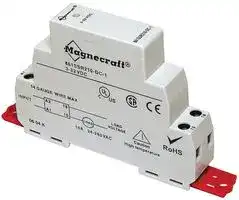
861SSR208-DD
SSR, DIN RAIL MOUNT, 150VDC, 32VDC, 8A
⚠️ Reference pricing provided. In case of supply shortages, we will connect you with our trusted procurement partners to ensure your project's continuity.
- Manufacturer: SCHNEIDER ELECTRIC/LEGACY RELAY
- Product type:
- ; SSR, DIN RAIL MOUNT, 150VDC, 32VDC, 8A; Contact Configuration:SPST-NO; Load Current:8A; Operating Voltage Max:150VDC; Relay Mounting:DIN Rail; Relay Terminals:Screw; Switching Mod
- SVHC: No SVHC (17-Dec-2014)
- Load Current: 8A
- Product Range: -
- Relay Mounting: DIN Rail
- Switching Mode: DC Switch
- Relay Terminals: Screw
- Control Voltage Max: 0
- Control Voltage Min: 0
- Contact Configuration: SPST-NO
- Operating Voltage Max: 150VDC
- Operating Voltage Min: 3VDC
| Delivery and price | |
|---|---|
| Units per pack | 50 |
| Price | 65.69 € |
| Current stock | 10+ |
| Lead time | 30 days |
Datasheet

## Magnecraft[®] Solid State Relays

Catalog 2010

_Contents_

## **Magnecraft[®] Solid State Relays**

Series Overview 861 Relays 861H Relays SSRDIN Relays 6000 Series Relays Accessories for 6000 Series Relays 70S2 Series Relays Application Data Selection Guide Website Guide

~~Schneider~~ 2

_Series Overview_

## **Magnecraft[®] Solid State Relays**

Depending on the application, the Magnecraft line of solid state relays offers a number of advantages over electromechanical relays, including longer life cycles, less energy consumption and reduced maintenance costs�

## **Key Features**

100% solid state design

Modern appearance and advanced technology

Industry first design (861 & 861H series)

Several styles to fit multiple applications

|**Series**<br>**861**|**Defining**<br>**Feature**<br>Slim<br>17�5 mm<br>profile|**Style**<br>Slim DIN &<br>panel mount|**Internal**<br>**Heat**<br>**Sink**<br>Yes|**Contact**<br>**Configuration**<br>SPST-NO;<br>SPST-NC|**Output**<br>**Current**<br>**Range (A)**<br>8–15|**Input**<br>**Voltage**<br>**Range**<br>3–32 Vdc;<br>90–280 Vac|**Output**<br>**Voltage**<br>**Range**<br>3–150 Vdc;<br>24–480 Vac|**Page**<br>6|
|---|---|---|---|---|---|---|---|---|
|**861H**|Class 1,<br>Division 2<br>certified<br>for use in<br>hazardous<br>locations|Slim DIN &<br>panel mount|Yes|SPST-NO;<br>SPST-NC|8–15|3–32 Vdc;<br>90–280 Vac|3–150 Vdc;<br>24–480 Vac|9|
|**SSRDIN**|Integrated<br>heat sink and<br>high current<br>switching<br>capacity|DIN & panel<br>mount|Yes|SPST-NO|10–45|4–32 Vdc;<br>90–280 Vac|0–60 Vdc;<br>24–660 Vac|12|
|**6000**|High current<br>switching<br>capacity in a<br>small package|Hockey puck-<br>panel mount|No|SPST-NO;<br>DPST-NO|10–75|3–32 Vdc;<br>90–280 Vac|3–200 Vdc;<br>24–480 Vac|15|
|**70S2**|Small<br>package<br>size|PCB & panel<br>mount|No|SPST-NO|3–25|3–32 Vdc|3–60 Vdc;<br>8–280 Vac|21|


_70S2 Series Relays_

3

## _Description_

## **Magnecraft[®] Solid State Relays** 861

SPST-NO, 8 A to 15 A SPST-NC, 10 A

## **Description**

The 861 is the first complete solid state relay without any moving parts, all in a slim 17�5 mm design�

**==> picture [37 x 8] intentionally omitted <==**

**----- Start of picture text -----**<br>
861 Relay<br>**----- End of picture text -----**<br>


|**Feature**<br>Solid state circuitry|**Benefit**<br>Involves no moving parts which extends product life,<br>increases reliability, and enables silent operation|
|---|---|
|Optically coupled circuit|Provides isolation between input and output circuits|
|Internal snubber|Helps protect the relay’s internal circuit from high<br>voltage transients|
|Internal heat sink|Provides factory-tested thermal management|
|Fingersafe®terminals|Helps prevent an operator from touching live circuits|
|DIN and panel mounting|Mounts directly onto DIN rail or panel and provides flexibility<br>to accommodate last minute design changes|


|**Switching**<br>**Type**<br>DC switching|**Switching**<br>**Device**<br>MOSFET (1)|**Input Voltage**<br>**Range**<br>3�5–32 Vdc|**Output Voltage**<br>**Range**<br>3–50 Vdc|**Contact**<br>**Configuration**<br>SPST-NO|**Rated Output**<br>**Current (A)**<br>15|**Standard Part**<br>**Number**<br>861SSR115-DD|
|---|---|---|---|---|---|---|
||||3–150 Vdc|SPST-NO|8|861SSR208-DD|
|Random|SCR (2)|3–32 Vdc|24–280 Vac|SPST-NO|10|861SSR210-DC-2|
|||||SPST-NC|10|861SSR210-DC-4|
|||90–280 Vac|24–280 Vac|SPST-NO|10|861SSR210-AC-2|
|Zero cross|SCR|3–32 Vdc|24–280 Vac|SPST-NO|10|861SSR210-DC-1|
||||48–480 Vac|SPST-NO|10|861SSR410-DC-1|
|||90–280 Vac|24–280 Vac|SPST-NO|10|861SSR210-AC-1|
||||48–480 Vac|SPST-NO|10|861SSR410-AC-1|


_(1) MOSFET = metal oxide semiconductor field-effect transistor_

_(2) SCR = silicon-controlled rectifier_

**==> picture [499 x 150] intentionally omitted <==**

**----- Start of picture text -----**<br>
Part Number Explanation<br>Series: Contact Configuration &<br>861 Switching Type:<br>Input Voltage: 1 = SPST-NO, Zero Cross<br>Output Type: AC = 90 to 280 Vac 2 = SPST-NO, Random<br>SSR = SCR Output Current: DC = 3 to 32 Vdc 4 = SPST-NC, Random<br>SSR = MOSFET (DD Only) 08 = 8 A DD = 3.5 to 32 Vdc Null = SPST-NO, DC Switching<br>Output Voltage:    10 = 10 A<br>1 = 3 to 50 Vdc 15 = 15 A<br>2 = 24 to 280 Vac<br>2 = 3 to 150 Vdc (DD Only)<br>4 = 48 to 480 Vac<br>**----- End of picture text -----**<br>


4

## _Specifications_

## **Magnecraft[®] Solid State Relays** 861 SPST-NO, 8 A to 15 A SPST-NC, 10 A

## **Specifications (UL 508)**

|**Part Number**|**861SSR•••-DD**|**861SSR•••-DC-•**|**861SSR•••-AC-•**|
|---|---|---|---|
|**Input Characteristics**||||
|Input Voltage Range|3�5–32 Vdc|3–32 Vdc|90–280 Vac|
|Must Release Voltage|1 Vdc||10 Vac|
|Nominal Input Impedance|Current regulator||16–25 kW|
|Typical Input Current at 5 Vdc|12 mA|16 mA; 12 mA<br>(861SSR210-DC-4)|12 mA|
|Reverse Polarity Protection|Yes|Yes|N/A|
|**Output Characteristics**||||
|Switching Device|MOSFET|SCR (2)||
|Switching Type|DC switching|Zero cross; Random||
|Contact Configuration|SPST-NO|SPST-NO; SPST-NC||
|Output Voltage Range|3–150 Vdc|24–480 Vac||
|Maximum Rate of Rise Off State Voltage (dv/dt)|N/A|500 V/us;<br>350 V/us (861SSR410);<br>200 V/us (861SSR210-DC-4)||
|Output Current Range|8–15 A|10 A (rms)||
|Minimum Load Current–Maintain On|20 mA|50 mA||
|Non-Repetitive Surge Current (8�3 ms)|8 A: 35 A;<br>15 A: 50 A|500 A (rms)||
|Maximum rms Overload Current (1 s)|8 A: 17 A;<br>15 A: 24 A;|24 A (rms)||
|Maximum Off State Leakage Current|0�25 mA|10 mA (rms)||
|Typical On State Voltage Drop|N/A|1�25 Vac (rms)||
|Maximum On State Voltage Drop|0�5 Vdc|1�6 Vac (rms)||
|Maximum On State Resistance|40 mW|N/A||
|Maximum Turn-On Time|5 ms|8�3 ms||
|Maximum Turn-Off Time|5 ms|8�3 ms||
|Maximum I² T for Fusing|N/A|1250 A²sec (861SSR210);<br>850 A²sec (861SSR410)||
|**General Characteristics**||||
|Electrical Life|N/A for solid state relays|||
|Thermal Resistance (Junction–Case)|8 A: 0�5 °C/W;<br>15 A: 1�4 °C/W|0�66 °C/W||
|Internal Heat Sink|4�0 °C/W|||
|Dielectric Strength (Input–Output)|2500  V (rms)|4000  V (rms)||
|Dielectric Strength (Terminals–Chassis)|2500  V (rms)|||
|Operating Temperature Range|-30 °C–+ 80 °C (derating applies)|||
|Storage Temperature Range|-40 °C–+100 °C|||
|Weight|127�1 g (4�1 oz)|||
|Input Indication|Green LED|||
|Terminal Wire Capacity (Input and Output)|14 AWG (2�5 mm²) maximum|||
|Terminal Screw Torque|7�1 lb-in (0�8 N•m) maximum|||
|Safety Cover|IP20|||
|Agency Approvals|UL Listed (E258297); CE (per IEC60947-4-2); CSA (168986); RoHS|||


5

_Dimensions, Wiring Diagram, De-Rating Curves_

**Magnecraft[®] Solid State Relays** 861 SPST-NO, 8 A to 15 A SPST-NC, 10 A

## **Dimensions: Inches (Millimeters)**

**==> picture [325 x 357] intentionally omitted <==**

**----- Start of picture text -----**<br>
0.6<br>0.2 (15.8)<br>(6)<br>0.7 0.6 0.2<br>(17.6) (14.0) (5)<br>0.2 0.56 pt FT [d] [ef]<br>(14.2) 0.1<br>(5.0)<br>(1.7)<br>7 lo d<br>INPUT<br>3.5<br>; = (90) 1.8 7 1 3.6<br>(45.3) 1.4 (92.4)<br>(35.6)<br>2.6<br>(66.8)<br>1.4<br>i; 4 T<br>OUTPUT (35.2)<br>s i ge<br>0.3 0.7 0.6<br>(6.9) (16.0) (14.3)<br>1.4<br>(34.6) 0.1<br>7 ] er<br>(3.4)<br>2.6 MAX.<br>(65.0)<br>Wiring Diagram<br>INPUT<br>POWER SUPPLY<br>+ - MOSFET ONLY<br>A2 (-) (-) 18<br>SSR POWER SOURCEOUTPUT<br>A1 (+) (+) 15 LOAD<br>INPUT<br>OUTPUT<br>**----- End of picture text -----**<br>


## **Wiring Diagram**

## **De-Rating Curves**

**==> picture [203 x 166] intentionally omitted <==**

**----- Start of picture text -----**<br>
16<br>15<br>14<br>13 BEEN APSE<br>12<br>11 PE aN Ee<br>10<br>9 PEE [HEEEPNSEEEHEEEE]<br>8<br>PEER EARCEEESES<br>7<br>6<br>5 PEEP EPSSPREE<br>4<br>PANE<br>3<br>2<br>1 PREPARE NSE<br>0 Gaeeeeeee 5 10 15 20 25 30 35 40 45 seen 50 55 60 65 70 75 80 oe 85 90<br>LOAD CURRENT IN AMPERES<br>**----- End of picture text -----**<br>


Note: _A minimum spacing of 17.5 mm (0.7 in) between adjacent 861 relays is required in order to acheive the maximum ratings._

AMBIENT TEMPERATURE IN °C

6

**Magnecraft[®] Solid State Relays** 861H SPST-NO, 8 A to 15 A

## _Description_

## **Description**

The 861H is the first complete solid state relay approved for use in hazardous locations. Patent pending.

**==> picture [182 x 117] intentionally omitted <==**

**----- Start of picture text -----**<br>
Class 1, Division 2 certification for<br>use in hazardous locations.<br>hoy (Temperature code: T5)<br>861H Relay<br>**----- End of picture text -----**<br>


|**Feature**<br>Class 1, Division 2<br>certification (1)|**Benefit**<br>UL-approved relay for use in<br>hazardous locations|
|---|---|
|Solid state circuitry|Involves no moving parts, which extends product life,<br>increases reliability, and enables silent operation|
|Optically coupled circuit|Provides isolation between input and output circuits|
|Internal snubber|Helps protect the relay’s internal circuit from high<br>voltage transients|
|Internal heat sink|Provides factory-tested thermal management|
|Fingersafe®terminals|Helps prevent an operator from touching live circuits|
|DIN and panel mounting|Mounts directly onto DIN rail or panel and provides<br>flexibility to accommodate last minute design changes|


_(1) See page 30 for more information on Class 1, Division 2._

|Switching<br>Type<br>Switching<br>Device<br>DC switching<br>MOSFET|Switching<br>Device<br>MOSFET|Input Voltage<br>Range<br>3.5–32 Vdc|Output Voltage<br>Range<br>3–50 Vdc|Contact<br>Configuration<br>SPST-NO|Rated Output<br>Current (A)<br>15|Standard Part<br>Number<br>861HSSR115-DD|
|---|---|---|---|---|---|---|
||||3–150 Vdc|SPST-NO|8|861HSSR208-DD|
|Zero cross<br>SCR (2)|SCR (2)|3–32 Vdc|24–280 Vac|SPST-NO|10|861HSSR210-DC-1|
||||48–480 Vac|SPST-NO|10|861HSSR410-DC-1|
||||48–600 Vac|SPST-NO|10|861HSSR610-DC-1|
|||90–280 Vac|24–280 Vac|SPST-NO|10|861HSSR210-AC-1|
||||48–480 Vac|SPST-NO|10|861HSSR410-AC-1|
||||48–600 Vac|SPST-NO|10|861HSSR610-AC-1|


**==> picture [496 x 157] intentionally omitted <==**

**----- Start of picture text -----**<br>
Part Number Explanation<br>Series: Contact Configuration &<br>861H Switching Type:<br>Input Voltage: 1 = SPST-NO, Zero Cross<br>Output Type: AC = 90 to 280 Vac Null = SPST-NO, DC Switching<br>SSR =  SCR Output Current: DC = 3 to 32 Vdc<br>SSR = MOSFET (DD Only) 08 = 8 A DD = 3.5 to 32 Vdc<br>Output Voltage:    10 = 10 A<br>1 = 3 to 50 Vdc 15 = 15 A<br>2 = 24 to 280 Vac<br>2 = 3 to 150 Vdc (DD Only)<br>4 = 48 to 480 Vac<br>6 = 48 to 600 Vac<br>**----- End of picture text -----**<br>


7

**Magnecraft[®] Solid State Relays** 861H SPST-NO, 8 A to 15 A

## _Specifications_

## **Specifications (UL 508)**

|**Part Number**|**861SSR•••-DD**|**861SSR•••-DC-•**|**861SSR•••-AC-•**|
|---|---|---|---|
|**Input Characteristics**||||
|Input Voltage Range|3�5–32 Vdc|3–32 Vdc|90–280 Vac|
|Must Release Voltage|1 Vdc||10 Vac|
|Nominal Input Impedance|Current regulator||16–25 kW|
|Typical Input Current at 5 Vdc|12 mA|16 mA; 12 mA<br>(861SSR210-DC-4)|12 mA|
|Reverse Polarity Protection|Yes|Yes|N/A|
|**Output Characteristics**||||
|Switching Device|MOSFET|SCR (2)||
|Switching Type|DC switching|Zero cross; Random||
|Contact Configuration|SPST-NO|SPST-NO; SPST-NC||
|Output Voltage Range|3–150 Vdc|24–480 Vac||
|Maximum Rate of Rise Off State Voltage (dv/dt)|8 A: 3–150 V:<br>15 A: 3–50 V|500 V/us;<br>350 V/us (861SSR410);<br>200 V/us (861SSR210-DC-4)||
|Output Current Range|8–15 A|10 A (rms)||
|Minimum Load Current–Maintain On|20 mA|50 mA||
|Non-Repetitive Surge Current (8�3 ms)|8 A: 35 A;<br>15 A: 50 A|500 A (rms)||
|Maximum rms Overload Current (1 s)|8 A: 17 A;<br>15 A: 24 A;|24 A (rms)||
|Maximum Off State Leakage Current|0�25 mA|10 mA (rms)||
|Typical On State Voltage Drop|N/A|1�25 Vac (rms)||
|Maximum On State Voltage Drop|0�5 Vdc|1�6 Vac (rms)||
|Maximum On State Resistance|40 mW|N/A||
|Maximum Turn-On Time|5 ms|8�3 ms||
|Maximum Turn-Off Time|5 ms|8�3 ms||
|Maximum I² T for Fusing|N/A|1250 A²sec (861SSR210);<br>850 A²sec (861SSR410)||
|**General Characteristics**||||
|Electrical Life|N/A for solid state relays|||
|Thermal Resistance (Junction–Case)|8 A: 0�5 °C/W;<br>15 A: 1�4 °C/W|0�66 °C/W||
|Internal Heat Sink|4�0 °C/W|||
|Dielectric Strength (Input–Output)|2500  V (rms)|4000  V (rms)||
|Dielectric Strength (Terminals–Chassis)|2500  V (rms)|||
|Operating Temperature Range|-30 °C–+ 80 °C (derating applies)|||
|Storage Temperature Range|-40 °C–+100 °C|||
|Weight|127�1 g (4�1 oz)|||
|Input Indication|Green LED|||
|Terminal Wire Capacity (Input and Output)|14 AWG (2�5 mm²) maximum|||
|Terminal Screw Torque|7�1 lb-in (0�8 N•m) maximum|||
|Safety Cover|IP20|||
|Agency Approvals|Class 1, Division 2 (for hazardous locations); UL Recognized (E317746); RoHS|||


8

**Magnecraft[®] Solid State Relays** 861H SPST-NO, 8 A to 15 A

_Dimensions, Wiring Diagram, De-Rating Curves_

## **Dimensions: Inches (Millimeters)**

**==> picture [321 x 359] intentionally omitted <==**

**----- Start of picture text -----**<br>
0.6<br>0.2 (15.8)<br>(6)<br>0.7 0.6 0.2<br>(17.6) (14.0) (5)<br>| — t eF T T<br>0.56<br>0.2<br>(14.2) 0.1<br>(5.0)<br>1 | (1.7)<br>INPUT<br>, lo d<br>3.5<br>[| (90) 1.8 - ; 3.6<br>(45.3) 1.4 (92.4)<br>(35.6)<br>2.6<br>(66.8)<br>- 4 f<br>1.4<br>OUTPUT (35.2)<br>jis |<br>0.3 0.7 0.6<br>(6.9) (16.0) (14.3)<br>1.4<br>(34.6) 0.1<br>(3.4)<br>2.6 MAX.<br>: |<br>(65.0)<br>Wiring Diagram<br>INPUT<br>POWER SUPPLY<br>+ - MOSFET ONLY<br>A2 (-) (-) 18<br>SSR POWER SOURCEOUTPUT<br>A1 (+) (+) 15 LOAD<br>INPUT<br>OUTPUT<br>**----- End of picture text -----**<br>


## **Wiring Diagram**

## **De-Rating Curves**

**==> picture [507 x 181] intentionally omitted <==**

**----- Start of picture text -----**<br>
16<br>15<br>14 Ree<br>13<br>12 Pte Note:  A minimum spacing of 17.5 mm (0.7 in) between adjacent 861 relays<br>11 is required in order to acheive the maximum ratings.<br>10<br>bebeEENe EEEeteHb<br>9<br>8 PEERS<br>7<br>6<br>5 PEPE Ep SSSNCEE<br>4<br>PaegugeUEoESSaNGud<br>3<br>2 Pet PY<br>1<br>0 PPP 5 10  r 15 20  Perr 25 30 35 40  rrr 45 50 55 60 rrr 65 70  err 75 80 85 90<br>AMBIENT TEMPERATURE IN °C<br>LOAD CURRENT IN AMPERES<br>**----- End of picture text -----**<br>


9

_Description_

SPST-NO, 10 A to 45 A

## **Magnecraft[®] Solid State Relays** SSRDIN

## **Description**

The SSRDIN relays offer a complete solid state package that is an energy-efficient, current switching alternative to standard electromechanical relays� Advantages include longer life cycles, less energy consumption, and reduced maintenance costs�

_SSRDIN Relay_

|**Feature**<br>Solid state circuitry|**Benefit**<br>Involves no moving parts|
|---|---|
|Optically coupled circuit|Provides isolation between input and output circuits|
|Internal snubber|Helps protect the relay’s internal circuit from high<br>voltage transients|
|Internal heat sink|Provides factory tested thermal management|
|Integrated chassis ground|Simplifies system wiring|
|Fingersafe®terminals|Helps prevent an operator from touching live circuits|
|DIN and panel mounting|Increases functionality and ease of use and fits a variety of<br>applications|


|**Switching Type**<br>DC switching|**Switching**<br>**Device**<br>MOSFET|**Input Voltage**<br>**Range**<br>4–32 Vdc|**Output Voltage**<br>**Range**<br>0–60 Vdc|**Contact**<br>**Configuration**<br>SPST-NO<br>~~[~~|**Rated Output**<br>**Current (A)**<br>10<br>||**Standard Part Number**<br>SSR310DIN-DC22(1)|
|---|---|---|---|---|---|---|
||||||20<br>~~|~~<br>~~[~~|SSR320DIN-DC22(1)|
||||||30<br>~~[~~|SSR330DIN-DC22(1)|
|Zero cross|SCR<br>~~a~~<br>~~a~~<br>~~es~~<br>~~RQ~~|4–32 Vdc|24–280 Vac|SPST-NO<br>~~[~~<br>~~[[~~|10<br>~~[f~~<br>~~[~~|SSR210DIN-DC22<br>|
||||||20<br>~~f~~<br>~~[[~~|SSR220DIN-DC22<br>~~[~~|
||||||30<br>~~[[~~|SSR230DIN-DC22<br>~~[~~|
|||3–32 Vdc<br>~~a~~|24–280 Vac<br>~~a~~|SPST-NO<br>~~[~~<br>~~a~~|45<br>~~[~~<br>~~a~~|SSR245DIN-DC45<br>~~[~~|
|||4–32 Vdc|48–660 Vac|SPST-NO<br>~~[~~|10<br>~~f~~<br>~~[~~|SSR610DIN-DC22<br>~~f~~|
||||||20<br>~~f~~<br>~~[~~|SSR620DIN-DC22<br>~~f~~|
||||||30<br>~~[[|~~|SSR630DIN-DC22|
|||~~a~~||SPST-NO|45|SSR645DIN-DC45|
|||90–280 Vac|24–280 Vac|SPST-NO|10<br>~~[|~~|SSR210DIN-AC22|
||||||20<br>~~fe~~|SSR220DIN-AC22|
||||||30<br>~~fe~~<br>~~fe~~|SSR230DIN-AC22|
|||90–140 Vac<br>~~es~~|24–280 Vac<br>~~es~~|SPST-NO<br>~~es~~|45<br>~~es~~|SSR245DIN-AC45|
|||90–280 Vac|48–660 Vac|SPST-NO|10<br>~~|~~|SSR610DIN-AC22|
||||||20<br>~~fe~~|SSR620DIN-AC22|
||||||30<br>~~fe~~<br>~~fo~~|SSR630DIN-AC22|
|||~~RQ~~|~~RQ~~|SPST-NO<br>~~RQ~~|45<br>~~RQ~~|SSR645DIN-AC45|


_(1) No agency approvals on MOSFET versions_

## Part Number Explanation

Series SSR

Output Voltage 2 = SCR, 24 to 280 Vac 3 = MOSFET, 0 to 60 Vdc

Current Rating 10 = 10 A 20 = 20 A 30 = 30 A 45 = 45 A

Size Input Voltage 22 = 22 mm width AC = 90 to 280 Vac 45 = 45 mm width DC = 4 to 32 Vdc

10

## _Specifications_

## **Magnecraft[®] Solid State Relays** SSRDIN SPST-NO, 10 A to 45 A

## **Specifications (UL 508)**

|**Part Number**<br>**SSR2••DIN-DC••**<br>**SSR3••DIN-DC22**|**SSR6••DIN-DC••**|**SSR2••DIN-AC••**||**SSR6••DIN-AC••**|
|---|---|---|---|---|
|**Input Characteristics**|||||
|Input Voltage Range<br>4–32 Vdc<br>Maximum Turn-On Voltage<br>4 Vdc<br>Minimum Turn-Off Voltage<br>1 Vdc<br>~~SSS~~<br>~~ON~~<br>~~Po~~||90–280 Vac<br>90 Vrms<br>10 Vrms|||
|Typical Input Current<br>8–12 mA<br>9–11 mA<br>~~a~~|8–12 mA|2–4 mA|||
|**Output Characteristics**|||||
|Output Type<br>SCR<br>MOSFET<br>~~re~~|SCR||||
|Switching Type<br>Zero voltage<br>DC switching<br>~~rr~~|Zero voltage||||
|Output Voltage<br>24–280 Vac<br>0–60 Vdc<br>Load Current Range<br>10–45 A<br>10–30 A<br>~~a~~<br>~~es~~|48–660 Vac<br>10–45 A|24–280 Vac||48–660 Vac|
|Transient Over-Voltage<br>600 Vpk<br>N/A<br>~~a~~<br>~~a~~|1200 Vpk|600 Vpk||1200 Vpk|
|Maximum Surge Current<br>10 A: 120 Apk;<br>20 A: 250 Apk;<br>30/45 A: 625 Apk<br>(at 16�6 ms)<br>10 A: 30 Apk;<br>20 A: 60 Apk;<br>30 A: 90 Apk<br>(at 10 ms)|625 Apk<br>(at 16�6 ms)|10 A: 120 Apk;<br>20 A: 250 Apk;<br>30/45 A: 625 Apk<br>(at 16�6 ms)||625 Apk<br>(at 16�6 ms)|
|Maximum On-State Voltage Drop at<br>Rated Current<br>1�6 Vpk<br>10 A: 0�2 Vpk;<br>20 A: 0�4 Vpk;<br>30 A: 0�5 Vpk|1�6 Vpk|1�6 Vpk||1�6 Vpk|
|Maximum I²t For Fusing,<br>(8�3 ms)<br>10 A: 60 A²sec;<br>20 A: 260 A²sec;<br>30/45 A: 1620 A²sec<br>N/A|1620 A²sec|10 A: 60 A²sec;<br>20 A: 260 A²sec;<br>30/45 A: 1620 A²sec||1620 A²sec|
|Maximum Off-State Leakage<br>Current at Rated Voltage<br>10 mA<br>0�1 mA|1 mA|10 mA||1 mA|
|Maximum Rate of Rise Off State<br>Voltage (dv/dt)<br>500 V/us<br>N/A|500 V/us||||
|Maximum Response Time<br>(On and Off)<br>1/2 cycle<br>1�0 ms|1/2 cycle||||
|Maximum On State Resistance<br>N/A<br>10 A: 20 mW;<br>20 A: 18 mW;<br>30 A: 16 mW|N/A||||
|**General Characteristics**|||||
|Electrical Life<br>N/A for solid state relays|||||
|Operating Temperature Range<br>-40–+80 °C (derating applies)|||||
|Storage Temperature Range<br>-40–+125 °C|||||
|Weight<br>10/20/30 A: 272 g (9�6 oz);<br>45 A: 482 g (17 oz)|||||
|Input Indication<br>Green LED|||||
|Encapsulation<br>Thermally conductive epoxy|||||
|Input Terminal Screw Torque<br>10/20/30 A: 5�0-6�0 in lb (0�6-0�7 N•m);<br>45 A: 5�0-6�0 in lb (0�6-0�7 N•m)|||||
|Output Terminal Screw Torque<br>10/20/30 A: 5�0-6�0 in lb (0�6-0�7 N•m);<br>45 A: 10�0-15�0 in lb (1�1-1�7 N•m)|||||
|Mount Type<br>DIN rail and panel mount|||||
|Agency Approvals<br>UL Recognized (E258297) SCR output only; CSA (168986) SCR output only; CE (per IEC 60950 and 61000); RoHS|||UL Recognized (E258297) SCR output only; CSA (168986) SCR output only; CE (per IEC 60950 and 61000); RoHS||


11

**Magnecraft[®] Solid State Relays** SSRDIN SPST-NO, 10 A to 45 A

## _Dimensions, Wiring Diagram, De-Rating Curves_

## **Dimensions: Inches (Millimeters)**

**==> picture [403 x 368] intentionally omitted <==**

**----- Start of picture text -----**<br>
0.89<br>MOUNTING HOLE 0.88 (22.6) MOUNTING HOLE<br>0.17 (4.3) DIA. (22.4) 0.17 (4.3) DIA.<br>INPUT INPUT<br>2.61<br>(66.2) (89.7)3.53 (63.7)2.51 (87.4)3.44<br>3.1<br>3.15 (78.7)<br>1 (80.0) 22 mm | 45 mm<br>OUTPUT OUTPUT<br>tt le _ot-|<br>0.44 1.79<br>i (22.4)0.88 g (11.2) (80.0)3.15 — (22.4)0.88(45.5) (78.7)3.1<br>3.8 4.2<br>(97.7) (106.7)<br>i= iB<br>Wiring Diagram<br>INPUT 22 mm 45 mm<br>input output input output<br>+POWER SUPPLY- MOSFET ONLY a AWG 10 6 mm [2] AWG 12 4 mm [2] 10 mm AWG 8 [2]<br>4 (-) (-) 2<br>SSR POWER SOURCEOUTPUT a<br>10<br>Cos 3 (+) (+) 1 LOAD = 0.39<br>INPUT<br>OUTPUT<br>**----- End of picture text -----**<br>


## **Wiring Diagram**

## **De-Rating Curves**

**Load Current vs Ambient Temperature (100% Duty Cycle)**

**==> picture [169 x 164] intentionally omitted <==**

**----- Start of picture text -----**<br>
SSRDIN 45 A<br>45 SESNSSGUETGSSUCSENGa<br>40 Pa Sr<br>35<br>paP eRe PN Eee eae Ee<br>SSRDIN 30 A<br>30 PEENSE ES<br>25 PeteeeNcke Nef<br>SSRDIN 20 A<br>20<br>GEESE GERSSeR\Caeges<br>15<br>PEPPERS PENN<br>SSRDIN 10 A<br>10 SEGRESEUSnac®<br>5 Peepepe80 CREE<br>0 SE 10 [UEEESESOUSEE:] 20 30 40 50 60 70 80 EYEE 90 ed<br>MAXIMUM AMBIENT TEMP. IN °C<br>LOAD CURRENT IN AMPS<br>**----- End of picture text -----**<br>


12

_Description_

**Magnecraft[®] Solid State Relays** 6000 SPST-NO, 10 A to 75 A DPST-NO, 10 A to 25 A

## **Description**

The 6000 Series solid state relays offer an energy-efficient, current switching alternative to standard electromechanical relays� Advantages include longer life cycles, less energy consumption, and reduced maintenance costs�

|**Feature**<br>Solid state circuitry|**Benefit**<br>Involves no moving parts|
|---|---|
|Optically coupled circuit|Provides isolation between input and output circuits|
|Internal snubber|Helps protect the relay’s internal circuit from high<br>voltage transients|
|Fingersafe®terminals|Helps prevent an operator from touching live circuits|


_6000 Series Relays_

Switching Input Voltage Output Voltage Contact Rated Output Standard Part Switching Type Device Range Range Configuration Current (A) Number 12 6312AXXMDS-DC3 DC switching MOSFET 3.5–32 Vdc 3–200 Vdc SPST-NO 25 6325AXXMDS-DC3 ~~|~~ 40 6340AXXMDS-DC3 ~~a~~ 10 6210AXXSZS-DC3 25 6225AXXSZS-DC3 24–280 Vac SPST-NO 40 6240AXXSZS-DC3 3–32 Vdc 50 6250AXXSZS-DC3 25 6425AXXSZS-DC3 48–480 Vac SPST-NO 50 6450AXXSZS-DC3 SCR 10 6210AXXSZS-AC90 25 6225AXXSZS-AC90 Zero cross 24–280 Vac SPST-NO 40 6240AXXSZS-AC90 90–280 Vac 50 6250AXXSZS-AC90 ~~—~~ 75 6275AXXSZS-AC90 10 6410AXXSZS-AC90 48–480 Vac SPST-NO ~~-=_eeae~~ 25 6425AXXSZS-AC90 24–280 Vac DPST-NO ~~—~~ 10 6210BXXTZB-DC3* Triac 3–32 Vdc SPST-NO 25 6425AXXTZB-DC3* 48–480 Vac —— ~~—<—<———~~ DPST-NO 25 6425BXXTZB-DC3* _* Blade terminals._ Part Number Explanation ~~a~~ Series Input Voltage 6000 Connection Type AC90 = 90–280 Vac B = Blade Terminals DC3 = 3–32 Vdc Output Voltage S = Screw Terminals 2 = 3 = 24 to 280 Vac3 to 200 Vdc ~~=~~ Current Rating Contact Output Type Switching Type 4 = 48 to 530 Vac 10 = 10 A 40 = 40 A Configuration M = MOSFET D = DC Switching 12 = 12 A 50 = 50 A AXX = SPST-NO S = SCR Z = Zero Cross 25 = 25 A 75 = 75 A BXX = DPST-NO T = TRIAC

13

**Magnecraft[®] Solid State Relays** 6000 SPST-NO, 10 A to 75 A DPST-NO, 10 A to 25 A

## _Specifications_

## **S pecifications (UL 508)**

|**Part Number**|**62••AXXSZS-AC90**|**64••AXXSZS-AC90**|**62••AXXSZS-DC3**|**64••AXXSZS-DC3**|
|---|---|---|---|---|
|**Input Characteristics**|||||
|Control Voltage Range|90–280 Vac (rms)||3–32 Vdc|4–32 Vdc|
|Maximum Turn-On Voltage|90 Vac (rms)||3 Vdc|4 Vdc|
|Minimum Turn-Off Voltage|10 Vac (rms)||1 Vdc||
|Nominal Input Impedance|60 KW||N/A||
|Typical Input Current|2 mA at 120 V (rms), 4 mA at 240 V (rms)||10 mA at 12 Vdc|15 mA DC|
|**Output Characteristics**|||||
|Switching Device|SCR||||
|Switching Type|Zero Cross||||
|Contact Configuration|SPST-NO||||
|Output Current Range|10–75 A|10–25 A|10–50 A|25–50 A|
|Output Voltage Range (47–63 Hz)|24–280 Vac (rms)|48–530 Vac (rms)|24–280 Vac (rms)|48–530 Vac (rms)|
|Transient Over-voltage|600 Vpk|1200 Vpk|600 Vpk|1200 Vpk|
|Maximum Off-State Leakage Current at Rated Voltage|10 mA (rms)||1 mA (rms)||
|Minimum Off-State dv/dt at Maximum Rated Voltage|500 V/us||||
|Minimum Load Current|40 mA(rms)||150 mA(rms)||
|Maximum Surge Current (16�6 ms)|10 A: 120 Apk;<br>25 A: 250 Apk;<br>40/50 A: 625 Apk;<br>75 A: 1000 Apk|10 A: 140 Apk;<br>25 A: 250 Apk|10 A: 120 Apk;<br>25 A: 250 Apk;<br>40/50 A: 625 Apk|25 A: 250 Apk;<br>50 A: 625 Apk|
|Maximum On-State Voltage Drop at Rated Current|1�6 V(rms)|1�7 V(rms)|1�6 V(rms)||
|Maximum I²T for Fusing (8�3 ms)|10 A: 60 A²sec;<br>25 A: 260 A²sec;<br>40/50A: 1620 A²sec;<br>75A: 4150 A²sec|10 A: 81 A²sec;<br>25 A: 260 A²sec|10 A: 60 A²sec;<br>25 A: 260 A²sec;<br>40/50 A: 1620 A²sec|25 A: 260 A²sec;<br>50 A: 1620 A²sec|
|Minimum Power Factor(with Maximum Load)|0�5||||
|**General Characteristics**|||||
|Electrical Life|N/A for solid state relays||||
|Maximum Turn-On Time|10 ms||1/2 Cycle||
|Maximum Turn-Off Time|40 ms||1/2 Cycle||
|Thermal Resistance(Junction–Case)|10 A: 1�48 °C/W; 25 A: 1�02 °C/W; 40/50A: 0�63 °C/W; 75 A: 0�31 °C/W||||
|Dielectric Strength, Input/Output/Base(50/60 Hz)|4000 Vac(rms)||||
|Minimum Insulation Resistance(at 500 Vdc)|1E+9W||||
|Maximum Capacitance(Input/Output)|8 pF||||
|Ambient OperatingTemperature Range|-40–80 °C(deratingapplies)||||
|Ambient Storage Temperature Range|-40–125 °C||||
|Weight(typical)|86�5g (3 oz)||||
|Input Indication|Green LED||||
|Encapsulation|Thermallyconductive epoxy||||
|Terminals|Screw and saddle clamps furnished, unmounted||||
|Recommended Terminal Screw Torque Range|6-32 Screws: 10 lb-in; 8-32 & 10-32 Screws: 20 lb-in (Screws dry without grease)||||
|Safety Cover|Yes||||
|Wire Clamp Plates|Yes||||
|Agency Approvals|UL Recognized (E258297); CE (per IEC 60950 and 61000); CSA (168986); RoHS||UL Recognized (E258297); CE (per IEC 60950 and 61000); CSA (168986); RoHS||


14

## _Specifications (continued)_

## **Magnecraft[®] Solid State Relays** 6000 SPST-NO, 10 A to 75 A DPST-NO, 10 A to 25 A

## **Specifications (UL 508)**

|**Part Number**|**6••••XXTZB-DC3**|**63••AXXMDS-DC3**|
|---|---|---|
|**Input Characteristics**|||
|Control Voltage Range|3–32 Vdc|3�5–32 Vdc|
|Maximum Turn-On Voltage|3 Vdc|3�5 Vdc|
|Minimum Turn-Off Voltage|1 Vdc||
|Nominal Input Impedance|Active current limiter|1kW|
|Typical Input Current|25 A: 16 mA;|10 mA|
||10 A: 2 mA||
|**Output Characteristics**|||
|Switching Device|Triac|MOSFET|
|Switching Type|Zero Cross|DC switching|
|Contact Configuration|SPST-NO, DPST-NO|SPST-NO|
|Output Current Range|10A–25A|12A–40A|
|Output Voltage Range|10 A: 24–280 Vac;|3–200 Vdc|
||25 A: 48–480 Vac||
|Transient Over-voltage|600 Vpk|200 Vpk|
|Maximum Off-State Leakage Current at Rated Voltage|10 mA|< 1 mA|
|Minimum Off-State dv/dt at Maximum Rated Voltage|250 V/us|N/A|
|Minimum Load Current–Maintain|80 mA|N/A|
|Maximum Surge Current (16�6 ms)|250 A|12 A: 27 A;|
|||25 A: 50 A;|
|||40 A: 90 A|
|Maximum On-State Voltage Drop at Rated Current|1�6 Vac(rms)|2�8 Vdc(at 40 A load)|
|Maximum I²T for Fusing (8�3 ms)|200 A2s|N/A|
|Minimum Power Factor(with Maximum Load)|0�5|0�95|
|**General Characteristics**|||
|Electrical Life|N/A for solid state relays||
|Maximum Turn-On Time|1/2 cycle|300 us|
|Maximum Turn-Off Time|1/2 cycle|1 ms|
|Thermal Resistance(Junction–Case)|1�2 °C/W|1�06 °C/W|
|Dielectric Strength, Input/Output/Base(50/60 Hz)|4000 Vac(rms)|2500 Vac(rms)|
|Minimum Insulation Resistance(at 500 Vdc)|1E+9W||
|Maximum Capacitance(Input/Output)|10 pF||
|Ambient OperatingTemperature Range|-30–80 °C(deratingapplies)|-40–80 °C(deratingapplies)|
|Ambient Storage Temperature Range|-40–100 °C|-40–100 °C|
|Weight(typical)|100g (3�52 oz)|110g (3�88 oz)|
|Input Indication|Green LED||
|Encapsulation|Epoxy||
|Terminals|1/4 in (6�35 mm); 3/16 in (4�74 mm)|Input: M3�5;<br>Output: M4 (12 A), M6 (25/40 A)|
|Recommended Terminal Screw Torque Range|N/A|20 lb-in; 10 lb-in|
|Safety Cover|Yes (IP20)||
|Wire Clamp Plates|N/A|Yes|
|Agency Approvals|UL Recognized (E258297), CSA (168986), CE (per IEC 60947-4-1), RoHS|UL Recognized (E258297), CSA (168986), CE (per IEC 60947-4-1), RoHS|


15

**Magnecraft[®] Solid State Relays** 6000 SPST-NO, 10 A to 75 A DPST-NO, 10 A to 25 A

## _Dimensions, Wiring Diagram, De-Rating Curves_

## **Dimensions: Inches (Millimeters)**

**==> picture [540 x 586] intentionally omitted <==**

**----- Start of picture text -----**<br>
0.192<br>(4.9) DIA.<br>0.41<br>(10.5)<br>1.4 5 (-) 6 (+)<br>(35.9)<br>Side View 1 (-) OUTPUT 2 (+) OUTPUT<br>1 (-) 2 (+)<br>er w v e Ny<br>1.87<br>2.28 Screw Terminals (47.5) Blade Terminals<br>(57.91) ||<br>4 (-) INPUT 3 (+) 4 (-) INPUT 3 (+)<br>1.7<br>(43.42)<br>1.74  1.74<br>Side View<br>(44.14) (44.14)<br>(25 & 40 A MOSFET versions only)<br>0.125<br>(3.2)<br>Wiring Diagram<br>INPUT Terminal Min.  Max.<br>+POWER SUPPLY- MOSFET ONLY OutputInput (0.138 3.5 4.2  ) (0.197 6.35  5  ) X mm in  10 max 0.393 papal<br>a (0.163) (0.25)<br>4 (-) (-) 1<br>OUTPUT 0..50A 50..125A<br>SSR POWER SOURCEOUTPUT Cu 75°Cmax. ambient<br>Cee 25°C e s BE<br>3 (+) (+) 2 LOAD<br>De-Rating Curves<br>10 A 25 A 12 A MOSFET<br>12 30 95<br>7°C/W 3°C/W 1°C/W 50<br>9°C/W 5°C/W 110 25 3°C/W 2°C/W 100 40<br>8 20 Mounted on heat sink with<br>NO HEATSINK 115 30 3.2 ºC/W thermal resistance<br>15 110<br>20<br>4 10<br>120 NO HEATSINK<br>5 120 10<br>0 /~ 2 3 6 8 10 20 40 60 80 0 A 5 10 15 20 S 25 20 40 60 80 0 10 20 30 40 50 60 70 80<br>Load Current (Arms) Ambient Temp. (°C) Load Current (Arms) Ambient Temp. (°C) Ambient Temp. (°C)<br>50 A 75 A 25/40 A MOSFET<br>60 120<br>1°C/W 0.5°C/W 90 50 Mounted on heat sink with<br>95 0.5 ºC/W thermal resistance<br>1.5°C/W 0.5°C/W 0.3°C/W 40<br>40 100 80 100<br>2°C/W 1°C/W 30<br>110 110 20<br>20 40<br>Mounted on heat sink with<br>0.5 ºC/W thermal resistance<br>10<br>NO HEATSINK 120 120<br>0 10 20 30 40 50 20 40 60 80 0 aN 15 30 45 60 75 20 40 60 80 0 10 20 30 40 50 60 70 80<br>Load Current (Arms) Ambient Temp. (°C) Load Current (Arms) Ambient Temp. (°C) Ambient Temp. (°C)<br>INPUT<br>OUTPUT<br>Power Dissipation Power Dissipation<br>Base Plate Temp (°C) Base Plate Temp (°C) Load Current (Arms)<br>Power Dissipation Base Plate Temp (°C) Power Dissipation Base Plate Temp (°C) Load Current (Arms)<br>**----- End of picture text -----**<br>


## **Wiring Diagram**

## **De-Rating Curves**

16

_Description_

**Magnecraft[®] Solid State Relays** Accessories for 6000 Series Heat Sink, SSR-HS-1 Thermal Pad, SSR-TP-1

## **Description**

Thermal management is a fundamental consideration in the design and use of solid state relays (SSRs) because of the contact dissipation (typically 1 W per ampere). Therefore, it is vital that sufficient heat sinking is provided, or the life and switching reliability of the SSR will be compromised.

The SSR-HS-1 heat sink maximizes heat dissipation and helps ensure reliable operation when properly selected for the specific application. For ease of installation, all mounting holes are pre-drilled and tapped.

The SSR-TP-1 simplifies installation with a simple peel-and-stick solution, which does not require messy thermal grease.

_SSR-HS-1_

_SSR-TP-1_

**==> picture [253 x 171] intentionally omitted <==**

**----- Start of picture text -----**<br>
Relay Mounting Example<br>6000 Series<br>relay<br>SSR-TP-1<br>a Thermal pad<br>SSR-HS-1<br>Heat sink<br>**----- End of picture text -----**<br>


|**Description**<br>Heat sink|**Function**<br>Maximizes heat dissipation|**Weight**<br>558�5 g (19�7 oz)|**For Use With Relays**<br>6000 Series Relays<br>(rated upto 50 A)|**Packaging**<br>**Minimum**<br>1|**Standard Part**<br>**Number**<br>SSR-HS-1|
|---|---|---|---|---|---|
|Thermal pad|Simplifies installation with a simple<br>peel-and-stick solution, which does<br>not require messy thermal grease|N/A|6000 Series Relays<br>(rated up to 50 A)|10|SSR-TP-1|


17

**Magnecraft[®] Solid State Relays** Accessories for 6000 Series Heat Sink, SSR-HS-1 Thermal Pad, SSR-TP-1

_Dimensions, De-Rating Curves_

## **Dimensions: Inches (Millimeters)**

**==> picture [435 x 268] intentionally omitted <==**

**----- Start of picture text -----**<br>
UP BSE =<br>1.72<br>SSR-HS-1 5.51<br>0.19 (139.95) (43.63)<br>(4.95)<br>1.75<br>(44.45) 2.22 SSR-TP-1<br>(56.3)<br>0.29<br>reat} tptI<br>(7.35)<br>0.13<br>(3.18)<br>TOP VIEW SIDE VIEW<br>0.88<br>~ : |_|<br>4.73 0.07 (22.45)<br>3.86 (120.14) (1.69)<br>(97.92) 2.65 INSTALLATION:<br>1.99 L (67.31) — 1. RELEASE LINER ON ONE<br>(50.63) 0.24 SIDE OF THE THERMAL PAD,<br>FRONT VIEW (6.04) PLACE UNDERNEATH CLASS 6 SOLID STATE RELAY.<br>2. RELEASE LINER ON OTHER<br>SIDE OF THERMAL PAD AND<br>PLACE RELAY AND PAD ONTO<br>HEAT SINK OR PANEL.<br>Tesi |<br>0.34 a e ]<br>(8.69)<br>**----- End of picture text -----**<br>


## **De-Rating Curves (when used with thermal pad and heat sink)**

**Load Current vs Ambient Temperature (100% Duty Cycle)**

## **Thermal Resistance vs Power Dissipation**

**==> picture [167 x 122] intentionally omitted <==**

**----- Start of picture text -----**<br>
1.0<br>0.92<br>0.8<br>0.69<br>0.6<br>0.51<br>0.55 0.52<br>0.4<br>0.2<br>0 20 40 60 80 100 120 140<br>DISSIPATION (W)<br>THERMAL RESISTANCE (ºC/W)<br>**----- End of picture text -----**<br>


**==> picture [185 x 265] intentionally omitted <==**

**----- Start of picture text -----**<br>
50A 6000 Series Relay with (70 Cfm) Fan<br>60<br>50<br>Gane oes Gnneaeneeune<br>40<br>BEEEEE [SRCEEE]<br>37<br>30<br>PAE EE ERA AR EE LE<br>28<br>20<br>BEEPSEber<br>10<br>PEGEPPEEE EE [EERE] ENEEE Ly<br>0 10 20 30 REE 40 50 60 70  EEE 80 90 100<br>AMBIENT TEMPERATURE (ºC)<br>50A 6000 Series Relay without Fan<br>60<br>50 GeosSeno eee<br>47<br>40 PEEEEENEEEEEEEEEEEE<br>38<br>30<br>PAPE EEAES<br>24<br>20<br>BEEEE [EEN] EEE 19 BPEL 14<br>10<br>PEPE EEEEEEEEE E EBSEELy<br>0 PAPER 10 20 30 40 EEE 50 60  EP 70  EEA 80 90 100<br>AMBIENT TEMPERATURE (ºC)<br>CURRENT RATING (A)<br>CURRENT RATING (A)<br>**----- End of picture text -----**<br>


18

**Magnecraft[®] Solid State Relays** 70S2

## _Description_

SPST-NO, 3 A to 25 A

## **Description**

The 70S2 Series are miniature solid state relays ideal for small space applications. They are available in panel and PCB mount, which increases the level of flexibility for designers.

**==> picture [189 x 78] intentionally omitted <==**

**----- Start of picture text -----**<br>
70S2 (V) Relay 70S2 (F) Relay 70S2 (S) Relay<br>Ne<br>70S2 (M) Relay 70S2 (N) Relay<br>**----- End of picture text -----**<br>


|**Feature**<br>Solid state circuitry|**Benefit**<br>Involves no moving parts|
|---|---|
|Optically coupled circuit|Provides isolation between input and output circuits|
|Internal snubber|Helps protect the relay’s internal circuit from high<br>voltage transients|
|Small package size|Ideal for small spaces|
|Panel and PCB mounting|Increases functionality and ease of use|


|**Switching**<br>**Type**<br>DC switching|**Switching**<br>**Device**<br>MOSFET<br>~~LSC~~|**Input Voltage**<br>**Range**<br>3–15 Vdc<br>~~LSC~~|**Output Voltage**<br>**Range**<br>3–60 Vdc<br>|**Rated Output**<br>**Current (A)**<br>3<br>ee|**Terminal**<br>**Style**<br>Solder<br>ee<br>~~ee~~|**Mounting**<br>**Style**<br>PCB Mount<br>ee|**Standard Part**<br>**Number**<br>70S2-01-A-03-V|
|---|---|---|---|---|---|---|---|
|||||5<br>~~ee~~<br><br>~~[|~~|Blade<br>~~ee~~<br>~~ee~~<br>~~ee~~<br>|Panel Mount<br>~~ee~~<br>~~ee~~<br>|70S2-01-A-05-N<br>~~ee~~|
||||||Screw<br>~~ee~~<br>~~ee~~<br><br>~~[|~~<br>~~™C—C—CYCCC—CSCSCSCCCCSY~~|Panel Mount<br>~~ee~~<br>~~ee~~<br><br>~~™C—C—CYCCC—CSCSCSCCCCSY~~|70S2-01-A-05-S<br>~~ee~~|
|||9–30 Vdc<br>~~LSCtCrT|CSC™~<“C;™CrYSC;CCTTT.~~|3–60 Vdc<br>~~tCrT|CSC™~<“C;™CrYSC;CCTTT.~~|5<br>~~tCrT|CSC™~<“C;™CrYSC;CCTTT.~~<br>~~[|~~|Screw<br>~~ee~~<br>~~tCrT|CSC™~<“C;™CrYSC;CCTTT.~~<br>~~[|~~<br>~~™C—C—CYCCC—CSCSCSCCCCSY~~|Panel Mount<br>~~ee~~<br>~~tCrT|CSC™~<“C;™CrYSC;CCTTT.~~<br>~~™C—C—CYCCC—CSCSCSCCCCSY~~|70S2-02-A-05-S<br>~~ee~~|
|Zero cross|Triac<br>~~LSC~~<br>~~SS~~<br>~~a~~|3–30 Vdc<br>~~LSC~~<br>~~a~~<br>~~SS~~|24–140 Vac<br><br>~~So~~|4<br><br>~~[|~~<br>~~So~~|Solder<br>~~ee~~<br><br>~~[|~~<br>~~™C—C—CYCCC—CSCSCSCCCCSY~~<br>~~Lf~~|PCB Mount<br>~~ee~~<br><br>~~™C—C—CYCCC—CSCSCSCCCCSY~~<br>~~Lf~~|70S2-04-B-04-F<br>~~ee~~|
|||||6<br>~~So~~|Blade<br>~~Lf~~|Panel Mount<br>~~Lf~~|70S2-04-B-06-N|
||||||Screw<br>~~Lf~~<br>~~ee~~|Panel Mount<br>~~Lf~~<br>~~ee~~|70S2-04-B-06-S|
|||||12<br>~~So ~~<br>~~EE~~|Blade<br> ~~Lf~~<br>~~EE~~|Panel Mount<br>~~Lf~~<br>~~EE~~|70S2-04-B-12-N|
||||||Screw<br>~~EE~~<br>~~ee~~|Panel Mount<br>~~EE~~<br>~~ee~~|70S2-04-B-12-S|
|||||25<br>~~EE~~|Screw<br>~~EE~~<br>~~ee~~|Panel Mount<br>~~EE~~<br>~~ee~~|70S2-03-B-25-S|
||||24–280 Vac<br>~~a~~<br>~~SS —~~|6<br>~~SL~~|Blade<br>~~SL~~|Panel Mount<br>~~SL~~|70S2-04-C-06-N|
||||||Screw<br>~~SL~~<br>~~ee~~|Panel Mount<br>~~SL~~<br>~~ee~~|70S2-04-C-06-S|
|||||10<br>~~ee~~|Solder<br>~~ee~~|PCB/Panel Mount<br>~~ee~~|70S2-04-C-10-M|
|||||12<br>~~ee~~<br>~~pp~~|Blade<br>~~ee~~<br>~~pp~~|Panel Mount<br>~~ee~~<br>~~pp~~|70S2-04-C-12-N|
||||||Screw<br>~~pp~~<br>~~ee~~|Panel Mount<br>~~pp~~<br>~~ee~~|70S2-04-C-12-S|
||||||Screw<br>~~pp~~<br>~~ee~~|Panel Mount<br>~~pp~~<br>~~ee~~|70S2-06-C-12-S|
|||||25|Screw|Panel Mount|70S2-03-C-25-S|
|||3–32 Vdc<br>~~a~~<br>~~SS~~|24–140 Vac<br>~~a~~<br>~~SS —~~|3|Solder|PCB Mount|70S2-04-B-03-V|
||||24–280 Vac<br>~~a~~<br>~~SS —~~|3|Solder|PCB Mount|70S2-04-C-03-V|
||||8–50 Vac<br>~~SS —~~<br>~~ee~~|3<br>~~ee~~|Solder<br>~~ee~~|PCB Mount<br>~~ee~~|70S2-04-D-03-V|
|||6–30 Vdc<br>~~SS~~<br>~~a~~|24–280 Vac<br>~~SS —~~|12|Screw|Panel Mount|70S2-05-C-12-S|


## **Part Number Explanation**

Series: Package Type: 70S2 F = PCB Mount w/Solder Terminals Output Current: Input Voltage: 70S2 ~~\ Me~~ 03 = 3 A M = PCB/Panel Mount w/Solder Terminals 01 = 3 to 15 Vdc Output Voltage: 04 = 4 A N = Panel Mount w/Blade Terminals 02 = 9 to 30 Vdc A = 3 to 60 Vdc 05 = 5 A S = Panel Mount w/Screw Terminals 03 = 3 to 30 Vdc B = 24 to 140 Vac 06 = 6 A V = PCB Mount w/Solder Terminals 04 = 3 to 30 Vdc C = 24 to 280 Vac 10 = 10 A 05 = 6 to 30 Vdc D = 8 to 50 Vac 12 = 12 A 06 = 6 to 30 Vdc 25 = 25 A

19

**Magnecraft[®] Solid State Relays** 70S2 SPST-NO, 3 A to 25 A

## _Specifications_

## **Specifications (UL 508)**

|**Part Number**<br>**70S2-01-A**<br>**70S2-02-A**|**70S2-03-B**|**70S2-03-C**|
|---|---|---|
|**Input Characteristics**|||
|Control Voltage Range<br>3–15 Vdc<br>9–30 Vdc<br>~~ee~~|3–30 Vdc||
|Must Release Voltage<br>1 Vdc|||
|Typical Input Current<br>5–40 mA<br>5–17 mA|7–16 mA|6–10 mA|
|Maximum Reverse Control Voltage<br>3 Vdc|||
|**Output Characteristics**|||
|Switching Device<br>MOSFET<br>~~pO~~|Triac||
|Switching Type<br>DC Switching<br>~~po~~|Zero Cross||
|Contact Configuration<br>SPST-NO|||
|Output Voltage Range<br>3–60 Vdc<br>24–140 Vac<br>~~a~~||24–280 Vac|
|Peak Blocking Voltage<br>105 Vdc<br>400 Vac<br>~~a~~||600 Vac|
|Maximum Rate of Rise Off State Voltage (dv/dt)<br>N/A<br>~~po~~|300 V/us||
|Output Current Range (rms)<br>3–5 A<br>5 A<br>25 A<br>Minimum Load Current–Maintain On<br>N/A<br>100 mA<br>~~a~~<br>~~Po~~||25 A|
|Non-Repetitive Surge Current(8�3 ms)<br>3 A: 5 A(1 s); 5 A: 7 A(1 s)<br>~~—~~|300 A||
|Maximum Off State Leakage Current(rms)<br>10 mA<br>Typical On State Voltage Drop(rms)<br>3 A: 1�2 Vdc; 5 A: 1�85 Vdc<br>Maximum Turn-On Time<br>75 ms<br>~~po~~<br>~~OO~~<br>~~po~~|6 mA<br>1�7 Vac<br>8�3 ms||
|Maximum Turn-Off Time<br>3 A: 500 ms; 5 A: 75 ms|8�3 ms||
|**General Characteristics**|||
|Electrical Life<br>N/A for solid state relays|||
|Thermal Resistance(Junction–Case)<br>3 A: 0�5 °C/W; 5/25 A: 4 °C/W|||
|Dielectric Strength (Input–Output)<br>3 A: 4000 Vac; 5 A: 2500 Vac<br>~~—~~|3000 Vac||
|Dielectric Strength (Terminals–Chassis)<br>3 A: 4000 Vac; 5 A: 2500 Vac<br>~~po~~|3000 Vac||
|OperatingTemperature Range<br>-40–+100 °C|||
|Storage Temperature Range<br>-40–+125 °C|||
|Weight<br>F/M: 35 g (1�2 oz):<br>N/S: 47 g (1�7 oz);<br>V: 25g (0�9oz)|||
|AgencyApprovals<br>UL Recognized(E258297); CSA(040787); RoHS|||


20

**Magnecraft[®] Solid State Relays** 70S2 SPST-NO, 3 A to 25 A

## _Specifications (continued)_

## **Specifications (UL 508)**

|**Part Number**|**70S2-04-B**<br>**70S2-04-C**|**70S2-04-D**|**70S2-05-C**|**70S2-06-C**|
|---|---|---|---|---|
|**Input Characteristics**|||||
|Control Voltage Range|3 A: 3–32 Vdc; 4/6/10/12 A: 3–30 Vdc<br>6–30 Vdc<br>~~a~~|||3–30 Vdc|
|Must Release Voltage|1 Vdc||||
|Typical Input Current|3 A: 1–19 mA; 4/6/10/12 A: 7–16 mA<br>6–10 mA<br>~~a~~|||1–17 mA|
|Maximum Reverse Control Voltage|3 Vdc||||
|**Output Characteristics**|||||
|Switching Device|Triac||||
|Switching Type|Zero Cross||||
|Contact Configuration|SPST-NO||||
|Output Voltage Range<br>Peak Blocking Voltage|24–140 Vac<br>24–280 Vac<br>8–50 Vac<br>400 Vac<br>600 Vac<br>200 Vac<br>~~or~~<br>~~a~~||24–280 Vac<br>600 Vac||
|Maximum Rate of Rise Off State Voltage (dv/dt)|300 V/us||||
|Output Current Range (rms)|3–12 A<br>3–12 A<br>3 A<br>~~es~~||12 A||
|Minimum Load Current–Maintain On|3/4/6 A: 75 mA; 10/12 A: 100 mA||||
|Non-Repetitive Surge Current(8�3 ms)|3/4/6 A: 60 A; 10/12 A: 150 A||||
|Maximum Off State Leakage Current(rms)|6 mA<br>10 mA<br>~~ee~~||6 mA||
|Typical On State Voltage Drop(rms)|1�6 Vac||||
|Maximum Turn-On Time|8�3 ms||||
|Maximum Turn-Off Time|8�3 ms||||
|**General Characteristics**|||||
|Electrical Life|N/A for solid state relays||||
|Thermal Resistance(Junction–Case)|3 A: 0�5 °C/W ; 4/6/10/12 A: 4 °C/W<br>~~a~~|||2�4 °C/W|
|Dielectric Strength (Input–Output)|3 A: 4000 Vac; 4/6/10/12 A: 3000 Vac||||
|Dielectric Strength (Terminals–Chassis)|3 A: 4000 Vac; 4/6/10/12 A: 3000 Vac||||
|OperatingTemperature Range|-40–+100 °C(deratingapplies)||||
|Storage Temperature Range|-40–+125 °C||||
|Weight|F/M: 35 g (1�2 oz):<br>N/S: 47 g (1�7 oz);<br>V: 25g (0�9 oz);||||
|AgencyApprovals|UL Recognized(E258297); CSA(040787); RoHS||||


21

**Magnecraft[®] Solid State Relays** 70S2

## _Dimensions_

SPST-NO, 3 A to 25 A

## **Dimensions: inches (millimeters)**

**==> picture [513 x 509] intentionally omitted <==**

**----- Start of picture text -----**<br>
0.6<br>(15.2) 0.2<br>0.6 (5.1)<br>(15.2)<br>0.2<br>—}__ J (5.1) a<br>0.5 0.5<br>(11.4) 2.2 1.2 OUTPUT (11.4)<br>OUTPUT (55.9) (31.2) 0.3<br>1.2 (7.6)<br>(31.2) INPUT<br>INPUT 1.9<br>0.3 70S2 (F) (47.5) 70S2 (M)<br>(7.6) ZZ &<br>0.4 0.3 0.3<br>(10.2) (7.6) 0.2 (7.6)<br>Hab er<br>1.0  1.2 (4.4) 0.4<br>(26.2) (31.7) 1.0 (10.2)<br>(26.2)<br>(20.7) —_— 0.8  — INPUT+- OUTPUT(-)(+) (4.7)0.2 0.9 MAX(22.9) oe INPUT- OUTPUT(-) 7<br>+ (+)<br>Lie, i Br<br>0.03 (0.76)<br>iF 0.03 (0.76) 0.3 Je<br>(6.4)<br>0.5<br>(12.7)<br>0.25<br>(6.5) 0.2<br>(4.4) 0.6<br>(15.3) 0.2<br>(4.5)<br>1.9<br>OUTPUT (47.5) 1.9<br>0.9 (47.5)<br>(22.9) eal (31.2)1.2 2.2 0.8 OUTPUT<br>|. INPUT (55.9) 70S2 (N) (19.1) INPUT 1 (31.2)1.2 (55.9)2.2 70S2 (S)<br>0.4<br>0.187 (10.2) 0.4<br>(4.75) 0.02 0.032<br>(10.2)<br>(0.5) (0.8)<br>ioe 1.0 1.0 |<br>(26.2) (26.2)<br>0.9 MAX - (-) - (-) 0.9<br>(22.9) INPUT OUTPUT INPUT OUTPUT (22.9)<br>+ (+) + (+)<br>A TOT =a<br>**----- End of picture text -----**<br>


22

**Magnecraft[®] S** ~~**olid St**~~ **ate** ~~**R**~~ **elays** 70S2 SPST-NO, 3 A to 25 A

_Dimensions (continued), Wiring Diagram, De-Rating Curves_

## **Dimensions: inches (millimeters)**

**==> picture [210 x 185] intentionally omitted <==**

**----- Start of picture text -----**<br>
0.16<br>4. (4.1)<br>ne 2<br>70S2 (V)<br>1.7<br>fh (43.2)<br>0.2 1.02<br>(5.1) (26.0)<br>INPUT OUTPUT<br>– + – +<br>mh<br>0.4<br>L I | r " +t 0.3 (10.2) o e ]<br>(7.6) 0.04 DIA.<br>0.4 (1.0)<br>0.9 (10.2)<br>(22.9)<br>1.1<br>_ Ls - aL<br>(27.9)<br>**----- End of picture text -----**<br>


## **Wiring Diagram**

**==> picture [268 x 86] intentionally omitted <==**

**----- Start of picture text -----**<br>
INPUT<br>POWER SUPPLY<br>+ - MOSFET ONLY<br>(-) (-)<br>SSR POWER SOURCEOUTPUT<br>(+) (+) LOAD<br>INPUT<br>OUTPUT<br>**----- End of picture text -----**<br>


## **De-Rating Curves**

## **Load Current vs Ambient Temperature (100% Duty Cycle)**

**==> picture [511 x 160] intentionally omitted <==**

**----- Start of picture text -----**<br>
3 & 5 A 4 & 6 A 10, 12 & 25 A<br>8 8 32<br>30<br>7 7 28<br>TEE 6 6REEEEEEEE 0 6 EEE<br>25<br>6 BUGSGRGGmCGtGcces§6 ©6©«| 6 (GtmMed@ccoccm@ens §6©6—| 24 SSS? Scecmeanerers<br>5 5 20<br>ELERCSECEEEE «=|  ESSUENCESEE «=|  ECE<br>4 4 16<br>PASSES EEEEESENKESESESE] 0 FEES SINCGEER<br>3 3 12<br>PEE PNT EEE, = FRREEPRANG] 0 10 GEREN<br>2 2 8<br>PPE ee<br>1 PRGGceeteeses 1 ESSN 4 SSP<br>PEEREREEEEEEEREEE, =  Geen =| Ee cieeeae<br>0 10 20 30 40 50 60 70 80 0 0 EREEEEESEREEEEERH 10 20 30 40 50 60 70 80 0 0 EEEEREESEREHEPERE 10 20 30 40 50 60 70 80<br>MAX. AMBIENT TEMPERATURE IN °C MAX. AMBIENT TEMPERATURE IN °C MAX. AMBIENT TEMPERATURE IN °C<br>LOAD CURRENT IN AMPERES LOAD CURRENT IN AMPERES LOAD CURRENT IN AMPERES<br>**----- End of picture text -----**<br>


23

_Application Data_

## **Magnecraft[®] Solid State Relays**

## **Definition**

A solid state relay (SSR) can perform many tasks that an electromechanical relay (EMR) can perform� The SSR differs in that it has no moving mechanical parts� It is essentially an electronic device that relies on the electrical and optical properties of semiconductors to achieve its isolation and switching function�

## **Principle of Operation**

SSRs are similar to electromechanical relays, in that both use a control circuit and a separate circuit for switching the load� When voltage is applied to the input of the SSR, the relay is energized by a light emitting diode� The light from the diode is beamed into a light sensitive semiconductor which conditions the control circuit to turn on the output solid state switch� In the case of zero voltage crossover relays, the output solid state switch is turned on at the zero crossing of AC voltage� Removal of the input power disables the control circuit and the solid state switch also turns off when the load current passes through the zero point of its cycle� Zero cross is only applied to AC switching circuits�  DC switching circuits operate at an instant on/off rate�

## **Advantages**

When used correctly in the intended application, the SSR provides many of the characteristics that are often difficult to find in the EMR: a high degree of reliability, long service life, significantly reduced electromagnetic interference, fast response and high vibration resistance are significant benefits of the SSR� The SSR has no moving parts to wear out or arcing contacts to deteriorate, which are often the primary cause of failure with an EMR�

**|** Long life (reliability) > 1E+9 operations | Arc-less switching || Zero voltage turn on, low EMI/RFI | No acoustical noise **|** Shock and vibration resistant | TTL compatible **|** Random turn-on, proportional control | Fast response | No contact bounce | No moving parts

## **EMR vs SSR Technology**

**==> picture [266 x 212] intentionally omitted <==**

**----- Start of picture text -----**<br>
EMR<br>COIL<br>MAGNETIC<br>COUPLING<br>_<br>O Sl S ->—o<br>— MECHANICALCONTACTS<br>ARMATURE S EE.)<br>SSR OUTPUT<br>PHOTODETECTOR DEVICE<br>(SSR)<br>LED<br>TRIGGER<br>CURRENT<br>LIMITER OPTICAL<br>COUPLING<br>¢ i<br>SNUBBER<br>**----- End of picture text -----**<br>


24

_Application Data (continued)_

## **Magnecraft[®] Solid State Relays**

## **Applications**

Since its introduction, SSR technology has gained acceptance in many applications that had previously been the sole domain of the EMR or contactor� The major growth areas have come from industrial process control applications; particularly heat/cool temperature control, motors, lamps, solenoids, valves, and transformers� The list of applications for the SSR is almost limitless�

## **Typical Examples of SSR Applications**

Electronic Appliances Industrial Heater Control _Domestic appliances, cooking appliances, Plastics industry: drying, extrusion/thermoforming, heating elements, audio equipment heat tracing, solder wave/reflow systems, car wash pumps and dryers_ Food & Beverage Lighting Control _Commercial/industrial cooking equipment, Traffic signal systems, motorway information filtration systems, bottleing, chillers, systems, theatrical lighting convection ovens_ se, High Reliability Mining _Medical equipment, lifts & escalators, low Blower control, motorized duct/vent control, switching noise, low electromagnetic drill control, explosive control, mineral extractors interference, automatic door operation_ os HVAC & Refridgeration Oil & Gas _Anti-condensation equipment, compressor Burner assemblies, chemical injection systems, control, blower control, motorized duct/vent extraction machines, refining machines, control solenoid control_ ae Industrial Appliances Packaging _Industrial cleaning equipment, commercial Conveyor motors, heaters, product/shrink wrap, coffee machines, commercial/industrial solenoid control cooking equipment_ we

Idustrial Automation _Automotive assembly plants, conveyance, motor control_

25

_Application Data (continued)_

## **Magnecraft[®] Solid State Relays**

## **Thermal Considerations**

One of the major considerations when using a SSR is properly managing the heat that is generated when switching currents are higher than 5 A� In this scenario mount the base plate of the SSR on a good heat conductor, such as aluminum, and use a good thermal transfer medium, such as thermal grease or a heat transfer pad� Using this technique, the SSR case to heat sink thermal resistance is reduced to a negligible value of 0.1 ˚C/W.

## **Thermal Calculations**

To understand the thermal relationship between the output semiconductor junction (TJ) and the surrounding ambient temperature (TA) measure the temperature gradient, or drop of temperature, from junction to ambient (TJ - TA); which equals the sum of the thermal resistances multiplied by the junction power dissipation�

**TJ - TA = P (RөJC + RөCS + RөSA)**

Where: **TJ** =  Junction Temperature, °C

**TA** =  Ambient Temperature, °C **P** =  Power Dissipation (ILOAD 3 EDROP) watts

**==> picture [231 x 40] intentionally omitted <==**

To use the equation, the maximum junction temperature of the semiconductor must be known, typically 125 ˚C, along with the actual power dissipation. When these two parameters are known, the third can be found as shown in the following example:

**1)** Determine the maximum allowable ambient temperature, for a 1 ˚C/W heat sink and a 10 A load (12 watts) with a maximum allowable junction temperature (TJ) of 100 ˚C, and assume a thermal resistance from junction to case (RөJC) of 1�3:

**==> picture [247 x 38] intentionally omitted <==**

**2)** Determine the required heat sink thermal resistance, for 71.2 ˚C maximum ambient temperature and a 10 amp load (12 watts):

**==> picture [145 x 74] intentionally omitted <==**

**3)** Determine maximum load current, for 1 ˚C/W heat sink and 71.2 ˚C ambient temperature:

**==> picture [267 x 76] intentionally omitted <==**

26

## _Application Data (continued)_

## **Magnecraft[®] Solid State Relays**

## **Heat Sinking**

Thermal management is a fundamental consideration in the design and use of solid state relays because of the dissipation (typically 1 watt per amp)� It is, therefore, vital that an adequate heat sink is provided, or the life and switching reliability of the SSR will be compromised� In order to properly size a heat sink one has to consider the variables that comprise the thermal resistance Rth (in °C/W)�

**Tr:** Temperature rise **Ta:** Ambient temperature (example 22 °C) **Th:** Heat sink temperature (example 54 °C) **Vh:** Voltage to heater (example 12 V) **Ih:** Current to heater (example 3�5 A) **Ph:** Power applied to heat sink **Rth:** Thermal resistance (in °C/W)

Therefore:

**Tr** = Th – Ta = 54 – 22 = 32 °C **Ph** = Vh 3 Ih = 12 3 3�5 = 42 W **Rth** = Tr  ÷  Ph = 32  ÷  42 = 0�76 °C/W

Now that we have calculated the thermal resistance (Rth) we can look at the thermal resistance vs� heat sink volume curve�

**Thermal Resistance vs Heat Sink Volume** _Natural convection at 50 C rise above ambient_

**==> picture [269 x 192] intentionally omitted <==**

**----- Start of picture text -----**<br>
10<br>1<br>0.1<br>0.01<br>10 100 1,000 10,000 100,000<br>HEAT SINK VOLUME (cm [3] )<br>(ºC/W)<br>THERMAL RESISTANCE OF SINK TO AMBIENT<br>**----- End of picture text -----**<br>


Using this curve with our example above, we can see that a heat sink volume of approximately 1000 cm[3 ] would be needed to successfully sink the amount of heat generated by the device�

27

_Application Data (continued)_

## **Magnecraft[®] Solid State Relays**

## **Load Considerations**

The major cause of application problems with SSRs is improper heat sinking� Following that are issues which result from operating conditions which specific loads impose upon an SSR� Carefully considered the surge characteristics of the load when designing an SSR as a switching solution�

## **• Resistive Loads**

Loads of constant value of resistance are the simplest application of SSRs� Proper thermal consideration along with attention to the steady state current ratings is important for reliable operation�

## **• DC Loads**

DC loads are inductive loads� Place a diode across the load to absorb surges during turn off�

## **• Lamp Loads**

Incandescent lamp loads, though basically resistive, require special consideration� Because the resistance of the cold filament is about 5 to 10 percent of the heated value, a large inrush current can occur� It is essential to verify that this inrush current is within the surge specifications of the SSR� One must also check that the lamp rating of the SSR is not exceeded� This is a  UL rating based on the inrush of a typical lamp� Due to the unusually low filament resistance at the time of turn-on, a zero voltage turn on characteristic is particularly desirable with incandescent lamps�

## **• Capacitive Loads**

These types of loads can be difficult because of their initial appearance as short circuits� High surge currents can occur while charging, limited only by circuit resistance� Use caution with low impedance capacitive loads to verify that the dl/dt capabilities are not exceeded� Zero voltage turn on is a particularly valuable means of limiting dl/dt with capacitive loads�

## **• Motors and Solenoids**

Motor and solenoid loads require special attention for reliable SSR functionality� Solenoids have high initial surge currents because their stationary impedance is very low� Motors also frequently have severe inrush currents during starting and can impose unusually high voltages during turn off� As a motor’s rotor rotates, it creates a back EMF that reduces the flow of current� This back EMF can add to the applied line voltage and create an over voltage condition during turn off� Likewise, verify that the inrush currents associated with mechanical loads having high starting torque or inertia, such as fans and flywheels, are within the surge capabilities of the SSR� Use a current shunt and oscilloscope to examine the duration of the inrush current�

28

## _Application Data (continued)_

## **Magnecraft[®] Solid State Relays**

## **Transformers**

In controlling transformers, consider the characteristics of the secondary load because they reflect the effective load on the SSR� Voltage transients from secondary loads circuits, similarly, are frequently transformers and can be imposed on the SSR� Transformers present a special challenge in that, depending on the state of the transformer flux at the time of turn off, the transformer may saturate during the first half-cycle of subsequently applied voltage� This saturation can impose a very large current (10 to 100 times rated typical) on the SSR which far exceeds its half cycle surge rating� SSRs having random turn on may have a better chance of survival than a zero cross turn on device for they commonly require the transformer to support only a portion of the first half cycle of the voltage� On the other hand, a random turn on device will frequently close at the zero cross point and then the SSR must sustain the worst case saturation current� A zero cross turn on device has the advantage that it turns on in a known mode and will immediately demonstrate the worst case condition� The use of a current shunt and an oscilloscope is recommended to verify that the half cycle surge capability is not exceeded�

A rule of thumb in applying an SSR to a transformer load is to select an SSR having a half cycle current surge rating greater than the maximum applied line voltage divided by the transformer primary resistance� The primary resistance is usually easily measured and can be relied on as a minimum impedance limiting the first half cycle of inrush current� The presence of some residual flux plus the saturated reactance of the primary will then further limit, in the worst case, the half cycle surge safely within the surge rating of the SSR�

## **Switching Devices**

The power family of semiconductors consists of several switching devices� The most widely used of this family are metal-oxide semiconductor field effect transistors (MOSFETs), silicon controlled rectifiers (SCRs), Triac, and Alternistor Triac� In many applications these devices perform key functions and therefore it is imperative that one understand their advantages as well as their shortcomings to properly design a reliable system� Once applied correctly SSRs are an asset in meeting environmental, speed, and reliability specifications which their electromechanical counterparts could not fulfill�

## **• MOSFET**

A power MOSFET is a specific type of metal oxide semiconductor field-effect transistor (MOSFET) designed to handle large amounts of power� It is a vertical structured transistor capable of sustaining high blocking voltage and high current� Power MOSFET’s are used in DC switching applications� Care must be taken to ensure that there is proper polarity for all DC ports� Failure to do so can lead to permanent device damage�

## **• Triac**

A TRIAC, is an electronic component approximately equivalent to two silicon-controlled rectifiers joined in inverse parallel (paralleled but with the polarity reversed) and with their gates connected together� This results in a bidirectional electronic switch which can conduct AC current only� The Triac is ideal for switching non-reactive loads�

## **• Alternistor Triac**

The Alternistor has been specifically designed for applications that switch highly inductive AC loads� A special chip offers similar performance as two SCRs wired inverse parallel (back-to-back), providing better turn-off behavior than a standard Triac� The Alternistor Triac is an economical solution; ideal for switching inductive AC loads�

## **• SCR**

The SCR (silicon-controlled rectifier) acts as a switch, conducting when its gate receives a current pulse, and continue to conduct for as long as it is forward biased� The SCR is ideal for switching all types of AC loads�

29

_Selection Guide_

## **Magnecraft[®] Solid State Relays**

## **The Magnecraft Range of Solid State Relays**

Depending on the application, the Magnecraft line of solid state relays offers a number of advantages over electromechanical relays, including longer life cycles, less energy consumption and reduced maintenance costs�

## **Selecting a Solid State Relay**

The list below is an example of the specifications to look for when selecting a solid state relay�

**==> picture [286 x 151] intentionally omitted <==**

**----- Start of picture text -----**<br>
|||
|---|---|
|Class 1, Division 2 certification (y/n):|__________________|
|Input voltage:|__________________|
|Output voltage:|__________________|
|Load rating:|__________________|
|Contact configuration:|__________________|
|Ambient temperature:|__________________|
|In-rush currents:|__________________|
|Mounting style:|__________________|

**----- End of picture text -----**<br>


Use the catalog specifications or online parametric search to determine a recommended part number **(www.magnecraft.com)** �

## **More About Class 1, Division 2 Certified Products**

Class 1, Division 2 is a classification which was developed by American National Standards Institute (ANSI) to provide requirements for the design and construction of CLASS 1 DIVISION 2 electrical equipment and parts that will be used in hazardous locations� Certified components, when used properly, are not capable of igniting the surrounding atmosphere�

Class 1, Division 2 components may be required in environments which may contain specific flammable gases, combustible dust or fibers that can ignite� The 861H SSR carries a Class 1, Division 2 (Categories: A, B, C, D and Temperature code: T5) approval from Underwriters Laboratories�

30

## _Website Guide_

## **Magnecraft[®] Solid State Relays**

The Magnecraft website **(www.magnecraft.com)** was designed to enable users to easily find the proper relay to fit design requirements and to help simplify and shorten workflow�

## **Easily find the proper relay to fit design requirements**

## � **Online Catalog**

Find the right product by choosing specifications, compare products side-byside, and view technical specifications, 2D and 3D drawings, and associated accessories�

## � **Cross Reference Search**

Search our comprehensive database to identify products by manufacturer and part number, and link directly to part specifications�

## � **3D CAD Library**

View, email, download or insert a file directly into your open CAD software pane and select from 18 different file formats�

**3D Models**

## � **Order Free Samples**

Magnecraft offers free samples as a courtesy to individuals and companies evaluating our products in their designs and applications� Sample orders are subject to approval�

## **Simplify and shorten workflow**

## � **Interactive Tools**

View interactive demonstrations such as our Time Delay Relay Interactive Demo (left) which visually demonstrates the ten different timing functions offered on Magnecraft time delay relays�

## � **Distributor Inventory Search**

Search authorized distributors’ current Magnecraft inventory and buy online� (Buy online not available for all distributors)�

## **Time Delay Relay Demo**

31

## **Schneider Electric USA, Inc.**

www�magnecraft�com

1300 S� Wolf Rd� The information and dimensions in this catalog are provided for the convenience of our customers� Des Plaines, IL 60018 While this information is believed to be accurate, Schneider Electric reserves the right to make Tel: 847-441-2540 updates and changes without prior notification and assumes no liability for any errors or omissions. Design: Schneider Electric Photos: Schneider Electric

October 2010

© 2010 Schneider Electric�  All Rights Reserved�
Updated at June 10, 2026
About Novapart
Novapart is a B2B electronic component broker specialising in stock shortages and cost reduction. We source hard-to-find parts and identify compliant alternatives across a catalogue of 410,000+ components from 500+ manufacturers.
Learn more →Stock Shortage Specialist
When a component is unavailable, discontinued or has an unacceptable lead time, we tap into our network of vetted European and Asian distributors to source what you need — without compromising on quality or traceability.
Request a quote →Compliant Alternatives
We identify pin-to-pin, electrically equivalent substitutes that meet the same certifications (RoHS, AEC-Q100, REACH) as your original specification — validated against datasheets, not just part numbers. Often at a lower cost.
BOM Analysis service →