
N-Channel vs P-Channel MOSFETs: A Selection Guide for Power Electronics
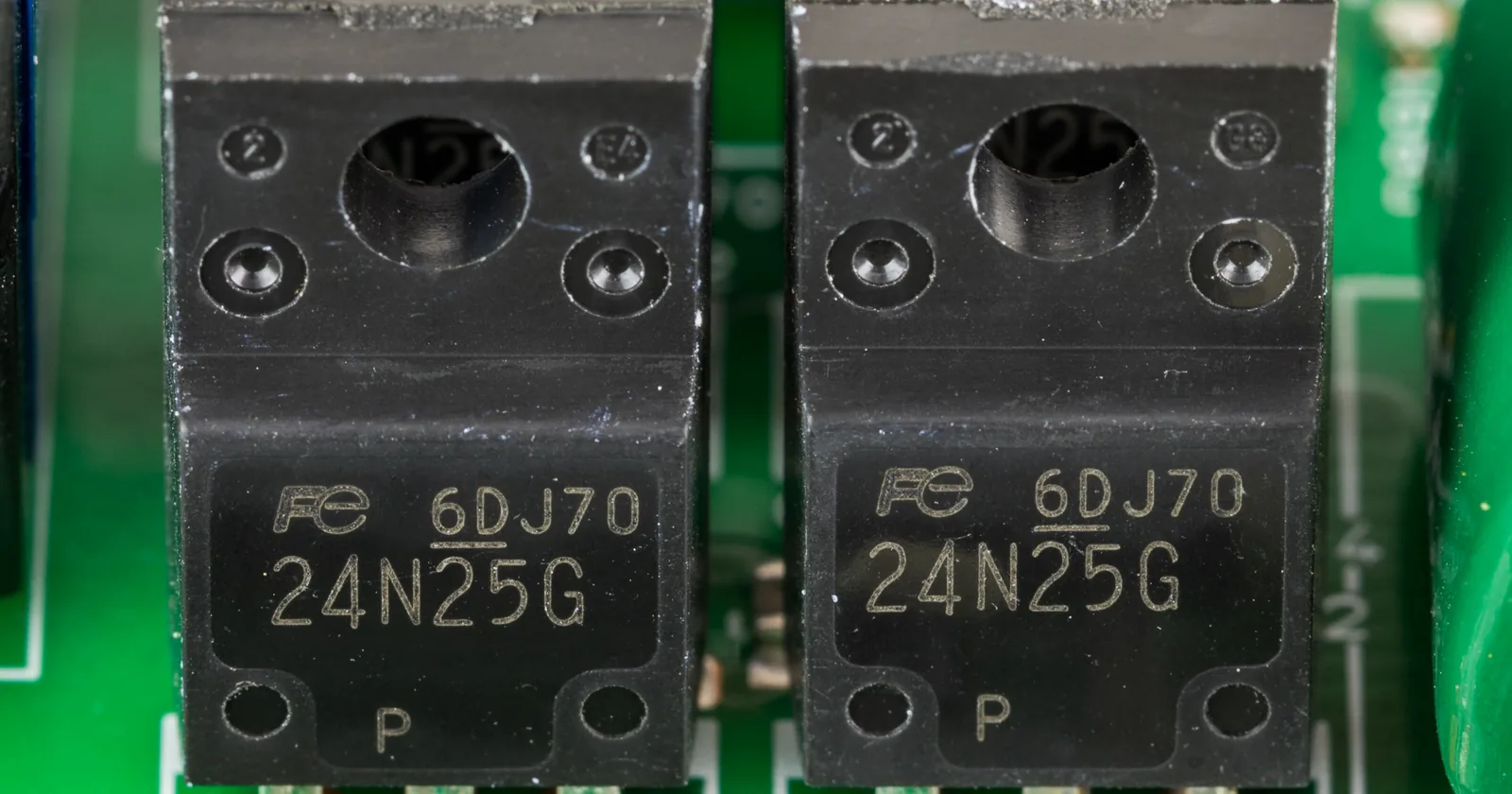
Most power electronics engineers reach for N-channel MOSFETs by default. The reason is physics: electrons move through silicon about 2.5x faster than holes. But the decision is about topology: where the switch sits, what voltage the gate sees, and how much heat the PCB can dissipate.
The physics gap, with real numbers
Electron mobility in silicon: ~1400 cm²/V·s. Hole mobility: ~450 cm²/V·s. Result: an N-channel MOSFET with a given die area has roughly half the RDS(on) of its P-channel equivalent. To match the on-resistance, a P-channel FET needs about twice the silicon: twice the gate charge, twice the cost, or both.
Real parts: the N-channel SI2318DS (Vishay, 30 V) delivers 28 mΩ RDS(on) at V_GS = 10 V in SOT-23. The comparable P-channel SI2301DS hits 110 mΩ in the same package. Same voltage, same footprint, nearly 4x worse on-resistance.
Gate drive: topology dictates complexity
Low-side, N-channel: Source at ground. A 5 V or 10 V logic signal drives the gate directly. No charge pump, no bootstrap, no level shifting. This is the default for good reason.
High-side, N-channel: Source floats at the load voltage. The gate must sit ~10 V above the positive rail to turn on. That needs a bootstrap circuit for switching applications or a charge pump for static DC. Bootstrap ICs like the IR2110 handle this with an external diode and capacitor.
High-side, P-channel: Source at the rail. Pull the gate low to turn on. No bootstrap needed. For rails under 20 V, an open-drain GPIO and a pull-up resistor often suffice. Two components (P-channel FET + NPN pull-down transistor) give you a high-side load switch with zero gate driver overhead.
Switching speed and frequency
N-channel FETs switch faster because lower Q_g charges through the gate resistor faster. In a 500 kHz synchronous buck converter, both high-side and low-side are N-channel. The gate drive complexity is worth the efficiency.
P-channel makes sense in static or low-frequency circuits: load switches, reverse-polarity protection, inrush limiters. When switching losses are negligible, simpler gate drive outweighs higher RDS(on).
Comparison table
| Parameter | N-Channel | P-Channel |
|---|---|---|
| Charge carrier | Electrons | Holes |
| Relative mobility | ~2.5x higher | 1x (reference) |
| RDS(on), same die area | Lower (half or better) | Higher |
| Cost for same RDS(on) | Lower | Higher |
| RDS(on) range, 30 V parts | 1-200 mΩ | 10-500 mΩ |
| Gate drive, low-side | V_GS = 5 V to GND | V_GS = -5 V to GND |
| Gate drive, high-side | Bootstrap/charge pump | Pull gate low (simple) |
| Switching speed | Faster | Slower |
| Best use | Converters, low-side switches | Load switches <20 V, reverse protection |
| V_GS(max) typical | ±20 V | ±20 V |
Circuit by circuit
- Synchronous buck converter: Two N-channel FETs, bootstrap high-side driver. No P-channel alternative above 2-3 A. Load switch (12 V, 5 A): P-channel with gate pull-down. 20-40 mΩ RDS(on) gives 1-2 W dissipation with reasonable copper.
- Motor H-bridge (24 V, 10 A): All N-channel, four FETs, bootstrap on the high side.
- Reverse-polarity protection: P-channel in series with positive rail. Gate pulled low through a resistor. Body diode blocks reverse voltage.
- Battery-powered (<5 V): N-channel low-side for switching, P-channel for power-path management.
FAQ
Can a P-channel MOSFET handle high current?
Above 5 A, the RDS(on) gap means either high conduction losses or an expensive oversized part. Bootstrap-driven N-channel is the standard in power conversion for a reason.
Why does ±20 V on the gate destroy a MOSFET?
The gate oxide is tens of nanometers thick. Above ~20 V, the electric field punches through it, shorting gate to channel permanently.
What is a logic-level MOSFET?
A FET with V_GS(th) low enough that 3.3 V or 5 V logic drives it fully on. Look for RDS(on) specified at V_GS = 4.5 V or 2.5 V, not just 10 V.
Is GaN replacing silicon MOSFETs?
In niches: GaN HEMTs switch faster with zero reverse recovery charge. For 1 MHz+ DC-DC converters, the advantage is real. For designs under 500 kHz, silicon MOSFETs are cheaper, more available, and better understood.
Match the MOSFET to the topology
N-channel vs P-channel comes down to where the switch sits and what drive circuit you accept building. Low-side: N-channel, always. High-side under 20 V: P-channel for simplicity. Everything else: N-channel with a bootstrap driver.
Browse Novapart's MOSFET catalog with parametric search by RDS(on), V_DS, V_GS(th), and package. Need a specific part number at volume? Submit an RFQ with your target price.
Suggested internal links:
- /en/categories/semiconductors/mosfets/: full MOSFET category with parametric search
- /en/categories/semiconductors/gate-drivers/: gate driver ICs for high-side drive
- /en/manufacturers/vishay/: Vishay MOSFETs (referenced above)
Need help sourcing electronic components for your next project?
Get a quote