
Ceramic vs Electrolytic Capacitors: When to Use Each Type on Your PCB
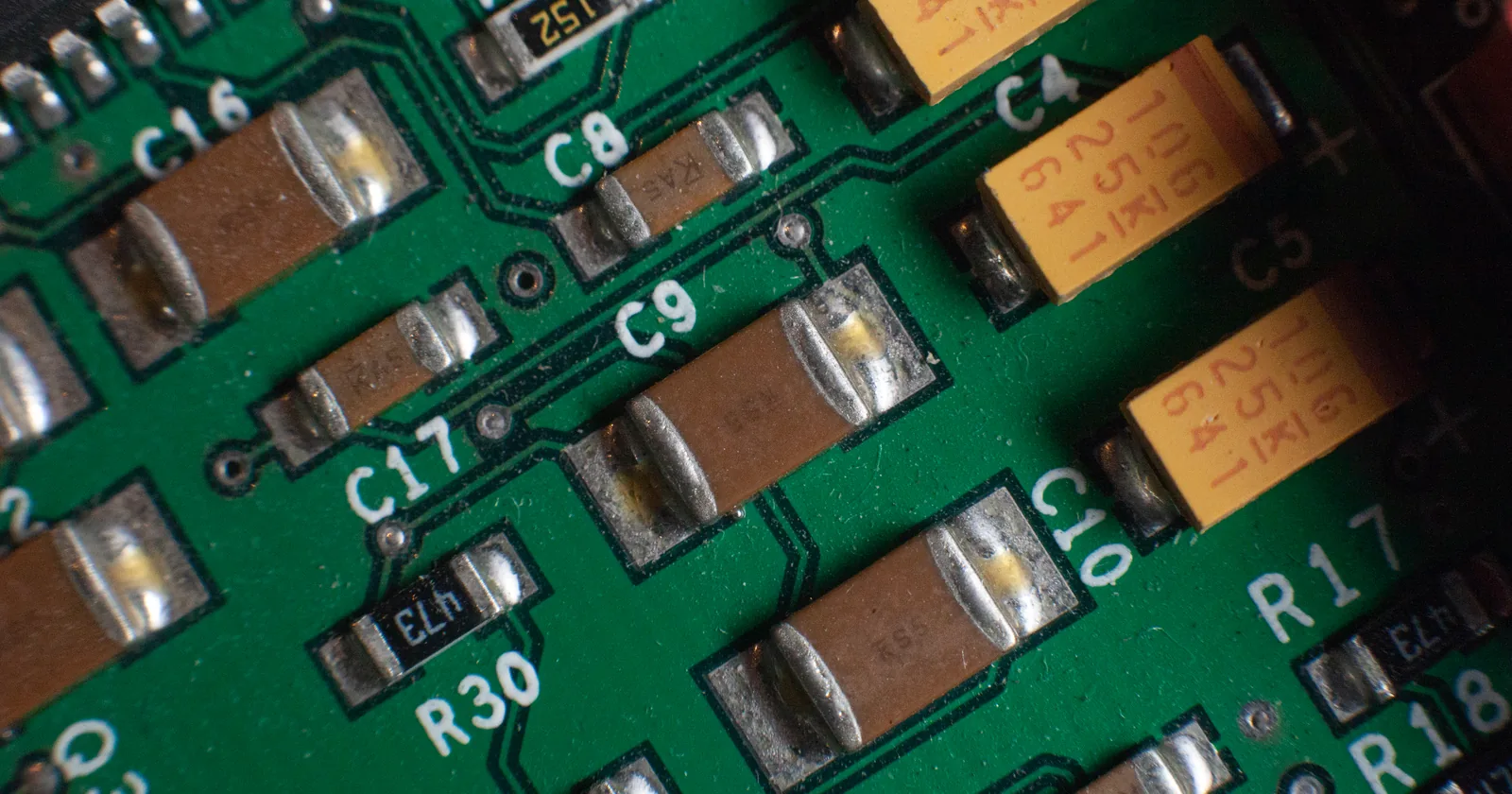
Pick the wrong capacitor and your voltage rail oscillates. Pick the right one and the board runs quiet for a decade. The choice between ceramic (MLCC) and aluminum electrolytic capacitors comes up in nearly every power delivery design. Each type dominates a different corner of the capacitance/voltage/frequency triangle.
How they differ, structurally
MLCCs sandwich alternating layers of barium titanate dielectric and metal electrodes into a monolithic chip. Class II dielectrics (X7R, X5R) pack high capacitance per volume but shift with temperature and DC bias. Class I (C0G/NP0) uses calcium zirconate, stable but low density.
Aluminum electrolytics wrap etched anode foil, electrolyte-soaked paper, and cathode foil into a cylinder. The etched surface area combined with a thin Al₂O₃ dielectric fits 1000 µF into a 10 mm can. That construction also gives electrolytics their polarity, their ESR, and their finite lifetime.
When ceramics win
For decoupling, MLCCs are hard to beat. A 0402 0.1 µF X7R placed within a few millimeters of an IC pin gives single-digit milliohm ESR at the 10-100 MHz frequencies where digital logic pulls current spikes. Cost: under a cent at volume.
Ceramics also handle input ripple current well. A handful of 10 µF X7R caps in parallel on a buck converter input beats a single electrolytic on ESL and lifetime, but account for DC bias derating. At 12 V DC, a 10 µF 25 V X7R in 0805 might deliver only 2-3 µF. Check the manufacturer's bias curve.
When electrolytics win
For bulk capacitance at low cost, electrolytics dominate. A 470 µF 35 V aluminum part in a 10 mm can costs about the same as one 10 µF MLCC in 1206. For regulator output caps and holdup energy, that density wins.
Electrolytics age predictably: every 10°C rise in core temperature roughly halves lifetime. A 105°C-rated part at 65°C ambient with low ripple might last 15 years. At 95°C, roughly three. Polymer electrolytics (OS-CON style) eliminate the dry-out failure mode at a price premium.
Head-to-head comparison
| Parameter | MLCC (X7R) | MLCC (C0G/NP0) | Aluminum Electrolytic |
|---|---|---|---|
| Capacitance range | 1 pF to 100 µF | 1 pF to 0.1 µF | 0.1 µF to 100,000 µF |
| Voltage range | 4 V to 3 kV | 10 V to 3 kV | 4 V to 500 V |
| ESR at 100 kHz | 1-50 mΩ | < 10 mΩ | 50 mΩ to 2 Ω |
| DC bias derating | Severe (Class II) | None | None |
| Temp coefficient | ±15% (-55 to +125°C) | ±30 ppm/°C | ±20% (-40 to +105°C) |
| Polarity | No | No | Yes |
| Aging mechanism | Capacitance loss under bias | Negligible | Electrolyte dry-out |
| Lifetime at rated temp | Decades | Decades | 1,000-10,000 h |
| Package | SMD (0201 to 2220) | SMD | Radial, axial, SMD can |
| Cost per µF (relative) | High | Very high | Low |
Application decision tree
Decoupling (1-100 MHz): MLCC, 0.1 µF + 10 µF parallel, X7R, at the pin. - Bulk filtering (120 Hz mains): Aluminum electrolytic, rated for ripple current, derated to 80% voltage. - Precision analog: C0G/NP0 MLCC: zero voltage coefficient, zero aging. - High temperature (>105°C): X7R/X8R MLCC or polymer electrolytic. - Audio coupling: Bipolar electrolytic or film. Low leakage, not low ESR.
FAQ
Do ceramic capacitors need voltage derating?
Class II dielectrics (X5R, X7R, X8R, Y5V, Z5U) do. Effective capacitance can drop to 20% of rated value at full rated voltage. Check the manufacturer's DC bias curve. C0G/NP0 parts do not derate.
Can I replace an electrolytic with a ceramic of the same value?
Carefully. The much lower ESR can destabilize an LDO designed for a high-ESR output cap. Some LDOs require 0.1-1 Ω minimum ESR for phase margin. Check before swapping.
Why do electrolytics have a shorter lifetime?
The liquid electrolyte evaporates through the seal; the rate doubles roughly every 10°C. End-of-life is typically 20-30% capacitance loss or 2-3x ESR increase. Polymer types do not dry out.
What about MLCC cracking?
MLCCs are brittle. Thermal shock and board flex crack the dielectric, often causing shorts. Use soft-termination MLCCs for mechanically stressed boards and keep large caps away from edges and mounting holes.
The right cap for the job
Most boards use both: bulk electrolytics on the input, ceramics on the output and at every IC pin. The skill is knowing where each type stops working.
Browse Novapart's capacitor catalog with parametric filters for capacitance, voltage, dielectric, and package. Need a part not in stock? Request a quote with your target specs.
Suggested internal links:
- /en/categories/passive-components/capacitors/ceramic-capacitors/: ceramic capacitor category
- /en/categories/passive-components/capacitors/aluminum-electrolytic-capacitors/: electrolytic capacitor category
- /en/categories/passive-components/resistors/: related passive components
Need help sourcing electronic components for your next project?
Get a quote