
AC/DC Power Supply Selection Guide: Sizing Power, Ripple, and Topology
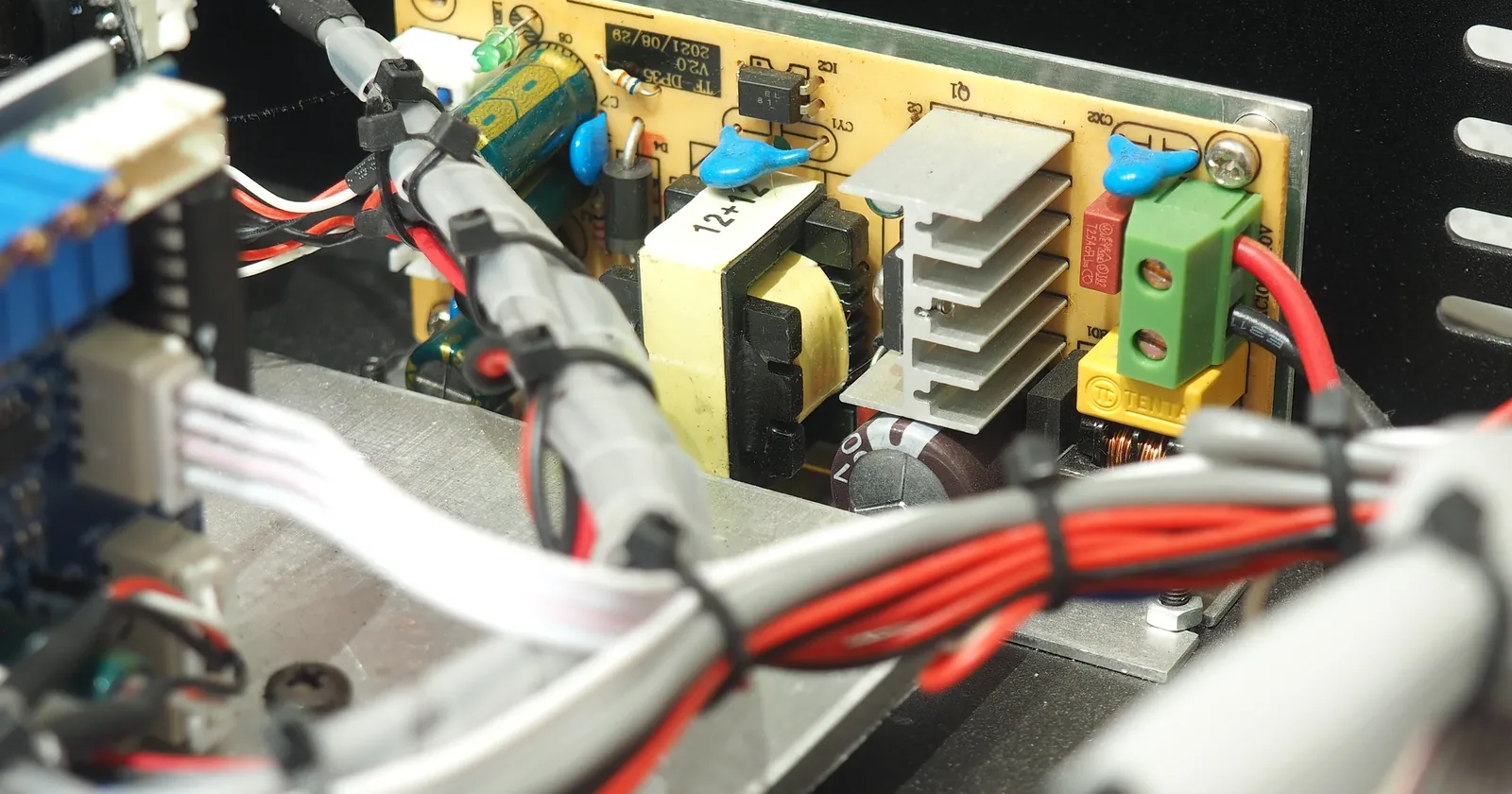
Selecting the wrong AC/DC power supply can cook your PCB, inject noise into sensitive analog front-ends, or force a late-stage respin when you realize the 65 W brick doesn't leave enough headroom at 70 °C ambient. This guide walks through the three decisions that matter most: wattage sizing, ripple tolerance, and topology, with real numbers and packaging codes you can spec directly into a BOM.
How to Size Power: Wattage with Derating
Step 1: Sum your DC rail loads
Add the maximum continuous draw of every rail in your design. Don't use "typical". Use worst-case:
| Rail | Voltage | Max Current | Power |
|---|---|---|---|
| 3.3 V digital | 3.3 V | 1.2 A | 3.96 W |
| 5.0 V analog | 5.0 V | 0.8 A | 4.00 W |
| 12 V fan | 12.0 V | 0.25 A | 3.00 W |
| ±15 V op-amp | 30.0 V | 0.10 A | 3.00 W |
| Total DC load | N/A | N/A | 13.96 W |
Step 2: Apply efficiency loss
The AC/DC converter itself burns power. A typical enclosed switching supply runs 85–90 % efficient at 50–100 % load. So:
Input power needed = DC load ÷ efficiency
                  = 13.96 W ÷ 0.85
                  = 16.42 W
Step 3: Derate for temperature and altitude
Every power supply datasheet includes a derating curve. A Mean Well LRS-35-12 rated at 35 W at 25 °C might deliver only 24 W at 60 °C (roughly 2 % derating per °C above 50 °C). Above 2000 m altitude, thin air reduces convection cooling. Count on another 5–10 % derating per 1000 m.
Practical rule: take your calculated DC load, divide by 0.80 (efficiency), then multiply by 1.25 (headroom). For 13.96 W:
Recommendation = 13.96 ÷ 0.80 × 1.25 ≈ 21.8 W → spec a 25 W supply minimum.
Ripple & Noise: What the Datasheet Numbers Mean
Ripple (periodic, switching-frequency noise) and noise (random, high-frequency spikes) appear on datasheets as a single peak-to-peak figure, typically 50–150 mVpp for a switching supply, under 5 mVpp for a well-designed linear unit.
What each rail can tolerate:
- Digital 3.3 V / 5 V logic: 50–100 mVpp is usually fine. Add a 10 µF MLCC + 100 nF per IC.
- Analog 5 V reference / ADC front-end: aim for < 10 mVpp. You'll likely need an LDO post-regulator (e.g., TPS7A47, 4.17 µVrms noise) after the switcher.
- RF / PLL / VCO rails: < 1 mVpp. Use a linear supply or cascaded LDO with high PSRR above 100 kHz.
If your ADC is 16-bit at 3.3 V reference, one LSB equals 50 µV. A 50 mVpp ripple on the 3.3 V rail equals 1000 LSBs of noise, unusable without cleanup.
Linear vs Switching: Pick Your Topology
| Criterion | Linear (e.g., LM317-based) | Switching (e.g., flyback, LLC resonant) |
|---|---|---|
| Efficiency | 30–60 % (drops hard at high Vin/Vout ratio) | 80–95 % |
| Ripple | < 5 mVpp | 50–150 mVpp (open-frame); < 20 mVpp with good filtering |
| EMI | Very low | Requires input filter + shielding (EN 55032 Class B) |
| Size for 50 W | Large, heavy 50/60 Hz toroidal transformer | Compact, high-frequency magnetics (TDK PC47 ferrite) |
| Cost at 25 W | Low (< $15 BOM) | Moderate ($12–$25 OEM) |
| Best for | Audio preamps, precision sensors, bench supplies | Embedded systems, motor drives, LED lighting, anything > 10 W |
When to choose linear: your load is under 10 W, and ripple spec is < 5 mVpp. A Triad Magnetics WAU series transformer plus an LM317 with a capacitance multiplier can get you there for under $15 BOM.
When to choose switching: anything above 15 W, any application where heat and size matter, or any design deployed in a sealed enclosure. A Mean Well IRM-30-12 (30 W, PCB-mount, 85 × 55 × 25 mm) covers most embedded Linux projects with room to spare.
Form-factor cheat sheet
| Type | Typical power range | Package example |
|---|---|---|
| PCB-mount open-frame | 3–60 W | Mean Well IRM / EPS series |
| Enclosed with screw terminals | 15–500 W | Mean Well LRS / RSP series |
| DIN-rail | 10–960 W | TDK-Lambda DRF / Mean Well HDR |
| External brick (desktop adapter) | 5–150 W | CUI Inc. SMI / SDI series |
FAQ
Q: Can I run two switching supplies in parallel for more current? Not directly, unless the supply supports active current sharing (check for a "P" terminal or datasheet note on paralleling). Most small enclosed supplies do not. If you need 10 A at 12 V from two 5 A units, add OR-ing Schottky diodes (STPS20H100CT, 100 V, 2 × 10 A) on each output to prevent one supply back-feeding the other.
Q: What's the difference between Class I and Class II AC/DC supplies? Class I requires a protective-earth connection (3-prong IEC C14 inlet). Class II is double-insulated and uses a 2-prong C8 or fixed cord, common in medical and consumer gear. Class II has stricter creepage/clearance requirements (IEC 62368-1) but saves you a ground wire.
Q: How much inrush current should I expect? At 230 VAC, a 150 W supply can pull 30–60 A inrush for < 1 ms. This is from the bulk capacitor charging through the bridge rectifier. If your circuit breaker is Type B (3–5× rated current magnetic trip), a 30 A inrush on a 10 A breaker is fine. If you're stacking three supplies, add an NTC thermistor (e.g., Amphenol CL-30, 2.5 Ω cold) to limit inrush.
Q: Do I need power-factor correction (PFC)? In the EU, EN 61000-3-2 requires PFC for loads above 75 W. Below that, passive PFC (a large input choke) or no PFC is acceptable. If your product ships globally, spec an active PFC supply for anything above 60 W; it simplifies compliance and works from 90–264 VAC without a range switch.
Next Step: Browse AC/DC Power Supplies by Wattage and Voltage
Choosing the right supply starts with knowing what's available. Browse Novapart's AC/DC power supply category and filter by wattage, output voltage, and form factor. Need something specific: medical-grade, DIN-rail, or ultra-low ripple? Request a quote with your target specs and our sourcing team will find the right part.
Internal links: Mean Well manufacturer page, TDK-Lambda manufacturer page, Browse all power supplies
Need help sourcing electronic components for your next project?
Get a quote