
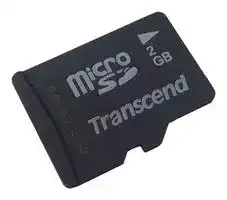
Image not available
Illustrative purposes only

TS2GUSDC
Flash Memory Card, MicroSD Card, 2 GB
⚠️ Reference pricing provided. In case of supply shortages, we will connect you with our trusted procurement partners to ensure your project's continuity.
- Manufacturer: TRANSCEND
- Product type: Flash Memory Cards
- Blank Media Flash Memory Type:MicroSD Card; Memory Capacity:2GB; Product Range:MicroSD Card Series; SVHC:No SVHC (15-Jan-2018); Memory Type:Flash; Module Interface:Serial
- SVHC: No SVHC (14-Jun-2023)
- App Rating: -
- UHS Standard: -
- Product Range: -
- Memory Capacity: 2GB
- Video Speed Class: -
- Supply Voltage Nom: -
- Standard Speed Class: -
- Flash Memory Card Type: MicroSD Card
- Operating Temperature Max: 85°C
- Operating Temperature Min: -25°C
| Delivery and price | |
|---|---|
| Units per pack | 1 |
| Price | 89.61 € |
| Current stock | 200+ |
| Lead time | 30 days |
Datasheet

## Description

Transcend microSD card series are non-volatile, which means no external power is required to retain the information stored on it. Besides, it is also a solid-state device that without moving parts to skip or break down. Based on original NAND flash chip, Transcend microSD can offer an incredible combination of fast data transfer, great flexibility, excellent security and incredibly small size.

## Features

- ROHS compliant product.

- Operating Voltage: 2.7 ~ 3.6V

- Operating Temperature: -25 ~ 85°C

- Durability: 10,000 insertion/removal cycles

- Fully compatible with SD card spec. v1.1

- Comply with SD Association File System Specification

- Mechanical Write Protection Switch with microSD adapter

- SD Host allows MultiMediaCard upward compatibility

- Form Factor: 11mm x 15mm x 1mm

## Placement 1 2 3 4 5 6 7 8

Front                               Back

Pin Definition

|SD Mode<br>SPI Mode<br>Pin No.<br>Name<br>Type<br>Description<br>Name<br>Type<br>Description<br>1<br>DAT2<br>I/O/PP<br>Data Line [Bit2]<br>RSV<br>Reserved<br>2<br>CD/DAT3<br>I/O/PP<br>Card Detect / Data Line [Bit3]<br>CS<br>I<br>Chip Select<br>3<br>CMD<br>PP<br>Command / Response<br>DI<br>I<br>Data In<br>4<br>VDD<br>S<br>Supply voltage<br>VDD<br>S<br>Supply voltage<br>5<br>CLK<br>I<br>Clock<br>SCLK<br>I<br>Clock<br>6<br>VSS<br>S<br>Supply voltage ground<br>VSS<br>S<br>Supply voltage ground<br>7<br>DAT0<br>I/O/PP<br>Data Line [Bit0]<br>DO<br>O/PP<br>Data out<br>8<br>DAT1<br>I/O/PP<br>Data Line [Bit1]<br>RSV<br>Reserved<br>~~a~~<br>~~Se~~<br>~~ee~~<br>~~ee ee eee eee~~<br>~~a a~~<br>~~ee~~<br>~~a a ee~~<br>~~a~~<br>~~ee ee ee~~<br>~~ee~~<br>~~ee ee eee~~<br>~~a a~~<br>~~ee~~<br>~~a a~~<br>~~ee~~<br>~~aee~~<br>~~ee~~|
|---|


S: Power Supply; I:Input; O:Output; PP:Push-Pull

**microSD Memory Card**

## Architecture

Transcend Information Inc.

2

**microSD Memory Card**

## Bus Operating Conditions

## **• General**

|Parameter|Symbol|Min.|Max.|Unit|Remark|
|---|---|---|---|---|---|
|Peak voltage on all lines||-0.3|VDD+0.3|V||
|All Inputs||||||
|Input Leakage Current||-10|10|µA||
|All Outputs||||||
|Output Leakage Current||-10|10|µA||


## **• Power Supply Voltage**

|Parameter|Symbol|Min.|Max.|Unit|Remark|
|---|---|---|---|---|---|
|Supply voltage|VDD|2.0|3.6|V|CMD0, 15,55,ACMD41|
||||||commands|
|Supply voltage specified in OCR register|||||Except CMD0, 15,55,|
||||||ACMD41 commands|
|Supplyvoltage differentials(VSS1,VSS2)||-0.3|0.3|V||
|Power uptime|||250|ms|From 0v to VDD Min.|


Note. The current consumption of any card during the power-up procedure must not exceed 10 mA.

## **• Bus Signal Line Load**

The total capacitance CL the CLK line of the SD Memory Card bus is the sum of the bus master capacitance CHOST, the bus capacitance CBUS itself and the capacitance CCARD of each card connected to this line: CL = CHOST + CBUS + Ν*CCARD

Where N is the number of connected cards. Requiring the sum of the host and bus capacitances not to exceed 30 pF for up to 10 cards, and 40 pF for up to 30 cards, the following values must not be exceeded:

|Parameter|Symbol|Min.|Max.|Unit|Remark|
|---|---|---|---|---|---|
|Bus signal line capacitance|CL||100|pF|fPP ≤20 MHz,7 cards|
|Single card capacitance|CCARD||10|pF||
|Maximum signal line inductance|||16|nH|fPP ≤20 MHz|
|Pull-up resistance inside card (pin1)|RDAT3|10|90|KΩ|May be used for card|
||||||detection|


Note that the total capacitance of CMD and DAT lines will be consist of CHOST, CBUS and one CCARD only since they are connected separately to the SD Memory Card host.

|Parameter|Symbol|Min.|Max.|Unit|Remark|
|---|---|---|---|---|---|
|Pull-upresistance|RCMD,RDAT|10|100|KΩ|Toprevent bus floating|
|Bus signal line capacitance|CL||250|pF|fPP ≤5 MHz,21 cards|


Transcend Information Inc.

3

**microSD Memory Card**

## **• Bus Signal Levels**

As the bus can be supplied with a variable supply voltage, all signal levels are related to the supply voltage.

To meet the requirements of the JEDEC specification JESD8-1A, the card input and output voltages shall be within the following specified ranges for any VDD of the allowed voltage range:

|Parameter|Symbol|Min.|Max.|Unit|Remark|
|---|---|---|---|---|---|
|Output HIGH voltage|VOH|0.75*VDD||V|IOH= -100μA@VDDmin|
|Output LOW voltage|VOL||0.125*VDD|V|IOL= 100μA@VDDmin|
|Input HIGH voltage|VIH|0.625*VDD|VDD+ 0.3|V||
|Input LOW voltage|VIL|VSS– 0.3|0.25*VDD|V||


Transcend Information Inc.

4

**microSD Memory Card**

## **• Bus Timing (Default)**

|Parameter<br>Symbol<br>Min<br>Max.<br>Unit<br>Remark<br>Clock CLK (All values are referred to min (VIH) and max (VIL)<br>~~rn~~<br>~~(rrr rr~~<br>~~rr ( (~~<br>~~|~~|
|---|
|Clock frequency Data Transfer Mode<br>fPP<br>0<br>25<br>MHz<br>CL ≤100 pF, (7 cards)|
|Clock frequency Identification Mode<br>fOD<br>0<br>400<br>KHz<br>CL ≤250 pF, (21 cards)|
|(The low freq. is required for MultiMediaCard|
|compatibility.)<br>tWL<br>10<br>ns<br>CL ≤100 pF, (7 cards)<br>Clock low time<br>50<br>ns<br>CL ≤250 pF, (21 cards)<br>tWH<br>10<br>ns<br>CL ≤100 pF, (7 cards)<br>Clock high time<br>50<br>ns<br>CL ≤250 pF, (21 cards)<br>tTLH<br>10<br>ns<br>CL ≤100 pF, (7 cards)<br>Clock rise time<br>50<br>ns<br>CL ≤250 pF, (21 cards)<br>tTHL<br>10<br>ns<br>CL ≤100 pF, (7 cards)<br>Clock fall time<br>50<br>ns<br>CL ≤250 pF, (21 cards)<br>Inputs CMD, DAT (referenced to CLK)<br>Input set-up time<br>tISU<br>5<br>ns<br>CL ≤25 pF, (1 cards)<br>Input hold time<br>tIH<br>5<br>ns<br>CL ≤25 pF, (1 cards)<br>Outputs CMD, DAT (referenced to CLK)<br>Output Delay time<br>tODLY<br>0<br>14<br>ns<br>CL ≤25 pF, (1 cards)<br>~~ee _—_—————~~<br>~~ee ee ee ee~~<br>~~ee _—_—————~~<br>~~ee ee ee ee~~<br>~~ee _—_—————~~<br>~~**ee** ~~~~**e**e ee ~~~~**ee**~~<br>~~ee _—_—————~~<br>~~e~~<br>~~|~~<br>~~rs~~<br>~~rts~~<br>~~rs~~<br>~~rd rs~~<br>~~rs~~<br>~~ers ers rs~~<br>~~|~~<br>~~rr~~<br>~~rte~~<br>~~rsOsee~~|


Transcend Information Inc.

5

**microSD Memory Card**

## **• Bus Timing (High-speed Mode)**

|Parameter<br>Symbol<br>Min<br>Max.<br>Unit<br>Remark<br>Clock CLK (All values are referred to min (VIH) and max (VIL)<br>~~PO~~<br>~~|~~|
|---|
|Clock frequency Data Transfer Mode<br>fPP<br>0<br>50<br>MHz<br>CCARD ≤10 pF, (1 card)<br>Clock low time<br>tWL<br>7<br>ns<br>CCARD ≤10 pF, (1 card)<br>Clock high time<br>tWH<br>7<br>ns<br>CCARD ≤10 pF, (1 card)<br>Clock rise time<br>tTLH<br>3<br>ns<br>CCARD ≤10 pF, (1 card)<br>~~Ge~~<br>~~ee~~<br>~~Ge~~<br>~~GC OO~~<br>~~es~~|
|Clock fall time<br>tTHL<br>3<br>ns<br>CCARD ≤10 pF, (1 card)<br>~~pe~~|
|Inputs CMD, DAT (referenced to CLK)<br>Input set-up time<br>tISU<br>6<br>ns<br>CCARD ≤10 pF, (1 card)<br>Input hold time<br>tIH<br>2<br>ns<br>CCARD ≤10 pF, (1 card)<br>Outputs CMD, DAT (referenced to CLK)<br>Output Delay time during Data Transfer Mode<br>tODLY<br>14<br>ns<br>CL ≤40 pF, (1 card)<br>Output Hold time<br>tOH<br>2.5<br>ns<br>CL ≤40 pF, (1 card)<br>Total System capacitance for each line1<br>CL<br>40<br>pF<br>(1 card)<br>1) In order to satisfy severe timing, host shall drive only one card.<br>~~|~~<br>~~posD~~<br>~~GD~~<br>~~Cnrs~~<br>~~ss~~<br>~~Ge~~<br>~~GG~~<br>~~QO GO~~<br>~~rs~~<br>~~Gs~~|


Transcend Information Inc.

6

**microSD Memory Card**

## Reliability and Durability

|Reliability and Durability|Reliability and Durability|
|---|---|
|Temperature|Operation: -25°C / 85°C (Target spec)|
||Storage: -40°C (168h) / 85°C (500h)|
||Junction temperature: max. 95°C|
|Moisture and corrosion|Operation: 25°C / 95% rel. humidity|
||Storage: 40°C / 93% rel. hum./500h|
||Salt Water Spray: 3% NaCl/35C;24h acc. MIL STD Method 1009|
|Durability|10000 matingcycles|
|Bending|10N|
|Torque|0.10N*m,+/- 2.5degmax|
|Droptest|1.5m free fall|
|UV light exposure|UV: 254nm,15Ws/cm² accordingto ISO 7816-1|
|Visual inspection|No warppage; no mold skin; complete form; no cavities surface smoothness <= -0.1|
|Shape and form|mm/cm² within contour;no cracks;nopollution(fat,oil dust,etc.)|


Above technical information is based on standard data and tested to be reliable. However, Transcend makes no warranty, either expressed or implied, as to its accuracy and assumes no liability in connection with the use of this product. Transcend reserves the right to make changes in specifications at any time without prior notice.

Transcend Information Inc.

7

**microSD Memory Card**

## Register Information

Within the card interface six registers are defined: OCR, CID, CSD, RCA, DSR and SCR. These can be accessed only by corresponding commands (see Chapter 4.7). The OCR, CID, CSD and SCR registers carry the card/content specific information, while the RCA and DSR registers are configuration registers storing actual configuration parameters.

## **1. OCR register**

The 32-bit operation conditions register stores the V DD voltage profile of the card. In addition, this register includes a status information bit. This status bit is set if the card power up procedure has been finished. The OCR register shall be implemented by the cards which do not support the full operating voltage range of the SD Memory Card bus, or if the card power up extends the definition in the timing diagram.

A voltage range is not supported if the corresponding bit value is set to LOW. As long as the card is busy, the corresponding bit (31) is set to LOW.

Transcend Information Inc.

8

**microSD Memory Card**

## **2. CID Register**

The Card IDentification (CID) register is 128 bits wide. It contains the card identification information used during the card identification phase. Every individual flash card shall have a unique identification number. The structure of the CID register is defined in the following paragraphs:

## **• MID**

An 8 bit binary number that identifies the card manufacturer. The MID number is controlled, defined and allocated to a SD Memory Card manufacturer by the SD Group. This procedure is established to ensure uniqueness of the CID register.

## **• OID**

A 2 ASCII string characters that identifies the card OEM and/or the card contents (when used as a distribution media either on ROM or FLASH cards). The OID number is controlled, defined and allocated to a SD Memory Card manufacturer by the SD Group. This procedure is established to ensure uniqueness of the CID register.

## **• PNM**

The product name is a string, 5 ASCII characters long.

## **• PRV**

The product revision is composed of two Binary Coded Decimal (BCD) digits, four bits each, representing an “n.m” revision number. The “n” is the most significant nibble and “m” is the least significant nibble. As an example, the PRV binary value field for product revision “6.2” will be: 0110 0010

## **• PSN**

The Serial Number is 32 bits of binary number.

**• MDT**

Transcend Information Inc.

9

**microSD Memory Card**

The manufacturing date composed of two hexadecimal digits, one is 8 bit representing the year(y) and the other is four bits representing the month(m).

The “m” field [11:8] is the month code. 1 = January.

The “y” field [19:12] is the year code. 0 = 2000.

As an example, the binary value of the Date field for production date “April 2001” will be: 00000001 0100.

## **• CRC**

CRC7 checksum (7 bits).

## **3. CSD Register**

The Card-Specific Data register provides information on how to access the card contents. The CSD defines the data format, error correction type, maximum data access time, whether the DSR register can be used etc. The programmable part of the register (entries marked by W or E, see below) can be changed by CMD27. The type of the entries in the table below is coded as follows: R= readable, W(1) = writable once, W = multiple writable.

Transcend Information Inc.

10

## **microSD Memory Card**

The following sections describe the CSD fields and the relevant data types. If not explicitly defined otherwise, all bit strings are interpreted as binary coded numbers starting with the left bit first.

## **• CSD_STRUCTURE**

Version number of the related CSD structure.

## **• TAAC**

Defines the asynchronous part of the data access time.

Transcend Information Inc.

11

**microSD Memory Card**

## **• NSAC**

Defines the worst case for the clock dependent factor of the data access time. The unit for NSAC is100 clock cycles. Therefore, the maximal value for the clock dependent part of the data access time is 25.5k clock cycles.

The total access time NAC as expressed in the Table 34 is the sum of TAAC and NSAC. It has to be computed by the host for the actual clock rate. The read access time should be interpreted as a typical delay for the first data bit of a data block or stream.

## **• TRAN_SPEED**

The following table defines the maximum data transfer rate per one data line - TRAN_SPEED:

Note that for current SD Memory Cards that field must be always 0_0110_010b (032h) which is equal to 25MHz - the mandatory maximum operating frequency of SD Memory Card.

In High-Speed mode, that field must be always 0_1011_010b (05Ah) which is equal to 50MHz. And when the timing mode returns to the default by CMD6 or CMD0 command, its value will be 032h.

## **• CCC**

The SD Memory Card command set is divided into subsets (command classes). The card command class register CCC defines which command classes are supported by this card. A value of ‘1’ in a CCC bit means that the corresponding

Transcend Information Inc. 12

**microSD Memory Card**

command class is supported.

## **• READ_BL_LEN**

The maximum read data block length is computed as 2 READ_BL_LEN . The maximum block length might therefore be in the range 512...2048 bytes (see Chapter 4.11 for details). Note that in SD Memory Card the WRITE_BL_LEN is always equal to READ_BL_LEN

## **• READ_BL_PARTIAL (always = 1 in SD Memory Card)**

Partial Block Read is always allowed in SD Memory Card. It means that smaller blocks can be used as well. The minimum block size will be one byte.

## **• WRITE_BLK_MISALIGN**

Defines if the data block to be written by one command can be spread over more than one physical block of the memory device. The size of the memory block is defined in WRITE_BL_LEN.

WRITE_BLK_MISALIGN=0 signals that crossing physical block boundaries is invalid. WRITE_BLK_MISALIGN=1 signals that crossing physical block boundaries is allowed.

## **• READ_BLK_MISALIGN**

Defines if the data block to be read by one command can be spread over more than one physical block of the memory device. The size of the memory block is defined in READ_BL_LEN.

READ_BLK_MISALIGN=0 signals that crossing physical block boundaries is invalid. READ_BLK_MISALIGN=1 signals that crossing physical block boundaries is allowed.

## **• DSR_IMP**

Transcend Information Inc.

13

**microSD Memory Card**

Defines if the configurable driver stage is integrated on the card. If set, a driver stage register (DSR)must be implemented also.

## **• C_SIZE**

This parameter is used to compute the user’s data card capacity (not include the security protected area). The memory capacity of the card is computed from the entries C_SIZE, C_SIZE_MULT and READ_BL_LEN as follows:

memory capacity = BLOCKNR * BLOCK_LEN

where

BLOCKNR = (C_SIZE+1) * MULT MULT = 2 C_SIZE_MULT+2 (C_SIZE_MULT < 8) BLOCK_LEN = 2 READ_BL_LEN ,      (READ_BL_LEN < 12)

Maximum capacity of the card, compliant to SD Physical Specification Versoin1.01 shall be up to2G bytes (231 bytes) to be consistent with the maximum capacity (2G bytes) of SD Memory Card File System Specification Ver.1.01. To indicate 2GByte card, BLOCK_LEN shall be 1024 bytes.

Therefore, the maximal capacity which can be coded is 4096*512*1024 = 2G bytes.

Example: A 32Mbyte card with BLOCK_LEN = 512 can be coded by C_SIZE_MULT = 3 and C_SIZE = 2000.

## **• VDD_R_CURR_MIN, VDD_W_CURR_MIN**

The maximum values for read and write currents at the minimal power supply V DD are coded as follows:

## **• VDD_R_CURR_MAX, VDD_W_CURR_MAX**

The maximum values for read and write currents at the maximal power supply V DD are coded as follows:

## **• C_SIZE_MULT**

This parameter is used for coding a factor MULT for computing the total device size (see ‘C_SIZE’).

Transcend Information Inc. 14

**microSD Memory Card**

The factor MULT is defined as 2 C_SIZE_MULT+2 .

## **• ERASE_BLK_EN**

The ERASE_BLK_EN defines the granularity of the unit size of the data to be erased. The erase operation can erase either one or multiple units of WRITE_BL_LEN or one or multiple units (orsectors) of SECTOR_SIZE (see definition below).

If ERASE_BLK_EN = ’0’, the host can erase one or multiple units of SECTOR_SIZE. The erase will start from the beginning of the sector that contains the start address to the end of the sector that contains the end address. For example, if SECTOR_SIZE=31 and the host sets the Erase Start Address to 5 and the Erase End Address to 40.

If ERASE_BLK_EN = ’1’ the host can erase one or multiple units of 512 bytes. All blocks that contain data from start address to end address are erased. For example, if the host sets the Erase Start Address to 5 and the Erase End Address to 40.

## **• SECTOR_SIZE**

The size of an erasable sector. The contents of this register is a 7 bit binary coded value, defining the number of write

Transcend Information Inc. 15

**microSD Memory Card**

blocks (see WRITE_BL_LEN). The actual size is computed by increasing this number by one. A value of zero means 1 write block, 127 means 128 write blocks.

## **• WP_GRP_SIZE**

The size of a write protected group. The contents of this register is a 7 bit binary coded value, defining the number of erase sectors (see SECTOR_SIZE). The actual size is computed by increasing this number by one. A value of zero means 1 erase sector, 127 means 128 erase sectors.

## **• WP_GRP_ENABLE**

A value of ‘0’ means no group write protection possible.

## **• R2W_FACTOR**

Defines the typical block program time as a multiple of the read access time. The following table defines the field format.

## **• WRITE_BL_LEN**

The maximum write data block length is computed as 2 WRITE_BL_LEN . The maximum block lengthmight therefore be in the range from 512 up to 2048 bytes. Write Block Length of 512 bytes isalways supported. Note that in SD Memory Card the WRITE_BL_LEN is always equal to READ_BL_LEN.

Transcend Information Inc.

16

**microSD Memory Card**

## **• WRITE_BL_PARTIAL**

Defines whether partial block sizes can be used in block write commands.WRITE_BL_PARTIAL=’0’ means that only the WRITE_BL_LEN block size and its partial derivatives,in resolution of units of 512 bytes, can be used for block oriented data write.WRITE_BL_PARTIAL=’1’ means that smaller blocks can be used as well. The minimum block sizeis one byte.

## **• FILE_FORMAT_GRP**

Indicates the selected group of file formats. This field is read-only for ROM.

## **• COPY**

Defines if the contents is original (= ‘0’) or has been copied (=’1’). The COPY bit for OTP and MTPdevices, sold to end consumers, is set to ‘1’ which identifies the card contents as a copy. The COPY bit is an one time programmable bit.

## **• PERM_WRITE_PROTECT**

Permanently protects the whole card content against overwriting or erasing (all write and erase commands for this card are permanently disabled). The default value is ‘0’, i.e. not permanently write protected.

## **• TMP_WRITE_PROTECT**

Temporarily protects the whole card content from being overwritten or erased (all write and erase commands for this card are temporarily disabled). This bit can be set and reset. The default value is ‘0’, i.e. not write protected.

## **• FILE_FORMAT**

Indicates the file format on the card. This field is read-only for ROM. The following formats are defined:

## **• CRC**

The CRC field carries the check sum for the CSD contents.

The checksum has to be recalculated by the host for any CSD modification. The default corresponds to the initial CSD contents.

Transcend Information Inc. 17

**microSD Memory Card**

The following table lists the correspondence between the CSD entries and the command classes. A ‘+’ entry indicates that the CSD field affects the commands of the related command class.

Transcend Information Inc.

18

**microSD Memory Card**

## **4. RCA Register**

The writable 16-bit relative card address register carries the card address that is published by the card during the card identification. This address is used for the addressed host-card communication after the card identification procedure. The default value of the RCA register is 0x0000. The value0x0000 is reserved to set all cards into the _Stand-by State_ with CMD7.

## **5. DSR Register (Optional)**

The 16-bit driver stage register is described in detail in Chapter 6.5. It can be optionally used to improve the bus performance for extended operating conditions (depending on parameters like bus length, transfer rate or number of

Transcend Information Inc.

19

**microSD Memory Card**

cards). The CSD register carries the information about the DSR register usage. The default value of the DSR register is 0x404.

## **6. SCR Register**

In addition to the CSD register there is another configuration register that named - SD CARD Configuration Register (SCR). SCR provides information on SD Memory Card's special features that were configured into the given card. The size of SCR register is 64 bit. This register shall be set in the factory by the SD Memory Card manufacturer. The following table describes the SCR register content.

## **• SCR_STRUCTURE**

Version number of the related SCR structure in the SD Memory Card Physical Layer Specification.

## **• SD_SPEC**

Describes the SD Memory Card Physical Layer Specification version supported by this card.

Transcend Information Inc.

20

**microSD Memory Card**

## **• DATA_STAT_AFTER_ERASE**

Defines the data status after erase, whether it is ‘0’ or ‘1’ (the status is card vendor dependent).

## **• SD_SECURITY**

Describes the security algorithm supported by the card.

Security Protocol 1.0 relates to Security Specification Version 0.96. Security Protocol 2.0 relates to Security Specification Version 1.0.-1.01

Note that it is mandatory for a regular writable SD Memory Card to support Security Protocol. For ROM (Read Only) and OTP (One Time Programmable) type of SD Memory Card the security feature is optional

## **• SD_BUS_WIDTHS**

Describes all the DAT bus widths that are supported by this card.

Since SD Memory Card shall support at least the two bus modes 1bit or 4bit width then any SD Card shall set at least bits 0 and 2 (SD_BUS_WIDTH="0101").

Transcend Information Inc.

21

**microSD Memory Card**

## Mechanical Dimension

## **Mechanical Description: Top View**

Transcend Information Inc.

22

**microSD Memory Card**

## **Mechanical Description: Bottom View**

Transcend Information Inc.

23

**microSD Memory Card**

## **Mechanical Description: Keep Out Area**

Transcend Information Inc.

24

**microSD Memory Card**

## **microSD package: Dimensions**

Transcend Information Inc.

25
Updated at June 3, 2026
About Novapart
Novapart is a B2B electronic component broker specialising in stock shortages and cost reduction. We source hard-to-find parts and identify compliant alternatives across a catalogue of 410,000+ components from 500+ manufacturers.
Learn more →Stock Shortage Specialist
When a component is unavailable, discontinued or has an unacceptable lead time, we tap into our network of vetted European and Asian distributors to source what you need — without compromising on quality or traceability.
Request a quote →Compliant Alternatives
We identify pin-to-pin, electrically equivalent substitutes that meet the same certifications (RoHS, AEC-Q100, REACH) as your original specification — validated against datasheets, not just part numbers. Often at a lower cost.
BOM Analysis service →