
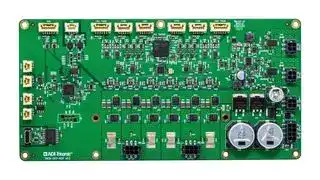


TMCM-2611-AGV
Controller Module, 2-Axis Servo Controller Driver, Brushless DC Motors, 3 Phase, 10 A, 20 to 28 V
- Manufacturer: ANALOG DEVICES
- Product type: Stepper Motor Drives
- SVHC: Lead (04-Feb-2026)
- Product Range: -
- Output Current Max: 10A
- Supply Voltage Max: 28V
- Supply Voltage Min: 20V
- Control / Drive Type: 2-Axis Servo Controller Driver Module
| Delivery and price | |
|---|---|
| Units per pack | 1 |
| Price | 914.37 € |
| Current stock | 10+ |
| Lead time | 30 days |

**MODULE**

**Module for BLDC**

## TMCM-2611-AGV Hardware Manual

HW Version V1.0 | 19-101832A, Rev 0 • 12/23

**The TMCM-2611-AGV is a dual axis servo drive platform for 3-phase BLDC motors running with up to 14ARMS at +48V. It offers RS485, CAN, and USB interfaces with TMCL™ protocol for communication. TMCM-2611-AGV supports various positions feedback options: incremental quadrature encoder and digital hall sensor.**

Features

- Servo Drive for BLDC Motors

- +24V System Supply

- +48V Motor Supply

- Up to 14ARMS Phase Current

- RS485, CAN and USB Interfaces

- Incremental Quadrature Encoder (ABN) Interfaces

- Digital Hall Sensor Interfaces

- STO Torque-Off Inputs (Not Certified)

- Motor Brakes

Applications

- Robotics

- Laboratory Automation

- Manufacturing

- Factory Automation

- Servo Drives

- Industrial Motor Drives

## Simplified Block Diagram

**==> picture [265 x 205] intentionally omitted <==**

**----- Start of picture text -----**<br>
STO1 STO2 +24V +48V<br>AGV Application Diagram<br>VS<br>(TMCL)RS485 MAX22500E HS<br>3-PHASE<br>CAN MAX13054A LTC7061 PMSM / BLDC<br>(TMCL) tet LS<br>HALL<br>USB Isolated USBADUM4160  Motion Control Core 2344LTC ENCODER<br>MCU 2x TMC4672 MAX49925<br>2x PWM  2x Pelican<br>CNTRL (FPGA)<br>Je [ =<br>MAX6324BUT MAX22215 BRAKE<br>(Watchdog/<br>Reset)<br>VS<br>HS<br>3-PHASE<br>LTC7061 PMSM / BLDC<br>Power Management<br>LS<br>HALL<br>LTC3638 MAX17644<br>(BUCK) (BUCK)<br>LTC ENCODER<br>2344<br>MAX38902 MAX20073 MAX49925<br>A ATBB<br>(LDO) (LDO)<br>MAX22215 BRAKE<br>**----- End of picture text -----**<br>


©2023 TRINAMIC Motion Control GmbH & Co. KG, Hamburg, Germany Terms of delivery and rights to technical change reserved. Download newest version at www.analog.com.

Read entire documentation.

TMCM-2611-AGV Hardware Manual • HW Version V1.0 | Rev 0 • 12/23

2/25

## **Contents**

|**1**|**Features**|**Features**||**4**|
|---|---|---|---|---|
|**2**|**Order Codes**|||**5**|
|**3**|**Connectors and Signals**|||**6**|
||3.1|Examples for Pin Numbering . . . . . . . . . . . . . . . . . . . . . . . . . . . . . . . . . . . . . .||8|
||3.2|System Logic Supply Connector. . . . . . . . . . . . . . . . . . . . . . . . . . . . . . . . . . . . .||8|
||3.3|Motor Supply Connector . . . . . . . . . . . . . . . . . . . . . . . . . . . . . . . . . . . . . . . . .||8|
||3.4|Motor Connectors<br>. .|. . . . . . . . . . . . . . . . . . . . . . . . . . . . . . . . . . . . . . . . . .|9|
||3.5|Brake Output Connectors . . . . . . . . . . . . . . . . . . . . . . . . . . . . . . . . . . . . . . . .||9|
||3.6|Incremental Encoder Connectors . . . . . . . . . . . . . . . . . . . . . . . . . . . . . . . . . . . .||9|
||3.7|Hall Sensor Connectors|. . . . . . . . . . . . . . . . . . . . . . . . . . . . . . . . . . . . . . . . .|9|
||3.8|Serial Encoder Connectors. . . . . . . . . . . . . . . . . . . . . . . . . . . . . . . . . . . . . . . .||10|
||3.9|Torque-Of Connector (STO) . . . . . . . . . . . . . . . . . . . . . . . . . . . . . . . . . . . . . . .||10|
||3.10|Digital GPIO Connector|. . . . . . . . . . . . . . . . . . . . . . . . . . . . . . . . . . . . . . . . . .|10|
||3.11|RS485 Interface Connectors . . . . . . . . . . . . . . . . . . . . . . . . . . . . . . . . . . . . . . .||10|
||3.12|CAN Interface Connectors . . . . . . . . . . . . . . . . . . . . . . . . . . . . . . . . . . . . . . . .||11|
|**4**|**Interface Circuits**|||**12**|
||4.1|Supply Connection and|Supply Bufering . . . . . . . . . . . . . . . . . . . . . . . . . . . . . . .|12|
||4.2|Brake Output<br>. . . . .|. . . . . . . . . . . . . . . . . . . . . . . . . . . . . . . . . . . . . . . . . .|12|
||4.3|Feedback Interfaces<br>.|. . . . . . . . . . . . . . . . . . . . . . . . . . . . . . . . . . . . . . . . . .|12|
|||4.3.1<br>Incremental Encoders . . . . . . . . . . . . . . . . . . . . . . . . . . . . . . . . . . . . .||12|
|||4.3.2<br>Digital Hall Sensors . . . . . . . . . . . . . . . . . . . . . . . . . . . . . . . . . . . . . . .||12|
||4.4|Torque-Of Interface (STO). . . . . . . . . . . . . . . . . . . . . . . . . . . . . . . . . . . . . . . .||12|
|**5**|**LED**|**Status Indicators**||**13**|
|**6**|**Communication**|||**14**|
||6.1|RS485 . . . . . . . . . .|. . . . . . . . . . . . . . . . . . . . . . . . . . . . . . . . . . . . . . . . . .|14|
||6.2|CAN . . . . . . . . . . .|. . . . . . . . . . . . . . . . . . . . . . . . . . . . . . . . . . . . . . . . . .|16|
|**7**|**Operational Ratings and Characteristics**|||**17**|
||7.1|Absolute Maximum Ratings . . . . . . . . . . . . . . . . . . . . . . . . . . . . . . . . . . . . . . .||17|
||7.2|Operational Ratings<br>.|. . . . . . . . . . . . . . . . . . . . . . . . . . . . . . . . . . . . . . . . . .|18|
|||7.2.1<br>System Supply|. . . . . . . . . . . . . . . . . . . . . . . . . . . . . . . . . . . . . . . . .|18|
|||7.2.2<br>Motor Supply|. . . . . . . . . . . . . . . . . . . . . . . . . . . . . . . . . . . . . . . . . .|18|
|||7.2.3<br>Motor . . . . .|. . . . . . . . . . . . . . . . . . . . . . . . . . . . . . . . . . . . . . . . . .|18|
|||7.2.4<br>Brake Output|. . . . . . . . . . . . . . . . . . . . . . . . . . . . . . . . . . . . . . . . . .|18|
|||7.2.5<br>STO . . . . . .|. . . . . . . . . . . . . . . . . . . . . . . . . . . . . . . . . . . . . . . . . .|18|
|||7.2.6<br>Incremental Encoder . . . . . . . . . . . . . . . . . . . . . . . . . . . . . . . . . . . . . .||19|
|||7.2.7<br>Hall Sensor<br>.|. . . . . . . . . . . . . . . . . . . . . . . . . . . . . . . . . . . . . . . . . .|19|
|||7.2.8<br>RS485. . . . .|. . . . . . . . . . . . . . . . . . . . . . . . . . . . . . . . . . . . . . . . . .|19|
|||7.2.9<br>CAN . . . . . .|. . . . . . . . . . . . . . . . . . . . . . . . . . . . . . . . . . . . . . . . . .|20|
|||7.2.10<br>USB . . . . . .|. . . . . . . . . . . . . . . . . . . . . . . . . . . . . . . . . . . . . . . . . .|20|
||7.3|Other Requirements .|. . . . . . . . . . . . . . . . . . . . . . . . . . . . . . . . . . . . . . . . . .|20|
|**8**|**Figures Index**|||**21**|
|**9**|**Tables Index**|||**22**|
|**10 **|**Supplemental Directives**|||**23**|
||10.1|Producer Information|. . . . . . . . . . . . . . . . . . . . . . . . . . . . . . . . . . . . . . . . . .|23|


**==> picture [96 x 41] intentionally omitted <==**

TMCM-2611-AGV Hardware Manual • HW Version V1.0 | Rev 0 • 12/23

3/25

|10.2|Copyright . . . . . . . . . . . . . . . . . . . . . . . . . . . . . . . . . . . . . . . . . . . . . . . . . . 23|
|---|---|
|10.3|Trademark Designations and Symbols. . . . . . . . . . . . . . . . . . . . . . . . . . . . . . . . . 23|
|10.4|Target User<br>. . . . . . . . . . . . . . . . . . . . . . . . . . . . . . . . . . . . . . . . . . . . . . . . 23|
|10.5|Disclaimer: Life Support Systems . . . . . . . . . . . . . . . . . . . . . . . . . . . . . . . . . . . . 23|
|10.6|Disclaimer: Intended Use<br>. . . . . . . . . . . . . . . . . . . . . . . . . . . . . . . . . . . . . . . . 23|
|10.7|Collateral Documents & Tools. . . . . . . . . . . . . . . . . . . . . . . . . . . . . . . . . . . . . . 24|


|**11 **|**Revision History**<br>**25**|
|---|---|
||11.1 Hardware Revision . . . . . . . . . . . . . . . . . . . . . . . . . . . . . . . . . . . . . . . . . . . . 25|
||11.2 Document Revision . . . . . . . . . . . . . . . . . . . . . . . . . . . . . . . . . . . . . . . . . . . . 25|


**==> picture [96 x 41] intentionally omitted <==**

TMCM-2611-AGV Hardware Manual • HW Version V1.0 | Rev 0 • 12/23

4/25

## **1 Features**

The TMCM-2611-AGV is a dual axis servo drive platform for 3-phase BLDC motors running with up to 14ARMS at +48V. It offers RS485, CAN, and USB interfaces with TMCL protocol for communication. TMCM2611-AGV supports various positions feedback options: incremental quadrature encoder and digital hall sensor.

## **Controller and Driver**

- System supply voltage: +24V DC nominal

- Motor supply voltage: +48V DC nominal

- Motor current: up to 10ARMS continuous, 14ARMS short time peak[1]

- Field oriented control (FOC) in hardware with up to 100kHz PWM and current control loop

- Support for BLDC motors

- Temperature rating: -30 °C to +60 °C

## **Position Feedback**

- Incremental quadrature encoder (ABN)

- Digital hall sensor

- +5V DC supply for external sensors

## **I/O and Communication Interfaces**

- RS485 interface (in and out) with on-board RS485 transceiver

- CAN interface (in and out) with on-board CAN transceiver

- Isolated USB interface

- Motor brake output

- STO torque-off inputs (not certified)

- Digital input

## **Mechanical data**

- Dimensions: 200mm x 100mm

- Weight: 117g (without mating connectors and cables)

- 7x M3 mounting holes

- 2x M3 mounting holes for heatsink

## **Software Options**

- TMCL™remote (direct mode) and standalone operation (memory for up to 1024 TMCL commands), fully supported by TMCL-IDE (PC based integrated development environment). Further information given in the TMCM-2611-AGV TMCL firmware manual.

> 1This is the maximum current rating. This is not for continuous operation but depends on motor type, duty cycle, ambient temperature, and active/passive cooling measures. TMCL is a trademark of Analog Devices, Inc.

**==> picture [96 x 41] intentionally omitted <==**

TMCM-2611-AGV Hardware Manual • HW Version V1.0 | Rev 0 • 12/23

5/25

## **2 Order Codes**

|Order Code|Description|Size|
|---|---|---|
|TMCM-2611-AGV|Dual<br>axis<br>servo<br>drive<br>module,<br>10A,<br>+24V/+48V supply, with TMCL frmware|200mm x 100mm|


_Table 1: TMCM-2611-AGV Order Codes_

**==> picture [96 x 41] intentionally omitted <==**

TMCM-2611-AGV Hardware Manual • HW Version V1.0 | Rev 0 • 12/23

6/25

## **3 Connectors and Signals**

The broad set of connectors on the TMCM-2611-AGV offers high flexibility for using the module in different applications.

Supply connectors:

- System supply

- Motor supply

Motor and brake connectors (per axis):

- Motor

- Incremental quadrature encoder

- Hall sensor

- Brake output

Communication connectors:

- RS485 (in and out)

- CAN (in and out)

- USB-C

I/O connectors:

- STO

- GPIO

**==> picture [128 x 75] intentionally omitted <==**

_Figure 1: Location of the Connectors on the Edge of the Board_

**==> picture [96 x 41] intentionally omitted <==**

TMCM-2611-AGV Hardware Manual • HW Version V1.0 | Rev 0 • 12/23

7/25

|stage before connecting/disconnecting motor.|stage before connecting/disconnecting motor.|stage before connecting/disconnecting motor.|stage before connecting/disconnecting motor.|
|---|---|---|---|
|||||
|**_NOTE_**|**Take care of polarity. Wrong polarity can destroy the board!**|||
|||||
|**Connector types and mating connectors**||||
|**Connector**||**Connector type on-board**|**Mating connector type**|
|System supply||Molex 043045-0415<br>(2x2-pin, 3mm pitch)|Housing: Molex 043025-0408<br>Contacts: Molex 043030-0001<br>Wire gauge: AWG 20-24|
|Motor Supply||Molex 043045-0815<br>(2x4-pin, 3mm pitch)|Housing: Molex 043025-0808<br>Contacts: Molex 043030-0001<br>Wire gauge: AWG 20-24|
|Motor||Molex 043045-0615<br>(2x3-pin, 3mm pitch)|Housing: Molex 043025-0608<br>Contacts: Molex 043030-0001<br>Wire gauge: AWG 20-24|
|Brake||Molex 043045-0415<br>(2x2-pin, 3mm pitch)|Housing: Molex 043025-0408<br>Contacts: Molex 043030-0001<br>Wire gauge: AWG 20-24|
|Incremental encoder||JST BM05B-ZESS-TBT<br>(5-pin, 1.5mm pitch)|Housing: JST ZER-05V-S<br>Contacts: JST SZE-002T-P0.3<br>Wire gauge: AWG 24-28|
|Hall sensor||JST BM05B-ZESS-TBT<br>(5-pin, 1.5mm pitch)|Housing: JST ZER-05V-S<br>Contacts: JST SZE-002T-P0.3<br>Wire gauge: AWG 24-28|
|Serial encoder||JST BM06B-ZESS-TBT<br>(6-pin, 1.5mm pitch)|Housing: JST ZER-06V-S<br>Contacts: JST SZE-002T-P0.3<br>Wire gauge: AWG 24-28|
|STO||JST BM03B-ZESS-TBT<br>(3-pin, 1.5mm pitch)|Housing: JST ZER-03V-S<br>Contacts: JST SZE-002T-P0.3<br>Wire gauge: AWG 24-28|
|GPIO||JST BM06B-ZESS-TBT<br>(6-pin, 1.5mm pitch)|Housing: JST ZER-06V-S<br>Contacts: JST SZE-002T-P0.3<br>Wire gauge: AWG 24-28|
|RS485 and CAN||JST BM02B-ZESS-TBT<br>(2-pin, 1.5mm pitch)|Housing: JST ZER-02V-S<br>Contacts: JST SZE-002T-P0.3<br>Wire gauge: AWG 24-28|
|USB||JAE DX07S024WJ3R400|USB-C|


_Table 2: Connector Types and Mating Connectors_

**==> picture [96 x 41] intentionally omitted <==**

TMCM-2611-AGV Hardware Manual • HW Version V1.0 | Rev 0 • 12/23

8/25

## **3.1 Examples for Pin Numbering**

The TMCM-2611-AGV uses two types of connectors. Figure 2 and Figure 3 show those as an example. Different sizes of those plugs have Pin 1 at the same position.

**==> picture [97 x 112] intentionally omitted <==**

**==> picture [96 x 114] intentionally omitted <==**

_Figure 2: Pin Number Example for RS485 Connector. Other Similar._

_Figure 3: Pin Number Example for Motor Connector. Other Similar._

## **3.2 System Logic Supply Connector**

|**Terminal**|**Signal**|**Description**|
|---|---|---|
|1 to 2|+24V|System supply input|
|3 to 4|GND|Signal and supply ground|


_Table 3: System Supply Connector Pinout_

## **3.3 Motor Supply Connector**

_**NOTE**_ **Beware that the used cables fit the required continuous current rating in the application.** _**NOTE**_ **Depending on the application, make sure to add sufficient capacitors to the driver input to stabilize driver supply. Low ESR electrolyte caps are recommended, especially for higher current applications. See section 4.1 for more information on this.**

|**Terminal**|**Signal**|**Description**|
|---|---|---|
|1 to 4|+48V|Motor supply input|
|5 to 8|GND|Signal and supply ground|


_Table 4: Motor Supply Connector Pinout_

**==> picture [96 x 41] intentionally omitted <==**

TMCM-2611-AGV Hardware Manual • HW Version V1.0 | Rev 0 • 12/23

9/25

## **3.4 Motor Connectors**

|**Terminal**<br>1, 4<br>2, 5<br>3, 6|**Signal**|**Description**|
|---|---|---|
||W|BLDC motor phase W|
||V|BLDC motor phase V|
||U|BLDC motor phase U|


_Table 5: Motor Connector Pinout_

## **3.5 Brake Output Connectors**

|**Terminal**|**Signal**|**Description**|
|---|---|---|
|1 to 2|BRAKE+|Positive terminal of the brake|
|3 to 4|BRAKE-|Negative terminal of the brake|


_Table 6: Brake Output Connector Pinout_

## **3.6 Incremental Encoder Connectors**

|**Terminal**|**Signal**|**Description**|
|---|---|---|
|1|+5V|+5V supply output for external sensors|
|2|GND|Signal and supply ground|
|3|ENC_A|Digital incremental quadrature encoder, A channel, +5V level|
|4|ENC_B|Digital incremental quadrature encoder, B channel, +5V level|
|5|ENC_N|Digital incremental quadrature encoder, N channel, +5V level|


_Table 7: Incremental Encoder Connector Pinout_

## **3.7 Hall Sensor Connectors**

|**Terminal**|**Signal**|**Description**|
|---|---|---|
|1|+5V|+5V supply output for external sensors|
|2|GND|Signal and supply ground|
|3|HALL_U|Digital hall sensor input, U channel, +5V level|
|4|HALL_V|Digital hall sensor input, V channel, +5V level|
|5|HALL_W|Digital hall sensor input, W channel, +5V level|


_Table 8: Hall Sensor Connector Pinout_

**==> picture [96 x 41] intentionally omitted <==**

TMCM-2611-AGV Hardware Manual • HW Version V1.0 | Rev 0 • 12/23

10/25

## **3.8 Serial Encoder Connectors**

Not supported. For future use.

## **3.9 Torque-Off Connector (STO)**

|**Terminal**|**Signal**|**Description**|
|---|---|---|
|1|STO1n|STO1 (inverted), +24V level|
|2|COM|Signal return|
|3|STO2|STO2, +24V level|


_Table 9: STO Connector Pinout_

## **3.10 Digital GPIO Connector**

|**Terminal**|**Signal**|**Description**|
|---|---|---|
|1|+3.3V|+3.3V supply output for external circuitry|
|2|GND|Signal and supply ground|
|3|NC|Not connected|
|4|NC|Not connected|
|5|GPI3|Digital input, +3.3V|
|6|GPI4|Digital input, +3.3V|


_Table 10: Digital GPIO Connector Pinout_

## **3.11 RS485 Interface Connectors**

|**Terminal**|**Signal**|**Description**|
|---|---|---|
|1|RS485_A|RS485 interface, dif. signal (non-inverting)|
|2|RS485_B|RS485 interface, dif. signal (inverting)|


_Table 11: RS485 Interface Connector Pinout_

**==> picture [96 x 41] intentionally omitted <==**

TMCM-2611-AGV Hardware Manual • HW Version V1.0 | Rev 0 • 12/23

11/25

## **3.12 CAN Interface Connectors**

|**Terminal**|**Signal**|**Description**|
|---|---|---|
|1|CAN_H|CAN interface, dif. signal (non-inverting)|
|2|CAN_L|CAN interface, dif. signal (inverting)|


_Table 12: CAN Interface Connector Pinout_

**==> picture [96 x 41] intentionally omitted <==**

TMCM-2611-AGV Hardware Manual • HW Version V1.0 | Rev 0 • 12/23

12/25

## **4 Interface Circuits**

## **4.1 Supply Connection and Supply Buffering**

TMCM-2611-AGV includes only limited onboard capacitance. For high current applications, additional capacitors must be placed close to the module power input to stabilize power supply. In addition, a regulated power supply is highly recommended.

_**NOTE**_ **It is recommended to connect electrolytic capacitors of significant size to the power supply lines close to the TMCM-2611-AGV ! Low ESR electrolyte caps are recommended. Rule of thumb for size of electrolytic capacitor:** _C_ = 1000 _[µ] A[F][×][ I][SUP P LY]_ **The capacitors should be selected with regard to high ripple current rating. In addition to power stabilization (buffer) and filtering, this added capacitor also reduces any voltage spikes, which might otherwise occur from a combination of high inductance power supply wires and the ceramic capacitors. In addition, it limits slew-rate of power supply voltage at the module. The low ESR of ceramic-only filter capacitors may cause stability problems with some switching power supplies.**

## **4.2 Brake Output**

The brake output is based on a PWM controlled half bridge driver with current feedback (MAX22215). The brake output operates at the +24V system supply level and can drive up to 3A.

## **4.3 Feedback Interfaces**

## **4.3.1 Incremental Encoders**

The input voltage range of the incremental quadrature encoder interfaces is 0V to 5V. The inputs have an internal 4.7kΩ pull-up resistor to 5V and the input filter has a cut-off frequency of 1.6MHz.

## **4.3.2 Digital Hall Sensors**

The input voltage range of the hall sensor interface is 0V to 5V. The inputs have an internal 4.7kΩ pull-up resistor to 5V and the input filter has a cut-off frequency of 34kHz.

## **4.4 Torque-Off Interface (STO)**

The STO interface has two opto-coupled inputs: STO1 (inverted) and STO2 (non-inverted). The signals have a 4.7kΩ resistor in series and 470Ω pull-down resistor to COM.

The STO input signals apply two independent methods for disconnecting the motor from torque-generating power:

- A low input level on STO1 cuts off the motor supply.

- A high input level on STO2 cuts off the driver supply.

_**NOTE**_ This torque-off interface and its circuit offers functionality known by safe torque off (STO).

Anyway, the circuit is not certified according to functional safety!

**==> picture [96 x 41] intentionally omitted <==**

TMCM-2611-AGV Hardware Manual • HW Version V1.0 | ~~Re~~ v 0 • 12/23

1 ~~3/25~~

## **5 LED Status Indicators**

The TMCM-2611-AGV has two LED status indicators for MCU stat ~~us.~~ They are located next to the RS485 and CAN connectors on th ~~e left~~ s ~~ide o~~ f ~~th~~ e board.

_Figure 4: Location of the L_ ~~_EDs_~~

|R<br>ER|UN<br>R|~~M~~CU ~~statu~~s<br>MCU error|Green<br>Red|
|---|---|---|---|


_Table 13: LED Status Indicators Description_

**==> picture [96 x 41] intentionally omitted <==**

TMCM-2611-AGV Hardware Manual • HW Version V1.0 | Rev 0 • 12/23

14/25

## **6 Communication**

The following sections give some guidelines and best practices when setting up the communication bus systems supported by TMCM-2611-AGV.

## **6.1 RS485**

For remote control and communication with a host system, the TMCM-2611-AGV provides a RS485 bus interface. There are two connectors (in and out) to simplify the cabling for systems with larger number of nodes.

For proper operation, consider the following items when setting up an RS485 network.

**==> picture [361 x 102] intentionally omitted <==**

**----- Start of picture text -----**<br>
HOST PERIPHERALS<br>c:><br>NODE NODE NODE<br> 1 n - 1 n<br>}<br>TERMINATION  TERMINATION<br>RESISTOR RS485  BUS RESISTOR<br>(120 Ohm) (120 Ohm)<br>KEEP DISTANCE AS<br>SHORT AS POSSIBLE<br>**----- End of picture text -----**<br>


_Figure 5: RS485 Bus Structure with Termination Resistors_

1. _BUS STRUCTURE:_

   - The network topology should follow a bus structure as closely as possible. That is, the connection between each node and the bus itself should be as short as possible. Basically, it should be short compared to the length of the bus. Figure 5 shows this.

2. _BUS TERMINATION:_

   - For longer buses and/or multiple nodes connected to the bus and/or high communication speeds, the bus should be properly terminated at both ends. The TMCM-2611-AGV has no internal termination resistor. Therefore, 120Ω termination resistors at both ends of the bus have to be added externally.

3. _NUMBER OF NODES:_

   - The RS485 electrical interface standard (EIA-485) allows up to 32 nodes to be connected to a single bus. _Note: Usually, reliable communication with the maximum number of nodes connected to one bus and maximum supported communication speed cannot be expected at the same time. Instead, a compromise must be found between bus cable length, communication speed, and number of nodes._

4. _COMMUNICATION SPEED:_

   - The maximum RS485 communication speed supported by the TMCM-2611-AGV hardware is 12.5Mbps. Factory default is 9.6kbps. Refer to the separate TMCM-2611-AGV TMCL firmware manual for information regarding other possible communication speeds.

5. _NO FLOATING BUS LINES:_

   - Avoid floating bus lines while neither the host/master nor one of the slaves along the bus line is transmitting data (all bus nodes switched to receive mode). Floating bus lines may lead to communication errors. To ensure valid signals on the bus, it is recommended to use a resistor network connecting both bus lines to well defined logic levels.

There are two options that can be recommended: Add resistor (bias) network on one side of the bus, only (120Ω termination resistor still at both ends):

**==> picture [96 x 41] intentionally omitted <==**

TMCM-2611-AGV Hardware Manual • HW Version V1.0 | Rev 0 • 12/23

15/25

**==> picture [245 x 117] intentionally omitted <==**

**----- Start of picture text -----**<br>
PERIPHERALS<br>+5V<br>NODE NODE<br>n - 1 n<br>PULL-UP (680 Ohm)<br>TERMINATION<br>RS485+ / RS485A<br>RESISTOR<br>RS485- / RS485B (120 Ohm)<br>PULL-DOWN (680 Ohm)<br>GND<br>**----- End of picture text -----**<br>


_Figure 6: RS485 Bus Lines with Resistor (Bias) Network on One Side Only_

Or add resistor network at both ends of the bus:

**==> picture [349 x 117] intentionally omitted <==**

**----- Start of picture text -----**<br>
PERIPHERALS<br>+5V NODE NODE +5V<br>n - 1 n<br>PULL-UP (390 Ohm) PULL-UP (390 Ohm)<br>TERMINATION<br>TERMINATION  R S485+ / RS485 A<br>RESISTOR<br>RESISTOR<br>(220 Ohm) RS485- / RS485B (220 Ohm)<br>PULL-DOWN (390 Ohm) PULL-DOWN (390 Ohm)<br>GND GND<br>**----- End of picture text -----**<br>


_Figure 7: RS485 Bus Lines with Resistor (Bias) Network on Both Sides_

**==> picture [96 x 41] intentionally omitted <==**

TMCM-2611-AGV Hardware Manual • HW Version V1.0 | Rev 0 • 12/23

16/25

## **6.2 CAN**

For remote control and communication with a host system, the TMCM-2611-AGV provides a CAN bus interface. There are two connectors (in and out) to simplify the cabling for systems with larger number of nodes.

For proper operation, consider the following items when setting up a CAN network:

## 1. _BUS STRUCTURE:_

The network topology should follow a bus structure as closely as possible. That is, the connection between each node and the bus itself should be as short as possible. Basically, it should be short compared to the length of the bus.

**==> picture [361 x 102] intentionally omitted <==**

_Figure 8: CAN Bus Structure with Termination Resistors_

## 2. _BUS TERMINATION:_

- For longer buses and/or multiple nodes connected to the bus and/or high communication speeds, the bus should be properly terminated at both ends. The TMCM-2611-AGV does not integrate any termination resistor. Therefore, 120Ω termination resistors at both ends of the bus have to be added externally.

## 3. _NUMBER OF NODES:_

Practically achievable number of nodes per CAN bus highly depend on bus length (longer bus -> less nodes) and communication speed (higher speed -> less nodes).

**==> picture [96 x 41] intentionally omitted <==**

TMCM-2611-AGV Hardware Manual • HW Version V1.0 | Rev 0 • 12/23

17/25

## **7 Operational Ratings and Characteristics**

## **7.1 Absolute Maximum Ratings**

|**Parameter**|**Min**|**Max**|**Unit**|
|---|---|---|---|
|System supply voltage||28|V|
|Motor supply voltage||72|V|
|Maximum motor phase current||141|Arms|
|Sensor supply output current||0.25|A|
|Incremental encoder input voltage|-0.5|6.5|V|
|Hall sensor input voltage|-0.5|6.5|V|
|Serial encoder input voltage|-15|15|V|
|STO input voltage|-6|35|V|
|RS485 input voltage|-15|15|V|
|CAN input voltage|-26|26|V|
|Ambient temperature|-40|+852|°C|


_Table 14: Absolute Maximum Ratings_

**DANGER** While using the module with 14ARMS , the power stage area reaches up to 120 °C without sufficient cooling. **Do not touch!**

_**NOTE**_

Stresses above those listed under "Absolute Maximum Ratings" may cause permanent damage to the device. This is a stress rating only and functional operation of the device at those or any other conditions above those indicated in the operation listings of this specification is not implied. Exposure to maximum rating conditions for extended periods may affect device reliability.

> 1This is the maximum current rating. This is not for continuous operation but depends on motor type, duty cycle, ambient temperature, and active/passive cooling measures.

> 2 Working at high environmental temperatures may require additional cooling measures depending on duty cycle and maximum current/power draw.

**==> picture [96 x 41] intentionally omitted <==**

TMCM-2611-AGV Hardware Manual • HW Version V1.0 | Rev 0 • 12/23

18/25

## **7.2 Operational Ratings**

Ambient temperature 25 °C, if not stated otherwise.

## **7.2.1 System Supply**

|**Parameter**|**Symbol**|**Min**|**Typ**|**Max**|**Unit**|
|---|---|---|---|---|---|
|System supply voltage|+_V S_|20|24|28|V|


_Table 15: System Supply Operational Ratings_

## **7.2.2 Motor Supply**

|**Parameter**|**Symbol**|**Min**|**Typ**|**Max**|**Unit**|
|---|---|---|---|---|---|
|Motor supply voltage|+_V M_|14|48|72|V|


_Table 16: Motor Supply Operational Ratings_

## **7.2.3 Motor**

|**Parameter**|**Symbol**|**Min**|**Typ**|**Max**|**Unit**|
|---|---|---|---|---|---|
|Continuous motor phase current|_Iphase_|||10|Arms|


_Table 17: Motor Operational Ratings_

## **7.2.4 Brake Output**

|**Parameter**|**Symbol**|**Min**|**Typ**|**Max**|**Unit**|
|---|---|---|---|---|---|
|Output current|_IOUT_|||3|A|
|Output ON-resistance|_RON_||50||mΩ|


_Table 18: Brake Output Operational Ratings_

## **7.2.5 STO**

|**Parameter**|**Symbol**|**Min**|**Typ**|**Max**|**Unit**|
|---|---|---|---|---|---|
|Input voltage range|_VIN_|0||28|V|
|Cut-of frequency|_fcutoff_||0.34||kHz|


_Table 19: STO Operational Ratings_

**==> picture [96 x 41] intentionally omitted <==**

TMCM-2611-AGV Hardware Manual • HW Version V1.0 | Rev 0 • 12/23

19/25

## **7.2.6 Incremental Encoder**

|**Parameter**|**Symbol**|**Min**|**Typ**|**Max**|**Unit**|
|---|---|---|---|---|---|
|+5V sensor supply output current|_I_+5_V_|||0.1|A|
|Input voltage range|_VIN_|0||5.5|V|
|Input high threshold voltage|_VT H_||1.8||V|
|Input low threshold voltage|_VT L_||1.1||V|
|Cut-of frequency|_fcutoff_||1.6||MHz|


_Table 20: Incremental Encoder Operational Ratings_

## **7.2.7 Hall Sensor**

|**Parameter**|**Symbol**|**Min**|**Typ**|**Max**|**Unit**|
|---|---|---|---|---|---|
|+5V sensor supply output current|_I_+5_V_|||0.1|A|
|Input voltage range|_VIN_|0||5.5|V|
|Input high threshold voltage|_VT H_||1.8||V|
|Input low threshold voltage|_VT L_||1.1||V|
|Cut-of frequency|_fcutoff_||34||kHz|


_Table 21: Hall Sensor Operational Ratings_

## **7.2.8 RS485**

|**Parameter**|**Symbol**|**Min**|**Typ**|**Max**|**Unit**|
|---|---|---|---|---|---|
|Common mode input voltage range|_VIC_|-15||15|V|
|Diferential input high threshold volt-<br>age|_VT H_|50||200|mV|
|Diferential input low threshold volt-<br>age|_VT L_|-200||-50|mV|
|Common mode output voltage|_VOC_||2.5|3|V|
|Diferential output voltage|_VOD_|1.5|||V|
|Data rate|_DR_|||12.51|Mbps|


_Table 22: RS485 Operational Ratings_

**==> picture [96 x 41] intentionally omitted <==**

1This is the electrical value. Note that the firmware speed is lower.

TMCM-2611-AGV Hardware Manual • HW Version V1.0 | Rev 0 • 12/23

20/25

## **7.2.9 CAN**

|**Parameter**|**Symbol**|**Min**|**Typ**|**Max**|**Unit**|
|---|---|---|---|---|---|
|Common mode input voltage range|_VIC_|-25||25|V|
|Diferential input dominant thresh-<br>old voltage|_VT H_|||0.9|V|
|Diferential input recessive threshold<br>voltage|_VT L_|0.5|||V|
|Common mode output voltage|_VOC_|2||3|V|
|Diferential output voltage|_VOD_|1.5||3|V|
|Data rate|_DR_|||21|Mbps|


_Table 23: CAN Operational Ratings_

## **7.2.10 USB**

|**Parameter**|**Symbol**|**Min**|**Typ**|**Max**|**Unit**|
|---|---|---|---|---|---|
|Isolation|_VISO_|5|||kVRMS|
|Data rate|_DR_||1.5||Mbps|


_Table 24: USB Operational Ratings_

## **7.3 Other Requirements**

|**Specifcations**|**Description or Value**|
|---|---|
|Temperature|-30 °C to +60 °C<br>Use appropriate cooling depending<br>on the use case, required power<br>output, and environmental tempera-<br>ture.|
|Environment|Avoid dust, water, oil mist and corro-<br>sive gases, no condensation, no frost-<br>ing.|


_Table 25: Other Requirements and Characteristics_

**==> picture [96 x 41] intentionally omitted <==**

1This is the electrical value. Note that the firmware speed is lower.

TMCM-2611-AGV Hardware Manual • HW Version V1.0 | Rev 0 • 12/23

21/25

## **8 Figures Index**

- 1 Location of the Connectors on the Edge of the Board . . . . . . . . . . . .

- 1 Location of the Connectors on the 5 RS485 Bus Structure with TerminaEdge of the Board . . . . . . . . . . . . 6 tion Resistors . . . . . . . . . . . . . . 14

- 2 Pin Number Example for RS485 Con6 RS485 Bus Lines with Resistor (Bias) nector. Other Similar. . . . . . . . . . 8 7 RS485Network on One Side OnlyBus Lines with Resistor. . .(Bias). . . 15

- 3 Pinnector.NumberOther Similar.Example for. .Motor. . . . Con-. . . 8 8 CANNetwork on Both SidesBus Structure with. Termination. . . . . . . . 15 4 Location of the LEDs . . . . . . . . . . 13 Resistors . . . . . . . . . . . . . . . . . 16

**==> picture [96 x 41] intentionally omitted <==**

TMCM-2611-AGV Hardware Manual • HW Version V1.0 | Rev 0 • 12/23

22/25

## **9 Tables Index**

- 1 TMCM-2611-AGV Order Codes . . . . 5 15 System Supply Operational Ratings . 18 2 Connector Types and Mating Connec16 Motor Supply Operational Ratings . . 18 tors . . . . . . . . . . . . . . . . . . . . 7 17 Motor Operational Ratings . . . . . . 18

- 3 System Supply Connector Pinout . . . 8 18 Brake Output Operational Ratings . . 18 4 Motor Supply Connector Pinout . . . 8 19 STO Operational Ratings . . . . . . . . 18 5 Motor Connector Pinout . . . . . . . . 9 20 Incremental Encoder Operational Rat6 Brake Output Connector Pinout . . . 9 ings . . . . . . . . . . . . . . . . . . . . 19 7 Incremental Encoder Connector Pinout 9 21 Hall Sensor Operational Ratings . . . 19 8 Hall Sensor Connector Pinout . . . . . 9 22 RS485 Operational Ratings . . . . . . 19 9 STO Connector Pinout . . . . . . . . . 10 23 CAN Operational Ratings . . . . . . . . 20 10 Digital GPIO Connector Pinout . . . . 10 24 USB Operational Ratings . . . . . . . . 20 11 RS485 Interface Connector Pinout . . 10 25 Other Requirements and Characteris12 CAN Interface Connector Pinout . . . 11 tics . . . . . . . . . . . . . . . . . . . . . 20 13 LED Status Indicators Description . . 13 26 Hardware Revision . . . . . . . . . . . 25 14 Absolute Maximum Ratings . . . . . . 17 27 Document Revision . . . . . . . . . . . 25

**==> picture [96 x 41] intentionally omitted <==**

TMCM-2611-AGV Hardware Manual • HW Version V1.0 | Rev 0 • 12/23

23/25

## **10 Supplemental Directives**

## **10.1 Producer Information**

## **10.2 Copyright**

ADI Trinamic/Trinamic Motion Control GmbH & Co. KG owns the content of this user manual in its entirety, including but not limited to pictures, logos, trademarks, and resources.

Redistribution of sources or derived formats (for example, Portable Document Format or Hypertext Markup Language) must retain the above copyright notice, and the complete data sheet, user manual, and documentation of this product including associated application notes; and a reference to other available product-related documentation.

## **10.3 Trademark Designations and Symbols**

Trademark designations and symbols used in this documentation indicate that a product or feature is owned and registered as trademark and/or patent either by ADI Trinamic or by other manufacturers, whose products are used or referred to in combination with ADI Trinamic’s products and ADI Trinamic’s product documentation.

This Hardware Manual is a non-commercial publication that seeks to provide concise scientific and technical user information to the target user. Thus, trademark designations and symbols are only entered in the Short Spec of this document that introduces the product at a quick glance. The trademark designation /symbol is also entered when the product or feature name occurs for the first time in the document. All trademarks and brand names used are property of their respective owners.

## **10.4 Target User**

The documentation provided here, is for programmers and engineers only, who are equipped with the necessary skills and have been trained to work with this type of product.

The Target User knows how to responsibly make use of this product without causing harm to himself or others, and without causing damage to systems or devices, in which the user incorporates the product.

## **10.5 Disclaimer: Life Support Systems**

ADI Trinamic/Trinamic Motion Control GmbH & Co. KG does not authorize or warrant any of its products for use in life support systems, without the specific written consent of ADI Trinamic/Trinamic Motion Control GmbH & Co. KG.

Life support systems are equipment intended to support or sustain life, and whose failure to perform, when properly used in accordance with instructions provided, can be reasonably expected to result in personal injury or death.

Information given in this document is believed to be accurate and reliable. However, no responsibility is assumed for the consequences of its use nor for any infringement of patents or other rights of third parties which may result from its use. Specifications are subject to change without notice.

## **10.6 Disclaimer: Intended Use**

The data specified in this user manual is intended solely for the purpose of product description. No representations or warranties, either express or implied, of merchantability, fitness for a particular purpose

**==> picture [96 x 41] intentionally omitted <==**

TMCM-2611-AGV Hardware Manual • HW Version V1.0 | Rev 0 • 12/23

24/25

or of any other nature are made hereunder with respect to information/specification or the products to which information refers and no guarantee with respect to compliance to the intended use is given.

In particular, this also applies to the stated possible applications or areas of applications of the product. TRINAMIC products are not designed for and must not be used in connection with any applications where the failure of such products would reasonably be expected to result in significant personal injury or death (safety-Critical Applications) without ADI Trinamic’s/Trinamic Motion Control GmbH & Co. KG specific written consent.

ADI Trinamic/Trinamic Motion Control GmbH & Co. KG products are not designed nor intended for use in military or aerospace applications or environments or in automotive applications unless specifically designated for such use by ADI Trinamic/Trinamic Motion Control GmbH & Co. KG.

ADI Trinamic/Trinamic Motion Control GmbH & Co. KG conveys no patent, copyright, mask work right or other trade mark right to this product. ADI Trinamic/Trinamic Motion Control GmbH & Co. KG assumes no liability for any patent and/or other trade mark rights of a third party resulting from processing or handling of the product and/or any other use of the product.

## **10.7 Collateral Documents & Tools**

This product documentation is related and/or associated with additional tool kits, firmware and other items, as provided on the product page at: www.analog.com.

**==> picture [96 x 41] intentionally omitted <==**

TMCM-2611-AGV Hardware Manual • HW Version V1.0 | Rev 0 • 12/23

25/25

## **11 Revision History**

## **11.1 Hardware Revision**

|Version|Date|Description|
|---|---|---|
|V1.0|07/23|Release version|


_Table 26: Hardware Revision_

## **11.2 Document Revision**

|Version|Date|Description|
|---|---|---|
|0|12/23|Initial release|


_Table 27: Document Revision_

**==> picture [96 x 41] intentionally omitted <==**
Updated at June 9, 2026
Since its inception in 1965, Analog Devices has established itself as a global leader in the design and manufacturing of high-performance analog, mixed-signal, and digital signal processing (DSP) integrated circuits. The company is renowned for solving complex engineering challenges by providing critical technologies that seamlessly convert real-world phenomena into precise electrical signals for the industrial, automotive, communications, and consumer markets. Within its extensive portfolio, Analog Devices provides highly reliable clock, timing, and frequency management solutions, featuring a comprehensive array of precision timers, oscillators, and pulse generators. Complementing this core lineup is a robust offering of driver and interface ICs, particularly high-performance I/O expanders that enable seamless connectivity and streamline complex electronic system architectures. Beyond these foundational integrated circuits, Analog Devices leads the industry in sensor innovation, delivering advanced MEMS accelerometers and integrated MEMS modules designed for exceptional precision in motion sensing. To support complete hardware designs, the company's specialized offerings also encompass discrete bipolar transistors, sub-2.4GHz RF transceivers, temperature-compensated oscillators, and dedicated power management components such as DC/DC converters and LED driver ICs.
About Novapart
Novapart is a B2B electronic component broker specialising in stock shortages and cost reduction. We source hard-to-find parts and identify compliant alternatives across a catalogue of 540,000+ components from 500+ manufacturers.
Learn more →Stock Shortage Specialist
When a component is unavailable, discontinued or has an unacceptable lead time, we tap into our network of vetted European and Asian distributors to source what you need — without compromising on quality or traceability.
Request a quote →Compliant Alternatives
We identify pin-to-pin, electrically equivalent substitutes that meet the same certifications (RoHS, AEC-Q100, REACH) as your original specification — validated against datasheets, not just part numbers. Often at a lower cost.
BOM Analysis service →