
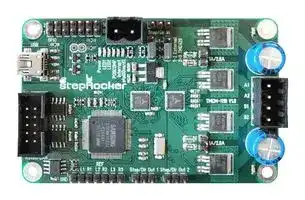
Image not available
Illustrative purposes only

TMCM-1110-STEPROCKER
Stepper Motor Driver, 2-Phase, Single Axis, 2.8A, 24V DC Output, USB, RS485
⚠️ Reference pricing provided. In case of supply shortages, we will connect you with our trusted procurement partners to ensure your project's continuity.
- Manufacturer: TRINAMIC / ANALOG DEVICES
- Product type: Stepper Motor Drives
- Supply Voltage Min:10V; Supply Voltage Max:30V; No. of Phases:Two Phase; Power Rating:-; Output Voltage Max:24V; Output Current:2.8A; Product Range:-; SVHC:No SVHC (27-Jun-2018)
- SVHC: No SVHC (04-Feb-2026)
- No. of Phases: Two Phase
- Product Range: TMCM StepRocker
- Output Current Max: 2.8A
- Supply Voltage Max: 30VDC
- Supply Voltage Min: 10VDC
- Control / Drive Type: 1-Axis Controller / Driver Module
| Delivery and price | |
|---|---|
| Units per pack | 1 |
| Price | 94.59 € |
| Current stock | 200+ |
| Lead time | 30 days |
Datasheet

**MODULE FOR** **`STEPPER MOTORS MODULE`**

## **Hardware Version V1.1**

## **HARDWARE MANUAL**

**==> picture [256 x 5] intentionally omitted <==**

**----- Start of picture text -----**<br>
+  +<br>**----- End of picture text -----**<br>


## stepRoclkter

**`1-axis stepper controller / driver module 1A RMS / 2.8A RMS 24V DC USB, RS485`**

**==> picture [270 x 5] intentionally omitted <==**

**----- Start of picture text -----**<br>
+  +<br>**----- End of picture text -----**<br>


## **UNIQUE FEATURES:**

TRINAMIC Motion Control GmbH & Co. KG Hamburg, Germany

## **www.trinamic.com**

TMCM-1110 stepRocker Hardware Manual (Ref. 1.08 / 2012-APR-04)

2

## **Table of Contents**

|1|Features ........................................................................................................................................................................... 3|Features ........................................................................................................................................................................... 3|
|---|---|---|
|2|Order Codes ................................................................................................................................................................... 4||
|3|Mechanical and Electrical Interfacing ..................................................................................................................... 4||
||3.1|Size of Board ......................................................................................................................................................... 4|
||3.2|Connectors ............................................................................................................................................................. 5|
||3.2.1|Power Connector ........................................................................................................................................... 6|
||3.2.2|I/O Connector to S3FN41F .......................................................................................................................... 6|
||3.2.3|Motor Connector ............................................................................................................................................ 6|
||3.2.4|Reference Switch Connector to TMC429 ................................................................................................. 7|
||3.2.5|RS485 and CAN Connector .......................................................................................................................... 7|
||3.2.6|USB Connector ................................................................................................................................................ 8|
||3.2.7|Step/Dir Input Connector (Motor 0) ......................................................................................................... 8|
||3.2.8|Step/Dir Output Connectors (Motor 1 and Motor 2)............................................................................ 8|
||3.2.9|µC Programming Interface ......................................................................................................................... 9|
||3.3|Jumper Settings .................................................................................................................................................. 10|
||3.4|LEDs ....................................................................................................................................................................... 11|
||3.5|Communication .................................................................................................................................................. 12|
||3.5.1|RS485 ............................................................................................................................................................... 12|
||3.5.2|USB................................................................................................................................................................... 13|
||3.5.3|CAN (_Retro-fit Option_) ................................................................................................................................. 13|
|4|Functional Description .............................................................................................................................................. 14||
||4.1|Extensions of the TMCM-1110 stepRocker .................................................................................................. 15|
|5|Operational Ratings ................................................................................................................................................... 16||
|6|Life Support Policy ..................................................................................................................................................... 17||
|7|Revision History .......................................................................................................................................................... 18||
||7.1|Document Revision ........................................................................................................................................... 18|
||7.2|Hardware Revision ............................................................................................................................................ 18|
|8|References..................................................................................................................................................................... 18||


www.trinamic.com

TMCM-1110 stepRocker Hardware Manual (Ref. 1.08 / 2012-APR-04)

3

## **1 Features**

The TMCM-1110 stepRocker is a single axis motor controller/driver board for 2-phase bipolar stepper motors. It features the TRINAMIC controller/driver chain consisting of TMC429 and TMC262 in combination with a Samsung S3FN41F processor. The Module is intended to be a fully functional development platform. A stepRocker can be extended to a full 3-axes system using two additional boards, because the TMCM-1110 stepRocker board can be both, master or slave.

Software wise two different approaches are possible: it is possible to use the stepRocker with the TrinamicMotionControlLanguage TMCL™. The board comes with the preinstalled firmware. The integrated development environment TMCL-IDE for PC can be downloaded and used free of charge. It is possible to remote control the stepRocker or to write and download complete command sequences for standalone use.

The alternative is to write the firmware for the microcontroller using downloadable software tools and motion control libraries (refer to www.motioncontrol-community.org).

## **Applications**

- Highly compact single axis stepper motor controller/driver board for 2-phase bipolar stepper motors

- 2- and 3-axis systems using additional boards as slaves

## **Electrical data**

- Supply voltage: +24V DC (+10… +30V DC)

- Motor current: up to 1A RMS or 2.8A RMS (can be selected with jumpers)

## **Mechanical data**

- Board size: 85mm x 55mm, height 15mm max. without mating connectors

- 4 mounting holes for M3 screws

## **Interfaces**

- RS485 host interface

- USB 2.0 host interface (mini-USB connector)

- Step/Dir input (TTL level)

- Step/Dir outputs (TTL level) for multi axis applications

- 3 multi-purpose inputs (can be used for ABN-encoder)

- 2 limit switch inputs per motor

- 6 multi-purpose I/Os

- 2 open-drain outputs

-

   - µC programming interface SWD (single wire debug / pads on PCB)

- Retro-fit option: CAN 2.0B communication interface

## **Features**

- TMC429 stepper motor controller IC for on-the-fly alteration of many motion specific parameters

- TMC262 advanced stepper motor driver IC with stallGuard2™ and coolStep™ features. Using the spreadCycle chopper the µstep current sine wave is well formed with smooth zero crossing.

- Ready for _dcStep™_

- Up to 256 microsteps per fullstep trough mircoPlyer technology

- 2 x end switch for all three axes.

- EEPROM

## **Software**

- TMCL™ remote (direct mode) and standalone operation (memory for up to 1024 TMCL™ commands)

- Fully supported by TMCL-IDE (PC based integrated development environment)

_Please note that the TMCM-1110 stepRocker can be used with a special TMCL™ firmware version with its source codes in order to provide new developments, too. Here is your platform for individual TMCL™ extensions: www.motioncontrol-community.org or www.steprocker.com._

www.trinamic.com

TMCM-1110 stepRocker Hardware Manual (Ref. 1.08 / 2012-APR-04)

4

## **2 Order Codes**

The standard version of the stepRocker has RS485 interface and USB interface.

The module is pre-programmed with TRINAMICs TMCL™ Firmware with all available features. For developing one’s own firmware please refer to www.steprocker.com or www.motioncontrol-community.org.

|**Order code**|**Description**|**Size of unit[mm3]**|
|---|---|---|
|TMCM-1110 stepRocker|The stepRocker is a 1-axes bipolar stepper motor<br>controller/driver module with RS485 and USB|<br>85 x 55 x 15|
||||


## **Table 2.1: TMCM-1110 order codes**

|**Order code**|**Description**|
|---|---|
|CABLE-USB-MINI|USB-mini cable|


**Table 2.4: Related product**

## **3 Mechanical and Electrical Interfacing**

## **3.1 Size of Board**

The board with the controller/driver electronics has an overall size of 85mm x 55mm x 15mm without mating connectors. It offers four mounting holes for M3 screws (3.2mm diameter). All four mounting holes are connected to the ground plane (signal and supply ground) of the module.

**==> picture [292 x 199] intentionally omitted <==**

**----- Start of picture text -----**<br>
4<br>4<br>Ø 3.2<br>55<br>4 x M3<br>screws<br>4<br>85<br>**----- End of picture text -----**<br>


**Figure 3.1: Board dimensions and position of mounting holes (all values in mm).**

www.trinamic.com

TMCM-1110 stepRocker Hardware Manual (Ref. 1.08 / 2012-APR-04)

5

## **3.2 Connectors**

The TMCM-1110 stepRocker has nine connectors altogether. There are two screw connectors for power and motor and two interface connectors (mini-USB and RS485). Further, the stepRocker has one connector for reference switches for all three motors, the driver input connector (TTL level) for motor 0, two controller output connectors (TTL level) for motors 1 and 2 and the GPIO connector, which can be used e.g. for connecting an ABN-encoder.

_**Start with power supply OFF and do not disconnect the motor while the board is powered as this can destroy the transistors!**_

**==> picture [372 x 227] intentionally omitted <==**

**----- Start of picture text -----**<br>
GPIO Power Driver In 0<br>14 1<br>1 1<br>USB<br>ns ae |‘pea oh Ut ieee (®<br>1<br>a ae ey<br>== ocker “r ~ oa<br>Motor<br>“* Step ACAliits Hy Te = en:<br>RS485<br>erik UES 1 wees = 7 | (ee<br>(CAN<br>optional) 1<br>a : iB ret CP Re LS RY Stap/Ok<br>wl NUNIT 1 1 ae 1 boa Le<br>rei nO @ \. Out t Gtep/Oe Oat 2) eaten we<br>Reference Controller Controller<br>switches Out 2 Out 1<br>**----- End of picture text -----**<br>


**Figure 3.2: TMCM-1110 stepRocker connectors**

**CONNECTORS OF TMCM-1110 STEPROCKER**

|**Label**|**Connector type **|**Mating connector type **|
|---|---|---|
|Power|RIA 220-02, 2 pol., 5.08mm pitch,<br>shrouded header|RIA 249-02, screw type terminal block,<br>pluggable,centerline 5.08mmpitch|
|Motor|RIA 183-04, 4 pol., 3.5mm pitch,<br>shrouded header|RIA 169-04, screw type terminal block,<br>pluggable,centerline 3.5mmpitch|
|USB|USB-mini female connector|USB-mini male connector|
|RS485/CAN|Low profile box header without locking<br>bar, type 8380, 10 pol., DIN 41651,<br>2.54mmpitch|Low profile IDC socket connector, 10pol.,<br>DIN41651, 2.54mm pitch|
|GPIO|Multi-pin-connector, 14 pol., 2.54mm<br>pitch|Female connector with 2.54mm pitch|
|Ref. switches|Multi-pin-connector,7pol.,2.54mmpitch|Female connector with 2.54mmpitch|
|Driver In|Multi-pin-connector,3pol.,2.54mmpitch|Female connector with 2.54mmpitch|
|Controller Out 1,2|Multi-pin-connector,3pol.,2.54mmpitch|Female connector with 2.54mmpitch|


**Table 3.1: Connectors and mating connectors**

_Because of the characteristic of the TMCM-1110 stepRocker as development platform TRINAMIC offers its internal circuit diagram here: www.steprocker.com_ or _www.motioncontrol-community.org. Please refer to the diagram in order to get further information about the pin assignments of µC, TMC429, and TMC262._

www.trinamic.com

TMCM-1110 stepRocker Hardware Manual (Ref. 1.08 / 2012-APR-04)

6

## **3.2.1 Power Connector**

_Take care of the polarity, wrong polarity can destroy the board!_

|**Pin**|**Label**|**Direction**|**Description**|
|---|---|---|---|
|1|GND|Power (GND)|Common system supplyand signalground|
|2|10… 30V|Power(input)|Power supplyvoltage.|


**Table 3.2: Power connector**

## **3.2.2 I/O Connector to S3FN41F**

|**Pin**|**Label**|**Direction**|**Description**|
|---|---|---|---|
|1|GND|Power(GND)|Supplyand signalground|
|2|GND|Power (GND)|Supplyand signalground|
|3|PWMD_0|in/out|Generalpurpose I/O (+5V compatible, _default: input_)|
|4|PWMU_0|in/out|Generalpurpose I/O(+5V compatible, _default: output_)|
|5|PWMD_1|in/out|Generalpurpose I/O (+5V compatible, _default: input_)|
|6|PWMU_1|in/out|Generalpurpose I/O (+5V compatible, _default: output_)|
|7|PWMD_2|in/out|Generalpurpose I/O(+5V compatible, _default: input_)|
|8|PWMU_2|in/out|Generalpurpose I/O (+5V compatible, _default: output_)|
|9|AIN_0|in|Analog input (can be used as home switch)<br>input voltage range: 0… +10V,<br>resolution: 12bit (0… 4095)|
|||||
|10|PHASE_A|in|Encoder input channel A<br>(+5V compatible,internalpull-upto +5V)|
|||||
|11|OpenDrain_1|out|Open-drain output(max. 100mA)|
|12|PHASE_B|in|Encoder input channel B<br>(+5V compatible,internalpull-upto +5V)|
|||||
|13|OpenDrain_2|out|Open-drain output(max. 100mA)|
|14|PHASE_Z|in|Encoder input zero channel<br>(+5V compatible,internalpull-upto +5V)|
|||||


**Table 3.3: I/O connector S3FN41F**

## **3.2.3 Motor Connector**

The motor is connected at the motor connector, one phase (phase A) between A1 and A2 and the second phase (phase B) between B1 and B2.

_Do not connect or disconnect the motor while the board is powered as this can destroy the transistors!_

|**Pin**|**Label**|**Direction**|**Description**|
|---|---|---|---|
|1|A1|out|Pin 1 of motor coil A|
|2|A2|out|Pin 2 of motor coil A|
|3|B1|out|Pin 1 of motor coil B|
|4|B2|out|Pin 2 of motor coil B|


**Table 3.5: Motor connector**

www.trinamic.com

TMCM-1110 stepRocker Hardware Manual (Ref. 1.08 / 2012-APR-04)

7

## **3.2.4 Reference Switch Connector to TMC429**

|**Pin**|**Label**|**Direction**|**Description**|
|---|---|---|---|
|1|GND|Power(GND)Si|Signal and systemground|
|2|L1|in|Input for left reference/limit switch of motor 0|
|3|R1|in|Input for right reference/limit switch of motor 0|
|4|L2|in|Input for left reference/limit switch of motor 1|
|5|R2|in|Input for right reference/limit switch of motor 1|
|6|L3|in|Input for left reference/limit switch of motor 2|
|7|R3|in|Input for right reference/limit switch of motor 2|


**Table 3.6: Reference switch connector**

## **3.2.5 RS485 and CAN Connector**

_**The standard TMCM-1110 stepRocker uses the RS485 interface pins, only.**_

|**Pin**|**Label**|**Direction**|**Description**|
|---|---|---|---|
|1||||
|2||||
|3|CAN_L|bi-directional Differential CAN bus si|bi-directional Differential CAN bus signal (inverting) - retro-fit option|
|4|CAN_H|bi-directional Differential CAN bus si|bi-directional Differential CAN bus signal(non-inverting)- retro-fit option|
|5|GND|Power(GND)Si|Signal and systemground|
|6|RS485+|bi-directional Differential RS485 bus si|bi-directional Differential RS485 bus signal (non-inverting)|
|7|RS485-|bi-directional Differential RS485 bus si|bi-directional Differential RS485 bus signal(inverting)|
|8||||
|9||||
|10||||


**Table 3.7: RS485/CAN connector**

## **3.2.5.1 Prepare the stepRocker for CAN**

The table above shows the pin configuration for CAN, too. Before starting with CAN it is necessary to solder a SN65HVD1050D CAN transceiver with housing SOIC8 and a 0.1µF capacitor with housing 0603 on the TMCM-1110 stepRocker. Now, the stepRocker is ready for using the CAN interface.

**0.1µF capacitor Housing: 0603**

Because of the pin assignment CAN and RS485 can be used at the same time.

Use firmware version V1.03 or higher with CAN interface!

_**It is not necessary to remove the RS485 transceiver.**_

**CAN transceiver SN65HVD1050D Housing: SOIC8**

www.trinamic.com

TMCM-1110 stepRocker Hardware Manual (Ref. 1.08 / 2012-APR-04)

8

## **3.2.6 USB Connector**

A USB interface is available via a mini-USB connector. This module supports USB 2.0 Full-Speed (12Mbit/s) connections.

|**Pin**|**Label**|**Direction**|**Description**|
|---|---|---|---|
|1|VBUS|Power<br>(+5V input)|+5V supply from host|
|2|D-|bi-directional USB Data -|bi-directional USB Data -|
|3|D+|bi-directional USB Data +|bi-directional USB Data +|
|4|ID||Connected to signal and systemground|
|5|GND|Power(GND)Si|Signal and systemground|


**Table 3.9: USB connector**

## **3.2.7 Step/Dir Input Connector (Motor 0)**

The TMCM-1110 stepRocker is equipped with a step/dir input connector for motor 0. Via this connector an external motion controller can be used together with the on-board driver electronics. For selecting an external motion controller instead of the on-board TMC429 motion controller two jumpers have to be set (please refer to chapter 3.3).

|**Pin**|**Label**|**Direction**|**Description**|
|---|---|---|---|
|1|GND|Power(GND)|Signal and Systemground|
|2|StepIn|in|Driver stepinput signal(+5V compatible)|
|3|Dir In|in|Driver direction input signal(+5V compatible)|


**Table 3.1: Step/dir input connector**

## **3.2.8 Step/Dir Output Connectors (Motor 1 and Motor 2)**

The TMC429 motion controller on the stepRocker is able to control up to three stepper motors.  Its Step/Dir outputs (TTL level) for motor 1 and motor 2 are leaded through to connectors _Step/Dir Out 1_ and _Step/Dir Out 2_ . The TMCM-1110 stepRocker can be extended to a complete motion controller/driver system for all three motors.

## _**ATTENTION**_

_Labels of the Step/Dir output connectors on the PCB are interchanged:_

- _Step/Dir Out 1 is used for axis 2._

- _Step/Dir Out 2 is used for axis 1._

**Controller OUT 2 Controller OUT 1**

|**Pin**|**Label**|**Direction**|**Description**|
|---|---|---|---|
|1|GND|Power(GND)|Signal and Systemground|
|2|StepOut|out|Driver stepoutput signal(+5V compatible)|
|3|Dir Out|out|Driver direction output signal(+5V compatible)|


**Table 3.2: Step/Dir Out connectors**

## **NOTE**

For setting the _**step pulse length**_ global parameter _**86**_ is used (available with firmware version 1.03 and higher). Adjust this parameter with the _**SGP**_ command. Refer to the TMCL Firmware Manual of the stepRocker for further information.

www.trinamic.com

TMCM-1110 stepRocker Hardware Manual (Ref. 1.08 / 2012-APR-04)

9

## **3.2.9 µC Programming Interface**

The programming pads of the interface are on the backside of the module. There are possibilities for programming in two different modes: _debug mode_ and _serial writing mode_ . The selection of the programming mode depends on the chosen adapter. Further, it is possible to use the programming pads of the µC interface by soldering adequate contacts directly on the programming pads.

Please refer to the datasheet of the S3FN41F microcontroller for further information. http://www.samsung.com/global/system/business/semiconductor/product/2011/6/21/024872um_s3fn41f_rev10.pdf

## **PROGRAMMING PADS**

|**Pin**<br>~~a~~|**Label**<br>~~a~~<br>~~a~~|**Description**<br>~~a~~|
|---|---|---|
|1<br>~~a~~<br>~~Rs~~|GND<br>~~a~~<br>~~Rs~~|Module and signalground|
|2<br>~~Rs~~|+5V<br>~~Rs~~|+5V DC supply|
|3<br>~~Rs~~|nRST<br>~~Rs~~|Hardware reset input|
|4|VPP|Connected to pin 14 of the processor (MODE0). VPP is used for mode setting<br>ether to_debug mode_or to_flash serial writing mode_.<br>Mode 1<br>Mode 0<br>Mode setting<br>0<br>0<br>User normal/debug mode.<br>(Usedpins: SWDIO and SWDCLK.)<br>0<br>1<br>User flash serial writing mode.<br>(Used pins: F_SDAT and PHASEA.)<br>The user program mode for flash memory programming and sector erasing<br>uses the internal high voltage generator, which is necessary for flash memory<br>programming and sector erasing. In other words, the flash memory controller<br>has an internal high voltage pumping circuit. Therefore, high voltage to VPP<br>pin is not needed. To program the data into the flash ROM or sector erase in<br>this mode,control registers should be used.|
|5|PHASEA|Function: F_CLK – serial clock.<br>Write speed: max 250kHz<br>Read speed: max 3MHz|
|6<br>~~Re~~|F_SDAT<br>~~Re~~|Serial Data pin (output for reading, input for writing)<br>Input andpush-pull outputport can be assigned.|
|7<br>~~Re~~|SWDIO<br>~~Re~~|Select/Serial Wire Data I/O. Internalpull-up|
|8<br>~~Re~~<br>~~I~~|SWDCLK<br>~~Re~~|Serial wire clock|


**Table 3.3: Programming pads**

**==> picture [272 x 96] intentionally omitted <==**

**----- Start of picture text -----**<br>
SWDCLK F SDAT VPP +5V<br>- ~*~ — _<br>oe ~y |<br>;<br>{ s i = WW a ~» F 1 }<br>PReaSeResvat<br>SWDIO PHASEA nRST GND<br>**----- End of picture text -----**<br>


**Figure 3.2: Programming pads**

www.trinamic.com

TMCM-1110 stepRocker Hardware Manual (Ref. 1.08 / 2012-APR-04)

10

## **3.3 Jumper Settings**

The TMCM-1110 stepRocker offers possibilities for settings by jumper. Here, three adjustments are mentioned. _Select motion controller_ and _select motor current_ are basic. Jumpers on the GPIO connector are optional.

**==> picture [85 x 247] intentionally omitted <==**

**----- Start of picture text -----**<br>
Select  Select<br>motion  motor<br>controller current<br>WATS<br>14.-"\2 eka<br>eS eee aicg<br>Fey<br>sb<br>we<br>> | wa<br>| Stee<br>=_=<br>SSOut 1 Sti e p/Dir Out2 "Treeos<br>Select<br>motor<br>current<br>**----- End of picture text -----**<br>


## **Figure 3.3: Jumper of TMCM-1110 stepRocker**

## **TMCM-1110 STEPROCKER JUMPERS**

|**Jumper**|**Label**|**Description**|
|---|---|---|
|Select motor current|1A/2.8A|Jumper plugged<br>motor current up to 2.8A RMS<br>Jumper unplugged<br>motor current upto 1A RMS|
|Select motion controller|1-2 External<br>2-3 TMC429|Set jumpers to select motion controller TMC429 (on the module)<br>or external, which have to be connected to Step/dir.<br>Jumperpins<br>Result<br>1, 2<br>External motion controller selected. LEDs<br>POSCOMP and interrupts are without<br>statement<br>2,3<br>TMC429 selected|


**Table 3.4: Jumpers of TMCM-1110 stepRocker**

www.trinamic.com

TMCM-1110 stepRocker Hardware Manual (Ref. 1.08 / 2012-APR-04)

11

## **3.4 LEDs**

## **LEDS OF THE TMCM-1110 STEPROCKER**

|**Status**|**Label**|**Description**|
|---|---|---|
|Power on|POWER|This orange LED lights up upon the power supply is working.|
|LED1<br>without defined function|without defined function<br>LED1|This yellow LED is applicable and can be used customer specific.<br>The LED is connected to pin 59 of the S3FN41F microcontroller.|
|LED2<br>without defined function|without defined function<br>LED2|This yellow LED is applicable and can be used customer specific.<br>The LED is connected to pin 58 of the S3FN41F microcontroller.|
|POSCOMP output used|POSCOMP|This yellow LED lights up if the POSCOMP output of the TMC429 is<br>used. POSCMP is available for triggering when moving over a<br>programmable position.|
|Interrupt detected|Interrupt|This orange LED lights up upon interrupts. The LED is connected<br>to the nIND_SDO_C pin of the TMC429.|
|stallGuard2™ detected|stallGuard2|This red LED light up upon stalling conditions. The LED is<br>connected to the SG_TST pin of the TMC262.|


**Table 3.5: LEDs**

**Figure 3.4: LEDs of the stepRocker**

www.trinamic.com

TMCM-1110 stepRocker Hardware Manual (Ref. 1.08 / 2012-APR-04)

12

## **3.5 Communication**

## **3.5.1 RS485**

For remote control and communication with a host system the TMCM-1110 provides a two wire RS485 bus interface. For proper operation the following items should be taken into account when setting up an RS485 network:

1. _BUS STRUCTURE_ :

   - The network topology should follow a bus structure as closely as possible. That is, the connection between each node and the bus itself should be as short as possible. Basically, it should be short compared to the length of the bus.

**==> picture [370 x 115] intentionally omitted <==**

**----- Start of picture text -----**<br>
Host<br>Slave Slave Slave<br>c:><br>node node node<br>1 n  - 1 n<br>}<br>termination termination<br>resistor resistor<br>(120 Ohm) (120 Ohm)<br>RS485 keep distance as<br>short as possible<br>**----- End of picture text -----**<br>


**Figure 3.5: RS485 bus structure**

## 2. _BUS TERMINATION_ :

Especially for longer busses and/or multiple nodes connected to the bus and/or high communication speeds, the bus should be properly terminated at both ends. The TMCM-1110 does not integrate any termination resistor. Therefore, 120 Ohm termination resistors at both ends of the bus have to be added externally.

3. _NUMBER OF NODES_ :

The RS485 electrical interface standard (EIA-485) allows up to 32 nodes to be connected to a single bus. The bus transceiver used on the TMCM-1110 units (SN65HVD3082ED) has just 1/8th of the standard bus load and allows a maximum of 256 units to be connected to a single RS485 bus.

4. _NO FLOATING BUS LINES:_

   - Avoid floating bus lines while neither the host/master nor one of the slaves along the bus line is transmitting data (all bus nodes switched to receive mode). Floating bus lines may lead to communication errors. In order to ensure valid signals on the bus it is recommended to use a resistor network connecting both bus lines as well defined logic levels. In contrast to the termination resistors this network is normally required just once per bus. Certain RS485 interface converters available for PCs already include these additional resistors (e.g. USB-2-485).

**==> picture [267 x 131] intentionally omitted <==**

**----- Start of picture text -----**<br>
Slave Slave<br>node node +5V<br>n  - 1 n<br>pull-up (1k)<br>RS485+ / RS485A termination<br>resistor<br>RS485- / RS485B (120 Ohm)<br>pull-down (1k)<br>GND<br>**----- End of picture text -----**<br>


**Figure 3.6: RS485 bus lines with resistor network**

www.trinamic.com

TMCM-1110 stepRocker Hardware Manual (Ref. 1.08 / 2012-APR-04)

13

## **3.5.2 USB**

For remote control and communication with a host system the TMCM-1110 stepRocker provides a USB 2.0 fullspeed (12Mbit/s) interface (mini-USB connector). As soon as a USB-Host is connected the module will accept commands via USB. The TMCM-1110 support USB self powered operation (when an external power is supplied via the power supply connector) and USB bus powered operation, also (no external power supply via power supply connector). During USB bus powered operation, only the core digital circuit parts will be operational. That is, the microcontroller itself and also the EEPROM. Motor movements will not be possible. This mode has been implemented in order to enable configuration / parameter setting / read-out, firmware updates etc. by just connecting a USB cable between the module and a host PC. No additional cabling / external devices as e.g. power supply etc. are required in that case.

Please note that the module might draw current from the USB +5V bus supply even in USB self powered operation depending on the voltage level of this supply.

## **3.5.3 CAN (** _**Retro-fit Option**_ **)**

For remote control and communication with a host system the TMCM-1110 stepRocker can be equipped with a CAN bus interface. _Please note, that it is necessary to prepare the board with a CAN transceiver and the according capacitor first (chapter 3.2.5.1)._

For proper operation the following items should be taken into account when setting up a CAN network:

1. _BUS STRUCTURE_ : The network topology should follow a bus structure as closely as possible. That is, the connection between each node and the bus itself should be as short as possible. Basically, it should be short compared to the length of the bus.

**==> picture [370 x 115] intentionally omitted <==**

**----- Start of picture text -----**<br>
Host<br>Slave Slave Slave<br>c:><br>node node node<br>1 n  - 1 n<br>}<br>termination termination<br>resistor resistor<br>(120 Ohm) (120 Ohm)<br>CAN keep distance as<br>short as possible<br>**----- End of picture text -----**<br>


**Figure 3.7: CAN bus structure**

## 2. _BUS TERMINATION_ :

Especially for longer busses and/or multiple nodes connected to the bus and/or high communication speeds, the bus should be properly terminated at both ends. The TMCM-1110 does not integrate any termination resistor. Therefore, 120 Ohm termination resistors at both ends of the bus have to be added externally.

www.trinamic.com

TMCM-1110 stepRocker Hardware Manual (Ref. 1.08 / 2012-APR-04)

14

## **4 Functional Description**

The TMCM-1110 stepRocker is a highly integrated 1-axes controller/driver module. The TMCM-1110 can be controlled via RS485 or USB serial interfaces (CAN _retro-fit option_ ).

The TMCM-1110 comes with the PC based software development environment TMCL-IDE for the Trinamic Motion Control Language (TMCL™). Using predefined TMCL™ high level commands like _move to position_ a rapid and fast development of motion control applications is guaranteed. Whereas the boot loader is installed during production and testing at TRINAMIC and remains normally untouched throughout the whole lifetime, the firmware can be updated by the user.

Communication traffic is kept low since all time critical operations, e.g. ramp calculation, are performed on board. Full remote control of device with feedback is possible. The firmware of the module can be updated via any of the serial interfaces.

In case, you prefer developing your own TMCL™ commands for the stepRocker refer to www.steprocker.com. The TMCL™ boot loader on the board can be used for downloading new TMCL™ programs including such personal extensions, too.

The TMCM-1110 module contains the following main components:

- ˗ ARM Cortex-MO processor Core S3FN41F microcontroller with built-in up to 256 Kbytes program flash memory and up to 32 Kbytes SRAM. Processor is equipped with crystal (more precision for USB communication).

- ˗ TMC429 highly integrated 3 axes stepper motor controller. Step-/direction outputs for motor 0 connected to TMC262.

- ˗ TMC262 advanced stepper motor driver IC with stallGuard2™ and coolStep™ with integrated MOSFET driver transistors (4x power MOSFETs for 2-phase bipolar stepper option) for motor 0.

- ˗ RS485 and USB transceivers.

- ˗ On-board switching and linear voltage regulators for supply of on-board digital circuits

**Step/Dir IN 0 (Slave)**

**==> picture [480 x 163] intentionally omitted <==**

**----- Start of picture text -----**<br>
EEPROM<br>+5V 3x 2 reference<br>SPI switches<br>+5V<br>RS485 Power  Motor 0<br>MOSFET<br>assembly CAN SPI progammableMotion  TMC262Driver Driver Stage4 x Mosfet<br>option<br>USB S3FN41F µC Controller TMC429 Step/Dir Step/Dir<br>OUT 1 (Master)<br>Inputs 4 Step/Dir<br>1x analogue  Step/Dir<br>3x with pull-upsGPIOs 6 SPI OUT 2 (Master)<br>10… 30V DC 1A RMS/<br>2.8A RMS<br>Step/Dir<br>**----- End of picture text -----**<br>


**Figure 4.1: TMCM-1110 stepRocker block diagram**

www.trinamic.com

TMCM-1110 stepRocker Hardware Manual (Ref. 1.08 / 2012-APR-04)

15

## **4.1 Extensions of the TMCM-1110 stepRocker**

The TMCM-1110 stepRocker provides the possibility for extension to full 3-axis systems. The stepRocker itself can be used as master or slave. An example for extensions is shown below.

**==> picture [31 x 9] intentionally omitted <==**

**----- Start of picture text -----**<br>
GPI/O<br>**----- End of picture text -----**<br>


**==> picture [242 x 409] intentionally omitted <==**

**----- Start of picture text -----**<br>
USB<br>TMCL™<br>Master / Motor 0<br>S/D OUT<br>3 x REF-IN<br>S/D IN<br>USB / RS485<br>only initialization  stepRoclser<br>and<br>parameterization Motor 1<br>S/D IN<br>USB / RS485<br>only initialization  stepRoclser<br>and<br>parameterization Motor 2<br>**----- End of picture text -----**<br>


**Figure 4.2: TMCM-1110 stepRocker extension**

www.trinamic.com

TMCM-1110 stepRocker Hardware Manual (Ref. 1.08 / 2012-APR-04)

16

## **5 Operational Ratings**

The operational ratings show the intended or the characteristic ranges and should be used as design values. _**In no case shall the maximum values be exceeded.**_

|**Symbol**|**Parameter**|**Min**|**Typ**|**Max**|**Unit**|
|---|---|---|---|---|---|
|VPower|Power supply voltage|10|12… 24|30|V|
|VUSB|Power supply via USB connector||5||V|
|IUSB|Current withdrawn from USB supply when<br>USB bus powered (no other supply connected)||85||mA|
|||||||
|ICOIL|Motor coil current for sine wave**peak**<br>(chopper regulated, adjustable via software)|0||1500 or<br>4000|mA|
|||||||
|IMC|Continuous motor current (**RMS**)|0||1000 or<br>2800|mA|
|||||||
|TENV|Environment temperature at rated current (no<br>forced cooling required)|-25|tbd|80|°C|
|||||||


**Table 5.1: General operational ratings of the module**

|**Symbol**|**Parameter**|**Min**|**Typ**|**Max**|**Unit**|
|---|---|---|---|---|---|
|NRS485|Number of nodes connected to<br>single RS485 network|||256||
|||||||


**Table 5.2: Operational ratings of RS485 interface**

www.trinamic.com

TMCM-1110 stepRocker Hardware Manual (Ref. 1.08 / 2012-APR-04)

17

## **6 Life Support Policy**

TRINAMIC Motion Control GmbH & Co. KG does not authorize or warrant any of its products for use in life support systems, without the specific written consent of TRINAMIC Motion Control GmbH & Co. KG.

Life support systems are equipment intended to support or sustain life, and whose failure to perform, when properly used in accordance with instructions provided, can be reasonably expected to result in personal injury or death.

- © TRINAMIC Motion Control GmbH & Co. KG 2012

Information given in this data sheet is believed to be accurate and reliable. However neither responsibility is assumed for the consequences of its use nor for any infringement of patents or other rights of third parties, which may result from its use.

Specifications are subject to change without notice.

www.trinamic.com

TMCM-1110 stepRocker Hardware Manual (Ref. 1.08 / 2012-APR-04)

18

## **7 Revision History**

## **7.1 Document Revision**

|||**Author**<br>SD – Sonja Dwersteg<br>GG – Guido Gandolfo||
|---|---|---|---|
|**Version**|**Date**||**Description**|
|||||
|1.00|2011-OCT-01|SD|First version|
|1.01|2011-OCT-04|GG|Minor changes|
|1.02|2011-OCT-05|SD|Minor changes|
|1.03|2011-OCT-27|SD|Minor changes|
|1.04|2011-OCT-31|SD|Minor changes|
||2011-DEC-21|SD|-<br>Chapter 3.2.8 corrected: labels of Step/Dir Out 1 and<br>Step/Dir Out 2 on PCB are interchanged.<br>-<br>Information about USB interface corrected (3.2.6)|
|1.05||||
|||||
|1.06|2011-DEC-22|SD|I/O connector information updated(3.2.2).|
|1.07|2012-JAN-03|SD|Minor changes|
||2012-APR-04|SD|-<br>Chapter 3.2.8 completed<br>-<br>Hint added in chapter 3.2.5.1|
|1.08||||
|||||


**Figure 7.1: Document revision**

## **7.2 Hardware Revision**

|**Version**|**Date**|**Description**|
|---|---|---|
|TMCM-1110 V1.1|2011-SEP-02|Minor changes from version 1.0 to version 1.1|
||||


## **Figure 7.2: Hardware revision**

## **8 References**

|[USB-2-485]|USB-2-485 interface converter|
|---|---|
||manual available onhttp://www.trinamic.com|
|[TMC262]|TMC262 datasheet|
||manual available onhttp://www.trinamic.com<br>.|
|[TMC429]|TMC429 datasheet|
||manual available onhttp://www.trinamic.com<br>.|
|[S3FN41F]|S3FN41F processor|
||manual available onwww.samsung.com<br>|


www.trinamic.com
Updated at April 29, 2026
About Novapart
Novapart is a B2B electronic component broker specialising in stock shortages and cost reduction. We source hard-to-find parts and identify compliant alternatives across a catalogue of 410,000+ components from 500+ manufacturers.
Learn more →Stock Shortage Specialist
When a component is unavailable, discontinued or has an unacceptable lead time, we tap into our network of vetted European and Asian distributors to source what you need — without compromising on quality or traceability.
Request a quote →Compliant Alternatives
We identify pin-to-pin, electrically equivalent substitutes that meet the same certifications (RoHS, AEC-Q100, REACH) as your original specification — validated against datasheets, not just part numbers. Often at a lower cost.
BOM Analysis service →