
Image not available
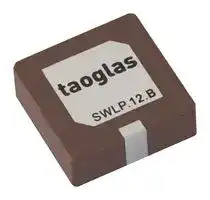
Illustrative purposes only

SWLP.2450.12.4.B.02
Patch Antenna, 2.4GHz to 2.5GHz, 3 VSWR, 2dBi Gain, 50ohm, Linear Polarisation, SMD
⚠️ Reference pricing provided. In case of supply shortages, we will connect you with our trusted procurement partners to ensure your project's continuity.
- Manufacturer: TAOGLAS
- Product type:
- Antenna Type:Patch; Frequency Min:2.4GHz; Frequency Max:2.5GHz; Antenna Mounting:SMD; Gain:2dBi; VSWR:3; Input Power:-; Input Impedance:50ohm; Antenna Polarisation:Linear; Product Range:-
- Gain: 2dBi
- SVHC: To Be Advised
- VSWR: 3
- Input Power: -
- Antenna Type: Patch
- Frequency Max: 2.5GHz
- Frequency Min: 2.4GHz
- Product Range: -
- Input Impedance: 50ohm
- Antenna Mounting: SMD
- Antenna Polarisation: Linear
| Delivery and price | |
|---|---|
| Units per pack | 500 |
| Price | 2.36 € |
| Current stock | 10+ |
| Lead time | 30 days |
Datasheet

## **SPECIFICATION**

Part No. : **SWLP.2450.12.4.B.02**

## Product Name : **12*12*4mm 2.4GHz SMD Patch Antenna**

- Features : 2.4 - 2.5GHz Patch Antenna

   - For Wi-Fi/WLAN/ISM/Zigbee Industrial Applications High Gain 2dBi Linearly Polarized ROHS Compliant

**==> picture [24 x 12] intentionally omitted <==**

**----- Start of picture text -----**<br>
Top<br>**----- End of picture text -----**<br>


**==> picture [42 x 10] intentionally omitted <==**

**----- Start of picture text -----**<br>
Bottom<br>**----- End of picture text -----**<br>


SPE-13-8-007/H/SS      Page 1 of 18

## **1. Introduction**

This 12*12*4mm high gain 2.4GHz patch antenna is ideally suited for high performance industrial applications in the 2.4GHz Wi-Fi, ISM, and Zigbee bands. This product has highest gain in the XZ (azimuth) plane direction, most suitable for fixed wireless applications where transmission and reception is focused to one hemisphere of the device, for example a wireless meter on a reinforced concrete wall. It can also be placed anywhere on the device groundplane, unlike most chip or loop antennas which need to be edge mounted.

Many module manufacturers specify peak gain limits for any antennas that are to be connected to that module. Those peak gain limits are based on free-space conditions. In practice, the peak gain of an antenna tested in free-space can degrade by at least 1 or 2dBi when put inside a device. So ideally you should go for a slightly higher peak gain antenna than mentioned on the module specification to compensate for this effect, giving you better performance.

Upon testing of any of our antennas with your device and a selection of appropriate layout, integration technique, or cable, Taoglas can make sure any of our antennas’ peak gain will be below the peak gain limits. Taoglas can then issue a specification and/or report for the selected antenna in your device that will clearly show it complying with the peak gain limits, so you can be assured you are meeting regulatory requirements for that module.

For example, a module manufacturer may state that the antenna must have less than 2dBi peak gain, but you don’t need to select an embedded antenna that has a peak gain of less than 2dBi in free-space. This will give you a less optimized solution. It is better to go for a slightly higher free-space peak gain of 3dBi or more if available. Once that antenna gets integrated into your device, performance will degrade below this 2dBi peak gain due to the effects of GND plane, surrounding components, and device housing. If you want to be absolutely sure, contact Taoglas and we will test. Choosing a Taoglas antenna with a higher peak gain than what is specified by the module manufacturer and enlisting our help will ensure you are getting the best performance possible without exceeding the peak gain limits.

SPE-13-8-007/H/SS      Page 2 of 18

It is better not to select an embedded antenna with very low free-space peak gain (<2dBi) directly, as this antenna would have worse performance in your device, and lead to compromised performance compared to using a Taoglas antenna.

## **2. Key Antenna Performance Indicators***

|**ELECTRICAL**<br>~~[~~|**ELECTRICAL**<br>~~[~~|
|---|---|
|Frequency Range|2400 MHz to 2500 MHz|
|Bandwidth|100 MHz @ -7dB|
|Efficiency|80.12% @ 2450 MHz|
|Polarization|Linear|
|VSWR|3.0 max @ Center Frequency|
|Peak Gain|+2 dBi typ.|
|Impedance<br>50 Ohms<br>**MECHANICAL**<br>~~[~~||
|Dimensions<br>12mm x 12mm x 4mm<br>Weight<br>4g<br>**ENVIRONMENTAL**<br>~~[~~||
|Operating Temperature|-40℃to +85℃|
|Storage Temperature|-40℃to +85℃|
|Termination|Ag (Environmentally Friendly Pb Free)|


Original Patch Specification measured on EVB 50*50mm. Actual value depends on ground-plane and housing

SPE-13-8-007/H/SS      Page 3 of 18

## **3. Electrical Specifications**

## **3.1 Return Loss**

SPE-13-8-007/H/SS      Page 4 of 18

## **3.2 Definition of X-Y-Z Plane**

**==> picture [117 x 117] intentionally omitted <==**

**----- Start of picture text -----**<br>
Y<br>X<br>Z<br>**----- End of picture text -----**<br>


SPE-13-8-007/H/SS      Page 5 of 18

## **3.3 Radiation Patterns**

## **XY Plane**

X

**==> picture [495 x 541] intentionally omitted <==**

**----- Start of picture text -----**<br>
0<br>10<br>330 30<br>0<br>-10<br>300 60<br>-20<br>f —N.<br>-30<br>270 -40 90 Y<br>2400MHz<br>240 120<br>2450MHz<br>210 150<br>2500MHz<br>180 (dB)<br>XZ Plane<br>Z<br>0<br>10<br>330 30<br>0<br>-10<br>300 60<br>-20<br>-30<br>270 -40 90 X<br>2400MHz<br>240 120<br>2450MHz<br>210 150<br>2500MHz<br>180 (dB)<br>**----- End of picture text -----**<br>


SPE-13-8-007/H/SS      Page 6 of 18

**==> picture [452 x 276] intentionally omitted <==**

**----- Start of picture text -----**<br>
YZ Plane<br>Z<br>0<br>10<br>330 30<br>0<br>a<br>/ 4bee -10 ft oN \<br>300 60<br>-20<br>/ L a rw \ \<br>-30<br>270 -40 90 Y<br>2400MHz<br>240 120<br>2450MHz<br>210 150<br>2500MHz<br>180 (dB)<br>**----- End of picture text -----**<br>


SPE-13-8-007/H/SS      Page 7 of 18

## **3.4 Efficiency**

## **3.5 Average Gain**

SPE-13-8-007/H/SS      Page 8 of 18

## **3.6 Peak Gain**

## **3.7 3D Radiation Pattern**

2400MHz

SPE-13-8-007/H/SS      Page 9 of 18

**==> picture [61 x 10] intentionally omitted <==**

**----- Start of picture text -----**<br>
2450MHz<br>**----- End of picture text -----**<br>


2500MHz

SPE-13-8-007/H/SS      Page 10 of 18

## **4. Dimensions**

SPE-13-8-007/H/SS      Page 11 of 18

## **4.1 Evaluation Board Dimensions**

SPE-13-8-007/H/SS      Page 12 of 18

## **5. Footprint**

## **5.1 Top Copper**

## **5.2 Top Solder paste**

SPE-13-8-007/H/SS      Page 13 of 18

## 5.3 Top Solder Mask

## 5.4 Composite Diagram

SPE-13-8-007/H/SS      Page 14 of 18

## **6. Packaging**

SPE-13-8-007/H/SS      Page 15 of 18

SPE-13-8-007/H/SS      Page 16 of 18

## **7. Recommended Reflow Temperature Profile**

SWLP.12B can be assembled following Pb-free assembly. According to the Standard IPC/JEDEC J-STD-020C, the temperature profile suggested is as follow:

|**Phase**|**Profile Features**|**Pb-Free Assembly (SnAgCu)**|
|---|---|---|
|PREHEAT|Temperature Min(Tsmin)|150°C|
||Temperature Max(Tsmax)|200°C|
||Time(ts) from (Tsmin to Tsmax)|60-120 seconds|
|RAMP-UP|Avg. Ramp-up Rate (Tsmax to|3°C/second(max)|
||TP)||
|REFLOW|Temperature(TL)|217°C|
||Total Time above TL (tL)|30-100 seconds|
|PEAK|Temperature(TP)|260°C|
||Time(tp)|2-5 seconds|
|RAMP-DOWN|Rate|3°C/second(max)|
|Time from 25°C to Peak Temperature||8 minutes max.|
|Composition of solder paste|Composition of solder paste|96.5Sn/3Ag/0.5Cu|
|Solder Paste Model||SHENMAO PF606-P26|


Soldering Iron condition: Soldering iron temperature 270°C±10°C.

Apply preheating at 120°C for 2-3 minutes. Finish soldering for each terminal within 3 seconds, if soldering iron temperature over270°C±10°C or 3 seconds, it will make cause component surface peeling or damage.

SPE-13-8-007/H/SS      Page 17 of 18

Taoglas makes no warranties based on the accuracy or completeness of the contents of this document and reserves the right to make changes to specifications and product descriptions at any time without notice. Taoglas reserves all rights to this document and the information contained herein.

Reproduction, use or disclosure to third parties without express permission is strictly prohibited.

Copyright © Taoglas Ltd.

SPE-13-8-007/H/SS      Page 18 of 18
Updated at June 9, 2026
About Novapart
Novapart is a B2B electronic component broker specialising in stock shortages and cost reduction. We source hard-to-find parts and identify compliant alternatives across a catalogue of 410,000+ components from 500+ manufacturers.
Learn more →Stock Shortage Specialist
When a component is unavailable, discontinued or has an unacceptable lead time, we tap into our network of vetted European and Asian distributors to source what you need — without compromising on quality or traceability.
Request a quote →Compliant Alternatives
We identify pin-to-pin, electrically equivalent substitutes that meet the same certifications (RoHS, AEC-Q100, REACH) as your original specification — validated against datasheets, not just part numbers. Often at a lower cost.
BOM Analysis service →