
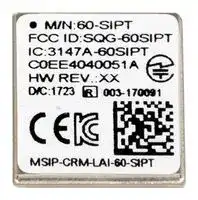
Image not available
Illustrative purposes only

ST60-SIPT
Wireless LAN Module, 60-SIPT series, 2.4 GHz, SDIO, UART, Industrial, Medical
⚠️ Reference pricing provided. In case of supply shortages, we will connect you with our trusted procurement partners to ensure your project's continuity.
- Manufacturer: EZURIO
- Product type:
- Frequency RF:2.4GHz; Module Interface:SDIO, UART; Module Applications:Industrial, Medical; Product Range:60-SIPT series; SVHC:No SVHC (07-Jul-2017)
- SVHC: To Be Advised
- Frequency RF: 2.4GHz
- Product Range: 60-SIPT series
- Module Interface: SDIO, UART
- Module Applications: Industrial, Medical
| Delivery and price | |
|---|---|
| Units per pack | 500 |
| Price | 27.27 € |
| Current stock | 10+ |
| Lead time | 30 days |
Datasheet

A

## Datasheet 60-SIPT series

_Version 1.1_

**SU60-SIPT** Datasheet

## REVISION HISTORY

|**Version**<br>1.0<br>~~**a** ~~|**Version**<br>1.0<br>~~**a** ~~|**Date**<br>**Notes**<br>**Approver**<br>29 Aug2017<br>Initial version<br>JayWhite<br> ~~a~~|
|---|---|---|
||1.1|08 Sept 2017<br>Updated Max. Current Consumption table/column headings<br>Andrew Chen|


**Embedded Wireless Solutions Support Center: http://ews-support.lairdtech.com** www.lairdtech.com/wireless

Americas: +1-800-492-2320 Europe: +44-1628-858-940 Hong Kong: +852 2923 0610

2

© Copyright 2017 Laird. All Rights Reserved

**SU60-SIPT** Datasheet

## CONTENTS

|1|Scope ..................................................................................................................................................................4|Scope ..................................................................................................................................................................4|
|---|---|---|
|2|Introduction ........................................................................................................................................................4||
|3|60-SIPT Series Features Summary ......................................................................................................................5||
|4|Specifications ......................................................................................................................................................6||
|5|WLAN Functional Description .......................................................................................................................... 11||
|6|Bluetooth Functional Description .................................................................................................................... 14||
|7|Block Diagram .................................................................................................................................................. 15||
|8|Electrical Characteristics .................................................................................................................................. 15||
|9|Bluetooth Radio Characteristics ...................................................................................................................... 19||
|10||Host Interface Specifications ....................................................................................................................... 22|
||10.1|SDIO Specifications .................................................................................................................................. 22|
||10.2|PCI Express Specifications........................................................................................................................ 26|
||10.3|USB Specifications ................................................................................................................................... 30|
||10.4|PCM Interface Specifications ................................................................................................................... 33|
|11||Pin Definitions ............................................................................................................................................. 34|
|12||Host Configuration Options ......................................................................................................................... 37|
|13||Mechanical Specifications ........................................................................................................................... 38|
|14||RF Layout Design Guidelines ....................................................................................................................... 39|
|15||Recommended Storage, Handling, Baking, and Reflow Profile ................................................................... 40|
||15.1|Required Storage Conditions ................................................................................................................... 40|
||15.2|Baking Conditions .................................................................................................................................... 41|
||15.3|Surface Mount Conditions ....................................................................................................................... 42|
||15.3.1<br>Soldering .......................................................................................................................................... 42||
||15.3.2<br>Cautions When Removing the SIP from the Platform for RMA ....................................................... 43||
||15.3.3<br>Precautions for Use ......................................................................................................................... 44||
|16||Regulatory ................................................................................................................................................... 44|
||16.1|Certified Antennas ................................................................................................................................... 44|
|17||FCC and IC Regulatory ................................................................................................................................. 44|
||17.1|FCC ........................................................................................................................................................... 45|
||17.2|Industry Canada ....................................................................................................................................... 46|
|18||European Union Regulatory ........................................................................................................................ 49|
|19||Ordering Information .................................................................................................................................. 50|
|20||Bluetooth SIG Qualification ......................................................................................................................... 52|
|21||Additional Assistance................................................................................................................................... 53|


**Embedded Wireless Solutions Support Center: http://ews-support.lairdtech.com** www.lairdtech.com/wireless

Americas: +1-800-492-2320 Europe: +44-1628-858-940 Hong Kong: +852 2923 0610

3

© Copyright 2017 Laird. All Rights Reserved

**SU60-SIPT** Datasheet

## 1 SCOPE

This document describes key hardware aspects of the Laird 60-SIPT series system-in-package (SiP) modules providing either SDIO, USB2.0, or PCIe bus interface for WLAN connection and UART/PCM, SDIO/PCM, USB2.0/PCM for Bluetooth `[®]` connection. This document is intended to assist device manufacturers and related parties with the integration of this radio into their host devices. Data in this document is drawn from several sources and includes information found in the Marvell 88W8997/88PG823 data sheets issued in April 2016, along with other documents provided from Marvell.

**Note that the information in this document is subject to change.** Please contact Laird to obtain the most recent version of this document.

## 2 INTRODUCTION

## **2.1 General Description**

The 60-SIPT series SiP modules are an integrated, small form factor 2x2 MIMO 802.11 a/b/g/n/ac WLAN plus _Bluetooth_ 4.2 dual mode device that is optimized for low-power mobile devices. The integration of all WLAN and _Bluetooth_ functionality in a single package supports low cost and simple implementation along with flexibility for platform-specific customization.

This device is pre-calibrated and integrates the complete transmit/receive RF paths including band pass filter, diplexer, switches, reference crystal oscillator, and power manage units (PMU).

The 60-SIPT series device supports IEEE 802.11 ac (wave 2) 2X2 receive multi-user MIMO (MU-MIMO) spatial stream multiplexing with data rates up to MCS9 (866.7 Mbps). It also supports Bluetooth 2.1 + EDR and Bluetooth 4.2 (Bluetooth Low Energy or BLE).  Internal Wi-Fi and BT coexistence scheme provides optimized throughput when Wi-Fi and BT working simultaneously. The device’s low power consumption radio architecture and power manage unit (PMU) proprietary power save technologies allow for extended battery life.

In addition, its dual 802.11 and Bluetooth radio includes full digital MAC and baseband engines that handle all 802.11 CCK/OFDM® 2.4/5GHz, and Bluetooth basic rate and EDR baseband and protocol processing.

Dual embedded low-power CPU cores minimize host loading and maximize flexibility to support customerspecific use cases.

The 60-SIPT series SiP modules include two product SKUs which is have different supported software features. Please check Laird Sales/FAE for further information. Order information is listed in Table 1.

_**Table 1: Product ordering information**_

|**Order Model**|**Description**|
|---|---|
|SU60-SIPT|802.11ac + BT4.2 60 Series hardware combined with Summit Series Enterprise software|
|ST60-SIPT|802.11ac + BT4.2 60 Series hardware combined with SterlingSeries Professional software|


**Embedded Wireless Solutions Support Center: http://ews-support.lairdtech.com** www.lairdtech.com/wireless

Americas: +1-800-492-2320 Europe: +44-1628-858-940 Hong Kong: +852 2923 0610

4

© Copyright 2017 Laird. All Rights Reserved

**SU60-SIPT** Datasheet

## 3 60-SIPT SERIES FEATURES SUMMARY

The Laird 60-SIPT series device features are described in Table 2.

_**Table 2: 60-SIPT series features**_

|**Feature**<br>~~ee~~|**Feature**<br>~~ee~~|**Description**<br>Integrates the complete transmit/receive RF paths including band pass filter, diplexer,|
|---|---|---|
||**Radio Front End**|switches, reference crystal oscillator, and power manage unit (PMU).<br>Supports 20/40/80MHz channel bandwidth.|
|||WLAN/Bluetooth share one antenna.|


The _Bluetooth_ ® word mark and logos are registered trademarks owned by Bluetooth SIG, Inc. Any use of such marks by Laird is under license. Other trademarks and trade names are those of their respective owners.

|**Coexistence**|Coexistence arbitration for WLAN, Bluetooth, and LTE operation|Coexistence arbitration for WLAN, Bluetooth, and LTE operation|Coexistence arbitration for WLAN, Bluetooth, and LTE operation||
|---|---|---|---|---|
|**Power**|Dynamic Voltage Scaling (DVS) and Adaptive Voltage Scaling (AVS) features support the|||Dynamic Voltage Scaling (DVS) and Adaptive Voltage Scaling (AVS) features support the|
|**Management**|latest Marvell SoC and Processorpower control scheme.||||
|**Pre-Calibration**|RF s||RF system tested and calibrated inproduction||
|**Sleep Clock**|An external slee||An external sleepclock of 32.768 KHz is required during power save mode||
|||▪|SDIO 3.0 (4-bit and 1-bit), SDR 12/25/50 mode (up to 100 MHz), USB2.0 or PCIe for|SDIO 3.0 (4-bit and 1-bit), SDR 12/25/50 mode (up to 100 MHz), USB2.0 or PCIe for|
||||WLAN||
|||▪|SDIO 3.0, USB 2.0, HS-UART for Bluetooth HCI (compatible with any upper layer||
||||Bluetooth stack)||
|||▪|PCM digital audio interface for Bluetooth audio application||
|**Host Interface**|**Strap Value**<br>**CONFIG_HOST[2-0]**<br>**WLAN**<br>**Bluetooth/BLE**<br>**ROM Notes**<br>000<br>SDIO<br>UART<br>-<br>~~ee~~||||
||||001<br>SDIO<br>SDIO<br>-||
||||010<br>PCIe<br>USB 2.0<br>Initial USB 2.0 PHY and COM PHY PCIeportion||
||||011<br>PCIe<br>UART<br>Initial onlyCOM PHY PCIeportion||
||||100<br>USB 2.0<br>UART<br>Initial COM PHY USB 2.0||
||||101<br>USB 2.0<br>USB 2.0<br>Initial only USB 2.0 PHY||
|||▪|Incorporates a 40 MHz reference frequency source in package||
|**Reference**||▪|An external sleep clock is recommended for minimal current consumption. If no sleep clock|An external sleep clock is recommended for minimal current consumption. If no sleep clock|
|**Frequency**|||input is provided, an internal sleep clock (derived from reference clock) is used. An approximate||
||||50 uA current increase on the 3.3V rail.||
|||▪|A-MPDU RX (de-aggregation) and TX (aggregation) supports 802.11ac single-MPDU A-MPDU.||
|||▪|Multi-BSS/Station||
|||▪|Transmit rate adaption, transmit power control||
|||▪|Modulation and coding scheme (MCS):  802.11ac—MCS0-9 Nsts=1 and 2.||
|**Advanced WLAN**||▪|802.11n—MCS0-15<br> Dynamic frequency selection (radar detection) DFS||
|||▪|20/40/80 MHz channel bandwidths support||
|||▪|On-chip gain selectable LNA with optimized noise figure and power consumption||
|||▪|Internal PA with optimized gain distribution for linearity and noise performance||
|||▪|Support wide varietyof WLAN encryption: TKIP/WEP/AES||


**Embedded Wireless Solutions Support Center: http://ews-support.lairdtech.com** www.lairdtech.com/wireless

Americas: +1-800-492-2320 Europe: +44-1628-858-940 Hong Kong: +852 2923 0610

5

© Copyright 2017 Laird. All Rights Reserved

**SU60-SIPT** Datasheet

## **Feature Description** ~~|~~

- Bluetooth 4.2 (BDR/EDR/LE), Bluetooth class 1

- ▪ Support data rate: 1 Mbps (GFSK), 2 Mbps ( π /4-DQPSK), 3 Mbps (8-DPSK)

- Digital audio interface with PCM/TDM interface for voice application

**Advanced Bluetooth**

- Adaptive Frequency Hopping (AFH) using Package Error Rate (PER)

- Standard SDIO or UART HCI transport layer

- WLAN/Bluetooth coexistence protocol support

- Shared LNA with WLAN/Bluetooth

- Encryption (AES) support

## 4 SPECIFICATIONS

_**Table 3: Specifications**_

|**Feature**<br>**Description**<br>**Physical Interface**<br>84-pin LGA package (including 16 thermal ground pad under the package)<br>~~ee~~|**Feature**<br>**Description**<br>**Physical Interface**<br>84-pin LGA package (including 16 thermal ground pad under the package)<br>~~ee~~|**Feature**<br>**Description**<br>**Physical Interface**<br>84-pin LGA package (including 16 thermal ground pad under the package)<br>~~ee~~|
|---|---|---|
|**Wi-Fi Interface**|1-bit or 4-bit Secure Digital I/O; PCIe v3.0 Gen1/Gen2 (2.5/5 Gbps); USB 2.0||
|**Bluetooth/BLE Interface**|Host Controller Interface (HCI) using high speed UART, SDIO, USB 2.0||
||**Strap Value**<br>**CONFIG_HOST[2-0]**<br>**WLAN**<br>**Bluetooth/**<br>**BLE**<br>**ROM Notes**<br>~~re~~||
||000<br>SDIO<br>UART|-|
||001<br>SDIO<br>SDIO|-|
|||Initial USB 2.0 PHY and COM PHY PCIe|
||010<br>PCIe<br>USB 2.0||
|||portion|
||011<br>PCIe<br>UART|Initial onlyCOM PHY PCIeportion|
||100<br>USB 2.0<br>UART|Initial COM PHY USB 2.0|
||101<br>USB 2.0<br>USB 2.0|Initial onlyUSB 2.0 PHY|
|**Main Chip**|Marvell 88W8997 (WLAN/BT); Marvell 88PG823 (PMU)||
|**Input Voltage Requirements**|DC 3.3 V ±10%||
|**I/O Signalling Voltage **|DC 3.3 V ± 10% or DC 1.8 V ± 10%||
|**Operating Temperature**|-30° to 85°C (-22° to 185°F)||
|**Operating Humidity**|10 to 90% (non-condensing)||
|**Storage Temperature**|-40° to 85°C (-40° to 185°F)||
|**Storage Humidity**|10 to 90% (non-condensing)||
|**Maximum Electrostatic**<br>**Discharge **|Conductive 4KV; Air coupled 8KV follow EN61000-4-2||
|**Size**|13 mm (length) x 14 mm (width) x 1.87 mm (thickness)||
|**Weight**|TBD g||
|**Wi-Fi Media**|Direct Sequence-Spread Spectrum (DSSS)||
||Complementary Code Keying (CCK)||
||Orthogonal Frequency Divisional Multiplexing (OFDM)|Orthogonal Frequency Divisional Multiplexing (OFDM)|
|**Bluetooth Media**|Frequency Hopping Spread Spectrum (FHSS)||
|**Wi-Fi Media Access Protocol**|Carrier sense multiple access with collision avoidance (CSMA/CA)||
||A-MPDU Rx (De-aggregation) and Tx (aggregation) (802.11ac single-MPDU A-||
||MPDU)||
|**Network Architecture Types**|Infrastructure and ad-hoc||


**Embedded Wireless Solutions Support Center: http://ews-support.lairdtech.com** www.lairdtech.com/wireless

Americas: +1-800-492-2320 Europe: +44-1628-858-940 Hong Kong: +852 2923 0610

6

© Copyright 2017 Laird. All Rights Reserved

**SU60-SIPT** Datasheet

|**Feature**<br>~~ee~~|~~ee~~|~~ee~~|~~ee~~|~~ee~~|**Description**<br>~~ee~~|~~ee~~|~~ee~~|~~ee~~|~~ee~~|~~ee~~|~~ee~~|~~ee~~|~~ee~~|~~ee~~|~~ee~~|~~ee~~|~~ee~~|
|---|---|---|---|---|---|---|---|---|---|---|---|---|---|---|---|---|---|
|**Wi-Fi Standards**<br>~~ee~~||~~ee~~|~~ee~~|~~ee~~|IEEE 802.11a, 802.11b, 802.11d*, 802.11e, 802.11g, 802.11h, 802.11i, 802.11k*,<br>~~ee~~|||IEEE 802.11a, 802.11b, 802.11d*, 802.11e, 802.11g, 802.11h, 802.11i, 802.11k*,<br>~~ee~~||||||||||
||||||802.11n, 802.11r, 802.11s*, 802.11v*, 802.11ac|||||||||||||
||||||* Summit version only|||||||||||||
|**Bluetooth Standards**||**Bluetooth Standards**|||Bluetooth version 2.1 with Enhanced Data Rate|||||||Bluetooth version 2.1 with Enhanced Data Rate||||||
||||||Bluetooth 4.2 (Bluetooth Low Energy or BLE)||Bluetooth 4.2 (Bluetooth Low Energy or BLE)|||||||||||
|**Wi-Fi Data Rates Supported**|||||Support 802.11 ac/a/b/g/n 2X2 MIMO.|||||||||||||
||||||802.11b (DSSS, CCK) 1, 2, 5.5, 11 Mbps||802.11b (DSSS, CCK) 1, 2, 5.5, 11 Mbps|||||||||||
||||||802.11a/g (OFDM) 6, 9, 12, 18, 24, 36, 48, 54 Mbps|||||802.11a/g (OFDM) 6, 9, 12, 18, 24, 36, 48, 54 Mbps||||||||
||||||802.11n (OFDM, HT20/HT40, MCS 0-15)||||802.11n (OFDM, HT20/HT40, MCS 0-15)|||||||||
||||||802.11ac (OFDM, HT20, MCS0-8; OFDM HT40/HT80, MCS 0-9)|||||||||802.11ac (OFDM, HT20, MCS0-8; OFDM HT40/HT80, MCS 0-9)||||
|**Modulation Table**|||||BPSK, QPSK, CCK, 16-QAM, 64-QAM, and 256-QAM.||||||BPSK, QPSK, CCK, 16-QAM, 64-QAM, and 256-QAM.|||||||
||**802.11ac**<br>**802.11n**||**HT**<br>**MCS**<br>**Index**|**VHT**<br>**MCS**<br>**Index**<br>**Spatial**<br>**Streams**<br>**Modulation**|||**Coding**|||**20 MHz**<br>**No SGI**|**20 MHz**<br>**No SGI**<br>**SGI**||**40 MHz**<br>**No SGI**|**40 MHz**<br>**No SGI**<br>**SGI**||**80 MHz**<br>**No SGI**|**80 MHz**<br>**No SGI**<br>**SGI**|
||||0|0|1<br>BPSK||1/2|||6.5||7.2|13.5||15|29.3|32.5|
||||1|1|1<br>QPSK||1/2|||13||14.4|27||30|58.5|65|
||||2|2|1<br>QPSK||3/4|||19.5||21.7|40.5||45|87.8|97.5|
||||3|3|1<br>16-QAM||1/2|||26||28.9|54||60|117|130|
||||4|4|1<br>16-QAM||3/4|||39||43.3|81||90|175.5|195|
||||5|5|1<br>64-QAM||2/3|||52||57.8|108||120|234|260|
||||6|6|1<br>64-QAM||3/4|||58.5||65|121.5||135|263.3|292.5|
||||7|7|1<br>64-QAM||5/6|||65||72.2|135||150|292.5|325|
|||||8|1<br>256-QAM||3/4|||78||86.7|162||180|351|390|
|||||9|1<br>256-QAM||5/6|||N/A||N/A|180||200|390|**433.3**|
||||8|0|2<br>BPSK||1/2|||13||14.4|27||30|58.5|65|
||||9|1|2<br>QPSK||1/2|||26||28.9|54||60|117|130|
||||10|2|2<br>QPSK||3/4|||39||43.3|81||90|175.5|195|
||||11|3|2<br>16-QAM||1/2|||52||57.8|108||120|234|260|
||||12|4|2<br>16-QAM||3/4|||78||86.7|162||180|351|390|
||||13|5|2<br>64-QAM||2/3|||104||115.6|216||240|468|520|
||||14|6|2<br>64-QAM||3/4|||117||130.3|243||270|526.5|585|
||||15|7|2<br>64-QAM||5/6|||130||144.4|270||300|585|650|
|||||8|2<br>256-QAM||3/4|||156||173.3|324||360|702|180|
|||||9|2<br>256-QAM||5/6|||N/A||N/A|360||400|780|**866.7**|
|**802.11ac/n Spatial Streams**|||||2 (2x2 MIMO)|||||||||||||
|**Bluetooth Data Rates Supported**|||||1, 2, 3 Mbps|||||||||||||
|**Bluetooth Modulation**|||||GFSK@ 1 Mbps|||||||||||||
||||||Pi/4-DQPSK@ 2 Mbps|||||||||||||
||||||8-DPSK@ 3 Mbps|||||||||||||
|**Regulatory Domain Support**|||||FCC (Americas, Parts of Asia, and Middle East)|||||||||||||
||||||ETSI (Europe, Middle East, Africa, and Parts of Asia)|||ETSI (Europe, Middle East, Africa, and Parts of Asia)||||||||||
||||||IC (Industry Canada)|||||||||||||
||||||MIC (Japan) (formerly TELEC) – Option|||||||||||||
||||||KC (Korea) (formerly KCC) – Option|||||||||||||


**Embedded Wireless Solutions Support Center: http://ews-support.lairdtech.com** www.lairdtech.com/wireless

Americas: +1-800-492-2320 Europe: +44-1628-858-940 Hong Kong: +852 2923 0610

7

© Copyright 2017 Laird. All Rights Reserved

**SU60-SIPT** Datasheet

|**Feature**<br>~~ee~~|**Description**<br>~~ee~~|**Description**<br>~~ee~~|~~ee~~|
|---|---|---|---|
|**2.4 GHz Frequency Bands**<br>~~ee~~|**ETSI:**2.4 GHz to 2.483 GHz<br>~~ee~~||~~ee~~|
||**FCC:**2.4 GHz to 2.473 GHz|||
||**MIC:**2.4 GHz to 2.495 GHz|||
||**KC:**2.4 GHz to 2.483 GHz|||
|**2.4 GHz Operating Channels**|**ETSI:**13 (3 non-overlapping)|||
|**(Wi-Fi)**|**FCC:**11 (3 non-overlapping)<br>**MIC:**14 (4 non-overlapping)|||
||**KC:**13(3 non-overlapping)|||
|**5 GHz Frequency Bands**|**ETSI**|||
||5.15 GHz to 5.35 GHz (Ch 36/40/44/48/52/56/60/64)|||
||5.47 GHz to 5.725 GHz (Ch 100/104/108/112/116/120/124/128/132/136/140/144)|||
||**FCC**|||
||5.15 GHz to 5.35 GHz (Ch 36/40/44/48/52/56/60/64)|||
||5.47 GHz to 5.725 GHz (Ch 100/104/108/112/116/120/124/128/132/136/140/144|||
||5.725 GHz to 5.85 GHz (Ch 149/153/157/161/165)|||
||**MIC (Japan)**|||
||5.15 GHz to 5.35 GHz (Ch 36/40/44/48/52/56/60/64)|||
||5.47 GHz to 5.725 GHz (Ch 100/104/108/112/116/120/124/128/132/136/140/144)|||
||**KC**|||
||5.15 GHz to 5.35 GHz (Ch 36/40/44/48/52/56/60/64)|||
||5.47 GHz to 5.725 GHz (Ch 100/104/108/112/116/120/124)|||
||5.725 GHz to 5.825 GHz(Ch 149/153/157/161)|||
|**5 GHz Operating Channels (Wi-Fi)**|ETSI: 19 non-overlapping; FCC: 24 non-overlapping|||
||MIC: (Japan): 19 non-overlapping; KC: 19 non-overlapping|||
|**Transmit Power**|**802.11a**|||
|||6 Mbps|18 dBm (63 mW)|
|**_Note:_**_Transmit power on each_||54 Mbps|16 dBm (40 mW)|
|_channel varies per individual_|**802.11b**|||
|_country regulations. All values are_||1 Mbps|18 dBm (63 mW)|
|_nominal with +/-2 dBm tolerance at_||11 Mbps|18 dBm (63 mW)|
|_room temperature._|**802.11g**|||
|_Tolerance could be up to +/-2.5_||6 Mbps|18 dBm (63 mW)|
|_dBm across operating temperature._||54 Mbps|16 dBm (40 mW)|
||**802.11n (2.4/5 GHz)**|||
|**_Note:_**<br>_HT20 – 20 MHz-wide channels_<br>_HT40 – 40 MHz-wide channels_<br>_HT80 – 80 MHz-wide channels_||6.5 Mbps (MCS0-5/MCS8-13; HT20)<br>65 Mbps (MCS6-7/MCS14-15; HT20)<br>13.5 Mbps (MCS0-5/MCS8-13; HT40)<br>135 Mbps (MCS6-7/MCS14-15; HT40)|18 dBm (63 mW)<br>16 dBm (40 mW)<br>16 dBm (40 mW)<br>14 dBm (25 mW)|
||**802.11ac (5 GHz)**|||
|||6.5/13 Mbps (MCS0-6; Ntst=1,2; HT20)|18 dBm (63 mW)|
|||78/156 Mbps (MCS7-8; Ntst=1,2; HT20)|16 dBm (40 mW)|
|||13.5/27 Mbps (MCS0-5; Ntst=1,2; HT40)|16 dBm (40 mW)|
|||180/360 Mbps (MCS6-8; Ntst=1,2; HT40)|14 dBm (25 mW)|
|||200/400 Mbps (MCS9; Ntst=1,2; HT40)|12 dBm (15.8mW)|
|||29.3/58.5 Mbps (MCS0-5; Ntst=1,2; HT80)|14 dBm (25 mW)|
|||263.3/526.5 Mbps (MCS6-8; Ntst=1,2; HT80)|12 dBm (15.8 mW)|
|||390/780 Mbps (MCS9; Ntst=1,2; HT80)|10 dBm (10 mW)|
||**Bluetooth**|||
|||1 Mbps(1DH5)|10 dBm(12.5 mW)|


**Embedded Wireless Solutions Support Center: http://ews-support.lairdtech.com** www.lairdtech.com/wireless

Americas: +1-800-492-2320 Europe: +44-1628-858-940 Hong Kong: +852 2923 0610

8

© Copyright 2017 Laird. All Rights Reserved

**SU60-SIPT** Datasheet

|**Feature**<br>~~ee~~|**Description**<br>~~ee~~|~~ee~~|
|---|---|---|
|~~ee~~|2 Mbps<br>~~ee~~|7 dBm (6.3 mW)<br>~~ee~~|
||3 Mbps|7 dBm (6.3 mW)|
||BLE(1 Mbps)|7 dBm(6.3 mW)|
|**Typical Receiver Sensitivity**|**802.11a:**||
|(PER <= 10%)<br>**_Note:_**_All values nominal, +/-3 dBm._|6 Mbps<br>54 Mbps<br>**802.11b:**|-89 dBm<br>-74 dBm|
|_Sensitivity on CH13 (WLAN)/CH78_|1 Mbps|-95 dBm|
|_(BT) will decade up to 4-6dB._|11 Mbps|-90 dBm (PER<8%)|
||**802.11g:**||
||6 Mbps|-91 dBm|
||54 Mbps|-75 dBm|
||**802.11n (2.4 GHz)**||
||6.5 Mbps (MCS0; HT20)|-91 dBm|
||65 Mbps (MCS7; HT20)|-73 dBm|
||13.5 Mbps (MCS0; HT40)|-85 dBm|
||135 Mbps (MCS7; HT40)|-70 dBm|
||**802.11n (5 GHz)**||
||6.5 Mbps (MCS0; HT20)|-89 dBm|
||65 Mbps (MCS7; HT20)|-70 dBm|
||13.5Mbps (MCS0; HT40)|-86 dBm|
||135Mbps (MCS7; HT40)|-69 dBm|
||**802.11ac (5 GHz)**||
||6.5 Mbps (MCS0; HT20)|-89 dBm|
||78 Mbps (MCS8; HT20)|-67 dBm|
||13.5 Mbps (MCS0; HT40)|-86 dBm|
||180 Mbps (MCS9; HT40)|-63 dBm|
||29.3 Mbps (MCS0; HT80)|-81 dBm|
||390/780 Mbps (MCS9; HT80)|-55 dBm|
||**Bluetooth:**||
||1 Mbps (1DH5)|-95 dBm|
||2Mbps (2DH5)|-94 dBm|
||3 Mbps (3DH5)|-88 dBm|
||BLE|-95 dBm|
|**Operating Systems Supported**|Linux 3.x to 4.9.x kernel.||
||Android 5.0-5.1.1 (Lollipop) Nov. 2014 supported.||
||Android 6.0-6.01 (Marshmallow) Oct 2015 supported||
||Android 7.0-7.1.1 (Nougat) Aug. 2016 supported||


**Embedded Wireless Solutions Support Center: http://ews-support.lairdtech.com** www.lairdtech.com/wireless

Americas: +1-800-492-2320 Europe: +44-1628-858-940 Hong Kong: +852 2923 0610

9

© Copyright 2017 Laird. All Rights Reserved

**SU60-SIPT** Datasheet

|**Feature**<br>**Description**<br>**Security**<br>**Standards**<br>~~ee~~|**Feature**<br>**Description**<br>**Security**<br>**Standards**<br>~~ee~~|
|---|---|
||Wireless Equivalent Privacy (WEP)|
||Wi-Fi Protected Access (WPA)|
||IEEE 802.11i (WPA2)|
||**Encryption**|
||Wireless Equivalent Privacy (WEP, RC4 Algorithm)|
||Temporal Key Integrity Protocol (TKIP, RC4 Algorithm)|
||Advanced Encryption Standard (AES, Rijndael Algorithm)|
||Encryption Key Provisioning|
||Static (40-bit and 128-bit lengths)|
||Pre-Shared (PSK)|
||**Dynamic**|
||802.1X Extensible Authentication Protocol Types|
||EAP-FAST<br>PEAP-MSCHAPv2|
||EAP-TLS<br>PEAP-TLS|
||EAP-TTLS<br>LEAP|
||PEAP-GTC|
|**Compliance**|**ETSI Regulatory Domain**|
|**_Note:_**_These regulatory_<br>_certifications are pending._|EN 300 328<br>EN 301 489-1<br>EN 301 489-17|
||EN 301 893|
||EN 60950-1|
||2011/65/EU (RoHS)|
||**FCC Regulatory Domain**|
||FCC 15.247 DTS – 802.11b/g (Wi-Fi) – 2.4 GHz|
||FCC 15.407 UNII – 802.11a (Wi-Fi) – 5 GHz|
||FCC 15.247 DSS – BT 2.1|
||**Industry Canada**|
||RSS-247 – 802.11a/b/g/n (Wi-Fi) – 2.4 GHz, 5.8 GHz, 5.2 GHz, and 5.4 GHz|
||RSS-247 – BT 2.1|
|**Certifications**|**Wi-Fi Alliance**(Summit version only)|
|**_Note:_**_These regulatory_|802.11a, 802.11b, 802.11g , 802.11n, 802.11ac|
|_certifications are pending._|WPA Enterprise|
||WPA2 Enterprise|
||**Cisco Compatible Extensions**(Version 4) (Summit version only)|
||**_Bluetooth®_ SIGQualification**|
|**Warranty**|Three Year Warranty|


_**All specifications are subject to change without notice**_

**Embedded Wireless Solutions Support Center: http://ews-support.lairdtech.com** www.lairdtech.com/wireless

Americas: +1-800-492-2320 Europe: +44-1628-858-940 Hong Kong: +852 2923 0610

10

© Copyright 2017 Laird. All Rights Reserved

**SU60-SIPT** Datasheet

## 5 WLAN FUNCTIONAL DESCRIPTION

## **5.1 Overview**

The 60-SIPT series SiP module is designed based on the Marvell 88W8997 802.11ac/a/b/g/n chipset. It is optimized for high speed, reliable, and low-power embedded applications. It’s integrated with dual-band WLAN (2.4/5GHz) and Bluetooth 4.2. Its functionality includes:

- Improved throughput on the link due to frame aggregation, RIFS (reduced inter-frame spacing), and half guard intervals.

- Support for STBC (Space Time Block Codes) and LDPC (Low Density Parity Check) codes.

- Improved 11n performance due to features such as 11n frame aggregation (A-MPDU and A-MSDU) and low-overhead host-assisted buffering (RX A-MSDU and RX A-MPDU). These techniques can improve performance and efficiency of applications involving large bulk data transfers such as file transfers or highresolution video streaming.

- IEEE 802.11 ac (Wave 2), 2X2 receive Multi-User MIMIO (MU-MIMO) spatial stream multiplexing with data rate up to MCS9 (866.7Mbps).

Additional functionality is listed in the following table (Table 4).

_**Table 4: WLAN functions**_

- **Feature Description** ~~[~~ ▪ Frame Exchange at the MAC level to deliver data ▪ Received frame filtering and validation (Cyclic Redundancy Check (CRC)) ▪ Generation of MAC header and trailer information (MAC protocol Data Units (MPDUs)) ▪ Fragmentation of data frames (MAC Service Data Units (MSDUs) ▪ Access Mechanism support for fair access to shared wireless medium through (DCF and EDCA) ▪ A-MPDU Aggregation/Deaggregation (support 802.11ac single –MPDU A-MPDU) ▪ 20/40/80 MHz channel Coexistence ▪ RIFS Burst Receive ▪ Management Information Base

- **WLAN MAC** ▪ Radio Resource Measurement ▪ Quality of Service ▪ Block Acknowledgement ▪ 802.11ac Downlink MU-MIMO (receive) ▪ Dynamic Frequency Selection ▪ Beamforming ▪ TIM Frame TX and RX ▪ Multi-BSS/Station ▪ Transmit Rate Adaptation. ▪ Transmit Power Control

**Embedded Wireless Solutions Support Center: http://ews-support.lairdtech.com** www.lairdtech.com/wireless

Americas: +1-800-492-2320 Europe: +44-1628-858-940 Hong Kong: +852 2923 0610

11

© Copyright 2017 Laird. All Rights Reserved

**SU60-SIPT** Datasheet

|**Feature**<br>**Description**<br>**WLAN Base Band**<br>▪<br>802.11ac 2x2 MU-MIMO (with on-chip Marvell RF radio)<br>~~Lt~~|**Feature**<br>**Description**<br>**WLAN Base Band**<br>▪<br>802.11ac 2x2 MU-MIMO (with on-chip Marvell RF radio)<br>~~Lt~~|**Feature**<br>**Description**<br>**WLAN Base Band**<br>▪<br>802.11ac 2x2 MU-MIMO (with on-chip Marvell RF radio)<br>~~Lt~~|**Feature**<br>**Description**<br>**WLAN Base Band**<br>▪<br>802.11ac 2x2 MU-MIMO (with on-chip Marvell RF radio)<br>~~Lt~~|
|---|---|---|---|
|||▪|Backward compatibility with legacy 802.11 n/a/b/g technology|
|||▪|WLAN/Bluetooth LNA sharing|
|||▪|PHY rate up to 866.7 Mbps|
|||▪|20 MHz bandwidth/channel, 40 MHz bandwidth/channel, upper/lower 20 MHz packets in 40|
||||MHz channel, 20 MHz duplicate legacy packets in 40 MHz channel operation.|
|||▪|80 MHz bandwidth/channel, 4 positions of 20 MHz packets in 80 MHz channel, upper/lower 40|
||||MHz packets in 80 MHz channel, 20 MHz quadruplicate legacy packets in 80 MHz channel|
||||mode operation.|
|||▪|Modulation and Coding Scheme (MCS): 802.11ac (MCS0-9. Nsts=1/2); 802.11n (MCS0-15)|
|||▪|Dynamic Frequency Selection (DFS) (Radar detection)|
||||– Enhanced radar detection for long and short pulse radar|
||||– Enhanced AGC scheme for DFS channel|
||||– Japan DFS requirements for W53 and W56|
|||▪|802.11 K Radio Resource Measurement.|
|||▪|802.11ac /802.11n optional MIMO features:|
||||20/40/80 MHz Coexistence with middle-packaged detection (GI detection) for enhanced CCA|
||||– One spatial stream STBC reception and transmission|
||||– LDPC transmission and reception for 802.11ac and 802.11n|
||||– 256 QAM (MCS8-9) modulations supported|
||||– Short guard interval|
||||– RIFS on receive path for 802.11n packets|
||||– 802.11n Greenfield TX/RX|
|||▪|Power Save feature|
||**WLAN Security**|▪|WLAN Encryption features supported include:|
||||– Temporal Key Integrity Protocol (TKIP)/Wired Equivalent Privacy (WEP)|
||||– Advanced Encryption Standard (AES)/Counter-Mode/CBC-MAC Protocol (CCMP)|
||||– Advanced Encryption Standard (AES)/Cipher-Based Message Authentication Code (CMAC)|
||||– Advanced Encryption Standard (AES)/Galois/Counter Mode Protocol (GCMP)|
||||– WLAN Authentication and Private Infrastructure(WPAI)|


**Embedded Wireless Solutions Support Center: http://ews-support.lairdtech.com** www.lairdtech.com/wireless

Americas: +1-800-492-2320 Europe: +44-1628-858-940 Hong Kong: +852 2923 0610

12

© Copyright 2017 Laird. All Rights Reserved

**SU60-SIPT** Datasheet

|~~PFT~~|**20 MHz**<br>~~es~~<br>~~PFTtt~~|**20 MHz**<br>~~es~~<br>~~PFTtt~~|**20 MHz**<br>~~es~~<br>~~PFTtt~~|**20 MHz**<br>~~es~~<br>~~PFTtt~~|**40 MHz**<br>~~es~~<br>~~tt~~|**40 MHz**<br>~~es~~<br>~~tt~~|**80 MHz**<br>~~es~~<br>~~tt~~|**80 MHz**<br>~~es~~<br>~~tt~~|
|---|---|---|---|---|---|---|---|---|
||**Channel**<br>~~PFT~~|**Freq.**<br>**(MHz)**<br>~~PFT~~|**Channel**<br>~~PFT~~|**Freq.**<br>**(MHz)**<br>~~tt~~|**Channel**<br>~~tt~~|**Freq.**<br>**(MHz)**<br>~~tt~~|**Channel**<br>~~tt~~|**Freq.**<br>**(MHz)**<br>~~tt~~|


**Embedded Wireless Solutions Support Center: http://ews-support.lairdtech.com** www.lairdtech.com/wireless

Americas: +1-800-492-2320 Europe: +44-1628-858-940 Hong Kong: +852 2923 0610

13

© Copyright 2017 Laird. All Rights Reserved

**SU60-SIPT** Datasheet

## 6 BLUETOOTH FUNCTIONAL DESCRIPTION

The 60-SIPT series includes a fully-integrated Bluetooth baseband/radio. Several features and functions are listed in Table 5.

## _**Table 5: Bluetooth functions**_

|**_Table 5: Bluetooth functionsfunctionsunctions_**|**_Table 5: Bluetooth functionsfunctionsunctions_**|||
|---|---|---|---|
|**_Table 5: Bluetooth functionsfunctionsunctions_**<br>**Feature**<br>~~Lo~~||**Description**<br>▪<br>Voice interface:||
||||–<br>Hardware support for continual PCM data transmission/reception without processor|
||||overhead.|
||||–<br>Standard PCM clock rates from 64 kHz to 2.048 MHz with multi-slot handshake and|
||**Bluetooth Interface**||synchronization.|
||||–<br>A-law, U-law, and linear voice PCM encoding/decoding.|
|||▪|SDIO interface|
|||▪|High-Speed UART interface|
|||▪|USB 2.0|
|||▪|Bluetooth 4.2|
|||▪|Bluetooth Class 2/Bluetooth class 1|
|||▪|WLAN and Bluetooth share same LNA and antenna|
|||▪|Digital audio interfaces with PCM/TDM interface for voice application|
|||▪|Baseband and radio BDR and EDR package type: 1 Mbps, 2 Mbps, 3 Mbps|
|||▪|Fully functional Bluetooth baseband: AFH, forward error correction, header error control,|
||||access code correction, CRC, encryption bit stream generation, and whitening.|
|||▪|Adaptive Frequency Hopping (AFH) using Packet Error Rate (PER)|
||**Bluetooth Core**|▪|Interlaced scan for faster connection setup|
||**functionality**|▪|Simultaneous active ACL connection setup|
|||▪|Automatic ACL package type selection|
|||▪|Full master and slave piconet support|
|||▪|Scatter net support|
|||▪|SCO/eSCO links with hardware accelerated audio signal processing and hardware supported|
||||PPEC algorithm for speech quality improvement|
|||▪|All standard SCO/eSCO voice coding|
|||▪|All standard pairing, authentication, link key, and encryption operations|
|||▪|Encryption(AES)support|
|||▪|Advertiser, Scanner, Initiator, Master, and Slave roles support (connects to 16 links)|
|||▪|WLAN/Bluetooth Coexistence (BCA) protocol support.|
|||▪|Shared RF with BDR/EDR|
|||▪|Encryption (AES) support.|
|||▪|Intelligent Adaptive Frequency Hopping (AFH)|
||**Bluetooth Low Energy**|▪|LE privacy 1.2|
||**(BLE) Core functionality**|▪|LE Secure Connection.|
|||▪|LE Data Length Extension|
|||▪|LE Advertising Length Extension.|
|||▪|2Mbps LE|
|||▪|Direction Finding –connectionless Angle of Departure (AoD)|
|||▪|Direction Finding–connectionless Angle of Arrival(AoA)|


**Embedded Wireless Solutions Support Center: http://ews-support.lairdtech.com** www.lairdtech.com/wireless

Americas: +1-800-492-2320 Europe: +44-1628-858-940 Hong Kong: +852 2923 0610

14

© Copyright 2017 Laird. All Rights Reserved

**SU60-SIPT** Datasheet

## 7 BLOCK DIAGRAM

_**Figure 1: Block diagram**_

## 8 ELECTRICAL CHARACTERISTICS

## **8.1 Absolute Maximum Ratings**

Table 6 summarizes the absolute maximum ratings and Table 7 lists the recommended operating conditions for the 60-SIPT Series. Absolute maximum ratings are those values beyond which damage to the device can occur. Functional operation under these conditions, or at any other condition beyond those indicated in the operational sections of this document, is not recommended.

**Note:** Maximum rating for signals follows the supply domain of the signals.

_**Table 6: Absolute maximum ratings**_

|**Symbol**<br>**(Domain)**|**Parameter**|**Max**<br>**Rating**|**Unit**|
|---|---|---|---|
|VIO_SD|WLAN host SDIO interface I/O supply (for 1.8V system)|2.2|V|
||(for 3.3V system)|4.0||


**Embedded Wireless Solutions Support Center: http://ews-support.lairdtech.com** www.lairdtech.com/wireless

Americas: +1-800-492-2320 Europe: +44-1628-858-940 Hong Kong: +852 2923 0610

15 © Copyright 2017 Laird. All Rights Reserved

**SU60-SIPT**

Datasheet

|**Symbol**<br>**(Domain)**|**Parameter**|**Max**<br>**Rating**|**Unit**|
|---|---|---|---|
|VIO|I/O configuration power supply (for 1.8V system)|2.2|V|
||(for 3.3V system)|4.0||
|3V3|External 3.3Vpower supply|4.0|V|
|Storage|Storage Temperature|-40 to +85|°C|
|ANT0; ANT1|Maximum RF input (reference to 50-Ωinput)|+10|dBm|
|ESD|Electrostatic discharge tolerance|2000|V|


## **8.2 Recommended Operating Conditions**

|**_Table 7: Recommended Operating Conditions_**<br>**Symbol(Domain)**<br>**Parameter**<br>**Min**<br>**Typ**<br>**Max**<br>**Unit**<br>VIO_SD<br>WLAN host interface I/O supply<br>1.62/2.97<br>1.8/3.3<br>1.98/3.63<br>V<br>~~a~~<br>~~es~~|**_Table 7: Recommended Operating Conditions_**<br>**Symbol(Domain)**<br>**Parameter**<br>**Min**<br>**Typ**<br>**Max**<br>**Unit**<br>VIO_SD<br>WLAN host interface I/O supply<br>1.62/2.97<br>1.8/3.3<br>1.98/3.63<br>V<br>~~a~~<br>~~es~~|**_Table 7: Recommended Operating Conditions_**<br>**Symbol(Domain)**<br>**Parameter**<br>**Min**<br>**Typ**<br>**Max**<br>**Unit**<br>VIO_SD<br>WLAN host interface I/O supply<br>1.62/2.97<br>1.8/3.3<br>1.98/3.63<br>V<br>~~a~~<br>~~es~~|**_Table 7: Recommended Operating Conditions_**<br>**Symbol(Domain)**<br>**Parameter**<br>**Min**<br>**Typ**<br>**Max**<br>**Unit**<br>VIO_SD<br>WLAN host interface I/O supply<br>1.62/2.97<br>1.8/3.3<br>1.98/3.63<br>V<br>~~a~~<br>~~es~~|**_Table 7: Recommended Operating Conditions_**<br>**Symbol(Domain)**<br>**Parameter**<br>**Min**<br>**Typ**<br>**Max**<br>**Unit**<br>VIO_SD<br>WLAN host interface I/O supply<br>1.62/2.97<br>1.8/3.3<br>1.98/3.63<br>V<br>~~a~~<br>~~es~~|**_Table 7: Recommended Operating Conditions_**<br>**Symbol(Domain)**<br>**Parameter**<br>**Min**<br>**Typ**<br>**Max**<br>**Unit**<br>VIO_SD<br>WLAN host interface I/O supply<br>1.62/2.97<br>1.8/3.3<br>1.98/3.63<br>V<br>~~a~~<br>~~es~~|**_Table 7: Recommended Operating Conditions_**<br>**Symbol(Domain)**<br>**Parameter**<br>**Min**<br>**Typ**<br>**Max**<br>**Unit**<br>VIO_SD<br>WLAN host interface I/O supply<br>1.62/2.97<br>1.8/3.3<br>1.98/3.63<br>V<br>~~a~~<br>~~es~~|**_Table 7: Recommended Operating Conditions_**<br>**Symbol(Domain)**<br>**Parameter**<br>**Min**<br>**Typ**<br>**Max**<br>**Unit**<br>VIO_SD<br>WLAN host interface I/O supply<br>1.62/2.97<br>1.8/3.3<br>1.98/3.63<br>V<br>~~a~~<br>~~es~~|**_Table 7: Recommended Operating Conditions_**<br>**Symbol(Domain)**<br>**Parameter**<br>**Min**<br>**Typ**<br>**Max**<br>**Unit**<br>VIO_SD<br>WLAN host interface I/O supply<br>1.62/2.97<br>1.8/3.3<br>1.98/3.63<br>V<br>~~a~~<br>~~es~~|
|---|---|---|---|---|---|---|---|---|
|||VIO||WLAN and BT GPIO I/Opower supply|1.62/2.97|1.8/3.3|1.98/3.63|V|
|||3V3||External 3.3Vpower supply|2.97|3.30|3.63|V|
|||T-ambient||Ambient temperature|-30|25|85|°C|


## **8.3 DC Electrical Characteristics**

Table 8 and Table 9 list the general DC electrical characteristics over recommended operating conditions (unless otherwise specified).

||otherwise specified).|otherwise specified).|otherwise specified).|||||
|---|---|---|---|---|---|---|---|
||**_Table 8: General DC electrical characteristics (For 1.8V operation VIO_SD; VIO)_**|||||||
|**Symbol**<br>VIH<br>~~a~~||**Parameter**<br>**Conditions**<br>High Level Input Voltage<br>--<br>~~esSe~~||**Min**<br>1.26|**Typ**|**Max**<br>2.2|**Unit**<br>V|
||VIL|Low Level Input Voltage|--|-0.4||0.54|V|
||VHYS|Input Hysteresis|--|100|||mV|
||VOH|Output high Voltage|--|1.4|||V|
||VOL|Output low Voltage|--|||0.4|V|


|**_Table 9: General DC electrical characteristics(For 3.3V operation VIO_SD; VIO)_**<br>**Symbol**<br>**Parameter**<br>**Conditions**<br>~~a~~<br>~~ee~~|**_Table 9: General DC electrical characteristics(For 3.3V operation VIO_SD; VIO)_**<br>**Symbol**<br>**Parameter**<br>**Conditions**<br>~~a~~<br>~~ee~~|**_Table 9: General DC electrical characteristics(For 3.3V operation VIO_SD; VIO)_**<br>**Symbol**<br>**Parameter**<br>**Conditions**<br>~~a~~<br>~~ee~~|**_Table 9: General DC electrical characteristics(For 3.3V operation VIO_SD; VIO)_**<br>**Symbol**<br>**Parameter**<br>**Conditions**<br>~~a~~<br>~~ee~~||**Min**||**Typ**|**Typ**|**Max**||**Unit**|
|---|---|---|---|---|---|---|---|---|---|---|---|
||VIH|High Level Input Voltage|--||2.4||||3.6||V|
||VIL|Low Level Input Voltage|--||-0.4||||0.9||V|
||VHYS|Input Hysteresis|--||100||||||mV|
||VOH|Output high Voltage|--||2.9||||||V|
||VOL|Output low Voltage|--||||||0.4||V|
|**_Table 10: DC electrical characteristics for 1.8V or 3.3V operation on special pads (PCIE_WAKEn, PCIE_CLKREQn)_**<br>**Symbol**<br>**Parameter**<br>**Conditions**<br>**Min**<br>**Typ**<br>**Max**<br>**Unit**<br>~~a~~<br>~~es~~<br>~~ee~~||||||||||||
||VIH|High Level Input Voltage|--||1.4||||3.6||V|
||VIL|Low Level Input Voltage|--||-0.4||||0.8||V|


**Embedded Wireless Solutions Support Center: http://ews-support.lairdtech.com** www.lairdtech.com/wireless

Americas: +1-800-492-2320 Europe: +44-1628-858-940 Hong Kong: +852 2923 0610

16

© Copyright 2017 Laird. All Rights Reserved

**SU60-SIPT** Datasheet

|**Symbol**<br>VHYS<br>~~a~~|**Symbol**<br>VHYS<br>~~a~~|**Parameter**<br>Input Hysteresis<br>~~es ee~~|**Conditions**<br>--<br>~~ee~~|**Min**<br>150|**Typ**<br>~~es~~|**Typ**<br>~~es~~|**Max**|**Unit**<br>mV|
|---|---|---|---|---|---|---|---|---|
||VOL|Output low Voltage|--||||0.4|V|


## **8.4 WLAN Radio Receiver Characteristics**

Table 11 and Table 12 summarize the WLAN 60-SIPT series receiver characteristics.

_**Table 11: WLAN receiver characteristics for 2.4 GHz signal chain operation**_

||**Symbol**<br>Frx<br>~~a ~~|**Parameter**<br>Receive input frequencyrange<br> ~~a~~|**Conditions**<br>~~es es~~|~~es~~|**Min**<br>2.412<br>~~es es~~|**Min**<br>2.412<br>~~es es~~|**Typ**<br>~~es~~|**Max**<br>2.484||**Unit**<br>GHz|
|---|---|---|---|---|---|---|---|---|---|---|
||Srf|Sensitivity|||||||||
|||CCK, 1 Mbps|||||-95||||
|||CCK, 11 Mbps|||||-90||||
|||OFDM, 6 Mbps|See Note1||||-91|||dBm|
|||OFDM, 54 Mbps|||||-75||||
|||HT20, MCS0|||||-91||||
|||HT20, MCS7|||||-73||||
||Radj|Adjacent channel rejection|||||||||
|||OFDM, 6 Mbps|||||TBD||||
|||OFDM, 54 Mbps|See Note1||||TBD|||dB|
|||HT20, MCS0|||||TBD||||
|||HT20, MCS7|||||TBD||||
|**_Table 12: WLAN Receiver Characteristicsfor 5 GHz Dual Chain Operation_**<br>**Symbol**<br>**Parameter**<br>**Conditions**<br>Frx<br>Receive input frequency<br>~~a~~<br>~~es~~|||||**Min**<br>5.15||**Typ**|**Max**<br>5.825||**Unit**<br>GHz|
|||range|||||||||
||Srf|Sensitivity|||||||||
|||OFDM, 6 Mbps|||||-89||||
|||OFDM, 54 Mbps|||||-74||||
|||HT20, MCS0|See Note1||||-89|||dBm|
|||HT20, MCS7|||||-70||||
|||HT40, MCS0|||||-86||||
|||HT40, MCS7|||||-69||||
||Radj|Adjacent channel rejection|||||||||
|||OFDM, 6 Mbps|||||TBD||||
|||OFDM, 54 Mbps|See Note1||||TBD|||dB|
|||HT20, MCS0|||||TBD||||
|||HT20, MCS7|||||TBD||||


## Note[1] : Performance data are measured under single chain operation.

**Embedded Wireless Solutions Support Center: http://ews-support.lairdtech.com** www.lairdtech.com/wireless

Americas: +1-800-492-2320 Europe: +44-1628-858-940 Hong Kong: +852 2923 0610

17

© Copyright 2017 Laird. All Rights Reserved

**SU60-SIPT** Datasheet

## **8.5 WLAN Transmitter Characteristics**

_**Table 13: WLAN transmitter characteristics for 2.4 GHz per chain operation**_

|**Symbol**<br>Ftx<br>~~a~~|**Symbol**<br>Ftx<br>~~a~~|**Parameter**<br>**Conditions**<br>Transmit output frequency range<br>~~esPes ~~|**Parameter**<br>**Conditions**<br>Transmit output frequency range<br>~~esPes ~~|**Min**<br>2.412<br> ~~ees es~~|**Typ**<br>~~es ~~|**Max**<br>2.484<br> ~~en~~|**Unit**<br>GHz|
|---|---|---|---|---|---|---|---|
||Pout|Outputpower|See Note7|||||
|||11b mask compliant|1-11Mbps||18|||
|||11gmask compliant|6-36Mbps||18|||
|||11gEVM compliant|48-54Mbps||16|||
|||11n HT20 mask compliant|MCS0-5/MCS8-13||18||dBm|
|||11n HT20 EVM compliant|MCS6-7/MCS14-15||16|||
|||11n HT40 mask compliant|MCS0-5/MCS8-13||16|||
|||11n HT40 EVM compliant|MCS6-7/MCS14-15||14|||
||ATx|Transmitpower accuracyat 25℃|-|-2.0|-|+2.0|dB|


|**Freq.**|**Mode/Rate (Mbps)**|**Output Power Per**<br>**Chain (dBm)**|**Maximum Current Consum**<br>**Single Chain(mA)8**|**Maximum Current Consum**<br>**Single Chain(mA)8**|**Maximum Current Consum**<br>**Single Chain(mA)8**|**Maximum Current Consumption**<br>**Dual Chains(mA)8**|
|---|---|---|---|---|---|---|
||1 Mbps|18dBm|340|||620|
|2412MHz|54 Mbps|16dBm|280|||500|
||HT20 MCS7|16dBm|280|||510|
|2422MHz|1 Mbps<br>54 Mbps|18dBm<br>16dBm|340<br>280|||620<br>500|
||HT20 MCS7|16dBm|280|||510|
||1 Mbps|18dBm|340|||620|
|2472MHz|54 Mbps|16dBm|280|||500|
||HT20 MCS7|16dBm|280|||510|


_**Table 14: WLAN transmitter characteristics for 5 GHz per chain operation**_

|**Symbol**<br>Ftx<br>~~a ~~|**Symbol**<br>Ftx<br>~~a ~~|**Parameter**<br>Transmit output frequencyrange<br> ~~a~~|**Conditions**<br>~~es es~~|**Min**<br>5.15<br>~~es ~~|**Typ**<br> ~~ee~~|**Max**<br>5.925|**Unit**<br>GHz|
|---|---|---|---|---|---|---|---|
||Pout|Outputpower|See Note3|||||
|||11a mask compliant|6-36Mbps||18|||
|||11a EVM compliant|48-54Mbps||16|||
|||11n HT20 mask compliant|MCS0-5/MCS8-13||18|||
|||11n HT20 EVM compliant|MCS6-7/MCS14-15||16|||
|||11n HT40 mask compliant|MCS0-5/MCS8-13||16|||
|||11n HT40 EVM compliant|MCS6-7/MCS14-15||14||dBm|
|||11ac HT20 mask compliant|MCS0-6(Ntst=1,2)||18|||
|||11ac HT20 EVM compliant|MCS7-8(Ntst=1,2)||16|||
|||11ac HT40 mask compliant|MCS0-5(Ntst=1,2)||16|||
|||11ac HT40 EVM compliant|MCS6-8(Ntst=1,2)||14|||
|||11ac HT40 EVM compliant|MCS9(Ntst=1,2)||12|||


**Embedded Wireless Solutions Support Center: http://ews-support.lairdtech.com** www.lairdtech.com/wireless

Americas: +1-800-492-2320 Europe: +44-1628-858-940 Hong Kong: +852 2923 0610

18

© Copyright 2017 Laird. All Rights Reserved

**SU60-SIPT** Datasheet

|**Symbol**<br>~~a~~|**Symbol**<br>~~a~~|**Parameter**<br>11ac HT80 mask compliant<br>~~ee~~||**Conditions**<br>MCS0-5(Ntst=1,2)<br>~~es ~~|**Min**<br> ~~ee ~~|**Typ**<br>14<br> ~~es ~~|**Max**<br> ~~ee~~|**Unit**|
|---|---|---|---|---|---|---|---|---|
|||11ac HT80 EVM compliant||MCS6-8(Ntst=1,2)||12|||
|||11ac HT80 EVM compliant||MCS9(Ntst=1,2)||10|||
||ATx|Transmitpower accuracyat 25℃|-|-|-2.0|-|+2.0|dB|


_**Table 15: WLAN current consumption on 5 GHz**_

|**Freq.**|**Freq.**|**Mode/Rate**<br>**[Mbps]**|**Output Power Per**<br>**Chain [dBm]**|**Maximum Current Consum**<br>**Single Chain(mA)**|**Maximum Current Consum**<br>**Single Chain(mA)**|**Maximum Current Consumption**<br>**Dual Chains(mA)**|
|---|---|---|---|---|---|---|
|||6 Mbps|18 dBm|400||710|
|||54 Mbps|16 dBm|330||610|
|5180 MHz|5180 MHz|HT20 MCS0|18 dBm|400||720|
|||HT20 MCS7|16 dBm|360||620|
|5190 MHz|5190 MHz|HT40 MCS7|14 dBm|320||550|
|||6 Mbps|18 dBm|380||680|
|||54 Mbps|16 dBm|330||600|
|5500 MHz|5500 MHz|HT20 MCS0|18 dBm|370||690|
|||HT20 MCS7|16 dBm|320||600|
|5510 MHz|5510 MHz|HT40 MCS7|14 dBm|300||530|
|||6 Mbps|18 dBm|380||690|
|||54 Mbps|16 dBm|310||600|
|5825 MHz|5825 MHz|HT20 MCS0|18 dBm|360||710|
|||HT20 MCS7|16 dBm|340||550|
|5795 MHz|5795 MHz|HT40 MCS7|14 dBm|300||530|


**Note:** Final TX power values on each channel are limited by the regulatory certification test limit.

## 9 BLUETOOTH RADIO CHARACTERISTICS

Table 16 through Table 17 describe the basic rate transmitter performance, enhanced data transmitter performance, basic rate receiver performance, enhanced rate receiver performance, and current consumption conditions at 25°C.

|**_Table 16: Basic rate transmitterperformance temperature at 25°C(3.3V)_**<br>**Test Parameter**<br>**Min**<br>**Typ**<br>**Max**<br>**BT Spec.**<br>**Unit**<br>Maximum RF Output Power<br>8<br>10<br>11<br>0 ~ +20<br>dBm<br>~~es~~<br>~~es Ge es~~|**_Table 16: Basic rate transmitterperformance temperature at 25°C(3.3V)_**<br>**Test Parameter**<br>**Min**<br>**Typ**<br>**Max**<br>**BT Spec.**<br>**Unit**<br>Maximum RF Output Power<br>8<br>10<br>11<br>0 ~ +20<br>dBm<br>~~es~~<br>~~es Ge es~~|**_Table 16: Basic rate transmitterperformance temperature at 25°C(3.3V)_**<br>**Test Parameter**<br>**Min**<br>**Typ**<br>**Max**<br>**BT Spec.**<br>**Unit**<br>Maximum RF Output Power<br>8<br>10<br>11<br>0 ~ +20<br>dBm<br>~~es~~<br>~~es Ge es~~|**_Table 16: Basic rate transmitterperformance temperature at 25°C(3.3V)_**<br>**Test Parameter**<br>**Min**<br>**Typ**<br>**Max**<br>**BT Spec.**<br>**Unit**<br>Maximum RF Output Power<br>8<br>10<br>11<br>0 ~ +20<br>dBm<br>~~es~~<br>~~es Ge es~~|**_Table 16: Basic rate transmitterperformance temperature at 25°C(3.3V)_**<br>**Test Parameter**<br>**Min**<br>**Typ**<br>**Max**<br>**BT Spec.**<br>**Unit**<br>Maximum RF Output Power<br>8<br>10<br>11<br>0 ~ +20<br>dBm<br>~~es~~<br>~~es Ge es~~|**_Table 16: Basic rate transmitterperformance temperature at 25°C(3.3V)_**<br>**Test Parameter**<br>**Min**<br>**Typ**<br>**Max**<br>**BT Spec.**<br>**Unit**<br>Maximum RF Output Power<br>8<br>10<br>11<br>0 ~ +20<br>dBm<br>~~es~~<br>~~es Ge es~~|**_Table 16: Basic rate transmitterperformance temperature at 25°C(3.3V)_**<br>**Test Parameter**<br>**Min**<br>**Typ**<br>**Max**<br>**BT Spec.**<br>**Unit**<br>Maximum RF Output Power<br>8<br>10<br>11<br>0 ~ +20<br>dBm<br>~~es~~<br>~~es Ge es~~|
|---|---|---|---|---|---|---|
||FrequencyRange<br>2.4<br>—||2.4835|2.4835|2.4 ≤ f ≤ 2.4835|GHz|
||20 dB Bandwidth<br>—<br>919.5||—||≤ 1000|KHz|
||Δf1avg Maximum Modulation<br>140<br>165||175||140 < Δf1avg <<br>175|KHz|
||Δf2max Minimum Modulation<br>—<br>135||—||≥ 115|KHz|
||Δf2avg/Δf1avg<br>—<br>0.9||—||≥ 0.80|—|


**Embedded Wireless Solutions Support Center: http://ews-support.lairdtech.com** www.lairdtech.com/wireless

Americas: +1-800-492-2320 Europe: +44-1628-858-940 Hong Kong: +852 2923 0610

19

© Copyright 2017 Laird. All Rights Reserved

**SU60-SIPT**

Datasheet

|**Test Parameter**<br>**Min**<br>**Typ**<br>**Max**<br>**BT Spec.**<br>**Unit**<br>Initial Carrier Frequency<br>—<br>+/-5<br>—<br>≤±75<br>KHz<br>~~es~~<br>~~ee Ge~~<br>~~es~~|**Test Parameter**<br>**Min**<br>**Typ**<br>**Max**<br>**BT Spec.**<br>**Unit**<br>Initial Carrier Frequency<br>—<br>+/-5<br>—<br>≤±75<br>KHz<br>~~es~~<br>~~ee Ge~~<br>~~es~~|**Test Parameter**<br>**Min**<br>**Typ**<br>**Max**<br>**BT Spec.**<br>**Unit**<br>Initial Carrier Frequency<br>—<br>+/-5<br>—<br>≤±75<br>KHz<br>~~es~~<br>~~ee Ge~~<br>~~es~~|**Test Parameter**<br>**Min**<br>**Typ**<br>**Max**<br>**BT Spec.**<br>**Unit**<br>Initial Carrier Frequency<br>—<br>+/-5<br>—<br>≤±75<br>KHz<br>~~es~~<br>~~ee Ge~~<br>~~es~~|**Test Parameter**<br>**Min**<br>**Typ**<br>**Max**<br>**BT Spec.**<br>**Unit**<br>Initial Carrier Frequency<br>—<br>+/-5<br>—<br>≤±75<br>KHz<br>~~es~~<br>~~ee Ge~~<br>~~es~~|**Test Parameter**<br>**Min**<br>**Typ**<br>**Max**<br>**BT Spec.**<br>**Unit**<br>Initial Carrier Frequency<br>—<br>+/-5<br>—<br>≤±75<br>KHz<br>~~es~~<br>~~ee Ge~~<br>~~es~~|**Test Parameter**<br>**Min**<br>**Typ**<br>**Max**<br>**BT Spec.**<br>**Unit**<br>Initial Carrier Frequency<br>—<br>+/-5<br>—<br>≤±75<br>KHz<br>~~es~~<br>~~ee Ge~~<br>~~es~~|**Test Parameter**<br>**Min**<br>**Typ**<br>**Max**<br>**BT Spec.**<br>**Unit**<br>Initial Carrier Frequency<br>—<br>+/-5<br>—<br>≤±75<br>KHz<br>~~es~~<br>~~ee Ge~~<br>~~es~~|**Test Parameter**<br>**Min**<br>**Typ**<br>**Max**<br>**BT Spec.**<br>**Unit**<br>Initial Carrier Frequency<br>—<br>+/-5<br>—<br>≤±75<br>KHz<br>~~es~~<br>~~ee Ge~~<br>~~es~~|**Test Parameter**<br>**Min**<br>**Typ**<br>**Max**<br>**BT Spec.**<br>**Unit**<br>Initial Carrier Frequency<br>—<br>+/-5<br>—<br>≤±75<br>KHz<br>~~es~~<br>~~ee Ge~~<br>~~es~~|
|---|---|---|---|---|---|---|---|---|---|
||Drift Rate(DH1package)||—||4|—||≤ 20|KHz/50µs|
||Drift(DH3packet)||—||8|—||≤25|KHz|
||Drift(DH5packet)||—||7|—||≤ 40|KHz|
|||F≥ ± 3MHz|—||-50|—||< -40|dBm|
||Adjacent Channel Power|F = ± 2MHz|—||-46|—||≤ -20|dBm|
|||F = ± 1MHz|—||-15|—||N/A|dBm|


|**_Table 17: Enhanced data rate transmitterperformance 25°C(3.3V)_**|**_Table 17: Enhanced data rate transmitterperformance 25°C(3.3V)_**|**_Table 17: Enhanced data rate transmitterperformance 25°C(3.3V)_**|||||
|---|---|---|---|---|---|---|
|**Test Parameter**<br>Relative Transmit Power<br>~~a~~||**Min**<br>5<br>~~es ee~~|**Typ**<br>7<br>~~ee ee~~|**Max**<br>9<br>~~ee~~|**BT Spec.**|**Unit**<br>dBm|
|Max Carrier Frequency<br>Stability |wo||2-DH5<br>3-DH5|—<br>—|1<br>1|—<br>—|≤ ±10|KHz|
|Max Carrier Frequency<br>Stability |wi||2-DH5<br>3-DH5|—<br>—|4<br>4|—<br>—|≤ ±75|KHz|
|Max Carrier Frequency<br>Stability |w0+wi||2-DH5<br>3-DH5|—<br>—|5<br>5|—<br>—|≤ ±75|KHz|
||2-DH5|—|4|—|≤ 20|%|
|RMS DEVM|||||||
||3-DH5|—|4|—|≤13|%|
||2-DH5|—|9|—|≤ 35|%|
|Peak DEVM|||||||
||3-DH5|—|9|—|≤ 25|%|
||2-DH5|—|12|—|≤ 30|%|
|99% DEVM|||||||
||3-DH5|—|12|—|≤ 20|%|
|EDR Differential Phase Encoding||—|99|—|≥ 99|%|
||F≥ ± 3MHz|—|TBD|—|< -40|dBm|
|Adjacent Channel Power|F = ± 2MHz|—|TBD|—|≤ -20|dBm|


_**Table 18: Basic rate receiver performance at 3.3V**_

|**_Table 18: Basic rate receiver performance at 3.3Vperformance at 3.3Verformance at 3.3Vformance at 3.3Vormance at 3.3V_**|**_Table 18: Basic rate receiver performance at 3.3Vperformance at 3.3Verformance at 3.3Vformance at 3.3Vormance at 3.3V_**|**_Table 18: Basic rate receiver performance at 3.3Vperformance at 3.3Verformance at 3.3Vformance at 3.3Vormance at 3.3V_**|**_Table 18: Basic rate receiver performance at 3.3Vperformance at 3.3Verformance at 3.3Vformance at 3.3Vormance at 3.3V_**|**_Table 18: Basic rate receiver performance at 3.3Vperformance at 3.3Verformance at 3.3Vformance at 3.3Vormance at 3.3V_**|**_Table 18: Basic rate receiver performance at 3.3Vperformance at 3.3Verformance at 3.3Vformance at 3.3Vormance at 3.3V_**|**_Table 18: Basic rate receiver performance at 3.3Vperformance at 3.3Verformance at 3.3Vformance at 3.3Vormance at 3.3V_**|**_Table 18: Basic rate receiver performance at 3.3Vperformance at 3.3Verformance at 3.3Vformance at 3.3Vormance at 3.3V_**|**_Table 18: Basic rate receiver performance at 3.3Vperformance at 3.3Verformance at 3.3Vformance at 3.3Vormance at 3.3V_**|**_Table 18: Basic rate receiver performance at 3.3Vperformance at 3.3Verformance at 3.3Vformance at 3.3Vormance at 3.3V_**|**_Table 18: Basic rate receiver performance at 3.3Vperformance at 3.3Verformance at 3.3Vformance at 3.3Vormance at 3.3V_**|
|---|---|---|---|---|---|---|---|---|---|---|
|**Test Parameter**<br>**Min**<br>**Typ**<br>**Max**<br>**BT Spec.**<br>**Unit**<br>Sensitivity (1DH5)<br>BER≤0.1%<br>—<br>-95<br>-92<br>≤-70<br>dBm<br>~~ee~~<br>~~ee es~~<br>~~ee ee~~|||||||||||
|Maximum Input<br>BER≤0.1%|-20||-10||—|||≥-20||dBm|
|Co-Channel|—||10||11|||11|||
|Carrier-to-Interferer Ratio<br>C/I (± 1 MHz)|—||-4||0|||0||dB|
|(C/I)<br>C/I (± 2 MHz)|—||-45||—|||-30||dB|
|C/I (± 3 MHz)|—||-49||—|||-40||dB|
|Maximum Level of Intermodulation Interferers|-39||-30||-|||≥-39||dBm|


**Embedded Wireless Solutions Support Center: http://ews-support.lairdtech.com** www.lairdtech.com/wireless

Americas: +1-800-492-2320 Europe: +44-1628-858-940 Hong Kong: +852 2923 0610

20

© Copyright 2017 Laird. All Rights Reserved

**SU60-SIPT** Datasheet

_**Table 19: Enhanced data rate receiver performance 3.3V**_

|**Test Parameter**<br>**Min**<br>**Typ**<br>**Max**<br>**Bluetooth**<br>**Specification**<br>**Unit**<br>~~eee~~|**Test Parameter**<br>**Min**<br>**Typ**<br>**Max**<br>**Bluetooth**<br>**Specification**<br>**Unit**<br>~~eee~~|**Test Parameter**<br>**Min**<br>**Typ**<br>**Max**<br>**Bluetooth**<br>**Specification**<br>**Unit**<br>~~eee~~|**Test Parameter**<br>**Min**<br>**Typ**<br>**Max**<br>**Bluetooth**<br>**Specification**<br>**Unit**<br>~~eee~~|**Test Parameter**<br>**Min**<br>**Typ**<br>**Max**<br>**Bluetooth**<br>**Specification**<br>**Unit**<br>~~eee~~|**Test Parameter**<br>**Min**<br>**Typ**<br>**Max**<br>**Bluetooth**<br>**Specification**<br>**Unit**<br>~~eee~~|**Test Parameter**<br>**Min**<br>**Typ**<br>**Max**<br>**Bluetooth**<br>**Specification**<br>**Unit**<br>~~eee~~|
|---|---|---|---|---|---|---|
||π/4 DQPSK|—|-94|-91|≤ -70|dBm|
|Sensitivity (BER ≤0.01%)|8 DPSK|—|-88|-85|≤ -70|dBm|
|Maximum Input (BER ≤0.1%)|π/4 DQPSK<br>8 DPSK|-20<br>-20|—<br>—|—<br>—|≥ -20<br>≥ -20|dBm<br>dBm|
|Co-Channel C/I (BER ≤0.1%)|π/4 DQPSK<br>8 DPSK|—<br>—|10<br>16|13<br>20|≤ ±13<br>≤ ±20|dB<br>dB|
|Adjacent Channel C/I (1MHz)|π/4 DQPSK<br>8 DPSK|—<br>—|-9<br>-6|0<br>5|≤ 0<br>≤5|dB<br>dB|
|Second Adjacent Channel C/I|π/4 DQPSK|—|-47|-30|≤ -30|dB|
|(2MHz)|8 DPSK|—|-42|-25|≤ -25|dB|
|Third Adjacent Channel C/I|π/4 DQPSK|—|-51|-40|≤ -40|dB|
|(3MHz)|8 DPSK|—|-48|-33|≤ -33|dB|
||30-2000MHz|—|-12.5|—|—|dBm|
||2-2.399GHz|—|-12.4|—|—|dBm|
|Out-of-band blocking|2.484-3GHz|—|-18|—|—|dBm|
||3-12.75GHz|—|-2.6|—|—|dBm|


**Embedded Wireless Solutions Support Center: http://ews-support.lairdtech.com** www.lairdtech.com/wireless

Americas: +1-800-492-2320 Europe: +44-1628-858-940 Hong Kong: +852 2923 0610

21

© Copyright 2017 Laird. All Rights Reserved

**SU60-SIPT** Datasheet

## 10 HOST INTERFACE SPECIFICATIONS

## **10.1 SDIO Specifications**

The 60-SIPT series SDIO host interface pins are powered from the VIO_SD voltage supply. The SDIO electrical specifications are identical for the 1-bit SDIO and 4-bit SDIO modes.

## **Default Speed, High-speed Modes**

_**Figure 2: SDIO protocol timing diagram--- default mode (3.3V)**_

_**Figure 3: SDIO protocol timing diagram--- High-Speed mode (3.3V)**_

**Note:** Over full range of values specified in the Recommended Operating Conditions unless otherwise specified.

_**Table 20: SDIO timing requirements**_

|**Symbol**|**Parameter**|**Condition**|**Min.**<br>~~a~~|**Min.**<br>~~a~~|**Min.**<br>~~a~~|**Typ. **|**Max.**|**Unit**|
|---|---|---|---|---|---|---|---|---|
|fPP|Clock Frequency|Default Speed<br>High-Speed||0<br>0||-<br>-|25<br>50|MHz|


**Embedded Wireless Solutions Support Center: http://ews-support.lairdtech.com** www.lairdtech.com/wireless

Americas: +1-800-492-2320 Europe: +44-1628-858-940 Hong Kong: +852 2923 0610

22

© Copyright 2017 Laird. All Rights Reserved

**SU60-SIPT** Datasheet

|**Symbol**<br>**Parameter**<br>**Condition**<br>**Min.**<br>**Typ. **<br>**Max.**<br>**Unit**<br>TWL<br>Clock low time<br>Default Speed<br>High-Speed<br>10<br>7<br>-<br>-<br>-<br>-<br>ns<br>~~SC~~|**Symbol**<br>**Parameter**<br>**Condition**<br>**Min.**<br>**Typ. **<br>**Max.**<br>**Unit**<br>TWL<br>Clock low time<br>Default Speed<br>High-Speed<br>10<br>7<br>-<br>-<br>-<br>-<br>ns<br>~~SC~~|**Symbol**<br>**Parameter**<br>**Condition**<br>**Min.**<br>**Typ. **<br>**Max.**<br>**Unit**<br>TWL<br>Clock low time<br>Default Speed<br>High-Speed<br>10<br>7<br>-<br>-<br>-<br>-<br>ns<br>~~SC~~|**Symbol**<br>**Parameter**<br>**Condition**<br>**Min.**<br>**Typ. **<br>**Max.**<br>**Unit**<br>TWL<br>Clock low time<br>Default Speed<br>High-Speed<br>10<br>7<br>-<br>-<br>-<br>-<br>ns<br>~~SC~~|**Symbol**<br>**Parameter**<br>**Condition**<br>**Min.**<br>**Typ. **<br>**Max.**<br>**Unit**<br>TWL<br>Clock low time<br>Default Speed<br>High-Speed<br>10<br>7<br>-<br>-<br>-<br>-<br>ns<br>~~SC~~|**Symbol**<br>**Parameter**<br>**Condition**<br>**Min.**<br>**Typ. **<br>**Max.**<br>**Unit**<br>TWL<br>Clock low time<br>Default Speed<br>High-Speed<br>10<br>7<br>-<br>-<br>-<br>-<br>ns<br>~~SC~~|**Symbol**<br>**Parameter**<br>**Condition**<br>**Min.**<br>**Typ. **<br>**Max.**<br>**Unit**<br>TWL<br>Clock low time<br>Default Speed<br>High-Speed<br>10<br>7<br>-<br>-<br>-<br>-<br>ns<br>~~SC~~|
|---|---|---|---|---|---|---|
|TWH|Clock high time|Default Speed<br>High-Speed|10<br>7|-<br>-|-<br>-|ns|
|TISU|Input Setup time|Default Speed<br>High-Speed|5<br>6|-<br>-|-<br>-|ns|
|TIH|Input Hold time|Default Speed<br>High-Speed|5<br>2|-<br>-|-<br>-|ns|
|TODLY|Output delay time<br>CL≦40pF (1 card)|Default Speed<br>High-Speed|-<br>-|-<br>-|14<br>14|ns|
|TOH|Output hold time|High-Speed|0|-|-|ns|


## **SDR12, SDR25, SDR50 Mode (up to 100MHz) (1.8V)**

_**Figure 4: SDIO protocol timing Diagram--- SDR12, SDR25, SDR50 modes (up to 100 MHz) (1.8V)**_

**Note:** Over full range of values specified in the Recommended Operating Conditions unless otherwise specified.

|**_Table 21: SDIO timing requirements--- SDR12, SDR25, SDR50 modes(up to 100 MHz) (1.8V)_**<br>**Symbol**<br>**Parameter**<br>**Condition**<br>**Min.**<br>**Typ. **<br>**Max.**<br>**Unit**<br>fPP<br>Clock Frequency<br>SDR12/25/50<br>25<br>-<br>100<br>MHz<br>~~aCC~~|**_Table 21: SDIO timing requirements--- SDR12, SDR25, SDR50 modes(up to 100 MHz) (1.8V)_**<br>**Symbol**<br>**Parameter**<br>**Condition**<br>**Min.**<br>**Typ. **<br>**Max.**<br>**Unit**<br>fPP<br>Clock Frequency<br>SDR12/25/50<br>25<br>-<br>100<br>MHz<br>~~aCC~~|**_Table 21: SDIO timing requirements--- SDR12, SDR25, SDR50 modes(up to 100 MHz) (1.8V)_**<br>**Symbol**<br>**Parameter**<br>**Condition**<br>**Min.**<br>**Typ. **<br>**Max.**<br>**Unit**<br>fPP<br>Clock Frequency<br>SDR12/25/50<br>25<br>-<br>100<br>MHz<br>~~aCC~~|**_Table 21: SDIO timing requirements--- SDR12, SDR25, SDR50 modes(up to 100 MHz) (1.8V)_**<br>**Symbol**<br>**Parameter**<br>**Condition**<br>**Min.**<br>**Typ. **<br>**Max.**<br>**Unit**<br>fPP<br>Clock Frequency<br>SDR12/25/50<br>25<br>-<br>100<br>MHz<br>~~aCC~~|**_Table 21: SDIO timing requirements--- SDR12, SDR25, SDR50 modes(up to 100 MHz) (1.8V)_**<br>**Symbol**<br>**Parameter**<br>**Condition**<br>**Min.**<br>**Typ. **<br>**Max.**<br>**Unit**<br>fPP<br>Clock Frequency<br>SDR12/25/50<br>25<br>-<br>100<br>MHz<br>~~aCC~~|**_Table 21: SDIO timing requirements--- SDR12, SDR25, SDR50 modes(up to 100 MHz) (1.8V)_**<br>**Symbol**<br>**Parameter**<br>**Condition**<br>**Min.**<br>**Typ. **<br>**Max.**<br>**Unit**<br>fPP<br>Clock Frequency<br>SDR12/25/50<br>25<br>-<br>100<br>MHz<br>~~aCC~~|**_Table 21: SDIO timing requirements--- SDR12, SDR25, SDR50 modes(up to 100 MHz) (1.8V)_**<br>**Symbol**<br>**Parameter**<br>**Condition**<br>**Min.**<br>**Typ. **<br>**Max.**<br>**Unit**<br>fPP<br>Clock Frequency<br>SDR12/25/50<br>25<br>-<br>100<br>MHz<br>~~aCC~~|**_Table 21: SDIO timing requirements--- SDR12, SDR25, SDR50 modes(up to 100 MHz) (1.8V)_**<br>**Symbol**<br>**Parameter**<br>**Condition**<br>**Min.**<br>**Typ. **<br>**Max.**<br>**Unit**<br>fPP<br>Clock Frequency<br>SDR12/25/50<br>25<br>-<br>100<br>MHz<br>~~aCC~~|**_Table 21: SDIO timing requirements--- SDR12, SDR25, SDR50 modes(up to 100 MHz) (1.8V)_**<br>**Symbol**<br>**Parameter**<br>**Condition**<br>**Min.**<br>**Typ. **<br>**Max.**<br>**Unit**<br>fPP<br>Clock Frequency<br>SDR12/25/50<br>25<br>-<br>100<br>MHz<br>~~aCC~~|
|---|---|---|---|---|---|---|---|---|
|||TISU|Input setuptime|SDR12/25/50|3|--|-|ns|
|||TIH|Input Hold time|SDR12/25/50|0.8|-|-|ns|
|||TCLK|Clock Time|SDR12/25/50|10|-|40|ns|
||||Raise time, Fall time||||||
|||TCR, TCF|TCR, TCF<2ns (max) at 100MHz|SDR12/25/50|-|-|0.2*TCLK|ns|
||||CCARD=10pF||||||


**Embedded Wireless Solutions Support Center: http://ews-support.lairdtech.com** www.lairdtech.com/wireless

Americas: +1-800-492-2320 Europe: +44-1628-858-940 Hong Kong: +852 2923 0610

23

© Copyright 2017 Laird. All Rights Reserved

**SU60-SIPT** Datasheet

~~SS~~ **Symbol Parameter Condition Min. Typ. Max. Unit** Output delay time TODLY SDR12/25/50 - - 7.5 ns CL ≦ 30pF Output hold time TOH SDR12/25/50 1.5 - - ns CL=15pF

- ~~oe~~ **SDR104 Mode (208MHz) (1.8V)**

## _**Figure 5: SDIO protocol timing Diagram--- SDR104 modes (up to 208 MHz) (1.8V)**_

**Note:** Over full range of values specified in the Recommended Operating Conditions unless otherwise specified.

_**Table 22: SDIO timing requirements--- SDR104 modes (up to 208MHz) (1.8V)**_

|**_Table 22: SDIO timing requirements--- SDR104 modes (up to 208MHz)g requirements--- SDR104 modes (up to 208MHz) requirements--- SDR104 modes (up to 208MHz)quirements--- SDR104 modes (up to 208MHz)uirements--- SDR104 modes (up to 208MHz)(up to 208MHz)up to 208MHz)p to 208MHz) to 208MHz)) (1.8V)1.8V))_**|**_Table 22: SDIO timing requirements--- SDR104 modes (up to 208MHz)g requirements--- SDR104 modes (up to 208MHz) requirements--- SDR104 modes (up to 208MHz)quirements--- SDR104 modes (up to 208MHz)uirements--- SDR104 modes (up to 208MHz)(up to 208MHz)up to 208MHz)p to 208MHz) to 208MHz)) (1.8V)1.8V))_**|**_Table 22: SDIO timing requirements--- SDR104 modes (up to 208MHz)g requirements--- SDR104 modes (up to 208MHz) requirements--- SDR104 modes (up to 208MHz)quirements--- SDR104 modes (up to 208MHz)uirements--- SDR104 modes (up to 208MHz)(up to 208MHz)up to 208MHz)p to 208MHz) to 208MHz)) (1.8V)1.8V))_**|**_Table 22: SDIO timing requirements--- SDR104 modes (up to 208MHz)g requirements--- SDR104 modes (up to 208MHz) requirements--- SDR104 modes (up to 208MHz)quirements--- SDR104 modes (up to 208MHz)uirements--- SDR104 modes (up to 208MHz)(up to 208MHz)up to 208MHz)p to 208MHz) to 208MHz)) (1.8V)1.8V))_**|**_Table 22: SDIO timing requirements--- SDR104 modes (up to 208MHz)g requirements--- SDR104 modes (up to 208MHz) requirements--- SDR104 modes (up to 208MHz)quirements--- SDR104 modes (up to 208MHz)uirements--- SDR104 modes (up to 208MHz)(up to 208MHz)up to 208MHz)p to 208MHz) to 208MHz)) (1.8V)1.8V))_**|**_Table 22: SDIO timing requirements--- SDR104 modes (up to 208MHz)g requirements--- SDR104 modes (up to 208MHz) requirements--- SDR104 modes (up to 208MHz)quirements--- SDR104 modes (up to 208MHz)uirements--- SDR104 modes (up to 208MHz)(up to 208MHz)up to 208MHz)p to 208MHz) to 208MHz)) (1.8V)1.8V))_**|**_Table 22: SDIO timing requirements--- SDR104 modes (up to 208MHz)g requirements--- SDR104 modes (up to 208MHz) requirements--- SDR104 modes (up to 208MHz)quirements--- SDR104 modes (up to 208MHz)uirements--- SDR104 modes (up to 208MHz)(up to 208MHz)up to 208MHz)p to 208MHz) to 208MHz)) (1.8V)1.8V))_**|
|---|---|---|---|---|---|---|
|**Symbol**<br>**Parameter**<br>**Condition**<br>**Min.**<br>**Typ. **<br>**Max.**<br>**Unit**<br>fPP<br>Clock Frequency<br>SDR104<br>0<br>-<br>208<br>MHz<br>~~SS~~|||||||
|TISU|Input setuptime|SDR104|1.4|--|-|ns|
|TIH|Input Hold time|SDR104|0.8|-|-|ns|
|TCLK|Clock Time|SDR104|4.8|-|-|ns|
||Raise time, Fall time|SDR104|||||
|TCR, TCF|TCR, TCF <0.96ns (max) at 208MHz||-|-|0.2*TCLK|ns|
||CCARD=10pF||||||
|TOP|Card Outputphase|SDR104|0|-|10|ns|
|TODW|Output timing pf variable data<br>window|SDR12/25/50|2.88|-|-|ns|


**Embedded Wireless Solutions Support Center: http://ews-support.lairdtech.com** www.lairdtech.com/wireless

Americas: +1-800-492-2320 Europe: +44-1628-858-940 Hong Kong: +852 2923 0610

24

© Copyright 2017 Laird. All Rights Reserved

**SU60-SIPT** Datasheet

## **DDR50 Mode (50MHz) (1.8V)**

_**Figure 6: SDIO CMD timing diagram--- DDR50 modes (50 MHz) (1.8V)**_

_**Figure 7: SDIO DAT[3:0] timing Diagram--- DDR50 modes (50 MHz) (1.8V)**_

**Note:** In DDR50 mode, DAT[3:0] lines are samples on both edges pf the clock (not applicable for CMD line)

|**_Table 23: SDIO timing requirements – DDR50 modes(50 MHz)_**|**_Table 23: SDIO timing requirements – DDR50 modes(50 MHz)_**||||||
|---|---|---|---|---|---|---|
|**Symbol**<br>Clock<br>~~a~~|**Parameter**|**Condition**|**Min.**|**Typ. **|**Max.**|**Unit**|
|TCLK|Clock time<br>50MHz(max)between risingedge|DDR50|20|--|--|ns|
||Rise time, fall time||||||
|TCR, TCF|TCR, TCF<4.00ns (max) at 50MHz.|DDR50|--|--|0.2*TCLK|ns|
||CCARD=10pF||||||
|Clock Duty|--|DDR50|45|--|55|%|
|CMD Input(referenced to clock risingedge)|||||||
|TIS|Input setup time<br>CCARD≦10pF(1 card)|DDR50|6|--|--|ns|


**Embedded Wireless Solutions Support Center: http://ews-support.lairdtech.com** www.lairdtech.com/wireless

Americas: +1-800-492-2320 Europe: +44-1628-858-940 Hong Kong: +852 2923 0610

25

© Copyright 2017 Laird. All Rights Reserved

**SU60-SIPT** Datasheet

|**Symbol**<br>TIH<br>~~a~~|**Symbol**<br>TIH<br>~~a~~|**Parameter**<br>Input hold time<br>CCARD≦10pF(1 card)<br>~~es~~|**Condition**<br>DDR50|**Min.**<br>0.8|**Typ. **<br>--|**Max.**<br>--|**Unit**<br>ns|
|---|---|---|---|---|---|---|---|
||CMD Output (referenced to clock risingand failingedge)|||||||
|||Output delay time during data transfer||||||
||TODLY|mode|DDR50|--|--|13.7|ns|
|||CL≦30pF (1 card)||||||
||TOHLD|Output hold time<br>CL≥15pF (1 card)|DDR50|1.5|--|--|ns|
||DAT[3:0] Input (referenced to clock risin|ut (referenced to clock risingand failingedges)||||||
||TIS2X|Input setup time<br>CCARD≦10pF(1 card)|DDR50|3|--|--|ns|
||TIH2X|Input hold time<br>CCARD≦10pF(1 card)|DDR50|0.8|--|--|ns|
||DAT[3:0] Output(referenced to clock risingand failingedges)|||||||
|||Output delay time during data transfer||||||
||TODLY2X (max)|mode|DDR50|--|--|7.0|ns|
|||CL≦25pF (1 card)||||||
||TODLY2X (min)|Output hold time<br>CL≥15pF (1 card))|DDR50|1.5|--|--|ns|


## **10.2 PCI Express Specifications**

The PCI Express host interface pins are powered from the 1.8V generated by the PMU inside the 60-SIPT series.

## **Differential TX Output Electricals**

**Note:** Over full range of values specified in the Recommended Operating Conditions unless otherwise specified.

## _**Table 24: PCI Express TX Output Specifications – 2.5GT/s**_

|**_Table 24: PCI Express TX Output Specifications – 2.5GT/spress TX Output Specifications – 2.5GT/sress TX Output Specifications – 2.5GT/s_**<br>**Symbol**<br>~~NE~~|**_Table 24: PCI Express TX Output Specifications – 2.5GT/spress TX Output Specifications – 2.5GT/sress TX Output Specifications – 2.5GT/s_**|**_Table 24: PCI Express TX Output Specifications – 2.5GT/spress TX Output Specifications – 2.5GT/sress TX Output Specifications – 2.5GT/sput Specifications – 2.5GT/sut Specifications – 2.5GT/specifications – 2.5GT/secifications – 2.5GT/sfications – 2.5GT/sications – 2.5GT/s/ss _**<br>**Parameter**|**Min.**|**Typ. **|**Max.**|**Unit**|
|---|---|---|---|---|---|---|
|||Unit interval (UI)|||||
|UI||The specified UI is equivalent to a tolerance of +/-<br>300ppm for each Refclk source. Period does not|399.88|-|400.12|Ps|
|||account for SSC induced variations.|||||
|VTX-DIFF-PP||Differential peak-to-peak TX voltage swing<br>VTX-DIFF-PP=2*│VTXD+– VTXD-│|0.8|-|1.2|V|
|||Low power differential peak-to-peak TX voltage|||||
|VTX-DIFF-PP-LOW||swing|0.4|-|1.2|V|
|||VTX-DIFF-PP=2*│VTXD+– VTXD-│|||||
|VTX-DE-RATIO-3.5dB||Tx de-emphasis level ratio(3.5dB)|3.0|-|4.0|V|
|TTX-EYE||Tx eye includingalljitter sources|0.75|-|-|UI|


**Embedded Wireless Solutions Support Center: http://ews-support.lairdtech.com** www.lairdtech.com/wireless

Americas: +1-800-492-2320 Europe: +44-1628-858-940 Hong Kong: +852 2923 0610

26

© Copyright 2017 Laird. All Rights Reserved

**SU60-SIPT** Datasheet

|**Symbol**<br>TTX-EYE-MEDIAN-to-<br>MAX-JITTER<br>~~a~~|**Parameter**<br>Maximum time between jitter median and<br>maximum deviation from median|**Min.**<br>-|**Typ. **<br>-|**Max.**<br>0.125|**Unit**<br>UI|
|---|---|---|---|---|---|
|TTX-RISE-FALL|Tx rise/fall time<br>Measured differentiallyfrom 20% to 80%|0.125|-|-|UI|
|RLTX-DIFF|Txpackageplus Si differential return loss|10|-|-|dB|
|RLTX-CM|Txpackageplus Si common mode return loss|6|-|-|dB|
|VTX-CM-AC-P|Tx AC common mode voltage|-|20|-|mV|
|ITX-SHORT|Tx short circuit current limit|-|-|90|mA|
|VTX-DC-CM|Tx DC common mode voltage|-|-|3.6|V|
|VTX-CM-DC-ACTIVE-<br>IDLE-DELTA|Absolute delta of DC common mode voltage<br>duringL0 and electrical idle.|0|-|100|mV|
|VTX-IDLE-DIFF-AC-p|Electrical idle differentialpeak output voltage|0|-|20|mV|
|TTX-IDLE-MIN|Minimum time spent in electrical idle|20|-|-|ns|
|TTX-IDLE-SET-TO-IDLE|Maximum time to transition to a valid electrical<br>idle after sendingan electrical idle ordered set|-|-|8|ns|
|TTX-IDLE-TO-DIFF-DATA|Maximum time to transition to valid diff signalling<br>after leavingelectrical idle|-|-|8|ns|
|TCROSLINK|Crosslink random timeout|-|-|1.0|ms|
|CTX|AC couplingcapacitor|75|-|200|nF|


**Note:** Over full range of values specified in the Recommended Operating Conditions unless otherwise specified.

|**_Table 25: PCI Express TX Output Specifications - 5GT/s _**|**_Table 25: PCI Express TX Output Specifications - 5GT/s _**|||||
|---|---|---|---|---|---|
|**Symbol**<br>~~a~~|**Parameter**<br>Unit interval (UI)<br>~~es ~~|**Min.**<br> ~~ee~~|**Typ. **|**Max.**|**Unit**|
|UI|The specified UI is equivalent to a tolerance of +/-<br>300ppm for each Refclk source. Period does not|199.94|-|200.06|Ps|
||account for SSC induced variations.|||||
|VTX-DIFF-PP|Differential peak-to-peak TX voltage swing<br>VTX-DIFF-PP=2*│VTXD+– VTXD-│|0.8|-|1.2|V|
||Low power differential peak-to-peak TX voltage|||||
|VTX-DIFF-PP-LOW|swing|0.4|-|1.2|V|
||VTX-DIFF-PP=2*│VTXD+– VTXD-│|||||
|VTX-DE-RATIO-3.5dB|Tx de-emphasis level ratio(3.5dB)|3.0|-|4.0|V|
|VTX-DE-RATIO-6dB|Tx de-emphasis level ratio (6dB)|5.5|-|6.5|V|
|TMIN-PULSE|Instantaneous lone pulse width<br>Measured relative to rising/failing pulse|0.9|-|-|UI|
|TTX-EYE|Tx eye includingalljitter sources|0.75|-|-|UI|
|TTX-HF-DJ-DD|Tx deterministic jitter > 1.5MHz<br>Deterministicjitter only|-|-|0.15|UI|


**Embedded Wireless Solutions Support Center: http://ews-support.lairdtech.com** www.lairdtech.com/wireless

Americas: +1-800-492-2320 Europe: +44-1628-858-940 Hong Kong: +852 2923 0610

27

© Copyright 2017 Laird. All Rights Reserved

**SU60-SIPT** Datasheet

|**Symbol**<br>~~a~~|**Parameter**<br>Tx RMS jitter<1.5MHz|**Min.**|**Typ. **|**Max.**|**Unit**|
|---|---|---|---|---|---|
|TTX-LF-RMS|Total energy measured over a 10KHz-1.5MHz|-|3.0|-|Ps RMS|
||range|||||
|TTX-RISE-FALL|Tx rise/fall time<br>Measured differentiallyfrom 20% to 80%|0.15|-|-|UI|
|RLTX-DIFF|Tx package plus Si differential return loss<br>(0.05-1.25GHz)<br>(1.25-2.5GHz)|10<br>8|-|-|dB|
|RLTX-CM|Tx package plus Si common mode return loss|6|-|-|dB|
|VTX-CM-AC-PP|Tx AC common mode voltage|-|-|100|mV|
|ITX-SHORT|Tx short circuit current limit|-|-|90|mA|
|VTX-DC-CM|Tx DC common mode voltage|-|-|3.6|V|
|VTX-CM-DC-ACTIVE-<br>IDLE-DELTA|Absolute delta of DC common mode voltage<br>duringL0 and electrical idle.|0|-|100|mV|
|VTX-IDLE-DIFF-AC-p|Electrical idle differential peak output voltage<br>VTX-IDLE-DIFF-DC=│VTX-IDLE-D+–VTX-IDLE-D-│≦20mV|0|-|20|mV|
|VTX-IDLE-DIFF-DC|DC Electrical idle differential output voltage<br>VTX-IDLE-DIFF-DC=│VTX-IDLE-D+–VTX-IDLE-D-│≦5mV|0|-|5|mV|
|VTX-RCVDETECT|Voltage change allowed duringreceiver detection|0|-|600|mV|
|TTX-IDLE-MIN|Minimum time spent in electrical idle|20|-|-|ns|
|TTX-IDLE-SET-TO-IDLE|Maximum time to transition to a valid electrical<br>idle after sendingan electrical idle ordered set|-|-|8|ns|
|TTX-IDLE-TO-DIFF-DATA|Maximum time to transition to valid diff signalling<br>after leavingelectrical idle|-|-|8|ns|
|TCROSLINK|Crosslink random timeout|-|-|1.0|ms|
|CTX|AC couplingcapacitor|75|-|200|nF|


**Differential RX input Electricals**

**Note:** Over full range of values specified in the Recommended Operating Conditions unless otherwise specified.

|**_Table 26: PCI Express RX Output Specifications – 2.5GT/s _**<br>**Symbol**<br>**Parameter**<br>~~a~~|**_Table 26: PCI Express RX Output Specifications – 2.5GT/s _**<br>**Symbol**<br>**Parameter**<br>~~a~~|**Min.**|**Typ. **|**Max.**|**Unit**|
|---|---|---|---|---|---|
||Unit interval (UI)|||||
|UI|The specified UI is equivalent to a tolerance of +/-<br>300ppm for each Refclk source. Period does not|399.88|-|400.12|Ps|
||account for SSC induced variations.|||||
|VRX-DIFF-PP-CC|Differential RX peak-to-peak voltage for common<br>Refclk RX architecture|0.175|-|1.2|V|
|VRX-DIFF-PP-DC|Differential RX peak-to-peak voltage for data<br>clocked Refclk RX architecture|0.175|-|1.2|V|


**Embedded Wireless Solutions Support Center: http://ews-support.lairdtech.com** www.lairdtech.com/wireless

Americas: +1-800-492-2320 Europe: +44-1628-858-940 Hong Kong: +852 2923 0610

28

© Copyright 2017 Laird. All Rights Reserved

**SU60-SIPT** Datasheet

|**Symbol**<br>TRX-EYE<br>~~a~~|**Symbol**<br>TRX-EYE<br>~~a~~|**Parameter**<br>Rx eye time opening<br>Minimum eye time at Rxpins toyield a 10-12BER|**Min.**<br>0.4|**Typ. **<br>-|**Max.**<br>-|**Unit**<br>UI|
|---|---|---|---|---|---|---|
||TRX-EYE-MEDIAN-to-<br>MAX-JITTER|Maximum time delta between median and<br>deviation from median|-|-|0.3|UI|
||VRX-CM-ACp|ACpeak common mode input voltage|-|-|150|mV|
||RLRX-DIFF|Differential return loss|15|-|-|dB|
||RLRX-CM|Common mode return loss|0|-|3.6|dB|
||ZRX-DIFF-DC|DC differential input impedance|80|100|120|Ω|
||ZRX-DC|DC input impedance|40|50|60|Ω|
||ZRX-HIGH-IMP-DC|Powered down DC input impedance|200|-|-|KΩ|
||VRX-IDLE-DET-DIFF-p-p|Electrical idle detect threshold|65|-|175|mV|
||TRX-IDLE-DIFF-<br>ENTERTIME|Unexpected electrical idle enter detect threshold<br>integration time|-|-|10|ms|
||LRX-SKEW|Total Skew|-|-|20|ns|


**Note:** Over full range of values specified in the Recommended Operating Conditions unless otherwise specified.

|**_Table 27: PCI Express RX Output Specifications – 5GT/s _**<br>**Symbol**<br>**Parameter**<br>Unit interval (UI)<br>~~a~~|**_Table 27: PCI Express RX Output Specifications – 5GT/s _**<br>**Symbol**<br>**Parameter**<br>Unit interval (UI)<br>~~a~~|**Min.**|**Typ. **|**Max.**|**Unit**|
|---|---|---|---|---|---|
|UI|The specified UI is equivalent to a tolerance of +/-<br>300ppm for each Refclk source. Period does not|199.94|-|200.06|ps|
||account for SSC induced variations.|||||
|VRX-DIFF-PP-CC|Differential RX peak-to-peak voltage for common<br>Refclk RX architecture|0.12|-|1.2|V|
|VRX-DIFF-PP-DC|Differential RX peak-to-peak voltage for data<br>clocked Refclk RX architecture|0.1|-|1.2|V|
|TRX-TJ-CC|Maximum Rx inherent total timing error for<br>common Refclk RX architecture|-|-|0.4|UI|
|TRX-TJ-DC|Maximum Rx inherent total timing error for data<br>clocked RX architecture|-|-|0.34|UI|
|TRX-DJ-DD-CC|Maximum Rx inherent deterministic timing error<br>for common Refclk RX architecture|-|-|0.3|UI|
|TRX-DJ-DD-DC|Maximum Rx inherent deterministic timing error<br>for data clocked RX architecture|-|-|0.24|UI|
|TRX-MIN-PULSE|Minimum widthpulse at Rx|0.6|-|-|UI|
|VRX-CM-ACp|ACpeak common mode input voltage|-|-|150|mV|
|RLRX-DIFF|Differential return loss|15|-|-|dB|
|RLRX-CM|Common mode return loss|1-|-|3.6|dB|
|ZRX-DIFF-DC|DC differential input impedance|80|100|120|Ω|
|ZRX-DC|DC input impedance|40|50|60|Ω|


**Embedded Wireless Solutions Support Center: http://ews-support.lairdtech.com** www.lairdtech.com/wireless

Americas: +1-800-492-2320 Europe: +44-1628-858-940 Hong Kong: +852 2923 0610

29

© Copyright 2017 Laird. All Rights Reserved

**SU60-SIPT** Datasheet

|**Symbol**<br>ZRX-HIGH-IMP-DC<br>~~a~~|**Symbol**<br>ZRX-HIGH-IMP-DC<br>~~a~~|**Parameter**<br>Powered down DC input impedance|**Min.**<br>200|**Typ. **<br>-|**Max.**<br>-|**Unit**<br>KΩ|
|---|---|---|---|---|---|---|
||VRX-IDLE-DET-DIFF-p-p|Electrical idle detect threshold|65|-|175|mV|
||TRX-IDLE-DIFF-<br>ENTERTIME|Unexpected electrical idle enter detect threshold<br>integration time|-|-|10|ms|
||LRX-SKEW|Total Skew|-|-|20|ns|


## **10.3 USB Specifications**

## **USB LS Driver and Receiver Parameters**

**Notes:** Over full range of values specified in the Recommended Operating Conditions unless otherwise specified.

The load is 100Ω differential for these parameters, unless other specified.

_**Table 28: USB LS Driver and Receiver Specifications**_

|**Symbol**|**Parameter**<br>|<br>{||{||**Min.**<br>||||**Typ. **|||||**Max.**|**Unit**|
|---|---|---|---|---|---|---|---|---|---|
|BR|Baud rate||-||1.5|||-|Mbps|
|BRPPM|Baud rate tolerance||-15000||-|||15000|ppm|
|**Driver Specifications**||||||||||
|VOH|Output signal ended high<br>Defined with 1.425KΩpull-upresistor to 3.6V||2.8||-|||3.6|V|
|VOL|Output signal ended low<br>Defined with 1.425KΩpull-upresistor toground||0.0||-|||0.3|V|
|VCRS|Output signal crossover voltage||1.3|||||2.0|V|
||Data fall time|||||||||
|TLR|Defined from 10% to 90% for raise time and 90% to 10%||75.0||-|||300.0|ns|
||for fall time|||||||||
||Data rise time|||||||||
|TLF|Defined from 10% to 90% for raise time and 90% to 10%||75.0||-|||300.0|ns|
||for fall time|||||||||
|TLRFM|Rise and fall time matching||80.0||-|||125.0|%|
||Source jitter total: to next transition|||||||||
|TUDJ1|*Including frequency tolerance. Timing difference<br>between the differential data signals.||-95||-|||95|ns|
||*Defined at crossoverpoint of differential signals|||||||||
||Source jitter total: for paired transitions|||||||||
|TUDJ2|*Including frequency tolerance. Timing difference<br>between the differential data signals.||-150||-|||150|ns|
||*Defined at crossoverpoint of differential signals|||||||||


## **Receiver Specifications**

**Embedded Wireless Solutions Support Center: http://ews-support.lairdtech.com** www.lairdtech.com/wireless

Americas: +1-800-492-2320 Europe: +44-1628-858-940 Hong Kong: +852 2923 0610

30

© Copyright 2017 Laird. All Rights Reserved

**SU60-SIPT**

## Datasheet

|VIH|Input signal ended high|2.0|-|-|V|
|---|---|---|---|---|---|
|VIL|Input signal ended low|-|-|0.8|V|
|VDI|Differential input sensitivity|0.2|-|-|V|


## **USB FS Driver and Receiver Parameters**

**Notes:** Over full range of values specified in the Recommended Operating Conditions unless otherwise specified.

The load is 100Ω differential for these parameters, unless other specified.

## _**Table 29: USB FS Driver and Receiver Specifications**_

|**_Table 29: USB FS Driver and Receiver Specifications_**<br>**Symbol**<br>~~a~~|**_Table 29: USB FS Driver and Receiver Specifications_**<br>**Symbol**<br>~~a~~|**_Table 29: USB FS Driver and Receiver Specificationspecificationsecificationsfications_**<br>**Parameter**|**Min.**|**Typ. **|**Max.**|**Unit**|
|---|---|---|---|---|---|---|
||BR|Baud rate|-|12.0|-|Mbps|
||BRPPM|Baud rate tolerance|-2500|-|2500|ppm|
||**Driver Specifications**||||||
||VOH|Output signal ended high<br>Defined with 1.425KΩpull-upresistor to 3.6V|2.8|-|3.6|V|
||VOL|Output signal ended low<br>Defined with 1.425KΩpull-upresistor toground|0.0|-|0.3|V|
||VCRS|Output signal crossover voltage|1.3||2.0|V|
|||Output raise time|||||
||TFR|Defined from 10% to 90% for raise time and 90% to|-4.0|-|20.0|ns|
|||10% for fall time|||||
|||Output fall time|||||
||TFL|Defined from 10% to 90% for raise time and 90% to|-4.0|-|20.0|ns|
|||10% for fall time|||||
|||Source jitter total: to next transition|||||
||TDJ1|*Including frequency tolerance. Timing difference<br>between the differential data signals.|-3.5|-|3.5|ns|
|||*Defined at crossoverpoint of differential signals|||||
|||Source jitter total: for paired transitions|||||
||TDJ2|*Including frequency tolerance. Timing difference<br>between the differential data signals.|-4.0|-|4.0|ns|
|||*Defined at crossoverpoint of differential signals|||||
|||Source jitter for differential transition to SE0|||||
||TFDEOP|transition. Defined at crossover point of differential<br>signals|-2.0|-|5.0|ns|
||**Receiver Specifications**||||||
||VIH|Input signal ended high|2.0|-|-|V|
||VIL|Input signal ended low|-|-|0.8|V|
||VDI|Differential input sensitivity|0.2|-|-|V|
||TJR1|Receiverjitter: to next transition|-18.5|-|18.5|ns|


**Embedded Wireless Solutions Support Center: http://ews-support.lairdtech.com** www.lairdtech.com/wireless

Americas: +1-800-492-2320 Europe: +44-1628-858-940 Hong Kong: +852 2923 0610

31

© Copyright 2017 Laird. All Rights Reserved

**SU60-SIPT** Datasheet

|**Symbol**<br>~~a~~|**Symbol**<br>~~a~~|**Parameter**<br>Defined at crossover point of differential data|**Min.**|**Typ. **|**Max.**|**Unit**|
|---|---|---|---|---|---|---|
|||signals|||||
|||Receiver jitter: for paired transitions|||||
||TJR2|Defined at crossover point of differential data|-9.0|-|9.0|ns|
|||signals|||||
||10.3.3|**USB HS Driver and Receiver Parameters**|||||
||**Notes:**Over full range of values specified in the Recommended Operating Conditions unless otherwise|Over full range of values specified in the Recommended Operating Conditions unless otherwise|||||
|||specified.|||||
|||The load is 100Ω differential for these parameters, unless other specified.|||||


|**_Table 30: USB HS Driver and Receiver Specifications_**<br>**Symbol**<br>**Parameter**<br>~~a~~|**_Table 30: USB HS Driver and Receiver Specifications_**<br>**Symbol**<br>**Parameter**<br>~~a~~|**_Table 30: USB HS Driver and Receiver Specifications_**<br>**Symbol**<br>**Parameter**<br>~~a~~|**Min.**|**Typ. **|**Max.**|**Unit**|
|---|---|---|---|---|---|---|
|BR||Baud rate|-|480|-|Mbps|
|BRPPM||Baud rate tolerance|-500|-|500|ppm|
|**Driver Specifications**|||||||
|VHSOH|Data signal high||360|-|440|mV|
|VHSOL|Data signal low||-10|-|10|mV|
||Data rise time||||||
|THSR|Defined from 10% to 90% for raise time and 90% to 10%||500|-|-|ns|
||for fall time|for fall time|||||
||Data fall time||||||
|THSF|Defined from 10% to 90% for raise time and 90% to 10%||-500|-|-|ns|
||for fall time|for fall time|||||
|**Receiver S**|**Receiver Specifications**||||||
|VHSCM|Input signal ended low||-50|-|500|mV|


**Embedded Wireless Solutions Support Center: http://ews-support.lairdtech.com** www.lairdtech.com/wireless

Americas: +1-800-492-2320 Europe: +44-1628-858-940 Hong Kong: +852 2923 0610

32

© Copyright 2017 Laird. All Rights Reserved

**SU60-SIPT** Datasheet

## **10.4 PCM Interface Specifications**

_**Figure 8: PCM Timing Specification – Master Mode**_

_**Table 31: PCM Timing Specification – Master Mode**_

|**Symbol**||**Parameter**|**Min.**|**Typ. **|**Max.**|**Unit**|
|---|---|---|---|---|---|---|
|FBCLK|-||-|2/2.048|-|MHz|
|DutyCycleBCLK|-||0.4|0.5|0.6|-|
|TBCLK rise/fall|-||-|3|-|ns|
|TDO|-||-|-|15|ns|
|TDISU|-||20|-|-|ns|
|TDIHO|-||15|-|-|ns|
|TBF|-||-|-|15|ns|


_**Figure 9: PCM Timing Specification – Slave Mode**_

## _**Table 32: PCM Timing Specification – Slave Mode**_

|**Symbol**||**Parameter**|**Min.**|**Typ. **|**Max.**|**Unit**|
|---|---|---|---|---|---|---|
|FBCLK|-||-|2/2.048|-|MHz|
|DutyCycleBCLK|-||0.4|0.5|0.6|-|
|TBCLK rise/fall|-||-|3|-|ns|


**Embedded Wireless Solutions Support Center: http://ews-support.lairdtech.com** www.lairdtech.com/wireless

Americas: +1-800-492-2320 Europe: +44-1628-858-940 Hong Kong: +852 2923 0610

33

© Copyright 2017 Laird. All Rights Reserved

**SU60-SIPT** Datasheet

|**Symbol**<br>TDO<br>~~a~~|-|**Parameter**<br>~~es~~|**Min.**<br>-|**Typ. **<br>-|**Max.**<br>30|**Unit**<br>ns|
|---|---|---|---|---|---|---|
|TDISU|-||15|-|-|ns|
|TDIHO|-||10|-|-|ns|
|TBFSU|-||15|-|-|ns|
|TBFHO|-||10|-|-|ns|


## 11 PIN DEFINITIONS

**Note:** AVDD18 is generated by PMU internally. No need to power from outside the SIP.

_**Table 33: Pin definitions of 60-SIPT series**_

|**Pin**<br>**#**|**Name**|**Type**|**Voltage**<br>**Ref.**|**Description**||**If Not**<br>**Used**|
|---|---|---|---|---|---|---|
|||||Full Power-Down (input) (Active low)|||
|||||0=full power-down mode; 1=normal mode|||
|1|PDn|I|-|PDn can accept an input range from 1.8V to 3.6V||--|
|||||**PDn must be high for normal operation. Please**|||
|||||**connect topin-32(1.8V_OUT) through 49.9KΩ.**|||
|2|GND|-|-|Ground||GND|
|3|GND|-|-|Ground||GND|
|4|ANT0 (Wi-Fi/BT)|A,I/O|-|RF Transmit/Receive<br>Wi-Fi and BT share the samepath.||50Ω<br>Load|
|5|GND|-|-|Ground||GND|
|6|GND|-|-|Ground||GND|
|7|GND|-|-|Ground||GND|
|8|GND|-|-|Ground||GND|
|9|GND|-|-|Ground||GND|
|10|GND|-|-|Ground||GND|
|11|GND|-|-|Ground||GND|
|12|ANT1 (Wi-Fi only)|A,I/O|-|RF Transmit/Receive<br>Wi-Fi  only||50Ω<br>Load|
|13|GND|-|-|Ground||GND|
|14|GND|-|-|Ground||GND|
|||||Host interface configuration setting.|||
|||||Detail configuration table are shown in Table 32|||
|15|CONFIG_HOST2|I, PU|AVDD18|To set a configuration bit to “0”, attach a 100kΩ<br>resistor from the pin to ground.||-|
|||||No external circuitry is required to set a|No external circuitry is required to set a||
|||||configuration bit to “1”.|||


**Embedded Wireless Solutions Support Center: http://ews-support.lairdtech.com** www.lairdtech.com/wireless

Americas: +1-800-492-2320 Europe: +44-1628-858-940 Hong Kong: +852 2923 0610

34

© Copyright 2017 Laird. All Rights Reserved

**SU60-SIPT**

Datasheet

|**Pin**<br>**#**|**Name**|**Type**|**Voltage**<br>**Ref.**|**Description**|**If Not**<br>**Used**|
|---|---|---|---|---|---|
|||||Host interface configuration setting.||
|||||Detail configuration table are shown in Table 32||
|16|CONFIG_HOST1|I, PU|AVDD18|To set a configuration bit to “0”, attach a 100kΩ<br>resistor from the pin to ground.|-|
|||||No external circuitry is required to set a||
|||||configuration bit to “1”.||
|||||Host interface configuration setting.||
|||||Detail configuration table are shown in Table 32||
|17|CONFIG_HOST0|I, PU|AVDD18|To set a configuration bit to “0”, attach a 100kΩ<br>resistor from the pin to ground.|-|
|||||No external circuitry is required to set a||
|||||configuration bit to “1”.||
|18|GND|-|-|Ground|GND|
|||||PCM Clock Signal (Optimal)||
|19|PCM_CLK|I/O|VIO|Optimal clock used for some codecs.|N/C|
|||||Output if Master mode;Input if Slave mode.||
|20|PCM_DOUT|O|VIO|PCM Data|N/C|
|21|PCM_SYNC|I/O|VIO|PCM Sync Pulse Signal<br>Output if Master mode;Input if Slave mode.|N/C|
|22|PCM_DIN|I|VIO|PCM Data|N/C|
|23|GPIO0|I/O|VIO|General purpose I/O pin.<br>Reserved for WoW(Wake on WLAN)feature.|N/C|
|24|GND|-|-|Ground|GND|
|25|PCIE_WAKEn|I/O|VIO|PCIe wake signal(input/output) (active low)|N/C|
|26|PCIE_CLKREQn|I/O|VIO|PCIe clock request(input/output) (active low)|GND|
|27|PCIE_PERSTn|I, PD|VIO|PCIe host indication to reset the device (input)<br>(active low)|N/C|
|28|PCIE_W_DISABLEn|I, PU|VIO|PCIe host indication to disable the WLAN function<br>of the device(input) (active low)|N/C|
|29|LTE_SOUT/<br>JTAG_TDO|O, PD<br>O,PD|VIO|Serial data to external LTE device/<br>JTAG Test Data Out(TDO)|N/C|
|30|LTE_SIN/<br>JTAG_TDI|I, PD<br>I,PD|VIO|Serial data from external LTE device/<br>JTAG Test Data Input(TDI)|N/C|
|31|VIO|Power|-|1.8V/2.5V/3.3V Digital I/O Power Supply|-|
|||||1.8V output from 60-SIPT series.||
|32|1.8V_OUT|Power|-|Used to pull-up the PDn pin for POR.<br>Note:|N/C|
|||||Do NOT used aspower source for other circuits.||
|33|GND|-|-|Ground|GND|
|||||Sleep Clock Input||
|34|32KHz|I, PU|VIO|An external sleep clock of 32.768KHz with<br>minimum +/-250ppm is required for power saving|-|
|||||mode||


**Embedded Wireless Solutions Support Center: http://ews-support.lairdtech.com** www.lairdtech.com/wireless

Americas: +1-800-492-2320 Europe: +44-1628-858-940 Hong Kong: +852 2923 0610

35

© Copyright 2017 Laird. All Rights Reserved

## **SU60-SIPT**

Datasheet

|**Pin**<br>**#**|**Name**|**Type**|**Voltage**<br>**Ref.**|**Description**|**If Not**<br>**Used**|
|---|---|---|---|---|---|
|35|GND|-|-|Ground|GND|
|36|PCIE_RCLK_N|I|AVDD18|PCIe Differential Clock Input-Negative|N/C|
|37|PCIE_RCLK_P|I|AVDD18 PCIe Differential Clock In|AVDD18 PCIe Differential Clock Input-Positive|N/C|
|38|GND|-|-|Ground|GND|
|39|PCIE_TX_P|O|AVDD18 PCIe Transmit Data-Positive|AVDD18 PCIe Transmit Data-Positive|N/C|
|40|PCIE_TX_N|O|AVDD18|PCIe Transmit Data-Negative|N/C|
|41|GND|-|-|Ground|GND|
|42|PCIE_RX_N|I|AVDD18|PCIe Receive Data-Negative|N/C|
|43|PCIE_RX_P|I|AVDD18 PCIe Receive Data-Positive|AVDD18 PCIe Receive Data-Positive|N/C|
|44|GND|-|-|Ground|GND|
|45|USB_DN|I/O|3V3|USB Differential Data-Negative|N/C|
|46|USB_DP|I/O|3V3|USB Differential Data-Positive|N/C|
|47|GND|-|-|Ground|GND|
|||||3.3V module power supply||
|||||**Note:**A 10u MLCC is needed for this pin. Place the||
|48|3V3|Power|-|capacitor close to this pin as possible.|-|
|||||Ref. parts: GRM188R60J106ME47D (MURATA)||
|||||or CC0805KKX7R6BB106(YAGO)||
|||||3.3V module power supply||
|||||**Note:**A 10u MLCC is needed for this pin. Place the||
|49|3V3|Power|-|capacitor close to this pin as possible.|-|
|||||Ref. parts: GRM188R60J106ME47D (MURATA)||
|||||or CC0805KKX7R6BB106(YAGO)||
|50|GND|-|-|Ground|GND|
|||||Enable input for all Regulators inside the 60-SIPT||
|51|PMU_EN|I||series when it is “H” state. The 60-SIPT will be off<br>when it is “L” state.<br>Note: DO NOT float this pin. Pull-up to 3.3V with|100K,<br>PU|
|||||100K for normal operation.||
|52|VIO_SD|Power|-|1.8V/3.3V Digital I/O SDIO Power Supply|-|
|53|SDIO_DATA0|I/O,PU|VIO_SD|SDIO 4-bit Mode DATA line Bit[0]|N/C|
|54|SDIO_DATA1|I/O,PU|VIO_SD|SDIO 4-bit Mode DATA line Bit[1]|N/C|
|55|SDIO_DATA2|I/O,PU|VIO_SD|SDIO 4-bit Mode DATA line Bit[2]|N/C|
|56|SDIO_DATA3|I/O,PU|VIO_SD|SDIO 4-bit Mode DATA line Bit[3]|N/C|
|57|SDIO_CMD|I/O,PU|VIO_SD|SDIO 4-bit Mode Command/Response|N/C|
|58|SDIO_CLK|I,PU|VIO_SD|SDIO 4-bit Mode Clock Input|N/C|
|59|GND|-|-|Ground|GND|
|60|UART_TXD|O,<br>WPU|VIO|UART Serial Data Output|N/C|
|61|UART_RXD|I, WPU|VIO|UART Serial Data Input|N/C|
|62|UART_CTSn|I,PU|VIO|UART Clear to Send(Active low)|N/C|


**Embedded Wireless Solutions Support Center: http://ews-support.lairdtech.com** www.lairdtech.com/wireless

Americas: +1-800-492-2320 Europe: +44-1628-858-940 Hong Kong: +852 2923 0610

36

© Copyright 2017 Laird. All Rights Reserved

**SU60-SIPT**

Datasheet

|**Pin**<br>**#**|**Name**|**Type**|**Voltage**<br>**Ref.**|**Description**|**If Not**<br>**Used**|
|---|---|---|---|---|---|
|63|UART_RTSn|O,<br>WPU|VIO|UART Request to Send (Active low)|N/C|
|64|GND|-|-|Ground|GND|
|65|JTAG_TCK|I,PU|VIO|JTAG Test Clock(input)|N/C|
|66|JTAG_TMS|I,PU|VIO|JTAG Test Controller Select(input)|N/C|
|67|LED_OUT_BT|O, PU|VIO|LED indicator for BT with 10 mA drive capability.<br>Reserved for BT wake upHost feature.|N/C|
|68|LED_OUT_WLAN|O,PU|VIO|LED indicator for WLAN with 10mA drive capability|N/C|
|69-<br>84|GND|-|-|Thermal Ground Pad<br>**(Important for RF performance and thermal**<br>**dissipation; please flow the reference design)**|GND|


## 12 HOST CONFIGURATION OPTIONS

60-SIPT series support various host configurations for WLAN and BT. Its detail configurations are shown in following table ( **Error! Reference source not found.** ).

_**Table 34: Wi-Fi host interface configuration table**_

|**CONFIG_HOST [2-0]**<br>~~es~~|**WLAN**<br>~~es~~|**BT/BLE**<br>~~es~~<br>~~es~~|**Note**<br>~~es~~|
|---|---|---|---|
|000<br>~~es~~|SDIO<br>~~es~~|UART<br>~~es~~<br>~~es~~|-<br>~~es~~|
|001|SDIO|SDIO|-|
|010|PCIe|USB 2.0|Initial USB 2.0 PHY and COM PHY PCIeportion|
|011|PCIe|UART|Initial onlyCOM PHY PCIeportion|
|100|USB 2.0|UART|Initial USB 2.0 PHY|
|101|USB 2.0|USB 2.0|Initial onlyUSB 2.0 PHY|


**Embedded Wireless Solutions Support Center: http://ews-support.lairdtech.com** www.lairdtech.com/wireless

Americas: +1-800-492-2320 Europe: +44-1628-858-940 Hong Kong: +852 2923 0610

37

© Copyright 2017 Laird. All Rights Reserved

**SU60-SIPT** Datasheet

## 13 MECHANICAL SPECIFICATIONS

Module dimensions of 60-SIPT series is 13 x 14 x 1.87 mm. Detail drawings are shown in Figure 10

_**Figure 10: Mechanical drawing - 60-SIPT**_

_**Figure 11: Module dimension of 60-SIPT series**_

**Note:** The Wi-Fi MAC address is located on the product label. The BT MAC address always immediately follows the Wi-Fi MAC address. Therefore, the BT MAC address is the Wi-Fi MAC address plus one.

**Embedded Wireless Solutions Support Center: http://ews-support.lairdtech.com** www.lairdtech.com/wireless

Americas: +1-800-492-2320 Europe: +44-1628-858-940 Hong Kong: +852 2923 0610

38

© Copyright 2017 Laird. All Rights Reserved

**SU60-SIPT** Datasheet

**==> picture [49 x 10] intentionally omitted <==**

**----- Start of picture text -----**<br>
TOP VIEW<br>**----- End of picture text -----**<br>


_**Figure 12: Recommended ground via**_

Recommend minimal via size and placement for grounding and thermal dissipation. Please double the ground via number when using laser via on HID process. More ground via and the use of 1-oz copper is recommended in our design to get better thermal dissipation.

## **Note:** When soldering, the stencil thickness should be ≥ 0.1 mm.

## 14 RF LAYOUT DESIGN GUIDELINES

The following is a list of RF layout design guidelines and recommendation when installing a Laird radio into your device.

- Do not run antenna cables directly above or directly below the radio.

- Do not place any parts or run any high speed digital lines below the radio.

- If there are other radios or transmitters located on the device (such as a _Bluetooth_ radio), place the devices as far apart from each other as possible. Also, make sure there is at least 25 dB isolation between these two antennas.

- Ensure that there is the maximum allowable spacing separating the antenna connectors on the Laird radio from the antenna. In addition, do not place antennas directly above or directly below the radio.

- Laird recommends the use of a double-shielded cable for the connection between the radio and the antenna elements.

- Be sure to put a 10uF capacitor on EACH 3.3V power pin. Also, place that capacitor to the pin as close as possible to make sure the internal PMU working correctly.

- Use proper electro-static-discharge (ESD) procedures when installing the Laird radio module.

- To get maximum throughput when operate at MIMO 2x2, two antennas with at least 25 dB isolation is recommended.

**Embedded Wireless Solutions Support Center: http://ews-support.lairdtech.com** www.lairdtech.com/wireless

Americas: +1-800-492-2320 Europe: +44-1628-858-940 Hong Kong: +852 2923 0610

39

© Copyright 2017 Laird. All Rights Reserved

**SU60-SIPT** Datasheet

- To avoid negatively impacting Tx power and receiver sensitivity, do not cover the antennas with metallic objects or components.

## 15 RECOMMENDED STORAGE, HANDLING, BAKING, AND REFLOW PROFILE

## **15.1 Required Storage Conditions**

## **Prior to Opening the Dry Packing**

The following are required storage conditions _**prior**_ **to opening the dry packing** :

- Normal temperature: 5~40 ℃

- Normal humidity: 80% (Relative humidity) or less

- Storage period: One year or less

**Note:** Humidity means Relative Humidity.

## **After Opening the Dry Packing**

The following are required storage conditions _**after**_ **opening the dry packing** (to prevent moisture absorption):

- Storage conditions for one-time soldering:

   - Temperature: 5~25 ℃

   - Humidity: 60% or less

   - Period: 48 hours or less after opening

- Storage conditions for two-time soldering

Storage conditions following opening and prior to performing the 1[st] reflow:

- Temperature: 5~25 ℃

- Humidity: 60% or less

- Period: 48 hours or less after opening

Storage conditions following completion of the 1[st] reflow and prior to performing the 2[nd] reflow

- Temperature: 5~25 ℃

- Humidity: 60% or less

- Period: 48 hours or less after completion of the 1[st] reflow

## **Temporary Storage Requirements after Opening**

The following are temporary storage requirements after opening:

- Only re-store the devices _once_ prior to soldering.

- Use a dry box or place desiccant (with a blue humidity indicator) with the devices and perform dry packing again using heat-sealing.

**Embedded Wireless Solutions Support Center: http://ews-support.lairdtech.com** www.lairdtech.com/wireless

Americas: +1-800-492-2320 Europe: +44-1628-858-940 Hong Kong: +852 2923 0610

40

© Copyright 2017 Laird. All Rights Reserved

**SU60-SIPT** Datasheet

The following indicate the required storage period, temperature, and humidity for this temporary storage:

1. Storage temperature and humidity

**==> picture [438 x 34] intentionally omitted <==**

**----- Start of picture text -----**<br>
Temperature: 5-40 ° C  Temperature: 5-25 ° C  Temperature: 5-40 ° C  Temperature: 5-25 ° C<br>Humidity: 80% or less  Humidity: 60% or less  Humidity: 80% or less  Humidity: 60% or less<br>***  ***<br>**----- End of picture text -----**<br>


*** - External atmosphere temperature and humidity of the dry packing

2. Storage period

   - X1+X2 – Refer to After Opening the Dry Packing storage requirements.

   - Y – Two weeks or less.

## **15.2 Baking Conditions**

Baking conditions and processes for the SSD50NBT follow the J-STD-033 standard which includes the following:

- The calculated shelf life in a sealed bag is 12 months at <40 ℃ and <90% relative humidity.

- Once the packaging is opened, the SiP must be mounted (per MSL3/Moisture Sensitivity Level 3) within 168 hours at <30 ℃ and <60% relative humidity.

- If the SiP is not mounted within 168 hours or if, when the packaging is opened, the humidity indicator card displays >10% humidity, then the product must be baked for 48 hours at 125 ℃ (±5 ℃ ).

**Embedded Wireless Solutions Support Center: http://ews-support.lairdtech.com** www.lairdtech.com/wireless

Americas: +1-800-492-2320 Europe: +44-1628-858-940 Hong Kong: +852 2923 0610

41

© Copyright 2017 Laird. All Rights Reserved

**SU60-SIPT** Datasheet

## **15.3 Surface Mount Conditions**

The following soldering conditions are recommended to ensure device quality.

## **Soldering**

- **Note:** When soldering, the stencil thickness should be ≥ 0.1 mm.

Convection reflow or IR/Convection reflow (one-time soldering or two-time soldering in air or nitrogen environment)

- Measuring point – IC package surface

- Temperature profile:

_**Figure 13 Temperature profile**_

**Embedded Wireless Solutions Support Center: http://ews-support.lairdtech.com** www.lairdtech.com/wireless

Americas: +1-800-492-2320 Europe: +44-1628-858-940 Hong Kong: +852 2923 0610

42

© Copyright 2017 Laird. All Rights Reserved

**SU60-SIPT** Datasheet

## **Cautions When Removing the SIP from the Platform for RMA**

- Bake the platform before removing the SIP from the platform. Reference baking conditions.

- Remove the SIP by using a hot air gun. This process should be carried out by a skilled technician.

Suggestion conditions:

- One-side component platform:

   - Set the hot plate at 280 `°` C.

   - Put the platform on the hot plate for 8~10 seconds.

   - Remove the SIP from platform.

- Two-side components platform:

   -

   - Use two hot air guns

- `°`

- On the bottom side, use a pre-heated nozzle (temperature setting of 200~250 C) at a suitable distance from the platform PCB.

- `°`

- On the top side, apply a remove nozzle (temperature setting of 330 C). Heat the SIP until it can be removed from platform PCB.

**==> picture [292 x 146] intentionally omitted <==**

**----- Start of picture text -----**<br>
Remove Nozzle<br>Platform<br>a<br>SIP<br>a<br>—E——<br>©<br>Pre-heat<br>**----- End of picture text -----**<br>


- Remove the residue solder under the bottom side of SIP.

(Not accepted for RMA)                    (Accepted for RMA analysis)

_**SIP with residue solder on the bottom        SIP without residue solder on the bottom**_

- Remove and clean the residue flux is needed.

**Embedded Wireless Solutions Support Center: http://ews-support.lairdtech.com** www.lairdtech.com/wireless

Americas: +1-800-492-2320 Europe: +44-1628-858-940 Hong Kong: +852 2923 0610

43

© Copyright 2017 Laird. All Rights Reserved

**SU60-SIPT** Datasheet

## **Precautions for Use**

- Opening/handing/removing must be done on an anti-ESD treated workbench. All workers must also have undergone anti-ESD treatment.

- The devices should be mounted within one year of the date of delivery.

## 16 REGULATORY

## **16.1 Certified Antennas**

|**16.1 Certified Antennas**||||
|---|---|---|---|
||||**2400~2483.5MHz**|
|**Model**|**Type**|**Connector**|**5150~5250MHz   5250~5350MHz**|
||||**5470~5725MHz   5725~5850MHz**|
|Laird/NanoBlade-IP04|PCB Dipole|IPEX U.FL|2 dBi (2.4-2.5 GHz), 3.9 dBi (5.15-5.35 GHz), 4 dBi<br>(5.6 GHz)|
|Laird/MAF95310 Mini NanoBlade<br>Flex|PCB Dipole|IPEX U.FL|2.79 dBi @ 2.4 GHz, 3.38 dBi @ 5 GHz|
|Ethertronics/WLAN_1000146|Magnetic<br>Dipole|IPEX U.FL|2.5dBi (2.390-2.490),3.5 dBi (4.900-5.100),3.5 dBi<br>(5.150-5.350),3.5 dBi (5.70-5.900)|
|LSR/FlexPIFA 001-0016|PIFA|IPEX U.FL|2.5dBi@2.4GHz, 3dBi@5GHz|
|LSR/001-0009|Dipole|IPEX U.FL|2dBi@2.4GHz, 2dBi@5GHz|


## 17 FCC AND IC REGULATORY **Model US/FCC CANADA/IC** ~~SS~~ 60-SIPT series SQG-SU60SIPT 3147A-SU60SIPT

The 60-SIPT is designed to pass certification with the antenna listed below. The required antenna impedance is 50 ohms.

|**Model**|**Type**<br>~~|~~|**Connector**<br>~~|~~|**Peak gain (dBi)**|**Peak gain (dBi)**|**Peak gain (dBi)**|**Peak gain (dBi)**|**Peak gain (dBi)**|**Peak gain (dBi)**|
|---|---|---|---|---|---|---|---|---|
||||**Connector**<br>**2400~2483.5**<br>**MHz**<br>~~cf~~|**5150~5250**<br>**MHz**<br>~~cf~~||**5250~5350**<br>**MHz**<br>|**5470~5725**<br>**MHz**|**5725~5850M**<br>**Hz**|
|Laird/NanoBlade-IP04|PCB Dipole<br>~~|~~<br>~~P|~~|IPEX U.FL<br>~~|~~<br>~~|~~<br>~~P|~~|2.0 dBi<br>~~cf~~<br>~~|~~<br>|3.9 dBi<br>~~cflh]~~|3.9 dBi<br>~~lh]~~||4.0dBi||
|Laird/MAF95310 Mini<br>NanoBlade Flex|PCB Dipole<br>~~|~~<br>~~|~~<br>~~P|~~|IPEX U.FL<br>~~|~~<br>~~|~~<br>~~|~~<br>~~P|~~|2.79 dB<br>~~cf~~<br>~~|~~<br>~~|~~<br>|3.38dBi<br>~~cf~~|||||
|Ethertronics/WLAN_1000146|Magnetic<br>Dipole<br>~~P|~~|IPEX U.FL<br>~~|~~<br>~~P| ~~fT|2.5 dBi<br>~~|~~<br>fT|3.5 dBi|||||
|LSR/FlexPIFA 001-0016|PIFA<br>~~P|~~<br>~~||~~|IPEX U.FL<br>~~|~~<br>~~P| ~~<br>~~||~~|2.5dBi<br>~~|~~<br><br>~~||~~|3.0dBi<br>~~||~~|||||
|LSR/001-0009|Dipole<br>~~|~~|IPEX U.FL<br>~~|~~<br>~~ft~~|2.0dBi<br>~~|~~<br>~~ft~~|2.0 dBi|||||


**Embedded Wireless Solutions Support Center: http://ews-support.lairdtech.com** www.lairdtech.com/wireless

Americas: +1-800-492-2320 Europe: +44-1628-858-940 Hong Kong: +852 2923 0610

44

© Copyright 2017 Laird. All Rights Reserved

**SU60-SIPT** Datasheet

## **17.1 FCC**

## **Federal Communication Commission Interference Statement**

This equipment has been tested and found to comply with the limits for a Class B digital device, pursuant to Part 15 of the FCC Rules. These limits are designed to provide reasonable protection against harmful interference in a residential installation. This equipment generates, uses and can radiate radio frequency energy and, if not installed and used in accordance with the instructions, may cause harmful interference to radio communications. However, there is no guarantee that interference will not occur in an installation. If this equipment does cause harmful interference to radio or television reception, which can be determined by turning the equipment off and on, the user is encouraged to try to correct the interference by one of the following measures:

- Reorient or relocate the receiving antenna.

- Increase the separation between the equipment and receiver.

- Connect the equipment into an outlet on a circuit different from that to which the receiver is connected.

- Consult the dealer or an experienced radio/TV technician for help.

## _FCC Caution:_

Any changes or modifications not expressly approved by the party responsible for compliance could void the user's authority to operate this equipment.

This device complies with Part 15 of the FCC Rules. Operation is subject to the following two conditions: (1) This device may not cause harmful interference, and (2) this device must accept any interference received, including interference that may cause undesired operation.

## _Important Note_

## **Radiation Exposure Statement**

This equipment complies with FCC radiation exposure limits set forth for an uncontrolled environment. This equipment should be installed and operated with minimum distance 20cm between the radiator and your body.

This transmitter must not be co-located or operating in conjunction with any other antenna or transmitter.

Country Code selection feature to be disabled for products marketed to the US/Canada.

## **This device is intended only for OEM integrators under the following conditions:**

1. The antenna must be installed such that 20 cm is maintained between the antenna and users, and

2. The transmitter module may not be co-located with any other transmitter or antenna,

3. For all products market in US, OEM must limit the operation channels in CH1 to CH11 for 2.4G band by supplied firmware programming tool. OEM shall not supply any tool or info to the end-user regarding to Regulatory Domain change.

If the three conditions above are met, further _**transmitter**_ testing is not required. However, the OEM integrator is still responsible for testing their end-product for any additional compliance requirements required with this module installed.

## _Important Note_

If these conditions _**cannot be met**_ (for example certain laptop configurations or co-location with another transmitter), then the FCC authorization is no longer considered valid and the FCC ID _**cannot**_ be used on the final

**Embedded Wireless Solutions Support Center: http://ews-support.lairdtech.com** www.lairdtech.com/wireless

Americas: +1-800-492-2320 Europe: +44-1628-858-940 Hong Kong: +852 2923 0610

45

© Copyright 2017 Laird. All Rights Reserved

**SU60-SIPT** Datasheet

product. In these circumstances, the OEM integrator is responsible for re-evaluating the end product (including the transmitter) and obtaining a separate FCC authorization.

## **End Product Labeling**

This transmitter module is authorized only for use in device where the antenna may be installed such that 20 cm may be maintained between the antenna and users. The end product must be labeled in a visible area with the following: _**Contains FCC ID: SQG-SSD50NBT**_ .

## **Manual Information to the End User**

The OEM integrator must be aware not to provide information to the end user regarding how to install or remove this RF module in the user’s manual of the end product which integrates this module.

The end user manual shall include all required regulatory information/warning as show in this manual.

## **17.2 Industry Canada**

## **Industry Canada Statement**

This device complies with Industry Canada’s license-exempt RSSs. Operation is subject to the following two conditions:

- This device may not cause interference; and

- This device must accept any interference, including interference that may cause undesired operation of the device.

Le présent appareil est conforme aux CNR d’Industrie Canada applicables aux appareils radio exempts de licence. L’exploitation est autorisée aux deux conditions suivantes:

- l’appareil ne doit pas produire de brouillage;

- l’utilisateur de l’appareil doit accepter tout brouillage radioélectrique subi, même si le brouillage est susceptible d’en compromettre le fonctionnement.

This radio transmitter (IC: 3147A-SSD50NBT) has been approved by Industry Canada to operate with the antenna types listed below with the maximum permissible gain indicated. Antenna types not included in this list, having a gain greater than the maximum gain indicated for that type, are strictly prohibited for use with this device.

Le présent émetteur radio (IC: 3147A-MSD50NBT _)_ a été approuvé par Industrie Canada pour fonctionner avec les types d'antenne énumérés ci-dessous et ayant un gain admissible maximal. Les types d'antenne non inclus dans cette liste, et dont le gain est supérieur au gain maximal indiqué, sont strictement interdits pour l'exploitation de l'émetteur.

## **Antenna Information**

|**Model**|**Type**|**Connector**|**Peak gain (dBi)**|**Peak gain (dBi)**|**Peak gain (dBi)**|**Peak gain (dBi)**|**Peak gain (dBi)**|
|---|---|---|---|---|---|---|---|
||||**2400~2483.5**<br>**MHz**|**5150~5250**<br>**MHz**|**5250~5350**<br>**MHz**|**5470~5725**<br>**MHz**|**5725~5850MH**<br>**z**|
|Laird/NanoBlade-IP04|PCB Dipole|IPEX U.FL|2.0 dBi|3.9 dBi|3.9 dBi|4.0 dBi||


**Embedded Wireless Solutions Support Center: http://ews-support.lairdtech.com** www.lairdtech.com/wireless

Americas: +1-800-492-2320 Europe: +44-1628-858-940 Hong Kong: +852 2923 0610

46

© Copyright 2017 Laird. All Rights Reserved

**SU60-SIPT** Datasheet

|**Model**|**Type**|**Connector**|**Peak gain (dBi)**|**Peak gain (dBi)**|
|---|---|---|---|---|
|Laird/MAF95310 Mini<br>NanoBlade Flex|**Type**<br>PCB Dipole<br>~~||~~|IPEX U.FL<br>~~||~~<br>~~|~~|2.79 dB<br>~~||~~<br>~~|~~|3.38 dBi<br>~~||~~|
|Ethertronics/WLAN_10<br>00146|Ethertronics/WLAN_10<br>Magnetic<br>Dipole<br>~~|~~|IPEX U.FL<br>~~|~~<br>~~|~~|2.5 dBi<br>~~|~~<br>~~|~~|3.5 dBi|
|LSR/FlexPIFA 001-0016|PIFA<br>~~Ft~~|IPEX U.FL<br>~~|~~<br>~~Ft~~|2.5 dBi<br>~~|~~<br>~~Ft~~|3.0 dBi|
|LSR/001-0009|Dipole<br>~~|~~|IPEX U.FL<br>~~|~~|2.0 dBi<br>~~|~~|2.0 dBi|


## _Caution:_

(i) The device for operation in the band 5150–5250 MHz is only for indoor use to reduce the potential for harmful interference to co-channel mobile satellite systems;

(ii) For devices with detachable antenna(s), the maximum antenna gain permitted for devices in the bands 52505350 MHz and 5470-5725 MHz shall be such that the equipment still complies with EIRP limit;

(iii) For devices with detachable antenna(s), the maximum antenna gain permitted for devices in the band 57255850 MHz shall be such that the equipment still complies with the EIRP limits specified for point-to-point and non-point-to-point operation as appropriate; and

Operations in the 5.25-5.35GHz band are restricted to indoor usage only.

## _Avertissement:_

(i) les dispositifs fonctionnant dans la bande de 5150 à 5250MHz sont réservés uniquement pour une utilisation à l'intérieur afin de réduire les risques de brouillage préjudiciable aux systèmes de satellites mobiles utilisant les mêmes canaux;

(ii) pour les dispositifs munis d'antennes amovibles, le gain maximal d'antenne permis pour les dispositifs utilisant les bandes de 5250 à 5350MHz et de 5470 à 5725 MHz doit être conforme à la limite de la p.i.r.e;

(iii) pour les dispositifs munis d'antennes amovibles, le gain maximal d'antenne permis (pour les dispositifs utilisant la bande de 5725 à 5850 MHz) doit être conforme à la limite de la p.i.r.e. spécifiée pour l'exploitation point à point et l'exploitation non point à point, selon le cas;

Les opérations dans la bande de 5.25-5.35GHz sont limités à un usage intérieur seulement.

## **Radiation Exposure Statement**

This equipment complies with Canada radiation exposure limits set forth for an uncontrolled environment. This equipment should be installed and operated with minimum distance 20cm between the radiator and your body.

## **Déclaration d'exposition aux radiations**

Cet équipement est conforme Canada limites d'exposition aux radiations dans un environnement non contrôlé. Cet équipement doit être installé et utilisé à distance minimum de 20cm entre le radiateur et votre corps.

**Embedded Wireless Solutions Support Center: http://ews-support.lairdtech.com** www.lairdtech.com/wireless

Americas: +1-800-492-2320 Europe: +44-1628-858-940 Hong Kong: +852 2923 0610

47

© Copyright 2017 Laird. All Rights Reserved

**SU60-SIPT** Datasheet

## **This device is intended only for OEM integrators under the following condition:**

- The transmitter module may not be co-located with any other transmitter or antenna.

If the condition above is met, further transmitter test is not required. However, the OEM integrator is still responsible for testing their end-product for any additional compliance requirements required with this module installed.

## **Cet appareil est conçu uniquement pour les intégrateurs OEM dans les conditions suivantes:**

- Le module émetteur peut ne pas être coïmplanté avec un autre émetteur ou antenne.

Tant que les 1 condition ci-dessus sont remplies, des essais supplémentaires sur l'émetteur ne seront pas nécessaires. Toutefois, l'intégrateur OEM est toujours responsable des essais sur son produit final pour toutes exigences de conformité supplémentaires requis pour ce module installé.

## _Important Note:_

If these conditions cannot be met (for example certain laptop configurations or co-location with another transmitter), then the Canada authorization is no longer considered valid and the IC ID cannot be used on the final product. In these circumstances, the OEM integrator will be responsible for re-evaluating the end product (including the transmitter) and obtaining a separate Canada authorization.

## _Note Importante:_

Dans le cas où ces conditions ne peuvent être satisfaites (par exemple pour certaines configurations d'ordinateur portable ou de certaines co-localisation avec un autre émetteur), l'autorisation du Canada n'est plus considéré comme valide et l'ID IC ne peut pas être utilisé sur le produit final. Dans ces circonstances, l'intégrateur OEM sera chargé de réévaluer le produit final (y compris l'émetteur) et l'obtention d'une autorisation distincte au Canada.

## **End Product Labeling**

The end product must be labeled in a visible area with the following: _**Contains IC: 3147A-SSD50NBT**_ .

## **Plaque signalétique du produit final**

Le produit final doit être étiqueté dans un endroit visible avec l'inscription suivante: _**Contient des IC: 3147ASSD50NBT**_ .

## **Manual Information to the End User**

The OEM integrator must be aware not to provide information to the end user regarding how to install or remove this RF module in the user’s manual of the end product which integrates this module.

The end user manual shall include all required regulatory information/warning as show in this manual.

## **Manuel d'information à l'utilisateur final**

L'intégrateur OEM doit être conscient de ne pas fournir des informations à l'utilisateur final quant à la façon d'installer ou de supprimer ce module RF dans le manuel de l'utilisateur du produit final qui intègre ce module.

Le manuel de l'utilisateur final doit inclure toutes les informations réglementaires requises et avertissements comme indiqué dans ce manuel.

**Embedded Wireless Solutions Support Center: http://ews-support.lairdtech.com** www.lairdtech.com/wireless

Americas: +1-800-492-2320 Europe: +44-1628-858-940 Hong Kong: +852 2923 0610

48

© Copyright 2017 Laird. All Rights Reserved

**SU60-SIPT** Datasheet

## 18 EUROPEAN UNION REGULATORY

The SU60-SIPT has been tested for compliance with relevant standards for the EU market. The SU60-SIPT module was tested with antennas listed below.

||||**2400~2483.5MHz**|
|---|---|---|---|
|**Model**|**Type**|**Connector**|**5150~5250MHz   5250~5350MHz**|
||||**5470~5725MHz   5725~5850MHz**|
|Laird/NanoBlade-IP04|PCB Dipole|IPEX U.FL|2 dBi (2.4-2.5 GHz), 3.9 dBi (5.15-5.35 GHz), 4 dBi<br>(5.6 GHz)|
|Laird/MAF95310 Mini NanoBlade Flex|PCB Dipole|IPEX U.FL|2.79 dBi @ 2.4 GHz, 3.38 dBi @ 5 GHz|
|Ethertronics/WLAN_1000146|Magnetic<br>Dipole|IPEX U.FL|2.5dBi (2.390-2.490),3.5 dBi (4.900-5.100),3.5 dBi<br>(5.150-5.350),3.5 dBi (5.70-5.900)|
|LSR/FlexPIFA 001-0016|PIFA|IPEX U.FL|2.5dBi@2.4GHz, 3dBi@5GHz|
|LSR/001-0009|Dipole|IPEX U.FL|2dBi@2.4GHz, 2dBi@5GHz|


The OEM should consult with a qualified test house before entering their device into an EU member country to make sure all regulatory requirements have been met for their complete device.

Reference the Declaration of Conformities listed below for a full list of the standards that the modules were tested to. Test reports are available upon request.

## **18.1 EU Declarations of Conformity**

This device complies with the essential requirements of the Radio Equipment directive: 2014/53/EU. The following test methods have been applied to prove presumption of conformity with the essential requirements of the Radio Equipment directive **2014/53/EU** :

|Manufacturer:|Laird|
|---|---|
|Products:|60-SIPT series|
|EU Directives:|2014/53/EU–Radio Equipment Directive (RED)|


## **Reference standards used for presumption of conformity:**

|**Article Number**<br>**Requirement**<br>**Reference standard(s)**<br>~~_;._;......,~~|**Article Number**<br>**Requirement**<br>**Reference standard(s)**<br>~~_;._;......,~~|**Article Number**<br>**Requirement**<br>**Reference standard(s)**<br>~~_;._;......,~~|
|---|---|---|
||Low voltage equipment safety|EN 60950-1:2006+A11+A1:2010+A12:2011+A2 2013|
|3.1a|RF Exposure|EN 62311:2008<br>EN 50385:2002|
|3.1b|Protection requirements with respect<br>to electromagnetic compatibility|Protection requirements with respect<br>EN 301 489-1 v2.2.0 (Draft)<br>EN 301 489-17 v3.2.0(Draft)|
|3.2|Means of the efficient use of the<br>radio frequencyspectrum|EN 300 328 v2.1.1 (2015-02)<br>EN 301 893 v2.1.0(Final Draft)|


## **Declaration:**

We, Laird, declare under our sole responsibility that the essential radio test suites have been carried out and that the above product to which this declaration relates is in conformity with all the applicable essential requirements of Article 3 of the EU Directive 1999/5/EC, when used for its intended purpose.

Place of Issue:

Laird W66N220 Commerce Court, Cedarburg, WI 53012   USA

**Embedded Wireless Solutions Support Center: http://ews-support.lairdtech.com** www.lairdtech.com/wireless

Americas: +1-800-492-2320 Europe: +44-1628-858-940 Hong Kong: +852 2923 0610

49

© Copyright 2017 Laird. All Rights Reserved

**SU60-SIPT** Datasheet

||tel: +1-262-375-4400|fax: +1-262-364-2649|
|---|---|---|
|Date of Issue:|May2017||
|Name of Authorized Person:|Thomas T Smith,Director of EMC Compliance||
|Signature of Authorized Person:|||


## Maximum Output Power for Each Frequency

TBD 20.5 dBm, 5.15-5.25 GHz 20.5 dBm, 5.25-5.35 GHz 20.5 dBm, 5.47-5.725 GHz

## Software Version for Testing

SW version: P95

The minimum distance between the user and/or any bystander and the radiating structure of the transmitter is 20 cm.

5150 ~ 5350 MHz is limited to indoor used in the following countries:

|BE<br>DK<br>IE<br>FR<br>CY<br>LU<br>NL<br>PT<br>SK<br>UK<br>NO<br>BG<br>DE<br>EL<br>HR<br>LV<br>HU<br>AT<br>RO<br>FI<br>LI<br>TR<br>CZ<br>EE<br>ES<br>IT<br>LT<br>MT<br>PL<br>SI<br>SE<br>IS<br>CH<br>~~Oe~~|
|---|


|19|ORDERINGINFORMATION||
|---|---|---|
|**Part Number**|**Part Number**|**Description**|
|ST60-SIPT/SU60-SIPT series||2X2 802.11 a/b/g/n/ac with BT4.2 dual mode module.|


## **19.1 General Comments**

This is a preliminary datasheet. Please check with Laird for the latest information before commencing a design. If in doubt, ask.

|**Česky**|_[Jméno výrobce]_tímto prohlašuje, že tento_[typ zařízení]_je ve shodě se základními požadavky a dalšími|
|---|---|
|**[Czech]**|příslušnými ustanoveními směrnice 1999/5/ES.|
|**Dansk**|Undertegnede_[fabrikantens navn]_erklærer herved, at følgende udstyr_[udstyrets typebetegnelse]_|
|**[Danish]**|overholder de væsentlige krav og øvrige relevante krav i direktiv 1999/5/EF.|
|**Deutsch**|Hiermit erklärt_[Name des Herstellers]_, dass sich das Gerät_[Gerätetyp]_in Übereinstimmung mit den|
|**[German]**|grundlegenden Anforderungen und den übrigen einschlägigen Bestimmungen der Richtlinie 1999/5/EG|
||befindet.|
|**Eesti**|Käesolevaga kinnitab_[tootja nimi = name of manufacturer]_seadme_[seadme tüüp = type of equipment]_|
|**[Estonian]**|vastavust direktiivi 1999/5/EÜ põhinõuetele ja nimetatud direktiivist tulenevatele teistele asjakohastele|
||sätetele.|
|**English**|Hereby,_[name of manufacturer]_, declares that this_[type of equipment]_is in compliance with the|
||essential requirements and other relevantprovisions of Directive 1999/5/EC.|
|**Español**|Por medio de la presente_[nombre del fabricante]_declara que el_[clase de equipo]_cumple con los|
|**[Spanish]**|requisitos esenciales y cualesquiera otras disposiciones aplicables o exigibles de la Directiva 1999/5/CE.|


**Embedded Wireless Solutions Support Center: http://ews-support.lairdtech.com** www.lairdtech.com/wireless

Americas: +1-800-492-2320 Europe: +44-1628-858-940 Hong Kong: +852 2923 0610

50

© Copyright 2017 Laird. All Rights Reserved

**SU60-SIPT**

Datasheet

|**Ελληνική**|ΜΕ ΤΗΝ ΠΑΡΟΥΣΑ_[name of manufacturer]_ΔΗΛΩΝΕΙ ΟΤΙ_[type of equipment]_|
|---|---|
|**[Greek]**|ΣΥΜΜΟΡΦΩΝΕΤΑΙ ΠΡΟΣ ΤΙΣ ΟΥΣΙΩΔΕΙΣ ΑΠΑΙΤΗΣΕΙΣ ΚΑΙ ΤΙΣ ΛΟΙΠΕΣ ΣΧΕΤΙΚΕΣ|
||ΔΙΑΤΑΞΕΙΣ ΤΗΣ ΟΔΗΓΙΑΣ 1999/5/ΕΚ.|
|**Français**|Par la présente_[nom du fabricant]_déclare que l'appareil_[type d'appareil]_est conforme aux exigences|
|**[French]**|essentielles et aux autres dispositions pertinentes de la directive 1999/5/CE.|
|**Italiano**|Con la presente_[nome del costruttore]_dichiara che questo_[tipo di apparecchio]_è conforme ai requisiti|
|**[Italian]**|essenziali ed alle altre disposizioni pertinenti stabilite dalla direttiva 1999/5/CE.|
|**Latviski**|Aršo_[name of manufacturer /izgatavotājanosaukums]_deklarē, ka_[type of equipment / iekārtas_|
|**[Latvian]**|_tips]_atbilstDirektīvas 1999/5/EK būtiskajāmprasībām un citiemar to saistītajiemnoteikumiem.|
|**Lietuvių**|Šiuo_[manufacturer name]_deklaruoja, kad šis_[equipment type]_atitinka esminius reikalavimus ir kitas|
|**[Lithuanian]**|1999/5/EB Direktyvos nuostatas.|
|Hierbij verklaart_[naam van de fabrikant]_dat het toestel_[type van toestel]_in overeenstemming is met de<br>~~EEE~~||
|**Nederlands**|essentiële eisen en de andere relevante bepalingen van richtlijn 1999/5/EG.|
|**[Dutch]**||
|**Malti**|Hawnhekk,_[isem tal-manifattur]_, jiddikjara li dan_[il-mudel tal-prodott]_jikkonforma mal-ħtiġijiet|
|**[Maltese]**|essenzjali u ma provvedimenti oħrajn relevanti li hemm fid-Dirrettiva 1999/5/EC.|
|**Magyar**|Alulírott,_[gyártó neve]_nyilatkozom, hogy a_[... típus]_megfelel a vonatkozó alapvetõ követelményeknek|
|**[Hungarian]**|és az 1999/5/EC irányelv egyéb elõírásainak.|
|**Polski**<br>[el]|Niniejszym_[nazwa producenta]_oświadcza, że_[nazwa wyrobu]_jest zgodny z zasadniczymi wymogami|
|**[Polish]**|oraz pozostałymi stosownymi postanowieniami Dyrektywy 1999/5/EC.|
|**Português**|_[Nome do fabricante]_declara que este_[tipo de equipamento]_está conforme com os requisitos essenciais|
|**[Portuguese]**|e outras disposições da Directiva 1999/5/CE.|
|**Slovensko**|_[Ime proizvajalca]_izjavlja, da je ta_[tip opreme]_v skladu z bistvenimi zahtevami in ostalimi|
|**[Slovenian]**|relevantnimi določili direktive 1999/5/ES.|
|**Slovensky**|_[Menovýrobcu]_týmtovyhlasuje, že_[typzariadenia]_spĺňazákladnépožiadavky a|
|**[Slovak]**|všetkypríslušnéustanoveniaSmernice 1999/5/ES.|
|**Suomi**|_[Valmistaja = manufacturer]_vakuuttaa täten että_[type of equipment = laitteen tyyppimerkintä]_|
|**[Finnish]**|tyyppinen laite on direktiivin 1999/5/EY oleellisten vaatimusten ja sitä koskevien direktiivin muiden|
||ehtojen mukainen.|
|**Svenska**|Härmed intygar_[företag]_att denna_[utrustningstyp]_står I överensstämmelse med de väsentliga|
|**[Swedish]**|egenskapskrav och övriga relevanta bestämmelser som framgår av direktiv 1999/5/EG.|


**Embedded Wireless Solutions Support Center: http://ews-support.lairdtech.com** www.lairdtech.com/wireless

Americas: +1-800-492-2320 Europe: +44-1628-858-940 Hong Kong: +852 2923 0610

51

© Copyright 2017 Laird. All Rights Reserved

**SU60-SIPT** Datasheet

## 20 BLUETOOTH SIG QUALIFICATION

## **20.1 Overview**

The 60 Series module is listed on the Bluetooth SIG website as a qualified Controller Subsystem.

|**Design Name**<br>SU60-SIPT<br>~~a ~~|**Design Name**<br>SU60-SIPT<br>~~a ~~|**Owner**<br>Laird<br> ~~ae~~|**Declaration ID**<br>D035149<br>~~ee~~|**Link to listing on the SIG website**<br>60 Series Summit SIP|
|---|---|---|---|---|
||ST60-SIPT|Laird|D035149|60 Series SterlingSIP|


It is a mandatory requirement of the Bluetooth Special Interest Group (SIG) that every product implementing Bluetooth technology has a Declaration ID. Every Bluetooth design is required to go through the qualification process, even when referencing a Bluetooth Design that already has its own Declaration ID. The Qualification Process requires each company to register as a member of the Bluetooth SIG – www.bluetooth.org

The following is a link to the Bluetooth Registration page: https://www.bluetooth.org/login/register/

For each Bluetooth Design, it is necessary to purchase a Declaration ID. This can be done before starting the new qualification, either through invoicing or credit card payment. The fees for the Declaration ID will depend on your membership status, please refer to the following webpage:

https://www.bluetooth.org/en-us/test-qualification/qualification-overview/fees

For a detailed procedure of how to obtain a new Declaration ID for your design, please refer to the following SIG document, (login is required to views this document):

https://www.bluetooth.org/DocMan/handlers/DownloadDoc.ashx?doc_id=283698&vId=317486

## **20.2 Qualification Steps When Referencing a Laird Controller Subsystem Design**

To qualify your product when referencing a Laird Controller Subsystem design, follow these steps:

1. To start a listing, go to: https://www.bluetooth.org/tpg/QLI_SDoc.cfm

**Note:** A user name and password are required to access this site.

2. In step 1, select the option, New Listing and Reference a Qualified Design.

3. Enter _99404_ in the Controller Subsystem table entry.

4. Enter your complimentary Host Subsystem and optional Profile Subsystem QDID in the table entry.

5. Select your pre-paid Declaration ID from the drop-down menu or go to the Purchase Declaration ID page.

**Note:** Unless the Declaration ID is pre-paid or purchased with a credit card, you cannot proceed until the SIG invoice is paid.

6. Once all the relevant sections of step 1 are finished, complete steps 2, 3, and 4 as described in the help document accessible from the site.

Your new design will be listed on the SIG website and you can print your Certificate and DoC.

For further information please refer to the following training material:

https://www.bluetooth.org/en-us/test-qualification/qualification-overview/listing-process-updates

If you require assistance with the qualification process please contact our recommended Bluetooth Qualification Expert (BQE), Steve Flooks, steve.flooks@eurexuk.com.

**Embedded Wireless Solutions Support Center: http://ews-support.lairdtech.com** www.lairdtech.com/wireless

Americas: +1-800-492-2320 Europe: +44-1628-858-940 Hong Kong: +852 2923 0610

52

© Copyright 2017 Laird. All Rights Reserved

**SU60-SIPT** Datasheet

## 21 ADDITIONAL ASSISTANCE

Please contact your local sales representative or our support team for further assistance:

Laird Technologies Connectivity Products Business Unit Support Centre: http://ews-support.lairdtech.com

Email: wireless.support@lairdtech.com Phone: Americas: +1-800-492-2320 Europe: +44-1628-858-940 Hong Kong: +852 2923 0610

Web: http://www.lairdtech.com/wireless

© Copyright 2017 Laird. All Rights Reserved. Any information furnished by Laird and its agents is believed to be accurate and reliable. All specifications are subject to change without notice. Responsibility for the use and application of Laird materials or products rests with the end user since Laird and its agents cannot be aware of all potential uses. Laird makes no warranties as to non-infringement nor as to the fitness, merchantability, or sustainability of any Laird materials or products for any specific or general uses. Laird, Laird Technologies, Inc., or any of its affiliates or agents shall not be liable for incidental or consequential damages of any kind. All Laird products are sold pursuant to the Laird Terms and Conditions of Sale in effect from time to time, a copy of which will be furnished upon request. When used as a tradename herein, _Laird_ means Laird PLC or one or more subsidiaries of Laird PLC. Laird™, Laird Technologies™, corresponding logos, and other marks are trademarks or registered trademarks of Laird. Other marks may be the property of third parties. Nothing herein provides a license under any Laird or any third party intellectual property right.

**Embedded Wireless Solutions Support Center: http://ews-support.lairdtech.com** www.lairdtech.com/wireless

Americas: +1-800-492-2320 Europe: +44-1628-858-940 Hong Kong: +852 2923 0610

53

© Copyright 2017 Laird. All Rights Reserved
Updated at April 25, 2026
About Novapart
Novapart is a B2B electronic component broker specialising in stock shortages and cost reduction. We source hard-to-find parts and identify compliant alternatives across a catalogue of 410,000+ components from 500+ manufacturers.
Learn more →Stock Shortage Specialist
When a component is unavailable, discontinued or has an unacceptable lead time, we tap into our network of vetted European and Asian distributors to source what you need — without compromising on quality or traceability.
Request a quote →Compliant Alternatives
We identify pin-to-pin, electrically equivalent substitutes that meet the same certifications (RoHS, AEC-Q100, REACH) as your original specification — validated against datasheets, not just part numbers. Often at a lower cost.
BOM Analysis service →