
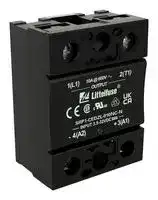


SRP1-CEDZH-080NC-N
Solid State Relay, SPST-NO, 80 A, 660 VAC, Panel Mount, Screw, Zero Crossing
- Manufacturer: LITTELFUSE
- Product type:
- SVHC: No SVHC (25-Jun-2025)
- Load Current: 80A
- Product Range: SRP1-CE Series
- Relay Mounting: Panel Mount
- Switching Mode: Zero Crossing
- Relay Terminals: Screw
- Control Voltage Max: 32VDC
- Control Voltage Min: 4VDC
- Contact Configuration: SPST-NO
- Operating Voltage Max: 660VAC
- Operating Voltage Min: 24VAC
| Delivery and price | |
|---|---|
| Units per pack | 10 |
| Price | 44.4 € |
| Current stock | 10+ |
| Lead time | 30 days |

**Solid State Relays** SRP1-CE Series

## **REACH HF**

## **Description**

The SRP1-CE Relays series offers an affordable solution for controlling simple heating applications. Designed with efficiency in mind, these solid-state relays (SSRs) provide essential features without compromising on quality.

- Industrial-Grade Build: Crafted for durability, these SSRs are built to withstand demanding environments using back-to-back SCRs to guarantee high quality, reliability, and longevity.

- IP20 Removable Protection: The IP20-rated design ensures protection against dust and accidental contact. Easily remove the cover for maintenance or adjustments.

## **Features & Benefits**

|FEATURES|BENEFITS|
|---|---|
|**Zero Cross Switching**|Reduces electrical noise and minimizes voltage spikes during<br>switching, enhancing overall system stability|
|**Compliance with International Standards**|Ensures that the Solid-State Relay (SSR) has undergone rigorous|
|**(cЯUus, VDE, CE, UKCA)**|testing, providing enhanced safety and product quality|
|**Efficient Design with High Quality**|Balances cost-effectiveness with reliable performance,<br>making it an ideal choice for budget-conscious projects|


## **Applications**

- Cooking ovens & hot drinks dispensers

- Commercial fryers and food warmers

- Air handlers and other HVAC equipment

- Plastic & packaging machinery

- Industrial ovens & electronics production equipment

- Heating in industrial automation

**Littelfuse.com/SRP1-CE** ©2025 Littelfuse, Inc. Specifications are subject to change without notice. Revised: 07/08/2025

**1 of 12**

**Solid State Relays** SRP1-CE Series

## **Ordering Information**

|**FOR HEATING CONTROL**<br>CATALOG NUMBER<br>SRP1-CEDZL-010NC-N<br>SRP1-CEDZL-020NC-N<br>SRP1-CEDZL-040NC-N<br>SRP1-CEDZH-050NC-N<br>SRP1-CEDZH-070NC-N<br>SRP1-CEDZH-080NC-N|OUTPUT MAX<br>CURRENT<br>10 A<br>20 A<br>40 A<br>50 A<br>70 A<br>80A|OUTPUT<br>VOLTAGE<br>12-280 V AC<br>12-280 V AC<br>12-280 V AC<br>24-660 V AC<br>24-660 V AC<br>24-660 V AC|OUTPUT<br>SWITCHING<br>STYLE<br>Zero Cross<br>Zero Cross<br>Zero Cross<br>Zero Cross<br>Zero Cross<br>Zero Cross|OUTPUT<br>OVERVOLTAGE<br>PROTECTION<br>-<br>-<br>-<br>-<br>-<br>-|INPUT VOLTAGE<br>RANGE<br>4-32 V DC<br>4-32 V DC<br>4-32 V DC<br>4-32 V DC<br>4-32 V DC<br>4-32 V DC|COMPLIANCE<br>cЯUus, VDE, CE, UKCA<br>cЯUus, VDE, CE, UKCA<br>cЯUus, VDE, CE, UKCA<br>cЯUus, VDE, CE, UKCA<br>cЯUus, VDE, CE, UKCA<br>cЯUus, VDE, CE, UKCA|
|---|---|---|---|---|---|---|


## **Input/Control Specifications[1]**

## **GENERAL DATA**

||||VALUE FOR|VALUE FOR||
|---|---|---|---|---|---|
|SYMBOL|PARAMETER|RANGE|10A, 20A, 40A|50A, 70A, 80A|UNIT|
||||VERSIONS|VERSIONS||
|Uc|Input (Control) Voltage*|Maximum<br>Nominal<br>Minimum|32<br>5 – 12 – 24<br>3|32<br>5 – 12 – 24<br>3.5|VDC<br>VDC<br>VDC|
|Urv|Reverse Voltage|Maximum|-32|-32|VDC|
|Uc on|Turn-On Voltage<br>(Pick-up/Engage/Activation Voltage)|Minimum|3.0|3.5|VDC|
|Uc off|Turn-Off Voltage<br>(Drop Out/Release/Deactivation Voltage)|Nominal|1.0|2.0|VDC|
|||Maximum|<13|<13|mA|
|Ic|Input (Control) Current|Minimum|<10|<10|mA|
|-|Input Impedance|Nominal|Current Regulated|Current Regulated|-|
|Ton|Turn-On Time|Maximum|10|10|1/2 ms|
|Toff|Turn-Off Time|Maximum|10|10|1/2 ms|


*Increase Min voltage by 1V for operations from -20 to -40 °C.

## Input Current vs Input Voltage Graphs (For Power Supply Selection)

To ensure the SSR operates efficiently and reliably, it is essential to understand the relationship between input voltage and input current. The following input current graphs provide detailed information on the current consumption of our SSRs across the specified input voltage range. This data is crucial for selecting an appropriate power supply and ensuring the relay functions within its safe operating limits. Proper understanding of current consumption is vital for the optimal performance of your application.

## **3-32 VDC Input (10A, 20A, 40A Versions)**

## **3.5-32 VDC Input (50A, 70A, 80A Versions)**

**==> picture [519 x 103] intentionally omitted <==**

**----- Start of picture text -----**<br>
 14 mA  14 mA<br> 12 mA y  12 mA<br> 10 mA mtb1 1 1 1 1 1 de! ' 1 1  10 mA me J_____---L____----4_-_-------1--------L-------1 T1 11 '1 i]I 4i]1 -<br>I<br> 8 mA 11 1 1 1 1  8 mA 1 1 i 1 1 1<br>I11111<br> 6 mA  6 mA<br>1<br> 4 mA i] 11 '' '1 '' 1'  4 mA !! 11 11 1! i)1 ii<br> 2 mA rs 1I a 11 Os !1 Sis 11Sis !1Sis 11 Si  2 mA Tort grr'1 ttre 11pers i}1 sss gers11 ese spes1f  egif<br>111111<br> 0 mA 11 1 1 1 1  0 mA 1 1 1 1 I 1<br> 0 V DC  5 V DC  10 V DC  15 V DC  20 V DC  25 V DC  30 V DC  0 V DC  5 V DC  10 V DC  15 V DC  20 V DC  25 V DC  30 V DC<br>Input (Control) Voltage Input (Control) Voltage<br>Input (Control) Current Input (Control) Current<br>**----- End of picture text -----**<br>


**Littelfuse.com/SRP1-CE**

©2025 Littelfuse, Inc. Specifications are subject to change without notice. Revised: 07/08/2025

**2 of 12**

**Solid State Relays** SRP1-CE Series

**==> picture [56 x 55] intentionally omitted <==**

**==> picture [314 x 55] intentionally omitted <==**

## **Output/Load Specifications[1]**

**==> picture [494 x 509] intentionally omitted <==**

**----- Start of picture text -----**<br>
LOW VOLTAGE VERSIONS (280V)<br>VALUE FOR 10A  VALUE FOR 20A  VALUE FOR 40A<br>SYMBOL PARAMETER CONDITION RANGE UNIT<br>VERSIONS VERSIONS VERSIONS<br>- Output Configuration - - SPST-NO SPST-NO SPST-NO -<br>Minimum 0,1 0,1 0,1<br>f Operating Frequency - Nominal 50-60 50-60 50-60 Hz<br>Maximum 800 800 800<br>Minimum 12 12 12<br>Ue Operating Voltage 47-63Hz Nominal 120-240 120-240 120-240 Vrms<br>Maximum 280 280 280<br>Usync Zero Cross Level   - Maximum 35 35 35 V<br>(Zero Voltage Turn-on)<br>Ua Latching Voltage At Ue Nominal Minimum 10 10 10 V<br>V On-State Voltage Drop At Rated Current Maximum 0,85 + 0,035 x Ie 0,85 + 0,016 x Ie 0,9 + 0,014 x Ie Vrms<br>Vto Threshold Voltage (Power  Tvj = 150 °C Maximum 0,85 0,85 0,90 V<br>Loss Calculations only)<br>On state dynamic<br>rt resistance (Power Loss   Tvj = 150 °C Maximum 35,0 16,0 14,0 mΩ<br>Calculations only)<br>Transient Over-Voltage*<br>Up (Peak/Blocking/Non- - Maximum 600 600 600 Vpk<br>Repetitive Voltage)<br>Minimum 120 260 380<br>Transient Over-Current   Max 1 Cycle<br>Itsm (Surge/Overload/Non- Apk<br>Repetitive Current) Tp = 10ms Nominal 160 340 500<br>Ilk Leakage Current  At Rated Voltage Maximum 1 1 1 mArms<br>(Off-State)<br>At Maximum<br>dv/dt Critical dV/dt (Off-State) Minimum 500 500 500 V/µsec<br>Rated Voltage<br>di/dt Non-repetitive di/dt - Maximum 50 50 50 A/μsec<br>½ Cycle at  Minimum 72 340 720<br>I²t I²t Value for Fusing 50/60Hz  A² sec<br>(Tvj=45 °C) Nominal 128 600 1250<br>Pf Minimum Power Factor At Maximum  Minimum 0,5 0,5 0,5 -<br>Load<br>0.765 x Ie +   0.765 x Ie +   0.81 x Ie +<br>Pd Power Dissipation At Rated Current Maximum W<br>0.035 x Ie² 0.016 x Ie² 0.014 x Ie²<br>Rthj/c Thermal Resistance  - Maximum 2,3 0,9 0,55 °C/W<br>Junction to Case (Rjc)<br>**----- End of picture text -----**<br>


*Output will self trigger between 450-600 Vpk not suitable for capacitive loads.

**Littelfuse.com/SRP1-CE**

©2025 Littelfuse, Inc. Specifications are subject to change without notice. Revised: 07/08/2025

**3 of 12**

**Solid State Relays** SRP1-CE Series

**==> picture [56 x 55] intentionally omitted <==**

**==> picture [314 x 55] intentionally omitted <==**

## **Output/Load Specifications[1] (Continued)**

**==> picture [494 x 436] intentionally omitted <==**

**----- Start of picture text -----**<br>
HIGH VOLTAGE VERSIONS (600V)<br>VALUE FOR 50A  VALUE FOR 70A  VALUE FOR 80A<br>SYMBOL PARAMETER CONDITION RANGE UNIT<br>VERSIONS VERSIONS VERSIONS<br>- Output Configuration - - SPST-NO SPST-NO SPST-NO -<br>Minimum 0,1 0,1 0,1<br>f Operating Frequency - Nominal 50-60 50-60 50-60 Hz<br>Maximum 800 800 800<br>Minimum 24 24 24<br>Ue Operating Voltage 47-63Hz Nominal 400 400 400 Vrms<br>Maximum 600 600 600<br>Usync Zero Cross Level   - Maximum 35 35 35 V<br>(Zero Voltage Turn-on)<br>Ua Latching Voltage At Ue Nominal Minimum 10 10 10 V<br>V On-State Voltage Drop At Rated Current Maximum 0,85 + 0,0075 x Ie 1 + 0,0045 x Ie 0,8 + 0,003 x Ie Vrms<br>Vto Threshold Voltage (Power  Tvj = 150 °C Maximum 0,85 1,00 0,80 V<br>Loss Calculations only)<br>On state dynamic<br>rt resistance (Power Loss  Tvj = 150 °C Maximum 7,5 4,5 3,0 mΩ<br>Calculations only)<br>Transient Over-Voltage*<br>Up (Peak/Blocking/Non- - Maximum 1200 1200 1200 Vpk<br>Repetitive Voltage)<br>Transient Over-Current   1/2 Cycle At  Minimum 530 1100 1400<br>Itsm (Surge/Overload/Non- 50/60 Hz  Apk<br>Repetitive Current) (Tvj=45 °C) Nominal 580 1200 1500<br>Ilk Leakage Current (Off-State) At Rated Voltage Maximum 1 1 1 mArms<br>At Maximum<br>dv/dt Critical dV/dt (Off-State) Minimum 500 500 500 V/µsec<br>Rated Voltage<br>di/dt Non-repetitive di/dt - Maximum 50 50 50 A/μsec<br>½ Cycle at  Minimum 1404 6000 9800<br>I²t I²t Value for Fusing 50/60Hz  A² sec<br>(Tvj=45 °C) Nominal 1680 7200 11250<br>Pf Minimum Power Factor At Maximum Load Minimum 0,5 0,5 0,5 -<br>0.765 x Ie +   0.9 x Ie +   0.72 x Ie +<br>Pd Power Dissipation At Rated Current Maximum W<br>0.0075 x Ie² 0.0045 x Ie² 0.003 x Ie²<br>Rthj/c Thermal Resistance  - Maximum 0,6 0,3 0,3 °C/W<br>Junction to Case (Rjc)<br>**----- End of picture text -----**<br>


*Output will self trigger between 450-600 Vpk not suitable for capacitive loads.

The maximum continuous current value given in this datasheet is only for resistive loads (specifically AC-1 type), which are mainly used for heating control.

**==> picture [494 x 116] intentionally omitted <==**

**----- Start of picture text -----**<br>
VALUE FOR 10A  VALUE FOR 20A  VALUE FOR 40A<br>SYMBOL PARAMETER CONDITION RANGE UNIT<br>VERSIONS VERSIONS VERSIONS<br>Load Current (Continuous)  Maximum* 12 25 40 Arms<br>Ie (AC-51) At 40 °C<br>– Heating Elements (AC-1) Minimum 0,005 0,005 0,05 Arms<br>VALUE FOR 50A  VALUE FOR 70A  VALUE FOR 80A<br>SYMBOL PARAMETER CONDITION RANGE UNIT<br>VERSIONS VERSIONS VERSIONS<br>Load Current (Continuous)  Maximum* 60 90 95 Arms<br>Ie (AC-51) At 40 °C<br>– Heating Elements (AC-1) Minimum 0,005 0,005 0,005 Arms<br>**----- End of picture text -----**<br>


*Heat sinking required, see derating curves.

**Littelfuse.com/SRP1-CE**

©2025 Littelfuse, Inc. Specifications are subject to change without notice. Revised: 07/08/2025

**4 of 12**

**Solid State Relays** SRP1-CE Series

## Thermal Derating Curves (For Heatsink Selection)

To operate the Solid-State Relay (SSR) at its specified ratings, the use of a heatsink is mandatory. The following thermal derating curves illustrate the maximum load current that our SSRs can manage under varying ambient temperatures and heatsink sizes. It is crucial to select a heatsink that is most suitable for your specific application.

## **10A Versions**

**==> picture [183 x 534] intentionally omitted <==**

**----- Start of picture text -----**<br>
 10 A<br>(B) (C) (D) (E)<br> 9 A<br> 8 A<br> 7 A<br> 6 A<br>(A)<br> 5 A<br> 4 A<br> 3 A<br> 2 A<br> 1 A<br> 0 A<br> 0 °C  10 °C  20 °C  30 °C  40 °C  50 °C  60 °C  70 °C  80 °C<br>Ambient Temperature<br>No Heatsink (C) 5,0 °C/W: Heatsink  (E) 2,1 °C/W:<br>Heatsink (D) 3,0 °C/W: Heatsink<br> 40 A<br> 35 A (C) (D) (E) (F)<br> 30 A (B)<br> 25 A<br> 20 A<br> 15 A<br>(A)<br> 10 A<br> 5 A<br> 0 A<br> 0 °C  10 °C  20 °C  30 °C  40 °C  50 °C  60 °C  70 °C  80 °C<br>Ambient Temperature<br>Heatsink (C) 1,5 °C/W: Heatsink  (E) 1,0 °C/W:<br>Heatsink (D) 1,2 °C/W: Heatsink (F) 0,7 °C/W:<br> 70 A<br> 60 A<br>(C) (D) (E) (F)<br> 50 A<br>(B)<br> 40 A (A)<br> 30 A<br> 20 A<br> 10 A<br> 0 A<br> 0 °C  10 °C  20 °C  30 °C  40 °C  50 °C  60 °C  70 °C  80 °C<br>Ambient Temperature<br>Output (Load) Current<br>Output (Load) Current<br>Output (Load) Current<br>**----- End of picture text -----**<br>


**(A):** No Heatsink **(C) 5,0 °C/W:** Heatsink **(E) 2,1 °C/W:** Heatsink **(B) 6,0°C/W:** Heatsink **(D) 3,0 °C/W:** Heatsink

## **40A Versions**

**(A) 6,0 °C/W:** Heatsink **(C) 1,5 °C/W:** Heatsink **(E) 1,0 °C/W:** Heatsink **(B) 2,1 °C/W:** Heatsink **(D) 1,2 °C/W:** Heatsink **(F) 0,7 °C/W:** Heatsink

## **70A Versions**

**(A) 1,75 °C/W:** Heatsink **(C) 1,2 °C/W:** Heatsink **(E) 0,7 °C/W:** Heatsink **(B) 1,5 °C/W:** Heatsink **(D) 1,0 °C/W:** Heatsink **(F) 0,5 °C/W:** Heatsink

## **20A Versions**

**==> picture [179 x 530] intentionally omitted <==**

**----- Start of picture text -----**<br>
 20 A<br>(B) (C) (D) (E)<br> 18 A<br> 15 A<br> 13 A<br>(A)<br> 10 A<br> 08 A<br> 05 A<br> 03 A<br> 00 A<br> 0 °C  10 °C  20 °C  30 °C  40 °C  50 °C  60 °C  70 °C  80 °C<br>Ambient Temperature<br>Heatsink (C) 2,1 °C/W: Heatsink  (E) 1,5 °C/W:<br>Heatsink (D) 1,75 °C/W: Heatsink<br> 50 A<br> 45 A<br>(C) (D) (E) (F)<br> 40 A<br>(B)<br> 35 A<br>(A)<br> 30 A<br> 25 A<br> 20 A<br> 15 A<br> 10 A<br> 5 A<br> 0 A<br> 0 °C  10 °C  20 °C  30 °C  40 °C  50 °C  60 °C  70 °C  80 °C<br>Ambient Temperature<br>Heatsink (C) 1,5 °C/W: Heatsink  (E) 0,7 °C/W:<br>Heatsink (D) 1,0 °C/W: Heatsink (F) 0,5 °C/W:<br> 80 A<br>(C) (D) (E) (F)<br> 70 A<br>(B)<br> 60 A<br>(A)<br> 50 A<br> 40 A<br> 30 A<br> 20 A<br> 10 A<br> 0 A<br> 0 °C  10 °C  20 °C  30 °C  40 °C  50 °C  60 °C  70 °C  80 °C<br>Ambient Temperature<br>Output (Load) Current<br>Output (Load) Current<br>Output (Load) Current<br>**----- End of picture text -----**<br>


**(A) 6,0 °C/W:** Heatsink **(C) 2,1 °C/W:** Heatsink **(E) 1,5 °C/W:** Heatsink **(B) 3,0 °C/W:** Heatsink **(D) 1,75 °C/W:** Heatsink

## **50A Versions**

**(A) 2,1 °C/W:** Heatsink **(C) 1,5 °C/W:** Heatsink **(E) 0,7 °C/W:** Heatsink **(B) 1,75 °C/W:** Heatsink **(D) 1,0 °C/W:** Heatsink **(F) 0,5 °C/W:** Heatsink

## **80A Versions**

**(A) 1,5 °C/W:** Heatsink **(C) 1,0 °C/W:** Heatsink **(E) 0,5 °C/W:** Heatsink **(B) 1,2 °C/W:** Heatsink **(D) 0,7 °C/W:** Heatsink **(F) 0,3 °C/W:** Heatsink

**Littelfuse.com/SRP1-CE**

©2025 Littelfuse, Inc. Specifications are subject to change without notice. Revised: 07/08/2025

**5 of 12**

**Solid State Relays** SRP1-CE Series

**==> picture [56 x 55] intentionally omitted <==**

**==> picture [314 x 55] intentionally omitted <==**

## Considerations – Switching Type

In applications requiring precise temperature management, solid-state relays (SSRs) play a crucial role. Specifically, the Zero Cross Switching type of SSR is commonly employed to regulate heaters based on signals from a temperature controller.

This technology proves particularly valuable in scenarios where high-frequency switching occurs—such as when a heater cycles on and off frequently over short intervals for extended periods.

## Considerations – Inrush Current

It’s essential to recognize that variations exist between different types of heating elements, especially in hot or cold conditions. While it is generally expected that heating elements exhibit no inrush current, in certain heating elements cold conditions can lead to an inrush current equivalent to 1.4 times the nominal current. To mitigate this, we highly recommend oversizing the current rating and ensuring an appropriately sized heatsink. Doing so improves the relay’s thermal endurance and extends its operational lifespan.

So, when selecting an SSR, consider using one with a capacity approximately 1.4 times that of the heater or operating the SSR at only 75%-80% of its maximum capacity. The following table provides guidance for choosing the right SSR for a specific heater load.

**==> picture [494 x 118] intentionally omitted <==**

**----- Start of picture text -----**<br>
NOMINAL SSR  MAXIMUM RECOMMENDED  HEATER POWER  HEATER POWER  HEATER POWER  HEATER POWER  HEATER POWER<br>CURRENT RATING HEATER CURRENT AT 120 VAC AT 240 VAC AT 400 VAC AT 480 VAC AT 600 VAC<br>10 A 8 A 960 W 1.9 KW - - -<br>20 A 16 A 1.8 KW 3.6 KW - - -<br>40 A 32 A 3.6 KW 7.2 KW - - -<br>50 A 40 A 4.8 KW 9.6 KW 16.0 KW 19.2 KW 24.0 KW<br>70 A 56 A 6.3 KW 12.6 KW 21.0 KW 25.2 KW 31.5 KW<br>80 A 64 A 7.2 KW 14.4 KW 24.0 KW 28.8 KW 36.0 KW<br>**----- End of picture text -----**<br>


## Output Surge Current Withstand Graphs (For Transient Protection)

To ensure the Solid-State Relay (SSR) can handle sudden increases in current without damage, it is essential to understand its surge current capacity. The following surge current graphs illustrate the maximum surge current that our SSRs can withstand over various durations. This information is crucial for selecting an SSR that can endure transient overcurrent events, ensuring the reliability and safety of your electrical system. Proper understanding of surge current capacity helps in preventing equipment failure and maintaining optimal performance in your application.

The graphs include a Single Pulse Surge Current curve used to define the protection offered by fuses, helping in the selection of appropriate protective devices. Additionally, is important to ensure that the Repetitive Surge Current curve is not exceeded during normal operation, as frequent overload currents can decrease the life expectancy of the SSR. Therefore, caution is advised to maintain the longevity and reliability of the SSR.

## **10A Versions:**

## **20A Versions:**

**==> picture [457 x 98] intentionally omitted <==**

**----- Start of picture text -----**<br>
 150 Apk  300 Apk<br>(A)<br> 125 Apk (A)  250 Apk<br> 100 Apk  200 Apk<br> 75 Apk  150 Apk<br> 50 Apk  100 Apk<br>(B) (B)<br> 25 Apk  50 Apk<br> 0 Apk  0 Apk<br> 0,01 s  0,10 s  1,00 s  10,00 s  0,01 s  0,10 s  1,00 s  10,00 s<br>Output (Load) Surge Duartion Output (Load) Surge Duartion<br>Output (Load) Surge Current Output (Load) Surge Current<br>**----- End of picture text -----**<br>


- **(A) Single Pulse Surge:** Initial SSR internal temperature at 25 °C (cooler state from minimal or no operation).

**(B) Repetitive Surges:** Initial SSR internal temperature 90 °C (warmer state from continuous operation).

- **(A) Single Pulse Surge:** Initial SSR internal temperature at 25 °C (cooler state from minimal or no operation).

- **(B) Repetitive Surges:** Initial SSR internal temperature 121 °C (warmer state from continuous operation).

**Littelfuse.com/SRP1-CE**

©2025 Littelfuse, Inc. Specifications are subject to change without notice. Revised: 07/08/2025

**6 of 12**

**Solid State Relays** SRP1-CE Series

**==> picture [56 x 55] intentionally omitted <==**

## **40A Versions:**

**==> picture [193 x 93] intentionally omitted <==**

**----- Start of picture text -----**<br>
 400 Apk<br> 350 Apk<br> 300 Apk<br> 250 Apk<br> 200 Apk<br> 150 Apk<br> 100 Apk (A)<br> 50 Apk (B)<br> 0 Apk<br> 0,01 s  0,10 s  1,00 s  10,00 s<br>Output (Load) Surge Duartion<br>Output (Load) Surge Current<br>**----- End of picture text -----**<br>


- **(A) Single Pulse Surge:** Initial SSR internal temperature at 25 °C (cooler state from minimal or no operation).

- **(B) Repetitive Surges:** Initial SSR internal temperature 70 °C (warmer state from continuous operation).

## **70A Versions:**

**==> picture [193 x 93] intentionally omitted <==**

**----- Start of picture text -----**<br>
1 200 Apk<br>1 000 Apk<br> 800 Apk<br> 600 Apk<br> 400 Apk<br> 200 Apk (A)<br>(B)<br> 0 Apk<br> 0,01 s  0,10 s  1,00 s  10,00 s<br>Output (Load) Surge Duartion<br>Output (Load) Surge Current<br>**----- End of picture text -----**<br>


- **(A) Single Pulse Surge:** Initial SSR internal temperature at 25 °C (cooler state from minimal or no operation).

- **(B) Repetitive Surges:** Initial SSR internal temperature 70 °C (warmer state from continuous operation).

**==> picture [314 x 55] intentionally omitted <==**

## **50A Versions:**

**==> picture [192 x 262] intentionally omitted <==**

**----- Start of picture text -----**<br>
 600 Apk<br> 500 Apk<br> 400 Apk<br> 300 Apk<br> 200 Apk<br> 100 Apk (A)<br>(B)<br> 0 Apk<br> 0,01 s  0,10 s  1,00 s  10,00 s<br>Output (Load) Surge Duartion<br>Initial SSR internal temperature at 25 °C<br>(cooler state from minimal or no operation).<br>Initial SSR internal temperature 70 °C<br>(warmer state from continuous operation).<br>1 800 Apk<br>1 500 Apk<br>1 200 Apk<br> 900 Apk<br> 600 Apk<br>(A)<br> 300 Apk<br>(B)<br> 0 Apk<br> 0,01 s  0,10 s  1,00 s  10,00 s<br>Output (Load) Surge Duartion<br>Output (Load) Surge Current<br>Output (Load) Surge Current<br>**----- End of picture text -----**<br>


- **(A) Single Pulse Surge:** Initial SSR internal temperature at 25 °C (cooler state from minimal or no operation).

- **(B) Repetitive Surges:** Initial SSR internal temperature 70 °C (warmer state from continuous operation).

## **80A Versions:**

- **(A) Single Pulse Surge:** Initial SSR internal temperature at 25 °C (cooler state from minimal or no operation).

- **(B) Repetitive Surges:** Initial SSR internal temperature 70 °C (warmer state from continuous operation).

## **General Specifications[1]**

**==> picture [494 x 249] intentionally omitted <==**

**----- Start of picture text -----**<br>
GENERAL DATA<br>SYMBOL PARAMETER CONDITION RANGE VALUE UNIT<br>- - - Continuously ON Green LED,  -<br>LED for Input (Control) Status Indicator<br>when control input is applied<br>Input to Output<br>Nominal 4 000<br>(50/60 HZ)<br>Ui Isolation (Dielectric Strength)  Vrms<br>Input/Output to<br>Nominal 2 500*<br>Ground (50/60 HZ)<br>Ri Insulation Resistance @ 500 VDC Minimum 1 GΩ<br>- Coupling Capacitance Input/Output Maximum 0,8 pF<br>Uimp Impulse Withstand Voltage - Nominal 4000 Vrms<br>- Short Circuit Current Rating (SCCR) - - 100 kA<br>- Endurance according to American Standard UL508 - Typical 100 000 Cycles<br>MTTFd (Mean Time to Dangerous Failure)<br>-  (Calculated in accordance with the guidelines for safety-related parts of  - - 110 Years<br>control systems, as specified by the international standard ISO 13849-1)<br>MTBF** (Mean Time Between Failures) @ 40 °C ambient - 72<br>- (Calculated in accordance with the Military Handbook Guidelines for  Years<br>Reliability Prediction of Electronic Equipment, as specified by the US  @ 60 °C ambient - 46<br>Department of Defense Standard MIL-HDBK-217)<br>**----- End of picture text -----**<br>


- *Value for 50A, 70A and 80A versions is 4 000 Vrms.

- **All parameters at 50% power rating and 100% duty cycle.

**Littelfuse.com/SRP1-CE**

©2025 Littelfuse, Inc. Specifications are subject to change without notice. Revised: 07/08/2025

**7 of 12**

**Solid State Relays** SRP1-CE Series

**==> picture [56 x 55] intentionally omitted <==**

**==> picture [314 x 55] intentionally omitted <==**

## **General Specifications[1 ] (Continued)**

**==> picture [493 x 262] intentionally omitted <==**

**----- Start of picture text -----**<br>
ENVIRONMENTAL<br>DATA<br>SYMBOL PARAMETER CONDITION RANGE VALUE UNIT<br>Vibration<br>- (Test conducted in accordance with the Vibration  5-100Hz Nominal 10 g<br>Environmental Testing Guidelines of the International<br>Standard IEC 60068-2-6)<br>Shock<br>- (Test conducted in accordance with the Shock  11ms Nominal 30, 40, 50 g<br>Environmental Testing Guidelines of the International<br>Standard IEC 60068-2-27)<br>Maximum 100 (212) °C (°F)<br>- No icing, no<br>Ambient Temperature - Operating (Working) [ 2]<br>condensation Minimum -40 (-40)* °C (°F)<br>Maximum 125 (257) °C (°F)<br>- No icing, no<br>Ambient Temperature - Storage<br>condensation Minimum -40 (-40)* °C (°F)<br>HR Relative Ambient Humidity Non-condensing  Nominal 40 to 85 %<br>(Per international standard IEC/EN 60068-2-78) @ 40 °C<br>Non-conductive<br>- Pollution Degree pollution with  Nominal 2 kA<br>condensation<br>possibilities<br>**----- End of picture text -----**<br>


*Value for 10A, 20A, 40A and 50A versions is -55 (-67) °C (°F).

**==> picture [493 x 304] intentionally omitted <==**

**----- Start of picture text -----**<br>
MECHANICAL<br>DATA<br>SYMBOL PARAMETER CONDITION RANGE VALUE UNIT<br>- Product Weight - Typical 80 (0.18) g (lbs)<br>Housing Material<br>- (In accordance with the American Standard UL- 94 for  - - Plastic UL 94 V-0 -<br>Safety of Flammability of Plastic Materials for Parts in<br>Devices and Appliances)<br>- - - Aluminum, Tinned- -<br>Baseplate Material<br>plated<br>Touch Protection Level<br>- (Test conducted in accordance with the IP Code of  - - IP20 -<br>Degrees of Protection Testing Guidelines of the<br>International Standard IEC 60529)<br>Input (Control)  Minimum 1.2 (11)<br>Nm (in-lb)<br>Terminals Maximum 2.0 (18)<br>- Screw Torque Range Output (Load)  Minimum 2 (18) Nm (in-lb)<br>Terminals Maximum 3 (26)<br>Minimum 1.2 (11)<br>SSR Mounting Nm (in-lb)<br>Maximum 1.8 (16)<br>Input Terminals - M4 x 0.7 -<br>- Screw Thread Size Output Terminals - M5 x 0.8 -<br>- M4 x 12mm or  -<br>SSR Mounting<br>#8-32 Pan Head<br>**----- End of picture text -----**<br>


**Littelfuse.com/SRP1-CE**

©2025 Littelfuse, Inc. Specifications are subject to change without notice. Revised: 07/08/2025

**8 of 12**

**Solid State Relays** SRP1-CE Series

## **Product Dimensions (Millimeters)**

**==> picture [421 x 370] intentionally omitted <==**

**----- Start of picture text -----**<br>
Wiring Diagram<br>AC<br>LOAD<br>a)<br>1 2<br>(~) (~)<br>4 4<br>(-/~) (+/~)<br>Om -O,<br>DC<br>Equivalent Circuit Block<br>4 (-) OPTICAL ISOLATION 1 (~)<br>REGULATION<br>Input Output<br>Terminals oT 7 t h Terminals<br>VDC VAC<br>3 (+) o—_- pe TRIGGER CIRCUIT(ZERO CROSS) -__ ¥ . | © 2 (~)<br>DC CONTROL<br>**----- End of picture text -----**<br>


## **Equivalent Circuit Block**

**Littelfuse.com/SRP1-CE**

©2025 Littelfuse, Inc. Specifications are subject to change without notice. Revised: 07/08/2025

**9 of 12**

**Solid State Relays** SRP1-CE Series

## **Short-Circuit Protection by Fuse**

To safeguard solid-state relays (SSRs) against load short circuits, the use of fuses is essential, especially fast-acting ones. Here are the key considerations:

- Fuse Selection: The I²t value (energy withstand capability) of the fuse should be less than half of the I²t value of the relay. Standard fuses are inadequate because they cannot react swiftly enough to prevent fault currents from exceeding the maximum levels that thyristors (used in SSRs) can handle. Therefore, we strongly recommend employing ultra-fast fuses.

- Fuse Placement: Position the fuse in front of the SSR in the circuit. This strategic placement ensures that if the relay must unexpectedly break the earth insulation (due to overheating, case damage, or leakage with the heatsink), the fuse will protect the entire circuit from firing.

- Resource for Fuse Options: For the most suitable fuse options, consider checking the ~~_~~ Littelfuse website.

## **Standards Conformity & Certifications**

## Product Safety Certifications

Products tested, compliant and certified to the following standards that states the requirements for electrical products to ensure they are safe for consumers to use.

|CERTIFICATION<br>BODY MARK|CERTIFICATION<br>BODY NAME<br>cЯUus|CERTIFICATION<br>DESCRIPTION<br>North American certificate of<br>compliance with the Safety<br>requirements for Industrial<br>Control Equipment|STANDARDS COVERED BY THE CERTIFICATION<br>**UL508**<br>American Standard of Safety for Industrial Control Equipment.<br>**CAN/CSA**<br>**C22.2 No.14-18**<br>Canadian Standard of Safety for Industrial Control Equipment.|
|---|---|---|---|
|~~app~~|VDE<br>~~pp~~|European certificate of<br>compliance with the Safety<br>requirements for Solid-state<br>relays and Low Voltage Gear<br>Safety<br>~~pp~~|**IEC/EN 60947-1, VDE 0660-100**<br>European Standard of Safety for Low-Voltage Switchgear and Controlgear.<br>**IEC/EN 60947-4-3, VDE 0660-109**<br>European Standard of Safety for Semiconductor Controllers and Contactors<br>for Non-Motor Loads.|
|~~a pp~~|CE<br>~~pp~~|Conformity with the<br>European safety, health, and<br>environmental protection<br>requirements.<br>~~pp~~|**LVD Directive**<br>**2014/35/EU**<br>EU Directive of Safety for Low Voltage Gear Equipment.<br>In accordance with the Low Voltage Gear Testing Guidelines of the International Standard IEC 60947-4-3<br>**EMC Directive**<br>**2014/30/EU**<br>EU Directive of Electromagnetic Compatibility.<br>In accordance with the Low Voltage Gear Testing Guidelines of the International Standard IEC 60947-4-3<br>**RoHS Directive**<br>**2015/863/EU**<br>EU Directive of Hazardous Substances Restriction.<br>In accordance with the Assessment of electrical and electronic products with respect to the restriction<br>of Hazardous substances Guidelines of the International Standard IEC 63000|
|UK<br>CA|UKCA|Conformity with the UK<br>product safety regulations|**SI 1101**<br>UK Regulations of Safety for Electrical Equipment.<br>In accordance with the Low Voltage Gear Testing Guidelines of the International Standard IEC 60947-4-3<br>**SI 1091**<br>UK Regulations of Electromagnetic Compatibility.<br>In accordance with the Low Voltage Gear Testing Guidelines of the International Standard IEC 60947-4-3<br>**SI 3032**<br>UK Regulations of Hazardous Substances Restriction.<br>In accordance with the Assessment of electrical and electronic products with respect to the restriction<br>of Hazardous substances Guidelines of the International Standard IEC 63000|


**Littelfuse.com/SRP1-CE**

©2025 Littelfuse, Inc. Specifications are subject to change without notice. Revised: 07/08/2025

**10 of 12**

**Solid State Relays** SRP1-CE Series

## **EMC Compliance (Electro-magnetic compatibility)**

## Radiated Emissions

|-|STANDARD NAME<br>Radiated RF|STANDARD DESCRIPTION<br>Radio interference field emission<br>(radiated)|STANDARD NUMBER<br>International Standard CISPR 11|LEVELS<br>Class A: 30M – 1GHz|
|---|---|---|---|---|
||Conducted RF|Radio interference voltage<br>emissions (conducted)|International Standard CISPR 11|Class A (with external filter):<br>150k – 30MHz|


## Immunity

|Immunity|||||
|---|---|---|---|---|
|-|STANDARD NAME<br>ESD|STANDARD DESCRIPTION<br>Immunity to Electrostatic<br>Discharge (ESD)|STANDARD NUMBER<br>International Standard<br>IEC 61000-4-2|LEVELS<br>Level 3:<br>-Contact Discharge: ± 6 kV<br>-Air Discharge: ± 8 kV<br>-Performance Criteria: A|
||Radiated RF|Immunity to Radiated Radio<br>Frequency|International Standard<br>IEC 61000-4-3|Level 3:<br>10 V/m (80MHz-2GHz)<br>Level 2:<br>3 V/m (2GHz-6GHz)<br>Performance Criteria: A|
||Burst|Immunity Electrical Fast Transients<br>(Burst)|International Standard<br>IEC 61000-4-4|2 kV<br>Performance Criteria: B|
||Surge|Immunity to Electrical Surges|International Standard<br>IEC 61000-4-5|2 kV<br>Performance Criteria: B|
||Conducted RF|Immunity to Conducted Radio<br>Frequency|International Standard<br>IEC 61000-4-6|Level 3: 10V/m (0.15-80 MHz)<br>Performance Criteria: A|
||Dips|Immunity to Voltage Dips|International Standard<br>IEC 61000-4-11|0% for 0.5, 1 cycle,<br>Performance Criteria: A<br>40% for 10/12 cycles,<br>Performance Criteria: A<br>70% for 25/30 cycles,<br>Performance Criteria: A<br>80% for 250/300 cycles,<br>Performance Criteria: A|
||Interruptions|Immunity to Voltage Interruptions|International Standard<br>IEC 61000-4-11|0% for 250/300 cycles,<br>Performance Criteria: B|


While these products are designed to meet high industrial standards for Class A equipment, ensuring robust performance in demanding environments, they may cause radio interference when used in domestic settings. To mitigate this, additional noise reduction measures, such as filters or shielding, may be necessary. Ensure that the entire setup where the SSR is installed complies with all relevant EMC regulations required by the application.

## **Environmental Compliance[2]**

Products comply to the following environmental standard requirements for electrical products to ensure they are safe for consumers to use.

|-|STANDARD NAME<br>RoHS|STANDARD DESCRIPTION<br>Conformity with the European Restriction of Hazardous Substances in<br>electrical and electronic products|STANDARD NUMBER<br>European Directive 2015/863/EU<br>(IEC 63000)|
|---|---|---|---|
||REACH|Conformity with the Registration, Evaluation, Authorization and<br>Restriction of Chemicals regulation to ensure safe use of chemicals|European Directive 1907/2006|
||WEEE|Conformity with the Waste Electrical and Electronic Equipment<br>regulation to ensure proper disposal and recycling of e-waste|Regulation 2002/96/EC|


**Littelfuse.com/SRP1-CE** ©2025 Littelfuse, Inc. Specifications are subject to change without notice. Revised: 07/08/2025

**11 of 12**

**Solid State Relays** SRP1-CE Series

## **Accessories**

|IMAGE|CATALOG NUMBER<br>SADH-C1N600|TYPE<br>DIN Rail Adaptor|DESCRIPTION<br>6 ºC/W Thermal Resistance|
|---|---|---|---|
||SADH-NN210|Heatsink|2.1 ºC/W Thermal Resistance|
||SADH-NN175|Heatsink|1.75 ºC/W Thermal Resistance|
||SADH-NN120|Heatsink|1.2 ºC/W Thermal Resistance|
||SADH-NN100|Heatsink|1.0 ºC/W Thermal Resistance|
||SADH-NN050|Heatsink|0.5 ºC/W Thermal Resistance, 24 VDC|
||SADH-ND030|Heatsink|0.3 ºC/W Thermal Resistance, 24 VDC|
||SADH-NA030|Heatsink|0.3 ºC/W Thermal Resistance, 230 VAC|
||SANP-C1N030|Thermal Interface|Thermal Pads|
|—_|SANG-CNN090|Thermal Interface|Thermal Paste|
|w bai|SANT-C1NM40|Mounting Screws|Mounting Screws Kit|
|on,|SANL-C1N040|Power Lugs|Power Lugs for High Current|


Notes:

- 1All parameters at 25 °C unless otherwise specified.

2The environmental compliance data reflects the most current information available and adheres to our rigorous standards for quality and sustainability. These specifications are valid from the product’s initial release and are subject to change with ongoing improvements.

## **Warning Information**

**Caution: Material Damage, Electric Shock, and Arc Flash Hazard.** Before installing or working with this equipment, take the following precautions:

1. **Disconnect all power:** Ensure that all power sources are disconnected.

2. **Verify connections:** Double-check all connections.

Failure to adhere to these instructions may lead to **serious injury or damage** of equipment.

**Disclaimer Notice –** Information furnished is believed to be accurate and reliable. However, users should independently evaluate the suitability of and test each product selected for their own applications. Littelfuse products are not designed for, and may not be used in, all applications. Read complete Disclaimer Notice at **www.littelfuse.com/product-disclaimer.**

**Littelfuse.com/SRP1-CE**

©2025 Littelfuse, Inc. Specifications are subject to change without notice. Revised: 07/08/2025

**12 of 12**
Updated at June 10, 2026
Founded in 1927 and headquartered in Chicago, Illinois, Littelfuse is a premier global manufacturer of circuit protection, power control, and sensing technologies. Widely recognized for pioneering the first small, fast-acting protective fuse, the company has grown into an industry leader whose highly reliable components are essential to modern industrial, transportation, and consumer electronics applications worldwide. At the core of the Littelfuse portfolio is an expansive and industry-leading range of circuit protection solutions. This encompasses a massive selection of traditional fuses, fuse holders, and resettable PTC thermistor fuses designed to safely interrupt overcurrent conditions. To defend against electrical overstress, Littelfuse also provides advanced transient voltage suppression (TVS) technologies, including thousands of specialized TVS diodes, TVS varistors, and gas discharge tubes (GDTs) that ensure robust defense against voltage spikes and environmental hazards. Beyond its foundational protection components, Littelfuse manufactures a diverse array of discrete semiconductors, sensors, and switching devices. Engineers rely on their high-performance thyristors, including TRIACs and SCRs, alongside power-efficient Schottky diodes and MOSFETs for demanding power control applications. Complemented by precision proximity sensors and highly reliable reed and solid-state relays, Littelfuse delivers the critical building blocks required for secure, efficient, and complete system design.
About Novapart
Novapart is a B2B electronic component broker specialising in stock shortages and cost reduction. We source hard-to-find parts and identify compliant alternatives across a catalogue of 410,000+ components from 500+ manufacturers.
Learn more →Stock Shortage Specialist
When a component is unavailable, discontinued or has an unacceptable lead time, we tap into our network of vetted European and Asian distributors to source what you need — without compromising on quality or traceability.
Request a quote →Compliant Alternatives
We identify pin-to-pin, electrically equivalent substitutes that meet the same certifications (RoHS, AEC-Q100, REACH) as your original specification — validated against datasheets, not just part numbers. Often at a lower cost.
BOM Analysis service →