
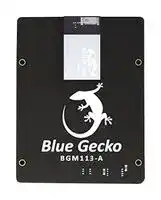


SLWRB4301A
Add-On Board, Wireless Module, BGM113 SoC, +3dBm, For Blue Gecko Starter Kits
- Manufacturer: SILICON LABS
- Product type: Bluetooth Modules & Adaptors
- Bluetooth Version:Bluetooth 4.2; Supply Voltage Min:1.85V; Supply Voltage Max:3.8V; Signal Range Max:50m; Data Rate:-; Bluetooth Class:-; Receive Sensitivity:-92dBm; Operating Temperature Min:-40°
- SVHC: To Be Advised
- Product Range: Blue Gecko Series
- Bluetooth Class: -
- Bluetooth Version: Bluetooth 4.2
- Supply Voltage Range: 1.85 V to 3.8 V
- Receiver Sensitivity Rx: -92 dBm
- Operating Temperature Range: -40 °C to 85 °C
| Delivery and price | |
|---|---|
| Units per pack | 1 |
| Price | 21.07 € |
| Current stock | 10+ |
| Lead time | 30 days |

## **UG187: BGM113 Blue Gecko Module Wireless Starter Kit User's Guide**

A Wireless Starter Kit with the BRD4301A Radio Board is an excellent starting point to get familiar with the BGM113 Blue Gecko Module. It also provides the necessary tools for developing a Silicon Labs wireless application.

BRD4301A contains the BGM113 Module, and it is a plug-in board for the Wireless Starter Kit Mainboard.

## **BRD4301A RADIO BOARD FEATURES**

- BGM113 Blue Gecko Module with 256 kB Flash and 32 kB RAM, with integrated chip antenna, RF matching network, crystals and decoupling (BGM113A256V1).

## **WIRELESS STK MAINBOARD FEATURES**

The Wireless Starter Kit Mainboard contains an on-board J-Link debugger with a Packet Trace Interface and a virtual COM port, enabling application development and debugging the attached radio board as well as external hardware. The mainboard also contains sensors and peripherals for easy demonstration of some of the BGM113's many capabilities.

This document describes how to use the BRD4301A Radio Board together with a Wireless Starter Kit Mainboard.

- Advanced Energy Monitor

- Packet Trace Interface

- Virtual COM Port

- SEGGER J-Link on-board debugger

- External device debugging

- Ethernet and USB connectivity

- Silicon Labs Si7021 Relative Humidity and Temperature sensor

- Low Power 128x128 pixel Memory LCD

- User LEDs / Pushbuttons

- 20-pin 2.54 mm EXP header

- Breakout pads for Module I/O

- CR2032 coin cell battery support

## **SOFTWARE SUPPORT**

- Simplicity Studio™

- Energy Profiler

- Network Analyzer

- iOS and Android applications

## **ORDERING INFORMATION**

- SLWRB4301A

**silabs.com** | Building a more connected world.

Rev. 2.01

## **Table of Contents**

|**1.**|**Introduction .**<br>**.**<br>**.**<br>**.**<br>**.**|**.**|**.**|**.**|**.**|**.**|**.**|**.**|**.**|**.**|**.**|**.**|**.**|**.**|**.**|**.**|**.**|**.**|**.**|**.**|**.**|**.**|**.**|**.**|**.**|**.**|**.**|**. 4**|
|---|---|---|---|---|---|---|---|---|---|---|---|---|---|---|---|---|---|---|---|---|---|---|---|---|---|---|---|---|
||1.1  Radio Boards .<br>.<br>.|.|.|.|.|.|.|.|.|.|.|.|.|.|.|.|.|.|.|.|.|.|.|.|.|.|.|. 4|
||1.2  Ordering Information|.|.|.|.|.|.|.|.|.|.|.|.|.|.|.|.|.|.|.|.|.|.|.|.|.|.|. 4|
||1.3  Getting Started<br>.<br>.|.|.|.|.|.|.|.|.|.|.|.|.|.|.|.|.|.|.|.|.|.|.|.|.|.|.|. 4|
|**2.**|**Hardware Overview .**<br>**.**|**.**|**.**|**.**|**.**|**.**|**.**|**.**|**.**|**.**|**.**|**.**|**.**|**.**|**.**|**.**|**.**|**.**|**.**|**.**|**.**|**.**|**.**|**.**|**.**|**.**|**.**|**. 5**|
||2.1  Hardware Layout .<br>.|.|.|.|.|.|.|.|.|.|.|.|.|.|.|.|.|.|.|.|.|.|.|.|.|.|.|. 5|
||2.2  Block Diagram.<br>.<br>.|.|.|.|.|.|.|.|.|.|.|.|.|.|.|.|.|.|.|.|.|.|.|.|.|.|.|. 6|
|**3.**|**Connectors .**<br>**.**<br>**.**<br>**.**<br>**.**|**.**|**.**|**.**|**.**|**.**|**.**|**.**|**.**|**.**|**.**|**.**|**.**|**.**|**.**|**.**|**.**|**.**|**.**|**.**|**.**|**.**|**.**|**.**|**.**|**.**|**.**|**. 7**|
||3.1  J-Link USB Connector|.|.|.|.|.|.|.|.|.|.|.|.|.|.|.|.|.|.|.|.|.|.|.|.|.|.|. 7|
||3.2  Ethernet Connector .|.|.|.|.|.|.|.|.|.|.|.|.|.|.|.|.|.|.|.|.|.|.|.|.|.|.|. 7|
||3.3  Breakout Pads<br>.<br>.|.|.|.|.|.|.|.|.|.|.|.|.|.|.|.|.|.|.|.|.|.|.|.|.|.|.|. 8|
||3.4  EXP Header<br>.<br>.<br>.|.|.|.|.|.|.|.|.|.|.|.|.|.|.|.|.|.|.|.|.|.|.|.|.|.|.|. 9|
||3.4.1  EXP Header Pinout||.|.|.|.|.|.|.|.|.|.|.|.|.|.|.|.|.|.|.|.|.|.|.|.|.|.10|
||3.5  Debug Connector.<br>.|.|.|.|.|.|.|.|.|.|.|.|.|.|.|.|.|.|.|.|.|.|.|.|.|.|.|.11|
||3.6  Simplicity Connector.|.|.|.|.|.|.|.|.|.|.|.|.|.|.|.|.|.|.|.|.|.|.|.|.|.|.|.12|
||3.7  Debug Adapter<br>.<br>.|.|.|.|.|.|.|.|.|.|.|.|.|.|.|.|.|.|.|.|.|.|.|.|.|.|.|.13|
|**4.**|**Power Supply and Reset **|**.**|**.**|**.**|**.**|**.**|**.**|**.**|**.**|**.**|**.**|**.**|**.**|**.**|**.**|**.**|**.**|**.**|**.**|**.**|**.**|**.**|**.**|**.**|**.**|**.**|**.**|**14**|
||4.1  Radio Board Power Selection||||.|.|.|.|.|.|.|.|.|.|.|.|.|.|.|.|.|.|.|.|.|.|.|.14|
||4.2  Board Controller Power.||.|.|.|.|.|.|.|.|.|.|.|.|.|.|.|.|.|.|.|.|.|.|.|.|.|.15|
||4.3  BGM113 Reset<br>.<br>.|.|.|.|.|.|.|.|.|.|.|.|.|.|.|.|.|.|.|.|.|.|.|.|.|.|.|.15|
|**5.**|**Peripherals .**<br>**.**<br>**.**<br>**.**<br>**.**|**.**|**.**|**.**|**.**|**.**|**.**|**.**|**.**|**.**|**.**|**.**|**.**|**.**|**.**|**.**|**.**|**.**|**.**|**.**|**.**|**.**|**.**|**.**|**.**|**.**|**.**|**16**|
||5.1  Push Buttons and LEDs||.|.|.|.|.|.|.|.|.|.|.|.|.|.|.|.|.|.|.|.|.|.|.|.|.|.16|
||5.2  Si7021 Relative Humidity||and||Temperature||||Sensor|||.|.|.|.|.|.|.|.|.|.|.|.|.|.|.|.|.17|
||5.3  Virtual COM Port .<br>.|.|.|.|.|.|.|.|.|.|.|.|.|.|.|.|.|.|.|.|.|.|.|.|.|.|.|.18|
||5.3.1  Host Interfaces|.|.|.|.|.|.|.|.|.|.|.|.|.|.|.|.|.|.|.|.|.|.|.|.|.|.|.19|
||5.3.2  Serial Configuration||.|.|.|.|.|.|.|.|.|.|.|.|.|.|.|.|.|.|.|.|.|.|.|.|.|.19|
||5.3.3  Hardware Handshake|||.|.|.|.|.|.|.|.|.|.|.|.|.|.|.|.|.|.|.|.|.|.|.|.|.20|
|**6.**|**Expansion Board .**<br>**.**<br>**.**|**.**|**.**|**.**|**.**|**.**|**.**|**.**|**.**|**.**|**.**|**.**|**.**|**.**|**.**|**.**|**.**|**.**|**.**|**.**|**.**|**.**|**.**|**.**|**.**|**.**|**.**|**21**|
||6.1  Accelerometer.<br>.<br>.|.|.|.|.|.|.|.|.|.|.|.|.|.|.|.|.|.|.|.|.|.|.|.|.|.|.|.21|
||6.2  Push Buttons and LEDs||.|.|.|.|.|.|.|.|.|.|.|.|.|.|.|.|.|.|.|.|.|.|.|.|.|.21|
||6.3  Joystick .<br>.<br>.<br>.<br>.|.|.|.|.|.|.|.|.|.|.|.|.|.|.|.|.|.|.|.|.|.|.|.|.|.|.|.22|
|**7.**|**Board Controller .**<br>**.**<br>**.**|**.**|**.**|**.**|**.**|**.**|**.**|**.**|**.**|**.**|**.**|**.**|**.**|**.**|**.**|**.**|**.**|**.**|**.**|**.**|**.**|**.**|**.**|**.**|**.**|**.**|**.**|**23**|
||7.1  Admin Console<br>.<br>.|.|.|.|.|.|.|.|.|.|.|.|.|.|.|.|.|.|.|.|.|.|.|.|.|.|.|.23|
||7.1.1  Connecting .<br>.|.|.|.|.|.|.|.|.|.|.|.|.|.|.|.|.|.|.|.|.|.|.|.|.|.|.|.23|
||7.1.2  Built-in Help<br>.|.|.|.|.|.|.|.|.|.|.|.|.|.|.|.|.|.|.|.|.|.|.|.|.|.|.|.23|
||7.1.3  Command Examples|||.|.|.|.|.|.|.|.|.|.|.|.|.|.|.|.|.|.|.|.|.|.|.|.|.24|


**silabs.com** | Building a more connected world.

Rev. 2.01 |  2

|7.2  Virtual UART .<br>.<br>.<br>.<br>.|.|.|.|.|.|.|.|.|.|.|.|.|.|.|.|.|.|.|.|.|.|.|.|.|.24|
|---|---|---|---|---|---|---|---|---|---|---|---|---|---|---|---|---|---|---|---|---|---|---|---|---|---|
|**8.  Advanced Energy Monitor**<br>**.**|**.**|**.**|**.**|**.**|**.**|**.**|**.**|**.**|**.**|**.**|**.**|**.**|**.**|**.**|**.**|**.**|**.**|**.**|**.**|**.**|**.**|**.**|**.**|**.**|**25**|
|8.1  Introduction.<br>.<br>.<br>.<br>.<br>.|.|.|.|.|.|.|.|.|.|.|.|.|.|.|.|.|.|.|.|.|.|.|.|.|.25|
|8.2  Theory of Operation .<br>.<br>.|.|.|.|.|.|.|.|.|.|.|.|.|.|.|.|.|.|.|.|.|.|.|.|.|.25|
|8.3  AEM Accuracy and Performance|||.|.|.|.|.|.|.|.|.|.|.|.|.|.|.|.|.|.|.|.|.|.|.26|
|8.4  Usage<br>.<br>.<br>.<br>.<br>.<br>.<br>.|.|.|.|.|.|.|.|.|.|.|.|.|.|.|.|.|.|.|.|.|.|.|.|.|.26|
|**9.  On-Board Debugger.**<br>**.**<br>**.**<br>**.**|**.**|**.**|**.**|**.**|**.**|**.**|**.**|**.**|**.**|**.**|**.**|**.**|**.**|**.**|**.**|**.**|**.**|**.**|**.**|**.**|**.**|**.**|**.**|**.**|**27**|
|9.1  Host Interfaces<br>.<br>.<br>.<br>.|.|.|.|.|.|.|.|.|.|.|.|.|.|.|.|.|.|.|.|.|.|.|.|.|.27|
|9.1.1  USB Interface .<br>.<br>.|.|.|.|.|.|.|.|.|.|.|.|.|.|.|.|.|.|.|.|.|.|.|.|.|.27|
|9.1.2  Ethernet Interface<br>.|.|.|.|.|.|.|.|.|.|.|.|.|.|.|.|.|.|.|.|.|.|.|.|.|.27|
|9.1.3  Serial Number Identification|||.|.|.|.|.|.|.|.|.|.|.|.|.|.|.|.|.|.|.|.|.|.|.27|
|9.2  Debug Modes .<br>.<br>.<br>.<br>.|.|.|.|.|.|.|.|.|.|.|.|.|.|.|.|.|.|.|.|.|.|.|.|.|.28|
|9.3  Debugging During Battery Operation||||.|.|.|.|.|.|.|.|.|.|.|.|.|.|.|.|.|.|.|.|.|.29|
|**10.  Kit Configuration and Upgrades .**|||**.**|**.**|**.**|**.**|**.**|**.**|**.**|**.**|**.**|**.**|**.**|**.**|**.**|**.**|**.**|**.**|**.**|**.**|**.**|**.**|**.**|**.**|**30**|
|10.1  Firmware Upgrades<br>.<br>.|.|.|.|.|.|.|.|.|.|.|.|.|.|.|.|.|.|.|.|.|.|.|.|.|.30|
|**11.  Schematics, Assembly Drawings, and BOM**|||||||**.**|**.**|**.**|**.**|**.**|**.**|**.**|**.**|**.**|**.**|**.**|**.**|**.**|**.**|**.**|**.**|**.**|**.**|**31**|
|**12.   Mainboard Connectors .**<br>**.**|**.**|**.**|**.**|**.**|**.**|**.**|**.**|**.**|**.**|**.**|**.**|**.**|**.**|**.**|**.**|**.**|**.**|**.**|**.**|**.**|**.**|**.**|**.**|**.**|**32**|
|12.1   Mainboard Connector Pin|Associations|||||.|.|.|.|.|.|.|.|.|.|.|.|.|.|.|.|.|.|.|.32|
|**13.  Mechanical Details .**<br>**.**<br>**.**<br>**.**|**.**|**.**|**.**|**.**|**.**|**.**|**.**|**.**|**.**|**.**|**.**|**.**|**.**|**.**|**.**|**.**|**.**|**.**|**.**|**.**|**.**|**.**|**.**|**.**|**33**|
|**14.  Radio Board Revision History and**|||**Errata**|||**.**|**.**|**.**|**.**|**.**|**.**|**.**|**.**|**.**|**.**|**.**|**.**|**.**|**.**|**.**|**.**|**.**|**.**|**.**|**34**|
|14.1  BRD4301A Revision History||.|.|.|.|.|.|.|.|.|.|.|.|.|.|.|.|.|.|.|.|.|.|.|.34|
|14.2  BRD4301A Errata .<br>.<br>.|.|.|.|.|.|.|.|.|.|.|.|.|.|.|.|.|.|.|.|.|.|.|.|.|.34|
|**15.  Kit Revision History**<br>**.**<br>**.**<br>**.**|**.**|**.**|**.**|**.**|**.**|**.**|**.**|**.**|**.**|**.**|**.**|**.**|**.**|**.**|**.**|**.**|**.**|**.**|**.**|**.**|**.**|**.**|**.**|**.**|**35**|
|15.1  SLWSTK6101B Revision History|||.|.|.|.|.|.|.|.|.|.|.|.|.|.|.|.|.|.|.|.|.|.|.35|
|15.2  SLWRB4301A Revision history.|||.|.|.|.|.|.|.|.|.|.|.|.|.|.|.|.|.|.|.|.|.|.|.35|
|**16.  Document Revision History**|**.**|**.**|**.**|**.**|**.**|**.**|**.**|**.**|**.**|**.**|**.**|**.**|**.**|**.**|**.**|**.**|**.**|**.**|**.**|**.**|**.**|**.**|**.**|**.**|**36**|


**silabs.com** | Building a more connected world.

Rev. 2.01 |  3

UG187: BGM113 Blue Gecko Module Wireless Starter Kit User's Guide Introduction

## **1.  Introduction**

The BGM113 Blue Gecko Module itself is featured on a Radio Board that forms a complete reference design, including the RF section and other components.

The Radio Board plugs directly into a Wireless Starter Kit Mainboard. The Mainboard features several tools for easy evaluation and development of wireless applications. An on-board J-Link debugger enables programming and debugging on the target device over USB or Ethernet. The Advanced Energy Monitor (AEM) offers real-time current and voltage monitoring. A virtual COM port interface (VCOM) provides an easy-to-use serial port connection over USB or Ethernet. The Packet Trace Interface (PTI) offers invaluable debug information about transmitted and received packets in wireless links.

All debug functionality, including AEM, VCOM and PTI, can also be used towards external target hardware instead of the attached radio board.

To further enhance its usability, the Mainboard contains sensors and peripherals demonstrating some of the many capabilities of the BGM113.

The Wireless Starter Kit for BGM113 includes an EXP board (BRD8006A) that can be connected to the Wireless STK mainboard EXP header. The EXP board contains additional peripherals such as an accelerometer, buttons, LEDs and a joystick.

## **1.1  Radio Boards**

A Wireless Starter Kit consists of one or more mainboards and radio boards that plug into the mainboard. Different radio boards are available, each featuring different Silicon Labs devices with different operating frequency bands.

Since the mainboard is designed to work with all different radio boards, the actual pin mapping from a device pin to a mainboard feature is done on the radio board. This means that each radio board has its own pin mapping to the Wireless Starter Kit features such as buttons, LEDs, the display, the EXP header and the breakout pads. Because this pin mapping is different for every radio board, it is important that the correct document be consulted which shows the kit features _in context_ of the radio board plugged in.

This document explains how to use the Wireless Starter Kit when the BGM113 Blue Gecko Module Radio Board (BRD4301A) is combined with a Wireless STK Mainboard. The combination of these two boards is hereby referred to as a Wireless Starter Kit (Wireless STK).

## **1.2  Ordering Information**

BRD4301A can be obtained as a separate radio board, SLWRB4301A.

**Table 1.1.  Ordering Information**

|**Part Number**|**Description**|**Contents**|**Notes**|
|---|---|---|---|
|SLWRB4301A|BGM113 Blue Gecko Module Ra-<br>dio Board|1x BRD4301A BGM113 Blue Gecko Module Radio Board||
|SLWSTK6101B|Blue Gecko Module Wireless<br>Starter Kit|1x BRD4001A Wireless Starter Kit Mainboard<br>1x BRD4300A BGM111 Blue Gecko Module Radio Board<br>1x BRD4301A BGM113 Blue Gecko Module Radio Board<br>1x BRD8006A Blue Gecko Module Kit Add-on Board<br>1x CR2032 Lithium battery<br>1x USB Type A to Mini-B cable|Discontinued|


## **1.3  Getting Started**

Detailed instructions for how to get started can be found on the Silicon Labs web pages:

http://www.silabs.com/bluetooth-getstarted

**silabs.com** | Building a more connected world.

Rev. 2.01  |  4

UG187: BGM113 Blue Gecko Module Wireless Starter Kit User's Guide Hardware Overview

## **2.  Hardware Overview**

## **2.1  Hardware Layout**

The layout of the BGM113 Blue Gecko Module Wireless Starter Kit is shown in the figure below.

**==> picture [501 x 235] intentionally omitted <==**

**----- Start of picture text -----**<br>
Radio Board Breakout Pads<br>Plug-in Radio Board<br>On-board USB and<br>Ethernet J-Link Si7021 Humidity and<br>\ = a Temperature Sensor<br>Debugger<br>| TEmun ‘5VGe@C GNC P25 P27 e Ceeeeeeeeeeeee P29 P31 GND P33 P35 P37 e  P39eveegseeGNDP41 P43eee P45, =-== e@<br>| eea25 51 cnopanr251  p23 ran cno P22 34 P36 P38 GND PaO PAZ Pa4 NC . Flite: -43TCisS, =m=-- © = 7© EXP Board<br>USB-serial-port = = , |adeo} I I I { 3 # »—=op”—=—=3a] SILICON LABS 3-axis Accelerometer2x Push Buttons<br>Packet-trace ry I. oe1a. a— ———|= HFi we1 2x LEDs<br>ipred oe BlueGecko > ——<br>Advanced Energy » a bag BGM113 = ——— | 3 Analog Joystick<br>u 1 pelat = LeDILEDo*- = 9 =2 —_— BMA280 OE1<br>Monitoring ee LH a -7 — oC —= =a== BINS BIN2<<br>+ Paar x u 1 EXP header for<br>= *e Ea<br>iaze= JY FO iO silicon cass dl @ | e<br>LY ~ DEBUG, expansion boards<br>Battery or —, | a VMQUSNDPOOREP2cmP4 "6 GNDPB PIOPI2PI4GNOPI6PI8P20P24 = «1 UU UUUUUUUU «LUNN eee JOU e<br>USB power ARM Coresight 19-pin<br>trace/debug header<br>Ultra-low power 128x128<br>pixel memory LCD, Serial-port, packet trace and Advanced<br>buttons and LEDs Energy Monitoring header<br>**----- End of picture text -----**<br>


**Figure 2.1.   Kit Hardware Layout**

**silabs.com** | Building a more connected world.

Rev. 2.01  |  5

UG187: BGM113 Blue Gecko Module Wireless Starter Kit User's Guide Hardware Overview

## **2.2  Block Diagram**

An overview of the BGM113 Blue Gecko Module Wireless Starter Kit is shown in the figure below.

**==> picture [344 x 546] intentionally omitted <==**

**----- Start of picture text -----**<br>
Wireless STK Mainboard<br>Board<br>RJ-45 Ethernet Controller USB Mini-B<br>Connector<br>Connector<br>UART<br>Multiplexer<br>Simplicity<br>Connector AEM<br>Packet Trace<br>Debug Debug<br>Connector<br>ETM Trace<br>WSTK Mainboard<br>Peripherals<br>GPIO<br>User Buttons<br>& LEDs<br>GPIO<br>EXP<br>Header Si7021<br>I2C<br>BGM113 Temperature<br>& Humidity<br>Module Sensor<br>Footprint for BMA280<br>I2C ExpansionBGM113 Accelerometer ButtonsLEDs &  JoystickAnalog<br>Expansion Board Peripherals<br>OUT<br>IN<br>UART AEM Debug<br>Packet Trace<br>MCU<br>UART AEM Debug<br>Packet Trace<br>I2C SPI<br>GPIO<br>ADC input<br>**----- End of picture text -----**<br>


**Figure 2.2.   Kit Block Diagram**

**silabs.com** | Building a more connected world.

Rev. 2.01  |  6

UG187: BGM113 Blue Gecko Module Wireless Starter Kit User's Guide Connectors

## **3.  Connectors**

This chapter gives you an overview of the Wireless STK Mainboard connectivity. The placement of the connectors are shown in the figure below.

**==> picture [454 x 249] intentionally omitted <==**

**----- Start of picture text -----**<br>
Ethernet<br>Connector<br>J-Link USB<br>Connector<br>Debug<br>Connector<br>Simplicity<br>Connector<br>Radio Board<br>Connectors<br>EXP Header<br>GNDP25 P27 P29 P31 P33 P35 P37 P39 P41 P43 P45 NC<br>   GND   P24   P26   P28   P30   P32   P34   P36   P38   P40   P42   P44   NC GND<br>5V    GND 3V3<br>5V 3V3<br>VMCUVMCU VRF<br>GND P1 P3 P5 P7 P9 P11 P13 P15 P17 P19 P21 P23 GND  VRF<br>   GND   P0   P2   P4   P6   P8   P10   P12   P14   P16   P18   P20   P22   GND<br>**----- End of picture text -----**<br>


**Figure 3.1.  Mainboard Connector Layout**

## **3.1  J-Link USB Connector**

The J-Link USB connector is situated on the left side of the Wireless Starter Kit Mainboard. Most of the kit's development features are supported through this USB interface when connected to a host computer, including:

- Debugging and programming of the target device using the on-board J-Link debugger

- Communication with the target device over the virtual COM port using USB-CDC

- Accurate current profiling using the AEM

In addition to providing access to development features of the kit, this USB connector is also the main power source for the kit. USB 5V from this connector powers the board controller and the AEM. It is recommended that the USB host be able to supply at least 500 mA to this connector, although the actual current required will vary depending on the application.

## **3.2  Ethernet Connector**

The Ethernet connector provides access to all of the Wireless Starter Kit's development features over TCP/IP. The Ethernet interface provides some additional development features to the user. Supported features include:

- Debugging and programming of the target device using the on-board J-Link debugger

- Communication with the target device over the virtual COM port using TCP/IP socket 4901

- "VUART" communication with the target device over the debug SWD/SWO interface using TCP/IP socket 4900

- Accurate current profiling using the AEM

- Real-time radio packet and network analysis using the Packet Trace Interface

- Access to advanced configuration options using the admin console over TCP/IP socket 4902

Please note that the Wireless Starter Kit cannot be powered using the Ethernet connector, so in order to use this interface, the USB connector must be used to provide power to the board.

**silabs.com** | Building a more connected world.

Rev. 2.01  |  7

UG187: BGM113 Blue Gecko Module Wireless Starter Kit User's Guide Connectors

## **3.3  Breakout Pads**

Most pins of the BGM113 are routed from the radio board to breakout pads at the top and bottom edges of the Wireless STK Mainboard. A 2.54 mm pitch pin header can be soldered on for easy access to the pins. The figure below shows you how the pins of the BGM113 maps to the pin numbers printed on the breakout pads. To see the available functions on each, refer to the data sheet for BGM113A256V1.

J101 **VMCU VMCU GND GND VCOM_CTS / PF2 / EXP3 / P0 P1 / EXP4 / PB11 / SPI_MOSI VCOM_RTS / PF3 / EXP5 / P2 P3 / EXP6 / PB12 / SPI_MISO NC / EXP7 / P4 P5 / EXP8 / PB13 / SPI_CLK NC / EXP9 / P6 P7 / EXP10 / PD13 / SPI_CS NC / EXP11 / P8 P9 / EXP12 / PA0 / VCOM_TX NC / EXP13 / P10 P11 / EXP14 / PA1 / VCOM_RX I2C_SCL / PC11 / EXP15 / P12 P13 / EXP16 / PC10 / I2C_SDA NC / P14 P15 / NC NC / P16 P17 / NC NC / P18 P19 / NC NC / P20 P21 / PD14 / BTN0_LED0 NC / P22 P23 / PD15 / BTN1_LED1 GND GND VRF VRF**

J102 **5V 5V GND GND NC / P24 P25 / PF0 / DBG_TCK_SWCLK NC / P26 P27 / PF1 / DBG_TMS_SWDIO NC / P28 P29 / NC NC / P30 P31 / NC NC / P32 P33 / NC NC / P34 P35 / NC NC / P36 P37 / tied high / SENSOR_ENABLE NC / P38 P39 / NC NC / P40 P41 / NC NC / P42 P43 / NC NC / P44 P45 / NC NC NC GND GND 3V3 3V3**

**Figure 3.2.  Breakout Pad Pin Mapping**

**silabs.com** | Building a more connected world.

Rev. 2.01  |  8

UG187: BGM113 Blue Gecko Module Wireless Starter Kit User's Guide Connectors

## **3.4  EXP Header**

The EXP header is an angled 20-pin expansion header provided to allow connection of peripherals or plugin boards to the kit. It is located on the right-hand side of the mainboard and it contains a number of I/O pins that can be used with most of the BGM113 Blue Gecko's features. Additionally, the VMCU, 3V3, and 5V power rails are also exported.

The connector follows a standard which ensures that commonly used peripherals such as an SPI, a UART, and an I2C bus are available on fixed locations in the connector. The rest of the pins are used for general purpose IO. This allows the definition of expansion boards (EXP boards) that can plug into a number of different Silicon Labs Starter Kits.

The figure below shows the pin assignment of the EXP header. Because of limitations in the number of available GPIO pins, some of the EXP header pins are shared with kit features.

> **3V3 20 19 BOARD_ID_SDA**

> **5V 18 17 BOARD_ID_SCL I2C_SDA / PC10 16 15 PC11 / I2C_SCL**

> **UART_RX / PA1 14 13 NC**

> **UART_TX / PA0 12 11 NC SPI_CS / PD13 10 9 NC SPI_SCK / PB13 8 7 NC SPI_MISO / PB12 6 5 PF3 / GPIO SPI_MOSI / PB11 4 3 PF2 / GPIO**

> **VMCU 2 1 GND**

BGM113 I/O Pin Reserved (Board Identification)

**Figure 3.3.  EXP Header**

**silabs.com** | Building a more connected world.

Rev. 2.01  |  9

UG187: BGM113 Blue Gecko Module Wireless Starter Kit User's Guide Connectors

## **3.4.1  EXP Header Pinout**

The pin-routing on the BGM113 is very flexible, so most peripherals can be routed to any pin. However, many pins are shared between the EXP header and other functions on the Wireless STK Mainboard. The table below includes an overview of the mainboard features that share pins with the EXP header.

**Table 3.1.  EXP Header Pinout**

|**Pin**|**Connection**|**EXP Header Function**|**Shared Feature**|**Peripheral Mapping**|
|---|---|---|---|---|
|20|3V3|Board controller supply|||
|18|5V|Board USB voltage|||
|16|PC10|I2C_SDA|SENSOR_I2C_SDA|I2C0_SDA #15|
|14|PA1|UART_RX|VCOM_RX|USART0_RX #0|
|12|PA0|UART_TX|VCOM_TX|USART0_TX #0|
|10|PD13|SPI_CS||USART1_CS #18|
|8|PB13|SPI_SCLK||USART1_CLK #6|
|6|PB12|SPI_MISO||USART1_RX #6|
|4|PB11|SPI_MOSI||USART1_TX #6|
|2|VMCU|BGM113 voltage domain, included in AEM measurements.|||
||||||
|19|BOARD_ID_SDA|Connected to Board Controller for identification of add-on boards.|||
|17|BOARD_ID_SCL|Connected to Board Controller for identification of add-on boards.|||
|15|PC11|I2C_SCL|SENSOR_I2C_SCL|I2C0_SCL #15|
|13|No Connection||||
|11|Not Connected||||
|9|Not Connected||||
|7|Not Connected||||
|5|PF3|GPIO|VCOM_RTS|USART0_CS #0|
|3|PF2|GPIO|VCOM_CTS|USART0_CLK #0|
|1|GND|Ground|||


**silabs.com** | Building a more connected world.

Rev. 2.01  |  10

UG187: BGM113 Blue Gecko Module Wireless Starter Kit User's Guide Connectors

## **3.5  Debug Connector**

The debug connector serves multiple purposes based on the "debug mode" setting which can be configured in Simplicity Studio. When the debug mode is set to "Debug IN", the debug connector can be used to connect an external debugger to the BGM113 on the radio board. When set to "Debug OUT", this connector allows the kit to be used as a debugger towards an external target. When set to "Debug MCU" (default), the connector is isolated from both the on-board debugger and the radio board target device.

Because this connector is electronically switched between the different operating modes, it can only be used when the board controller is powered (i.e. J-Link USB cable connected). If debug access to the target device is required when the board controller is unpowered, connect directly to the appropriate breakout pins.

The pinout of the connector follows that of the standard ARM Cortex Debug+ETM 19-pin connector. The pinout is described in detail below. Even though the connector has support for both JTAG and ETM Trace, it does not necessarily mean that the kit or the on-board target device supports this.

|**GND**<br>**NC**<br>**NC**<br>**GND**<br>**GND**<br>**GND**<br>**GND**<br>**VTARGET**<br>**Cable Detect**<br>**NC**|**1**|||**2**|**TMS / SWDIO / C2D**<br>**TCK / SWCLK / C2CK**<br>**TDO / SWO**<br>**TDI / C2Dps**<br>**TRACECLK**<br>**TRACED0**<br>**TRACED1**<br>**TRACED2**<br>**TRACED3**<br>**RESET / C2CKps**|
|---|---|---|---|---|---|
||**3**|||**4**||
||**5**<br>**7**|||**8**<br>**6**||
||**9**<br>**11**|||**10**<br>**12**||
||**13**<br>|||**14**<br>||
||**15**<br>**17**|||**16**<br>**18**||
||**19**|||**20**||
|||||||


**Figure 3.4.  Debug Connector**

**Note:** The pinout matches the pinout of an ARM Cortex Debug+ETM connector, but these are not fully compatible as pin 7 is physically removed from the Cortex Debug+ETM connector. Some cables have a small plug that prevent them from being used when this pin is present. If this is the case, remove the plug, or use a standard 2x10 1.27 mm straight cable instead.

**Table 3.2.  Debug Connector Pin Descriptions**

|**Pin Number(s)**|**Function**|**Description**|
|---|---|---|
|1|VTARGET|Target reference voltage. Used for shifting logical signal levels between target and<br>debugger.|
|2|TMS / SDWIO / C2D|JTAG test mode select, Serial Wire data, or C2 data|
|4|TCK / SWCLK / C2CK|JTAG test clock, Serial Wire clock, or C2 clock|
|6|TDO/SWO|JTAG test data out or Serial Wire Output|
|8|TDI / C2Dps|JTAG test data in or C2D "pin sharing" function|
|10|RESET / C2CKps|Target device reset or C2CK "pin sharing" function|
|12|TRACECLK|Not connected|
|14|TRACED0|Not connected|
|16|TRACED1|Not connected|
|18|TRACED2|Not connected|
|20|TRACED3|Not connected|
|9|Cable detect|Connect to ground|
|11, 13|NC|Not connected|
|3, 5, 15, 17, 19|GND|Ground|


**silabs.com** | Building a more connected world.

Rev. 2.01  |  11

UG187: BGM113 Blue Gecko Module Wireless Starter Kit User's Guide Connectors

## **3.6  Simplicity Connector**

The Simplicity Connector enables the advanced debugging features, such as the AEM, the virtual COM port and the Packet Trace Interface, to be used towards an external target. The pinout is illustrated in the figure below.

|||||||
|---|---|---|---|---|---|
|**VMCU**<br>**3V3**<br>**5V**<br>**GND**<br>**GND**<br>**GND**<br>**GND**<br>**GND**<br>**BOARD_ID_SCL**<br>**BOARD_ID_SDA**|**1**|||**2**|**VCOM_TX**<br>**VCOM_RX**<br>**VCOM_CTS**<br>**VCOM_RTS**<br> **PTI0_SYNC**<br> **PTI0_DATA**<br> **PTI0_CLK**<br> **PTI1_SYNC**<br> **PTI1_DATA**<br> **PTI1_CLK**|
||**3**|||**4**||
||**5**|||**6**||
||**7**|||**8**||
||**9**|||**10 **||
||**11**|||**12 **||
||**13**|||**14 **||
||**15**|||**16 **||
||**17**|||**18 **||
||**19**|||**20 **||
|||||||


**Figure 3.5.  Simplicity Connector**

**Note:** Current drawn from the VMCU voltage pin is included in the AEM measurements, while the 3V3 and 5V voltage pins are not. To monitor the current consumption of an external target with the AEM, unplug the radio board from the Wireless STK Mainboard to avoid adding the radio board current consumption to the measurements.

**Table 3.3.  Simplicity Connector Pin Descriptions**

|**Pin Number(s)**|**Function**|**Description**|
|---|---|---|
|1|VMCU|3.3 V power rail, monitored by the AEM|
|3|3V3|3.3 V power rail|
|5|5V|5 V power rail|
|2|VCOM_TX|Virtual COM Tx|
|4|VCOM_RX|Virtual COM Rx|
|6|VCOM_CTS|Virtual COM CTS|
|8|VCOM_RTS|Virtual COM RTS|
|10|PTI0_SYNC|Packet Trace 0 Sync|
|12|PTI0_DATA|Packet Trace 0 Data|
|14|PTI0_CLK|Packet Trace 0 Clock|
|16|PTI1_SYNC|Packet Trace 1 Sync|
|18|PTI1_DATA|Packet Trace 1 Data|
|20|PTI1_CLK|Packet Trace 1 Clock|
|17|BOARD_ID_SCL|Board ID SCL|
|19|BOARD_ID_SDA|Board ID SDA|
|7, 9, 11, 13, 15|GND|Ground|


**silabs.com** | Building a more connected world.

Rev. 2.01  |  12

UG187: BGM113 Blue Gecko Module Wireless Starter Kit User's Guide Connectors

## **3.7  Debug Adapter**

BRD8010A STK/WSTK Debug Adapter is an adapter board which plugs directly into the debug connector and the Simplicity Connector on the mainboard. It combines selected functionality from the two connectors to a smaller footprint 10-pin connector, which is more suitable for space constrained designs.

For versatility, the debug adapter features three different 10-pin debug connectors:

- Silicon Labs Mini Simplicity Connector

- ARM Cortex 10-pin Debug Connector

- Silicon Labs ISA3 Packet Trace

The ARM Cortex 10-pin Debug Connector follows the standard Cortex pinout defined by ARM and allows the Starter Kit to be used to debug hardware designs that use this connector.

The ISA3 connector follows the same pinout as the Packet Trace connector found on the Silicon Labs Ember Debug Adapter (ISA3). This allows the Starter Kit to be used to debug hardware designs that use this connector.

The Mini Simplicity Connector is designed to offer advanced debug features from the Starter Kit on a 10-pin connector:

- Serial Wire Debug (SWD) with SWO

- Packet Trace Interface (PTI)

- Virtual COM port (VCOM)

- AEM Monitored voltage rail

**Note:** Packet Trace is only available on Wireless STK Mainboards. MCU Starter Kits do not support Packet Trace.

|**VAEM**<br>**RST**<br>**VCOM_TX**<br>**PTI_FRAME**<br>**SWDIO**|**1**<br>|||**2**<br>|**GND**<br>**VCOM_RX**<br>**SWO**<br>**SWCLK**<br> **PTI_DATA**|
|---|---|---|---|---|---|
||**3**<br>**5**|||**4**<br>**6**||
||**7**|||**8**<br>||
||**9**|||**10 **||


**Figure 3.6.  Mini Simplicity Connector**

## **Table 3.4.  Mini Simplicity Connector Pin Descriptions**

|**Pin Number**|**Function**|**Description**|
|---|---|---|
|1|VAEM|Target voltage on the debugged application. Supplied and monitored by the AEM<br>when power selection switch is in the "AEM" position.|
|2|GND|Ground|
|3|RST|Reset|
|4|VCOM_RX|Virtual COM Rx|
|5|VCOM_TX|Virtual COM Tx|
|6|SWO|Serial Wire Output|
|7|SWDIO|Serial Wire Data|
|8|SWCLK|Serial Wire Clock|
|9|PTI_FRAME|Packet Trace Frame Signal|
|10|PTI_DATA|Packet Trace Data Signal|


**silabs.com** | Building a more connected world.

Rev. 2.01  |  13

UG187: BGM113 Blue Gecko Module Wireless Starter Kit User's Guide Power Supply and Reset

## **4.  Power Supply and Reset**

## **4.1  Radio Board Power Selection**

The BGM113 on a Wireless Starter Kit can be powered by one of these sources:

- The debug USB cable

- A 3 V coin cell battery

- A USB regulator on the radio board (for devices with USB support only)

The power source for the radio board is selected with the slide switch in the lower left corner of the Wireless STK Mainboard. The figure below shows how the different power sources can be selected with the slide switch.

**==> picture [436 x 186] intentionally omitted <==**

**----- Start of picture text -----**<br>
Advanced<br>5 V 3.3 V<br>LDO  Energy<br>USB Mini-B<br>Connector Monitor AEM<br>USB VMCU<br>BAT<br>3 V Lithium Battery  BGM113<br>(CR2032)<br>BAT USB AEM<br>**----- End of picture text -----**<br>


**Figure 4.1.  Power Switch**

With the switch in the **AEM** position, a low noise 3.3 V LDO on the mainboard is used to power the radio board. This LDO is again powered from the debug USB cable. The AEM is now also connected in series, allowing accurate high speed current measurements and energy debugging/profiling.

With the switch in the **USB** position, radio boards with USB-support can be powered by a regulator on the radio board itself. BRD4301A does not contain an USB regulator, and setting the switch in the **USB** postition will cause the BGM113 to be unpowered.

Finally, with the switch in the **BAT** position, a 20 mm coin cell battery in the CR2032 socket can be used to power the device. With the switch in this position no current measurements are active. This is the recommended switch position when powering the radio board with an external power source.

**Note:** The current sourcing capabilities of a coin cell battery might be too low to supply certain wireless applications.

**Note:** The AEM can only measure the current consumption of the BGM113 when the power selection switch is in the **AEM** position.

**silabs.com** | Building a more connected world.

Rev. 2.01  |  14

UG187: BGM113 Blue Gecko Module Wireless Starter Kit User's Guide Power Supply and Reset

## **4.2  Board Controller Power**

The board controller is responsible for important features such as the debugger and the AEM, and is powered exclusively through the USB port in the top left corner of the board. This part of the kit resides on a separate power domain, so a different power source can be selected for the target device while retaining debugging functionality. This power domain is also isolated to prevent current leakage from the target power domain when power to the board controller is removed.

The board controller power domain is not influenced by the position of the power switch.

The kit has been carefully designed to keep the board controller and the target power domains isolated from each other as one of them powers down. This ensures that the target BGM113 device will continue to operate in the **USB** and **BAT** modes.

## **4.3  BGM113 Reset**

The BGM113 Module can be reset by a few different sources:

- A user pressing the RESET button

- The on-board debugger pulling the #RESET pin low

- An external debugger pulling the #RESET pin low

In addition to the reset sources mentioned above, a reset to the BGM113 will also be issued during board controller boot-up. This means that removing power to the board controller (unplugging the J-Link USB cable) will not generate a reset, but plugging the cable back in will, as the board controller boots up.

**silabs.com** | Building a more connected world.

Rev. 2.01  |  15

UG187: BGM113 Blue Gecko Module Wireless Starter Kit User's Guide Peripherals

## **5.  Peripherals**

The starter kit has a set of peripherals that showcase some of the features of the BGM113.

Be aware that most BGM113 I/O routed to peripherals are also routed to the breakout pads. This must be taken into consideration when using the breakout pads for your application.

## **5.1  Push Buttons and LEDs**

The kit features two user push buttons, marked _PB0_ (BUTTON0) and _PB1_ (BUTTON1), and two yellow LEDs, marked _LED0_ and _LED1_ .

BUTTON0 and LED0 share the connection to GPIO pin PD14, and BUTTON1 and LED1 are both connected to PD15.

To use the push buttons as inputs to the BGM113, each button's GPIO pin must be configured as an input. Configure the pins as outputs to control the LEDs. Note that LEDs are connected to GPIO pins in an active-low configuration.

The push buttons are debounced by RC filters with a time constant of 1 ms.

**==> picture [266 x 75] intentionally omitted <==**

**----- Start of picture text -----**<br>
PD14 (GPIO) UIF_BUTTON0_LED0<br>UIF_BUTTON1_LED1<br>PD15 (GPIO) User Buttons<br>& LEDs<br>BGM113<br>**----- End of picture text -----**<br>


**Figure 5.1.  Buttons/LEDs**

**silabs.com** | Building a more connected world.

Rev. 2.01  |  16

UG187: BGM113 Blue Gecko Module Wireless Starter Kit User's Guide Peripherals

## **5.2  Si7021 Relative Humidity and Temperature Sensor**

The Si7021 I[2] C relative humidity and temperature sensor is a monolithic CMOS IC integrating humidity and temperature sensor elements, an analog-to-digital converter, signal processing, calibration data, and an I[2] C Interface. The patented use of industry-standard, low-K polymeric dielectrics for sensing humidity enables the construction of low-power, monolithic CMOS Sensor ICs with low drift and hysteresis, and excellent long term stability.

The humidity and temperature sensors are factory-calibrated and the calibration data is stored in the on-chip non-volatile memory. This ensures that the sensors are fully interchangeable, with no recalibration or software changes required.

The Si7021 is available in a 3x3 mm DFN package and is reflow solderable. It can be used as a hardware- and software-compatible drop-in upgrade for existing RH/ temperature sensors in 3x3 mm DFN-6 packages, featuring precision sensing over a wider range and lower power consumption. The optional factory-installed cover offers a low profile, convenient means of protecting the sensor during assembly (e.g., reflow soldering) and throughout the life of the product, excluding liquids (hydrophobic/oleophobic) and particulates.

The Si7021 offers an accurate, low-power, factory-calibrated digital solution ideal for measuring humidity, dew-point, and temperature, in applications ranging from HVAC/R and asset tracking to industrial and consumer platforms.

The I[2] C bus used for the Si7021 is shared with the EXP header. The temperature sensor is normally isolated from the I[2] C line. To use the sensor, SENSOR_ENABLE (tied high) must be set high. When enabled, the sensor's current consumption is included in the AEM measurements.

**==> picture [420 x 169] intentionally omitted <==**

**----- Start of picture text -----**<br>
VMCU<br>VDD<br>Si7021<br>SENSOR_I2C_SCL SCL Temperature<br>PC11 (I2C0_SCL #15)<br>& Humidity<br>PC10 (I2C0_SDA #15) SENSOR_I2C_SDA SDA Sensor<br>SENSOR_ENABLE<br>NC (tied high)<br>0: I2C lines are isolated, sensor is not powered<br>1: Sensor is powered and connected<br>BGM113<br>**----- End of picture text -----**<br>


**Figure 5.2.  Si7021 Relative Humidity and Temperature Sensor**

Refer to the Silicon Labs web pages for more information: http://www.silabs.com/humidity-sensors

**silabs.com** | Building a more connected world.

Rev. 2.01  |  17

UG187: BGM113 Blue Gecko Module Wireless Starter Kit User's Guide Peripherals

## **5.3  Virtual COM Port**

An asynchronous serial connection to the board controller is provided for application data transfer between a host PC and the target BGM113. This eliminates the need for an external serial port adapter.

**==> picture [454 x 159] intentionally omitted <==**

**----- Start of picture text -----**<br>
Isolation & Level Shift<br>PA0 (US0_TX #0) VCOM_TX USB Host<br>VCOM_RX or<br>PA1 (US0_RX #0) Board ETH PC<br>PF2 (US0_CTS #22) VCOM_CTS Controller<br>VCOM_RTS<br>PF3 (US0_RTS #22)<br>VCOM_ENABLE<br>NC (tied high)<br>BGM113<br>**----- End of picture text -----**<br>


**Figure 5.3.  Virtual COM Port Interface**

The virtual COM port consists of a physical UART between the target device and the board controller, and a logical function in the board controller that makes the serial port available to the host PC over USB or Ethernet. The UART interface consists of four pins and an enable signal.

**Table 5.1.  Virtual COM Port Interface Pins**

|**Signal**|**Description**|
|---|---|
|VCOM_TX|Transmit data from the BGM113 to the board controller|
|VCOM_RX|Receive data from the board controller to the BGM113|
|VCOM_CTS|Clear to Send hardware flow control input, asserted by the board controller when it is ready to receive more data|
|VCOM_RTS|Request to Send hardware flow control output, asserted by the BGM113 when it is ready to receive more data|
|VCOM_ENABLE|Enables the VCOM interface, allowing data to pass through to the board controller.|


The parameters of the serial port, such as baud rate or flow control, can be configured using the admin console. The default settings depend on which radio board is used with the Wireless STK Mainboard.

**Note:** The VCOM port is only available when the board controller is powered, which requires the J-Link USB cable to be inserted.

**silabs.com** | Building a more connected world.

Rev. 2.01  |  18

UG187: BGM113 Blue Gecko Module Wireless Starter Kit User's Guide Peripherals

## **5.3.1  Host Interfaces**

Data sent to the board controller through the VCOM interface is available in two different ways to the user. At the same time, data can be sent to the target device using these interfaces:

- Virtual COM port using a standard USB-CDC driver.

- TCP/IP, by connecting to the Wireless STK on TCP/IP port 4901 with a Telnet client.

When connecting via USB, the device should automatically show up as a COM port. Some examples of device names that can be assosiated with the kit:

- JLink CDC UART Port (COM5) on Windows hosts

- /dev/cu.usbmodem1411 on macOS

- /dev/ttyACM0 on Linux

Note that these are only examples of what the device might show up as, and the actual assignment depends on the operating system, and how many devices are or have been connected previously. Data sent by the target device into the VCOM interface can be read from this port, and data written to this port is transmitted to the traget device.

Connecting to the Wireless STK on port 4901 gives access to the same data over TCP/IP. Data written into the VCOM interface by the target device can be read from the socket, and data written into the socket is transmitted to the target device.

**Note:** Only one of these interfaces can be used at the same time, with the TCP/IP socket taking priority. This means that if a socket is connected to port 4901, no data can be sent or received on the USB COM port.

## **5.3.2  Serial Configuration**

By default, the VCOM serial port is configured to use 115200 8N1, with flow control disabled/ignored. (115.2 Kbit/s, 8 databits, 1 stop bit). The configuration can be changed using the Admin Console:

## `WSTK> serial vcom config`

```
Usage: serial vcom config [--nostore] [handshake <rts/cts/rtscts/disable/auto>] [speed <9600,921600>]
```

Using this command, the baud rate can be configured between 9600 and 921600 bit/s, and hardware handshake can be enabled or disabled on either or both flow control pins.

**silabs.com** | Building a more connected world.

Rev. 2.01  |  19

UG187: BGM113 Blue Gecko Module Wireless Starter Kit User's Guide Peripherals

## **5.3.3  Hardware Handshake**

The VCOM peripheral supports basic RTS/CTS flow control.

VCOM_CTS (target clear to send) is a signal that is output from the board controller and input to the target device. The board controller de-asserts this pin whenever its input buffer is full and it is unable to accept more data from the target device. If hardware handshake is enabled in the target firmware, its UART peripheral will halt when data is not being consumed by the host. This implements end-to-end flow control for data moving from the target device to the host.

VCOM_CTS is connected to the RTS pin on the board controller, and is enabled by setting handshake to either RTS or RTSCTS using the "serial vcom config" command.

VCOM_RTS (target request to send) is a signal that is output form the target device and input to the board controller. The board controller will halt transmission of data towards the target if the target device de-asserts this signal. This gives the target firmware a means to hold off incoming data until it can be processed. Please note that de-asserting RTS will not abort the byte currently being transmitted, so the target firmware must be able to accept at least one more character after RTS is de-asserted.

VCOM_RTS is connected to the CTS pin of the board controller, and is enabled by setting handshake to either CTS or RTSCTS using the "serial vcom config" command in the Admin Console. If CTS flow control is disabled, the state of VCOM_RTS will be ignored and data will be transmitted to the target device anyway.

## **Table 5.2.  Hardware Handshake Configuration**

|**Mode**|**Description**|
|---|---|
|disabled|RTS (VCOM_CTS) is not driven by the board controller and CTS (VCOM_RTS) is ignored|
|rts|RTS (VCOM_CTS) is driven by the board controller to halt target from transmitting when input buffer is full. CTS<br>(VCOM_RTS) is ignored.|
|cts|RTS (VCOM_CTS) is not driven by the board controller. Data is transmitted to the target device if CTS<br>(VCOM_RTS) is asserted, and halted when de-asserted.|
|rtscts|RTS (VCOM_CTS) is driven by the board controller to halt target when buffers are full. Data is transmitted to the<br>target device if CTS (VCOM_RTS) is asserted, and halted when de-asserted.|


**Note:** Please note that enabling CTS flow control without configuring the VCOM_RTS pin can result in no data being transmitted from the host to the target device.

**silabs.com** | Building a more connected world.

Rev. 2.01  |  20

UG187: BGM113 Blue Gecko Module Wireless Starter Kit User's Guide Expansion Board

## **6.  Expansion Board**

The User Interface Expansion Board included with the BGM113 Wireless STK includes the following features:

- 1x 3-axis accelerometer (Bosch Sensortech BMA280)

- 1x Joystick with 9 measurable positions

- 2x Push buttons and 2x LEDs

The connections between the Expansion Board and the BGM113 are shown in the figure below:

**==> picture [270 x 292] intentionally omitted <==**

**----- Start of picture text -----**<br>
JOYSTICK  (EXP12)<br>PA0 (ADC)<br>Analog<br>Joystick<br>BUTTON_LED2 (EXP7)<br>No connection<br>BUTTON_LED3  (EXP14) Buttons<br>PA1 (GPIO)<br> & LEDs<br>ACC_MOSI (EXP4)<br>PB11 (US1_TX #6)<br>ACC_MISO (EXP6)<br>PB12 (US1_RX #6)<br>ACC_SCK (EXP8)<br>PB13 (US1_CLK #6) BMA280<br>ACC_CS (EXP10)<br>PD13 (US1_CS #18) Accelerometer<br>ACC_INT (EXP9)<br>No connection<br>BGM113<br>**----- End of picture text -----**<br>


**Figure 6.1.  User Interface Expansion Board**

The following sections contain more detailed information about each feature.

## **6.1  Accelerometer**

Bosch Sensortec BMA280 is a triaxial, low-power, low-g accelerometer sensor with SPI interface. It features 14-bit digital resolution and allows very low-noise measurement of acceleration in 3 perpendicular axes and can therefore sense tilt, motion, shock and vibration.

Please refer to Bosch Sensortec's product page for a detailed datasheet of this sensor: http://www.bosch-sensortec.com/bst/products/ all_products/bma280

## **6.2  Push Buttons and LEDs**

The Expansion Board contains two push buttons (marked **BTN2** and **BTN3** on the PCB) and two LEDs (LED2 and LED3, not marked but placed correspondingly above the push button markings). One push button and one LED share the same I/O pin on the BGM113. The push button is connected to the LED through a transistor, allowing the I/O to be used either as an input (for reading the push button state) or as an output (to control the LED state on or off).

When configured as an input, **"0"** indicates that the button is being pressed and **"1"** that the push button is not being pressed. Likewise, when configured as an output, **"0"** will turn the LED on and **"1"** will turn it off.

Pressing a push button will also light up the corresponding LED because the LED is controlled by the same line (state) regardless of whether it is the BGM113 or the push button that pulls the line low.

The each button is debounced by an RC filter with a time constant of about 1 ms. Pressing the push button while having the pin configured as an output in high state ( **"1"** ) will not cause damage, but will cause extra current to flow.

**silabs.com** | Building a more connected world.

Rev. 2.01  |  21

UG187: BGM113 Blue Gecko Module Wireless Starter Kit User's Guide Expansion Board

## **6.3  Joystick**

The analog joystick offers 9 measureable positions. This joystick is connected to the BGM113 pin **PD4** . Each of the joystick output pins are connected to a different resistor value to create a unique voltage that is measured by the internal ADC on the BGM113. The joystick output is connected to AD Channel 0 ( **ADC0** ). The figure below shows the connection between the joystíck and the BGM113.

**==> picture [79 x 94] intentionally omitted <==**

**----- Start of picture text -----**<br>
PA0 (ADC)<br>BGM113<br>**----- End of picture text -----**<br>


**==> picture [231 x 128] intentionally omitted <==**

**Figure 6.2.  User Interface Expansion Board Joystick**

The table below lists the expected output voltage from each joystick position.

**Table 6.1.   Joystick Output Voltage**

|**Position**|**Position**|**Resistor combinations [kohm]**|**Joystick output voltage [V]1**|
|---|---|---|---|
|||||
||Center press|0.1 / (0.1 + 10)|0.03 V|
||Up (N)|60.4 / (60.4 + 10)|2.83 V|
||Up-Right (NE)|{(N // E) / {(N // E) + 10 } = 21.34 / (21.34<br>+ 10)|2.25 V|
||Right (E)|33 / (33 + 10)|2.53 V|
|Down-Right (SE)||(S // E) / {(S // E) + 10)} = 7.67 / (7.67 + 10)|1.43 V|
|Down (S)||10 / (10 + 10)|1.65 V|
|Down-Left (SW)||(S // W) / {(S // W) + 10)} = 6 / (6 + 10)|1.24 V|
|Left (W)||15 / (15 + 10)|1.98 V|
|Up-Left (NW)||(N // W) / {(N // W) + 10)} = 12.01 / (12.01<br>+ 10)|1.80 V|
|**Note:**1) Output Voltage is calculated with VMCU of 3.3 V .||||


**silabs.com** | Building a more connected world.

Rev. 2.01  |  22

UG187: BGM113 Blue Gecko Module Wireless Starter Kit User's Guide Board Controller

## **7.  Board Controller**

The Wireless STK Mainboard contains a dedicated microcontroller for some of the advanced kit features provided. This microcontroller is referred to as the board controller, and is not programmable by the user. The board controller acts as an interface between the host PC and the target device on the radio board, as well as handling some house-keeping functions on the board.

Some of the kit features actively managed by the board controller are:

- The on-board debugger, which can flash and debug both on-board and external targets.

- The Advanced Energy Monitor, which provides real-time energy profiling of the user application.

- The Packet Trace Interface, which is used in conjunction with PC software to provide detailed insight into an active radio network.

- The Virtual COM Port and Virtual UART interfaces, which provide ways to transfer application data between the host PC and the target processor.

- The admin console, which provides configuration of the various board features.

Silicon Labs publishes updates to the board controller firmware in the form of firmware upgrade packages. These updates may enable new features or fix issues. See 10.1 Firmware Upgrades for details on firmware upgrade.

## **7.1  Admin Console**

The admin console is a command line interface to the board controller on the kit. It provides functionality for configuring the kit behavior and retreiving configuration and operational parameters.

## **7.1.1  Connecting**

The Wireless Starter Kit must be connected to Ethernet using the Ethernet connector in the top left corner of the mainboard for the admin console to be available. See 9.1.2 Ethernet Interface for details on the Ethernet connectivity.

Connect to the admin console by opening a telnet connection to the kit's IP address, port number 4902.

When successfully connected, a `WSTK>` prompt is displayed.

## **7.1.2  Built-in Help**

The admin console has a built-in help system which is accessed by the `help` command. The `help` command will print a list of all top level commands:

```
WSTK> help
*************** Root commands ****************
aem           AEM commands   [ calibrate, current, dump, ... ]
boardid       Commands for board ID probe.   [ list, probe ]
dbg           Debug interface status and control   [ info, mode,]
dch           Datachannel control and info commands   [ info ]
discovery     Discovery service commands.
net           Network commands.   [ dnslookup, geoprobe, ip ]
pti           Packet trace interface status and control   [ config, disable, dump, ... ]
quit          Exit from shell
sys           System commands   [ nickname, reset, scratch, ... ]
target        Target commands.   [ button, flashwrite, go, ... ]
time          Time Service commands   [ client, server ]
user          User management functions   [ login,]
```

The `help` command can be used in conjunction with any top level command to get a list of sub-commands with description. For example, `pti help` will print a list of all available sub-commands of `pti` :

```
WSTK> pti help
*************** pti commands ****************
config        Configure packet trace
disable       Disable packet trace
dump          Dump PTI packets to the console as they come
enable        Enable packet trace
info          Packet trace state information
```

This means that running `pti enable` will enable packet trace.

**silabs.com** | Building a more connected world.

Rev. 2.01  |  23

UG187: BGM113 Blue Gecko Module Wireless Starter Kit User's Guide Board Controller

## **7.1.3  Command Examples**

## **PTI Configuration**

```
pti config 0 efruart 1600000
```

Configures PTI to use the "EFRUART" mode at 1.6 Mb/s.

## **Serial Port Configuration**

```
serial config vcom handshake enable
```

Enables hardware handshake on the VCOM UART connection.

## **7.2  Virtual UART**

The Virtual UART interface provides a high performance application data interface that does not require any additional I/O pins apart from the debug interface. It is based on SEGGER's Real Time Transfer (RTT) technology, and uses Serial Wire Output (SWO) to get appliaction data from the device, and a shared memory interface to send data to the target application.

The Wireless Starter Kit makes the Virtual UART interface available on TCP/IP port 4900.

**silabs.com** | Building a more connected world.

Rev. 2.01  |  24

UG187: BGM113 Blue Gecko Module Wireless Starter Kit User's Guide Advanced Energy Monitor

## **8.  Advanced Energy Monitor**

## **8.1  Introduction**

Any embedded developer seeking to make his embedded code spend as little energy as the underlying architecture supports needs tools to easily and quickly discover inefficiencies in the running application.

This is what the Simplicity Energy Profiler is designed to do. In real-time, the Energy Profiler will graph and log current as a function of time while correlating this to the actual target application code running on the BGM113. There are multiple features in the profiler software that allows for easy analysis, such as markers and statistics on selected regions of the current graph or aggregate energy usage by different parts of the application.

## **8.2  Theory of Operation**

The Advanced Energy Monitor (AEM) circuitry on the board is capable of measuring current signals in the range of 0.1 µA to 95 mA, which is a dynamic range of alomst 120 dB. It can do this while maintaining approximately 10 kHz of current signal bandwidth. This is accomplished through a combination of a highly capable current sense amplifier, multiple gain stages, and signal processing within the kit's board controller before the current sense signal is read by a host computer for display and/or storage.

The current sense amplifier measures the voltage drop over a small series resistor, and the gain stage further amplifies this voltage with two different gain settings to obtain two current ranges. The transition between these two ranges occurs around 250 µA.

The current signal is combined with the target processor's Program Counter (PC) sampling by utilizing a feature of the ARM CoreSight debug architecture. The Instrumentation Trace Macrocell (ITM) block can be programmed to sample the MCU's PC at periodic intervals (50 kHz) and output these over SWO pin ARM devices. When these two data streams are fused and correlated with the running application's memory map, an accurate statistical profile can be built, that shows the energy profile of the running application in real-time.

At kit power-up or on a power-cycle, an automatic AEM calibration is performed. This calibration compensates for any offset errors in the current sense amplifiers.

**==> picture [188 x 216] intentionally omitted <==**

**==> picture [99 x 202] intentionally omitted <==**

**----- Start of picture text -----**<br>
LDO<br>AEM<br>Processing<br>**----- End of picture text -----**<br>


**==> picture [164 x 72] intentionally omitted <==**

**----- Start of picture text -----**<br>
BGM113 Peripherals<br>**----- End of picture text -----**<br>


**Figure 8.1.  Advanced Energy Monitor**

**Note:** The 3.3 V regulator feedback point is after the 2.35 Ω sense resistor to ensure that the VMCU voltage is kept constant when the output current changes. Maximum recommended output current is 300 mA.

**silabs.com** | Building a more connected world.

Rev. 2.01  |  25

UG187: BGM113 Blue Gecko Module Wireless Starter Kit User's Guide Advanced Energy Monitor

## **8.3  AEM Accuracy and Performance**

The AEM is capable of measuring currents in the range of 0.1 µA to 95 mA. For currents above 250 µA, the AEM is accurate within 0.1 mA. When measuring currents below 250 µA, the accuracy increases to 1 µA. Even though the absolute accuracy is 1 µA in the sub 250 µA range, the AEM is able to detect changes in the current consumption as small as 100 nA.

The AEM current sampling rate is 10 kHz.

**Note:** The AEM circuitry only works when the kit is powered and the power switch is in the AEM position.

## **8.4  Usage**

The AEM data is collected by the board controller and can be displayed by the Energy Profiler, available through Simplicity Studio. By using the Energy Profiler, current consumption and voltage can be measured and linked to the actual code running on the BGM113 in realtime.

**silabs.com** | Building a more connected world.

Rev. 2.01  |  26

UG187: BGM113 Blue Gecko Module Wireless Starter Kit User's Guide On-Board Debugger

## **9.  On-Board Debugger**

The Wireless STK Mainboard contains an integrated debugger, which can be used to download code and debug the BGM113. In addition to programming a target on a plug-in radio board, the debugger can also be used to program and debug external Silicon Labs EFM32, EFM8, EZR32, and EFR32 devices connected through the debug connector.

The debugger supports three different debug interfaces for Silicon Labs devices:

- Serial Wire Debug is supported by all EFM32, EFR32, and EZR32 devices

- JTAG is supported by EFR32 and some EFM32 devices

- C2 Debug is supported by EFM8 devices

In order for debugging to work properly, make sure that the selected debug interface is supported by the target device. The debug connector on the board supports all three of these modes.

## **9.1  Host Interfaces**

The Wireless Starter Kit supports connecting to the on-board debugger using either Ethernet or USB.

Many tools support connecting to a debugger using either USB or Ethernet. When connected over USB, the kit is identified by its J-Link serial number. When connected over Ethernet, the kit is normally identified by its IP address. Some tools also support using the serial number when connecting over Ethernet, however this typically requires the computer and the kit to be on the same subnet for the discovery protocol (using UDP broadcast packets) to work.

## **9.1.1  USB Interface**

The USB interface is available whenever the USB Mini-B connector on the left-hand side of the mainboard is connected to a computer.

## **9.1.2  Ethernet Interface**

The Ethernet interface is available when the mainboard Ethernet connector in the top left corner is connected to a network. Normally, the kit will receive an IP address from a local DHCP server, and the IP address is printed on the LCD display. If your network does not have a DHCP server, you need to connect to the kit via USB and set the IP address manually using Simplicity Studio, Simplicity Commander, or J-Link Configurator.

For the Ethernet connectivity to work, the kit must still be powered through the USB Mini-B connector. See 4.2 Board Controller Power for details.

## **9.1.3  Serial Number Identification**

All Silicon Labs kits have a unique J-Link serial number which identifies the kit to PC applications. This number is 9 digits, and is normally on the form `44xxxxxxx` .

The J-Link serial number is normally printed at the bottom of the kit LCD display.

**silabs.com** | Building a more connected world.

Rev. 2.01  |  27

UG187: BGM113 Blue Gecko Module Wireless Starter Kit User's Guide On-Board Debugger

## **9.2  Debug Modes**

Programming external devices is done by connecting to a target board through the provided debug connector, and by setting the debug mode to [ **Out** ]. The same connector can also be used to connect an external debugger to the BGM113 Module on the kit, by setting debug mode to [ **In** ].

Selecting the active debug mode is done in Simplicity Studio.

**Debug MCU:** In this mode, the on-board debugger is connected to the BGM113 on the kit.

**==> picture [210 x 129] intentionally omitted <==**

**----- Start of picture text -----**<br>
Host USB Board<br>Computer Controller<br>RADIO BOARD<br>DEBUG HEADER<br>**----- End of picture text -----**<br>


**Figure 9.1.  Debug MCU**

**Debug OUT:** In this mode, the on-board debugger can be used to debug a supported Silicon Labs device mounted on a custom board.

**==> picture [264 x 129] intentionally omitted <==**

**----- Start of picture text -----**<br>
Host USB Board<br>Computer Controller<br>RADIO BOARD<br>External<br> Hardware<br>DEBUG HEADER<br>**----- End of picture text -----**<br>


**Figure 9.2.  Debug OUT**

**Debug IN:** In this mode, the on-board debugger is disconnected, and an external debugger can be connected to debug the BGM113 on the kit.

**==> picture [296 x 129] intentionally omitted <==**

**----- Start of picture text -----**<br>
Host USB Board<br>Computer Controller<br>RADIO BOARD<br>External Debug Probe<br>DEBUG HEADER<br>**----- End of picture text -----**<br>


**Figure 9.3.  Debug IN**

**silabs.com** | Building a more connected world.

Rev. 2.01  |  28

UG187: BGM113 Blue Gecko Module Wireless Starter Kit User's Guide On-Board Debugger

**Note:** For "Debug IN" to work, the kit board controller must be powered through the Debug USB connector.

## **9.3  Debugging During Battery Operation**

When the BGM113 is powered by battery and the J-Link USB is still connected, the on-board debug functionality is available. If the USB power is disconnected, the Debug IN mode will stop working.

If debug access is required when the target is running off another energy source, such as a battery, and the board controller is powered down, the user should make direct connections to the GPIO used for debugging. This can be done by connecting to the appropriate pins of the breakout pads. Some Silicon Labs kits provide a dedicated pin header for this purpose.

**silabs.com** | Building a more connected world.

Rev. 2.01  |  29

UG187: BGM113 Blue Gecko Module Wireless Starter Kit User's Guide Kit Configuration and Upgrades

## **10.  Kit Configuration and Upgrades**

The kit configuration dialog in Simplicity Studio allows you to change the J-Link adapter debug mode, upgrade its firmware, and change other configuration settings. To download Simplicity Studio, go to http://www.silabs.com/simplicity.

In the main window of the Simplicity Studio's Launcher perspective, the debug mode and firmware version of the selected J-Link adapter is shown. Click the [ **Change** ] link next to any of them to open the kit configuration dialog.

**Figure 10.1.  Simplicity Studio Kit Information**

**Figure 10.2.  Kit Configuration Dialog**

## **10.1  Firmware Upgrades**

Upgrading the kit firmware is done through Simplicity Studio. Simplicity Studio will automatically check for new updates on startup.

You can also use the kit configuration dialog for manual upgrades. Click the [ **Browse** ] button in the [ **Update Adapter** ] section to select the correct file ending in `.emz` . Then, click the [ **Install Package** ] button.

**silabs.com** | Building a more connected world.

Rev. 2.01  |  30

UG187: BGM113 Blue Gecko Module Wireless Starter Kit User's Guide Schematics, Assembly Drawings, and BOM

## **11.  Schematics, Assembly Drawings, and BOM**

Schematics, assembly drawings, and bill of materials (BOM) are available through Simplicity Studio when the kit documentation package has been installed.

**silabs.com** | Building a more connected world.

Rev. 2.01  |  31

UG187: BGM113 Blue Gecko Module Wireless Starter Kit User's Guide Mainboard Connectors

## **12.   Mainboard Connectors**

BRD4301A contains two dual-row, female socket, 0.05" pitch polarized connectors (P/N: SFC-120-T2-L-D-A-K-TR) which provide the interface to the Wireless STK Mainboard. The Mainboard has the corresponding male header pin connectors (P/N: TFC-120-02-F-DLC-ND).

## **12.1   Mainboard Connector Pin Associations**

The figure below shows the pin mapping on the connector to the radio pins and their corresponding function on the Wireless STK Mainboard.

**==> picture [383 x 175] intentionally omitted <==**

**----- Start of picture text -----**<br>
P200 P201<br>Upper Row Lower Row<br>3V3 GND GND VMCU_IN<br>NC / P36 P37 / TIED HIGH / SENSOR_ENABLE EXP3 / PF2 / P0 P1 / PB11 / EXP4<br>NC / P38 P39 / NC EXP5 / PF3 / P2 P3 / PB12 / EXP6<br>NC / P40 P41 / NC NC / P4 P5 / PB13 / EXP8<br>NC / P42 P43 / NC NC / P6 P7 / PD13 / EXP10<br>NC / P44 P45 / NC NC / P8 P9 / PA0 / EXP12<br>DBG_SWDIO / PF1 / F0 F1 / PF0 / DBG_SWCLK NC / P10 P11 / PA1 / EXP14<br>NC / F2 F3 / NC EXP15 / PC11 / P12 P13 / PC10 / EXP16<br>DBG_RESET / F4 F5 / TIED HIGH / VCOM_ENABLE NC / P14 P15 / NC<br>VCOM_TX / PA0 / F6 F7 / PA1 / VCOM_RX NC / P16 P17 / NC<br>VCOM_CTS / PF2 / F8 F9 / PF3 / VCOM_RTS NC / P18 P19 / NC<br>LED0 / PD14 / F10 F11 / PD15 / LED1 NC / P20 P21 / PD14<br>BUTTON0 / PD14 / F12 F13 / PD15 / BUTTON1 NC / P22 P23 / PD15<br>NC / F14 F15 / NC NC / P24 P25 / PF0<br>NC / F16 F17 / NC NC / P26 P27 / PF1<br>NC / F18 F19 / PB13 / PTI_FRAME NC / P28 P29 / NC<br>PTI_DATA / PB12 / F20 F21 / NC NC / P30 P31 / NC<br>USB_VBUS USB_VREG NC / P32 P33 / NC<br>5V GND NC / P34 P35 / NC<br>Board ID SCL Board ID SDA GND VRF_IN<br>**----- End of picture text -----**<br>


**Figure 12.1.  Radio Board Connectors**

**silabs.com** | Building a more connected world.

Rev. 2.01  |  32

UG187: BGM113 Blue Gecko Module Wireless Starter Kit User's Guide Mechanical Details

## **13.  Mechanical Details**

The mechanical layout of BRD4301A BGM113 Blue Gecko Module Radio Board is illustrated in the figures below.

**Figure 13.1.   BRD4301A Top View**

**==> picture [185 x 241] intentionally omitted <==**

**Figure 13.2.   BRD4301A Bottom View**

**silabs.com** | Building a more connected world.

Rev. 2.01  |  33

UG187: BGM113 Blue Gecko Module Wireless Starter Kit User's Guide Radio Board Revision History and Errata

## **14.  Radio Board Revision History and Errata**

## **14.1  BRD4301A Revision History**

The Radio Board revision is printed on the backside of the BRD4301A Radio Board.

## **Table 14.1.  BRD4301A Revision History**

|**Radio Board Revision**|**Released**|**Description**|
|---|---|---|
|A00|28 March 2016|Initial release.|


## **14.2  BRD4301A Errata**

There are no known errata at present.

**silabs.com** | Building a more connected world.

Rev. 2.01  |  34

UG187: BGM113 Blue Gecko Module Wireless Starter Kit User's Guide Kit Revision History

## **15.  Kit Revision History**

The kit revision can be found printed on the kit packaging label, as outlined in the figure below.

## **BGM113 Blue Gecko Module Radio Board**

SLWRB4301A 124802042

28-03-16 A00

## **Figure 15.1.  Kit Label**

## **15.1  SLWSTK6101B Revision History**

|**Kit Revision**|**Released**|**Description**|
|---|---|---|
|A01|7 June 2016|Updated BRD4300A to revision A03.|
|A00|13 April 2016|Initial kit release, replaces SLWSTK6101A.<br>Added BRD4301A BGM113 Blue Gecko Module Radio Board.<br>Updated BRD4300A to revision A02.|


## **15.2  SLWRB4301A Revision history**

|**Kit Revision**|**Released**|**Description**|
|---|---|---|
|A00|27 January 2016|Initial release.|


**silabs.com** | Building a more connected world.

Rev. 2.01  |  35

UG187: BGM113 Blue Gecko Module Wireless Starter Kit User's Guide Document Revision History

## **16.  Document Revision History**

## **Revision 2.01**

March 2018

- Corrected peripheral mapping for SPI functionality in EXP Header table.

- Corrected peripheral mapping for CTS/RTS pins in Virtual COM Port Interface figure.

## **Revision 2.00**

October 2016

- Added sections for ordering information, mechanical drawings and radio board connector pin-out, deprecating the BRD4301A Reference Manual.

- Added SLWSTK6101B Rev A01 to kit revision history.

- Smart removed from Bluetooth Smart for consistenty.

- Simplicity Studio added to front page features.

## **Revision 1.00**

March 2016

- Initial document revision.

**silabs.com** | Building a more connected world.

Rev. 2.01  |  36

**==> picture [533 x 177] intentionally omitted <==**

**----- Start of picture text -----**<br>
Simplicity Studio<br>One-click access to MCU and<br>wireless tools, documentation,<br>software, source code libraries &<br>more. Available for Windows,<br>Mac and Linux!<br>IoT Portfolio SW/HW Quality Support and Community<br>www.silabs.com/IoT www.silabs.com/simplicity www.silabs.com/quality community.silabs.com<br>**----- End of picture text -----**<br>


## **Disclaimer**

Silicon Labs intends to provide customers with the latest, accurate, and in-depth documentation of all peripherals and modules available for system and software implementers using or intending to use the Silicon Labs products. Characterization data, available modules and peripherals, memory sizes and memory addresses refer to each specific device, and "Typical" parameters provided can and do vary in different applications. Application examples described herein are for illustrative purposes only. Silicon Labs reserves the right to make changes without further notice and limitation to product information, specifications, and descriptions herein, and does not give warranties as to the accuracy or completeness of the included information. Silicon Labs shall have no liability for the consequences of use of the information supplied herein. This document does not imply or express copyright licenses granted hereunder to design or fabricate any integrated circuits. The products are not designed or authorized to be used within any Life Support System without the specific written consent of Silicon Labs. A "Life Support System" is any product or system intended to support or sustain life and/or health, which, if it fails, can be reasonably expected to result in significant personal injury or death. Silicon Labs products are not designed or authorized for military applications. Silicon Labs products shall under no circumstances be used in weapons of mass destruction including (but not limited to) nuclear, biological or chemical weapons, or missiles capable of delivering such weapons.

## **Trademark Information**

Silicon Laboratories Inc.® , Silicon Laboratories®, Silicon Labs®, SiLabs® and the Silicon Labs logo®, Bluegiga®, Bluegiga Logo®, Clockbuilder®, CMEMS®, DSPLL®, EFM®, EFM32®, EFR, Ember®, Energy Micro, Energy Micro logo and combinations thereof, "the world’s most energy friendly microcontrollers", Ember®, EZLink®, EZRadio®, EZRadioPRO®, Gecko®, ISOmodem®, Micrium, Precision32®, ProSLIC®, Simplicity Studio®, SiPHY®, Telegesis, the Telegesis Logo®, USBXpress®, Zentri and others are trademarks or registered trademarks of Silicon Labs. ARM, CORTEX, Cortex-M3 and THUMB are trademarks or registered trademarks of ARM Holdings. Keil is a registered trademark of ARM Limited. All other products or brand names mentioned herein are trademarks of their respective holders.

**Silicon Laboratories Inc. 400 West Cesar Chavez Austin, TX 78701 USA**

**http://www.silabs.com**
Updated at April 28, 2026
Silicon Labs is a recognized industry leader in secure, intelligent wireless technology and precision timing solutions. Renowned for driving innovation in the Internet of Things (IoT) and industrial automation, the company develops electronic components that deliver the performance, energy savings, and design simplicity required to build a seamlessly connected world. Our extensive portfolio of Silicon Labs components prominently features their robust wireless connectivity and timing products. This includes a comprehensive selection of Bluetooth modules and adaptors engineered for reliable, low-power communication in smart devices. Complementing these wireless offerings is a broad array of precision timing devices, particularly standard and advanced MEMS oscillators, which are critical for ensuring exact synchronization and stable frequency control in demanding circuit designs. To support a wider spectrum of networking and communication requirements, the lineup also encompasses versatile WLAN modules and USB adaptors. Additionally, engineers will find highly integrated sub-2.4GHz ISM band RF transceivers, available as both standalone integrated circuits and complete RF modules, providing exceptional range and signal resilience for complex wireless deployments.
About Novapart
Novapart is a B2B electronic component broker specialising in stock shortages and cost reduction. We source hard-to-find parts and identify compliant alternatives across a catalogue of 420,000+ components from 500+ manufacturers.
Learn more →Stock Shortage Specialist
When a component is unavailable, discontinued or has an unacceptable lead time, we tap into our network of vetted European and Asian distributors to source what you need — without compromising on quality or traceability.
Request a quote →Compliant Alternatives
We identify pin-to-pin, electrically equivalent substitutes that meet the same certifications (RoHS, AEC-Q100, REACH) as your original specification — validated against datasheets, not just part numbers. Often at a lower cost.
BOM Analysis service →