
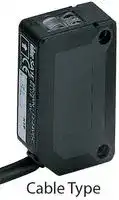


SA1E-PN2
SENSOR ((NS))
- Manufacturer: IDEC
- Product type: Optical / Slot Photoelectric Sensors
- Product Range: SA1E Series
- Sensor Output: NPN
- Output Current: 100mA
- Sensing Range Max: 2.5m
- Supply Voltage DC Max: 30V
- Supply Voltage DC Min: 10V
| Delivery and price | |
|---|---|
| Units per pack | 100 |
| Price | 29.81 € |
| Current stock | 10+ |
| Lead time | 30 days |

_**Sensors**_ SA1E: Photoelectric

|**_Sensors_**<br>SA1E: Photoelectric|**_Sensors_**<br>SA1E: Photoelectric|**_Sensors_**<br>SA1E: Photoelectric|**_Sensors_**<br>SA1E: Photoelectric|**_Sensors_**<br>SA1E: Photoelectric|
|---|---|---|---|---|
|**Simple, compact design for world-wide usage.**<br>**Key features of the SA1E photoelectric sensor include:**<br>• Four sensing methods<br>• Cable types and M8 connector types available<br>• NPN output, PNP output, light ON, dark ON options<br>• Long sensing ranges, high speed response<br>• CE marked<br>**SA1E: Photoelectric Switches**<br>~~=~~|||||
||**Through-beam**<br>**Polarized**|**Diffuse-reflective**|**Small-beam**||
||**Type**<br>**Retroreflective Type**|**Type**|**Reflective Type**||
||NPN output<br>Light ON<br>**SA1E-TN1**<br>**SA1E-PN1**<br>Dark ON<br>**SA1E-TN2**<br>**SA1E-PN2**|**SA1E-DN1**<br>**SA1E-DN2**|**SA1E-NN1**<br>**SA1E-NN2**||
||Cable Type<br>PNP output<br>Light ON<br>**SA1E-TP1**<br>**SA1E-PP1**<br>Dark ON<br>**SA1E-TP2**<br>**SA1E-PP2**|**SA1E-DP1**<br>**SA1E-DP2**|**SA1E-NP1**<br>**SA1E-NP2**||
||Connector<br>NPN output<br>Light ON<br>**SA1E-TN1C**<br>**SA1E-PN1C**<br>Dark ON<br>**SA1E-TN2C**<br>**SA1E-PN2C**|**SA1E-DN1C**<br>**SA1E-DN2C**|**SA1E-NN1C**<br>**SA1E-NN2C**||
||Type<br>PNP output<br>Light ON<br>**SA1E-TP1C**<br>**SA1E-PP1C**<br>Dark ON<br>**SA1E-TP2C**<br>**SA1E-PP2C**|**SA1E-DP1C**<br>**SA1E-DP2C**|**SA1E-NP1C**<br>**SA1E-NP2C**||
||Applicable Standard<br>IEC606947-5-2||||
||Rated Operational Voltage<br>12 to 24V DC||||
|**General Specifications**<br>Operating Limits<br>10 to 30V DC<br>Rated Insulation Voltage<br>30V DC<br>Power Consumption / Current Draw<br>Emitter: 15 mA<br>Receiver: 20 mA<br>30 mA<br>Sensing Range<br>10 m<br>2.5 m (IAC-R5)<br>1.5 m (IAC-R6) (Note)<br>1 m (IAC-RS1)<br>700 mm<br>(using 200×200 mm<br>white matt paper)<br>Detectable Object<br>Opaque<br>Opaque/Transparent<br>Hysteresis<br>—<br>20% maximum<br>Response Time<br>1 ms maximum<br>Sensitivity Control<br>Adjustable using a potentiometer (approx. 260°)<br>Light Source Element<br>Infrared LED<br>Red LED<br>Infrared LED<br>=S5=|||50 to 150 mm<br>(using 100×100 mm<br>white matt paper)<br>Red LED||
||Operation Mode<br>Light ON/Dark ON||||
||NPN open collector/PNP open collector||||
||Control Output<br>30V DC, 100 mA maximum<br>Voltage drop: 1.2V maximum||||
||Short-circuit protection||||
||Operation LED: Yellow||||
||LED Indicators<br>Stable LED: Green<br>Power LED: Green (Through-beam type emitter)||||
||Interference Prevention<br>—<br>Two units can be mounted close together||||
||Degree of Protection<br>IP67 (IEC60529)||||


## **Q**

- _photoelectric switch and must be ordered separately._

_2. Standard cable length for cable type is 1 meter. Contact IDEC for longer cable lengths._

_**www.idec.com**_

_**USA: (800) 262-IDEC or (408) 747-0550,   Canada: (888) 317-IDEC**_

_**Q-29**_

**==> picture [523 x 697] intentionally omitted <==**

**----- Start of picture text -----**<br>
SA1E: Photoelectric Sensors IDEC<br>Through-beam  Polarized Diffuse-reflective  Small-beam<br>Type Retroreflective Type Type Reflective Type<br>Extraneous Light Immunity Sunlight: 10,000 lux maximum, Incandescent lamp: 3,000 lux maximum (at receiver)<br>Operating Temperature –25 to + 55°C (no freezing)<br>Operating Humidity 35 to 85% RH (no condensation)<br>Storage Temperature –40 to +70°C (no freezing)<br>Insulation Resistance Between live and dead parts: 20 M Ω  maximum (500V DC megger)<br>Dielectric Strength Between live and dead parts: 1000V AC, 50/60 Hz, 1 minute<br>Vibration Resistance Damage limits: 10 to 55 Hz, Amplitude 0.75 mm p-p, 20 cycles in each of 3 axes<br>Shock Resistance Damage limits: 500 m/s [2] , 10 shocks in each of 3 axes<br>Material Housing: PC/PBT, Lens: PC (Polarized retroreflective type: PMMA), Indicator cover: PC<br>Accessories Included Instruction sheet, Sensitivity control screwdriver<br>Emitter: 30g<br>Cable Type 30 g<br>Weight  Receiver: 30g<br>(approx)<br>Emitter: 10g<br>Connector Type 10 g<br>Receiver: 10g<br>Connection  Cable Type ø3.5 mm, 3-core, 0.2 mmtype) [2] , 1-m vinyl cabtyre cable (2-core for the emitter of through-beam<br>Method<br>Connector Type M8 connector (4-pin)<br>—<br>SA1E Accessories<br>Ld<br>Mounting Brackets Connector Cable for connector type<br>Part Number Type Package  Part Number Core  Type & Length Package<br>Quantity Wires Quantity<br>tf Ps<br>SA9Z-K01 Vertical SA9Z-CM8K-4S2 Straight, 2m<br>1<br>SA9Z-K02 Horizontal SA9Z-CM8K-4L2 Right angle, 2m<br>4 1<br>SA9Z-CM8K-4S5 Straight, 5m<br>SA9Z-CM8K-4L5 Right angle, 5m<br>Reflectors for polarized retroreflective type<br>Package  Type & Applicable Mounting<br>Part Number Type<br>Quantity Sensing Range Bracket<br>ee<br>IAC-R5 Standard Straight, 2m IAC-L2 .<br>IAC-R6 Small 1 Right angle, 2m IAC-L3<br>IAC-RS1 Tape type Straight, 5m —<br>Slits for through-beam type<br>Maximum Detectable<br>Part Number Slit Width Package  Sensing Range (m) Object Width (mm)<br>Quantity<br>One side Both sides a One side Both sides<br>SA9Z-S06PN02 0.5 mm 2.5 1.0 7.0 0.5<br>SA9Z-S07PN02 1.0 mm 2 3.5 1.5 7.0 1.0<br>SA9Z-S08PN02 2.0 mm 6.0 3.5 7.0 2.0<br>Dimensions<br>8.2<br>The slit can be pressed to fit on  A 6.1<br>the front easily in one touch. -<br>Slit (Stainless Steel)<br>General Specifications con’t<br>32.1 18<br>0.3<br>**----- End of picture text -----**<br>


**Q** |

_**www.idec.com**_

_**USA: (800) 262-IDEC or (408) 747-0550,   Canada: (888) 317-IDEC**_

_**Q-30**_

SA1E: Photoelectric

**==> picture [523 x 476] intentionally omitted <==**

**----- Start of picture text -----**<br>
Sensors SA1E: Photoelectric<br>NipeEc<br>Dimensions<br>Ce<br>Cable Type<br>13.4<br>9.0 Operation LED (yellow) (Note 1)<br>Sensitivity Control (Note 2)<br>19.5<br>Emitteror 3.4 Notes:<br>Receiver Receiver 1. Power ON LED (green) for through-beam emit-<br>ter.<br>Emitter 2. No sensitivity control and stable LED are<br>attached on the through-beam emitter.<br>3. 5.2mm for polarized retroreflective type.<br>4. The connector length is 18mm when a right-<br>angle connector cable (SA9Z-CM8K-4L) is<br>attached.<br>Through Beam Polarized retroreflective 2-M3<br>Diffuse-reflective<br>i Small-beam reflective<br>Connector Type<br>13.4<br>9.0 Operation LED (yellow) (Note 1)<br>10.8 10.8<br>6.5 6.5<br>Stable LED (green) (Note 2) Sensitivity Control (Note 2)<br>Projector<br>Receiveror Receiver 19.5<br>3.4<br>|<br>See notes 1 through 4 above.<br>Projector<br>Through Beam Polarized retroreflective<br>Diffuse-reflective<br>Small-beam reflective 2-M3<br>(Note 4)<br>×1<br>o3.5 -1 m<br>2.9<br>10.8<br>1.2<br>17.4 17.4 8.8<br>17.1 12.7 31.5 25.4<br>7.1<br>4.0<br>2.9<br>10.8<br>1.2<br>17.4 17.4 8.8<br>17.1<br>12.7<br>7.1 31.5 25.4<br>4.0<br>4.5<br>6.3<br>**----- End of picture text -----**<br>


**==> picture [547 x 238] intentionally omitted <==**

**----- Start of picture text -----**<br>
Output Circuit and Wiring Diagram<br>• NPN Output • PNP Output<br>+V +V<br>1 1<br>Brown Brown<br>12 to 24V DC Connector Pin Assignment<br>4 Black 4 OUT ➃  (OUT) ➂  (0V)<br>OUT Black<br>12 to 24V DC ➁  (NC) ➀  (+V)<br>0V 0V<br>3 3<br>Blue Blue<br>• Through-beam Type Emitter<br>Q<br>Connector Pin Assignment<br>+V<br>1<br>Brown<br>➃  (NC) ➂  (0V)<br>12 to 24V DC ➁  (NC) ➀  (+V)<br>0V<br>3<br>Blue<br>iz .<br>Load<br>Main Circuit Main Circuit<br>Load<br>Main Circuit Sensors<br>**----- End of picture text -----**<br>


_**www.idec.com**_

_**USA: (800) 262-IDEC or (408) 747-0550,   Canada: (888) 317-IDEC**_

_**Q-31**_

_**Sensors**_

SA1E: Photoelectric

**Dimensions, continued**

## **Mounting Bracket**

**SA9Z-K01                                                                                                With Mounting Bracket**

**==> picture [538 x 574] intentionally omitted <==**

**----- Start of picture text -----**<br>
0.5 19.5<br>__ asi<br>21.5 21.5<br>14(<br>13.7 10.8 13.7<br>(3.2)<br>eer raf (Note 2) ows J)<br>|<br>(Material: stamose | T a<br>Note 1: Center of optical axis (through-beam type)<br>Note 2: Center of optical axis (polarized retroreflective,<br>             diffuse reflective, and small-beam reflective type)<br>SA9Z-K02                                                                                               With Mounting Bracket<br>| 17.6 | 1.0 lies |<br>21.5 21.5<br>12.7 12.7<br>_|<br>Q<br>mf) 1.2 e e l ee 1.2 RbC e ee @ 2<br>8.0<br>14.6 12.0 5.0 14.6 (3.2) 12.0 5.0<br>Note 1: Center of optical axis (through-beam type)<br>(Material: Stainless Steel)<br>Note 2: Center of optical axis (polarized retroreflective,<br>             diffuse reflective, and small-beam reflective type)<br>° 7°<br>4.5 4.5<br>3.4 3.4<br>R12.0 R12.0<br>R12.0 R12.0<br>ˆø3.4<br>14° 14°<br>14°<br>14°<br>8.0<br>24.8 13.4<br>3.4 6.0 3.4<br>3.2<br>25.4 25.4 31.5<br>42.5 42.5<br>25.0<br>12.3<br>1.2 1.2 9.3<br>6.0<br>1.5<br>17.1<br>34.8 25.4 34.8 25.4<br>12.7 31.5<br>55.0 55.0<br>28.0<br>10.6 4.5 15.3 10.6 4.5 15.3<br>8.4 8.4<br>**----- End of picture text -----**<br>


_**www.idec.com**_

_**USA: (800) 262-IDEC or (408) 747-0550,   Canada: (888) 317-IDEC**_

_**Q-32**_

SA1E: Photoelectric

## _**Sensors**_

## **Dimensions, continued**

## **Reflector**

**==> picture [505 x 518] intentionally omitted <==**

**----- Start of picture text -----**<br>
2-ø4.3<br>IAC-R5 IAC-R6 IAC-RS1<br>—}a<br>35<br>8.3<br>35.3 0.2<br>r epston ets a<br>laaalepale,ads,| ck<br>25 3.3<br>2-ø3.6<br>3<br>51 9 (Effective reflecting area: 30 × 31 mm)<br>(Effective reflecting area: 47.2 × 47.2 mm)<br>Reflector Mounting Bracket Connector Cable<br>(one-side connector)<br>IAC-L2 IAC-L3<br>Straight Type<br>42 25 SA9Z-CM8K-4S ø9.6<br>rt 4.5 im<br>➀ Black ➂ White<br>7 : Tt ➁ Blue e ➃ Brown<br>6<br>a) 30 @ 35 | 8b : iTT l<br>->———— 25 Cable length: 2 or 5 m ø5.2<br>4-ø4.4 Note: Dielectric strength when installed          on the switch<br>Between live part and mounting bracket:<br>1000V AC (except between live part<br>and clamping ring)<br>: ie © © l<br>2-ø3.4<br>6 oH<br>Right-angle Type<br>SA9Z-CM8K-4L<br>+ | 8-M3 × o  0.5 holes | | 20<br>16 5<br>Material: SPCC (zinc plating) ➀ Black ➂<br>➁ Blue Brown<br>. é . F White i |<br>| = iif ø5.2<br>58<br>b+ Cable length: 2 or 5 m<br>Note: Dielectric strength when installed<br>          on the switch<br>Material: SPCC (zinc chromate plating, black) Between live part and mounting bracket:<br>1000V AC (except between live part<br>and clamping ring)<br>72 60<br>34.3<br>42.3 40<br>8<br>4<br>10<br>28 19<br>11 32<br>5.5<br>16<br>44<br>10<br>74 60 37 8 1.6<br>6<br>113<br>ø9.6<br>70<br>28<br>2<br>**----- End of picture text -----**<br>


**==> picture [15 x 16] intentionally omitted <==**

**----- Start of picture text -----**<br>
Q<br>**----- End of picture text -----**<br>


_**www.idec.com**_

_**USA: (800) 262-IDEC or (408) 747-0550,   Canada: (888) 317-IDEC**_

_**Q-33**_

_**Sensors**_

General Information

**Q**

## **General Information**

## **Specifications**

Do not operate a sensor under any conditions exceeding these specifications.

Do not operate a sensor under current and voltage conditions other than those for which the individual sensor is rated.

Do not exceed the recommended operating temperature and humidity. Although sensors are rated for operation below 0°C, this specification does not imply that performance characteristics will remain constant under prolonged freezing conditions. Continued exposure and the accompanying frost, ice, dew, and condensation which accumulate on the optical surface will adversely affect sensor performance.

To maintain superior performance characteristics, do not exceed vibration and shock resistance ratings while operating a sensor. In addition, avoid isolated impacts to the sensor housing which are severe enough to adversely affect the waterproof characteristics.

## **Extraneous Light**

Bright, extraneous light such as sunlight, incandescent lights, or fluorescent lights may impair the performance of sensors in detecting color or light.

_3. SA6A ultrasonic sensors are not affected by extraneous light._

Make sure that extraneous light does not exceed recommended levels found in the individual _specifications_ sections. When 500 lux is specified, this is equal to 50 footcandles. The average factory illumination is ordinarily below this level, except in areas where visual inspection is being performed. Only in such brightly lit areas is incident light of particular concern.

Unwanted light interference can often be avoided simply by making sure that the optical receiver is not aimed directly toward a strong light source. When mounting direction cannot be adjusted, place a light barrier between all nearby light sources and the receiver.

## **Reflected-Light Sensors**

## **IEC (International Electrotechnical Commission) Ratings**

Sensors rated IP67 are resistant to moisture when occasionally immersed in still water. Sensors rated IP64 through IP66 are resistant to moisture when occasionally subjected to splashing or when located in the vicinity of turbulent waters. These ratings do not imply that a sensor is intended for use under continual high-pressure water spray. Avoid such applications to maintain optimal sensor performance.

Sensors rated IP64 through IP67 are dust-tight and water-tight. For best performance, avoid using any sensor in an area where it will be subjected to heavy particle blasts and where dust, water, or steam will accumulate on the optical surface.

When installing sensors which detect reflected light, make sure that unwanted light reflections from nearby surfaces, such as the floor, walls, reflective machinery, or stainless steel, do not reach the optical receiver.

Also, make sure that reflected-light sensors mounted in close proximity do not cause interfering reflections. When it is not possible to maintain the recommended clearance between sensors, as noted in the individual _installation_ sections, provide light barriers between sensors.

## **Through-Beam Sensors**

A slit attachment is available to modify the beam size of through-beam sensors. This option is recommended for detecting very small objects (near the size of the smallest object which a sensor can detect) or for eliminating light interference when sensors are mounted in close proximity.

## **Laser Sensors**

## **Start-up**

Do not test the housing for dielectric strength and insulation resistance, since the housing is connected to the electronic circuit ground of a sensor. Do not perform dielectric strength and insulation resistance tests on electrical systems without disconnecting photoelectric sensors, as such testing may result in damage to the sensor.

Several lines of sensors, as noted in the individual _operation_ sections, are provided with an internal circuit to turn an output off for a specified amount of time upon power-up. This delay is normal; it prevents a transient state when turning power on.

## **Optimum Performance**

**IMPORTANT:** Always consider safety when installing a laser sensor of any kind. Make sure that the laser beam cannot inadvertently shine into the eyes of people passing by or working in the vicinity. See safety information on page Q-20.

## **Mounting**

The mounting bracket and hardware are included with sensors, where applicable. Use the appropriate hardware for mounting, along with washers and spring washers or lock nuts. Do not overtighten attachment hardware. Overtightening causes damage to the housing and will adversely affect the waterproof characteristics of the sensor.

Best results can be obtained when the sensor is mounted so that the object sensed is in the center of the beam, rather than when the object is located near the edges of the sensing window. In addition, the most reliable sensing occurs when the majority of the objects being sensed are well within the sensing range, rather than at the extreme near and far limits.

The optical surface of each sensor must be cleaned on a regular basis for continual superior performance. Use a soft cloth dipped in isopropyl alcohol to remove dust and moisture build-up.

**IMPORTANT:** Do not use organic solvents (such as thinner, ammonia, caustic soda, or benzene) to clean any part of a sensor.

All sensors experience signal inconsistencies under the influence of inductive noise. Do not use sensors in close proximity to transformers, large inductive motors, or generators. Avoid using sensors in direct contact with sources of excessive heat. Also avoid operation in close proximity to welding equipment.

_1. Even though the SA6A ultrasonic sensor features protection against noise, there may be adverse effects from strong noise._

_2. It is strongly recommended to avoid using any sensor where it will be continually subjected to elements which impair performance or cause corrosive damage to the sensor. In particular, avoid strong vibrations and shocks, corrosive gases, oils, and chemicals, as well as blasts of water, steam, dust, or other particles._

_**www.idec.com**_

_**USA: (800) 262-IDEC or (408) 747-0550,   Canada: (888) 317-IDEC**_

_**Q-55**_

General Information

## _**Sensors**_

## **Wiring**

Avoid running high-voltages or power lines in the same conduit with sensor signal lines. This prevents inaccurate results or damage from induced noise. Use a separate conduit when the influence of power lines or electromagnetic equipment may occur, particularly when the distance of the wiring is extended.

**IMPORTANT:** Connect the sensor cables and wires as noted in the individual _Wiring_ sections. Failure to connect as shown in wiring diagrams will result in damage to the internal circuit.

When extending sensor cables and wires, make sure to use cables equal or superior to that recommended in the individual _specifications_ sections.

When wiring terminals, be sure to prevent contact between adjoining terminals. When using ring or fork lug terminals, use the insulated sleeve style only. Each sensor terminal can accept only one ring of fork lug terminal.

On ISF series photoelectric sensors, use recommended cable, along with the attached packing gland and washer, when wiring the terminals. This ensures waterproof and dustproof characteristics.

## **Glossary**

**Attenuation:** Reduction of beam intensity as a result of environmental factors such as dust, humidity, steam, etc.

**Dark on:** Output energized when light is _not_ detected by the receiving element. For through-beam sensors, light from the projector is not detected by the receiver when an object is present. For reflected light sensors, light is not detected when it is not reflected from an object surface.

**Diffuse-reflected light sensors:** Sensors that detect all scattered, reflected light. Light reflected from nearby surfaces, as well as intended object surface, is detected. Diffuse-reflected light sensors are often called “proximity switches,” since they switch when any object is near. Also use to detect color contrast when colors reflect light intensity differently (green LED recommended for this application).

**EEPROM:** Acronym which stands for electronically erasable, programmable, read only memory.

**Excess gain:** Ratio of optical power available at a given projector-toreceiver range divided by the minimum optical power required to trigger the receiver.

## **Power Supply**

Noise resistance characteristics are improved when a sensor is grounded to the 0V power terminal. If the 0V power terminal is not at ground potential, use a ceramic 0.01µF capacitor which can withstand 250V AC minimum.

When using a switching power supply, be sure to ground the FG terminal to eliminate high-frequency noise. The power supply should include an insulating transformer, not an autotransformer.

On ISF series photoelectric sensors, the power supply should be sized according to the voltage drop through the lead wire when using a long extension for the DC type (328' or 100m maximum extension).

## **Power Supply**

The compact PS5R-A power supply is the perfect companion item for most IDEC sensors. This power supply is only 1.77" (45mm) wide, 3.15" (80mm) tall, and 2.76" (70mm) deep. Call an IDEC representative for more details.

|**Part Number**|**Output Ratings**|
|---|---|
|PS5R-A12|12V DC, 0.62A|
|PS5R-A24|24V DC, 0.32A|


**Extraneous light:** Incident light received by a sensor, irrelated to the presence or absence of object being detected. Extraneous light is usually unwanted background light such as sunlight and incandescent lamps in close proximity.

∆ **E:** The measurement of color difference as a three-variable function, located on an XYZ axis of light, hue, and chroma values.

**Hysteresis:** Operating point and release point at different levels. For solid state sensors, this is accomplished electrically. For mechanical switches, it results from storing potential energy before the transition occurs.

**Light on:** Output energized when light is detected by receiving element. For through-beam sensors, light from the projector is detected by the receiver when an object is not present. For reflected light sensors, light is detected when it is reflected from an object surface.

**Linearity:** Measurement of how nearly linear, that is, how accurate actual analog output is, with respect to distance.

**NPN/PNP:** Types of open collector transistors. NPN is a sink transistor; output on establishes negative potential difference. PNP is a source transistor; output on establishes positive potential difference.

**Polarizing:** Filtering out all reflected light except that which is projected in one plane only. Polarized retro-reflected light sensors detect the light from corner-cube type reflectors when an object is not present.

**Reflected-light sensors:** Sensors with the projector and receiver in one housing. Light is projected by the light source, and reflected light is received by the optical surface. Includes diffuse-reflected, retro-reflected, limited-reflected, and spot-reflected sensors.

## **Miscellaneous**

Strong magnetic fields may detract from the accuracy of the sensing measurement. Avoid mounting a sensor directly to machinery, since the housing is connected to the electronic circuit ground of the sensor. If it is necessary to mount a sensor on machinery, use the insulating plate and sleeve provided.

**Repeatability:** Ability of a sensor to reproduce output readings consistently when the same value is applied consecutively, in the same direction, for a specified number of cycles, or for a specified time duration.

**Resolution:** Overall dimension of the smallest object which can be detected (when sensing the presence of an object) or smallest increment of distance which can be distinguished with reliable results (when sensing the position of an object).

**Response time:** Time elapsed between input and output. Total response time is the sum of object detection, amplifier response, and output response times.

**Q**

**Retro-reflective scan:** This type of reflected light sensor uses a special reflector to return projected light when an object is not present. Sensor detects the presence of an object when the light is reflected differently.

**Through-beam sensors:** Sensors with a separate projector and receiver. The light source from the projector is detected by the receiver, except when an object is present.

**Transient:** Undesirable surge of current (many times larger than normal current) for a very short period, such as during the start-up of an inductive motor.

_**www.idec.com**_

_**Q-56**_

_**USA: (800) 262-IDEC or (408) 747-0550,   Canada: (888) 317-IDEC**_
Updated at February 9, 2023
Founded in 1945, IDEC is a globally recognized leader in industrial automation, machine safety, and control products. Renowned for pioneering innovations in Human-Machine Interface (HMI) systems, the company is dedicated to creating a safe and efficient harmony between advanced workplace technology and human operators. At the core of IDEC’s extensive portfolio is a comprehensive selection of high-performance relays designed for demanding industrial environments. This includes a broad range of electromechanical power relays, solid-state relays, contactors, and critical safety relays, supported by a wide array of specialized relay accessories to ensure reliable and efficient switching. Beyond switching components, IDEC provides complete solutions for modern control panels and automated systems. Their robust engineering extends to advanced panel displays and instrumentation, precision light sensors, and dependable AC/DC power converters. With additional offerings in industrial switches, visual signaling units, and DIN rail terminal blocks, IDEC equips engineers with the high-quality components required to build secure, next-generation automation infrastructure.
About Novapart
Novapart is a B2B electronic component broker specialising in stock shortages and cost reduction. We source hard-to-find parts and identify compliant alternatives across a catalogue of 410,000+ components from 500+ manufacturers.
Learn more →Stock Shortage Specialist
When a component is unavailable, discontinued or has an unacceptable lead time, we tap into our network of vetted European and Asian distributors to source what you need — without compromising on quality or traceability.
Request a quote →Compliant Alternatives
We identify pin-to-pin, electrically equivalent substitutes that meet the same certifications (RoHS, AEC-Q100, REACH) as your original specification — validated against datasheets, not just part numbers. Often at a lower cost.
BOM Analysis service →