
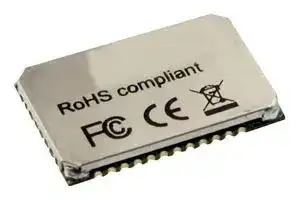


RN41N-I/RM
Bluetooth 2.1/2.0/1.2/1.1, Class 1 Module, 3.3V Supply, 100m Range, 3Mbps, -80dBm Sensitivity
- Manufacturer: MICROCHIP
- Product type: Bluetooth Modules & Adaptors
- Bluetooth Version:Bluetooth 2.1, 2.0, 1.2 and 1.1; Supply Voltage Min:3V; Supply Voltage Max:3.6V; Signal Range Max:100m; Data Rate:3Mbps; Bluetooth Class:Class 1; Receive Sensitivi
- SVHC: No SVHC (15-Jan-2018)
- Interfaces: SPI, UART, USB
- Product Range: -
- Certifications: CE, FCC, IC
- Bluetooth Class: Class 1
- Bluetooth Version: Bluetooth 2.1, 2.0, 1.2 and 1.1
- Supply Voltage Range: 3 V to 3.6 V
- Receiver Sensitivity Rx: -80 dBm
- Operating Temperature Range: -40 °C to 85 °C
| Delivery and price | |
|---|---|
| Units per pack | 1 |
| Price | 19.81 € |
| Current stock | 10+ |
| Lead time | 30 days |

**RN-41-DS**

## **RN41/RN41N Class 1 Bluetooth Module**

## **Features**

- Fully qualified Bluetooth[®] version 2.1 module, supports version 2.1 + Enhanced Data Rate (EDR)

- Backwards-compatible with Bluetooth version 2.0, 1.2, and 1.1

- Postage stamp sized form factor, 13.4 mm x 25.8 mm x 2 mm

- Low power (30 mA connected, < 10 mA sniff mode)

- UART (SPP or HCI) and USB (HCI only) data connection interfaces

- Sustained SPP data rates: 240 Kbps (slave), 300 Kbps (master)

- HCI data rates: 1.5 Mbps sustained, 3.0 Mbps burst in HCI mode

- Embedded Bluetooth stack profiles included (requires no host stack): GAP, SDP, RFCOMM, and L2CAP protocols, with SPP and DUN profile support

- Bluetooth SIG qualified, end product listing

- Castellated SMT pads for easy and reliable PCB mounting

- Class 1 high power amplifier with on board ceramic RF chip antenna (RN41) or without antenna (RN41N)

- Certifications: FCC, ICS, CE

- Environmentally friendly, RoHS compliant

## **Applications**

- Cable replacement

- Barcode scanners

- Measurement and monitoring systems

- Industrial sensors and controls

- Medical devices

- Asset tracking

## **Description**

The RN41 module is a small form factor, low power, class 1 Bluetooth radio that is ideal for designers who want to add wireless capability to their products without spending significant time and money developing Bluetooth-specific hardware and software. The RN41 supports multiple interface protocols, is simple to design in, and is fully certified, making it a complete embedded Bluetooth solution. With its high-performance, on-chip antenna and support for Bluetooth EDR, the RN41 delivers up to a 3-Mbps data rate for distances up to 100 meters. The RN41 is also available without an antenna (RN41N).

**Figure 1. RN41 Block Diagram**

**==> picture [259 x 106] intentionally omitted <==**

**----- Start of picture text -----**<br>
RN41 Crystal<br>VCC<br>GND<br>GPIO4<br>GPIO5<br>SwitchRF BALUN CSR BlueCore-04External GPIO6USB<br>PA UART<br>PCM<br>Flash Memory<br>**----- End of picture text -----**<br>


www.rovingnetworks.com

Version 3.42r 4/11/2013

1

**RN-41-DS**

## **OVERVIEW**

- Baud rate speeds: 1,200 bps up to 921 Kbps, non-standard baud rates can be programmed

- Class 1 radio, 330’ (100 m) range, 15 dBm output transmitter, -80 dBm typical receive sensitivity

- Frequency 2,402  ~ 2,480 MHz

- FHSS/GFSK modulation, 79 channels at 1-MHz intervals

- Secure communication, 128-bit encryption

- Error correction for guaranteed packet delivery

- Configuration via the local UART and over-the-air RF

- Auto-discovery/pairing does not require software configuration (supports instant cable replacement)

- Auto-connect master, I/O pin (DTR), and character-based trigger modes

The module’s moisture sensitivity level (MSL) is 1. Table 1 shows the module’s size and weight.

**Table 1. Module Size & Weight**

|**Parameter**<br>~~a~~|**RN41**<br>~~a~~|**RN41N**<br>~~a~~|**Units**<br>~~a~~|
|---|---|---|---|
|Size<br>~~a~~|13.4 x 25.8 x 2<br>~~a~~|13.4 x 19 x 2<br>~~a~~|mm<br>~~a~~|
|Weight<br>~~a~~|0.055<br>~~a~~|0.020<br>~~a~~|Oz.<br>~~a~~|


**Table 2. Environmental Conditions**

|**Parameter**|**Value**|
|---|---|
|Temperature Range (Operating)|-40<br>oC ~ 85<br>oC|
|Temperature Range (Storage)|-40<br>oC ~ 85<br>oC|
|Relative Humidity (Operating)|≤90%|
|Relative Humidity (Storage)|≤90%|


**Table 3. Electrical Characteristics**

|**Parameter**|**Min.**|**Typ.**|**Max.**|**Units**|
|---|---|---|---|---|
|Supply Voltage (DC)|3.0|3.3|3.6|V|
|RX Supply Current||35|60|mA|
|TX Supply Current||65|100|mA|
|**Average Power Consumption**|||||
|Standby/Idle (Default Settings)||25||mA|
|Connected (Normal Mode)||30||mA|
|Connected (Low-Power Sniff)||8||mA|
|Standby/Idle (Deep Sleep Enabled)|250|2.5||mA|


www.rovingnetworks.com

Version 3.42r 4/11/2013

2

**RN-41-DS**

**Table 4. Radio Characteristics**

|**Parameter**<br>~~ee~~|**Frequency**<br>**(GHz)**<br>~~ee~~<br>~~ee~~|**Min.**<br>~~ee~~<br>~~ee~~|**Typ.**<br>~~ee~~<br>~~ee~~|**Max.**<br>~~ee~~<br>~~ee~~|**Bluetooth**<br>**Specification**<br>~~ee~~<br>~~ee~~|**Units**<br>~~ee~~<br>~~ee~~|
|---|---|---|---|---|---|---|
|Sensitivity at 0.1% BER<br>~~ee~~<br>~~a~~<br>~~SSS~~|2.402<br>~~ee~~<br>~~ee ~~<br>~~a~~|-<br>~~ee~~<br> ~~ee ~~<br>~~a~~|-80<br>~~ee~~<br> ~~ee ~~<br>~~a~~|-86<br>~~ee~~<br> ~~ee~~<br>~~a~~|≤ -70<br>~~ee~~<br>~~ee~~<br>~~a~~<br>~~SSS~~|dBm<br>~~ee~~<br>~~ee~~<br>~~a~~|
||2.441<br>~~a~~|-<br>~~a~~|-80<br>~~a~~|-86<br>~~a~~||dBm<br>~~a~~|
||2.480<br>~~a~~<br>~~SSS~~|-<br>~~a~~<br>~~SSS~~|-80<br>~~a~~<br>~~SSS~~|-86<br>~~a~~<br>~~SSS~~||dBm<br>~~a~~<br>~~SSS~~|
|RF Transmit Power<br>~~SSS~~|2.402<br>~~SSS~~|15.0<br>~~SSS~~|16.0<br>~~SSS~~|~~SSS~~|≤ 20<br>~~SSS~~|dBm<br>~~SSS~~|
||2.441<br>~~SSS~~<br>~~—EE~~|15.0<br>~~SSS~~<br>~~—EE~~|16.0<br>~~SSS~~<br>~~—EE~~|~~SSS~~<br>~~—EE~~||dBm<br>~~SSS~~<br>~~—~~|
||2.480<br>~~SSS~~<br>~~—EE~~|15.0<br>~~SSS~~<br>~~—EE~~<br>~~=__~~|16.0<br>~~SSS~~<br>~~—EE~~<br>~~=__~~|~~SSS~~<br>~~—EE~~<br>~~=__~~||dBm<br>~~SSS~~<br>~~—~~|
|Initial Carrier Frequency Tolerance<br>~~=~~|2.402<br>~~—EE~~<br>~~=~~|-<br>~~—EE~~<br>~~=~~<br>~~=__~~|5<br>~~—EE~~<br>~~=~~<br>~~=__~~|75<br>~~—EE~~<br>~~=~~<br>~~=__~~|75<br>~~=~~|kHz<br>~~—~~<br>~~=~~|
||2.441<br>~~—EE~~<br>~~=~~|-<br>~~—EE~~<br>~~=~~<br>~~=__~~|5<br>~~—EE~~<br>~~=~~<br>~~=__~~|75<br>~~—EE~~<br>~~=~~<br>~~=__~~||kHz<br>~~—~~<br>~~=~~|
||2.480<br>~~=~~|-<br>~~=~~<br>~~=__~~|5<br>~~=~~<br>~~=__~~|75<br>~~=~~<br>~~=__~~||kHz<br>~~=~~|
|20-dB Bandwidth for Modulated Carrier<br>~~=~~|~~=~~|-<br>~~=~~<br>~~=__~~|900<br>~~=~~<br>~~=__~~|1000<br>~~=~~<br>~~=__~~|≤ 1000<br>~~=~~|kHz<br>~~=~~|
|Drift (Five Slots Packet)<br>~~ee~~|~~ee~~|-<br>~~=__~~<br>~~ee~~|15<br>~~=__~~<br>~~ee~~|-<br>~~=__~~<br>~~ee~~|40<br>~~ee~~|kHz<br>~~ee~~|
|Drift Rate<br>~~ee~~|~~ee~~|-<br>~~ee~~|13<br>~~ee~~|-<br>~~ee~~|20<br>~~ee~~|kHz<br>~~ee~~|
|∆f1avgMaximum Modulation<br>~~EEE~~|2.402<br>~~EEE~~|140<br>~~EEE~~|165<br>~~EEE~~|175<br>~~EEE~~|> 140<br>~~EEE~~|kHz<br>~~EEE~~|
||2.441<br>~~EEE~~<br>~~ee~~|140<br>~~EEE~~<br>~~ee~~|165<br>~~EEE~~<br>~~ee~~|175<br>~~EEE~~<br>~~ee~~||kHz<br>~~EEE~~<br>~~TCS~~|
||2.480<br>~~EEE~~<br>~~ee~~<br>~~ee~~|140<br>~~EEE~~<br>~~ee~~<br>~~ee~~|165<br>~~EEE~~<br>~~ee~~<br>~~ee~~|175<br>~~EEE~~<br>~~ee~~<br>~~ee~~<br>~~—_~~||kHz<br>~~EEE~~<br>~~TCS~~<br>~~r”~SY~~|
|∆f2avgMinimum Modulation<br>~~i~~|2.402<br>~~ee~~<br>~~ee~~<br>~~i~~|140<br>~~ee~~<br>~~ee~~<br>~~i~~|190<br>~~ee~~<br>~~ee~~<br>~~i~~|-<br>~~ee~~<br>~~ee~~<br>~~i~~<br>~~—_~~|115<br>~~i~~|kHz<br>~~TCS~~<br>~~r”~SY~~<br>~~i~~|
||2.441<br>~~ee~~<br>~~i~~|140<br>~~ee~~<br>~~i~~|190<br>~~ee~~<br>~~i~~|-<br>~~ee~~<br>~~i~~<br>~~—_~~||kHz<br>~~r”~SY~~<br>~~i~~|
||2.480<br>~~i~~|140<br>~~i~~|190<br>~~i~~|-<br>~~i~~<br>~~—_~~||kHz<br>~~i~~|


**Table 5. Digital I/O Characteristics**

www.rovingnetworks.com

Version 3.42r 4/11/2013

3

**RN-41-DS**

**==> picture [468 x 600] intentionally omitted <==**

**----- Start of picture text -----**<br>
Figure 2 shows the pinout and Table 6 describes the pins.<br>Figure 2. RN41/RN41N Pinout<br>GND 1 24 SPI_MISO GND 1 24 SPI_MISO<br>SPI_MOSI 2 RN41 23 SPI_CSB SPI_MOSI 2 RN41N 23 SPI_CSB<br>GPIO6 3 Top View 22 GPIO4 GPIO6 3 Top View 22 GPIO4<br>GPIO7 4 21 GPIO5 GPIO7 4 21 GPIO5<br>RESET 5 20 GPIO3 RESET 5 20 GPIO3<br>SPI_CLOCK 6 19 GPIO2 SPI_CLOCK 6 19 GPIO2<br>PCM_CLK 7 18 USB_D- PCM_CLK 7 18 USB_D-<br>PCM_SYNC 8 17 USB_D+ PCM_SYNC 8 17 USB_D+<br>PCM_IN 9 16 UART_CTS PCM_IN 9 16 UART_CTS<br>PCM_OUT 10 15 UART_RTS PCM_OUT 10 15 UART_RTS<br>VDD 11 14 UART_TX VDD 11 14 UART_TX<br>GND 12 13 UART_RX GND 12 13 UART_RX<br>35 29 34 33 32 31 28 30 35 29 34 33 32 31 28 30<br>Table 6. Pin Description<br>Pin  Name  Description  Default<br>1  GND  Ground  –<br>=<br>2  SPI_MOSI  Programming only  No connect<br>3  GPIO6  Set Bluetooth master  (high = auto-master mode)  Input to RN41with weak pulldown<br>4  GPIO7  Set baud rate  (high = force 9,600, low = 115 K  Input to RN41 with weak pulldown<br>or firmware setting)<br>5  RESET  Active-low reset   Input to RN41 with 1K pullup<br>6  SPI_CLK  Programming only  No Connect<br>7  PCM_CLK  PCM interface  No Connect<br>8  PCM_SYNC  PCM interface  No Connect<br>9  PCM_IN  PCM interface  No Connect<br>10  PCM_OUT  PCM interface  No Connect<br>11  VDD  3.3-V regulated power input  –<br>12  GND  Ground  –<br>13  UART_RX  UART receive input   Input to RN41<br>14  UART_TX  UART transmit output   High level output from RN41<br>15  UART_RTS  UART RTS, goes high to disable host transmitter  Low level output from RN41<br>16  UART_CTS  UART CTS, if set high, it disables transmitter  Low level input to RN41<br>AIO1 GND GPIO11 GPIO10 GPIO9 GPIO8 GND AIO0 AIO1 GND GPIO11 GPIO10 GPIO9 GPIO8 GND AIO0<br>**----- End of picture text -----**<br>


www.rovingnetworks.com

Version 3.42r 4/11/2013

4

**RN-41-DS**

|**Pin**|**Name**|**Description**|**Default**|
|---|---|---|---|
|17|USB_D+|USB port|1.5 K pullup activated when USB<br>port is ready (~500 ms after reset)|
|18|USB_D-|USB port|–|
|19|GPIO2|Status, high when connected, low otherwise|Output from RN41|
|20|GPIO3|Auto discovery = high|Input to RN41 with weak pulldown|
|21|GPIO5|Status, toggles based on state, low on connect|Output from RN41|
|22|GPIO4|Set factory defaults|Input to RN41 with weak pulldown|
|23|SPI_CSB|Programming only|No connect|
|24|SPI_MISO|Programming only|No connect|
|25 - 27|NC|RF pad, keep all traces and planes clear|–|
|28 - 29|GND|Ground|–|
|30|AIO0|Optional analog input|Not used|
|31|GPIO8|Status  (RF data RX/TX)|Output from RN41|
|32|GPIO9|I/O|Input to RN41 with weak pulldown|
|33|GPIO10|I/O  (remote DTR signal)|Input to RN41 with weak pulldown|
|34|GPIO11|I/O  (remote RTS signal)|Input to RN41 with weak pulldown|
|35|AIO1|Optional analog input|Not Used|


Figure 3 shows the module’s physical dimensions.

**Figure 3. RN41/RN41N Physical Dimensions**

**==> picture [281 x 23] intentionally omitted <==**

**----- Start of picture text -----**<br>
RN41 i 19 “hs : RN41N<br>oe 2 Ul<br>**----- End of picture text -----**<br>


www.rovingnetworks.com

Version 3.42r 4/11/2013

5

**RN-41-DS**

## **TYPICAL APPLICATION SCHEMATIC**

Figure 4 shows a typical application schematic.

**Figure 4. Application Schematic**

www.rovingnetworks.com

Version 3.42r 4/11/2013

6

**RN-41-DS**

## **DESIGN CONCERNS**

The following sections provide information on designing with the RN41 module, including radio interference, factory reset, solder reflow profile, connection status, etc.

## **Reset Circuit**

The RN41 contains a 1k pullup to VCC, and the reset polarity is active low. The module’s reset pin has an optional poweron-reset circuit with a delay, which should only be required if the input power supply has a very slow ramp or tends to bounce or have instability on power up. Often a microcontroller or embedded CPU I/O is available to generate the reset once power is stable. If not, designers can use one of the many low-cost power supervisor chips currently available, such as the MCP809, MCP102/121, and Torex XC61F.

## **Factory Reset Using GPIO4**

Roving Networks recommends that designers connect the GPIO4 pin to a switch, jumper, or resistor so it can be accessed. This pin can be used to reset the module to its factory default settings, which is critical in situations where the module has been misconfigured. To reset the module to the factory defaults, GPIO4 should be high on power-up and then toggle low, high, low, high with a 1 second wait between the transitions.

## **Connection Status**

GPIO5 is available to drive an LED, and it blinks at various speeds to indicate status (see Table 7). GPIO2 is an output that directly reflects the connection state as shown in Table 8.

**Table 7. GPIO5 Status**

|**GPIO5 Status**<br>**Description**<br>Toggle at 1 Hz<br>The module is discoverable and waiting for a connection.<br>Toggle at 10 Hz<br>The module is in command mode.<br>Low<br>The module is connected to another device over Bluetooth.<br>~~———~~|
|---|
|**Table 8. GPIO2 Status**<br>**GPIO2 Status**<br>**Description**<br>High<br>The module is connected to another device over Bluetooth.<br>Low<br>The module is not connected over Bluetooth.<br>~~——=—_—~~|


## **HCI Mode**

Roving Networks offers the Host Controller Interface (HCI) mode in addition to the standard operational mode of its Bluetooth modules (standard mode refers to the on-board stack running on the module).

In HCI mode, the on-board stack is bypassed and the module is put in a state that runs the Bluetooth baseband. The HCI provides a command reference interface to the baseband controller and the link manager, and provides access to the hardware status and control registers. This interface provides a uniform method for accessing the Bluetooth baseband capabilities.

www.rovingnetworks.com

Version 3.42r 4/11/2013

7

**RN-41-DS**

In this mode, the Bluetooth stack is no longer on-board the module. It is offloaded to the interfacing host processor. The Bluetooth module is used as a radio, performing the lower level MAC functionalities, while the application stack runs on the host processor.

Using the module in HCI mode allows designers to implement profiles that are not natively supported on the Bluetooth module.

**NOTE:** HCI mode requires a separate firmware build that must be loaded into the module’s flash at the factory. Is not upgradeable in the field.

Roving Networks offers HCI mode in two hardware interfaces:

- HCI over UART (RN41HCI-I/RM)

- HCI over USB (RN41U-I/RM)

## HCI over UART

In this mode, the hardware interface between the host processor and the Bluetooth module is the UART. You must interface the flow control signals between the host processor and the Bluetooth module for the HCI interface to work. Failure to do so can cause the host processor and the Bluetooth module to become out of sync and break the Bluetooth link.

## HCI over USB

In this mode, the hardware interface between the host processor and the Bluetooth module is the USB. In this architecture, the Bluetooth module is the USB slave and the host processor is the USB host.

Using the USB interface offers the advantage of a faster data link between the Bluetooth module and the host processor. With this architecture, it is possible to achieve Bluetooth’s theoretical maximum throughput of 3 Mpbs.

## **Using the SPI Bus to Upgrade the Flash Memory**

While not required, this bus is very useful for configuring the Bluetooth modules’ advanced parameters. The bus is required when upgrading the module’s firmware. The typical application schematic shown in Figure 4 shows a 6-pin header that can be implemented to gain access to this bus. A minimum-mode version might simply use the SPI signals (4 pins) and obtain ground and VCC from elsewhere in the design.

## **Minimizing Radio Interference**

When laying out the carrier board for the RN41 module, the areas under the antenna and shielding connections should not have surface traces, ground planes, or exposed vias (see Figure 5). For optimal radio performance, the RN41 module’s antenna end should protrude at least 5 mm beyond any metal enclosure.

www.rovingnetworks.com

Version 3.42r 4/11/2013

8

**RN-41-DS**

**Figure 5. Minimizing Radio Interference**

**==> picture [458 x 315] intentionally omitted <==**

**----- Start of picture text -----**<br>
1.5 mm 13.4 mm 1.5 mm<br>Do not located any surface<br>7.0 mm<br>parts, surface traces, internal<br>traces, or ground planes under<br>the antenna area.<br>1 24<br>2 Do not locate vias 23<br>3 or surface traces  22<br>4 under shield  21<br>5 connectors 10 25.6 mm<br>6 (1.5 mm square). 19<br>7 18<br>8 17<br>9 16<br>10 15<br>11 14<br>12 29 33 31 30 13<br>1.5 mm 35 34 32 28<br>1.5 mm<br>i n f<br>Top View<br>Because the RN41N does not contain an antenna, it does not carry regulatory approvals.<br>If designers use Roving Networks recommended design, they can file for a permissible antenna change and use Roving<br>Networks’ regulatory approvals. Roving Networks recommends the Yageo chip antenna for the RN41N module. For<br>detailed information on this antenna, refer to the Yageo chip antenna data sheet on the Support page of the Roving<br>Networks website at http://www.rovingnetworks.com/Support_Overview.<br>**----- End of picture text -----**<br>


If designers choose to use another antenna, they must go through the regulatory approval process.

## **Solder Reflow Profile**

The lead-free solder reflow temperature and times are:

- Temperature—230 **°** C, 30 - 40 seconds, peak 250 **°** C maximum

- Preheat temperature—165 **°** ± 15 **°** C, 90 to 120 seconds

- Time—Single pass, one time

www.rovingnetworks.com

Version 3.42r 4/11/2013

9

**RN-41-DS COMPLIANCE INFORMATION** Table 9 describes the module’s compliance information. **Table 9. Compliance Information (RN41 Only) Category Country Standard** Radio USA FCC CFR47 Part 15 C, para 15.247 FCC ID: T9J-R41-1 Europe EN 300 328-1 EN 300 328-2  2.4GHz Canada IC RSS-210 low power comm. device IC Canada ID: 6514A-RN411 EMC USA FCC CFR47 Part 15 subclass B Europe EN 55022 Class B radiated EN61000-4-2 ESD immunity EN61000-4-3 radiated field EN61000-4-6 RF immunity EN61000-4-8 power magnetic immunity Bluetooth LISTED B013180 Environmental RoHS RoHS  compliant **ORDERING INFORMATION** Table 10 provides ordering information. **Table 10. Ordering Information Part Number Description** RN41-I/RM Standard Application firmware (SPP/DUN Master and Slave). RN41HCI-I/RM HCI firmware (HCI over H4 UART). RN41U-I/RM USB firmware (HCI over USB port, slave device at 12-Mbps rate). RN41HID-I/RM HID firmware supporting HID device and SPP profiles. RN41N-I/RM Standard application firmware (SPP and DUN) without antenna. RN41NHCI-I/RM HCI firmware (HCI over H4 UART) without antenna. RN41NU-I/RM USB firmware (HCI over USB port) without antenna. RN41NHID-I/RM HID firmware supporting HID device and SPP profiles without antenna. For other configurations, contact Roving Networks directly. ~~a~~ Go to http://www.rovingnetworks.com for current pricing and a list of distributors carrying Roving Networks products. ~~[=]~~ www.rovingnetworks.com Version 3.42r 4/11/2013 10

10

**RN-41-DS**

## **REVISION HISTORY**

## **Version 3.42r 4/11/2013**

- Updated the module part numbers.

## **Version 3.41r 10/15/2012**

- Updated the GPIO5 status table to correctly show that when GPIO5 is low, it indicates that the module is connected to another device over Bluetooth.

www.rovingnetworks.com

Version 3.42r 4/11/2013

11

**RN-41-DS**

Copyright © 2013 Roving Networks. All rights reserved. Roving Networks is a registered trademark of Roving Networks. Apple Inc., iPhone, iPad, iTunes, Made for iPhone are registered trademarks of Apple Computer.

Roving Networks reserves the right to make corrections, modifications, and other changes to its products, documentation and services at any time. Customers should obtain the latest relevant information before placing orders and should verify that such information is current and complete.

Roving Networks, Inc. 102 Cooper Court Los Gatos, CA 95032 +1 (408) 395-5300 www.rovingnetworks.com

Roving Networks assumes no liability for applications assistance or customer’s product design. Customers are responsible for their products and applications which use Roving Networks components. To minimize customer product risks, customers should provide adequate design and operating safeguards.

Roving Networks products are not authorized for use in safety-critical applications (such as life support) where a failure of the Roving Networks product would reasonably be expected to cause severe personal injury or death, unless officers of the parties have executed an agreement specifically governing such use.

www.rovingnetworks.com

Version 3.42r 4/11/2013

12
Updated at April 28, 2026
Microchip Technology Inc. is a leading global provider of smart, connected, and secure embedded control solutions. Known for enabling engineers to design with confidence, the company delivers a comprehensive product portfolio that reduces total system costs and accelerates time to market across the industrial, automotive, communications, and computing sectors. Our extensive selection of Microchip components highlights the manufacturer's strength in both discrete semiconductors and advanced wireless connectivity. We carry a robust lineup of highly efficient single MOSFETs and Schottky diodes tailored for demanding power management and switching applications. Alongside these essential discretes, engineers can source a wide array of ready-to-use networking modules, prominently featuring Bluetooth and WLAN adapters that streamline the development of modern IoT and connected devices. Rounding out the offering is a diverse range of Microchip integrated circuits and specialized components. This includes versatile I/O expanders for simplified system integration, precision timing solutions such as MEMS oscillators and pulse generators, as well as AC/DC LED driver ICs and sub-2.4GHz RF transceivers. Backed by Microchip's renowned commitment to exceptional quality and reliable performance, these components provide scalable, dependable building blocks for complex electronic designs.
About Novapart
Novapart is a B2B electronic component broker specialising in stock shortages and cost reduction. We source hard-to-find parts and identify compliant alternatives across a catalogue of 410,000+ components from 500+ manufacturers.
Learn more →Stock Shortage Specialist
When a component is unavailable, discontinued or has an unacceptable lead time, we tap into our network of vetted European and Asian distributors to source what you need — without compromising on quality or traceability.
Request a quote →Compliant Alternatives
We identify pin-to-pin, electrically equivalent substitutes that meet the same certifications (RoHS, AEC-Q100, REACH) as your original specification — validated against datasheets, not just part numbers. Often at a lower cost.
BOM Analysis service →