
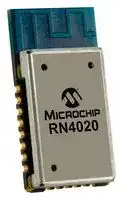


RN4020-V/RMBEC133
Bluetooth 4.1 Module, 1.8V to 3.6V Supply, 100m Range, 1Mbps, -92.5dBm, 2.402GHz to 2.480GHz
- Manufacturer: MICROCHIP
- Product type: Bluetooth Modules & Adaptors
- Bluetooth Version:Bluetooth 4.1; Supply Voltage Min:1.8V; Supply Voltage Max:3.6V; Signal Range Max:100m; Data Rate:1Mbps; Bluetooth Class:-; Receive Sensitivity:-92.5dBm; Operating Tem
- SVHC: No SVHC (04-Feb-2026)
- Interfaces: SPI, UART
- Product Range: -
- Certifications: CE, FCC, IC, KC, NCC, VCCI
- Bluetooth Class: -
- Bluetooth Version: Bluetooth 4.1
- Supply Voltage Range: 1.8 V to 3.6 V
- Receiver Sensitivity Rx: -92.5 dBm
- Operating Temperature Range: -30 °C to 85 °C
| Delivery and price | |
|---|---|
| Units per pack | 250 |
| Price | 7.83 € |
| Current stock | 50+ |
| Lead time | 30 days |

## **RN4020**
## **Bluetooth[®] Low Energy Module**
## **Features**
- Fully certified Bluetooth[®] version 4.1 module
- On-board Bluetooth Low Energy 4.1 stack
- ASCII command interface API over UART
- Device Firmware Upgrade (DFU) over UART or Over the Air (OTA)
- Microchip Low-energy Data Profile (MLDP) for serial data applications
- Remote commands over-the-air
- 64 KB internal flash
- Compact form factor: 11.5 x 19.5 x 2.5 mm
- Castellated SMT pads for easy and reliable PCB mounting
- Environmentally friendly, RoHS compliant
- Certifications: FCC, IC, CE, QDID, VCCI, KCC, and NCC
## **Applications**
- Health/Medical Devices
- Glucose meters
## **Operational**
- Single operating voltage: 1.8V to 3.6V (3.3V typical)
- Temperature range: -30°C to 85°C
- Low-power consumption
- Simple, UART interface
- Integrated Crystal, I[2] C Interface, Internal Voltage Regulator, Matching Circuitry, and PCB Antenna
- Multiple IOs for control and status
- GPIO, ADC
- Three Pulse Width Modulation (PWM) outputs
## **RF/Analog Features**
- ISM Band 2.402 to 2.480 GHz operation
- Channels 0-39
- RX Sensitivity: -92.5 dBm at 0.1% BER
- TX Power: -19.0 dBm to +7.5 dBm
- RSSI Monitor
- Heart rate
- Scale
- Sports Activity and Fitness - Pedometer
- Cycling computer
- Heart rate
- Retail
- Point of Sale (POS)
- Asset tagging and tracking
- Proximity advertising
- Beacon Applications
- Internet of Things (IoT) Sensor tag
- Remote Control
- Embedded Device Control
- AV consoles and game controllers
- Wearable Smart Devices and Accessories
- Industrial Control
- Private (custom) services
- Low bandwidth cable replacement
## **MAC/Baseband/Higher Layer Features**
- Secure AES128 encryption
- GAP, GATT, SM, L2CAP, and integrated public profiles
- Create custom services using command API
- Keyboard I/O Authentication
- Software configurable role as peripheral or central and client or server
- Built-in scripting capabilities for hostless operation
- Smart Energy/Smart Home
## **Description**
Microchip’s RN4020 Bluetooth Low Energy Module provides a highly integrated solution for delivering low-power Bluetooth 4.1 solutions. The advanced command interface offers rapid time to market. The RN4020 module complies with Bluetooth specification version 4.1. The module integrates RF, a baseband controller, and a command API processor, making it a complete Bluetooth Low Energy solution. The RN4020 can be used with ultra-low cost microcontroller for intelligent Bluetooth Low Energy applications. For simple sensor applications, the RN4020 internal scripting capabilities enable basic functions to be implemented without the need for external host MCU or
software development tools.
DS50002279B-page 1
2015 Microchip Technology Inc.
**RN4020**
## **Table of Contents**
|1.0|Device Overview........................................................................................................................................................................... 3|
|---|---|
|2.0|General Specifications.................................................................................................................................................................. 6|
|3.0|Microcontroller to RN4020 Interface............................................................................................................................................. 7|
|4.0|Physical Dimensions .................................................................................................................................................................... 8|
|5.0|Typical Application Schematic .................................................................................................................................................... 11|
|6.0|ASCII Command API.................................................................................................................................................................. 12|
|7.0|Supported Services .................................................................................................................................................................... 13|
|8.0|Regulatory Approval ................................................................................................................................................................... 15|
|9.0|Ordering Information................................................................................................................................................................... 21|
|Appendix A: Revision History............................................................................................................................................................... 23||
|The|Microchip Web Site ....................................................................................................................................................................... 25|
|Customer Change Notification Service ................................................................................................................................................ 25||
|Customer Support ................................................................................................................................................................................ 25||
## **TO OUR VALUED CUSTOMERS**
It is our intention to provide our valued customers with the best documentation possible to ensure successful use of your Microchip products. To this end, we will continue to improve our publications to better suit your needs. Our publications will be refined and enhanced as new volumes and updates are introduced.
If you have any questions or comments regarding this publication, please contact the Marketing Communications Department via E-mail at **docerrors@microchip.com** . We welcome your feedback.
## **Most Current Data Sheet**
To obtain the most up-to-date version of this data sheet, please register at our Worldwide Web site at:
## **http://www.microchip.com**
You can determine the version of a data sheet by examining its literature number found on the bottom outside corner of any page. The last character of the literature number is the version number, (e.g., DS30000000A is version A of document DS30000000).
## **Errata**
An errata sheet, describing minor operational differences from the data sheet and recommended workarounds, may exist for current devices. As device/documentation issues become known to us, we will publish an errata sheet. The errata will specify the revision of silicon and revision of document to which it applies.
To determine if an errata sheet exists for a particular device, please check with one of the following:
- Microchip’s Worldwide Web site; **http://www.microchip.com**
- Your local Microchip sales office (see last page)
When contacting a sales office, please specify which device, revision of silicon and data sheet (include literature number) you are using.
## **Customer Notification System**
Register on our web site at **www.microchip.com** to receive the most current information on all of our products.
DS50002279B-page 2
2015 Microchip Technology Inc.
**RN4020**
## **1.0 DEVICE OVERVIEW**
**FIGURE 1-2:**
**RN4020 PIN DIAGRAM**
The RN4020 Bluetooth Low Energy RF module integrates Bluetooth 4.1 radio baseband, MCU, digital analog I/O, on-board stack, and ASCII command API. Figure 1-1 shows the top view of the module. The pinout of the module is shown in Figure 1-2, and the description is presented in Table 1-1. Figure 1-3 lists all the key components of the module.
**FIGURE 1-1: RN4020 TOP VIEW**
**==> picture [460 x 328] intentionally omitted <==**
**----- Start of picture text -----**<br>
MICROCHIP 5629G@ O92 = aw<br>ao = N 8 F ® Y¥ Qa<br>:; RN4020 OZz2a2 0@ 9O©@ GO@ asg¢ ©ZB<br>i+ — —s = —as<br>{tierra<br>FIGURE 1-3: RN4020 BLOCK DIAGRAM<br>RN4020 Bluetooth [©] 4.1 Low Energy Module<br>High-Performance<br>Integrated Antenna<br>UART Interface<br>UART<br>Radio<br>64KB serial<br>3x Analog I/O<br>10-bit ADC Flash for<br>[ ee — Modem<br>User profiles<br>4 PWM I/O, I [2] C Comm. and scripts<br>GPIO<br>[ fT tsti—‘i‘siS@ BTLE v 4.1 Core |<br>with BT SIG Certified<br>Firmware GATT/GAP 1.8 – 3.6V<br>128b AES Encryption VReg<br>rSCS~*SY —_<br>Crystal<br>/CTS<br>**----- End of picture text -----**<br>
## **FIGURE 1-3: RN4020 BLOCK DIAGRAM**
DS50002279B-page 3
2015 Microchip Technology Inc.
**RN4020**
**TABLE 1-1: PIN DESCRIPTION**
|**Pin**|**Name**|**Description**|**Function**|
|---|---|---|---|
|1|GND|Ground|Ground|
|2|AIO2|Bi-directional withprogrammable analogI/O|1.35V and 30 mA max out|
|3|AIO1|Bi-directional withprogrammable analogI/O|1.35V and 30 mA max out|
|4|AIO0|Bi-directional withprogrammable analogI/O|1.35V and 30 mA max out|
|5|UART TX|UART Transmit(TX)|Output|
|6|UART RX|UART Receive(RX)|Input|
|7|WAKE_SW|Deep Sleep Wake; active-high to wake module from<br>Deep Sleep. If the module runs without a host micro-<br>controller, connect the UART_RX pin to VDD via a<br>10K resistor to conservepower in DeepSleep.|Input; weak pull down|
|8|CMD/MLDP|Command or MLDP mode – In Command mode,<br>UART traffic is sent to the command interpreter. In<br>MLDP mode, UART traffic is routed to the MLDP<br>Bluetooth LED connection, if active.|Input; Edge triggered; Change<br>from High to Low to enter CMD<br>mode from MLDP mode|
|9|GND|Ground|Ground|
|10|CONNECTION<br>LED<br>PIO[1]<br>SCK<br>PWM1|Default state is output. Active-high indicates the<br>module is connected to a remote device. Active-low<br>indicates a disconnected state. Configurable as<br>PIO[1] via software command. SCK for Diagnostics<br>and Factory Calibration if pin 17 is asserted.|• Connection Status Indicator<br>(Green LED)<br>• PIO[1]<br>• SCK<br>• PWM1|
|11|MLDP_EV<br>PIO[2]<br>CS<br>PWM2|Default function is output used for MLDP data event<br>indicator (Red LED). Active-high indicates MLDP<br>data received or UART console data pending. Low<br>level indicates no events. Event is only triggered in<br>MLDP mode, when CMD/MLDP (pin 8) is high.<br>Configurable as PIO[2] via “|I” and “|O” commands.<br>CS for Diagnostics and Factory Calibration if pin 17<br>is asserted.|• MLDP Data Indicator (Red<br>LED)<br>• PIO[2]<br>• CS<br>• PWM2|
|12|WS<br>PIO[3]<br>MOSI<br>PWM3|Default function is an output used for Activity<br>Indicator (Blue LED). High level indicates module is<br>awake and active. Low level indicates module is in a<br>Sleep state. Accessible as PIO[3] via “|>” and “|<”<br>commands. MOSI for Diagnostics and Factory<br>Calibration ifpin 17 is asserted.|• WS (Blue LED)<br>• PIO[3]<br>• MOSI<br>• PWM3|
|13|PIO[4]<br>MISO|MISO for Diagnostics and Factory Calibration if pin<br>17 asserted.|• PIO[4]<br>• MISO|
|14|CTS<br>PIO[5]|Reserved for CTS if hardware flow control is enabled<br>on the UART; active-low.|• CTS (input)<br>• PIO[5]|
DS50002279B-page 4
2015 Microchip Technology Inc.
**RN4020**
## **TABLE 1-1: PIN DESCRIPTION (CONTINUED)**
|**Pin**|**Name**|**Description**|**Function**|
|---|---|---|---|
|15|WAKE_HW|Hardware wake from Dormant state. Setting the<br>WAKE_HW (pin15) high wakes the module from Dor-<br>mant mode. During the module power up, if<br>WAKE_HW pin is flipped high and low for three<br>cycles (putting the WAKE_HW pin into high, low, and<br>then high again is considered as one flip cycle) in the<br>first five seconds, then the module performs a factory<br>Reset. If the WAKE_SW pin is high when a factory<br>Reset is performed, the factory Reset is a full reset.<br>Otherwise, it is a partial reset that retains the device<br>name, private service and scripts. Set WAKE_HW<br>pin to low in order to lower power consumption in<br>Deep Sleep and Dormant modes.<br>**CAUTION**<br>A full factory Reset erases scripts and sets the<br>device name to the serialized name. For more<br>information, refer to theSFCommand in the<br>_RN4020 Bluetooth Low Energy User's Guide_<br>(DS70005191).|Active-high; internal pull down|
|16|GND|Ground|Ground|
|17|SPI/PIO|SPI/PIO<br>for pins 10-13; active-high|Input with internal pull down;<br>selects SPI onpins 10-13|
|18|RTS<br>PIO[6]|Reserved for RTS if hardware flow control on UART<br>is enabled. If the data transmission to RN4020 must<br>be halted, assert RTS to high. RTS pin operates<br>independentlyfrom the CTS(pin 14).|• RTS (output)<br>• PIO[6]|
|19|PWM4<br>PIO[7]|Spare PIO|PIO[7]; Spare PIO configurable as<br>input or output|
|20|RSVD|Do not connect. Factorydiagnostics.|No Connect|
|21|SDA|SDA Data line of the I2C interface. The RN4020<br>always acts as the I2C Master.|SDA|
|22|SCL|I2C Clock|SCL|
|23|VDD|Supplyvoltage|1.8 to 3.6V|
|24|GND|Ground|Ground|
DS50002279B-page 5
2015 Microchip Technology Inc.
## **RN4020**
## **2.0 GENERAL SPECIFICATIONS**
Table 2-1 provides the general specifications of the module. Table 2-2 and Table 2-3 shows the weight and dimensions, and electrical characteristics of the module. Table 2-4 and Table 2-5 specify the current consumption of the module.
## **TABLE 2-1: GENERAL SPECIFICATIONS**
|**Specification**|**Description**|
|---|---|
|Standard|Bluetooth 4.1|
|FrequencyBand|2.4 ~ 2.48 GHz|
|Modulation Method|GFSK|
|Maximum Data Rate|1 Mbps|
|Antenna|PCB|
|Interface|UART, PIO, AIO, SPI|
|Operation Range|100 meters**(1)**|
|Sensitivity|-92.5 dBm at 0.1% BER|
|RF TX Power|-19.0 dBm to +7.5 dBm|
|Temperature(operating)|-30°C to +85°C|
|Temperature(storage)|-40°C to +85°C|
|Humidity|10% ~ 90%<br>non-condensing|
- **Note 1:** Maximum range under ideal conditions such as RF matching, line of sight, maximum power. Actual results may vary depending on the customer’s design.
## **TABLE 2-2: WEIGHT AND DIMENSIONS**
|**Specification**|**Description**|
|---|---|
|Dimensions|11.5 x 19.5 x 2.5 mm|
|Weight|1.2g|
## **TABLE 2-3: ELECTRICAL CHARACTERISTICS**
|**Specification**|**Description**|
|---|---|
|SupplyVoltage|1.8 to 3.6V DC|
|Working current|Depends on profiles, 12 mA<br>typical|
## **TABLE 2-4: CURRENT CONSUMPTION**
|**Mode**|**Typical Current at 3V**|
|---|---|
|Dormant|<900 nA|
|DeepSleep|<5.0µA|
|Idle|<1.5 mA|
|TX/RX active|16 mA|
## **TABLE 2-5: CURRENT CONSUMPTION VS RF TX POWER**
**RN4020, VDD = 3.3V, 25°C**
|**TABLE 2-5:**<br>**CURRENT CONSUMPTION VS**<br>**RF TX POWER**|**TABLE 2-5:**<br>**CURRENT CONSUMPTION VS**<br>**RF TX POWER**|
|---|---|
|**RN4020, VDD = 3.3V, 25°C**||
|**TX Power (dBm)**|**Id (mA)**|
|-19.1|14.0|
|-15.1|14.4|
|-10.9|15.0|
|-6.9|15.9|
|-2.5|17.6|
|1.6|20.7|
|5.8|26.9|
|7.5|33.6|
DS50002279B-page 6
2015 Microchip Technology Inc.
**RN4020**
## **3.0 MICROCONTROLLER TO RN4020 INTERFACE**
Figure 3-1 illustrates the interface between PIC microcontroller and the RN4020 module.
The minimum interface consists of UART and WAKE_HW lines. This enables the microcontroller to communicate with the RN4020 module using ASCII command API. The command API is described in **Section 6.0 “ASCII Command API”** .
## **3.1 CTS/RTS Hardware Flow Control**
## **3.2 Microchip Low-energy Data Profile (MLDP)**
The Microchip Low-energy Data Profile is a private BTLE service that provides a 50 kbps serial data transport over Bluetooth Low Energy on the RN4020. Pin 8 (CMD/MLDP) is required. CTS/RTS hardware control is also highly recommended for this service to avoid data loss.
For more information on how to use the MLDP data service, refer to _RN4020 Bluetooth Low Energy Module User’s Guide_ (DS70005191).
For customer applications using the Microchip Lowenergy Data Profile, Pin 8 (CMD/MLDP) is required. CTS/RTS hardware control is also required for this service to avoid buffer overruns.
## **FIGURE 3-1: INTERFACE DESCRIPTION**
**Note:** If the RN4020 is operated in a hostless mode (without a microcontroller), set the UART_RX pin to high via a 10K resistor to reduce power consumption in Deep Sleep mode.
DS50002279B-page 7
2015 Microchip Technology Inc.
**RN4020**
## **4.0 PHYSICAL DIMENSIONS**
Figure 4-1 shows the physical dimensions for RN4020 module. Figure 4-2 illustrates the recommended PCB layout. It is recommended that when laying out the carrier board for the RN4020 module, the areas under the antenna, RF test point (semi-circular pad), and shielding connections do not contain surface traces, ground planes, or exposed vias.
Figure 4-3 specifies the recommended mounting details. For optimal radio performance, it is recommended that the antenna end of the RN4020 module protrudes at least 31 mm beyond any metal enclosure. Figure 4-4 shows an example of good and acceptable positioning of the RN4020 on the host PCB.
**FIGURE 4-1: RN4020 MODULE DIMENSIONS**
DS50002279B-page 8
2015 Microchip Technology Inc.
**RN4020**
## **FIGURE 4-2: RN4020 RECOMMENDED PCB FOOTPRINT**
## **FIGURE 4-3: RN4020 MODULE MOUNTING DETAILS**
DS50002279B-page 9
2015 Microchip Technology Inc.
**RN4020**
**FIGURE 4-4: RN4020 HOST PCB EXAMPLE LAYOUT**
DS50002279B-page 10
2015 Microchip Technology Inc.
## **5.0 TYPICAL APPLICATION SCHEMATIC**
Figure 5-1 shows the schematics for the RN4020 Bluetooth Low Energy PICtail™/PICtail Plus development tool (P/N: RN-4020-PICtail).
## **FIGURE 5-1: RN4020 TYPICAL APPLICATION SCHEMATICS**
## **RN4020**
## **6.0 ASCII COMMAND API**
The RN4020 command API is documented in _RN4020 Bluetooth Low Energy Module User’s Guide_ (DS70005191).
Commands are categorized into the following functions:
- Built-in Public Services
- Enable/Disable service as Server or Client
- Read/Write characteristic values
- Set notification for characteristic
- Max TX Power
- Set power in dB
- GAP Role
- Central, Peripheral, Observer and Broadcaster
- Advertising
- Start/Stop
- Bonding
- Bond/Unbound to Master
- IO
- Configure GPIO mask
- Set/Get GPIO states
- Ready and Write ADC values
- Read/Write I[2] C
- Configure PWM
- Device Firmware Update
- Accessing remote configuration
- System
- Reboot
- Factory default
- Display configuration
- Scripting
- Enter script mode
- Declare event handler
- Execute current script
- List current script
- Clear script
- Define User function
- Private Service
- Set private service UUID
- Set characteristic UUID for private service
- Set private service filter
- Microchip Low-energy Data Profile (MLDP)
- Enable
- Enter MLDP mode
- Peripheral side configuration
- Central side configuration
- Device Information Profile settings
- Connection
- Status
- Disconnect
- Kill active connection
- Establish connection (Central role only)
- Start/Stop inquiry scan for other devices (Central role only)
DS50002279B-page 12
2015 Microchip Technology Inc.
**RN4020**
## **7.0 SUPPORTED SERVICES**
The RN4020 firmware support the built-in public services listed in Table 7-1. The services are enabled via Command API and serviced in the same manner. Each service manages “Characteristics” which are declared and defined by Bluetooth as data values. The values for each characteristic are cached in modules memory and can be read by another Bluetooth device such as smartphone acting in Central role. The values of every Characteristic are updated via Command API over UART.
## **TABLE 7-1: SUPPORTED PUBLIC SERVICES ON RN4020[(1)]**
|**Service Name**|**Bluetooth SIG UUID**|
|---|---|
|Device Information|0x180A|
|Battery|0x180F|
|Heart Rate|0x180D|
|Health Thermometer|0x1809|
|Glucose|0x1808|
|Blood Pressure|0x1810|
|RunningSpeed Cadence|0x1814|
|CyclingSpeed Cadence|0x1816|
|Current Time|0x1805|
|Next DST Change|0x1807|
|Reference Time Update|0x1806|
|Link Loss|0x1803|
|Immediate Alert|0x1802|
|TX Power|0x1804|
|Alert Notification|0x1811|
|Phone Alert Status|0x180E|
|Scan Parameters|0x1813|
Private services are not registered with the Bluetooth SIG, and therefore not interoperable with other Bluetooth Low Energy devices, unless the device implements the private service. An example of a built-in private service is Microchip Streaming Data service.
For an example on how to create a custom service using the RN4020, refer to _RN4020 Bluetooth Low Energy Module User’s Guide_ (DS70005191).
## **7.2 PCB Antenna**
The PCB antenna is fabricated on the top copper layer and covered in solder mask. The layers below the antenna do not have copper trace. It is recommended that the module is mounted on the edge of the host PCB. Having PCB material below the antenna structure is permitted as long as no copper traces or planes are on the host PCB in that area.
Table 7-2 provides the antenna specification.
**TABLE 7-2: ANTENNA CHARACTERISTICS**
|**Specification**|**Description**|
|---|---|
|Type|PCB|
|FrequencyRange|2.402 to 2.485 MHz|
|Peak Gain|-0.23 dBi|
Figure 7-1, Figure 7-2, and Figure 7-3 show the antenna efficiency, the antenna plot, and the 3D radiation pattern.
## **FIGURE 7-1:**
## **EFFICIENCY**
- **Note 1:** The services listed above are based on firmware version 1.20. For the latest list of supported services, refer to the firmware version on the RN4020 web page.
## **7.1 Public and Private Services**
The RN4020 provides the ability to create private service. If the services are supported on both end points of a Bluetooth Low Energy connection, such as Central and Peripheral devices, data can be exchanged. For example, two RN4020 modules can define a custom (private) service with its own unique UUID and GATT characteristics. Data can be exchanged easily via Command API.
DS50002279B-page 13
2015 Microchip Technology Inc.
## **RN4020**
## **FIGURE 7-2: ANTENNA PLOT**
## **7.3 Soldering Recommendations**
The RN4020 wireless module is assembled using standard lead-free reflow profile IPC/JEDEC J-STD-020.
The module can be soldered to the host PCB using standard leaded and lead-free solder reflow profiles.
To avoid damaging the module, the following recommendations are given:
- Microchip Technology Application Note, _AN233 Solder Reflow Recommendation_ (DS00233) provides solder reflow recommendations
- Do not exceed peak temperature (Tp) of 250°C
- Refer to the solder paste data sheet for specific reflow profile recommendations
- Use no-clean flux solder paste
- Do not wash as moisture can be trapped under the shield
- Use only one flow. If the PCB requires multiple flows, apply the module on the final flow.
**FIGURE 7-3: 3D RADIATION PATTERN AND ANTENNA ORIENTATION**
DS50002279B-page 14
2015 Microchip Technology Inc.
**RN4020**
## **8.0 REGULATORY APPROVAL**
This section outlines the regulatory information for the RN4020 module for the following countries:
- United States
- Canada
- Europe
- Australia
- New Zealand
- Japan
- Korea
- Taiwan
## **8.1 United States**
The RN4020 module has received Federal Communications Commission (FCC) CFR47 Telecommunications, Part 15 Subpart C “Intentional Radiators” modular approval in accordance with Part 15.212 Modular Transmitter approval. Modular approval allows the end user to integrate the RN4020 module into a finished product without obtaining subsequent and separate FCC approvals for intentional radiation, provided no changes or modifications are made to the module circuitry. Changes or modifications could void the user’s authority to operate the equipment. The end user must comply with all of the instructions provided by the Grantee, which indicate installation and/or operating conditions necessary for compliance.
The finished product is required to comply with all applicable FCC equipment authorizations regulations, requirements and equipment functions not associated with the transmitter module portion. For example, compliance must be demonstrated to regulations for other transmitter components within the host product; to requirements for unintentional radiators (Part 15 Subpart B “Unintentional Radiators”), such as digital devices, computer peripherals, radio receivers, etc.; and to additional authorization requirements for the non-transmitter functions on the transmitter module (i.e., Verification, or Declaration of Conformity) (e.g., transmitter modules may also contain digital logic functions) as appropriate.
## 8.1.1 LABELING AND USER INFORMATION REQUIREMENTS
The RN4020 module has been labeled with its own FCC ID number, and if the FCC ID is not visible when the module is installed inside another device, then the outside of the finished product into which the module is installed must also display a label referring to the enclosed module. This exterior label can use wording as follows:
RN4020 **:**
Contains Transmitter Module FCC ID: T9JRN4020 _or_
Contains FCC ID: T9JRN4020
This device complies with Part 15 of the FCC Rules. Operation is subject to the following two conditions: (1) this device may not cause harmful interference, and (2) this device must accept any interference received, including interference that may cause undesired operation
A user’s manual for the product should include the following statement:
This equipment has been tested and found to comply with the limits for a Class B digital device, pursuant to part 15 of the FCC Rules. These limits are designed to provide reasonable protection against harmful interference in a residential installation. This equipment generates, uses and can radiate radio frequency energy, and if not installed and used in accordance with the instructions, may cause harmful interference to radio communications. However, there is no guarantee that interference will not occur in a particular installation. If this equipment does cause harmful interference to radio or television reception, which can be determined by turning the equipment off and on, the user is encouraged to try to correct the interference by one or more of the following measures:
- Reorient or relocate the receiving antenna.
- Increase the separation between the equipment and receiver.
- Connect the equipment into an outlet on a circuit different from that to which the receiver is connected.
- Consult the dealer or an experienced radio/TV technician for help.
Additional information on labeling and user information requirements for Part 15 devices can be found in KDB Publication 784748 available at the FCC Office of Engineering and Technology (OET) Laboratory Division Knowledge Database (KDB) http://apps.fcc.gov/oetcf/kdb/index.cfm.
DS50002279B-page 15
2015 Microchip Technology Inc.
## **RN4020**
## 8.1.2 RF EXPOSURE
All transmitters regulated by FCC must comply with RF exposure requirements. KDB 447498 General RF Exposure Guidance provides guidance in determining whether proposed or existing transmitting facilities, operations or devices comply with limits for human exposure to Radio Frequency (RF) fields adopted by the Federal Communications Commission (FCC).
This module is approved for installation into mobile and/or portable host platforms and must not be colocated or operating in conjunction with any other antenna or transmitter except in accordance with FCC multitransmitter guidelines. End users must be provided with transmitter operating conditions for satisfying RF Exposure compliance.
## 8.1.3 HELPFUL WEB SITES
Federal Communications Commission (FCC): http://www.fcc.gov
FCC Office of Engineering and Technology (OET) Laboratory Division Knowledge Database (KDB): http://apps.fcc.gov/oetcf/kdb/index.cfm
## **8.2 Canada**
The RN4020 module has been certified for use in Canada under Industry Canada (IC) Radio Standards Specification (RSS) RSS-210 and RSSGen. Modular approval permits the installation of a module in a host device without the need to recertify the device.
## 8.2.1 LABELING AND USER INFORMATION REQUIREMENTS
Labeling Requirements for the Host Device (from Section 3.2.1, RSS-Gen, Issue 3, December 2010): The host device shall be properly labeled to identify the module within the host device.
The Industry Canada certification label of a module shall be clearly visible at all times when installed in the host device, otherwise the host device must be labeled to display the Industry Canada certification number of the module, preceded by the words “Contains transmitter module”, or the word “Contains”, or similar wording expressing the same meaning, as follows:
tus shall contain the following or equivalent notice in a conspicuous location in the user manual or alternatively on the device or both:
This device complies with Industry Canada licenseexempt RSS standard(s). Operation is subject to the following two conditions: (1) this device may not cause interference, and (2) this device must accept any interference, including interference that may cause undesired operation of the device.
Le présent appareil est conforme aux CNR d'Industrie Canada applicables aux appareils radio exempts de licence. L'exploitation est autorisée aux deux conditions suivantes: (1) l'appareil ne doit pas produire de brouillage, et (2) l'utilisateur de l'appareil doit accepter tout brouillage radioélectrique subi, même si le brouillage est susceptible d'en compromettre le fonctionnement.
Transmitter Antenna (from Section 7.1.2 RSS-Gen, Issue 3, December 2010): User manuals for transmitters shall display the following notice in a conspicuous location:
Under Industry Canada regulations, this radio transmitter may only operate using an antenna of a type and maximum (or lesser) gain approved for the transmitter by Industry Canada. To reduce potential radio interference to other users, the antenna type and its gain should be so chosen that the equivalent isotropically radiated power (e.i.r.p.) is not more than that necessary for successful communication.
Conformément à la réglementation d'Industrie Canada, le présent émetteur radio peut fonctionner avec une antenne d'un type et d'un gain maximal (ou inférieur) approuvé pour l'émetteur par Industrie Canada. Dans le but de réduire les risques de brouillage radioélectrique à l'intention des autres utilisateurs, il faut choisir le type d'antenne et son gain de sorte que la puissance isotrope rayonnée équivalente (p.i.r.e.) ne dépasse pas l'intensité nécessaire à l'établissement d'une communication satisfaisante.
The above notice may be affixed to the device instead of displayed in the user manual.
## 8.2.2 RF EXPOSURE
Contains transmitter module IC: 6514A-RN4020
User Manual Notice for License-Exempt Radio Apparatus (from Section 7.1.3 RSS-Gen, Issue 3, December 2010): User manuals for license-exempt radio appara-
All transmitters regulated by IC must comply with RF exposure requirements listed in RSS-102 - Radio Frequency (RF) Exposure Compliance of Radiocommunication Apparatus (All Frequency Bands).
This module is approved for installation into mobile and/or portable host platforms and must not be colocated or operating in conjunction with any other antenna or transmitter except in accordance with Industry Canada's multi-transmitter guidelines. End users must be provided with transmitter operating conditions for satisfying RF Exposure compliance.
DS50002279B-page 16
2015 Microchip Technology Inc.
**RN4020**
## 8.2.3 APPROVED EXTERNAL ANTENNA TYPES
Transmitter Antenna (from Section 7.1.2 RSS-Gen, Issue 3, December 2010):
The RN4020 module can only be sold or operated with antennas with which it was approved. Transmitter may be approved with multiple antenna types. An antenna type comprises antennas having similar in-band and out-of-band radiation patterns. Testing shall be performed using the highest gain antenna of each combination of transmitter and antenna type for which approval is being sought, with the transmitter output power set at the maximum level. Any antenna of the same type having equal or lesser gain as an antenna that had been successfully tested with the transmitter, will also be considered approved with the transmitter, and may be used and marketed with the transmitter.
When a measurement at the antenna connector is used to determine RF output power, the effective gain of the device's antenna shall be stated, based on measurement or on data from the antenna manufacturer. For transmitters of output power greater than 10 milliwatts, the total antenna gain shall be added to the measured RF output power to demonstrate compliance to the specified radiated power limits.
## 8.2.4 HELPFUL WEB SITES
Industry Canada: http://www.ic.gc.ca/
## **8.3 Europe**
The RN4020 module is an R&TTE Directive assessed radio module that is CE marked and has been manufactured and tested with the intention of being integrated into a final product.
The RN4020 module has been tested to R&TTE Directive 1999/5/EC Essential Requirements for Health and Safety (Article (3.1(a)), Electromagnetic Compatibility (EMC) (Article 3.1(b)), and Radio (Article 3.2) and are summarized in Table 3-1: European Compliance Testing. A Notified Body Opinion has also been issued. All test reports are available on the RN4020 product web page at http://www.microchip.com.
The R&TTE Compliance Association provides guidance on modular devices in document **Technical Guidance Note 01** available at
http://www.rtteca.com/html/download_area.htm.
**Note:** To maintain conformance to the testing listed in Table 8-1, the module shall be installed in accordance with the installation instructions in this data sheet and shall not be modified.
When integrating a radio module into a completed product the integrator becomes the manufacturer of the final product and is therefore responsible for demonstrating compliance of the final product with the essential requirements of the R&TTE Directive.
## 8.3.1 LABELING AND USER INFORMATION REQUIREMENTS
The label on the final product which contains the RN4020 module must follow CE marking requirements. The “ _R&TTE Compliance Association Technical Guidance Note 01”_ provides guidance on final product CE marking.
## 8.3.2 ANTENNA REQUIREMENTS
From R&TTE Compliance Association document **Technical Guidance Note 01** :
Provided the integrator installing an assessed radio module with an integral or specific antenna and installed in conformance with the radio module manufacturer’s installation instructions requires no further evaluation under Article 3.2 of the R&TTE Directive and does not require further involvement of an R&TTE Directive Notified Body for the final product. [Section 2.2.4]
## 8.3.3 HELPFUL WEB SITES
A document that can be used as a starting point in understanding the use of Short Range Devices (SRD) in Europe is the European Radio Communications Committee (ERC) Recommendation 70-03 E, which can be downloaded from the European Radio Communications Office (ERO) at: http://www.ero.dk/.
Additional helpful web sites are:
- Radio and Telecommunications Terminal Equipment (R&TTE): http://ec.europa.eu/enterprise/rtte/index_en.htm
- European Conference of Postal and Telecommunications Administrations (CEPT): http://www.cept.org/
- European Telecommunications Standards Institute (ETSI): http://www.etsi.org
DS50002279B-page 17
2015 Microchip Technology Inc.
## **RN4020**
- European Radio Communications Office (ERO): http://www.ero.dk/
- The Radio and Telecommunications Terminal Equipment Compliance Association (R&TTE CA): http://www.rtteca.com/
**TABLE 8-1: RN4020 EUROPEAN COMPLIANCE TESTING Report Certification Standards Article Laboratory Date Number** ~~a ee~~ Safety EN 60950-1:2006+A11:2009+A1:2010 [3.1(a)] Pending +A12:2011 ~~ee rra~~ Health EN 62479:2010 ~~a~~ Pendin ~~ee~~ g ~~ee~~ EMC EN 301 489-1 V1.9.2 (2011-09) [3.1(b)] Pending ~~er~~ EN 301 489-17 V2.2.1 (2012-09) ~~ee a~~ Radio EN 300 328 V1.8.1 (2006-06) (3.2) Pending Notified Body Pending Opinion ~~cco~~
## **8.4 Australia**
The Australia radio regulations do not provide a modular approval policy similar to the United States (FCC) and Canada (IC). However, RN4020 module RF transmitter test reports can be used in part to demonstrate compliance in accordance with ACMA Radio communications “Short Range Devices” Standard 2004 (The Short Range Devices standard calls up the AS/NZS 4268:2008 industry standard). The RN4020 module test reports can be used as part of the product certification and compliance folder. For more information on the RF transmitter test reports, contact Microchip Technology Australia sales office.
To meet overall Australian final product compliance, the developer must construct a compliance folder containing all relevant compliance test reports e.g. RF, EMC, electrical safety and DoC (Declaration of Conformity) etc. It is the responsibility of the integrator to know what is required in the compliance folder for ACMA compliance. All test reports are available on the RN4020 product web page at http://www.microchip.com. For more information on Australia compliance, refer to the Australian Communications and Media Authority web site http://www.acma.gov.au/.
## 8.4.1 HELPFUL WEB SITE
The Australian Communications and Media Authority: www.acma.gov.au/.
## **8.5 New Zealand**
The New Zealand radio regulations do not provide a modular approval policy similar to the United States (FCC) and Canada (IC). However, RN4020 module RF transmitter test reports can be used in part to demonstrate compliance against the New Zealand “General User Radio License for Short Range Devices”. New Zealand Radio communications (Radio Standards) Notice 2010 calls up the AS / NZS 4268:2008 industry standard. The RN4020 module test reports can be used as part of the product certification and compliance folder. All test reports are available on the RN4020 product web page at http://www.microchip.com. For more information on the RF transmitter test reports, contact Microchip Technology sales office.
Information on the New Zealand short range devices license can be found in the following web links:
http://www.rsm.govt.nz/cms/licensees/types-oflicence/ general-user-licences/short-range-devices and
http://www.rsm.govt.nz/cms/policy-and-planning/spectrum-policy-overview/legislation/gazette-notices/product-compliance
To meet overall New Zealand final product compliance, the developer must construct a compliance folder containing all relevant compliance test reports e.g. RF, EMC, electrical safety and DoC (Declaration of Conformity) etc. It is the responsibility of the developer to know what is required in the compliance folder for New Zealand Radio communications. For more information on New Zealand compliance, refer to the web site
http://www.rsm.govt.nz/.
DS50002279B-page 18
2015 Microchip Technology Inc.
**RN4020**
## **8.6 Japan**
The RN4020 module has received type certification and is labeled with its own technical conformity mark and certification number as required to conform to the technical standards regulated by the Ministry of Internal Affairs and Communications (MIC) of Japan pursuant to the Radio Act of Japan.
Integration of this module into a final product does not require additional radio certification provided installation instructions are followed and no modifications of the module are allowed. Additional testing may be required:
- If the host product is subject to electrical appliance safety (for example, powered from an AC mains), the host product may require Product Safety Electrical Appliance and Material (PSE) testing. The integrator should contact their conformance laboratory to determine if this testing is required.
## **8.7 Korea**
The RN4020 module has received certification of conformity in accordance with the Radio Waves Act. Integration of this module into a final product does not require additional radio certification provided installation instructions are followed and no modifications of the module are allowed.
## 8.7.1 LABELING AND USER INFORMATION REQUIREMENTS
The label on the final product which contains the RN4020 module must follow KC marking requirements. The integrator of the module should refer to the labeling requirements for Korea available on the Korea Communications Commission (KCC) website.
The RN4020 module is labeled with its own KC mark. The final product requires the KC mark and certificate number of the module:
- There is an voluntary Electromagnetic Compatibility (EMC) test for the host product administered by VCCI: http://www.vcci.jp/vcci_e/index.html
## MSIP-CRI-029-RN4020
## 8.6.1 LABELING AND USER INFORMATION REQUIREMENTS
The label on the final product which contains the RN4020 module must follow Japan marking requirements. The integrator of the module should refer to the labeling requirements for Japan available at the Ministry of Internal Affairs and Communications (MIC) website.
## 8.7.2 HELPFUL WEB SITES
Korea Communications Commission (KCC): http://www.kcc.go.kr
National Radio Research Agency (RRA): http://rra.go.kr
The RN4020 module is labeled with its own technical conformity mark and certification number. The final product in which this module is being used must have a label referring to the type certified module inside:
**==> picture [157 x 6] intentionally omitted <==**
**----- Start of picture text -----**<br>
Contains transmitter module with certificate number:<br>**----- End of picture text -----**<br>
## 8.6.2 4.6.2 HELPFUL WEB SITES
Ministry of Internal Affairs and Communications (MIC): http://www.tele.soumu.go.jp/e/index.htm
Association of Radio Industries and Businesses (ARIB): http://www.arib.or.jp/english/
DS50002279B-page 19
2015 Microchip Technology Inc.
## **RN4020**
## **8.8 Taiwan**
The RN4020 module has received compliance approval in accordance with the Telecommunications Act. Customers seeking to use the compliance approval in their product should contact Microchip Technology sales or distribution partners to obtain a Letter of Authority.
## 8.8.2 HELPFUL WEB SITE
National Communications Commission (NCC): http://www.ncc.gov.tw
Integration of this module into a final product does not require additional radio certification provided installation instructions are followed and no modifications of the module are allowed.
## 8.8.1 LABELING AND USER INFORMATION REQUIREMENTS
The RN4020 module is labeled with its own NCC mark and certificate number as below:
The user's manual should contain below warning (for RF device) in traditional Chinese:
注意 !
依據 低功率電波輻射性電機管理辦法 第十二條 經型式認證合格之低功率射頻電 機,非經許可,
公司、商號或使用者均不得擅自變更頻率、 加大功率或變更原設計 之特性及功能。
第十四條 低功率射頻電機之使用不得影響飛 航安全及干擾合法通信; 經發現有干擾現象時,應立即停用,並改善 至無干擾時方得繼續使用。 前項合法通信,指依電信規定作業之無線電 信。
低功率射頻電機須忍受合法通信或工業、科 學及醫療用電波輻射性
電機設備之干擾。
DS50002279B-page 20
2015 Microchip Technology Inc.
**RN4020**
## **9.0 ORDERING INFORMATION**
## Table 9-1 provides ordering information for the RN4020 module. **TABLE 9-1: ORDERING INFORMATION**
|**Part Number**|**Description**|
|---|---|
|RN4020-V/RM|Standard firmware(GATT, GAP, L2CAP) peripheral and Central mode|
**Note:** For custom applications, contact Microchip representative.
Go to http://www.microchip.com for current pricing and a list of distributors carrying Microchip products. Go to http://www.microchip.com/RN4020 for latest RN4020 firmware update.
DS50002279B-page 21
2015 Microchip Technology Inc.
**RN4020**
## **NOTES:**
DS50002279B-page 22
2015 Microchip Technology Inc.
**RN4020**
## **APPENDIX A: REVISION HISTORY**
## **Revision A (June 2014)**
This is the initial released version of the document in the Microchip format.
## **Revision B (September 2015)**
This revision includes the following updates:
- Updated information for single operating voltage from 3.0V to 3.6V to show 1.8V to 3.6V on page 1.
- Updated Figure 1-2 to change pin names for pin numbers 10, 11, 12, 19, 21 and 22.
- Updated Figure 1-3 to include current inputs and outputs.
- Updated Table 1-1 for changes in pin names, description, and functions.
- Added a Note in Table 2-1.
- Added Table 2-5.
- Added a Note in Figure 3-1.
- Updated Figure 4-2.
- Updated Figure 4-4.
- Updated Figure 5-1.
- Updated **Section 6.0 “ASCII Command API”** to add information for GAP Role, MLDP, IO, and Scripting functions.
- Added a Note in Table 7-1.
- Updated **Section 8.0 “Regulatory Approval”** to add the regulatory information for Japan, Korea, and Taiwan.
- Minor updates to text and formatting have been incorporated throughout the document.
DS50002279B-page 23
2015 Microchip Technology Inc.
**RN4020**
## **NOTES:**
DS50002279B-page 24
2015 Microchip Technology Inc.
**RN4020**
## **THE MICROCHIP WEB SITE**
Microchip provides online support via our WWW site at www.microchip.com. This web site is used as a means to make files and information easily available to customers. Accessible by using your favorite Internet browser, the web site contains the following information:
- **Product Support** – Data sheets and errata, application notes and sample programs, design resources, user’s guides and hardware support documents, latest software releases and archived software
- **General Technical Support** – Frequently Asked Questions (FAQ), technical support requests, online discussion groups, Microchip consultant program member listing
## **CUSTOMER SUPPORT**
Users of Microchip products can receive assistance through several channels:
- Distributor or Representative
- Local Sales Office
- Field Application Engineer (FAE)
- Technical Support
Customers should contact their distributor, representative or Field Application Engineer (FAE) for support. Local sales offices are also available to help customers. A listing of sales offices and locations is included in the back of this document.
**Technical support is available through the web site at: http://microchip.com/support**
- **Business of Microchip** – Product selector and ordering guides, latest Microchip press releases, listing of seminars and events, listings of Microchip sales offices, distributors and factory representatives
## **CUSTOMER CHANGE NOTIFICATION SERVICE**
Microchip’s customer notification service helps keep customers current on Microchip products. Subscribers will receive e-mail notification whenever there are changes, updates, revisions or errata related to a specified product family or development tool of interest.
To register, access the Microchip web site at www.microchip.com. Under “Support”, click on “Customer Change Notification” and follow the registration instructions.
DS50002279B-page 25
2015 Microchip Technology Inc.
**RN4020**
## **NOTES:**
DS50002279B-page 26
2015 Microchip Technology Inc.
**Note the following details of the code protection feature on Microchip devices:**
- Microchip products meet the specification contained in their particular Microchip Data Sheet.
- Microchip believes that its family of products is one of the most secure families of its kind on the market today, when used in the intended manner and under normal conditions.
- There are dishonest and possibly illegal methods used to breach the code protection feature. All of these methods, to our knowledge, require using the Microchip products in a manner outside the operating specifications contained in Microchip’s Data Sheets. Most likely, the person doing so is engaged in theft of intellectual property.
- Microchip is willing to work with the customer who is concerned about the integrity of their code.
- Neither Microchip nor any other semiconductor manufacturer can guarantee the security of their code. Code protection does not mean that we are guaranteeing the product as “unbreakable.”
Code protection is constantly evolving. We at Microchip are committed to continuously improving the code protection features of our products. Attempts to break Microchip’s code protection feature may be a violation of the Digital Millennium Copyright Act. If such acts allow unauthorized access to your software or other copyrighted work, you may have a right to sue for relief under that Act.
Information contained in this publication regarding device applications and the like is provided only for your convenience and may be superseded by updates. It is your responsibility to ensure that your application meets with your specifications. MICROCHIP MAKES NO REPRESENTATIONS OR WARRANTIES OF ANY KIND WHETHER EXPRESS OR IMPLIED, WRITTEN OR ORAL, STATUTORY OR OTHERWISE, RELATED TO THE INFORMATION, INCLUDING BUT NOT LIMITED TO ITS CONDITION, QUALITY, PERFORMANCE, MERCHANTABILITY OR FITNESS FOR PURPOSE **.** Microchip disclaims all liability arising from this information and its use. Use of Microchip devices in life support and/or safety applications is entirely at the buyer’s risk, and the buyer agrees to defend, indemnify and hold harmless Microchip from any and all damages, claims, suits, or expenses resulting from such use. No licenses are conveyed, implicitly or otherwise, under any Microchip intellectual property rights unless otherwise stated.
## **Trademarks**
The Microchip name and logo, the Microchip logo, dsPIC, FlashFlex, flexPWR, JukeBlox, KEELOQ, KEELOQ logo, Kleer, LANCheck, MediaLB, MOST, MOST logo, MPLAB, OptoLyzer, PIC, PICSTART, PIC[32] logo, RightTouch, SpyNIC, SST, SST Logo, SuperFlash and UNI/O are registered trademarks of Microchip Technology Incorporated in the U.S.A. and other countries.
The Embedded Control Solutions Company and mTouch are registered trademarks of Microchip Technology Incorporated in the U.S.A.
Analog-for-the-Digital Age, BodyCom, chipKIT, chipKIT logo, CodeGuard, dsPICDEM, dsPICDEM.net, ECAN, In-Circuit Serial Programming, ICSP, Inter-Chip Connectivity, KleerNet, KleerNet logo, MiWi, motorBench, MPASM, MPF, MPLAB Certified logo, MPLIB, MPLINK, MultiTRAK, NetDetach, Omniscient Code Generation, PICDEM, PICDEM.net, PICkit, PICtail, RightTouch logo, REAL ICE, SQI, Serial Quad I/O, Total Endurance, TSHARC, USBCheck, VariSense, ViewSpan, WiperLock, Wireless DNA, and ZENA are trademarks of Microchip Technology Incorporated in the U.S.A. and other countries.
SQTP is a service mark of Microchip Technology Incorporated in the U.S.A.
Silicon Storage Technology is a registered trademark of Microchip Technology Inc. in other countries.
GestIC is a registered trademark of Microchip Technology Germany II GmbH & Co. KG, a subsidiary of Microchip Technology Inc., in other countries.
All other trademarks mentioned herein are property of their respective companies.
© 2014-2015, Microchip Technology Incorporated, Printed in the U.S.A., All Rights Reserved.
ISBN: 978-1-63277-793-5
## **QUALITY MANAGEMENT SYSTEM**
## **CERTIFIED BY DNV**
## == == **ISO/TS 16949**
_Microchip received ISO/TS-16949:2009 certification for its worldwide headquarters, design and wafer fabrication facilities in Chandler and Tempe, Arizona; Gresham, Oregon and design centers in California and India. The Company’s quality system processes and procedures are for its PIC[®] MCUs and dsPIC[®] DSCs, KEELOQ[®] code hopping devices, Serial EEPROMs, microperipherals, nonvolatile memory and analog products. In addition, Microchip’s quality system for the design and manufacture of development systems is ISO 9001:2000 certified._
DS50002279B-page 27
2014-2015 Microchip Technology Inc.
## **Worldwide Sales and Service**
## **AMERICAS**
**Corporate Office** 2355 West Chandler Blvd. Chandler, AZ 85224-6199 Tel: 480-792-7200 Fax: 480-792-7277 Technical Support: http://www.microchip.com/ support Web Address: www.microchip.com
**Atlanta** Duluth, GA Tel: 678-957-9614 Fax: 678-957-1455
**Austin, TX** Tel: 512-257-3370
**Boston** Westborough, MA Tel: 774-760-0087 Fax: 774-760-0088
**Chicago** Itasca, IL Tel: 630-285-0071 Fax: 630-285-0075
**Cleveland** Independence, OH Tel: 216-447-0464 Fax: 216-447-0643
**Dallas** Addison, TX Tel: 972-818-7423 Fax: 972-818-2924
**Detroit** Novi, MI Tel: 248-848-4000
**Houston, TX** Tel: 281-894-5983
**Indianapolis** Noblesville, IN Tel: 317-773-8323 Fax: 317-773-5453
**Los Angeles** Mission Viejo, CA Tel: 949-462-9523 Fax: 949-462-9608
**New York, NY** Tel: 631-435-6000
**San Jose, CA** Tel: 408-735-9110
**Canada - Toronto** Tel: 905-673-0699 Fax: 905-673-6509
## **ASIA/PACIFIC**
**Asia Pacific Office** Suites 3707-14, 37th Floor Tower 6, The Gateway Harbour City, Kowloon
**Hong Kong** Tel: 852-2943-5100 Fax: 852-2401-3431
**Australia - Sydney** Tel: 61-2-9868-6733 Fax: 61-2-9868-6755
**China - Beijing** Tel: 86-10-8569-7000 Fax: 86-10-8528-2104
**China - Chengdu** Tel: 86-28-8665-5511 Fax: 86-28-8665-7889
**China - Chongqing** Tel: 86-23-8980-9588 Fax: 86-23-8980-9500
**China - Dongguan** Tel: 86-769-8702-9880
**China - Hangzhou** Tel: 86-571-8792-8115 Fax: 86-571-8792-8116
**China - Hong Kong SAR** Tel: 852-2943-5100 Fax: 852-2401-3431
**China - Nanjing** Tel: 86-25-8473-2460 Fax: 86-25-8473-2470
**China - Qingdao** Tel: 86-532-8502-7355 Fax: 86-532-8502-7205
**China - Shanghai** Tel: 86-21-5407-5533 Fax: 86-21-5407-5066
**China - Shenyang** Tel: 86-24-2334-2829 Fax: 86-24-2334-2393
**China - Shenzhen** Tel: 86-755-8864-2200 Fax: 86-755-8203-1760
**China - Wuhan** Tel: 86-27-5980-5300 Fax: 86-27-5980-5118
**China - Xian** Tel: 86-29-8833-7252 Fax: 86-29-8833-7256
## **ASIA/PACIFIC**
**China - Xiamen** Tel: 86-592-2388138 Fax: 86-592-2388130
**China - Zhuhai** Tel: 86-756-3210040 Fax: 86-756-3210049
**India - Bangalore** Tel: 91-80-3090-4444 Fax: 91-80-3090-4123
**India - New Delhi** Tel: 91-11-4160-8631 Fax: 91-11-4160-8632
**India - Pune** Tel: 91-20-3019-1500
**Japan - Osaka** Tel: 81-6-6152-7160 Fax: 81-6-6152-9310
**Japan - Tokyo** Tel: 81-3-6880- 3770 Fax: 81-3-6880-3771
**Korea - Daegu** Tel: 82-53-744-4301 Fax: 82-53-744-4302
**Korea - Seoul** Tel: 82-2-554-7200 Fax: 82-2-558-5932 or 82-2-558-5934
**Malaysia - Kuala Lumpur** Tel: 60-3-6201-9857 Fax: 60-3-6201-9859
**Malaysia - Penang** Tel: 60-4-227-8870 Fax: 60-4-227-4068
**Philippines - Manila** Tel: 63-2-634-9065 Fax: 63-2-634-9069
**Singapore** Tel: 65-6334-8870 Fax: 65-6334-8850
**Taiwan - Hsin Chu** Tel: 886-3-5778-366 Fax: 886-3-5770-955
**Taiwan - Kaohsiung** Tel: 886-7-213-7828
**Taiwan - Taipei** Tel: 886-2-2508-8600 Fax: 886-2-2508-0102
**Thailand - Bangkok** Tel: 66-2-694-1351
Fax: 66-2-694-1350
## **EUROPE**
**Austria - Wels** Tel: 43-7242-2244-39 Fax: 43-7242-2244-393
**Denmark - Copenhagen** Tel: 45-4450-2828 Fax: 45-4485-2829
**France - Paris** Tel: 33-1-69-53-63-20 Fax: 33-1-69-30-90-79
**Germany - Dusseldorf** Tel: 49-2129-3766400
**Germany - Karlsruhe** Tel: 49-721-625370
**Germany - Munich** Tel: 49-89-627-144-0 Fax: 49-89-627-144-44
**Italy - Milan** Tel: 39-0331-742611 Fax: 39-0331-466781
**Italy - Venice** Tel: 39-049-7625286
**Netherlands - Drunen** Tel: 31-416-690399 Fax: 31-416-690340
**Poland - Warsaw** Tel: 48-22-3325737
**Spain - Madrid** Tel: 34-91-708-08-90 Fax: 34-91-708-08-91
**Sweden - Stockholm** Tel: 46-8-5090-4654
**UK - Wokingham** Tel: 44-118-921-5800 Fax: 44-118-921-5820
07/14/15
DS50002279B-page 28
2015 Microchip Technology Inc.
Updated at April 28, 2026
Microchip Technology Inc. is a leading global provider of smart, connected, and secure embedded control solutions. Known for enabling engineers to design with confidence, the company delivers a comprehensive product portfolio that reduces total system costs and accelerates time to market across the industrial, automotive, communications, and computing sectors. Our extensive selection of Microchip components highlights the manufacturer's strength in both discrete semiconductors and advanced wireless connectivity. We carry a robust lineup of highly efficient single MOSFETs and Schottky diodes tailored for demanding power management and switching applications. Alongside these essential discretes, engineers can source a wide array of ready-to-use networking modules, prominently featuring Bluetooth and WLAN adapters that streamline the development of modern IoT and connected devices. Rounding out the offering is a diverse range of Microchip integrated circuits and specialized components. This includes versatile I/O expanders for simplified system integration, precision timing solutions such as MEMS oscillators and pulse generators, as well as AC/DC LED driver ICs and sub-2.4GHz RF transceivers. Backed by Microchip's renowned commitment to exceptional quality and reliable performance, these components provide scalable, dependable building blocks for complex electronic designs.
About Novapart
Novapart is a B2B electronic component broker specialising in stock shortages and cost reduction. We source hard-to-find parts and identify compliant alternatives across a catalogue of 410,000+ components from 500+ manufacturers.
Learn more →Stock Shortage Specialist
When a component is unavailable, discontinued or has an unacceptable lead time, we tap into our network of vetted European and Asian distributors to source what you need — without compromising on quality or traceability.
Request a quote →Compliant Alternatives
We identify pin-to-pin, electrically equivalent substitutes that meet the same certifications (RoHS, AEC-Q100, REACH) as your original specification — validated against datasheets, not just part numbers. Often at a lower cost.
BOM Analysis service →