
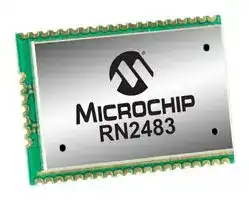


RN2483A-I/RM104
Transceiver Module, FSK, GFSK, LoRa, 300Kbps, 870MHz, -146 dBm, 2.1V to 3.6V Supply, I2C, SPI, UART
- Manufacturer: MICROCHIP
- Product type: RF Transceivers - Sub 2.4GHz ISM Band
- Data Rate Max: 300Kbps
- Frequency Max: 870MHz
- Product Range: LoRaWAN Series
- RF Modulation: FSK, GFSK, LoRa
- Supply Current: 32.9mA
- Transmit Power: 14dBm
- Sensitivity dBm: -146dBm
- Module Interface: I2C, SPI, UART
- Supply Voltage Max: 3.6V
- Supply Voltage Min: 2.1V
- RF Transceiver Applications: Automatic Meter Reading, Wireless Sensor Networks, Home and Building Automation
| Delivery and price | |
|---|---|
| Units per pack | 100 |
| Price | 14.5 € |
| Current stock | 1000+ |
| Lead time | 7 days |

## **RN2483** ## **Low-Power Long Range LoRa[®] Technology Transceiver Module** ## **General Features** - On-Board LoRaWAN™ Protocol Stack - ASCII Command Interface over UART - Compact Form Factor: 17.8 x 26.7 x 3.34 mm - Castellated SMT Pads for Easy and Reliable PCB Mounting - Environmentally Friendly, RoHS Compliant - European R&TTE Directive Assessed Radio Module - Device Firmware Upgrade (DFU) over UART, see _“RN2483 LoRa[®] Technology Module Command Reference User’s Guide”_ (DS40001784) ## **Operational** - Single Operating Voltage: 2.1V to 3.6V (3.3V typical) - Temperature Range: -40°C to +85°C - Low-Power Consumption - Programmable RF Communication Bit Rate up to 300 kbps with FSK Modulation, 10937 bps with LoRa[® ] Technology Modulation - Integrated MCU, Crystal, EUI-64 Node Identity Serial EEPROM, Radio Transceiver with Analog Front End, Matching Circuitry - 14 GPIOs for Control and Status, Shared with 13 Analog Inputs ## **Description** Microchip’s RN2483 Low-Power Long Range LoRa Technology Transceiver module provides an easy to use, low-power solution for long range wireless data transmission. The advanced command interface offers rapid time to market. The RN2483 module complies with the LoRaWAN Class A protocol specifications. It integrates RF, a baseband controller, command Application Programming Interface (API) processor, making it a complete long range solution. The RN2483 module is suitable for simple long range sensor applications with external host MCU. ## **RF/Analog Features** - Low-Power Long Range Transceiver Operating in the 433 MHz and 868 MHz Frequency Bands - High Receiver Sensitivity: Down to -146 dBm - TX Power: Adjustable up to +14 dBm high Efficiency PA - FSK, GFSK, and LoRa Technology Modulation - IIP3 = -11 dBm ## **Applications** - Automated Meter Reading - Home and Building Automation - Wireless Alarm and Security Systems - Industrial Monitoring and Control - Machine to Machine (M2M) - Internet of Things (IoT) - Up to 15 km Coverage at Suburban and up to 5 km Coverage at Urban Area DS50002346C-page 1 2015-2017 Microchip Technology Inc. **RN2483** ## **Table of Contents** |1.0|Device Overview .......................................................................................................................................................................... 3| |---|---| |2.0|General Specifications ................................................................................................................................................................. 6| |3.0|Typical Hardware Connections..................................................................................................................................................... 9| |4.0|Physical Dimensions ...................................................................................................................................................................11| |5.0|Application Information............................................................................................................................................................... 12| |6.0|Regulatory Approval ................................................................................................................................................................... 13| |Appendix A: Revision History............................................................................................................................................................... 15|| |The|Microchip Web Site ....................................................................................................................................................................... 17| |Customer Change Notification Service ................................................................................................................................................ 17|| |Customer Support................................................................................................................................................................................ 17|| |Product Identification System............................................................................................................................................................... 19|| ## **TO OUR VALUED CUSTOMERS** It is our intention to provide our valued customers with the best documentation possible to ensure successful use of your Microchip products. To this end, we will continue to improve our publications to better suit your needs. Our publications will be refined and enhanced as new volumes and updates are introduced. If you have any questions or comments regarding this publication, please contact the Marketing Communications Department via E-mail at **docerrors@microchip.com** . We welcome your feedback. ## **Most Current Data Sheet** To obtain the most up-to-date version of this data sheet, please register at our Worldwide Web site at: ## **http://www.microchip.com** You can determine the version of a data sheet by examining its literature number found on the bottom outside corner of any page. The last character of the literature number is the version number, (e.g., DS30000000A is version A of document DS30000000). ## **Errata** An errata sheet, describing minor operational differences from the data sheet and recommended workarounds, may exist for current devices. As device/documentation issues become known to us, we will publish an errata sheet. The errata will specify the revision of silicon and revision of document to which it applies. To determine if an errata sheet exists for a particular device, please check with one of the following: - Microchip’s Worldwide Web site; **http://www.microchip.com** - Your local Microchip sales office (see last page) When contacting a sales office, please specify which device, revision of silicon and data sheet (include literature number) you are using. ## **Customer Notification System** Register on our web site at **www.microchip.com** to receive the most current information on all of our products. DS50002346C-page 2 2015-2017 Microchip Technology Inc. **RN2483** ## **1.0 DEVICE OVERVIEW** The RN2483 transceiver module features LoRa Technology RF modulation, which provides long range spread spectrum communication with high interference immunity. Using LoRa Technology modulation technique, RN2483 can achieve a receiver sensitivity of -146 dBm. The high sensitivity combined with the integrated +14 dBm power amplifier yields industry leading link budget, which makes it optimal for applications requiring extended range and robustness. LoRa Technology modulation also provides significant advantages in both blocking and selectivity compared to the conventional modulation techniques, solving the traditional design compromise between extended range, interference immunity, and low-power consumption. The RN2483 module delivers exceptional phase noise, selectivity, receiver linearity, and IIP3 for significantly lower power consumption. Figure 1-1, Figure 1-2, and Figure 1-3 show the top view, the pinout, and the block diagram of the module. **FIGURE 1-2: RN2483 PIN DIAGRAM** **FIGURE 1-1: RN2483 TOP VIEW** **==> picture [129 x 199] intentionally omitted <==** **----- Start of picture text -----**<br> 28 GND GND 20<br>29 NC NC 19<br>30 PGC_INT NC 18<br>31 PGD_INT NC 17<br>32 RESET NC 16<br>33 GND NC 15<br>34 VDD GPIO10 14<br>35 GPIO0 GPIO11 13<br>36 GPIO1 VDD 12<br>37 GPIO2 GND 11<br>38 GPIO3 GPIO12 10<br>39 GPIO4 GPIO13 9<br>40 GPIO5 GND 8<br>41 GND UART_RX 7<br>42 NC UART_TX 6<br>43 GPIO6 RESERVED 5<br>44 GPIO7 RESERVED 4<br>45 GPIO8 UART_CTS 3<br>46 GPIO9 UART_RTS 2<br>47 GND GND 1<br>27 26 25 24 23 22 21<br>GND GND RFL GND RFH GND GND<br>**----- End of picture text -----**<br> **FIGURE 1-3: RN2483 BLOCK DIAGRAM** **==> picture [269 x 240] intentionally omitted <==** **----- Start of picture text -----**<br> Host MCU<br>RN2483 Module<br>MCU UART<br>Command Processor<br>LoRaWAN™ Protocol Stack<br>14 GPIO Pins<br>2C Real-Time SPI<br>Clock<br>EUI-64 32768 Hz LoRa [®] Technology<br>EEPROM Crystal Radio<br>User Hardware: Antenna Antenna<br>Status LEDs, Switches, Logic IOs, etc. 433 MHz 868 MHz<br>**----- End of picture text -----**<br> DS50002346C-page 3 2015-2017 Microchip Technology Inc. ## **RN2483** Table 1-1 describes the RN2483 pins. **TABLE 1-1: PIN DESCRIPTION** |**Pin**|**Name**|**Type**|**Description**| |---|---|---|---| |1|GND|Power|Ground supplyterminal| |2|UART_RTS|Output|Communication UART RTS signal**(1)**, or GPIO| |3|UART_CTS|Input|Communication UART CTS signal**(1)**, or GPIO| |4|RESERVED|—|Do not connect| |5|RESERVED|—|Do not connect| |6|UART_TX|Output|Communication UART Transmit(TX)| |7|UART_RX|Input|Communication UART Receive(RX)| |8|GND|Power|Ground supplyterminal| |9|GPIO13|Input/Output|Generalpurpose I/Opin or analoginput| |10|GPIO12|Input/Output|Generalpurpose I/Opin or analoginput| |11|GND|Power|Ground supplyterminal| |12|VDD|Power|Positive supplyterminal| |13|GPIO11|Input/Output|Generalpurpose I/Opin or analoginput| |14|GPIO10|Input/Output|Generalpurpose I/Opin or analoginput| |15|NC|—|Not connected| |16|NC|—|Not connected| |17|NC|—|Not connected| |18|NC|—|Not connected| |19|NC|—|Not connected| |20|GND|Power|Ground supplyterminal| |21|GND|Power|Ground supplyterminal| |22|GND|Power|Ground supplyterminal| |23|RFH|RF analog|RF signalpin for high band| |24|GND|Power|Ground supplyterminal| |25|RFL|RF analog|RF signalpin for low band| |26|GND|Power|Ground supplyterminal| |27|GND|Power|Ground supplyterminal| |28|GND|Power|Ground supplyterminal| |29|NC|—|Not connected| |30|PGC_INT|Input/Output|Internal MCU ICSP program clock or general<br>purpose I/Opin**(2)**| |31|PGD_INT|Input/Output|Internal MCU ICSP program data or general purpose<br>I/Opin**(2)**| |32|RESET|Input|Active-low device Reset input| |33|GND|Power|Ground supplyterminal| |34|VDD|Power|Positive supplyterminal| |35|GPIO0|Input/Output|Generalpurpose I/Opin or analoginput| |36|GPIO1|Input/Output|Generalpurpose I/Opin or analoginput| |37|GPIO2|Input/Output|Generalpurpose I/Opin or analoginput| |38|GPIO3|Input/Output|Generalpurpose I/Opin or analoginput| |39|GPIO4|Input/Output|Generalpurpose I/Opin| |40|GPIO5|Input/Output|Generalpurpose I/Opin or analoginput| |41|GND|Power|Ground supplyterminal| |42|NC|—|Not connected| DS50002346C-page 4 2015-2017 Microchip Technology Inc. **RN2483** ## **TABLE 1-1: PIN DESCRIPTION (CONTINUED)** |**Pin**|**Name**|**Type**|**Description**| |---|---|---|---| |43|GPIO6|Input/Output|Generalpurpose I/Opin or analoginput| |44|GPIO7|Input/Output|Generalpurpose I/Opin or analoginput| |45|GPIO8|Input/Output|Generalpurpose I/Opin or analoginput| |46|GPIO9|Input/Output|Generalpurpose I/Opin or analoginput| |47|GND|Power|Ground supplyterminal| **Note 1:** Optional handshake lines are supported in future firmware releases. - **2:** The _“RN2483 LoRa[®] Technology Module Command Reference User’s Guide”_ (DS40001784F) uses the pin name TEST0 for PGC_INT and TEST1 for PGD_INT. DS50002346C-page 5 2015-2017 Microchip Technology Inc. **RN2483** ## **2.0 GENERAL SPECIFICATIONS** Table 2-1 provides the general specifications for the module. Table 2-2, Table 2-3, and Table 2-4 provide the electrical characteristics, current consumption, and dimensions of the module, respectively. Table 2-5 shows the RF output power calibration data. Table 2-6 shows the RF output power at different supply voltages and temperatures. ## **TABLE 2-1: GENERAL SPECIFICATIONS** |**Specification**|**Description**| |---|---| |FrequencyBand|863.000 MHz to 870.000 MHz; 433.050 MHz to 434.790 MHz| |Modulation Method|FSK, GFSK, and LoRa®Technologymodulation| |Maximum Over-the-Air Data Rate|300 kbps with FSK modulation; 10937 bps with LoRa Technologymodulation| |RF Connection|Board edge connection| |Interface|UART| |Operation Range|Upto 15 km coverage at suburban; upto 5 km coverage at urban area| |Sensitivityat 1% PER|-146 dBm**(1)**| |RF TX Power|Adjustable up to max. 10 dBm on 433 MHz band (limited to meet regulations);<br>max. 14 dBm on the 868 MHz band**(2)**| |Temperature(operating)|-40°C to +85°C| |Temperature(storage)|-40°C to +115°C| |Humidity|10% ~ 90% non-condensing| **Note 1:** Dependent on modulation settings, Receiver Bandwidth (RBW), and Spreading Factor (SF). - **2:** TX power is adjustable. For more information, refer to the _“RN2483 LoRa[®] Technology Module Command Reference User’s Guide”_ (DS40001784). ## **TABLE 2-2: ELECTRICAL CHARACTERISTICS** |**Parameter**|**Parameter**||**Min.**|**Typ.**|**Max.**|**Units**| |---|---|---|---|---|---|---| |SupplyVoltage|||2.1|—|3.6|V| |Voltage on|any pin with respect to VSS(except VDD)and|RESET|-0.3|—|VDD + 0.3|V| |Voltage on|VDD with respect to VSS||-0.3|—|3.9|V| |Voltage on|RESET<br>with respect to VSS||0|—|+11|V| |Input ClampCurrent(IIK) (VI < 0 or VI > VDD)|||—|—|+/-20|mA| |Output ClampCurrent(IOK) (VO < 0 or VO > VDD)|||—|—|+/-20|mA| |GPIO sink/source current each|||—|—|25/25|mA| |Total GPIO sink/source current|||—|—|200/185|mA| |RAM Data Retention Voltage(in Sleepmode or Reset state)|||1.5|—|—|V| |VDD Start Voltage to ensure internal Power-on Reset signal|||—|—|0.7|V| |VDD Rise Rate to ensure internal Power-on Reset signal|||0.05|—|—|V/ms| |Brown-out Reset Voltage|||1.75|1.9|2.05|V| |Logic Input Low Voltage|||—|—|0.15 x VDD|V| |Logic Input High Voltage|||0.8 x VDD|—|—|V| |Input Leakage at <25°C<br>(VSS<VPIN<VDD, Pin at high-impedance)|||—|0.1|50|nA| |Input Leakage at +60°C<br>(VSS<VPIN<VDD, Pin at high-impedance)|||—|0.7|100|nA| |Input Leakage at +85°C<br>(VSS<VPIN<VDD, Pin at high-impedance)|||—|4|200|nA| |RF Input Level|||—|—|+10|dBm| DS50002346C-page 6 2015-2017 Microchip Technology Inc. **RN2483** ## **TABLE 2-3: CURRENT CONSUMPTION** |**Mode**|**Temperature**<br>**(°C)**|**Typical Current (mA)**|**Typical Current (mA)**|**Typical Current (mA)**| |---|---|---|---|---| |||**VDD = 2.1V**|**VDD = 3.3V**|**VDD = 3.6V**| |Idle|-40 to +85|1.7|2.8|3.1| |Transmit|25|28.6|38.9|44.5| |Sleep|-40|0.0011|0.0013|0.0014| ||25|0.0015|0.0016|0.0016| ||85|0.002|0.0026|0.0026| ## **TABLE 2-4: MODULE DIMENSIONS** **Parameter Value** |**Parameter**|**Value**| |---|---| |Dimensions|17.8 x 26.7 x 3.34 mm| |Weight|2.05g| ## **TABLE 2-5: OUTPUT POWER OF TX POWER SETTING** |**Band**|**TX Power Setting**|**Output Power (dBm)**|**Typical Supply Current at**<br>**3.3V (mA)**| |---|---|---|---| |868 MHz|-3|-4.0|17.3| ||-2|-2.9|18.0| ||-1|-1.9|18.7| ||0|-1.7|20.2| ||1|-0.6|21.2| ||2|0.4|22.3| ||3|1.4|23.5| ||4|2.5|24.7| ||5|3.6|26.1| ||6|4.7|27.5| ||7|5.8|28.8| ||8|6.9|30.0| ||9|8.1|31.2| ||10|9.3|32.4| ||11|10.4|33.7| ||12|11.6|35.1| ||13|12.5|36.5| ||14|13.5|38.0| ||15|14.1|38.9| DS50002346C-page 7 2015-2017 Microchip Technology Inc. ## **RN2483** ## **TABLE 2-5: OUTPUT POWER OF TX POWER SETTING (CONTINUED)** |**Band**|**TX Power Setting**|**Output Power (dBm)**|**Typical Supply Current at**<br>**3.3V (mA)**| |---|---|---|---| |433 MHz|-3|-3.5|14.7| ||-2|-2.3|15.1| ||-1|-1.3|15.6| ||0|-2.3|15.8| ||1|-1.2|16.4| ||2|-0.1|17.0| ||3|1.0|17.7| ||4|2.1|18.5| ||5|3.2|19.4| ||6|4.3|20.3| ||7|5.4|21.4| ||8|6.5|22.3| ||9|7.6|23.3| ||10|8.8|24.5| ||11|9.9|25.8| ||12|10.9|27.3| ||13|11.9|28.8| ||14|12.9|30.7| ||15|13.6|32.9| ## **TABLE 2-6: OUTPUT POWER OF SUPPLY VOLTAGE AND TEMPERATURE** |**Temperature**<br>**(°C)**|**Typical Output Power at 868 MHz (dBm)**|**Typical Output Power at 868 MHz (dBm)**|**Typical Output Power at 868 MHz (dBm)**| |---|---|---|---| ||**VDD = 2.1V**|**VDD = 3.3V**|**VDD = 3.6V**| |-40|10.5|13.8|13.7| |25|10.0|14.1|14.6| |85|9.1|13.4|13.7| ## **TABLE 2-7: OUTPUT POWER OF SUPPLY VOLTAGE AND TEMPERATURE** |**Temperature**<br>**(°C)**|**Typical Output Power at 434 MHz (dBm)**|**Typical Output Power at 434 MHz (dBm)**|**Typical Output Power at 434 MHz (dBm)**| |---|---|---|---| ||**VDD = 2.1V**|**VDD = 3.3V**|**VDD = 3.6V**| |-40|10.1|13.2|13.2| |25|9.7|13.6|14.2| |85|9.3|13.0|13.4| DS50002346C-page 8 2015-2017 Microchip Technology Inc. **RN2483** ## **3.0 TYPICAL HARDWARE CONNECTIONS** Figure 3-1 shows the typical hardware connections. ## **FIGURE 3-1: HARDWARE CONNECTIONS** **==> picture [468 x 372] intentionally omitted <==** **----- Start of picture text -----**<br> VCC VCC 434 MHz Antenna 868 MHz Antenna<br>ICSP<br>1 10k<br>2<br>3<br>Logic input 4<br>VCC 5<br>3 6<br>2<br>1<br>GND<br>GND GND 28 GND GND [20] GND<br>Indicator LEDs 2930 NCPGC_INT NCNC [19][18]<br>VCC 31 PGD_INT NC [17]<br>32 RESET NC [16]<br>220R VCC 33 GND NC [15]<br>34 VDD GPIO10 [14]<br>220R 35 GPIO0 GPIO11 [13] VCC<br>36 GPIO1 RN2483 VDD [12]<br>GND 37 GPIO2 GND [11]<br>38 GPIO3 GPIO12 [10] VCC<br>Transistor output 39 GPIO4 GPIO13 [9]<br>3 GPIOs 4041 GPIO5 GND UART_RXGND [8][7]<br>42 NC UART_TX [6] MCU<br>1 43 GPIO6 RESERVED [5]<br>2 220R 44 GPIO7 RESERVED [4]<br>45 GPIO8 UART_CTS [3]<br>46 GPIO9 UART_RTS [2]<br>GND 47 GND GND [1]<br>VCC<br>GND GND GND<br>Analog 0-VCC<br>Sensor<br>GND<br>27 26 25 24 23 22 21<br>GND GND RFL GND RFH GND GND<br>**----- End of picture text -----**<br> ## **3.1 Interface to Host MCU** The RN2483 module has a dedicated UART interface to communicate with a host controller. Optional handshake lines are supported in future firmware releases. The _“RN2483 LoRa[®] Technology Module Command Reference User’s Guide”_ (DS40001784) provides a detailed UART command description. Table 3-1 shows the default settings for the UART communication. ## **TABLE 3-1: DEFAULT UART SETTINGS** |**Specification**|**Description**| |---|---| |Baud Rate|57600 bps| |Packet Length|8 bit| |ParityBit|No| |StopBits|1 bit| |Hardware Flow Control|No| ## **3.2 GPIO Pins (GPIO0-GPIO13)** The module has 14 GPIO pins. These lines can be connected to switches, LEDs, and relay outputs. The pins can be either logic inputs or outputs, and some pins (see Table 1-1) have analog input capability that can be accessed via the module firmware. These pins have limited sink and source capabilities. Electrical characteristics are described in Table 2-2. For more information, see _“RN2483 LoRa[®] Technology Module Command Reference User’s Guide”_ (DS40001784). ## **3.3 RF Connections (RFL, RFH)** RFL is the RF analog port for the lower frequency band (433 MHz) while RFH is for the higher frequency band (868 MHz). When routing RF paths, use proper strip lines with an impedance of 50 Ohm. DS50002346C-page 9 2015-2017 Microchip Technology Inc. ## **RN2483** ## **3.4 RESET Pin** The RESET pin of the module is an active-low logic input. An internal weak pull-up resistor is enabled when the pin is configured as the MCLR input. ## **3.5 Power Pins** It is recommended to connect power pins (Pin 12 and 34) to a stable supply voltage with sufficient source current. Table 2-3 shows the current consumption. Additional filtering capacitors are not required but used to ensure stable supply voltage in a noisy environment. ## **3.6 Internal Program Pins** PGC_INT (Pin 30) and PGD_INT (Pin 31) are internal program pins used during manufacturing. For normal operation, these pins can be left unconnected. The normal firmware upgrade method is through the internal bootloader of the module via the UART. The method is documented in the _“RN2483 LoRa[®] Technology Module Command Reference User’s Guide”_ (DS40001784) _._ However, for backup firmware update purposes the user can place a 6-pin ICSP header on their host PCB with PGC_INT (Pin 30), PGD_INT (Pin 31), RESET (Pin 32), power and ground. During High Voltage In-Circuit Serial Programming mode, the RESET pin is driven with high-voltage (9V), therefore protection may be necessary for sensitive devices. **Note:** Only official Microchip Technology firmware released for the RN2483 module shall be used to maintain FCC and IC certification. DS50002346C-page 10 2015-2017 Microchip Technology Inc. **RN2483** ## **4.0 PHYSICAL DIMENSIONS** Figure 4-1 and Figure 4-2 illustrate the physical dimensions and the recommended PCB layout for the RN2483 module. **==> picture [246 x 8] intentionally omitted <==** **----- Start of picture text -----**<br> FIGURE 4-1: RN2483 PHYSICAL DIMENSIONS<br>**----- End of picture text -----**<br> ## **FIGURE 4-2:** ## **RECOMMENDED PCB FOOTPRINT** DS50002346C-page 11 2015-2017 Microchip Technology Inc. **RN2483** ## **5.0 APPLICATION INFORMATION** ## **5.1 RF Trace Layout Design** The RN2483 modular transmitter is certified with a PCB edge SMA connector and micro-strip trace layout as shown in Figure 5-1 and Figure 5-2. The two RF paths are axisymmetric with the same linear dimensions. The host PCB can follow these trace design to maintain compliance under the modular grant (FCC) and certificate (IC). Gerber files are available on the RN2483 product web page at www.microchip.com/ RN2483. **FIGURE 5-1: RF TRACE ROUTING (TOP LAYER)** **==> picture [384 x 64] intentionally omitted <==** **----- Start of picture text -----**<br> PCB Details: Trace Dimensions:<br> Two layer, plated through hole Trace width: 0.75<br> FR4 Trace gap: 0.15<br> Thickness: 1.55 mm Finished Copper Weight: 1 ounce<br> Via stitching with 0.25 mm plated<br>Dimensions are in millimeters<br>**----- End of picture text -----**<br> **FIGURE 5-2: RF TRACE ROUTING (BOTTOM LAYER)** DS50002346C-page 12 2015-2017 Microchip Technology Inc. **RN2483** ## **6.0 REGULATORY APPROVAL** This section outlines the regulatory information for the RN2483 module for Europe. ## **6.1 Europe** The RN2483 module is an R&TTE Directive assessed radio module that is CE marked and has been manufactured and tested with the intention of being integrated into a final product. The RN2483 module has been tested to R&TTE Directive 1999/5/EC Essential Requirements for Health and Safety (Article 3.1a), Electromagnetic Compatibility (EMC) (Article 3.1b), and Radio (Article 3.2) and are summarized in Table 6-1: European Compliance Testing. A Notified Body Opinion has also been issued. All test reports are available on the product web page at http://www.microchip.com. The R&TTE Compliance Association provides guidance on modular devices in document **Technical Guidance Note 01** available at http://www.rtteca.com/html/download_area.htm. **Note:** To maintain conformance to the testing listed in Table 6-1: European Compliance Testing, the module shall be installed in accordance with the installation instructions in this data sheet and shall not be modified. When integrating a radio module into a completed product the integrator becomes the manufacturer of the final product and is therefore responsible for demonstrating compliance of the final product with the essential requirements of the R&TTE Directive. ## 6.1.2 EXTERNAL ANTENNA REQUIREMENTS From R&TTE Compliance Association document **Technical Guidance Note 01** : Provided the integrator installing an assessed radio module with an integral or specific antenna and installed in conformance with the radio module manufacturer's installation instructions requires no further evaluation under Article 3.2 of the R&TTE Directive and does not require further involvement of an R&TTE Directive Notified Body for the final product (Section 2.2.4). ## 6.1.3 HELPFUL WEB SITES A document that can be used as a starting point in understanding the use of Short Range Devices (SRD) in Europe is the European Radio Communications Committee (ERC) Recommendation 70-03 E, which can be downloaded from the European Radio Communications Office (ERO) at: http://www.ero.dk/. Additional helpful web sites are: - Radio and Telecommunications Terminal Equipment (R&TTE): http://ec.europa.eu/enterprise/sectors/rtte/ regulatory-framework/index_en.htm - European Conference of Postal and Telecommunications Administrations (CEPT): http://www.cept.org - European Telecommunications Standards Institute (ETSI): http://www.etsi.org - European Radio Communications Office (ERO): http://www.ero.dk/ - The Radio and Telecommunications Terminal Equipment Compliance Association (R&TTE CA): http://www.rtteca.com/ ## 6.1.1 LABELING AND USER INFORMATION REQUIREMENTS The label on the final product which contains the RN2483 module must follow CE marking requirements. The _“R&TTE Compliance Association Technical Guidance Note 01”_ provides guidance on final product CE marking. ## **TABLE 6-1: EUROPEAN COMPLIANCE TESTING** |**Certification**|**Standards**|**Article**|**Laboratory**|**Report Number**|**Date**| |---|---|---|---|---|---| |Safety|IEC 60950-1:2005 (2nd Ed:<br>A1:2009)|(3.1a)|TRaC Global Ltd.|TRA-025134-43-00A|2/12/2015| |Health|EN 62479|—|TRaC Global Ltd.|TRA-025134-01-47-03A|2/12/2015| |EMC|EN 301 489-3 v1.6.1|(3.1b)|TRaC Global Ltd.|TRA-025134-43-00A|2/12/2015| |Radio|EN 300 220-2 v2.4.1|(3.2)|TRaC Global Ltd.|TRA-025134-01-47-00A<br>(433 MHz) TRA-025134-<br>01-47-01A(868MHz)|2/12/2015| DS50002346C-page 13 2015-2017 Microchip Technology Inc. **RN2483** ## **NOTES:** DS50002346C-page 14 2015-2017 Microchip Technology Inc. **RN2483** ## **APPENDIX A: REVISION HISTORY** ## **Revision A (March 2015)** This is the initial release of this document. ## **Revision B (December 2015)** This revision includes the following updates: - Updated Deep Sleep value in Table 2-3 - Updated Dimensions value in Table 2-4 - Updated Figure 4-1 - Updated Figure 4-2 - Added Figure 5-2 - Updated information for **Section 5.1 “RF Trace Layout Design”** . ## **Revision C (April 2017)** This revision includes the following updates: - Updated Figure 1-2 and Figure 3-1 - Updated Table 1-1, Table 2-2, and Table 2-3 - Added Table 2-6 and Table 2-7 - Updated **Section 3.4 “RESET Pin”** - Added **Section 3.6 “Internal Program Pins”** - Deleted Section “5.2 Application Schematic”. DS50002346C-page 15 2015-2017 Microchip Technology Inc. **RN2483** ## **NOTES:** DS50002346C-page 16 2015-2017 Microchip Technology Inc. **RN2483** ## **THE MICROCHIP WEB SITE** Microchip provides online support via our WWW site at www.microchip.com. This web site is used as a means to make files and information easily available to customers. Accessible by using your favorite Internet browser, the web site contains the following information: - **Product Support** – Data sheets and errata, application notes and sample programs, design resources, user’s guides and hardware support documents, latest software releases and archived software - **General Technical Support** – Frequently Asked Questions (FAQ), technical support requests, online discussion groups, Microchip consultant program member listing ## **CUSTOMER SUPPORT** Users of Microchip products can receive assistance through several channels: - Distributor or Representative - Local Sales Office - Field Application Engineer (FAE) - Technical Support Customers should contact their distributor, representative or Field Application Engineer (FAE) for support. Local sales offices are also available to help customers. A listing of sales offices and locations is included in the back of this document. **Technical support is available through the web site at: http://microchip.com/support** - **Business of Microchip** – Product selector and ordering guides, latest Microchip press releases, listing of seminars and events, listings of Microchip sales offices, distributors and factory representatives ## **CUSTOMER CHANGE NOTIFICATION SERVICE** Microchip’s customer notification service helps keep customers current on Microchip products. Subscribers will receive e-mail notification whenever there are changes, updates, revisions or errata related to a specified product family or development tool of interest. To register, access the Microchip web site at www.microchip.com. Under “Support”, click on “Customer Change Notification” and follow the registration instructions. DS50002346C-page 17 2015-2017 Microchip Technology Inc. **RN2483** ## **NOTES:** DS50002346C-page 18 2015-2017 Microchip Technology Inc. **RN2483** ## **PRODUCT IDENTIFICATION SYSTEM** To order or obtain information, e.g., on pricing or delivery, refer to the factory or the listed sales office. |**PART NO.**<br>**I**<br>**RM**<br>**XXX**<br>**Firmware**<br>**Package**<br>**Temperature**<br>**Range**<br>**Device**<br>**Device:**<br>RN2483:<br>Low-Power Long Range LoRa®Technology<br>Transceiver module<br>**Temperature Range:**<br>I<br>=<br>-40C to +85C (Industrial)<br>**Package:**<br>RM<br>=<br>Radio Module<br>**Revision**<br>**Number**|**Examples:**<br>RN2483A-I/RM: Industrial temperature| |---|---| DS50002346C-page 19 2015-2017 Microchip Technology Inc. **RN2483** ## **NOTES:** DS50002346C-page 20 2015-2017 Microchip Technology Inc. ## **Note the following details of the code protection feature on Microchip devices:** - Microchip products meet the specification contained in their particular Microchip Data Sheet. - Microchip believes that its family of products is one of the most secure families of its kind on the market today, when used in the intended manner and under normal conditions. - There are dishonest and possibly illegal methods used to breach the code protection feature. All of these methods, to our knowledge, require using the Microchip products in a manner outside the operating specifications contained in Microchip’s Data Sheets. Most likely, the person doing so is engaged in theft of intellectual property. - Microchip is willing to work with the customer who is concerned about the integrity of their code. - Neither Microchip nor any other semiconductor manufacturer can guarantee the security of their code. Code protection does not mean that we are guaranteeing the product as “unbreakable.” Code protection is constantly evolving. We at Microchip are committed to continuously improving the code protection features of our products. Attempts to break Microchip’s code protection feature may be a violation of the Digital Millennium Copyright Act. If such acts allow unauthorized access to your software or other copyrighted work, you may have a right to sue for relief under that Act. Information contained in this publication regarding device applications and the like is provided only for your convenience and may be superseded by updates. It is your responsibility to ensure that your application meets with your specifications. MICROCHIP MAKES NO REPRESENTATIONS OR WARRANTIES OF ANY KIND WHETHER EXPRESS OR IMPLIED, WRITTEN OR ORAL, STATUTORY OR OTHERWISE, RELATED TO THE INFORMATION, INCLUDING BUT NOT LIMITED TO ITS CONDITION, QUALITY, PERFORMANCE, MERCHANTABILITY OR FITNESS FOR PURPOSE **.** Microchip disclaims all liability arising from this information and its use. Use of Microchip devices in life support and/or safety applications is entirely at the buyer’s risk, and the buyer agrees to defend, indemnify and hold harmless Microchip from any and all damages, claims, suits, or expenses resulting from such use. No licenses are conveyed, implicitly or otherwise, under any Microchip intellectual property rights unless otherwise stated. _Microchip received ISO/TS-16949:2009 certification for its worldwide headquarters, design and wafer fabrication facilities in Chandler and Tempe, Arizona; Gresham, Oregon and design centers in California and India. The Company’s quality system processes and procedures are for its PIC[®] MCUs and dsPIC[®] DSCs, KEELOQ[®] code hopping devices, Serial EEPROMs, microperipherals, nonvolatile memory and analog products. In addition, Microchip’s quality system for the design and manufacture of development systems is ISO 9001:2000 certified._ ## **QUALITY MANAGEMENT SYSTEM** ## **CERTIFIED BY DNV** ## **Trademarks** The Microchip name and logo, the Microchip logo, AnyRate, AVR, AVR logo, AVR Freaks, BeaconThings, BitCloud, CryptoMemory, CryptoRF, dsPIC, FlashFlex, flexPWR, Heldo, JukeBlox, KEELOQ, KEELOQ logo, Kleer, LANCheck, LINK MD, maXStylus, maXTouch, MediaLB, megaAVR, MOST, MOST logo, MPLAB, OptoLyzer, PIC, picoPower, PICSTART, PIC32 logo, Prochip Designer, QTouch, RightTouch, SAM-BA, SpyNIC, SST, SST Logo, SuperFlash, tinyAVR, UNI/O, and XMEGA are registered trademarks of Microchip Technology Incorporated in the U.S.A. and other countries. ClockWorks, The Embedded Control Solutions Company, EtherSynch, Hyper Speed Control, HyperLight Load, IntelliMOS, mTouch, Precision Edge, and Quiet-Wire are registered trademarks of Microchip Technology Incorporated in the U.S.A. Adjacent Key Suppression, AKS, Analog-for-the-Digital Age, Any Capacitor, AnyIn, AnyOut, BodyCom, chipKIT, chipKIT logo, CodeGuard, CryptoAuthentication, CryptoCompanion, CryptoController, dsPICDEM, dsPICDEM.net, Dynamic Average Matching, DAM, ECAN, EtherGREEN, In-Circuit Serial Programming, ICSP, Inter-Chip Connectivity, JitterBlocker, KleerNet, KleerNet logo, Mindi, MiWi, motorBench, MPASM, MPF, MPLAB Certified logo, MPLIB, MPLINK, MultiTRAK, NetDetach, Omniscient Code Generation, PICDEM, PICDEM.net, PICkit, PICtail, PureSilicon, QMatrix, RightTouch logo, REAL ICE, Ripple Blocker, SAM-ICE, Serial Quad I/O, SMART-I.S., SQI, SuperSwitcher, SuperSwitcher II, Total Endurance, TSHARC, USBCheck, VariSense, ViewSpan, WiperLock, Wireless DNA, and ZENA are trademarks of Microchip Technology Incorporated in the U.S.A. and other countries. - SQTP is a service mark of Microchip Technology Incorporated in the U.S.A. Silicon Storage Technology is a registered trademark of Microchip Technology Inc. in other countries. GestIC is a registered trademark of Microchip Technology Germany II GmbH & Co. KG, a subsidiary of Microchip Technology Inc., in other countries. All other trademarks mentioned herein are property of their respective companies. - © 2017, Microchip Technology Incorporated, All Rights Reserved. ISBN: 978-1-5224-1667-8 ## == == **ISO/TS 16949** DS50002346C-page 21 2017 Microchip Technology Inc. ## **Worldwide Sales and Service** ## **AMERICAS** **Corporate Office** 2355 West Chandler Blvd. Chandler, AZ 85224-6199 Tel: 480-792-7200 Fax: 480-792-7277 Technical Support: http://www.microchip.com/ support Web Address: www.microchip.com **Atlanta** Duluth, GA Tel: 678-957-9614 Fax: 678-957-1455 **Austin, TX** Tel: 512-257-3370 **Boston** Westborough, MA Tel: 774-760-0087 Fax: 774-760-0088 **Chicago** Itasca, IL Tel: 630-285-0071 Fax: 630-285-0075 **Dallas** Addison, TX Tel: 972-818-7423 Fax: 972-818-2924 **Detroit** Novi, MI Tel: 248-848-4000 **Houston, TX** Tel: 281-894-5983 **Indianapolis** Noblesville, IN Tel: 317-773-8323 Fax: 317-773-5453 Tel: 317-536-2380 **Los Angeles** Mission Viejo, CA Tel: 949-462-9523 Fax: 949-462-9608 Tel: 951-273-7800 **Raleigh, NC** Tel: 919-844-7510 **New York, NY** Tel: 631-435-6000 **San Jose, CA** Tel: 408-735-9110 Tel: 408-436-4270 **Canada - Toronto** Tel: 905-695-1980 Fax: 905-695-2078 ## **ASIA/PACIFIC** ## **ASIA/PACIFIC** **Asia Pacific Office** Suites 3707-14, 37th Floor Tower 6, The Gateway Harbour City, Kowloon **China - Xiamen** Tel: 86-592-2388138 Fax: 86-592-2388130 **China - Zhuhai** Tel: 86-756-3210040 Fax: 86-756-3210049 **Hong Kong** Tel: 852-2943-5100 Fax: 852-2401-3431 **India - Bangalore** Tel: 91-80-3090-4444 Fax: 91-80-3090-4123 **Australia - Sydney** Tel: 61-2-9868-6733 Fax: 61-2-9868-6755 **India - New Delhi** Tel: 91-11-4160-8631 Fax: 91-11-4160-8632 **China - Beijing** Tel: 86-10-8569-7000 Fax: 86-10-8528-2104 **India - Pune** Tel: 91-20-3019-1500 **China - Chengdu** Tel: 86-28-8665-5511 Fax: 86-28-8665-7889 **Japan - Osaka** Tel: 81-6-6152-7160 Fax: 81-6-6152-9310 **China - Chongqing** Tel: 86-23-8980-9588 Fax: 86-23-8980-9500 **Japan - Tokyo** Tel: 81-3-6880- 3770 Fax: 81-3-6880-3771 **China - Dongguan** Tel: 86-769-8702-9880 **Korea - Daegu** Tel: 82-53-744-4301 Fax: 82-53-744-4302 **China - Guangzhou** Tel: 86-20-8755-8029 **Korea - Seoul** Tel: 82-2-554-7200 Fax: 82-2-558-5932 or 82-2-558-5934 **China - Hangzhou** Tel: 86-571-8792-8115 Fax: 86-571-8792-8116 **China - Hong Kong SAR** Tel: 852-2943-5100 Fax: 852-2401-3431 **Malaysia - Kuala Lumpur** Tel: 60-3-6201-9857 Fax: 60-3-6201-9859 **China - Nanjing** Tel: 86-25-8473-2460 Fax: 86-25-8473-2470 **Malaysia - Penang** Tel: 60-4-227-8870 Fax: 60-4-227-4068 **China - Qingdao** Tel: 86-532-8502-7355 Fax: 86-532-8502-7205 **Philippines - Manila** Tel: 63-2-634-9065 Fax: 63-2-634-9069 **China - Shanghai** Tel: 86-21-3326-8000 Fax: 86-21-3326-8021 **Singapore** Tel: 65-6334-8870 Fax: 65-6334-8850 **China - Shenyang** Tel: 86-24-2334-2829 Fax: 86-24-2334-2393 **Taiwan - Hsin Chu** Tel: 886-3-5778-366 Fax: 886-3-5770-955 **China - Shenzhen** Tel: 86-755-8864-2200 Fax: 86-755-8203-1760 **Taiwan - Kaohsiung** Tel: 886-7-213-7830 **China - Wuhan** Tel: 86-27-5980-5300 Fax: 86-27-5980-5118 **Taiwan - Taipei** Tel: 886-2-2508-8600 Fax: 886-2-2508-0102 **China - Xian Thailand - Bangkok** Tel: 86-29-8833-7252 Tel: 66-2-694-1351 Fax: 86-29-8833-7256 Fax: 66-2-694-1350 **Thailand - Bangkok** Tel: 66-2-694-1351 ## **EUROPE** **Austria - Wels** Tel: 43-7242-2244-39 Fax: 43-7242-2244-393 **Denmark - Copenhagen** Tel: 45-4450-2828 Fax: 45-4485-2829 **Finland - Espoo** Tel: 358-9-4520-820 **France - Paris** Tel: 33-1-69-53-63-20 Fax: 33-1-69-30-90-79 **France - Saint Cloud** Tel: 33-1-30-60-70-00 **Germany - Garching** Tel: 49-8931-9700 **Germany - Haan** Tel: 49-2129-3766400 **Germany - Heilbronn** Tel: 49-7131-67-3636 **Germany - Karlsruhe** Tel: 49-721-625370 **Germany - Munich** Tel: 49-89-627-144-0 Fax: 49-89-627-144-44 **Germany - Rosenheim** Tel: 49-8031-354-560 **Israel - Ra’anana** Tel: 972-9-744-7705 **Italy - Milan** Tel: 39-0331-742611 Fax: 39-0331-466781 **Italy - Padova** Tel: 39-049-7625286 **Netherlands - Drunen** Tel: 31-416-690399 Fax: 31-416-690340 **Norway - Trondheim** Tel: 47-7289-7561 **Poland - Warsaw** Tel: 48-22-3325737 **Romania - Bucharest** Tel: 40-21-407-87-50 **Spain - Madrid** Tel: 34-91-708-08-90 Fax: 34-91-708-08-91 **Sweden - Gothenberg** Tel: 46-31-704-60-40 **Sweden - Stockholm** Tel: 46-8-5090-4654 **UK - Wokingham** Tel: 44-118-921-5800 Fax: 44-118-921-5820 DS50002346C-page 22 2017 Microchip Technology Inc. 11/07/16
Updated at February 9, 2023
Microchip Technology Inc. is a leading global provider of smart, connected, and secure embedded control solutions. Known for enabling engineers to design with confidence, the company delivers a comprehensive product portfolio that reduces total system costs and accelerates time to market across the industrial, automotive, communications, and computing sectors. Our extensive selection of Microchip components highlights the manufacturer's strength in both discrete semiconductors and advanced wireless connectivity. We carry a robust lineup of highly efficient single MOSFETs and Schottky diodes tailored for demanding power management and switching applications. Alongside these essential discretes, engineers can source a wide array of ready-to-use networking modules, prominently featuring Bluetooth and WLAN adapters that streamline the development of modern IoT and connected devices. Rounding out the offering is a diverse range of Microchip integrated circuits and specialized components. This includes versatile I/O expanders for simplified system integration, precision timing solutions such as MEMS oscillators and pulse generators, as well as AC/DC LED driver ICs and sub-2.4GHz RF transceivers. Backed by Microchip's renowned commitment to exceptional quality and reliable performance, these components provide scalable, dependable building blocks for complex electronic designs.
About Novapart
Novapart is a B2B electronic component broker specialising in stock shortages and cost reduction. We source hard-to-find parts and identify compliant alternatives across a catalogue of 410,000+ components from 500+ manufacturers.
Learn more →Stock Shortage Specialist
When a component is unavailable, discontinued or has an unacceptable lead time, we tap into our network of vetted European and Asian distributors to source what you need — without compromising on quality or traceability.
Request a quote →Compliant Alternatives
We identify pin-to-pin, electrically equivalent substitutes that meet the same certifications (RoHS, AEC-Q100, REACH) as your original specification — validated against datasheets, not just part numbers. Often at a lower cost.
BOM Analysis service →