
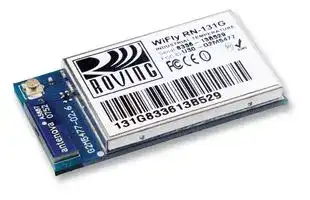


RN131G-I/RM
Wireless LAN Module, 802.11 b/g, Ultra-Low Power Embedded TCP/IP Solution, Industrial
- Manufacturer: MICROCHIP
- Product type:
- Frequency RF:2.48GHz; Module Interface:UART; Module Applications:Wireless Connectivity; Product Range:-; SVHC:No SVHC (15-Jan-2018); Compliance Standard:CE, FCC, IC
- SVHC: No SVHC (04-Feb-2026)
- Frequency RF: 2.48GHz
- Product Range: -
- Module Interface: UART
- Module Applications: Wireless Connectivity
| Delivery and price | |
|---|---|
| Units per pack | 250 |
| Price | 33.71 € |
| Current stock | 10+ |
| Lead time | 30 days |

**RN-131-DS**

## **RN-131G & RN-131C 802.11 b/g Wireless LAN Module**

## **Features**

- Qualified 2.4-GHz IEEE 802.11b/g transceiver

- Ultra-low power: 4 uA sleep, 40 mA Rx, 210 mA Tx

- High throughput, 1 Mbps sustained data rate with TCP/IP and WPA2

- Small, compact surface-mount module

- On-board ceramic chip antenna and U.FL connector for external antenna

- 8-Mbit flash memory and 128-KB RAM

- UART hardware interface

- 10 general-purpose digital I/O pins

- 8 analog sensor interfaces

- Real-time clock for wakeup and time stamping

- Accepts 3.3-V regulated or 2 to 3 V battery

- Supports ad hoc and infrastructure networking modes

- On board ECOS -OS, TCP/IP stacks

- Wi-Fi Alliance certified for WPA2-PSK

- FCC/CE/ICS certified and RoHS compliant.

- Industrial (RN-131G) and commercial (RN-131C) grade temperature options

## **Applications**

- Remote equipment monitoring

- Telemetry

- Industrial sensors and home automation controls

- Medical device monitoring

## **Description**

The RN-131 module is a standalone, embedded wireless 802.11 b/g networking module. With its small form factor and extremely low power consumption, the RN-131 is perfect for mobile wireless applications such as asset monitoring, GPS tracking, and battery sensors. The WiFly module incorporates a 2.4-GHz radio, processor, TCP/IP stack, real-time clock, crypto accelerator, power management, and analog sensor interfaces as shown in Figure 1. The module is preloaded with software to simplify integration and minimize application development. In the simplest configuration, the hardware requires only four connections (PWR, TX, RX, and GND) to create a wireless data connection. Additionally, the sensor interface provides temperature, audio, motion, acceleration, and other analog data without requiring additional hardware. The module is programmed and controlled with a simple ASCII command language. Once the module is set up, it can scan to find an access point, associate, authenticate, and connect over any Wi-Fi network.

**Figure 1. RN-131 Block Diagram**

**==> picture [321 x 173] intentionally omitted <==**

**----- Start of picture text -----**<br>
RN-131<br>On-Board Chip<br>Antenna 128-KB 32-Bit<br>RAM CPU 2-MB ROM Flash<br>2.4 GHz r— Memory<br>TX/RX<br>2.4-GHz Timers<br>Radio<br>U.FL Connector “L_ 802.11 b/g<br>for Optional ExternalAntenna 2.4-GHz MAC/PHY SPI SPIGPIO<br>PA UART<br>VDD IN<br>Crypto ADC Pwr GPIO VDD BATT<br>accelerator Mgmt<br>SL c 7<br>SDIO 3.3-V Boost Boost<br>Sensor Interface EPC/RFID io Regulator Enable<br>ae<br>2-KB NVM<br>**----- End of picture text -----**<br>


www.rovingnetworks.com

Version 3.2r 4/9/2012

1

**RN-131-DS**

## **OVERVIEW**

- Host data rate up to 1 Mbps for the UART

- Intelligent, built-in power management with programmable wakeup

- Real-time clock for time stamping, auto-sleep, and auto-wakeup

- Configuration over UART using simple ASCII commands

- Remote configuration over WiFi using Telnet

- Supports over the air firmware upgrade (FTP)

- Supports WPS pushbutton mode for easy association with access points

- Secure WiFi authentication using WEP-128, WPA-PSK (TKIP), or WPA2-PSK (AES)

- Built-in networking applications—DHCP, UDP, DNS, ARP, ICMP, TCP, HTTP client, and FTP client

- • 802.11 power saving and roaming functions

The modules size and weight are:

- Size—1.49” x 0.78” x 0.15” (37mm x 20 mm x 3.5 mm)

- Weight—0.140 oz

Tables 1 through 4 provide detailed specifications for the module.

**Table 1. Environmental Conditions**

|**Parameter**|**RN-131G**|**RN-131C**|
|---|---|---|
|Temperature Range (Operating)|-30<br>oC to +85<br>oC|0<br>oC to  +70<br>oC|
|Temperature Range (Storage)|-40<br>oC to +85<br>oC|-40<br>oC o +85<br>oC|
|Relative Humidity (Operating)|≤90%|≤90%|
|Relative Humidity (Storage)|≤90%|≤90%|


**Table 2. Electrical Characteristics**

|**Supply Voltage**|**Min**|**Typ.**|**Max.**|**Unit**|
|---|---|---|---|---|
|Supplyvoltage VDD|3.0|3.3|3.7|VDC|
|Supplyvoltage(VBATT option)|2.0|3.0|3.3|VDC|
|Pin 21 switched 3.3 V output|||150|mA|
|**Digital input**|||||
|Input logic high VIH|2.3 V|||VDC|
|Input logic low VIL|||1.0 V|VDC|
|**Digital output drive**|||||
|GPIO 4, 5, 6, 7, 8||24||mA|
|GPIO 9, 10, 11, 12, 13||8||mA|
|**Power consumption**|||||
|Sleep||4||uA|
|Standby (doze)|-|15|-|mA|
|Connected (idle, RX)||40||mA|
|Connected(TX)||140|212|mA|


www.rovingnetworks.com

Version 3.2r 4/9/2012

2

**RN-131-DS**

**Table 3. Analog Sensor Inputs**

|**Parameter**|**Value**|
|---|---|
|Sense 0,1,2,3 wakeup detect threshold|500 mV|
|AD sense 0 - 7 measurement range|0 - 400 mV|
|Precision|14 bits = 12 uV|
|Accuracy|5% un-calibrated, 0.01% calibrated|
|Minimum conversion time|35uS   (5kHz over Wi-Fi)|
|Sensor Power (pin 33) output resistance 3.3 V|10 ohms, max current = 50 mA|
|**Table 4. Radio Characteristics**<br>**Parameter**<br>**Specifications**<br>Frequency<br>2,402 to 2,480 MHz<br>Modulation<br>802.11b compatibility: DSSS (CCK-11, CCK-5.5, DQPSK-2, DBPSK-1)<br>802.11g: OFDM (default)<br>Channel intervals<br>5 MHz<br>Channels<br>1 - 14<br>Transmission rate (over the air)<br>1 – 11 Mbps for 802.11b / 6 – 54 Mbps for 802.11g<br>Receive sensitivity<br>-85 dBm typ.<br>Output level (class 1)<br>+18 dBm<br>Maximum RF input to U.FL connector<br>10 dBm<br>~~a~~||


www.rovingnetworks.com

Version 3.2r 4/9/2012

3

**RN-131-DS**

## **TYPICAL APPLICATION SCHEMATIC**

Figure 2 shows a typical application schematic.

**Figure 2. Application Schematic**

**==> picture [60 x 152] intentionally omitted <==**

**----- Start of picture text -----**<br>
P3_3V<br>DL4 |<br>LED_BLUE<br>DL1<br>FF.<br>LED_RED<br>DLe<br>RF,<br>LED_YEL<br>DL3<br>KF.<br>LED_GREEN<br>**----- End of picture text -----**<br>


www.rovingnetworks.com

Version 3.2r 4/9/2012

4

**RN-131-DS**

Figure 3 shows the pin pads and Table 5 describes the pins.

**Figure 3. Pin Pads**

**==> picture [129 x 189] intentionally omitted <==**

**----- Start of picture text -----**<br>
44 43 42 41 40 39 38 37 36<br>1 35<br>2 34<br>3 33<br>4 32<br>5 31<br>6 30<br>7 29<br>8 28<br>9 27<br>10 26<br>11 25<br>12 24<br>13 23<br>14 15 16 17 18 19 20 21 22<br>Top View<br>(Pads Not Visible from Top)<br>**----- End of picture text -----**<br>


**Table 5. Pin Description**

|**Pin**<br>~~OO~~|**Name**<br>~~OO~~|**Description**<br>~~OO~~|**Default**<br>~~|~~|
|---|---|---|---|
|1<br>~~OO~~<br>~~a~~|SENSOR 6<br>~~OO~~<br>~~a~~|Sensor interface, analog input to module, 1.2 V.<br>~~OO~~<br>|No connect<br>~~|~~<br>|
|2<br>~~So~~|SENSOR 4<br>~~So~~|Sensor interface, Analog input to module, 1.2 V.<br>~~So~~|No connect<br>~~So~~|
|3<br>~~So~~|SENSOR 5<br>~~So~~|Sensor interface, Analog input to module, 1.2 V.<br>~~So~~|No connect<br>~~So~~|
|4<br>~~a~~|SENSOR 7<br>~~a~~|Analog input to module, 1.2 V.|No connect|
|5<br>~~a~~|RESET<br>~~a~~|Module reset, active low, reference to VDD-BATT, 160 usec pulse.|Pull up|
|6<br>~~a~~|EPC-ANT-A<br>~~a~~|EPC port, RFID antenna A.|No connect|
|7<br>~~a~~|EPC-ANT-B<br>~~a~~|EPC port, RFID antenna B.|No connect|
|8<br>~~a~~|SUPERCAP<br>~~a~~|Balance center pin voltage on stacked super capacitors, analog 3.3 V.|No connect|
|9<br>~~a~~|FORCE_AWAKE<br>~~a~~|Force the module to wakeup, input to module, 250 us min. pulse.3.3 V.|–|
|10<br>~~a~~|GPIO-13<br>~~a~~|UART RTS flow control, 8-mA drive, 3.3-V tolerant.|–|
|11<br>~~a~~|GPIO-12<br>~~a~~|UART CTS flow control, 8-mA drive, 3.3-V tolerant.|–|
|12<br>~~a~~|UART-RX<br>~~a~~|INPUT: RX in to the module, 3.3-V tolerant.|–|
|13<br>~~a~~|UART-TX<br>~~a~~|OUTPUT: TX out from the module, 8-mA drive, 3.3-V tolerant.|–|
|14<br>~~a~~|Not used<br>~~a~~|Not applicable|No connect|
|15<br>~~a~~|Not used<br>~~a~~|Not applicable|No connect|
|16<br>~~a~~|Not used<br>~~a~~|Not applicable|No connect|
|17<br>~~a~~|3.3V-REG-OUT<br>~~a~~|Boost regulator control output, connect to 3.3V-REG-IN to enable.|No connect|
|18<br>~~a~~|3.3V-REG-IN<br>~~a~~|Boost regulator control input, connect to 3.3V-REG-OUT to enable.|GND to disable|
|19<br>~~a~~|GND<br>~~a~~|Ground.|–|
|20<br>~~a~~|VDD-BATT<br>~~a~~|Battery input. 2.0 to 3.3 V with boost regulator in use, otherwise use 3.0<br>to 3.7 V.|–|
|21<br>~~a~~|VDD-IN<br>~~a~~|3.3 to 3.7 voltage. Do not connect when boost regulator is in use.|–|


www.rovingnetworks.com

Version 3.2r 4/9/2012

5

**RN-131-DS**

|**Pin**<br>~~a~~|**Name**<br>~~ee~~|**Description**|**Default**|
|---|---|---|---|
|22<br>~~a~~<br>~~a~~<br>~~a~~|DMA-TX<br>~~ee~~<br>~~ee~~<br>~~ee~~|Debug port (apply a 100 kΩpull down if ultra-low sleep power is<br>required)<br>~~ee~~|High Z<br>~~ee~~|
|23<br>~~a~~<br>~~a~~<br>~~—~~|DMA-RX<br>~~ee~~<br>~~ee~~<br>|Debug port<br>~~ee~~<br>|No connect<br>~~ee~~<br>|
|24<br>~~a~~<br>~~—os~~|GPIO-9<br>~~ee~~<br>~~os~~|Restore factory resets/enter ad hoc mode, 8-mA drive, 3.3-V tolerant.<br>~~os~~|Input<br>~~os~~|
|25<br>~~—os~~<br>~~a~~|GPIO-8<br>~~os~~<br>~~ee~~|GPIO, 24-mA drive, 3.3-V tolerant.<br>~~os~~|GP output<br>~~os~~|
|26<br>~~—~~<br>~~a~~<br>~~—~~|GPIO-7<br><br>~~ee~~<br>|GPIO, 24-mA drive, 3.3-V tolerant.<br><br>|GP output<br><br>|
|27<br>~~a~~<br>~~—os~~|GPIO-6<br>~~ee~~<br>~~os~~|Association STATUS, 24-mA drive, 3.3-V tolerant.<br>~~os~~|LED_RED output<br>~~os~~|
|28<br>~~—os~~|GPIO-5<br>~~os~~|Data transfer STATUS, 24-mA drive, 3.3-V tolerant.<br>~~os~~|LED_YELLOW output<br>~~os~~|
|29<br>~~—~~<br>~~Sn~~|GPIO-4<br><br>~~Sn~~|Connection STATUS, 24-mA drive, 3.3-V tolerant.<br>|LED_GREEN output<br>|
|30<br>~~Sn~~<br>~~Ne~~|SENSOR-1<br>~~Sn~~|Sensor interface, analog input to module, 1.2 V.|–|
|31<br>~~Ne~~|SENSOR-2|Sensor interface, analog input to module, 1.2 V.|–|
|32<br>~~Ne~~<br>~~—~~|SENSOR-3<br>|Sensor interface, analog input to module, 1.2 V.<br>|–<br>|
|33<br>~~Ne~~<br>~~—os~~|SENSE-PWR<br>~~os~~|Voltage output from module to power external sensors, 3.3 V.<br>~~os~~|–<br>~~os~~|
|34<br>~~—os~~<br>~~a~~|SENSOR-0<br>~~os~~<br>~~ee~~|Wakeup from external condition.<br>~~os~~|–<br>~~os~~|
|35<br>~~—~~<br>~~a~~|NO CONNECT<br><br>~~ee~~|–<br>|No connect<br>|
|36-<br>44<br>~~a~~<br>~~a~~|GND<br>~~ee~~<br>~~en~~|Must be connected for proper antenna performance.<br>~~en~~|–<br>~~en~~|


Figure 4 shows the module’s physical dimensions. Figure 5 shows the pad dimensions.

www.rovingnetworks.com

Version 3.2r 4/9/2012

6

**RN-131-DS**

**Figure 4. Module Physical Dimensions**

**==> picture [468 x 188] intentionally omitted <==**

**----- Start of picture text -----**<br>
20 mm<br>2.5 mm<br>Ceramic Chip<br>Antenna 2.5 mm<br>U.FL Connector<br>37 mm<br>RN-131<br>Ceramic Chip RF Shield<br>RF Shield Antenna<br>3.5 mm<br>**----- End of picture text -----**<br>


**Figure 5. Pad Dimensions**

www.rovingnetworks.com

Version 3.2r 4/9/2012

7

**RN-131-DS**

## **DESIGN CONCERNS**

The following sections provide information on designing with the RN-131 module, including radio interference, grounding, solder reflow, connection status, etc.

## **Minimizing Radio Interference**

When integrating the WiFly module with the on-board chip antenna, ensure that the area around the chip antenna end of the module protrudes at least 6 mm from the motherboard and any metal enclosure. If this placement is not possible, use the on-board U.FL connector to route to an external antenna.

The 8.5-mm area under the module’s antenna end should be kept clear of metallic components, connectors, vias, traces, and other materials that can interfere with the radio signal. See Figure 6.

**Figure 6. Antenna Clearance**

**==> picture [332 x 271] intentionally omitted <==**

**----- Start of picture text -----**<br>
20 mm<br>6 mm<br>Keep Metallic Components,<br>Connectors, Vias, & Traces<br>Away from Antenna Area 8.5 mm<br>RN-131<br>Top View<br>**----- End of picture text -----**<br>


www.rovingnetworks.com

Version 3.2r 4/9/2012

8

**RN-131-DS**

## **Grounding Recommendations**

For the module antenna to function, pins 36 through 44 must be connected to ground. Roving Networks suggests you place the module such that 0.5 mm of theses pads is exposed. This placement provides access for soldering pins 36 through 44 from below, and provides ample clearance of the antenna from the PCB. See Figure 7.

**Figure 7. Module Placement for Grounding**

**==> picture [454 x 290] intentionally omitted <==**

**----- Start of picture text -----**<br>
8.5 mm<br>For Proper Antenna<br>Performance, Pins 36<br>Through 44 Must be<br>Grounded<br>RN-131<br>Motherboard<br>for RN-131<br>|<br>Bottom View<br>Solder Reflow<br>The solder reflow temperature must not exceed 220 °  C. To reflow solder the module onto a PCB, Roving Networks<br>recommends an RoHS-compliant solder paste equivalent to NIHON ALMIT paste or OMNIX OM-310 solder paste from<br>Alpha metals. See Table 6.<br>**----- End of picture text -----**<br>


**NOTE:** Use no-clean flux and DO NOT water wash.

**Table 6. Paste Solder Recommendations**

|**Manufacturer**|**Alpha Metals**<br>**http://www.alphametals.com**|**NIHON ALMIT Co. LTD**<br>**http://almit.co.jp**|
|---|---|---|
|Part Number|OMNIX OM-310|LFM-70W INP|
|Metal Composition|SAC305 (96.5% Sn, 3% Ag, 0.5% Cu)|88% Sn, 3.5% Ag, 0.5% Bi, 8% In|
|Liquidus Temperature|~220°C|~215°C|


Figures 8 and 9 show the solder reflow temperature profiles.

www.rovingnetworks.com

Version 3.2r 4/9/2012

9

**RN-131-DS**

**Figure 8. Solder Reflow Temperature Profile**

www.rovingnetworks.com

Version 3.2r 4/9/2012

10

**RN-131-DS**

**Figure 9. Solder Reflow Curve**

## **U.FL Connector**

Roving Networks recommends that you use the Hirose U.FL connector (part number U.FL-R-SMT) for connecting external antennas. If you prefer to use the SMA connector, use the Roving Networks U.FL-to-SMA cable (part number RN-UFLSMA6). Figure 10 shows the U.FL connector dimensions.

**Figure 10. U.FL Connector Dimensions**

www.rovingnetworks.com

Version 3.2r 4/9/2012

11

**RN-131-DS**

## **Connection Status**

GPIO4, GPIO5, and GPIO6 drive status the LEDs.

- GPIO4 indicates the TCP/IP connection status. This signal is on high for an active connection, toggles fast to indicate no IP address, and toggles slowly to indicate that the IP address is OK but not connected.

- GPIO6 indicates the association status. High means the module is not associated with a network, off indicates that it is associated and Internet access is OK.

- GPIO5 toggles when data is transferred.

## **Keep-Out Areas**

When designing your PCB avoid exposed traces and vias beneath the module. Figure 11 shows areas on the module that should be kept clear.

**Figure 11. Keep Out Areas**

**==> picture [335 x 69] intentionally omitted <==**

**----- Start of picture text -----**<br>
Keep Out Areas.  There are two 1-mm round<br>test pads on the bottom of the module. Avoid<br>8.0 mm placing exposed traces or vias in these areas.<br>3 mm<br>/}— 6 mm -— 5 mm<br>**----- End of picture text -----**<br>


## **Powering the Module**

The module can be powered from either 3.0-V DC batteries or 3.3-V DC regulated power.

For 3.0-V DC battery power:

   - Apply power to pin 20 (VDD-BATT).

   - Short pin 17 (3.3 V REG-OUT) to pin 18 (3.3 V REG-IN) (battery boost mode).

- 150 mA of current at 3.3 V is available for external devices on pin 21 when the module is in battery boost mode.

- For 3.3-V DC power:

   - Apply power to pin 20 (VDD-BATT) and pin 21 (VDD-IN).

   - Connect pin 18 (3.3 V REG-IN) to ground and leave pin 17 (3.3 V REG-OUT) unconnected.

www.rovingnetworks.com

Version 3.2r 4/9/2012

12

**RN-131-DS**

## **Reset (Pin 5)**

The RESET signal is used to reset the module and is active low. This pin has a built-in 100-kΩ pull up resistor. You do not need to connect this; it can be left unconnected. To reset the module, apply a 3.3-V pulse for a minimum of 160 us.

## **Force Awake (Pin 9)**

This signal forces the module to wake up from sleep. FORCE_AWAKE is an active-high signal. To wake the module, apply a 3.3-V pulse for a minimum of 250 us.

## **Achieving Lowest Power in Sleep Mode**

To achieve the lowest power consumption (4 uA) in sleep mode, connect a weak pull-down (100 KΩ resistor to GND) on pin 22 (DMA-TX).

If GPIO8 through GPIO4 are being used to drive an output, connect a 100-kΩ pull-down resistor. Any unused (no connect) GPIO pins can be left floating.

- Pin 25: GPIO8

- Pin 26: GPIO7

- Pin 27: GPIO6

- Pin 28: GPIO5

- Pin 29: GPIO4

For other GPIO lines, you do not need to use a pull down. The module already has an on-chip internal pull down (80 kΩ

The power consumption in sleep mode without these signals connected to a pull down is 655 uA.

## **Sensor Interfaces**

Inputs must not exceed 1.2 V.  The sensitivity saturates at 400 mV.

## **Ad Hoc Mode & Restoring Factory Settings**

Ad hoc mode is controlled with GPIO9 (pin 24). Roving Networks recommends that you connect pin 24 to a switch or jumper connected to a pull up. When GPIO9 is driven high at power up, the module enters ad hoc mode. If GPIO9 is then toggled low 5 times, the module will be restored to it’s initial factory default configuration. This feature is useful for cases where the module is misconfigured and is no long responding.

www.rovingnetworks.com

Version 3.2r 4/9/2012

13

**RN-131-DS**

## **COMPLIANCE INFORMATION**

The following sections describe the module’s FCC and NCC compliance information.

## **FCC Compliance**

This equipment has been tested and found to comply with the limits for a Class digital device, pursuant to Part 15 of the FCC rules. These limits are designed to provide reasonable protection against harmful interference in a residential installation. This equipment generates uses and can radiate radio frequency energy and, if not installed and used in accordance with the instructions, may cause harmful interference to the radio communications. However, there are no guarantees that interference will not occur in a particular installation.

## Troubleshooting

If this equipment does cause harmful interference to radio or television reception, which can be determined by turning the equipment off and on, the user is encouraged to try to correct the interference by one or more of the following instructions

- Reorient or relocate the receiving antenna.

- Increase the separation between the equipment and receiver.

- Connect the equipment to an outlet or a circuit difference from that to which the receiver is connected.

- Consult the dealer or an experienced radio/TV technician .

## Conditions

Operation is subject to the following conditions

- This device may not cause harmful interference.

- This device must accept any interference received, including interference that may cause undesired operation.

## Markings

To satisfy the FCC exterior labeling requirements the following text must be placed on the exterior of the end product.

## **Contains Module FCC ID: U30-G2M5477**

This marking applies to the G2M5477 and the RN-131 module, which are the same.  Any similar working that expresses the same meaning may be used.

## FCC Warning

## **Modifications**

Modifications not expressly approved by the manufacturer could void the user’s authority to operate the equipment under FCC rules. See Table 7.

www.rovingnetworks.com

Version 3.2r 4/9/2012

14

**RN-131-DS**

**Table 7. Radio Frequency Exposure**

|**Property (Units Measured)**|**Value**|**Units**|
|---|---|---|
|Antenna Gain|2.0|dBi|
|Numeric Gain|1.58|Numeric|
|Max Allowable Peak Power|+23.76|dBm|
|Max Allowable Peak Power|237.7|mW|
|Calculated Safe Distance at 1|5.5|mW/cm<br>2|
|Minimum Separation Distance|20|cm<br>3|


This equipment has been evaluated in accordance with the FCC bulletin 56 “Hazards of radio frequency and electromagnetic fields” and Bulletin 65 “Human exposure to radio frequency and electromagnetic fields.”

A distance greater or equal to 20 cm from the device should be maintained for safe operation in an uncontrolled environment.

## **NCC (Taiwan Statement)**

**Contains Transmitter Module NCC ID: CCAF11LP0240T6**

802.11b/802.11g/BT 警語:

第十二條→經型式認證合格之低功率射頻電機,非經許可,公司,商號或使用者均不得擅自變更頻率、加 大功率或變更原設計之特性及功能。

第十四條→

,並改善至無干擾時方得繼續使用。

前項合法通信,指依電信法規定作業之無線電通信。

## Unofficial Translation

## **Article 12**

Without permission granted by the NCC, any company, enterprise, or user is not allowed to change frequency, enhance transmitting power or alter original characteristic as well as performance to an approved low power radio-frequency devices.

## **Article 14**

The low power radio-frequency devices shall not influence aircraft security and interfere legal communications. If found, the user shall cease operating immediately until no interference is achieved.

The said legal communications means radio communications is operated in compliance with the Telecommunications Act.

The low power radio-frequency devices must be susceptible with the interference from legal communications or ISM radio wave radiated devices.

www.rovingnetworks.com

Version 3.2r 4/9/2012

15

**RN-131-DS**

## **Table 8. Compliance Information**

|**Specification**|**Compliance**|
|---|---|
|FCC|ID  U3O-G2M5477 Part 15.247|
|IC|(Canada) RSS-210|
|CE|EU ID # 0681|
|REG|U9M20901-1000-C|
|RADIO|EN 300328 V1.7.1 (10/2006)|
|EMC|EN 301489-1 V1.8.1 (04/2008), EN 301489-17 V1.3.2 (04/2008)|
|SAFETY|EN 60950-1:2001+A11:2004|
|RoHs|Compliant|


## **ORDERING INFORMATION**

Table 9 provides ordering information.

**Table 9. Ordering Information**

**Part Number Description** RN-131G Industrial Temperature  (-30 to + 85 C )  With chip antenna and U.FL connector RN-131C Commercial Temperature  (0 to + 70 C )  With chip antenna and U.FL connector RN-131G-EVAL Development Kit for the RN-131G (Includes the RN-131G module) RN-134 RN-131 Evaluation board, includes RS-232, LEDs, and power regulator. Sensor connections. RN-SMA4-RP 4” external antenna with reverse polarity SMA connector.  Used with RN-UFL-SMA6 RN-UFL-SMA6 6 inch cable with U.FL connector on one end and  SMA on the other For other configurations, contact Roving Networks directly. Go to http://www.rovingnetworks.com for current pricing and a list of distributors carrying Roving Networks products. ~~[==]~~

www.rovingnetworks.com

Version 3.2r 4/9/2012

16

**RN-131-DS**

## **NOTES**

www.rovingnetworks.com

Version 3.2r 4/9/2012

17

**RN-131-DS**

Copyright © 2012 Roving Networks. All rights reserved. Roving Networks is a registered trademark of Roving Networks. Apple Inc., iPhone, iPad, iTunes, Made for iPhone are registered trademarks of Apple Computer.

Roving Networks reserves the right to make corrections, modifications, and other changes to its products, documentation and services at any time. Customers should obtain the latest relevant information before placing orders and should verify that such information is current and complete.

Roving Networks, Inc. 102 Cooper Court Los Gatos, CA 95032 +1 (408) 395-5300 www.rovingnetworks.com

Roving Networks assumes no liability for applications assistance or customer’s product design. Customers are responsible for their products and applications which use Roving Networks components. To minimize customer product risks, customers should provide adequate design and operating safeguards.

Roving Networks products are not authorized for use in safety-critical applications (such as life support) where a failure of the Roving Networks product would reasonably be expected to cause severe personal injury or death, unless officers of the parties have executed an agreement specifically governing such use.

www.rovingnetworks.com

Version 3.2r 4/9/2012

18
Updated at March 31, 2026
Microchip Technology Inc. is a leading global provider of smart, connected, and secure embedded control solutions. Known for enabling engineers to design with confidence, the company delivers a comprehensive product portfolio that reduces total system costs and accelerates time to market across the industrial, automotive, communications, and computing sectors. Our extensive selection of Microchip components highlights the manufacturer's strength in both discrete semiconductors and advanced wireless connectivity. We carry a robust lineup of highly efficient single MOSFETs and Schottky diodes tailored for demanding power management and switching applications. Alongside these essential discretes, engineers can source a wide array of ready-to-use networking modules, prominently featuring Bluetooth and WLAN adapters that streamline the development of modern IoT and connected devices. Rounding out the offering is a diverse range of Microchip integrated circuits and specialized components. This includes versatile I/O expanders for simplified system integration, precision timing solutions such as MEMS oscillators and pulse generators, as well as AC/DC LED driver ICs and sub-2.4GHz RF transceivers. Backed by Microchip's renowned commitment to exceptional quality and reliable performance, these components provide scalable, dependable building blocks for complex electronic designs.
About Novapart
Novapart is a B2B electronic component broker specialising in stock shortages and cost reduction. We source hard-to-find parts and identify compliant alternatives across a catalogue of 410,000+ components from 500+ manufacturers.
Learn more →Stock Shortage Specialist
When a component is unavailable, discontinued or has an unacceptable lead time, we tap into our network of vetted European and Asian distributors to source what you need — without compromising on quality or traceability.
Request a quote →Compliant Alternatives
We identify pin-to-pin, electrically equivalent substitutes that meet the same certifications (RoHS, AEC-Q100, REACH) as your original specification — validated against datasheets, not just part numbers. Often at a lower cost.
BOM Analysis service →