
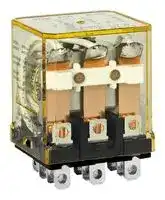


RH4B-UDC24V
Power Relay, 4PDT, 24 VDC, 10 A, RH Series, Socket, Non Latching
- Manufacturer: IDEC
- Product type: Power Relays
- Contact Configuration:4PDT; Coil Voltage:24VDC; Contact Current:10A; Product Range:RH Series; Relay Mounting:Socket; Coil Type:Non Latching; Contact Voltage VAC:110V; Relay Terminals:Quic
- SVHC: No SVHC (15-Jan-2019)
- Coil Type: Non Latching
- Coil Voltage: 24VDC
- Product Range: RH Series
- Relay Mounting: Socket
- Coil Resistance: 388ohm
- Contact Current: 10A
- Relay Terminals: Quick Connect
- Contact Material: Silver Cadmium Oxide
- Contact Voltage VAC: 110V
- Contact Voltage VDC: 30V
- Approvals & Standards: CE, CSA, UL
- Contact Configuration: 4PDT
| Delivery and price | |
|---|---|
| Units per pack | 50 |
| Price | 11.68 € |
| Current stock | 10+ |
| Lead time | 30 days |

**Relays  & Sockets**

**RH**

## **RH Series Compact Power Relays**

## **Key features**

- SPDT through 4PDT, 10A contacts

- Compact power type relays

- Miniature power relays with a large capacity

- 10A contact capacity

- Compact size saves space

## **Part Number Selection**

||Part Number||
|---|---|---|
|Contact<br>Model|Blade<br>Terminal<br>PCB Termi-<br>nal|Coil Voltage Code<br>**(Standard Stock in bold)**|
|SPDT<br>Standard<br>With Indicator<br>With Check Button<br>With Indicator and Check Button|RH1B-U0<br>RH1V2-U0<br>RH1B-UL0<br>—<br>RH1B-UC0<br>—<br>RH1B-ULC0<br>—|AC6V, AC12V,**AC24V**, AC110V,**AC120V**,<br>AC220V,**AC240V**DC6V,**DC12V**,**DC24V**,<br>DC48V, DC110V|
|Top Bracket Mounting|RH1B-UT0<br>—||
|With Diode (DC coil only)|RH1B-UD0<br>RH1V2-UD0|DC6V,**DC12V**,**DC24V**, DC48V, DC110V|
|With Indicator and Diode (DC coil only)|RH1B-ULD0<br>—|**DC12V**,**DC24V**, DC48V, DC110V|
|DPDT<br>Standard<br>With Indicator<br>With Check Button<br>With Indicator and Check Button<br>Top Bracket Mounting<br>With Diode (DC coil only)<br>With Indicator and Diode (DC coil only)<br>~~cn~~|RH2B-U0<br>RH2V2-U0<br>RH2B-UL0<br>RH2V2-UL0<br>RH2B-UC0<br>—<br>RH2B-ULC0<br>—<br>RH2B-UT0<br>—<br>RH2B-UD0<br>RH2V2-UD0<br>RH2B-ULD0<br>RH2V2-ULD0|AC6V, AC12V,**AC24V**,**AC110-120V**,<br>**AC220-240V**<br>DC6V,**DC12V**,**DC24V**, DC48V, DC100-110V<br>DC6V,**DC12V**,**DC24V**, DC48V, DC100-110V|
|3PDT<br>Standard<br>With Indicator<br>With Check Button<br>With Indicator and Check Button|RH3B-U0<br>RH3V2-U0<br>RH3B-UL0<br>RH3V2-UL0<br>RH3B-UC0<br>—<br>RH3B-ULC0<br>—|AC6V, AC12V,**AC24V**, AC110V,**AC120V**,<br>AC220V,**AC240V**DC6V,**DC12V**,**DC24V**,<br>DC48V, DC110V|
|Top Bracket Mounting|RH3B-UT0<br>—||
|With Diode (DC coil only)<br>With Indicator and Diode (DC coil only)<br>4PDT<br>Standard<br>With Indicator<br>With Check Button<br>With Indicator and Check Button|RH3B-UD0<br>—<br>RH3B-ULD0<br>—<br>RH4B-U0<br>RH4V2-U0<br>RH4B-UL0<br>RH4V2-UL0<br>RH4B-UC0<br>—<br>RH4B-ULC0<br>—|DC6V, DC12V, DC24V, DC48V, DC110V<br>AC6V, AC12V,**AC24V**, AC110V,**AC120V**,<br>AC220V,**AC240V**DC6V,**DC12V**,**DC24V**, DC48V,<br>DC110V|
|Top Bracket Mounting<br>RH4B-UT0<br>—<br>~~-D~~|||
|With Diode (DC coil only)<br>With Indicator and Diode (DC coil only)|RH4B-UD0<br>RH4V2-UD0<br>RH4B-ULD0<br>—|DC6V, DC12V, DC24V, DC48V, DC110V|


PCB terminal relays are designed to mount directly to a circuit board without any socket.

**Ordering Information**

When ordering, specify the Part No. and coil voltage code: (example)                         Part No.                         Coil Voltage Code ~~—~~ **RH3B-U       AC120V** E

**800-262-IDEC** (4332) • USA & Canada

773

**Relays & Sockets**

**RH**

**==> picture [575 x 501] intentionally omitted <==**

**----- Start of picture text -----**<br>
|||||||||||||||||
|---|---|---|---|---|---|---|---|---|---|---|---|---|---|---|---|
|Sockets|(for Blade Terminal Models)|
|Relays|Standard DIN Rail Mount|[1]|Finger-safe DIN Rail Mount|[1]|Through Panel Mount|PCB Mount|
|RH1B|SH1B-05|SH1B-O5C|SH1B-51|SH1B-62|
|RH2B|SH2B-05|SH2B-05C|SH2B-51|SH2B-62|1. DIN Rail mount socket|
|comes with two|
|RH3B|SH3B-05|SH3B-05C|SH3B-51|SH3B-62|horseshoe clips. Do|
|not use unless you|
|RH4B|SH4B-05|SH4B-05C|SH4B-51|SH4B-62|
|plan to insert pullover|
|wire spring. Replace-|
|ment horseshoe|
|clip part number is|
|Y778-011.|
|Sis|A|
|Hold Down Springs & Clips|
|For DIN|For Through Panel &|
|Appearance|Item|Relay|
|Mount Socket|PCB Mount Socket|
|ee|eee|
|RH1B|SY2S-02F1|[2]|2. Must use horseshoe clip when|
|mounting in DIN mount socket.|
|RH2B|SY4S-02F1|[2]|
|Replacement horseshoe clip|
|Pullover Wire Spring|SY4S-51F1|
|RH3B|SH3B-05F1|[2]|part number is Y778-011.|
|3. Two required per relay.|
|SN|—i|RH4B|SH4B-02F1|i|[2]|A|
|Leaf Spring (side latch)|RH1B, RH2B, RH3B, RH4B|SFA-202|[3]|SFA-302|[3]|
|Leaf Spring (top latch)|RH1B, RH2B, RH3B, RH4B|SFA-101|[3]|SFA-301|[3]|
|E|
|TT|—|hhlUcLZ|
|AC Coil Ratings|
|Rated Current (mA) ±15% at 20°C|Coil Resistance (Ω)|Operation Characteristics|
|Voltage|AC 50Hz|AC 60Hz|±10% at 20°C|(against rated values at 20ºC)|
|(V)|
|Max. Continuous|Pickup|Dropout|
|SPDT|DPDT|3PDT|4PDT|SPDT|DPDT|3PDT|4PDT|SPDT|DPDT|3PDT|4PDT|
|Applied Voltage|Voltage|Voltage|
|ee|LhYS—|
|6|170|240|330|387|150|200|280|330|330|9.4|6.4|5.4|
|12|86|121|165|196|75|100|140|165|165|39.3|25.3|21.2|
|24|42|60.5|81|98|37|50|70|83|83|153|103|84.5|
|110|9.6|—|18.1|21.6|8.4|—|15.5|18.2|18.2|—|2,200|1,800|
|110-120|—|9.4-|—|—|—|8.0-9.2|—|—|—|—|—|—|110%|80%|30%|
|10.8|maximum|minimum|
|120|8.6|—|16.4|19.5|7.5|—|14.2|16.5|16.5|—|10,800|7,360|
|220|4.7|—|8.8|10.7|4.1|—|7.7|9.1|9.1|—|10,800|7,360|
|220-240|—|4.7-5.4|—|—|—|4.0-4.6|—|—|18,820|—|—|
|240|4.9|—|8.2|9.8|4.3|—|7.1|8.3|8.3|—|12,100|9,120|

**----- End of picture text -----**<br>


**DC Coil Ratings**

**==> picture [551 x 136] intentionally omitted <==**

**----- Start of picture text -----**<br>
|||||||||||||
|---|---|---|---|---|---|---|---|---|---|---|---|
|Coil Resistance (Ω)|Operation Characteristics|
|Rated Current (mA) ±15% at 20°C|
|Voltage|±10% at 20°C|(against rated values at 20ºC)|
|(V)|Max. Continuous|Pickup|Dropout|
|SPDT|DPDT|3PDT|4PDT|SPDT|DPDT|3PDT|4PDT|
|Applied Voltage|Voltage|Voltage|
|ee|eee|
|6|128|150|240|250|47|40|25|24|
|12|64|75|120|125|188|160|100|96|
|24|32|36.9|60|62|750|650|400|388|80%|10%|Standard coil volt-|
|110%|ages are in|BOLD|.|
|48|18|18.5|30|31|2,660|2,600|1,600|1,550|maximum|minimum|
|_—|100-110|—|8.2-9.0|—|—|||—|12,250|—|—|A|
|110|8|—|12.8|15|13,800|—|8,600|7,340|

**----- End of picture text -----**<br>


Hipec

**www.IDEC.com**

774

**Relays  & Sockets**

**RH**

## **Contact Ratings**

## **UL Ratings**

|Maximum Contact Capacity<br>Model<br>Continuous<br>Current<br>Allowable Contact Power<br>Rated Load<br>Resistive<br>Load<br>Inductive<br>Load<br>Voltage<br>(V)<br>Res.<br>Load<br>Ind.<br>Load<br>SPDT<br>10A<br>1540VA<br>300W<br>990VA<br>210W<br>110 AC<br>10A<br>7A<br>220 AC<br>7A<br>4.5A<br>30 DC<br>10A<br>7A<br>DPDT<br>3PDT<br>4PDT<br>10A<br>1650VA<br>300W<br>1100VA<br>225W<br>110 AC<br>10A<br>7.5A<br>220 AC<br>7.5A<br>5A<br>30 DC<br>10A<br>7.5A<br>Note: Inductive load for the rated load — cos ø = 0.3, L/R = 7 ms<br>**TÜV Ratings**<br>Voltage<br>RH1<br>RH2<br>RH3<br>RH4<br>~~=~~<br>4<br>~~ee~~<br>~~ee~~|~~ee~~|Voltage<br>Resistive<br>General Use<br>Horsepower Rating<br>RH1<br>RH2<br>RH3<br>RH4<br>RH1<br>RH2<br>RH3<br>RH4<br>RH1<br>RH2<br>RH3<br>RH4<br>240V AC<br>10A<br>7.5A<br>7.5A<br>7A<br>6.5A<br>5A<br>1/3 HP<br>1/3 HP<br>—<br>120V AC<br>—<br>10A<br>10A<br>—<br>7.5A<br>7.5A<br>1/6 HP<br>1/6 HP<br>—<br>30V DC<br>10A<br>10A<br>—<br>7A<br>—<br>—<br>—<br>—<br>—<br>28V DC<br>—<br>—<br>10A<br>—<br>—<br>—<br>—<br>—<br>—<br>**CSA Ratings**<br>Voltage<br>Resistive<br>General Use<br>Horse-<br>power<br>Rating<br>RH1<br>RH2<br>RH3<br>RH4<br>RH1<br>RH2<br>RH3<br>RH4<br>RH1, 2, 3<br>240V AC<br>10A<br>10A<br>—<br>7.5A<br>7A<br>7A<br>7A<br>5A<br>1/3 HP<br>120V AC<br>10A<br>10A<br>10A<br>10A<br>7.5A<br>7.5A<br>—<br>7.5A<br>1/6 HP<br>30V DC<br>10A<br>10A<br>10A<br>10A<br>7A<br>7.5A<br>—<br>—<br>—<br>~~P~~E LP<br>~~PET~~<br>Pye<br>~~a~~<br>ee<br>PPE ta bbb<br>id<br>~~TT~~<br>~~LT~~<br>~~=~~|
|---|---|---|


## **TÜV Ratings**

Voltage RH1 RH2 RH3 RH4 240V AC 10A 10A 7.5A 7.5A 30V DC 10A 10A 10A 10A ~~ee ee~~ AC: cos ø = 1.0, DC: L/R = 0 ms

## **Socket Specifications**

|Sockets<br>DIN Rail<br>Mount<br>Sockets<br>SH1B-05<br>SH2B-05<br>SH3B-05<br>SH4B-05<br>Finger-safe<br>DIN Rail<br>Mount<br>SH1B-05C<br>SH2B-05C<br>SH3B-05C<br>SH4B-05C<br>Through<br>Panel<br>Mount<br>Socket<br>SH1B-51<br>SH2B-51<br>SH3B-51<br>SH4B-51<br>PCB Mount<br>Socket<br>SH1B-62<br>SH2B-62<br>SH3B-62<br>SH4B-62<br>~~a~~|Sockets<br>DIN Rail<br>Mount<br>Sockets<br>SH1B-05<br>SH2B-05<br>SH3B-05<br>SH4B-05<br>Finger-safe<br>DIN Rail<br>Mount<br>SH1B-05C<br>SH2B-05C<br>SH3B-05C<br>SH4B-05C<br>Through<br>Panel<br>Mount<br>Socket<br>SH1B-51<br>SH2B-51<br>SH3B-51<br>SH4B-51<br>PCB Mount<br>Socket<br>SH1B-62<br>SH2B-62<br>SH3B-62<br>SH4B-62<br>~~a~~|Terminal<br>~~ee~~|Electrical Rating<br>~~ee~~|Wire Size<br>~~ee~~|Torque<br>ee|
|---|---|---|---|---|---|
||SH1B-05<br>SH2B-05<br>SH3B-05<br>SH4B-05<br>SH1B-05C<br>SH2B-05C<br>SH3B-05C<br>SH4B-05C<br>SH1B-51<br>SH2B-51<br>SH3B-51<br>SH4B-51<br>SH1B-62<br>SH2B-62<br>SH3B-62<br>SH4B-62<br>~~a~~|(Coil) M3 screws<br>(contact) M3.5 screws with captive wire clamp<br>M3.5 screws with captive wire clamp<br>(coil) M3 screws<br>(contact) M3.5 screws with captive wire clamp, fingersafe<br>M3.5 screws with captive wire clamp, fingersafe<br>Solder<br>PCB mount<br>PCB mount<br>~~ee~~|250V, 10A<br>300V, 10A<br>250V, 10A<br>300V, 10A<br>300V, 10A<br>250V, 10A<br>300V, 10A<br>~~ee~~|Maximum up to 2–#12AWG<br>Maximum up to 2–#12AWG<br>Maximum up to 2–#12AWG<br>Maximum up to 2–#12AWG<br>—<br>—<br>—<br>~~ee~~|5.5 - 9 in•lbs<br>9 - 11.5 in•lbs<br>9 - 11.5 in•lbs<br>5.5 - 9 in•lbs<br>9 - 11.5 in•lbs<br>9 - 11.5 in•lbs<br>—<br>—<br>—<br> ee|
|Finger-safe<br>DIN Rail<br>Mount||||||
|Through<br>Panel<br>Mount<br>Socket||||||
|PCB Mount<br>Socket||||||


## **Accessories**

|Item<br>Aluminum<br>DIN Rail<br>(1 meter length)|Appearance|Use with<br>All DIN rail sockets|Part No.<br>BNDN1000|Remarks<br>The BNDN1000 is designed to accommodate DIN mount sockets.<br>Made of durable extruded aluminum, the BNDN1000 measures 0.413<br>(10.5mm) in height and 1.37 (35mm) in width (DIN standard). Standard<br>length is 39” (1,000mm).|
|---|---|---|---|---|
|DIN Rail End<br>Stop<br>Replacement<br>Hold-Down<br>Spring Anchor|Pe|DIN rail<br>DIN mount sockets and hold<br>down springs.|BNL5<br>Y778-011|9.1 mm wide.<br>For use on DIN rail mount socket when using pullover wire hold down<br>spring. 2 pieces included with each socket.|


**800-262-IDEC** (4332) • USA & Canada

775

**Relays & Sockets**

**RH**

## **Specifications**

|Contact Material<br>Contact Resistance1<br>Minimum Applicable Load<br>Operating Time2<br>SPDT<br>DPDT<br>3PDT<br>4PDT<br>Release Time2<br>SPDT<br>DPDT<br>3PDT<br>4PDT<br>Power Consumption<br>(approx.)<br>SPDT<br>DPDT<br>3PDT<br>4PDT<br>Insulation Resistance<br>Dielectric Strength3<br>SPDT<br>DPDT<br>3PDT<br>4PDT<br>Operating Frequency<br>Vibration Resistance<br>Shock Resistance<br>Mechanical Life<br>~~i~~|Silver cadmium oxide<br>50mΩ maximum<br>24V DC, 30 mA; 5V DC, 100 mA (reference value)<br>20ms maximum<br>25ms maximum<br>20ms maximum<br>25ms maximum<br>AC: 1.1VA (50Hz), 1VA (60Hz)<br>DC: 0.8W<br>AC: 1.4VA (50Hz), 1.2VA (60Hz)<br>DC: 0.9W<br>AC: 2VA (50Hz), 1.7VA (60Hz)<br>DC: 1.5W<br>AC: 2.5VA (50Hz), 2VA (60Hz)<br>DC: 1.5W<br>100MΩ minimum (500V DC megger)<br>Between live and dead parts:<br>2,000V AC, 1 minute<br>Between contact and coil:<br>2,000V AC, 1 minute<br>Between contacts of the same pole: 1,000V AC, 1 minute<br>Between live and dead parts:<br>2,000V AC, 1 minute<br>Between contact and coil:<br>2,000V AC, 1 minute<br>Between contacts of different poles: 2,000V AC, 1 minute<br>Between contacts of the same pole: 1,000V AC, 1 minute<br>Electrical:<br>1,800 operations/hour maximum<br>Mechanical:<br>18,000 operations/hour maximum<br>Damage limits:<br>10 to 55Hz, amplitude 0.5 mm<br>Operating extremes:<br>10 to 55Hz, amplitude 0.5 mm<br>Damage limits:<br>1,000m/s2(100G)<br>Operating extremes:<br>200m/s2(20G - SPDT, DPDT)<br>100m/s2(10G - 3PDT, 4PDT)<br>50,000,000 operations minimum|
|---|---|
|Electrical Life|500,000 operations minimum (120V AC, 10A)<br>200,000 operations minimum (120V AC, 10A)<br>–25 to +70°C (no freezing)<br>45 to 85% RH (no condensation)<br>SPDT: 24g, DPDT: 37g, 3PDT: 50g, 4PDT: 74g<br>~~e~~|
|Operating<br>Temperature4||


2. Measured at the rated voltage (at 20°C), excluding contact bouncing Release time of relays with diode: 40 ms maximum

3. Relays with indicator or diode: 1000V AC, 1 minute

4. For use under different temperature conditions, refer to Continuous Load Current vs. Operating Temperature Curve. The operating temperature range of relays with indicator or diode is –25 to +40°C.

Hipec

**www.IDEC.com**

776

**Relays  & Sockets**

**RH**

## **Characteristics (Reference Data)**

## **Electrical Life Curves**

**==> picture [27 x 7] intentionally omitted <==**

**----- Start of picture text -----**<br>
AC Load<br>**----- End of picture text -----**<br>


**==> picture [543 x 686] intentionally omitted <==**

**----- Start of picture text -----**<br>
DC Load<br>1000 1000<br>(RH1) 120V AC resistive (RH1)<br>500 500<br>30V DC resistive<br>100 100<br>50 50<br>100V DC resistive<br>30V DC inductive<br>20 20<br>240V AC inductive 120V AC inductive 240V AC resistive 100V DC inductive<br>10 1 2 3 4 5 6 7 8 9 10 10 1 2 3 4 5 6 7 8 9 10<br>Load Current (A) Load Current (A)<br>(RH2) 1000 120V AC resistive (RH2) 1000<br>30V DC resistive<br>500 500<br>100 100<br>50 50 100V DC resistive 30V DCinductive<br>240V AC inductive 240V AC resistive<br>120V AC inductive 100V DC inductive<br>20 20<br>10 1 2 3 4 5 6 7 8 9 10 10 1 2 3 4 5 6 7 8 9 10<br>Load Current (A) Load Current (A)<br>(RH3/RH4) 1000 (RH3/RH4) 1000<br>120V AC resistive<br>500 500 30V DC resistive<br>30V DC inductive<br>100 100<br>50 50<br>20 240V AC inductive 20 100V DC resistive<br>240V AC resistive 100V DC inductive<br>120V AC inductive<br>10 “ae 1 2 3 4 5 6 7 8 9 10 10 1 2 3 4 5 6 7 8 9 10<br>Load Current (A) Load Current (A)<br>Maximum Switching Capacity<br>(RH1) (RH2/RH3/RH4)<br>10.0 10.0<br>AC resistive AC resistive<br>5.0 AC inductive 5.0 AC inductive<br>DC resistive<br>DC resistive<br>1.0 1.0<br>DC inductive<br>0.5 DC inductive 0.5<br>0.11 5 10 50 100 200 300 0.11 5 10 50 100 200 300<br>Load Voltage (V) Load Voltage (V)<br>800-262-IDEC  (4332) • USA & Canada<br>yy 777<br> 10,000 operations)×<br>Life (¥ 10,000 operations)<br>Life (<br>Signaling Lights<br>Relays & Sockets<br> 10,000 operations)×<br>Life (¥ 10,000 operations)<br>Life (<br>Timers<br> 10,000 operations)×<br>Life (¥ 10,000 operations)<br>Life (<br>Contactors<br>Terminal Blocks<br>Load Current (A) Load Current (A)<br>Circuit Breakers<br>**----- End of picture text -----**<br>


**==> picture [8 x 58] intentionally omitted <==**

**----- Start of picture text -----**<br>
Relays & Sockets<br>**----- End of picture text -----**<br>


**==> picture [7 x 36] intentionally omitted <==**

**----- Start of picture text -----**<br>
Contactors<br>**----- End of picture text -----**<br>


## **Maximum Switching Capacity**

**==> picture [7 x 53] intentionally omitted <==**

**----- Start of picture text -----**<br>
Circuit Breakers<br>**----- End of picture text -----**<br>


**Relays & Sockets**

**RH**

## **Continuous Load Current vs. Operating Temperature Curve (Basic Type, With Check Button, and Top Bracket Mounting Type)**

**==> picture [560 x 569] intentionally omitted <==**

**----- Start of picture text -----**<br>
Continuous Load Current vs. Operating Temperature Curve (Basic Type, With Check Button, and Top Bracket Mounting Type)<br>(RH1) 100 Note: The rated voltage is       applied to the coil. (RH2) 100 Note: The rated voltage is       applied to the coil. (RH3/RH4) 100 Note: The rated voltage is       applied to the coil.<br>90 90 90<br>80 80 80<br>DC Coil<br>70 70 DC Coil 70<br>60 60 60<br>50 AC Coil 50 50 AC/DC Coil<br>40 40 AC Coil 40<br>30 30 30<br>20 20 20<br>10 10 10<br>0 1 2 3 4 5 6 7 8 9 10 0 1 2 3 4 5 6 7 8 9 10 0 1 2 3 4 5 6 7 8 9 10<br>Load Current (A) Load Current (A) Load Current (A)<br>Internal Connection (View from Bottom)<br>Basic Type<br>SPDT DPDT 3PDT 4PDT With Check Button<br>Front<br>1 2 3 4 Pushbutton<br>5 6 7 8<br>9 10 11 12 Contacts can be operated by pressing the<br>13 ( – ) ( + ) 14 check button.<br>With Indicator (-L type)<br>SPDT 3PDT 4PDT DPDT<br>1 1 2 4 1 2 3 4 1 4<br>Below  59 59 106 128 59 106 117 128 Below  59 128 When the relay is energized,<br>100V AC/DC (  –  )13 (  +  )14 13(  –  ) (  +  )14 13(  –  ) (  +  )14 24V AC/DC 13(  –  ) (  +  )14 the indicator goes on. • Relay coils less than 100V<br>DC do not contain a protec-<br>Tj Sr fe tion diode (except DPDT).<br>| • Relay coils below 100V<br>use LED indicator, coils<br>1 1 2 4 1 2 3 4 1 4 above 100V use neon lamp<br>100V  5 5 6 8 5 6 7 8 24V AC/ 5 8 indicator.<br>EP AC/DC and over (  –  )13 9 (  +  )14 S 913 R ( – ) E 10 PE ( + ) 1412 P E 139 PE ( – ) 10 PE 11 N ( + ) E 1214 Y DC and over | E 9 P R 12 • LED color of DPDT model is green<br>13(  –  ) (  +  )14<br>OA ES) ee<br>With Diode (-D type)<br>SPDT DPDT 3PDT 4PDT<br>Contains a diode to absorb the back emf<br>1 1 4 1 2 4 1 2 3 4 generated when the coil is de-energized. The<br>5 5 8 5 6 8 5 6 7 8 release time is slightly longer. Available for DC<br>BP a a y ) peri<br>9 9 12 9 10 12 9 10 11 12 coil only.<br>13( – ) 14( + ) 13 ( – ) ( + ) 14 13 ( – ) ( + ) 14 13 ( – ) ( + ) 14 • Diode Characteristics<br>Reverse withstand voltage: 1,000V<br>Forward current: 1A<br>C)° C)° C)°<br>Switches & Pilot Lights<br>Operating Temperature ( Operating Temperature (<br>Operating Temperature (<br>Signaling Lights<br>Relays & Sockets<br>Timers<br>Contactors<br>Terminal Blocks<br>**----- End of picture text -----**<br>


Hipec

**www.IDEC.com**

778

**Relays  & Sockets**

**RH**

## **With Indicator LED & Diode (-LD type)**

SPDT 3PDT

## 4PDT

**==> picture [19 x 7] intentionally omitted <==**

**----- Start of picture text -----**<br>
DPDT<br>**----- End of picture text -----**<br>


**==> picture [89 x 119] intentionally omitted <==**

**----- Start of picture text -----**<br>
1<br>5<br>9<br>Below  13 14<br>100V DC (  –  ) (  +  )<br>1<br>5<br>100V DC  9<br>and over 13(  –  ) 14(  +  )<br>**----- End of picture text -----**<br>


**==> picture [203 x 130] intentionally omitted <==**

**----- Start of picture text -----**<br>
1 4<br>5 8<br>Below<br>9 12<br>24V AC/<br>DC 13(  –  ) (  +  )14<br>Contains an LED indicator and<br>a surge absorber, and has the<br>same height as the basic type.<br>1 4 LED color of DPDT model is<br>24V AC/ 5 8 green.<br>DC and  9 12<br>over<br>13 14<br>(  –  ) (  +  )<br>**----- End of picture text -----**<br>


## **Dimensions (mm)**

## **RH1B-U/RH1B-UL/RH1B-UD/RH1B-ULD**

**RH2B-U/RH2B-UL/RH2B-UD/RH2B-ULD**

## **RH3B-U/RH3B-UL/RH3B-UD/RH3B-ULD**

**==> picture [520 x 480] intentionally omitted <==**

**----- Start of picture text -----**<br>
Total length from panel surface including relay socket Total length from panel surface including relay socket Total length from panel surface including relay socket<br>SH1B-05: 61.5 (63.5) max., SH1B-51: 39.6 (41.6) max. SH2B-05: 61.5 (63.5) max., SH2B-51: 39.6 (41.6) max. SH3B-05: 61.5 (63.5) max., SH3B-51: 39.6  [(] 41.6 [) ] max.<br>a Dimensions in the (  )include a hold-down spring. Dimensions in the (  )include a hold-down spring. Dimensions in the (  )include a hold-down spring.<br>ø2.6 hole<br>ø2.6 hole<br>1 ø2.6 hole<br>= 5 CS 1 4 =<br>9 5 8<br>13 14 9 12<br>13 14 1 2 4<br>5 6 8<br>5.4 14 9 10 11<br>35.6 max. 6.4 35.6 max. 6.4 21 13 14<br>35.6 max. 6.4 31<br>RH4B-U/RH4B-UL/RH4B-UD/RH4B-ULD  RH1B-UT RH2B-UT<br>Total length from panel surface including relay socket<br>SH4B-05: 61.5 (63.5) max., SH4B-51: 39.6 (41.6) max.<br>Dimensions in the (  )<br>include a hold-down spring. ø2.6 hole<br>ø2.6 hole<br>1<br>5<br>9 15 48<br>13 14 9 12<br>13 14<br>5 ø2.6 hole nie oe<br>3.5 2 5.4<br>14.5 35.6 max. 6.4 3.5 2<br>1 2 3 4 21.5 35.6 max. 6.4<br>5 6 7 8 [Dee]<br>9 10 11 12<br>13 14<br>im, [MP] A<br>35.6 max. 6.4 41<br>RH3B-UT RH4B-UT<br>3.5 ø2.6 hole 2 3.5<br>ø2.6 hole<br>1 2 4<br>5 6 8 1 2 3 4<br>9 10 12 5 6 7 8<br>13 14 9 10 11 12<br>13 14<br>21.5 2 35.6 max. 6.4 28<br>31.5 35.6 max. 6.4 42 max. 41.5<br>Se DS<br>800-262-IDEC  (4332) • USA & Canada<br>Lie Bs EipEc<br>4.7<br>4.7<br>4.7<br>5<br>05. 27. 0.5 27.5<br>0.5 27.5<br>4.7<br>10<br>0.5 4.7<br>0.5 4.7<br>4.7<br>43.2 38 5.9 27.5 43.2 38 5.9 27.5<br>6.6<br>4.7 7.25<br>0.5 27.5<br>4.7 10 10<br>10 10<br>10<br>4.7<br>0.5 4.7<br>0.5 4.7<br>43.2 38 5.9 28 44 38 5.9 28<br>7.25 7.25<br>**----- End of picture text -----**<br>


779

**Relays & Sockets**

**RH**

## **Dimensions con’t (mm)**

**RH1V2-U/RH1V2-UD**

**RH2V2-U/RH2V2-UL/RH2V2-UD**

8-ø2.4 holes 3-ø2.4 holes 0.5 2-ø2 holes 0.5 ~~1~~ 5 9 1 4 13 14 5 8 9 12 13 14 35.6 max. 4.6 14 10 ~~=a av~~ 4.4 ~~d =~~ 35.6 max. 4.6 21 ~~8~~ 14.2 ~~i~~ **RH3V2-U/RH3V2-UL/RH3V2-D RH4V2-U/RH4V2-UL/RH4V2-UD** 30 11-ø2.4 holes 10 10 14-ø2.4 holes 10 c ~~H SH~~ + ~~ars~~ 1 2 4 5 6 8 1 2 3 4 9 10 11 5 6 7 8 13 14 9 10 11 12 13 14 0.5 31 ~~a gett~~ 0.5 41 35.6 max. 4.6 ~~a~~ 35.6 max. ~~_—~~ 4.6

**RH3V2-U/RH3V2-UL/RH3V2-D**

## **Standard DIN Rail Mount Sockets**

## **SH1B-05**

## **SH2B-05**

**==> picture [527 x 112] intentionally omitted <==**

**----- Start of picture text -----**<br>
17 31.5 22 31.5<br>8 M3.5 TerminalScrew 18 DIN Rail(BNDN) 2-ø4.2 Mounting Holes(or M4 Tapped Holes) Terminal Arrangement 51 8 M3.5 TerminalScrew 18 DIN Rail(BNDN) 2-ø4.2 Mounting Holes(or M4 Tapped Holes) Terminal Arrangement 48 15<br>16 26<br>M3 Terminal 5.5 min. 4.8 min. 14 13 4.4 max. 5.5 min. 14 13<br>Screw 4.4 max. 4 max. 9 1 2 9<br>16 14.5 ø3.6 min. ø3.2 min.(Top View) 26 14.5 7.9 max. (Top View)<br>20 25 7.9 max. 5.9 max. 30 25 ø3.6 min.<br>(For terminals 1, 5, and 9) (For terminals 13 and 14)<br>4.2 4.2<br>67 47 67 47<br>2.5 2.5<br>**----- End of picture text -----**<br>


## **SH3B-05**

## **SH4B-05**

**==> picture [507 x 97] intentionally omitted <==**

**----- Start of picture text -----**<br>
32 31.5 42 31.5<br>8 M3.5 TerminalScrew 18 DIN Rail(BNDN) 2-ø4.2 Mounting Holes(or M4 Tapped Holes) Terminal Arrangement84 26 51 8 M3.5 TerminalScrew 18 DIN Rail(BNDN) 2-ø4.2 Mounting Holes(or M4 Tapped Holes) Terminal Arrangement 48 37 26 15<br>46<br>36<br>4.4 max. 5.5 min. 14 1 3 4.4 max. 5.5 min. 1412 11 10 139<br>12 10 9<br>36 14.5 (Top View) 46 14.5 7.9 max. (Top View)<br>7.9 max. 50 25 ø3.6 min.<br>40 25 ø3.6 min.<br>4.2 4.2<br>47 67 47<br>2.5<br>**----- End of picture text -----**<br>


**==> picture [5 x 49] intentionally omitted <==**

**----- Start of picture text -----**<br>
67<br>2.5<br>**----- End of picture text -----**<br>


Hipec

**www.IDEC.com**

780

**RH**

## **Relays  & Sockets**

## **Dimensions con’t (mm)**

## **Finger-safe DIN Rail Mount Sockets**

## **SH1B-05C**

**==> picture [41 x 8] intentionally omitted <==**

**----- Start of picture text -----**<br>
SH2B-05C<br>**----- End of picture text -----**<br>


**==> picture [526 x 228] intentionally omitted <==**

**----- Start of picture text -----**<br>
22 36<br>177 M3.5 Terminal Screw 3625 DIN Rail Terminal Arrangement 7 M3.5 TerminalScrew 25 DIN Rail (BNDN) Terminal Arrangement<br>kext (BNDN) 2-ø4.2 Mounting Holes(or M4 Tapped Holes) (2 51 | fetes 2-ø4.2 Mounting Holes(or M4 Tapped Holes) 3 48 15<br>26<br>16<br>f i»)eae= q| M3 TerminalScrew i4 > PHo 14 13 4H ilrad1eyoo f y\ i‘AH 1412  & 139 i<br>9<br>fotUS|Ll 16 18.7 Ring terminals cannot be used. (Top View) ésLI , fesi 2630 29.518.7 Ring terminals cannot be used. (Top View) (0 Oj<br>20 29.5<br>SH3B-05C SH4B-05C<br>32 When using<br>7 M3.5 TerminalScrew 3625 DIN Rail(BNDN) Terminal Arrangement 42 7 BAA/BAP: 3325 DIN Rail<br>2-ø4.2 Mounting Holes 84 26 51 (BAA/BAP) Terminal Arrangement<br>(or M4 Tapped Holes) 2-ø4.2 Mounting Holes 8 7 6 5<br>fotetct Pee fstotate! (or M4 Tapped Holes) — 4 3 2 1<br>36<br>14 13 46<br>eamey | 12 10 9 | i 14 13<br>aBoa 36 18.7 Ring terminals cannot be used. 12.90Bool (Top View) ee.)Baeeel , Ring type crimping  Say soos 12 (Top View)11 10 L 9 yle<br>40 29.5 46 18.7 terminals cannot be used.<br>50 29.5<br>ø5<br>ø5<br>ø5<br>ø5<br>4.2<br>4.2<br>69 49<br>69 48<br>1.7<br>1.7<br>4.2<br>4.2<br>69 49<br>69 49<br>1.7<br>1.7<br>**----- End of picture text -----**<br>


**==> picture [40 x 9] intentionally omitted <==**

**----- Start of picture text -----**<br>
SH3B-05C<br>**----- End of picture text -----**<br>


## **Through Panel Mount Socket**

## **SH1B-51**

## **SH2B-51**

## **SH3B-51**

## **SH4B-51**

**800-262-IDEC** (4332) • USA & Canada

781

**Relays & Sockets**

**RH**

## **Dimensions con’t (mm)**

**==> picture [552 x 269] intentionally omitted <==**

**----- Start of picture text -----**<br>
Dimensions con’t (mm)<br>PCB Mount Sockets<br>SH1B-62 SH2B-62<br>Terminal Arrangement 3-ø2.4 holes 6.8 18 min. Terminal Arrangement 2.85 21.5 min.<br>1 4.4 1 4 15.5<br>5 5 8 10<br>9 9 12<br>13 14 13 14<br>18 3 (Bottom View) 21.2 3 (Bottom View)<br>SS 11 (00; Se _ 11 ‘OO: BS i<br>15 2-ø2 holes 15 8-ø2.4 holes<br>2<br>T 12.2 al 1.5 * 36 min. when using    hold-down springs aS (Tolerance ±0.1) G 2 q * 34 min. when using   hold-down springs — (Tolerance 0.1)<br>SH3B-62 SH4B-62<br>Terminal Arrangement 36 min. Terminal Arrangement 6.85 45 min.<br>1 2 4 7.35 21.3 1 2 3 4 31.3<br>5 6 8 10 10 5 6 7 8 10 10 10<br>9 10 12 9 10 11 12<br>13 14 13 14<br>36 3 (Bottom View) 45 3 (Bottom View)<br>11<br>11<br>15<br>15 11-ø2.4 holes 14-ø2.4 holes<br>2<br>30.2 2 * 36 min. when using (Tolerance 0.1) 39.2 * 36 min. when using   hold-down springs (Tolerance 0.1)<br>   hold-down springs<br>6.95<br>Switches & Pilot Lights 31 25.4 4.7 29 25.4 4.7 5.65<br>0.3 11.85 0.3<br>12.5<br>5.95<br>31 min.*  6.6<br> 29 min.*<br>Signaling Lights<br>31 25.4 4.7 31 25.4 4.7 6.65<br>0.3 12.5 6.65 0.3 12.5<br> 31 min.* 6.6 31 min.*  6.6<br>Relays & Sockets<br>**----- End of picture text -----**<br>


Hipec

**www.IDEC.com**

782

**Relays  & Sockets**

**Operating Instructions**

## **Operating Instructions**

## **Driving Circuit for Relays**

## **Protection for Relay Contacts**

1. To ensure correct relay operation, apply rated voltage to the relay coil.

1. The contact ratings show maximum values. Make sure that these values are not exceeded. When an inrush current flows through the load, the contact may become welded. If this is the case, connect a contact protection circuit, such as a current limiting resistor.

## 2. Input voltage for the DC coil:

A complete DC voltage is best for the coil power to make sure of stable relay operation. When using a power supply containing a ripple voltage, suppress the ripple factor within 5%. When power is supplied through a rectification circuit, the relay operating characteristics, such as pickup voltage and dropout voltage, depend on the ripple factor. Connect a smoothing capacitor for better operating characteristics as shown below.

2. Contact protection circuit:

When switching an inductive load, arcing causes carbides to form on the contacts, resulting in increased contact resistance. In consideration of contact reliability, contact life, and noise suppression, use of a surge absorbing circuit is recommended. Note that the release time of the load becomes slightly longer. Check the operation using the actual load. Incorrect use of a contact protection circuit will adversely affect switching characteristics. Four typical examples of contact protection circuits are shown in the following table: examples of contact protection circuits are shown in the following table:

**==> picture [539 x 388] intentionally omitted <==**

**----- Start of picture text -----**<br>
Pulsation<br>longer. Check the operation using the actual load. Incorrect use of a contact<br>SmoothingCapacitor Emin Emax Emean DC protection circuit will adversely affect switching characteristics. Four typical examples of contact protection circuits are shown in the following table:<br>+<br>– R Relay Ripple Factor (%) Emax –EmeanEmin ¥ 100% This protection circuit can be used when the load<br>Emax = Maximum of pulsating current impedance is smaller than the RC impedance in an<br>EminEmean = DC mean value= Minimum of pulsating current Power C R Ind. Load AC load power circuit.• R: Resistor of approximately the same resistance<br>3. Leakage current while relay is off:  value as the load<br>When driving an element at the same time as the relay operation, special  • C:0.1 to 1 µF<br>consideration is needed for the circuit design. As shown in the incorrect  This protection circuit can be used for both AC and<br>circuit below, leakage current (Io) flows through the relay coil while the relay  DC load power circuits.<br>is off. Leakage current causes coil release failure or adversely affects the  R: Resistor of approximately the same resistance<br>value as the load<br>vibration resistance and shock resistance. Design a circuit as shown in the<br>fro, Foo I C: 0.1 to 1 µF<br>correct example.<br>This protection circuit can be used for DC load power<br> Incorrect  Correct  + circuits. Use a diode with the following ratings.<br>R TE R Power D Ind. Load Reverse withstand voltage: Power voltage of the<br>– load circuit x 10<br>Io Forward current: More than the load current<br>=a =ee (CE<br>This protection circuit can be used for both AC and<br>DC load power circuits.<br>4. Surge suppression for transistor driving circuits:<br>For a best result, when using a power voltage of 24<br>When the relay coil is turned off, a high-voltage pulse is generated, causing a  Power Ind. Load<br>to 48V AC/DC, connect a varistor across the load.<br>transistor to deteriorate and sometimes to break. Be sure to connect a diode<br>tt When using a power voltage of 100 to 240V AC/DC,<br>to suppress the back electromotive force. Then, the coil release time becomes  connect a varistor across the contacts.<br>slightly longer. To shorten the coil release time, connect a Zener diode<br>between the collector and emitter of the transistor. Select a Zener diode with  3. Do not use a contact protection circuit as shown below:<br>a Zener voltage slightly higher than the power voltage.<br>This protection circuit is very effective in arc suppression when<br>Back emf<br>suppressing diode opening the contacts. But, the capacitor is charged while the<br>+– R Relay PowerC Load contacts are opened. When the contacts are closed, the capacitor is discharged through the contacts, increasing the possibility of contact welding.<br>This protection circuit is very effective in arc suppression when<br>C Load opening the contacts. But, when the contacts are closed, a current<br>B S 8 Power flows to charge the capacitor, causing contact welding.<br>RC<br>Diode<br>Varistor<br>Varistor<br>**----- End of picture text -----**<br>


Generally, switching a DC inductive load is more difficult than switching a DC resistive load. Using an appropriate arc suppressor, however, will improve the switching characteristics of a DC inductive load.

## **Soldering**

1. When soldering the relay terminals, use a soldering iron of 30 to 60W, and quickly complete soldering (within approximately 3 seconds).

2. Use a non-corrosive rosin flux.

**800-262-IDEC** (4332) • USA & Canada

817

**Relays & Sockets**

**Operating Instructions**

## **Operating Instructions con’t**

## **Other Precautions**

   2. UL and CSA ratings may differ from product rated values determined by IDEC.

1. General notice:

- To maintain the initial characteristics, do not drop or shock the relay.

   3. Do not use relays in the vicinity of strong magnetic field, as this may affect relay operation.

- The relay cover cannot be removed from the base during normal operation. To maintain the initial characteristics, do not remove the relay cover.

Use the relay in environments free from condensation, dust, sulfur dioxide (SO2), and hydrogen sulfide (H2S).

Make sure that the coil voltage does not exceed applicable coil voltage range.

## **Safety Precautions**

- Turn off the power to the relay before starting installation, removal, wiring, maintenance, and inspection of the relays. Failure to turn power off may cause electrical shock or fire hazard.

- Observe specifications and rated values, otherwise electrical shock or fire hazard may be caused.

- Use wires of the proper size to meet voltage and current requirements. Tighten the terminal screws on the relay socket to the proper tightening torque.

- Surge absorbing elements on AC relays with RC or DC relays with diode are provided to absorb the back electromotive force generated by the coil. When the relay is subject to an excessive external surge voltage, the surge absorbing element may be damaged. Add another surge absorbing provision to the relay to prevent damage.

## **Precautions for the RU Relays**

- Before operating the latching lever of the RU relay, turn off the power to the RU relay. After checking the circuit, return the latching lever to the original position.

- Do not use the latching lever as a switch. The durability of the latching lever is a minimum of 100 operations.

- When using DC loads on 4PDT relays, apply a positive voltage to terminals of neighboring poles and a negative voltage to the other terminals of neighboring poles to prevent the possibility of short circuits.

- DC relays with a diode have a polarity in the coil terminals. Apply the DC voltage to the correct terminals.

Hipec

**www.IDEC.com**

818
Updated at April 26, 2026
Founded in 1945, IDEC is a globally recognized leader in industrial automation, machine safety, and control products. Renowned for pioneering innovations in Human-Machine Interface (HMI) systems, the company is dedicated to creating a safe and efficient harmony between advanced workplace technology and human operators. At the core of IDEC’s extensive portfolio is a comprehensive selection of high-performance relays designed for demanding industrial environments. This includes a broad range of electromechanical power relays, solid-state relays, contactors, and critical safety relays, supported by a wide array of specialized relay accessories to ensure reliable and efficient switching. Beyond switching components, IDEC provides complete solutions for modern control panels and automated systems. Their robust engineering extends to advanced panel displays and instrumentation, precision light sensors, and dependable AC/DC power converters. With additional offerings in industrial switches, visual signaling units, and DIN rail terminal blocks, IDEC equips engineers with the high-quality components required to build secure, next-generation automation infrastructure.
About Novapart
Novapart is a B2B electronic component broker specialising in stock shortages and cost reduction. We source hard-to-find parts and identify compliant alternatives across a catalogue of 410,000+ components from 500+ manufacturers.
Learn more →Stock Shortage Specialist
When a component is unavailable, discontinued or has an unacceptable lead time, we tap into our network of vetted European and Asian distributors to source what you need — without compromising on quality or traceability.
Request a quote →Compliant Alternatives
We identify pin-to-pin, electrically equivalent substitutes that meet the same certifications (RoHS, AEC-Q100, REACH) as your original specification — validated against datasheets, not just part numbers. Often at a lower cost.
BOM Analysis service →