
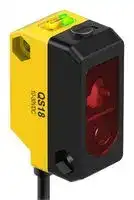


QS18VP6LAF250Q5
LASER
- Manufacturer: BANNER ENGINEERING
- Product type:
- SVHC: No SVHC (23-Jan-2024)
- Product Range: QS18 Series
| Delivery and price | |
|---|---|
| Units per pack | 50 |
| Price | 275.36 € |
| Current stock | 10+ |
| Lead time | 30 days |

QS18VxAF Mechanically Adjustable Background Suppression Sensor

## Features

Miniature sensors with visible red LED or visible red laser

   - Exceptional optical performance, comparable to larger sensors

   - • Simple multi-turn screw adjustment of cutoff distance • 10 V DC to 30 V DC operation, with complementary (SPDT) NPN or PNP outputs, depending on model • Less than 1 millisecond output response for excellent sensing repeatability

   - Laser Models: • Narrow effective beam (approx. 1 mm spot size) for small-object detection and precise position control • Crosstalk rejection algorithm to avoid optical disturbance from adjacent sensors • Class 2 models have reduced excess gain within 20 mm of sensor for decreased susceptibility to the effects of lens contamination and to allow use of external lens shield

- WARNING: • Do not use this device for personnel protection • Using this device for personnel protection could result in serious injury or death. • This device does not include the self-checking redundant circuitry necessary to allow its use in personnel safety applications. A device failure or malfunction can cause either an energized (on) or de-energized (off) output condition.

## Models

|Models|Sensing Beam|Range|
|---|---|---|
|QS18VN6AF100|660 nm Visible Red LED|1 mm (0.04 in) to cutoff point; Adjustable cutoff point,<br>20 mm to 100 mm (0.8 in to 4 in)|
|QS18VP6AF100|||
|QS18VN6LAF|650 nm Visible Red<br>Class 1 Laser|1 mm (0.04 in) to cutoff point; Adjustable cutoff point,<br>30 mm to 150 mm (1.2 in to 6 in)|
|QS18VP6LAF|||
|QS18VN6LAF250|658 nm Visible Red<br>Class 2 Laser|20 mm (0.08 in) to cutoff point; Adjustable cutoff<br>point, 50 mm to 250 mm (2 in to 10 in)|
|QS18VP6LAF250|||


Standard 2 m (6.5 ft) cable models are listed.

- For 4-pin M8 pigtail QD: add suffix “ Q ” to the model number (for example, QS18VN6AF100Q ); accessory mating cordset required, see " Quick-Disconnect (QD) Cordsets " on page 10.

- For 4-pin M12 pigtail QD: add suffix “ Q5 ” to the model number (for example, QS18VN6AF100Q5 ); accessory mating cordset required, see " Quick-Disconnect (QD) Cordsets " on page 10.

Original Instructions 07-Nov-25

© Banner Engineering Corp. All rights reserved.

www.bannerengineering.com

p/n: 66981 Rev. N

QS18VxAF Mechanically Adjustable Background Suppression Sensor

## Overview

The QS18 Adjustable-Field Sensor are a full-featured sensor in a miniature package. It provides background suppression sensing capability for small or difficult-to-reach areas. Models are available with a visible red LED sensing beam, or one of two visible red lasers (see "QS18VxAF Models" on page 1).

These adjustable-field sensors are able to detect objects of relatively low reflectivity, while ignoring other objects in the background (beyond the cutoff point). The cutoff distance is mechanically adjustable, using the 5-turn adjustment screw on the sensor top. Backgrounds and background objects must always be placed beyond the cutoff distance.

**==> picture [77 x 57] intentionally omitted <==**

**----- Start of picture text -----**<br>
Sensor features<br>2<br>1<br>3<br>**----- End of picture text -----**<br>


1. Green: Power Indicator (Flashes for Output Overload)

2. Amber: Light Sensed Indicator (Flashes for Low Gain Conditions)

3. Cutoff Point Adjustment Screw

## Adjustable-Field Sensing — Theory of Operation

The sensor compares the reflections of its emitted light beam (E) from an object back to the sensor’s two differently-aimed detectors R1 and R2.

If the near detector (R1) light signal is stronger than the far detector (R2) light signal (see object A, closer than the cutoff distance), the sensor responds to the object. If the far detector (R2) light signal is stronger than the near detector (R1) light signal (see object B, object beyond the cutoff distance), the sensor ignores the object.

The cutoff distance for these sensors is adjustable. Objects lying beyond the cutoff distance are ignored, even if they are highly reflective. However, it is possible to falsely detect a background object, under certain conditions (see "Background Reflectivity and Placement" on page 4).

In this document, the letters E, R1, and R2 identify how the sensor’s three optical elements (Emitter “E”, Near Detector “R1”, and Far Detector “R2”) line up across the face of the sensor. The location of these elements defines the sensing axis (see "Setting the

**==> picture [101 x 7] intentionally omitted <==**

**----- Start of picture text -----**<br>
Adjustable field sensing concept<br>**----- End of picture text -----**<br>


**==> picture [171 x 159] intentionally omitted <==**

**----- Start of picture text -----**<br>
Cutoff<br>Distance<br>Receiver<br>Elements | Object B<br>ObjectA | orBackground<br>Near |<br>Detector R1<br>Lenses |<br>|<br>Far<br>Detector R2<br>|<br>|<br>E<br>| |<br>Sensing<br>Range<br>**----- End of picture text -----**<br>


Cutoff Distance" on page 4). The sensing axis becomes important in certain situations, such as those illustrated in "Figure: Object Beyond Cutoff - Problem" on page 5 and "Figure: Object Beyond Cutoff - Solution" on page 5.

## Color Sensitivity

The effects of object reflectivity on cutoff distance, though small, may be important for some applications. It is expected that at any given cutoff setting, the actual cutoff distance for lower reflectance targets will be slightly shorter than for higher reflectance targets (see the cutoff point deviation graphs). This behavior is known as color sensitivity.

The excess gain curves were generated using a white test card of 90% reflectance. Objects with reflectivity of less than 90% reflect less light back to the sensor, and thus require proportionately more excess gain in order to be sensed with the same reliability as more reflective objects. When sensing an object of very low reflectivity, it may be especially important to sense it at or near the distance of maximum excess gain.

In the cutoff point deviation graphs, the percentage of deviation indicates a change in the cutoff point for either 18% gray or 6% black targets, relative to the cutoff point set for a 90% reflectance white test card.

For example, in "Figure: QS18AF100 minimum separation between object and background" on page 3, the cutoff point decreases 10% for a 6% reflectance black target when the cutoff point is adjusted for 100 mm (4 in) using a 90% reflectance white test card. In other words, the cutoff point for the black target is 90 mm (3.6 in) for this setting.

page 2 of 12

© Banner Engineering Corp. All rights reserved. www.bannerengineering.com

07-Nov-25

QS18VxAF Mechanically Adjustable Background Suppression Sensor

**==> picture [498 x 351] intentionally omitted <==**

**----- Start of picture text -----**<br>
QS18AF100 minimum separation between object and background QS18LAF150 minimum separation between object and background<br>QS18LAF150 Minimum Separation Between Object<br>to Background (Background Suppression Mode)<br>12 50<br>10 Object/Background black/white 4540 Object/Background black/white<br>35<br>8<br>30<br>6 25<br>4 gray/white 2015 gray/white<br>10<br>2<br>white/white 5<br>white/white<br>0 0<br>0 50 100 150 200 0 50 100 150 200<br>Distance to Object, Dimension X (mm) Distance to Object, Dimension X (mm)<br>QS18LAF250 minimum separation between object and background<br>Object Background<br>70<br>Object/Background black/white<br>60<br>50<br>Y<br>40<br>gray/white<br>X<br>30<br>20<br>white/white Cutoff<br>10 Distance<br>0 X: Distance to Object (mm)<br>0 50 100 150 200 250 300<br>Y: Minimum Separation Between Object and Background (mm)<br>Distance to Object, Dimension X (mm)<br>Minimum Separations Object to Background Dimensiosn Y (mm)<br>**----- End of picture text -----**<br>


## Installation

## Wiring Diagrams

Cabled wiring diagrams are shown.Quick disconnect wiring diagrams are functionally identical.

**==> picture [500 x 221] intentionally omitted <==**

**----- Start of picture text -----**<br>
NPN (sinking) outputs PNP (sourcing) outputs<br> bu (3) – bn (1) +<br>10-30 V DC 10–30 V DC<br>bn (1) + bu (3) –<br>bk (4) bk (4)<br>Load Light operate Load Light operate<br>wh (2) wh (2)<br>Load Dark operate Load Dark operate<br>4-pin M12 Male 4-pin M8 Male 1. Brown<br>2 1 2 4<br>2. White<br>3. Blue<br>1 3<br>3 4 4. Black<br>**----- End of picture text -----**<br>


In dark operate (DO) mode, the output is ON when the target returns less light to the sensor than the configured target and OFF when the sensor detects more light than the configured/taught target.

© Banner Engineering Corp. All rights reserved. www.bannerengineering.com

page 3 of 12

07-Nov-25

QS18VxAF Mechanically Adjustable Background Suppression Sensor

In light operate (LO) mode, the output is ON when the target returns the same or more light to the sensor and OFF when the sensor detects less light than the configured/taught target.

In adjustable field sensing modes, light operate is active when the target is present and dark operate is active when the target is absent.

## Setting the Cutoff Distance

**==> picture [146 x 143] intentionally omitted <==**

**----- Start of picture text -----**<br>
Sensing Axis<br>Sensing<br>Axis<br>Receiver<br>Elements<br>‘le<br>Emitter<br>When an object approaches from the side, the<br>most reliable sensing usually occurs when the<br>line of approach is parallel to the sensing axis.<br>**----- End of picture text -----**<br>


The cutoff distance for the QS18AF models may be adjusted between 20 mm and 100 mm (0.8 in to 4 in); for QS18LAF models, between 30 mm and 150 mm (1.2 in to 6 in); and for QS18LAF250 models, between 50 mm and 250 mm (2 in to 10 in).

To properly set the cutoff point, position the lightest possible background to be used, at the closest position it will come to the sensor during use. Using a small screwdriver in the adjustment screw, adjust the cutoff distance until the threshold is reached and the yellow Light Sensed indicator changes state. (If the indicator never comes ON, the background is beyond the maximum sensing distance and will be ignored.) Repeat the procedure, using the darkest target, placed in its most distant position for sensing. Adjust the cutoff approximately midway between the two positions ("Figure: Set cutoff distance approximately midway between the farthest target and the closest background" on page 4).

_Set cutoff distance approximately midway between the farthest target and the closest background_

**==> picture [132 x 123] intentionally omitted <==**

**----- Start of picture text -----**<br>
Target Background<br>R1<br>R2<br>E<br>|<br>Cutoff<br>Distance<br>**----- End of picture text -----**<br>


## Sensing Reliability

For the highest sensitivity, position the target for sensing at or near the point of maximum excess gain. See the Performance Curves section for the excess gain curves. Maximum excess gain for model QS18VN6AF100 at a 20 mm cutoff occurs at a lens-to-object distance of about 7 mm, for example. Sensing at or near this distance makes maximum use of each sensor’s available sensing power. The background must be placed beyond the cutoff distance. Note that the reflectivity of the background surface also may affect the cutoff distance. Following these guidelines improves sensing reliability.

## Background Reflectivity and Placement

Avoid mirror-like backgrounds that produce specular reflections. A false sensor response occurs if a background surface reflects the sensor's light more to the near detector (R1) than to the far detector (R2). The result is a false ON condition ("Figure: Reflective Background - Problem" on page 5). Correct this problem by using a diffusely reflective (matte) background or angling either the sensor or the background (in any plane) so the background does not reflect light back to the sensor ("Figure: Reflective Background - Solution" on page 5). Position the background as far beyond the cutoff distance as possible.

An object beyond the cutoff distance, either stationary (and when positioned as shown in "Figure: Object Beyond Cutoff - Problem" on page 5), or moving past the face of the sensor in a direction perpendicular to the sensing axis, may cause unwanted triggering of the sensor if more light is reflected to the near detector than to the far detector. Correct the problem by rotating the sensor 90° ("Figure: Object Beyond Cutoff - Solution" on page 5). The object then reflects the R1 and R2 fields equally, resulting in no false triggering. A better solution, if possible, may be to reposition the object or the sensor.

page 4 of 12

© Banner Engineering Corp. All rights reserved. www.bannerengineering.com

07-Nov-25

QS18VxAF Mechanically Adjustable Background Suppression Sensor

**==> picture [498 x 385] intentionally omitted <==**

**----- Start of picture text -----**<br>
Reflective Background - Problem Reflective Background - Solution<br>Sensing Sensing<br>Field Field<br>Cutoff Cutoff<br>Distance Distance<br>Strong<br>Direct<br>R1 Reflection R1<br>R2 to R1 R2 Core of<br>Emitted<br>E Core of E Beam<br>Emitted<br>Beam Strong<br>Direct<br>Reflective Reflection Reflective<br>Background Away From Background<br>E = Emitter Sensor<br>R1 = Near Detector E = Emitter<br>R2 = Far Detector R1 = Near Detector<br>R2 = Far Detector<br>Object Beyond Cutoff - Problem<br>Cutoff Object Beyond Cutoff - Solution<br>Distance<br>R1<br>R2<br>R1, R2,E<br>E<br>Sensing<br>Field<br>Sensing<br>Field A reflective background object in this position or moving across the sensor face in this<br>axis is ignored.<br>A reflective background object in this position or moving across the sensor face in this<br>axis and direction may cause a false sensor response.<br>**----- End of picture text -----**<br>


## Specifications

## Supply Voltage

QS18AF Models: 10 V DC to 30 V DC (10% maximum ripple) at less than 25 mA, exclusive of load;

QS18LAF / QS18LAF250 Models: 10 V DC to 30 V DC (10% maximum ripple) at less than 15 mA, exclusive of load

## Sensing Beam

QS18AF Models: Visible red LED, 640 nm

QS18LAF / QS18LAF250 Models: Visible red laser (see below)

Laser Characteristics - QS18AF Models

N/A

Laser Characteristics - QS18LAF Models

See "Class 1 Laser Description and Safety Information" on page 6

Rep Rate: 130 microseconds

Laser Characteristics - QS18LAF250 Models

See "Class 2 Laser Description and Safety Information" on page 7

Rep Rate: 130 microseconds

Supply Protection Circuitry

## Output Configuration - All Models

Solid-state complementary (SPDT): NPN or PNP (current sinking or sourcing), depending on model;

Rating: 100 mA maximum eh output at 25 °C

Protected against false pulse on power-up and continuous overload or short circuit of outputs

Output Configuration - QS18AF Models

Off-state leakage current: less than 50 µA at 30 V DC ON-state saturation voltage: less than 1.5 V at 10 mA; less than 3.0 V at 100 mA

Output Configuration - QS18LAF / QS18LAF250 Models

Off-state leakage current: NPN: less than 200 µA at 30 V DC (See Application Note 1); PNP: less than 10 µA at 30 V DC ON-state saturation voltage: NPN: less than 1.6 V at 100 mA; PNP: less than 3.0 V at 100 mA

## Output Response

QS18AF Models: 850 microseconds ON/OFF; 100 ms delay on power-up; outputs do not conduct during this time QS18LAF / QS18LAF250 Models: 700 microseconds ON/ OFF; 200 ms delay on power-up; outputs do not conduct during this time

Protected against reverse polarity and transient voltages

© Banner Engineering Corp. All rights reserved. www.bannerengineering.com

page 5 of 12

07-Nov-25

QS18VxAF Mechanically Adjustable Background Suppression Sensor

## Application Notes

NPN off-state leakage current is < 200 µA for load resistances > 3 kΩ or optically isolated loads. For load current of 100 mA, leakage is < 1% of load current.

## Repeatability

QS18AF Models: 85 microseconds

QS18LAF / QS18LAF250 Models: 130 microseconds

## Adjustments

Five-turn adjustment screw sets cutoff distance between min. and max. positions clutched at both ends of travel

## Laser Classification

QS18AF Models: N/A

QS18LAF Models: Class 1 laser product; Complies with IEC 60825-1:2014 and 21 CFR 1040.10, except for deviations pursuant to Laser Notice 56, dated May 8, 2019

QS18LAF250 Models: Class 2 laser product; Complies with IEC 60825-1:2001 and 21 CFR 1040.10, except for deviations pursuant to Laser Notice 50, dated 7-26-01

## Spot Size

**==> picture [192 x 264] intentionally omitted <==**

**----- Start of picture text -----**<br>
QS18AF100<br>Distance (mm) Size (Horizontal × Vertical)<br>20 5 × 5<br>75 7 × 7<br>150 10 × 10<br>QS18LAF150<br>Distance (mm) Size (Horizontal × Vertical)<br>30 3.0 × 1.0<br>75 3.0 × 1.0<br>150 2.5 × .80<br>QS18LAF250<br>Distance (mm) Size (Horizontal × Vertical)<br>50 2.2 × 1.1<br>125 2.0 × 1.0<br>250 1.5 × .75<br>Environmental Rating<br>IEC IP67; NEMA 6; UL Type 1<br>**----- End of picture text -----**<br>


## Operating Conditions

95% relative humidity at 50 °C (non-condensing) QS18AF Models:

QS18LAF / QS18LAF250 Models: –10 °C to 50 °C (14 °F to 122 °F)

## Construction

ABS housing, acrylic lens cover, 2.5 mm and 3 mm mounting hardware included

## Connections

2 m (6.5 ft) 4-wire PVC cable, 9 m (30 ft) PVC cable, 4-pin M8 or M12 150 mm (6 in) cable with quick-disconnect connector, depending on model

Certifications

Banner Engineering BV Park Lane, Culliganlaan 2F bus 3 1831 Diegem, BELGIUM

Turck Banner LTD Blenheim House Blenheim Court Wickford, Essex SS11 8YT GREAT BRITAIN

Required Overcurrent Protection

WARNING: Electrical connections must be made by qualified personnel in accordance with local and national electrical codes and regulations.

Overcurrent protection is required to be provided by end product application per the supplied table. Overcurrent protection may be provided with external fusing or via Current Limiting, Class 2 Power Supply. Supply wiring leads < 24 AWG shall not be spliced. For additional product support, go to www.bannerengineering.com.

**==> picture [208 x 68] intentionally omitted <==**

**----- Start of picture text -----**<br>
Supply  Supply<br>Required Overcurrent  Required Overcurrent<br>Wiring  Wiring<br>Protection (A) Protection (A)<br>(AWG) (AWG)<br>20 5.0 26 1.0<br>22 3.0 28 0.8<br>24 2.0 30 0.5<br>**----- End of picture text -----**<br>


Class 1 Laser Description and Safety Information

Laser light. Do not stare into the beam. **CLASS 1** Complies with 21 CFR 1040.10 and 1040.11 except for deviations **LASER PRODUCT** pursuant to Laser Notice No. 56, dated May 8, 2019. (__]

## CAUTION:

- Never stare directly into the sensor lens.

- • Laser light can damage your eyes. • Avoid placing any mirror-like object in the beam. Never use a mirror as a retroreflective target.

page 6 of 12

© Banner Engineering Corp. All rights reserved. www.bannerengineering.com

07-Nov-25

QS18VxAF Mechanically Adjustable Background Suppression Sensor

CAUTION:

- Return defective units to the manufacturer.

- • Use of controls or adjustments or performance of procedures other than those specified herein may result in hazardous radiation exposure.

- Do not attempt to disassemble this sensor for repair. A defective unit must be returned to the manufacturer.

CAUTION:

- Ne regardez jamais directement la lentille du capteur.

- La lumière laser peut endommager la vision.

- • Évitez de placer un objet réfléchissant (de type miroir) dans la trajectoire du faisceau. N'utilisez jamais de miroir comme cible rétro-réfléchissante.

## CAUTION:

- Tout dispositif défectueux doit être renvoyé au fabricant.

- • L'utilisation de commandes, de réglages ou de procédures autres que celles décrites dans le présent document peut entraîner une exposition dangereuse aux radiations.

- N'essayez pas de démonter ce capteur pour le réparer. Tout dispositif défectueux doit être renvoyé au fabricant.

Class 1 lasers are lasers that are safe under reasonably foreseeable conditions of operation, including the use of optical instruments for intrabeam viewing.

Complies with IEC 60825-1:2014 and EN 60825-1:2014+A11:2021.

For safe laser use:

- Do not stare at the laser.

- • Do not point the laser at a person’s eye. • Mount open laser beam paths either above or below eye level, where practical. • Terminate the beam emitted by the laser product at the end of its useful path.

Class 1 Laser Characteristics

Output power: 0.065 mW Laser wavelength: 650 nm Pulse duration: 7 µs

Class 2 Laser Description and Safety Information

Laser light. Do not stare into the beam. **CLASS 2** Complies with 21 CFR 1040.10 and 1040.11 except for deviations **LASER PRODUCT** pursuant to Laser Notice No. 56, dated May 8, 2019. L__)

- CAUTION: • Never stare directly into the sensor lens. • Laser light can damage your eyes. • Avoid placing any mirror-like object in the beam. Never use a mirror as a retroreflective target.

- CAUTION: • Return defective units to the manufacturer. • Use of controls or adjustments or performance of procedures other than those specified herein may result in hazardous radiation exposure.

- • Do not attempt to disassemble this sensor for repair. A defective unit must be returned to the manufacturer.

- CAUTION: • Ne regardez jamais directement la lentille du capteur.

   - La lumière laser peut endommager la vision.

   - • Évitez de placer un objet réfléchissant (de type miroir) dans la trajectoire du faisceau. N'utilisez jamais de miroir comme cible rétro-réfléchissante.

© Banner Engineering Corp. All rights reserved.

page 7 of 12

07-Nov-25

www.bannerengineering.com

QS18VxAF Mechanically Adjustable Background Suppression Sensor

## CAUTION:

- Tout dispositif défectueux doit être renvoyé au fabricant.

- L'utilisation de commandes, de réglages ou de procédures autres que celles décrites dans le présent document peut entraîner une exposition dangereuse aux radiations.

- N'essayez pas de démonter ce capteur pour le réparer. Tout dispositif défectueux doit être renvoyé au fabricant.

Class 2 lasers are lasers that emit visible radiation in the wavelength range from 400 nm to 700 nm, where eye protection is normally afforded by aversion responses, including the blink reflex. This reaction may be expected to provide adequate protection under reasonably foreseeable conditions of operation, including the use of optical instruments for intrabeam viewing.

## Complies with IEC 60825-1:2014 and EN 60825-1:2014+A11:2021.

Class 2 Laser Safety Notes . Low-power lasers are, by definition, incapable of causing eye injury within the duration of a blink (aversion response) of 0.25 seconds. They also must emit only visible wavelengths (400 nm to 700 nm). Therefore, an ocular hazard may exist only if individuals overcome their natural aversion to bright light and stare directly into the laser beam.

## For safe laser use:

- Do not stare at the laser.

- Do not point the laser at a person’s eye.

- Mount open laser beam paths either above or below eye level, where practical.

- Terminate the beam emitted by the laser product at the end of its useful path.

IMPORTANT: This laser device is not bore-sighted.

Class 2 Laser Characteristics

Output power: 0.2 mW Laser wavelength: 658 nm Pulse duration: 7 µs

## Dimensions

All measurements are listed in millimeters [inches], unless noted otherwise. The measurements provided are subject to change.

**==> picture [66 x 8] intentionally omitted <==**

**----- Start of picture text -----**<br>
QS18AF Dimensions<br>**----- End of picture text -----**<br>


page 8 of 12

© Banner Engineering Corp. All rights reserved. www.bannerengineering.com

07-Nov-25

QS18VxAF Mechanically Adjustable Background Suppression Sensor

**==> picture [90 x 7] intentionally omitted <==**

**----- Start of picture text -----**<br>
QS18LAF and QS18LAF250<br>**----- End of picture text -----**<br>


**==> picture [80 x 36] intentionally omitted <==**

**==> picture [231 x 171] intentionally omitted <==**

## Performance Curves

The performance is based on 90% reflectance white test card

**==> picture [498 x 281] intentionally omitted <==**

**----- Start of picture text -----**<br>
Gain at 20 mm Cutoff Gain at 100 mm Cutoff<br>Gain at 20 mm Cutoff Gain at 100 mm Cutoff<br>10000 10000<br>QS18..AF100<br>QS18..AF100<br>1000 1000<br>100 100<br>10 10<br>1 1 1 10 100 1000<br>1 10 100 1000 Distance (mm)<br>Distance (mm)<br>Gain at 30 mm Cutoff Gain at 150 mm Cutoff<br>1000 1000<br>QS18..LAF QS18..LAF<br>100 100<br>10 10<br>1 1<br>1 mm 10 mm 100 mm 1000 mm 1 mm 10 mm 100 mm 1000 mm<br>.04" .4" 4" 40" .04" .4" 4" 40"<br>Distance Distance<br>Excess Gain Excess Gain<br>Excess Gain Excess Gain<br>**----- End of picture text -----**<br>


Continued on page 10

© Banner Engineering Corp. All rights reserved. www.bannerengineering.com

page 9 of 12

07-Nov-25

QS18VxAF Mechanically Adjustable Background Suppression Sensor

Continued from page 9

**==> picture [130 x 139] intentionally omitted <==**

**----- Start of picture text -----**<br>
Gain at 50 mm Cutoff<br>1000<br>QS18..LAF250<br>100<br>10<br>1 maritima mati<br>1 mm 10 mm 100 mm 1000 mm<br>.04" .4" 4" 40"<br>Distance<br>Excess Gain<br>**----- End of picture text -----**<br>


**==> picture [81 x 7] intentionally omitted <==**

**----- Start of picture text -----**<br>
Gain at 250 mm Cutoff<br>**----- End of picture text -----**<br>


**==> picture [130 x 129] intentionally omitted <==**

**----- Start of picture text -----**<br>
1000<br>QS18..LAF250<br>100<br>10<br>1 HHH<br>1 mm 10 mm 100 mm 1000 mm<br>.04" .4" 4" 40"<br>Distance<br>Excess Gain<br>**----- End of picture text -----**<br>


## Accessories

## Quick-Disconnect (QD) Cordsets

Use the M8 cordsets with QS18 with Q suffix; use the M12 cordsets with QS18 with Q5 suffix.

**==> picture [469 x 256] intentionally omitted <==**

**----- Start of picture text -----**<br>
4-Pin Single-Ended Snap-on M8 Female Cordsets<br>Model  Length  Style  Dimensions  Pinout (Female)<br>32 Typ.<br>4 2<br>1 = Brown<br>2 = White<br>PKG4-2 2.03 m (6.66 ft)  Straight  ' 1. @ 3 = Blue<br>ø 9.0 3 Ly 1 4 = Black<br>oe .<br>4-pin Single-Ended M12 Female Cordsets (datasheet p/n 235937)<br>Model Length Dimensions (mm) Pinout (Female)<br>BC-M12F4-22-1 1 m (3.28 ft) 44 Typ.<br>BC-M12F4-22-2 2 m (6.56 ft)<br>BC-M12F4-22-5 5 m (16.4 ft) == (SG 1 = Brown<br>BC-M12F4-22-8 8 m (26.25 ft) M12 x 1 1 2 2 = White 3 = Blue<br>ø 14.5 4 = Black<br>BC-M12F4-22-10 10 m (30.81 ft) 5 5 = Unused<br>Ø5.2 mm<br>BC-M12F4-22-15 15 m (49.2 ft) 4 @ 3<br>BC-M12F4-22-20 20 m (65.61 ft) LISTED<br>—— 7 mm 6<br>BC-M12F4-22-25 25 m (82.02 ft)<br>58 mm H — @)us<br>BC-M12F4-22-30 30 m (98.42 ft)<br>**----- End of picture text -----**<br>


page 10 of 12

© Banner Engineering Corp. All rights reserved. www.bannerengineering.com

07-Nov-25

QS18VxAF Mechanically Adjustable Background Suppression Sensor

**==> picture [500 x 182] intentionally omitted <==**

**----- Start of picture text -----**<br>
4-pin Single-Ended M12 Female Right-Angle Cordsets (datasheet p/n 235937)<br>Model Length Dimensions (mm) Pinout (Female)<br>BC-M12F4A-22-1 1 m (3.28 ft) 32 Typ.<br>[1.26"]<br>BC-M12F4A-22-2 2 m (6.56 ft)<br>BC-M12F4A-22-5 5 m (16.4 ft)<br>30 Typ.<br>BC-M12F4A-22-8 8 m (26.25 ft) [1.18"] 1 = Brown<br>BC-M12F4A-22-10 10 m (30.81 ft) 1 2 2 = White 3 = Blue<br>4 = Black<br>M12 x 1 5 = Unused<br>ø 14.5 [0.57"]<br>4 3<br>Ø5.2 mm<br>BC-M12F4A-22-15 15 m (49.2 ft)<br>7 mm<br>58 mm<br>**----- End of picture text -----**<br>


## Mounting Brackets

All measurements are listed in millimeters, unless noted otherwise. The measurements provided are subject to change.

- SMBQS18A 19 25 • Wrap-around protection bracket • Die-cast bracket • Base fits 18 mm threaded hole • Metal hex nut, lock washer and grommet included • Mounting holes specially designed for QS18AF sensors 62 A • CAD Files: DXF, PDF, IGS, STP

- Hole size: A = ø 15.3

- SMBQS18AF • Right-angle mounting bracket • 14-ga. 304 stainless steel A 44 • CAD Files: DXF, PDF, IGS, STP B 15

- Hole center spacing: A to B = 20.3 Hole size: A = 4.3 × 9.4, B = ø 4.3 32

- SMBQS18YL 16 41 • Heavy-duty die-cast bracket for industrial protection • Replaceable window (A) • M18 vertical mount-option A • Nut and lock washer included • Only for use with Class 2 laser models 55 • CAD Files: DXF, PDF, IGS, STPDXF, PDF, IGS, STP, PDF, IGS, STPPDF, IGS, STP, IGS, STPIGS, STP, STPSTP B

- SMBQS18YL • Heavy-duty die-cast bracket for industrial protection • Replaceable window (A) • M18 vertical mount-option • Nut and lock washer included • Only for use with Class 2 laser models • CAD Files: DXF, PDF, IGS, STPDXF, PDF, IGS, STP, PDF, IGS, STPPDF, IGS, STP, IGS, STPIGS, STP, STPSTP

- Hole size: B = ø 15.3

## Product Support and Maintenance

## Clean Sensor with Compressed Air Then Isopropyl Alcohol

Handle the sensor with care during installation and operation. Sensor windows soiled by fingerprints, dust, water, oil, etc. create stray light that may degrade the peak performance of the sensor.

Blow dust from the sensor using filtered, compressed air. If the sensor is still dirty, gently wipe the sensor with a dry optical cloth. If the dry optical cloth does not remove all residue, use 70% isopropyl alcohol on a clean optical cloth, then dry with a clean dry optical cloth and blow with filtered, compressed air. Do not use any other chemicals for cleaning.

© Banner Engineering Corp. All rights reserved. www.bannerengineering.com

page 11 of 12

07-Nov-25

QS18VxAF Mechanically Adjustable Background Suppression Sensor

## Repairs

Contact Banner Engineering for troubleshooting of this device. Do not attempt any repairs to this Banner device; it contains no fieldreplaceable parts or components. If the device, device part, or device component is determined to be defective by a Banner Applications Engineer, they will advise you of Banner's RMA (Return Merchandise Authorization) procedure.

IMPORTANT: If instructed to return the device, pack it with care. Damage that occurs in return shipping is not covered by warranty.

## Contact Us

Banner Engineering Corp. | 9714 Tenth Avenue North | Plymouth, MN 55441, USA | Phone: + 1 888 373 6767

For worldwide locations and local representatives, visit www.bannerengineering.com.

## Banner Engineering Corp Limited Warranty

Banner Engineering Corp. warrants its products to be free from defects in material and workmanship for one year following the date of shipment. Banner Engineering Corp. will repair or replace, free of charge, any product of its manufacture which, at the time it is returned to the factory, is found to have been defective during the warranty period. This warranty does not cover damage or liability for misuse, abuse, or the improper application or installation of the Banner product.

THIS LIMITED WARRANTY IS EXCLUSIVE AND IN LIEU OF ALL OTHER WARRANTIES WHETHER EXPRESS OR IMPLIED (INCLUDING, WITHOUT LIMITATION, ANY WARRANTY OF MERCHANTABILITY OR FITNESS FOR A PARTICULAR PURPOSE), AND WHETHER ARISING UNDER COURSE OF PERFORMANCE, COURSE OF DEALING OR TRADE USAGE.

This Warranty is exclusive and limited to repair or, at the discretion of Banner Engineering Corp., replacement. IN NO EVENT SHALL BANNER ENGINEERING CORP. BE LIABLE TO BUYER OR ANY OTHER PERSON OR ENTITY FOR ANY EXTRA COSTS, EXPENSES, LOSSES, LOSS OF PROFITS, OR ANY INCIDENTAL, CONSEQUENTIAL OR SPECIAL DAMAGES RESULTING FROM ANY PRODUCT DEFECT OR FROM THE USE OR INABILITY TO USE THE PRODUCT, WHETHER ARISING IN CONTRACT OR WARRANTY, STATUTE, TORT, STRICT LIABILITY, NEGLIGENCE, OR OTHERWISE.

Banner Engineering Corp. reserves the right to change, modify or improve the design of the product without assuming any obligations or liabilities relating to any product previously manufactured by Banner Engineering Corp. Any misuse, abuse, or improper application or installation of this product or use of the product for personal protection applications when the product is identified as not intended for such purposes will void the product warranty. Any modifications to this product without prior express approval by Banner Engineering Corp will void the product warranties. All specifications published in this document are subject to change; Banner reserves the right to modify product specifications or update documentation at any time. Specifications and product information in English supersede that which is provided in any other language. For the most recent version of any documentation, refer to: www.bannerengineering.com.

For patent information, see www.bannerengineering.com/patents.

page 12 of 12

© Banner Engineering Corp. All rights reserved. www.bannerengineering.com

07-Nov-25
Updated at April 28, 2026
Founded in 1966, Banner Engineering is a globally recognized leader in the design and manufacture of industrial automation products. The company is renowned for developing innovative, high-quality solutions that improve operational efficiency, safeguard personnel, and optimize manufacturing processes across a diverse range of industries. Our extensive selection of Banner Engineering components prominently features their industry-leading sensing technologies. We offer a comprehensive array of precision light sensors engineered for accurate detection and measurement in demanding environments. Complementing this core sensing portfolio is a robust offering of automation signaling devices, including visual signal indicator units and essential accessories, which provide clear and immediate communication of machine status. Beyond primary sensing and indication solutions, our range encompasses critical components for broader process control and machine safety. This includes advanced process controllers, reliable pressure sensors and transducers, and dependable safety relays. Supported by a variety of purpose-built sensor accessories and fiber optic lead assemblies, Banner Engineering delivers the durable, high-performance technologies required to build and maintain sophisticated automated systems.
About Novapart
Novapart is a B2B electronic component broker specialising in stock shortages and cost reduction. We source hard-to-find parts and identify compliant alternatives across a catalogue of 410,000+ components from 500+ manufacturers.
Learn more →Stock Shortage Specialist
When a component is unavailable, discontinued or has an unacceptable lead time, we tap into our network of vetted European and Asian distributors to source what you need — without compromising on quality or traceability.
Request a quote →Compliant Alternatives
We identify pin-to-pin, electrically equivalent substitutes that meet the same certifications (RoHS, AEC-Q100, REACH) as your original specification — validated against datasheets, not just part numbers. Often at a lower cost.
BOM Analysis service →