
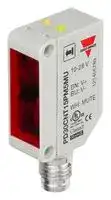


PD30CNT15PM5MU
Photoelectric Sensor, 15 m, PNP, Through Beam, 10 to 30 VDC, PD30CNT15 Series
- Manufacturer: CARLO GAVAZZI
- Product type:
- SVHC: No SVHC (21-Jan-2025)
- Product Range: PD30 Series
- Sensing Method: Through Beam
- Connection Method: 4 Pin M8 Connector
- Sensing Range Max: 15m
- Sensor Output Type: PNP
| Delivery and price | |
|---|---|
| Units per pack | 50 |
| Price | 37.43 € |
| Current stock | 10+ |
| Lead time | 30 days |

## **Photoelectrics Through-beam Type PD30CNT15....MU/RT**

- **Miniature sensor range**

- **Range: 15 m**

- **Sensitivity adjustment by Teach-In programming**

- **Modulated, Infraredred light 880 nm**

- **Supply voltage: 10 to 30 VDC**

- **Output: 100 mA, NPN or PNP preset**

- **Make and break switching function programmable**

- **LED indication for output, stability and power ON**

- **Protection: reverse polarity, short circuit and transients**

- **Cable and plug versions**

- **Excellent EMC performance**

- **Mute function (Sensor blanking) Emitter**

- **Remote teach - Receiver**

## **Product Descri tion p**

The PD30CNT15 sensor family comes in a compact 10 x 30 x 20 mm reinforced PMMA/ABS housing. The sensors are useful in applications where highaccuracy detection as well as small size is required. Compact housing and high power LED for excellent performance-size ratio. The Teach-In function for adjustment of the sensitivity

makes the sensors highly flexible. The output type is preset (NPN or PNP), and the output switching function is programmable (NO or NC).

The mute function can be used for testing the sensor for: Malfunctioning, disconnection, optical axis adjustment, dusty and dirty lenses.

## **Orderin Ke g y PD30CNT15NPM5RT**

**Type Housing style Housing size Housing material Housing length Detection principle Sensing distance Output type Output configuration Connection type Remote teach**

## **T e Selection yp**

|**Housing**<br>**Range Connection Ordering no.**|**Range Connection Ordering no.**|**Range Connection Ordering no.**|**Ordering no.**|**Ordering no.**|**Ordering no.**|
|---|---|---|---|---|---|
|**W x H x D**<br>**Sn**||**NPN**|**NPN**|**PNP**|**PNP**|
|||**Emitter**|**Make or break switching Emitter**|**Make or break switching Emitter**|**Make or break switching**|
|10 x 30 x 20 mm 15 m|Cable|**PD 30 CNT 15 NMU**|**PD 30 CNT 15 NPRT**|**PD 30 CNT 15 PMU**|**PD 30 CNT 15 PPRT**|
|10 x 30 x 20 mm 15 m|Plug|**PD 30 CNT 15 NM5MU**|**PD 30 CNT 15 NPM5RT**|**PD 30 CNT 15 PM5MU PD 30 CNT 15 PPM5RT**|**PD 30 CNT 15 PM5MU PD 30 CNT 15 PPM5RT**|


**Note:** Emitter, Receiver and Connector to be ordered separately.

## **S ecifications Emitter** EN 60947-5-2 **p**

|**Rated operational volt.**(UB)|10 to 30 VDC|
|---|---|
|**Ripple**(Urpp)|≤ 10%|
|**Supply current**|≤ 25 mA|
|**Light Source**<br>**Optical angle**<br>**Light type **<br>**Light spot**|GaAIAs,LED,880 nm<br>± 2º at ½ range<br>Infrared,modulated<br>110 mm @ 1.5 m|


|**Protection**|||Reversepolarity,transients|
|---|---|---|---|
|**Indication function**||||
|Power supplyON|ON||LED, green|
|**Mute function**||||
|Emitter off|0 to 3 sec|0 to 3 sec|0 to 2.5 VDC (NPN)|
||||5 to 30 VDC (PNP)|
|Emitter half power||> 3 sec|0 to 2.5 VDC (NPN)|
||||5 to 30 VDC (PNP)|


**1**

Specifications are subject to change without notice (28.10.2022)

**PD30CNT15....MU/RT**

## **S ecifications Receiver** EN 60947-5-2 **p**

|**Rated operating distance**(Sn)|15 m, with PD30CNT15|
|---|---|
||Emitter|
|**Blind zone**|None|
|**Sensitivity**|Adjustable by Teach-In|
|**Temperature drift**|(push button or wire)<br>≤ 0.3%/ºC|
|**Hysteresis**(H)||
|(differential travel)|≤ 10%|
|**Rated operational volt.**(UB)|10 to 30 VDC|
|**Ripple**(Urpp)|≤ 10%|
|**Adjustable range**|1.5 m to 15 m|
|resolution|3% on distance|
|**Output current**||
|Continuous (Ie)|≤ 100 mA|
|Short-time (I)|≤ 100 mA|
||(max. load capacity100 nF)|
|**No load supply current**(Io)<br>**Minimum operational current**(Im)<br>**OFF-state current**(Ir)<br>**Voltage drop**(Ud)|≤ 30 mA<br>0.5 mA<br>≤ 100µA<br>≤ 2.5 VDC @ 100 mA|


**==> picture [72 x 72] intentionally omitted <==**

|**Protection**|Short-circuit, reverse polarity||
|---|---|---|
||and transients||
|**Sensing angle**|± 4º||
|**Ambient light**|10,000 lux||
|**Operating frequency**|1000 Hz||
|**Response time**|||
|OFF-ON (tON)|≤ 0.5 ms||
|ON-OFF(tOFF)|≤ 0.5 ms||
|**Power ON delay **(tv)|≤ 300 ms||
|**Output function**|||
|NPN and PNP|Preset||
|NO/NC switchingfunction|Set upbybutton||
|**Remote teach**|||
|“Push button active”|0 to 2.5 VDC (NPN)||
||5 to 30 VDC (PNP)||
|Tamper proof|When activated more than||
||20 sec. the sensor goes into||
||a Tamperproof mode.||
|**Indication**|||
|Output ON|LED, yellow||
|Signal stability ON and power ON|LED, green||


**General S ecifications** EN 60947-5-2 **p**

|**Environment**||
|---|---|
|Installation category<br>Pollution degree|III (IEC 60664/60664A;<br>60947-1)<br>3 (IEC 60664/60664A;|
|Degree ofprotection|60947-1)<br>IP 67(IEC 60529;60947-1)|
|**Ambient temperature**||
|Operating<br>Storage|-25°to +55°C (-13°to +131°F)<br>-40°to +70°C(-40°to +158°F)|
|**Vibration**|10 to 55 Hz, 0.5 mm/7.5 g<br>(IEC 60068-2-6)|
|**Shock**|30 g / 11ms, 3 pos, 3 neg<br>per axis<br>(IEC 60068-2-6, 60068-2-32)|


|**Rated insulation voltage**|**Rated insulation voltage**|500 VAC(rms)|
|---|---|---|
|**Housing material**|||
|Body||ABS|
|Front material||PMMA,red|
|**Connection**|||
|Cable|Emitter/receiver|PVC, black, 2 m, Ø = 3.3 mm|
|||4 x 0.14 mm2|
|Plug||M8, 4-pin (CON.54NF..|
|||series)|
|**Weight**(each|sensor)|With cable: 40 g|
|||Withplug:  10g|
|**CE-marking**||Yes|
|**Approvals**||cULus (UL508)|


## **O eration Dia ram p g**

tv = Power ON delay

**==> picture [483 x 115] intentionally omitted <==**

**----- Start of picture text -----**<br>
ON<br>Power supply OFF<br>Present<br>Object Not Present<br>ON T < 3 sec. T > 3 sec.<br>Mute (Emitter) OFF<br>100%<br>Emitted power 50%0%<br>Dirty<br>Optics Clean<br>ON Tv<br>Make Output (N.O.) OFF<br>ON Tv<br>Break Output (N.C.)  OFF<br>**----- End of picture text -----**<br>


**2**

Specifications are subject to change without notice (28.10.2022)

**PD30CNT15....MU/RT**

## **Wiring Diagrams**

**==> picture [242 x 161] intentionally omitted <==**

**----- Start of picture text -----**<br>
Receiver<br>NPN PNP<br>1 BN V 1 BN V<br>2 WH 4 BK<br>Teach<br>4 BK 2 WH<br>Teach<br>3 BU 3 BU<br>V V<br>Teach input active when  Teach input active when<br>connected to GND connected to V+<br>**----- End of picture text -----**<br>


**==> picture [72 x 72] intentionally omitted <==**

**==> picture [250 x 161] intentionally omitted <==**

**----- Start of picture text -----**<br>
Emitter<br>NPN PNP<br>1 BN V 1 BN V<br>2 WH<br>Mute<br>Mute 2 WH<br>3 BU 3 BU<br>V V<br>Mute input active when  Mute input active when<br>connected to GND connected to V+<br>**----- End of picture text -----**<br>


## **Detection Diagram**

**==> picture [244 x 161] intentionally omitted <==**

**----- Start of picture text -----**<br>
Emitter<br>X Y<br>Receiver (feet)<br>16.5 33 49.5 66<br>400 16<br>300 12<br>200 8<br>100 4<br>0 0<br>-100 -4<br>-200 -8<br>-300 -12<br>-400 -16<br>0 5 10 15 20<br>Sensing range (m)<br>(mm) (inch)<br>**----- End of picture text -----**<br>


## **Excess Gain**

**==> picture [245 x 161] intentionally omitted <==**

**----- Start of picture text -----**<br>
1000<br>100<br>10<br>1<br>1.0 10.0 100.0<br>Distance (m)<br>Excess Gain<br>**----- End of picture text -----**<br>


## **Si nal Stabilit Indication g y**

## **Accessories**

**==> picture [500 x 161] intentionally omitted <==**

**----- Start of picture text -----**<br>
21.2<br>14<br>9° 1.2 32.4<br>Excess Gain 25.4<br>3.2 1.2<br>1.25 Operation level x 1.25<br>1.0 Operation level<br>0.75 Operation level x 0.75<br>13.5 16.2<br>5.7 6.0 6.0 5.2<br>Time<br>Green LED ON<br>Yellow LED ON<br>4.4 4.4<br>Mounting bracket: APD30-MB1 Mounting bracket: APD30-MB2<br>25.4 9°<br>39<br>3.2 26,3 29.3<br>10<br>7.3 10 8.2 4.4<br>16 3 14<br>**----- End of picture text -----**<br>


**3**

Specifications are subject to change without notice (28.10.2022)

**PD30CNT15....MU/RT**

## **Dimensions**

**==> picture [72 x 72] intentionally omitted <==**

**==> picture [500 x 232] intentionally omitted <==**

**----- Start of picture text -----**<br>
Cable version Plug version<br>Teach Button* Teach Button*<br>Output LED Power / Stability LED Output LED Power / Stability LED<br>Yellow*  Green Yellow*  Green<br>10.6 10.6<br>10.8 10.8<br>17 17<br>Receiver or emitter Two, 9.5 dia. Receiver or emitter Two, 9.5 dia.<br>Lenses Lenses<br>Optical axis Optical axis<br>Two M3 Two M3<br>10.25<br>* Not avaible on emitter version<br>10.6 6 10.6 6<br>20 20<br>1.1 1.1<br>5.5 5.5<br>30 25.4 22 30 25.4 22<br>5.5 5.5<br>15 15<br>**----- End of picture text -----**<br>


## **Installation Hints**

**==> picture [500 x 118] intentionally omitted <==**

**----- Start of picture text -----**<br>
To avoid interference from inductive voltage / Relief of the cable strain Protection of the sensing face Sensor mounted on a mobile carrier<br>current peaks, separate the proximity switch<br>cables from any other power cables. E.g.<br>Engine, contactor or solenoid cables<br>Incorrect<br>Incorrect<br>Incorrect Correct<br>Correct<br>> 100 mm<br>A proximity switch should not serve Any repetitive flexing of the<br>The cable should not be pulled as mechanical stop cable should be avoided<br>**----- End of picture text -----**<br>


## **Deliver Contents y**

- Photoelectric switch: PD 30 CNT 15 ...

- Installation instruction

## **Accessories**

   - Mounting bracket APD30-2 to be purchased separately

   - Connector type CONG 5A../CON. 54NF.. series.

- Mountingbracket APD30-1

- **Packaging:** Cardboard box

**4**

Specifications are subject to change without notice (28.10.2022)

**PD30CNT15....MU/RT**

## **Teach functions**

## **Normal operation, optimized switching point**

1. Line up the emitter and receiver. Yellow LED and Green LED are ON.

2. Press the button for 3 seconds until both LEDs flashes simultaneously.

   - (The first switch point is stored)

3. Place the object between the emitter and receiver in the detection zone.

4. Press the button once and the sensor is ready to operate (Green LED ON, Yellow LED ON) (The second switch point is stored)

**==> picture [244 x 93] intentionally omitted <==**

**----- Start of picture text -----**<br>
1 2 3 4<br>3 sec. Push once<br>**----- End of picture text -----**<br>


## **For maximum sensing distance**

**(default setting)**

1. Line up the emitter and receiver, place the object between the emitter and receiver in the detection

   - zone. Yellow LED is OFF and Green LED is ON.

2. Press the button for 3 seconds until both LEDs flashes simultaneously.

   - (The first switch point is stored)

3. Press the button a second time and the sensor is ready to operate (Green LED ON, Yellow LED ON) (The second switch point is stored)

**==> picture [177 x 83] intentionally omitted <==**

**----- Start of picture text -----**<br>
1 2 3<br>3 sec. Push once<br>**----- End of picture text -----**<br>


**==> picture [32 x 42] intentionally omitted <==**

**==> picture [72 x 72] intentionally omitted <==**

## **For dynamic set-up (running process)**

1. Line up the emitter and receiver. Green LED is ON, status on the yellow LED is not important.

2. Press the button for 3 second until both LEDs flashes simultaneously.

   - (The first switch point is stored)

3. Press the button a second time and keep the button pressed for at least one process cycle, release the button and the sensor is ready to operate (The second switch point is stored)

**==> picture [165 x 81] intentionally omitted <==**

**----- Start of picture text -----**<br>
1 2 3<br>3 sec. Push once<br>**----- End of picture text -----**<br>


**==> picture [38 x 54] intentionally omitted <==**

**For make or break set-up**

1. Press the button for 10 seconds, until the green LEDs flashes.

2. While the green LED flashes, the output is inverted each time the button is pressed. Yellow LED indicates N.O. function selected.

If the button is not pressed within the next 10

- seconds, the current output is stored.

**==> picture [134 x 85] intentionally omitted <==**

**----- Start of picture text -----**<br>
1 2<br>10 sec. Push once<br>**----- End of picture text -----**<br>


## **For minimum sensing distance**

**(Transparent or semi-transparent objects)**

1. Line up the emitter and receiver. Yellow LED and Green LED are ON.

2. Press the button for 3 seconds until both LEDs flashes simultaneously.

   - (The first switch point is stored)

3. Press the button a second time and the sensor is

   - ready to operate (Green LED ON, Yellow LED ON) (The second switch point is stored)

**==> picture [38 x 44] intentionally omitted <==**

**==> picture [165 x 81] intentionally omitted <==**

**----- Start of picture text -----**<br>
1 2 3<br>3 sec. Push once<br>**----- End of picture text -----**<br>


**5**

Specifications are subject to change without notice (28.10.2022)
Updated at April 29, 2026
Founded in Milan in 1931, Carlo Gavazzi is a globally recognized leader in the design and manufacture of high-quality automation components. For nearly a century, the company has driven technological innovation in the industrial and building automation markets. With ISO 9001-certified production facilities across Europe and Asia, Carlo Gavazzi delivers state-of-the-art solutions tailored for demanding applications, including HVAC, renewable energy, semiconductor manufacturing, and electric vehicle charging infrastructure. Our extensive portfolio of Carlo Gavazzi components focuses heavily on their industry-leading switching and sensing technologies. We carry a comprehensive selection of solid state relays, contactors, and power relays engineered for exceptional reliability and thermal performance. Alongside these robust switching solutions, our range features a wide array of precision sensors, with a strong emphasis on proximity switches and light sensors that are critical for automated manufacturing processes, mobile equipment, and access control systems. Beyond core sensing and switching, the Carlo Gavazzi lineup extends into essential power management, circuit protection, and control devices. This includes highly efficient AC/DC converters, thermal magnetic circuit breakers, and advanced panel instrumentation designed to monitor and optimize energy efficiency. From current sensing transformers to motor starters, engineers consistently trust Carlo Gavazzi to provide competitive, dependable, and forward-thinking components for their most complex automation challenges.
About Novapart
Novapart is a B2B electronic component broker specialising in stock shortages and cost reduction. We source hard-to-find parts and identify compliant alternatives across a catalogue of 410,000+ components from 500+ manufacturers.
Learn more →Stock Shortage Specialist
When a component is unavailable, discontinued or has an unacceptable lead time, we tap into our network of vetted European and Asian distributors to source what you need — without compromising on quality or traceability.
Request a quote →Compliant Alternatives
We identify pin-to-pin, electrically equivalent substitutes that meet the same certifications (RoHS, AEC-Q100, REACH) as your original specification — validated against datasheets, not just part numbers. Often at a lower cost.
BOM Analysis service →