
Image not available
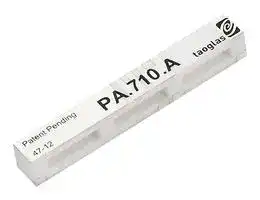
Illustrative purposes only

PA.710.A
Cellular/LTE Antenna, 1.71GHz to 2.69GHz, 3 VSWR, 3.5dBi Gain, 50ohm, Linear Polarisation, PCB
⚠️ Reference pricing provided. In case of supply shortages, we will connect you with our trusted procurement partners to ensure your project's continuity.
- Manufacturer: TAOGLAS
- Product type:
- Antenna Type:Cellular / LTE; Frequency Min:1.71GHz; Frequency Max:2.69GHz; Antenna Mounting:PCB; Gain:3.5dBi; VSWR:3; Input Power:5W; Input Impedance:50ohm; Antenna Polarisation:Lin
- Gain: 3.5dBi
- SVHC: To Be Advised
- VSWR: 3
- Input Power: 5W
- Antenna Type: Cellular / LTE
- Frequency Max: 2.69GHz
- Frequency Min: 1.71GHz
- Product Range: -
- Input Impedance: 50ohm
- Antenna Mounting: PCB
- Antenna Polarisation: Linear
| Delivery and price | |
|---|---|
| Units per pack | 250 |
| Price | 6.73 € |
| Current stock | 500+ |
| Lead time | 30 days |
Datasheet

## g antenna solutions ## **Specification** ## **Patent Pending** Part Number : **PA.710.A WARRIOR** Product Name : Ultra Wideband LTE/Cellular/CDMA SMD Antenna For 4G/3G/2G Applications LTE / GSM / CDMA /DCS /PCS / WCDMA / UMTS / HSDPA / GPRS / EDGE /IMT 698MHz to 960MHz, 1710MHz to 2690Mhz - Features : High Efficiency Wideband Antenna Manufactured in an IATF16949 Certified Facility Surface Mount Distribution 40.0x5.0x6.0 mm size RoHS Compliant ✓ SPE-12-8-126/G/EZ Page 1 of 21 ## g taogias ## **1. Introduction** The Warrior, the revolutionary patent pending PA.710A is a 4G/3G/2G, High Efficiency SMD Ceramic antenna, operating at 698MHz to 960MHz and 1710MHz to 2690MHz. It uses high grade custom ceramic material and new design techniques to deliver the highest efficiencies on all bands when mounted on the device’s main PCB. The exceptional wide-band response means it is the ideal antenna for all LTE applications that also need high efficiency and backward compatibility for 3G and 2G globally on all lower and upper bands. The PA.710A is delivered on tape and reel and mounted securely during the device PCB reflow process. ## **1.1 Key Advantages** 1. **Highest efficiency in a small size, i.e. 40mm*5mm*6mm.** A comparative antenna, for example metal/FR4/FPC/whip/rod/helix, would have much reduced efficiency in this configuration due to their different dielectric constants. Very high efficiency antennas are critical to 3G and 4G devices ability to deliver the stated dataspeed rates of systems such as HSPA and LTE. 2. **More resistant to detuning compared to other antenna integrations.** If tuning is required it can be tuned for the device environment using a matching circuit, or other techniques on the main PCB itself. There is no need for new tooling, thereby saving money if customization is required. 3. **Highly reliable and robust** – its predecessors the PA.25A and PA700A antennas are used by the world’s leading automotive makers in extremely challenging environments. The antenna meets all temperature and mechanical specs required (vibration, drop tests, etc) 4. **Easy to integrate** . Other antenna designs come in irregular shapes and sizes making them more difficult to integrate. 5. **Surface Mount Distribution (Directly On-Board)** antenna saves on labor, cable and connector costs, leads to higher integration yield rates, and reduces losses in transmission. SPE-12-8-126/G/EZ Page 2 of 21 ## g taogias 6. **Minimum Transmission and Reception Losses** - these are kept to absolute minimum resulting in much improved OTA (over the air), i.e. TRP (Total Radiated Power)/TIS (Total Isotropic Radiation), device performance compared to similar efficiency cable and connector antenna solutions. This means it is an ideal antenna to be used for devices that need to pass for example USA carrier network approvals 7. **RSE Reductions** – will help to eliminate radiated spurious emission failures compared to other antenna technologies as the required layout for the antenna can deliver natural isolation between the onboard noise and the antenna itself. Also the antenna can be matched better to the system with the matching circuit function. 8. **High Gain in Both Polarization Planes** - Achieves moderate to high gain in both vertical and horizontal polarization planes. This feature is very useful in certain wireless communications where the antenna orientation is not fixed and the reflections or multipath signals may be present from any plane. In those cases, the important parameter to be considered is the total field strength, which is the vector sum of the signal from the horizontal and vertical polarization planes at any instant in time. SPE-12-8-126/G/EZ Page 3 of 21 ## taoglas ## **2. Specification** |ELECTRICAL|ELECTRICAL|ELECTRICAL|ELECTRICAL|ELECTRICAL|ELECTRICAL|ELECTRICAL| |---|---|---|---|---|---|---| |Standard<br>~~eee~~|4G/3G/2G<br>~~eee~~|||||| |Operation<br>Frequency|698~960<br>MHz|703~803<br>MHz|1710~2170<br>MHz|2300~2400<br>MHz|2490~2690<br>MHz|3400~3600<br>MHz| |Peak Gain|1.0dBi||3.2dBi|3.5dBi|3.5dBi|| |Average Gain|-2.3 dB||-1.5dB|-1.8dB|-1.5dB|| |Efficiency|60%||70%|65%|70%|| |VSWR|<3.0:1|||||| |Impedance|50Ω|||||| |Polarization|Linear|||||| |Radiation<br>Properties|Omni-directional|||||| |Max Input Power|5 W|||||| • The Warrior PA710 antenna performance was measured with 120x45mm ground plane. |Dimensions<br>~~LT~~|40 x 5 x 6 mm<br>~~LT~~| |---|---| |Material|Ceramic| |Termination|Ag (environmental-friendly Pb free)| |EVB Connector|SMA(F)| |Operation Temperature|-40°C to 85°C| |---|---| |Storage Temperature|-40°C to 85°C| |Relative Humidity|Non-condensing65°C 95% RH| |RoHs Compliant|Yes| SPE-12-8-126/G/EZ Page 4 of 21 ## taoglas |LTE BANDS<br>~~a~~<br>~~ee~~|LTE BANDS<br>~~a~~<br>~~ee~~|LTE BANDS<br>~~a~~<br>~~ee~~|LTE BANDS<br>~~a~~<br>~~ee~~| |---|---|---|---| |Band Number<br>~~a~~<br>~~ee~~|LTE/LTE-Advanced/WCDMA/HSPA/HSPA+/TD-SCDMA<br>~~a~~||| |~~ee~~|**Uplink**|**Downlink**|**PA710.A**| |**1**|UL: 1920 to 1980|DL: 2110 to 2170|✓| |**2**|UL: 1850 to 1910|DL: 1930 to 1990|✓| |**3**|UL: 1710 to 1785|DL: 1805 to 1880|✓| |**4**|UL: 1710 to 1755|DL: 2110 to 2155|✓| |**5**|UL: 824 to 849|DL: 869 to 894|✓| |**7**|UL: 2500 to 2570|DL:2620 to 2690|✓| |**8**|UL: 880 to 915|DL: 925 to 960|✓| |**9**|UL: 1749.9 to 1784.9|DL: 1844.9 to 1879.9|✓| |**11**|UL: 1427.9 to 1447.9|DL: 1475.9 to 1495.9|| |**12**|UL: 699 to 716|DL: 729 to 746|✓| |**13**|UL: 777 to 787|DL: 746 to 756|✓| |**14**|UL: 788 to 798|DL: 758 to 768|✓| |**17**|UL: 704 to 716|DL: 734 to 746 (LTE only)|✓| |**18**|UL: 815 to 830|DL: 860 to 875 (LET only)|✓| |**19**|UL: 830 to 845|DL: 875 to 890|✓| |**20**|UL: 832 to 862|DL: 791 to 821|✓| |**21**|UL: 1447.9 to 1462.9|DL: 1495.9 to 1510.9|| |**22**|UL: 3410 to 3490|DL: 3510 to 3590|| |**23**|UL:2000 to 2020|DL: 2180 to 2200 (LTE only)|✓| |**24**|UL:1625.5 to 1660.5|DL: 1525 to 1559 (LTE only)|✓| |**25**|UL: 1850 to 1915|DL: 1930 to 1995|✓| |**26**|UL: 814 to 849|DL: 859 to 894|✓| |**27**|UL: 807 to 824|DL: 852 to 869 (LTE only)|✓| |**28**|UL: 703 to 748|DL: 758 to 803 (LTE only)|✓| |**29**|UL: -|DL: 717 to 728 (LTE only)|✓| |**30**|UL: 2305 to 2315|DL: 2350 to 2360 (LTE only)|✓| |**31**|UL: 452.5 to 457.5|DL: 462.5 to 467.5 (LTE only)|| |**32**|UL: -|DL: 1452 - 1496|✓| |**35**|1850 to 1910||✓| |**38**|2570 to 2620||✓| |**39**|1880 to 1920||✓| |**40**|2300 to 2400||✓| |**41**|2496 to 2690||✓| |**42**|3400 to 3600||| |**43**|3600 to 3800||| *Covered bands represent an efficiency greater than 20% SPE-12-8-126/G/EZ Page 5 of 21 ## taoglas ## **3. Test Setup** **==> picture [105 x 79] intentionally omitted <==** **----- Start of picture text -----**<br> X<br>Y Z<br>**----- End of picture text -----**<br> **Figure 1.** Impedance measurements (left hand) and peak gain, average gain, efficiency and radiation pattern measurements (right hand) SPE-12-8-126/G/EZ Page 6 of 21 **==> picture [167 x 47] intentionally omitted <==** **----- Start of picture text -----**<br> g antenna solutions<br>**----- End of picture text -----**<br> ## **4. Antenna Parameters** ## **4.1. Return Loss** **Figure 2.** Return Loss of the Warrior PA710 LTE antenna ## **4.2. VSWR** **Figure 3.** VSWR of the Warrior PA710 LTE antenna SPE-12-8-126/G/EZ Page 7 of 21 ## g taogtas ## **4.3. Efficiency** **Figure 4.** Efficiency of the Warrior PA710 LTE antenna ## **4.4. Peak Gain** **Figure 5.** Peak Gain of the Warrior PA710 LTE antenna SPE-12-8-126/G/EZ Page 8 of 21 ## g antenna solutions ## **4.5. Average Gain** **Figure 6.** Average Gain of the Warrior PA710 LTE antenna SPE-12-8-126/G/EZ Page 9 of 21 **==> picture [167 x 47] intentionally omitted <==** **----- Start of picture text -----**<br> g antenna solutions<br>**----- End of picture text -----**<br> ## **4.6. 3D Radiation Pattern (measured on 120*45mm EVB)** **Figure 7.** 3D Radiation Pattern at 700 and 800 MHz of the Warrior PA710 Antenna **Figure 8.** 3D Radiation Pattern at 900 and 1700 MHz of the Warrior PA710 Antenna SPE-12-8-126/G/EZ Page 10 of 21 ## g antenna solutions **Figure 9.** 3D Radiation Pattern at 1805 and 1910 MHz of the Warrior PA710 Antenna **Figure 10.** 3D Radiation Pattern at 1990 and 2170 MHz of the Warrior PA710 Antenna SPE-12-8-126/G/EZ Page 11 of 21 **Figure 11.** 3D Radiation Pattern at 2500 and 2600 MHz of the Warrior PA710 Antenna **Figure 12.** 3D Radiation Pattern at 2700 and 2800 MHz of the Warrior PA710 Antenna SPE-12-8-126/G/EZ Page 12 of 21 ## g antenna solutions ## **4.7. 2D Radiation Pattern (measured on 120*45mm EVB)** **==> picture [122 x 355] intentionally omitted <==** **----- Start of picture text -----**<br> X<br>Y<br>(dBi)<br>Z<br>Y<br>**----- End of picture text -----**<br> **==> picture [118 x 115] intentionally omitted <==** **----- Start of picture text -----**<br> Z<br>X<br>**----- End of picture text -----**<br> **Figure 13.** 2D Radiation Pattern of the Warrior PA710 Antenna SPE-12-8-126/G/EZ Page 13 of 21 ## **5. Mechanical Drawings (Unit: mm)** **Figure 14.** Mechanical Drawing of the Warrior PA710 Antenna. SPE-12-8-126/G/EZ Page 14 of 21 ## **6. Layout Dimensions (Unit: mm)** **Figure 15.** Layout dimensions of the Warrior PA710 Antenna. SPE-12-8-126/G/EZ Page 15 of 21 ## g antenna solutions ## **7. EVB Dimension (Unit: mm)** ## **Figure 16.** EVB Dimensions of the Warrior PA710 SPE-12-8-126/G/EZ Page 16 of 21 ## **8. Matching Circuit (Unit: mm)** |||Solder area|Solder area|||L|| |---|---|---|---|---|---|---|---| ||||||||| ||||||C||| ||||||||| |**Circuit Symbol**||**Size**||**Description**|||| |**L1**||**0402**||**5.6nH inductor (LQG15HS5N6S02D)**|||| |**C1**||**0402**|**4.3pF Capacitor (GRM1555C1H4R3CA01D)**||||| **Figure 17.** Recommended matching circuit SPE-12-8-126/G/EZ Page 17 of 21 ## g antenna solutions ## **9. Packaging (Unit: mm)** SPE-12-8-126/G/EZ Page 18 of 21 ## g antenna solutions SPE-12-8-126/G/EZ Page 19 of 21 **==> picture [167 x 47] intentionally omitted <==** **----- Start of picture text -----**<br> g antenna solutions<br>**----- End of picture text -----**<br> ## **10. Recommended Reflow Temperature** PA.710 can be assembled following either Sn-Pb or Pb-Free assembly processes. The recommended soldering temperatures are as follows: **Figure 18.** Temperature profile for the assembly process in reflow ovens SPE-12-8-126/G/EZ Page 20 of 21 ## g taogias Taoglas makes no warranties based on the accuracy or completeness of the contents of this document and reserves the right to make changes to specifications and product descriptions at any time without notice. Taoglas reserves all rights to this document and the information contained herein. Reproduction, use or disclosure to third parties without express permission is strictly prohibited. Copyright © Taoglas Ltd. SPE-12-8-126/G/EZ Page 21 of 21
Updated at June 9, 2026
About Novapart
Novapart is a B2B electronic component broker specialising in stock shortages and cost reduction. We source hard-to-find parts and identify compliant alternatives across a catalogue of 410,000+ components from 500+ manufacturers.
Learn more →Stock Shortage Specialist
When a component is unavailable, discontinued or has an unacceptable lead time, we tap into our network of vetted European and Asian distributors to source what you need — without compromising on quality or traceability.
Request a quote →Compliant Alternatives
We identify pin-to-pin, electrically equivalent substitutes that meet the same certifications (RoHS, AEC-Q100, REACH) as your original specification — validated against datasheets, not just part numbers. Often at a lower cost.
BOM Analysis service →