
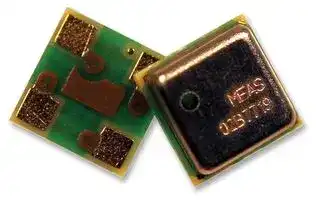

MS563702BA03-50
Pressure Sensor, 1.2 bar, I2C Digital, SPI, Absolute, 3 V, 20.09 µA
- Manufacturer: TE CONNECTIVITY
- Product type: Pressure Transducers
- Sensor Output: I2C Digital, SPI
- Supply Current: 20.09µA
- Voltage Rating: 3V
- Operating Pressure Max: 1.2bar
- Pressure Measurement Type: Absolute
| Delivery and price | |
|---|---|
| Units per pack | 50 |
| Price | 2.55 € |
| Current stock | 10+ |
| Lead time | 7 days |

## MS5637-02BA03

Low Voltage Barometric Pressure Sensor

## SPECIFICATIONS

- **QFN package 3 x 3 x 0.9 mm[3]**

- **High-resolution module, 13 cm**

- **Supply voltage: 1.5 to 3.6 V**

- **Fast conversion down to 0.5 ms**

- **Low power, 0.6 µA (standby ≤ 0.1 µA at 25°C)**

- **Integrated digital pressure sensor (24 bit ΔΣ ADC)**

- **Operating range: 300 to 1200 mbar, -40 to +85 °C**

- **I[2] C interface**

- **No external components (internal oscillator)**

The MS5637 is an ultra-compact micro altimeter. It is optimized for altimeter and barometer applications in Smart-phones and Tablet PCs. The altitude resolution at sea level is 13 cm of air. The sensor module includes a high-linearity pressure sensor and an ultra-low power 24 bit ΔΣ ADC with internal factory-calibrated coefficients. It provides a precise digital 24-bit pressure and temperature value and different operation modes that allow the user to optimize for conversion speed and current consumption. A high-resolution temperature output allows the implementation of an altimeter/thermometer function without any additional sensor. The MS5637 can be interfaced to any microcontroller with I[2] C-bus interface. The communication protocol is simple, without the need of programming internal registers in the device. Small dimensions of 3 x 3 x 0.9 mm[3] allow the integration in mobile devices. This new sensor module generation is based on leading MEMS technology and latest benefits from MEAS Switzerland proven experience and know-how in high volume manufacturing of altimeter modules, which has been widely used for over a decade. The sensing principle employed leads to very low hysteresis and high stability of both pressure and temperature signal.

SENSOR SOLUTIONS ///MS5637-02BA03

Page 1

06/2017

MS5637-02BA03

Low Voltage Barometric Pressure Sensor

## FEATURES

## **FIELD OF APPLICATION**

Smart-phones Tablet PCs Personal navigation devices

## **TECHNICAL DATA**

|**Sensor Performances (VDD = 3 V)**|**Sensor Performances (VDD = 3 V)**|**Sensor Performances (VDD = 3 V)**|**Sensor Performances (VDD = 3 V)**|**Sensor Performances (VDD = 3 V)**|
|---|---|---|---|---|
|**Pressure**|**Min**|**Typ**|**Max**|**Unit**|
|Maximum Range|10||2000|mbar|
|ADC|24|||bit|
|Resolution (1)|0.11 / 0.062/ 0.039<br>/ 0.028 / 0.021 /<br>0.016|||mbar|
|Error band at 25°C,<br>300 to 1200 mbar|-2||+2|mbar|
|Error band, -20°C to + 85°C<br>300 to 1200 mbar (2)|-4||+4|mbar|
|Response time (1)|0.5 / 1.1 / 2.1 / 4.1 /<br>8.22/16.44|||ms|
|Long term stability||±1||mbar/yr|
|**Temperature**|**Min**|**Typ**|**Max**|**Unit**|
|Range|-40||+85|°C|
|Resolution||<0.01||°C|
|Accuracyat 25°C|-1||+1|°C|
|Notes: (1) Oversampling Ratio: 256 / 512 / 1024 / 2048 / 4096 / 8192<br> (2)Withauto-zero at one pressure point|||||


## **FUNCTIONAL BLOCK DIAGRAM**

**==> picture [240 x 145] intentionally omitted <==**

**----- Start of picture text -----**<br>
VDD<br>SENSOR +IN InterfaceI [2] C Bus SDA<br>-IN ADC Filterdig. SCL<br>Sensor  Memory<br>Interface IC (PROM)<br>112 bits<br>SGND<br>GND<br>**----- End of picture text -----**<br>


06/2017

SENSOR SOLUTIONS /// MS5637-02BA03

Page 2

MS5637-02BA03 Low Voltage Barometric Pressure Sensor

## PERFORMANCE SPECIFICATIONS

## **ABSOLUTE MAXIMUM RATINGS**

|**Parameter **|**Symbol **|**Conditions**|**Min.**|**Typ. **|**Max.**|**Unit**|
|---|---|---|---|---|---|---|
|Supplyvoltage|VDD||-0.3||+3.6|V|
|Storage temperature|TS||-20||+85|°C|
|Overpressure|Pmax|||6||bar|
|Maximum Soldering<br>Temperature|Tmax|40 sec max|||250|°C|
|ESD rating||Human Body<br>Model|-2||+2|kV|
|Latch up||JEDEC standard<br>No 78|-100||+100|mA|


## **ELECTRICAL CHARACTERISTICS**

|**Parameter**|**Symbol**|**Conditions**|**Min.**|**Typ. **|**Max.**|**Unit**|
|---|---|---|---|---|---|---|
|OperatingSupplyvoltage|VDD||1.5|3.0|3.6|V|
|OperatingTemperature|T||-40|+25|+85|°C|
|Supply current<br>(1 sample per sec.)|IDD|OSR                  8192<br>4096<br>2048<br>1024<br>512<br>256||20.09<br>10.05<br>5.02<br>2.51<br>1.26<br>0.63||µA|
|Peak supplycurrent||duringconversion||1.25||mA|
|Standbysupplycurrent||at 25°C(VDD= 3.0 V)||0.01|0.1|µA|
|VDD Capacitor||from VDD to GND|100|470||nF|


## **ANALOG DIGITAL CONVERTER (ADC)**

|**Parameter**|**Symbol**|**Conditions**|**Min.**|**Typ. **|**Max.**|**Unit**|
|---|---|---|---|---|---|---|
|Output Word||||24||bit|
|Conversion time|tc|OSR               8192<br>4096<br>2048<br>1024<br>512<br>256||16.44<br>8.22<br>4.13<br>2.08<br>1.06<br>0.54||ms|


06/2017

SENSOR SOLUTIONS /// MS5637-02BA03

Page 3

MS5637-02BA03

Low Voltage Barometric Pressure Sensor

## PERFORMANCE SPECIFICATIONS (CONTINUED)

## **PRESSURE OUTPUT CHARACTERISTICS (VDD = 3.0 V, T = 25 °C UNLESS OTHERWISE NOTED)**

|**Parameter **|**Conditions**|**Conditions**|**Min.**|**Typ. **|**Max.**|**Unit**|
|---|---|---|---|---|---|---|
|OperatingPressure Range|Prange||300||1200|mbar|
|Extended Pressure Range|Pext|Linear Range of<br>ADC|10||2000|mbar|
|Relative Accuracy, autozero at<br>one pressure point (1)|700…1000 mbar at 25°C|||±0.1||mbar|
|Absolute Accuracy,<br>no autozero|300..1200 mbar at 25°C<br>300..1200mbar, -20..85°C||-2<br>-4||+2<br>+4|mbar|
|Resolution RMS|OSR                                 8192<br>4096<br>2048<br>1024<br>512<br>256|||0.016<br>0.021<br>0.028<br>0.039<br>0.062<br>0.11||mbar|
|Maximum error with supply<br>voltage|VDD= 1.5 V … 3.6 V|||±0.5||mbar|
|Long-term stability||||±1||mbar/yr|
|Reflow soldering impact|IPC/JEDEC J-STD-020C<br>(See application note AN808<br>on http://meas-spec.com)|||-1||mbar|
|Recoveringtime after reflow(2)||||3||days|


(1) Characterized value performed on qualification devices

(2) Recovering time at least 66% of the reflow impact

## **TEMPERATURE OUTPUT CHARACTERISTICS (VDD = 3 V, T = 25°C UNLESS OTHERWISE NOTED)**

|**Parameter **|**Conditions**|**Min.**|**Typ. **|**Max.**|**Unit**|
|---|---|---|---|---|---|
|Absolute Accuracy|at 25°C<br>-20..85°C|-1<br>-2||+1<br>+2|°C|
|Maximum error with supply<br>voltage|VDD= 1.5 V … 3.6 V||±0.3||°C|
|Resolution RMS|OSR                                 8192<br>4096<br>2048<br>1024<br>512<br>256||0.002<br>0.003<br>0.004<br>0.006<br>0.009<br>0.012||°C|


06/2017

SENSOR SOLUTIONS /// MS5637-02BA03

Page 4

MS5637-02BA03

Low Voltage Barometric Pressure Sensor

## PERFORMANCE SPECIFICATIONS (CONTINUED)

## **DIGITAL INPUTS (SDA, SCL)**

|**IGITAL INPUTS (SDA, SCL)**|||||||
|---|---|---|---|---|---|---|
|**Parameter **|**Symbol **|**Conditions**|**Min.**|**Typ. **|**Max.**|**Unit**|
|Serial data clock|SCL||||400|kHz|
|Input high voltage|VIH||80% VDD||100% VDD|V|
|Input low voltage|VIL||0% VDD||20% VDD|V|
|Input leakage current|Ileak|T = 25 °C|||0.1|µA|
|Input capacitance|CIN|||6||pF|


## **DIGITAL OUTPUTS (SDA)**

|**IGITAL OUTPUTS (SDA)**|||||||
|---|---|---|---|---|---|---|
|**Parameter **|**Symbol **|**Conditions**|**Min.**|**Typ. **|**Max.**|**Unit**|
|Output high voltage|VOH|Isource= 1 mA|80% VDD||100% VDD|V|
|Output low voltage|VOL|Isink= 1 mA|0% VDD||20% VDD|V|
|Load capacitance|CLOAD|||16||pF|


06/2017

SENSOR SOLUTIONS /// MS5637-02BA03

Page 5

MS5637-02BA03 Low Voltage Barometric Pressure Sensor

## FUNCTIONAL DESCRIPTION

**==> picture [270 x 166] intentionally omitted <==**

**----- Start of picture text -----**<br>
VDD<br>SENSOR +IN InterfaceI [2] C Bus SDA<br>ADC dig.<br>-IN Filter SCL<br>Sensor  Memory<br>Interface IC (PROM)<br>112 bits<br>SGND<br>GND<br>**----- End of picture text -----**<br>


Figure 1: Block diagram

## **GENERAL**

The MS5637 consists of a piezo-resistive sensor and a sensor interface integrated circuit. The main function of the MS5637 is to convert the uncompensated analogue output voltage from the piezo-resistive pressure sensor to a 24-bit digital value, as well as providing a 24-bit digital value for the temperature of the sensor.

## **FACTORY CALIBRATION**

Every module is individually factory calibrated at two temperatures and two pressures. As a result, 6 coefficients necessary to compensate for process variations and temperature variations are calculated and stored in the 112bit PROM of each module. These bits (partitioned into 6 coefficients) must be read by the microcontroller software and used in the program converting D1 and D2 into compensated pressure and temperature values.

## **SERIAL I2C INTERFACE**

The external microcontroller clocks in the data through the input SCL (Serial CLock) and SDA (Serial DAta). The sensor responds on the same pin SDA which is bidirectional for the I[2] C bus interface. So this interface type uses only 2 signal lines and does not require a chip select.

|**Module reference**|**Mode**|**Pins used**|
|---|---|---|
|MS563702BA03|I2C|SDA, SCL|


06/2017

SENSOR SOLUTIONS /// MS5637-02BA03

Page 6

MS5637-02BA03

Low Voltage Barometric Pressure Sensor

## **PRESSURE AND TEMPERATURE CALCULATION**

## **Start**

Maximum values for calculation results: PMIN = 10mbar   PMAX = 2000mbar TMIN = -40°C TMAX = 85°C TREF = 20°C

**==> picture [497 x 436] intentionally omitted <==**

**----- Start of picture text -----**<br>
Convert calibration data into coefficients (see bit pattern of W1 to W4)Read calibration data (factory calibrated) from PROM<br>Variable Description | Equation Recommended Size [ [1]] Value Example /<br>variable type [bit] min max Typical<br>C1 Pressure sensitivity | SENST1 unsigned int 16 16 0 65535 46372<br>C2 Pressure offset | OFFT1 unsigned int 16 16 0 65535 43981<br>C3 Temperature coefficient of pressure sensitivity | TCS unsigned int 16 16 0 65535 29059<br>C4 Temperature coefficient of pressure offset | TCO unsigned int 16 16 0 65535 27842<br>C5 Reference temperature | TREF unsigned int 16 16 0 65535 31553<br>C6 Temperature coefficient of the temperature | TEMPSENS unsigned int 16 16 0 65535 28165<br>Read dig tal pressureRead digital pressure and temperature datad temperature data<br>D1 Digital pressure value unsigned int 32 24 0 16777216 6465444<br>D2 Digital temperature value unsigned int 32 24 0 16777216 8077636<br>Calculate temperature<br>Difference between actual and reference temperature  [[2]]<br>dT signed int 32 25 -16776960 16777216 68<br>dT   = D2 - TREF =  D2   -  C5 * 2 [8]<br>Actual temperature (-40…85°C with 0.01°C resolution) 2000<br>TEMP TEMP = 20°C + dT * TEMPSENS = 2000 + dT * C6 / 2 [23] signed int 32 41 -4000 8500 = 20.00 °C<br>Calculate temperatureCalculate temperature compensated pressurepensated pressure<br>OFF Offset at actual temperature  OFF = OFFT1 + TCO * dT = C2 [[3]] * 2 [17] + (C4 * dT  ) / 2 [6] signed int 64 41 -17179344900 25769410560 5764707214<br>SENS Sensitivity at actual temperature  SENS = SENST1 + TCS * dT = C1 * 2 [[4]] [16] + ( C3 * dT  ) / 2 [7] signed int 64 41 -8589672450 12884705280 3039050829<br>Temperature compensated pressure (10…1200mbar with  110002<br>P 0.01mbar resolution) signed int 32 58 1000 120000<br>P   = D1 * SENS - OFF =  (D1 * SENS / 2 [21]  - OFF) / 2 [15] = 1100.02 mbar<br>Display pressure and temperature value<br>**----- End of picture text -----**<br>


Notes

[1] Maximal size of intermediate result during evaluation of variable [2] min and max have to be defined [3] min and max have to be defined [4] min and max have to be defined

Figure 2: Flow chart for pressure and temperature reading and software compensation.

06/2017

SENSOR SOLUTIONS /// MS5637-02BA03

Page 7

MS5637-02BA03 Low Voltage Barometric Pressure Sensor

## **SECOND ORDER TEMPERATURE COMPENSATION**

In order to obtain best accuracy over temperature range, particularly at low temperature, it is recommended to compensate the non-linearity over the temperature. This can be achieved by correcting the calculated temperature, offset and sensitivity by a second-order correction factor. The second-order factors are calculated as follows:

Figure 3: Flow chart for pressure and temperature to the optimum accuracy.

06/2017

SENSOR SOLUTIONS /// MS5637-02BA03

Page 8

MS5637-02BA03 Low Voltage Barometric Pressure Sensor

## I[2] C INTERFACE

## **COMMANDS**

The MS5637 has only five basic commands:

1. Reset

2. Read PROM (112 bit of calibration words)

3. D1 conversion

4. D2 conversion

5. Read ADC result (24 bit pressure / temperature)

Each I[2] C communication message starts with the start condition and it is ended with the stop condition. The MS5637 address is 1110110x (write : x=0, read : x=1).

Size of each command is 1 byte (8 bits) as described in the table below. After ADC read commands, the device will return 24 bit result and after the PROM read 16 bit results. The address of the PROM is embedded inside of the PROM read command using the a2, a1 and a0 bits.

||**Command byte**|**Command byte**|**Command byte**||||||**hex value**|
|---|---|---|---|---|---|---|---|---|---|
|Bit number|0|1|2|3|4|5|6|7||
|Bit name|PRO<br>M|CO<br>NV|-|Typ|Ad2/<br>Os2|Ad1/<br>Os1|Ad0/<br>Os0|Stop||
|Command||||||||||
|Reset|0|0|0|1|1|1|1|0|0x1E|
|Convert D1(OSR=256)|0|1|0|0|0|0|0|0|0x40|
|Convert D1(OSR=512)|0|1|0|0|0|0|1|0|0x42|
|Convert D1(OSR=1024)|0|1|0|0|0|1|0|0|0x44|
|Convert D1(OSR=2048)|0|1|0|0|0|1|1|0|0x46|
|Convert D1(OSR=4096)|0|1|0|0|1|0|0|0|0x48|
|Convert D1(OSR=8192)|0|1|0|0|1|0|1|0|0x4A|
|Convert D2(OSR=256)|0|1|0|1|0|0|0|0|0x50|
|Convert D2(OSR=512)|0|1|0|1|0|0|1|0|0x52|
|Convert D2(OSR=1024)|0|1|0|1|0|1|0|0|0x54|
|Convert D2(OSR=2048)|0|1|0|1|0|1|1|0|0x56|
|Convert D2(OSR=4096)|0|1|0|1|1|0|0|0|0x58|
|Convert D2(OSR=8192)|0|1|0|1|1|0|1|0|0x5A|
|ADC Read|0|0|0|0|0|0|0|0|0x00|
|PROM Read|1|0|1|0|Ad2|Ad1|Ad0|0|0xA0 to<br>0xAE|


Figure 4: Command structure

06/2017

SENSOR SOLUTIONS /// MS5637-02BA03

Page 9

MS5637-02BA03 Low Voltage Barometric Pressure Sensor

## **RESET SEQUENCE**

The Reset sequence shall be sent once after power-on to make sure that the calibration PROM gets loaded into the internal register. It can be also used to reset the device PROM from an unknown condition.

The reset can be sent at any time. In the event that there is not a successful power on reset this may be caused by the SDA being blocked by the module in the acknowledge state. The only way to get the MS5637 to function is to send several SCLs followed by a reset sequence or to repeat power on reset.

||1|1|1|0|1|1|0|0|0|0|0|0|1|1|1|1<br>0|0|||
|---|---|---|---|---|---|---|---|---|---|---|---|---|---|---|---|---|---|---|---|
|||Device||Address||||||||command||||||||
|S||Device||Address||||W|A|||cmd||byte|||A|P||
|||||||||||||||||||||
||From||Master||||S = Start|||Condition||||||W = Write|||A = Acknowledge|
||From||Slave||||P = Stop Condition|||||||||R = Read|||N = Not Acknowledge|


Figure 5: I[2] C Reset Command

## **PROM READ SEQUENCE**

The read command for PROM shall be executed once after reset by the user to read the content of the calibration PROM and to calculate the calibration coefficients. There are in total 7 addresses resulting in a total memory of 112 bit. Addresses contains factory data and the setup, calibration coefficients, the serial code and CRC. The command sequence is 8 bits long with a 16 bit result which is clocked with the MSB first. The PROM Read command consists of two parts. First command sets up the system into PROM read mode. The second part gets the data from the system.

|Figure 6: I2C Command to read memory address= 011<br>1<br>1<br>1<br>0<br>1<br>1<br>0<br>0<br>0<br>1<br>0<br>1<br>0<br>0<br>1<br>1<br>0<br>0<br>S<br>W A<br>A<br>P<br>From Master<br>S = Start Condition<br>W = Write<br>A = Acknowledge<br>From Slave<br>P = Stop Condition<br>R = Read<br>N = Not Acknowledge<br>Device Address<br>Device Address<br>cmd byte<br>command<br>1<br>1<br>1<br>0<br>1<br>1<br>0<br>1<br>0<br>X<br>X<br>X<br>X<br>X<br>X<br>X<br>X<br>0<br>X<br>X<br>X<br>X<br>X<br>X<br>X<br>X<br>0<br>Device Address<br>data<br>data|Figure 6: I2C Command to read memory address= 011<br>1<br>1<br>1<br>0<br>1<br>1<br>0<br>0<br>0<br>1<br>0<br>1<br>0<br>0<br>1<br>1<br>0<br>0<br>S<br>W A<br>A<br>P<br>From Master<br>S = Start Condition<br>W = Write<br>A = Acknowledge<br>From Slave<br>P = Stop Condition<br>R = Read<br>N = Not Acknowledge<br>Device Address<br>Device Address<br>cmd byte<br>command<br>1<br>1<br>1<br>0<br>1<br>1<br>0<br>1<br>0<br>X<br>X<br>X<br>X<br>X<br>X<br>X<br>X<br>0<br>X<br>X<br>X<br>X<br>X<br>X<br>X<br>X<br>0<br>Device Address<br>data<br>data|Figure 6: I2C Command to read memory address= 011<br>1<br>1<br>1<br>0<br>1<br>1<br>0<br>0<br>0<br>1<br>0<br>1<br>0<br>0<br>1<br>1<br>0<br>0<br>S<br>W A<br>A<br>P<br>From Master<br>S = Start Condition<br>W = Write<br>A = Acknowledge<br>From Slave<br>P = Stop Condition<br>R = Read<br>N = Not Acknowledge<br>Device Address<br>Device Address<br>cmd byte<br>command<br>1<br>1<br>1<br>0<br>1<br>1<br>0<br>1<br>0<br>X<br>X<br>X<br>X<br>X<br>X<br>X<br>X<br>0<br>X<br>X<br>X<br>X<br>X<br>X<br>X<br>X<br>0<br>Device Address<br>data<br>data|Figure 6: I2C Command to read memory address= 011<br>1<br>1<br>1<br>0<br>1<br>1<br>0<br>0<br>0<br>1<br>0<br>1<br>0<br>0<br>1<br>1<br>0<br>0<br>S<br>W A<br>A<br>P<br>From Master<br>S = Start Condition<br>W = Write<br>A = Acknowledge<br>From Slave<br>P = Stop Condition<br>R = Read<br>N = Not Acknowledge<br>Device Address<br>Device Address<br>cmd byte<br>command<br>1<br>1<br>1<br>0<br>1<br>1<br>0<br>1<br>0<br>X<br>X<br>X<br>X<br>X<br>X<br>X<br>X<br>0<br>X<br>X<br>X<br>X<br>X<br>X<br>X<br>X<br>0<br>Device Address<br>data<br>data|Figure 6: I2C Command to read memory address= 011<br>1<br>1<br>1<br>0<br>1<br>1<br>0<br>0<br>0<br>1<br>0<br>1<br>0<br>0<br>1<br>1<br>0<br>0<br>S<br>W A<br>A<br>P<br>From Master<br>S = Start Condition<br>W = Write<br>A = Acknowledge<br>From Slave<br>P = Stop Condition<br>R = Read<br>N = Not Acknowledge<br>Device Address<br>Device Address<br>cmd byte<br>command<br>1<br>1<br>1<br>0<br>1<br>1<br>0<br>1<br>0<br>X<br>X<br>X<br>X<br>X<br>X<br>X<br>X<br>0<br>X<br>X<br>X<br>X<br>X<br>X<br>X<br>X<br>0<br>Device Address<br>data<br>data|Figure 6: I2C Command to read memory address= 011<br>1<br>1<br>1<br>0<br>1<br>1<br>0<br>0<br>0<br>1<br>0<br>1<br>0<br>0<br>1<br>1<br>0<br>0<br>S<br>W A<br>A<br>P<br>From Master<br>S = Start Condition<br>W = Write<br>A = Acknowledge<br>From Slave<br>P = Stop Condition<br>R = Read<br>N = Not Acknowledge<br>Device Address<br>Device Address<br>cmd byte<br>command<br>1<br>1<br>1<br>0<br>1<br>1<br>0<br>1<br>0<br>X<br>X<br>X<br>X<br>X<br>X<br>X<br>X<br>0<br>X<br>X<br>X<br>X<br>X<br>X<br>X<br>X<br>0<br>Device Address<br>data<br>data|Figure 6: I2C Command to read memory address= 011<br>1<br>1<br>1<br>0<br>1<br>1<br>0<br>0<br>0<br>1<br>0<br>1<br>0<br>0<br>1<br>1<br>0<br>0<br>S<br>W A<br>A<br>P<br>From Master<br>S = Start Condition<br>W = Write<br>A = Acknowledge<br>From Slave<br>P = Stop Condition<br>R = Read<br>N = Not Acknowledge<br>Device Address<br>Device Address<br>cmd byte<br>command<br>1<br>1<br>1<br>0<br>1<br>1<br>0<br>1<br>0<br>X<br>X<br>X<br>X<br>X<br>X<br>X<br>X<br>0<br>X<br>X<br>X<br>X<br>X<br>X<br>X<br>X<br>0<br>Device Address<br>data<br>data|Figure 6: I2C Command to read memory address= 011<br>1<br>1<br>1<br>0<br>1<br>1<br>0<br>0<br>0<br>1<br>0<br>1<br>0<br>0<br>1<br>1<br>0<br>0<br>S<br>W A<br>A<br>P<br>From Master<br>S = Start Condition<br>W = Write<br>A = Acknowledge<br>From Slave<br>P = Stop Condition<br>R = Read<br>N = Not Acknowledge<br>Device Address<br>Device Address<br>cmd byte<br>command<br>1<br>1<br>1<br>0<br>1<br>1<br>0<br>1<br>0<br>X<br>X<br>X<br>X<br>X<br>X<br>X<br>X<br>0<br>X<br>X<br>X<br>X<br>X<br>X<br>X<br>X<br>0<br>Device Address<br>data<br>data|Figure 6: I2C Command to read memory address= 011<br>1<br>1<br>1<br>0<br>1<br>1<br>0<br>0<br>0<br>1<br>0<br>1<br>0<br>0<br>1<br>1<br>0<br>0<br>S<br>W A<br>A<br>P<br>From Master<br>S = Start Condition<br>W = Write<br>A = Acknowledge<br>From Slave<br>P = Stop Condition<br>R = Read<br>N = Not Acknowledge<br>Device Address<br>Device Address<br>cmd byte<br>command<br>1<br>1<br>1<br>0<br>1<br>1<br>0<br>1<br>0<br>X<br>X<br>X<br>X<br>X<br>X<br>X<br>X<br>0<br>X<br>X<br>X<br>X<br>X<br>X<br>X<br>X<br>0<br>Device Address<br>data<br>data|
|---|---|---|---|---|---|---|---|---|
|S|Device Address|R|A|Memory bit 15-8|A|Memory bit 7-0|N|P|
|From Master<br>S = Start Condition<br>W = Write<br>A = Acknowledge<br>From Slave<br>P = Stop Condition<br>R = Read<br>N = Not Acknowledage|||||||||
||||||||||
||||||||||


Figure 7: I[2] C answer from MS5637

## **CONVERSION SEQUENCE**

The conversion command is used to initiate uncompensated pressure (D1) or uncompensated temperature (D2) conversion. After the conversion, using ADC read command the result is clocked out with the MSB first. If the conversion is not executed before the ADC read command, or the ADC read command is repeated, it will give 0 as the output result. If the ADC read command is sent during conversion the result will be 0, the conversion will not stop and the final result will be wrong. Conversion sequence sent during the already started conversion process will yield incorrect result as well. A conversion can be started by sending the command to MS5637. When command is sent to the system it stays busy until conversion is done. When conversion is finished the data can be accessed by sending a Read command, when an acknowledge is sent from the MS5637, 24 SCL cycles may be sent to receive all result bits. Every 8 bits the system waits for an acknowledge signal.

06/2017

SENSOR SOLUTIONS /// MS5637-02BA03

Page 10

MS5637-02BA03

Low Voltage Barometric Pressure Sensor

1 1 1 0 1 1 0 0 0 0 1 0 0 1 0 0 0 0 Device Address command ~~L~~ S Device Address ~~TT~~ W A cmd byte A P From Master S = Start Condition W = Write A = Acknowledge ~~H~~ From Slave P = Stop Condition R = Read N = Not Acknowledge Figure 8: I[2] C command to initiate a pressure conversion (OSR=4096, typ=D1) 1 1 1 0 1 1 0 0 0 0 0 0 0 0 0 0 0 0 Device Address command ~~L~~ S Device Address W A ~~T~~ cmd byte ~~TT~~ A P From Master S = Start Condition W = Write A = Acknowledge ~~H~~ From Slave P = Stop Condition R = Read N = Not Acknowledge Figure 9: I[2] C ADC read sequence 1 1 1 0 1 1 0 1 0 X X X X X X X X 0 X X X X X X X X 0 X X X X X X X X 0 Device Address data data data ~~O~~ S Device Address R A Data 23-16 A ~~L~~ Data 15 - 8 ~~EO~~ A Data 7 - 0 N P From Master S = Start Condition W = Write A = Acknowledge ~~=~~ From Slave P = Stop Condition R = Read N = Not Acknowledge

Figure 10: I[2] C answer from MS5637

06/2017

SENSOR SOLUTIONS /// MS5637-02BA03

Page 11

MS5637-02BA03 Low Voltage Barometric Pressure Sensor

## CYCLIC REDUNDANCY CHECK (CRC)

MS5637 contains a PROM memory with 112-Bit. A 4-bit CRC has been implemented to check the data validity in memory. The C code example below describes the CRC calculation which is stored on DB12 to DB15 in the first PROM word.

**==> picture [230 x 122] intentionally omitted <==**

**----- Start of picture text -----**<br>
A  D D D D D D D D D D D D D D D D<br>B B B B B B<br>d  B B B B B B B B B B<br>1 1 1 1 1 1<br>d  5 4 3 2 1 0 9 8 7 6 5 4 3 2 1 0<br>0  CRC Factory defined<br>1  C1<br>2  C2<br>3  C3<br>4  C4<br>5  C5<br>6  C6<br>**----- End of picture text -----**<br>


Figure 11: Memory PROM mapping

C Code example for CRC-4 calculation:

unsigned char crc4(unsigned int n_prom[]) // n_prom defined as 8x unsigned int (n_prom[8]) { int cnt; // simple counter unsigned int n_rem=0; // crc reminder unsigned char n_bit; n_prom[0]=((n_prom[0]) & 0x0FFF); // CRC byte is replaced by 0 n_prom[7]=0; // Subsidiary value, set to 0 for (cnt = 0; cnt < 16; cnt++) // operation is performed on bytes { // choose LSB or MSB if (cnt%2==1) n_rem ^= (unsigned short) ((n_prom[cnt>>1]) & 0x00FF); else n_rem ^= (unsigned short) (n_prom[cnt>>1]>>8); for (n_bit = 8; n_bit > 0; n_bit--) { if (n_rem & (0x8000)) n_rem = (n_rem << 1) ^ 0x3000; else n_rem = (n_rem << 1); } } n_rem= ((n_rem >> 12) & 0x000F); // final 4-bit reminder is CRC code return (n_rem ^ 0x00);

}

06/2017

SENSOR SOLUTIONS /// MS5637-02BA03

Page 12

MS5637-02BA03 Low Voltage Barometric Pressure Sensor

## APPLICATION CIRCUIT

The MS5637 is a circuit that can be used in conjunction with a microcontroller in mobile altimeter applications.

Figure 12: Typical application circuit

06/2017

SENSOR SOLUTIONS /// MS5637-02BA03

Page 13

MS5637-02BA03

Low Voltage Barometric Pressure Sensor

## PIN CONFIGURATION

|**Pin**|**Name**|**Type **|**Function**|
|---|---|---|---|
|1|VDD|P|Positive supply voltage|
|2|SDA<br>~~Ht~~|I/O<br>~~Ht~~|I2C data|
|3|SCL<br>~~Ht~~|I<br>~~Ht~~|I2C clock|
|4|GND|I|Ground|


## DEVICE PACKAGE OUTLINE

Notes:   (1) Dimensions in mm (2) General tolerance: ±0.1

Figure 13: MS5637 package outline

06/2017

SENSOR SOLUTIONS /// MS5637-02BA03

Page 14

MS5637-02BA03 Low Voltage Barometric Pressure Sensor

## RECOMMENDED PAD LAYOUT

Pad layout for bottom side of the MS5637 soldered onto printed circuit board.

**==> picture [86 x 33] intentionally omitted <==**

**----- Start of picture text -----**<br>
Reserved area:<br>Please do not route<br>tracks between pads<br>**----- End of picture text -----**<br>


Figure 14: MS5637 pad layout

## SHIPPING PACKAGE

06/2017

SENSOR SOLUTIONS /// MS5637-02BA03

Page 15

MS5637-02BA03 Low Voltage Barometric Pressure Sensor

## MOUNTING AND ASSEMBLY CONSIDERATIONS

## **SOLDERING**

Please refer to the application note AN808 available on our website for all soldering issues.

## **MOUNTING**

The MS5637 can be placed with automatic Pick & Place equipment using vacuum nozzles. It will not be damaged by the vacuum. Due to the low stress assembly the sensor does not show pressure hysteresis effects. It is important to solder all contact pads.

## **CONNECTION TO PCB**

The package outline of the module allows the use of a flexible PCB for interconnection. This can be important for applications in watches and other special devices.

## **CLEANING**

The MS5637 has been manufactured under clean-room conditions. It is therefore recommended to assemble the sensor under class 10’000 or better conditions. Should this not be possible, it is recommended to protect the sensor opening during assembly from entering particles and dust. To avoid cleaning of the PCB, solder paste of type “noclean” shall be used. Cleaning might damage the sensor!

## **ESD PRECAUTIONS**

The electrical contact pads are protected against ESD up to 2 kV HBM (human body model). It is therefore essential to ground machines and personnel properly during assembly and handling of the device. The MS5637 is shipped in antistatic transport boxes. Any test adapters or production transport boxes used during the assembly of the sensor shall be of an equivalent antistatic material.

## **DECOUPLING CAPACITOR**

Particular care must be taken when connecting the device to the power supply. A 100nF minimum ceramic capacitor must be placed as close as possible to the MS5637 VDD pin. This capacitor will stabilize the power supply during data conversion and thus, provide the highest possible accuracy.

06/2017

SENSOR SOLUTIONS /// MS5637-02BA03

Page 16

MS5637-02BA03 Low Voltage Barometric Pressure Sensor

## TYPICAL PERFORMANCE CHARACTERISTICS

## **PRESSURE AND TEMPERATURE ERROR VERSUS PRESSURE AND TEMPERATURE**

## **(TYPICAL VALUES)**

## **PRESSURE AND TEMPERATURE ERROR VERSUS POWER SUPPLY**

## **(TYPICAL VALUES)**

06/2017

SENSOR SOLUTIONS /// MS5637-02BA03

Page 17

MS5637-02BA03

Low Voltage Barometric Pressure Sensor

## ORDERING INFORMATION

|**Part Number / Art. Number**|**Product**|**Delivery Form**|
|---|---|---|
|MS563702BA03-50|Micro Altimeter Module 3x3mm|Tape & Reel|


## **NORTH AMERICA**

Measurement Specialties, Inc., a TE Connectivity company Tel:  800-522-6752

Email: customercare.frmt@te.com

## **EUROPE**

Measurement Specialties (Europe), Ltd., a TE Connectivity Company Tel:  800-440-5100 Email: customercare.bevx@te.com

## **ASIA**

Measurement Specialties (China) Ltd., a TE Connectivity company Tel:  0400-820-6015 Email: customercare.shzn@te.com

## **TE.com/sensorsolutions**

Measurement Specialties, Inc., a TE Connectivity company.

Measurement Specialties, TE Connectivity, TE Connectivity (logo) and EVERY CONNECTION COUNTS are trademarks. All other logos, products and/or company names referred to herein might be trademarks of their respective owners.

The information given herein, including drawings, illustrations and schematics which are intended for illustration purposes only, is believed to be reliable. However, TE Connectivity makes no warranties as to its accuracy or completeness and disclaims any liability in connection with its use. TE Connectivity‘s obligations shall only be as set forth in TE Connectivity‘s Standard Terms and Conditions of Sale for this product and in no case will TE Connectivity be liable for any incidental, indirect or consequential damages arising out of the sale, resale, use or misuse of the product. Users of TE Connectivity products should make their own evaluation to determine the suitability of each such product for the specific application.

© 2015 TE Connectivity Ltd. family of companies All Rights Reserved.

06/2017

SENSOR SOLUTIONS /// MS5637-02BA03

Page 18
Updated at February 9, 2023
TE Connectivity is a globally recognized engineering and manufacturing leader, specializing in highly reliable connectivity and sensing solutions. Renowned for innovation and durability, their components are engineered to perform in the most demanding environments, supporting critical advancements in industrial equipment, data communications, and automotive systems. Our extensive selection of TE Connectivity products is anchored by their industry-leading connector portfolio. We carry a comprehensive array of terminal blocks and accessories, including wire-to-board, pluggable, standard, and barrier configurations, alongside robust backplane connectors designed to ensure secure and efficient power and data transmission in complex circuit designs. Beyond physical connections, TE Connectivity is a premier manufacturer of precision sensors, antennas, and electromechanical switching components. Our inventory features a wide variety of RF antennas and highly accurate pressure, temperature, and force transducers. Additionally, we provide an expansive range of TE's dependable relays, encompassing automotive, power, and signal variants, alongside essential passive components like shielding gaskets and RF inductors to fully support your engineering requirements.
About Novapart
Novapart is a B2B electronic component broker specialising in stock shortages and cost reduction. We source hard-to-find parts and identify compliant alternatives across a catalogue of 410,000+ components from 500+ manufacturers.
Learn more →Stock Shortage Specialist
When a component is unavailable, discontinued or has an unacceptable lead time, we tap into our network of vetted European and Asian distributors to source what you need — without compromising on quality or traceability.
Request a quote →Compliant Alternatives
We identify pin-to-pin, electrically equivalent substitutes that meet the same certifications (RoHS, AEC-Q100, REACH) as your original specification — validated against datasheets, not just part numbers. Often at a lower cost.
BOM Analysis service →