
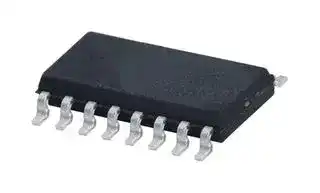


MMA1210KEG
MEMS Accelerometer, Analogue, Z, 4.75 V, 5.25 V, SOIC
- Manufacturer: NXP
- Product type: MEMS Accelerometers
- No. of Pins: 16Pins
- Sensitivity Max: 21mV/g
- Sensitivity Min: 19mV/g
- Sensitivity Typ: 20mV/g
- Measurement Axis: Z
- Sensor Case Style: SOIC
- MEMS Sensor Output: Analogue
- Supply Voltage Max: 5.25V
- Supply Voltage Min: 4.75V
- Automotive Qualification Standard: AEC-Q100
| Delivery and price | |
|---|---|
| Units per pack | 1 |
| Price | 9.15 € |
| Current stock | 10+ |
| Lead time | 30 days |

N ~~eerrr~~ errr (ele, **Freescale Semiconductor** Document Number: MMA1210 Data Sheet: Technical Data Rev 6, 09/2011

## **Surface Mount Micromachined Accelerometer**

## **MMA1210**

The MMA series of silicon capacitive, micromachined accelerometers feature signal conditioning, a 4-pole low pass filter and temperature compensation. Zero-g offset full scale span and filter cutoff are factory set and require no external devices. A full system self-test capability verifies system functionality.

## **Features**

- Integral Signal Conditioning

- Linear Output

- Ratiometric Performance

- 4th Order Bessel Filter Preserves Pulse Shape Integrity

- Calibrated Self-test

- Low Voltage Detect, Clock Monitor, and EPROM Parity Check Status

- Transducer Hermetically Sealed at Wafer Level for Superior Reliability

**==> picture [56 x 27] intentionally omitted <==**

**----- Start of picture text -----**<br>
16-LEAD SOIC<br>Pb-FREE<br>CASE 475-01<br>**----- End of picture text -----**<br>


- Robust Design, High Shocks Survivability

- Qualified AECQ100, Rev. F Grade 2 (-40 ° C/+105 ° C)

## **Typical Applications**

- Vibration Monitoring and Recording

- Impact Monitoring

## **ORDERING INFORMATION**

|**ORDERING INFORMATION**|**ORDERING INFORMATION**|**ORDERING INFORMATION**|**ORDERING INFORMATION**|
|---|---|---|---|
|**Device Name**|**Temperature Range**|**Case No.**|**Package**|
|MMA1210EG|–40°to 125°C|475-01|SOIC-16|
|MMA1210EGR2|–40°to 125°C|475-01|SOIC-16, Tape & Reel|
|MMA1210KEG|–40°to 125°C|475-01|SOIC-16|
|MMA1210KEGR2|–40°to 125°C|475-01|SOIC-16, Tape & Reel|


**==> picture [133 x 142] intentionally omitted <==**

**----- Start of picture text -----**<br>
Top View<br>N/C 1 16 N/C<br>N/C 2 15 N/C<br>N/C 3 14 N/C<br>ST 4 13 N/C<br>VOUT 5 12 N/C<br>STATUS 6 11 N/C<br>VSS 7 10 N/C<br>VDD 8 9 N/C<br>Pin Connections<br>**----- End of picture text -----**<br>


”K” suffix indicates device manufactured with an alternate silicon sourcing.

© Freescale Semiconductor, Inc., 2011. All rights reserved. ~~ee~~

**==> picture [300 x 118] intentionally omitted <==**

**----- Start of picture text -----**<br>
VDD<br>G-Cell Temp<br>Sensor Integrator Gain Filter Comp VOUT<br>ST<br>Self-test Control Logic & Oscillator Clock<br>EPROM Trim Circuits Generator VSS<br>STATUS<br>**----- End of picture text -----**<br>


**Figure 1 Simplified Accelerometer Functional Block Diagram**

## **Table 1. Maximum Ratings**

(Maximum ratings are the limits to which the device can be exposed without causing permanent damage.)

|**Rating**<br>**Symbol**<br>**Value**<br>**Unit**<br>Powered Acceleration (all axes)<br>Gpd<br>1500<br>g<br>Unpowered Acceleration (all axes)<br>Gupd<br>2000<br>g<br>Supply Voltage<br>VDD<br>–0.3 to +7.0<br>V<br>Drop Test(1)<br>Ddrop<br>1.2<br>m<br>Storage Temperature Range<br>Tstg<br>–40 to +125<br>°C<br>~~==~~|**Rating**<br>**Symbol**<br>**Value**<br>**Unit**<br>Powered Acceleration (all axes)<br>Gpd<br>1500<br>g<br>Unpowered Acceleration (all axes)<br>Gupd<br>2000<br>g<br>Supply Voltage<br>VDD<br>–0.3 to +7.0<br>V<br>Drop Test(1)<br>Ddrop<br>1.2<br>m<br>Storage Temperature Range<br>Tstg<br>–40 to +125<br>°C<br>~~==~~|**Rating**<br>**Symbol**<br>**Value**<br>**Unit**<br>Powered Acceleration (all axes)<br>Gpd<br>1500<br>g<br>Unpowered Acceleration (all axes)<br>Gupd<br>2000<br>g<br>Supply Voltage<br>VDD<br>–0.3 to +7.0<br>V<br>Drop Test(1)<br>Ddrop<br>1.2<br>m<br>Storage Temperature Range<br>Tstg<br>–40 to +125<br>°C<br>~~==~~|**Rating**<br>**Symbol**<br>**Value**<br>**Unit**<br>Powered Acceleration (all axes)<br>Gpd<br>1500<br>g<br>Unpowered Acceleration (all axes)<br>Gupd<br>2000<br>g<br>Supply Voltage<br>VDD<br>–0.3 to +7.0<br>V<br>Drop Test(1)<br>Ddrop<br>1.2<br>m<br>Storage Temperature Range<br>Tstg<br>–40 to +125<br>°C<br>~~==~~|
|---|---|---|---|
|1. Dropped onto concrete surface from any axis.||||
|**ELECTRO STATIC DISCHARGE (ESD)**||||
|**WARNING:**<br>**This device is sensitive to electrostatic**||||
|**discharge.**||||


Although the Freescale accelerometers contain internal 2 kV ESD protection circuitry, extra precaution must be taken by the user to protect the chip from ESD. A charge of over 2000 volts can accumulate on the human body or associated test equipment. A charge of this magnitude can alter the

performance or cause failure of the chip. When handling the accelerometer, proper ESD precautions should be followed to avoid exposing the device to discharges which may be detrimental to its performance.

**MMA1210**

Sensors Freescale Semiconductor

2

## **Table 2. Operating Characteristics**

(Unless otherwise noted: –40°C ≤ TA ≤ +105°C, 4.75 ≤ VDD ≤ 5.25, Acceleration = 0g, Loaded output.[(1)] )

|(Unless otherwise noted: –40°C≤TAA≤+105°C, 4.75≤VDDDD|VDDDD ≤5.25, Acceleration = 0g, Loaded output.|5.25, Acceleration = 0g, Loaded output.|5.25, Acceleration = 0g, Loaded output.|5.25, Acceleration = 0g, Loaded output.[(1)])||
|---|---|---|---|---|---|
|**Characteristic**<br>~~Od~~|**Symbol**<br>~~Od~~|**Min**<br>~~Od~~|**Typ**<br>~~Od~~|**Max**<br>~~Od~~|**Unit**<br>~~Od~~|
|Operating Range(2)<br>Supply Voltage(3)<br>Supply Current<br>Operating Temperature Range<br>Acceleration Range<br>~~Od~~|VDD<br>IDD<br>TA<br>gFS<br>~~Od~~|4.75<br>3.0<br>–40<br>—<br>~~Od~~|5.00<br>—<br>—<br>112.5<br>~~Od~~|5.25<br>6.0<br>+125<br>—<br>~~Od~~|V<br>mA<br>C<br>g<br>~~Od~~|
|Output Signal<br>Zero g (TA= 25°C, VDD= 5.0 V)(4)<br>Zero g<br>Sensitivity (TA= 25°C, VDD= 5.0 V)(5)<br>Sensitivity<br>Bandwidth Response<br>Nonlinearity|VOFF<br>VOFF,V<br>S<br>SV<br>f–3dB<br>NLOUT|2.35<br>0.46 VDD<br>19<br>3.72<br>360<br>–1.0|2.5<br>0.50 VDD<br>20.0<br>4.0<br>400<br>—|2.65<br>0.54 VDD<br>21<br>4.28<br>440<br>1.0|V<br>V<br>mV/g<br>mV/g/V<br>Hz<br>% FSO|
|Noise<br>RMS (0.1–1 kHz)<br>Power Spectral Density<br>Clock Noise (without RC load on output)(6)<br>~~FEE~~|nRMS<br>nPSD<br>nCLK<br>~~FEE~~|—<br>—<br>—<br>~~FEE~~|—<br>110<br>2.0<br>~~FEE~~|2.8<br>—<br>—<br>~~FEE~~|mVrms<br>μV/(Hz1/2)<br>mVpk<br>~~FEE~~|
|Self-Test<br>Output Response(7)<br>Input Low<br>Input High<br>Input Loading(8)<br>Response Time(9)<br>~~FEE~~|gST<br>VIL<br>VIH<br>IIN<br>tST<br>~~FEE~~|55<br>VSS<br>0.7×VDD<br>–30<br>—<br>~~FEE~~|75<br>—<br>—<br>–100<br>2.0<br>~~FEE~~|93<br>0.3×VDD<br>VDD<br>–260<br>10<br>~~FEE~~|g<br>V<br>V<br>μA<br>ms<br>~~FEE~~|
|Status(10), (11)<br>Output Low (Iload= 100μA)<br>Output High (Iload= 100μA)<br>~~pd~~|VOL<br>VOH<br>~~pd~~|—<br>VDD– 0.8<br>~~pd~~|—<br>—<br>~~pd~~|0.4<br>—<br>~~pd~~|V<br>V<br>~~pd~~|
|Minimum Supply Voltage (LVD Trip)<br>~~pd~~|VLVD<br>~~pd~~|2.7<br>~~pd~~|3.25<br>~~pd~~|4.0<br>~~pd~~|V<br>~~pd~~|
|Clock Monitor Fail Detection Frequency<br>~~Od~~|fmin<br>~~Od~~|50<br>~~Od~~|—<br>~~Od~~|260<br>~~Od~~|kHz<br>~~Od~~|
|Output Stage Performance<br>Electrical Saturation Recovery Time(12)<br>Full Scale Output Range (IOUT= 200μA)<br>Capacitive Load Drive(13)<br>Output Impedance<br>~~Od~~|tDELAY<br>VFSO<br>CL<br>ZO<br>~~Od~~<br>~~ee~~|—<br>0.25<br>—<br>—<br>~~Od~~<br>~~ee~~|0.2<br>—<br>—<br>300<br>~~Od~~<br>~~eee~~|—<br>VDD–0.25<br>100<br>—<br>~~Od~~<br>~~eee~~|ms<br>V<br>pF<br>Ω<br>~~Od~~<br>~~eee~~|
|Mechanical Characteristics<br>Transverse Sensitivity(14)<br>Package Resonance<br>~~e~~|VXZ,YZ<br>fPKG<br>~~e~~~~**e**~~<br>~~ee~~|—<br>—<br>~~**e**~~<br>~~ee~~|—<br>10<br>~~**e**~~<br>~~eee~~|5.0<br>—<br>~~**e**~~<br>~~eee~~|% FSO<br>kHz<br>~~**e**~~<br>~~eee~~|


1. For a loaded output the measurements are observed after an RC filter consisting of a 1 k Ω resistor and a 0.01 μ F capacitor to ground.

2. These limits define the range of operation for which the part will meet specification.

3. Within the supply range of 4.75 and 5.25 volts, the device operates as a fully calibrated linear accelerometer. Beyond these supply limits the device may operate as a linear device but is not guaranteed to be in calibration.

4. The device can measure both + and – acceleration. With no input acceleration the output is at midsupply. For positive acceleration the output will increase above VDD/2 and for negative acceleration the output will decrease below VDD/2.

5. The device is calibrated at 35g.

6. At clock frequency ≅ 70 kHz.

7. Δ VOFF calculated with typical sensitivity.

8. The digital input pin has an internal pull-down current source to prevent inadvertent self test initiation due to external board level leakages.

9. Time for the output to reach 90% of its final value after a self-test is initiated.

10. The Status pin output is not valid following power-up until at least one rising edge has been applied to the self-test pin. The Status pin is high whenever the self-test input is high, as a means to check the connectivity of the self-test and Status pins in the application.

11. The Status pin output latches high if a Low Voltage Detection or Clock Frequency failure occurs, or the EPROM parity changes to odd. The Status pin can be reset low if the self-test pin is pulsed with a high input for at least 100 μ s, unless a fault condition continues to exist.

12. Time for amplifiers to recover after an acceleration signal causes them to saturate.

13. Preserves phase margin (60°) to guarantee output amplifier stability.

14. A measure of the device's ability to reject an acceleration applied 90° from the true axis of sensitivity.

**MMA1210**

Sensors Freescale Semiconductor

3

## **PRINCIPLE OF OPERATION**

The Freescale accelerometer is a surface-micromachined integrated-circuit accelerometer.

The device consists of a surface micromachined capacitive sensing cell (g-cell) and a CMOS signal conditioning ASIC contained in a single integrated circuit package. The sensing element is sealed hermetically at the wafer level using a bulk micromachined “cap'' wafer.

The g-cell is a mechanical structure formed from semiconductor materials (polysilicon) using semiconductor processes (masking and etching). It can be modeled as two stationary plates with a moveable plate in-between. The center plate can be deflected from its rest position by subjecting the system to an acceleration (Figure 3).

When the center plate deflects, the distance from it to one fixed plate will increase by the same amount that the distance to the other plate decreases. The change in distance is a measure of acceleration.

The g-cell plates form two back-to-back capacitors (Figure 4). As the center plate moves with acceleration, the distance between the plates changes and each capacitor's value will change, (C = A ε /D). Where A is the area of the plate, ε is the dielectric constant, and D is the distance between the plates.

The CMOS ASIC uses switched capacitor techniques to measure the g-cell capacitors and extract the acceleration data from the difference between the two capacitors. The ASIC also signal conditions and filters (switched capacitor) the signal, providing a high level output voltage that is ratiometric and proportional to acceleration.

## **SPECIAL FEATURES**

## **Filtering**

The Freescale accelerometers contain an onboard 4-pole switched capacitor filter. A Bessel implementation is used because it provides a maximally flat delay response (linear phase) thus preserving pulse shape integrity. Because the filter is realized using switched capacitor techniques, there is no requirement for external passive components (resistors and capacitors) to set the cutoff frequency.

## **Self-Test**

The sensor provides a self-test feature that allows the verification of the mechanical and electrical integrity of the accelerometer at any time before or after installation. This feature is critical in applications such as automotive airbag systems where system integrity must be ensured over the life of the vehicle. A fourth “plate'' is used in the g-cell as a selftest plate. When the user applies a logic high input to the selftest pin, a calibrated potential is applied across the self-test plate and the moveable plate. The resulting electrostatic

**==> picture [222 x 26] intentionally omitted <==**

The resultant deflection is measured by the accelerometer's control ASIC and a proportional output voltage results. This procedure assures that both the mechanical (g-cell) and electronic sections of the accelerometer are functioning.

## **Status**

~~t==>~~ **Acceleration** ~~=~~ **Figure 3. Transducer Figure 4. Equivalent Physical Model Circuit Model**

Freescale accelerometers include fault detection circuitry and a fault latch. The Status pin is an output from the fault latch, OR'd with self-test, and is set high whenever the following event occurs:

- Parity of the EPROM bits becomes odd in number.

The fault latch can be reset by a rising edge on the self-test input pin, unless one (or more) of the fault conditions continues to exist.

**MMA1210**

Sensors Freescale Semiconductor

4

**BASIC CONNECTIONS Pinout Description PCB Layout** N/C 1 16 N/C STATUS P1 N/C 2 15 N/C N/C 3 14 N/C ST P0 ST 4 13 N/C VSS VOUT 5 12 N/C VOUT ~~R~~ A/D In C 0.1 μ F STATUSVVDDSS 678 11109 N/CN/CN/C VVDDSS C 0.1 1 k Ωμ F C 0.01 μ F VDD “ ~~A eo~~ VRH C 0.1 μ F **Table 3. Pin Descriptions Pin No. Pin Name Description** Power Supply 1 thru 3 — Leave unconnected. **Figure 6. Recommended PCB Layout for Interfacing** 4 ST Logic input pin used to initiate **Accelerometer to Microcontroller** self-test. 5 VOUT Output voltage of the **NOTES:** accelerometer. 1. Use a 0.1 μ F capacitor on VDD to decouple the power 6 STATUS Logic output pin to indicate fault. source. 7 VSS The power supply ground. 2. Physical coupling distance of the accelerometer to the microcontroller should be minimal. 8 VDD The power supply input. 3. Place a ground plane beneath the accelerometer to 9 thru 13 Trim pins Used for factory trim. Leave reduce noise, the ground plane should be attached to unconnected. all of the open ended terminals shown in Figure 6. 14 thru 16 — No internal connection. Leave 4. Use an RC filter of 1 k Ω and 0.01 μ F on the output of the accelerometer to minimize clock noise (from the unconnected. ~~. RO~~ switched capacitor filter circuit). 5. PCB layout of power and ground should not couple power supply noise. 6. Accelerometer and microcontroller should not be a VDD MMA1210 6 STATUS high current path. Logic 4 ST R1 Input 8 VDD VOUT 5 1 k Ω OutputSignal 7. switching frequency should be selected such that they do not interfere with the internal accelerometer A/D sampling rate and any external power supply do not interfere with the internal accelerometer A/D sampling rate and any external power supply A/D sampling rate and any external power supply C1 0.1 μ F C2 sampling frequency. This will prevent aliasing errors. 7 VSS 0.01 μ F ~~MeLFF~~ **Figure 5. SOIC Accelerometer with Recommended Connection Diagram**

7. switching frequency should be selected such that they do not interfere with the internal accelerometer A/D sampling rate and any external power supply do not interfere with the internal accelerometer A/D sampling rate and any external power supply A/D sampling rate and any external power supply sampling frequency. This will prevent aliasing errors.

**MMA1210**

Sensors Freescale Semiconductor

5

**==> picture [248 x 452] intentionally omitted <==**

**----- Start of picture text -----**<br>
Dynamic Acceleration Sensing Direction<br>+ Z<br>Acceleration of the package in the<br>+ Z direction (center plate moves in<br>the  − Z direction) will result in an<br>O increase in the output.<br>Kh<br>Activation of Self test moves the<br>−<br>center plate in the  Z direction,<br>v<br>resulting in an increase in the output.<br>− Z<br>Side View<br>Static Acceleration Sensing Direction<br>Direction of Earth's gravity field [(1)]<br>w<br>Kh<br>Side View<br>1. When positioned as shown, the Earth's gravity will result in a positive 1g output.<br>**----- End of picture text -----**<br>


**MMA1210**

Sensors Freescale Semiconductor

6

## **MINIMUM RECOMMENDED FOOTPRINT FOR SURFACE MOUNTED APPLICATIONS**

Surface mount board layout is a critical portion of the total design. The footprint for the surface mount packages must be the correct size to ensure proper solder connection interface between the board and the package. With the correct

footprint, the packages will self-align when subjected to a solder reflow process. It is always recommended to design boards with a solder mask layer to avoid bridging and shorting between solder pads.

**==> picture [177 x 227] intentionally omitted <==**

**----- Start of picture text -----**<br>
0.050 in.<br>0.380 in. 1.27 mm<br>9.65 mm<br>a<br>= =<br>CO -]—<br>= rt<br>C TC<br>0.024 in.<br>0.610 mm<br>= 5<br>Co ae<br>AL Br<br>0.080 in.<br>2.03 mm<br>**----- End of picture text -----**<br>


**Figure 7. Footprint SOIC-16 (Case 475-01)**

**MMA1210**

Sensors Freescale Semiconductor

7

## **PACKAGE DIMENSIONS**

PAGE 1 OF 2

**CASE 475-01 ISSUE C 16 LEAD SOIC**

**MMA1210**

Sensors Freescale Semiconductor

8

## **PACKAGE DIMENSIONS**

PAGE 2 OF 2

**CASE 475-01 ISSUE C 16 LEAD SOIC**

**MMA1210**

Sensors Freescale Semiconductor

9

## _**How to Reach Us:**_

**Home Page:** www.freescale.com

## **Web Support:**

http://www.freescale.com/support

## **USA/Europe or Locations Not Listed:**

Freescale Semiconductor, Inc. Technical Information Center, EL516 2100 East Elliot Road Tempe, Arizona 85284 1-800-521-6274 or +1-480-768-2130 www.freescale.com/support

## **Europe, Middle East, and Africa:**

Freescale Halbleiter Deutschland GmbH Technical Information Center Schatzbogen 7 81829 Muenchen, Germany +44 1296 380 456 (English) +46 8 52200080 (English) +49 89 92103 559 (German) +33 1 69 35 48 48 (French) www.freescale.com/support

## **Japan:**

Freescale Semiconductor Japan Ltd. Headquarters ARCO Tower 15F 1-8-1, Shimo-Meguro, Meguro-ku, Tokyo 153-0064 Japan 0120 191014 or +81 3 5437 9125 support.japan@freescale.com

## **Asia/Pacific:**

Freescale Semiconductor China Ltd. Exchange Building 23F No. 118 Jianguo Road Chaoyang District Beijing 100022 China +86 10 5879 8000 support.asia@freescale.com

## _**For Literature Requests Only:**_

Freescale Semiconductor Literature Distribution Center 1-800-441-2447 or +1-303-675-2140 Fax: +1-303-675-2150 LDCForFreescaleSemiconductor@hibbertgroup.com

Information in this document is provided solely to enable system and software implementers to use Freescale Semiconductor products. There are no express or implied copyright licenses granted hereunder to design or fabricate any integrated circuits or integrated circuits based on the information in this document.

Freescale Semiconductor reserves the right to make changes without further notice to any products herein. Freescale Semiconductor makes no warranty, representation or guarantee regarding the suitability of its products for any particular purpose, nor does Freescale Semiconductor assume any liability arising out of the application or use of any product or circuit, and specifically disclaims any and all liability, including without limitation consequential or incidental damages. “Typical” parameters that may be provided in Freescale Semiconductor data sheets and/or specifications can and do vary in different applications and actual performance may vary over time. All operating parameters, including “Typicals”, must be validated for each customer application by customer’s technical experts. Freescale Semiconductor does not convey any license under its patent rights nor the rights of others. Freescale Semiconductor products are not designed, intended, or authorized for use as components in systems intended for surgical implant into the body, or other applications intended to support or sustain life, or for any other application in which the failure of the Freescale Semiconductor product could create a situation where personal injury or death may occur. Should Buyer purchase or use Freescale Semiconductor products for any such unintended or unauthorized application, Buyer shall indemnify and hold Freescale Semiconductor and its officers, employees, subsidiaries, affiliates, and distributors harmless against all claims, costs, damages, and expenses, and reasonable attorney fees arising out of, directly or indirectly, any claim of personal injury or death associated with such unintended or unauthorized use, even if such claim alleges that Freescale Semiconductor was negligent regarding the design or manufacture of the part.

Freescale and the Freescale logo are trademarks of Freescale Semiconductor, Inc., Reg. U.S. Pat. & Tm. Off.

All other product or service names are the property of their respective owners. © Freescale Semiconductor, Inc. 2011. All rights reserved.

RoHS-compliant and/or Pb-free versions of Freescale products have the functionality and electrical characteristics of their non-RoHS-compliant and/or non-Pb-free counterparts. For further information, see http:/www.freescale.com or contact your Freescale sales representative.

For information on Freescale’s Environmental Products program, go to http://www.freescale.com/epp.

MMA1210 Rev. 6 09/2011
Updated at February 9, 2023
NXP Semiconductors is a global leader in secure connectivity solutions, driving innovation across the automotive, industrial, IoT, mobile, and communications infrastructure markets. By developing advanced, purpose-built technologies, NXP enables devices to sense, think, connect, and act intelligently, delivering rigorously tested components that make the connected world safer and more efficient. Within the semiconductor space, NXP is highly regarded for its extensive range of high-performance integrated circuits and discrete devices. The brand's portfolio excels in drivers and interfaces, featuring a comprehensive selection of I/O expanders designed to streamline complex system architectures. For demanding high-frequency and wireless applications, NXP provides industry-leading RF FETs and RF/PIN diodes engineered to deliver exceptional signal integrity, efficiency, and reliability. The NXP product lineup further extends to essential discrete components, including versatile bipolar transistors, JFETs, and small signal diodes optimized for precision switching and amplification. Additionally, the portfolio supports advanced automation and smart applications with precision IC sensors, such as MEMS accelerometers, alongside specialized power management solutions like AC/DC LED driver ICs and single MOSFETs for cutting-edge electronics design.
About Novapart
Novapart is a B2B electronic component broker specialising in stock shortages and cost reduction. We source hard-to-find parts and identify compliant alternatives across a catalogue of 410,000+ components from 500+ manufacturers.
Learn more →Stock Shortage Specialist
When a component is unavailable, discontinued or has an unacceptable lead time, we tap into our network of vetted European and Asian distributors to source what you need — without compromising on quality or traceability.
Request a quote →Compliant Alternatives
We identify pin-to-pin, electrically equivalent substitutes that meet the same certifications (RoHS, AEC-Q100, REACH) as your original specification — validated against datasheets, not just part numbers. Often at a lower cost.
BOM Analysis service →