
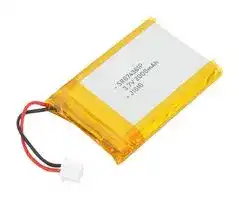
Image not available
Illustrative purposes only

MIKROE-1120
Rechargeable Battery, 3.7 V, Lithium Polymer, 2 Ah, Connector, 1
⚠️ Reference pricing provided. In case of supply shortages, we will connect you with our trusted procurement partners to ensure your project's continuity.
- Manufacturer: MIKROELEKTRONIKA
- Product type: Batteries - Rechargeable
- Battery Voltage:3.7V; Battery Technology:Lithium Polymer; Battery Capacity:2Ah; Battery Size Code:-; Battery Terminals:Wire Leads; External Diameter:-; External Height:6mm; External Width:44mm; Ex
- SVHC: No SVHC (14-Jun-2023)
- Weight: 45g
- Pack Quantity: 1
- Product Range: -
- External Depth: 63mm
- External Width: 44mm
- Battery Voltage: 3.7V
- External Height: 6mm
- Battery Capacity: 2Ah
- Battery IEC Code: -
- Battery NEDA Code: -
- Battery Size Code: -
- Battery Terminals: Connector
- Battery Compliance: -
- Battery Technology: Lithium Polymer
- Battery Type / Size: -
| Delivery and price | |
|---|---|
| Units per pack | 50 |
| Price | 19.47 € |
| Current stock | 200+ |
| Lead time | 30 days |
Datasheet

Type : SR674361P REV : 1.0 Date : 2013-3-8

## Li-Polymer battery datasheet

Type : SR674361P REV : 1.0 Date : 2013-3-8

## **Content**

1. Battery type and scope ------------------------------------------------------------------3 2. Basic characteristic and components of battery------------------------------------3 2.1: Basic performance parameter of battery -------------------------------------3 2.2: Main components and parts -----------------------------------------------------4 2.3: Reliable performance test --------------------------------------------------------4 2.4: Dimension ----------------------------------------------------------------------------7 3. Specification of parts ----------------------------------------------------------------------8 3.1 : PCB--------------------------------------------------------------------------------------8 3.1.1 : General electric characteristic--------------------------------------------------8 3.2 : Electric schematic diagram --------------------------------------------------------9 3.3:  Specification of battery cell ------------------------------------------------------10 4. Attentions ------------------------------------------------------------------------------------11

Type : SR674361P REV : 1.0 Date : 2013-3-8

Page 2/ 12

Type : SR674361P REV : 1.0

Date : 2013-3-8

## **1. Battery type and scope**

This Specification Approval Sheet is for rechargeable Li-polymer battery provided by Shirui Battery Co., LTD.

- 1.1 model : SR674361P

- 1.2 scope:

## **2 . Basic characteristic and components of the battery**

## **2.1 Basic performance parameter**

|**S/N**|**Details**|**Parameters**|**Parameters**|**Remarks**|
|---|---|---|---|---|
|**1**|Rated voltage|3.7V|||
|**2**|Rated capacity|2000mAh||discharge with 0.2C to 2.75V<br>after fully charge within 1h,<br>measuringthe discharge time|
|**3**|Limited charge voltage|4.2V|||
|**4**|Internal resistance|≤160mΩ|||
|**5**|charge mode|C.C/C.V.|||
|**6**|Charge time|6H||Standard charging 0.2C<br>400mA|
|**7**|Max Charge Current|2000mA|||
|**8**|Max discharge current|Continuous:2000mA|||
|**9**|Working temperature|charging|0~45℃||
|||discharging|-10~60℃||
|**10**|Storage temperature|1 Month|-10~35℃|Charge to 40%~50% of<br>capacitywhen storage|
|||6 months|-10~30℃||
|**11**|Storage humidity|≤75%||relative humidity|
|**12**|Weight|Approx.45g|||
|**13**|ESD ability|Touch discharge≥20000V|||
|||Air discharge≥20000V|||
|**14**|Cycle life|300 times||capacity≥80%|


**Note:If you need the battery protection parameters, please refer to PAGE 8.**

Page 3/ 12

Type : SR674361P REV : 1.0 Date : 2013-3-8

## **2.2 Main components and parts**

|**2.2 Main components**|**andparts**||||
|---|---|---|---|---|
|Materials|Model|Quantity|Related technical<br>parameters|Manufacturer|
|Li-Polymer battery cell|SR674361P|1PCS|Please refer to the<br>battery cell<br>specification|/|
|Protection board|674361|1PCS|||
|Wire|JST-XHP-2<br>UL1007AWG24<br>Length 50mm|1PCS|||


## **2.3 Reliable performance test**

|S/N|Inspection item|Standard|Testing Method|
|---|---|---|---|
|1|High temperature|No deformation, no rust, no fire or<br>explosion;<br>Discharge time≥100mins with<br>0.5C5A discharge|Place the battery in the environment of<br>55±2℃for 2 hours after fully charge, then<br>discharge with 0.5C5A to cut-off voltage.|
|2|Low temperature|No deformation, no rust, no fire or<br>explosion;<br>Discharge time≥3 hours with<br>0.2C5A discharge at -20±2℃|After fully charge, place the battery in the<br>environment of -20±2℃for 16-24h, then<br>discharge with 0.2C5A to cut-off voltage.<br>Then display the battery in 20±5℃for 2<br>hours, observe the appearance of the<br>battery.|
|||No deformation, no rust, no fire or<br>explosion;<br>Discharge time≥3.5 hours with<br>0.2C5A discharge at -10±2℃|After fully charge, place the battery in the<br>environment of -10±2℃for 16-24h, then<br>discharge with 0.2C5A to cut-off voltage.<br>Then display the battery in 20±5℃for 2<br>hours, observe the appearance of the<br>battery.|
|3|Capability<br>Retention|Discharge time≥4.25h|After fully charged, store the battery at<br>20±5℃for 28 days, then discharge with<br>0.2C5A to cut-off voltage.|


Page 4/ 12

Type : SR674361P REV : 1.0 Date : 2013-3-8

|4|Constant humidity<br>and heat|No deformation, no rust, no smoke<br>or explosion.<br>Discharge time≥36 mins|After fully charge, place the battery in the<br>environment of 40±2℃and 90% - 95%<br>Relative humidity for 48 hours, then place<br>it in 20±5℃for 2 hours, later, discharge<br>with 1C5A to cut-off voltage.|
|---|---|---|---|
|5|Vibration|No deformation, no rust, no smoke<br>or explosion.<br>Battery voltage≥3.6V|Batteries are vibrated 30 minutes in three<br>mutually perpendicular directions of X, Y,<br>Z with amplitude of 0.38mm (10~55Hz)<br>and the scanningrage of 1octper minute.|
|6|Shock|No deformation, no smoke or<br>explosion.<br>Battery voltage≥3.6V|Vibration test ended, place the battery in<br>the directions of X.Y.Z three mutually<br>perpendicular axis, and set pulse peak<br>acceleration as 100m//s2. Then shock the<br>battery with frequency of 40 ~ 80 per<br>minute. The duration of pulse is 16ms,<br>Shock times: 2000±10.|
|7|Free Drop|No<br>leakage,<br>no<br>smoke<br>or<br>explosion,<br>but<br>a<br>slight<br>deformation.<br>Discharge time≥100mins at<br>0.5C5A discharge|After shock test, the batteries are<br>dropped on the 18-20mm hardwood on<br>the concrete floor from 2000mm height<br>as per positive and negative 6 direction<br>of X, Y, Z. Each direction should drop<br>one time. After test, batteries can be<br>charged and discharged for at least<br>three cycles.|
|8|Overcharge<br>Protection|No explosion, no fire, no smoke or<br>leakage|After fully charged, continue to charge the<br>battery for 8 hours with C.C/C.V source.<br>The constant voltage source sets to 2<br>times nominal voltage and constant<br>current sets 2 C5A.|
|9|Over-discharge<br>Protection|No explosion, no fire, no smoke or<br>leakage.|At<br>20±5℃,<br>discharge<br>the<br>battery<br>discharge with 0.2C5A to cut-off voltage.<br>Then, continuously discharge the battery<br>with a 30Ωload resistance for 24 hours.|
|10|Short-circuit<br>Protection|No explosion, no fire, no smoke or<br>leakage;<br>Batteries voltage is not less than<br>N*3.6V<br>after<br>instantaneous<br>charge.|After fully charge, short-circuit positive<br>and negative electrode with 0.1Ωfor 1<br>hour. Cut-off positive and negative<br>electrode, then charge the battery at<br>0.5C5A instantaneouslyfor 5S.|


Page 5/ 12

Type : SR674361P REV : 1.0 Date : 2013-3-8

|11|Thermal Shock|No fire, No explosion|Battery is heated in a circulating air oven<br>at a rate of (5±2)℃per minute to 130℃,<br>and then placed for 30 minutes at 130℃.|
|---|---|---|---|
|12|Overcharge|No fire, No explosion|Place battery connected thermocouple<br>in a ventilated cabinet, connect the<br>positive and negative  to CC/CV source,<br>and adjust constant current  to 3C5A,<br>and constant voltage to N*10V.  Charge<br>the battery to N*10V and current to 0 A.<br>Then<br>monitor<br>the<br>changes<br>of<br>temperature. If the temperature of battery<br>drops to about 10℃lower than the max<br>temperature,test is finished.|
|13|Short circuit|No fire, No explosion. The out<br>side temperature of the battery is<br>less than 130℃.|Place battery connected thermocouple<br>in a ventilated cabinet, short-circuit the<br>positive and negative, then monitor the<br>changes<br>of<br>temperature.<br>If<br>the<br>temperature of battery drops to about<br>10℃lower than the max temperature,<br>test is finished.|
|14|Nail|No fire, No explosion|Put battery in the nail test platform.<br>then, use a diameter 8 mm steel tip to<br>poke through into hole.<br>Finally, use a heavy hammer to blow the<br>battery|
|15|Cycle life|Cycle life≥300|At 20±5℃,charge battery with 0.5 C5A to<br>4.2V and then charge it with constant<br>voltage to the current less than 20mA.<br>Stop charge and display for 0.5~1 hour.<br>Then discharge it with 1 C5A to cut-off<br>voltage. Display for 0.5 ~1 hour, do next<br>charge and discharge cycle. Repeat<br>these steps. Stop it until the continuous<br>two cycle discharge time is less than 48<br>minutes.|


Page 6/ 12

Type : SR674361P REV : 1.0 Date : 2013-3-8

When it is stored for 3 month, fully Storage charge it, then discharge it at 0.2 16 C5A, discharge time is not less than 4 hours.

The storage test of battery should be selected a battery which is less than 3 month from production date to the date of experiment. Before storage, battery capacity should be full charged 40%~50% capacity, the ambient temperature is 20 ℃ ±5 ℃ and relative humidity is 45%-85%. After the storage expiration of battery, battery should be charged and discharged according to fully charged and discharged.

## **2.4 Dimension of the Battery**

Page 7/ 12

Type : SR674361P REV : 1.0 Date : 2013-3-8

## **3. Specifications of Parts**

## **3.1: PCB: DW01/BMB101B02, 8205A 3.1. 1: General electric characteristic**

## **Model of Protection IC:DW01/BMB101B02**

|Items|Specification|Remarks|
|---|---|---|
|Over-charging Protection<br>Voltage|4.325V±0.1V||
|Over-charging Return Voltage|4.1V±0.1V||
|Over-discharge Protection<br>Voltage|2.5V±0.1V||
|Over-discharge Return<br>Voltage|3.0V±0.1V||
|Over-current Protection|2-5A||
|Output short-circuit Protection<br>Voltage|-1.2V~ -0.9V||
|Detection Delay Time of<br>Over-chargingProtection|≤1.5S(Typical)||
|Detection Delay Time of<br>Over-dischargingProtection|≤144mS(Typical)||
|Detection Delay Time of<br>Over-current Protection|≤9mS(Typical)||
|Detection<br>Delay<br>Time<br>of<br>Output short-circuit Protection|≤320uS(Typical)||
|Internal Resistance of Proper<br>Functioning|≤2000mΩ||
|Consume Current|≤6.0uA||
|Operating Temperature|-20~70℃||


Page 8/ 12

Type : SR674361P REV : 1.0 Date : 2013-3-8

## **3.2 Electric schematic diagram of battery**

## **3.3 : Components of the Fender Lists**

|No.|Name of the<br>components|Position|Specification|Precision%|Dosage|Supplier|Remarks|
|---|---|---|---|---|---|---|---|
|1|PCB||674361|Negative<br>tolerance|1||Latten|
|2|Internal<br>Resistance|R1|100Ω±5%/0402|±5|1||470Ω|
|3|Internal<br>Resistance|R2|1KΩ±5%/0402|±5|1||2KΩ|
|4|Capacity|C1|0.1μF/±10%/16V/0402|±20|1||0.1uF|
|5|Protect IC|U1|DW01/BMB101B02|/|1||SOT-23-6|
|6|MOS-FET|U2|8205A|/|1|||


Page 9/ 12

Type : SR674361P REV : 1.0 Date : 2013-3-8

## **4 Specifications of the Cells**

|**4 Specifications of the Cells**|**4 Specifications of the Cells**|**4 Specifications of the Cells**|**4 Specifications of the Cells**|**4 Specifications of the Cells**|**4 Specifications of the Cells**|**4 Specifications of the Cells**|**4 Specifications of the Cells**|**4 Specifications of the Cells**|
|---|---|---|---|---|---|---|---|---|
||||||||||
||NO.|Items|Parameters||Tolerance|Term|Remark/ condition||
||1|Appearance|No mechanical<br>damage, leakage ,<br>sink ,drum and so on||/|50cm distance<br>under 40W<br>daylight lamp|Visual||
||2|Dimensions|Length|61.0mm|Max<br>61.0mm|Digital caliper|||
||||Width|43.0mm|Max<br>43.0mm||||
||||Thickness|6.7mm|Max<br>6.7m<br>m||||
||3|Voltage|≥3.80V||/|Multimeter|VC9801||
||4|Capacity|≥2000mAH||/|0.2C|||
||5|Internal<br>resistance|≤80mΩ||/|1KHz|/||
||6|Consistency|Appearance quality is the same||||||
||**7**|**Security**|**Correspond to related safety performance**||||||


Page 10/ 12

Type : SR674361P REV : 1.0 Date : 2013-3-8

## **Attentions**

## **Danger**

To prevent battery from weeping, fever, exploding ,please obey the rules as follows: Do not immerse the battery into the water or the sea, Guard against Damp; Do not approach the heat source, like fire or heater; Please use the appointed charger when charging; Do not transposition the +.- poles of the battery to charge;

Do not direct-connected the battery to alternating current power supply, or autoignition of the vehicle;

Do not discard the battery to the fire or hyperpyretic objects;

Do not use the conductor to lead the short circuit of the + -poles of the battery. Do not put the battery with metallic conductors to transport or store, like necklace, hairpin and so on;

Do not beat or throw the battery;

Do not impale the battery with needle or some other sharp things, do not strike it with weight;

As installed safety device in the battery, please do not resolve or change any other sections of the battery to protect the inherent safety functions;

## **Warnings**

Do not put the battery to the microwave oven or pressure tank;

Do not use the battery with some chemical batteries (like dry battery) or different capacities and brands battery together, if the battery emits the smell, heat , changes color, be out of shape or appears any other abnormal phenomena during the charging or stored procedures, please get out the battery from the device or charger and stop using;

If can not recharge within the charging period, please not continue charging; Put the battery to where the kids can not touch, if the kids swallow the battery , please seeing the doctor soon; If the electrolyte of the battery into the eyes, do not rub ,should wash the eyes first ,then see the doctor;

Page 11/ 12

Type : SR674361P REV : 1.0 Date : 2013-3-8

## **Announcements**

Do not put the battery under the high temperature places (like sunshine irradiation or car in the hot weather), or it will catch fire for the heat , reduce the performance and loss the life;

To insure the safety, the battery should install the safety device, please not use when the static electricity is more than we need when produce, or the safety device will lose efficacy and lead the overheating ,fracture, exploding and catching fire;

Please use the battery in normal as follows, or it will be overheating, caught fire , reduced performance and shorten the life;

Environment condition (Temperature)  Charging: 0~+45[0] C Discharging: -10~+60[0] C

Store within 30 days: -10~+35[0] C Store within 90 days : -10~+30[0] C

If the kids use the battery, they should use as the operation instruction manual and guarantee that it must be use in normal at any time;

.

If the battery weeps, the electrolytes stick on the skin or cloth, use the water to wash or running water to wash To insure not install the battery wrong or wastage of the battery, please read the instruction carefully to install and dismounting;

If the battery will not be used for a long time ,please take out of the battery from the device and store in dry and shady places;

If there is sludge on the surface of the battery, please wipe up clean before using, or it will lead bad contact with the device.

## **! Special Notice**

Keep the cells in 50% charged state during long period storage. We recommend to charge the battery up to 50% of the total capacity every 3 months after receipt of the battery and maintain the voltage 3.7V~4.1V. And store the battery in cool and dry place.

Page 12/ 12
Updated at June 4, 2026
About Novapart
Novapart is a B2B electronic component broker specialising in stock shortages and cost reduction. We source hard-to-find parts and identify compliant alternatives across a catalogue of 540,000+ components from 500+ manufacturers.
Learn more →Stock Shortage Specialist
When a component is unavailable, discontinued or has an unacceptable lead time, we tap into our network of vetted European and Asian distributors to source what you need — without compromising on quality or traceability.
Request a quote →Compliant Alternatives
We identify pin-to-pin, electrically equivalent substitutes that meet the same certifications (RoHS, AEC-Q100, REACH) as your original specification — validated against datasheets, not just part numbers. Often at a lower cost.
BOM Analysis service →