
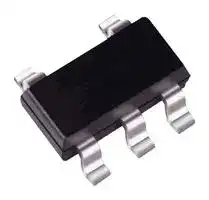


MIC1557YM5-TR
Timer, Oscillator IC, IttyBitty CMOS RC, Astable, 5 MHz, 2.7 V to 18 V, SOT-23-5
- Manufacturer: MICROCHIP
- Product type: Timers, Oscillators & Pulse Generators
- Frequency: 5MHz
- No. of Pins: 5Pins
- Digital IC Case: SOT-23
- Supply Voltage Max: 18V
- Supply Voltage Min: 2.7V
- Operating Temperature Max: 85°C
- Operating Temperature Min: -40°C
| Delivery and price | |
|---|---|
| Units per pack | 100 |
| Price | 0.922 € |
| Current stock | 1000+ |
| Lead time | 7 days |

**MIC1555/1557**

**==> picture [196 x 39] intentionally omitted <==**

## **General Description**

The MIC1555 IttyBitty[®] CMOS RC timer/oscillator and MIC1557 IttyBitty[®] CMOS RC oscillator are designed to provide rail-to-rail pulses for precise time delay or frequency generation.

The devices are similar in function to the industry standard “555”, without a frequency control (FC) pin or an opencollector discharge (D) pin. The threshold pin (THR) has precedence over the trigger (TRG) input, ensuring that the BiCMOS output is off when TRG is high.

The MIC1555 can be used as an astable (oscillator) or monostable (one-shot) with separate threshold and trigger inputs. In the one-shot mode, the output pulse width is precisely controlled by an external resistor and a capacitor. Time delays may be accurately controlled from microseconds to hours. In the oscillator mode, the output is used to provide precise feedback, with a minimum of one resistor and one capacitor producing a 50% duty cycle square wave.

## **IttyBitty[®] RC Timer/Oscillator**

## **Features**

- +2.7V to +18V operation

- Low current

   - <1µA typical shutdown mode (MIC1557)

   - 200µA typical (TRG and THR low) at 3V supply

- Timing from microseconds to hours

- “Zero” leakage trigger and threshold inputs

- 50% square wave with one resistor, one capacitor

- Threshold input precedence over trigger input

- <15Ω output on resistance

- No output cross-conduction current spikes

- <0.005%/°C temperature stability

- <0.055%/V supply stability

- 10-pin ultra-thin DFN package (2mm × 2mm × 0.4mm)

- Small SOT-23-5 surface mount package

## **Applications**

- Precision timer

The MIC1557 is designed for astable (oscillator) operation only, with a chip select/reset (CS) input for low power shutdown. One resistor and one capacitor provide a 50% duty cycle square wave. Other duty-cycle ratios may be produced using two diodes and two resistors.

The MIC1555/7 is powered from a +2.7V to +18V supply voltage and is rated for –40°C to +85°C ambient temperature range. The MIC1555/7 is available in SOT-235, and thin SOT23-5 5-pin packages. A low profile, ultrathin, (UTDFN), version of the MIC1555 (with chip select) is also available.

Datasheets and support documentation are available on Micrel’s website at: www.micrel.com.

- Pulse generation

- Sequential timing

- Time-delay generation

- Missing pulse detector

- Micropower oscillator to 5MHz

- Charge-pump driver

- LED blinker

- Voltage converter

- Linear sweep generator

- Variable frequency and duty cycle oscillator

IttyBitty is a registered trademark of Micrel, Inc.

**Micrel Inc. • 2180 Fortune Drive • San Jose, CA 95131 • USA • tel +1 (408) 944-0800 • fax + 1 (408) 474-1000 • http://www.micrel.com**

Revision 6.1

August 12, 2015

MIC1555/1557

Micrel, Inc.

## **Typical Applications**

**Monostable (One-Shot)**

**Monostable (with Enable)**

**Astable (Oscillator)**

Revision 6.1

August 12, 2015

2

MIC1555/1557

Micrel, Inc.

## **Ordering Information**

|**Part Number**|**Top Marking(1, 2)**|**Temperature Range**|**Package**|**Package Height (mm)**|
|---|---|---|---|---|
|MIC1555YD5|T12|–40°C to +85°C|5-Pin Thin SOT-23|1.0 (maximum)|
|MIC1555YMU|T14|–40°C to +85°C|10-Pin 2mm × 2mm UTDFN|0.4 (maximum)|
|MIC1555YM5|T10|–40°C to +85°C|5-Pin SOT-23|0.9 – 1.45|
|MIC1557YD5|T13|–40°C to +85°C|5-Pin Thin SOT-23|1.0 (maximum)|
|MIC1557YM5|T11|–40°C to +85°C|5-Pin SOT-23|0.9 – 1.45|


**Note:**

1. Underbars ( ) shown for the top marking may not be to scale.

2. The top marking in the YMU package does not have an underbar.

## **Pin Configuration (MIC1555 SOT-23 and TSOT-23)**

**5-Pin SOT-23 (M5) (Top View)**

**5-Pin TSOT-23 (D5) (Top View)**

## **Pin Description (MIC1555 SOT-23 and TSOT-23)**

|**Pin Number**|**Pin Name**|**Pin Function**|
|---|---|---|
|1|VS|Supply (Input): +2.7V to +18V supply.|
|2|GND|Ground: Supply return.|
|3|OUT|Output: CMOS totem-pole output.|
|4|TRG|Trigger (Input): Sets output high.  Active low (at ≤2/3VSnominal).|
|5|THR|Threshold (Dominant Input): Sets output low.  Active high (at ≥2/3VSnominal).|


Revision 6.1

August 12, 2015

3

MIC1555/1557

Micrel, Inc.

## **Pin Configuration (MIC1555 UTDFN)**

## **10-Pin UTDFN (MU) (Top View)**

## **Pin Description (MIC1555 UTDFN)**

|**Pin Number**|**Pin Name**|**Pin Function**|
|---|---|---|
|1|VS|Supply (Input): +2.7 to +18V supply.|
|2|CS|Chip Select/Reset (Input): Active high at >2/3VS.  Output off when low at <1/3VS. If chip select<br>functionality is not desired, CS may be connected directly to VS.|
|3, 4, 7, 9|NC|No Connect. This pin is not internally connected.|
|5|THR|Threshold (Dominant Input): Sets output low.  Active high (at ≥ 2/3VSnominal).|
|6|TRG|Trigger (Input): Sets output high.  Active low (at ≤2/3VSnominal).|
|8|GND|Ground: Supply return.|
|10|OUT|Output: CMOS totem-pole output.|


## **Pin Configuration (MIC1557 SOT-23 and TSOT-23)**

**5-Pin SOT-23 (M5) (Top View)**

**5-Pin TSOT-23 (D5) (Top View)**

## **Pin Description (MIC1557 SOT-23 and TSOT-23)**

|**Pin Number**|**Pin Name**|**Pin Function**|
|---|---|---|
|1|T/T|Trigger/Threshold (Input): Internally connected to both threshold and trigger functions. When the<br>voltage at this pin is ≤2/3VS it will set the output high. When the voltage at this pin is ≥2/3VS it will set<br>the output low.|
|2|GND|Ground: Supply return.|
|3|CS|Chip Select/Reset (Input): Active high at >2/3VS.  Output off when low at <1/3VS. If chip select<br>functionality is not desired, CS may be connected directly to VS.|
|4|VS|Supply (Input): +2.7 to +18V supply.|
|5|OUT|Output: CMOS totem-pole output.|


Revision 6.1

August 12, 2015

4

MIC1555/1557

Micrel, Inc.

## **Absolute Maximum Ratings[(][3][)]**

Supply Voltage (VS) ...................................................... +22V Threshold Voltage (VTHR, VT/T). .................................... +22V Trigger Voltage (VTGR, VT/T) .......................................... +22V Lead Temperature (soldering, 10s) ............................ 300°C Ambient Storage Temperature .................. –65°C to +150°C ESD HBM Rating[(][5][)] ......................................................... 2kV ESD MM Rating............................................................ 200V

## **Operating Ratings[(][4][)]**

Supply voltage (VS) ....................................... +2.7V to +18V Ambient Temperature (TA) .......................... –40°C to +85°C Package Thermal Resistance SOT23-5 and Thin SOT23-5 (θJA) ................... 250°C/W 2mm × 2mm UTDFN (θJA) ................................. 90°C/W

## **Electrical Characteristics**

TA = 25°C, **bold** values indicate –40°C ≤ TA ≤ +85°C, unless noted.

|TA= 25°C,**bold**values indicate|–40°C ≤ TA≤ +85°C, unless noted.|||||
|---|---|---|---|---|---|
|**Parameter**|**Condition**|**Min.**|**Typ. **|**Max.**|**Units**|
|Supply Current|VS= 5V||240|**300**|µA|
||VS= 15V||350|**400**||
|Monostable Timing Accuracy|RA= 10kΩ, C =0.1µF, VS= 5V||2||%|
||RA= 10kΩ, C =0.1µF, VS= 5V|**858**||**1161**|µs|
|Monostable Drift<br>Overtemperature|VS= 5V, –55°C ≤ TA≤ +125°C(6)||100||ppm/°C|
||VS= 10V, –55°C ≤ TA≤ +125°C(6)||150|||
||VS= 15V, –55°C ≤ TA≤ +125°C(6)||200|||
|Monostable Drift over Supply|VS= 5V to 15V(6)||0.5||%/V|
|Astable Timing Accuracy|RA= RB= 10kΩ, C = 0.1µF, VS= 5V||2||%|
||RA= RB= 10kΩ, C = 0.1µF, VS= 5V|**1717**||**2323**|µs|
|Maximum Astable<br>Frequency|RT= 1kΩ, CT= 47pF, VS= 8V||5||MHz|
|Astable Drift<br>Overtemperature|VS= 5V, –55°C ≤ TA≤ +125°C(6)||100||ppm/°C|
||VS= 10V, –55°C ≤ TA≤ +125°C(6)||150|||
||VS= 15V, –55°C ≤ TA≤ +125°C(6)||200|||
|Astable Drift over Supply|VS= 5V to 15V(6)||0.5||%/V|
|Threshold Voltage|VS= 15V|**61**|67|**72**|%/VS|
|Trigger Voltage|VS= 15V|**27**|32|**37**|%/VS|
|Trigger Current|VS= 15V|||**50**|nA|
|Threshold Current|VS= 15V|||**50**|nA|
|Chip Select|on > 2/3 VS|**50**|67|**72**|%/VS|
||off < 1/3 VS|**28**|33|**50**||


## **Notes:**

3. Exceeding the absolute maximum ratings may damage the device

4. The device is not guaranteed to function outside its operating ratings.

5. Devices are ESD protected, however handling precautions recommended.

6. Not tested.

Revision 6.1

August 12, 2015

5

MIC1555/1557

Micrel, Inc.

## **Electrical Characteristics (Continued)**

TA = 25°C, **bold** values indicate –40°C ≤ TA ≤ +85°C, unless noted.

|TA= 25°C,**bold**values indicate|–40°C ≤ TA≤ +85°C, unless noted.|||||
|---|---|---|---|---|---|
|**Parameter**|**Condition**|**Min.**|**Typ.**|**Max.**|**Units**|
|Output Voltage Drop|VS= 15V, ISINK= 20mA||0.3|**1.25**|V|
||VS= 5V, ISINK= 3.2mA||0.08|**0.5**||
||VS= 15V, ISOURCE= 20mA|**14.1**|14.7|||
||VS= 5V, ISOURCE= 3.2mA|**3.8**|4.7|||
|Supply Voltage|Functional Operation(6)|**2.7**||**18**|V|
|Output Rise Time|RL= 10MΩ, CL= 10pF, VS= 5V(6)||15||ns|
|Output Fall Time|RL= 10MΩ, CL= 10pF, VS= 5V(6)||15||ns|


Revision 6.1

August 12, 2015

6

MIC1555/1557

Micrel, Inc.

## **Typical Characteristics**

TA = 25°C, VIN = +5V.

Revision 6.1

August 12, 2015

7

MIC1555/1557

Micrel, Inc.

## **MIC1555 Functional Block Diagrams**

**MIC155YM5/MIC155YD5 Block Diagram with External Components (Monostable Configuration)**

**MIC1555YMU Block Diagram with External Components (Monostable Configuration)**

Revision 6.1

August 12, 2015

8

MIC1555/1557

Micrel, Inc.

## **MIC1557 Functional Block Diagram**

**MIC1557YM5/MIC1557YD5 Block Diagram with External Components (Astable Configuration)**

Revision 6.1

August 12, 2015

9

MIC1555/1557

Micrel, Inc.

## **Functional Description**

The MIC1555/7 provides the logic for creating simple RC timer or oscillator circuits.

The MIC1555 has separate THR (threshold) and TRG (trigger) connections for monostable (one-shot) or astable (oscillator) operation.

The MIC1557 has a single T/T (threshold and trigger) connection for astable (oscillator) operation only. The MIC1557 includes a CS (chip select/reset) control.

For more information, refer to the _MIC1555 Functional_

_Block Diagrams_ and _MIC1557 Functional Block Diagram_ .

## **Supply**

Voltage supply (VS) is rated for +2.7V to +18V. An external capacitor is recommended to decouple noise.

## **Resistive Divider**

The resistive voltage divider is constructed of three equal value resistors to produce 1/3VS and 2/3VS voltage for trigger and threshold reference voltages.

## **Chip Select/Reset (MIC1555YMU and MIC1557 only)**

Chip select/reset (CS) controls the bias supply to the oscillator’s internal circuitry. CS must be connected to CMOS logic-high or logic-low levels. Floating CS will result in unpredictable operation. When the chip is deselected, the supply current is less than 1µA. Forcing CS low resets the device by setting the flip flop, forcing the output low. If Chip Select functionality is not desired, CS may be connected directly to VS.

## **Basic Monostable Operation**

A momentary low signal applied to TRG causes the output to go high. The external capacitor charges slowly through the external resistor. When threshold voltage (VTHR) reaches 2/3VS, the output is switched off, discharging the capacitor. During power-on, a single pulse may be generated.

For more information, refer to the _MIC1555 Functional Block Diagrams_ .

## **Basic Astable Operation**

Refer to the MIC1557 functional diagram.

The MIC1557 starts with T/T low, causing the output to go high. The external capacitor charges slowly through the external resistor. When VT/T reaches 2/3VS (threshold voltage), the output is switched off, slowly discharging the capacitor. When VT/T decreases to 1/3VS (trigger voltage), the output is switched on, causing VT/T to rise again, repeating the cycle.

For more information, refer to the _MIC1557 Functional Block Diagram_ .

## **Threshold Comparator**

The threshold comparator is connected to S (set) on the RS flip-flop. When the threshold voltage (2/3VS) is reached, the flip-flop is set, making the output low. THR is dominant over TRG.

## **Trigger Comparator**

The trigger comparator is connected to R (reset) on the RS flip-flop. When TRG (trigger) goes below the trigger voltage (1/3VS), the flip-flop resets, making the output high.

## **Flip-Flop and Output**

A reset signal causes Q to go low, turning on the P- channel MOSFET and turning off the N-channel MOSFET.  This makes the output rise to nearly VS.

A set signal causes Q to go high, turning off the P- channel MOSFET, and turning on the N-channel MOSFET, grounding OUT.

Revision 6.1

August 12, 2015

10

MIC1555/1557

Micrel, Inc.

## **Application Information**

## **Basic Monostable (One-Shot) Circuit**

A monostable oscillator produces a single pulse each time that it is triggered, and is often referred to as a “oneshot”. The pulse width is constant, while the time between pulses depends on the trigger input. One-shots are generally used to “stretch” incoming pulses, of varying widths, to a fixed width. The IttyBitty MIC1555 is designed for monostable operation, but may also be connected to provide astable oscillations. The pulse width is determined by the time it takes to charge a capacitor from ground to a comparator trip point. If the capacitor (CT) is charged through a resistor (RT) connected to the output of an MIC1555, the trip point is approximately 1.1RTCT (the same time as the initial power-on cycle of an astable circuit.) If the trigger pulse of an MIC1555 remains low longer than the output pulse width, short oscillations may be seen in the output of a one-shot circuit, since the threshold pin has precedence over the trigger pin. These occur since the output goes low when the threshold is exceeded, and then goes high again as the trigger function is asserted. AC coupling the input with a series capacitor and a pull-up resistor, with an RC time constant less than the pulse width, will prevent these short oscillations. A diode (DT) in parallel with (RT) resets the one-shot quickly.

**Figure 1. One-Shot Diagram**

The period of a monostable circuit is: t = k2 RC

where: t = period (s)

k2 = Constant (see _Typical Characteristics_ )

R = Resistance (Ω)

C = Capacitance (F)

## **Basic Astable (Oscillator) Circuits**

An astable oscillator switches between two states, “on” and “off”, producing a continuous square wave. The IttyBitty MIC1557 is optimized for this function, with the two comparator inputs, threshold and trigger (T/T), tied together internally. CS is brought out to allow on-off control of the oscillator.

The MIC1555 may also be used as an astable oscillator by tying the threshold and trigger pins together, forming a T/T pin. If a resistor (RT) is connected from the output to a grounded timing capacitor (CT), the voltage at their junction will ramp up from ground when the output goes high. If the T/T pin is connected to this junction, the output will switch low when the ramp exceeds 2/3 of the input voltage. The junction's voltage ramps down toward ground while the output is low. When the ramp is below 1/3 of the input voltage, the output switches to high, and the junction ramps up again. The continuing frequency of an MIC1555/7 astable oscillator depends on the RC time constant, and is approximately 0.7/RC below 1MHz. At frequencies above 1MHz the RC multiplier increases as capacitance is decreased, and propagation delay becomes dominant. Non-symmetrical oscillator operation is possible at frequencies up to 5MHz.

If a duty cycle other than 50% is desired, a low-power signal diode may be connected in series with the timing resistor (RA), and a second resistor (RB) in series with an opposite facing switching diode and resistor connected in parallel (see Figure 2). The frequency is then made up of two components, the charging time (tA) and the discharging time (tB) tA = 0.7RACT and tB = 0.7RBCT. The frequency is the reciprocal of the sum of the two times tA + tB, so the total time is 1.4RTCT. The first half-cycle of an astable, after power-on or CS enable, is lengthened since the capacitor is charging from ground instead of the 1/3 input trigger trip voltage, to 1.1RC, the same as a monostable pulse.

Revision 6.1

August 12, 2015

11

MIC1555/1557

Micrel, Inc.

The MIC1555YMU and MIC1557 feature a CS input. With a logic-low signal, CS places the part into a <1µA shutdown state. If unused, the CS input must be pulled up.

**Figure 4. MIC1557 Oscillator Configuration**

## **Falling-Edge Triggered Monostable Circuit**

**Figure 2. Oscillator Diagram**

The MIC1555 or MIC1557 can be used to construct an oscillator.

The MIC1555 may be triggered by an AC-coupled fallingedge, as shown in Figure 5. The RC time constant of the input capacitor and pull-up resistor should be less than the output pulse time, to prevent multiple output pulses. A diode across the timing resistor provides a fast reset at the end of the positive timing pulse.

The frequency of an astable oscillator is:

**==> picture [42 x 30] intentionally omitted <==**

where:

f = frequency (Hz)

k1 = Constant (see _Typical Characteristics_ )

**Figure 5. Falling Edge Trigger Configuration**

R = Resistance (Ω)

C = Capacitance (F)

To use the MIC1555 as an oscillator, connect TRG to THR.

**Figure 3. MIC1555 Oscillator Configuration**

Revision 6.1

August 12, 2015

12

MIC1555/1557

Micrel, Inc.

## **Rising-Edge Triggered Monostable Circuit**

The MIC1555 may be triggered by an AC-coupled risingedge, as shown in Figure 6. The pulse begins when the ac-coupled input rises, and a diode from the output holds the THR input low until TRG discharges to 1/3VS. This circuit provides a low-going output pulse.

## **Inverting Schmitt Trigger**

As shown in Figure 7, the trip points of the MIC1555/7 are defined as 1/3 and 2/3VS, which allows either device to be used as a signal conditioning inverter, with hysteresis. A slowly changing input on T/T will be converted to a fast rise or fall-time opposite direction railto-rail output voltage. This output maybe used to directly drive the gate of a logic-level P-channel MOSFET with a gate pull-up resistor. This is an inverted logic low-side logic level MOSFET driver. A standard N-channel MOSFET may be driven by a second MIC1555/7, powered by 12V to 15V, to level-shift the input.

**Figure 6. Rising Edge Trigger Configuration**

## **Accuracy**

The two comparators in the MIC1555/7 use a resistor voltage divider to set the threshold and trigger trip points to approximately 2/3 and 1/3 of the input voltage, respectively. Since the charge and discharge rates of an RC circuit are dependent on the applied voltage, the timing remains constant if the input voltage varies. If a duty cycle of exactly 50% (or any other value from 1 to 99%), two resistors (or a variable resistor) and two diodes are needed to vary the charge and discharge times. The forward voltage of diodes varies with temperature, so some change in frequency will be seen with temperature extremes, but the duty cycle should track. For absolute timing accuracy, the MIC1555/7 output could be used to control constant current sources to linearly charge and discharge the capacitor, at the expense of added components and board space.

## **Long Time Delays**

Timing resistors larger than 1MΩ or capacitors larger than 10µF are not recommended due to leakage current inaccuracies. Time delays greater than 10 seconds are more accurately produced by dividing the output of an oscillator by a chain of flip-flop counter stages. To produce an accurate one-hour delay, for example, divide a 4.55Hz MIC1557 oscillator by 16,384 (4000hex, 214) using a CD4020 CMOS divider. 4.5Hz may be generated with a 1µF CT and approximately 156kΩ.

**Figure 7. Schmitt Trigger**

## **Charge-Pump Low-Side MOSFET Drivers**

A standard MOSFET requires approximately >5V to fully enhance the gate for minimum RDS(ON). Substituting a logic-level MOSFET reduces the required gate voltage, allowing an MIC1557 to be used as an inverting Schmitt trigger, described above. An MIC1557 may be configured as a voltage quadrupler to boost a 5V input to over 15V to fully enhance an N-channel MOSFET which may have its drain connected to a higher voltage, through a highside load. ATTL high signal applied to CS enables a 10kHz oscillator, which quickly develops 15V at the gate of the MOSFET, clamped by a Zener diode. A resistor from the gate to ground ensures that the FET will turn off quickly when the MIC1557 is turned off.

**Figure 8. Charge Pump**

Revision 6.1

August 12, 2015

13

MIC1555/1557

Micrel, Inc.

## **Audible Voltmeter**

If an additional charge or discharge source is connected to the timing capacitor, the frequency may be shifted by turning the source on or off. An MIC1555 oscillator, powered by the circuit under test, may be used to drive a small loud speaker or piezo-electric transducer to provide a medium frequency for an open or high impedance state at the probe. A high tone is generated for a high level, and a lower frequency for a logic low on the probe.

**Figure 9. Audible Voltmeter**

Revision 6.1

August 12, 2015

14

MIC1555/1557

Micrel, Inc.

## **Package Information and Recommended Land Pattern[(][7][)]**

## **5-Pin SOT-23 (M5)**

## **Note:**

7. Package information is correct as of the publication date. For updates and most current information, go to www.micrel.com.

Revision 6.1

August 12, 2015

15

MIC1555/1557

Micrel, Inc.

## **Package Information and Recommended Land Pattern[(]**[7] **[)] (Continued)**

## **5-Pin Thin SOT-23 (D5)**

Revision 6.1

August 12, 2015

16

MIC1555/1557

Micrel, Inc.

## **Package Information and Recommended Land Pattern[(]**[7] **[)] (Continued)**

## **10-Pin 2mm × 2mm UTDFN (MU)**

Revision 6.1

August 12, 2015

17

MIC1555/1557

Micrel, Inc.

## **MICREL, INC.   2180 FORTUNE DRIVE   SAN JOSE, CA  95131   USA**

## TEL +1 (408) 944-0800  FAX +1 (408) 474-1000  WEB http://www.micrel.com

Micrel, Inc. is a leading global manufacturer of IC solutions for the worldwide high performance linear and power, LAN, and timing & communications markets. The Company’s products include advanced mixed-signal, analog & power semiconductors; high-performance communication, clock management, MEMs-based clock oscillators & crystal-less clock generators, Ethernet switches, and physical layer transceiver ICs.  Company customers include leading manufacturers of enterprise, consumer, industrial, mobile, telecommunications, automotive, and computer products. Corporation headquarters and state-of-the-art wafer fabrication facilities are located in San Jose, CA, with regional sales and support offices and advanced technology design centers situated throughout the Americas, Europe, and Asia.  Additionally, the Company maintains an extensive network of distributors and reps worldwide.

Micrel makes no representations or warranties with respect to the accuracy or completeness of the information furnished in this datasheet. This information is not intended as a warranty and Micrel does not assume responsibility for its use.  Micrel reserves the right to change circuitry, specifications and descriptions at any time without notice.  No license, whether express, implied, arising by estoppel or otherwise, to any intellectual property rights is granted by this document. Except as provided in Micrel’s terms and conditions of sale for such products, Micrel assumes no liability whatsoever, and Micrel disclaims any express or implied warranty relating to the sale and/or use of Micrel products including liability or warranties relating to fitness for a particular purpose, merchantability, or infringement of any patent, copyright, or other intellectual property right.

Micrel Products are not designed or authorized for use as components in life support appliances, devices or systems where malfunction of a product can reasonably be expected to result in personal injury. Life support devices or systems are devices or systems that (a) are intended for surgical implant into the body or (b) support or sustain life, and whose failure to perform can be reasonably expected to result in a significant injury to the user. A Purchaser’s use or sale of Micrel Products for use in life support appliances, devices or systems is a Purchaser’s own risk and Purchaser agrees to fully indemnify Micrel for any damages resulting from such use or sale.

© 2004 Micrel, Incorporated.

Revision 6.1

August 12, 2015

18
Updated at February 9, 2023
Microchip Technology Inc. is a leading global provider of smart, connected, and secure embedded control solutions. Known for enabling engineers to design with confidence, the company delivers a comprehensive product portfolio that reduces total system costs and accelerates time to market across the industrial, automotive, communications, and computing sectors. Our extensive selection of Microchip components highlights the manufacturer's strength in both discrete semiconductors and advanced wireless connectivity. We carry a robust lineup of highly efficient single MOSFETs and Schottky diodes tailored for demanding power management and switching applications. Alongside these essential discretes, engineers can source a wide array of ready-to-use networking modules, prominently featuring Bluetooth and WLAN adapters that streamline the development of modern IoT and connected devices. Rounding out the offering is a diverse range of Microchip integrated circuits and specialized components. This includes versatile I/O expanders for simplified system integration, precision timing solutions such as MEMS oscillators and pulse generators, as well as AC/DC LED driver ICs and sub-2.4GHz RF transceivers. Backed by Microchip's renowned commitment to exceptional quality and reliable performance, these components provide scalable, dependable building blocks for complex electronic designs.
About Novapart
Novapart is a B2B electronic component broker specialising in stock shortages and cost reduction. We source hard-to-find parts and identify compliant alternatives across a catalogue of 410,000+ components from 500+ manufacturers.
Learn more →Stock Shortage Specialist
When a component is unavailable, discontinued or has an unacceptable lead time, we tap into our network of vetted European and Asian distributors to source what you need — without compromising on quality or traceability.
Request a quote →Compliant Alternatives
We identify pin-to-pin, electrically equivalent substitutes that meet the same certifications (RoHS, AEC-Q100, REACH) as your original specification — validated against datasheets, not just part numbers. Often at a lower cost.
BOM Analysis service →