
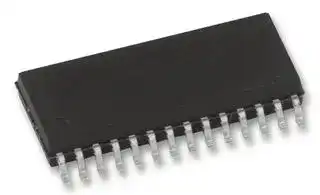


MCP23017-E/SO
I/O Expander, 16bit, 1.7 MHz, I2C, Serial, 1.8 V, 5.5 V, SOIC
- Manufacturer: MICROCHIP
- Product type: I/O Expanders
- No. of Pins: 28Pins
- No. of I/O's: 16I/O's
- Bus Frequency: 1.7MHz
- Product Range: MCP23017; MCP23S17
- IC Interface Type: I2C, Serial
- Chip Configuration: 16bit
- Supply Voltage Max: 5.5V
- Supply Voltage Min: 1.8V
- Interface Case Style: SOIC
| Delivery and price | |
|---|---|
| Units per pack | 100 |
| Price | 1.14 € |
| Current stock | 10+ |
| Lead time | 30 days |

## **MCP23017/MCP23S17**

## **16-Bit I/O Expander with Serial Interface**

## **Features**

- 16-bit remote bidirectional I/O port

- I/O pins default to input

- High-speed I[2] C™ interface ( **MCP23017** )

- 100 kHz

- 400 kHz

- 1.7 MHz

- High-speed SPI interface ( **MCP23S17** )

- 10 MHz (max.)

- Three hardware address pins to allow up to eight devices on the bus

- Configurable interrupt output pins

- Configurable as active-high, active-low or open-drain

- INTA and INTB can be configured to operate independently or together

- Configurable interrupt source

- Interrupt-on-change from configured register defaults or pin changes

- Polarity Inversion register to configure the polarity of the input port data

- External Reset input

- Low standby current: 1 µA (max.)

- Operating voltage:

- 1.8V to 5.5V @ -40°C to +85°C

- 2.7V to 5.5V @ -40°C to +85°C

- 4.5V to 5.5V @ -40°C to +125°C

## **Packages**

- 28-pin PDIP (300 mil)

- 28-pin SOIC (300 mil)

- 28-pin SSOP

- 28-pin QFN

## **Package Types**

|**QFN**<br>VSS<br>NC<br>VDD<br>GPB5<br>GPB6<br>GPB7<br>GPB4<br>GPB0<br>GPB1<br>GPB2<br>GPB3<br>GPB4<br>NC<br>NC<br>GPB5<br>GPB6<br>GPB7<br>SCL<br>VDD<br>VSS<br>SDA<br>**PDIP,**<br>**SSOP**<br>**SOIC,**<br>**MCP23017**|||• 1<br>2<br>3<br>4<br>5<br>6<br>7<br>8<br>9<br>10<br>28<br>27<br>26<br>25<br>24<br>23<br>22<br>21<br>20<br>19<br>**CP23017**|GPA4<br>GPA3<br>GPA2<br>GPA1<br>GPA0<br>INTB<br>INTA<br>INTA<br>GPA7<br>GPA6<br>GPA5<br>GPA4<br>GPA3<br>GPA2<br>GPA1<br>GPA0<br>A2<br>A1<br>A0<br>INTB<br>RESET|
|---|---|---|---|---|
||||• 1<br>2<br>3<br>4<br>5<br>6<br>7<br>8<br>9<br>10<br>28<br>27<br>26<br>25<br>24<br>23<br>22<br>21<br>20<br>19<br>**CP23017**||
||||||
|||2<br>3<br>4<br>5<br>6<br>1<br>7<br><br>|15<br>16<br>17<br>18<br>19<br>20<br>21<br>SCL<br>SDA<br>NC<br>A0<br>A1<br>A2<br>RESET<br>23<br>24<br>25<br>26<br>27<br>28<br>22<br>GPB3<br>GPB2<br>GPB1<br>GPB0<br>GPA7<br>GPA6<br>GPA5<br>1011<br>8 9<br>121314<br>**MCP23017**<br><br>11<br>12<br>13<br>14<br><br>18<br>17<br>16<br>15<br>**M**||
||||||
|GPB0<br>GPB1<br>GPB2<br>GPB3<br>GPB4<br>SO<br>CS<br>GPB5<br>GPB6<br>GPB7<br>SCK<br>VDD<br>VSS<br>SI<br>**MCP23S17**<br>**QFN**<br>VSS<br>CS<br>VDD<br>GPB5<br>GPB6<br>GPB7<br>GPB4<br>**PDIP,**<br>**SSOP**<br>**SOIC,**|||• 1<br>2<br>3<br>4<br>5<br>6<br>7<br>8<br>9<br><br>28<br>27<br>26<br>25<br>24<br>23<br>22<br>21<br>20<br><br>**CP23S17**|INTA<br>GPA7<br>GPA6<br>GPA5<br>GPA4<br>GPA3<br>GPA2<br>GPA1<br>GPA0<br>A2<br>A1<br>A0<br>INTB<br>RESET<br>GPA4<br>GPA3<br>GPA2<br>GPA1<br>GPA0<br>INTB<br>INTA|
||||• 1<br>2<br>3<br>4<br>5<br>6<br>7<br>8<br>9<br><br>28<br>27<br>26<br>25<br>24<br>23<br>22<br>21<br>20<br><br>**CP23S17**||
||||||
|||10<br>11<br>12<br>13<br>14<br>19<br>18<br>17<br>16<br>15<br>**M**<br>2<br>3<br>4<br>5<br>6<br>1<br>7<br>15<br>16<br>17<br>18<br>19<br>20<br>21<br>SI<br>SO<br>A0<br>A1<br>A2<br>RESET<br>23<br>24<br>25<br>26<br>27<br>28<br>22<br>GPB3<br>GPB2<br>GPB1<br>GPB0<br>GPA7<br>GPA6<br>GPA5<br>1011<br>8 9<br>121314<br>**MCP23S17**<br>SCK|||


DS21952B-page 1

© 2007 Microchip Technology Inc.

**MCP23017/MCP23S17**

## **Functional Block Diagram**

**==> picture [390 x 298] intentionally omitted <==**

**----- Start of picture text -----**<br>
MCP23S17<br>CS<br>SCK<br>SI<br>SPI<br>SO<br>MCP23017<br>GPB7<br>SCL Serializer/<br>GPB6<br>SDA I [2] C™  Deserializer<br>GPB5<br>GPB4<br>3 GPIO<br>GPB3<br>A2:A0 Decode<br>GPB2<br>RESET Control GPB1<br>INTA Interrupt 16 GPB0<br>INTB Logic GPA7<br>GPA6<br>8 GPA5<br>GPA4<br>GPIO GPA3<br>Configuration/ GPA2<br>Control GPA1<br>Registers GPA0<br>**----- End of picture text -----**<br>


DS21952B-page 2

© 2007 Microchip Technology Inc.

**MCP23017/MCP23S17**

## **1.0 DEVICE OVERVIEW**

The MCP23017/MCP23S17 (MCP23X17) device family provides 16-bit, general purpose parallel I/O expansion for I[2] C bus or SPI applications. The two devices differ only in the serial interface.

- MCP23017 – I[2] C interface

- MCP23S17 – SPI interface

The MCP23X17 consists of multiple 8-bit configuration registers for input, output and polarity selection. The system master can enable the I/Os as either inputs or outputs by writing the I/O configuration bits (IODIRA/B). The data for each input or output is kept in the corresponding input or output register. The polarity of the Input Port register can be inverted with the Polarity Inversion register. All registers can be read by the system master.

The 16-bit I/O port functionally consists of two 8-bit ports (PORTA and PORTB). The MCP23X17 can be configured to operate in the 8-bit or 16-bit modes via IOCON.BANK.

There are two interrupt pins, INTA and INTB, that can be associated with their respective ports, or can be logically OR’ed together so that both pins will activate if either port causes an interrupt.

The interrupt output can be configured to activate under two conditions (mutually exclusive):

1. When any input state differs from its corresponding Input Port register state. This is used to indicate to the system master that an input state has changed.

2. When an input state differs from a preconfigured register value (DEFVAL register).

The Interrupt Capture register captures port values at the time of the interrupt, thereby saving the condition that caused the interrupt.

The Power-on Reset (POR) sets the registers to their default values and initializes the device state machine.

The hardware address pins are used to determine the device address.

DS21952B-page 3

© 2007 Microchip Technology Inc.

## **MCP23017/MCP23S17**

## **1.1 Pin Descriptions**

**TABLE 1-1: PINOUT DESCRIPTION**

|**Pin**<br>**Name**|**PDIP/**<br>**SOIC/**<br>**SSOP**|**QFN**|**Pin**<br>**Type**|**Function**|
|---|---|---|---|---|
|GPB0|1|25|I/O|Bidirectional I/O pin. Can be enabled for interrupt-on-change and/or internal weak pull-up<br>resistor.|
|GPB1|2|26|I/O|Bidirectional I/O pin. Can be enabled for interrupt-on-change and/or internal weak pull-up<br>resistor.|
|GPB2|3|27|I/O|Bidirectional I/O pin. Can be enabled for interrupt-on-change and/or internal weak pull-up<br>resistor.|
|GPB3|4|28|I/O|Bidirectional I/O pin. Can be enabled for interrupt-on-change and/or internal weak pull-up<br>resistor.|
|GPB4|5|1|I/O|Bidirectional I/O pin. Can be enabled for interrupt-on-change and/or internal weak pull-up<br>resistor.|
|GPB5|6|2|I/O|Bidirectional I/O pin. Can be enabled for interrupt-on-change and/or internal weak pull-up<br>resistor.|
|GPB6|7|3|I/O|Bidirectional I/O pin. Can be enabled for interrupt-on-change and/or internal weak pull-up<br>resistor.|
|GPB7|8|4|I/O|Bidirectional I/O pin. Can be enabled for interrupt-on-change and/or internal weak pull-up<br>resistor.|
|VDD|9|5|P|Power|
|VSS|10|6|P|Ground|
|NC/CS|11|7|I|NC(MCP23017), Chip Select(MCP23S17)|
|SCL/SCK|12|8|I|Serial clock input|
|SDA/SI|13|9|I/O|Serial data I/O(MCP23017), Serial data input(MCP23S17)|
|NC/SO|14|10|O|NC(MCP23017), Serial data out(MCP23S17)|
|A0|15|11|I|Hardware address pin. Must be externallybiased.|
|A1|16|12|I|Hardware address pin. Must be externallybiased.|
|A2|17|13|I|Hardware address pin. Must be externallybiased.|
|RESET|18|14|I|Hardware reset. Must be externallybiased.|
|INTB|19|15|O|Interrupt output for PORTB. Can be configured as active-high, active-low or open-drain.|
|INTA|20|16|O|Interrupt output for PORTA. Can be configured as active-high, active-low or open-drain.|
|GPA0|21|17|I/O|Bidirectional I/O pin. Can be enabled for interrupt-on-change and/or internal weak pull-up<br>resistor.|
|GPA1|22|18|I/O|Bidirectional I/O pin. Can be enabled for interrupt-on-change and/or internal weak pull-up<br>resistor.|
|GPA2|23|19|I/O|Bidirectional I/O pin. Can be enabled for interrupt-on-change and/or internal weak pull-up<br>resistor.|
|GPA3|24|20|I/O|Bidirectional I/O pin. Can be enabled for interrupt-on-change and/or internal weak pull-up<br>resistor.|
|GPA4|25|21|I/O|Bidirectional I/O pin. Can be enabled for interrupt-on-change and/or internal weak pull-up<br>resistor.|
|GPA5|26|22|I/O|Bidirectional I/O pin. Can be enabled for interrupt-on-change and/or internal weak pull-up<br>resistor.|
|GPA6|27|23|I/O|Bidirectional I/O pin. Can be enabled for interrupt-on-change and/or internal weak pull-up<br>resistor.|
|GPA7|28|24|I/O|Bidirectional I/O pin. Can be enabled for interrupt-on-change and/or internal weak pull-up<br>resistor.|


DS21952B-page 4

© 2007 Microchip Technology Inc.

**MCP23017/MCP23S17**

## **1.2 Power-on Reset (POR)**

The on-chip POR circuit holds the device in reset until VDD has reached a high enough voltage to deactivate the POR circuit (i.e., release the device from reset). The maximum VDD rise time is specified in **Section 2.0 “Electrical Characteristics”** .

When the device exits the POR condition (releases reset), device operating parameters (i.e., voltage, temperature, serial bus frequency, etc.) must be met to ensure proper operation.

## **1.3 Serial Interface**

This block handles the functionality of the I[2] C (MCP23017) or SPI (MCP23S17) interface protocol. The MCP23X17 contains 22 individual registers (11 register pairs) that can be addressed through the Serial Interface block, as shown in Table 1-2.

## **TABLE 1-2: REGISTER ADDRESSES**

|**Address**<br>**IOCON.BANK =1**|**Address**<br>**IOCON.BANK =0**|**Access to:**|
|---|---|---|
|00h|00h|IODIRA|
|10h|01h|IODIRB|
|01h|02h|IPOLA|
|11h|03h|IPOLB|
|02h|04h|GPINTENA|
|12h|05h|GPINTENB|
|03h|06h|DEFVALA|
|13h|07h|DEFVALB|
|04h|08h|INTCONA|
|14h|09h|INTCONB|
|05h|0Ah|IOCON|
|15h|0Bh|IOCON|
|06h|0Ch|GPPUA|
|16h|0Dh|GPPUB|
|07h|0Eh|INTFA|
|17h|0Fh|INTFB|
|08h|10h|INTCAPA|
|18h|11h|INTCAPB|
|09h|12h|GPIOA|
|19h|13h|GPIOB|
|0Ah|14h|OLATA|
|1Ah|15h|OLATB|


## 1.3.1 BYTE MODE AND SEQUENTIAL MODE

The MCP23X17 family has the ability to operate in Byte mode or Sequential mode (IOCON.SEQOP).

**Byte Mode** disables automatic Address Pointer incrementing. When operating in Byte mode, the MCP23X17 family does not increment its internal address counter after each byte during the data transfer. This gives the ability to continually access the same address by providing extra clocks (without additional control bytes). This is useful for polling the GPIO register for data changes or for continually writing to the output latches.

A special mode **(Byte mode with IOCON.BANK = 0 )** causes the address pointer to toggle between associated A/B register pairs. For example, if the BANK bit is cleared and the Address Pointer is initially set to address 12h (GPIOA) or 13h (GPIOB), the pointer will toggle between GPIOA and GPIOB. Note that the Address Pointer can initially point to either address in the register pair.

**Sequential mode** enables automatic address pointer incrementing. When operating in Sequential mode, the MCP23X17 family increments its address counter after each byte during the data transfer. The Address Pointer automatically rolls over to address 00h after accessing the last register.

These two modes are not to be confused with single writes/reads and continuous writes/reads that are serial protocol sequences. For example, the device may be configured for Byte mode and the master may perform a continuous read. In this case, the MCP23X17 would not increment the Address Pointer and would repeatedly drive data from the same location.

## 1.3.2 I[2] C INTERFACE

## 1.3.2.1 I[2] C Write Operation

The I[2] C write operation includes the control byte and register address sequence, as shown in the bottom of Figure 1-1. This sequence is followed by eight bits of data from the master and an Acknowledge (ACK) from the MCP23017. The operation is ended with a Stop (P) or Restart (SR) condition being generated by the master.

Data is written to the MCP23017 after every byte transfer. If a Stop or Restart condition is generated during a data transfer, the data will not be written to the MCP23017.

Both “byte writes” and “sequential writes” are supported by the MCP23017. If Sequential mode is enabled (IOCON, SEQOP = 0 ) (default), the MCP23017 increments its address counter after each ACK during the data transfer.

DS21952B-page 5

© 2007 Microchip Technology Inc.

**MCP23017/MCP23S17**

## 1.3.2.2 I[2] C Read Operation

I[2] C Read operations include the control byte sequence, as shown in the bottom of Figure 1-1. This sequence is followed by another control byte (including the Start condition and ACK) with the R/W bit set (R/W = 1 ). The MCP23017 then transmits the data contained in the addressed register. The sequence is ended with the master generating a Stop or Restart condition.

## 1.3.2.3 I[2] C Sequential Write/Read

For sequential operations (Write or Read), instead of transmitting a Stop or Restart condition after the data transfer, the master clocks the next byte pointed to by the address pointer (see **Section 1.3.1 “Byte Mode and Sequential Mode”** for details regarding sequential operation control).

The sequence ends with the master sending a Stop or Restart condition.

The MCP23017 Address Pointer will roll over to address zero after reaching the last register address. Refer to Figure 1-1.

## 1.3.3 SPI INTERFACE

## 1.3.3.1 SPI Write Operation

The SPI write operation is started by lowering CS. The Write command (slave address with R/W bit cleared) is then clocked into the device. The opcode is followed by an address and at least one data byte.

## 1.3.3.2 SPI Read Operation

The SPI read operation is started by lowering CS. The SPI read command (slave address with R/W bit set) is then clocked into the device. The opcode is followed by an address, with at least one data byte being clocked out of the device.

## 1.3.3.3 SPI Sequential Write/Read

For sequential operations, instead of deselecting the device by raising CS, the master clocks the next byte pointed to by the Address Pointer. (see **Section 1.3.1 “Byte Mode and Sequential Mode”** for details regarding sequential operation control).

The sequence ends by the raising of CS.

The MCP23S17 Address Pointer will roll over to address zero after reaching the last register address.

DS21952B-page 6

© 2007 Microchip Technology Inc.

**MCP23017/MCP23S17**

## **FIGURE 1-1: MCP23017 I[2] C™ DEVICE PROTOCOL**

**==> picture [468 x 477] intentionally omitted <==**

**----- Start of picture text -----**<br>
S - Start<br>SR - Restart<br>S OP W ADDR DIN .... DIN P<br>P - Stop<br>w - Write SR OP R DOUT .... DOUT P<br>R - Read<br>OP - Device opcode SR OP W DIN .... DIN P<br>ADDR - Device register address P<br>DOUT - Data out from MCP23017<br>DIN - Data in to MCP23017<br>S OP R DOUT .... DOUT P<br>SR OP R DOUT .... DOUT P<br>SR OP W ADDR DIN .... DIN P<br>P<br>Byte and Sequential Write<br>Byte S OP W ADDR DIN P<br>Sequential S OP W ADDR DIN .... DIN P<br>Byte and Sequential Read<br>Byte S OP W SR OP R DOUT P<br>Sequential S OP W SR OP R DOUT .... DOUT P<br>**----- End of picture text -----**<br>


DS21952B-page 7

© 2007 Microchip Technology Inc.

## **MCP23017/MCP23S17**

## **1.4 Hardware Address Decoder**

The hardware address pins are used to determine the device address. To address a device, the corresponding address bits in the control byte must match the pin state. The pins must be biased externally.

## 1.4.1 ADDRESSING I[2] C DEVICES (MCP23017)

The MCP23017 is a slave I[2] C interface device that supports 7-bit slave addressing, with the read/write bit filling out the control byte. The slave address contains four fixed bits and three user-defined hardware address bits (pins A2, A1 and A0). Figure 1-2 shows the control byte format.

## 1.4.2 ADDRESSING SPI DEVICES (MCP23S17)

The MCP23S17 is a slave SPI device. The slave address contains four fixed bits and three user-defined hardware address bits (if enabled via IOCON.HAEN) (pins A2, A1 and A0) with the read/write bit filling out the control byte. Figure 1-3 shows the control byte format. The address pins should be externally biased even if disabled (IOCON.HAEN = 0 ).

## **FIGURE 1-2: I[2] C™ CONTROL BYTE FORMAT**

**==> picture [213 x 96] intentionally omitted <==**

**----- Start of picture text -----**<br>
Control Byte<br>S 0 1 0 0 A2 A1 A0 R/W ACK<br>Slave Address<br>Start R/W bit<br>bit ACK bit<br>R/W =  0  = write<br>R/W =  1  = read<br>**----- End of picture text -----**<br>


## **FIGURE 1-3: SPI CONTROL BYTE FORMAT**

**==> picture [205 x 111] intentionally omitted <==**

**----- Start of picture text -----**<br>
CS<br>Control Byte<br>0 1 0 0 A2 A1 A0 R/W<br>Slave Address<br>R/W bit<br>R/W =  0  = write<br>R/W =  1  = read<br>**----- End of picture text -----**<br>


**FIGURE 1-4:**

## **I[2] C™ ADDRESSING REGISTERS**

**==> picture [468 x 249] intentionally omitted <==**

**----- Start of picture text -----**<br>
S 0 1 0 0 A2 A1 A0 0 ACK * A7 A6 A5 A4 A3 A2 A1 A0 ACK *<br>R/W =  0<br>Device Opcode Register Address<br>*The ACKs are provided by the MCP23017.<br>FIGURE 1-5: SPI ADDRESSING REGISTERS<br>CS<br>0 1 0 0 A2 A1 A0 R/W A7 A6 A5 A4 A3 A2 A1 A0<br>* * *<br>Device Opcode Register Address<br>*  Address pins are enabled/disabled via IOCON.HAEN.<br>**----- End of picture text -----**<br>


DS21952B-page 8

© 2007 Microchip Technology Inc.

**MCP23017/MCP23S17**

## **1.5 GPIO Port**

The GPIO module is a general purpose, 16-bit wide, bidirectional port that is functionally split into two 8-bit wide ports.

The GPIO module contains the data ports (GPIOn), internal pull-up resistors and the output latches (OLATn).

Reading the GPIOn register reads the value on the port. Reading the OLATn register only reads the latches, not the actual value on the port.

Writing to the GPIOn register actually causes a write to the latches (OLATn). Writing to the OLATn register forces the associated output drivers to drive to the level in OLATn. Pins configured as inputs turn off the associated output driver and put it in high-impedance.

**TABLE 1-3: SUMMARY OF REGISTERS ASSOCIATED WITH THE GPIO PORTS (BANK = 1 )**

|**Register**<br>**Name**|**Address**<br>**(hex)**|**bit 7**|**bit 6**|**bit 5**|**bit 4**|**bit 3**|**bit 2**|**bit 1**|**bit 0**|**POR/RST**<br>**value**|
|---|---|---|---|---|---|---|---|---|---|---|
|IODIRA|00|IO7|IO6|IO5|IO4|IO3|IO2|IO1|IO0|1111 1111|
|IPOLA|01|IP7|IP6|IP5|IP4|IP3|IP2|IP1|IP0|0000 0000|
|GPINTENA|02|GPINT7|GPINT6|GPINT5|GPINT4|GPINT3|GPINT2|GPINT1|GPINT0|0000 0000|
|GPPUA|06|PU7|PU6|PU5|PU4|PU3|PU2|PU1|PU0|0000 0000|
|GPIOA|09|GP7|GP6|GP5|GP4|GP3|GP2|GP1|GP0|0000 0000|
|OLATA|0A|OL7|OL6|OL5|OL4|OL3|OL2|OL1|OL0|0000 0000|
|IODIRB|10|IO7|IO6|IO5|IO4|IO3|IO2|IO1|IO0|1111 1111|
|IPOLB|11|IP7|IP6|IP5|IP4|IP3|IP2|IP1|IP0|0000 0000|
|GPINTENB|12|GPINT7|GPINT6|GPINT5|GPINT4|GPINT3|GPINT2|GPINT1|GPINT0|0000 0000|
|GPPUB|16|PU7|PU6|PU5|PU4|PU3|PU2|PU1|PU0|0000 0000|
|GPIOB|19|GP7|GP6|GP5|GP4|GP3|GP2|GP1|GP0|0000 0000|
|OLATB|1A|OL7|OL6|OL5|OL4|OL3|OL2|OL1|OL0|0000 0000|


## **TABLE 1-4: SUMMARY OF REGISTERS ASSOCIATED WITH THE GPIO PORTS (BANK = 0 )**

|**Register**<br>**Name**|**Address**<br>**(hex)**|**bit 7**|**bit 6**|**bit 5**|**bit 4**|**bit 3**|**bit 2**|**bit 1**|**bit 0**|**POR/RST**<br>**value**|
|---|---|---|---|---|---|---|---|---|---|---|
|IODIRA|00|IO7|IO6|IO5|IO4|IO3|IO2|IO1|IO0|1111 1111|
|IODIRB|01|IO7|IO6|IO5|IO4|IO3|IO2|IO1|IO0|1111 1111|
|IPOLA|02|IP7|IP6|IP5|IP4|IP3|IP2|IP1|IP0|0000 0000|
|IPOLB|03|IP7|IP6|IP5|IP4|IP3|IP2|IP1|IP0|0000 0000|
|GPINTENA|04|GPINT7|GPINT6|GPINT5|GPINT4|GPINT3|GPINT2|GPINT1|GPINT0|0000 0000|
|GPINTENB|05|GPINT7|GPINT6|GPINT5|GPINT4|GPINT3|GPINT2|GPINT1|GPINT0|0000 0000|
|GPPUA|0C|PU7|PU6|PU5|PU4|PU3|PU2|PU1|PU0|0000 0000|
|GPPUB|0D|PU7|PU6|PU5|PU4|PU3|PU2|PU1|PU0|0000 0000|
|GPIOA|12|GP7|GP6|GP5|GP4|GP3|GP2|GP1|GP0|0000 0000|
|GPIOB|13|GP7|GP6|GP5|GP4|GP3|GP2|GP1|GP0|0000 0000|
|OLATA|14|OL7|OL6|OL5|OL4|OL3|OL2|OL1|OL0|0000 0000|
|OLATB|15|OL7|OL6|OL5|OL4|OL3|OL2|OL1|OL0|0000 0000|


DS21952B-page 9

© 2007 Microchip Technology Inc.

**MCP23017/MCP23S17**

## **1.6 Configuration and Control Registers**

There are 21 registers associated with the MCP23X17, as shown in Table 1-5 and Table 1-6. The two tables show the register mapping with the two BANK bit values. Ten registers are associated with PortA and ten

are associated with PortB. One register (IOCON) is shared between the two ports. The PortA registers are identical to the PortB registers, therefore, they will be referred to without differentiating between the port designation (i.e., they will not have the “A” or “B” designator assigned) in the register tables.

**TABLE 1-5: CONTROL REGISTER SUMMARY (IOCON.BANK = 1 )**

|**Register**<br>**Name**|**Address**<br>**(hex)**|**bit 7**|**bit 6**|**bit 5**|**bit 4**|**bit 3**|**bit 2**|**bit 1**|**bit 0**|**POR/RST**<br>**value**|
|---|---|---|---|---|---|---|---|---|---|---|
|IODIRA|00|IO7|IO6|IO5|IO4|IO3|IO2|IO1|IO0|1111 1111|
|IPOLA|01|IP7|IP6|IP5|IP4|IP3|IP2|IP1|IP0|0000 0000|
|GPINTENA|02|GPINT7|GPINT6|GPINT5|GPINT4|GPINT3|GPINT2|GPINT1|GPINT0|0000 0000|
|DEFVALA|03|DEF7|DEF6|DEF5|DEF4|DEF3|DEF2|DEF1|DEF0|0000 0000|
|INTCONA|04|IOC7|IOC6|IOC5|IOC4|IOC3|IOC2|IOC1|IOC0|0000 0000|
|IOCON|05|BANK|MIRROR|SEQOP|DISSLW|HAEN|ODR|INTPOL|—|0000 0000|
|GPPUA|06|PU7|PU6|PU5|PU4|PU3|PU2|PU1|PU0|0000 0000|
|INTFA|07|INT7|INT6|INT5|INT4|INT3|INT2|INT1|INTO|0000 0000|
|INTCAPA|08|ICP7|ICP6|ICP5|ICP4|ICP3|ICP2|ICP1|ICP0|0000 0000|
|GPIOA|09|GP7|GP6|GP5|GP4|GP3|GP2|GP1|GP0|0000 0000|
|OLATA|0A|OL7|OL6|OL5|OL4|OL3|OL2|OL1|OL0|0000 0000|
|IODIRB|10|IO7|IO6|IO5|IO4|IO3|IO2|IO1|IO0|1111 1111|
|IPOLB|11|IP7|IP6|IP5|IP4|IP3|IP2|IP1|IP0|0000 0000|
|GPINTENB|12|GPINT7|GPINT6|GPINT5|GPINT4|GPINT3|GPINT2|GPINT1|GPINT0|0000 0000|
|DEFVALB|13|DEF7|DEF6|DEF5|DEF4|DEF3|DEF2|DEF1|DEF0|0000 0000|
|INTCONB|14|IOC7|IOC6|IOC5|IOC4|IOC3|IOC2|IOC1|IOC0|0000 0000|
|IOCON|15|BANK|MIRROR|SEQOP|DISSLW|HAEN|ODR|INTPOL|—|0000 0000|
|GPPUB|16|PU7|PU6|PU5|PU4|PU3|PU2|PU1|PU0|0000 0000|
|INTFB|17|INT7|INT6|INT5|INT4|INT3|INT2|INT1|INTO|0000 0000|
|INTCAPB|18|ICP7|ICP6|ICP5|ICP4|ICP3|ICP2|ICP1|ICP0|0000 0000|
|GPIOB|19|GP7|GP6|GP5|GP4|GP3|GP2|GP1|GP0|0000 0000|
|OLATB|1A|OL7|OL6|OL5|OL4|OL3|OL2|OL1|OL0|0000 0000|


DS21952B-page 10

© 2007 Microchip Technology Inc.

## **MCP23017/MCP23S17**

**TABLE 1-6: CONTROL REGISTER SUMMARY (IOCON.BANK = 0 )**

|**Register**<br>**Name**|**Address**<br>**(hex)**|**bit 7**|**bit 6**|**bit 5**|**bit 4**|**bit 3**|**bit 2**|**bit 1**|**bit 0**|**POR/RST**<br>**value**|
|---|---|---|---|---|---|---|---|---|---|---|
|IODIRA|00|IO7|IO6|IO5|IO4|IO3|IO2|IO1|IO0|1111 1111|
|IODIRB|01|IO7|IO6|IO5|IO4|IO3|IO2|IO1|IO0|1111 1111|
|IPOLA|02|IP7|IP6|IP5|IP4|IP3|IP2|IP1|IP0|0000 0000|
|IPOLB|03|IP7|IP6|IP5|IP4|IP3|IP2|IP1|IP0|0000 0000|
|GPINTENA|04|GPINT7|GPINT6|GPINT5|GPINT4|GPINT3|GPINT2|GPINT1|GPINT0|0000 0000|
|GPINTENB|05|GPINT7|GPINT6|GPINT5|GPINT4|GPINT3|GPINT2|GPINT1|GPINT0|0000 0000|
|DEFVALA|06|DEF7|DEF6|DEF5|DEF4|DEF3|DEF2|DEF1|DEF0|0000 0000|
|DEFVALB|07|DEF7|DEF6|DEF5|DEF4|DEF3|DEF2|DEF1|DEF0|0000 0000|
|INTCONA|08|IOC7|IOC6|IOC5|IOC4|IOC3|IOC2|IOC1|IOC0|0000 0000|
|INTCONB|09|IOC7|IOC6|IOC5|IOC4|IOC3|IOC2|IOC1|IOC0|0000 0000|
|IOCON|0A|BANK|MIRROR|SEQOP|DISSLW|HAEN|ODR|INTPOL|—|0000 0000|
|IOCON|0B|BANK|MIRROR|SEQOP|DISSLW|HAEN|ODR|INTPOL|—|0000 0000|
|GPPUA|0C|PU7|PU6|PU5|PU4|PU3|PU2|PU1|PU0|0000 0000|
|GPPUB|0D|PU7|PU6|PU5|PU4|PU3|PU2|PU1|PU0|0000 0000|
|INTFA|0E|INT7|INT6|INT5|INT4|INT3|INT2|INT1|INTO|0000 0000|
|INTFB|0F|INT7|INT6|INT5|INT4|INT3|INT2|INT1|INTO|0000 0000|
|INTCAPA|10|ICP7|ICP6|ICP5|ICP4|ICP3|ICP2|ICP1|ICP0|0000 0000|
|INTCAPB|11|ICP7|ICP6|ICP5|ICP4|ICP3|ICP2|ICP1|ICP0|0000 0000|
|GPIOA|12|GP7|GP6|GP5|GP4|GP3|GP2|GP1|GP0|0000 0000|
|GPIOB|13|GP7|GP6|GP5|GP4|GP3|GP2|GP1|GP0|0000 0000|
|OLATA|14|OL7|OL6|OL5|OL4|OL3|OL2|OL1|OL0|0000 0000|
|OLATB|15|OL7|OL6|OL5|OL4|OL3|OL2|OL1|OL0|0000 0000|


DS21952B-page 11

© 2007 Microchip Technology Inc.

## **MCP23017/MCP23S17**

## 1.6.1 I/O DIRECTION REGISTER

Controls the direction of the data I/O.

When a bit is set, the corresponding pin becomes an input. When a bit is clear, the corresponding pin becomes an output.

## **REGISTER 1-1:**

## **IODIR – I/O DIRECTION REGISTER (ADDR 0x00)**

|**REGISTER 1-1:**<br>**IODIR – I/O DIRECTION REGISTER (ADDR 0x00)**|**REGISTER 1-1:**<br>**IODIR – I/O DIRECTION REGISTER (ADDR 0x00)**|**REGISTER 1-1:**<br>**IODIR – I/O DIRECTION REGISTER (ADDR 0x00)**|**REGISTER 1-1:**<br>**IODIR – I/O DIRECTION REGISTER (ADDR 0x00)**|**REGISTER 1-1:**<br>**IODIR – I/O DIRECTION REGISTER (ADDR 0x00)**|**REGISTER 1-1:**<br>**IODIR – I/O DIRECTION REGISTER (ADDR 0x00)**|**REGISTER 1-1:**<br>**IODIR – I/O DIRECTION REGISTER (ADDR 0x00)**|**REGISTER 1-1:**<br>**IODIR – I/O DIRECTION REGISTER (ADDR 0x00)**|
|---|---|---|---|---|---|---|---|
|||||||||
|R/W-1<br>R/W-1<br>R/W-1<br>R/W-1<br>R/W-1<br>R/W-1<br>R/W-1<br>R/W-1||||||||
|IO7|IO6|IO5|IO4|IO3|IO2|IO1|IO0|
|bit 7<br>bit 0||||||||
|||||||||
|**Legend:**<br>R = Readable bit<br>W = Writable bit<br>U = Unimplemented bit, read as ‘0’<br>-n = Value at POR<br>‘1’ = Bit is set<br>‘0’ = Bit is cleared<br>x = Bit is unknown||||||||
|||||||||


bit 7-0 **IO7:IO0:** These bits control the direction of data I/O <7:0>

1 = Pin is configured as an input.

0 = Pin is configured as an output.

DS21952B-page 12

© 2007 Microchip Technology Inc.

**MCP23017/MCP23S17**

## 1.6.2 INPUT POLARITY REGISTER

This register allows the user to configure the polarity on the corresponding GPIO port bits.

If a bit is set, the corresponding GPIO register bit will reflect the inverted value on the pin.

## **REGISTER 1-2:**

## **IPOL – INPUT POLARITY PORT REGISTER (ADDR 0x01)**

|**REGISTER 1-2:**<br>**IPOL – INPUT POLARITY PORT REGISTER (ADDR 0x01)**|**REGISTER 1-2:**<br>**IPOL – INPUT POLARITY PORT REGISTER (ADDR 0x01)**|**REGISTER 1-2:**<br>**IPOL – INPUT POLARITY PORT REGISTER (ADDR 0x01)**|**REGISTER 1-2:**<br>**IPOL – INPUT POLARITY PORT REGISTER (ADDR 0x01)**|**REGISTER 1-2:**<br>**IPOL – INPUT POLARITY PORT REGISTER (ADDR 0x01)**|**REGISTER 1-2:**<br>**IPOL – INPUT POLARITY PORT REGISTER (ADDR 0x01)**|**REGISTER 1-2:**<br>**IPOL – INPUT POLARITY PORT REGISTER (ADDR 0x01)**|**REGISTER 1-2:**<br>**IPOL – INPUT POLARITY PORT REGISTER (ADDR 0x01)**|
|---|---|---|---|---|---|---|---|
|||||||||
|R/W-0<br>R/W-0<br>R/W-0<br>R/W-0<br>R/W-0<br>R/W-0<br>R/W-0<br>R/W-0||||||||
|IP7|IP6|IP5|IP4|IP3|IP2|IP1|IP0|
|bit 7<br>bit 0||||||||


|**Legend:**||||
|---|---|---|---|
|R = Readable bit|W = Writable bit|U = Unimplemented bit, read as ‘0’||
|-n = Value at POR|‘1’ = Bit is set|‘0’ = Bit is cleared|x = Bit is unknown|


bit 7-0 **IP7:IP0:** These bits control the polarity inversion of the input pins <7:0>

1 = GPIO register bit will reflect the opposite logic state of the input pin.

0 = GPIO register bit will reflect the same logic state of the input pin.

DS21952B-page 13

© 2007 Microchip Technology Inc.

**MCP23017/MCP23S17**

## 1.6.3 INTERRUPT-ON-CHANGE CONTROL REGISTER

The GPINTEN register controls the interrupt-onchange feature for each pin.

If a bit is set, the corresponding pin is enabled for interrupt-on-change. The DEFVAL and INTCON registers must also be configured if any pins are enabled for interrupt-on-change.

## **REGISTER 1-3:**

**GPINTEN – INTERRUPT-ON-CHANGE PINS (ADDR 0x02)**

|**REGISTER 1-3:**<br>**GPINTEN – INTERRUPT-ON-CHANGE PINS (ADDR 0x02)**|**REGISTER 1-3:**<br>**GPINTEN – INTERRUPT-ON-CHANGE PINS (ADDR 0x02)**|**REGISTER 1-3:**<br>**GPINTEN – INTERRUPT-ON-CHANGE PINS (ADDR 0x02)**|**REGISTER 1-3:**<br>**GPINTEN – INTERRUPT-ON-CHANGE PINS (ADDR 0x02)**|**REGISTER 1-3:**<br>**GPINTEN – INTERRUPT-ON-CHANGE PINS (ADDR 0x02)**|**REGISTER 1-3:**<br>**GPINTEN – INTERRUPT-ON-CHANGE PINS (ADDR 0x02)**|**REGISTER 1-3:**<br>**GPINTEN – INTERRUPT-ON-CHANGE PINS (ADDR 0x02)**|**REGISTER 1-3:**<br>**GPINTEN – INTERRUPT-ON-CHANGE PINS (ADDR 0x02)**|
|---|---|---|---|---|---|---|---|
|R/W-0<br>R/W-0<br>R/W-0<br>R/W-0<br>R/W-0<br>R/W-0<br>R/W-0<br>R/W-0||||||||
|GPINT7|GPINT6|GPINT5|GPINT4|GPINT3|GPINT2|GPINT1|GPINT0|
|bit 7<br>bit 0||||||||
|||||||||
|**Legend:**<br>R = Readable bit<br>W = Writable bit<br>U = Unimplemented bit, read as ‘0’<br>-n = Value at POR<br>‘1’ = Bit is set<br>‘0’ = Bit is cleared<br>x = Bit is unknown||||||||


bit 7-0 **GPINT7:GPINT0:** General purpose I/O interrupt-on-change bits <7:0>

- 1 = Enable GPIO input pin for interrupt-on-change event.

- 0 = Disable GPIO input pin for interrupt-on-change event.

Refer to INTCON and GPINTEN.

DS21952B-page 14

© 2007 Microchip Technology Inc.

**MCP23017/MCP23S17**

## 1.6.4 DEFAULT COMPARE REGISTER FOR INTERRUPT-ON-CHANGE

The default comparison value is configured in the DEFVAL register. If enabled (via GPINTEN and INTCON) to compare against the DEFVAL register, an opposite value on the associated pin will cause an interrupt to occur.

## **REGISTER 1-4: DEFVAL – DEFAULT VALUE REGISTER (ADDR 0x03)**

|**REGISTER 1-4:**<br>**DEFVAL – DEFAULT VALUE REGISTER (ADDR 0x03)**|**REGISTER 1-4:**<br>**DEFVAL – DEFAULT VALUE REGISTER (ADDR 0x03)**|**REGISTER 1-4:**<br>**DEFVAL – DEFAULT VALUE REGISTER (ADDR 0x03)**|**REGISTER 1-4:**<br>**DEFVAL – DEFAULT VALUE REGISTER (ADDR 0x03)**|**REGISTER 1-4:**<br>**DEFVAL – DEFAULT VALUE REGISTER (ADDR 0x03)**|**REGISTER 1-4:**<br>**DEFVAL – DEFAULT VALUE REGISTER (ADDR 0x03)**|**REGISTER 1-4:**<br>**DEFVAL – DEFAULT VALUE REGISTER (ADDR 0x03)**|**REGISTER 1-4:**<br>**DEFVAL – DEFAULT VALUE REGISTER (ADDR 0x03)**|
|---|---|---|---|---|---|---|---|
|R/W-0<br>R/W-0<br>R/W-0<br>R/W-0<br>R/W-0<br>R/W-0<br>R/W-0<br>R/W-0||||||||
|DEF7|DEF6|DEF5|DEF4|DEF3|DEF2|DEF1|DEF0|
|bit 7<br>bit 0||||||||
|||||||||
|**Legend:**<br>R = Readable bit<br>W = Writable bit<br>U = Unimplemented bit, read as ‘0’<br>-n = Value at POR<br>‘1’ = Bit is set<br>‘0’ = Bit is cleared<br>x = Bit is unknown||||||||


bit 7-0 **DEF7:DEF0:** These bits set the compare value for pins configured for interrupt-on-change from defaults <7:0>.  Refer to INTCON.

If the associated pin level is the opposite from the register bit, an interrupt occurs.

Refer to INTCON and GPINTEN.

DS21952B-page 15

© 2007 Microchip Technology Inc.

## **MCP23017/MCP23S17**

## 1.6.5 INTERRUPT CONTROL REGISTER

The INTCON register controls how the associated pin value is compared for the interrupt-on-change feature. If a bit is set, the corresponding I/O pin is compared against the associated bit in the DEFVAL register. If a bit value is clear, the corresponding I/O pin is compared against the previous value.

## **REGISTER 1-5:**

**INTCON – INTERRUPT-ON-CHANGE CONTROL REGISTER (ADDR 0x04)**

|**REGISTER 1-5:**<br>**INTCON – INTERRUPT-ON-CHANGE CONTROL REGISTER (ADDR 0x04)**|**REGISTER 1-5:**<br>**INTCON – INTERRUPT-ON-CHANGE CONTROL REGISTER (ADDR 0x04)**|**REGISTER 1-5:**<br>**INTCON – INTERRUPT-ON-CHANGE CONTROL REGISTER (ADDR 0x04)**|**REGISTER 1-5:**<br>**INTCON – INTERRUPT-ON-CHANGE CONTROL REGISTER (ADDR 0x04)**|**REGISTER 1-5:**<br>**INTCON – INTERRUPT-ON-CHANGE CONTROL REGISTER (ADDR 0x04)**|**REGISTER 1-5:**<br>**INTCON – INTERRUPT-ON-CHANGE CONTROL REGISTER (ADDR 0x04)**|**REGISTER 1-5:**<br>**INTCON – INTERRUPT-ON-CHANGE CONTROL REGISTER (ADDR 0x04)**|**REGISTER 1-5:**<br>**INTCON – INTERRUPT-ON-CHANGE CONTROL REGISTER (ADDR 0x04)**|
|---|---|---|---|---|---|---|---|
|||||||||
|R/W-0<br>R/W-0<br>R/W-0<br>R/W-0<br>R/W-0<br>R/W-0<br>R/W-0<br>R/W-0||||||||
|IOC7|IOC6|IOC5|IOC4|IOC3|IOC2|IOC1|IOC0|
|bit 7<br>bit 0||||||||
|||||||||
|**Legend:**<br>R = Readable bit<br>W = Writable bit<br>U = Unimplemented bit, read as ‘0’<br>-n = Value at POR<br>‘1’ = Bit is set<br>‘0’ = Bit is cleared<br>x = Bit is unknown||||||||
|||||||||


bit 7-0 **IOC7:IOC0:** These bits control how the associated pin value is compared for interrupt-on-change <7:0>

1 = Controls how the associated pin value is compared for interrupt-on-change.

0 = Pin value is compared against the previous pin value.

Refer to INTCON and GPINTEN.

DS21952B-page 16

© 2007 Microchip Technology Inc.

**MCP23017/MCP23S17**

## 1.6.6 CONFIGURATION REGISTER

The IOCON register contains several bits for configuring the device:

The **BANK** bit changes how the registers are mapped (see Table 1-5 and Table 1-6 for more details).

- If BANK = 1 , the registers associated with each port are segregated. Registers associated with PORTA are mapped from address 00h - 0Ah and registers associated with PORTB are mapped from 10h - 1Ah.

- If BANK = 0 , the A/B registers are paired. For example, IODIRA is mapped to address 00h and IODIRB is mapped to the next address (address 01h). The mapping for all registers is from 00h - 15h.

It is important to take care when changing the BANK bit as the address mapping changes after the byte is clocked into the device. The address pointer may point to an invalid location after the bit is modified.

For example, if the device is configured to automatically increment its internal Address Pointer, the following scenario would occur:

- BANK = 0

- Write 80h to address 0Ah (IOCON) to set the BANK bit

- Once the write completes, the internal address now points to 0Bh which is an invalid address when the BANK bit is set.

For this reason, it is advised to only perform byte writes to this register when changing the BANK bit.

The **MIRROR** bit controls how the INTA and INTB pins function with respect to each other.

- When MIRROR = 1 , the INTn pins are functionally OR’ed so that an interrupt on either port will cause both pins to activate.

- When MIRROR = 0 , the INT pins are separated. Interrupt conditions on a port will cause its respective INT pin to activate.

The Sequential Operation ( **SEQOP** ) controls the incrementing function of the Address Pointer. If the address pointer is disabled, the Address Pointer does not automatically increment after each byte is clocked during a serial transfer. This feature is useful when it is desired to continuously poll (read) or modify (write) a register.

The Slew Rate ( **DISSLW** ) bit controls the slew rate function on the SDA pin. If enabled, the SDA slew rate will be controlled when driving from a high to low.

The Hardware Address Enable ( **HAEN** ) bit enables/ disables hardware addressing on the MCP23S17 only. The address pins (A2, A1 and A0) must be externally biased, regardless of the HAEN bit value.

If enabled (HAEN = 1 ), the device’s hardware address matches the address pins.

If disabled (HAEN = 0 ), the device’s hardware address is A2 = A1 = A0 = 0 .

The Open-Drain ( **ODR** ) control bit enables/disables the INT pin for open-drain configuration. Erasing this bit overrides the INTPOL bit.

The Interrupt Polarity ( **INTPOL** ) sets the polarity of the INT pin. This bit is functional only when the ODR bit is cleared, configuring the INT pin as active push-pull.

DS21952B-page 17

© 2007 Microchip Technology Inc.

## **MCP23017/MCP23S17**

**REGISTER 1-6: IOCON – I/O EXPANDER CONFIGURATION REGISTER (ADDR 0x05)**

|**REGISTER 1-6:**<br>**IOCON – I/O EXPANDER CONFIGURATION REGISTER (ADDR 0x05)**|**REGISTER 1-6:**<br>**IOCON – I/O EXPANDER CONFIGURATION REGISTER (ADDR 0x05)**|**REGISTER 1-6:**<br>**IOCON – I/O EXPANDER CONFIGURATION REGISTER (ADDR 0x05)**|**REGISTER 1-6:**<br>**IOCON – I/O EXPANDER CONFIGURATION REGISTER (ADDR 0x05)**|**REGISTER 1-6:**<br>**IOCON – I/O EXPANDER CONFIGURATION REGISTER (ADDR 0x05)**|**REGISTER 1-6:**<br>**IOCON – I/O EXPANDER CONFIGURATION REGISTER (ADDR 0x05)**|**REGISTER 1-6:**<br>**IOCON – I/O EXPANDER CONFIGURATION REGISTER (ADDR 0x05)**|**REGISTER 1-6:**<br>**IOCON – I/O EXPANDER CONFIGURATION REGISTER (ADDR 0x05)**|
|---|---|---|---|---|---|---|---|
|R/W-0<br>R/W-0<br>R/W-0<br>R/W-0<br>R/W-0<br>R/W-0<br>R/W-0<br>U-0||||||||
|BANK|MIRROR|SEQOP|DISSLW|HAEN|ODR|INTPOL|—|
|bit 7<br>bit 0||||||||


- **Legend:** R = Readable bit W = Writable bit U = Unimplemented bit, read as ‘0’ -n = Value at POR ‘1’ = Bit is set ‘0’ = Bit is cleared x = Bit is unknown bit 7 **BANK:** Controls how the registers are addressed 1 = The registers associated with each port are separated into different banks 0 = The registers are in the same bank (addresses are sequential)

- bit 6 **MIRROR:** INT Pins Mirror bit 1 = The INT pins are internally connected 0 = The INT pins are not connected. INTA is associated with PortA and INTB is associated with PortB

- bit 5 **SEQOP:** Sequential Operation mode bit.

- 1 = Sequential operation disabled, address pointer does not increment. 0 =  Sequential operation enabled, address pointer increments.

- bit 4 **DISSLW:** Slew Rate control bit for SDA output.

- 1 = Slew rate disabled. 0 =  Slew rate enabled.

- bit 3 **HAEN:** Hardware Address Enable bit (MCP23S17 only). Address pins are always enabled on MCP23017.

   - 1 = Enables the MCP23S17 address pins.

- 0 =  Disables the MCP23S17 address pins.

- bit 2 **ODR:** This bit configures the INT pin as an open-drain output. 1 = Open-drain output (overrides the INTPOL bit). 0 =  Active driver output (INTPOL bit sets the polarity).

- bit 1 **INTPOL:** This bit sets the polarity of the INT output pin. 1 = Active-high.

- 0 =  Active-low.

- bit 0 **Unimplemented:** Read as ‘ 0 ’.

DS21952B-page 18

© 2007 Microchip Technology Inc.

**MCP23017/MCP23S17**

## 1.6.7 PULL-UP RESISTOR CONFIGURATION REGISTER

The GPPU register controls the pull-up resistors for the port pins. If a bit is set and the corresponding pin is configured as an input, the corresponding port pin is internally pulled up with a 100 kΩ resistor.

## **REGISTER 1-7:**

**GPPU – GPIO PULL-UP RESISTOR REGISTER (ADDR 0x06)**

|**REGISTER 1-7:**<br>**GPPU – GPIO PULL-UP RESISTOR REGISTER (ADDR 0x06)**|**REGISTER 1-7:**<br>**GPPU – GPIO PULL-UP RESISTOR REGISTER (ADDR 0x06)**|**REGISTER 1-7:**<br>**GPPU – GPIO PULL-UP RESISTOR REGISTER (ADDR 0x06)**|**REGISTER 1-7:**<br>**GPPU – GPIO PULL-UP RESISTOR REGISTER (ADDR 0x06)**|**REGISTER 1-7:**<br>**GPPU – GPIO PULL-UP RESISTOR REGISTER (ADDR 0x06)**|**REGISTER 1-7:**<br>**GPPU – GPIO PULL-UP RESISTOR REGISTER (ADDR 0x06)**|**REGISTER 1-7:**<br>**GPPU – GPIO PULL-UP RESISTOR REGISTER (ADDR 0x06)**|**REGISTER 1-7:**<br>**GPPU – GPIO PULL-UP RESISTOR REGISTER (ADDR 0x06)**|
|---|---|---|---|---|---|---|---|
|R/W-0<br>R/W-0<br>R/W-0<br>R/W-0<br>R/W-0<br>R/W-0<br>R/W-0<br>R/W-0||||||||
|PU7|PU6|PU5|PU4|PU3|PU2|PU1|PU0|
|bit 7<br>bit 0||||||||
|||||||||


## **Legend:**

|**Legend:**|||
|---|---|---|
|R = Readable bit|W = Writable bit|U = Unimplemented bit, read as ‘0’|
|-n = Value at POR|‘1’ = Bit is set|‘0’ = Bit is cleared<br>x = Bit is unknown|


bit 7-0 **PU7:PU0:** These bits control the weak pull-up resistors on each pin (when configured as an input) <7:0>.

- 1 = Pull-up enabled.

- 0 = Pull-up disabled.

DS21952B-page 19

© 2007 Microchip Technology Inc.

## **MCP23017/MCP23S17**

## 1.6.8 INTERRUPT FLAG REGISTER

The INTF register reflects the interrupt condition on the port pins of any pin that is enabled for interrupts via the GPINTEN register. A ‘set’ bit indicates that the associated pin caused the interrupt.

This register is ‘read-only’. Writes to this register will be ignored.

## **REGISTER 1-8:**

## **INTF – INTERRUPT FLAG REGISTER (ADDR 0x07)**

|**REGISTER 1-8:**<br>**INTF – INTERRUPT FLAG REGISTER (ADDR 0x07)**|**REGISTER 1-8:**<br>**INTF – INTERRUPT FLAG REGISTER (ADDR 0x07)**|**REGISTER 1-8:**<br>**INTF – INTERRUPT FLAG REGISTER (ADDR 0x07)**|**REGISTER 1-8:**<br>**INTF – INTERRUPT FLAG REGISTER (ADDR 0x07)**|**REGISTER 1-8:**<br>**INTF – INTERRUPT FLAG REGISTER (ADDR 0x07)**|**REGISTER 1-8:**<br>**INTF – INTERRUPT FLAG REGISTER (ADDR 0x07)**|**REGISTER 1-8:**<br>**INTF – INTERRUPT FLAG REGISTER (ADDR 0x07)**|**REGISTER 1-8:**<br>**INTF – INTERRUPT FLAG REGISTER (ADDR 0x07)**|
|---|---|---|---|---|---|---|---|
|R-0<br>R-0<br>R-0<br>R-0<br>R-0<br>R-0<br>R-0<br>R-0||||||||
|INT7|INT6|INT5|INT4|INT3|INT2|INT1|INT0|
|bit 7<br>bit 0||||||||
|||||||||
|**Legend:**<br>R = Readable bit<br>W = Writable bit<br>U = Unimplemented bit, read as ‘0’<br>-n = Value at POR<br>‘1’ = Bit is set<br>‘0’ = Bit is cleared<br>x = Bit is unknown||||||||


bit 7-0 **INT7:INT0:** These bits reflect the interrupt condition on the port. Will reflect the change only if interrupts are enabled (GPINTEN) <7:0>.

- 1 = Pin caused interrupt.

- 0 = Interrupt not pending.

DS21952B-page 20

© 2007 Microchip Technology Inc.

**MCP23017/MCP23S17**

## 1.6.9 INTERRUPT CAPTURE REGISTER

The INTCAP register captures the GPIO port value at the time the interrupt occurred. The register is ‘read only’ and is updated only when an interrupt occurs. The register will remain unchanged until the interrupt is cleared via a read of INTCAP or GPIO.

## **REGISTER 1-9: INTCAP – INTERRUPT CAPTURED VALUE FOR PORT REGISTER (ADDR 0x08)**

|**REGISTER 1-9:**<br>**INTCAP – INTERRUPT CAPTURED VALUE FOR PORT REGISTER (ADDR 0x08)**|**REGISTER 1-9:**<br>**INTCAP – INTERRUPT CAPTURED VALUE FOR PORT REGISTER (ADDR 0x08)**|**REGISTER 1-9:**<br>**INTCAP – INTERRUPT CAPTURED VALUE FOR PORT REGISTER (ADDR 0x08)**|**REGISTER 1-9:**<br>**INTCAP – INTERRUPT CAPTURED VALUE FOR PORT REGISTER (ADDR 0x08)**|**REGISTER 1-9:**<br>**INTCAP – INTERRUPT CAPTURED VALUE FOR PORT REGISTER (ADDR 0x08)**|**REGISTER 1-9:**<br>**INTCAP – INTERRUPT CAPTURED VALUE FOR PORT REGISTER (ADDR 0x08)**|**REGISTER 1-9:**<br>**INTCAP – INTERRUPT CAPTURED VALUE FOR PORT REGISTER (ADDR 0x08)**|**REGISTER 1-9:**<br>**INTCAP – INTERRUPT CAPTURED VALUE FOR PORT REGISTER (ADDR 0x08)**|
|---|---|---|---|---|---|---|---|
|R-x<br>R-x<br>R-x<br>R-x<br>R-x<br>R-x<br>R-x<br>R-x||||||||
|ICP7|ICP6|ICP5|ICP4|ICP3|ICP2|ICP1|ICP0|
|bit 7<br>bit 0||||||||
|||||||||
|**Legend:**<br>R = Readable bit<br>W = Writable bit<br>U = Unimplemented bit, read as ‘0’<br>-n = Value at POR<br>‘1’ = Bit is set<br>‘0’ = Bit is cleared<br>x = Bit is unknown||||||||


bit 7-0 **ICP7:ICP0:** These bits reflect the logic level on the port pins at the time of interrupt due to pin change <7:0>

- 1 = Logic-high.

- 0 = Logic-low.

DS21952B-page 21

© 2007 Microchip Technology Inc.

## **MCP23017/MCP23S17**

## 1.6.10 PORT REGISTER

The GPIO register reflects the value on the port. Reading from this register reads the port. Writing to this register modifies the Output Latch (OLAT) register.

## **REGISTER 1-10:**

**GPIO – GENERAL PURPOSE I/O PORT REGISTER (ADDR 0x09)**

|**REGISTER 1-10:**<br>**GPIO – GENERAL PURPOSE I/O PORT REGISTER (ADDR 0x09)**|**REGISTER 1-10:**<br>**GPIO – GENERAL PURPOSE I/O PORT REGISTER (ADDR 0x09)**|**REGISTER 1-10:**<br>**GPIO – GENERAL PURPOSE I/O PORT REGISTER (ADDR 0x09)**|**REGISTER 1-10:**<br>**GPIO – GENERAL PURPOSE I/O PORT REGISTER (ADDR 0x09)**|**REGISTER 1-10:**<br>**GPIO – GENERAL PURPOSE I/O PORT REGISTER (ADDR 0x09)**|**REGISTER 1-10:**<br>**GPIO – GENERAL PURPOSE I/O PORT REGISTER (ADDR 0x09)**|**REGISTER 1-10:**<br>**GPIO – GENERAL PURPOSE I/O PORT REGISTER (ADDR 0x09)**|**REGISTER 1-10:**<br>**GPIO – GENERAL PURPOSE I/O PORT REGISTER (ADDR 0x09)**|
|---|---|---|---|---|---|---|---|
|||||||||
|R/W-0<br>R/W-0<br>R/W-0<br>R/W-0<br>R/W-0<br>R/W-0<br>R/W-0<br>R/W-0||||||||
|GP7|GP6|GP5|GP4|GP3|GP2|GP1|GP0|
|bit 7<br>bit 0||||||||
|||||||||
|**Legend:**<br>R = Readable bit<br>W = Writable bit<br>U = Unimplemented bit, read as ‘0’<br>-n = Value at POR<br>‘1’ = Bit is set<br>‘0’ = Bit is cleared<br>x = Bit is unknown||||||||
|||||||||


- bit 7-0 **GP7:GP0:** These bits reflect the logic level on the pins <7:0> 1 = Logic-high. 0 = Logic-low.

DS21952B-page 22

© 2007 Microchip Technology Inc.

**MCP23017/MCP23S17**

## 1.6.11 OUTPUT LATCH REGISTER (OLAT)

The OLAT register provides access to the output latches. A read from this register results in a read of the OLAT and not the port itself. A write to this register modifies the output latches that modifies the pins configured as outputs.

## **REGISTER 1-11: OLAT – OUTPUT LATCH REGISTER 0 (ADDR 0x0A)**

|**REGISTER 1-11:**<br>**OLAT – OUTPUT LATCH REGISTER 0 (ADDR 0x0A)**|**REGISTER 1-11:**<br>**OLAT – OUTPUT LATCH REGISTER 0 (ADDR 0x0A)**|**REGISTER 1-11:**<br>**OLAT – OUTPUT LATCH REGISTER 0 (ADDR 0x0A)**|**REGISTER 1-11:**<br>**OLAT – OUTPUT LATCH REGISTER 0 (ADDR 0x0A)**|**REGISTER 1-11:**<br>**OLAT – OUTPUT LATCH REGISTER 0 (ADDR 0x0A)**|**REGISTER 1-11:**<br>**OLAT – OUTPUT LATCH REGISTER 0 (ADDR 0x0A)**|**REGISTER 1-11:**<br>**OLAT – OUTPUT LATCH REGISTER 0 (ADDR 0x0A)**|**REGISTER 1-11:**<br>**OLAT – OUTPUT LATCH REGISTER 0 (ADDR 0x0A)**|
|---|---|---|---|---|---|---|---|
|R/W-0<br>R/W-0<br>R/W-0<br>R/W-0<br>R/W-0<br>R/W-0<br>R/W-0<br>R/W-0||||||||
|OL7|OL6|OL5|OL4|OL3|OL2|OL1|OL0|
|bit 7<br>bit 0||||||||
|||||||||
|**Legend:**<br>R = Readable bit<br>W = Writable bit<br>U = Unimplemented bit, read as ‘0’<br>-n = Value at POR<br>‘1’ = Bit is set<br>‘0’ = Bit is cleared<br>x = Bit is unknown||||||||


bit 7-0 **OL7:OL0:** These bits reflect the logic level on the output latch <7:0>

- 1 = Logic-high.

- 0 = Logic-low.

DS21952B-page 23

© 2007 Microchip Technology Inc.

## **MCP23017/MCP23S17**

## **1.7 Interrupt Logic**

If enabled, the MCP23X17 activates the INTn interrupt output when one of the port pins changes state or when a pin does not match the preconfigured default. Each pin is individually configurable as follows:

- Enable/disable interrupt via GPINTEN

- Can interrupt on either pin change or change from default as configured in DEFVAL

Both conditions are referred to as Interrupt-on-Change (IOC).

The interrupt control module uses the following registers/bits:

- IOCON.MIRROR – controls if the two interrupt pins mirror each other

- GPINTEN – Interrupt enable register

- INTCON – Controls the source for the IOC

- DEFVAL – Contains the register default for IOC operation

## 1.7.1 INTA AND INTB

There are two interrupt pins: INTA and INTB. By default, INTA is associated with GPAn pins (PortA) and INTB is associated with GPBn pins (PortB). Each port has an independent signal which is cleared if its associated GPIO or INTCAP register is read.

## 1.7.1.1 Mirroring the INT pins

Additionally, the INTn pins can be configured to mirror each other so that any interrupt will cause both pins to go active. This is controlled via IOCON.MIRROR.

If IOCON.MIRROR = 0 , the internal signals are routed independently to the INTA and INTB pads.

If IOCON.MIRROR = 1 , the internal signals are OR’ed together and routed to the INTn pads. In this case, the interrupt will only be cleared if the associated GPIO or INTCAP is read (see Table 1-7).

## **TABLE 1-7: INTERRUPT OPERATION (IOCON.MIRROR = 1 )**

## 1.7.2 IOC FROM PIN CHANGE

If enabled, the MCP23X17 will generate an interrupt if a mismatch condition exists between the current port value and the previous port value. Only IOC enabled pins will be compared. Refer to Register 1-3 and Register 1-5.

## 1.7.3 IOC FROM REGISTER DEFAULT

If enabled, the MCP23X17 will generate an interrupt if a mismatch occurs between the DEFVAL register and the port. Only IOC enabled pins will be compared. Refer to Register 1-3, Register 1-5 and Register 1-4.

## 1.7.4 INTERRUPT OPERATION

The INTn interrupt output can be configured as activelow, active-high or open-drain via the IOCON register.

Only those pins that are configured as an input (IODIR register) with Interrupt-On-Change (IOC) enabled (IOINTEN register) can cause an interrupt. Pins defined as an output have no effect on the interrupt output pin.

Input change activity on a port input pin that is enabled for IOC will generate an internal device interrupt and the device will capture the value of the port and copy it into INTCAP. The interrupt will remain active until the INTCAP or GPIO register is read. Writing to these registers will not affect the interrupt. The interrupt condition will be cleared after the LSb of the data is clocked out during a read command of GPIO or INTCAP.

The first interrupt event will cause the port contents to be copied into the INTCAP register. Subsequent interrupt conditions on the port will not cause an interrupt to occur as long as the interrupt is not cleared by a read of INTCAP or GPIO.

**Note:** The value in INTCAP can be lost if GPIO is read before INTCAP while another IOC is pending. After reading GPIO, the interrupt will clear and then set due to the pending IOC, causing the INTCAP register to update.

|**Interrupt**<br>**Condition**|**Read Portn ***|**Interupt Result**|
|---|---|---|
|GPIOA|PortA|Clear|
||PortB|Unchanged|
|GPIOB|PortA|Unchanged|
||PortB|Clear|
|GPIOA and<br>GPIOB|PortA|Unchanged|
||PortB|Unchanged|
||Both PortA and<br>PortB|Clear|


* Port n = GPIOn or INTCAPn

DS21952B-page 24

© 2007 Microchip Technology Inc.

**MCP23017/MCP23S17**

## 1.7.5 INTERRUPT CONDITIONS

There are two possible configurations that cause interrupts (configured via INTCON):

1. Pins configured for **interrupt-on-pin change** will cause an interrupt to occur if a pin changes to the opposite state. The default state is reset after an interrupt occurs and after clearing the interrupt condition (i.e., after reading GPIO or INTCAP). For example, an interrupt occurs by an input changing from ‘ 1 ’ to ‘ 0 ’. The new initial state for the pin is a logic 0 after the interrupt is cleared.

2. Pins configured for **interrupt-on-change from register value** will cause an interrupt to occur if the corresponding input pin differs from the register bit. The interrupt condition will remain as long as the condition exists, regardless if the INTCAP or GPIO is read.

See Figure 1-6 and Figure 1-7 for more information on interrupt operations.

|**FIGURE 1-6:**|**INTERRUPT-ON-PIN**<br>**CHANGE**|**INTERRUPT-ON-PIN**<br>**CHANGE**|
|---|---|---|
|GPx<br>INT<br>ACTIVE<br>ACTIVE<br>Port value<br>is captured<br>into INTCAP<br>Read GPIO<br>or INTCAP<br>Port value<br>is captured<br>into INTCAP|||
||||
||||


## **FIGURE 1-7: INTERRUPT-ON-CHANGE FROM REGISTER DEFAULT**

## **DEFVAL REGISTER**

**==> picture [196 x 188] intentionally omitted <==**

**----- Start of picture text -----**<br>
GP: 7 6 5 4 3 2 1 0<br>X X X X X 0 X X<br>GP2<br>Pin<br>INT ACTIVE AC T IVE<br>Pin<br>Port value<br>is captured Read GPIU<br>into INTCAP or INTCAP<br>(INT clears only if interrupt<br>condition does not exist.)<br>**----- End of picture text -----**<br>


DS21952B-page 25

© 2007 Microchip Technology Inc.

**MCP23017/MCP23S17**

## **NOTES:**

DS21952B-page 26

© 2007 Microchip Technology Inc.

**MCP23017/MCP23S17**

## **2.0 ELECTRICAL CHARACTERISTICS**

## **Absolute Maximum Ratings †**

|Ambient temperature under bias.............................................................................................................-40°C to +125°C|
|---|
|Storage temperature ...............................................................................................................................-65°C to +150°C|
|Voltage on VDDwith respect to VSS.......................................................................................................... -0.3V to +5.5V|
|Voltage on all other pins with respect to VSS(except VDD)............................................................. -0.6V to (VDD+ 0.6V)|
|Total power dissipation (**Note**) .............................................................................................................................700 mW|
|Maximum current out of VSSpin ...........................................................................................................................150 mA|
|Maximum current into VDDpin ..............................................................................................................................125 mA|
|Input clamp current, IIK(VI< 0 or VI> VDD)......................................................................................................................±20 mA|
|Output clamp current, IOK(VO< 0 or VO> VDD)..............................................................................................................±20 mA|
|Maximum output current sunk by any output pin ....................................................................................................25 mA|
|Maximum output current sourced by any output pin ...............................................................................................25 mA|
|**Note:**<br>Power dissipation is calculated as follows:|
|PDIS= VDDx {IDD-∑IOH} +∑{(VDD- VOH) x IOH} +∑(VOLx IOL)|


> † **NOTE:** The graphs and tables provided following this note are a statistical summary based on a limited number of samples and are provided for informational purposes only. The performance characteristics listed herein are not tested or guaranteed. In some graphs or tables, the data presented may be outside the specified operating range (e.g., outside specified power supply range) and therefore outside the warranted range.

DS21952B-page 27

© 2007 Microchip Technology Inc.

**MCP23017/MCP23S17**

## **2.1 DC Characteristics**

|**DC Characteristics**|**DC Characteristics**|**Operating Conditions (unless otherwise indicated):**<br>1.8V≤VDD ≤5.5V at -40°C≤TA ≤+85°C (I-Temp)<br>4.5V≤VDD ≤5.5V at -40°C≤TA ≤+125°C (E-Temp)**(Note 1)**|**Operating Conditions (unless otherwise indicated):**<br>1.8V≤VDD ≤5.5V at -40°C≤TA ≤+85°C (I-Temp)<br>4.5V≤VDD ≤5.5V at -40°C≤TA ≤+125°C (E-Temp)**(Note 1)**|**Operating Conditions (unless otherwise indicated):**<br>1.8V≤VDD ≤5.5V at -40°C≤TA ≤+85°C (I-Temp)<br>4.5V≤VDD ≤5.5V at -40°C≤TA ≤+125°C (E-Temp)**(Note 1)**|**Operating Conditions (unless otherwise indicated):**<br>1.8V≤VDD ≤5.5V at -40°C≤TA ≤+85°C (I-Temp)<br>4.5V≤VDD ≤5.5V at -40°C≤TA ≤+125°C (E-Temp)**(Note 1)**|**Operating Conditions (unless otherwise indicated):**<br>1.8V≤VDD ≤5.5V at -40°C≤TA ≤+85°C (I-Temp)<br>4.5V≤VDD ≤5.5V at -40°C≤TA ≤+125°C (E-Temp)**(Note 1)**|**Operating Conditions (unless otherwise indicated):**<br>1.8V≤VDD ≤5.5V at -40°C≤TA ≤+85°C (I-Temp)<br>4.5V≤VDD ≤5.5V at -40°C≤TA ≤+125°C (E-Temp)**(Note 1)**|
|---|---|---|---|---|---|---|---|
|**Param**<br>**No.**|**Characteristic**|**Sym**|**Min**|**Typ**<br>**(Note 1(**|**Max**|**Units**|**Conditions**|
|D001|Supply Voltage|VDD|1.8|—|5.5|V||
|D002|VDDStart Voltage to<br>Ensure Power-on<br>Reset|VPOR|—|VSS|—|V||
|D003|VDDRise Rate to<br>Ensure Power-on<br>Reset|SVDD|0.05|—|—|V/ms|Design guidance only.<br>Not tested.|
|D004|Supply Current|IDD|—|—|1|mA|SCL/SCK = 1 MHz|
|D005|Standby current|IDDS|—|—|1|µA||
||||—|—|3|µA|4.5V-5.5V @ +125°C<br>**(Note 1)**|
||**Input Low Voltage**|||||||
|D030<br>D031|A0, A1 (TTL buffer)<br>CS<br>, GPIO,SCL/SCK,<br>SDA, A2, RESET<br>(Schmitt Trigger)|VIL|VSS<br>VSS|—<br>—|0.15 VDD<br>0.2 VDD|V<br>V||
||**Input High Voltage**|||||||
|D040<br>D041|A0, A1<br>(TTL buffer)<br>CS<br>, GPIO,SCL/SCK,<br>SDA, A2, RESET<br>(Schmitt Trigger)|VIH|0.25 VDD+ 0.8<br>0.8 VDD|—<br>—|VDD<br>VDD|V<br>V|For entire VDDrange|
||**Input Leakage Current**|||||||
|D060|I/O port pins|IIL|—|—|±1|µA|VSS ≤VPIN ≤VDD|
||**Output Leakage Current**|||||||
|D065|I/O port pins|ILO|—|—|±1|µA|VSS ≤VPIN ≤VDD|
|D070|GPIO weak pull-up<br>current|IPU|40|75|115|µA|VDD= 5V, GP Pins = VSS<br>–40°C≤TA ≤+85°C|
||**Output Low-Voltage**|||||||
|D080|GPIO<br>INT<br>SO, SDA<br>SDA|VOL|—<br>—<br>—<br>—|—<br>—<br>—<br>—|0.6<br>0.6<br>0.6<br>0.8|V<br>V<br>V<br>V|IOL= 8.0 mA, VDD= 4.5V<br>IOL= 1.6 mA, VDD= 4.5V<br>IOL= 3.0 mA, VDD= 1.8V<br>IOL= 3.0 mA, VDD= 4.5V|
||**Output High-Voltage**|||||||
|D090|GPIO, INT, SO|VOH|VDD– 0.7<br>VDD– 0.7|—<br>—|—<br>—|V|IOH= -3.0 mA, VDD= 4.5V|
||||||||IOH= -400 µA, VDD= 1.8V|
||**Capacitive Loading Specs on Output Pins**|||||||
|D101<br>D102|GPIO, SO, INT<br>SDA|CIO<br>CB|—<br>—|—<br>—|50<br>400|pF<br>pF||


**Note 1:** This parameter is characterized, not 100% tested.

DS21952B-page 28

© 2007 Microchip Technology Inc.

**MCP23017/MCP23S17**

## **FIGURE 2-1: LOAD CONDITIONS FOR DEVICE TIMING SPECIFICATIONS**

**==> picture [286 x 102] intentionally omitted <==**

**----- Start of picture text -----**<br>
VDD<br>Pin<br>1 kΩ<br>SCL and<br>50 pF<br>SDA pin<br>MCP23017<br>135 pF<br>**----- End of picture text -----**<br>


## **FIGURE 2-2: RESET AND DEVICE RESET TIMER TIMING**

**==> picture [444 x 170] intentionally omitted <==**

**----- Start of picture text -----**<br>
VDD<br>RESET<br>30 32<br>Internal<br>RESET<br>34<br>Output pin<br>**----- End of picture text -----**<br>


DS21952B-page 29

© 2007 Microchip Technology Inc.

## **MCP23017/MCP23S17**

## **TABLE 2-1: DEVICE RESET SPECIFICATIONS**

|**TABLE 2-1:**<br>**DEVICE RESET**|**TABLE 2-1:**<br>**DEVICE RESET**|**TABLE 2-1:**<br>**DEVICE RESET**|**SPECIFICATIONS**|**SPECIFICATIONS**|**SPECIFICATIONS**|**SPECIFICATIONS**|**SPECIFICATIONS**|**SPECIFICATIONS**|
|---|---|---|---|---|---|---|---|---|
|**AC Characteristics**|||**Operating Conditions (unless otherwise indicated):**<br>1.8V≤VDD ≤5.5V at -40°C≤TA ≤+85°C (I-Temp)<br>4.5V≤VDD ≤5.5V at -40°C≤TA ≤+125°C (E-Temp)**(Note 1)**||||||
|**Param**<br>**No.**|**Characteristic**||**Sym**|**Min**|**Typ(1)**|**Max**|**Units**|**Conditions**|
|30|RESET<br>Pulse Width<br>(Low)||TRSTL|1|—|—|µs||
|32|Device Active After Reset<br>high||THLD|—|0|—|ns|VDD= 5.0V|
|34|Outp<br>From|ut High-Impedance<br>RESET<br>Low|TIOZ|—|—|1|µs||


**Note 1:** This parameter is characterized, not 100% tested.

## **FIGURE 2-3: I[2] C™ BUS START/STOP BITS TIMING**

**==> picture [454 x 108] intentionally omitted <==**

**----- Start of picture text -----**<br>
SCL<br>91 93<br>90 92<br>SDA<br>Start Stop<br>Condition Condition<br>**----- End of picture text -----**<br>


**FIGURE 2-4:**

## **I[2] C™ BUS DATA TIMING**

**==> picture [396 x 109] intentionally omitted <==**

**----- Start of picture text -----**<br>
103 100 102<br>101<br>SCL<br>90 106<br>91 107 92<br>SDA<br>In<br>109 109 110<br>SDA<br>Out<br>**----- End of picture text -----**<br>


DS21952B-page 30

© 2007 Microchip Technology Inc.

**MCP23017/MCP23S17**

## **TABLE 2-2: I[2] C™ BUS DATA REQUIREMENTS**

|**I2C™ AC Characteristics**|**I2C™ AC Characteristics**|**Operating Conditions (unless otherwise indicated):**<br>1.8V≤VDD ≤5.5V at -40°C≤TA ≤+85°C (I-Temp)<br>4.5V≤VDD ≤5.5V at -40°C≤TA ≤+125°C (E-Temp)**(Note 1)**<br>RPU(SCL, SDA) = 1 kΩ, CL(SCL, SDA) = 135 pF|**Operating Conditions (unless otherwise indicated):**<br>1.8V≤VDD ≤5.5V at -40°C≤TA ≤+85°C (I-Temp)<br>4.5V≤VDD ≤5.5V at -40°C≤TA ≤+125°C (E-Temp)**(Note 1)**<br>RPU(SCL, SDA) = 1 kΩ, CL(SCL, SDA) = 135 pF|**Operating Conditions (unless otherwise indicated):**<br>1.8V≤VDD ≤5.5V at -40°C≤TA ≤+85°C (I-Temp)<br>4.5V≤VDD ≤5.5V at -40°C≤TA ≤+125°C (E-Temp)**(Note 1)**<br>RPU(SCL, SDA) = 1 kΩ, CL(SCL, SDA) = 135 pF|**Operating Conditions (unless otherwise indicated):**<br>1.8V≤VDD ≤5.5V at -40°C≤TA ≤+85°C (I-Temp)<br>4.5V≤VDD ≤5.5V at -40°C≤TA ≤+125°C (E-Temp)**(Note 1)**<br>RPU(SCL, SDA) = 1 kΩ, CL(SCL, SDA) = 135 pF|**Operating Conditions (unless otherwise indicated):**<br>1.8V≤VDD ≤5.5V at -40°C≤TA ≤+85°C (I-Temp)<br>4.5V≤VDD ≤5.5V at -40°C≤TA ≤+125°C (E-Temp)**(Note 1)**<br>RPU(SCL, SDA) = 1 kΩ, CL(SCL, SDA) = 135 pF|**Operating Conditions (unless otherwise indicated):**<br>1.8V≤VDD ≤5.5V at -40°C≤TA ≤+85°C (I-Temp)<br>4.5V≤VDD ≤5.5V at -40°C≤TA ≤+125°C (E-Temp)**(Note 1)**<br>RPU(SCL, SDA) = 1 kΩ, CL(SCL, SDA) = 135 pF|
|---|---|---|---|---|---|---|---|
|**Param**<br>**No.**|<br>**Characteristic**|**Sym**|**Min**|**Typ**|**Max**|**Units**|**Conditions**|
|100|Clock High Time:<br>100 kHz mode|THIGH||||||
||||4.0|—|—|µs|1.8V–5.5V(I-Temp)|
||400 kHz mode||0.6|—|—|µs|2.7V–5.5V(I-Temp)|
||1.7 MHz mode||0.12|—|—|µs|4.5V–5.5V(E-Temp)|
|101|Clock Low Time:|TLOW||||||
||100 kHz mode||4.7|—|—|µs|1.8V–5.5V(I-Temp)|
||400 kHz mode||1.3|—|—|µs|2.7V–5.5V(I-Temp)|
||1.7 MHz mode||0.32|—|—|µs|4.5V–5.5V(E-Temp)|
|102|SDA and SCL Rise Time:|TR<br>**(Note 1)**||||||
||100 kHz mode||—|—|1000|ns|1.8V–5.5V(I-Temp)|
||400 kHz mode||20 + 0.1 CB**(2)**|—|300|ns|2.7V–5.5V(I-Temp)|
||1.7 MHz mode||20|—|160|ns|4.5V–5.5V(E-Temp)|
|103|SDA and SCL Fall Time:|TF<br>**(Note 1)**||||||
||100 kHz mode||—|—|300|ns|1.8V–5.5V(I-Temp)|
||400 kHz mode||20 + 0.1 CB**(2)**|—|300|ns|2.7V–5.5V(I-Temp)|
||1.7 MHz mode||20|—|80|ns|4.5V–5.5V(E-Temp)|
|90|START Condition SetupTime:|TSU:STA||||||
||100 kHz mode||4.7|—|—|µs|1.8V–5.5V(I-Temp)|
||400 kHz mode||0.6|—|—|µs|2.7V–5.5V(I-Temp)|
||1.7 MHz mode||0.16|—|—|µs|4.5V–5.5V(E-Temp)|
|91|START Condition Hold Time:|THD:STA||||||
||100 kHz mode||4.0|—|—|µs|1.8V–5.5V(I-Temp)|
||400 kHz mode||0.6|—|—|µs|2.7V–5.5V(I-Temp)|
||1.7 MHz mode||0.16|—|—|µs|4.5V–5.5V(E-Temp)|
|106|Data Input Hold Time:|THD:DAT||||||
||100 kHz mode||0|—|3.45|µs|1.8V–5.5V(I-Temp)|
||400 kHz mode||0|—|0.9|µs|2.7V–5.5V(I-Temp)|
||1.7 MHz mode||0|—|0.15|µs|4.5V–5.5V(E-Temp)|
|107|Data Input SetupTime:|TSU:DAT||||||
||100 kHz mode||250|—|—|ns|1.8V–5.5V(I-Temp)|
||400 kHz mode||100|—|—|ns|2.7V–5.5V(I-Temp)|
||1.7 MHz mode||0.01|—|—|µs|4.5V–5.5V(E-Temp)|
|92|StopCondition SetupTime:|TSU:STO||||||
||100 kHz mode||4.0|—|—|µs|1.8V–5.5V(I-Temp)|
||400 kHz mode||0.6|—|—|µs|2.7V–5.5V(I-Temp)|
||1.7 MHz mode||0.16|—|—|µs|4.5V–5.5V(E-Temp)|


**Note 1:** This parameter is characterized, not 100% tested.

**2:** CB is specified to be from 10 to 400 pF.

DS21952B-page 31

© 2007 Microchip Technology Inc.

## **MCP23017/MCP23S17**

## **TABLE 2-2: I[2] C™ BUS DATA REQUIREMENTS (CONTINUED)**

|**I2C™ AC Characteristics**|**I2C™ AC Characteristics**|**Operating Conditions (unless otherwise indicated):**<br>1.8V≤VDD ≤5.5V at -40°C≤TA ≤+85°C (I-Temp)<br>4.5V≤VDD ≤5.5V at -40°C≤TA ≤+125°C (E-Temp)**(Note 1)**<br>RPU(SCL, SDA) = 1 kΩ, CL(SCL, SDA) = 135 pF|**Operating Conditions (unless otherwise indicated):**<br>1.8V≤VDD ≤5.5V at -40°C≤TA ≤+85°C (I-Temp)<br>4.5V≤VDD ≤5.5V at -40°C≤TA ≤+125°C (E-Temp)**(Note 1)**<br>RPU(SCL, SDA) = 1 kΩ, CL(SCL, SDA) = 135 pF|**Operating Conditions (unless otherwise indicated):**<br>1.8V≤VDD ≤5.5V at -40°C≤TA ≤+85°C (I-Temp)<br>4.5V≤VDD ≤5.5V at -40°C≤TA ≤+125°C (E-Temp)**(Note 1)**<br>RPU(SCL, SDA) = 1 kΩ, CL(SCL, SDA) = 135 pF|**Operating Conditions (unless otherwise indicated):**<br>1.8V≤VDD ≤5.5V at -40°C≤TA ≤+85°C (I-Temp)<br>4.5V≤VDD ≤5.5V at -40°C≤TA ≤+125°C (E-Temp)**(Note 1)**<br>RPU(SCL, SDA) = 1 kΩ, CL(SCL, SDA) = 135 pF|**Operating Conditions (unless otherwise indicated):**<br>1.8V≤VDD ≤5.5V at -40°C≤TA ≤+85°C (I-Temp)<br>4.5V≤VDD ≤5.5V at -40°C≤TA ≤+125°C (E-Temp)**(Note 1)**<br>RPU(SCL, SDA) = 1 kΩ, CL(SCL, SDA) = 135 pF|**Operating Conditions (unless otherwise indicated):**<br>1.8V≤VDD ≤5.5V at -40°C≤TA ≤+85°C (I-Temp)<br>4.5V≤VDD ≤5.5V at -40°C≤TA ≤+125°C (E-Temp)**(Note 1)**<br>RPU(SCL, SDA) = 1 kΩ, CL(SCL, SDA) = 135 pF|
|---|---|---|---|---|---|---|---|
|**Param**<br>**No.**|<br>**Characteristic**|**Sym**|**Min**|**Typ**|**Max**|**Units**|**Conditions**|
|109|Output Valid From Clock:|TAA||||||
||100 kHz mode||—|—|3.45|µs|1.8V–5.5V(I-Temp)|
||400 kHz mode||—|—|0.9|µs|2.7V–5.5V(I-Temp)|
||1.7 MHz mode||—|—|0.18|µs|4.5V–5.5V(E-Temp)|
|110|Bus Free Time:|TBUF||||||
||100 kHz mode||4.7|—|—|µs|1.8V–5.5V(I-Temp)|
||400 kHz mode||1.3|—|—|µs|2.7V–5.5V(I-Temp)|
||1.7 MHz mode||N/A|—|N/A|µs|4.5V – 5.5V(E-Temp)|
||Bus Capacitive Loading:|CB||||||
||100 kHz and 400 kHz||—|—|400|pF|**Note 1**|
||1.7 MHz||—|—|100|pF|**Note 1**|
||Input Filter Spike Suppression<br>(SDA and SCL)|TSP||||||
||100 kHz and 400 kHz||—|—|50|ns||
||1.7 MHz||—|—|10|ns|Spike suppression off|


**Note 1:** This parameter is characterized, not 100% tested.

**2:** CB is specified to be from 10 to 400 pF.

## **FIGURE 2-5: SPI INPUT TIMING**

**==> picture [406 x 133] intentionally omitted <==**

**----- Start of picture text -----**<br>
3<br>CS<br>11<br>1 6 10<br>Mode 1,1 7 2<br>SCK Mode 0,0<br>4 5<br>SI<br>MSB in LSB in<br>SO High-Impedance<br>**----- End of picture text -----**<br>


DS21952B-page 32

© 2007 Microchip Technology Inc.

**MCP23017/MCP23S17**

## **FIGURE 2-6: SPI OUTPUT TIMING**

**==> picture [443 x 148] intentionally omitted <==**

**----- Start of picture text -----**<br>
CS<br>2<br>8 9<br>SCK Mode 1,1<br>Mode 0,0<br>12<br>14<br>13<br>SO<br>MSB out LSB out<br>Don’t Care<br>SI<br>**----- End of picture text -----**<br>


## **TABLE 2-3: SPI INTERFACE AC CHARACTERISTICS**

|**SPI Interface AC Characteristics**|**SPI Interface AC Characteristics**|**Operating Conditions (unless otherwise indicated):**<br>1.8V≤VDD ≤5.5V at -40°C≤TA ≤+85°C (I-Temp)<br>4.5V≤VDD ≤5.5V at -40°C≤TA ≤+125°C (E-Temp)**(Note 1)**|**Operating Conditions (unless otherwise indicated):**<br>1.8V≤VDD ≤5.5V at -40°C≤TA ≤+85°C (I-Temp)<br>4.5V≤VDD ≤5.5V at -40°C≤TA ≤+125°C (E-Temp)**(Note 1)**|**Operating Conditions (unless otherwise indicated):**<br>1.8V≤VDD ≤5.5V at -40°C≤TA ≤+85°C (I-Temp)<br>4.5V≤VDD ≤5.5V at -40°C≤TA ≤+125°C (E-Temp)**(Note 1)**|**Operating Conditions (unless otherwise indicated):**<br>1.8V≤VDD ≤5.5V at -40°C≤TA ≤+85°C (I-Temp)<br>4.5V≤VDD ≤5.5V at -40°C≤TA ≤+125°C (E-Temp)**(Note 1)**|**Operating Conditions (unless otherwise indicated):**<br>1.8V≤VDD ≤5.5V at -40°C≤TA ≤+85°C (I-Temp)<br>4.5V≤VDD ≤5.5V at -40°C≤TA ≤+125°C (E-Temp)**(Note 1)**|**Operating Conditions (unless otherwise indicated):**<br>1.8V≤VDD ≤5.5V at -40°C≤TA ≤+85°C (I-Temp)<br>4.5V≤VDD ≤5.5V at -40°C≤TA ≤+125°C (E-Temp)**(Note 1)**|
|---|---|---|---|---|---|---|---|
|**Param**<br>**No.**|**Characteristic**|**Sym**|**Min**|**Typ**|**Max**|**Units**|**Conditions**|
||Clock Frequency|FCLK|—|—|5|MHz|1.8V–5.5V(I-Temp)|
||||—|—|10|MHz|2.7V–5.5V(I-Temp)|
||||—|—|10|MHz|4.5V–5.5V(E-Temp)|
|1|CS<br>SetupTime|TCSS|50|—|—|ns||
|2|CS<br>Hold Time|TCSH|100|—|—|ns|1.8V–5.5V(I-Temp)|
||||50|—|—|ns|2.7V–5.5V(I-Temp)|
||||50|—|—|ns|4.5V–5.5V(E-Temp)|
|3|CS<br>Disable Time|TCSD|100|—|—|ns|1.8V–5.5V(I-Temp)|
||||50|—|—|ns|2.7V–5.5V(I-Temp)|
||||50|—|—|ns|4.5V–5.5V(E-Temp)|
|4|Data Setup Time|TSU|20|—|—|ns|1.8V–5.5V(I-Temp)|
||||10|—|—|ns|2.7V–5.5V(I-Temp)|
||||10|—|—|ns|4.5V–5.5V(E-Temp)|
|5|Data Hold Time|THD|20|—|—|ns|1.8V–5.5V(I-Temp)|
||||10|—|—|ns|2.7V–5.5V(I-Temp)|
||||10|—|—|ns|4.5V–5.5V(E-Temp)|
|6|CLK Rise Time|TR|—|—|2|µs|**Note 1**|
|7|CLK Fall Time|TF|—|—|2|µs|**Note 1**|
|8|Clock High Time|THI|90|—|—|ns|1.8V–5.5V(I-Temp)|
||||45|—|—|ns|2.7V–5.5V(I-Temp)|
||||45|—|—|ns|4.5V–5.5V(E-Temp)|


**Note 1:** This parameter is characterized, not 100% tested.

DS21952B-page 33

© 2007 Microchip Technology Inc.

## **MCP23017/MCP23S17**

## **TABLE 2-3: SPI INTERFACE AC CHARACTERISTICS (CONTINUED)**

|**SPI Interface AC Characteristics**|**SPI Interface AC Characteristics**|**Operating Conditions (unless otherwise indicated):**<br>1.8V≤VDD ≤5.5V at -40°C≤TA ≤+85°C (I-Temp)<br>4.5V≤VDD ≤5.5V at -40°C≤TA ≤+125°C (E-Temp)**(Note 1)**|**Operating Conditions (unless otherwise indicated):**<br>1.8V≤VDD ≤5.5V at -40°C≤TA ≤+85°C (I-Temp)<br>4.5V≤VDD ≤5.5V at -40°C≤TA ≤+125°C (E-Temp)**(Note 1)**|**Operating Conditions (unless otherwise indicated):**<br>1.8V≤VDD ≤5.5V at -40°C≤TA ≤+85°C (I-Temp)<br>4.5V≤VDD ≤5.5V at -40°C≤TA ≤+125°C (E-Temp)**(Note 1)**|**Operating Conditions (unless otherwise indicated):**<br>1.8V≤VDD ≤5.5V at -40°C≤TA ≤+85°C (I-Temp)<br>4.5V≤VDD ≤5.5V at -40°C≤TA ≤+125°C (E-Temp)**(Note 1)**|**Operating Conditions (unless otherwise indicated):**<br>1.8V≤VDD ≤5.5V at -40°C≤TA ≤+85°C (I-Temp)<br>4.5V≤VDD ≤5.5V at -40°C≤TA ≤+125°C (E-Temp)**(Note 1)**|**Operating Conditions (unless otherwise indicated):**<br>1.8V≤VDD ≤5.5V at -40°C≤TA ≤+85°C (I-Temp)<br>4.5V≤VDD ≤5.5V at -40°C≤TA ≤+125°C (E-Temp)**(Note 1)**|
|---|---|---|---|---|---|---|---|
|**Param**<br>**No.**|**Characteristic**|**Sym**|**Min**|**Typ**|**Max**|**Units**|**Conditions**|
|9|Clock Low Time|TLO|90|—|—|ns|1.8V–5.5V(I-Temp)|
||||45|—|—|ns|2.7V–5.5V(I-Temp)|
||||45|—|—|ns|4.5V–5.5V(E-Temp)|
|10|Clock DelayTime|TCLD|50|—|—|ns||
|11|Clock Enable Time|TCLE|50|—|—|ns||
|12|Output Valid from Clock Low|TV|—|—|90|ns|1.8V–5.5V(I-Temp)|
||||—|—|45|ns|2.7V–5.5V(I-Temp)|
||||—|—|45|ns|4.5V–5.5V(E-Temp)|
|13|Output Hold Time|THO|0|—|—|ns||
|14|Output Disable Time|TDIS|—|—|100|ns||


**Note 1:** This parameter is characterized, not 100% tested.

## **FIGURE 2-7: GPIO AND INT TIMING**

**==> picture [420 x 261] intentionally omitted <==**

**----- Start of picture text -----**<br>
SCL/SCK<br>SDA/SI<br>In D1 D0<br>LSb of data byte zero<br>during a write or read<br>command, depending<br>on parameter 50<br>GPn<br>Output<br>Pin<br>51<br>INT<br>Pin<br>INT Pin Active Inactive<br>53<br>GPn<br>Input<br>Pin<br>52<br>Register<br>Loaded<br>**----- End of picture text -----**<br>


DS21952B-page 34

© 2007 Microchip Technology Inc.

**MCP23017/MCP23S17**

## **TABLE 2-4: GP AND INT PINS**

|**TABLE 2-4:**<br>**GP AND INT PINS**|**TABLE 2-4:**<br>**GP AND INT PINS**|||||||
|---|---|---|---|---|---|---|---|
|**AC Characteristics**||**Operating Conditions (unless otherwise indicated):**<br>1.8V≤VDD ≤5.5V at -40°C≤TA ≤+85°C (I-Temp)<br>4.5V≤VDD ≤5.5V at -40°C≤TA ≤+125°C (E-Temp)**(Note 1)**||||||
|**Param**<br>**No.**|**Characteristic**|**Sym**|**Min**|**Typ**|**Max**|**Units**|**Conditions**|
|50|Serial Data to Output Valid|TGPOV|—|—|500|ns||
|51|Interrupt Pin Disable Time|TINTD|—|—|600|ns||
|52|GP Input Change to<br>Register Valid|TGPIV|—|—|450|ns||
|53|IOC Event to INT Active|TGPINT|—|—|600|ns||
||Glitch Filter on GP Pins|TGLITCH|—|—|150|ns|**Note 1**|


**Note 1:** This parameter is characterized, not 100% tested

DS21952B-page 35

© 2007 Microchip Technology Inc.

**MCP23017/MCP23S17**

## **NOTES:**

DS21952B-page 36

© 2007 Microchip Technology Inc.

**MCP23017/MCP23S17**

## **3.0 PACKAGING INFORMATION**

## **3.1 Package Marking Information**

## 28-Lead PDIP (Skinny DIP)

Example:

**==> picture [80 x 24] intentionally omitted <==**

**----- Start of picture text -----**<br>
XXXXXXXXXXXXXXXXX<br>XXXXXXXXXXXXXXXXX<br>YYWWNN<br>**----- End of picture text -----**<br>


**==> picture [80 x 21] intentionally omitted <==**

**----- Start of picture text -----**<br>
MCP23017 -E/SP^^ e3<br>0648256<br>**----- End of picture text -----**<br>


## 28-Lead QFN

Example:

**==> picture [49 x 27] intentionally omitted <==**

**----- Start of picture text -----**<br>
XXXXXXXX<br>XXXXXXXX<br>YYWWNNN<br>**----- End of picture text -----**<br>


**==> picture [36 x 27] intentionally omitted <==**

**----- Start of picture text -----**<br>
23017<br>E/ML^^ e3<br>0648256<br>**----- End of picture text -----**<br>


## 28-Lead SOIC

## Example:

**==> picture [80 x 35] intentionally omitted <==**

**----- Start of picture text -----**<br>
XXXXXXXXXXXXXXXXX<br>XXXXXXXXXXXXXXXXX<br>XXXXXXXXXXXXXXXXX<br>YYWWNNN<br>**----- End of picture text -----**<br>


**==> picture [82 x 23] intentionally omitted <==**

**----- Start of picture text -----**<br>
MCP23017 -E/SO^^ e3<br>0648256<br>**----- End of picture text -----**<br>


## 28-Lead SSOP

## Example:

**==> picture [73 x 30] intentionally omitted <==**

**----- Start of picture text -----**<br>
XXXXXXXXXXXX<br>XXXXXXXXXXXX<br>YYWWNNN<br>**----- End of picture text -----**<br>


**==> picture [46 x 31] intentionally omitted <==**

**----- Start of picture text -----**<br>
MCP23017<br>E/SS^^ e3<br>0648256<br>**----- End of picture text -----**<br>


**Legend:** XX...X Customer-specific information Y Year code (last digit of calendar year) YY Year code (last 2 digits of calendar year) WW Week code (week of January 1 is week ‘01’) NNN Alphanumeric traceability code e3 Pb-free JEDEC designator for Matte Tin (Sn) ***** This package is Pb-free. The Pb-free JEDEC designator (     ) e3 can be found on the outer packaging for this package. **Note** : In the event the full Microchip part number cannot be marked on one line, it will be carried over to the next line, thus limiting the number of available characters for customer-specific information.

DS21952B-page 37

© 2007 Microchip Technology Inc.

**MCP23017/MCP23S17**

## **28-Lead Skinny Plastic Dual In-Line (SP) – 300 mil Body [SPDIP]**

**Note:** For the most current package drawings, please see the Microchip Packaging Specification located at http://www.microchip.com/packaging

**==> picture [467 x 234] intentionally omitted <==**

**----- Start of picture text -----**<br>
N<br>NOTE 1<br>E1<br>1 2 3<br>D<br>E<br>A A2<br>L<br>c<br>A1 b1<br>b e eB<br>**----- End of picture text -----**<br>


## **Notes:**

|Units|Units|INCHES|INCHES|INCHES|
|---|---|---|---|---|
|Dimension Limits||MIN|NOM|MAX|
|Number of Pins|N|28|||
|Pitch|e|.100 BSC|||
|Topto SeatingPlane|A|–|–|.200|
|Molded Package Thickness|A2|.120|.135|.150|
|Base to SeatingPlane|A1|.015|–|–|
|Shoulder to Shoulder Width|E|.290|.310|.335|
|Molded Package Width|E1|.240|.285|.295|
|Overall Length|D|1.345|1.365|1.400|
|Tipto SeatingPlane|L|.110|.130|.150|
|Lead Thickness|c|.008|.010|.015|
|Upper Lead Width|b1|.040|.050|.070|
|Lower Lead Width|b|.014|.018|.022|
|Overall Row Spacing §|eB|–|–|.430|


1. Pin 1 visual index feature may vary, but must be located within the hatched area.

2. § Significant Characteristic.

3. Dimensions D and E1 do not include mold flash or protrusions. Mold flash or protrusions shall not exceed .010" per side.

4. Dimensioning and tolerancing per ASME Y14.5M.

   - BSC: Basic Dimension. Theoretically exact value shown without tolerances.

Microchip Technology Drawing C04-070B

DS21952B-page 38

© 2007 Microchip Technology Inc.

**MCP23017/MCP23S17**

## **28-Lead Plastic Quad Flat, No Lead Package (ML) – 6x6 mm Body [QFN] with 0.55 mm Contact Length**

**Note:** For the most current package drawings, please see the Microchip Packaging Specification located at http://www.microchip.com/packaging

## **Notes:**

|||||||||||||||||||||||
|---|---|---|---|---|---|---|---|---|---|---|---|---|---|---|---|---|---|---|---|---|---|
|||||||D|EXPOSED<br>E2<br>E<br>N<br>NOTE 1<br>1<br>2<br>2<br>1<br>A<br>A1<br> <br>PAD|||||||D2||||||||
|||||||||||||||||||||||
|||||||||||||||||||||||
|||||||||||||||||||||||
|||||||||||||||||||||||
||||||||||E2<br>2||||||||||||e|
||||||||||||||||||||||b<br>K|
||||||N<br>**TOP VIEW**|||||||||**BOTTOM VIEW**||||||||
||||||||||||||||||||L|||
|||||||||||||||||||||||
|||||||||||||||||||||||
|A3||||||||||||||||||||||
|||||||||||||||||||||||
|||||||||||||||||||||||
||||||||Units|||||||MILLIMETERS||||||||
||||||||Dimension Limits|||MIN||||NOM|||||MAX|||
|||Number of Pins||||||N||||||28||||||||
|||Pitch||||||e||||||0.65 BSC||||||||
|||Overall Height||||||A||0.80||||0.90|||||1.00|||
|||Standoff||||||A1||0.00||||0.02|||||0.05|||
|||Contact Thickness||||||A3||||||0.20 REF||||||||
|||Overall Width||||||E||||||6.00 BSC||||||||
|||Exposed Pad Width||||||E2||3.65||||3.70|||||4.20|||
|||Overall Length||||||D||||||6.00 BSC||||||||
|||Exposed Pad Length||||||D2||3.65||||3.70|||||4.20|||
|||Contact Width||||||b||0.23||||0.30|||||0.35|||
|||Contact Length||||||L||0.50||||0.55|||||0.70|||
|||Contact-to-Exposed Pad||||||K||0.20||||–|||||–|||


1. Pin 1 visual index feature may vary, but must be located within the hatched area.

2. Package is saw singulated.

3. Dimensioning and tolerancing per ASME Y14.5M.

   - BSC: Basic Dimension. Theoretically exact value shown without tolerances. REF: Reference Dimension, usually without tolerance, for information purposes only.

Microchip Technology Drawing C04-105B

DS21952B-page 39

© 2007 Microchip Technology Inc.

**MCP23017/MCP23S17**

## **28-Lead Plastic Small Outline (SO) – Wide, 7.50 mm Body [SOIC]**

**Note:** For the most current package drawings, please see the Microchip Packaging Specification located at http://www.microchip.com/packaging

|A1<br>A<br>NOTE 1|A1<br>A<br>NOTE 1||||||||||||||||||||A2<br>E<br>E1<br>φ<br>α|A2<br>E<br>E1<br>φ<br>α|A2<br>E<br>E1<br>φ<br>α|||c<br>β|
|---|---|---|---|---|---|---|---|---|---|---|---|---|---|---|---|---|---|---|---|---|---|---|---|---|---|---|
|||||N|||||||||||||||||||||||
||||||||||||||||||||||E<br>E1||||||
||||||||||||||||||||||||||||
||||||||||||||||||||||||||||
||||||||||||||||||||||||||||
|||||1 2 3<br>b||||||||||e|||||||||||||
||||||||||||||||||||||||||||
||||||||||||||||||||||||||||
||||||||||||||||||||||A2|||h<br>h<br>L<br>L1<br>|||
||||||||||||||||||||||||||||
||||||||||||||||||||||||||||
||1||||||||||||||||||||||||||
||||||||||||||||||||||||||||
|||||||||||||||||||||||||||AX<br>65<br>–<br>30<br>75<br>27<br>°<br>33<br>51<br>5°<br>5°|
||||||||||||||||||||||Units|||MILLMETERS|||
|||||||||||||||Dimension Limits|||||||||MIN||NOM<br>M||
||Number of Pins|||||||||||||||||||||N|28||||
||Pitch|||||||||||||||||||||e|1.27 BSC||||
||Overall Height|||||||||||||||||||||A|–||–<br>2.||
||Molded Package Thickness|||||||||||||||||||||A2|2.05||–<br>||
||Standoff  §|||||||||||||||||||||A1|0.10||–<br>0.||
||Overall Width|||||||||||||||||||||E|10.30 BSC||||
||Molded Package Width|||||||||||||||||||||E1|7.50 BSC||||
||Overall Length|||||||||||||||||||||D|17.90 BSC||||
||Chamfer (optional)|||||||||||||||||||||h|0.25||–<br>0.||
||Foot Length|||||||||||||||||||||L|0.40||–<br>1.||
||Footprint|||||||||||||||||||||L1|1.40 REF||||
||Foot Angle Top|||||||||||||||||||||φ|0°||–<br>8||
||Lead Thickness|||||||||||||||||||||c|0.18||–<br>0.||
||Lead Width|||||||||||||||||||||b|0.31||–<br>0.||
||Mold Draft Angle Top|||||||||||||||||||||α|5°||–<br>1||
||Mold Draft Angle Bottom|||||||||||||||||||||β|5°||–<br>1||


## **Notes:**

1. Pin 1 visual index feature may vary, but must be located within the hatched area.

2. § Significant Characteristic.

3. Dimensions D and E1 do not include mold flash or protrusions. Mold flash or protrusions shall not exceed 0.15 mm per side.

4. Dimensioning and tolerancing per ASME Y14.5M.

   - BSC: Basic Dimension. Theoretically exact value shown without tolerances. REF: Reference Dimension, usually without tolerance, for information purposes only.

Microchip Technology Drawing C04-052B

DS21952B-page 40

© 2007 Microchip Technology Inc.

**MCP23017/MCP23S17**

## **28-Lead Plastic Shrink Small Outline (SS) – 5.30 mm Body [SSOP]**

**Note:** For the most current package drawings, please see the Microchip Packaging Specification located at http://www.microchip.com/packaging

## **Notes:**

|||N<br>1 2<br>NOTE 1<br>b|N<br>1 2<br>NOTE 1<br>b|N|||||||||||D|D|D|D|D|D|D|D|D||||||
|---|---|---|---|---|---|---|---|---|---|---|---|---|---|---|---|---|---|---|---|---|---|---|---|---|---|---|---|---|
||||||||||||||||||||||||||E<br>E1||||
||||||||||||||||||||||||||||||
||||||||||||||||||||e||||||||||
||||||||||||||||||||||||||||||
||||||||||||||||||||||||||||||
||||||||||||||||||||||||||||||
||||||||||||||||||||||||||||||
|A|||||||||||||||||||||||||A||||
||||||||||||||||||||||||||||||
||||||||||||||||||||||||||||||
|A1|||||||||||||||||||||||||||||
||||||||||||||||||||||||||||||
||||||||||||||||||||||||||Units||MILLIMETERS||
||||||||||||||||Dimension Limits||||||||||||<br>MIN|NOM<br>M|
||||Number of Pins|||||||||||||||||||||||N|28||
||||Pitch|||||||||||||||||||||||e|0.65 BSC||
||||Overall Height|||||||||||||||||||||||A|–|–<br>2.|
||||Molded Package Thickness|||||||||||||||||||||||A2|1.65|1.75<br>1.|
||||Standoff|||||||||||||||||||||||A1|0.05|–<br>|
||||Overall Width|||||||||||||||||||||||E|7.40|7.80<br>8.|
||||Molded Package Width|||||||||||||||||||||||E1|5.00|5.30<br>5.|
||||Overall Length|||||||||||||||||||||||D|9.90|10.20<br>10|
||||Foot Length|||||||||||||||||||||||L|0.55|0.75<br>0.|
||||Footprint|||||||||||||||||||||||L1|1.25 REF||
||||Lead Thickness|||||||||||||||||||||||c|0.09|–<br>0.|
||||Foot Angle|||||||||||||||||||||||φ|0°|4°<br>|
||||Lead Width|||||||||||||||||||||||b|0.22|–<br>0.|


1. Pin 1 visual index feature may vary, but must be located within the hatched area.

2. Dimensions D and E1 do not include mold flash or protrusions. Mold flash or protrusions shall not exceed 0.20 mm per side.

3. Dimensioning and tolerancing per ASME Y14.5M.

   - BSC: Basic Dimension. Theoretically exact value shown without tolerances.

   - REF: Reference Dimension, usually without tolerance, for information purposes only.

Microchip Technology Drawing C04-073B

DS21952B-page 41

© 2007 Microchip Technology Inc.

**MCP23017/MCP23S17**

## **NOTES:**

DS21952B-page 42

© 2007 Microchip Technology Inc.

**MCP23017/MCP23S17**

## **APPENDIX A: REVISION HISTORY**

## **Revision B (February 2007)**

1. Changed Byte and Sequential Read in Figure 1-1 from “R” to “W”.

2. Table 2-4, Param No. 51 and 53: Changed from 450 to 600 and 500 to 600, respecively.

3. Added disclaimers to package outline drawings.

4. Updated package outline drawings.

## **Revision A (June 2005)**

- Original Release of this Document.

DS21952B-page 39

© 2007 Microchip Technology Inc.

**MCP23017/MCP23S17**

## **NOTES:**

DS21952B-page 40

© 2007 Microchip Technology Inc.

**MCP23017/MCP23S17**

## **PRODUCT IDENTIFICATION SYSTEM**

To order or obtain information, e.g., on pricing or delivery, refer to the factory or the listed sales office.

|Device<br>MCP23017:<br>16-Bit I/O Expander w/I2C™ Interface<br>MCP23017T:<br>16-Bit I/O Expander w/I2C Interface<br>(Tape and Reel)<br>MCP23S17:<br>16-Bit I/O Expander w/SPI Interface<br>MCP23S17T:<br>16-Bit I/O Expander w/SPI Interface<br>(Tape and Reel)<br>Temperature<br>Range<br>E<br>=<br>-40°C to +125°C (Extended)<br>Package<br>ML<br>=<br>Plastic Quad, Flat No Leads (QFN), 28-lead<br>SP<br>=<br>Plastic DIP (300 mil Body), 28-Lead<br>SO<br>=<br>Plastic SOIC (300 mil Body), 28-Lead<br>SS<br>=<br>SSOP, (209 mil Body, 5.30 mm), 28-Lead<br>**PART NO.**<br>**X**<br>**/XX**<br>**Package**<br>**Temperature**<br>**Range**<br>**Device**<br>–|**Examples:**<br>a)<br>MCP23017-E/SP:<br>Extended Temp.,<br>28LD PDIP package.<br>b)<br>MCP23017-E/SO:<br>Extended Temp.,<br>28LD SOIC package.<br>c)<br>MCP23017T-E/SO: Tape and Reel,<br>Extended Temp.,<br>28LD SOIC package.<br>d)<br>MCP23017-E/SS:<br>Extended Temp.,<br>28LD SSOP package.<br>e)<br>MCP23017T-E/SS: Tape and Reel,<br>Extended Temp.,<br>28LD SSOP package.<br>a)<br>MCP23S17-E/SP:<br>Extended Temp.,<br>28LD PDIP package.<br>b)<br>MCP23S17-E/SO:<br>Extended Temp.,<br>28LD SOIC package.<br>c)<br>MCP23S17T-E/SO: Tape and Reel,<br>Extended Temp.,<br>28LD SOIC package.<br>d)<br>MCP23S17-E/SS:<br>Extended Temp.,<br>28LD SSOP package.<br>e)<br>MCP23S17T-E/SS: Tape and Reel,<br>Extended Temp.,<br>28LD SSOP package.|
|---|---|


DS21952B-page 41

© 2007 Microchip Technology Inc.

**MCP23017/MCP23S17**

## **NOTES:**

DS21952B-page 42

© 2007 Microchip Technology Inc.

**Note the following details of the code protection feature on Microchip devices:**

- Microchip products meet the specification contained in their particular Microchip Data Sheet.

- Microchip believes that its family of products is one of the most secure families of its kind on the market today, when used in the intended manner and under normal conditions.

- There are dishonest and possibly illegal methods used to breach the code protection feature. All of these methods, to our knowledge, require using the Microchip products in a manner outside the operating specifications contained in Microchip’s Data Sheets. Most likely, the person doing so is engaged in theft of intellectual property.

- Microchip is willing to work with the customer who is concerned about the integrity of their code.

- Neither Microchip nor any other semiconductor manufacturer can guarantee the security of their code. Code protection does not mean that we are guaranteeing the product as “unbreakable.”

Code protection is constantly evolving. We at Microchip are committed to continuously improving the code protection features of our products. Attempts to break Microchip’s code protection feature may be a violation of the Digital Millennium Copyright Act. If such acts allow unauthorized access to your software or other copyrighted work, you may have a right to sue for relief under that Act.

Information contained in this publication regarding device applications and the like is provided only for your convenience and may be superseded by updates. It is your responsibility to ensure that your application meets with your specifications. MICROCHIP MAKES NO REPRESENTATIONS OR WARRANTIES OF ANY KIND WHETHER EXPRESS OR IMPLIED, WRITTEN OR ORAL, STATUTORY OR OTHERWISE, RELATED TO THE INFORMATION, INCLUDING BUT NOT LIMITED TO ITS CONDITION, QUALITY, PERFORMANCE, MERCHANTABILITY OR FITNESS FOR PURPOSE **.** Microchip disclaims all liability arising from this information and its use. Use of Microchip devices in life support and/or safety applications is entirely at the buyer’s risk, and the buyer agrees to defend, indemnify and hold harmless Microchip from any and all damages, claims, suits, or expenses resulting from such use. No licenses are conveyed, implicitly or otherwise, under any Microchip intellectual property rights.

## **Trademarks**

The Microchip name and logo, the Microchip logo, Accuron, dsPIC, KEELOQ, KEELOQ logo, micro ID , MPLAB, PIC, PICmicro, PICSTART, PRO MATE, PowerSmart, rfPIC, and SmartShunt are registered trademarks of Microchip Technology Incorporated in the U.S.A. and other countries.

AmpLab, FilterLab, Linear Active Thermistor, Migratable Memory, MXDEV, MXLAB, PS logo, SEEVAL, SmartSensor and The Embedded Control Solutions Company are registered trademarks of Microchip Technology Incorporated in the U.S.A.

Analog-for-the-Digital Age, Application Maestro, CodeGuard, dsPICDEM, dsPICDEM.net, dsPICworks, ECAN, ECONOMONITOR, FanSense, FlexROM, fuzzyLAB, In-Circuit Serial Programming, ICSP, ICEPIC, Mindi, MiWi, MPASM, MPLAB Certified logo, MPLIB, MPLINK, PICkit, PICDEM, PICDEM.net, PICLAB, PICtail, PowerCal, PowerInfo, PowerMate, PowerTool, REAL ICE, rfLAB, rfPICDEM, Select Mode, Smart Serial, SmartTel, Total Endurance, UNI/O, WiperLock and ZENA are trademarks of Microchip Technology Incorporated in the U.S.A. and other countries.

SQTP is a service mark of Microchip Technology Incorporated in the U.S.A.

All other trademarks mentioned herein are property of their respective companies.

© 2007, Microchip Technology Incorporated, Printed in the U.S.A., All Rights Reserved.

0 Printed on recycled paper.

_Microchip received ISO/TS-16949:2002 certification for its worldwide headquarters, design and wafer fabrication facilities in Chandler and Tempe, Arizona, Gresham, Oregon and Mountain View, California. The Company’s quality system processes and procedures are for its PIC[®] MCUs and dsPIC[®] DSCs, KEELOQ[®] code hopping devices, Serial EEPROMs, microperipherals, nonvolatile memory and analog products. In addition, Microchip’s quality system for the design and manufacture of development systems is ISO 9001:2000 certified._

DS21952B-page 43

© 2007 Microchip Technology Inc.

## **WORLDWIDE SALES AND SERVICE**

## **AMERICAS**

**Corporate Office** 2355 West Chandler Blvd. Chandler, AZ  85224-6199 Tel:  480-792-7200 Fax:  480-792-7277 Technical Support: http://support.microchip.com Web Address: www.microchip.com

**Atlanta** Duluth, GA Tel: 678-957-9614 Fax: 678-957-1455

**Boston** Westborough, MA Tel: 774-760-0087 Fax: 774-760-0088

**Chicago** Itasca, IL Tel: 630-285-0071 Fax: 630-285-0075

**Dallas** Addison, TX Tel: 972-818-7423 Fax: 972-818-2924

**Detroit** Farmington Hills, MI Tel: 248-538-2250 Fax: 248-538-2260

**Kokomo** Kokomo, IN Tel: 765-864-8360 Fax: 765-864-8387

**Los Angeles** Mission Viejo, CA Tel: 949-462-9523 Fax: 949-462-9608

**Santa Clara** Santa Clara, CA Tel: 408-961-6444 Fax: 408-961-6445

**Toronto** Mississauga, Ontario, Canada Tel: 905-673-0699 Fax:  905-673-6509

## **ASIA/PACIFIC**

**Asia Pacific Office** Suites 3707-14, 37th Floor Tower 6, The Gateway Habour City, Kowloon Hong Kong Tel: 852-2401-1200 Fax: 852-2401-3431

**Australia - Sydney** Tel: 61-2-9868-6733 Fax: 61-2-9868-6755

**China - Beijing** Tel: 86-10-8528-2100 Fax: 86-10-8528-2104

**China - Chengdu** Tel: 86-28-8665-5511 Fax: 86-28-8665-7889

**China - Fuzhou** Tel: 86-591-8750-3506 Fax: 86-591-8750-3521

**China - Hong Kong SAR** Tel: 852-2401-1200 Fax: 852-2401-3431

**China - Qingdao** Tel: 86-532-8502-7355 Fax: 86-532-8502-7205

**China - Shanghai** Tel: 86-21-5407-5533 Fax: 86-21-5407-5066

**China - Shenyang** Tel: 86-24-2334-2829 Fax: 86-24-2334-2393

**China - Shenzhen** Tel: 86-755-8203-2660 Fax: 86-755-8203-1760

**China - Shunde** Tel: 86-757-2839-5507 Fax: 86-757-2839-5571

**China - Wuhan** Tel: 86-27-5980-5300 Fax: 86-27-5980-5118

**China - Xian** Tel: 86-29-8833-7250 Fax: 86-29-8833-7256

## **ASIA/PACIFIC**

**India - Bangalore** Tel: 91-80-4182-8400 Fax: 91-80-4182-8422

**India - New Delhi** Tel: 91-11-4160-8631 Fax: 91-11-4160-8632

**India - Pune** Tel: 91-20-2566-1512 Fax: 91-20-2566-1513

**Japan - Yokohama** Tel: 81-45-471- 6166 Fax: 81-45-471-6122

**Korea - Gumi** Tel: 82-54-473-4301 Fax: 82-54-473-4302

**Korea - Seoul** Tel: 82-2-554-7200 Fax: 82-2-558-5932 or 82-2-558-5934

**Malaysia - Penang** Tel: 60-4-646-8870 Fax: 60-4-646-5086

**Philippines - Manila** Tel: 63-2-634-9065 Fax: 63-2-634-9069

**Singapore** Tel:  65-6334-8870 Fax: 65-6334-8850

**Taiwan - Hsin Chu** Tel: 886-3-572-9526 Fax: 886-3-572-6459

**Taiwan - Kaohsiung** Tel: 886-7-536-4818 Fax: 886-7-536-4803

**Taiwan - Taipei** Tel: 886-2-2500-6610 Fax: 886-2-2508-0102

**Thailand - Bangkok** Tel: 66-2-694-1351 Fax: 66-2-694-1350

## **EUROPE**

**Austria - Wels** Tel: 43-7242-2244-39 Fax: 43-7242-2244-393

**Denmark - Copenhagen** Tel: 45-4450-2828 Fax: 45-4485-2829

**France - Paris** Tel: 33-1-69-53-63-20 Fax: 33-1-69-30-90-79

**Germany - Munich** Tel: 49-89-627-144-0 Fax: 49-89-627-144-44

**Italy - Milan** Tel: 39-0331-742611 Fax: 39-0331-466781

**Netherlands - Drunen** Tel: 31-416-690399 Fax: 31-416-690340

**Spain - Madrid** Tel: 34-91-708-08-90 Fax: 34-91-708-08-91

**UK - Wokingham** Tel: 44-118-921-5869 Fax: 44-118-921-5820

12/08/06

DS21952B-page 44

© 2007 Microchip Technology Inc.
Updated at February 9, 2023
Microchip Technology Inc. is a leading global provider of smart, connected, and secure embedded control solutions. Known for enabling engineers to design with confidence, the company delivers a comprehensive product portfolio that reduces total system costs and accelerates time to market across the industrial, automotive, communications, and computing sectors. Our extensive selection of Microchip components highlights the manufacturer's strength in both discrete semiconductors and advanced wireless connectivity. We carry a robust lineup of highly efficient single MOSFETs and Schottky diodes tailored for demanding power management and switching applications. Alongside these essential discretes, engineers can source a wide array of ready-to-use networking modules, prominently featuring Bluetooth and WLAN adapters that streamline the development of modern IoT and connected devices. Rounding out the offering is a diverse range of Microchip integrated circuits and specialized components. This includes versatile I/O expanders for simplified system integration, precision timing solutions such as MEMS oscillators and pulse generators, as well as AC/DC LED driver ICs and sub-2.4GHz RF transceivers. Backed by Microchip's renowned commitment to exceptional quality and reliable performance, these components provide scalable, dependable building blocks for complex electronic designs.
About Novapart
Novapart is a B2B electronic component broker specialising in stock shortages and cost reduction. We source hard-to-find parts and identify compliant alternatives across a catalogue of 410,000+ components from 500+ manufacturers.
Learn more →Stock Shortage Specialist
When a component is unavailable, discontinued or has an unacceptable lead time, we tap into our network of vetted European and Asian distributors to source what you need — without compromising on quality or traceability.
Request a quote →Compliant Alternatives
We identify pin-to-pin, electrically equivalent substitutes that meet the same certifications (RoHS, AEC-Q100, REACH) as your original specification — validated against datasheets, not just part numbers. Often at a lower cost.
BOM Analysis service →