
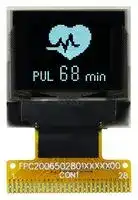


MCOT064048A1V-WM
Graphic OLED, 64 x 48 Pixels, White on Black, 3V, I2C, Parallel, SPI, 18.46mm x 18.1mm, -40 °C
- Manufacturer: MIDAS DISPLAYS
- Product type: Graphic OLED Displays
- Resolution:64 x 48 Pixels; Display Appearance:White on Black; Logic Voltage:3V; Interface Type:I2C, Parallel, SPI; Module Size:18.46mm x 18.1mm; Operating Temperature Min:-40°C;
- MSL: -
- SVHC: No SVHC (25-Jun-2025)
- Resolution: 64 x 48 Pixels
- Module Size: 18.46mm x 18.1mm
- Logic Voltage: 3V
- Product Range: -
- Interface Type: I2C, Parallel, SPI
- Display Appearance: White on Black
- Display Construction: TAB
- Operating Temperature Max: 80°C
- Operating Temperature Min: -40°C
| Delivery and price | |
|---|---|
| Units per pack | 250 |
| Price | 5.15 € |
| Current stock | 10+ |
| Lead time | 30 days |

**Sauls Wharf House Crittens Road Great Yarmouth Norfolk NR31 0AG**

Telephone +44 (0)1493 602602 Email:sales@midasdisplays.com Email:tech@midasdisplays.com www.midasdisplays.com

|MCOT064048A1V-WM|MCOT064048A1V-WM|64 x 48|64 x 48|OLED Module|
|---|---|---|---|---|
|**Specification**|||||
|Version:    1|||Date:01/10/2016||
|**Revision**|||||
|1|29/09/2016||First Issue||


|DisplayFeatures|DisplayFeatures|||
|---|---|---|---|
|Resolution|64 x 48|||
|Appearance|White on Black|||
|Logic Voltage|3V|||
|Interface|Multi|||
|Module Size|18.46 x 18.10 x 1.30mm|||
|OperatingTemperature|-40°C ~ +80°C|BoxQuantity|Weight / Display|
|Construction|COT|---|---|


* - For full design functionality, please use this specification in conjunction with the SSD1306BZ specification. (Provided Separately)

|**Display Accessories**|**Display Accessories**||**Optional Variants**||
|---|---|---|---|---|
|**Part Number**|**Description**||**Appearance**|**Voltage**|
||||Blueon Black||
||||Yellow on Black||


Page 1 of 18

## **General Specification**

The Features is described as follow:

- Module dimension: 18.46 × 18.10 × 1.3 mm

- Active area: 13.42 × 10.06 mm

- Dot Matrix: 64 x 48 Dots

- Pixel size: 0.185 × 0.185 mm

- Pixel pitch: 0.210 × 0.210 mm

- Display Mode: Passive Matrix

- Drive Duty: 1/48 Duty

- Display Color: White

- IC: SSD1306BZ

- SIZE:0.66 inch

Page 2 of 18

**Interface Pin Function**

No. Symbol Function 1 ESD-GND It should be connected to ground. 2 C2N _Positive Terminal of the Flying Inverting Capacitorr Negative Terminal of_ 3 C2P _the Flying Boost Capacitor_ The charge-pump capacitors are required 4 C1P between the terminals. They must be floated when the converter is not 5 C1N used. _Power Supply for DC/DC Converter Circuit_ This is the power supply pin for the internal buffer of the DC/DC voltage 6 VBAT converter. It must be connected to external source when the converter is used. It should be connected to VDD when the converter is not used. 7 VSS This is a ground pin. ~~ce~~ 8 VDD Power supply pin for core logic operation. 9 BS1 MCU bus interface selection pins. Table : MCU Bus Interface Pin Selection **SSD1306B I[2] C 6800-parallel 8080-parallel 4-wire Serial Pin Name Interface interface (8 bit) interface(8 bit) interface** 10 BS2 BS0 0 0 0 0 BS1 1 0 1 0 BS2 0 1 1 0 _Chip Select_ 11 CS# This pin is the chip select input. The chip is enabled for MCU ~~=.~~ communication only when CS# is pulled low. _Power Reset for Controller and Driver_ 12 RES# This pin is reset signal input. When the pin is low, initialization of the chip is executed. This is Data/Command control pin. When it is pulled HIGH (i.e. connect to VDD), the data at D[7:0] is treated as data. When it is pulled LOW, the data at D[7:0] will be transferred to the 13 D/C# command register. In I2C mode, this pin acts as SA0 for slave address selection. When 3-wire serial interface is selected, this pin must be connected to ~~pe~~ VSS. This is read / write control input pin connecting to the MCU interface. When interfacing to a 6800-series microprocessor, this pin will be used as Read/Write (R/W#) 14 R/W# selection input. Read mode will be carried out when this pin is pulled HIGH (i.e. connect to VDD) ~~ff~~ and write mode when LOW.

Page 3 of 18

|15|E/RD#|When interfacing to a 6800-series microprocessor, this pin will be used as<br>the Enable (E) signal.<br>Read/write operation is initiated when this pin is pulled HIGH (i.e. connect<br>to VDD) and the chip<br>is selected.<br>When connecting to an 8080-series microprocessor, this pin receives the<br>Read (RD#) signal. Read<br>operation is initiated when this pin is pulled LOW and the chip is selected.<br>When serial or I2C interface is selected, this pin must be connected to<br>VSS|
|---|---|---|
|16~23|16~23<br>D0~D7|These are 8-bit bi-directional data bus to be connected to the<br>microprocessor’s data bus. When<br>serial interface mode is selected, D0 will be the serial clock input: SCLK;<br>D1 will be the serial<br>data input: SDIN.<br>When I2C mode is selected, D2, D1 should be tied together and serve as<br>SDAout, SDAin in<br>application and D0 is the serial clock input, SCL.|
|24|IREF|This is segment output current reference pin.<br>When external IREF is used, a resistor should be connected between this<br>pin and VSS to maintain<br>the IREF current at a maximum of 30uA. Please refer to Figure 7-15 for the<br>details of resistor<br>value.<br>When internal IREF is used, this pin should be kept NC.|
|25|VCOMH|_Voltage Output High Level for COM Signal_<br>This pin is the input pin for the voltage output high level for COM signals. A<br>capacitor should be connected between this pin and VSS.|
|26|VCC|_Power Supply for OEL Panel_<br>This is the most positive voltage supply pin of the chip. A stabilization<br>capacitor should be connected between this pin and VSS when the<br>converter is used. It must be connected to external source when the<br>converter is not used.|
|27|VLSS|This is an analog ground pin. It should be connected to VSS externally.|
|28|ESDGND I|ND It should be connected to ground.|


Page 4 of 18

## **Contour Drawing & Block Diagram**

**==> picture [420 x 333] intentionally omitted <==**

**----- Start of picture text -----**<br>
18.46¡ À0.2 1 ESD GND<br>0.50 17.46(Polarizer) 2 C2N<br>3 C2P<br>1.52 15.42(VA)<br>2.52 13.42(AA) 1.30¡ À0.30.55¡ À0.1 45 C1NC1P<br>0.50¡ À0.07 6 VBAT<br>PULL 7 VSS<br>TAPE 8 VDD<br>9 BS1<br>bath e ——_, |<br>10 BS2<br>11 CS#<br>12 RES#<br>64*48 13 D/ C#<br>14 R/ W#<br>15 E/ RD#<br>16 D0<br>17 D1<br>1! ¢ 18 D2<br>Polarizer 19 D3<br>Silicon 20 D4<br>Po Ay’ 21 D5<br>Protective tape Glue 22 D6<br>!!- 2324 I REFD7<br>| 1 G4 28 2526 VCOMHVCC<br>16.75¡ À0.10.32¡ À0.05 0.90 Contact 2728 ESD GNDVLSS<br>Contact<br>P0.65*27=17.55¡ À0.05 0.50<br>18.55¡ À0.2 0.12¡ À0.05<br>0.210<br>The non-specified tolerance of dimension is  0.3mm.<br>0.185<br>— i<br>SCALE:20/1<br>ii Dots Size<br>?  0.80¡ À0.1<br>2-<br>0.50 1.10 2.10<br>14.26<br>18.10¡ À0.2 13.26(Polarizer) 12.06(VA) 10.06(AA)<br>(27.90)<br>9.80¡ À0.5<br>5.00¡ À0.2 4.10¡ À0.21.50¡ À0.3<br>0.210 0.185<br>**----- End of picture text -----**<br>


Page 5 of 18

## **FUNCTION BLOCK DIAGRAM**

*For more information, please refer to Application Note provided by Midas Displays.

Page 6 of 18

## **Absolute Maximum Ratings**

|Parameter|Symbol|Min|Max|Unit|Notes|
|---|---|---|---|---|---|
|Supply Voltage for Logic|VDD|0|4|V|1,2|
|Supply Voltage for Display|VCC|0|15|V|1,2|
|Operating Temperature|TOP|-40|+80|°C|—|
|Storage Temperature|TSTG|-40|+80|°C|—|


Note 1: All the above voltages are on the basis of “VSS = 0V”.

Note 2: When this module is used beyond the above absolute maximum ratings, permanent breakage of the module may occur. Also, for normal operations, it is desirable to use this module under the conditions according to Section 6 “Electrical Characteristics”. If this module is used beyond these conditions, malfunctioning of the module can occur and the reliability of the module may deteriorate

## **Electrical Characteristics**

|**Item**|**Symbol**|**Condition**|**Min**|**Typ**|**Max**|**Unit**|
|---|---|---|---|---|---|---|
|Supply Voltage for Logic|VDD|-|2.8|3.0|3.3|V|
|Supply Voltage for Display|VCC|-|7.0|7.5|8.0|V|
|Input High Volt.|VIH|-|0.8×VDD|0.8×VDD<br>-|VDDIO|V|
|Input Low Volt.|VIL|-|0|-|0.2×VDD|0.2×VDD<br>V|
|Output High Volt.|VOH|-|0.9×VDD|0.9×VDD<br>-|VDDIO|V|
|Output Low Volt.|VOL|-|0|-|0.1×VDD|0.1×VDD<br>V|
|50% Check Board operating<br>Current|50% Check Board operating<br>ICC|VCC=7.5V|-|6.0|13.0|mA|


Page 7 of 18

## **Optical Characteristics**

|**Item**|**Symbol**|**Condition**|**Min**|**Typ**|**Max**|**Unit**|
|---|---|---|---|---|---|---|
|View Angle|(V)θ|-|160|-|-|deg|
||(H)φ|-|160|-|-|deg|
|Contrast Ratio|CR|Dark|2000:1|-|-|-|
|Response Time|T rise|-|-|10|-|μs|
||T fall|-|-|10|-|μs|
|Display with 50% check Board Brightness|||100|120|-|cd/m2|
|CIEx(White)||(CIE1931)|0.26|0.28|0.30|-|
|CIEy(White)||(CIE1931)|0.30|0.32|0.34|-|


## **OLED Lifetime**

|ITEM|Conditions|Min|Typ|Remark|
|---|---|---|---|---|
|Operating<br>Life Time|Ta=25℃<br>/ Initial 50% check board<br>brightness Typical Value|20,000 Hrs|-|Note|


## Notes:

1. Life time is defined the amount of time when the luminance has decayed to <50% of the initial value.

2. This analysis method uses life data obtained under accelerated conditions to extrapolate an estimated probability density function ( _pdf_ ) for the product under normal use conditions.

3. Screen saving mode will extend OLED lifetime.

Page 8 of 18

## **Reliability**

## **Content of Reliability Test**

|**Content of Reliability Testy Test Test**|**Content of Reliability Testy Test Test**|**Content of Reliability Testy Test Test**|**Content of Reliability Testy Test Test**|
|---|---|---|---|
|**Environmental Test**||||
|**Test Item**|**Content of Test**|**Test Condition**|**Applicable**<br>**Standard**|
|High<br>Temperature<br>storage|Endurance test applying the high<br>storage temperature for a long time.|80℃<br>240hrs|——|
|Low<br>Temperature<br>storage|Endurance test applying the low storage<br>temperature for a long time.|Endurance test applying the low storage<br>-40℃<br>240hrs|——|
|High<br>Temperature<br>Operation|Endurance test applying the electric<br>stress (Voltage & Current) and the<br>thermal stress to the element for a long<br>time.|80℃<br>240hrs|——|
|Low<br>Temperature<br>Operation|Endurance test applying the electric<br>stress under low temperature for a long<br>time.|-40℃<br>240hrs|——|
|High<br>Temperature/<br>Humidity<br>Storage|Endurance test applying the high<br>temperature and high humidity storage<br>for a long time.|60℃,90%RH<br>240hrs|——|
|Temperature<br>Cycle|Endurance test applying the low and<br>high temperature cycle.<br>-40℃25℃80℃<br>30min    5min     30min<br>1cycle|-40℃/80℃<br>100 cycles|——|
|Mechanical Test||||
|Vibration test|Endurance test applying the vibration<br>during transportation and using.|10~22Hz→1.5mmp-p<br>22~500Hz→1.5G<br>Total0.5hr|10~22Hz→1.5mmp-p<br>——|
|Shock test|Constructional and mechanical<br>endurance test applying the shock<br>during transportation.|50G Half sin<br>wave 11 ms<br>3 times of each<br>direction|——|
|Atmospheric<br>pressure test|Endurance test applying the<br>atmospheric pressure during<br>transportationby air.|115mbar<br>40hrs|——|
|Others||||
|Static<br>electricity test|Endurance test applying the electric<br>stress to the terminal.|VS=±600V(contact),<br>±800v(air),<br>RS=330Ω<br>CS=150pF<br>10 times|——|


*** Supply voltage for OLED system =Operating voltage at 25 ℃

Page 9 of 18

## **Test and measurement conditions**

1. All measurements shall not be started until the specimens attain to temperature stability. After the completion of the described reliability test, the samples were left at room temperature for 2 hrs prior to conducting the failure test at 23±5°C; 55±15% RH.

2. All-pixels-on is used as operation test pattern.

3. The degradation of Polarizer are ignored for High Temperature storage, High Temperature/ Humidity Storage, Temperature Cycle

## **Evaluation criteria**

1. The function test is OK.

2. No observable defects.

3. Luminance: > 50% of initial value.

4. Current consumption: within ± 50% of initial value.

## **APPENDIX:**

## **RESIDUE IMAGE**

Because the pixels are lighted in different time, the luminance of active pixels may reduce or differ from inactive pixels. Therefore, the residue image will occur. To avoid the residue image, every pixel needs to be lighted up uniformly.

Page 10 of 18

**Inspection specification**

NO Item Criterion AQL 01 Electrical 1.1 Missing vertical, horizontal segment, segment contrast Testing defect. 1.2 Missing character , dot or icon. 1.3 Display malfunction. 1.4 No function or no display. 0.65 1.5 Current consumption exceeds product specifications. 1.6 OLED viewing angle defect. 1.7 Mixed product types. 1.8 Contrast defect. ~~al~~ 02 Black or 2.1 White and black spots on display ≦ 0.25mm, no more than white three white or black spots present. spots on 2.2 Densely spaced: No more than two spots or lines within 2.5 OLED 3mm. (display only) 03 OLED 3.1 Round type : As black following drawing SIZE Acceptable Q ~~r~~ spots, Φ=( x + y ) / 2 ~~e~~ TY white Φ ≦ 0.10 Accept no spots, dense contamina 0.10 < 2 2.5 tion Φ ≦ 0.20 (non-displ 0.20 < 1 ay) Φ ≦ 0.25 0.25 < Φ 0 ~~==!~~ 3.2 Line type : (As following drawing) Length Width Acceptable Q TY --W ≦ 0.02 Accept no dense 2.5 L ≦ 3.0 0.02 < W ≦ 0.03 2 L ≦ 2.5 0.03 < W ≦ 0.05 --0.05 < W As round type ~~PES~~ 04 Polarizer bubbles If bubbles are visible, Size Φ Acceptable Q TY judge using black spot Φ ≦ 0.20 Accept no dense specifications, not easy 0.20 < Φ ≦ 0.50 3 2.5 to find, must check in 0.50 < Φ ≦ 1.00 2 specify direction. 1.00 < Φ 0 Total Q TY 3 ~~TT ==~~ Page 11 of 18

|NO<br>~~a~~|Item|Criterion|AQL|
|---|---|---|---|
|05<br>~~a~~|Scratches|Follow NO.3 OLED black spots, white spots, contamination||
|06|Chipped<br>glass|Symbols Define:<br>x: Chip length      y: Chip width     z: Chip thickness<br>k: Seal width       t: Glass thickness  a: OLED side length<br>L: Electrode pad length:<br>6.1 General glass chip :<br>6.1.1 Chip on panel surface and crack between panels:<br>z: Chip thickness<br>y: Chip width<br>x: Chip length<br>Z≦1/2t<br>Not over viewing<br>area<br>x≦1/8a<br>1/2t<z≦2t<br>Not exceed 1/3k<br>x≦1/8a<br>☉If there are 2 or more chips, x is total length of each chip.<br>6.1.2 Corner crack:<br>z: Chip thickness<br>y: Chip width<br>x: Chip length<br>Z≦1/2t<br>Not over viewing<br>area<br>x≦1/8a<br>1/2t<z≦2t<br>Not exceed 1/3k<br>x≦1/8a<br>☉If there are 2 or more chips, x is the total length of each chip.<br>x<br>K<br>We|2.5|


Page 12 of 18

**==> picture [474 x 508] intentionally omitted <==**

**----- Start of picture text -----**<br>
i NO Item  e Criterion  AQL<br>Symbols :<br>x: Chip length      y: Chip width     z: Chip thickness<br>k: Seal width       t: Glass thickness  a: OLED side length<br>L: Electrode pad length<br>6.2 Protrusion over terminal :<br>6.2.1 Chip on electrode pad :<br>Z<br>y: Chip width  x: Chip length  z: Chip thickness<br>y ≦ 0.5mm  x ≦ 1/8a  0  <  z  ≦  t<br>6.2.2 Non-conductive portion:<br>Li L<br>Glass<br>06  2.5<br>crack  nl pie Z yy ees z 7<br>A A<br>y: Chip width  x: Chip length  z: Chip<br>thickness<br>y ≦  L  x ≦ 1/8a  0  <  z  ≦  t<br>☉ If the chipped area touches the ITO terminal, over 2/3 of the ITO<br>must remain and be inspected according to electrode terminal<br>specifications.<br>☉ If the product will be heat sealed by the customer, the alignment<br>mark not be damaged.<br>6.2.3 Substrate protuberance and internal crack.<br>x<br>y: width  x: length<br>y ≦ 1/3L  x  ≦  a<br>**----- End of picture text -----**<br>


Page 13 of 18

|NO|Item|Criterion|AQL|
|---|---|---|---|
|07|Cracked<br>glass|The OLED with extensive crack is not acceptable.|2.5|
|08|Backlight<br>elements|8.1 Illumination source flickers when lit.<br>8.2 Spots or scratched that appear when lit must be judged.<br>Using OLED spot, lines and contamination standards.<br>8.3 Backlight doesn’t light or color wrong.|0.65<br>2.5<br>0.65|
|09|Bezel|9.1 Bezel may not have rust, be deformed or have<br>fingerprints, stains or other contamination.<br>9.2 Bezel must comply with job specifications.|2.5<br>0.65|
|10|PCB、COB|10.1 COB seal may not have pinholes larger than 0.2mm or<br>contamination.<br>10.2 COB seal surface may not have pinholes through to the<br>IC.<br>10.3 The height of the COB should not exceed the height<br>indicated in the assembly diagram.<br>10.4 There may not be more than 2mm of sealant outside the<br>seal area on the PCB. And there should be no more than<br>three places.<br>10.5 No oxidation or contamination PCB terminals.<br>10.6 Parts on PCB must be the same as on the production<br>characteristic chart. There should be no wrong parts,<br>missing parts or excess parts.<br>10.7 The jumper on the PCB should conform to the product<br>characteristic chart.<br>10.8 If solder gets on bezel tab pads, OLED pad, zebra pad<br>or screw hold pad, make sure it is smoothed down.|2.5<br>2.5<br>0.65<br>2.5<br>2.5<br>0.65<br>0.65<br>2.5|
|11|Soldering|11.1 No un-melted solder paste may be present on the PCB.<br>11.2 No cold solder joints, missing solder connections,<br>oxidation or icicle.<br>11.3 No residue or solder balls on PCB.<br>11.4 No short circuits in components on PCB.|2.5<br>2.5<br>2.5<br>0.65|


Page 14 of 18

|NO|Item|Criterion|AQL|
|---|---|---|---|
|12|General<br>appearance|12.1 No oxidation, contamination, curves or, bends on<br>interface Pin (OLB) of TCP.<br>12.2 No cracks on interface pin (OLB) of TCP.<br>12.3 No contamination, solder residue or solder balls on<br>product.<br>12.4 The IC on the TCP may not be damaged, circuits.<br>12.5 The uppermost edge of the protective strip on the<br>interface pin must be present or look as if it cause the<br>interface pin to sever.<br>12.6 The residual rosin or tin oil of soldering (component or<br>chip component) is not burned into brown or black color.<br>12.7 Sealant on top of the ITO circuit has not hardened.<br>12.8 Pin type must match type in specification sheet.<br>12.9 OLED pin loose or missing pins.<br>12.10 Product packaging must the same as specified on<br>packaging specification sheet.<br>12.11 Product dimension and structure must conform to<br>product specification sheet.|2.5<br>0.65<br>2.5<br>2.5<br>2.5<br>2.5<br>2.5<br>0.65<br>0.65<br>0.65<br>0.65|


Page 15 of 18

|**Check Item**|**Classification**|**Criteria**|
|---|---|---|
|No Display|Major|PTTTTTTTTTTTTT|
|Missing Line|Major|PTT TTT TTT TTT TT<br>PTT~~TTT~~<br>ET<br>SERRE<br>PTETTTTEE<br>ET<br>PyTEE<br>EEE<br>EECCA<br>SEREER BREE<br>SERGE ERR<br>SEEEEE ERR<br>L+HHHH<br>SEGRE ERR<br>SERGE ERE<br>LEEET|
|Pixel Short|Major|LE EET<br>Py eT<br>EEE<br>TE<br>PTT **T**T**T** **TTT** **T**TT **T**T<br>PTT<br>E<br>y<br>y<br>TTT<br>TTTTET<br>PPT<br>EEE EEE<br>PPE<br>~~EE~~<br>~~PTET TTTTTTETTy~~<br>TT<br>PTT|
|Darker Short|Major|~~EE~~<br>~~PTET TT TTT TET Ty~~<br>~~PTET~~<br>TT<br>PTT~~TT~~<br>ET<br>PTT **T**T E**E**E **E**TL<br>Py T<br>TT<br>T<br>T<br>TTT MTT<br>PTT TTEEE<br>TE<br>PPTEEE<br>~~EE~~~~**E**T~~<br>~~PyTTTELTLy~~<br>~~T~~|
|Wrong Display|Major|~~EE ~~~~**E**T~~<br>~~Py TTT ELT Ly~~<br>~~T~~<br>HHH aa ~~H+~~<br>BEGG GE Ee<br>SEREEE ER See<br>PTTTTT<br>TyTTT<br>PTTTT LLTT<br>SERGE 6<br>SERGE<br>G8 See<br>~~TTTTTTT~~<br>Ty<br>~~HTT~~TEPTTEE<br>Py|
|Un-uniform<br>B/A x 100% < 70%<br>A/C x 100% < 70%|Major|~~TT TT TTT~~<br>Ty<br>~~HTT~~ TEP TT EE<br>PyEE EEE<br>PETTTT TTT TTTTL<br>PTT **TT**T**TT**TTy **T**y<br>PET<br>TTT<br>L<br>PEE<br>EE<br>PE<br>EEE EETL<br>SERRE<br>ie<br>|ee]<br>LEE]<br>[Ieteemal<br>)ey|enak<br>inet<br>[EL| oc BRSMLight<br>Fiacel<br>|ey<br>ie|


Page 16 of 18

## **Precautions in use of OLED Modules**

(1) Avoid applying excessive shocks to module or making any alterations or modifications to it. (2) Don’t make extra holes on the printed circuit board, modify its shape or change the components of OLED display module.

(3) Don’t disassemble the OLED display module.

(4) Don’t operate it above the absolute maximum rating.

(5) Don’t drop, bend or twist OLED display module.

(6) Soldering: only to the I/O terminals.

(7) Storage: please storage in anti-static electricity container and clean environment.

(8) It's pretty common to use "Screen Saver" to extend the lifetime and Don't use fix information for long time in real application.

(9) Don't use fixed information in OLED panel for long time, that will extend "screen burn" effect time..

(10) Midas has the right to change the passive components, including R2and R3 adjust resistors.  (Resistors, capacitors and other passive components will have different appearance and color caused by the different supplier.)

(11) Midas have the right to change the PCB Rev. (In order to satisfy the supplying stability, management optimization and the best product performance...etc, under the premise of not affecting the electrical characteristics and external dimensions, Midas have the right to modify the version.)

## **Handling Precautions**

- (1) Since the display panel is being made of glass, do not apply mechanical impacts such us dropping from a high position.

- (2) If the display panel is broken by some accident and the internal organic substance leaks out, be careful not to inhale nor lick the organic substance.

- (3) If pressure is applied to the display surface or its neighborhood of the OLED display module, the cell structure may be damaged and be careful not to apply pressure to these sections.

- (4) The polarizer covering the surface of the OLED display module is soft and easily scratched. Please be careful when handling the OLED display module.

- (5) When the surface of the polarizer of the OLED display module has soil, clean the surface. It takes advantage of by using following adhesion tape.

- Scotch Mending Tape No. 810 or an equivalent

Never try to breathe upon the soiled surface nor wipe the surface using cloth containing solvent Also, pay attention that the following liquid and solvent may spoil the polarizer:

- Water

- Ketone

- Aromatic Solvents

- (6) Hold OLED display module very carefully when placing OLED display module into the System housing. Do not apply excessive stress or pressure to OLED display module. And, do not over bend the film with electrode pattern layouts. These stresses will influence the display performance. Also, secure sufficient rigidity for the outer cases.

Page 17 of 18

- (7) Do not apply stress to the LSI chips and the surrounding molded sections.

- (8) Do not disassemble nor modify the OLED display module.

- (9) Do not apply input signals while the logic power is off.

- (10) Pay sufficient attention to the working environments when handing OLED display modules to prevent occurrence of element breakage accidents by static electricity.

- Be sure to make human body grounding when handling OLED display modules.

- Be sure to ground tools to use or assembly such as soldering irons.

- To suppress generation of static electricity, avoid carrying out assembly work under dry environments.

- Protective film is being applied to the surface of the display panel of the OLED display

- module. Be careful since static electricity may be generated when exfoliating the protective film.

- (11) Protection film is being applied to the surface of the display panel and removes the protection film before assembling it. At this time, if the OLED display module has been stored surface of the display panel after removed of the film. In such case, remove the residue material by the method introduced in the above Section 5.

- (12) If electric current is applied when the OLED display module is being dewed or when it is placed under high humidity environments, the electrodes may be corroded and be careful to avoid the above.

## **Storage Precautions**

- (1) When storing OLED display modules, put them in static electricity preventive bags avoiding exposure to direct sun light nor to lights of fluorescent lamps. And, also, avoiding high temperature and high humidity environment or low temperature (less than 0°C) environments.(We recommend you to store these modules in the packaged state when they were shipped from Midas Displays. At that time, be careful not to let water drops adhere to the packages or bags nor let dewing occur with them.

- (2) If electric current is applied when water drops are adhering to the surface of the OLED display module, when the OLED display module is being dewed or when it is placed under high humidity environments, the electrodes may be corroded and be careful about the above.

## **Designing Precautions**

- (1) The absolute maximum ratings are the ratings which cannot be exceeded for OLED display module, and if these values are exceeded, panel damage may be happen.

- (2) To prevent occurrence of malfunctioning by noise, pay attention to satisfy the VIL and VIH specifications and, at the same time, to make the signal line cable as short as possible.

- (3) We recommend you to install excess current preventive unit (fuses, etc.) to the power circuit (VDD). (Recommend value: 0.5A)

- (4) Pay sufficient attention to avoid occurrence of mutual noise interference with the neighboring devices.

- (5) As for EMI, take necessary measures on the equipment side basically.

- (6) When fastening the OLED display module, fasten the external plastic housing section.

- (7) If power supply to the OLED display module is forcibly shut down by such errors as taking out the main battery while the OLED display panel is in operation, we cannot guarantee the quality of this OLED display module. Connection (contact) to any other potential than the above may lead to rupture of the IC.

Page 18 of 18
Updated at April 27, 2026
Midas Displays is a recognized specialist in the electronic display industry, dedicated to providing high-quality visual solutions tailored to a wide range of applications. Backed by a UK-based, in-house team of engineers, the company is known for its extensive technical knowledge and commitment to delivering fast, reliable service. This expertise ensures that designers and manufacturers receive best-in-class support when integrating displays into their projects. The core of the Midas Displays portfolio features an extensive selection of Liquid Crystal Displays (LCD). Ranging from standard character and graphic modules to advanced configurations, these LCD displays are engineered for exceptional clarity and durability. Designed to meet the rigorous demands of various industries, they provide reliable performance for both industrial and commercial applications requiring robust and cost-effective visual output. Complementing their primary LCD offerings, Midas Displays also provides a versatile range of Organic Light Emitting Diode (OLED) displays. These advanced modules deliver high-contrast, energy-efficient viewing solutions ideal for modern, compact electronic designs. To ensure seamless integration across all display types, the company supports its core products with a variety of complementary accessories, including touch screens, interconnects, and evaluation kits.
About Novapart
Novapart is a B2B electronic component broker specialising in stock shortages and cost reduction. We source hard-to-find parts and identify compliant alternatives across a catalogue of 410,000+ components from 500+ manufacturers.
Learn more →Stock Shortage Specialist
When a component is unavailable, discontinued or has an unacceptable lead time, we tap into our network of vetted European and Asian distributors to source what you need — without compromising on quality or traceability.
Request a quote →Compliant Alternatives
We identify pin-to-pin, electrically equivalent substitutes that meet the same certifications (RoHS, AEC-Q100, REACH) as your original specification — validated against datasheets, not just part numbers. Often at a lower cost.
BOM Analysis service →