
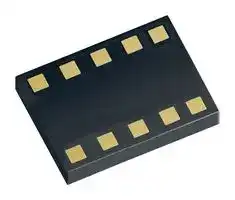


MAXM17532AMB+T
DC/DC POL Converter, Adjustable, Buck, Module, 4V to 42VIn, 0.9V to 5.5V/100mAOut, 900kHz, µSLIC-10
- Manufacturer: ANALOG DEVICES
- Product type: DC / DC Non Isolated Board Mount Converters - Adjustable Output
- DC / DC Converter Type:Module; Input Voltage Min:4V; Input Voltage Max:42V; No. of Outputs:1 Output; DC / DC Converter IC Case:µSLIC; No. of Pins:10Pins; Output Current:100mA; Output Vol
- MSL: MSL 3 - 168 hours
- SVHC: No SVHC (04-Feb-2026)
- Depth: 2.6mm
- Width: 3mm
- Height: 1.5mm
- Topology: Synchronous Buck (Step Down)
- No. of Pins: 10Pins
- Product Range: MAXM17532 Series
- No. of Outputs: 1 Output
- Output Current: 100mA
- Output Power Max: -
- Input Voltage Max: 42V
- Input Voltage Min: 4V
- Output Current Max: 100mA
- Output Voltage Max: 5.5V
- Output Voltage Min: 900mV
- Switching Frequency: 900kHz
- Input Voltage DC Max: 42V
- Input Voltage DC Min: 4V
- DC / DC Converter Type: uSLIC-10, Module
- DC / DC Converter IC Case: µSLIC
- Operating Temperature Max: 125°C
- Power Supply Applications: Industrial
- DC / DC Converter Output Type: Adjustable
| Delivery and price | |
|---|---|
| Units per pack | 500 |
| Price | 4.17 € |
| Current stock | 50+ |
| Lead time | 30 days |

**EVALUATION KIT AVAILABLE**

## **MAXM17532**

## **4V to 42V, 100mA, Himalaya uSLIC Step-Down Power Module**

## **General Description**

The Himalaya series of voltage regulator ICs and power modules enable cooler, smaller, and simpler powersupply solutions. The MAXM17532 is a high-efficiency, synchronous, step-down DC-DC power module with integrated controller, MOSFETs, compensation components, and inductor that operates over a wide input-voltage range. The module operates from 4V to 42V input and delivers up to 100mA output current over a programmable output voltage from 0.9V to 5.5V. The module significantly reduces design complexity, manufacturing risks and offers a true “plug and play” power supply solution, reducing the time-to-market.

The MAXM17532 employs peak-current-mode control architecture. To reduce input inrush current, the device offers a soft-start feature including the default soft-start time of 5.1ms.

The MAXM17532 is available in a low profile, compact 10-pin 2.6mm x 3mm x 1.5mm uSLIC™ package.

## **Applications**

- Industrial Sensors and Encoders

- 4-20mA Current-Loop Powered Sensors

- LDO Replacement

- HVAC and Building Control

- Battery-Powered Equipment

## **Benefits and Features**

- Easy to use

   - Wide 4V to 42V Input

   - Adjustable 0.9V to 5.5V Output

   - ±1.75% Feedback Accuracy

   - Up to 100mA Output Current

   - Internally Compensated

   - All Ceramic Capacitors

- High Efficiency

   - Fixed-Frequency PWM

   - Shutdown Current as Low as 1.2μA (typ)

- Flexible Design

   - Programmable Soft-Start and Prebias Startup

   - Open-Drain Power Good Output ( RESET Pin)

   - Programmable EN/UVLO Threshold

- Robust Operation

   - Hiccup Overcurrent Protection

   - Overtemperature Protection

   - -40°C to +125°C Ambient OperatingTemperature / -40°C to +150°C Junction Temperature

- Rugged

   - Complies with CISPR22 (EN55022) Class B Conducted and Radiated Emissions.

   - Passes Drop, Shock, and Vibration Standards– JESD22–B103, B104, B111

## _**Ordering Information appears at end of data sheet.**_

_uSLIC is a trademark of Maxim Integrated Products, Inc._

## **Typical Application Circuit**

**==> picture [506 x 171] intentionally omitted <==**

**----- Start of picture text -----**<br>
VIN MAXM17532 VOUT<br>24V 5V, 100mA<br>IN OUT<br>CIN COUT<br>2.2µF   EN/UVLO GND 10µF R1<br>261kΩ<br>RESET<br>FB<br>RT/SYNC<br>R2<br>R3 LX SS 49.9kΩ<br>69.8kΩ<br>CIN = 2.2µF: C2012X7R1H225K125AC<br>COUT = 10µF: GRM21BR70J106K<br>**----- End of picture text -----**<br>


**==> picture [125 x 31] intentionally omitted <==**

_19-100038; Rev 3; 3/18_

## MAXM17532

## 4V to 42V, 100mA, Himalaya uSLIC Step-Down Power Module

## **Absolute Maximum Ratings**

IN, EN/UVLO to GND ............................................-0.3V to +48V LX to GND .......................................................-0.3V to IN +0.3V OUT to GND ............................................................-0.3V to +7V RT/SYNC, SS, FB, RESET , MODE to GND ...........-0.3V to +6V Output Short-Circuit Duration ....................................Continuous

Junction Temperature (Note 1) ........................................+150°C Storage Temperature Range ............................ -55°C to +125°C Lead Temperature (soldering, 10s) .................................+260°C Soldering Temperature (reflow) .......................................+260°C

_Stresses beyond those listed under “Absolute Maximum Ratings” may cause permanent damage to the device. These are stress ratings only, and functional operation of the device at these or any other conditions beyond those indicated in the operational sections of the specifications is not implied. Exposure to absolute maximum rating conditions for extended periods may affect device reliability._

## **Package Information**

|**Package Information**|**Package Information**|
|---|---|
|**PACKAGE TYPE: 10-PIN uSLIC**||
|Package Code|M102A3+1|
|Outline Number|**21-100094**|
|Land Pattern Number|**90-100027**|
|**THERMAL RESISTANCE FOUR-LAYER BOARD (Note 2)**||
|Junction to Ambient (θJA)|30.6°C/W|


For the latest package outline information and land patterns (footprints), go to **www.maximintegrated.com/packages** . Note that a “+”, “#”, or “-” in the package code indicates RoHS status only. Package drawings may show a different suffix character, but the drawing pertains to the package regardless of RoHS status.

- **Note 1:** Junction temperature greater than +125°C degrades operating lifetimes

- **Note 2:** Package thermal resistance measured on Evaluation Board, Natural convection. For detailed information on package thermal considerations, refer to **www.maximintegrated.com/thermal-tutorial** .

Maxim Integrated  │ 2

www.maximintegrated.com

## MAXM17532

## 4V to 42V, 100mA, Himalaya uSLIC Step-Down Power Module

## **Electrical Characteristics**

(VIN = 24V, VGND = 0V, VFB = 0.85V, VEN/UVLO = 1.5V, RT/SYNC = 69.8kΩ, LX = SS = RESET = unconnected; TA = -40°C to +125°C, unless otherwise noted. Typical values are at TA = +25°C. All voltages are referenced to GND, unless otherwise noted) (Note 3)

|**PARAMETER**|**SYMBOL**|**CONDITIONS**|**MIN**<br>**TYP**<br>**MAX**|**UNITS**|
|---|---|---|---|---|
|**INPUT SUPPLY (IN)**|||||
|Input Voltage Range|VIN||4<br>42|V|
|Input Shutdown Current|IIN-SH|VEN/UVLO= 0V, TA= +25°C|0.67<br>1.2<br>2.25|µA|
|Input Supply Current|IQ-PWM|VFB= Normal switching, VMODE= 0V,<br>VOUT= 3.3V|800<br>1100<br>1950||
|**MODULE OUTPUT PIN (OUT)**|||||
|Output Line Regulation<br>Accuracy||VIN= 4V to 42V, VOUT= 3.3V,<br>ILOAD= 0|0.1|mV/V|
|Output Load Regulation<br>Accuracy||Tested with IOUT= 0A and 100mA<br>VOUT= 3.3V|0.3|mV/mA|
|**ENABLE/UVLO (EN/UVLO)**|||||
|EN/UVLO Threshold|VENR|VEN/UVLOrising|1.2<br>1.25<br>1.3|V|
||VENF|VEN/UVLOfalling|1.1<br>1.15<br>1.2||
||VEN-TRUESD|VEN/UVLOfalling, true shutdown|0.72||
|EN/UVLO Leakage Current|IEN|VEN/UVLO= 1.3V, TA= +25°C|-100<br>+100|nA|
|**LX**|||||
|LX Leakage Current|ILX-LKG|VEN= 0V, TA= +25°C,VLX= (VGND+ 1V)<br>to (VIN- 1V) VOUT= foat|-1<br>+1|µA|
|**SOFT-START (SS)**|||||
|Soft-Start Time|tSS|No SS cap|4.4<br>5.1<br>5.8|ms|
|SS Charging Current|ISS|VSS= 0.4V|4.7<br>5<br>5.3|µA|
|**FEEDBACK (FB)**|||||
|FB Regulation Voltage|VFB-REG||0.786<br>0.8<br>0.814|V|
|FB Input Leakage Current|IFB|VFB= 0.81V, TA= 25°C|-100<br>+120|nA|
|**CURRENT LIMIT**|||||
|VOUTCurrent-Limit|ISOURCE-LIMIT||100<br>178|mA|
|VOUTCurrent-Limit|ISINK-LIMIT||-74<br>-50|mA|


Maxim Integrated  │ 3

www.maximintegrated.com

## MAXM17532

## 4V to 42V, 100mA, Himalaya uSLIC Step-Down Power Module

## **Electrical Characteristics (continued)**

(VIN = 24V, VGND = 0V, VFB = 0.85V, VEN/UVLO = 1.5V, RT/SYNC = 69.8kΩ, LX = SS = RESET = unconnected; TA = -40°C to +125°C, unless otherwise noted. Typical values are at TA = +25°C. All voltages are referenced to GND, unless otherwise noted) (Note 3)

|**PARAMETER**|**SYMBOL**|**CONDITIONS**|**MIN**|**TYP**|**MAX**|**UNITS**|
|---|---|---|---|---|---|---|
|**OSCILLATOR (RT/SYNC)**|||||||
|Switching Frequency|fSW|RRT= 422kΩ|85<br>100<br>120|||kHz|
|||RRT= 191kΩ|200<br>220<br>250||||
|||RRT= 130kΩ|295<br>322<br>350||||
|||RRT= 69.8kΩ|540<br>600<br>640||||
|||RRT= 45.3kΩ|813<br>900<br>973||||
|Switching Frequency<br>Adjustable Range||See the Switching Frequency<br>(RT/SYNC) section for details|100<br>900|||kHz|
|SYNC Input Frequency|||1.1 x<br>fSW<br>900|||kHz|
|SYNC Pulse Minimum<br>Of-Time|||40|||ns|
|SYNC Rising Threshold|VSYNC-H||1<br>1.22<br>1.48|||V|
|Hysteresis|VSYNC-HYS||0.115<br>0.18<br>0.265||||
|Number of SYNC Pulses to<br>Enable Synchronization|||1|||Cycles|
|**TIMING**|||||||
|Minimum On-Time|tON-MIN||46<br>90<br>152|||ns|
|Maximum Duty Cycle|DMAX|VFB= 0.98 x VFB-REG<br>FSW= 600kHz|90<br>94<br>98|||%|
|||600kHz < fSW< 900kHz,<br>VFB= 0.98 x VFB-REG|87<br>92||||
|Hiccup Timeout|||51|||ms|
|**RESET**|||||||
|FB Threshold forRESET<br>Rising|VFB-OKR|VFBrising|93<br>95<br>97|||%|
|FB Threshold forRESET<br>Falling|VFB-OKF|VFBfalling|90<br>92<br>94|||%|
|RESETDelay after FB<br>Reaches 95% Regulation|||2.08|||ms|
|RESETOutput Level Low||IRESET= 1mA|0.23|||V|
|RESETOutput Leakage<br>Current||VFB= 1.01 x VFB-REG,TA= +25°C|1|||µA|
|**THERMAL SHUTDOWN**|||||||
|Thermal-Shutdown Threshold||Temperature rising|160|||°C|
|Thermal-Shutdown Hysteresis|||20|||°C|


**Note 3:** All limits are 100% tested at +25°C. Limits over temperature are guaranteed by design.

Maxim Integrated  │ 4

www.maximintegrated.com

## MAXM17532

## 4V to 42V, 100mA, Himalaya uSLIC Step-Down Power Module

## **Typical Operating Characteristics**

(VIN = 24V, VEN/UVLO = 1.5V, RT/SYNC = 69.8kΩ, TA = +25°C unless otherwise noted)

**==> picture [474 x 315] intentionally omitted <==**

**----- Start of picture text -----**<br>
EFFICIENCY vs. LOAD CURRENT EFFICIENCY vs. LOAD CURRENT LOAD AND LINE REGULATION<br>100 (3.3V OUTPUT, PWM MODE)  toc01 100 (5V OUTPUT, PWM MODE) toc02 3.350 (3.3V OUTPUT, PWM MODE) toc03<br>90 HEE 90 HUET TTT 3.345 VIN = 6V VIN = 24V<br>3.340<br>80 80<br>70 PeiAleeeere aesecnnnaassseeee 70 |I eoasLeer 3.335 i<br>3.330<br>60 HA ACT 60 ANE V INTT IN = 36V EN 3.325 OE A AAGA<br>50 AA | VIN = 24V VIN = 36V HAL 50 HY LT VIN = 24V VIN = 42V 3.320<br>40 WON VIN = 12V i HEE 40 WL VIN = 12V Doi 3.315 VIN = 12V VIN = 36V<br>30 WN EEE 30 WET TTT 3.310<br>20 VIN = 6V 20 3.305<br>WL LTE T T T<br>10 PLU 10 AULT ETT 3.300 0 10 20 30 40 50 60 70 80 90 100<br>0 20 40 60 80 100 0 20 40 60 80 100<br>LOAD CURRENT (mA) LOAD CURRENT (mA) LOAD CURRENT (mA)<br>LOAD AND LINE REGULATION SOFT-START FROM EN/UVLO  SOFT-START  FROM EN/UVLO<br>5.05 (5V OUTPUT, PWM MODE) toc04 (3.3V OUTPUT, 100MA LOAD CURRENT, PWM MODE) toc05 (5V OUTPUT, 100mA LOAD CURRENT, PWM MODE) toc06<br>5.00<br>4.95 | VEN/UVLO 5V/div VEN/UVLOEN/UVLO<br>4.90 VIN = 24V<br>4.85 VIN = 12V VIN = 42V VIN = 36V 1V/div<br>4.80 VOUT VOUTOUT<br>IOUT 50mA/div IOUTOUT<br>4.75<br>VRESET 5V/div VRESETRESET<br>4.70 ia<br>0 10 20 30 40 50 60 70 80 90 100<br>LOAD CURRENT (mA) 1ms/div 1ms/div<br>EFFICIENCY (%) EFFICIENCY (%)<br>OUTPUT  VOLTAGE (V)<br>OUTPUT  VOLTAGE (V)<br>**----- End of picture text -----**<br>


**==> picture [151 x 136] intentionally omitted <==**

**----- Start of picture text -----**<br>
SOFT-START  FROM EN/UVLO<br>(5V OUTPUT, 100mA LOAD CURRENT, PWM MODE)<br>toc06<br>VEN/UVLOEN/UVLO 5V/div<br>VOUTOUT 2V/div<br>IOUTOUT 50mA/div<br>VRESETRESET 5V/div<br>1ms/div<br>**----- End of picture text -----**<br>


**==> picture [495 x 142] intentionally omitted <==**

**----- Start of picture text -----**<br>
SHUTDOWN FROM EN/UVLO  SOFT-START WITH 3V PREBIAS  SOFT-START WITH 3V PREBIAS,<br>(5V OUTPUT, 100mA LOAD CURRENT, PWM MODE) (5V OUTPUT, NO LOAD, PWM MODE) (5V OUTPUT, 100mA LOAD CURRENT, PWM MODE)<br>TOC07 toc08 toc09<br>VEN/UVLO 5V/div 5V/div<br>VOUT 5V/div VEN/UVLO 1V/div VEN/UVLO 2V/div<br>VOUT<br>100mA/div<br>IOUT 2V/div IOUT<br>VRESET 50mA/div VOUT 5V/div VRESET 5V/div<br>1ms/div 5V/div VRESET 1ms/div 1ms/div<br>**----- End of picture text -----**<br>


Maxim Integrated  │ 5

www.maximintegrated.com

## MAXM17532

## 4V to 42V, 100mA, Himalaya uSLIC Step-Down Power Module

**Typical Operating Characteristics (continued)** (VIN = 24V, VEN/UVLO = 1.5V, RT/SYNC = 69.8kΩ, TA = +25°C unless otherwise noted)

**==> picture [501 x 317] intentionally omitted <==**

**----- Start of picture text -----**<br>
STEADY-STATE SWITCHING WAVEFORMS  STEADY-STATE SWITCHING WAVEFORMS<br>(5V OUTPUT,  NO LOAD, PWM MODE) (5V OUTPUT, 0.1A LOAD CURRENT, PWM MODE) AVERAGE CURRENT LIMIT<br>toc10 toc11 240 toc12<br>230<br>V(AC)OUT 10mV/div V(AC)OUT 10mV/div 220 TEMP = 85°C<br>210<br>200<br>190<br>180 TEMP = 25 ° C TEMP = -40 ° C<br>VLX 10V/div VLX 10V/div 170<br>160 ea<br>2 μ s/div 2 μ s/div 0 5 10 15 20 25 30 35 40 45<br>INPUT VOLTAGE (V)<br>LOAD CURRENT TRANSIENT RESPONSE<br>SWITCHING FREQUENCY  SHUTDOWN CURRENT<br>vs. INPUT VOLTAGE vs. INPUT VOLTAGE (VIN = 24V, VOUT = 5V, IOUT = 0.05A TO 0. 1 A)<br>630 toc13 3.0 toc14 toc15<br>620 2.5<br>50mV/div<br>610 2.0 25°C VOUT (AC COUPLED)<br>600<br>1.5<br>590<br>-40°C<br>25°C 1.0<br>580 85°C<br>570 0.5 TEMP = 25 ° C<br>IOUT 50mA/div<br>560 0.0<br>0 5 10 15 20 25 30 35 40 45 0 7 14 21 28 35 42 100µs/div<br>INPUT VOLTAGE (V) INPUT VOLTAGE (V)<br>AVERAGE CURRENT LIMIT (mA)<br>SWITCHING FREQUENCY (kHz) SHUTDOWN CURRENT (µA)<br>**----- End of picture text -----**<br>


**==> picture [492 x 143] intentionally omitted <==**

**----- Start of picture text -----**<br>
LOAD CURRENT TRANSIENT RESPONSE LOAD CURRENT TRANSIENT RESPONSE LOAD CURRENT TRANSIENT RESPONSE<br>(VIN = 24V, VOUT = 3.3V, IOUT = 0.05A TO 0. toc161 A) (VIN = 24V, VOUT = 5V, IOUT = 0A TO 0.05A) toc17 (VIN = 24V, VOUT = 3.3V, IOUT = 0A TO 0.05A)<br>toc18<br>VOUT 50mV/div (AC  VOUT 50mV/div (AC COUPLED) VOUT 50mV/div (AC COUPLED)<br>COUPLED)<br>IOUT<br>IOUT 50mA/div IOUT 50mA/div<br>50mA/div<br>FEE<br>200µs/div 100µs/div 200µs/div<br>**----- End of picture text -----**<br>


Maxim Integrated  │ 6

www.maximintegrated.com

## MAXM17532

## 4V to 42V, 100mA, Himalaya uSLIC Step-Down Power Module

## **Typical Operating Characteristics (continued)**

(VIN = 24V, VEN/UVLO = 1.5V, RT/SYNC = 69.8kΩ, TA = +25°C unless otherwise noted)

**==> picture [488 x 336] intentionally omitted <==**

**----- Start of picture text -----**<br>
EXTERNAL SYNCHRONIZATION<br>WITH 900kHz CLOCK FREQUENCY OVERLOAD PROTECTION OVERLOAD PROTECTION<br>(VIN = 24V, VOUT = 5V, IOUT = 0.1A)  toc20 toc21<br>toc19<br>VOUT 2V/div<br>VLX 10V/div<br>IOUT 100mA/div<br>LX 20V/div<br>2V/div<br>VSYNC<br>20ms/div 40µs/div<br>2µs/div<br>BODE PLOT BODE PLOT<br>(VIN = 24V,  VOUT = 5V, IOUT = 0.1A) (VIN = 24V, VOUT = 3.3V, IOUT = 0.1A)<br>40 toc22 80 40 toc23 80<br>30 PHASE 70 30 PHASE 70<br>60<br>20 SS S HT 60 20 EE II I<br>PN A ONT LIT ONE 50<br>10 50 10 40<br>0 Mm IN th 40 0 —s \ 30<br>-10 GAIN 30 -10 GAIN 20<br>10<br>-20 Ea ni, 20 -20 pnail HN<br>-30 fPHASE MARGIN = 65.2CR = 22.3kHz,  ° 10 -30 fPHASE MARGIN = 59.8CR = 26.4kHz,  ° 0-10<br>-40 pA 0 -40 py -20<br>10 [3] 10 [4] aiiill 10 [5] 10 [3] 10 [4] alll 10 [5]<br>FREQUENCY (Hz)<br>FREQUENCY (Hz)<br>GAIN (dB) ) ° PHASE ( GAIN (dB) ) ° PHASE (<br>**----- End of picture text -----**<br>


Maxim Integrated  │ 7

www.maximintegrated.com

## MAXM17532

## 4V to 42V, 100mA, Himalaya uSLIC Step-Down Power Module

## **Pin Configuration**

**==> picture [505 x 192] intentionally omitted <==**

**----- Start of picture text -----**<br>
TOP VIEW<br>+<br>LX 1 10 IN<br>GND 2 9 EN/UVLO<br>MAXM17532<br>GND 3 8 RT/SYNC<br>RESET 4 7 SS<br>OUT 5 6 FB<br>(“+” INDICATES PIN 1 OF THE MODULE)<br>**----- End of picture text -----**<br>


## **Pin Description**

|**PIN NAME**|**PIN #**|**FUNCTION**|
|---|---|---|
|LX|1|Switching Node. LX is high impedance when the device is in shutdown. Do not connect any external<br>components to this pin.|
|GND|2, 3|Ground. Connect GND to the power ground plane. Connect all the circuit ground connections together<br>at a single point. See the_PCB Layout Guidelines_section.|
|RESET|4|Open-Drain Reset Output. Pull upRESETto an external power supply less than or equal to 5.5V with<br>an external resistor.RESETpulls low if FB drops below 92% of its set value.RESETgoes high 2ms<br>after FB rises above 95% of its set value.|
|OUT|5|Module output pin. Connect a capacitor from OUT to GND. See PCB Layout Guidelines section for<br>more connection details.|
|FB|6|Output Feedback Connection. Connect FB to a resistor-divider between OUT and GND to set the<br>output voltage.|
|SS|7|Soft-Start Capacitor Input. Connect a capacitor from SS to GND to set the soft-start time. Leave SS<br>unconnected for default 5.1ms internal soft-start.|
|RT/SYNC|8|Oscillator Timing Resistor Input. Connect a resistor from RT/SYNC to GND to program the switching<br>frequency from 100kHz to 900kHz. See the_Switching Frequency (RT/SYNC)_section for details. An<br>external pulse can be applied to RT/SYNC through a coupling capacitor to synchronize the internal<br>clock to the external pulse frequency.|
|EN/UVLO|9|Active-High, Enable/Undervoltage-Detection Input. Pull EN/UVLO to GND to disable the module<br>output. Connect EN/UVLO to IN for always-on operation. Connect a resistor-divider between IN, EN/<br>UVLO, and GND to program the input voltage at which the module is enabled and turns on.|
|IN|10|Power Module Input. Connect a ceramic capacitor from IN to GND for bypassing. Place the capacitor<br>close to the IN and PGND pins. See_Component Selection_tables for more details.|


Maxim Integrated  │ 8

www.maximintegrated.com

## MAXM17532

## 4V to 42V, 100mA, Himalaya uSLIC Step-Down Power Module

## **Functional Diagram**

**==> picture [505 x 388] intentionally omitted <==**

**----- Start of picture text -----**<br>
MAXM17532<br>IN<br>LDO<br>HIGH-SIDE DRIVER<br>RT/SYNC OSCILLATOR LX<br>PEAK<br>CURRENT-MODE 100µH<br> CONTROLLER O UT<br>EN/UVLO<br>1.25V LOW-SIDE DRIVER<br>GND<br>SS<br>RESET<br>FB<br>PGOOD LOGIC<br>0.76V<br>**----- End of picture text -----**<br>


## **Detailed Description**

The MAXM17532 high-voltage, synchronous step-down power module with integrated MOSFETs and inductor, operates over a 4V to 42V input voltage range. The module can deliver output current up to 100mA at output voltages of 0.9V to 5.5V. The feedback voltage is accurate to within ±1.75% over -40°C to +125°C.

The device uses an internally-compensated, peak current mode control architecture. On the rising edge of the internal clock, the high-side pMOSFET turns on. An internal error amplifier compares the feedback voltage to a fixed internal reference voltage and generates an error

voltage. The error voltage is compared to a sum of the current-sense voltage and a slope-compensation voltage by a PWM comparator to set the “on-time.” During the on-time of the pMOSFET, the inductor current ramps up. For the remainder of the switching period (off-time), the pMOSFET is kept off and the low-side nMOSFET turns on. During the off-time, the inductor releases the stored energy as the inductor current ramps down, providing current to the output. Under overload conditions, the cycleby-cycle current- limit feature limits inductor peak current by turning off the high-side pMOSFET and turning on the low-side nMOSFET.

Maxim Integrated  │ 9

www.maximintegrated.com

## MAXM17532

## **Enable Input (EN/UVLO) and Soft-Start (SS)**

When EN/UVLO voltage increases above 1.25V (typ), the device initiates a soft-start sequence and the duration of the soft-start depends on the status of the SS pin voltage at the time of power-up. If the SS pin is not connected, the device uses a fixed 5.1ms (typ) internal soft-start to ramp up the internal error-amplifier reference. If a capacitor is connected from SS to GND, a 5μA current source charges the capacitor and ramps up the SS pin voltage. The SS pin voltage is used as a reference for the internal error amplifier. Such a reference ramp up allows the output voltage to increase monotonically from zero to the final set value independent of the load current.

EN/UVLO can be used as an input voltage UVLO adjustment input. An external voltage-divider between IN and EN/UVLO to GND adjusts the input voltage at which the device turns on or off. See the _Setting the Input Undervoltage-Lockout Level_ section for details. If input UVLO programming is not desired, connect EN/UVLO to IN (see the _Electrical Characteristics_ table for EN/UVLO rising and falling-threshold voltages). Driving EN/UVLO low disables both power MOSFETs, as well as other internal circuitry, and reduces IN quiescent current to below 1.2μA. The SS capacitor is discharged with an internal pulldown resistor when EN/UVLO is low. If the EN/UVLO pin is driven from an external signal source, a series resistance of minimum 1kΩ is recommended to be placed between the signal source output and the EN/UVLO pin, to reduce voltage ringing on the line.

## **Switching Frequency (RT/SYNC)**

Switching frequency of the device can be programmed from 100kHz to 900kHz by using a resistor connected from RT/SYNC to GND. The switching frequency (fSW) is related to the resistor connected at the RT/SYNC pin (RT) by the following equation, where RT is in kΩ and fSW is in kHz:

**==> picture [54 x 25] intentionally omitted <==**

## 4V to 42V, 100mA, Himalaya uSLIC Step-Down Power Module

## **External Synchronization**

The RT/SYNC pin can be used to synchronize the device’s internal oscillator to an external system clock. The external clock should be coupled to the RT/SYNC pin through a 47pF capacitor, as shown in Figure 1. The external clock logic high level should be higher than 3V, logic low level lower than 0.5V and the duty cycle of the external clock should be in the range of 10% to 70%. The RT resistor should be selected to set the switching frequency 10% lower than the external clock frequency. The external clock should be applied at least 500μs after enabling the device for proper configuration of the internal loop compensation.

## **Reset Output ( RESET )**

The device includes an open-drain RESET output to monitor output voltage. RESET should be pulled up with an external resistor to the desired external power supply less than or equal to 5.5V. RESET goes high impedance 2ms after the output rises above 95% of its nominal set value and pulls low when the output voltage falls below 92% of the set nominal output voltage. RESET asserts low during the hiccup timeout period.

**==> picture [242 x 182] intentionally omitted <==**

**----- Start of picture text -----**<br>
MAXM17532<br>47pF<br>RT/SYNC<br>CLOCK<br>SOURCE RT<br>VLOGIC-HIGH<br>VLOGIC-LOW<br>DUTY<br>**----- End of picture text -----**<br>


_Figure 1. Synchronization to an External Clock_

The switching frequency in ranges of 130kHz to 160kHz and 230kHz to 280kHz are not allowed for user programming to ensure proper configuration of the internal adaptive-loop compensation scheme.

Maxim Integrated  │ 10

www.maximintegrated.com

## MAXM17532

## **Startup Into a Pre-biased Output**

The device supports monotonic startup into a pre-biased output. When the module starts into a pre-biased output, both the high-side and low-side switches are turned off so that the module does not sink current from the output. High-side and low-side switches do not start switching until the PWM comparator commands the first PWM pulse, at which point switching commences. The output voltage is then smoothly ramped up to the target value in alignment with the internal reference. Such a feature is useful in applications where digital integrated circuits with multiple rails are powered.

## **Operating Input-Voltage Range**

The maximum operating input voltage is determined by the minimum controllable on-time, while the minimum operating input voltage is determined by the maximum duty cycle and circuit voltage drops. The minimum and maximum operating input voltages for a given output voltage should be calculated as follows:

**==> picture [193 x 67] intentionally omitted <==**

where,

VOUT = Steady-state output voltage

IOUT = Maximum load current

fSW = Switching frequency (max)

DMAX = Maximum duty cycle

tON(MIN) = Worst case minimum controllable switch ontime (152ns).

## **Overcurrent Protection (OCP), Hiccup Mode**

The device implements a HICCUP-type overload protection scheme to protect the inductor and internal FETs under output short-circuit conditions. When the overcurrent event occurs, the part enters hiccup mode. In this mode, the part is initially operated with hysteretic cycleby-cycle peak-current limit that continues for a time period equal to twice the soft-start time. The part is then turned off for a fixed 51ms hiccup timeout period. This sequence of hysteretic inductor current waveforms, followed by a hiccup timeout period, continues until the short/overload

## 4V to 42V, 100mA, Himalaya uSLIC Step-Down Power Module

on the output is removed. Since the inductor current is bound between two limits, inductor current runway never happens.

## **Thermal Shutdown**

Thermal shutdown limits the total power dissipation in the module. When the junction temperature exceeds +160°C, an on-chip thermal sensor shuts down the device, turns off the internal power MOSFETs, allowing the device to cool down. The device turns on after the junction temperature cools by approximately 20°C.

## **Application Information**

## **Input Capacitor Selection**

Small ceramic input capacitors are recommended. The input capacitor reduces peak current drawn from the power source and reduces noise and voltage ripple on the input caused by the switching circuitry. It is recommended to select the input capacitor of the module to keep the input-voltage ripple under 2% of the minimum input voltage, and to meet the maximum ripple-current requirements.

## **Output Capacitor Selection**

Small ceramic X7R-grade output capacitors are recommended for the device. The output capacitor has two functions. It stores sufficient energy to support the output voltage under load transient conditions and stabilizes   the device’s internal control loop. Usually the output capacitor is sized to support a step load of 50% of the maximum output current in the application, such that the output voltage deviation is less than 3%. Calculate the minimum required output capacitance from the following equations:

|**FREQUENCY RANGE**<br>**(kHZ)**|**MINIMUM OUTPUT CA-**<br>**PACITANCE (µF)**|**MINIMUM OUTPUT CA-**<br>**PACITANCE (µF)**|
|---|---|---|
|100 to 130||OUT<br>50<br>V|
|160 to 230||OUT<br>25<br>V|
|280 to 900||OUT<br>17<br>V|


It should be noted that dielectric materials used in ceramic capacitors exhibit capacitance loss due to DC bias levels and should be appropriately de-rated to ensure the required output capacitance is obtained in the application.

Maxim Integrated  │ 11

www.maximintegrated.com

## MAXM17532

## **Soft Start Capacitor Selection**

The device offers a 5.1ms internal soft-start when the SS pin is left unconnected.  When adjustable soft-start time is required, connect a capacitor from SS to GND to program the soft-start time. The minimum soft-start time is related to the output capacitance (COUT) and the output voltage (VOUT) by the following equation:

**==> picture [115 x 10] intentionally omitted <==**

where tSS is in milliseconds and COUT is in µF.

Soft-start time (tSS) is related to the capacitor connected at SS (CSS) by the following equation:

**==> picture [73 x 10] intentionally omitted <==**

where tSS is in milliseconds and CSS is in nanofarads.

## **Setting the Input Undervoltage-Lockout Level**

The device offers an adjustable input undervoltage-lockout level. Set the voltage at which the device turns on with a resistive voltage-divider connected from IN to GND (see Figure 2). Connect the center node of the divider to EN/ UVLO. Choose R1 to be 3.3MΩ max and then calculate R2 as follows:

**==> picture [74 x 24] intentionally omitted <==**

where VINU is the voltage at which the device is required to turn on.

## **Adjusting the Output Voltage**

The output voltage can be programmed from 0.9V to 5.5V. Different output voltage needs to use different switching frequency (see Table 1). Set the output voltage by connecting a resistor-divider from output to FB to GND (see Figure 3). Choose R5 in the range of 25kΩ to 100kΩ and calculate R4 with the following equation:

## 4V to 42V, 100mA, Himalaya uSLIC Step-Down Power Module

**==> picture [242 x 182] intentionally omitted <==**

**----- Start of picture text -----**<br>
VIN<br>IN<br>MAXM17532<br>R1<br>EN/UVLO<br>R2<br>GND<br>**----- End of picture text -----**<br>


_Figure 2. Adjustable EN/UVLO Network_

**==> picture [242 x 183] intentionally omitted <==**

**----- Start of picture text -----**<br>
VOUT<br>MAXM17532<br>R4<br>FB<br>R5<br>GND<br>**----- End of picture text -----**<br>


_Figure 3 Circuit for Setting the Output Voltage._

**==> picture [84 x 23] intentionally omitted <==**

Maxim Integrated  │ 12

www.maximintegrated.com

## MAXM17532

## 4V to 42V, 100mA, Himalaya uSLIC Step-Down Power Module

**Table 1. Selection Component Values**

**==> picture [506 x 145] intentionally omitted <==**

**----- Start of picture text -----**<br>
VOUT (V) VIN (V) CIN fSW (kHz) RT (kΩ) R4 (kΩ) R5 (kΩ) COUT<br>0.9 4 to 26 2 x 1μF 1206 50V X7R 220 191 6.19 49.9 2 x 10μF 0805 6.3V X7R<br>1.2 4 to 35 2 x 2.2μF 1206 50V X7R 220 191 24.9 49.9 2 x 10μF 0805 6.3V X7R<br>1.5 4 to 32 2 x 2.2μF 1206 50V X7R 322 130 43.2 49.9 1 x 10μF 0805 6.3V X7R<br>1.8 4 to 39 2 x 2.2μF 1206 50V X7R 322 130 61.9 49.9 1 x 10μF 0805 6.3V X7R<br>2.5 4 to 41 2 x 2.2μF 0805 50V X7R 400 105 107 49.9 1 x 10μF 0805 6.3V X7R<br>3.3 6.5 to 42 1 x 1μF 0603 50V X7R 400 105 158 49.9 1 x 10μF 0805 6.3V X7R<br>3.3 6 to 36 1 x 2.2μF 1206 50V X7R 600 69.8 158 49.9 1 x 10μF 0805 6.3V X7R<br>5 10 to 42 1 x 2.2μF 0805 50V X7R 600 69.8 261 49.9 1 x 10μF 0805 6.3V X7R<br>5.5 10 to 42 1 x 2.2μF 0805 50V X7R 700 60 294 49.9 1 x 10μF 0805 6.3V X7R<br>**----- End of picture text -----**<br>


## **Transient Protection**

In applications where fast line transients or oscillations with a slew rate in excess of 15V/µs are expected during power-up or steady-state operation, the MAXM17532 should be protected with a series resistor that forms a low pass filter with the input ceramic capacitor (Figure 4). These transients can occur in conditions such as hot-plugging from a low-impedance source or due to inductive load switching and surges on the supply lines.

## **Power Dissipation**

Ensure that the junction temperature of the devices do not exceed 125°C under the operating conditions specified for the power supply. At a particular operating condition, the power losses that lead to temperature rise of the device are estimated as follows:

**==> picture [91 x 38] intentionally omitted <==**

where POUT is the output power, η is the efficiency of power conversion. See the _Typical Operating Characteristics_ for the power-conversion efficiency or

**==> picture [242 x 141] intentionally omitted <==**

**----- Start of picture text -----**<br>
4.7Ω<br>IN<br>MAXM17532<br>CIN = 2.2µF<br>GND<br>**----- End of picture text -----**<br>


_Figure 4. Circuit for Transient Protection_

measure the efficiency to determine the total power dissipation.  The junction temperature (TJ) of the device can be estimated at any ambient temperature (TA) from the following equation:

**==> picture [97 x 11] intentionally omitted <==**

where θJA is the junction-to-ambient thermal impedance of the package.

Maxim Integrated  │ 13

www.maximintegrated.com

## MAXM17532

## 4V to 42V, 100mA, Himalaya uSLIC Step-Down Power Module

## **PCB Layout Guidelines**

Careful PCB layout (Figure 5) is critical to achieve clean and stable operation. The switching power stage requires particular attention. Follow these guidelines for good PCB layout:

- Place the input ceramic capacitor as close as possible to VIN and GND pins

- Ensure that all feedback connections are short and direct

- Route high-speed switching node (LX) away from the signal pins

For a sample PCB layout that ensures the first-pass success, refer to the MAXM17532 evaluation kit data sheet.

**==> picture [504 x 424] intentionally omitted <==**

**----- Start of picture text -----**<br>
VIN IN OUT VOUT<br>CIN R1 MAXM17532 R6 R4 COUT<br>LX    RESET<br>EN/UVLO            FB<br>R2 SS RT/SYNC<br>R5<br>GND<br>R3<br>GND PLANE CIN VIN PLANE<br>+<br>1LX 10 IN<br>MAXM17532 R1<br>GND 2 9 EN/UVLO<br>GND 3 8 RT/SYNC R2<br>RESET COUT 4 7SS R3<br>R6<br>OUT 5 6<br>FB<br>R5<br>VOUT PLANE R4 GND PLANE<br>VIAS TO BOTTOM SIDE GROUND PLANE<br>**----- End of picture text -----**<br>


_Figure 5. Layout Guidelines_

Maxim Integrated  │ 14

www.maximintegrated.com

## MAXM17532

## 4V to 42V, 100mA, Himalaya uSLIC Step-Down Power Module

## **Ordering Information**

|**PART**|**TEMP RANGE**|**PIN-PACKAGE**|
|---|---|---|
|MAXM17532AMB+|-40°C to +125°C|10-pin uSLIC|
|MAXM17532AMB+T|-40°C to +125°C|10-pin uSLIC|


_+Denotes a lead(Pb)-free/RoHS-compliant package. T = Tape and reel._

## **Chip Information**

PROCESS: BiCMOS

Maxim Integrated  │ 15

www.maximintegrated.com

## MAXM17532

## 4V to 42V, 100mA, Himalaya uSLIC Step-Down Power Module

## **Revision History**

|**Revision**|**History**|||
|---|---|---|---|
|**REVISION**<br>**NUMBER**|**REVISION**<br>**DATE**|**DESCRIPTION**|**PAGES**<br>**CHANGED**|
|0|5/17|Initial release|—|
|1|9/17|Updated all fgures, and changed package type to uSLIC. Updated_Benefts and_<br>_Features, Absolute Maximum Ratings, Detailed Description, Enable Input (EN/_<br>_UVLO)_ _and_ _Soft-Start (SS)_,_Operating Input-Voltage Range, Overcurrent Protection_<br>_(OCP), Hiccup Mode_, and_Input Capacitor Selection_sections. Updated_Electrical_<br>_Characteristics_global characteristics,_Pin Description_table (pin 1 and pin 5), Table 1,<br>_Ordering Information_, and_Package Information_table. Updated TOC01-TOC04 and<br>TOC19, and added TOC22-TOC23.|1–16|
|1.1||Added trademark information for uSLIC|1–2, 15|
|2|2/18|Updated the_General Description, Applications, Benefts and Features, Absolute_<br>_Maximum Ratings_sections, and_Package Information_and_Ordering Information_<br>table.|1–2, 15|
|2.1||Corrected typos|1|
|3|3/18|Updated the_General Description_and_Benefts and Features_sections.|1|


For pricing, delivery, and ordering information, please contact Maxim Direct at 1-888-629-4642, or visit Maxim Integrated’s website at www.maximintegrated.com.

_Maxim Integrated cannot assume responsibility for use of any circuitry other than circuitry entirely embodied in a Maxim Integrated product. No circuit patent licenses are implied. Maxim Integrated reserves the right to change the circuitry and specifications without notice at any time. The parametric values (min and max limits) shown in the Electrical Characteristics table are guaranteed. Other parametric values quoted in this data sheet are provided for guidance._

© 2018 Maxim Integrated Products, Inc.  │ 16

Maxim Integrated and the Maxim Integrated logo are trademarks of Maxim Integrated Products, Inc.
Updated at April 10, 2026
Since its inception in 1965, Analog Devices has established itself as a global leader in the design and manufacturing of high-performance analog, mixed-signal, and digital signal processing (DSP) integrated circuits. The company is renowned for solving complex engineering challenges by providing critical technologies that seamlessly convert real-world phenomena into precise electrical signals for the industrial, automotive, communications, and consumer markets. Within its extensive portfolio, Analog Devices provides highly reliable clock, timing, and frequency management solutions, featuring a comprehensive array of precision timers, oscillators, and pulse generators. Complementing this core lineup is a robust offering of driver and interface ICs, particularly high-performance I/O expanders that enable seamless connectivity and streamline complex electronic system architectures. Beyond these foundational integrated circuits, Analog Devices leads the industry in sensor innovation, delivering advanced MEMS accelerometers and integrated MEMS modules designed for exceptional precision in motion sensing. To support complete hardware designs, the company's specialized offerings also encompass discrete bipolar transistors, sub-2.4GHz RF transceivers, temperature-compensated oscillators, and dedicated power management components such as DC/DC converters and LED driver ICs.
About Novapart
Novapart is a B2B electronic component broker specialising in stock shortages and cost reduction. We source hard-to-find parts and identify compliant alternatives across a catalogue of 410,000+ components from 500+ manufacturers.
Learn more →Stock Shortage Specialist
When a component is unavailable, discontinued or has an unacceptable lead time, we tap into our network of vetted European and Asian distributors to source what you need — without compromising on quality or traceability.
Request a quote →Compliant Alternatives
We identify pin-to-pin, electrically equivalent substitutes that meet the same certifications (RoHS, AEC-Q100, REACH) as your original specification — validated against datasheets, not just part numbers. Often at a lower cost.
BOM Analysis service →