
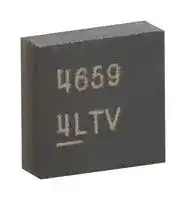


LTM4659IV#PBF
DC/DC Converter, 2.25 to 5.5 V Input, 10 A, 500mV to 5.5 V Output, LGA-25, LTM4659 Series
- Manufacturer: ANALOG DEVICES
- Product type: DC / DC Non Isolated Board Mount Converters - Adjustable Output
- SVHC: Lead (04-Feb-2026)
- Product Range: LTM4659 Series
- Output Current Max: 10A
- Output Voltage Max: 5.5V
| Delivery and price | |
|---|---|
| Units per pack | 5 |
| Price | 18.28 € |
| Current stock | 500+ |
| Lead time | 30 days |

LTM4659
## Ultrathin, Low VIN 10A Step-Down DC/DC µModule Regulator
## **FEATURES**
- n **Tiny Surface Mount, 4mm × 4mm × 1.43mm LGA**
- n **Silent Switcher[®] 2 Architecture**
- n **Ultralow EMI Noise**
- n Input Voltage Range: 2.25V to 5.5V
- n Output Voltage Range: 0.5V to VIN
- n 10A DC Output Current
- n Current Mode Control, Fast Transient Response
- n Multiphase Parallel Current Sharing with Multiple LTM4659s
- n Output Soft-Start with Voltage Tracking
- n External Frequency Synchronization
- n Selectable Pulse-Skipping Mode
- n Power Good Indicator
- n Die Temperature Monitoring Output
- n Overvoltage, Overcurrent, and Overtemperature Protection
## **APPLICATIONS**
- n Telecom, Datacom, Networking System
- n Optical Module
- n Industrial Equipment
- n Point-of-Load Regulation
## **DESCRIPTION**
The LTM[®] 4659 is a complete 10A step-down switch-ing mode μModule[®] regulator in a tiny 4mm × 4mm × 1.43mm LGA package. The package includes the switching controller, power MOSFETs, inductor and all support components. Operating over an input voltage range of 2.25V to 5.5V, the LTM4659 supports an output voltage range of 0.5V to VIN set by external resistors. Its high-efficiency design delivers 10A continuous output current. Only ceramic input and output capacitors are needed.
The LTM4659 employs a Silent Switcher 2 architecture with internal hot loop bypass capacitors to achieve both low EMI and high efficiency at high switching frequencies.
The LTM4659 also supports frequency synchronization, multiphase operation, selectable pulse-skipping mode (PSM) operation, and output voltage tracking for supply rail sequencing. Its high switching frequency and a current mode architecture enables a very fast transient response to line and load changes without sacrificing stability.
Fault protection features include overvoltage, overcurrent, and overtemperature protection. The LTM4659 is lead(Pb)-Free and RoHS-compliant.
All registered trademarks and trademarks are the property of their respective owners.
## **TYPICAL APPLICATION**
**Single 10A, 1V Output DC/DC μModule Regulator**
**==> picture [258 x 121] intentionally omitted <==**
**----- Start of picture text -----**<br>
MODE/SYNC PGOOD<br>2.5V TO 5.5VVIN 22µF6.3V V RUN IN VOUT 100µF6.3V 1V, 10AVOUT<br>FREQ LTM4659 GND 60.4k<br>COMP<br>6.81k SSTT FB<br>680pF 0.1µF AGND 4659 TA01a 60.4k<br>**----- End of picture text -----**<br>
**==> picture [177 x 176] intentionally omitted <==**
**----- Start of picture text -----**<br>
Efficiency vs Load Current<br>100 3.0<br>90<br>EFFICIENCY 2.5<br>80<br>70<br>2.0<br>60<br>50 1.5<br>40<br>1.0<br>30<br>20<br>POWER LOSS VIN = 3.3V 0.5<br>10 VOUT = 1V<br>FREQ = 2MHz<br>0 0<br>0 1 2 3 4 5 6 7 8 9 10<br>LOAD CURRENT (A)<br>4659 TA01b<br>EFFICIENCY (%)<br>POWER LOSS (W)<br>**----- End of picture text -----**<br>
**==> picture [18 x 6] intentionally omitted <==**
**----- Start of picture text -----**<br>
Rev. 0<br>**----- End of picture text -----**<br>
1
For more information www.analog.com
Document Feedback
## LTM4659
## **ABSOLUTE MAXIMUM RATINGS**
## **(Note 1)**
VIN ............................................................... –0.3V to 6V VOUT ............................................................ –0.3V to VIN PGOOD ......................................................... –0.3V to 6V RUN, SSTT, MODE/SYNC, FB, COMP, FREQ ......................................... –0.3V to VIN Operating Junction Temperature (Note 2) .................................................. –40°C to 125°C Storage Temperature Range .................. –55°C to 125°C Peak Solder Reflow Body Temperature .................260°C Note that the peak reflow temperature must not exceed 260°C, including the reworking process.
## **PIN CONFIGURATION**
## **(See Pin Functions and Table 9)**
**==> picture [148 x 159] intentionally omitted <==**
**----- Start of picture text -----**<br>
TOP VIEW<br>RUN VOUT<br>5<br>FB AGND<br>COMP SSTT<br>4 FREQ<br>VIN MODE/SYNC<br>3 PGOOD<br>2 GND<br>SW<br>1<br>A B C D E<br>LGA PACKAGE<br>25-PIN (4mm × 4mm × 1.43mm)<br>TJMAX = 125°C, θJA = 23°C/W,<br>θJCtop = 27.8°C/W, θJCbot = 5.7°C/W<br>WEIGHT = 86mg<br>**----- End of picture text -----**<br>
## **ORDER INFORMATION**
|**PART NUMBER**|**PAD OR BALL**<br>**FINISH***|**PART MARKING**|**PART MARKING**|**PACKAGE**<br>**TYPE**|**MSL**<br>**RATING**|**TEMPERATURE RANGE**<br>**(SEE Note 2)**|
|---|---|---|---|---|---|---|
|||**DEVICE**|**FINISH CODE**||||
|LTM4659EV#PBF|Au(RoHS)|4659|4|LGA|4|–40°C to 125°C|
|LTM4659IV#PBF|Au(RoHS)|4659|4|LGA|4|–40°C to 125°C|
- Contact the factory for parts specified with wider operating temperature ranges. *Pad or ball finish code is per IPC/JEDEC J-STD-609.
- Recommended LGA and BGA PCB Assembly and Manufacturing Procedures
- LGA and BGA Package and Tray Drawings
**ELECTRICAL CHARACTERISTICS The** l **denotes the specifications which apply over the specified operating temperature range, otherwise specifications are at TA = 25°C (Note 2). VIN = 3.3V per the typical application.**
|**SYMBOL**|**PARAMETER**|**CONDITIONS**|**CONDITIONS**|**MIN**<br>**TYP**<br>**MAX**|**UNITS**|
|---|---|---|---|---|---|
|VIN|Input DC Voltage||l|2.25<br>5.5|V|
|VOUT(RANGE)|Output Voltage Range|MODE/SYNC = 1MHz, FREQ = VIN|l|0.5<br>VIN|V|
|VOUT(DC)|Output Voltage|MODE/SYNC = 1MHz, FREQ = VIN, VOUT= 0.5V|l|0.4925<br>0.5<br>0.5075|V|
|VIN_UVLO|VINUndervoltage Lockout|VINRising||2.0<br>2.1<br>2.2|V|
|VIN_UVLO_HYS|VINUndervoltage Lockout Hysteresis|||150|mV|
|VRUN|RUN Pin on Threshold|VRUNRising||0.375<br>0.4<br>0.425|V|
|VRUN_HYS|RUN Pin Hysteresis|||60|mV|
|IRUN|RUN Pin Leakage Current|RUN = 0.4V||±200|nA|
|IQ(VIN)|Input Supply Bias Current<br>Pulse-Skipping Mode<br>Forced Continuous Mode<br>Shutdown|MODE/SYNC = FREQ = VIN, VOUT= 1.5V<br>MODE/SYNC = 0V, FREQ = VIN, VOUT= 1.5V<br>RUN = 0V(Note 4)||1.6<br>70<br>1|mA<br>mA<br>μA|
|IS(VIN)|Input Supply Current|VOUT= 0.5V, IOUT= 10A||2.3|A|
Rev. 0
2
For more information www.analog.com
LTM4659
**ELECTRICAL CHARACTERISTICS The** l **denotes the specifications which apply over the specified operating temperature range, otherwise specifications are at TA = 25°C, (Note 2). VIN = 3.3V per the typical application.**
|**SYMBOL**|**PARAMETER**|**CONDITIONS**|**CONDITIONS**|**MIN**<br>**TYP**<br>**MAX**|**UNITS**|
|---|---|---|---|---|---|
|IOUT(DC)|Output Continuous Current Range|VOUT= 0.5V(Note 4)||10|A|
|∆VOUT(LINE)/VOUT|Line Regulation Accuracy|FREQ = VIN, VOUT= 1.5V, VIN= 5.5V, IOUT= 0A|l|0.001<br>0.8|%/V|
|∆VOUT(LOAD)/VOUT|Load Regulation Accuracy|VIN= FREQ = 3.3V, SYNC = 1.0MHz,<br>VOUT= 0.5V, IOUT= 0A to 10A|l|1|%|
|VOUT(AC)|Output Ripple Voltage|IOUT= 0A, COUT= 100μF + 22μF ×2 Ceramic,<br>(Notes 4)||2|mV|
|∆VOUT(START)|Turn-On Overshoot|IOUT= 0A, COUT= 100μF + 22μF ×2 Ceramic,<br>(Notes 4)||5|mV|
|tSTART|Turn-On Time|COUT= 100μF + 22μF ×2 Ceramic, No Load,<br>SSTT = 0.1μF(Note 4)||5|ms|
|ISSTT|Track Pin Soft-Start Pull-Up Current|SSTT = 0.5V||7<br>10<br>13|μA|
|∆VOUTLS|Peak Deviation for Dynamic Load|Load: 0% to 50% to 0% of Full Load<br>COUT= 100μF + 22μF ×2 Ceramic<br>(Note 4)||157|mV|
|tSETTLE|Settling Time for Dynamic Load Step|Load: 0% to 50% to 0% of Full Load,<br>COUT= 100μF + 22μF ×2 Ceramic,<br>(Note 4)||15|μs|
|IOUTPK|Output Current Limit|VIN= 3.3V, VOUT= 0.5V||18|A|
|VFB|Voltage at VFBPin|IOUT= 0A, VOUT= 1.5V|l|0.495<br>0.50<br>0.505|V|
|IFB|Current at VFBPin|||±20|nA|
|VPGOOD|PGOOD Trip Level<br>Undervoltage Falling Threshold<br>Overvoltage Rising Threshold|As a Percentage of Regulated VOUT<br>VFBRamping Negative<br>VFBRamping Positive||–4<br>7<br>–3<br>10<br>–2<br>13|%<br>%|
|IPGOOD|PGOOD Leakage|VPGOOD= 5.5V||50|nA|
|fOSC|Oscillator Frequency|||2|MHz|
|SYNC_RANGE|Sync Frequency Range|FREQ = VIN||1.0<br>2.6|MHz|
|SYNC_LEVEL|Clock Level High on SYNC<br>Clock Level Low on SYNC|||1.2<br>0.4|V<br>V|
**Note 1:** Stresses beyond those listed under Absolute Maximum Ratings may cause permanent damage to the device. Exposure to any Absolute Maximum Rating condition for extended periods may affect device reliability and lifetime.
**Note 2:** The LTM4659 is tested under pulsed load conditions such that TJ ≈ TA. The LTM4659E is guaranteed to meet performance specifications over the 0°C to 125°C internal operating temperature range. Specifications over the full –40°C to 125°C internal operating temperature range are assured by design, characterization and correlation
with statistical process controls. The LTM4659I is guaranteed to meet specifications over the full –40°C to 125°C internal operating temperature range. Note that the maximum ambient temperature consistent with these specifications is determined by specific operating conditions in conjunction with board layout, the rated package thermal resistance and other environmental factors.
**Note 3:** See output current derating curves for different VIN, VOUT and TA. **Note 4:** Guaranteed by design.
Rev. 0
3
For more information www.analog.com
LTM4659
## **TYPICAL PERFORMANCE CHARACTERISTICS**
**Efficiency vs Load Current at 2.5VIN**
**==> picture [163 x 361] intentionally omitted <==**
**----- Start of picture text -----**<br>
100<br>95<br>Pt tt tT ty Tt<br>90<br>85 ProAirebl | | |<br>80 ai ee<br>75 Hf ee<br>70 af | | NESS<br>| | | Tt | AN<br>65 VOUT = 0.5V (1MHz)<br>yo<br>VOUT = 0.8V (2MHz)<br>60 VOUT = 1V (2MHz)<br>55 VOUT = 1.5V (2MHz)<br>VOUT = 1.8V (2MHz)<br>50 Hi) i |<br>0 1 2 3 4 5 6 7 8 9 10<br>LOAD CURRENT (A)<br>4659 G01<br>Efficiency vs Load Current at 5VIN<br>100<br>95 P| tT Pt tf<br>90<br>85<br>80 ijee | | | rs<br>75 His AT |<br>70 Hist VVOUTOUT = 0.5V (1MHz) = 0.8V (2MHz)<br>65 By VOUT = 1V (2MHz)<br>60 VVOUTOUT = 1.5V (2MHz) = 1.8V (2MHz)<br>55 io VOUT = 2.5V (2MHz)<br>VOUT = 3.3V (2MHz)<br>50 i<br>0 1 2 3 4 5 6 7 8 9 10<br>LOAD CURRENT (A)<br>4659 G03<br>EFFICIENCY (%)<br>EFFICIENCY (%)<br>**----- End of picture text -----**<br>
**==> picture [139 x 11] intentionally omitted <==**
**----- Start of picture text -----**<br>
Efficiency vs Load Current at 3.3VIN<br>**----- End of picture text -----**<br>
**==> picture [168 x 360] intentionally omitted <==**
**----- Start of picture text -----**<br>
100<br>95 Pt tt tt yt Yt |<br>9085 Peeseeed | | |<br>80 Ae<br>LfoR<br>75<br>FAG<br>70 HA | Tt tt |<br>65 Wh} | VOUT = 0.5V (1MHz)<br>VOUT = 0.8V (2MHz)<br>60 VOUT = 1V (2MHz)<br>55 VOUT = 1.5V (2MHz)<br>VOUT = 1.8V (2MHz)<br>50 Hi|<br>0 1 2 3 4 5 6 7 8 9 10<br>LOAD CURRENT (A)<br>4659 G02<br>Efficiency vs Load Current at<br>Different Modes of Operation<br>100<br>VIN = 3.3V PSM<br>90 VIN = 5V PSM | |<br>80 VIN = 3.3V FCM<br>VIN = 5V FCM<br>70<br>60 a Via<br>50 a ae 7//e<br>40 |ffsae<br>30 | ff ssfi [|] ||<br>20<br>100 YeLeseeee<br>0.001 0.010 0.100 1.000 10.000<br>LOAD CURRENT (A)<br>4659 G04<br>EFFICIENCY (%)<br>EFFICIENCY (%)<br>**----- End of picture text -----**<br>
## **Output Transient Response, VIN = 3.3V, VOUT = 1.0V**
## **Output Transient Response, VIN = 5V, VOUT = 1.0V**
**==> picture [175 x 102] intentionally omitted <==**
**----- Start of picture text -----**<br>
VOUT<br>200mV/DIV<br>AC-COUPLED<br>ILOAD<br>5A/DIV<br>4659 G05<br>20μs/DIV<br>IOUT = 2.5A TO 7.5A,<br>OUTPUT CAPACITOR = 100μF + 22μF ×2<br>fSW = 2MHz<br>**----- End of picture text -----**<br>
**==> picture [175 x 101] intentionally omitted <==**
**----- Start of picture text -----**<br>
VOUT<br>200mV/DIV<br>AC-COUPLED<br>ILOAD<br>5A/DIV<br>4659 G06<br>20μs/DIV<br>IOUT = 2.5A TO 7.5A,<br>OUTPUT CAPACITOR = 100μF + 22μF ×2<br>fSW = 2MHz<br>**----- End of picture text -----**<br>
Rev. 0
4
For more information www.analog.com
LTM4659
## **TYPICAL PERFORMANCE CHARACTERISTICS**
**Output Transient Response, VIN = 3.3V, VOUT = 1.5V**
**Output Transient Response, VIN = 5V, VOUT = 1.5V**
**==> picture [320 x 102] intentionally omitted <==**
**----- Start of picture text -----**<br>
VOUTOUT VOUTOUT<br>200mV/DIV 200mV/DIV<br>AC-COUPLED AC-COUPLED<br>ILOADLOAD ILOADLOAD<br>5A/DIV 5A/DIV<br>4659 G07<br>20μs/DIV<br>IOUT = 2.5A TO 7.5A,OUT = 2.5A TO 7.5A,= 2.5A TO 7.5A, IOUT OUT = 2.5A TO 7.5A,<br>OUTPUT CAPACITOR = 100μF + 22μF ×2<br>fSW = 2MHzSW = 2MHz = 2MHz fSW = 2MHzSW = 2MHz = 2MHz<br>**----- End of picture text -----**<br>
**==> picture [523 x 577] intentionally omitted <==**
**----- Start of picture text -----**<br>
VOUTOUT VOUTOUT<br>200mV/DIV 200mV/DIV<br>AC-COUPLED AC-COUPLED<br>ILOADLOAD ILOADLOAD<br>5A/DIV 5A/DIV<br>4659 G07 4659 G08<br>20μs/DIV 20μs/DIV<br>IOUT = 2.5A TO 7.5A,OUT = 2.5A TO 7.5A,= 2.5A TO 7.5A, IOUT OUT = 2.5A TO 7.5A,<br>OUTPUT CAPACITOR = 100μF + 22μF ×2 OUTPUT CAPACITOR = 100μF + 22μF ×2<br>fSW = 2MHzSW = 2MHz = 2MHz fSW = 2MHzSW = 2MHz = 2MHz<br>Start-Up with No Load Start-Up with 10A Load Start-Up with Prebiased Output<br>VOUT VOUT RUN<br>1V/DIV 1V/DIV 2V/DIV<br>RUN RUN 500mV/DIVVOUT<br>2V/DIV 2V/DIV<br>PGOOD<br>2V/DIV<br>1A/DIVIIN 5A/DIVIIN 1A/DIVIIN<br>See 10ms/DIV 4659 G09 10ms/DIV 4659 G10 2ms/DIV 4659 G11<br>VIN = 3.3V, VOUT = 1.5V, IOUT = 0A, VIN = 3.3V, VOUT = 1.5V, RLOAD = 0.15Ω, VIN = 3.3V, VOUT = 1.5V, IOUT = 0A,<br>fSW = 2MHz fSW = 2MHz fSW = 2MHz<br>Short-Circuit with No Load Short-Circuit with 10A Load<br>VOUT VOUT<br>1V/DIV 1V/DIV<br>IIN IIN<br>2A/DIV 2A/DIV<br>=<br>100μs/DIV 4659 G12 200μs/DIV 4659 G13<br>VIN = 3.3V, VOUT = 1.5V, IOUT = 0A, VIN = 3.3V, VOUT = 1.5V, IOUT = 10A,<br>fSW = 2MHz fSW = 2MHz<br>Conducted EMI Performance (CISPR32 Radiated<br>Emission Test with Class B 10m)<br>70<br>60<br>50<br>40<br>30<br>20<br>10<br>0 [1] HORIZONTAL<br>QPK LIMIT<br>–10 —<br>30 130 230 330 430 530 630 730 830 930 1000<br>FREQUENCY (MHz) 4659 G14<br>DC3248A DEMO BOARD, NO INPUT<br>EMI FILTER INSTALLED, 3.3VIN TO 1VOUT, RLOAD = 0.125Ω (8A)<br>AMPLITUDE (dBµV/m)<br>**----- End of picture text -----**<br>
Rev. 0
5
For more information www.analog.com
LTM4659
## **PIN FUNCTIONS**
## **PACKAGE ROW AND COLUMN LABELING MAY VARY AMONG µModule PRODUCTS. REVIEW EACH PACKAGE LAYOUT CAREFULLY.**
**==> picture [35 x 31] intentionally omitted <==**
**GND (Pins A1, A2, B2, C2, D2, E1, E2):** Power Ground Pins for both Input and Output Returns.
**VIN (Pins A3, B3, C3):** The VIN pins supply current to the internal circuitry and topside power switch. All of the VIN pins must be connected together with short, wide traces and bypassed to PGND with low ESR capacitors located as close as possible to the pins.
**COMP (Pin A4):** The COMP pin is the compensation node for the output voltage regulation control loop. Compensation components connected to this pin are referenced to AGND.
**RUN (Pin A5):** Run the Control Input of each Switching Mode Regulator Channel. Enables chip operation by connecting RUN above 0.4V. Connecting it to GND shuts down the part.
**SW (Pins B1, C1, D1):** Switching Node Internal High Current Path from MOSFET to Inductor. Connect with a solid cooper area or leave it floating.
**FB (Pin B4):** The negative input of the error amplifier for the switching mode regulator. The LTM4659 regulates the voltage between FB and AGND to 500mV. A resistor divider connecting to VOUT sets the output voltage. In PolyPhase[®] operation, connecting the FB pins of the subordinate channels to VIN to disable the internal error amplifier. See the Applications Information section for details.
**VOUT (Pins B5, C5, D5, E5):** Power Output Pins of Each Switching Mode Regulator. Apply output load between these pins and GND pins. Recommend placing output decoupling capacitance directly between these pins and the GND pins.
capacitor (COUT) at the load. A drop in the high current power ground return path will be compensated. All of the signal components, such as the FB resistor dividers and soft-start capacitor, should be referenced to the AGND node. The AGND node carries very little current and, therefore, can be a minimal size trace.
**MODE/SYNC (Pin D3):** The MODE/SYNC pin facilitates multiphase operation and synchronization to an external clock. Depending on the mode of operation, the MODE/ SYNC pin either accepts an input clock pulse or outputs a clock pulse at its operating frequency. (See Multiphase Operation in the Applications Information section). The MODE/SYNC pin also programs the mode of operation: pulse-skipping or forced continuous mode.
**SSTT (Pin D4):** Soft-Start, Tracking, and Temperature Monitor Pin. An internal 10μA current into an external capacitor on the soft-start pin programs the output voltage ramp rate during start-up. When SSTT is below 0.5V, the VFB pin voltage will track the SSTT pin voltage. When SSTT is above 0.5V, the tracking function is disabled. The internal reference resumes control of the error amplifier and the SSTT pin servos to a voltage representative of junction temperature. For a clean recovery from an output short-circuit condition, the SSTT pin is pulled down to approximately 140mV above the VFB voltage, and a new soft-start cycle is initiated. During shutdown and fault conditions, the SSTT pin is pulled to ground.
**PGOOD (Pin E3):** Output Power Good with Open-Drain Logic of the Switching Mode Regulator Channel. PGOOD is pulled to ground when the voltage on the FB pin is not within −3%/10% of the internal 0.5V reference.
**FREQ (Pin E4):** The FREQ pin sets the oscillator frequency with an external resistor to AGND or sets the phasing for multiphase operation. (See Multiphase Operation in the Applications Information section).
**AGND (Pin C4):** The AGND pin is the ground reference for the internal analog circuitry, including the bandgap voltage reference. To achieve good load regulation, connect the AGND pin to the negative terminal of the output
Rev. 0
6
For more information www.analog.com
LTM4659
## **BLOCK DIAGRAM**
**==> picture [451 x 341] intentionally omitted <==**
**----- Start of picture text -----**<br>
VIN<br>R1<br>RUN<br>+ INTERNAL 0.55V VIN<br>R2 0.4V – REFERENCE 0.5V0.49V + VIN<br>CIN<br>SW<br>FREQ<br>OSCILLATOR S Q SWITCH LOGIC 80nH<br>RFREQ R ANTI-SHOOT THROUGHAND VIN VOUT VOUT<br>COUT<br>SENSE [+]<br>MODE/SYNC GND<br>SENSE [–]<br>SLOPE COM P<br>ERROR RA CFF<br>AMP FB<br>COMP<br>+ 0.5V<br>RB<br>RC<br>AGND<br>CC C22pFCOMP<br>10µA<br>– PGOOD<br>SSTT VTEMP 0.49V +<br>FAULT<br>CSS FAULT<br>+<br>0.55V –<br>4659 F01<br>+<br>–<br>–<br>+<br>+<br>–<br>**----- End of picture text -----**<br>
**Figure 1. Simplified LTM4659 Block Diagram**
## **DECOUPLING REQUIREMENTS**
|**SYMBOL**|**PARAMETER**|**CONDITIONS**|**MIN**<br>**TYP**<br>**MAX**|**UNITS**|
|---|---|---|---|---|
|CIN|External Input Capacitor Requirement<br>(VIN= 2.25V to 5.5V, VOUT= 1.5V)|IOUT= 10A|22|µF|
|COUT|External Output Capacitor Requirement<br>(VIN= 2.25V to 5.5V, VOUT= 1.5V)|IOUT= 10A|100|µF|
Rev. 0
7
For more information www.analog.com
LTM4659
## **OPERATION**
The LTM4659 is a standalone nonisolated step-down μModule regulator. It can deliver up to 10A of DC output current with a few external input and output capacitors. This module provides precisely regulated output voltage from 0.5V to 5.5V over a 2.25V to 5.5V input voltage range. See Typical Application schematic for more details.
The LTM4659 has an integrated constant-frequency peak current mode step-down regulator with power MOSFETs, inductor, and other supporting discrete components. The default switching frequency is 2MHz. It can be externally synchronized to a clock from 1MHz to 2.60MHz. See the Applications Information section.
Current mode control provides cycle-by-cycle fast current limiting and overcurrent protection. Internal feedback loop compensation provides sufficient stability margins and good transient performance with a wide range of output capacitors, even with all ceramic output capacitors.
Internal undervoltage and overvoltage comparators pull the open-drain PGOOD output low if the feedback voltage exits a −3%/10% window around the regulation point. Furthermore, in an overvoltage condition, the internal top MOSFET is turned off, and the bottom MOSFET is turned on and held on until the overvoltage condition clears.
For systems with higher power requirements, multiphase operation can be easily employed with the synchronization and phase mode controls.
Pulling the RUN pin to GND forces the controller into its shutdown state, turning off both power MOSFETs and most of the internal control circuitry. At light load currents, PSM operation can be enabled to achieve higher efficiency compared to FCM by setting the MODE/SYNC pin to VIN. The SSTT pin is used for power supply tracking, soft-start programming and die temperature monitoring. See the Applications Information section.
Rev. 0
8
For more information www.analog.com
LTM4659
## **APPLICATIONS INFORMATION**
See LTM4659 Typical Application circuit. External component selection is primarily determined by the input voltage, the output voltage and the maximum load current. See Table 8 for specific external capacitor requirements for a particular application.
local ground and remote output ground, resulting in a more accurate output voltage. The LTM4659 allows for remote output ground deviations as much as ±100mV with respect to the local ground.
## **Input Decoupling Capacitors**
## **VIN to VOUT Step-Down Ratios**
The minimum VOUT step-down ratio that can be achieved for a given input voltage is limited by the minimum ontime of the regulator.
The minimum on-time limit imposes a minimum duty cycle of the converter which can be calculated using Equation 1.
**==> picture [240 x 18] intentionally omitted <==**
where TON(MIN) is the minimum on-time, 45ns typical for the LTM4659. In the rare cases where the minimum duty cycle is surpassed, the output will overvoltage and a slower switching frequency is needed to accommodate the high VIN/VOUT ratio.
The LTM4659 is capable of a maximum duty cycle of 100%; therefore, the VIN-to-VOUT dropout is limited by the RDS(ON) of the top switch, the inductor DCR, and the load current.
The LTM4659 module should be connected to a low AC-impedance DC source. All of the VIN pins must be connected together with short, wide traces and bypassed to PGND with low ESR capacitors located as close as possible to the pins. For the regulator, a one-piece 22µF input ceramic capacitor is recommended for RMS ripple current decoupling. A bulk input capacitor is only needed when the input source impedance is compromised by long inductive leads, traces or not enough source capacitance. The bulk capacitor can be an electrolytic aluminum capacitor and polymer capacitor.
Without considering the inductor current ripple, the RMS current of the input capacitor can be estimated using Equation 3.
**==> picture [241 x 31] intentionally omitted <==**
where η % is the estimated efficiency of the power module.
## **Output Voltage Programming and Output Voltage Sensing**
The PWM controller has an internal 0.5V reference voltage. The resistor divider from the VOUT remote sensing point to the FB pin and from the FB pin to the AGND pin programs the output voltage (Equation 2). See the Block Diagram for more information.
**==> picture [239 x 30] intentionally omitted <==**
In high current operation, a ground offset may be present between the LTM4659 local ground and ground at the load. To overcome this offset, AGND should have a Kelvin connection to the load ground, and the lowest potential node of the resistor divider should be connected to AGND. The internal error amplifier senses the difference between this feedback voltage and a 0.5V AGND referenced voltage. This scheme overcomes any ground offsets between
## **Output Decoupling Capacitors**
With an optimized high-frequency, high-bandwidth design, only two pieces of 47μF low ESR output ceramic capacitors are required for LTM4659 to achieve low output voltage ripple and very good transient response. Additional output filtering may be required by the system designer, if further reduction of output ripples or dynamic transient spikes is required. Table 8 shows a matrix of different output voltages and output capacitors to minimize the voltage droop and overshoot during a 2.5A (25%) load-step transient.
The multiphase operation will reduce effective output ripple as a function of the number of phases. Analog Devices Application Note 77 discusses this noise reduction versus output ripple current cancellation, but the output capacitance will be more a function of stability and transient response. The Analog Devices LTpowerCAD[®] design tool is available to download online for output ripple, stability and
Rev. 0
9
For more information www.analog.com
LTM4659
## **APPLICATIONS INFORMATION**
transient response analysis and calculation of the output ripple reduction as the number of phases implemented increases by N times.
## **Modes of Operation**
The MODE/SYNC pin either synchronizes the external switching frequency, or a clock output, to set the PWM mode. The PWM modes of operation are either pulseskipping (PSM) or forced continuous mode (FCM). See Table 1.
The frequency can be programmed to switch from 1MHz to 3MHz. Table 2 shows the necessary RFREQ value for a desired switching frequency.
**Table 2. SW Frequency vs RFREQ Value**
|**Table 2. SW Frequency vs RFREQ **|**Value**|
|---|---|
|**fSW**<br>**(MHz)**|**RFREQ**<br>**(kΩ)**|
|1|549|
|2|274|
|2.2|243|
|3|178|
**Table 1. LTM4659 Single-Phase Configuration**
|**FREQ PIN**<br>**CONNECTION**|**MODE/SYNC**<br>**PIN CONNECTION**|**MODE OF**<br>**OPERATION**|**SWITCHING**<br>**FREQUENCY**|
|---|---|---|---|
|VIN|Clock Input|FCM|External<br>Clock|
|VIN|AGND|FCM|2MHz Default|
|VIN|VIN|PSM|2MHz Default|
|Resistor<br>to AGND|Clock Output|FCM|RFREQ<br>Programmed|
The LTM4659 operates in FCM for low noise or PSM for high efficiency at light load. The LTM4659 operates in PSM when both FREQ and MODE/SYNC pins are connected to VIN. In PSM, switching cycles are skipped at light load to regulate the output voltage. The LTM4659 defaults to FCM in regulation and during synchronization. During FCM, the top switch turns on every cycle and light load regulation is achieved by allowing negative inductor current.
## **Setting the Operating Frequency**
The operating frequency defaults to 2MHz when the FREQ pin is connected to VIN. If any frequency higher than the default frequency is required, the frequency can be programmed by tying a resistor from the FREQ pin to AGND using Equation 4.
**==> picture [240 x 19] intentionally omitted <==**
## **Synchronizing the Oscillator to an External Clock**
The LTM4659 switching frequency can also be adjusted by synchronizing the internal PLL circuit to an external clock to the MODE/SYNC pin. The synchronization frequency range is 1MHz to 2.6MHz. The LTM4659 operates in FCM when synchronized to an external clock.
Connect the FREQ pin to VIN configures the MODE/SYNC pin as a clock input. During synchronization, the top power switch turn-on is locked to the rising edge of the external frequency source. The slope compensation is automatically adapted to the external clock frequency.
At start-up, before the LTM4659 recognizes the external clock applied to MODE/SYNC, the LTM4659 will switch at its default frequency of 2MHz. Once the externally applied clock is recognized, the switching frequency will gradually transition from the default frequency to the applied frequency. If the external clock is removed, the LTM4659 will slowly transition back to the default frequency.
The synchronizing clock amplitude should be greater than 1.2V and less than 0.4V with a pulse width greater than 40ns. An internal 200k resistor on the MODE/SYNC pin to AGND allows the MODE/SYNC to be floating. Note that a low switching frequency will increase the inductor peak current and the output voltage ripple.
where RFREQ is in kΩ and fSW is the desired switching frequency in MHz.
Rev. 0
10
For more information www.analog.com
LTM4659
## **APPLICATIONS INFORMATION**
## **Multiphase Operation**
For output loads that demand more than 10A of current, multiple LTM4659s can be paralleled to run out of phase to provide more output current without increasing input and output voltage ripples. See Table 3.
To parallel multiple LTM4659 modules to achieve the same switching frequency, a perfect interleaved phase shift and an accurate current sharing between different modules, one of the LTM4659 will become the main module, and the rest of the LTM4659s need to be programmed to be subordinate modules. See Multiphase Operation in the Applications Information section.
1. Connect a resistor from the FREQ pin to the AGND of the main phase will program the frequency and configures the MODE/SYNC pin to become a clock output used to drive the MODE/SYNC pins of the subordinate phase(s).
Connecting the FREQ pin of the main phase to VIN configures the MODE/SYNC pin to become an input capable of accepting an external clock. The switching frequency defaults to the nominal 2MHz internal frequency when the external clock is unavailable, such as during start-up.
Connecting the FB pin to VIN configures a phase as a subordinate. The MODE/SYNC becomes an input, and the voltage control loop is disabled. The subordinate phase current control loop is still active, and the peak current is controlled via the shared COMP node. Careful consideration should be taken when routing the COMP node between phases. Routing the COMP and AGND nodes together is recommended to create a low inductance path.
Connecting the PGOOD pins together and adding an external pull-up resistor allows the main phase to communicate with the subordinate phases on when startup has been completed.
The pull-up voltage should be greater than 0.49V for subordinate channels on multiphase operations.
2. The phasing of a subordinate phase relative to the main phase is programmed with a resistor divider on the FREQ pin (see Figure 2). Use of 1% resistors is recommended. See Table 4 for more information.
When configured for main/subordinate operation, the subordinate phases operate in FCM.
**Table 3. Multiphase Configuration**
|**MAIN/SUBORDINATE**|**FREQ PIN**|**FB PIN**|**MODE/SYNC PIN**|**SWITCHING FREQUENCY (fSW)**|
|---|---|---|---|---|
|Main|VIN|VOUTDivider|Clock Input|External Clock/2MHz Default|
|Main|Resistor to AGND|VOUTDivider|Clock Output|FREQ Programmed|
|Subordinate|VINDivider|VIN|Clock Input|External Clock|
**Table 4. Programming Subordinate Phase Angle**
|**SYNC PHASE ANGLE**|**R3**<br>**RATIO**|**R4**<br>**RATIO**|**R3**<br>**EXAMPLE**|**R4**<br>**EXAMPLE**|
|---|---|---|---|---|
|0°|0Ω|NA|0Ω|NA|
|90°|3 • R|R|301k|100k|
|120°|7 • R|5 • R|243k|174k|
|180°|NA|0Ω|NA|0Ω|
|240°|5 • R|7 • R|174k|243k|
|270°|R|3 • R|100k|301k|
Rev. 0
11
For more information www.analog.com
LTM4659
## **APPLICATIONS INFORMATION**
## **Soft-Start, Tracking, Temperature Monitor**
**==> picture [74 x 72] intentionally omitted <==**
**----- Start of picture text -----**<br>
VIN<br>FB<br>R3<br>LTM4659<br>FREQ<br>R4<br>4659 F02<br>AGND<br>**----- End of picture text -----**<br>
**Figure 2. Phase Programming**
The LTM4659 device is an inherently current modecontrolled device, so parallel modules will have very good current sharing. This will balance the thermals on the design. Connect the RUN and COMP pins of each paralleling channel together. Figure 17 through Figure 19 show examples of parallel operation and pin connections.
## **Input RMS Ripple Current Cancellation**
The Analog Devices Application Note 77 provides a detailed explanation of multiphase operation. The input RMS ripple current cancellation mathematical derivations are presented, and a graph is displayed representing the RMS ripple current reduction as a function of the number of interleaved phases. Figure 3 shows this graph.
**==> picture [247 x 232] intentionally omitted <==**
**----- Start of picture text -----**<br>
0.60<br>1-PHASE<br>2-PHASE<br>0.55 3-PHASE<br>4-PHASE<br>6-PHASE<br>0.50<br>0.45<br>0.40<br>0.35<br>0.30<br>0.25<br>0.20<br>0.15<br>0.10<br>0.05<br>0<br>0.1 0.15 0.2 0.25 0.3 0.35 0.4 0.45 0.5 0.55 0.6 0.65 0.7 0.75 0.8 0.85 0.9<br>DUTY CYCLE (VOUT/VIN) 4659 F03<br>DC LOAD CURRENT<br>RMS INPUT RIPPLE CURRENT<br>**----- End of picture text -----**<br>
**Figure 3. Input RMS Current Ratios to DC Load Current as a Function of Duty Cycle**
The LTM4659 allows the user to program its output voltage ramp rate using the SSTT pin.
An internal 10μA pulls up the SSTT pin. Putting an external capacitor on SSTT enables soft-starting the output to prevent current surge on the input supply and output voltage overshoot. During the soft-start ramp, the output voltage will proportionally track the SSTT pin voltage. When the soft-start is complete, the pin will servo to a voltage proportional to the LTM4659 junction temperature. Figure 4 shows the SSTT pin operating range.
**==> picture [191 x 143] intentionally omitted <==**
**----- Start of picture text -----**<br>
150<br>125<br>DIE TEMP 100 SSTT PIN VOLTAGE<br> (°C) 75 OPERATING RANGE<br>50 TEMP<br>MONITOR<br>25 ~4mV/°C<br>0.6<br>0.5<br>0.4<br>FB<br>0.3<br> (V)<br>0.2<br>SOFT-START<br>0.1 AND TRACKING<br>0<br>0 0.1 0.2 0.3 0.4 0.5 0.6 1.2 1.3 1.4 1.5 1.6 1.7 SSTT (V)<br>4659 F04<br>**----- End of picture text -----**<br>
**Figure 4. Soft-Start and Temperature Monitor Operation**
The soft-start time is calculated using Equation 5.
**==> picture [240 x 29] intentionally omitted <==**
For output tracking applications, SSTT can be externally driven by another voltage source. From 0V to 0.5V, the SSTT voltage will override the internal 0.5V reference input to the error amplifier, thus regulating the FB pin voltage to that of the SSTT pin. When SSTT is above 0.5V, tracking is disabled and the feedback voltage will regulate the internal reference voltage.
An active pull-down circuit is connected to the SSTT pin to discharge the external soft-start capacitor in the case of fault conditions. The ramp will restart when the fault is cleared. Fault conditions that clear the soft-start capacitor are the RUN/UV pin transitioning low, VIN voltage falling too low or thermal shutdown.
Rev. 0
12
For more information www.analog.com
LTM4659
## **APPLICATIONS INFORMATION**
Once the soft-start cycle has been completed and the output power good flag has been thrown, the SSTT pin reports the die junction temperature. The LTM4659 regulates the SSTT pin to a voltage proportional to the junction temperature. While reporting the temperature, the SSTT voltage is not valid below 1V. The junction temperature is calculated using Equation 6.
**==> picture [239 x 27] intentionally omitted <==**
The following procedure is used for a more accurate measurement of the junction temperature.
1. Measure the ambient temperature TA.
2. Measure the SSTT voltage while in PSM with the VOUT pulled up slightly higher than the regulated VOUT.
3. Calculate the slope of the temperature sensing circuit using Equation 7.
**==> picture [240 x 31] intentionally omitted <==**
4. Calculate the junction temperature with the new calibrated slope.
When the output voltage goes out of regulation and the power good pin is pulled low, the soft-start pin no longer reports the temperature.
## **Power Good**
The PGOOD pins are open-drain pins that can be used to monitor valid output voltage regulation. This pin monitors a −3/10% window around the regulation point. A resistor can be pulled up to a particular supply voltage for monitoring. To prevent unwanted PGOOD glitches during transients or dynamic VOUT changes, the LTM4659’s PGOOD falling edge includes a blanking delay of approximately 100µs. The PGOOD is also actively pulled low during fault conditions: RUN pin is low, VIN is too low, or in thermal shutdown.
## **Transient Response and Loop Compensation**
When determining the compensation components, CFF, RC, and CC, control loop stability and transient response are the two main considerations. The LTM4659 has been designed to operate at high bandwidth for fast transient response capability. Operating at a high loop bandwidth reduces the output capacitance required to meet transient response requirements. Applying a load transient and monitoring the system’s response or using a network analyzer to measure the actual loop response are two ways to verify and optimize LTM4659. For more information, refer to the Analog Devices technical article: “Understand Power Supply Loop Stability and Loop Compensation— Part 1: Basic Concepts and Tools”. Analog Devices LTpowerCAD is a useful tool for optimizing the compensation components.
When using the load transient response method to stabilize the control loop, apply an output current pulse of 20% to 100% of the full load current having a rise time of 1µs. This will produce a transient on the output voltage and COMP pin waveforms.
Switching regulators take multiple cycles to respond to a step in load current. When a load step occurs, VOUT is immediately perturbed, generating a feedback error signal used by the regulator to return VOUT to its steady-state value.
During this recovery time, monitor VOUT for overshoot or ringing indicating a stability problem. The initial output voltage step may not be within the bandwidth of the feedback loop, so the standard second-order overshoot/ DC ratio cannot be used to determine the phase margin. The gain of the loop increases with the RC, and the bandwidth of the loop increases with decreasing CC. If RC is increased by the same factor that CC is decreased, the zero frequency will be kept the same, thereby keeping the phase the same in the most critical frequency range of the feedback loop. In addition, adding a feedforward capacitor, CFF, improves the high frequency response. Capacitor CFF provides phase lead by creating a high-frequency zero with RA to improve the phase margin. The compensation
Rev. 0
13
For more information www.analog.com
LTM4659
## **APPLICATIONS INFORMATION**
components of the typical application circuits are a good starting point for component values. The output voltage settling behavior is related to the stability of the closedloop system. For a detailed explanation of optimizing the compensation components, including a review of control loop theory, refer to the Analog Devices Application Note 76.
## **RUN Threshold Programming**
The LTM4659 has a precision threshold RUN pin to enable or disable switching. Pulling the RUN pin to ground forces the LTM4659 into its shutdown state, turning off both power MOSFETs and most of its internal control circuitry. Bringing the RUN pin above 0.4V will turn on the entire chip.
The rising threshold of the RUN comparator is 400mV with 60mV of hysteresis. Connect the RUN pin to VIN if the shutdown feature is not used. Adding a resistor divider from VIN to RUN programs the LTM4659 to regulate the output only when VIN is above a desired voltage (see the Block Diagram). Typically, this threshold, VIN(RUN), is used in situations where the input supply is current limited or has a relatively high source resistance. A switching regulator draws constant power from the source, so the source current increases as the source voltage drops. This looks like a negative resistance load to the source and can cause the source to current limit or latch low under low source voltage conditions. The VIN(RUN) threshold prevents the regulator from operating at source voltages where problems may occur. This threshold can be adjusted by setting the values R1 and R2 such that they satisfy Equation 8.
**==> picture [239 x 33] intentionally omitted <==**
where the LTM4659 will remain off until VIN is above VIN(RUN). Due to the comparator’s hysteresis, switching will not stop until the input falls slightly below VIN(RUN).
Alternatively, a resistor divider from an output of another regulator to the enable RUN pin of the LTM4659 provides event-based power up sequencing, enabling the LTM4659 when the output of the other regulator reaches a predetermined level.
## **Output Overvoltage Protection**
During an output overvoltage event, when the FB pin voltage is greater than 110% of nominal, the LTM4659 top power switch will be turned off. If the output remains out of regulation for more than 100μs, the PGOOD pin will be pulled low. An output overvoltage event should not happen under normal operating conditions.
## **Output Short-Circuit Protection and Recovery**
The peak inductor current at which the current comparator shuts off the top power switch is controlled by the voltage on the COMP pin. If the output current increases, the error amplifier raises the COMP pin voltage until the average inductor current matches the new load current. In normal operation, the LTM4659 clamps at the maximum COMP pin voltage.
When the output is shorted to ground, the inductor current decays very slowly during the switch-off time because of the low voltage across the inductor. To keep the current in control, a secondary limit is also imposed on the valley inductor current. If the inductor current measured through the bottom power switch increases beyond IVALLEY(MAX), the top power switch will be held off and switching cycles will be skipped until the inductor current is reduced.
Recovery from a short circuit can be abrupt, and because the output is shorted and below regulation, the regulator is requesting the maximum current to charge the output. When the short circuit condition is removed, the inductor current could cause an extreme voltage overshoot in the output. The LTM4659 addresses this potential issue by regulating the SSTT voltage just above the FB voltage when the output is out of regulation. Therefore, a recovery from an output short circuit goes through a soft-start cycle. The output ramp is controlled, and the overshoot is minimized.
## **Thermal Considerations and Output Current Derating**
The thermal resistances reported in the Pin Configuration section are consistent with those parameters defined by JESD51-9. They are intended for use with finite element analysis (FEA) software modeling tools that leverage the outcome of thermal modeling, simulation, and correlation
Rev. 0
14
For more information www.analog.com
LTM4659
## **APPLICATIONS INFORMATION**
to hardware evaluation performed on a µModule package mounted to a hardware test board—also defined by JESD51-9 (“Test Boards for Area Array Surface Mount Package Thermal Measurements”). The motivation for providing these thermal coefficients is found in JESD51-12 (“Guidelines for Reporting and Using Electronic Package Thermal Information”).
Many designers may use laboratory equipment and a test vehicle such as the demo board to anticipate the µModule regulator’s thermal performance in their application at various electrical and environmental operating conditions to compliment any FEA activities. Without FEA software, the thermal resistances reported in the Pin Configuration section are in-and-of themselves not relevant to providing guidance on thermal performance; instead, the derating curves provided in the data sheet can be used in a manner that yields insight and guidance pertaining to one’s application-usage, and can be adapted to correlate thermal performance to one’s own application.
The Pin Configuration section typically gives four thermal coefficients explicitly defined in JESD51-12; these coefficients are quoted or paraphrased below.
1. θ JA, the thermal resistance from junction to ambient, is the natural convection junction-to-ambient air thermal resistance measured in one cubic foot sealed enclosure. This environment is sometimes referred to as “still air” although natural convection causes the air to move.
This value is determined with the part mounted to a JESD51-9 defined test board, which does not reflect an actual application or viable operating condition.
2. θ JCbot, the thermal resistance from junction to bottom of the product case, is determined with all of the component power dissipation flowing through the bottom of the package. In the typical module regulator, the bulk of the heat flows out the bottom of the package, but there is always heat flow out into the ambient environment. As a result, this thermal resistance value may be useful for comparing packages, but the test conditions don’t generally match the user’s application.
3. θ JCtop, the thermal resistance from the junction to the top of the product case, is determined with nearly all of the component power dissipation flowing through the top of the package. As the electrical connections of the typical µModule are on the bottom of the package, it is rare for an application to operate such that most of the heat flows from the junction to the top of the part. As in the case of θ JCbot, this value may be useful for comparing packages but the test conditions don’t generally match the user’s application.
A graphical representation of the aforementioned thermal resistances is shown in Figure 5; blue resistances are contained within the µModule regulator, whereas green resistances are external to the µModule.
**==> picture [404 x 146] intentionally omitted <==**
**----- Start of picture text -----**<br>
µModule DEVICE θJA JUNCTION-TO-AMBIENT RESISTANCE<br>θJCtop JUNCTION-TO-CASE CASE (TOP)-TO-AMBIENT<br>(TOP) RESISTANCE RESISTANCE<br>JUNCTION AMBIENT<br>θJCbot JUNCTION-TO-CASE CASE (BOTTOM)-TO-BOARD BOARD-TO-AMBIENT<br>(BOTTOM) RESISTANCE RESISTANCE RESISTANCE<br>4659 F05<br>**----- End of picture text -----**<br>
**Figure 5. Graphical Representation of JESD51-12 Thermal Coefficients**
Rev. 0
15
For more information www.analog.com
LTM4659
## **APPLICATIONS INFORMATION**
As a practical matter, it should be clear to the reader that no individual or sub-group of the four thermal resistance parameters defined by JESD51-12 or provided in the Pin Configuration section replicates or conveys normal operating conditions of a μModule. For example, in normal board-mounted applications, never does 100% of the device’s total power loss (heat) thermally conduct exclusively through the top or exclusively through bottom of the µModule—as the standard defines for θ JCtop and θ JCbot, respectively. In practice, power loss is thermally dissipated in both directions away from the package—granted, in the absence of a heat sink and airflow, a majority of the heat flow is into the board.
Within a SIP (system-in-package) module, be aware that there are multiple power devices and components dissipating power, with the consequence that the thermal resistances relative to different junctions of components or die are not exactly linear with respect to total package power loss. To reconcile this complication without sacrificing modeling simplicity—but also, not ignoring practical realities—an approach has been taken using FEA software modeling along with laboratory testing in a controlled-environment chamber to reasonably define and correlate the thermal resistance values supplied in this data sheet: (1) Initially, FEA software is used to accurately build the mechanical geometry of the µModule and the specified PCB with all of the correct material coefficients along with accurate power loss source definitions; (2) this model simulates a software-defined JEDEC environment consistent with JESD51-9 to predict power loss heat flow and temperature readings at different interfaces that enable the calculation of the JEDEC-defined thermal resistance values; (3) the model and FEA software is used to evaluate the µModule with heat sink and airflow; (4) having solved for and analyzed these thermal resistance values and simulated various operating conditions in the software model, a thorough laboratory evaluation replicates the simulated conditions with thermocouples within a controlled-environment chamber while operating the device at the same power loss as that which was simulated. An outcome of this process and due-diligence yields a set of derating curves provided in other sections of this data sheet.
The 2.5VIN, 3.3VIN and 5VIN power loss curves in Figure 6, Figure 7, and Figure 8 can be used in coordination with the load current derating curves in Figure 9 to Figure 14 for calculating an approximate θ JA thermal resistance for the LTM4659 with various heat sinking and airflow conditions. The power loss curves are taken at room temperature, and are increased with multiplicative factors according to the junction temperature. This approximate factor is ~1.2 assuming the junction temperature is reaching 120°C. The maximum load current is achievable while increasing ambient temperature as long as the junction temperature is less than 120°C, which is a 5°C guardband from the maximum junction temperature of 125°C. When the ambient temperature reaches a point where the junction temperature is 120°C, then the load current is lowered to maintain the junction at 120°C while increasing the ambient temperature up to 120°C. The derating curves are plotted with the output current starting at 10A and the ambient temperature at 30°C. The output voltages are 1.0V, 1.5V and 2.5V. These are chosen to include the lower and higher output voltage ranges to correlate the thermal resistance. Thermal models are derived from several temperature measurements in a controlled temperature chamber, along with thermal modeling analysis. The junction temperatures are monitored while ambient temperature is increased with and without airflow. The power loss increase with ambient temperature change is factored into the derating curves. The junctions are maintained at 120°C maximum while lowering output current or power with increasing ambient temperature. The decreased output current will decrease the internal module loss as ambient temperature is increased. The monitored junction temperature of 120°C minus the ambient operating temperature specifies how much module temperature rise can be allowed. For example, to determine the maximum ambient temperature allowable when VIN = 3.3V, VOUT = 1V and 10A load current without a heat sink and airflow, find out the power loss from Figure 7, which equals to 2.24W in this case, then multiply by the 1.2 coefficient for 120°C junction temperature, If the 65.4°C ambient temperature is subtracted from the 120°C junction temperature, then the difference of 54.6°C divided by 2.7W equals a 20.2°C/W for θ JA the system equivalent thermal resistance. Table 5 specifies a 21°C/W
Rev. 0
16
For more information www.analog.com
LTM4659
## **APPLICATIONS INFORMATION**
**==> picture [526 x 653] intentionally omitted <==**
**----- Start of picture text -----**<br>
3.5 3.5 3.5<br>VOUT = 0.5V VOUT = 0.5V VOUT = 0.5V<br>3.0 V OUT = 0.8V 3.0 V OUT = 0.8V 3.0 V OUT = 0.8V<br>VOUT = 1V VOUT = 1V VOUT = 1V<br>VOUT = 1.5V VOUT = 1.5V VOUT = 1.5V<br>2.5 V OUT = 1.8V 2.5 V OUT = 1.8V 2.5 V OUT = 1.8V<br>VOUT = 2.5V<br>2.0 2.0 2.0 VOUT = 3.3V<br>1.5 1.5 1.5<br>1.0 1.0 1.0<br>0.5 0.5 0.5<br>0 0 0<br>0 2 4 6 8 10 0 2 4 6 8 10 0 2 4 6 8 10<br>LOAD CURRENT (A) LOAD CURRENT (A) LOAD CURRENT (A)<br>4659 F06 4659 F07 4659 F08<br>Figure 6. Power Loss vs Figure 7. Power Loss vs Load Figure 8. Power Loss vs Load<br>Load Current at 2.5VIN Current at 3.3VIN Current at 5VIN<br>12 12 12<br>10 10 10<br>8 8 8<br>6 6 6<br>4 4 4<br>2 0LFM 2 0LFM 2 0LFM<br>200LFM 200LFM 200LFM<br>400LFM 400LFM 400LFM<br>0 0 0<br>0 20 40 60 80 100 120 0 20 40 60 80 100 120 0 20 40 60 80 100 120<br>TEMPERATURE (°C) TEMPERATURE (°C) TEMPERATURE (°C)<br>4659 F09 4659 F10 4659 F11<br>Figure 9. 3.3V to 1V Derating Figure 10. 3.3V to 1.5V Figure 11. 3.3V to 2.5V<br>Curve, No Heat Sink Derating Curve, No Heat Sink Derating Curve, No Heat Sink<br>12 12 12<br>10 10 10<br>8 8 8<br>6 6 6<br>4 4 4<br>2 0LFM 2 0LFM 2<br>200LFM 200LFM<br>400LFM 400LFM<br>0 0 0<br>0 20 40 60 80 100 120 0 20 40 60 80 100 120 0 20 40 60 80 100 120<br>TEMPERATURE (°C) TEMPERATURE (°C) TEMPERATURE (°C)<br>4659 F12 4659 F13 4659 F14<br>Figure 12. 5V to 1V Derating Figure 13. 5V to 1.5V Derating Figure 14. 5V to 2.5V Derating<br>Curve, No Heat Sink Curve, No Heat Sink Curve, No Heat Sink<br>Rev. 0<br>17<br>POWER LOSS (W) POWER LOSS (W) POWER LOSS (W)<br>LOAD CURRENT (A) LOAD CURRENT (A) LOAD CURRENT (A)<br>LOAD CURRENT (A) LOAD CURRENT (A) LOAD CURRENT (A)<br>**----- End of picture text -----**<br>
For more information www.analog.com
LTM4659
## **APPLICATIONS INFORMATION**
value, which is very close. Table 6 and Table 7 provide equivalent thermal resistances for 1.5V and 2.5V outputs with and without airflow. **The Pin Configuration section shows the simulation data for the worst-case scenario.** Table 5 to Table 7 provide equivalent thermal resistances for 1.0V, 1.5V and 2.5V outputs with and without airflow. The derived thermal resistances in Table 5 to Table 7 for the various conditions can be multiplied by the calculated power loss as a function of ambient temperature to derive
temperature rise above ambient, thus maximum junction temperature. Room temperature power loss can be derived from the efficiency curves in the Typical Performance Characteristics section and adjusted with the above ambient temperature multiplicative factors. The printed circuit board is a 1.6mm thick four-layer board with two ounces of copper for the two outer layers and one ounce copper for the two inner layers. The PCB dimensions are 76mm × 76mm.
**Table 5. 1.0V Output**
|**Table 5. 1.0V Output**||||||
|---|---|---|---|---|---|
|**DERATING CURVE**|**VIN (V)**|**POWER LOSS CURVE**|**AIRFLOW (LFM)**|**HEAT SINK**|θ**JA (°C/W)**|
|Figure 9, Figure 12|3.3, 5|Figure 7, Figure 8|0|None|21|
|Figure 9, Figure 12|3.3, 5|Figure 7, Figure 8|200|None|18|
|Figure 9, Figure 12|3.3, 5|Figure 7, Figure 8|400|None|17|
## **Table 6. 1.5V Output**
|**Table 6. 1.5V Output**||||||
|---|---|---|---|---|---|
|**DERATING CURVE**|**VIN (V)**|**POWER LOSS CURVE**|**AIRFLOW (LFM)**|**HEAT SINK**|θ**JA (°C/W)**|
|Figure 10, Figure 13|3.3, 5|Figure 7, Figure 8|0|None|22|
|Figure 10, Figure 13|3.3, 5|Figure 7, Figure 8|200|None|19|
|Figure 10, Figure 13|3.3, 5|Figure 7, Figure 8|400|None|18|
**Table 7. 2.5V Output**
|**Table 7. 2.5V Output**||||||
|---|---|---|---|---|---|
|**DERATING CURVE**|**VIN (V)**|**POWER LOSS CURVE**|**AIRFLOW (LFM)**|**HEAT SINK**|θ**JA (°C/W)**|
|Figure 11, Figure 14|3.3, 5|Figure 7, Figure 8|0|None|23|
|Figure 11, Figure 14|3.3, 5|Figure 7, Figure 8|200|None|18|
|Figure 11, Figure 14|3.3, 5|Figure 7, Figure 8|400|None|17|
Rev. 0
18
For more information www.analog.com
LTM4659
## **APPLICATIONS INFORMATION**
**Table 8. Output Voltage Response vs Component Matrix (See Typical Application) 0A to 5A Load Step Typical Measured Values**
|**CIN CERAMIC**<br>**VENDORS**|**CIN CERAMIC**<br>**VENDORS**|**CIN CERAMIC**<br>**VENDORS**|**VALUE**<br>**(μF)**|**VALUE**<br>**(μF)**|**PART NUMBER**|**PART NUMBER**|**PART NUMBER**|**PART NUMBER**|**COUT VENDORS**|**COUT VENDORS**|**VALUE**<br>**(μF)**|**VALUE**<br>**(μF)**|**PART**<br>**NUMBER**|**PART**<br>**NUMBER**|**PART**<br>**NUMBER**|
|---|---|---|---|---|---|---|---|---|---|---|---|---|---|---|---|
|Taiyo Yuden|||10||EMK212BB7106MG-T||||Murata||22||GRM188R60J226MEA0D|||
|Murata|||22||GRM188R61A226ME15D||||Murata||100||GRM21BR60J107ME15K|||
|||||||||||||||||
|**VOUT**<br>**(V)**|**CIN**<br>**(CERAMIC)**<br>**(μF)**|**CIN**<br>**(BULK)**||**COUT**<br>**(CERAMIC)**<br>**(μF)**||**CFF**<br>**(pF)**|**VIN**<br>**(V)**|**DROOP**<br>**(mV)**||**P-P**<br>**Deviation**<br>**(mV)**|**RECOVERY**<br>**TIME**<br>**(µs)**|**LOAD STEP**<br>**(A/µs)**||**LOAD STEP**<br>**SLEW RATE**<br>**(A/µs)**|**FREQ.**<br>**(kHz)**|
|0.5|10 ×2|150||100 + 22 ×2||Open|3.3|40||78|5|5||5|1000|
|0.8|10 ×2|150||100 + 22 ×2||Open|3.3|45||92|10|5||5|2000|
|0.8|10 ×2|150||100 + 22 ×2||Open|5|45||90|10|5||5|2000|
|1|10 ×2|150||100 + 22 ×2||Open|3.3|55||109|10|5||5|2000|
|1|10 ×2|150||100 + 22 ×2||Open|5|55||105|10|5||5|2000|
|1.5|10 ×2|150||100 + 22 ×2||Open|3.3|80||157|10|5||5|2000|
|1.5|10 ×2|150||100 + 22 ×2||Open|5|80||156|10|5||5|2000|
|2.5|10 ×2|150||100 + 22 ×2||Open|3.3|120||239|15|5||5|2000|
|2.5|10 ×2|150||100 + 22 ×2||Open|5|120||241|15|5||5|2000|
|3.3|10 ×2|150||100 + 22 ×2||Open|5|120||291|15|5||5|2000|
## **Safety Considerations**
The LTM4659 modules do not provide galvanic isolation from VIN to VOUT. There is no internal fuse. If required, a slow-blow fuse with a rating twice the maximum input current must be provided to protect each unit from catastrophic failure. The device does support thermal shutdown and overcurrent protection.
## **Layout Checklist/Example**
The high integration of LTM4659 makes the PCB board layout very simple and easy. However, to optimize its electrical and thermal performance, some layout considerations are still necessary.
- Use large PCB copper areas for high-current paths, including VIN, GND and VOUT. It helps to minimize the PCB conduction loss and thermal stress.
- Place high frequency ceramic input and output capacitors next to the VIN, GND and VOUT pins as close as possible to minimize high frequency noise.
- Place a dedicated power ground layer underneath the unit.
- To minimize the via conduction loss and reduce module thermal stress, use multiple vias for interconnection between top layer and other power layers.
- Do not put via directly on the pad, unless they are capped or plated over.
- Use a separated GND ground copper area for components connected to signal pins. Connect the AGND to GND underneath the unit.
- For parallel modules, tie the VOUT, RUN, and COMP pins together. Use an internal layer to closely connect these pins together.
- Bring out test points on the signal pins for monitoring.
Figure 15 shows a good example of the recommended layout.
Rev. 0
19
For more information www.analog.com
LTM4659
## **APPLICATIONS INFORMATION**
**==> picture [224 x 158] intentionally omitted <==**
**----- Start of picture text -----**<br>
COUT<br>CIN 5<br>4<br>3<br>2<br>1<br>A B C D E<br>4659 F15<br>**----- End of picture text -----**<br>
**Figure 15. Recommended PCB Layout**
## **TYPICAL APPLICATION**
**==> picture [235 x 126] intentionally omitted <==**
**----- Start of picture text -----**<br>
VIN<br>2.5V TO 5V<br>22µF 22µF<br>RUN VIN PGOOD<br>VOUT<br>MODE/SYNC VOUT 0.5V<br>10A<br>60.4k<br>LTM4659 47µF<br>SSTT FB ×4<br>0.1µF<br>COMP FREQ<br>6.81k AGND GND 549k<br>4659 F16<br>680pF<br>**----- End of picture text -----**<br>
**Figure 16. High Efficiency, 1MHz, 0.5V, 10A Forced Continuous Mode, Low Part Count**
Rev. 0
20
For more information www.analog.com
LTM4659
## **TYPICAL APPLICATIONS**
**==> picture [302 x 218] intentionally omitted <==**
**----- Start of picture text -----**<br>
PGOOD<br>VIN 100k<br>2.5V TO 5.5V 22µF VIN PGOOD VIN<br>6.3V RUN VOUT VOUT<br>LTM4659 RA 100µF 1V<br>COMP 60.4k 6.3V 20A<br>FB<br>3.4k MODE/SYNC RB<br>60.4k<br>1500pF SSTT FREQ<br>0.1µF AGND GND RFREQ<br>274k<br>VIN<br>22µF VIN PGOOD PGOOD<br>6.3V RUN VOUT<br>LTM4659 100µF<br>SSTT 6.3V<br>MODE/SYNC FB VIN<br>COMP FREQ<br>AGND GND 180°<br>4659 F17<br>**----- End of picture text -----**<br>
**Figure 17. Dual-Phase Application with 180° Phase**
**==> picture [313 x 316] intentionally omitted <==**
**----- Start of picture text -----**<br>
PGOOD<br>VIN 100k<br>3V TO 5.5V 22µF VIN PGOOD VIN<br>6.3V RUN VOUT VOUT<br>RA 100µF 0.6V<br>COMP LTM4659 86.6k 6.3V 30A<br>2.2k MODE/SYNC FB RB<br>432k<br>2200pF SSTT FREQ<br>0.1µF AGND GND RFREQ<br>274k<br>VIN<br>22µF VIN PGOOD PGOOD<br>6.3V RUN VOUT<br>100µF<br>COMP LTM4659 FB VIN 6.3V<br>MODE/SYNC 243k<br>SSTT FREQ<br>AGND GND 174k<br>120˚<br>VIN<br>22µF VIN PGOOD PGOOD<br>6.3V RUN VOUT<br>100µF<br>COMP LTM4659 FB VIN 6.3V<br>MODE/SYNC 174k<br>SSTT FREQ<br>AGND GND 243k<br>4659 F18<br>240˚<br>**----- End of picture text -----**<br>
**Figure 18. Three-Phase Application**
Rev. 0
21
For more information www.analog.com
LTM4659
## **TYPICAL APPLICATION**
**==> picture [317 x 421] intentionally omitted <==**
**----- Start of picture text -----**<br>
PGOOD<br>VIN 100k<br>3.0V TO 5.5V 22µF6.3V RUNVIN PGOODVOUT VIN V1.2VOUT<br>FREQ LTM4659 RA 100µF 40A<br>COMP 140k 6.3V<br>FB<br>1.69k MODE/SYNC RB<br>100k<br>2700pF SSTT<br>0.1µF AGND GND<br>VIN<br>22µF VIN PGOOD PGOOD<br>6.3V RUN VOUT<br>LTM4659 100µF<br>COMP FB VIN 6.3V<br>MODE/SYNC 301k<br>SSTT FREQ<br>AGND GND 100k<br>90˚<br>VIN<br>22µF VIN PGOOD PGOOD<br>6.3V RUN VOUT<br>LTM4659 100µF<br>COMP 6.3V<br>FB VIN<br>MODE/SYNC<br>SSTT FREQ<br>AGND GND<br>180˚<br>VIN<br>22µF VIN PGOOD PGOOD<br>6.3V RUN VOUT<br>LTM4659 100µF<br>COMP FB VIN 6.3V<br>MODE/SYNC 100k<br>SSTT FREQ<br>AGND GND 301k<br>4659 F19<br>270˚<br>**----- End of picture text -----**<br>
**Figure 19. Four-Phase Application**
Rev. 0
22
For more information www.analog.com
LTM4659
## **PACKAGE DESCRIPTION**
**==> picture [34 x 31] intentionally omitted <==**
## **PACKAGE ROW AND COLUMN LABELING MAY VARY AMONG µModule PRODUCTS. REVIEW EACH PACKAGE LAYOUT CAREFULLY.**
**Table 9. LTM4659 Component Pinout**
|**PIN ID**|**FUNCTION**|**PIN ID**|**FUNCTION**|**PIN ID**|**FUNCTION**|**PIN ID**|**FUNCTION**|**PIN ID**|**FUNCTION**|
|---|---|---|---|---|---|---|---|---|---|
|A1|GND|A2|GND|A3|VIN|A4|COMP|A5|RUN|
|B1|SW|B2|GND|B3|VIN|B4|FB|B5|VOUT|
|C1|SW|C2|GND|C3|VIN|C4|AGND|C5|VOUT|
|D1|SW|D2|GND|D3|MODE/SYNC|D4|SSTT|D5|VOUT|
|E1|GND|E2|GND|E3|PGOOD|E4|FREQ|E5|VOUT|
Rev. 0
23
For more information www.analog.com
LTM4659
## **PACKAGE DESCRIPTION**
**==> picture [355 x 482] intentionally omitted <==**
**----- Start of picture text -----**<br>
25-Terminal Land Grid Array with Embedded Die [LGA_EM]<br>(CL-25-3)<br>Dimensions shown in millimeters<br>4.10<br>4.00 SQ<br>INDICATORAREAPIN 1 3.90 5 4 3 2 1 PIN 1INDICATORAREA<br>A<br>B<br>2.60 REF<br>SQ C<br>0.65<br>BSC D<br>E<br>TOP VIEW BOTTOM VIEW<br>Ø 0.35 REF<br>1.480<br>1.430 SIDE VIEW 1.040REF<br>1.380<br>0.39<br>REF<br>SEATING COPLANARITY<br>PLANE 0.08<br>RECOMMENDED PCB LAYOUT<br>APPLY SOLDER MASK TO AREAS THAT ARE NOT SOLDERED<br>1.30<br>0.65<br>0.35 ± 0.02 5 0.00<br>0.65<br>1.30<br>PKG-000000 06-09-2022-A<br>1.30 0.65 0.00 0.65 1.30<br>**----- End of picture text -----**<br>
Rev. 0
24
For more information www.analog.com
LTM4659
## **REVISION HISTORY**
|**REV**|**DATE**|**DESCRIPTION**|**PAGE NUMBER**|
|---|---|---|---|
|0|04/24|Initial Release.|—|
Rev. 0
25
Information furnished by Analog Devices is believed to be accurate and reliable. However, no responsibility is assumed by Analog Devices for its use, nor for any infringements of patents or other rights of third parties that may result from its use. Specifications subject to change without notice. No license is granted by implicatiFor more informati **on** or otherwise under any patent or patent rights of Analog Devices.www.analog.com
LTM4659
## **PACKAGE PHOTOS**
## **Part marking is either ink mark or laser mark**
## **DESIGN RESOURCES**
|**DESIGN RESOURCES**|||
|---|---|---|
|**SUBJECT**|**DESCRIPTION**||
|µModule Design and Manufacturing Resources|Design:<br>• Selector Guides<br>• Demo Boards and Gerber Files<br>• Free Simulation Tools|Manufacturing:<br>• Quick Start Guide<br>• PCB Design, Assembly and Manufacturing Guidelines<br>• Package and Board Level Reliability|
|µModule Regulator Products Search|1. Sort table of products by parameters and download the result as a spread sheet.<br>2. Search using the Quick Power Search parametric table.<br>INPUT |<br>Vin(Min)<br>Vv<br>Vin(Max)<br>Vv<br>OUTPUT |<br>Vout<br>Vv<br>lout<br>A<br>FEATURES |<br>Low EMI<br>Ultrathin<br>Internal Heat Sink<br>{search)||
|Digital Power System Management|Analog Devices’ family of digital power supply management ICs are highly integrated solutions that<br>offer essential functions, including power supply monitoring, supervision, margining and sequencing,<br>and feature EEPROM for storing user configurations and fault logging.||
## **RELATED PARTS**
|**PART NUMBER**|**DESCRIPTION**|**COMMENTS**|
|---|---|---|
|LTM4658|Low VIN, 10A Silent Switcher 2 µModule Regulator|2.25V ≤ VIN≤ 5.5V, 0.5V ≤ VOUT≤ VIN, 4mm × 4mm × 4.32mm LGA,<br>4mm × 4mm × 4.62mm BGA|
|LTM4691|Low VIN, Ultrathin, Dual 2A μModule Regulator|2.25V ≤ VIN≤ 3.6V, 0.5V ≤ VOUT≤ 2.5V, 3mm × 4mm × 1.18mm LGA,<br>3mm × 4mm × 1.48mm BGA|
|LTM4710-1|Low VIN, Quad 8A Silent Switcher µModule Regulator|2.25V ≤ VIN≤ 5.5V, 0.5V ≤ VOUT≤ 3.6V, 6mm × 12mm × 3.54mm LGA|
|LTM4693|Low VIN, Ultrathin, 2A Buck-Boost μModule Regulator|2.6V ≤ VIN≤ 5.5V, 1.8V ≤ VOUT≤ 5.5V, 3.5mm × 4mm × 1.25mm LGA|
|LTM4611|Ultralow VIN, 15A μModule Regulator|1.5V ≤ VIN≤ 5.5V, 0.8V ≤ VOUT≤ 5V, 15mm × 15mm × 4.32mm LGA|
|LTM4670|Low VIN, Quad 10A μModule Regulator|2.25V ≤ VIN≤ 5.5V, 0.5V ≤ VOUT≤ IN, 7.5mm × 15mm × 4.65mm BGA|
Rev. 0
04/24 www.analog.com
26
> For more information >| DEVICESANALOG www.analog.com
ANALOG DEVICES, INC. 2024
Updated at April 10, 2026
Since its inception in 1965, Analog Devices has established itself as a global leader in the design and manufacturing of high-performance analog, mixed-signal, and digital signal processing (DSP) integrated circuits. The company is renowned for solving complex engineering challenges by providing critical technologies that seamlessly convert real-world phenomena into precise electrical signals for the industrial, automotive, communications, and consumer markets. Within its extensive portfolio, Analog Devices provides highly reliable clock, timing, and frequency management solutions, featuring a comprehensive array of precision timers, oscillators, and pulse generators. Complementing this core lineup is a robust offering of driver and interface ICs, particularly high-performance I/O expanders that enable seamless connectivity and streamline complex electronic system architectures. Beyond these foundational integrated circuits, Analog Devices leads the industry in sensor innovation, delivering advanced MEMS accelerometers and integrated MEMS modules designed for exceptional precision in motion sensing. To support complete hardware designs, the company's specialized offerings also encompass discrete bipolar transistors, sub-2.4GHz RF transceivers, temperature-compensated oscillators, and dedicated power management components such as DC/DC converters and LED driver ICs.
About Novapart
Novapart is a B2B electronic component broker specialising in stock shortages and cost reduction. We source hard-to-find parts and identify compliant alternatives across a catalogue of 410,000+ components from 500+ manufacturers.
Learn more →Stock Shortage Specialist
When a component is unavailable, discontinued or has an unacceptable lead time, we tap into our network of vetted European and Asian distributors to source what you need — without compromising on quality or traceability.
Request a quote →Compliant Alternatives
We identify pin-to-pin, electrically equivalent substitutes that meet the same certifications (RoHS, AEC-Q100, REACH) as your original specification — validated against datasheets, not just part numbers. Often at a lower cost.
BOM Analysis service →