
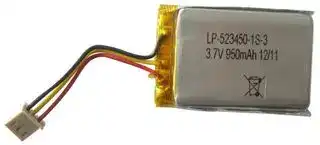
Image not available
Illustrative purposes only

LP-523450-IS-3
Rechargeable Battery, 3.7 V, Lithium Polymer, 950 mAh, Connector, 1
⚠️ Reference pricing provided. In case of supply shortages, we will connect you with our trusted procurement partners to ensure your project's continuity.
- Manufacturer: BAK TECHNOLOGY
- Product type: Batteries - Rechargeable
- Battery Voltage:3.7V; Battery Technology:Lithium Polymer; Battery Capacity:980mAh; Battery Size Code:-; Battery Terminals:Connector; External Diameter:-; External Height:5mm; Exte
- SVHC: No SVHC (23-Jan-2024)
- Weight: 24g
- Pack Quantity: 1
- Product Range: -
- External Depth: 51mm
- External Width: 33.5mm
- Battery Voltage: 3.7V
- External Height: 5mm
- Battery Capacity: 950mAh
- Battery IEC Code: -
- Battery NEDA Code: -
- Battery Size Code: -
- Battery Terminals: Connector
- Battery Compliance: -
- Battery Technology: Lithium Polymer
- Battery Type / Size: Battery Pack
| Delivery and price | |
|---|---|
| Units per pack | 50 |
| Price | 9.6 € |
| Current stock | 10+ |
| Lead time | 30 days |
Datasheet

**Fileno.** : 201704062 **Edition:** 1.0

## **SHENZHEN BAK TECHNOLOGY CO., LTD**

## **Specification**

## **of**

## **Li-polymer Rechargeable Battery**

## **- - - Model No.: LP 523450 1S 3**

Reported by: J.B. Yang Date: April,6th,2017 Checked by: Date: Approved by: Date:

## **1. Scope**

This specification describes the definition, technical requirement, testing method, warning and caution of the Lithium ion polymer rechargeable battery. The specification only applies to SHENZHEN BAK’s Li-ion battery.

## **2. Product Model**

Battery type: Rechargeable Lithium-ion Polymer Battery Battery Model: LP-523450-1S-3

## **3. Ratings**

3.1. Nominal Capacity[at 0.2C]: 950mAh (typical) 3.2. Nominal Voltage: 3.7V (average voltage at 0.2C discharge) 3.3. Charging Voltage: 4.20 V 3.4. Max. Charging Current: 0.1C (0~10℃) 0.2C (10℃~20℃) 0.5C(20℃~45℃)

- 3.5. Charging Method: constant current constant voltage

Standard Charge: 0.2C (stand charge, 6~7hr) 3.6. Max. Continuous Discharge Current: 0.5C

- 3.7. Discharge Cut-off Voltage: 2.5V(limited by PCM)

- 3.8. Battery Dimensions (Refer to the attached drawing)

   - Thickness: 5.2mm Max

(Measured with weighing 300gf at 25±2℃)

Width: 34.5mm Max (Measured with weighing 300gf at 25±2℃) Length: 52mm Max 3.9.Battery Weight: ≤24g

- 3.10. Operating Temperature

Discharge: -20℃ ~ +60℃ Charging: 0℃ ~ +45℃

Charge at a very low temperature such as below 0℃, will get a lower capacity and reduce cycle life of the battery.

Storage in a 50% charged state

-10~45℃≤3 months ≤85%RH -10~30℃≤12 months ≤85%RH

Do NOT storage at fully charged state(4.2V);

Over long storage period cells should be cycled every 90 days. The method is to do a charge-discharge cycle with standard method.

Must charge the battery which with protect circuit when storage for three months.(Under normal storage conditions, long time storage can lead to decrease of capacity and cycle life, such as the decrease of the capacity of the storage environment and the decrease of the cycle life.)

## **4. Battery Performance**

## 4.1. Visual Inspection

There shall be no such defects as remarkable scratches, cracks, leakage or deformations.

- 4.2. Test Condition

## 4.2.1.Standard Test Condition

Test new cells within one month after shipment from our factory and the cells shall not be cycled over five times before the tests.

All the tests in this specification shall be conducted in an ambient temperature of 25℃

   - ±5℃ under a humidity of 25% to 85%, unless otherwise specified.

- 4.2.2 Measuring Instrument or Apparatus

- 4.2.2.1. The dimension measurement shall be implemented by instruments with equal or more precision of 0.01mm.

- 4.2.2.2 Standard class specified in the national standard or more sensitive class having inner impedance more than 10kΩ/V.

- 4.2.2.3 Impedance shall be measured by a sinusoidal alternating current method (1kHz LCR meter).

- 4.2.2.4 The current measurement shall be implemented by instrument with equal to more precision scale of±0.1% and the constant voltage precision should be implemented with±0.5%, and the timing precision should be not below ±0.1%.

- 4.2.2.5 The temperature measurement shall be implemented by instrument with equal or more precision seal of ±0.5℃.

- 4.3 Electrical Characteristics

- 4.3.1 Standard Charge

The cell shall be charged at a constant current of 0.2C to 4.2V and then at constant

voltage of 4.2V with a charging time of 6~7 hours or 0.02C cut off.

- 4.3.2 Rated Capacity (0.2C): 950mAh (minimum)

The capacity shall be measured at a discharge current of 0.2C and a cut-off voltage of 2.75V after the standard charge (Section 4.3.1.)

- 4.3.3 Low Temperature Discharge Capacity (-10℃): ≥210min

   - Charge in this way under 23±2℃: charge at 0.2C until the voltage reaches 4.2V, then charge under a constant 4.2V, until the current ≤0.2C. Then let the battery stay at -10±2℃ for 4h and then discharge at 0.2C until the voltage drops to 2.75V, then stay at 23±2℃ for 2h.

- 4.3.4 High Temperature Discharge Capacity (55℃): ≥300min Charge in this way under 23±2℃: charge at 0.2C until the voltage reaches 4.2V, then charge under a constant 4.2V, until the current ≤0.2C. Then let the battery stay at 55 ±2 ℃ for 2h and then discharge at 0.2C until the voltage drops to 2.75V, then stay at 23±2℃ for 2h.

- 4.3.5. Storage Characteristics (23±2℃) Capacity Retention: ≥255mins Capacity Recovery: ≥270mins The capacity retention shall be measured at a discharge current of 0.2C and a cut-off voltage of 2.75V after standard charge (Section 4.3.1.) and being stored for 28 days at 25℃±5℃. Then, the capacity recovery shall be measured at a discharge current of 0.2C and a cut-off voltage of 2.75V after standard charge (Section 4.3.1.).

- 4.3.6 Internal Impedance: 180mΩ( max)

The internal impedance shall be measured at a since wave alternative current process of 1kHz after the standard charge.

- 4.3.7. Cycle Life :

The cycle life shall be conducted as the following procedures:

Step 1: charge the cell with the standard charge (as of section 4.3.1); Step 2: discharge the cell at 0.2C to 2.75V,

Step 3: repeat Step 1 and Step 2 for 300 times. The capacity after 300 cycles is expected to be equal to or more than 80% of the rated capacity.

- 4.3.8 Open Circuit Voltage: 3.7V ~ 3.80V as of shipment(within 10 days from factory).

- 4.4 Environmental Performance

- 4.4.1 Vibration Test: The battery has no distortion, no leakage, no smoking and no explosion. And the voltage shall be ≥3.60V

Procedure: Fix the fully charged battery on the vibration table. Adjust the instrument as follows. There are 3 directions: X, Y, Z. In each direction, the battery should be vibrated for 30 min from 10Hz to 55Hz.

Frequency sweeping rate: 1Hz~30Hz;

Movement amplitude(mon-amplitude): 0.38mm;

Vibrating frequency: 30Hz~55Hz;

Movement amplitude(mon-amplitude): 0.19mm.

- 4.4.2 Drop Testing: The battery has no leakage, no smoking, no fire no explosion. The voltage should≥ 90% of the initial.

Procedure: After fully charged, the battery is dropped from a high 1.0m away free onto concrete land once of each side, total six times.

- 4.5 Safety Performance

- 4.5.1 Short Circuit Test: (with a PCM) No Fire, No Explosion

Fully charging the battery, discharge through a 0.1Ω resistor for 1h. Then charge at 1C for 5s, observe the battery’s appearance.

- 4.5.2 Over charge Test: (with a PCM) No Fire, No Explosion

Charge in this way under 23±2℃: charge at 1C until the battery reaches 4.2V, then charge under a constant 4.2V, until the current ≤ 0.02C. Then the cell shall be charged at 3C/4.6V for 7h. The over charge protection function should work.

- 4.5.3 Over discharge Test: (with a PCM) No Fire, No Explosion

Discharge at 0.2C at 23±2℃ until the battery voltage drops to the over discharge voltage, then discharge through a 30Ω resister for 24h. The over discharge protection function should work.

- 4.5.4 Thermal Shock Test (with a PCM) No Fire, No Explosion

After standard charge (Section 4.3.1.), the battery is placed in an oven and is heated up at a rate of 5℃/min until the temperature reaches 130℃. The oven shall be maintained at 130℃ for 30 minutes.

**5. Delivery Condition:** about 30% charged for air shipment.

## **6. Lithium Ion Polymer Battery Handling Guideline**

- 6.1 In case of contacting the materials from a damaged or ruptured cell or battery: Eye contact: Washing immediately with plenty of water and soap or for at least 15 minutes.

Get medical attention.

Skin Contact: Washing immediately with water and soap. Inhalation of Vented Gas: Remove to fresh air. Get medical attention. Ingestion: Get medical attention immediately.

- 6.2 Keep away batteries from children.

- 6.3 The cells/ batteries are requested to be stored within a proper temperature range specified in this specification.

- 6.4 Do not store batteries in a manner that allow s terminals to short circuit.

- 6.5 Do not place batteries near heating sources, nor exposed to direct sunlight for long periods. Elevated temperatures can result in reduced battery service life.

- 6.6 Charging Battery

   - Use only approved chargers and procedures. Improperly charging a cell or battery may cause the cell or battery to flame or damage.

   - Charge the battery using the “CC/CV” or constant current /constant voltage method.

   - Do not charge the battery with a current or voltage higher than the specified maximum value in this specification. The absolute maximum charging voltage is 4.25V per cell.

   - Prohibit reverse charging of the battery. The battery must be connected correctly.

- 6.7 Discharging Battery

   - Discharge battery at the max current specified in this specification. If you plan to discharge battery at a higher current than the max current, please consult us. Avoid discharge the battery below 2.75V for each cell.

   - Do not over-discharge the battery. Over-discharging can damage the performance of the battery. It should be noted that the cell/battery would be at an over-discharged state by its self-discharge characteristics in case the cell is not used for long time. In order to prevent over-discharging, the cell/battery shall be charged periodically to maintain between 3.7V and 3.8V.

- 6.8 Operation Temperature

   - The battery shall be operated (stored, charged and discharged) in the temperature specified in This specification.

- 6.9 Cell/Battery Protection Circuit Module (PCM)

   - The cell/battery must be equipped with a PCM that protects the cell/battery from overcharging, over-discharging and over-current.

- 6.10 Battery Short Circuit

   - Do not short-circuit a battery. A short circuit can result in over-heating of the terminals and provide an ignition source. More than a momentary short circuit will generally reduce the cell or battery service life and can lead to ignition of surrounding materials or materials within the cell or battery if the seal integrity is damaged. Extended short-circuiting creates high temperature in the cell and at the terminals. Physical contact to high temperatures can cause skin burns. In addition, extended short-circuit may cause the cell or battery to flame.

- 6.11 Prohibit reversing cell polarity within a battery assembly.

- 6.12 The cell edge of the heat seal zone is electrically conductive. Avoid the edge cross battery terminals, PCB, or conductive surfaces.

- 6.13 Do not bend, fold or fall the battery or part of the battery. It may cause the battery be damaged and result in the battery swelling, leaking, explosion or ignition

- 6.14 Do not open or manipulate the folded cell edge.

- 6.15 Do not bend or fold the sealing edge. And do not tear off the sealing film.

## 6.16 Battery Pack Design

The battery housing should have sufficient mechanical strength.

No sharp edge components shall be inside the battery housing. The sharp edge may destroy the cell packaging.

No cell movement is allowed in the battery housing.

The ultrasonic head shall not directly/ or indirectly pressed the cell if you need to enclose the battery housing by ultrasonic method. Please consult us for designing the ultrasonic head. Avoid designing airtight battery housing.

- 6.17 Battery Assembly

We recommend ultrasonic welding or spot welding to connect battery with PCM or other

parts. If you employ manual solder method to connect tab with PCM, please pay attention to the followings:

Use a solder with temperature controlled and ESD.

Soldering temperature should not exceed 300℃.

Soldering time should not be longer than 3s.

Soldering times should not exceed 5 times.

Keep battery tab cold down before next time soldering.

Do not directly heat cell body. It may cause the battery be damaged by heat above 90℃

- 6.18 Battery Disassembly

Never disassemble a battery.

Should a battery unintentionally be crushed, thus releasing its contents, rubber gloves must be used to handle all battery components. Avoid inhalation of any vapors that may be emitted.

- 6.19 Do not mixed Batteries and Types. Avoid to use old and new cells or cells of different sizes, different chemistry or types in the same battery assembly.

- 6.20 Warranty

The warranty period is one year after the date of ex-factory. However, the manufacturer will not replace the battery free of charge even in the warranty period if the problem with the battery results from misuse rather than bad quality.

- 6.21Other Warnings

Do not heat or dispose the battery into fire, water or other liquids.

Do not put the battery into microwave, washing machine or drying machine. Do not use a damaged battery.

- 6.22 Others

## **7. Remarks**

If any matter with this specification arises, it shall be revised by mutual agreements.

## **8. Drawing**

|**8. Drawing**||||
|---|---|---|---|
|No.|Item|Spec|Qty|
|01|Cell|523450P|1|
|02|PCM+NTC|2.5V cut-off<br>25℃<br>10K±1%|1|
|03|Wire(+)|UL1007 AWG24|1|
|04|Wire(NTC)|UL1007 AWG24|1|
|05|Wire(-)|UL1007 AWG24|1|
|06|Connector|Molex 5264-0300 or<br>equivalent|1|
|07|InsulatingTape|Orange|1|
|08|PVC|Orange|2|
|09|Label|8*8mm|1|


## **9. Electrical Characteristics of PCM**

|No.|Item||Unit|Min|Typ|Max|
|---|---|---|---|---|---|---|
|1|Over charge<br>protection|Over charge<br>protection<br>voltage|V|4.175|4.200|4.225|
|||Delay<br>time<br>for<br>over<br>charge<br>protection|S|0.7|1.0|1.3|
|2|Over<br>discharge<br>protection|Over<br>discharge<br>protection<br>voltage|V|2.438|2.500|2.562|
|||Delay<br>time<br>for<br>over<br>discharge<br>protection|mS|14|20|26|
|3|Over current<br>discharge<br>protection|Over current<br>discharge<br>protection<br>testing<br>values|A|3||6|
|||Delay<br>time<br>for<br>over<br>current<br>protection|mS|8|12|16|
|4|Short circuit<br>protection|Delay<br>time<br>for<br>short<br>circuit<br>protection|uS|230|300|500|
|5|Power<br>consumption<br>of protection<br>circuit|Power down|uA|/|/|2.0|
|||Operation|uA|/|4.0|8.0|
|6|PCB onternal|resistance|mΩ|/|/|65|
|7|NTC<br>thermistor<br>value<br>Operation(25℃, tested by<br>multimeter)||KΩ|9.9|10.0|10.1|
Updated at June 4, 2026
About Novapart
Novapart is a B2B electronic component broker specialising in stock shortages and cost reduction. We source hard-to-find parts and identify compliant alternatives across a catalogue of 410,000+ components from 500+ manufacturers.
Learn more →Stock Shortage Specialist
When a component is unavailable, discontinued or has an unacceptable lead time, we tap into our network of vetted European and Asian distributors to source what you need — without compromising on quality or traceability.
Request a quote →Compliant Alternatives
We identify pin-to-pin, electrically equivalent substitutes that meet the same certifications (RoHS, AEC-Q100, REACH) as your original specification — validated against datasheets, not just part numbers. Often at a lower cost.
BOM Analysis service →