
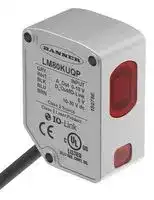


LM80KUQP.
LASER SENSOR, TRIANGULATION, 80MM, 30V
- Manufacturer: BANNER ENGINEERING
- Product type:
- Sensing Method:Triangulation; Product Range:LM Series; Connection Method:M12 Connector; Supply Voltage Min:10V; Supply Voltage Max:30V; Sensing Range Max:80mm; 88AH5834
- Product Range: LM Series
- Sensing Method: Triangulation
- Connection Method: M12 Connector
- Sensing Distance Max: 80mm
| Delivery and price | |
|---|---|
| Units per pack | 5 |
| Price | 1204.95 € |
| Current stock | 10+ |
| Lead time | 30 days |

LM Analog/Discrete Series Laser L-GAGE® Sensor Quick Start Guide

## Product Description

Laser displacement sensor that supports IO-Link communication with analog and discrete (switched) outputs.

This guide is designed to help you set up and install the LM Analog/Discrete Series Laser Sensor. For complete information on programming, performance, troubleshooting, dimensions, and accessories, please refer to the Product Manual at www.bannerengineering.com. Search for part number 205812 to view the Product Manual. Use of this document assumes familiarity with pertinent industry standards and practices.

## WARNING:

- Do not use this device for personnel protection

- • Using this device for personnel protection could result in serious injury or death. • This device does not include the self-checking redundant circuitry necessary to allow its use in personnel safety applications. A device failure or malfunction can cause either an energized (on) or de-energized (off) output condition.

## Features and Indicators

**==> picture [451 x 109] intentionally omitted <==**

**----- Start of picture text -----**<br>
Three LED indicators provide ongoing indication of the sensing status.<br>1 1.  Analog Output LED Indicator<br>Solid Amber = Displayed distance is within the taught analog output window<br>Off = Displayed distance is outside the taught analog output window<br>2<br>2.  Power LED Indicator<br>Solid Green = Normal operation, power On and laser On<br>Flashing Green (1 Hz) = Power On and laser Off (laser enable mode)<br>3 3.  Discrete Output LED Indicator<br>Solid Amber = Discrete Output is On<br>Off = Discrete Output is Off<br>**----- End of picture text -----**<br>


**==> picture [349 x 16] intentionally omitted <==**

**----- Start of picture text -----**<br>
Class 1 Laser Description and Safety Information<br>**----- End of picture text -----**<br>


**==> picture [432 x 176] intentionally omitted <==**

**----- Start of picture text -----**<br>
Laser light. Do not stare into the beam.<br>CLASS 1<br>Complies with 21 CFR 1040.10 and 1040.11 except for deviations  LASER PRODUCT<br>pursuant to Laser Notice No. 56, dated May 8, 2019.<br>:<br>CAUTION:<br>• Never stare directly into the sensor lens.<br>• Laser light can damage your eyes.<br>• Avoid placing any mirror-like object in the beam. Never use a mirror as a retroreflective target.<br>CAUTION:<br>• Return defective units to the manufacturer.<br>• Use of controls or adjustments or performance of procedures other than those specified herein may result in<br>hazardous radiation exposure.<br>• Do not attempt to disassemble this sensor for repair. A defective unit must be returned to the manufacturer.<br>**----- End of picture text -----**<br>


Original Instructions 21-Jul-25

- © Banner Engineering Corp. All rights reserved. www.bannerengineering.com

p/n: 205811 Rev. E

LM Analog/Discrete Series Laser L-GAGE® Sensor Quick Start Guide

## CAUTION:

- Ne regardez jamais directement la lentille du capteur.

- La lumière laser peut endommager la vision.

- Évitez de placer un objet réfléchissant (de type miroir) dans la trajectoire du faisceau. N'utilisez jamais de miroir comme cible rétro-réfléchissante.

## CAUTION:

- Tout dispositif défectueux doit être renvoyé au fabricant.

- • L'utilisation de commandes, de réglages ou de procédures autres que celles décrites dans le présent document peut entraîner une exposition dangereuse aux radiations.

- N'essayez pas de démonter ce capteur pour le réparer. Tout dispositif défectueux doit être renvoyé au fabricant.

Class 1 lasers are lasers that are safe under reasonably foreseeable conditions of operation, including the use of optical instruments for intrabeam viewing.

Complies with IEC 60825-1:2014 and EN 60825-1:2014+A11:2021.

## For safe laser use:

- Do not stare at the laser.

- • Do not point the laser at a person’s eye.

- Mount open laser beam paths either above or below eye level, where practical.

- • Terminate the beam emitted by the laser product at the end of its useful path.

## Class 1 Laser Characteristics

Output power: < 0.33 mW Laser wavelength: 655 nm Pulse duration: 45 µs to 1750 µs

## Class 2 Laser Description and Safety Information

Laser light. Do not stare into the beam. **CLASS 2** Complies with 21 CFR 1040.10 and 1040.11 except for deviations **LASER PRODUCT** pursuant to Laser Notice No. 56, dated May 8, 2019. LJ

- CAUTION: • Never stare directly into the sensor lens. • Laser light can damage your eyes. • Avoid placing any mirror-like object in the beam. Never use a mirror as a retroreflective target.

## CAUTION:

   - Return defective units to the manufacturer.

   - • Use of controls or adjustments or performance of procedures other than those specified herein may result in hazardous radiation exposure.

   - • Do not attempt to disassemble this sensor for repair. A defective unit must be returned to the manufacturer.

- CAUTION: • Ne regardez jamais directement la lentille du capteur.

   - La lumière laser peut endommager la vision.

   - • Évitez de placer un objet réfléchissant (de type miroir) dans la trajectoire du faisceau. N'utilisez jamais de miroir comme cible rétro-réfléchissante.

## CAUTION:

- Tout dispositif défectueux doit être renvoyé au fabricant.

- • L'utilisation de commandes, de réglages ou de procédures autres que celles décrites dans le présent document peut entraîner une exposition dangereuse aux radiations.

- N'essayez pas de démonter ce capteur pour le réparer. Tout dispositif défectueux doit être renvoyé au fabricant.

page 2 of 9

© Banner Engineering Corp. All rights reserved.

21-Jul-25

www.bannerengineering.com

LM Analog/Discrete Series Laser L-GAGE® Sensor Quick Start Guide

Class 2 lasers are lasers that emit visible radiation in the wavelength range from 400 nm to 700 nm, where eye protection is normally afforded by aversion responses, including the blink reflex. This reaction may be expected to provide adequate protection under reasonably foreseeable conditions of operation, including the use of optical instruments for intrabeam viewing.

Complies with IEC 60825-1:2014 and EN 60825-1:2014+A11:2021.

Class 2 Laser Safety Notes . Low-power lasers are, by definition, incapable of causing eye injury within the duration of a blink (aversion response) of 0.25 seconds. They also must emit only visible wavelengths (400 nm to 700 nm). Therefore, an ocular hazard may exist only if individuals overcome their natural aversion to bright light and stare directly into the laser beam.

For safe laser use:

- Do not stare at the laser.

- Do not point the laser at a person’s eye.

- Mount open laser beam paths either above or below eye level, where practical.

- Terminate the beam emitted by the laser product at the end of its useful path.

IMPORTANT: This laser device is not bore-sighted.

Class 2 Laser Characteristics

Output power: 0.45 mW Laser wavelength: 640 nm - 670 nm Pulse duration: 45-1,750 ms

## Installation Instructions

## Sensor Installation

NOTE: Handle the sensor with care during installation and operation. Sensor windows soiled by fingerprints, dust, water, oil, etc. may create stray light that may degrade the peak performance of the sensor. Blow the window clear using filtered, compressed air, then clean as necessary using 70% isopropyl alcohol and cotton swabs or water and a soft cloth.

## Install the Safety Label

The safety label must be installed on or near the LM sensors.

NOTE: Position the label on the cable or near the sensor in a location that has minimal chemical exposure.

**==> picture [174 x 8] intentionally omitted <==**

**----- Start of picture text -----**<br>
Typical installation; other mounting options are possible.<br>**----- End of picture text -----**<br>


**==> picture [49 x 65] intentionally omitted <==**

**==> picture [98 x 32] intentionally omitted <==**

**==> picture [50 x 65] intentionally omitted <==**

**==> picture [74 x 55] intentionally omitted <==**

1. Remove the protective cover from the adhesive on the label.

2. Wrap the label around the LM cable, as shown.

3. Press the two halves of the label together.

## Sensor Orientation

Correct sensor-to-object orientation is important to ensure proper sensing. See the following figures for examples of correct and incorrect sensor-to-object orientation as certain placements may pose problems for sensing distances.

© Banner Engineering Corp. All rights reserved. www.bannerengineering.com

page 3 of 9

21-Jul-25

LM Analog/Discrete Series Laser L-GAGE® Sensor Quick Start Guide

**==> picture [444 x 141] intentionally omitted <==**

**----- Start of picture text -----**<br>
Orientation by a wall Orientation in an opening Orientation for a turning object<br>1 1 a4 i 1 /<br>loysVf AiWall LifAd KW | iy,4 ij i//<br>hid 1 iy! 1 iif<br>/ / i Lil<br>Nf — ——_<br>\i/<br>Correct Incorrect Correct Incorrect Correct Incorrect<br>Orientation for a height difference Orientation for a color or luster difference Orientation for a highly reflective target<br>**----- End of picture text -----**<br>


Applying tilt to sensor may improve performance on reflective targets. The direction and magnitude of the tilt depends on the application, but a 15° tilt is often sufficient.

## Mount the Device

1. If a bracket is needed, mount the device onto the bracket.

2. Mount the device (or the device and the bracket) to the machine or equipment at the desired location. Do not tighten the mounting screws at this time.

3. Check the device alignment.

4. Tighten the mounting screws to secure the device (or the device and the bracket) in the aligned position.

## Wiring Diagrams

**==> picture [462 x 118] intentionally omitted <==**

**----- Start of picture text -----**<br>
bn (1) + Key bn (1) +<br>10–30 V DC 10–30 V DC<br>bu (3) – 2 bu (3) –<br>*<br>bk (4) Load D_Out/IO-Link * 1 000 bk (4) Load D_Out/IO-Link *<br>== aN 3 a<br>Ws,<br>wh (2) 4-20 mA A_Out 4 5 wh (2) 0-10 V A_Out<br>ae — a a<br>gy (5) a 1 = Brown gy (5) oo<br>Input 2 = White Input<br>3 = Blue<br>4 = Black<br>shield shield<br>5 = Gray<br>* Push-Pull output. User-configurable PNP/NPN setting. * Push-Pull output. User-configurable PNP/NPN setting.<br>NPN NPN<br>PNP PNP<br>**----- End of picture text -----**<br>


The bare shield wire is connected internally to the sensor housing and should be connected as follows:

- If the sensor housing is mounted so that it is in continuity with both the machine frame and earth ground, connect the bare wire (also) to earth ground.

- If the sensor housing is mounted so that it is insulated from the machine frame and you are experiencing noise, connecting the bare wire to -V dc (together with the blue wire), may help.

- If the sensor is mounted so that it is in continuity with the machine frame, but not with earth ground, do not connect the bare wire (e.g. cut off the bare wire).

page 4 of 9

© Banner Engineering Corp. All rights reserved. www.bannerengineering.com

21-Jul-25

LM Analog/Discrete Series Laser L-GAGE® Sensor Quick Start Guide

## Configuration Instructions

## Sensor Programming

Program the sensor using the buttons on the RSD1 remote sensor display accessory, via IO-Link, or the remote input (limited programming options).

If you are using the RSD1 for programming, from Run mode, use the buttons to access the Quick Menu and the Sensor Menu. See the instruction manual (p/n 205812) for more information on the options available from each menu. For TEACH options, follow the TEACH instructions in the instruction manual.

In addition to programming the sensor, use the remote input to disable the buttons for security, preventing unauthorized or accidental programming changes. See the instruction manual for more information.

**==> picture [244 x 194] intentionally omitted <==**

**----- Start of picture text -----**<br>
Accessing the Menus<br>from Run Mode<br>Press<br>> 4 sec.<br>Access Access<br>Sensor Menu RSD1 Menu<br>**----- End of picture text -----**<br>


## Remote Display Buttons and the LM

Use the RSD1 buttons Down , Up , Enter , and Escape to view or change RSD1 settings and information and to program a connected sensor.

Down and Up Buttons

Press Down and Up to:

- Access the Quick Menu from Run mode

- Navigate the menu systems

- Change programming settings

- Change individual digit values in distance based settings

When navigating the menu systems, the menu items loop.

Press Down and Up to change setting values. Press and hold the buttons to cycle through numeric values. After changing a setting value, the value slowly flashes until the change is saved using the Enter button.

Enter Button

Press Enter to:

- Access the Sensor Menu from Run mode

- Access the submenus

- Move right one digit in distance based settings

- Save changes

In the RSD1 Menu, a check mark in the lower right corner of the display indicates that pressing Enter accesses a submenu.

Press Enter to save changes. New values flash rapidly, and the sensor returns to the parent menu.

Continued on page 6

© Banner Engineering Corp. All rights reserved. www.bannerengineering.com

page 5 of 9

21-Jul-25

LM Analog/Discrete Series Laser L-GAGE® Sensor Quick Start Guide

## Continued from page 5

Escape Button

Press and hold Escape for 4 seconds to:

- Access the RSD1 Menu while in Run mode

Press Escape to:

- Leave the current menu and return to the parent menu

IMPORTANT: Pressing Escape discards any unsaved programming changes.

In the RSD1 Menu, a return arrow in the upper left corner of the display indicates that pressing Escape returns to the parent menu.

Press and hold Escape for 2 seconds to return to Run mode from the RSD1 Menu.

## Quick Menu

The sensor includes a Quick Menu with easy access to view and change the analog and discrete output switch points.

Access the Quick Menu by pressing Down or Up from Run mode. When in the Quick Menu, the current distance measurement displays on the first line and the menu name and the analog value alternate on the second line of the display.

Press Enter to access the switch points.

Press Down or Up to change the switch point to the desired value.

Press Enter to save the new value and return to the Quick Menu.

## Quick Menu

**==> picture [212 x 144] intentionally omitted <==**

**----- Start of picture text -----**<br>
Run<br>Mode 4mA Pt (value)<br>set value with<br>20mA Pt (value) Save setting<br>and return to<br>Quick Menu<br>or<br>SPt1 Pt (value)<br>Cancel and<br>return to<br>Quick Menu<br>SPt2 Pt (value)<br>access Sensor<br>MENU Menu (Top Menu)<br>**----- End of picture text -----**<br>


- In Setpoint mode, SPt1 Pt is replaced by SPt and SPt2 Pt is not available. In Dual mode, SPt1 is replaced by DualSPt and SPt2 Pt is not available.

## Sensor Menu (MENU)

Access the Sensor Menu by pressing Enter from Run mode. The Sensor Menu is also accessible from the Quick Menu: navigate to MENU and press Enter . The Sensor Menu includes several submenus that provide access to view and change sensor settings and to view sensor information.

page 6 of 9

© Banner Engineering Corp. All rights reserved. www.bannerengineering.com

21-Jul-25

LM Analog/Discrete Series Laser L-GAGE® Sensor Quick Start Guide

## Sensor Menu Full Map

From Run mode, press Enter to enter the top-level menu system (A_OUT, D_OUT, INPUT, MEASURE, etc.).

**==> picture [487 x 475] intentionally omitted <==**

**----- Start of picture text -----**<br>
Top Menu Sub-Menus Top Menu Sub-Menus<br>Run Enter<br>Mode MENU A_OUT A_OUT Tch2Pt Tch2Pt Tch4mA Tch4mA 50.00mm MENU INPUT INPUT Type Type Teach<br>Top Menu Tch2Pt Tch20mA Tch20mA 150.00mm Type LasrEnbl<br>A_OUT TchMid TchMid WndSize WndSize +030.00mm Type Trigger<br>Select menu item TchMid Tch12mA Tch12mA 100.00mm Type SyncMstr<br>Press to save settingor TchMid Offset Offset 0mm Type SyncSlve<br>A_OUT Adj4mA Adj4mA +050.00mm Type Disabled *<br>(see Quick Menu diagram)Enter Quick Menu Loop Press and hold to go backGo back to parent menuPress and hold 4 secondsto Run modeoror A_OUT Adj20mAA_OUT Slope Adj20mA +150.00mmSlope PositiveSlope Negative * INPUT Active Active Low (NPN)Active High (PNP) *<br>to go back to Run mode A_OUT LossSig LossSig 3.5 mA *<br>LossSig 20.5 mA MENU MEASURE MEASURE Speed Speed 4 ms<br>LossSig Hold<br>Speed 2 ms<br>A_OUT Average Average 512 Speed 1 ms *<br>Average 256 Speed 0.25 ms<br>Average 128<br>Average 64 MEASURE Trigger Trigger Sample *<br>Average 32 Trigger Average<br>Average 16 * Trigger Max<br>Average 8 Trigger Min<br>Average 4 Trigger Range<br>Average 2 Trigger TrackMax<br>Average 1 Trigger TrackMin<br>MENU D_OUT D_OUT Tch2Pt Tch2Pt TchSPt1Tch2Pt TchSPt2 TchSPt1 050.00mmTchSPt2 150.00mm MENU DISPLAY DISPLAY Units Units mm *<br>Units in<br>D_OUT TchMid TchMid WndSize WndSize +030.00mm DISPLAY Zero Zero Near *<br>TchMid TchMdPt TchMdPt 100.00mm<br>Zero Far<br>TchMid Offset Offset 0mm DISPLAY Shift Shift Off *<br>D_OUT AdjSPt1 AdjSPt1 +050.00mm Shift SetZero<br>D_OUT AdjSPt2 AdjSPt2 +150.00mm Shift AutoSet<br>(in Dual mode only) D_OUT TchDual<br>(in Dual mode only) D_OUT DualSPt DualSPt 75P<br>(in Dual mode only) D_OUT Track Track Off * MENU INFO INFO Model Model LM150KI<br>Track HS INFO P/N P/N<br>Track On INFO S/N S/N F..S..P..D..<br>D_OUT Mode Mode Alarm INFO Version Version 1.0.0<br>Mode Health INFO CommP/N P/N<br>Mode Swtch<br>INFO CommVer Version 1.0.0<br>Mode Swtch<br>Mode Wnd *<br>Mode Wnd<br>Mode Dual<br>Mode Dual MENU RESET RESET No<br>RESET Yes<br>(in SPt mode only) D_OUT SPtRef SPtRef Object<br>SPtRef Backgrnd<br>SPtRef Custom<br>(in SPtRef Custom D_OUT Offset Offset 0 mm<br>mode only)<br>D_OUT Timer Timer OffDly OffDly 0 ms<br>Timer Off1Sho Off1Sho 0 ms<br>Timer OnDly OnDly 0 ms<br>Timer On1Sho On1Sho 0 ms<br>D_OUT Polarity Polarity PNP *<br>Polarity NPN<br>**----- End of picture text -----**<br>


* Factory default setting

## Specifications

## Supply Voltage (Vcc)

10 V DC to 30 V DC Use only with a suitable Class 2 power supply (North America)

Power and Current Consumption, exclusive of load Normal Run Mode: 1.5 W, Current consumption < 62 mA at 24 V DC

## Ambient Light Immunity

10,000 lux

Construction

Housing: stainless steel Window: acrylic

Supply Protection Circuitry Protected against reverse polarity and transient overvoltages

© Banner Engineering Corp. All rights reserved. www.bannerengineering.com

page 7 of 9

21-Jul-25

LM Analog/Discrete Series Laser L-GAGE® Sensor Quick Start Guide

## Output Ratings

Discrete Output: 50 mA maximum (protected against continuous overload and short circuit) Output saturation voltage (PNP): < 3 V at 50 mA Output saturation voltage (NPN): < 2.5 V at 50 mA Analog current output (LM...I Models): 500 Ω maximum Analog voltage output (LM...U Models): 1000 Ω minimum

Maximum Torque 1.5 N·m Remote Input Allowable Input Voltage Range: 0 to Vcc Active Low (internal weak pullup—sinking current): High State: > 3.6 V Low State: < 2.4 V Active High (internal weak pulldown—sourcing current): High State: > Vcc - 2.9 V Low State: < Vcc - 4.6 V

Minimum Window Size, Analog and Discrete LM80:

Analog: 1 mm Discrete: 0.024 mm LM150:

Analog: 1 mm Discrete: 0.1 mm

Minimum Object Separation LM80:

Uniform targets (6% to 90% reflectivity) 40 mm to 70 mm: 0.04 mm

Uniform targets (6% to 90% reflectivity) 70 mm to 80 mm: 0.06 mm Non-uniform targets (6% to 90% reflectivity): 0.4 mm LM150:

Uniform targets (6% to 90% reflectivity) 50 mm to 120 mm: 0.120 mm

Uniform targets (6% to 90% reflectivity) 120 mm to 150 mm: 0.140 mm Non-uniform targets (6% to 90% reflectivity): 0.8 mm

Environmental Rating IP67

Storage Temperature –35 °C to +60 °C (–31°F to +140 °F)

Sensing Beam Visible red, 655 nm Sensing Range LM80: 40 mm to 80 mm LM150: 50 mm to 150 mm Delay at Power Up 2.1 s Measurement/Output Rate 0.25 ms to 4 ms; user selectable from the Speed menu Output Configuration Analog output: 4 mA to 20 mA (LM...I Models) or 0 to 10 V DC (LM...U Models) Discrete output: Push/Pull, IO-Link Analog Resolution LM80: 0.002 mm LM150: 0.004 mm Repeatability LM80: ± 0.001 mm[(1)] LM150: ± 0.002 mm[(2)]

(1) Performance with 6% to 90% reflectivity with 128× averaging. With 1×

averaging, repeatability of ± 0.004 mm from 40 to 80 mm. (2) Performance with 6% to 90% reflectivity with 128× averaging. With 1× averaging, repeatability of ± 0.005 mm from 50 to 120 mm and ± 0.010 mm from 120 to 150 mm.

Analog and IO-Link Linearity LM80:

40 mm to 70 mm: ± 0.02 mm 70 mm to 80 mm: ± 0.03 mm LM150:

50 mm to 120 mm: ± 0.06 mm 120 mm to 150 mm: ± 0.07 mm

IO-Link Accuracy[(3)] LM80: ± 0.175 mm LM150: ± 0.2 mm Temperature Effect, Typical LM80: ± 0.006 mm/°C LM150: ± 0.008 mm/°C

Response Time Total response speed varies from 0.5 ms to 2048 ms, depending on base measurement rate and averaging settings. See Instruction Manual for more information.

Boresighting

± 0.70 mm at 40 mm ± 0.87 mm at 50 mm ± 1.40 mm at 80 mm ± 2.62 mm at 150 mm

## Vibration/Mechanical Shock

Meets IEC 60947-5-2 (10 to 60 Hz max., double amplitude 0.06 in, max acceleration 10G. 30G 11 ms duration, half sine wave)

Application Note

For optimum performance, allow 10 minutes for the sensor to warm up

Operating Conditions

–10 °C to +55 °C (+14 °F to +131 °F)

90% at +55 °C maximum relative humidity (non-condensing)

Certifications

Banner Engineering BV Park Lane, Culliganlaan 2F bus 3 1831 Diegem, BELGIUM

Turck Banner LTD Blenheim House Blenheim Court Wickford, Essex SS11 8YT GREAT BRITAIN UL Type 1

(3) The accuracy specification refers to the possible absolute offset when installing a sensor without taking any reference measurement. Linearity is the more relevant specification for most applications.

page 8 of 9

© Banner Engineering Corp. All rights reserved. www.bannerengineering.com

21-Jul-25

LM Analog/Discrete Series Laser L-GAGE® Sensor Quick Start Guide

Supply wiring leads < 24 AWG shall not be spliced. For additional product support, go to www.bannerengineering.com.

## Required Overcurrent Protection

WARNING: Electrical connections must be made by qualified personnel in accordance with local and national electrical codes and regulations.

|be made by qualified personnel in<br>accordance with local and national<br>electrical codes and regulations.|Supply<br>Wiring<br>(AWG)<br>Required Overcurrent<br>Protection (A)<br>Supply<br>Wiring<br>(AWG)<br>Required Overcurrent<br>Protection (A)|
|---|---|
|Overcurrent protection is required to be provided by end|20<br>5.0<br>26<br>1.0|
|product application per the supplied table.|22<br>3.0<br>28<br>0.8|
|Overcurrent protection may be provided with external fusing<br>or via Current Limiting, Class 2 Power Supply.|24<br>1.0<br>30<br>0.5|


## FCC Part 15 Class A for Unintentional Radiators

This equipment has been tested and found to comply with the limits for a Class A digital device, pursuant to Part 15 of the FCC Rules. These limits are designed to provide reasonable protection against harmful interference when the equipment is operated in a commercial environment. This equipment generates, uses, and can radiate radio frequency energy and, if not installed and used in accordance with the instruction manual, may cause harmful interference to radio communications. Operation of this equipment in a residential area is likely to cause harmful interference in which case the user will be required to correct the interference at his own expense.

(Part 15.21) Any changes or modifications not expressly approved by the party responsible for compliance could void the user’s authority to operate this equipment.

## Industry Canada ICES-003(A)

This device complies with CAN ICES-3 (A)/NMB-3(A). Operation is subject to the following two conditions: 1) This device may not cause harmful interference; and 2) This device must accept any interference received, including interference that may cause undesired operation.

Cet appareil est conforme à la norme NMB-3(A). Le fonctionnement est soumis aux deux conditions suivantes : (1) ce dispositif ne peut pas occasionner d'interférences, et (2) il doit tolérer toute interférence, y compris celles susceptibles de provoquer un fonctionnement non souhaité du dispositif.

## Banner Engineering Corp Limited Warranty

Banner Engineering Corp. warrants its products to be free from defects in material and workmanship for one year following the date of shipment. Banner Engineering Corp. will repair or replace, free of charge, any product of its manufacture which, at the time it is returned to the factory, is found to have been defective during the warranty period. This warranty does not cover damage or liability for misuse, abuse, or the improper application or installation of the Banner product.

THIS LIMITED WARRANTY IS EXCLUSIVE AND IN LIEU OF ALL OTHER WARRANTIES WHETHER EXPRESS OR IMPLIED (INCLUDING, WITHOUT LIMITATION, ANY WARRANTY OF MERCHANTABILITY OR FITNESS FOR A PARTICULAR PURPOSE), AND WHETHER ARISING UNDER COURSE OF PERFORMANCE, COURSE OF DEALING OR TRADE USAGE.

This Warranty is exclusive and limited to repair or, at the discretion of Banner Engineering Corp., replacement. IN NO EVENT SHALL BANNER ENGINEERING CORP. BE LIABLE TO BUYER OR ANY OTHER PERSON OR ENTITY FOR ANY EXTRA COSTS, EXPENSES, LOSSES, LOSS OF PROFITS, OR ANY INCIDENTAL, CONSEQUENTIAL OR SPECIAL DAMAGES RESULTING FROM ANY PRODUCT DEFECT OR FROM THE USE OR INABILITY TO USE THE PRODUCT, WHETHER ARISING IN CONTRACT OR WARRANTY, STATUTE, TORT, STRICT LIABILITY, NEGLIGENCE, OR OTHERWISE.

Banner Engineering Corp. reserves the right to change, modify or improve the design of the product without assuming any obligations or liabilities relating to any product previously manufactured by Banner Engineering Corp. Any misuse, abuse, or improper application or installation of this product or use of the product for personal protection applications when the product is identified as not intended for such purposes will void the product warranty. Any modifications to this product without prior express approval by Banner Engineering Corp will void the product warranties. All specifications published in this document are subject to change; Banner reserves the right to modify product specifications or update documentation at any time. Specifications and product information in English supersede that which is provided in any other language. For the most recent version of any documentation, refer to: www.bannerengineering.com.

For patent information, see www.bannerengineering.com/patents.

© Banner Engineering Corp. All rights reserved. www.bannerengineering.com

page 9 of 9

21-Jul-25
Updated at April 28, 2026
Founded in 1966, Banner Engineering is a globally recognized leader in the design and manufacture of industrial automation products. The company is renowned for developing innovative, high-quality solutions that improve operational efficiency, safeguard personnel, and optimize manufacturing processes across a diverse range of industries. Our extensive selection of Banner Engineering components prominently features their industry-leading sensing technologies. We offer a comprehensive array of precision light sensors engineered for accurate detection and measurement in demanding environments. Complementing this core sensing portfolio is a robust offering of automation signaling devices, including visual signal indicator units and essential accessories, which provide clear and immediate communication of machine status. Beyond primary sensing and indication solutions, our range encompasses critical components for broader process control and machine safety. This includes advanced process controllers, reliable pressure sensors and transducers, and dependable safety relays. Supported by a variety of purpose-built sensor accessories and fiber optic lead assemblies, Banner Engineering delivers the durable, high-performance technologies required to build and maintain sophisticated automated systems.
About Novapart
Novapart is a B2B electronic component broker specialising in stock shortages and cost reduction. We source hard-to-find parts and identify compliant alternatives across a catalogue of 410,000+ components from 500+ manufacturers.
Learn more →Stock Shortage Specialist
When a component is unavailable, discontinued or has an unacceptable lead time, we tap into our network of vetted European and Asian distributors to source what you need — without compromising on quality or traceability.
Request a quote →Compliant Alternatives
We identify pin-to-pin, electrically equivalent substitutes that meet the same certifications (RoHS, AEC-Q100, REACH) as your original specification — validated against datasheets, not just part numbers. Often at a lower cost.
BOM Analysis service →