
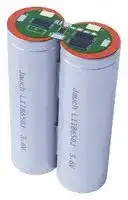
Image not available
Illustrative purposes only

LI18650JLS HB 2S1P
Rechargeable Battery, 7.2 V, Lithium Ion, 3.35 Ah, Wire Leads, 1
⚠️ Reference pricing provided. In case of supply shortages, we will connect you with our trusted procurement partners to ensure your project's continuity.
- Manufacturer: JAUCH
- Product type: Batteries - Rechargeable
- SVHC: To Be Advised
- Weight: 100g
- Pack Quantity: 1
- Product Range: -
- External Depth: 20mm
- External Width: 38mm
- Battery Voltage: 7.2V
- External Height: 69mm
- Battery Capacity: 3.35Ah
- Battery IEC Code: -
- Battery NEDA Code: -
- Battery Size Code: -
- Battery Terminals: Wire Leads
- Battery Compliance: -
- Battery Technology: Lithium Ion
- Battery Type / Size: -
| Delivery and price | |
|---|---|
| Units per pack | 20 |
| Price | 38.1 € |
| Current stock | 10+ |
| Lead time | 30 days |
Datasheet

SPECIFICATIONS CHARGING CHARACTERISTICS PER BATTERY PACK Cell Used ▪ LI18650JLS HB 2S1P Charge Voltage ▪ 8.4 V Jauch No. ▪ 250481 Standard Current ▪ 650 mA UL1642/UL2054 ▪ YES/NO Max. Charging Current ▪ 1000 mA UN 38.3 ▪ YES Operating Temperature ▪ +10°C to +45°C IEC62133 ▪ NO Nominal Voltage ▪ 7.2 V Typ. Capacity ▪ 3350 mAh (0.2C, 2.50V discharge) Min. Capacity ▪ 3250 mAh (0.2C, 2.50V discharge) Weight ▪ Approx. 100 gr.

## PCM PARAMETER PER BATTERY CELL

DISCHARGING CHARACTERISTICS PER BATTERY PACK

Overcharge Det. Voltage ▪ 4.30 V ± 0.02 V Cut-off Voltage ▪ 5.6 V Overcharge Rel. Voltage ▪ 4.15 V ± 0.03 V Standard Current ▪ 650 mA Overdischarge Det. Voltage ▪ 2.80 V ± 0.05 V Max. Discharging Current ▪ 5000 mA Overdischarge Rel. Voltage ▪ 3.00 V ± 0.10 V Operating Temperature ▪ -20°C to +60°C Over Current Range ▪ 7.1 A – 8.7 A Storage Temperature ▪ -20°C to +25°C (max. 3 months) PTC ▪ Ihold = 4A Delivery State of Charge ▪ Max. 30% Itrip = 8A Life Expectancy 0.2C/1.0C ▪ 500 cycles ~ 70% of @25 ± 2°C capacity

> LI18650JLS HB 2S1P | 410) 24.12Wh oped 7.2V | 3350mAh ie 31/21 250481

**==> picture [112 x 33] intentionally omitted <==**

**----- Start of picture text -----**<br>
‘Jauch<br>**----- End of picture text -----**<br>


Jauch Quartz GmbH • email: batterytechnology@jauch.com www.jauch.com

This information is generally descriptive only and is not intended to make or imply any representation, guarantee or warranty with respect to any cells and batteries. Cell and battery designs/specifications are subject to modification without notice. Contact JAUCH for the latest information.

Version 1.1 12/2021 TMU

## HANDLING AND STORAGE

Important notice:

If the battery is for backup use or if battery will be outside of the given temperature ranges – please consult with Jauch

When used correctly, Lithium-Battery-Packs / Rechargeable Lithium-Batteries provide a safe and dependable source of power. However, if they are misused or abused, leakage, venting, or in extreme cases explosion and / or fire may result. Make sure to observe amongst others, following warnings.

Caution:

Do not incinerate, disassemble, short terminals, expose to high temperature 100°C (212°F) risk of fire, explosion. Keep small cells and batteries which are considered swallowable out of the reach of children.

Swallowing may lead to burns, perforation of soft tissue and death. Severe burns can occur within 2 h of ingestion.

In case of ingestion of a cell or battery, seek medical assistance promptly.

Handling

- Do not insert batteries in reverse. Observe the polarity markings on battery and equipment

- Do not short-circuit batteries

- Do not overcharge batteries

- Do not force discharge batteries

- Do not mix batteries

- Do not overheat batteries by exposure to high temperatures and direct sunlight.

- Do not weld or solder directly to batteries

- Do not dismantle batteries

- Do not deform batteries

- Do not dispose of batteries in fire

- A battery with a damaged pouch should not be exposed to water

- Do not allow children to replace batteries without adult supervision

- Keep batteries out of the reach of children. In case of ingestion of a cell or battery, the person involved should seek medical assistance promptly

- Equipment intended for use by children should have battery compartments which are tamper-proof

- Do not encapsulate and/or modify batteries

- Exhausted batteries should be immediately removed from equipment and disposed of

## Storage

- Store unused batteries in their original packaging and keep them away from metal objects which may short circuit them.

- Storing unpackaged cells together could result in cell shorting and heat build-up

- Store and display batteries in their original packaging in well ventilated, dry and cool conditions

- Avoid storing or display batteries in direct sun or in places where they get exposed to rain

- The normal storage of Lithium-ion Battery Pack is made at temperature between +10°C and +25°C, never exceeding +30°C In this way the maximum shelf-life (i.e. max. retention of cell performances after storage periods) of Lithium-Ion-Battery Pack is achieved

- Storage temperatures above room temperature will increase the rate of self-discharge, reducing the available capacity of the cell. Humidity above 95% R.H. and below 40% R.H. should also be avoided for sustained periods, as these extremes are detrimental to batteries

- Storing the cells / batteries at low temperature is also suggested, but attention must be paid when transferring the cells to warmer environments, because of the possibility of having water condensing on to the cells (risk of short circuits)

- Do not stack battery cartons on top of each other exceeding a specified height. The height is clearly dependent on the strength of the packaging. As for general rule this height should not exceed 1.5 m for cardboard packages or 3 m for wooden cases. The above recommendations are equally valid for storage conditions during prolonged transit. Thus, batteries should be stored away from ship engines and not left for long periods in unventilated metal box cars (containers) during summer.

## Charge

   - Charging method must be Constant Current – Constant Voltage (CC-CV)

   - The specified charging characteristics shall not be exceeded

- When discarding batteries with solder tags, insulate the tags by wrapping them with tape, foil, etc.

<Jauch’

This information is generally descriptive only and is not intended to make or imply any representation, guarantee or warranty with respect to any cells and batteries. Cell and battery designs/specifications are subject to modification without notice. Contact JAUCH for the latest information.

Jauch Quartz GmbH • email: batterytechnology@jauch.com www.jauch.com Version 1.1 12/2021 TMU
Updated at June 4, 2026
About Novapart
Novapart is a B2B electronic component broker specialising in stock shortages and cost reduction. We source hard-to-find parts and identify compliant alternatives across a catalogue of 410,000+ components from 500+ manufacturers.
Learn more →Stock Shortage Specialist
When a component is unavailable, discontinued or has an unacceptable lead time, we tap into our network of vetted European and Asian distributors to source what you need — without compromising on quality or traceability.
Request a quote →Compliant Alternatives
We identify pin-to-pin, electrically equivalent substitutes that meet the same certifications (RoHS, AEC-Q100, REACH) as your original specification — validated against datasheets, not just part numbers. Often at a lower cost.
BOM Analysis service →