
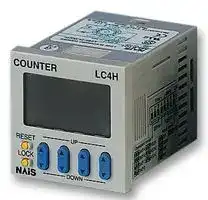


LC4H-R4-AC240V
Counter, LED, LC4H Series, 4 Digits, 100 to 240 Vac, 11 Pin Terminal
- Manufacturer: PANASONIC
- Product type:
- No. of Digits / Alpha:4; Digit Height:-; Supply Voltage Min:100VAC; Supply Voltage Max:240VAC; Panel Cutout Height:-; Panel Cutout Width:-; Operating Temperature Min:-10°C; Operating Temperature Max:55°
- SVHC: No SVHC (07-Jul-2017)
- Digit Height: -
- Product Range: -
- Panel Cutout Width: -
- Supply Voltage Max: 240VAC
- Supply Voltage Min: 100VAC
- Panel Cutout Height: -
- No. of Digits / Alpha: 4
- Operating Temperature Max: 55°C
- Operating Temperature Min: -10°C
| Delivery and price | |
|---|---|
| Units per pack | 1 |
| Price | 129.66 € |
| Current stock | 10+ |
| Lead time | 30 days |

LC4H

## **DIN 48 SIZE LCD ELECTRONIC COUNTER**

## LC4H

## **FEATURES**

**==> picture [160 x 125] intentionally omitted <==**

**----- Start of picture text -----**<br>
_ [|]<br>48<br>1.890<br>L<br>ol<br>64.5<br>48 2.539<br>a 1.890<br>mm inch<br>R4/T4 systems (4-digit display)<br>**----- End of picture text -----**<br>


## **1. Bright and Easy-to-Read Display**

A brand new bright 2-color backlight LCD display. The easy-to-read screen in any location makes checking and setting procedures a cinch.

## **2. Simple Operation**

Seesaw buttons make operating the unit even easier than before.

## **3. Short Body of only 64.5 mm 2.539 inch (screw type) or 70.1 mm 2.760 inch (pin type)**

With a short body, it easily installs in even narrow control panels.

**4. Conforms to IP66’s Weather Resistant Standards**

The water-proof panel keeps out water and dirt for reliable operation even in poor environments.

## **5. Screw terminal and Pin Type are Both Standard Options**

The two terminal types are standard options to support either front panel installation or embedded installation.

## **6. Changeable Panel Cover**

Also offers a black panel cover to meet your design considerations.

## **7. 4-digit or 6-digit display**

Two sizes of displays are offered for you to choose the one that suits your needs.

## **8. Conforms With EMC and Low**

**Voltage Directives** Conforms with EMC directives (EN50081-2/EN50082-2) and low-voltage directives (VDE0435/Part 2021) for CE certification vital for use in Europe.

R6/T6 systems (6-digit display)

Pin type

Screw terminal type

## **PRODUCT TYPES**

|Count speed<br>rs|Output mode<br>rs|Output<br>~~GQ~~<br>Pe|Operation voltage<br>~~GQ~~<br>Pe|Power down insurance<br>~~GQ~~|Terminal<br>~~—~~|
|---|---|---|---|---|---|
|30 Hz (cps)/<br>5 KHz (Kcps)<br>switchable<br>rs|• Maintain<br>output/hold count<br>• Maintain<br>output/over countI<br>• Maintain<br>output/over countII<br>• One shot/over<br>count<br>• One shot/recountI<br>• One shot/recountII<br>• One shot/hold<br>count<br>(7 modes)<br>rs|Relay<br>(1c)<br>~~GQ~~<br>Pe<br>Pe<br>Pe<br>Po|100-240 V AC<br>~~GQ~~<br>Pe<br>Pe|Available<br>~~GQ~~|8 pin<br>~~—~~|
||||||11 pin<br>8 pin<br>~~—~~|
||||||11 pin<br>Screw<br>~~—~~<br>—|
||||24 V AC / 24 V DC<br>Pe<br>Pe<br>Pe||8 pin<br>~~—~~<br>—|
||||||11 pin<br>8 pin<br>—|
||||||11 pin<br>Screw<br>—<br>—|
||||12-24 V DC<br>Pe<br>Pe<br>Po||8 pin<br>—<br>—|
||||||11 pin<br>8 pin<br>—|
||||||11 pin<br>Screw<br>—<br>—|
|||Transistor<br>(1a)<br>Pe<br>Po<br>Pe<br>Pe<br>Po|100-240 V AC<br>Pe<br>Po<br>Pe||8 pin<br>—<br>—|
||||||11 pin<br>8 pin<br>—|
||||||11 pin<br>Screw<br>—<br>—|
||||24 V AC / 24 V DC<br>Po<br>Pe<br>Pe||8 pin<br>—<br>—|
||||||11 pin<br>8 pin<br>—|
||||||11 pin<br>Screw<br>—<br>—|
||||12-24 V DC<br>Pe<br>Pe<br>Po||8 pin<br>—<br>—|
||||||11 pin<br>8 pin<br>—|
||||||11 pin<br>Screw<br>—<br>—|
|||Relay<br>(1c)<br>Pe<br>Po<br>Pe<br>Pe<br>Po|100-240 V AC<br>Pe<br>Po<br>Pe||8 pin<br>—<br>—|
||||||11 pin<br>8 pin<br>—|
||||||11 pin<br>Screw<br>—<br>—|
||||24 V AC / 24 V DC<br>Po<br>Pe<br>Pe||8 pin<br>—<br>—|
||||||11 pin<br>8 pin<br>—|
||||||11 pin<br>Screw<br>—<br>—|
||||12-24 V DC<br>Pe<br>Pe<br>Po||8 pin<br>—<br>—|
||||||11 pin<br>8 pin<br>—|
||||||11 pin<br>Screw<br>—<br>—|
|||Transistor<br>(1a)<br>Pe<br>Po<br>Pe<br>Pe|100-240 V AC<br>Pe<br>Po<br>Pe||8 pin<br>—<br>—|
||||||11 pin<br>8 pin<br>—|
||||||11 pin<br>Screw<br>—<br>—|
||||24 V AC / 24 V DC<br>Po<br>Pe<br>Pe||8 pin<br>—<br>—|
||||||11 pin<br>8 pin<br>—|
||||||11 pin<br>Screw<br>—<br>—|
||||12-24 V DC<br>Pe<br>Pe||8 pin<br>—<br>—|
||||||11 pin<br>8 pin<br>—|
||||||11 pin<br>Screw<br>—|


76

02/2003 02/2003

LC4H

## **PART NAMES**

**==> picture [528 x 269] intentionally omitted <==**

**----- Start of picture text -----**<br>
DIP switches<br>COUNTER LC4H<br>Counter display<br>1 2 3 4 5 6 7 8<br>Controlled output indicator<br>Set value display<br>OP.<br>Reset indicator RST<br>LOCK<br>Lock indicator<br>RESET UP<br>Up keys<br>Reset switch LOCK<br>Down keys<br>Lock switch DOWN<br>(Same for screw-down terminal type)<br>DIP switches<br>COUNTER LC4H<br>Counter display<br>1 2 3 4 5 6 7 8<br>Controlled output indicator<br>Set value display<br>OP.<br>Reset indicator RST<br>LOCK<br>Lock indicator<br>RESET<br>Up keys<br>Reset switch LOCK<br>Lock switch<br>(Same for screw-down terminal type)<br>ON<br>ON<br>**----- End of picture text -----**<br>


## **SPECIFICATIONS**

**==> picture [528 x 417] intentionally omitted <==**

**----- Start of picture text -----**<br>
Ralay output type Transistor output type<br>Item<br>AC type DC type AC type DC type<br>Rated operating voltage 100 to 240 V AC, 24 V AC [1)] 12 to 24 V DC 100 to 240 V AC, 24 V AC [1)] 12 to 24 V DC<br>Rated frequency 50/60 Hz common — 50/60 Hz common —<br>Power consumption Max. 10 V A Max. 3 W Max. 10 V A Max. 3 W<br>Control output 1 Form C: 5 A, 250 V AC (resistive) 1 Form A: 100 mA, 30 V DC Open collector output (Max.)<br>Addition (UP)/Subtraction (DOWN)/Direction (DIR)/Individuality (IND)/Phase (PHASE)<br>Input mode<br>5 modes selectable by DIP switch<br>Counting speed 30 Hz/5 kHz (selectable by DIP switch)<br>Min. counting input time 16.7 ms at 30 Hz/0.1 ms at 5 kHz ON time: OFF time = 1:1<br>Reset input method Signal reset/Push-key switch, Min. input time 1 ms, 20 ms (selected by DIP switch)<br>Rating<br>Lock input Min. input signal width: 20 ms<br>Contact or Open collector input/Input impedance: 1 kΩ or less, Input residual voltage: 2 V or less,<br>Input signal Open impedance: 100 kΩ or more, Max. energized voltage: 40 V DC<br>Output mode HOLD-A/HOLD-B/HOLD-C/SHOT-A/SHOT-B/SHOT-C/SHOT-D, 7 modes selectable by DIP switch<br>One shot output time Approx. 1 s<br>Indication 7-segment LCD, Counter value (backlight red LED), Setting value (backlight yellow LED)<br>4-digit display type –999 to 9999 (–3 digits to +4 digits) (0 to 9999 for setting)<br>Digit<br>6-digit display type –99999 to 999999 (–5 digits to 6 digits) (0 to 999999 for setting)<br>Memory EEP-ROM (Overwriting times: 10 [5] ope. or more)<br>Contact arrangement 1 Form C 1 Form A (Open collector)<br>Contact Initial contact resistance 100 mΩ (at 1 A 6 V DC) —<br>Contact material Ag alloy/Au flush —<br>Mechanical 2.0 × 10 [7] ope. (Except for switch operation parts) —<br>Life<br>Electrical 1.0 × 10 [5] ope. (At rated control voltage) 1.0 × 10 [7] ope. (At rated control voltage)<br>Operating voltage range 85 to 110 % of rated operating voltage<br>Between live and dead metal parts: 2,000 Vrms for 1 min (11-pin type)<br>Between live and dead metal parts: 2,000 Vrms for 1 min (11-pin type)<br>Initial withstand voltage Between input and output: 2,000 Vrms for 1 min<br>Between input and output: 2,000 V AC for 1 min<br>Between open contacts: 1,000 Vrms for 1 min<br>Electrical<br>Initial insulation resistance(At 500 V DC) Between live and dead metal parts: Min. 100 MBetween input and output: Min. 100 MBetween open contact: Min. 100 MΩΩΩ(11-pin type) Between live and dead metal parts: Min. 100 MBetween input and output: Min. 100 MΩ Ω(11-pin type)<br>Temperature rise Max. 65° C (under the flow of nominal operating current at nominal voltage)<br>Vibration Functional 10 to 55 Hz (1 cycle/min), single amplitude: 0.35 mm .014 inch (10 min on 3 axes)<br>resistance Destructive 10 to 55 Hz (1 cycle/min), single amplitude: 0.75 mm .030 inch (1 h on 3 axes)<br>Mechanical<br>Shock  Functional Min. 98 m 321.522 ft./s [2] (4 times on 3 axes)<br>resistance Destructive Min. 294 m 964.567 ft./s [2] (5 times on 3 axes)<br>Ambient temperature –10° C to 55° C +14° F to +131° F<br>Operating Ambient humidity Max. 85 % RH<br>conditions Air pressure 860 to 1,060 h Pa<br>Ripple rate — 20 % or less — 20 % or less<br>Connection 8-pin/11-pin/screw terminal<br>Protective construction IP66 (front panel with a rubber gasket)<br>**----- End of picture text -----**<br>


Note: 1) the 24 V AC type can be operated also with 24 V DC.

77

02/2003

LC4H

## **DIMENSIONS** (units: mm inch)

**==> picture [529 x 593] intentionally omitted <==**

**----- Start of picture text -----**<br>
• LC4H electrical counter Screw-down terminal type  Pin type (embedded installation/<br>(embedded installation) front panel installation)<br>5.5 5.5 70.1<br>1.89048 .217 64.5 .217 2.76055.6<br>2.539 2.189<br>COUNTER LC4H<br>48 (44.5 (44.5<br>1.890 (1.752 (1.752<br>RESET UP<br>LOCK<br>DOWN 7.5 7.5<br>.295 .295<br>Screw-down terminal type  Pin type (embedded installation/<br>(embedded installation) front panel installation)<br>1.89048 5.5.216 2.53964.5 5.5.217 2.7602.18970.155.6<br>COUNTER LC4H<br>48 (44.5 (44.5<br>1.890 (1.752 (1.752<br>RESET<br>LOCK<br>7.5 7.5<br>.295 .295<br>• Dimensions for embedded installation (with adapter installed)<br>Screw-down terminal type Pin type<br>Rubber gasketATC18002 (supplied) Installation panel Installation frame for embedded installations Rubber gasketATC18002 (supplied) Installation panel Installation frame for embedded installations 8-pin type(8p cap AD8-RC<br>AT8-DA4 (supplied) ATA4811 (supplied) sold separately)<br>COUNTER LC4H COUNTER LC4H 11-pin type(11p cap AT8-DP11<br>sold separately)<br>1.89048 OP.RSTLOCK 1.96950 2.59866 ((44.51.752 1.89048 OP.RSTLOCK 1.96950 2.59866<br>RESET UP RESET<br>LOCK LOCK<br>DOWN<br>1 1<br>48 .039 63.5 48 .039 90<br>1.890 2.500 1.890 3.543<br>• Dimensions for front panel installations • Installation panel cut-out dimensions • For connected installations<br>The standard panel cut-out dimensions are shown<br>DIN rail terminal blockATC18004 or ATC18003  below. Use the installation frame (AT8-DA4) and<br>(sold separately) rubber gasket (ATC18002). 1.77245 [-.024][-0.6] 00<br>80 min.<br>3.150<br>45 [-0.6] 0 1.772 [-.024] 0 A<br>Device installation railAT8-DLA1 (sold separately) 1.77245 [-.024][-0.6] 00 A = (48 × n – 2.5)  [–0.6] 0<br>80 min. Note 1: The installation panel thickness should be between 1<br>(90.0)95.5 3.150 and 5 mm .039 and .197 inch.<br>3.760 Note 2: For connected installations, the waterproofing ability<br>(3.543)<br>between the unit and installation panel is lost.<br>(   ) Dimensions for 8-pin type.<br>���� ��<br>���<br>���<br>���<br>���<br>���<br>��� ��<br>��<br>**----- End of picture text -----**<br>


## **TERMINAL LAYOUT AND WIRING**

**==> picture [529 x 97] intentionally omitted <==**

**----- Start of picture text -----**<br>
• 8 pin type • 11 pin type • Screw-down terminal type<br>Relay output type Transistor output type Relay output type Transistor output type Relay output type Transistor output type<br>Input 2Input 1Reset 3 4 5 6 NO Input 2Input 1Reset 3 4 5 6 ResetInput 1Input 2Lock 4 5 6 7 8 NO NC ResetInput 1Input 2Lock 4 5 6 7 8 ResetInput 1Input 2Lock 6 7 8 9 10 COM ResetInput 1Input 2Lock 6 7 8 9 10<br>2 1 8 7 2 1 8 7 3 2 1 11 109 COM 3 2 1 11 109 1 2 3 4 5 NO NC 1 2 3 4 5<br>COM (+) Operation voltage (–) (+) Operation voltage (–)<br>(–) Operation voltage (+) (–) Operation voltage (+) (–) Operation voltage (+) (–) Operation voltage (+)<br>Note: For connecting the output leads of the transistor output type, refer to 6) Transistor output on page 99.<br>**----- End of picture text -----**<br>


78

02/2003

LC4H

## **SETTING THE OPERATION MODE AND COUNTER**

## **Setting procedure 1)  Setting the operation mode (input mode and output mode)**

Set the input and output modes with the DIP switches on the side of the unit. **DIP switches**

## Table 1: Setting the output mode

**The new settings are valid after power OFF** � **ON**

**==> picture [473 x 223] intentionally omitted <==**

**----- Start of picture text -----**<br>
DIP switch DIP switch No.<br>Item Output mode<br>OFF ON 1 2 3<br>1 ON ON ON SHOT-A<br>2 Operation mode Refer to table 1 OFF OFF OFF SHOT-B<br>3 ON OFF OFF SHOT-C<br>4 Minimum reset input signal width 20 ms 1 ms OFF ON OFF SHOT-D<br>5 Maximum counter setting 30 Hz 5 kHz ON ON OFF HOLD-A<br>6 OFF OFF ON HOLD-B<br>7 Input mode Refer to table 2 ON OFF ON HOLD-C<br>8 OFF ON ON — See note 1<br>Table 2: Setting the input mode<br>DIP switches  See note 2 DIP switch No.<br>Input mode<br>6 7 8<br>1 2 3 4 5 6 7 8 ON ON ON Addition input<br>OFF OFF OFF Subtraction input<br>ON OFF OFF Directive input<br>OFF ON OFF Independent input<br>ON ON OFF Phase input<br>(Same for 6-digit, screw-down terminal type) OFF OFF ON — See note 1<br>ON OFF ON — See note 1<br>OFF ON ON — See note 1<br>ON<br>**----- End of picture text -----**<br>


Note 1: The counter and set value displays will display DIP Err. Note 2: Set the DIP switches before installing the unit.

## **Setting procedure 2)  Setting the set value**

Set the set value with the keys on the front of the unit.

## **Front display section**

- Q Counter display Counter display

**==> picture [298 x 203] intentionally omitted <==**

**----- Start of picture text -----**<br>
Q Counter display Counter display<br>COUNTER LC4H<br>W Set value display 1<br>E Controlled output indicator 3<br>R Reset indicator OP. 2<br>T Lock indicator 4 RSTLOCK<br>Y UP keys 5 RESET UP 6<br>[Changes the corresponding 8 7<br>LOCK<br>digit of the set value in the 9<br>addition direction (upwards)] DOWN<br>Q Counter display<br>COUNTER LC4H<br>W Set value display 1<br>E Controlled output indicator 3<br>R Reset indicator OP. 2<br>T Lock indicator 4 RSTLOCK<br>5 6<br>RESET<br>7<br>LOCK<br>8<br>**----- End of picture text -----**<br>


## U DOWN keys

Changes the corresponding digit of the set value in the subtraction direction (downwards)

- I RESET switch

Resets the set value and the output

- O LOCK switch

Locks the operation of all keys on the unit

## Y UP keys

Changes the corresponding digit of the set value in the addition direction (upwards)

- U RESET switch

Resets the set value and the output

I LOCK switch Locks the operation of all keys on the unit

## **• Changing the set value**

## **1. It is possible to change the set value with the up and down keys (4digit type only) even during counting. However, be aware of the following points.**

1) If the set value is changed to less than the count value with counting set to the addition direction, counting will continue until it reaches full scale (9999 with the 4-digit type and 999999 with the 6-digit type), returns to zero, and then reaches the new set value. If the set value is changed to a value above the count value, counting will continue until the count value reaches the new set value.

2) If counting is set to the subtraction direction, counting will continue until full scale (-999 with the 4-digit type and - 99999 with the 6-digit type) regardless of the new set value, and then the display will change to with the 4-digit type and with the 6-digit type.

**2. If the set value is changed to “0,” the unit will not complete count-up. However, be aware of the following points.**

1) When counting is set to the addition direction, counting will continue until full scale is reached (9999 with the 4-digit

type and 999999 with the 6-digit type), return to zero, and then complete countup.

2) When counting is set to the subtraction direction, counting will continue until full scale is reached (-999 with the 4-digit type and -99999 with the 6-digit type), and then the display will change to

with the 4-digit type and

with the 6-digit type.

3) For directive, independent, and phase input, when the counter value increases or decreases from the value "0" and then returns back to the value "0," count-up is completed.

79

02/2003

LC4H

## **OPERATION MODE**

## **1. Input mode**

For the input mode, you can choose one of the following five modes

- Addition UP • Subtraction DOWN • Directive DIR • Independent IND • Phase PHASE

**==> picture [529 x 609] intentionally omitted <==**

**----- Start of picture text -----**<br>
Input mode Operation *Minimum input signal width 30 Hz: 16.7 ms; 5 kHz: 0.1 ms<br>IN1 or IN2 works as an input block • Example where IN1 is the count input and IN2 is the input block (gate).<br>(gate) for the other input.<br>H<br>IN1 L<br>A A A A<br>Blocked<br>Addition<br>H<br>UP IN2 L<br>Counting (addition) 0 1 2 3 n-3 n-2 n-1 n<br>Counting (subtraction) n n-1 n-2 n-3 3 2 1 0<br>Reset Count-up completed<br>• Example where IN2 is the count input and IN1 is the input block (gate).<br>IN1 HL Blocked Blocked<br>A A A A<br>H<br>Subtraction IN2 L<br>DOWN Counting (addition) 0 1 2 3 4 n-1 n<br>n n-1 n-2 n-3 n-4 1 0<br>Counting (subtraction)<br>Reset Count-up completed<br>* “A” must be more than the minimum input signal width.<br>IN1 is the count input and IN2 is the<br>addition or subtraction directive input.<br>IN2 adds at L level and subtracts at H IN1 HL<br>level. A A A A<br>Addition Subtraction Addition<br>Directive IN2 HL<br>DIR Counting 0 1 2 3 4 3 2 1 0 1 2 3 4<br>Reset<br>* “A” must be more than the minimum input signal width.<br>IN1 is addition input and IN2 is subtrac-<br>tion input.<br>IN1 H<br>L<br>Independent IN2 HL<br>IND Counting 0 1 2 3 4 3 2 1 2 1 2 3<br>Reset<br>* IN1 and IN2 are completely independent, so there is no restriction on signal<br>timing.<br>Addition when the IN1 phase advances<br>beyond IN2, and subtraction when the<br>IN2 phase advances beyond IN1. IN1 HL<br>H<br>Phase IN2 L B B<br>Phase advance Phase retard<br>PHASE<br>Counting 0 1 2 3 2 1 0<br>Reset<br>* “B” must be more than the minimum input signal width.<br>**----- End of picture text -----**<br>


80

02/2003

LC4H

## **2. Output mode**

For the operation mode, you can choose one of the following seven modes

**==> picture [528 x 710] intentionally omitted <==**

**----- Start of picture text -----**<br>
• Maintain output/hold count HOLD-A<br>• Maintain output/over count I HOLD-B<br>• Maintain output/over count II HOLD-C<br>• One shot/over count SHOT-A<br>• One shot/recount I SHOT-B<br>• One shot/recount II SHOT-C<br>• One shot/hold count SHOT-D<br>Output mode Operation (Example when input mode is either addition or subtraction)<br>Output control is maintained after<br>count-up completion and until resetting. Counting (addition) n-3 n-2 n-1 n<br>Maintain output During that time, the count display does Counting (subtraction) 3 2 1 0<br>Hold count not change from that at count-up com-<br>HOLD-A pletion. Counting able/unable Able Unable<br>ON<br>Output control OFF<br>* n: Set value<br>Output control is maintained after<br>Counting (addition) n-2 n-1 n n+1 n+2<br>count-up completion and until resetting.<br>Maintain output However, counting is possible despite Counting (subtraction) 2 1 0 -1 -2<br>Over count I completion of count-up.<br>Counting able/unable Able<br>HOLD-B<br>ON<br>Output control OFF<br>* n: Set value<br>Output control is maintained after<br>Counting (addition) n-2 n-1 n n+1 n+2<br>count-up completion and until the next<br>Maintain output signal enters. However, counting is Counting (subtraction) 2 1 0 -1 -2<br>Over count II possible despite completion of count-<br>HOLD-C up. Counting able/unable Able<br>ON<br>Output control OFF OFF<br>* n: Set value<br>Output control is maintained after Counting (addition) n-2 n-1 n n+1 n+2<br>count-up completion for a fixed time<br>One shot (approx. 1 sec). Counting is possible Counting (subtraction) 2 1 0 -1 -2<br>Over count despite completion of count-up.<br>Counting able/unable Able<br>SHOT-A<br>ON<br>Output control OFF OFF<br>Approx. 1 s<br>* n: Set value<br>Output control is maintained after Counting (addition) n-2 n-1 0 1 2<br>count-up completion for a fixed time<br>One shot (approx. 1 sec). Counting is possible Counting (subtraction) 2 1 n n-1 n-2<br>Recount I despite completion of count-up. Reset (automatic)<br>SHOT-B However, reset occurs simultaneouswith completion of count-up. While out- Counting able/unable Able<br>put is being maintained, restarting ofthe count is not possible. Output control OFF ON OFF<br>* n: Set value Approx. 1 s<br>Output control is maintained after Counting (addition) n-1 n n+1 0 1<br>count-up completion for a fixed time<br>One shot (approx. 1 sec). Counting is possible Counting (subtraction) 1 0 -1 n n-1<br>Recount II despite completion of count-up. Reset (automatic)<br>SHOT-C However, reset occurs simultaneous Counting able/unable Able<br>with output OFF. ON<br>Output control OFF OFF<br>* n: Set value Approx. 1 s<br>Output control is maintained after Counting (addition) n-1 n 0 1<br>count-up completion for a fixed time<br>One shot (approx. 1 sec). During that time, the Counting (subtraction) 1 0 n n-1<br>Hold count count display does not change from Reset (automatic)<br>SHOT-D that at count-up completion. Reset Counting able/unable Able Unable Able<br>occurs simultaneous with output OFF. ON<br>Output control OFF OFF<br>* n: Set value Approx. 1 s<br>**----- End of picture text -----**<br>


81

02/2003

## **LC4H series CAUTIONS FOR USE**

## **PRECAUTIONS DURING USAGE**

## **1. Terminal wiring**

1) When wiring the terminals, refer to the terminal layout and wiring diagrams and be sure to perform the wiring properly without errors.

2) For embedded installation applications, the screw-down terminal type is recommended.

Use either the rear terminal block (AT8RR) or the 8P cap (AD8-RC) for the 8- pin type, and the 11P cap (AT8-DP11) for the 11-pin type. Avoid soldering directly to the round pins on the unit. For front panel installation applications, use the 11-pin type DIN rail terminal block (ATC18004).

3) After turning the unit off, make sure that any resulting induced voltage or residual voltage is not applied to power supply terminals W through U (8-pin type), W through P (11-pin type) or 1 and 2 (screw-down terminal type). (If the power supply wire is wired parallel to the high voltage wire or power wire, an induced voltage may be generated between the power supply terminals.) 4) Have the power supply voltage pass through a switch or relay so that it is applied at one time. If the power supply is applied gradually, the counting may malfunction regardless of the settings, the power supply reset may not function, or other such unpredictable occurrence may result.

## **2. Input connections**

The power circuit has no transformer. When an input signal is fed to two or more counters at once, do not arrange the power circuit in an independent way. If the counter is powered on and off independently as shown in Fig. A, the counter's internal circuitry may get damaged.Be careful never to allow such circuitry. (Figs. A, B and C show the circuitry for the 11-pin type.)

**==> picture [165 x 121] intentionally omitted <==**

**----- Start of picture text -----**<br>
(Fig. A)<br>Input contact<br>point or transistor<br>Input<br>3 terminal<br>2 10 Power<br>supply<br>Input<br>3 terminal<br>2 10<br>**----- End of picture text -----**<br>


If independent power circuitry must be used, keep the input contacts or transistors separate from each other, as shown in Fig. B. When power circuitry is not independent,

age of less than 2 V when the transistor is on.

**==> picture [347 x 155] intentionally omitted <==**

**----- Start of picture text -----**<br>
(Fig. B) age of less than 2 V when the transistor<br>Input contact is on.<br>point or transistor<br>* The short-circuit impedance should be<br>Input<br>3 terminal<br>2 10 Power Reset input<br>supply Input 1<br>Input 2<br>Input contact<br>point or transistor Lock<br>  input<br>Input<br>3 terminal<br>2 10 8-pin type 1 — 5 4 3<br>11-pin type 3 4 5 6 7<br>Screw terminal type 6 7 8 9 10<br>one input signal can be fed to two or<br>Note: The LC4H-W does not have the lock input<br>more counters at once, as shown in Fig. C. R 7 .<br>**----- End of picture text -----**<br>


## **3. Input and output**

less than 1 kΩ.

**==> picture [166 x 121] intentionally omitted <==**

**----- Start of picture text -----**<br>
(Fig. C)<br>Input contact<br>point or transistor<br>Input<br>3 terminal<br>2 10 Power<br>supply<br>Input<br>3 terminal<br>2 10<br>**----- End of picture text -----**<br>


[When the impedance is 0 W, the current coming from the input 1 and input 2 terminals is approximately 12 mA, and from the reset input and lock input terminals is approximately 1.5 mA.]

Also, the open-circuit impedance should be more than 100 kΩ.

* As shown in the diagram below, from a non-contact point circuit (proximity switches, photoelectric switches, etc.) with a power supply voltage of between 12 and 40 V, the signal can be input without using an open collector transistor. In the case of the diagram below, when the non-contact point transistor Q switches from off to on (when the signal voltage goes from high to low), the signal is input.

1) Signal input type

(1) Contact point input

Use highly reliable metal plated contacts. Since the contact point’s bounce time leads directly to error in the count value, use contacts with as short a bounce time as possible. In general, select Input 1 and Input 2 to have a maximum counting speed of 30 Hz and to be reset with a minimum input signal width of 20 ms. (2) Non-contact point input

- 2) The input mode and output mode

**==> picture [157 x 101] intentionally omitted <==**

**----- Start of picture text -----**<br>
12 to 40V DC<br>Reset input<br>Q<br>8-pin type 1 — 5 4 3<br>11-pin type 3 4 5 6 7<br>Screw terminal type 6 7 8 9 10<br>(The above example is for reset input)<br>**----- End of picture text -----**<br>


**==> picture [157 x 91] intentionally omitted <==**

**----- Start of picture text -----**<br>
Reset input<br>Input 1<br>Input 2<br>Lock<br>  input<br>8-pin type 1 — 5 4 3<br>11-pin type 3 4 5 6 7<br>Screw terminal type 6 7 8 9 10<br>**----- End of picture text -----**<br>


change depending on the DIP switch settings. Therefore, before making any connections, be sure to confirm the operation mode and operation conditions currently set.

Note: The LC4H-W does not have the lock input R 7 .

Connect with an open collector. Use transistors whose characteristics satisfy the criteria given below. VCEO = 20 V min. IC = 20 mA min. ICBO = 6µA max. Also, use transistors with a residual volt-

3) For the power supply of the input

98

02/2003

device, use a single-phase or doublephase insulated power transformer. The second-phase side must not be grounded.

4) Since the power supply circuitry does

**==> picture [138 x 86] intentionally omitted <==**

**----- Start of picture text -----**<br>
LC4H counter<br>Input Power<br>terminals supply<br>Circuit<br>Insulated transformer<br>is necessary<br>Rectifier circuits<br>**----- End of picture text -----**<br>


not contain a transformer, be aware that it is not possible for simultaneous input from an input contact point or transistor to a LC4H counter with independent power supply operation.

5) The input signal is applied by the shorting of each input terminal with the common terminal (terminal 1 for 8-pin type, terminal 3 for 11-pin type and terminal 6 for screw-down terminal types). Never connect other terminals or voltages higher than DC 40 V, because it may destroy the internal circuitry.

- 6) Transistor output

- (1) Since the transistor output is insulated from the internal circuitry by a photocoupler, it can be used as an NPN output or PNP (equal value) output. (The above example is 11-pin type)

- (2) Use the diode connected to the out-

**==> picture [135 x 153] intentionally omitted <==**

**----- Start of picture text -----**<br>
LC4H counter<br>As NPN output<br>{ O I<br>Load<br>Load’s power supply<br>LC4H counter<br>As PNP output<br>{ O I<br>Load<br>Load’s power supply<br>**----- End of picture text -----**<br>


Note: With the LC4H 8-pin type and the LC4H-W, there is no diode between points I and O.

put transistor’s collector for absorbing the reverse voltage from induced loads. (LC4H only)

7) When wiring, use shielded wires or

**==> picture [151 x 79] intentionally omitted <==**

**----- Start of picture text -----**<br>
LC4H counter<br>Inductive load<br>Diode rating:<br>IF (forward current): 1 A<br>VR (reverse voltage): 600 V Load’s<br>power supply<br>**----- End of picture text -----**<br>


## **4. Output mode setting**

**==> picture [159 x 207] intentionally omitted <==**

**----- Start of picture text -----**<br>
Leakage current<br>Operation power supply R C C<br>(Fig. A)<br>R<br>Operation power supply<br>C<br>C<br>(Fig. B)<br>**----- End of picture text -----**<br>


The output mode can be set with the DIP switches on the side of the counter. Make the DIP switch settings before installing the counter on the panel.

## **5. Conditions of usage**

1) Avoid locations subject to flammable or corrosive gases, excessive dust, oil, vibrations, or excessive shocks.

2) Since the cover of the unit is made of polycarbonate resin, avoid contact with or use in environments containing methyl alcohol, benzene, thinners, and other organic solvents; and ammonia, caustic sodas, and other alkaline substances.

3) If power supply surges exceed the values given below, the internal circuits may become damaged. Be sure to use surge absorbing element to prevent this from happening.

6) Long periods of continuous operation in the count-up completed condition (one month or more) will result in the weakening of the internal electrical components from the generated heat and, therefore, should be avoided. If you do plan to use the unit for such continuous operation, use in conjunction with a relay as shown in the circuit in the diagram below.

**==> picture [166 x 44] intentionally omitted <==**

**----- Start of picture text -----**<br>
Operating voltage Surge voltage (peak value)<br>AC type 6,000V<br>DC type<br>1,000V<br>24V AC type<br>**----- End of picture text -----**<br>


**==> picture [154 x 19] intentionally omitted <==**

**----- Start of picture text -----**<br>
• Surge wave form<br>[± (1.2 × 50) ms uni-polar full wave voltage]<br>**----- End of picture text -----**<br>


**==> picture [340 x 95] intentionally omitted <==**

**----- Start of picture text -----**<br>
100 in the circuit in the diagram below.<br>90<br>Peak value<br>50<br>R C R R<br>30<br>0 R Relay C Counter Receive outputfrom contact<br>0 1.2 50 at relay R<br>Time (µs)<br>Surge voltage (%)<br>**----- End of picture text -----**<br>


4) Regarding external noise, the values below are considered the noise-resistant voltages. If voltages rise above these values, malfunctions or damage to the internal circuitry may result, so take the necessary precautions.

**==> picture [165 x 54] intentionally omitted <==**

**----- Start of picture text -----**<br>
Power supply terminals<br>Input<br>AC type DC type terminals<br>24V AC type<br>Noise<br>1,500V 1,000V 600V<br>voltage<br>**----- End of picture text -----**<br>


Noise wave form (noise simulator) Rise time: 1 ns Pulse width: 1 µs, 50 ns Polarity: ± Cycle: 100 cycles/second

5) When connecting the operation power supply, make sure that no leakage current enters the counter. For example, when performing contact protection, if set up like that of diagram A, leaking current will pass through C and R, enter the unit, and cause incorrect operation. Diagram B shows the correct setup.

metallic wire tubes, and keep the wire lengths as short as possible.

99

02/2003

## **6. Self-diagnosis function**

## **If a malfunction occurs, one of the following displays will appear.**

**==> picture [529 x 98] intentionally omitted <==**

**----- Start of picture text -----**<br>
Display Contents Output condition Restoration procedure Preset values after restoration<br>Minimum value went below –999 Enter reset or RESET<br>or<br>or –99999. See note 1. key.<br>No change No change<br>Restart unit (correct DIP<br>Incorrect DIP switch setting.<br>switch settings)<br>The values at start-up before the CPU<br>Malfunctioning CPU.<br>Enter reset, RESET key, malfunction occurred.<br>OFF<br>Malfunctioning memory. See or restart unit.<br>0<br>note 2.<br>**----- End of picture text -----**<br>


Note 1: When the counter value goes below the minimum value during any of the subtraction, directive, independent, or phase input modes. Note 2: Includes the possibility that the EEPROM’s life has expired.

## **7. CE Marking Certification**

1) EMC directive (89/336/EEC) As a counter unit, the LC4H series conforms to EMC directives. Applicable standards are EN50081-2 and EN500822.

2) Low voltage directive (73/23/EEC) In order to satisfy VDE0435/Part 2021, be sure to adhere to the following installation conditions and precautions.

(1) The counter uses a non-transformer power supply and the power supply and input signal terminals are not insulated.

• When a sensor is connected to the

input circuit, install double insulation on the sensor side.

• With contact-point inputting, use double-insulated relays, etc.

(2) Always connect loads insulated with basic insulation specifications to the output contact points. The counter unit is also insulated with basic insulation specifications. The combination of the two satisfies VDE, which calls for double insulation.

(3) For the applied power supply, use one protected by an over-current protec-

tion device that conforms with EN/IEC standards (e.g. 250 V, 1 A fuse). (4) During installation, always use a terminal block or the appropriate sockets. Do not touch the terminals, or other part of the counter unit while it is on. Before installation or removal of the unit, first verify that no voltage is being applied to any of the terminals.

(5) Do not use the counter in a safety circuit. When the unit is being used in a circuit such as a heater circuit, install a protection circuit on the machine side.

100

02/2003
Updated at April 22, 2026
Panasonic Industry is a global leader in the design and manufacture of high-quality electronic components. Renowned for a commitment to continuous innovation, the company provides the essential building blocks that empower modern engineering. From industrial automation to consumer electronics, Panasonic's components are trusted worldwide for their outstanding reliability, efficiency, and long-term performance. The extensive portfolio is anchored by a massive selection of passive components, featuring an industry-leading range of aluminium electrolytic, film, and polymer capacitors. Alongside these advanced capacitance solutions, engineers rely on Panasonic's robust power inductors and a highly versatile array of electromechanical devices, including solid-state, power, and signal relays engineered to excel in demanding environments. Beyond core passives and switching solutions, the offering encompasses critical circuit protection devices such as TVS varistors and NTC thermistors, as well as sophisticated thermal management materials. Panasonic also delivers precision light and motion sensors, highly reliable batteries, and advanced Bluetooth and WLAN connectivity modules, providing a comprehensive ecosystem of components to support next-generation technological design.
About Novapart
Novapart is a B2B electronic component broker specialising in stock shortages and cost reduction. We source hard-to-find parts and identify compliant alternatives across a catalogue of 410,000+ components from 500+ manufacturers.
Learn more →Stock Shortage Specialist
When a component is unavailable, discontinued or has an unacceptable lead time, we tap into our network of vetted European and Asian distributors to source what you need — without compromising on quality or traceability.
Request a quote →Compliant Alternatives
We identify pin-to-pin, electrically equivalent substitutes that meet the same certifications (RoHS, AEC-Q100, REACH) as your original specification — validated against datasheets, not just part numbers. Often at a lower cost.
BOM Analysis service →