
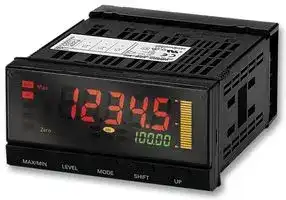


K3HBXVD 24VACVDC
METER, PROCESS, VOLTAGE, 24VAC/DC
- Manufacturer: OMRON INDUSTRIAL AUTOMATION
- Product type: Digital Panel Meters
- No. of Analogue Inputs:-; No. of Analogue Outputs:-; No. of Digital Inputs:-; No. of Digital Outputs:-; Approval Bodies:CE, cRUus, UL; Current Consumption:50mA; External Depth:95mm; Ext
- Supply Voltage Max: 24V
- Operating Temperature Max: 55°C
- Operating Temperature Min: -10°C
| Delivery and price | |
|---|---|
| Units per pack | 1 |
| Price | 431.0 € |
| Current stock | 10+ |
| Lead time | 30 days |

**Process Indicator K3HB-X**

CSM_K3HB-X_DS_E_11_2

## **A Process Indicator Ideal for Discriminating and Displaying Measurements for Voltage/Current Signals**

- Easy recognition of judgement results using color display that can be switched between red and green. *

- Equipped with a position meter for monitoring operating status trends.

- External event input allows use in various measurement and discrimination applications.

- Series expanded to include DeviceNet models.

- Short body with depth of only 95 mm (from behind the front panel), or 97 mm for DeviceNet models.

- UL certification approval (Certification Mark License).

- CE Marking conformance by third party assessment body.

- Water-resistant enclosure conforms to NEMA 4X (equivalent to IP66).

- Capable of high-speed sampling at 50 times per second (20 ms)

- Easy-to-set two-point scaling allows conversion and display of any userset values.

- Visual confirmation of judgement results is not supported on models that do not have an output or models that do not support DeviceNet. You can change the display color by setting it, but you cannot switch it based on the judgement results.

For the most recent information on models that have been certified for safety standards, refer to your OMRON website.

Refer to _Safety Precautions for All Digital Panel Meters_ .

## **Model Number Structure**

## ■ **Model Number Legend**

Base Units and Optional Boards can be ordered individually or as sets.

## **Base Units**

**K3HB-X** @ CE) **1 5**

## **1. Input Sensor Code**

VD: DC voltage input

AD: DC current input

VA: AC voltage input AA: AC current input

## **5. Supply Voltage**

100-240 VAC: 100 to 240 VAC

- 24 VAC/VDC: 24 VAC/VDC

## **Base Units with Optional Boards**

**K3HB-X** @ — **-** @@@ 2 Ed **1 2 3 4 5**

## **2. Sensor Power Supply/Output Type Code**

None: None

CPA: Relay output (PASS: SPDT) + Sensor power supply

(12 VDC +/−10%, 80 mA) (See note 1.)

L1A: Linear current output (0 to 20 or 4 to 20 mA DC) + Sensor power supply (12 VDC +/−10%, 80 mA) (See note 2.)

L2A: Linear voltage output (0 to 5, 1 to 5, or 0 to 10 VDC) + Sensor power supply (12 VDC +/−10%, 80 mA) (See note 2.)

A: Sensor power supply (12 VDC +/−10%, 80 mA)

FLK1A: Communications (RS-232C) + Sensor power supply

(12 VDC +/−10%, 80 mA) (See note 2.)

FLK3A: Communications (RS-485) + Sensor power supply

(12 VDC +/−10%, 80 mA) (See note 2.)

## **Note: 1.** CPA can be combined with relay outputs only.

**2.** Only one of the following can be used by each Digital Indicator: RS-232C/RS-485 communications, a linear output, or DeviceNet communications.

## **Optional Board**

## **Sensor Power Supply/Output Boards**

## **K33-** @

**2**

## **Relay/Transistor Output Boards**

## **K34-** @

**3**

## **Event Input Boards**

## **K35-** @

**4**

## **3. Relay/Transistor Output Type Code**

None: None

C1: Relay contact (H/L: SPDT each)

C2: Relay contact (HH/H/LL/L: SPST-NO each)

- T1: Transistor (NPN open collector: HH/H/PASS/L/LL)

T2: Transistor (PNP open collector: HH/H/PASS/L/LL)

BCD *: BCD output + transistor output (NPN open collector: HH/H/PASS/L/ LL)

DRT: DeviceNet (See note 2.)

- A Special BCD Output Cable (sold separately) is required.

## **4. Event input Type Code**

None: None

- 1: 5 inputs (M3 terminal blocks), NPN open collector

- 2: 8 inputs (10-pin MIL connector), NPN open collector

- 3: 5 inputs (M3 terminal blocks), PNP open collector

- 4: 8 inputs (10-pin MIL connector), PNP open collector

**Note:** The following combinations are not possible.

- Communications (FLK@A) + DeviceNet (DRT)

- Communications (FLK@A) + BCD output (BCD)

- Linear current/voltage (L@A) + DeviceNet (DRT)

**1**

**K3HB-X**

## **Accessories (Sold Separately)**

K32-DICN: Special Cable (for event inputs, with 8-pin connector) K32-BCD: Special BCD Output Cable

## **Watertight Cover**

**Model**

Y92A-49N

## **Rubber Packing**

**Model** K32-P1

**Note:** Rubber packing is provided with the Controller.

## **S ecifications p**

## ■ **Ratings**

|■**Ratings**|■**Ratings**||
|---|---|---|
|**Power supply voltage**||100 to 240 VAC (50/60 Hz), 24 VAC/VDC, DeviceNet power supply: 24 VDC|
|**Allowable power supply voltage range**||85% to 110% of the rated power supply voltage, DeviceNet power supply: 11 to 25 VDC|
|**Power consumption**<br>**(See note 1.)**||100 to 240 V: 18 VA max. (max. load)<br>24 VAC/DC: 11 VA/7 W max. (max. load)|
|**Current consumption**||DeviceNet power supply: 50 mA max. (24 VDC)|
|**Input**||DC voltage, DC current, AC voltage, AC current|
|**A/D conversion method**||Delta-Sigma method|
|**External power supply**||12 VDC ±10%, 80 mA (models with external power supply only)|
|**Event inputs (See**<br>**note 2.)**|**Timing input**|NPN open collector or no-voltage contact signal<br>ON residual voltage: 3 V max.<br>ON current at 0Ω: 17 mA max.<br>Max. applied voltage: 30 VDC max.<br>OFF leakage current: 1.5 mA max.|
||**Startup compensa-**<br>**tion timer input**|NPN open collector or no-voltage contact signal<br>ON residual voltage: 2 V max.<br>ON current at 0Ω: 4 mA max.<br>Max. applied voltage: 30 VDC max.<br>OFF leakage current: 0.1 mA max.|
||**Hold input**||
||**Reset input**||
||**Forced-zero input**||
||**Bank input**||
|**Output ratings (de-**<br>**pends on the mod-**<br>**el)**|**Relay output**|250 VAC, 30 VDC, 5 A (resistive load)<br>Mechanical life expectancy: 5,000,000 operations, Electrical life expectancy: 100,000 operations|
||**Transistor output**|Maximum load voltage: 24 VDC, Maximum load current: 50 mA, Leakage current: 100μA max.|
||**Linear output**|Linear output 0 to 20 mA DC, 4 to 20 mA DC:<br>Load: 500Ωmax, Resolution: Approx. 10,000, Output error: ±0.5% FS<br>Linear output 0 to 5 VDC, 1 to 5 VDC, 0 to 10 VDC:<br>Load: 5 kΩmax, Resolution: Approx. 10,000, Output error: ±0.5% FS<br>(1 V or less: ±0.15 V; no output for 0 V or less)|
|**Display method**||Negative LCD (backlit LED) display<br>7-segment digital display (Character height: PV: 14.2 mm (green/red); SV: 4.9 mm (green)|
|**Main functions**||Scaling function, measurement operation selection, averaging, previous average value comparison, forced-ze-<br>ro, zero-limit, output hysteresis, output OFF delay, output test, teaching, display value selection, display color<br>selection, key protection, bank selection, display refresh period, maximum/minimum hold, reset|
|**Ambient operating temperature**||−10 to 55°C (with no icingor condensation)|
|**Ambient operating humidity**||25% to 85%|
|**Storage temperature**||−25 to 65°C (with no icingor condensation)|
|**Altitude**||2,000 m max.|
|**Accessories**||Watertight packing, 2 fixtures, terminal cover, unit stickers, instruction manual. DeviceNet models also include<br>a DeviceNet connector (Hirose HR31-5.08P-5SC(01)) and crimp terminals (Hirose HR31-SC-121) (See note<br>3.)|


**Note: 1.** DC power supply models require a control power supply capacity of approximately 1 A per Unit when power is turned ON. Particular attention is required when using two or more DC power supply models. The OMRON S8VS-series DC Power Supply Unit is recommended.

**2.** PNP input types are also available.

**3.** For K3HB-series DeviceNet models, use only the DeviceNet Connector included with the product. The crimp terminals provided are for Thin Cables.

**==> picture [539 x 34] intentionally omitted <==**

**2**

**K3HB-X**

## ■ **Characteristics**

|■**Characteristics**|■**Characteristics**||
|---|---|---|
|**Display range**||−19,999 to 99,999|
|**Sampling period**||20 ms (50 times/second)|
|**Comparative output response time**||DC input: 100 ms max.; AC input: 300 ms max.<br>(The time until the comparative output is output when there is a forced sudden change in the input signal<br>from 15% to 95% or 95% to 15%.)|
|**Linear output response time**||DC input: 150 ms max.; AC input: 420 ms max.<br>(The time until the final analog output value is reached when there is a forced sudden change in the output<br>signal from 15% to 95% or 95% to 15%.)|
|**Insulation resistance**||20 MΩmin. (at 500 VDC)|
|**Dielectric strength**||2,300 VAC for 1 min between external terminals and case|
|**Noise immunity**||100 to 240 VAC models:<br>±1,500 V at power supply terminals in normal or common mode<br>(waveform with 1-ns rising edge and pulse width of 1μs/100 ns)<br>24 VAC/VDC models:<br> ±1,500 V at power supply terminals in normal or common mode<br>(waveform with 1-ns risingedge andpulse width of 1μs/100 ns)|
|**Vibration resistance**||Frequency: 10 to 55 Hz; Acceleration: 50 m/s2, 10 sweeps of 5 min each in X, Y, and Z directions|
|**Shock resistance**||150 m/s2(100 m/s2for relayoutputs) 3 times each in 3 axes, 6 directions|
|**Weight**||Approx. 300g(Base Unit only)|
|**Degree of**<br>**protection**|**Front panel**|Conforms to NEMA 4X for indoor use (equivalent to IP66)|
||**Rear case**|IP20|
||**Terminals**|IP00 + finger protection (VDE0106/100)|
|**Memory protection**||EEPROM (non-volatile memory)<br>Number of rewrites: 100,000|
|**Applicable standards**||UL61010-1, CSA C22.2 No.61010-1-04<br>EN61010-1 (IEC61010-1): Pollution degree 2/Overvoltage category II<br>EN61326-1|
|**EMC**||EMI: EN61326-1 Industrial electromagnetic environment<br>Electromagnetic radiation interference<br>CISPR 11 Group 1, Class A<br>Terminal interference voltage<br>CISPR 11 Group 1, Class A<br>EMS: EN61326-1 Industrial electromagnetic environment<br>Electrostatic Discharge Immunity<br>EN61000-4-2: 4 kV (contact), 8 kV (in air)<br>Radiated Electromagnetic Field Immunity<br>EN61000-4-3: 10 V/m 1 kHz sine wave amplitude modulation (80 MHz to 1 GHz, 1.4 to 2 GHz)<br>Electrical Fast Transient/Burst Immunity<br>EN61000-4-4: 2 kV (power line), 1 kV (I/O signal line)<br>Surge Immunity<br>EN61000-4-5: 1 kV with line (power line), 2 kV with ground (power line)<br>Conducted Disturbance Immunity<br>EN61000-4-6: 3 V (0.15 to 80 MHz)<br>Power Frequency Magnetic Immunity<br>EN61000-4-8: 30 A/m (50 Hz) continuous time<br>Voltage Dips and Interruptions Immunity<br>EN61000-4-11: 0.5 cycle, 0°/180°,100% (rated voltage)|


**==> picture [539 x 34] intentionally omitted <==**

**3**

**K3HB-X**

## ■ **Input Range (Measurement Range and Accuracy) CAT II**

|**Input type**|**Range**|**Set value**|**Measurement range**|**Maximum**<br>**measurement range**|**Input**<br>**impedance**|**Accuracy**|**Allowable**<br>**instantaneous**<br>**overload (30 s)**|
|---|---|---|---|---|---|---|---|
|K3HB-XVD<br>DC voltage|A|a Ud|±199.99 V|-199.99 to 219.99 V|10 MΩmin.|±0.1%rdg  ± 1<br>digit max.|±400 V|
||B|b Ud|±19.999 V|-19.999 to 21.999 V|1 MΩmin.||±200 V|
||C|c Ud|±1.9999 V|-1.9999 to 2.1999 V||||
||D|d Ud|1.0000 to 5.0000 V|0.5000 to 5.5000 V||||
|K3HB-XAD<br>DC current|A|a ad|±199.99 mA|199.99 to 219.99 mA|1Ωmax.|±0.1%rdg  ± 1<br>digit max.|±400 mA|
||B|b ad|±19.999 mA|19.999 to 21.999 mA|10Ωmax.||±200 mA|
||C|c ad|±1.9999 mA|1.9999 to 2.1999 mA|33Ωmax.|||
||D|d ad|4.000 to 20.000 mA|2.000 to 22.000 mA|10Ωmax.|||
|K3HB-XVA<br>AC voltage<br>(See note 4.)|A|a Ua|0.0 to 400.0 V|0.0 to 440.0 V|1 MΩmin.|±0.3%rdg  ± 5<br>digits max.|700 V|
||B|b Ua|0.00 to 199.99 V|0.00 to 219.99 V||||
||C|c Ua|0.000 to 19.999 V|0.000 to 21.999 V||±0.5%rdg  ± 10<br>digits max.|400 V|
||D|d Ua|0.0000 to 1.9999 V|0.0000 to 1.9999 V||||
|K3HB-XAA<br>AC current|A|a aa|0.000 to 10.000 A|0.000 to 11.000 A|(0.5 VA CT)<br>(See note 3.)|±0.5%rdg  ± 20<br>digits max.|20 A|
||B|b aa|0.0000 to 1.9999 A|0.0000 to 2.1999 A|(0.5 VA CT)<br>(See note 3.)|||
||C|c aa|0.00 to 199.99 mA|0.00 to 219.99m A|1Ωmax.|±0.5%rdg  ± 10<br>digits max.|2 A|
||D|d aa|0.000 to 19.999 mA|0.000 to 21.999m A|10Ωmax.|||


- **Note: 1.** The accuracy is for an input frequency range of 40 Hz to 1 kHz (except for AD current input A and B ranges of 50 to 60 Hz) and an ambient temperature of 23 ±5°C. The error, however, increases below 10% of the maximum input value. DC voltage input (all ranges): 10% or less of max. input = ±0.15% FS

   - DC current input (all ranges): 10% or less of max. input = ±0.1% FS

   - AC voltage input (A: 0.0 to 400.0 V): 10% or less of max. input = ±0.15% FS AC voltage input (B: 0.00 to 199.99 V): 10% or less of max. input = ±0.2% FS

   - AC voltage input (C: 0.000 to 19.999 V; D: 0.0000 to 1.9999 V): 10% or less of max. input = ±1.0% FS AC current input (A: 0.000 to 10.000 A): 10% or less of max. input = ±0.25% FS

   - AC current input (B: 0.0000 to 1.9999 A): 10% or less of max. input = ±0.5% FS

AC current input (C: 0.00 to 199.99 mA; D: 0.000 to 19.999 A): 10% or less of max. input = ±0.15% FS

   - When DC voltage input models are used with a ±1.9999 V range, make sure that the connections between input terminals are not open. If the input terminals are open, the display will show large variations. Connect resistance of approximately 1 MΩ between the input terminals if they are open.

**2.** The letters “rdg” mean “reading” and refer to the input error.

**3.** The value (0.5 VA CT) is the VA consumption of the internal CT (current transformer).

**==> picture [69 x 83] intentionally omitted <==**

**----- Start of picture text -----**<br>
E2<br>E3<br>±1.9999 V<br>+ E4<br>1 MΩ E5<br>− E6 COM<br>**----- End of picture text -----**<br>


**4.** The K3HB-XVA@@ complies with UL standards when the applied input voltage is within the range 0 to 150 VAC. If the input voltage is higher than 150 VAC, install an external transformer or take other measures to drop the voltage to 150 VAC or lower.

**==> picture [539 x 34] intentionally omitted <==**

**4**

**K3HB-X**

## **Common S ecifications p**

## ■ **Event Input Ratings**

|**Input type**|**S-TMR, HOLD, RESET, ZERO, BANK1, BANK2,**<br>**BANK4**|**TIMING**|
|---|---|---|
|**Contact**|ON: 1 kΩmax., OFF: 100 kΩmin.|---|
|**No-contact**|ON residual voltage: 2 V max.<br>OFF leakage current: 0.1 mA max.<br>Load current: 4 mA max.<br>Maximum applied voltage: 30 VDC max.|ON residual voltage: 3 V max.<br>OFF leakage current: 1.5 mA max.<br>Load current: 17 mA max.<br>Maximum applied voltage: 30 VDC max.|


## ■ **Output Ratings**

## **Contact Output**

|**Item**|**Resistive loads**<br>**(250 VAC, cos**φ**=1;**<br>**30 VDC, L/R=0 ms)**|**Inductive loads**<br>**(250 VAC, closed**<br>**circuit, cos**φ**=0.4;**<br>**30 VDC, L/R=7 ms)**|
|---|---|---|
|**Rated load**|5 A at 250 VAC<br>5 A at 30 VDC|1 A at 250 VAC<br>1 A at 30 VDC|
|**Mechanical life**<br>**expectancy**|5,000,000 operations||
|**Electrical life**<br>**expectancy**|100,000 operations||


## **Transistor Output**

|**Maximum load voltage**|24 VDC|
|---|---|
|**Maximum load current**|50 mA|
|**Leakage current**|100μA max.|


## **Linear Output**

|**Linear Output**||||||
|---|---|---|---|---|---|
|**Item**|**0 to 20 mA**|**4 to 20 mA**|**0 to 5 V**|**1 to 5 V**|**0 to 10 V**|
|**Allowable load impedance**|500Ωmax.||5 kΩmin.|||
|**Resolution**|Approx. 10,000|||||
|**Output error**|±0.5%FS||±0.5%FS (1 V or less: ±0.15 V; no output for 0 V or less.)|||


## **Serial Communications Output**

|**Item**|**RS-232C, RS-485**|
|---|---|
|**Communications method**|Half duplex|
|**Synchronization method**|Start-stop synchronization|
|**Baud rate**|9,600, 19,200, or 38,400 bps|
|**Transmission code**|ASCII|
|**Data length**|7 bits or 8 bits|
|**Stop bit length**|2 bits or 1 bit|
|**Error detection**|Vertical parityand FCS|
|**Parity check**|Odd, even|


**Note:** For details on serial and DeviceNet communications, refer to the _Digital Indicator K3HB Communications User's Manual_ (Cat.No. N129).

## **BCD Output I/O Ratings (Input Signal Logic: Negative)**

||**I/O signal name**|**Item**|**Item**|**Rating**|
|---|---|---|---|---|
|**Inputs**|REQUEST<br>HOLD<br>MAX<br>MIN<br>RESET|Input signal||No-voltage<br>contact input|
|||Input current for<br>no-voltage input||10 mA|
|||Signal<br>level|ON voltage|1.5 V max.|
||||OFF voltage|3 V min.|
|**Outputs**|DATA<br>POLARITY<br>OVER<br>DATA VALID<br>RUN|Maximum load<br>voltage||24 VDC|
|||Maximum load<br>current||10 mA|
|||Leakage current||100μA max.|
||HH<br>H<br>PASS<br>L<br>LL|Maximum load<br>voltage||24 VDC|
|||Maximum load<br>current||50 mA|
|||Leakage current||100μA max.|


**Note:** For details on serial and DeviceNet communications, refer to the _Digital Indicator K3HB Communications User's Manual_ (Cat.No. N129).

**==> picture [539 x 34] intentionally omitted <==**

**5**

**K3HB-X**

## **DeviceNet Communications**

|**DeviceNet Communications**|**DeviceNet Communications**|||
|---|---|---|---|
|**Communications protocol**||Conforms to DeviceNet||
|**Supported communi-**<br>**cations**|**Remote I/O communications**|Master-Slave connection (polling, bit-strobe, COS, cyclic)<br>Conforms to DeviceNet communications standards.||
||**I/O allocations**|Allocate any I/O data using the Configurator.<br>Allocate any data, such as DeviceNet-specific parameters and variable area for Digital<br>Indicators.<br>Input area: 2 blocks, 60 words max.<br>Output area: 1 block, 29 words max.<br>(The first word in the area is always allocated for the Output Execution Enabled Flags.)||
||**Message communications**|Explicit message communications<br>CompoWay/F communications commands can be executed (using explicit message<br>communications)||
|**Connection methods**||Combination of multi-drop and T-branch connections (for trunk and drop lines)||
|**Baud rate**||DeviceNet: 500, 250, or 125 Kbps (automatic follow-up)||
|**Communications media**||Special 5-wire cable (2 signal lines, 2 power supplylines, 1 shield line)||
|**Communications distance**|||**Baud rate**<br>**Network length**<br>**(max.)**<br>**Drop line length**<br>**(max.)**<br>**Total drop line**<br>**length(max.)**<br>500 Kbps<br>100 m(100 m)<br>6 m<br>39 m<br>250 Kbps<br>100 m<br>(250 m)<br>6 m<br>78 m<br>125 Kbps<br>100 m<br>(500 m)<br>6 m<br>156 m<br>The values inparentheses are for Thick Cable.|
|**Communicationspower supply**||24-VDC DeviceNetpower supply||
|**Allowable voltage fluctuation range**||11 to 25-VDC DeviceNetpower supply||
|**Current consumption**||50 mA max.(24 VDC)||
|**Maximum number of nodes**||64(DeviceNet Configurator is counted as one node when connected)||
|**Maximum number of slaves**||63||
|**Error control checks**||CRC errors||
|**DeviceNet power supply**||Supplied from DeviceNet communications connector||


## ■ **Internal Block Diagram**

**==> picture [345 x 243] intentionally omitted <==**

**----- Start of picture text -----**<br>
Analog input circuitInput  ADC Keys<br>EEP-ROM Indications<br>BCD<br>BCD I/O ••• Input circuit Output circuit Transistor  circuitDrive circuitDrive Transistoroutput<br>output circuit<br>Micro-<br>computer<br>Event input Digital input circuit shaping circuitWaveform circuitDrive X Relay output<br>Linear output Linear outputcircuit circuitDrive circuitDrive DeviceNetcircuit DeviceNet<br>Sensor powersupply Filter circuitDrive Communi-cationsdriver Communications<br>VO VDD VCOM<br>Power supply circuit (isolated) VO DC-DC<br>Converter (isolated)<br>Power supply<br>**----- End of picture text -----**<br>


**==> picture [539 x 34] intentionally omitted <==**

**6**

**K3HB-X**

## ■ **Power Supply Derating Curve for Sensor (Reference Value)**

**With 12 V**

## **With 10 V**

**==> picture [425 x 164] intentionally omitted <==**

**----- Start of picture text -----**<br>
Max. current (mA) Max. current (mA)<br>140 140<br>1 1<br>120 120<br>100 100<br>80 80<br>60 60<br>40 40<br>20 20<br>0 0<br>−20 −10 0 10 20 30 40 50 60 −20 −10 0 10 20 30 40 50 60<br>Ambient temperature (°C) Ambient temperature (°C)<br>**----- End of picture text -----**<br>


- **Note: 1.** The above values are for standard mounting. The derating curve differs depending on the mounting conditions.

   **2.** Do not use the Sensor outside of the derating area (i.e., do not use it in the area labeled A in the above graphics). Doing so may occasionally cause deterioration or damage to internal components.

## ■ **Component Names and Functions**

**==> picture [469 x 391] intentionally omitted <==**

**----- Start of picture text -----**<br>
Max/Min status indicator PV display<br>Turns ON when the maximum value or minimum value is  Displays PVs, maximum values,<br>displayed in the RUN level. minimum values, parameter<br>names, and error names.<br>Level/bank display Position meter<br>In RUN level, displays the bank if the bank function is  Displays the position of the PV with<br>ON. (Turns OFF if the bank function is OFF.) respect to a desired scale.<br>In other levels, displays the current level.<br>Comparative output  SV display<br>status indicators HH Max Displays SV and monitor values.<br>H Min<br>Display the status of comparative outputs. PL LT-ZR CMW TG HH H<br>LL Zero Hold T LL L<br>Status indicators SV display status indicators<br>Display Function MAX/MIN LEVEL MODE SHIFT UP Display Function<br>T-ZR Turns ON when the tare zero function is executed. Turns OFF if it is not executed or is cleared. TG Turns ON when the timing signal turns ON. Otherwise OFF.<br>Zero Turns ON when the forced-zero function is executed. Turns OFF if it is not executed or is cleared. (Excluding the K3HB-H.) T Turns ON when parameters for which teaching can be performed are displayed.<br>Hold Turns ON/OFF when hold input turns ON/OFF. HH, H,  In RUN level, turn ON when the comparative set values HH, H, L, and<br>L, LL LL are displayed.<br>MAX/MIN Key LEVEL Key MODE Key SHIFT Key UP Key<br>Used to switch the  Used to switch level. Used to switch the  Used to change  When changing a set value,<br>display between the  parameters displayed. parameter settings.  this key is used to change<br>PV, maximum value,  When changing a set  the actual value.<br>and minimum value and  value, this key is used  When a measurement value<br>to reset the maximum  to move along the  is displayed, this key is<br>and minimum values. digits. used to execute or clear the<br>forced-zero function or to<br>execute teaching.<br>**----- End of picture text -----**<br>


**==> picture [539 x 34] intentionally omitted <==**

**7**

**K3HB-X**

## ■ **BCD Output Timing Chart**

A REQUEST signal from a Programmable Controller or other external device is required to read BCD data.

## **Single Sampling Data Output**

**==> picture [224 x 86] intentionally omitted <==**

**----- Start of picture text -----**<br>
20-ms pulse min. (50 ms max.)<br>REQ.<br>MAX.MIN.<br>DATA All data "High" Data All data "High"<br>DATA<br>VALID<br>Approx. 30 ms 40 ms 16 ms<br>**----- End of picture text -----**<br>


The data is set in approximately 30 ms from the rising edge of the REQUEST signal and the DATA VALID signal is output. When reading the data from a Programmable Controller, start reading the data when the DATA VALID signal turns ON. The DATA VALID signal will turn OFF 40 ms later, and the data will turn OFF 16 ms after that.

## **Continuous Data Output**

**==> picture [223 x 85] intentionally omitted <==**

**----- Start of picture text -----**<br>
REQ.<br>MAX.MIN.<br>DATA All data "High" Data 1 Data 2<br>DATA<br>VALID<br>40 ms 40 ms<br>Approx. 24 ms 24 ms<br>30 ms 64 ms 64 ms<br>**----- End of picture text -----**<br>


Measurement data is output every 64 ms while the REQUEST signal remains ON.

**Note:** If HOLD is executed when switching between data 1 and data 2, either data 1 or data 2 is output depending on the timing of the hold signal. The data will not go LOW.

**==> picture [409 x 123] intentionally omitted <==**

**----- Start of picture text -----**<br>
REQ. (1)<br>K3HB<br>(1)<br>Programmable<br>Controller REQ. (2)<br>K3HB<br>(2) REQ. (3)<br>DATA (including POL and<br>OVER) and DATA VALID can<br>be used in a wired OR.  DATA (1) (2) (3)<br>K3HB RUN, HH, H, PASS, L, and<br>(3) LL are always output, with or<br>without a REQUEST signal. DATA<br>Do not used a wired OR  VALID<br>connect for these signals. (See note.) (See note.) (See note.)<br>Note:  Leave 20 ms min. between DATA VALID turning OFF and the REQUEST signal.<br>**----- End of picture text -----**<br>


## **Programmable Controller Connection Example Display Unit Connection Example**

**==> picture [510 x 282] intentionally omitted <==**

**----- Start of picture text -----**<br>
Digital Indicator SYSMAC Programmable Controller  Digital Indicator<br>Connector pin No. (See note.) DC Input Unit Connector pin No. (See note.)<br>1.COMMON COM 1.COMMON<br>2.1 IN 2.1<br>3.2 IN 3.2<br>10° 10°<br>4.4 IN 4.4<br>5.8 IN 5.8<br>23.DATA VALID 23.DATA VALID<br>24.RUN IN 24.RUN<br>IN To 10 [1]<br>To 10 [2]<br>25.COMMON Transistor Output Unit 25.COMMON<br>Short-<br>26.REQUEST OUT 26.REQUEST circuit<br>+5 V 240 Ω +5 V 240 Ω<br>240 Ω 240 Ω<br>30.RESET OUT 30.RESET<br>240 Ω 240 Ω<br>240 Ω 31.POLARITY(+/− polarity) COM(0 V) 240 Ω 31.POLARITY(+/− polarity) 8 8 8 SEC<br>24 VDC M7E-01D@N2, 01H@N2<br>+24 V DC power  Note:  The BCD output connector pin number is the D-sub connector pin number when <M7E Digital Display Unit><br>0 V supply the BCD Output Cable (sold separately) is connected. This number differs from<br>the pin number for the Digital Indicator narrow pitch connector (manufactured by<br>Honda Tsushin Kogyo Co., Ltd.).<br>Internal circuit<br>Internal circuit Internal circuit V O D C B A P D E L V O D C B A P D E L V O D C B A P D E L V O<br>**----- End of picture text -----**<br>


Refer to the following User's Manual for application precautions and other information required when using the Digital Indicator: K3HB-S/-X/-V/-H Digital Indicator User's Manual (Cat. No. N128)

The manual can be downloaded from the following site in PDF format: OMRON Industrial Web http://www.fa.omron.co.jp

**==> picture [539 x 34] intentionally omitted <==**

**8**

**K3HB-X**

## ■ **Connections**

## **Terminal Arrangement**

**Note:** Insulation is used between signal input, event input, output, and power supply terminals.

**==> picture [442 x 561] intentionally omitted <==**

**----- Start of picture text -----**<br>
A  B  C  D  E<br>A Operating Power Supply  1<br>2<br>100 to 240 VAC  3<br>24 VAC/ VDC<br>4<br>A1 5<br>6<br>A2<br>*1 Check the required power supply type.<br>*2 There is no polarity on models for 24<br>VAC/DC.<br>B Sensor Power Supply/Output<br>Sensor power supply +   C Relays, Transistors, BCD and DeviceNet<br>PASS output<br>B1<br>PASS  B2 Relay Outputs  Relay Outputs  Transistor Outputs  DeviceNet Connector (Included)<br><C1>  <C2>  <T1> <T2>  <DRT><br>B3<br>NPN  PNP<br>N/C  B4  C1  HH  C1 HH  C1<br>+  B5  H  C2  H  C2 H  C2<br>C3  COM  C3  PASS  C3<br>B6<br>−  C4  L  C4 L  C4<br><K33- CPB> Sensor power supply +  <K33- CPA> linear output  L  C5 C6  COM LL  C5C6  COM LL  C5 C6  1: V2: CAN L (Communications cable: Blue) 3: Shield 4: CAN H  (Communications cable: White) − (Power supply cable: Black)<br>5: V+ (Power supply cable: Red)<br>0-5/1-5/ 0-10 V  0-20/ N/C  0-5/1-5/ 0-10 V  [N/C ] 0-20/  + − +  B1 B2 B3  BCD (NPN Open Collector): BCD Applicable Connector (Sold separately)  Applicable Connector: HR31-5.08P-5SC (01) (HIROSE ELECTRIC CO., LTD.) * Attach the provided crimp terminals.<br>N/C  4-20 mA N/C  4-20 mA  −  B4  HDR-E50MAG1 (HONDA TSUSHIN KOGYO CO., LTD.)<br>+  B5  Special Cable (Sold separately)<br>K32-BCD (OMRON)<br>−  B6  (HDR-E50MAG1 with 0.3-m cable)<br><K33-  <K33-  <K33-  <K33-<br>L2B>  L1B>  L2A>  L1A>  The BCD COMMON is shared.<br>Sensor power supply  The pins indicated in the above diagram<br>as blank (white) boxes have been removed.<br>B1  * Only one of the following can be used for each Digital Indicator: communications, BCD, or DeviceNet.<br>B2<br>N/C  Contact output  Transistor Output<br>B3  (NPN Open Collector)<br>B4<br>+  B5  5V<br>−  B6  HH  HH<br><K33-B>  <K33-A>  H  H<br>Sensor power supply +   L   L<br>communications   LL  LL<br>B (+)  SD  B (+)  SD  B1  PASS   PASS<br>A (−)  RD  A (−)  RD  B2<br>B (+)  SG  B (+)  SG  B3<br>A (−)  N/C  A (−)  N/C  B4<br>+  B5  Safety Standards Conformance<br>•  Always use a EN/IEC-compliant power supply with reinforced insulation or<br>B6<br>−  double insulation for the DeviceNet power supply.<br>RS-485 <K33-  RS-232C <K33-  RS-485 <K33-  RS-232C <K33-  •  The product must be used indoors for the above applicable standards to The product must be used indoors for the above applicable standards to<br>FLK3B>  FLK1B>  FLK3A>  FLK1A>  apply.<br>supply<br>1   2   3   4   5<br>10 VDC  100 mA  12 VDC  80 mA  Sensor power<br>supply<br>10 VDC  100 mA  10 VDC  100 mA  12 VDC  80 mA  12 VDC  80 mA  Sensor power<br>supply<br>10 VDC  100 mA  12 VDC  80 mA  Sensor power<br>supply<br>10 VDC  100 mA  10 VDC  100 mA  12 VDC  80 mA  12 VDC  80 mA  Sensor power<br>**----- End of picture text -----**<br>


- The product must be used indoors for the above applicable standards to The product must be used indoors for the above applicable standards to apply.

- The K3HB-XVA@@ complies with UL standards when the applied input voltage is within the range 0 to 150 VAC.

**==> picture [539 x 34] intentionally omitted <==**

**9**

**K3HB-X**

**==> picture [525 x 385] intentionally omitted <==**

**----- Start of picture text -----**<br>
E Analog Input<br>Process Indicator Weighing Indicator Temperature Indicator Linear Sensor Indicator<br>K3HB-X K3HB-V K3HB-H K3HB-S<br>AC voltage only<br>E1 N/C A, B E1 N/C E1 E1 Input B<br>E2 A N/C E2 A N/C E2 Current input E2 Input A<br>E3 B C E3 B E3 E3 COM<br>A<br>E4 C D E4 C E4 Voltage input E4 Input A<br>E5 D N/C E5 D Pt - E5 E5 Input B<br>B TC<br>E6 COM COM E6 COM E6 COM N/C E6<br>B' +<br>D Event Input<br>Models with Terminal Blocks •  Use terminal pin D6 as the common terminal.<br><K35-1><K35-3> •  Use NPN open collector or no-voltage contacts for event input.<br>    PNP types are also available.<br>D1 TIMING<br>D2 S-TMR S-TMR: D2 12 V 12 V<br>HOLD: D3<br>D3 HOLD RESET: D4<br>D4 RESET ZERO: D5 4.7 kΩ TIMING 560 Ω<br>D5 ZERO D1<br>3.9 kΩ 750 Ω<br>D6 COM<br>Models with Connectors  D6 D6<br>COM COM<br><K35-2><K35-4><br>1: TIMING 2: S-TMR<br>1 2<br>3: HOLD 4: RESET<br>5: ZERO 6: COM<br>7: BANK4 8: BANK2<br>9: BANK1 9 10 10: COM<br>• Applicable Connector (Sold separately)<br>XG4M-1030 (OMRON)<br>• Special Cable (Sold separately)<br>K32-DICN (OMRON)<br>(XG4M-1030 with 3 m cable)<br>**----- End of picture text -----**<br>


## **BCD Output Cable**

**==> picture [512 x 123] intentionally omitted <==**

**----- Start of picture text -----**<br>
Model Shape Pin arrangement<br>K32-BCD Connector: HDR-E50MAG1 Cover:  K3HB end38 mm(manufactured by Honda Tsushin Co., Ltd.)HDR-E50LPA5 (manufactured by Honda Tsushin Co., Ltd.)300 mm Connector: Equivalent to 17JE-13370-02 Stand: D-sub connector (37-pin female)Cover:  (PLC, display device, etc.)(manufactured by DDK) 17L-002A (manufactured by DDK)17JE-37H-1A (manufactured by DDK)Connected device end46.5 mm COMMON 1010101010 [0][1][2][3][4] 124812481248124812 10111213141516171819123456 7 89 273031333436202122232425262829323537 48 10 [4] OVERDATA VALIDRUNCOMMONREQUESTMAX REQ.MIN REQ.HOLDRESETPOLARITYHHHPASSL LLCOMMON<br>**----- End of picture text -----**<br>


**Note:** The BCD Output Cable has a D-sub plug. Cover: 17JE-37H-1A (manufactured by DDK); Connector: equivalent to 17JE-23370-02 (D1) (manufactured by DDK)

## **- Special Cable (for Event Inputs with 8 pin Connector)**

**==> picture [320 x 103] intentionally omitted <==**

**----- Start of picture text -----**<br>
Model Appearance Wiring<br>K32-DICN Pin No. Signal name<br>1 N/C<br>9 10 2 S-TMR<br>3 HOLD<br>1 2 4 RESET<br>3,000 mm 5 N/C<br>Cable marking (3 m) 6 COM<br>7 BANK4<br>8 BANK2<br>9 BANK1<br>10 COM<br>**----- End of picture text -----**<br>


**==> picture [539 x 34] intentionally omitted <==**

**10**

**K3HB-X**

## ■ **Main Functions**

## **Measurement**

## **Timing Hold**

## **Normal**

- Continuously performs measurement and always outputs based on comparative results.

**==> picture [222 x 74] intentionally omitted <==**

**----- Start of picture text -----**<br>
Input<br>H comparative set value<br>Measurement value<br>H output<br>**----- End of picture text -----**<br>


**==> picture [14 x 5] intentionally omitted <==**

**----- Start of picture text -----**<br>
Time<br>**----- End of picture text -----**<br>


## **Peak Hold/Bottom Hold**

- Measures the maximum (or minimum) value in a specified period.

**==> picture [239 x 82] intentionally omitted <==**

**----- Start of picture text -----**<br>
Input Peak hold value<br>Measurement value<br>Bottom hold value<br>Time<br>TIMING ON<br>input OFF<br>**----- End of picture text -----**<br>


## **Scaling**

## **Sampling Hold**

- Holds the measurement at the rising edge of the TIMING signal.

**==> picture [229 x 80] intentionally omitted <==**

**----- Start of picture text -----**<br>
Input Sampling hold value<br>Measurement value<br>Time<br>TIMING ON<br>input OFF<br>**----- End of picture text -----**<br>


## **Peak-to-peak Hold**

- Measures the difference between the maximum and minimum values in a specified period.

**==> picture [237 x 82] intentionally omitted <==**

**----- Start of picture text -----**<br>
Input Peak-to-peak value<br>(b2−a2)<br>(b1−a1)<br>Measurement value b1 'b2<br>a1 'a2<br>Time<br>TIMING ON<br>input OFF<br>**----- End of picture text -----**<br>


## **Average Processing**

Scaling converts input signals in any way required before displaying them. The values can be manipulated by shifting, inverting, or +/– reversing.

**==> picture [251 x 91] intentionally omitted <==**

**----- Start of picture text -----**<br>
Display value Display value<br>Display value 2 Display value 2<br>(dsp.a2) (dsp.a2)<br>Display value 1 Display value 1<br>(dsp.a1) (dsp.a1)<br>Input value 1(inp.a1) Input value 2(inp.a2) Input value Input value 2(inp.a2) Input value 1(inp.a1) Input value<br>(Scaling) (Reverse scaling)<br>**----- End of picture text -----**<br>


Average processing of input signals with extreme changes or noise smooths out the display and makes control stable.

## **Previous Average Value Comparison**

Slight changes can be removed from input signals to detect only extreme changes.

## **Teaching**

Settings for scaling can be made using the present measurement values instead of inputting values with the SHIFT and UP Keys. This is a convenient function for making the settings while monitoring the operating status.

## **Standby Sequence**

Turns the comparative output OFF until the measurement value enters the PASS range.

**==> picture [539 x 34] intentionally omitted <==**

**11**

**K3HB-X**

## ■ **Input Compensation/Display**

## **Forced-zero**

## **Display Value Selection**

Forces the present value to 0. (Convenient for setting reference values or deducting tares for weight measurement.)

## **Zero-trimming**

The current display value can be selected from the present value, the maximum value, and the minimum value.

## **Step Value**

Compensates for mild fluctuations in input signals due to factors such as sensor temperature drift, based on OK (PASS) data at measurement. (This function can be used with sampling hold, peak hold, or bottom hold.)

## **Zero-limit**

It is possible to specify (i.e., restrict) the values that the smallest displayed digit can change by. For example, if the setting is 2, the smallest digit will only take the values 0, 2, 4, 6, or 8 and if the setting is 5, it will only take the values 0 or 5. If the setting is 10, it will only take the value of 0.

## **Interruption Memory**

Changes the display value to 0 for input values less than the set value. It is enabled in normal mode only. (This function can be used, for example, to stop negative values being displayed or to eliminate flickering and minor inconsistencies near 0.)

**==> picture [135 x 78] intentionally omitted <==**

**----- Start of picture text -----**<br>
Display<br>Zero-limit<br>setting<br>Input<br>**----- End of picture text -----**<br>


- The minimum and maximum values when the power supply is turned OFF can be saved if interruption memory is turned ON.

- If interruption memory is ON, the maximum and minimum values after the last resetting will be displayed.

- If interruption memory is OFF, the maximum and minimum values will be displayed after the power supply is turned ON (or after the reset input is performed).

## **Display Refresh Period**

The display refresh period can be lengthened to reduce flickering and thereby make the display easier to read.

## **Display Color Selection**

Values can be displayed in either red or green. With comparative output models, the display color can also be set to change according to the status of comparative outputs (e.g., green to red or red to green).

**==> picture [213 x 102] intentionally omitted <==**

**----- Start of picture text -----**<br>
Example) Setting: grn-r<br>Red<br>H 110.01<br>110.00<br>Comparative set value H<br>Green<br>P 100.05<br>Comparative set value L 110.00<br>L 99.87110.00<br>Red<br>**----- End of picture text -----**<br>


**==> picture [539 x 34] intentionally omitted <==**

**12**

**K3HB-X**

## ■ **Output**

## **Comparative Output Pattern**

## **Hysteresis**

Prevents comparative output chattering when the measurement value fluctuates slightly near the set value.

The output pattern for comparative outputs can be selected. In addition to high/low comparison with set values, output based on level changes is also possible. (Use the type of output pattern appropriate for the application.)

Example: Comparative Output Pattern (Standard Output)

**==> picture [175 x 58] intentionally omitted <==**

**----- Start of picture text -----**<br>
Hysteresis<br>Comparative set value H Hysteresissis<br>Comparative set value L<br>Comparative output H<br>Comparative output L<br>**----- End of picture text -----**<br>


**==> picture [507 x 225] intentionally omitted <==**

**----- Start of picture text -----**<br>
Comparativeset value HHComparativeset value H Standard Output MeasurementvalueHigher Comparativeset value HHComparativeset value H Level Output MeasurementvalueHigher Comparative set value L Hysteresissis<br>Output HHComparativeset value LComparativeset value LL ONLowerOutput HHComparativeset value LComparativeset value LL ONLower Comparative output H<br>Output H OFF Output H OFF Comparative output L<br>Output PASS Output PASS<br>Output LOutput LL Output LOutput LL Startup Compensation Timer<br>Measurement<br>Comparativeset value HHComparativeset value H Zone Output valueHigher Measurement can be stopped for a set time using external input.<br>Comparativeset value LComparativeset value LL Lower When S-TMR and COM are interconnected and the startup compen-sation timer is set, measurement will not be performed until a setsation timer is set, measurement will not be performed until a set<br>Output HH ON<br>Output H OFF time after the power supply is tuned ON.<br>Output PASS<br>Output L Input<br>Output LL<br>H comparative set value<br>Output Logic<br>Reverses the output operation of comparative outputs for compara- Time<br>tive results.<br>H output Startup<br>compensation<br>time set time<br>H input<br>**----- End of picture text -----**<br>


Measurement can be stopped for a set time using external input. When S-TMR and COM are interconnected and the startup compen-sation timer is set, measurement will not be performed until a setsation timer is set, measurement will not be performed until a set time after the power supply is tuned ON.

## **PASS Output Change**

Comparative results other than PASS and error signals can be output from the PASS output terminal.

## ■ **Dimensions**

**==> picture [506 x 219] intentionally omitted <==**

**----- Start of picture text -----**<br>
101.2  Terminal cover (included)<br>91<br>Character Size for Main Display (mm)  Panel Cutout Dimensions<br>PV display  SV display  120 min. *2<br>14.2  4.9<br>100<br>3.5<br>(112)<br>7.6<br>75 min.<br>92  [+0.8 ]    0<br>12  45  [+0.6 ]    0<br>1.3<br>95 *1<br>2<br>96<br>*2. Leave a distance of at least 140 mm<br>     when using the Watertight Cover<br>     Y92A-49N.<br>48  44.8<br>Note:  Mounting Recommended Panel<br>          Thickness 1 to 8 mm.<br>*1. DeviceNet models: 97 mm<br>          Mount the product horizontally.<br>Terminal: M3, Terminal Cover: Accessory<br>**----- End of picture text -----**<br>


**==> picture [539 x 34] intentionally omitted <==**

**13**

**K3HB-X**

## ■ **Wiring Precautions**

- For terminal blocks, use the crimp terminals suitable for M3 screws.

- Tighten the terminal screws to the recommended tightening torque of approx. 0.5 N⋅m.

- To prevent inductive noise, separate the wiring for signal lines from that for power lines.

## ~~_~~ **Wiring**

**==> picture [222 x 59] intentionally omitted <==**

**----- Start of picture text -----**<br>
• Use the crimp terminals suitable for M3 screws shown below. —F<br>5.8 mm max. ,<br>5.8 mm max.<br>**----- End of picture text -----**<br>


## **Unit Stickers**

- Select the appropriate units from the unit sticker sheets provided and attach the sticker to the Indicator. ~~VAT~~ [Ale[9, [rdi} a]

## ■ **Mounting Method**

**1.** Insert the K3HB into the mounting cutout in the panel.

**2.** Insert watertight packing around the Unit to make the mounting watertight.

**==> picture [28 x 24] intentionally omitted <==**

**----- Start of picture text -----**<br>
Watertight<br>packing<br>\.<br>**----- End of picture text -----**<br>


**3.** Insert the adapter into the grooves on the left and right sides of the rear case and push until it reaches the panel and is fixed in place.

**==> picture [22 x 7] intentionally omitted <==**

**----- Start of picture text -----**<br>
Adapter<br>**----- End of picture text -----**<br>


## ■ **LCD Field of Vision**

- **Note:** When using for meters, such as weighing meters, use the units specified by regulations on weights and measures.

The K3HB is designed to have the best visibility at the angles shown in the following diagram.

**==> picture [14 x 20] intentionally omitted <==**

**----- Start of picture text -----**<br>
10°<br>30°<br>**----- End of picture text -----**<br>


## ■ **Watertight Cover**

## **Y92A-49N**

## ■ **Rubber Packing**

## **K32-P1**

If the rubber packing is lost or damaged, it can be ordered using the following model number: K32-P1.

(Depending on the operating environment, deterioration, contraction, or hardening of the rubber packing may occur and so, in order to ensure the level of waterproofing specified in NEMA4, periodic replacement is recommended.)

**Note:** Rubber packing is provided with the Controller.

**14**

**K3HB-X**

## ■ **Safety Precautions**

## ! **WARNING**

Do not touch the terminals while power is being supplied. Doing so may possibly result in electric shock. Make sure that the terminal cover is installed before using the product.

Always provide protective circuits in the network. Without protective circuits, malfunctions may possibly result in accidents that cause serious injury or significant property damage.

Provide double or triple safety measures in external control circuits, such as emergency stop circuits, interlock circuits, or limit circuits, to ensure safety in the system if an abnormality occurs due to malfunction of the product or another external factor affecting the product's operation.

## ! **CAUTION**

Do not allow pieces of metal, wire clippings, or fine metallic shavings or filings from installation to enter the product. Doing so may occasionally result in minor electric shock, fire, or malfunction.

Do not use the product in locations where flammable or explosive gases are present. Doing so may occasionally result in explosion, causing minor or moderate injury, or property damage.

Do not attempt to disassemble, repair, or modify the product. Doing so may occasionally result in minor or moderate injury due to electric shock.

Do not use the equipment for measurements within Measurement Categories III and IV for K3HB-X and II, III, and IV for K3HB-S, K3HB-V, and K3HB-H (according to IEC61010-1). Doing so may occasionally cause unexpected operation, resulting in minor or moderate injury, or damage to the equipment. Use the equipment for measurements only within the Measurement Category for which the product is designed.

Perform correct setting of the product according to the application. Failure to do so may occasionally cause unexpected operation, resulting in minor or moderate injury, or damage to the equipment.

Ensure safety in the event of product failure by taking safety measures, such as installing a separate monitoring system. Product failure may occasionally prevent operation of comparative outputs, resulting in damage to the connected facilities and equipment.

Tighten the screws on the terminal block and the connector locking screws securely using a tightening torque within the following ranges. Loose screws may occasionally cause fire, resulting in minor or moderate injury, or damage to the equipment. Terminal block screws: 0.43 to 0.58 N·m

Connector locking screws: 0.18 to 0.22 N·m

Make sure that the product will not be adversely affected if the DeviceNet cycle time is lengthened as a result of changing the program with online editing. Extending the cycle time may cause unexpected operation, occasionally resulting in minor or moderate injury, or damage to the equipment.

Before transferring programs to other nodes or changing I/O memory of other nodes, check the nodes to confirm safety. Changing the program or I/O memory of other nodes may occasionally cause unexpected operation, resulting in minor or moderate injury, or damage to the equipment.

**==> picture [32 x 32] intentionally omitted <==**

**==> picture [32 x 110] intentionally omitted <==**

**==> picture [32 x 32] intentionally omitted <==**

**==> picture [32 x 75] intentionally omitted <==**

**==> picture [32 x 32] intentionally omitted <==**

## **Precautions for Safe Use**

**1.** Do not use the product in the following locations.

- Locations subject to direct radiant heat from heating equipment

- Locations where the product may come into contact with water or oil

- Locations subject to direct sunlight

- Locations where dust or corrosive gases (in particular, sulfuric or ammonia gas) are present

- Locations subject to extreme temperature changes

- Locations where icing or condensation may occur

- Locations subject to excessive shocks or vibration

**2.** Do not use the product in locations subject to temperatures or humidity levels outside the specified ranges or in locations prone to condensation. If the product is installed in a panel, ensure that the temperature around the product (not the temperature around the panel) does not go outside the specified range.

**3.** Provide sufficient space around the product for heat dissipation.

**4.** Use and store the product within the specified temperature and humidity ranges. If several products are mounted side-by-side or arranged in a vertical line, the heat dissipation will cause the internal temperature of the products to rise, shortening the service life. If necessary, cool the products using a fan or other cooling method.

**5.** The service life of the output relays depends on the switching capacity and switching conditions. Consider the actual application conditions and use the product within the rated load and electrical service life. Using the product beyond its service life may result in contact welding or burning.

**6.** Install the product horizontally.

**7.** Mount to a panel between 1 and 8-mm thick.

**8.** Use the specified size of crimp terminals (M3, width: 5.8 mm max.) for wiring. To connect bare wires, use AWG22 (cross section: 0.326 mm[2] ) to AWG14 (cross section: 2.081 mm[2] ) to wire the power supply terminals and AWG28 (cross section: 0.081 mm[2] ) to AWG16 (cross section: 1.309 mm[2] ) for other terminals. (Length of exposed wire: 6 to 8 mm)

**9.** In order to prevent inductive noise, wire the lines connected to the product separately from power lines carrying high voltages or currents. Do not wire in parallel with or in the same cable as power lines. Other measures for reducing noise include running lines along separate ducts and using shield lines.

**10.** Ensure that the rated voltage is achieved no longer than 2 s after turning the power ON.

**11.** Allow the product to operate without load for at least 15 minutes after the power is turned ON.

**12.** Do not install the product near devices generating strong high-frequency waves or surges. When using a noise filter, check the voltage and current and install it as close to the product as possible.

**13.** Do not use thinner to clean the product. Use commercially available alcohol.

**14.** Be sure to confirm the name and polarity for each terminal before wiring the terminal block and connectors.

**15.** Use the product within the noted supply voltage and rated load.

**16.** Do not connect anything to unused terminals.

**17.** Output turns OFF when the mode is changed or settings are initialized. Take this into consideration when setting up the control system.

**18.** Install an external switch or circuit breaker that complies with applicable IEC60947-1 and IEC60947-3 requirements and label them clearly so that the operator can quickly turn OFF the power.

**19.** Use the specified cables for the communications lines and stay within the specified DeviceNet communications distances. Refer to the User's Manual (Cat. No. N129) for details on communications distance specifications and cables.

**20.** Do not pull the DeviceNet communications cables with excessive force or bend them past their natural bending radius.

**21.** Do not connect or remove connectors while the DeviceNet power is being supplied. Doing so will cause product failure or malfunction.

**22.** Use cables with a heat resistance of 70ºC min.

**==> picture [539 x 34] intentionally omitted <==**

**15**

**K3HB-X**

## ■ **Noise Countermeasures**

**1.** Do not install the product near devices generating strong high-frequency waves or surges, such as high-frequency welding and sewing machines.

**2.** Mount a surge suppressor or noise filter to peripheral devices generating noise, in particular, motors, transformers, solenoids, and magnet coils.

**==> picture [227 x 60] intentionally omitted <==**

**----- Start of picture text -----**<br>
Line filter<br>+<br>Digital  Digital<br>Indicator Indicator<br>- Surge<br>suppressor<br>Signal input<br>Power supply input Power supply input<br>**----- End of picture text -----**<br>


**3.** In order to prevent inductive noise, wire the lines connected to the terminal block separately from power lines carrying high voltages or currents. Do not wire in parallel with or in the same cable as power lines. Other measures for reducing noise include running lines along separate ducts and using shield lines.

## **Example of Countermeasures for Inductive Noise on Input Lines**

**==> picture [136 x 50] intentionally omitted <==**

**----- Start of picture text -----**<br>
Signal  Digital<br>input Indicator<br>2 conductors<br>with shield<br>-<br>+<br>**----- End of picture text -----**<br>


**4.** If a noise filter is used for the power supply, check the voltage and current, and install the noise filter as close to the product as possible.

**5.** Reception interference may occur if the product is used close to a radio, television, or wireless.

ALL DIMENSIONS SHOWN ARE IN MILLIMETERS.

To convert millimeters into inches, multiply by 0.03937. To convert grams into ounces, multiply by 0.03527.

In the interest of product improvement, specifications are subject to change without notice.

**==> picture [539 x 34] intentionally omitted <==**

**16**

## Terms and Conditions Agreement

## Read and understand this catalog.

Please read and understand this catalog before purchasing the products.  Please consult your OMRON representative if you have any questions or comments.

## Warranties.

(a) Exclusive Warranty. Omron’s exclusive warranty is that the Products will be free from defects in materials and workmanship for a period of twelve months from the date of sale by Omron (or such other period expressed in writing by Omron). Omron disclaims all other warranties, express or implied.

(b) Limitations. OMRON MAKES NO WARRANTY OR REPRESENTATION, EXPRESS OR IMPLIED, ABOUT NON-INFRINGEMENT, MERCHANTABILITY OR FITNESS FOR A PARTICULAR PURPOSE OF THE PRODUCTS. BUYER ACKNOWLEDGES THAT IT ALONE HAS DETERMINED THAT THE

PRODUCTS WILL SUITABLY MEET THE REQUIREMENTS OF THEIR INTENDED USE.

Omron further disclaims all warranties and responsibility of any type for claims or expenses based on infringement by the Products or otherwise of any intellectual property right. (c) Buyer Remedy. Omron’s sole obligation hereunder shall be, at Omron’s election, to (i) replace (in the form originally shipped with Buyer responsible for labor charges for removal or replacement thereof) the non-complying Product, (ii) repair the non-complying Product, or (iii) repay or credit Buyer an amount equal to the purchase price of the non-complying Product; provided that in no event shall Omron be responsible for warranty, repair, indemnity or any other claims or expenses regarding the Products unless Omron’s analysis confirms that the Products were properly handled, stored, installed and maintained and not subject to contamination, abuse, misuse or inappropriate modification. Return of any Products by Buyer must be approved in writing by Omron before shipment. Omron Companies shall not be liable for the suitability or unsuitability or the results from the use of Products in combination with any electrical or electronic components, circuits, system assemblies or any other materials or substances or environments. Any advice, recommendations or information given orally or in writing, are not to be construed as an amendment or addition to the above warranty.

See http://www.omron.com/global/ or contact your Omron representative for published information.

## Limitation on Liability; Etc.

OMRON COMPANIES SHALL NOT BE LIABLE FOR SPECIAL, INDIRECT, INCIDENTAL, OR CONSEQUENTIAL DAMAGES, LOSS OF PROFITS OR PRODUCTION OR COMMERCIAL LOSS IN ANY WAY CONNECTED WITH THE PRODUCTS, WHETHER SUCH CLAIM IS BASED IN CONTRACT, WARRANTY, NEGLIGENCE OR STRICT LIABILITY. Further, in no event shall liability of Omron Companies exceed the individual price of the Product on which liability is asserted.

## Suitability of Use.

Omron Companies shall not be responsible for conformity with any standards, codes or regulations which apply to the combination of the Product in the Buyer’s application or use of the Product. At Buyer’s request, Omron will provide applicable third party certification documents identifying ratings and limitations of use which apply to the Product. This information by itself is not sufficient for a complete determination of the suitability of the Product in combination with the end product, machine, system, or other application or use. Buyer shall be solely responsible for determining appropriateness of the particular Product with respect to Buyer’s application, product or system. Buyer shall take application responsibility in all cases.

NEVER USE THE PRODUCT FOR AN APPLICATION INVOLVING SERIOUS RISK TO LIFE OR PROPERTY OR IN LARGE QUANTITIES WITHOUT ENSURING THAT THE SYSTEM AS A WHOLE HAS BEEN DESIGNED TO ADDRESS THE RISKS, AND THAT THE OMRON PRODUCT(S) IS PROPERLY RATED AND INSTALLED FOR THE INTENDED USE WITHIN THE OVERALL EQUIPMENT OR SYSTEM.

## Programmable Products.

Omron Companies shall not be responsible for the user’s programming of a programmable Product, or any consequence thereof.

## Performance Data.

Data presented in Omron Company websites, catalogs and other materials is provided as a guide for the user in determining suitability and does not constitute a warranty. It may represent the result of Omron’s test conditions, and the user must correlate it to actual application requirements. Actual performance is subject to the Omron’s Warranty and Limitations of Liability.

## Change in Specifications.

Product specifications and accessories may be changed at any time based on improvements and other reasons. It is our practice to change part numbers when published ratings or features are changed, or when significant construction changes are made. However, some specifications of the Product may be changed without any notice. When in doubt, special part numbers may be assigned to fix or establish key specifications for your application. Please consult with your Omron’s representative at any time to confirm actual specifications of purchased Product.

## Errors and Omissions.

Information presented by Omron Companies has been checked and is believed to be accurate; however, no responsibility is assumed for clerical, typographical or proofreading errors or omissions.

**In the interest of product improvement, specifications are subject to change without notice.**

## **OMRON Corporation**

## **Industrial Automation Company**

2015.8

**http://www.ia.omron.com/**

(c)Copyright OMRON Corporation 2015 All Right Reserved.
Updated at June 9, 2026
With a legacy spanning over 80 years, Omron Industrial Automation is a globally recognized leader in the manufacture of advanced industrial control and automation components. Renowned for their reliability and engineering excellence, Omron delivers comprehensive solutions that enhance efficiency, machine safety, and precision across a wide range of manufacturing environments. Our extensive portfolio of Omron products is heavily focused on their industry-leading sensing and switching technologies. We offer a vast selection of sensors, excelling specifically in high-performance proximity sensors, light sensors, and temperature sensors. Complementing this range are robust switching solutions, featuring a deep inventory of power relays, solid-state relays, safety relays, and essential relay accessories designed for demanding operational requirements. Beyond sensing and switching, Omron is highly regarded for its precision automation and process control equipment. Our selection features highly accurate temperature controllers, versatile process controllers, and sophisticated panel displays and instrumentation. To support these fundamental systems, we also supply dependable Omron power supplies, notably AC/DC converters, alongside vital connectivity components like DIN rail terminal blocks to ensure secure, efficient, and complete industrial setups.
About Novapart
Novapart is a B2B electronic component broker specialising in stock shortages and cost reduction. We source hard-to-find parts and identify compliant alternatives across a catalogue of 410,000+ components from 500+ manufacturers.
Learn more →Stock Shortage Specialist
When a component is unavailable, discontinued or has an unacceptable lead time, we tap into our network of vetted European and Asian distributors to source what you need — without compromising on quality or traceability.
Request a quote →Compliant Alternatives
We identify pin-to-pin, electrically equivalent substitutes that meet the same certifications (RoHS, AEC-Q100, REACH) as your original specification — validated against datasheets, not just part numbers. Often at a lower cost.
BOM Analysis service →