
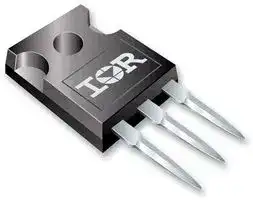


IRG4PH50UPBF
IGBT, 45 A, 3.2 V, 200 W, 1.2 kV, TO-247AC, 3 Pins
- Manufacturer: INFINEON
- Product type: Single IGBTs
- No. of Pins: 3Pins
- Power Dissipation: 200W
- Transistor Mounting: Through Hole
- Transistor Case Style: TO-247AC
- Operating Temperature Max: 150°C
- Continuous Collector Current: 45A
- Collector Emitter Voltage Max: 1.2kV
- Collector Emitter Saturation Voltage: 3.2V
| Delivery and price | |
|---|---|
| Units per pack | 1000 |
| Price | 1.28 € |
| Current stock | 10+ |
| Lead time | 30 days |

PD - 95191

## IRG4PH50UPbF

## INSULATED GATE BIPOLAR TRANSISTOR

## Ultra Fast Speed IGBT

## **Features**

- UltraFast: Optimized for high operating frequencies up to 40 kHz in hard switching, >200 kHz  in resonant mode

- New  IGBT design provides tighter parameter distribution and higher efficiency than previous generations

- Optimized for power conversion; SMPS, UPS and welding

**==> picture [195 x 96] intentionally omitted <==**

**----- Start of picture text -----**<br>
C<br>VCES = 1200V<br>V =  2.78V<br>G CE(on) typ.<br>E @VGE = 15V, IC = 24A<br>n-channel<br>**----- End of picture text -----**<br>


- Industry standard TO-247AC package

- Lead-Free

## **Benefits**

- Higher switching frequency capability  than competitive IGBTs

- Highest efficiency available

- Much  lower conduction losses than MOSFETs

- More efficient than short circuit rated IGBTs

TO-247AC

## **Absolute Maximum Ratings**

|**Parameter**<br>**Max.**<br>**Units**<br>VCES<br>Collector-to-Emitter Breakdown Voltage<br>1200<br>V<br>IC@ TC= 25°C<br>Continuous Collector Current<br>45<br>IC@ TC= 100°C<br>Continuous Collector Current<br>24<br>A<br>ICM<br>Pulsed Collector Current<br>180<br>ILM<br>Clamped Inductive Load Current<br>180<br>VGE<br>Gate-to-Emitter Voltage<br>± 20<br>V<br>EARV<br>Reverse Voltage Avalanche Energy<br>170<br>mJ<br>PD@ TC= 25°C<br>Maximum Power Dissipation<br>200<br>PD@ TC= 100°C<br>Maximum Power Dissipation<br>78<br>TJ<br>Operating Junction and<br>-55  to + 150<br>TSTG<br>Storage Temperature Range<br>SolderingTemperature, for 10 seconds<br>300(0.063 in.(1.6mm)from case)<br>°C<br>Mounting torque, 6-32 or M3 screw.<br>10 lbf•in (1.1N•m)<br>W<br>~~a~~<br>~~a~~<br>es<br>ns<br>es~~eo~~<br>Re<br>><br>es<br>nD<br>Rs<br>©<br>a<br>~~esee~~<br>~~po~~<br>~~es~~<br>~~esen~~|**Parameter**<br>**Max.**<br>**Units**<br>VCES<br>Collector-to-Emitter Breakdown Voltage<br>1200<br>V<br>IC@ TC= 25°C<br>Continuous Collector Current<br>45<br>IC@ TC= 100°C<br>Continuous Collector Current<br>24<br>A<br>ICM<br>Pulsed Collector Current<br>180<br>ILM<br>Clamped Inductive Load Current<br>180<br>VGE<br>Gate-to-Emitter Voltage<br>± 20<br>V<br>EARV<br>Reverse Voltage Avalanche Energy<br>170<br>mJ<br>PD@ TC= 25°C<br>Maximum Power Dissipation<br>200<br>PD@ TC= 100°C<br>Maximum Power Dissipation<br>78<br>TJ<br>Operating Junction and<br>-55  to + 150<br>TSTG<br>Storage Temperature Range<br>SolderingTemperature, for 10 seconds<br>300(0.063 in.(1.6mm)from case)<br>°C<br>Mounting torque, 6-32 or M3 screw.<br>10 lbf•in (1.1N•m)<br>W<br>~~a~~<br>~~a~~<br>es<br>ns<br>es~~eo~~<br>Re<br>><br>es<br>nD<br>Rs<br>©<br>a<br>~~esee~~<br>~~po~~<br>~~es~~<br>~~esen~~||
|---|---|---|
|**Thermal Resistance**|||
|**Parameter**<br>**Typ.**<br>**Max.**|**Units**||
|RθJC<br>Junction-to-Case<br>–––<br>0.64|||
|RθCS<br>Case-to-Sink, Flat, Greased Surface<br>0.24<br>–––|°C/W||
|RθJA<br>Junction-to-Ambient,  typical socket mount<br>–––<br>40|||
|Wt<br>Weight<br>6 (0.21)<br>–––|g (oz)||
|www.irf.com|1||
||04/26/04||


## **Thermal Resistance**

## IRG4PH50UPbF

## **Electrical Characteristics @ TJ = 25°C (unless otherwise specified)**

|i<br>ee|**Parameter**<br>rs<br>Gs|**Min.**<br>tdrr<br>Gs|**Typ. **<br>rr<br>Gs|**Max.**<br>rr<br>Gs|**Units**<br>Gs|**Conditions**<br>Gs|
|---|---|---|---|---|---|---|
|V(BR)CES<br>i<br>ee<br>ee|Collector-to-Emitter Breakdown Voltage<br>rs <br>Gs<br>oe|1200<br> tdrr<br>Gs<br>oe|—<br>rr<br>Gs<br>|—<br>rr<br>Gs|V<br>Gs|VGE= 0V, IC= 250µA<br>Gs|
|V(BR)ECS<br>ee<br>ee<br>es|Emitter-to-Collector Breakdown Voltage<br>Gs<br>oe|18<br>Gs<br>oeSe|—<br>Gs<br>Se|—<br>Gs|V<br>Gs<br>|||VGE= 0V, IC= 1.0A<br>Gs|
|∆V(BR)CES/∆TJ<br>ee<br>es|Temperature Coeff. of Breakdown Voltage<br>oe|—<br>oeSe<br>**|**|1.20<br>Se<br>**|**|—|V/°C<br>|||VGE= 0V, IC= 1.0mA|
|VCE(ON)<br>es|Collector-to-Emitter Saturation Voltage<br><br>es|—<br>Se<br>**||**|2.56<br>Se<br>**||**|3.5|V<br>||<br>es|IC= 20A<br>IC= 24A                          VGE= 15V<br>IC= 45A<br>See Fig.2, 5<br>IC= 24A , TJ= 150°C|
|||—<br>**||**<br>**|**|2.78<br>**||**<br>**|**|3.7|||
|||—<br>**|**<br>**||**|3.20<br>**|**<br>**||**|—|||
|||—<br>**||**<br>es|2.54<br>**||**<br>es|—<br>es|||
|VGE(th)|Gate Threshold Voltage<br>es|3.0<br>**|**<br>es|—<br>**|**<br>es|6.0<br>es||VCE= VGE, IC= 250µA|
|∆VGE(th)/∆TJ<br>~~QQ~~|Temperature Coeff. of Threshold Voltage<br>~~QQ~~|—<br>~~QQ~~|-13<br>~~QQ~~|—<br>~~QQ~~|mV/°C <br>~~QQ~~|VCE= VGE, IC= 250µA<br>~~QQ~~|
|gfe<br>~~DQ~~|Forward Transconductance<br>~~DQ~~|23<br>~~DQ~~|35<br>~~DQ~~|—<br>~~DQ~~|S<br>~~DQ~~|VCE =100V, IC= 24A<br>~~DQ~~|
|ICES<br>~~es~~|Zero Gate Voltage Collector Current<br>~~|~~<br>~~sn~~|—<br>~~oe~~<br>||—<br>~~oe~~<br>||250<br>~~oe~~<br>|µA<br>~~oe~~<br>~~|~~|VGE= 0V, VCE= 1200V|
|||—<br>~~oe~~<br>|<br>~~|~~|—<br>~~oe~~<br>|~~|~~|2.0<br>~~oe~~<br>~~|~~||VGE= 0V, VCE= 24V, TJ= 25°C|
|||—<br>~~oe~~<br>|<br>~~|~~|<br>~~sn~~|—<br>~~oe~~<br>|~~|~~<br>rn|5000<br>~~oe~~<br>~~|~~||VGE= 0V, VCE= 1200V, TJ= 150°C|
|IGES<br>~~es~~|Gate-to-Emitter Leakage Current<br>~~|~~<br>~~sn~~|—<br><br>~~| ~~|<br>~~sn~~|—<br>~~|~~<br>rn|±100<br>~~|~~|nA<br>~~|~~|VGE= ±20V|
|**Switching Characteristics @ TJ = 25°C (unless otherwise specified)**<br> |<br>~~es~~<br>~~sn~~<br>rn<br>RR|||||||
|RR|**Parameter**<br>RR|**Min.**<br><br>ee|**Typ. **<br>|**Max.**<br>|**Units**|**Conditions**|
|Qg<br>RR|Total Gate Charge (turn-on)<br>RRee|—<br>ee<br>ee<br>ee|160<br>ee|250<br>ee|nC|IC= 24A<br>VCC= 400V<br>See Fig. 8<br>VGE= 15V|
|Qge|Gate - Emitter Charge (turn-on)<br>ee|—<br>ee<br>ee<br>ee|27<br>ee|40<br>ee|||
|ge<br>Qgc|Gate - Collector Charge(turn-on)<br>ee|—<br>ee<br>ee|53<br>ee|83<br>ee|||
|td(on)<br>Re|Turn-On Delay Time<br>~~a~~<br>|—<br>~~a~~<br>ee<br>|35<br>~~a~~<br>|—|ns|TJ= 25°C<br>IC= 24A,  VCC= 960V<br>VGE= 15V,  RG= 5.0Ω<br>Energy losses include "tail"<br>See Fig. 9, 10, 14|
|d(on)<br>tr<br>Re|Rise Time<br>~~ee~~<br>|—<br>~~ee~~<br>ee<br>|15<br>~~ee~~<br>|—|||
|td(off)<br>Re<br>ee|Turn-Off Delay Time<br>~~ee~~|—<br>ee<br>~~ee~~|200<br>~~ee~~|350|||
|d(off)<br>tf<br>Re<br>ee<br>Rs|Fall Time<br>~~ee~~|—<br>ee<br>~~ee~~|290<br>~~ee~~|500|||
|Eon<br><br>ee<br>Rs<br>es|Turn-On Switching Loss<br>~~ee~~<br>ee|—<br>~~ee~~<br>ee|0.53<br>~~ee~~<br>ee|—<br>ee|mJ||
|Eoff<br>Rs<br>es|Turn-Off Switching Loss<br>ee|—<br>ee|1.41<br>ee|—<br>ee|||
|Ets<br>es<br>a|Total Switching Loss<br>ee<br>|—<br>ee<br><br>es|1.94<br>ee<br>|2.6<br>ee<br>|||
|td(on)<br>|Turn-On Delay Time<br> es|—<br>es<br>es|31<br>es|—<br>es|ns|TJ= 150°C<br>IC= 24A,  VCC= 960V<br>VGE= 15V,  RG= 5.0Ω<br>Energy losses include "tail"<br>See Fig. 11, 14<br>e|
|d(on)<br>tr|Rise Time<br>a|—<br>es<br>a<br>ee|18<br>a<br>ee|—<br>a<br>ee|||
|r<br>td(off)|Turn-Off Delay Time<br>ee|—<br>ee<br>ee|320<br>ee<br>ee|—<br>ee<br>ee|||
|tf<br>es|Fall Time<br>**e**e|—<br>ee<br>e|280<br>ee <br>e|—<br> ee<br>e|||
|Ets<br>es|Total Switching Loss<br>**e**e<br>e|—<br>e<br>e|5.40<br>e<br>e|—<br>e<br>e|mJ<br>e||
|Eon<br>es<br>+++<br>ee|Turn-On Switching Loss<br>**e**e<br>+++<br>|—<br>e<br>+++<br>|0.35<br>e<br>+++<br>|—<br>e<br>+++<br>|mJ|TJ= 25°C,VGE= 15V,  RG= 5.0Ω<br>IC= 20A,  VCC= 960V<br>Energy losses include "tail"<br>See Fig. 9, 10, 11, 14,      TJ= 150°C|
|Eoff<br>+++<br>ee|Turn-Off Switching Loss<br>+++<br>|—<br>+++<br>|1.43<br>+++<br>|—<br>+++<br>|||
|Ets<br>eea<br>es|Total Switching Loss<br>a<br>||—<br>a<br>||1.78<br>a<br>|2.9<br>a<br>|||
|||—<br>a<br>||||4.56<br>a<br>|||—<br>a<br>|||||
|LE<br>es<br>Rs|Internal Emitter Inductance<br>||—<br>||||13<br>|||—<br>|||nH|Measured 5mm from package|
|Cies<br>es<br>Rs<br>Re|Input Capacitance<br><br>es|—<br>||<br>es|3600<br>||<br>es|—<br>||<br>es|pF|VGE= 0V<br>VCC= 30V<br>See Fig. 7<br>ƒ = 1.0MHz|
|Coes<br>Rs<br>Re<br>ee|Output Capacitance<br>es|—<br>es|160<br>es|—<br>es|||
|Cres<br>Re<br>ee|Reverse Transfer Capacitance<br>es|—<br>es|31<br>es|—<br>es|||


**Notes:**

- @® Repetitive rating; VGE = 20V, pulse width limited by Repetitive rating; pulse width limited by maximum max. junction temperature. ( See fig. 13b ) junction temperature.

- @ VCC = 80%(VCES), VGE = 20V, L = 10µH, RG = 5.0 Ω ,[®] (See fig. 13a) )

- Pulse width ≤ 80µs; duty factor ≤ 0.1%.

- Pulse width 5.0µs, single shot.

www.irf.com

2

## IRG4PH50UPbF

**==> picture [437 x 487] intentionally omitted <==**

**----- Start of picture text -----**<br>
60<br>For both: Triangular wave:<br>Duty cycle: 50%<br>T   = 125°CJ I<br>T        = 90°C<br>sink<br>G ate drive as specified<br>Power Dissipation = 40W Clam p voltage:<br>40 80% of rated<br>| | PW __ 4<br>Squa re wave:<br>60% of rated<br>         voltage<br>20 F T I NE NUE |<br>Tn HE DNNUIE LLL<br>Ideal diodes<br>T E TPsTT |<br>0<br>0.1 1 10 100<br>f, Frequency (kHz)<br>Fig. 1  - Typical Load Current vs. Frequency<br>  (Load Current = IRMS of fundamental)<br> 1000  1000<br>es ee ee Hf} yt fp pt yf<br> 100 240  100 2<br>T  = 150  CJ o<br>——= a seas F UE<br>ee Ae r+ AATEEE<br>T  = 150  CJ o<br>p f FL IAA tt ft i tt yt<br> 10 ey / eee  10 A| Att<br>T  = 25  CJ o T  = 25  CJ o<br>7 S e<br>V      = 15VGE V      = 50VCC<br> 1 LY/A n 20µs PULSE WIDTH e  1 P/E VEL LLL 5µs PULSE WIDTH<br> 1  10 5 6 7 8 9 10 11 12<br>V     , Collector-to-Emitter Voltage (V)CE V     , Gate-to-Emitter Voltage (V)GE<br>Load Current (A)<br>C C<br>I   ,  Collector-to-Emitter Current (A) I   ,  Collector-to-Emitter Current (A)<br>**----- End of picture text -----**<br>


**Fig. 2** - Typical Output Characteristics

**Fig. 3** - Typical Transfer Characteristics

www.irf.com

3

## IRG4PH50UPbF

**==> picture [433 x 478] intentionally omitted <==**

**----- Start of picture text -----**<br>
50 4.0<br>V      = 15VGE I   =       AC 48<br>80 us PULSE WIDTH<br>Ki fi tt Et td a<br>40<br>BNES Eee pT<br>3.5<br>HARES LL<br>30<br>Pi EE R e<br>tT IN | SET I   =       AC 24<br>3.0<br>TTT ST AUD Se<br>20<br>ptt tt PNET NEE EEE<br>I   =       AC 12<br>if tt tN 2.5 PLLER LE<br>10<br>TOLL NL e e<br>0 PEELE TTT Nn 2.0 PEE EE EEL EEE EL<br>25 50 75 100 125 150 -60 -40 -20 0 20 40 60 80 100 120 140 160<br>T   , Case Temperature (    C)C ° T   , Junction Temperature (  C)J °<br>Fig. 4  - Maximum Collector Current vs. Case Fig. 5  - Typical Collector-to-Emitter  Voltage<br>Temperature vs. Junction Temperature<br> 1<br>Ee ee ee ee ee  _——e ee ee ee ee<br>S 0.50 S ee Th<br>0.20 Be<br>0.1 r eoe<br>0.10<br>a ==... Seell<br>0.05<br>0.02<br>a 0.01 SINGLE PULSE e e ee ee PDM<br>0.01 eee (THERMAL RESPONSE) TT<br>t 1<br>E R t 2<br>Notes:<br>a ee eel 1. Duty factor D = eet t   / t1 2<br>ell 2. Peak TJ = PDM x  Z thJC + TC<br>0.001<br>0.00001 0.0001 0.001 0.01 0.1  1<br>t  , Rectangular Pulse Duration (sec)1<br>Maximum DC Collector Current(A) CE<br>V     , Collector-to-Emitter Voltage(V)<br>thJC<br>Thermal Response (Z        )<br>**----- End of picture text -----**<br>


**Fig. 6** - Maximum Effective Transient Thermal Impedance, Junction-to-Case

www.irf.com

4

## IRG4PH50UPbF

**==> picture [212 x 195] intentionally omitted <==**

**----- Start of picture text -----**<br>
7000<br>VGE = 0V, f = 1MHz<br>6000 |_|r_| CCiesres == CCgegc + Cgc , C      SHORTEDce<br>CK Coes = Cce + Cgc<br>5000 |<br>Cies<br>P S<br>4000 es<br>a )<br>3000<br>PROC LLELT<br>NS |<br>2000 Coes<br>SS H<br>Se<br>1000 Cres<br>a<br>ro WO<br>0 P A NS<br> 1  10  100<br>V     , Collector-to-Emitter Voltage (V)CE<br>C, Capacitance (pF)<br>**----- End of picture text -----**<br>


**==> picture [202 x 195] intentionally omitted <==**

**----- Start of picture text -----**<br>
20<br>VCC = 400V<br>I C = 24A Pt tte Lt<br>16 Pf itt tL<br>Ft fT | tty | bE<br>12 Sean 4ee<br>LA<br>Pi TTT Eye |<br>8 TP TTTTT<br>H+4<br>| p e | | tt<br>T nn<br>4 ATT<br>0 AEE<br>0 40 80 120 160 200<br>Q   , Total Gate Charge (nC)G<br>GE<br>V     , Gate-to-Emitter Voltage (V)<br>**----- End of picture text -----**<br>


**Fig. 7 -** Typical Capacitance vs. Collector-to-Emitter Voltage

**Fig. 8** - Typical Gate Charge vs. Gate-to-Emitter Voltage

**==> picture [235 x 158] intentionally omitted <==**

**----- Start of picture text -----**<br>
> |<br>w ea<br>LL<br>PT tT tT tT | ty yt<br>fy<br>0) 10 20 30 40 50<br>Ω<br>Total Switching Losses (mJ) Total Switching Losses (mJ)<br>**----- End of picture text -----**<br>


**Fig. 9** - Typical Switching Losses vs. Gate Resistance

**Fig. 10** - Typical Switching Losses vs. Junction Temperature

www.irf.com

5

## IRG4PH50UPbF

**==> picture [204 x 134] intentionally omitted <==**

**----- Start of picture text -----**<br>
‘0 P T PyBREAPT Law<br>PF} Tt Tt PAWA ft<br>PrP TAP<br>P| | Pre yf df |<br>0 EMER<br>Total Switching Losses (mJ)<br>**----- End of picture text -----**<br>


**Fig. 11 -** Typical Switching Losses vs. Collector-to-Emitter Current

**==> picture [203 x 192] intentionally omitted <==**

**----- Start of picture text -----**<br>
 1000 V      = 20VGE nsaot<br>erry T      = 125  CJ o HE<br>Sgt eG a<br> 100<br>7)Se sit meet|tMsemen meat<br>Seay ait| aii| ait| aT<br> 10<br>EE|<br>Oy eee eeeeere eerie |e<br>SAFE OPERATING AREA<br> 1 Po| | | |<br> 1  10  100  1000  10000<br>V     , Collector-to-Emitter Voltage (V)CE<br>C<br>I   ,  Collector-to-Emitter Current (A)<br>**----- End of picture text -----**<br>


**Fig. 12** - Turn-Off SOA

www.irf.com

6

## IRG4PH50UPbF

**==> picture [415 x 491] intentionally omitted <==**

**----- Start of picture text -----**<br>
L D.U.T.<br>50V V  *C 0 - 960V RL = 4 X I960VC@25°C<br>1000V 480µF<br>960V<br>(2)<br>* Driver same type as D.U.T.; Vc = 80% of Vce(max)<br>* Note: Due to the 50V pow er supply, pulse width and inductor<br>   w ill increase to obtain rated Id.<br>Fig. 13a  - Clamped Inductive Fig. 13b  - Pulsed Collector<br>Load Test Circuit Current Test Circuit<br>I C<br>L<br>Driver* D.U.T. Fig. 14a  - Switching Loss<br>fs, THO VC —\ Test Circuit<br>50V<br>1000V<br>* Driver same type<br>LL wk «ag<br>  as D.U.T., VC = 960V<br>®<br>90%<br>10%<br>ns<br>VC<br>90% t d (off) Fig. 14b  - Switching Loss<br>Waveforms<br>I C 5% 1 0%<br>t r t f<br>t d(o n ) t=5µs<br>E o n E o ff<br>E   = (E     +E     )ts        o n       o ff<br>**----- End of picture text -----**<br>


www.irf.com

7

## IRG4PH50UPbF

## TO-247AC Package Outline

Dimensions are shown in millimeters (inches)

## TO-247AC Part Marking Information

**==> picture [374 x 89] intentionally omitted <==**

**----- Start of picture text -----**<br>
EXAMPLE: THIS IS AN IRFPE30<br>WITH ASSEMBLY  PART NUMBER<br>LOT CODE 5657 INTERNATIONAL<br>ASSEMBLED ON WW 35, 2000 RECTIFIER IRFPE30<br>LOGO  035H<br>IN THE ASSEMBLY LINE "H"<br>56           57<br>Note:   "P" in assembly line a DATE CODE<br>position indicates "Lead-Free" ASSEMBLY YEAR 0 =  2000<br>LOT CODE WEEK 35<br>LINE H<br>**----- End of picture text -----**<br>


Data and specifications subject to change without notice.

**IR WORLD HEADQUARTERS:** 233 Kansas St., El Segundo, California 90245, USA Tel: (310) 252-7105

TAC Fax: (310) 252-7903 Visit us at www.irf.com for sales contact information **.** 04/04

www.irf.com

8

Note:  For the most current drawings please refer to the IR website at: http://www.irf.com/package/
Updated at February 9, 2023
Infineon Technologies is a globally recognized leader in semiconductor solutions, renowned for driving innovation in power management, energy efficiency, and modern mobility. With a strong legacy of engineering excellence, the company provides highly reliable components designed to meet the rigorous demands of industrial, automotive, and advanced commercial applications. The core of our Infineon portfolio is centered on their industry-leading discrete semiconductors. We offer an extensive selection of single and dual MOSFETs, alongside a robust range of single IGBTs and advanced IGBT modules. These flagship power transistors are essential for high-efficiency power conversion and motor control, providing engineers with superior thermal performance and minimized switching losses. Beyond advanced field-effect transistors, the selection includes a comprehensive array of diodes and rectifiers, heavily featuring Schottky diodes, as well as fast-recovery and RF/PIN diodes. This power foundation is further supported by bipolar transistors, intelligent power modules, and thyristor SCR modules, delivering the critical building blocks required for complex power system designs. To support broader system integration, the portfolio also encompasses specialized solutions such as solid-state relays, AC/DC LED driver ICs, and Bluetooth communications modules. From high-power industrial rectifiers to wireless connectivity adapters, Infineon equips designers with the precision components needed to build efficient, scalable, and fully connected electronic systems.
About Novapart
Novapart is a B2B electronic component broker specialising in stock shortages and cost reduction. We source hard-to-find parts and identify compliant alternatives across a catalogue of 410,000+ components from 500+ manufacturers.
Learn more →Stock Shortage Specialist
When a component is unavailable, discontinued or has an unacceptable lead time, we tap into our network of vetted European and Asian distributors to source what you need — without compromising on quality or traceability.
Request a quote →Compliant Alternatives
We identify pin-to-pin, electrically equivalent substitutes that meet the same certifications (RoHS, AEC-Q100, REACH) as your original specification — validated against datasheets, not just part numbers. Often at a lower cost.
BOM Analysis service →