
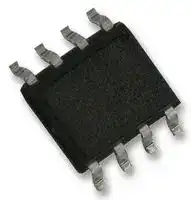


IRF7509TRPBF
Dual MOSFET, Complementary N and P Channel, 30 V, 30 V, 2.7 A, 2.7 A, 0.11 ohm
- Manufacturer: INFINEON
- Product type: Dual MOSFETs
- Transistor Polarity:N and P Channel; Continuous Drain Current Id:2.7A; Drain Source Voltage Vds:30V; On Resistance Rds(on):0.11ohm; Rds(on) Test Voltage Vgs:10V; Threshold Voltage Vgs:1V; Power Dissipation Pd
- MSL: MSL 2 - 1 year
- SVHC: No SVHC (21-Jan-2025)
- No. of Pins: 8Pins
- Channel Type: Complementary N and P Channel
- Product Range: -
- Qualification: -
- Transistor Case Style: µSOIC
- Operating Temperature Max: 150°C
- Power Dissipation N Channel: 1.25W
- Power Dissipation P Channel: 1.25W
- Drain Source Voltage Vds N Channel: 30V
- Drain Source Voltage Vds P Channel: 30V
- Continuous Drain Current Id N Channel: 2.7A
- Continuous Drain Current Id P Channel: 2.7A
- Drain Source On State Resistance N Channel: 0.11ohm
- Drain Source On State Resistance P Channel: 0.11ohm
| Delivery and price | |
|---|---|
| Units per pack | 100 |
| Price | 0.416 € |
| Current stock | 10+ |
| Lead time | 30 days |

## HEXFET Power MOSFET

**==> picture [419 x 103] intentionally omitted <==**

**----- Start of picture text -----**<br>
||||||||||
|---|---|---|---|---|---|---|---|---|
|Generation V Technology|N-CHANNEL MOSFET|
|Ultra Low On-Resistance|S1|1|8|D1|
|Dual N and P Channel MOSFET|G1|2|7|D1|
|Very Small SOIC Package|
|3|6|
|S2|oo|Ho|D2|Voss|||30V|||-30V|
|Low Profile (<1.1mm)|Leste|||sen|eon|
|Available in Tape & Reel|G2|Lb|4|in|5|D2|
|Fast Switching|P-CHANNEL MOSFET|Rpgion)|0.11|Ω|0.20|Ω|
|Lead-Free|Top View|

**----- End of picture text -----**<br>


## **Description**

Fifth  Generation HEXFETs from International Rectifier utilize advanced processing techniques to achieve extremely low  on-resistance per silicon area.  This benefit, combined with the fast switching speed and ruggedized device design that HEXFET Power MOSFETs are well known for, provides the designer with an extremely efficient and reliable device for use in a wide variety of applications.

The new Micro8 package, with half the footprint area of the standard SO-8, provides the smallest footprint available in an SOIC outline.  This makes the Micro8 an ideal device for applications where printed circuit board space is at a premium.  The low profile (<1.1mm) of the Micro8 will allow it to fit easily into extremely thin application environments such as portable electronics and PCMCIA cards.

**==> picture [32 x 8] intentionally omitted <==**

**----- Start of picture text -----**<br>
Micro8<br>**----- End of picture text -----**<br>


**==> picture [433 x 203] intentionally omitted <==**

**----- Start of picture text -----**<br>
|||||||
|---|---|---|---|---|---|
|Parameter|Max.|Units|
|es|
|N-Channel                 P-Channel|se|
|VDS|Drain-Source Voltage                                                       30                              -30                   V|
|I|
|ID @ TA = 25°C|Continuous Drain Current, VGS                                        2.7                             -2.0|
|es|
|ID @ TA = 70°C|Continuous Drain Current, VGS                                        2.1                             -1.6|A|
|es|
|IDM|Pulsed Drain Current|21                              -16|
|es|©|
|ee|PD @TA = 25°C|Maximum Power Dissipation|2|1.25|W|
|en|PD @TA = 70°C|Maximum Power Dissipation|0.8|W|
|Linear Derating Factor                                                                       10                               mW/°C|
|a|©|
|VGS                                     Gate-to-Source Voltage|± 20                                   V|
|a|
|VGSM                                  Gate-to-Source Voltage Single Pulse tp<10µS                                   30                                     V|
|es|
|se|dv/dt|Peak Diode Recovery dv/dt|5.0|V/ns|
|TJ , TSTG|Junction and Storage Temperature Range|-55  to + 150|°C|
|es|©|
|Soldering Temperature, for 10 seconds                                 240 (1.6mm from case)|
|es|
|Thermal Resistance|
|Parameter|Max.                               Units|
|es|
|eG|RθJA|Maximum Junction-to-Ambient|100                                   °C/W|

**----- End of picture text -----**<br>


www.irf.com

1

**==> picture [400 x 242] intentionally omitted <==**

**----- Start of picture text -----**<br>
∆ Vv(BR)Dss/ ∆ Ty| Breakd Volt T . Coeffi_ t | N-Ch| — |0.059) ° Reference to 25°C, , Ip = 1mA<br>Ty| Breakdown Voltage Temp. Coefficien Se =e Cc Reference to 25°C, Ip = -1mA<br>Rosion) Static Drain-to-Source On-Resistance “N-ch| = | 0090-00 Ω Ves= 10V, Ip= 1.7A<br>-_ =So77|020| Vas = ASV. b = 0.858 4<br>| — [0.30| 0.40 | Vos = -4.5V, Ip =-0.6A ©<br>“N-Ch)1.0|<br>Vsth) Gateate ThresholdThreshold VoltageVolt “P-ch/-1.0/—— || —— || ¥|| Vos=Vos=  Ves,Voss Ipln == -2500A 250uA<br>* Fi—_—dT duct: |.N-Ch|/P-ch/0.92/— | — | | —100 || © | V op s ==10= 24 V, , VesIp = = -0.6A OV<br>loss Drain-to-Source Leakage Current | P-ch| — | — | -1.0 | A Vos = -24V, Ves = OV<br>Gate-to-Source Forward Leakage ||[.N-Ch| [P-ch]|]  N-P | — — | | — — | [+100]-2525 | Veg V osos = = += 24V,-24V, 20V Vas Ves = = OV, Ty OV, Ty = = 125°C 125°C<br>Nohp<br>Gate-to-Source Charge — = [12/18]+ nc2 |= VTA, Vos= 24V, Vos = 10V<br>Cae Gate-to-Drain ("Miller") Charge |iP-ch| P-ch| —— || [1.3/1.9]  2513.7]| Ip = -1.2A, Vps = -24V, Veg = -10V<br>, Vpp= 15V, Ip = 1.7A, Re= 6.1 Ω,<br>Ω<br>tacotty Turn-Off Delay Time Noh 2RS VppP-Channel= -15V, Ip = -1.2A,Rg=6.2 Ω<br>ty Fall Time |N-Ch| — | 5.3 | — | R49 Ω<br>**----- End of picture text -----**<br>


**==> picture [401 x 40] intentionally omitted <==**

**----- Start of picture text -----**<br>
≤   ≤<br>max. junction temperature. ( See fig. 21 )<br>N-Channel ISD ≤ 1.7A, di/dt ≤ 120A/Us, Vpp ≤ Vierypss: Ty ≤ 150°C  @ Surface mounted on FR-4 board, t ≤<br>P-Channel ISD ≤ ≤ ≤ ≤<br>**----- End of picture text -----**<br>


**==> picture [61 x 9] intentionally omitted <==**

**----- Start of picture text -----**<br>
www.irf.com<br>**----- End of picture text -----**<br>


2

**==> picture [152 x 324] intentionally omitted <==**

**----- Start of picture text -----**<br>
100<br> TOP           15V<br>                   10V<br>                   7.0V Saline neata<br>                   5.5V<br>                   4.5V ee<br>                   4.0V<br>                   3.5V<br> BOTTOM   3.0V<br>10 aepnpn gee<br>rr ee OSeeeeee<br>7,| f aA| f aA f aA aAA  3.0V<br>1<br>G Y<br>Zz<br>0.1  T   = 150°CJJ<br>0.1 Satin: 1 10<br>V     , Drain-to-Source Voltage (V)DSDS<br>Fig 2.   Typical Output Characteristics<br>100<br>———<br>a<br>10<br>a==<br>4 T  = 150°CJJ<br>[— T  = 25°CJJ<br>1 aa n<br>SS<br>SS<br>0.10.4 arePeee|TErePeee|TEPeee|TEe|TE eeo}<br>0.4 0.8 1.2 1.6 2.0<br>V     , Source-to-Drain Voltage (V)SDSD<br>I   , Drain-to-Source Current (A)DD<br>I     , Reverse Drain Current (A)SDSD<br>**----- End of picture text -----**<br>


**==> picture [397 x 509] intentionally omitted <==**

**----- Start of picture text -----**<br>
100 100<br> TOP           15V  TOP           15V<br>                   10V                    10V<br>                   7.0V eatae Geen Eae|                    7.0V Saline neata<br>                   5.5V                    5.5V<br>                   4.5V ee ee                    4.5V ee<br>                   4.0V                    4.0V<br>                   3.5V                    3.5V<br> BOTTOM   3.0V  BOTTOM   3.0V<br>10 peeen) ell 10 aepnpn gee<br>ee A ea ee ee ee ee rr ee OSeeeeee<br>|| LooBaar 7,| f aA| f aA f aA aAA  3.0V<br>1 1<br>a  3.0V G Y<br>a Zz<br>0.1  T   = 25°CJ A 0.1  T   = 150°CJJ<br>0.1 pest 1 10 0.1 Satin: 1 10<br>V      , Drain-to-Source Voltage (V)DS V     , Drain-to-Source Voltage (V)DSDS<br>Fig 1.   Typical Output Characteristics Fig 2.   Typical Output Characteristics<br>100 100<br>BS SSE SEES ———<br>a a<br>T  = 25°CJ<br>10 10<br>Snnn ae= == =n a==<br>T  = 150°CJ 4 T  = 150°CJJ<br>AC [—<br>T  = 25°CJJ<br>1 Ze 1 aa n<br>=== SS<br>ee SS<br> V     = 10VDS<br>0.13.0 TedPT 3.5 tT 4.0 TE | 4.5 cous 5.0  purse 5.5  wore 6.0A 0.10.4 arePeee|TErePeee|TEPeee|TEe|TE 0.8 |TETE 1.2 eeo} 1.6 eo}} 2.0<br>V     , Gate-to-Source Voltage (V)GS V     , Source-to-Drain Voltage (V)SDSD<br>Fig 3.   Typical Transfer Characteristics Fig 4.   Typical Source-Drain Diode<br>Forward Voltage<br>2.0 P PT 0.220 Pi TET Ty ey<br>1.5 0.180<br>S e Petit TL<br>DS tl Pit ty VGS = 4.5V TAL<br>1.0 0.140<br>tt tert tt pit tb<br>0.5 0.100<br>aan ee) a a = p EEi VGS = 10V f<br>0.0-60 eee -40 -20 0 20 40 60 80 100 120 140 160A 0.060 0 Pit 2 TT 4 tT 6 tT| 8 10<br>T   , Junction Temperature (°C)J I    , Drain Current (A)D<br>I    , Drain-to-Source Current (A)D I   , Drain-to-Source Current (A)DD<br>I     , Reverse Drain Current (A)SDSD<br>I   , Drain-to-Source Current (A)D<br>(Normalized)<br>DS(on)<br>R           ,  Drain-to-Source On Resistance<br>DS (on)<br>R            , Drain-to-Source On Resistance<br>**----- End of picture text -----**<br>


**Fig 2.** Typical Output Characteristics

**Fig 4.** Typical Source-Drain Diode Forward Voltage

**Fig 5.** Normalized On-Resistance Vs. Temperature

**Fig 6.** Typical On-Resistance Vs. Drain Current

www.irf.com

3

**==> picture [146 x 144] intentionally omitted <==**

**----- Start of picture text -----**<br>
0.140<br>0.120<br>ID = 2.7A<br>0.100 . |<br>a<br>0.080 NRNw<br>0.060 PPToS<br>0 4 8 12 16<br>V      , Gate-to-Source Voltage (V)GS<br>DS (on)<br>R            , Drain-to-Source On Resistance<br>**----- End of picture text -----**<br>


**Fig 7.** Typical On-Resistance Vs. Gate Voltage

**==> picture [144 x 146] intentionally omitted <==**

**----- Start of picture text -----**<br>
400<br>V      = 0V,         f = 1MHzGS<br>C      = C     + C     ,   C     SHORTEDiss         gs         gd         ds<br>C      = Crss         gd<br>C      = C     + Coss        ds         gd<br>300 K s S ETT<br>ss<br>200<br>100 ss ais<br>ree [PS] Saal<br>0 Alll<br>1 10 100<br>V     , Drain-to-Source Voltage (V)DS<br>C, Capacitance (pF)<br>**----- End of picture text -----**<br>


**Fig 9.** Typical Capacitance Vs. Drain-to-Source Voltage

**==> picture [157 x 149] intentionally omitted <==**

**----- Start of picture text -----**<br>
 100<br>OPERATION IN THIS AREA LIMITED<br>BY RDS(on)<br>10us<br> 10<br>ps EER st 100us EH<br>Ps t<br> 1 PSE ETT 1ms<br>ESp oel l<br>10ms<br>E  T TCJ = 25  C= 150  C° ° H<br>0.1 ea  Single Pulse l aeniein, la<br> 1  10  100<br>V     , Drain-to-Source Voltage (V)DS<br>I   , Drain Current (A) D<br>**----- End of picture text -----**<br>


**Fig 8.** Maximum Safe Operating Area

**==> picture [147 x 146] intentionally omitted <==**

**----- Start of picture text -----**<br>
20<br>I    = 1.7AD<br>16 HE E ates<br>12 SeGnG0080700<br>8<br>Y<br>4 PL wm<br>tA<br>0 (AeVann SRGeneee     SEE FIGURE 9<br>0 2 4 6 8 10 12<br>Q   , Total Gate Charge (nC)G<br>GS<br>V     , Gate-to-Source Voltage (V)<br>**----- End of picture text -----**<br>


**Fig 10.** Typical Gate Charge Vs. Gate-to-Source Voltage

www.irf.com

4

**==> picture [160 x 507] intentionally omitted <==**

**----- Start of picture text -----**<br>
10<br> TOP         - 15V<br>                 - 10V<br>                 - 7.0V<br>                 - 5.5V<br>                 - 4.5V<br>                 - 4.0V<br>                 - 3.5V<br> BOTTOM - 3.0V<br>CTA<br>1 (Fh| Jyv..————7<br>VPS ff<br> -3.0V<br>Uf<br>Vat e e<br>Ze oh<br>0.1  T   = 25°CJ<br>0.1 1 1 aes 10<br>-V     , Drain-to-Source Voltage (V)DS<br>Fig 11.   Typical Output Characteristics<br>10<br>T  = 25°CJ<br>T  = 150°CJ<br>ay  4 s<br>1 fi _| |<br>ee<br>ee<br> V     = -10VDS<br>0.1<br>3.0 EL LTT 4.0 5.0 sneeesewins 6.0 7.0<br>-V     , Gate-to-Source Voltage (V)GS<br>Fig 13.   Typical Transfer Characteristics<br>2.0<br>m7<br>PP L TTT<br>1.5 e e<br>Cer<br>Pa<br>1.0<br>COE iy<br>0.5 try]<br>TA<br>CUT<br>0.0 PU<br>-60 -40 -20 0 20 40 60 80 100 120 140 160<br>T   , Junction Temperature (°C)J<br>D<br>-I   , Drain-to-Source Current (A)<br>D<br>-I   , Drain-to-Source Current (A)<br>(Normalized)<br>DS(on)<br>R           ,  Drain-to-Source On Resistance<br>**----- End of picture text -----**<br>


## **Fig 11.** Typical Output Characteristics

**Fig 13.** Typical Transfer Characteristics

**Fig 15.** Normalized On-Resistance Vs. Temperature

**==> picture [151 x 321] intentionally omitted <==**

**----- Start of picture text -----**<br>
10<br> TOP         - 15V<br>                 - 10V<br>                 - 7.0V<br>                 - 5.5V<br>                 - 4.5V<br>                 - 4.0V<br>                 - 3.5V<br> BOTTOM - 3.0V<br>YO<br>1 |)||V777zammmnal—§$_ —“fgf— fffe——ffpffn ft|  -3.0V —<br>UY 7<br>Ys<br>0.1  T   = 150°CJ<br>0.1 ANN 1 soca 10<br>-V     , Drain-to-Source Voltage (V)DS<br>  Typical Output Characteristics<br>10<br>T  = 150°CJ<br>ny @/.ae<br>1 AI T  = 25°CJ |<br>a<br>oe<br>0.1<br>0.4 Van 0.6  .eee 0.8 1.0 eee 1.2 1.4<br>-V     , Source-to-Drain Voltage (V)SD<br>D<br>-I   , Drain-to-Source Current (A)<br>SD<br>-I     , Reverse Drain Current (A)<br>**----- End of picture text -----**<br>


## **Fig 12.** Typical Output Characteristics

**Fig 14.** Typical Source-Drain Diode Forward Voltage

**==> picture [7 x 13] intentionally omitted <==**

**----- Start of picture text -----**<br>
 ( Ω )<br>**----- End of picture text -----**<br>


**Fig 16.** Typical On-Resistance Vs. Drain Current

www.irf.com

5

**==> picture [393 x 355] intentionally omitted <==**

**----- Start of picture text -----**<br>
0.60  100 _———<br>OPERATION IN THIS AREA LIMITED<br>5 om oc ne i BY RDS(on) o 10us r<br> 10<br>| Paani ee<br>100us<br>@ | Vf wea | | | PS O<br>1ms<br> 1<br>bof AL Sanat Sa li l<br>10ms<br> T TCJ = 25  C= 150  C° °<br>°: jE or 3 6 9 FE 12 Fy 15 0.1  1 i  Single Pulse STi  10 me i  i i  100<br>-V     , Drain-to-Source Voltage (V)DS<br>-Ves_, Gate-to-Source Voltage (V)<br>Fig 17.  Typical On-Resistance Vs. Gate Fig 18.   Maximum Safe Operating Area<br>Voltage<br>400 20<br>V      = 0V,         f = 1MHzGS  I    = -1.2AD<br>C      = C     + C     ,   C     SHORTEDiss         gs         gd         ds<br>C      = Crss         gd<br>300 C      = C     + Coss        ds         gd 16  V      = -15VDS<br>Poot pp<br>s<br>12<br>eH ss EU PUPA<br>200<br>Ba el San EnD” 4000<br>8<br>SBS ail SEEEED/AGBEE<br>100 s<br>MST CTT 4 A<br>0 Hts A 0 J Yi | i}     SEE FIGURE 9 FOR TEST CIRCUITH<br>1 10 100 0 2 4 6 8 10 12<br>-V     , Drain-to-Source Voltage (V)DS Q   , Total Gate Charge (nC)G<br>Fig 19.   Typical Capacitance Vs. Fig 20.   Typical Gate Charge Vs.<br>Drain-to-Source Voltage Gate-to-Source Voltage<br> ( Ω )<br>I   , Drain Current (A) D-<br>C, Capacitance (pF)<br>GS<br>-V     , Gate-to-Source Voltage (V)<br>**----- End of picture text -----**<br>


## **Fig 17.** Typical On-Resistance Vs. Gate Voltage

## **Fig 18.** Maximum Safe Operating Area

**==> picture [146 x 23] intentionally omitted <==**

**----- Start of picture text -----**<br>
Fig 20.   Typical Gate Charge Vs.<br>Gate-to-Source Voltage<br>**----- End of picture text -----**<br>


**==> picture [53 x 7] intentionally omitted <==**

**----- Start of picture text -----**<br>
N-P - Channel<br>**----- End of picture text -----**<br>


**==> picture [314 x 138] intentionally omitted <==**

**----- Start of picture text -----**<br>
 1000<br>PT TT<br> 100<br>D = 0.50<br>0.20 mitt<br> 10 0.10<br>0.05<br>PDM<br>0.020.01 a es t1<br> 1 S ea SINGLE PULSE nad t2<br>(THERMAL RESPONSE) Notes:<br>pT TT 1. Duty factor D = t   / t1 2<br>0.1 PA T n 2. Peak T J = P DM x  Z thJA + TA<br>0.00001 0.0001 0.001 0.01 0.1  1  10  100<br>t  , Rectangular Pulse Duration (sec)1<br>(Z        )thJA<br>Thermal Response<br>**----- End of picture text -----**<br>


**Fig 21.** Maximum Effective Transient Thermal Impedance, Junction-to-Ambient

www.irf.com

6

## Micro8 Package Outline

Dimensions are shown in milimeters (inches)

**==> picture [305 x 180] intentionally omitted <==**

**----- Start of picture text -----**<br>
LEAD ASSIGNMENTS       INCHES        MILLIMETERS<br>D DIM   MIN       MAX       MIN      MAX<br>- B - 3 D  D  D  D D1 D1 D2 D2 A       .036       .044        0.91      1.11<br>A1     .004       .008        0.10      0.20<br>8   7   6   5 8   7   6   5 B       .010       .014        0.25      0.36<br>3 E it 8   7   6   5 — H gpa SINGLE pBABE DUAL ptt C       .005       .007        0.13      0.18D       .116       .120        2.95      3.05<br>- A - 0.25  (.010)       M     A    M 1   2   3   4 1   2   3   4 e        .0256 BASIC        0.65 BASIC<br>ol, 1   2   3   4 [|] SSS e1      .0128 BASIC        0.33 BASIC 4<br>S  S  S  G S1 G1 S2 G2 E       .116       .120         2.95      3.05<br>H       .188       .198        4.78       5.03<br>e L oe L        .016      .026         0.41       0.66<br>6X ET θ          0°          6°           0°           6° tt 4<br>e 1<br>θ RECOMMENDED FOOTPRINT<br>A  1.04   0.38<br>- C - — 0.10  (.004) — ( .041 )   8X ( .015 )  [8X]<br>B     8X A 1 L C<br>ite HY 8X 8X Oh<br>0.08  (.003)         M    C   A  S    B   S   3.20   4.24   5.28<br>( .126 ) ( .167 ) ( .208 )<br>NOTES:<br>       1  DIMENSIONING AND TOLERANCING PER ANSI Y14.5M-1982.<br>       2  CONTROLLING DIMENSION : INCH.    0.65<br>       3  DIMENSIONS DO NOT INCLUDE MOLD FLASH. fe} JL ( .0256 ) [6X]<br>**----- End of picture text -----**<br>


## Micro8 Part Marking Information

EXAMPLE: THIS IS AN IRF7501

LOT CODE (XX) PART NUMBER

DATE CODE (YW) - See table below Y =  YEAR W =  WEEK P =  DESIGNATES LEAD - FREE PRODUCT (OPTIONAL)

WW =  (1-26) IF PRECEDED BY LAST DIGIT OF CALENDAR YEAR

|||WORK|WORK|||
|---|---|---|---|---|---|
|YEAR|Y|WEEK||W||
|2003<br>2002<br>2001<br>2004|3<br>2<br>1<br>4|03<br>02<br>01<br>04||C<br>B<br>A<br>D||
|2005|5|||||
|2006|6|||||
|2007|7|||||
|2008|8|||||
|2009<br>2010|9<br>0|26<br>24<br>25||Z<br>X<br>Y||


WW =  (27-52) IF PRECEDED BY A LETTER

|||WORK|WORK|||
|---|---|---|---|---|---|
|YEAR|Y|WEEK||W||
|2001|A|27||A||
|2002|B|28||B||
|2003|C|29||C||
|2004|D|30||D||
|2005|E|||||
|2006|F|||||
|2007|G|||||
|2008|H|||||
|2009|J|||||
|2010|K|50||X||
|||51||Y||
|||52||Z||


www.irf.com

7

## Micro8 Tape & Reel Information

Dimensions are shown in millimeters (inches)

**==> picture [211 x 143] intentionally omitted <==**

**----- Start of picture text -----**<br>
TERMINAL NUMBER 1<br>Ooo oo<br>12.3 ( .484 )<br>11.7 ( .461 )<br>8.1 ( .318 ) Lo FEED DIRECTION<br>7.9 ( .312 )<br>**----- End of picture text -----**<br>


NOTES:

1.   OUTLINE CONFORMS TO EIA-481 & EIA-541.

2.   CONTROLLING DIMENSION : MILLIMETER.

**==> picture [197 x 87] intentionally omitted <==**

**----- Start of picture text -----**<br>
 330.00<br>(12.992)<br>  MAX.<br>14.40 ( .566 )<br>12.40 ( .488 )<br>**----- End of picture text -----**<br>


NOTES :

1. CONTROLLING DIMENSION : MILLIMETER.

2. OUTLINE CONFORMS TO EIA-481 & EIA-541.

Data and specifications subject to change without notice. This product has been designed and qualified for the Consumer market. Qualification Standards can be found on IR’s Web site.

**IR WORLD HEADQUARTERS:** 233 Kansas St., El Segundo, California 90245, USA Tel: (310) 252-7105

TAC Fax: (310) 252-7903 Visit us at www.irf.com for sales contact information **.** 06/04

www.irf.com

8
Updated at June 9, 2026
Infineon Technologies is a globally recognized leader in semiconductor solutions, renowned for driving innovation in power management, energy efficiency, and modern mobility. With a strong legacy of engineering excellence, the company provides highly reliable components designed to meet the rigorous demands of industrial, automotive, and advanced commercial applications. The core of our Infineon portfolio is centered on their industry-leading discrete semiconductors. We offer an extensive selection of single and dual MOSFETs, alongside a robust range of single IGBTs and advanced IGBT modules. These flagship power transistors are essential for high-efficiency power conversion and motor control, providing engineers with superior thermal performance and minimized switching losses. Beyond advanced field-effect transistors, the selection includes a comprehensive array of diodes and rectifiers, heavily featuring Schottky diodes, as well as fast-recovery and RF/PIN diodes. This power foundation is further supported by bipolar transistors, intelligent power modules, and thyristor SCR modules, delivering the critical building blocks required for complex power system designs. To support broader system integration, the portfolio also encompasses specialized solutions such as solid-state relays, AC/DC LED driver ICs, and Bluetooth communications modules. From high-power industrial rectifiers to wireless connectivity adapters, Infineon equips designers with the precision components needed to build efficient, scalable, and fully connected electronic systems.
About Novapart
Novapart is a B2B electronic component broker specialising in stock shortages and cost reduction. We source hard-to-find parts and identify compliant alternatives across a catalogue of 410,000+ components from 500+ manufacturers.
Learn more →Stock Shortage Specialist
When a component is unavailable, discontinued or has an unacceptable lead time, we tap into our network of vetted European and Asian distributors to source what you need — without compromising on quality or traceability.
Request a quote →Compliant Alternatives
We identify pin-to-pin, electrically equivalent substitutes that meet the same certifications (RoHS, AEC-Q100, REACH) as your original specification — validated against datasheets, not just part numbers. Often at a lower cost.
BOM Analysis service →