
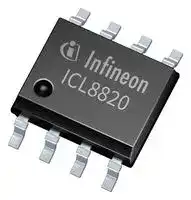


ICL8820XUMA1
LED Driver, AC/DC, 150 kHz, Constant Voltage/Flyback, PG-DSO-8, SMD
- Manufacturer: INFINEON
- Product type: AC / DC LED Driver ICs
- MSL: MSL 3 - 168 hours
- SVHC: No SVHC (25-Jun-2025)
- Topology: Constant Voltage, Flyback
- IC Mounting: Surface Mount
- No. of Pins: 8Pins
- Product Range: -
- Qualification: -
- No. of Outputs: 1Outputs
- Device Topology: Constant Voltage, Flyback
- LED Driver Type: -
- Driver Case Style: PG-DSO
- IC Case / Package: PG-DSO
- Input Voltage Max: 300V
- Input Voltage Min: 90V
- Output Current Max: -
- Output Voltage Max: -
- Switching Frequency: 150kHz
- Switching Frequency Typ: 150kHz
- Operating Temperature Max: 125°C
- Operating Temperature Min: -40°C
- Automotive Qualification Standard: -
| Delivery and price | |
|---|---|
| Units per pack | 5000 |
| Price | 0.276 € |
| Current stock | 1000+ |
| Lead time | 7 days |

**==> picture [584 x 65] intentionally omitted <==**

## **ICL88xx**

## **Datasheet for ICL8800, ICL8810 and ICL8820**

## **Feature list**

The ICL88xx family of single stage flyback controllers for constant voltage output is tailored for LED lighting applications to meet the required performance. They offer power factor correction (PFC) and low total harmonic distortion (THD) from low to full load conditions.

## **General features ICL8800, ICL8810, ICL8820**

- Constant voltage (CV) output flyback topology with a feature set and operation targeting lighting applications

- Optimized for PFC-flyback topologies with secondary side regulation (SSR) operation, primary side regulation (PSR) possible

- Supports universal input voltage (90 _V_ AC to 300 _V_ AC, 45 Hz to 66 Hz) and DC input voltage operation

- High power factor low THD performance across wide load and input AC line range

- Quasi-resonant operation with continuous conduction mode (CCM)-prevention and valley switching discontinuous conduction mode (DCM) in mid to light load

- Adjustable max on-time – limits input power and current allowing safe-operation under low line condition

- Comprehensive set of protections: Internal overtemperature protection (OTP), output overvoltage protection (OVP), overcurrent protection (OCP), brown-in and brownout protection, open loop protection, input overvoltage protection

- Soft-start to reduce stress during turn-on

- External start-up circuit control signal with _V_ cc support in light load operation

- Reduced gate driver output voltage during start-up sequence and burst mode allowing smaller Vcc cap

- Burst mode for very light loads and low system standby power consumption

- Jitter function on DC input to ease electromagnetic interference (EMI) testing for emergency lighting

## **Additional features ICL8810, ICL8820**

- Burst mode for very light loads and low system standby power consumption

## **Additional features ICL8820**

- Jitter function on DC input to ease EMI testing for emergency lighting

## **Potential applications**

## **PFC-flyback CV**

- LED driver and luminaries up to 125 W

- Adapter, charger, flat TV, all-in-one PC, monitor up to 125 W

Please read the Important Notice and Warnings at the end of this document

Datasheet **www.infineon.com**

Rev. 1.0 2021-04-01

**ICL88xx Datasheet for ICL8800, ICL8810 and ICL8820**

**==> picture [105 x 47] intentionally omitted <==**

## **Product validation**

**==> picture [492 x 220] intentionally omitted <==**

**----- Start of picture text -----**<br>
VOUT +<br>VOUT-<br>L CMC CoolMOS<br>GD<br>DMC CS<br>N ICL88xx<br>VS<br>VIN<br>VCC ZCD<br>TD GND<br>**----- End of picture text -----**<br>


**Figure 1**

**Flyback-SSR-CV**

**==> picture [493 x 209] intentionally omitted <==**

**----- Start of picture text -----**<br>
VOUT +<br>VOUT-<br>L CMC<br>CoolMOS<br>GD<br>DMC CS<br>N ICL88xx<br>VS<br>VIN<br>VCC ZCD<br>TD GND<br>**----- End of picture text -----**<br>


**Figure 2 Flyback-PSR-CV**

|**Figure 2**<br>**Flyback-PSR-CV**|||
|---|---|---|
|**Product type**|**Package**|**Ordering code**|
|ICL8800|PG-DSO-8|SP003135776|
|ICL8810|PG-DSO-8|SP005418406|
|ICL8820|PG-DSO-8|SP005418407|


## **Product validation**

Qualified for applications listed above based on the test conditions in the relevant tests of JEDEC20/22.

Datasheet

Rev. 1.0 2021-04-01

2

**ICL88xx Datasheet for ICL8800, ICL8810 and ICL8820**

**==> picture [105 x 47] intentionally omitted <==**

## **Description**

## **Description**

The ICL8800, ICL8810 and ICL8820 is a voltage mode controller for flyback topologies operating in quasiresonant mode and valley switching DCM. It is designed for low and high power lumen LED driver, requiring high power factor and efficiency. The flyback controller is capable of controlling SSR-CV an PSR-CV topologies. Offering a wide usage in low cost applications where a PFC functionality in dual stage topologies is required.

For lighting applications, the IC offers a wide power range as well as a comprehensive set of protections, including a power limitation. The IC is easy to design in and requires a minimum number of external components.

The gate driver current enables reasonable designs up to 125 W with state-of-the-art MOSFETs. The system P7 performance and efficiency, especially in light load conditions, can be optimized using Infineon CoolMOS[™] power MOSFETs.

## **ICL8810 and ICL8820**

The integrated burst mode function allows designs with a very low standby power consumption and small output ripple during standby mode and very light loads.

## **ICL8820**

The jitter function eases the design of emergency lighting LED drivers without additional circuitry to improve EMI performance.

Datasheet

Rev. 1.0 2021-04-01

3

**ICL88xx Datasheet for ICL8800, ICL8810 and ICL8820**

**==> picture [105 x 47] intentionally omitted <==**

## **Table of contents**

## **Table of contents**

||**Feature list**. . . . . . . . . . . . . . . . . . . . . . . . . . . . . . . . . . . . . . . . . . . . . . . . . . . . . . . . . . . . . . . . . . . . . . . . . . . . 1|
|---|---|
||**Potential applications**. . . . . . . . . . . . . . . . . . . . . . . . . . . . . . . . . . . . . . . . . . . . . . . . . . . . . . . . . . . . . . . . . . 1|
||**Product validation**. . . . . . . . . . . . . . . . . . . . . . . . . . . . . . . . . . . . . . . . . . . . . . . . . . . . . . . . . . . . . . . . . . . . . 2|
||**Description**. . . . . . . . . . . . . . . . . . . . . . . . . . . . . . . . . . . . . . . . . . . . . . . . . . . . . . . . . . . . . . . . . . . . . . . . . . . . .3|
||**Table of contents**. . . . . . . . . . . . . . . . . . . . . . . . . . . . . . . . . . . . . . . . . . . . . . . . . . . . . . . . . . . . . . . . . . . . . . . 4|
|**1**|**Pin configuration**. . . . . . . . . . . . . . . . . . . . . . . . . . . . . . . . . . . . . . . . . . . . . . . . . . . . . . . . . . . . . . . . . . . . . . . 6|
|**2**|**Block diagram**. . . . . . . . . . . . . . . . . . . . . . . . . . . . . . . . . . . . . . . . . . . . . . . . . . . . . . . . . . . . . . . . . . . . . . . . . . 7|
|**3**|**Functional description**. . . . . . . . . . . . . . . . . . . . . . . . . . . . . . . . . . . . . . . . . . . . . . . . . . . . . . . . . . . . . . . . . . 8|
|3.1|Operating modes . . . . . . . . . . . . . . . . . . . . . . . . . . . . . . . . . . . . . . . . . . . . . . . . . . . . . . . . . . . . . . . . . . . . . . . . 8|
|3.2|Burst mode . . . . . . . . . . . . . . . . . . . . . . . . . . . . . . . . . . . . . . . . . . . . . . . . . . . . . . . . . . . . . . . . . . . . . . . . . . . . 12|
|3.3|Input voltage detection and protection . . . . . . . . . . . . . . . . . . . . . . . . . . . . . . . . . . . . . . . . . . . . . . . . . . . 13|
|3.4|Zero crossing detection . . . . . . . . . . . . . . . . . . . . . . . . . . . . . . . . . . . . . . . . . . . . . . . . . . . . . . . . . . . . . . . . . 14|
|3.5|Power factor correction and THD correction . . . . . . . . . . . . . . . . . . . . . . . . . . . . . . . . . . . . . . . . . . . . . . .16|
|3.6|Frequency jitter . . . . . . . . . . . . . . . . . . . . . . . . . . . . . . . . . . . . . . . . . . . . . . . . . . . . . . . . . . . . . . . . . . . . . . . . 17|
|3.7|Start-up . . . . . . . . . . . . . . . . . . . . . . . . . . . . . . . . . . . . . . . . . . . . . . . . . . . . . . . . . . . . . . . . . . . . . . . . . . . . . . . 18|
|3.8|Power limitation . . . . . . . . . . . . . . . . . . . . . . . . . . . . . . . . . . . . . . . . . . . . . . . . . . . . . . . . . . . . . . . . . . . . . . . 19|
|3.9|Overtemperature protection . . . . . . . . . . . . . . . . . . . . . . . . . . . . . . . . . . . . . . . . . . . . . . . . . . . . . . . . . . . . .19|
|3.10|Overcurrent protection . . . . . . . . . . . . . . . . . . . . . . . . . . . . . . . . . . . . . . . . . . . . . . . . . . . . . . . . . . . . . . . . . 20|
|3.11|Output overvoltage protection . . . . . . . . . . . . . . . . . . . . . . . . . . . . . . . . . . . . . . . . . . . . . . . . . . . . . . . . . . .21|
|3.12|Open loop protection . . . . . . . . . . . . . . . . . . . . . . . . . . . . . . . . . . . . . . . . . . . . . . . . . . . . . . . . . . . . . . . . . . . 22|
|3.13|VCC protections . . . . . . . . . . . . . . . . . . . . . . . . . . . . . . . . . . . . . . . . . . . . . . . . . . . . . . . . . . . . . . . . . . . . . . . . 23|
|3.14|Fault reaction and flow chart . . . . . . . . . . . . . . . . . . . . . . . . . . . . . . . . . . . . . . . . . . . . . . . . . . . . . . . . . . . . 24|
|3.15|Adjustable functions . . . . . . . . . . . . . . . . . . . . . . . . . . . . . . . . . . . . . . . . . . . . . . . . . . . . . . . . . . . . . . . . . . . .25|
|**4**|**Electrical characteristics and parameters**. . . . . . . . . . . . . . . . . . . . . . . . . . . . . . . . . . . . . . . . . . . . . . . 26|
|4.1|Absolute maximum ratings . . . . . . . . . . . . . . . . . . . . . . . . . . . . . . . . . . . . . . . . . . . . . . . . . . . . . . . . . . . . . . 26|
|4.2|Operating conditions . . . . . . . . . . . . . . . . . . . . . . . . . . . . . . . . . . . . . . . . . . . . . . . . . . . . . . . . . . . . . . . . . . . 27|
|4.3|DC electrical characteristics . . . . . . . . . . . . . . . . . . . . . . . . . . . . . . . . . . . . . . . . . . . . . . . . . . . . . . . . . . . . . 27|
|4.3.1|Power supply . . . . . . . . . . . . . . . . . . . . . . . . . . . . . . . . . . . . . . . . . . . . . . . . . . . . . . . . . . . . . . . . . . . . . . . . .27|
|4.3.2|Zero crossing detection . . . . . . . . . . . . . . . . . . . . . . . . . . . . . . . . . . . . . . . . . . . . . . . . . . . . . . . . . . . . . . . 28|
|4.3.3|Voltage sense . . . . . . . . . . . . . . . . . . . . . . . . . . . . . . . . . . . . . . . . . . . . . . . . . . . . . . . . . . . . . . . . . . . . . . . . 28|
|4.3.4|Input voltage detection . . . . . . . . . . . . . . . . . . . . . . . . . . . . . . . . . . . . . . . . . . . . . . . . . . . . . . . . . . . . . . . .29|
|4.3.5|THD configuration . . . . . . . . . . . . . . . . . . . . . . . . . . . . . . . . . . . . . . . . . . . . . . . . . . . . . . . . . . . . . . . . . . . . 29|
|4.3.6|Current sense . . . . . . . . . . . . . . . . . . . . . . . . . . . . . . . . . . . . . . . . . . . . . . . . . . . . . . . . . . . . . . . . . . . . . . . . 29|
|4.3.7|PWM generation . . . . . . . . . . . . . . . . . . . . . . . . . . . . . . . . . . . . . . . . . . . . . . . . . . . . . . . . . . . . . . . . . . . . . . 30|
|4.3.8|Gate driver . . . . . . . . . . . . . . . . . . . . . . . . . . . . . . . . . . . . . . . . . . . . . . . . . . . . . . . . . . . . . . . . . . . . . . . . . . . 31|
|4.3.9|Clock oscillators . . . . . . . . . . . . . . . . . . . . . . . . . . . . . . . . . . . . . . . . . . . . . . . . . . . . . . . . . . . . . . . . . . . . . . 31|
|4.3.10|Temperature sensor . . . . . . . . . . . . . . . . . . . . . . . . . . . . . . . . . . . . . . . . . . . . . . . . . . . . . . . . . . . . . . . . . . 31|


Datasheet

Rev. 1.0 2021-04-01

4

**ICL88xx Datasheet for ICL8800, ICL8810 and ICL8820**

**==> picture [105 x 47] intentionally omitted <==**

## **Table of contents**

|**5**|**Package dimensions**. . . . . . . . . . . . . . . . . . . . . . . . . . . . . . . . . . . . . . . . . . . . . . . . . . . . . . . . . . . . . . . . . . . 32|
|---|---|
|**6**|**Glossary**. . . . . . . . . . . . . . . . . . . . . . . . . . . . . . . . . . . . . . . . . . . . . . . . . . . . . . . . . . . . . . . . . . . . . . . . . . . . . . 34|
|**7**|**Revision history**. . . . . . . . . . . . . . . . . . . . . . . . . . . . . . . . . . . . . . . . . . . . . . . . . . . . . . . . . . . . . . . . . . . . . . . 35|
||**Disclaimer**. . . . . . . . . . . . . . . . . . . . . . . . . . . . . . . . . . . . . . . . . . . . . . . . . . . . . . . . . . . . . . . . . . . . . . . . . . . . 36|


Datasheet

Rev. 1.0 2021-04-01

5

**ICL88xx Datasheet for ICL8800, ICL8810 and ICL8820**

**==> picture [105 x 47] intentionally omitted <==**

## **1 Pin configuration**

## **1 Pin configuration**

**==> picture [279 x 171] intentionally omitted <==**

**----- Start of picture text -----**<br>
ZCD 1 8 VCC<br>VS 2 7 GND<br>VIN 3 6 GD<br>TD 4 5 CS<br>PG-DSO-8<br>ICL88xx<br>**----- End of picture text -----**<br>


|PG-DSO-8|PG-DSO-8|PG-DSO-8|
|---|---|---|
|**Figure 3**<br>**Pin configuration**|||
|**Table 1**<br>**Pin definition and function**|||
|**Symbol**|**Pin**|**Function**|
|_ZCD_|1|**Zero crossing detection**<br>This pin is connected to an auxiliary winding via a resistor to detect the zero crossing<br>of the switching current. When the zero crossing is detected, the controller initiates a<br>new switching cycle. The resistor from_ZCD_pin to the auxiliary winding is used to set the<br>maximum on-time.|
|_VS_|2|**Voltage sense**<br>This pin is connected to the feedback circuit.|
|_VIN_|3|**Input voltage detection**<br>This pin is used to measure the AC or DC input voltage for power limitation, input OVP,<br>brown-in and brownout.|
|_TD_|4|**THD correction**<br>This pin is used to set the THD correction using a resistor to_GND_. The voltage on this pin<br>can be used to control an external start-up circuit.|
|_CS_|5|**MOSFET current sense and secondary side over voltage protection**<br>This pin is used for primary side over current protection. A series resistance between<br>pin and shunt resistor is used to tune the secondary side over voltage protection for the<br>flyback topology.|
|_GD_|6|**Gate driver**<br>This pin controls the gate of the MOSFET.|
|_GND_|7|**Ground**<br>This pin is connected to ground and represents the ground level of the IC for the supply<br>voltage, gate driver and sense signals.|
|_VCC_|8|**Power supply**<br>This pin supplies the IC.|


Datasheet

Rev. 1.0 2021-04-01

6

**ICL88xx Datasheet for ICL8800, ICL8810 and ICL8820**

**==> picture [105 x 47] intentionally omitted <==**

## **2 Block diagram**

## **2**

## **Block diagram**

**==> picture [492 x 341] intentionally omitted <==**

**----- Start of picture text -----**<br>
TD<br>VOVP +- Over voltage protection adjustmentTHD  startup circuit External control CS protectionsQ RS Blanking Blanking timetime ++-- VVOCP2OCP1 IOVP CS<br>THD configuration<br>+ AC sync and BI/BO Pulse generation<br>VBI +- Thermal protection and THDcorrection ZCD<br>VIN VBO +- voltage Level detectionAC/DC detection; Input  Tj Thermal Protection Pulse generation & mode change GD<br>VUV -<br>1.6 V<br>Burst control<br>RPU =  Fault control<br>500Ω   (ICL8810 &<br>ICL8820)<br>VS A ADC<br>I<br>Powerlimitation<br>Decimation and jitter  DAC<br>(ICL8820)<br>Digital state machine<br>VS open loop protection Supply, reference & biasing VCC monitoring<br>Vovp +- Blanking time S Q 3.3 V Reference/ VUVLO +-<br>R Selfsupply<br>+<br>VOVLO -<br>GND VCC<br>**----- End of picture text -----**<br>


**Figure 4**

**Block diagram**

Datasheet

Rev. 1.0 2021-04-01

7

**ICL88xx Datasheet for ICL8800, ICL8810 and ICL8820**

## **3 Functional description**

## **3 Functional description**

These sections describe the listed functions in detail.

## **3.1 Operating modes**

The controller operates in voltage mode to optimize the power factor. It also autonomously selects the best mode of operation based on operation conditions like input voltage and input frequency as well as load conditions.

The supported modes are:

- Quasi-resonant mode (QRM)

This mode controls the on-time and maximizes the efficiency by switching on at the valleys of the _ZCD_ signal. This ensures zero-current switching with a minimum of switching losses.

## **Figure 5 Example of the switching waveform in the first valley**

- Burst mode for ICL8810 and ICL8820

   - Operation in burst mode to increase the efficiency in light load operation and to extend the power range for wide range input voltage designs. Enables very low standby power.

At highest relative power, the controller operates in voltage mode with constant on-time in QRM, switching at the first valley. The maximum on-time can be tuned using the _ZCD_ series resistance to adjust the maximum relative power.

In QRM, the operating frequency depends on the QR resonant frequency of the transformer and the MOSFET. To reduce relative power, the controller reduces the on-time. At certain relative power levels, the controller also starts increasing the valley to avoid high frequencies. The switching frequencies remain within a range of typically 20 kHz to 150 kHz depending on component selection.

The on-time is compensated to ensure a constant relative power for the change of the valley. The off-time of the controller is limited to TOff = 47 µs to ensure a minimum switching frequency outside the audible range.

To achieve lowest relative output power, the ICL8810 and ICL8820 enter a burst mode with a repetition frequency of approximately four times the AC input frequency.

Datasheet

Rev. 1.0 2021-04-01

8

**ICL88xx Datasheet for ICL8800, ICL8810 and ICL8820**

## **3 Functional description**

**Figure 6 Exemplary switching characteristics versus relative power for a flyback application with an QR oscillation period of 1.6 µs for a line frequency of 50 Hz for ICL8810 and ICL8820**

To avoid fast changes in the selected valley, for example multiple subsequent changes of the valley during one AC half-wave, the IC uses a valley hysteresis. During each half-wave, the IC measures the required valley to fulfill the power demand for a given AC input voltage and applies the minimum valley for the next half-wave. During this half-wave, the IC adjusts the on-time to stay in the calculated valley. In this way, the number of valley jumps is limited to a minimum.

In addition, if a load jump is detected, the valley number is adjusted immediately and set to the new minimum value in the next AC half cycle. Since in some load and line conditions valley jumps are unavoidable, this IC uses an asymmetric hysteresis to minimize the impact of a changed valley on the input current of the converter. If the valley has to be corrected down, it happens immediately, but changing the valley up either happens on load jumps or at the start of the next AC half-wave.

Datasheet

Rev. 1.0 2021-04-01

9

**ICL88xx Datasheet for ICL8800, ICL8810 and ICL8820**

## **3 Functional description**

**Figure 7 Valley selection hysteresis**

## **Feedback loop**

The pulse generation is based upon the current drawn out of the _VS_ pin. This method has shown better noise immunity.

The VS-current is exponentially mapped from 200 μA to 600 μA over the entire pulse width range including burst mode. In the range 20 μs to 1 μs, the mapping is relatively well exponential with a halving of the pulse duration per 50 μA opto-current.

**Figure 8 Mapping of the on-time vs the current out of the VS-pin**

Datasheet

Rev. 1.0 2021-04-01

10

**ICL88xx Datasheet for ICL8800, ICL8810 and ICL8820**

## **3 Functional description**

To ensure proper operation of the feedback loop, a 12 kΩ resistor must be connected from the _VS_ pin to ground. The minimum current drown out of this pin (current through the opto coupler plus the current of the 12 kΩ resistor) results in maximum power transfer, and the maximum current out of the _VS_ pin results in loading to the smallest operation point. To achieve the best THD and PF results, a low crossover frequency of a few Hz is recommended.

**Figure 9 VS pin circuit**

Datasheet

Rev. 1.0 2021-04-01

11

**ICL88xx Datasheet for ICL8800, ICL8810 and ICL8820**

## **3 Functional description**

## **3.2 Burst mode**

Only valid for ICL8810 and ICL8820.

Burst mode extends the controller's power range for very low loads and enables very low standby power consumption.

The IC wakes up at a fixed repetition frequency of approximately four times the input line frequency and decides based on the _VS_ signal, if pulses are necessary to keep the output in regulation range. The duty cycle of each burst is determined by the filtered feedback from the external control loop. The IC uses the current flowing out of the _VS_ pin to provide feedback to the IC. This method tends to be less noise sensitive and leads to a very small voltage change on the pin throughout the whole power range.

## **Figure 10 Relation of the feedback current to the duty cycle in the flyback CV topology**

Based on the power requested by the _VS_ pin, the IC is capable of skipping entire generations of bursts to keep the output in tight regulation range. The missing pulses can lead to a drop of the _V_ cc voltage. To prevent an IC restart due to too low supply voltage, two mechanisms are implemented to overcome this issue:

- In addition to the burst mode wake-up according to the control loop, a higher priority _V_ CC wake-up threshold may trigger a burst start if _V_ CC drops as low as _V_ VCCwake. The controller continues with the burst until _V_ CC increases up to _V_ VCCburst again.

- In parallel, the _TD_ pin lowers its voltage to allow an external start-up circuit to charge the _V_ CC cap until _V_ VCCburst is reached.

This burst mode control allows tight output regulation and reduces the standby power since no unnecessary pulses are generated. In addition, it allows the use of a small _V_ CC capacitor.

To save energy and lower the standby power consumption, the gate driver operates during burst mode with a lower gate driver level of 7 V.

Datasheet

Rev. 1.0 2021-04-01

12

**ICL88xx Datasheet for ICL8800, ICL8810 and ICL8820**

**==> picture [105 x 47] intentionally omitted <==**

## **3 Functional description**

## **3.3 Input voltage detection and protection**

The controller detects the AC or DC amplitude using an ADC between _V_ BI and _V_ VINOV. The averaged input voltage level is used for power limitation and the brown-in and brownout. In addition, the _V_ in pin voltage is necessary to enable the jitter function (ICL8820 only) for DC input. Theses conditions are checked before start-up and during operation.

In addition, the _VIN_ pin has an input OVP threshold of _V_ VINOV and a short protection with a threshold of _V_ VINshort where the IC stops switching and waits until the operating conditions are met again. In case of _V_ VINshort, the IC enters a shorter restart cycle of 25 ms. This can be used to achieve lower standby power by actively disabling the IC, but still providing a quick reaction to a turn-on signal.

The brownout and brown-in thresholds of _V_ BO and _V_ BI, respectively, ensure a proper operation at low input voltages.

**==> picture [189 x 235] intentionally omitted <==**

**----- Start of picture text -----**<br>
L<br>PFC<br>N<br>VIN<br>**----- End of picture text -----**<br>


**Figure 11**

**VIN pin circuit**

Datasheet

Rev. 1.0 2021-04-01

13

**ICL88xx Datasheet for ICL8800, ICL8810 and ICL8820**

## **3 Functional description**

## **3.4 Zero crossing detection**

To minimize switching losses, the controller initiates a new switching cycle when the current through the transformer becomes zero during the off-time of the MOSFET. This time is approximated by detecting the voltage change of the separate _ZCD_ winding/auxiliary winding from positive to negative level, which represents a voltage of zero at the inductor windings.

The first occurrence of this condition marks the end of the demagnetization of the flyback transformer and the end of the current flow through the secondary side diode.

For medium to low power levels, the controller switches not at the first occurrence, but counts the number of zero crossings until a desired valley is reached. Even if the valley is not measurable, the IC extrapolates the ringing time to stay in the valley switching.

## **Figure 12 Windings of a flyback transformer**

A threshold with hysteresis, _V_ ZCDUp for increasing level and _V_ ZCDLow for decreasing level, is used to detect the change of the transformer voltage. A resistor connected between the auxiliary winding and the _ZCD_ pin limits the sink and source currents of the sense pin when the voltage of the auxiliary winding exceeds the internal clamping levels _V_ pclp and _V_ nclp of the IC. When the sensed voltage level of the auxiliary winding is not sufficient (e.g., during start-up), an internal start-up timer will initiate a new cycle every _t_ Rep after turn-off of the gate driver.

The _ZCD_ resistor can be used to change the maximum on-time of the controller to limit the power transfer by the system. The maximum on-time for a _ZCD_ peak to peak clamp current of 1.2 mA is 20 µs and scales linearly with lower clamp currents as it can be seen in _**Figure 13**_ .

A very tight limitation of the power by the on-time limits the ability of the system to quickly recover from large load jumps. The adjustment of the _TD_ resistor can mitigate the influence on the THD performance caused by changing the maximum on-time.

For wide range designs, an inductor of around 600 μH and for narrow range designs 1000 μH is recommended to utilize the full capabilities of this IC.

Datasheet

Rev. 1.0 2021-04-01

14

**ICL88xx Datasheet for ICL8800, ICL8810 and ICL8820**

## **3 Functional description**

**Figure 13 max on-time versus ZCD current**

Datasheet

Rev. 1.0 2021-04-01

15

**ICL88xx Datasheet for ICL8800, ICL8810 and ICL8820**

## **3 Functional description**

## **3.5 Power factor correction and THD correction**

The gate driver _GD_ is used for driving the power MOSFET in voltage mode by on-time control. Suppressing the output ripple with the external feedback loop results in a quasi-constant on-time _t_ on during the AC half-sine wave. This already ensures a basic high power-factor and low THD performance.

In addition, the _ZCD_ pin is used for a THD correction function that extends the pulse width of gate signal according to the detected _I_ ZCD. This optimizes the input current waveform, especially in the area near AC voltage zero crossing.

_**Figure 14**_ shows the THD correction principle. During low input voltage levels, the on-time of the MOSFET is increased to minimize gaps in the line current during zero crossing of the line voltage and to improve the THD of the input current. This THD correction set with the _TD_ resistor. The voltage on the _TD_ pin (2.15 V or a 68 kΩ resistor from _TD_ to ground) is measured at the start-up and is internally multiplied with the measured _I_ ZCD current. The result is handed over to the pulse generation block inside the IC to create the optimized waveform. In rare cases (small transformer inductance and small capacitor output capacitance which results in a high oscillation frequency), a lower value resistor down to 27 kΩ might result in a better THD performance.

**Figure 14 THD improvement – automatic pulse width extension**

Datasheet

Rev. 1.0 2021-04-01

16

**ICL88xx Datasheet for ICL8800, ICL8810 and ICL8820**

## **3 Functional description**

## **3.6 Frequency jitter**

Only valid for ICL8820.

A jitter function implemented into the IC for DC input voltage eases the design according to EN50172 (Emergency Lighting), which covers the requirements of the radio disturbance according to the EN55015 during mains DC input voltage for emergency lighting.

A DC input voltage usually causes a flyback to operate at a single frequency resulting in the measured EMI spectrum being very high. To avoid this, the IC starts varying the frequency of the gate signal, if a DC voltage is detected at the _VIN_ pin. This added jitter spreads the peak and reduces the EMI spectrum. This function is implemented by an additional triangular pattern injected into the internal PWM generator with a frequency of approximately 222 Hz while still adjusting the frequency to maintain the desired output voltage. This manipulation of the internal control loop results in a 5 kHz to 10 kHz jitter of the run frequency dependent on the load and line condition.

**Figure 15 Added jitter function**

Datasheet

Rev. 1.0 2021-04-01

17

**ICL88xx Datasheet for ICL8800, ICL8810 and ICL8820**

**==> picture [105 x 47] intentionally omitted <==**

## **3 Functional description**

## **3.7 Start-up**

As long as the voltage on the _VCC_ pin is below the _V_ CCon threshold, the controller consumes _I_ VCCstart. As soon as the VCCon threshold is reached, the controller senses the resistor at the _TD_ pin and the input voltage at the _VIN_ pin.

After checking that the start conditions are within the limits (for example input voltage for brown-in, junction temperature), the ICL88xx starts switching. The initial on-time is based on the sensed input voltage. In this phase, the frequency is variable and the IC requires a current of _I_ CC plus the gate driver current. The reduced gate driver voltage _V_ GDred feature enables reducing the _V_ CC capacitor without compromising the time-to-light. In the soft start, the on-time is increased every 280 μs up to a maximum on-time of _t_ ON_max. The control switches to QRM as soon as a sufficient _ZCD_ signal becomes available.

The start-up is considered successful as soon as the feedback current requires less power compared to the internal start-up ramp. At the end of the start-up or after 15 ms at the latest, the gate driver level is increased to the voltage level _V_ GD for normal operation to achieve the best possible efficiency for the given power MOSFET. External start-up cell control:

After the measurement of the _TD_ resistance to ground, the pin remains on a high level. The voltage is dependent on the used resistor. It can vary between 0.99 V and 2.33 V. The high level is maintained as long as the IC has a sufficient _VCC_ supply. For the ICL8800 the start-up circuit is only active at the initial start-up or during a restart of the IC.

For ICL8810 and ICL8820: While in burst mode, the pin is reset to low when the _VCC_ drops below _V_ VCCwake and it is set high again if _V_ CC exceeds _V_ VCCburst. The maximum capacitive loading of this pin is 1 nF. To assure a proper functioning of the IC, a resistor of 12 kΩ has to be placed from _VS_ pin to _GND_ .

**==> picture [482 x 153] intentionally omitted <==**

**----- Start of picture text -----**<br>
Normal startup Output short startup<br>Voltage Voltage<br>tstart,max tstart,max<br>tout,charge<br>Output setpoint Output setpoint<br>Vout<br>VVCCON VVCCON<br>(12.5V typ) VVCC (12.5V typ) VVCC<br>VUVOFF VUVOFF<br>(7V typ.) time (7V typ.) V out time<br>tVCCON,charge tVCC,holdup tVCCON,charge tVCC,holdup<br>**----- End of picture text -----**<br>


**Figure 16 Waveforms of VCC and Vout during normal start-up and in output short condition**

Datasheet

Rev. 1.0 2021-04-01

18

**ICL88xx Datasheet for ICL8800, ICL8810 and ICL8820**

## **3 Functional description**

## **3.8 Power limitation**

Based on the mean voltage detected at the _VIN_ pin, the relative power transfer is limited as seen in _**Figure 17**_ . The power limitation is divided into three sections:

- Voltage range between 0.4 V and 0.6 V: A steep limitation curve to avoid high currents and enable good dynamic behavior above brownout threshold.

- Voltage range between 0.6 V and 2 V: Nearly linear limitation of the output power dependent of _V_ ac.

- Voltage range above 2 V: An input over voltage triggers a restart of the system .

## **Figure 17 Exemplary representation of the power limitation versus input voltage**

This limitation is implemented in the internal pulse generation block by limiting its output to a calculated maximum value.

If an output undervoltage event occurs in the flyback topology, either the power limiting limits the delivered power to the output, allowing large capacitors to be charged, or an insufficient _V_ CC supply triggers a restart.

## **3.9 Overtemperature protection**

ICL8800, ICL8810 and ICL8820 offers a temperature protection using an internal temperature sensor. This feature protects the IC from too high temperatures. The protection starts at an internal temperature of _T_ = 130 °C.

Datasheet

Rev. 1.0 2021-04-01

19

**ICL88xx Datasheet for ICL8800, ICL8810 and ICL8820**

## **3 Functional description**

## **3.10 Overcurrent protection**

The input overcurrent protection level 1 is performed by means of the cycle-by-cycle peak current limitation to _V_ OCP1. A leading edge blanking _t_ LEB prevents the IC from falsely switching off the power MOSFET due to a leading edge spike. If the measured current reaches the threshold of 0.6 V at the _CS_ pin, the IC turns off the gate.

The input overcurrent protection level 2 is meant for covering fault conditions like a short in the transformer primary winding or transformer core saturation. In this case, overcurrent protection level 1 does not limit properly the peak current due to the very steep slope of the peak current. Once the threshold _V_ OCP2 of 1.2 V at the _CS_ pin is reached within the time window of _t_ OCP2, the protection is triggered.

**Figure 18 Timing overview of the OCP1 and OCP2**

Datasheet

Rev. 1.0 2021-04-01

20

**ICL88xx Datasheet for ICL8800, ICL8810 and ICL8820**

**==> picture [105 x 47] intentionally omitted <==**

## **3 Functional description**

## **3.11 Output overvoltage protection**

The ICL88xx has additionally to the feedback loop a second output overvoltage protection. This protection uses the _ZCD_ clamp current during the demagnetization time to protect the output. The _ZCD_ clamp current is internally converted to a current out of the _CS_ pin with the conversion ratio _n_ ZCDOVP. Depending on the _CS_ series resistance, the _V_ OCP1 threshold triggers the protection.

**==> picture [479 x 212] intentionally omitted <==**

**----- Start of picture text -----**<br>
ZCD<br>AUX winding<br>CS<br>OVP<br>series resistor OCP1 threshold<br>EMI filter<br>shunt resistor<br>**----- End of picture text -----**<br>


## **Figure 19 Flyback secondary OVP**

Due to this protection, the voltage at the _CS_ pin is not zero during the demagnetization, but mirrors the reflected output voltage.

Datasheet

Rev. 1.0 2021-04-01

21

**ICL88xx Datasheet for ICL8800, ICL8810 and ICL8820**

## **3 Functional description**

**==> picture [195 x 11] intentionally omitted <==**

**----- Start of picture text -----**<br>
Figure 20 Flyback CS waveform<br>**----- End of picture text -----**<br>


## **3.12 Open loop protection**

An open feedback loop results in maximum power transfer after the soft-start. The flyback secondary over voltage protection is triggered once the over voltage threshold is exceeded for a longer time than the related blanking time. This causes an auto-restart.

In the case of an open _VS_ pin, due to the _VS_ pin sourcing, a current of 1 µA out of the IC during normal operation, the voltage at the _VS_ pin rises. The _VS_ pin voltage is compared to the over voltage comparator threshold _V_ VSOVOFF. If the voltage exceeds the threshold for longer than the related blanking time, the overvoltage protection blocks any switching. A restart may occur if the _V_ CC voltage drops below the undervoltage lockout unit (UVLO) threshold.

Datasheet

Rev. 1.0 2021-04-01

22

**ICL88xx Datasheet for ICL8800, ICL8810 and ICL8820**

**==> picture [105 x 47] intentionally omitted <==**

## **3 Functional description**

## **3.13 VCC protections**

An UVLO is implemented that ensures a defined enabling and disabling of the IC operation depending on the supply voltage at the _VCC_ pin. The UVLO contains a hysteresis with the voltage thresholds _V_ VCCon for enabling the IC and _V_ VCCmin for disabling the IC. As soon as the mains input voltage is applied, current flows into the _VCC_ pin. The IC is enabled when _V_ CC exceeds the threshold _V_ VCCon and enters normal operation when no fault condition is detected. In this phase, _V_ CC drops until the self-supply via the auxiliary winding takes over the supply at the _VCC_ pin. For a proper start-up, the self-supply via auxiliary winding must be in place before _V_ CC falls below _V_ VCCmin threshold.

If the voltage at the _VCC_ pin reaches _V_ VCCclamp during start-up, restart and in the burst pause, the IC is able to sink up to _I_ VCCclamp. Overvoltage detection at the _VCC_ pin is implemented via a threshold of _V_ VCCmax. The start-up behaviour can be seen in _**Figure 16**_ .

## **ICL8810 and ICL8820 only**

To prevent an IC restart due to too low supply voltage, two mechanisms are implemented to overcome this issue:

- In addition to the burst mode wake-up according to the control loop, a higher priority _VCC_ wake-up threshold may trigger a burst start if _VCC_ drops as low as _V_ VCCwake. The controller continues with the burst until _V_ CC increases up to _V_ VCCburst again.

- In parallel, the _TD_ pin lowers its voltage to enable an external start-up circuit to charge the _VCC_ cap until _V_ VCCburst.

Datasheet

Rev. 1.0 2021-04-01

23

**ICL88xx Datasheet for ICL8800, ICL8810 and ICL8820**

**==> picture [105 x 47] intentionally omitted <==**

## **3 Functional description**

## **3.14 Fault reaction and flow chart**

## **Flow chart**

The _**Figure 21**_ shows the different states of the IC and the conditions to change the state.

**==> picture [254 x 367] intentionally omitted <==**

**----- Start of picture text -----**<br>
timer exceeded Restart<br>UVLO<br>Regular = 200ms timer<br>VCC < VVCCmin Vin<(Vinuvp||Vinbo) = 25ms<br>VCC > VVCCon<br>IC power up Internal error<br>Power up done<br>Temp > T<br>Monitoring<br>Vin < Vinuvp<br>Vin < Vinbi<br>Temp < T, Vin > Vinbi,<br>TD measurement done, Fault<br>Soft Start<br>Any protection<br>Start-up done<br>Run<br>Any protection<br>**----- End of picture text -----**<br>


**==> picture [181 x 11] intentionally omitted <==**

**----- Start of picture text -----**<br>
Figure 21 ICL88xx flow chart<br>**----- End of picture text -----**<br>


## **Fault reaction**

The controller handles protections as listed in _**Table 2**_ .

_Note: Some blanking times vary slightly with the line frequency._

Datasheet

Rev. 1.0 2021-04-01

24

**ICL88xx Datasheet for ICL8800, ICL8810 and ICL8820**

**==> picture [105 x 47] intentionally omitted <==**

## **3 Functional description**

|**Table 2**<br>**Fault matrix**|**Table 2**<br>**Fault matrix**|**Table 2**<br>**Fault matrix**|||||
|---|---|---|---|---|---|---|
|**Fault**|**Detection**|**Typical**<br>**blanking**<br>**time**|**State**|||**Reaction**|
||||**Monit**<br>**or**|**Sof-**<br>**start**|**Run**||
|Insuficient supply|_V_VCC<_V_VCCon|1 µs|X|-|-|Wait in reset|
|Insuficient supply|_V_VCC<_V_VCCmin|1 µs|X|X|X|Reset|
|_VCC_overvoltage|_V_CC>_V_VCCOVP|1 µs|-|X|X|Auto-restart afer_t_restart|
|_VIN_short protection|_V_VIN<_V_VINshort|1 µs|X|X|X|Auto-restart afer_t_restart|
|_VIN_undervoltage<br>protection|_V_VIN<_V_BI|2 ms|X|X|X|Fast auto-restart afer<br>_t_restart,fast|
|_VIN_overvoltage<br>protection|_V_VIN<_V_VINOV|2 ms|X|X|X|Auto-restart afer_t_restart|
|Overcurrent protection<br>(OCP1)|_V_CS>_V_OCP1|250 ns|-|X|X|Turn of gate driver for<br>the on-going switching<br>cycle|
|Overcurrent protection<br>(OCP2)|_V_CS>_V_OCP2|150 ns|-|X|X|Auto-restart afer_t_restart|
|Secondary output<br>overvoltage protection|_I_ZCD_*n_ZCDOVP><br>VOCP1|100 µs|-|X|X|Auto-restart afer_t_restart|
|Overtemperature|_T_>_T_critical|18 µs|X|X|X|Auto-restart afer_t_restart|
|_VS_overvoltage|_V_VS>_V_VSOVOFF|20 µs|-|X|X|Turn of gate driver and<br>restart if_V_VS<_V_VSOVON|


## **3.15 Adjustable functions**

Some features of the controller can be adjusted using external circuitry:

- The maximum power/on-time/operating point can be configured using the _ZCD_ to aux winding resistance.

- The flyback output over voltage protection can be configured using the _CS_ series resistance to the shunt resistor.

- Brown-in and out Protection and the related input over voltage protection

- Primary side over current protection

Please refer to the Design Guide for details.

Datasheet

Rev. 1.0 2021-04-01

25

**ICL88xx Datasheet for ICL8800, ICL8810 and ICL8820**

**==> picture [105 x 47] intentionally omitted <==**

## **4 Electrical characteristics and parameters**

## **4 Electrical characteristics and parameters**

All signals are measured with respect to the ground pin, _GND_ . The voltage levels are valid provided that other ratings are not violated.

## **4.1 Absolute maximum ratings**

_Note: Absolute maximum ratings are defined as ratings, which if exceeded may lead to destruction of the integrated circuit. Exposure to absolute maximum rating conditions for extended periods may affect device reliability. Maximum ratings are absolute ratings; exceeding only one of these values may cause irreversible damage to the integrated circuit. These values are not tested during production test._

## **Table 3 Absolute maximum ratings**

|**Parameter**|**Symbol**|**Values**|**Values**|**Values**|**Unit**|**Note or test**<br>**condition**|
|---|---|---|---|---|---|---|
|||**Min.**|**Typ.**|**Max.**|||
|_VCC_voltage|_V_CC|-0.5|–|26|V||
|Junction temperature|_T_j|-40|–|150|°C||
|Storage temperature|_T_S|-55|–|150|°C||
|Soldering temperature|_T_S|–|–|260|°C|Wave soldering<br>according to<br>JESD22-A111 Rev<br>A.|
|Thermal resistance junction to ambient|_R_ThJA|–|–|185|K/W||
|Power dissipation at 50°C|_P_D|–|–|0.5|W||
|ESD capability HBM|_V_ESD|–|–|2|kV|ESD-HBM<br>according to ANSI/<br>ESDA/JEDEC<br>JS-001.|
|ESD capability CDM|_V_ESD|–|–|500|V|ESD-CDM<br>according to ANSI/<br>ESDA/JEDEC<br>JS-002.|
|_GD_voltage|_V_GD|-0.5|–|VCC+<br>0.3|V||
|_CS_voltage|_V_CS|-0.5|–|3.6|V||
|_CS_current|_I_CS|-2|–|2|mA||
|_ZCD_voltage|_V_ZCD|-1.2|–|3.6|V||
|_ZCD_current|_I_ZCD|-4|–|4|mA||
|_VS_voltage|_V_VS|-0.3|–|3.6|V||
|_VIN_voltage|_V_VIN|-0.3|–|3.6|V||
|_TD_voltage|_V_TD|-0.3|–|3.6|V||


Datasheet

Rev. 1.0 2021-04-01

26

**ICL88xx Datasheet for ICL8800, ICL8810 and ICL8820**

**==> picture [105 x 47] intentionally omitted <==**

## **4 Electrical characteristics and parameters**

## **4.2 Operating conditions**

The recommended operating conditions are shown for which the DC electrical characteristics are valid.

## **Operating characteristics**

||||||||
|---|---|---|---|---|---|---|
|**Table 4**<br>**Operating characteristics**|||||||
|**Parameter**|**Symbol**|**Values**|||**Unit**|**Note or test**<br>**condition**|
|||**Min.**|**Typ.**|**Max.**|||
|Junction temperature|_T_J|-40|–|125|°C||
|Supply voltage|_V_CC|8|–|24|V||
|External capacitance at the_TD_pin|_C_TD|–|–|1|nF||


## **4.3 DC electrical characteristics**

The electrical characteristics provide the spread of values applicable within the specified supply voltage and junction temperature range. Devices are tested in production at _T_ A = 25 °C. Values have been verified either with simulation models or by device characterization up to 125 °C. Typical values represent the median values related to _T_ A = 25 °C.

All voltages refer to _GND_ , and the assumed supply voltage is _V_ CC = 15 V, if not otherwise specified.

## **4.3.1 Power supply**

**Table 5 Power supply characteristics**

|**Parameter**|**Symbol**|**Values**|**Values**|**Values**|**Unit**|**Note or test**<br>**condition**|
|---|---|---|---|---|---|---|
|||**Min.**|**Typ.**|**Max.**|||
|_VCC_turn-on threshold|_V_VCCon|12.0|12.5|13.1|V||
|Start-up current|_I_VCCstart|–|30|–|μA||
|Supply current|_I_CC|–|2.0|–|mA|IC self-supply<br>excluding gate<br>currents.|
|Supply current during burst pause|_I_CCburst|–|220|–|μA||
|Supply current in protection mode|_I_CCrestart|–|40|–|μA||
|_VCC_undervoltage threshold|_V_VCCmin|6.0|6.6|7.6|V||
|_VCC_wake-up threshold|_V_VCCwake|6.6|7.6|8.8|V||
|_VCC_burst threshold|_V_VCCburst|7.1|8.1|9.1|V||
|Diference between_V_VCCwakeand_V_Vccburst|_V_delta|500|–|–|mV||
|_VCC_overvoltage threshold|_V_VCCmax|23.8|25|26.4|V||
|_VCC_clamp voltage afer_VCC_overvoltage|_V_VCCclamp|–|24.2|–|V||
|_VCC_clamp current|_I_VCCclamp|–|2.5|–|mA||


Datasheet

Rev. 1.0 2021-04-01

27

**ICL88xx Datasheet for ICL8800, ICL8810 and ICL8820**

**==> picture [105 x 47] intentionally omitted <==**

## **4 Electrical characteristics and parameters**

## **4.3.2 Zero crossing detection**

|**4.3.2**<br>**Zero crossing detection**|**4.3.2**<br>**Zero crossing detection**||||||
|---|---|---|---|---|---|---|
|**Table 6**<br>**Electrical characteristics**|||||||
|**Parameter**|**Symbol**|**Values**|||**Unit**|**Note or test**<br>**condition**|
|||**Min.**|**Typ.**|**Max.**|||
|Zero crossing threshold (falling edge)|_V_ZCDDown|10|45|–|mV||
|Zero crossing threshold (rising edge)|_V_ZCDUp|–|55|90|mV||
|Clamping current|_I_ZCDclp|–|–|1.2|mA|Applies to positive<br>and negative<br>clamping.|
|Clamping of positive voltages|_V_ZCDpclp|400|550|700|mV|_I_ZCDSink= 1 mA|
|Clamping of negative voltages|_V_ZCDnclp|-600|-500|-400|mV|_I_ZCDSource= - 1 mA|
|_ZCD_ringing suppression time|_t_Ringsup|350|700|1100|ns||
|_ZCD_to_CS_current ratio for flyback<br>secondary side OVP|_n_ZCDOVP|0.455|0.484|0.513||_I_CSsource/_I_ZCDclpat<br>1.2 mA|
|_ZCD_to_CS_current ratio for flyback<br>secondary side OVP|_n_ZCDOVP|0.450|0.484|0.518||_I_CSsource/_I_ZCDclpat<br>0.8 mA|


## **4.3.3 Voltage sense**

## **Table 7 Electrical characteristics**

|**Parameter**|**Symbol**|**Values**|**Values**|**Values**|**Un**<br>**it**|**Note or test**<br>**condition**|
|---|---|---|---|---|---|---|
|||**Min.**|**Typ.**|**Max.**|||
|_VS_bias current|_- I_VSBias|0.5|1.0|1.5|µA|_V_VS=_V_ref|
|Voltage source for optocoupler/feedback<br>supply|_V_VS|1.56|1.6|1.63|V|Internal series<br>resistance of 500 Ω.|
|_VS_current threshold for start up|_- I_VSsink|102|130|154|µA|12 kΩ from VS to GND<br>recommended.|
|Open pin turn-of|_V_VSOVOFFFB|2.64|2.7|2.76|V||
|ADC lower current limit|_- I_VSADCmin|166|210|260|µA|For maximum ontime<br>during operation|
|ADC upper current limit|_- I_VSADCmax|500|610|720|µA|For minimum ontime<br>in burst mode|


Datasheet

Rev. 1.0 2021-04-01

28

**ICL88xx Datasheet for ICL8800, ICL8810 and ICL8820**

**==> picture [105 x 47] intentionally omitted <==**

## **4 Electrical characteristics and parameters**

## **4.3.4 Input voltage detection**

|**4.3.4**<br>**Input voltage detection**|**4.3.4**<br>**Input voltage detection**||||||
|---|---|---|---|---|---|---|
|**Table 8**<br>**Electrical characteristics**|||||||
|**Parameter**|**Symbol**|**Values**|||**Unit**|**Note or test**<br>**condition**|
|||**Min.**|**Typ.**|**Max.**|||
|Brownout voltage level|_V_BO|0.4|0.42|0.44|V|DC threshold afer<br>internal<br>averaging.|
|Brown-in voltage level|_V_BI|0.61|0.63|0.65|V|DC threshold afer<br>internal<br>averaging.|
|_VIN_pin short to GND threshold|_V_VINshort|150|200|250|mV||
|_VIN_over voltage threshold|_V_VINOV|1.9|2.0|2.1|V||


## **4.3.5 THD configuration**

|**4.3.5**<br>**THD configuration**|**4.3.5**<br>**THD configuration**||||||
|---|---|---|---|---|---|---|
|**Table 9**<br>**Electrical characteristics**|||||||
|**Parameter**|**Symbol**|**Values**|||**Unit**|**Note or test**<br>**condition**|
|||**Min.**|**Typ.**|**Max.**|||
|Internal pull up resistor for THD tuning|_R_TD,flyback|32|40|48|kΩ|Internal voltage<br>3.3 V.|
|Minimum threshold for THD tuning|_V_TD,low|0.94|1.02|1.1|V||
|Maximum threshold for THD tuning|_V_TD,high|2.18|2.28|2.4|V||
|Resistor range for THD correction function|_R_TD|27|–|68|kΩ|Only valid for<br>resistor from_TD_<br>pin to_GND._|


## **4.3.6 Current sense**

|**4.3.6**<br>**Current sense**|**4.3.6**<br>**Current sense**||||||
|---|---|---|---|---|---|---|
|**Table 10**<br>**Electrical characteristics**|||||||
|**Parameter**|**Symbol**|**Values**|||**Unit**|**Note or test**<br>**condition**|
|||**Min.**|**Typ.**|**Max.**|||
|OCP1 turn-of threshold|_V_OCP1|570|610|650|mV||
|OCP1 leading-edge blanking time|_t_LEB|240|295|350|ns|Pulse width when<br>_V_CS>_V_OCP1; no<br>production test.|
|Over current blanking and propagation<br>delay|_t_CSOf|–|290|–|ns|Propagation delay<br>= 50 ns; no<br>production test.|
|OCP2 turn-of threshold|_V_OCP2|1140|1210|1260|mV||
|OCP2 trigger time|_t_OCP2|–|150|–|ns|Pulse width when<br>_V_CS>_V_OCP2; no<br>production test.|
|_CS_pull-up current|_-I_CSPU|0.5|1|1.5|µA||


Datasheet

Rev. 1.0 2021-04-01

29

**ICL88xx Datasheet for ICL8800, ICL8810 and ICL8820**

**==> picture [105 x 47] intentionally omitted <==**

## **4 Electrical characteristics and parameters**

## **4.3.7 PWM generation**

|**4.3.7**<br>**PWM generation**|**4.3.7**<br>**PWM generation**||||||
|---|---|---|---|---|---|---|
|**Table 11**<br>**Electrical characteristics**|||||||
|**Parameter**|**Symbol**|**Values**|||**Unit**|**Note or test**<br>**condition**|
|||**Min.**|**Typ.**|**Max.**|||
|Initial on-time**_1)_**|_t_ON_initial|1.75|6.0|10.64|µs|Depending on<br>input voltage, not<br>tested in<br>production.|
|Maximal on-time**_2)_**|_t_ON_max|16|20|-|µs|For_I_ZCDclp= 1.2<br>mA, not tested in<br>production.|
|Minimum on-time|_t_ON_min|–|200|–|ns|Depends on<br>MOSFET gate<br>capacitance.<br>Pulses are<br>minimum 800 ns,<br>but can be<br>shortened due to<br>pre-charging, not<br>tested in<br>production.|
|Repetition time**_1)_**|_t_Rep|47|52|60|µs|_V_ZCD= 0 V, not<br>tested in<br>production.|
|Of-time|_t_Of|42|47|52.5|µs|Not tested in<br>production.|


> 1 When missing zero crossing signal.

> 2 At the maximum of the AC line input voltage in RUN mode.

Datasheet

Rev. 1.0 2021-04-01

30

**ICL88xx Datasheet for ICL8800, ICL8810 and ICL8820**

**==> picture [105 x 47] intentionally omitted <==**

## **4 Electrical characteristics and parameters**

## **4.3.8 Gate driver**

**Table 12 Electrical characteristics**

|**Parameter**|**Symbol**|**Values**|**Values**|**Values**|**Unit**|**Note or test**<br>**condition**|
|---|---|---|---|---|---|---|
|||**Min.**|**Typ.**|**Max.**|||
|_GD_source current|-_I_source|125|–|–|mA|The parameter is<br>not subject to<br>production testing<br>– verified by<br>design/<br>characterization.|
|_GD_sink current|_I_sink|250|–|–|mA|The parameter is<br>not subject to<br>production testing<br>– verified by<br>design/<br>characterization.|
|_GD_voltage|_V_GD|10.4|11.0|11.6|V|_V_CC> 11.5 V|
|Reduced_GD_voltage during start-up and<br>burst mode|_V_GDred|6.5|7.0|7.5|V|_V_CC> 7.7 V|


## **4.3.9 Clock oscillators**

**Table 13 Electrical characteristics**

|**Parameter**|**Symbol**|**Values**|**Values**|**Values**|**Unit**|**Note or test**<br>**condition**|
|---|---|---|---|---|---|---|
|||**Min.**|**Typ.**|**Max.**|||
|Restart time|_t_restart|–|200|–|ms|Not tested in<br>production.|
|Fast restart time|_t_restart,fast|–|25|–|ms|Only for_VIN_under<br>voltage event; not<br>tested in<br>production.|


## **4.3.10 Temperature sensor**

**Table 14 Electrical characteristics**

|**Parameter**|**Symbol**|**Values**|**Values**|**Values**|**Unit**|**Note or test**<br>**condition**|
|---|---|---|---|---|---|---|
|||**Min.**|**Typ.**|**Max.**|||
|Relative accuracy of the temperature<br>sensor|Δ_T_|-6|–|+6|°C||
|End temperature for power limitation and<br>shutdown temperature|_T_|–|130|–|°C||


Datasheet

Rev. 1.0 2021-04-01

31

**ICL88xx Datasheet for ICL8800, ICL8810 and ICL8820**

**==> picture [105 x 47] intentionally omitted <==**

## **5 Package dimensions**

## **5 Package dimensions**

The package dimensions of PG-DSO-8 are provided.

**==> picture [213 x 101] intentionally omitted <==**

**==> picture [64 x 70] intentionally omitted <==**

**==> picture [332 x 44] intentionally omitted <==**

**Figure 22 Package dimensions for PG-DSO-8**

Datasheet

Rev. 1.0 2021-04-01

32

**ICL88xx Datasheet for ICL8800, ICL8810 and ICL8820**

**==> picture [105 x 47] intentionally omitted <==**

## **5 Package dimensions**

**==> picture [196 x 98] intentionally omitted <==**

## **Figure 23 Tape and reel for PG-DSO-8**

_Note: You can find all of our packages, packing types and other package information on our Infineon Internet page “Products”: http://www.infineon.com/products._

Datasheet

Rev. 1.0 2021-04-01

33

**ICL88xx Datasheet for ICL8800, ICL8810 and ICL8820**

**==> picture [105 x 47] intentionally omitted <==**

## **6 Glossary**

|**6**<br>**Glossary**|**6**<br>**Glossary**|
|---|---|
|AC|Alternating current|
|ADC|Analog-to-digital converter|
|BM|Burst mode|
|CV|Constant voltage|
|CCM|Continuous conduction mode|
|DC|Direct current|
|DCM|Discontinuous conduction mode|
|EMI|Electromagnetic interference|
|ESD|Electrostatic discharge|
|LED|Light emitting diode|
|OCP|Overcurrent protection|
|OTP|Overtemperature protection|
|OVP|Overvoltage protection|
|PF|Power factor|
|PFC|Power factor correction|
|PSR|Primary side regulated|
|QR|Quasi-resonant|
|QRM|Quasi-resonant mode|
|SSR|Secondary side regulation|
|THD|Total harmonic distortion|
|UVLO|Under voltage lockout unit|


Datasheet

Rev. 1.0 2021-04-01

34

**ICL88xx Datasheet for ICL8800, ICL8810 and ICL8820**

**==> picture [105 x 47] intentionally omitted <==**

## **7 Revision history**

**7 Revision history**

|**Revision**|**Date**|**Changes**|
|---|---|---|
|1.0|2021-03-17|Initial release|


Datasheet

Rev. 1.0 2021-04-01

35

## **Trademarks**

All referenced product or service names and trademarks are the property of their respective owners.

**Edition 2021-04-01 IMPORTANT NOTICE Published by** The information given in this document shall in no event be regarded as a guarantee of conditions or **Infineon Technologies AG** characteristics (“Beschaffenheitsgarantie”). **81726 Munich, Germany** With respect to any examples, hints or any typical values stated herein and/or any information regarding **© 2021 Infineon Technologies AG** the application of the product, Infineon Technologies hereby disclaims any and all warranties and liabilities **All Rights Reserved.** of any kind, including without limitation warranties of non-infringement of intellectual property rights of any **Do you have a question about any** third party. **aspect of this document?** In addition, any information given in this document is **Email: erratum@infineon.com** subject to customer’s compliance with its obligations stated in this document and any applicable legal requirements, norms and standards concerning **Document reference** customer’s products and any use of the product of **IFX-ksh1514880840764** Infineon Technologies in customer’s applications.

## **WARNINGS**

Due to technical requirements products may contain dangerous substances. For information on the types in question please contact your nearest Infineon Technologies office.

Except as otherwise explicitly approved by Infineon Technologies in a written document signed by authorized representatives of Infineon Technologies, Infineon Technologies’ products may not be used in any applications where a failure of the product or any consequences of the use thereof can reasonably be expected to result in personal injury.

The data contained in this document is exclusively intended for technically trained staff. It is the responsibility of customer’s technical departments to evaluate the suitability of the product for the intended application and the completeness of the product information given in this document with respect to such application.
Updated at March 15, 2026
Infineon Technologies is a globally recognized leader in semiconductor solutions, renowned for driving innovation in power management, energy efficiency, and modern mobility. With a strong legacy of engineering excellence, the company provides highly reliable components designed to meet the rigorous demands of industrial, automotive, and advanced commercial applications. The core of our Infineon portfolio is centered on their industry-leading discrete semiconductors. We offer an extensive selection of single and dual MOSFETs, alongside a robust range of single IGBTs and advanced IGBT modules. These flagship power transistors are essential for high-efficiency power conversion and motor control, providing engineers with superior thermal performance and minimized switching losses. Beyond advanced field-effect transistors, the selection includes a comprehensive array of diodes and rectifiers, heavily featuring Schottky diodes, as well as fast-recovery and RF/PIN diodes. This power foundation is further supported by bipolar transistors, intelligent power modules, and thyristor SCR modules, delivering the critical building blocks required for complex power system designs. To support broader system integration, the portfolio also encompasses specialized solutions such as solid-state relays, AC/DC LED driver ICs, and Bluetooth communications modules. From high-power industrial rectifiers to wireless connectivity adapters, Infineon equips designers with the precision components needed to build efficient, scalable, and fully connected electronic systems.
About Novapart
Novapart is a B2B electronic component broker specialising in stock shortages and cost reduction. We source hard-to-find parts and identify compliant alternatives across a catalogue of 410,000+ components from 500+ manufacturers.
Learn more →Stock Shortage Specialist
When a component is unavailable, discontinued or has an unacceptable lead time, we tap into our network of vetted European and Asian distributors to source what you need — without compromising on quality or traceability.
Request a quote →Compliant Alternatives
We identify pin-to-pin, electrically equivalent substitutes that meet the same certifications (RoHS, AEC-Q100, REACH) as your original specification — validated against datasheets, not just part numbers. Often at a lower cost.
BOM Analysis service →