
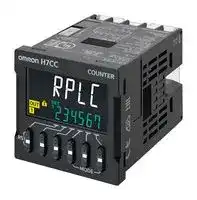


H7CC-AWD.
COUNTER, 6-DIGIT, SPDT, SCREW, 48VDC
- Manufacturer: OMRON INDUSTRIAL AUTOMATION
- Product type:
- No. of Digits / Alpha:6; Digit Height:10mm; Supply Voltage Min:12VDC; Supply Voltage Max:48VDC; Panel Cutout Height:45mm; Panel Cutout Width:45mm; Operating Tempe 31AJ3834
- Digit Height: 10mm
- Product Range: H7CC-A Series
- Panel Cutout Width: 45mm
- Supply Voltage Max: 48VDC
- Supply Voltage Min: 12VDC
- Panel Cutout Height: 45mm
- No. of Digits / Alpha: 6
- Operating Temperature Max: 55°C
- Operating Temperature Min: -10°C
| Delivery and price | |
|---|---|
| Units per pack | 25 |
| Price | 452.19 € |
| Current stock | 10+ |
| Lead time | 30 days |

## **Digital Counter/Tachometer H7CC**

**New and improved design for easier use, programming, maintenance and user feedback The improved user interface is intuitive and offers better overall visibility. Replacement time notification function notifies the user of potential preventive maintenance**

## **Basic Features**

- The white-color display offers better visual clarity and visibility, and the color universal design is used.

- Up/Down Keys are provided for all six digits, which reduces the number of button operations during setup and other processes.

- An easy operation is realized by the operation guide on which each key lights up.

- The progress can be easily understood at one glance from the status indicators of the present value and the measurement value.

For the most recent information on models that have been certified for safety standards, refer to your OMRON website.

- The body depth of all models with screw terminals has been reduced to 59 mm.

## **Safety and Reliability**

Refer to _Safety Precautions_ page 61 **.**

- The replacement time is notified in advance by predicting the service life.

- The power supply circuit and input circuits are isolated in all models, and therefore, there is no need of any wiring restrictions.

## **Other Features**

- Follows the ratings, characteristics, and functionality of the H7CX-N.

- Equipped with the Output Allocation and Output ON/OFF Inversion Function.

- Equipped with a Memory Backup and H7AN Compatibility Function to facilitate problem-free conversion from H7CN/H7AN.

## **Features**

## **Basic Features**

## **Better visual feedback and operation**

The white-color display offers better visual clarity and visibility, and the color universal design is used. The keys of all six digits can be operated up/down for easier use. The LED indicator of the operable keys lights up to support setup.

Simplified operation by the Up/Down Keys White-color for all six digits _ _ common H7CC COUNTER display improves visibility Color universal KH z| Zi ay jut z| am a _cFb! design is used

The operable keys light up to support setup

## **Status Notification by Status Indicator**

The status can be indicated by the ratio of the present value or measurement value to the set value, which makes it easy to understand the status.

## **Safety and Reliability**

## **Notification of Replacement Time**

The service life prerequisites of the counter include the relay output count and the deterioration of the electrolytic capacitors. In the H7CC, in addition to the relay output count, an alarm is displayed when the deterioration of electrolytic capacitors due to the cumulative run time reaches the standard value, and planned maintenance is supported. **Note:** For details, refer to _Replacement Time Notification Function_ on pages 41 and 57.

**==> picture [144 x 90] intentionally omitted <==**

**----- Start of picture text -----**<br>
a The service life reduces to half<br>when the temperature rises to<br>10°C.<br>'<br>:<br>a<br>2 — _<br>! 10°C | :<br>35 45 55 Temperature (°C)<br>Relationship between the life expectancy of<br>electrolytic capacitors and temperature (Example)<br>Life expectancy (h)<br>**----- End of picture text -----**<br>


## **Isolated Power Supply and Input Circuits**

Three indicators light up All indicators light up when the status reaches 50% when the status reaches 100%

## **Shortened Body**

The body depth of all models with screw terminals has been reduced to 59 mm, which contributes to thinner control panels!

Models with Screw Terminals: 59 mm Models with Sockets:

63.7 mm (case dimension)

**==> picture [77 x 11] intentionally omitted <==**

**----- Start of picture text -----**<br>
New models [Previous ] models<br>**----- End of picture text -----**<br>


In all models, the power supply circuit and input circuits are isolated. Previous non-isolated counters had wiring restrictions and could be damaged if wired incorrectly. The H7CC removes these worries.

**==> picture [222 x 89] intentionally omitted <==**

**----- Start of picture text -----**<br>
H7CC Input  PLC or<br>terminal other output terminals<br>AC power 0V terminal<br> supply *<br>COM terminal<br>There is no sneak current  * Grounding of<br>from wires because of  -V +V AC power supply<br>transformer-type power supply. DC stabilized  implies grounding<br>at the commercial<br>power supply<br>power supply side.<br>**----- End of picture text -----**<br>


**1**

**H7CC**

## **Other Features**

## **Equipped with a Key Protect Function**

Any abnormality in the device due to malfunctioning or setting errors can be prevented.

## **Follows the Ratings, Characteristics, and Functionality of the H7CX-N**

The H7CC follows the ratings, characteristics, and functionality of the H7CX-N. Other than the H7CC-A8 @ , all models are equipped with power supply to external devices, which reduces the load on wiring.

## **Output Allocation Function**

The allocation of outputs 1 and 2 (OUT1 and OUT2) can be changed. In the conventional 2-stage output models, output 1 (OUT1) was fixed as SPST, and output 2 (OUT2) was fixed as SPDT, however, in the H7CC, the allocation of outputs 1 and 2 (OUT1 and OUT2) can be changed to SPST or SPDT, which reduces the man-hours involved when it is necessary to change the wiring.

## **Output ON/OFF Inversion Function**

Conventionally, the output turns ON when the set value is reached, however, when this function is used, the output can be turned OFF when the set value is reached. As a result, the man-hours involved in checking the wiring can be reduced.

## **Memory Backup Function**

Conversion from the H7CN/H7AN is supported by enabling the setting of the present value and the output state memory backup.

## **H7AN Compatibility Function**

Conversion from the H7AN is supported by enabling the setting to start counting from 999999 when the present value being decremented exceeds 0.

**==> picture [195 x 47] intentionally omitted <==**

**----- Start of picture text -----**<br>
12 13 Output 1(OUT1) 12 13 Output 2(OUT2)<br>oo , os<br>Output 2 Output 1<br>3 4 5 (OUT2) 3 4 5 (OUT1)<br>**----- End of picture text -----**<br>


## **Model Number Structure**

## **Model Configuration**

|**H7CC Series**<br>~~PC~~|**H7CC Series**<br>~~PC~~|**H7CC Series**<br>~~PC~~|**H7CC Series**<br>~~PC~~|**H7CC Series**<br>~~PC~~|**H7CC Series**<br>~~PC~~|
|---|---|---|---|---|---|
|**Model**<br>~~Pe~~||**H7CC-A Series Digital Counter**<br>~~Pe~~||**H7CC-R Series Digital Tachometer**||
|||~~Pe~~||||
|**Classification**<br>~~ee~~||Preset counter<br>~~ee~~|Preset counter/Tachometer<br>~~ee~~|Tachometer||
|**Model**<br>~~a~~<br>~~ee~~<br>~~es~~||H7CC-A@<br>~~a~~<br>~~ee~~<br>|H7CC-AW@/AU@<br>~~ee~~|H7CC-R11@<br>~~ee~~|H7CC-R11W@|
|**Function**|**1-stage preset counter**<br>~~a~~<br>~~ee~~<br>~~es~~<br>~~ee~~|Yes<br>~~a~~<br>~~ee~~<br>~~ee~~<br>|Yes<br>~~ee~~|No<br>~~ee~~||
||**2-stage preset counter**<br>~~a~~<br>~~ee ~~<br>~~es~~<br>~~ee ee~~<br>~~ee~~|No<br>~~a ~~<br> ~~ee~~<br>~~ee~~<br>~~ee~~<br>|Yes<br> ~~ee~~|No<br>~~ee~~||
||**Total and preset counter**<br> <br>~~es ~~<br>~~ee ee~~<br>~~ee~~<br>~~ee~~|Yes<br> ~~ee~~<br> ~~ee~~<br>~~ee~~<br>~~**ee**~~|Yes|No||
||**Batch counter**<br> <br>~~ee ee~~<br>~~ee~~<br>~~ee~~|No<br> ~~ee~~<br>~~ee~~<br>~~**ee**~~|Yes|No||
||**Dual counter**<br>~~ee~~<br>~~ee ~~<br>~~ee~~|No<br>~~ee~~<br> ~~**ee**~~|Yes|No||
||**Twin counter**<br> <br>~~ee~~<br>~~es~~|No<br> ~~**ee**~~<br>~~es~~|Yes<br>~~es~~|No||
||**Tachometer**|No|Yes*|Yes||
|**Tachometer Input**<br>~~P|~~||---<br>~~P|~~|1 input or 2 inputs<br>(independent measurements,<br>differential, absolute ratio<br>value and error ratio value)<br>~~P|~~|Yes<br>1 input<br>~~P|~~|Yes<br>2 inputs<br>(independent measurement<br>only)|
|**Settings**<br>~~es~~||1-stage<br>~~es~~|2-stage<br>~~es~~|1-stage||
|**External connections**<br>~~es~~||8-pin socket, 11-pin socket,<br>Screw terminals<br>~~es~~|Screw terminals<br>~~es~~|11-pin socket||
|**Display digits**||6 digits||||


* Set the tachometer input mode from the function setting mode to switch to the tachometer function.

**2**

**H7CC**

**Model Number Legend** (Not all possible combinations of functions are available.)

## **H7CC-** @@@@@

## **1 2 3 4 5**

## **2. External connections**

## **1. Type**

|**Symbol**|**Meaning**||**Symbol**|**Meaning**|
|---|---|---|---|---|
|A|Standard type||None|Screw terminals|
|R|Tachometer||8|8-pin socket|
||||11|11-pin socket|


## **3. Settings**

|**Symbol**|**Meaning**|
|---|---|
|None|1-stage setting|
|W|2-stage setting*|
|U|1-stage contact+1-stage Solid state|


* The H7CC-R11W @ is a 1-stage (2 inputs and outputs) rather than a 2-stage counter.

## **4. Output type**

## **5. Supply voltage**

|**Symbol**|**Meaning**||**Symbol**|**Meaning**|
|---|---|---|---|---|
|None|Contact output||None|100 to 240 VAC at 50/60 Hz|
|S|Transistor output||D|24 VAC 50/60 Hz/12-48 VDC|


## **Ordering Information**

## **List of Models**

|**Type**|**Classification**|**Configuration**|**External**<br>**connections**|**Settings**|**Display**<br>**digits**|<br>**Outputs**|**Power supply**<br>**voltage**|**Model**|
|---|---|---|---|---|---|---|---|---|
|H7CC-A<br>Series|Preset counter|• 1-stage preset counter<br>• Total and preset<br>counter|8-pin socket|1-stage|6 digits|Contact output (SPST)|100 to 240 VAC|**H7CC-A8**|
||||||||24 VAC/<br>12 to 48 VDC|**H7CC-A8D**|
||||11-pin socket|||Contact output (SPDT)|100 to 240 VAC|**H7CC-A11**|
|||||||Transistor output (SPST)||**H7CC-A11S**|
|||||||Contact output (SPDT)|24 VAC/<br>12 to 48 VDC|**H7CC-A11D**|
|||||||Transistor output (SPST)||**H7CC-A11SD**|
||||Screw<br>terminals|||Contact output (SPDT)|100 to 240 VAC|**H7CC-A**|
|||||||Transistor output (SPST)||**H7CC-AS**|
|||||||Contact output (SPDT)|24 VAC/<br>12 to 48 VDC|**H7CC-AD**|
|||||||Transistor output (SPST)||**H7CC-ASD**|
||Preset counter/<br>Tachometer|• 1-stage preset counter<br>• 2-stage preset counter<br>• Total and preset<br>counter<br>• Batch counter<br>• Dual counter<br>• Twin counter<br>• Tachometer||2-stage||Contact output<br>(SPST+SPDT)|100 to 240 VAC|**H7CC-AW**|
|||||||Transistor output (DSPT)||**H7CC-AWS**|
|||||||Contact output<br>(SPST+SPDT)|24 VAC/<br>12 to 48 VDC|**H7CC-AWD**|
|||||||Transistor output (DSPT)||**H7CC-AWSD**|
|||||||Contact output (SPDT) +<br>Transistor output (SPST)|100 to 240 VAC|**H7CC-AU**|
||||||||24 VAC/<br>12 to 48 VDC|**H7CC-AUD**|
|H7CC-R<br>Series|Tachometer|• Tachometer|11-pin socket|1-stage<br>(1 input and<br>output)||Contact output (SPDT)|100 to 240 VAC|**H7CC-R11**|
||||||||24 VAC/<br>12 to 48 VDC|**H7CC-R11D**|
|||||1 stage<br>(2 inputs and<br>outputs)||Contact output<br>(SPDT+SPST)|100 to 240 VAC|**H7CC-R11W**|
||||||||24 VAC/<br>12 to 48 VDC|**H7CC-R11WD**|


**3**

**H7CC**

## **Accessories (Order Separately) Soft Cover**

|**Model**|**Remarks**|**Page**|
|---|---|---|
|**Y92A-48F1**|---|12|


## **Hard Cover**

|**Model**|**Remarks**|**Page**|
|---|---|---|
|**Y92A-48**|---|12|


## **Flush Mounting Adapter**

|**Model**|**Remarks**|**Page**|
|---|---|---|
|**Y92F-30**|Included with models with screw<br>terminals.|12|
|**Y92F-45**|Use this Adapter to install the Counter/<br>Tachometer in a cutout previously made<br>for a DIN 72×72 mm device (panel<br>cutout: 68×68 mm).||


## **Waterproof Packing**

|**Model**|**Remarks**|**Page**|
|---|---|---|
|**Y92S-P6**|Included with models with screw<br>terminals.|12|


## **Connection Sockets**

|**Model**|**Classification**|**Connectable Counter/**<br>**Tachometers**|**Remarks**|**Page**|
|---|---|---|---|---|
|**P2CF-08**|Front-connecting Socket|H7CC-@8|---|13|
|**P2CF-08-E**|Front-connecting Socket<br>(Finger-safe Type)||Round crimp terminals cannot be used on<br>Finger-safe Sockets.<br>Use forked crimp terminals.||
|**P3GA-08**|Back-connecting Sockets||A Y92A-48G Terminal Cover can be used with<br>the Socket to create a finger-safe construction.||
|**P2CF-11**|Front-connecting Socket|H7CC-@11|---||
|**P2CF-11-E**|Front-connecting Socket<br>(Finger-safe Type)||Round crimp terminals cannot be used on<br>Finger-safe Sockets.<br>Use forked crimp terminals.||
|**P3GA-11**|Back-connecting Sockets||A Y92A-48G Terminal Cover can be used with<br>the Socket to create a finger-safe construction.||


## **Terminal Covers for P3GA-11 Back-connecting Socket**

|**Model**|**Remarks**|**Page**|
|---|---|---|
|**Y92A-48G**|---|14|


**4**

**H7CC-A** @

## **H7CC-A** @ **Digital Counter** ~~Po~~

- Equipped with a replacement time notification function.

- The white-color display further improves visibility, and the color universal design is used. The Up/Down Keys make it easier to use the Counter.

- Compatible with the ratings, characteristics, and functionality of the H7CX-N.

For the most recent information on models that have been certified for safety standards, refer to your OMRON website.

## **Specifications**

## **Ratings**

|**Model**<br>**Item**|**Model**<br>**Item**|**H7CC-A8/-A11**@<br>~~ee~~|**H7CC-A**@<br>~~ee~~|**H7CC-AW**@**/AU**@|
|---|---|---|---|---|
|**Classification**||Preset counter<br>~~ee~~||Preset counter/ tachometer|
|**Configuration**||1-stage preset counter, 1-stage preset counter with total counter (selectable)*1<br>~~ee~~||1-stage/2-stage preset counter, total and<br>preset counter*1, batch counter, dual<br>counter, twin counter, and tachometer<br>(selectable)|
|**Ratings**|**Power supply voltage**<br>***2**|• 100 to 240 VAC, 50/60 Hz<br>• 24 VAC, 50/60 Hz or 12 to 48 VDC|||
||**Operating voltage**<br>**fluctuation range**|85% to 110% of rated supply voltage (12 to 48 VDC: 90% to 110%)|||
||**Power consumption**|Approx. 6.8 VA at 100 to 240 VAC,<br>Approx. 5.5 VA/3.3 W at 24 VAC/12 to 48 VDC,|||
|**Mounting method**||Flush mounting or surface mounting<br>~~ee~~|Flush mounting||
|**External connections**||8-pin/ 11-pin socket<br>~~ee~~<br>~~ee~~|Screw terminals||
|**Degree of protection**<br>~~LoOO~~||IEC IP66 for panel surface only and only when Y92S-P6 Waterproof Packing is used.<br>~~ee~~<br>~~OO~~|||
|**Input signals**<br>~~LoOO~~||CP1, CP2, reset, and total reset*4<br>~~OO~~||CP1, CP2, reset 1, and reset 2|
|**Counter**<br>~~Lo~~|**Maximum counting**<br>**speed**<br>~~LoOO~~|30 Hz (minimum pulse width: 16.7 ms) or 10 kHz (minimum pulse width: 0.05 ms) (selectable) (ON/OFF ratio 1:1)<br>*Common setting for CP1 and CP2<br>~~OO~~|||
||**Input mode**<br>~~LoOO~~|Increment (UP), decrement (DOWN), increment/decrement (UP/DOWN A (command input), UP/DOWN B (individual inputs), or<br>UP/DOWN C (quadrature inputs)), UP/DOWN D (command input), UP/DOWN E (individual inputs), UP/DOWN E (quadrature inputs)<br>~~OO~~|||
||**Output mode**<br>~~a~~|N, F, C, R, K-1, P, Q, A, K-2, D, and L.||N, F, C, R, K-1, P, Q, A, K-2, D, L, and H.|
||**One-shot out put time**<br>~~Tt~~|0.01 to 99.99 s|||
||**Reset system**|External (minimum reset signal width: 1 ms or 20 ms, selectable), manual, and automatic reset (internal according to C, R, P,<br>and Q mode operation)|||
|**Tachometer**||Refer to the separate table for_tachometer function ratings_.|||
|**Prescaling function**||Yes (0.001 to 99.999)|||
|**Decimal point adjustment**||Yes (right most 3 digits)|||
|**Sensor waiting time**||290 ms max. (Control output is turned OFF and no input is accepted during sensor waiting time.)|||
|**Input method**||No-voltage (NPN) input/voltage (PNP) input (switchable)<br>No-voltage inputs:<br>ON impedance: 1 kΩmax. (Leakage current: 12 mA at 0Ω) ON residual voltage: 3 V max.<br>OFF impedance: 100 kΩmin.<br>Voltage input:<br>High (logic) level: 4.5 to 30 VDC<br>Low (logic) level: 0 to 2 VDC (Input resistance: approx. 4.7 kΩ)|||
|**External power supply**||12 VDC (±10%), 100 mA (except for H7CC-A8@models) Refer to_Precautions for Correct Use_on page 61 for details.|||
|**Control output**||• Contact output: 3 A at 250 VAC/30 VDC, resistive load (cosφ=1),<br>Minimum applied load: 10 mA at 5 VDC (failure level: P, reference value)<br>• Transistor output: NPN open collector, 100 mA at 30 VDC, Residual voltage: 1.5 VDC max. (approx. 1 V),<br>Leakage current: 0.1 mA max.|||
|**Display*3**||7-segment, negative transmissive LCD<br>Character height<br>Count value: 10 mm (white)<br>Set value: 6 mm (green)|||
|**Digits**||6 digits<br>-99999 to 999999<br>(-5 digits to +6 digits)||6 digits<br>-99999 to 999999 (-5 digits to +6 digits),<br>tachometer: 0 to 999999|
|**Memory backup**||Non-volatile memory (overwrites: 100,000 times min.) that can store data for 10 years min.|||
|**Operating temperature range**||-10 to 55°C (-10 to 50°C if Counter/Tachometers are mounted side by side) (with no icing or condensation)|||
|**Storage temperature range**||-25 to 70°C (with no icing or condensation)|||
|**Operating humidity range**||25% to 85%|||
|**Case color**||Black (N1.5)|||
|**Attachments**||---<br>~~es~~|Flush mounting adapter, waterproof packing, terminal cover||


- *1. 1-stage preset counter and total counter functionality.

- *2. Do not use the output from an inverter as the power supply.The ripple must be 20% maximum for DC power.

- *3. The display is lit only when the power is ON. Nothing is displayed when power is OFF.

- *4. Only reset input is performed in the H7CC-A8 @ , and the total count is also reset simultaneously.

**5**

**H7CC-A** @

## **Tachometer Function Ratings**

|**Model**<br>**Item**|**H7CC-A8**@<br>**H7CC-A11**@<br>**H7CC-A**@|**H7CC-AW**@**/AU**@|**H7CC-AW**@**/AU**@|**H7CC-AW**@**/AU**@|**H7CC-AW**@**/AU**@|
|---|---|---|---|---|---|
|**Input mode**|No<br>tachometer<br>functionality|Selectable from 1 inputs, independent measurements for 2 inputs, differential input for 2 inputs, absolute ratio for 2 inputs,<br>and error ratio for 2 inputs.||||
|**Pulse measurement**<br>**method**||Periodic measurement||Pulse width measurement||
|**Maximum counting**<br>**speed**||30 Hz<br>(minimum pulse width: 16.7 ms)|1-input mode:<br>10 kHz(minimum pulse width: 0.05 ms)<br>Other modes:<br>5 kHz(minimum pulse width: 0.1 ms)|30 Hz<br>(minimum pulse width: 16.7 ms)|1-input mode:<br>10 kHz(minimum pulse width: 0.05 ms)<br>Other modes:<br>5 kHz(minimum pulse width: 0.1 ms)|
|**Minimum input**<br>**signal width**||---|---|30 ms*|1-input mode: 0.2 ms<br>Other modes: 0.4 ms*|
|**Measuring ranges**||0.001 to 30.00 Hz|1-input mode: 0.001 to 10 kHz,<br>Other modes: 0.01 to 5 kHz|0.030 to 999999 s|1-input mode: 0.0002 to 999999 s<br>Other modes: 0.0004 to 999999 s|
|**Sampling period**||200 ms min.|200 ms min. or continuous<br>selectable (minimum interval of<br>10 ms)|Continuous (minimum interval of 10 ms)||
|**Measuring accuracy**||±0.1% FS±1 digit max. (at 23±5°C)||||
|**Output mode**||Input mode:<br>Not 2-input independent measurement: HI-LO, AREA, HI-HI, LO-LO<br>2-input independent measurement: HI-HI, LO-LO||||
|**Auto-zero time**||0.1 to 999.9s||||
|**Startup time**||0.0 to 99.9s||||
|**Averaging**||Simple averaging/moving averaging selectable, Processing: OFF, 2, 4, 8, or 16 times||||
|**Hold input**||Minimum input signal width: 20 ms||||


* An input OFF time of at least 20 ms is required.

## **Characteristics**

|**Characteristics**|**Characteristics**||
|---|---|---|
|**Insulation resistance**||100 MΩmin. (at 500 VDC) between current-carrying terminals and exposed non-current-carrying metal parts,<br>and between non-continuous contacts|
|**Dielectric strength**||2,000 VAC, 50/60 Hz for 1 min between current-carrying metal parts and non-current-carrying metal parts<br>2,000 VAC, 50/60 Hz for 1 min between power supply and input circuit for all models except H7CC-@D@(1,500 VAC<br>for 24 VAC/12 to 48 VDC)<br>1,500 VAC (for H7CC-@SD@), 50/60 Hz for 1 min between control output, power supply, and input circuit (2,000 VAC<br>for models other than H7CC-@SD@)<br>1,000 VAC, 50/60 Hz for 1 min between non-continuous contacts|
|**Impulse withstand voltage**||6.0 kV between power terminals (1.0 kV for models with 24 VAC/12 to 48 VDC)<br>6.0 kV between current-carrying terminals and exposed non-current-carrying metal parts (1.5 kV for models with 24<br>VAC/12 to 48 VDC)|
|**Static immunity**<br>~~|~~||Malfunction: 8 kV<br>Destruction: 15 kV|
|**Vibration resistance**|**Destruction**<br>~~|||~~|10 to 55 Hz with 0.75-mm single amplitude each in three directions for 2 h each|
||**Malfunction**<br>~~|||~~|10 to 55 Hz with 0.35-mm single amplitude each in three directions for 10 min each|
|**Shock resistance**|**Destruction**<br>~~|||~~|300 m/s2each in three directions|
||**Malfunction**<br>~~|||~~|100 m/s2each in three directions|
|**Life expectancy**<br>~~|~~||Mechanical: 10,000,000 operations min.<br>Electrical: 100,000 operations min. (3 A at 250 VAC, resistive load, ambient temperature condition: 23°C)*|
|**Weight**||Approx. 120 g (Counter only)|


* Refer to the Life-test Curve.

## **Life-test Curve (Reference Values)**

## **Resistive load**

## **Inductive load**

**==> picture [317 x 140] intentionally omitted <==**

**----- Start of picture text -----**<br>
1,000 1,000<br>700 700<br>SSS SSS<br>500 ACS 500 |<br>300 AN ee 300 | |<br>30 VDC (cosφ=1)<br>30 VDC (L/R=7 ms)<br>100 250 VAC (cosφ=1) 100<br>250 VAC (cosφ=1)<br>70 70<br>50 es 50 | |<br>0 1 2 3 4 0 1 2 3 4<br>Load current (A) Load current (A)<br>3)No. of operations (10× 3)No. of operations (10×<br>**----- End of picture text -----**<br>


A current of 0.15 A max. can be switched at 125 VDC (cos φ =1) and current of 0.1 A max. can be switched if L/R=7 ms. In both cases, a life of 100,000 operations can be expected.

**6**

**H7CC-A** @

## **Applicable Standards**

|**Approved**<br>**safety**<br>**standards**|cULus (or cURus): UL508/CSA C22.2 No. 14*1<br>EN 61010-1 (IEC 61010-1): Pollution degree 2/overvoltage category II<br>EAC<br>RCM<br>B300 PILOT DUTY<br>1/4 HP 120 VAC, 1/3 HP, 240 VAC, 3 A, 250 VAC/30 VDC resistive load<br>VDE0106/part100|*1.The following safety standards<br>apply to models with sockets<br>(H7CC-A11@/H7CC-A8@).<br>cUL (Listing):<br>Applicable when an OMRON<br>P2CF(-E) Socket is used.<br>cUR (Recognition):<br>Applicable when any other<br>socket is used.<br>*2.Industrial electromagnetic<br>environment (EN/IEC 61326-1<br>Table 2)|
|---|---|---|
|**EMC**|(EMI)<br>EN61326-1*2<br>Emission Enclosure:<br>EN 55011 Group 1 class A<br>Emission AC mains:<br>EN 55011 Group 1 class A<br>(EMS)<br>EN61326-1*2<br>Immunity ESD:<br>EN 61000-4-2:<br>4 kV contact discharge;<br>8 kV air discharge<br>Immunity RF-interference:<br>EN 61000-4-3:<br>10 V/m (Amplitude-modulated, 80 MHz to 1 GHz)<br>3 V/m (Amplitude-modulated, 1.4 G to 2 GHz)<br>1 V/m (Amplitude-modulated, 2 G to 2.7 GHz)<br>10 V/m (Pulse-modulated, 900 MHz ±5 MHz)<br>Immunity Conducted Disturbance:<br>EN 61000-4-6:<br>10 V (0.15 to 80 MHz)<br>Immunity Burst:<br>EN 61000-4-4:<br>2 kV power-line;<br>1 kV I/O signal-line<br>Immunity Surge:<br>EN 61000-4-5:<br>1 kV line to lines (power and output lines);<br>2 kV line to ground (power and output lines)<br>Immunity Voltage Dip/Interruption:<br>EN 61000-4-11: Voltage Dip<br>1 cycle, 100% (rated voltage)<br>10/12 cycle  60% (rated voltage)<br>25/30 cycle  30% (rated voltage)<br>Interruption<br>250/300 cycle  100% (rated voltage)||


## **I/O Functions**

**Using as a Counter**[*] **[1]**

|**Inputs**|**CP1, CP2**|(1) In general (except for Dual Counter Mode)<br>• Reads counting signals.<br>• Increment, decrement, increment/decrement (command/individual/quadrature) inputs accepted.<br>(2) When used as a dual counter or twin counter<br>• Reads CP1 count signals with CP1 input and CP2 count signals with CP2 input.<br>• Increment signals can be input.|
|---|---|---|
||**Reset/reset 1**|(1) In general (except for Dual Counter Mode)<br>• Resets present value and outputs (OUT2 when using the batch counter)*2.<br>• Counting cannot be performed during reset/reset 1 input.<br>• Reset indicator is lit while reset input is ON.<br>(2) When used as a dual counter or twin counter.<br>• Resets the CP1 present value (to 0).<br>• Counting for CP1 input cannot be performed while the reset 1 input is ON.<br>• The reset indicator is lit while the reset 1 input is ON.|
||**Total reset or reset 2**|The reset function depends on the selected configuration*3.|
|**Outputs**|**OUT1, OUT2**|Outputs signals according to the specified output mode when a set value is reached.|


- *1. For information on operation of I/O functions, refer to pages page 24 to page 29.

- *2. In increment mode or increment/decrement mode, the present value returns to 0; in decrement mode, the present value returns to the set value with 1-stage models, and returns to set value 2 with 2-stage models.

- *3. Reset operates as described in the following table. (The reset indicator will not be lit.)

|**Configuration**|**Reset operation**|
|---|---|
|**1-stage/2-stage preset counter**|Does not operate (not used).|
|**Total and preset counter**|• Resets the total count value.<br>• The total count value is held at 0 while the total reset input is ON.|
|**Batch counter**|• Resets the batch count value and batch output (OUT1).<br>• The batch count value is held at 0 while the reset 2 input is ON.|
|**Dual counter**|• Resets the CP2 present value.<br>• Counting for CP2 input cannot be performed while the reset 2 input is ON.|
|**Twin counter**|• Resets the CP2 present value.|


- The following table shows the delay from when the reset signal is input until the output is turned OFF. (Reference values)

|• The following table shows the delay from when the reset signal is input until the output is turned OFF. (Reference values)|• The following table shows the delay from when the reset signal is input until the output is turned OFF. (Reference values)|• The following table shows the delay from when the reset signal is input until the output is turned OFF. (Reference values)|
|---|---|---|
|**Minimum reset signal width**<br>**Output delay time**<br>**Relay output**<br>**Transistor output**|||
||1 ms|3.7 to 6.6 ms<br>0.58 to 0.78 ms|
||20 ms|17.0 to 19.8 ms<br>13.7 to 17.2 ms|
|**Operating Procedures (Tachometer Function)**|||
||**CP1, CP2**|Reads counting signals. (The CP2 input can be used when the input mode is not 1-input mode.)|
|||• Holds the measurement value and outputs. (The reset 2 input can be used when the input mode is 2-input independent measurement.)|
|**Inputs**|**Reset 1/reset 2**|• Functions as a hold input.<br>The measurement value (displayed value) and the outputs are held while the RST Key on the front panel is pressed.|
|||• The hold indicator is lit when the value is being hold.|
|**Outputs**|**OUT1, OUT2**|Outputs signals according to the specified output mode when a set value is reached.|


**7**

**H7CC-A** @

## **Connections**

## **Terminal Arrangement**

Confirm that the power supply meets specifications before use.

**==> picture [512 x 328] intentionally omitted <==**

**----- Start of picture text -----**<br>
H7CC-A11/-A11D H7CC-A11S/-A11SD H7CC-A8/-A8D<br>1-stage Contact Output 1-stage Transistor Output 1-stage Contact Output<br>Reset Reset<br>CP1 CP1<br>Internal<br>CP2 Internal circuit CP2 Internal circuit circuit<br>Total Reset 5 6 7 Total Reset 5 6 7<br>4 8 4 8<br>0 V 3 9 0 V 3 9 4 5<br>(-) 2 10 (-) 2 10 3 6<br>Sensor 1 11 Sensor 1 11<br>(+) 12 DCV (+) 12 DCV 2 1 8 7<br>External power supply OUT External power supply OUT 0 V<br>OUT<br>(-) (+) (-) (+)<br>(-) (+)<br>H7CC-A/H7CC-AD H7CC-AS/-ASD<br>1-stage Contact Output 1-stage Transistor Output<br>0 V 0 V<br>(-) 6 7 8 9 10 (-) 6 7 8 9 10<br>Sensor Sensor<br>(+) 12 VDC 11 (+) 12 VDC 11<br>External  External<br>power supply power supply<br>1 2 3 4 5 1 2 3 4 5<br>OUT OUT<br>(-) (+) (-) (+)<br>Reset input CP1 input CP2 input<br>Reset CP2 CP1 Reset CP2 CP1<br>Total reset Total reset<br>**----- End of picture text -----**<br>


**==> picture [512 x 171] intentionally omitted <==**

**----- Start of picture text -----**<br>
H7CC-AW/-AWD/-AU/-AUD H7CC-AWS/-AWSD<br>2-stage Contact Output 2-stage Transistor Output<br>0 V 0 V<br>(-) 6 7 8 9 10 (-) 6 7 8 9 10<br>Sensor *1 Sensor *1<br>(+) (+)<br>12 VDC 12 VDC<br>11 12 13 OUT1 *2 11 12 13 OUT1 *2<br>External  External<br>power supply *1: H7CC-AU power supply<br>1 2 3 4 5 1 2 3 4 5<br>OUT2 *2 12 13 OUT2 *2<br>*2: OUT1 and OUT2 are<br>(-) (+) *2: OUT1 and OUT2 are  (-) (+)       switchable by allocation change<br>      switchable by allocation change<br>Reset 1 CP2 CP1 Reset 2 Reset 1 CP2 CP1 Reset 2<br>**----- End of picture text -----**<br>


## **Transistor Output**

- The transistor output of the H7CC is isolated from the internal circuitry by a photocoupler, so the transistor output can be used as both NPN and PNP output.

**==> picture [152 x 82] intentionally omitted <==**

**----- Start of picture text -----**<br>
NPN Output PNP Output<br>Load Load<br>+ +<br>Power for load Power for load<br>**----- End of picture text -----**<br>


- The diode connected to the collector of the output transistor is used to absorb inverted voltage that is generated when an inductive load is connected to the H7CC.

**==> picture [79 x 68] intentionally omitted <==**

**----- Start of picture text -----**<br>
Counter<br>Inductive<br>load<br>+<br>Power for load<br>**----- End of picture text -----**<br>


**8**

**H7CC-A** @

## **Block Diagram**

**==> picture [171 x 73] intentionally omitted <==**

**----- Start of picture text -----**<br>
(Basic insulation)<br>Output circuit Power supply circuit<br>(Basic insulation) (Basic insulation)<br>Display circuit<br>Internal<br>Input circuits control circuit<br>Key switch<br>circuit<br>**----- End of picture text -----**<br>


## **Input Circuits**

## **CP1, CP2, Reset/Reset 1, and Total Reset/Reset 2 Input**

**==> picture [234 x 72] intentionally omitted <==**

**----- Start of picture text -----**<br>
No-voltage Inputs  Voltage Inputs<br>(NPN Inputs) (PNP Inputs)<br>+14V<br>1 kΩ IN Approx. 4.7 kΩ Internal<br>IN Internal  circuit<br>circuit<br>**----- End of picture text -----**<br>


## **Input Connections**

The inputs of the H7CC are no-voltage (short-circuit or open) inputs or voltage inputs.

## **No-voltage Inputs (NPN Inputs)**

**Open Collector**

**==> picture [499 x 153] intentionally omitted <==**

**----- Start of picture text -----**<br>
Open Collector Voltage Output Contact Input DC Two-wire Sensor<br>PLC or  Sensor<br>sensor<br>H7CC-A8@ 1 3 5 4 --- H7CC-A8@ 1 3 5 4 --- H7CC-A8@ 1 3 5 4 --- H7CC-A8@ 1 3 5 4 ---<br>H7CC-A11@ 3 7 5 6 4 H7CC-A11@ 3 7 5 6 4 H7CC-A11@ 3 7 5 6 4 H7CC-A11@ 3 7 5 6 4<br>H7CC-A@ 6 7 8 9 10 H7CC-A@ 6 7 8 9 10 H7CC-A@ 6 7 8 9 10 H7CC-A@ 6 7 8 9 10<br>Note:  Operates with transistor ON. Note:  Operates with transistor ON. Note:  Operates with relay ON. Note:  Operates with transistor ON.<br>0 V for inputs Reset/reset 1 input CP2 input CP1 input Total reset/reset 2 input 0 V for inputs Reset/reset 1 input CP2 input CP1 input Total reset/reset 2 input 0 V for inputs Reset/reset 1 input CP2 input CP1 input Total reset/reset 2 input 0 V for inputs Reset/reset 1 input CP2 input CP1 input Total reset/reset 2 input<br>**----- End of picture text -----**<br>


## **No-voltage Input Signal Levels**

Short-circuit level (transistor ON)

- Residual voltage: 3 V max.

- Impedance when ON: 1 k Ω max.

**No-contact input** (The leakage current is approx. 12 mA when the impedance is 0 Ω .) Open level (transistor OFF) • Impedance when OFF: 100 k Ω min. **Contact input** Use contacts which can adequately switch 5 mA at 10 V.

## **Applicable Two-wire Sensor**

- Leakage current: 1.5 mA max.

- Switching capacity: 5 mA min.

- Residual voltage: 3 VDC max.

- Operating voltage: 10 VDC

**Note:** The DC voltage must be 30 VDC max.

## **Voltage Inputs (PNP Inputs)**

**No-contact Input (NPN Transistor)**

## **No-contact Input (PNP Transistor)**

## **Contact Input**

**==> picture [456 x 135] intentionally omitted <==**

**----- Start of picture text -----**<br>
Sensor Sensor<br>H7CC-A8@ 1 5 4 3 --- H7CC-A8@ 1 5 4 3 --- H7CC-A8@ 1 5 4 3 ---<br>H7CC-A11@ 3 7 5 6 4 H7CC-A11@ 3 7 5 6 4 H7CC-A11@ 3 7 5 6 4<br>H7CC-A@ 6 7 8 9 10 H7CC-A@ 6 7 8 9 10 H7CC-A@ 6 7 8 9 10<br>Note:  Operates with transistor ON. Note:  Operates with transistor ON. Note:  Operates with relay ON.<br>0 V for inputs Reset/reset 1 input CP2 input CP1 input Total reset/reset 2 input 0 V for inputs Reset/reset 1 input CP2 input CP1 input Total reset/reset 2 input 0 V for inputs Reset/reset 1 input CP2 input CP1 input Total reset/reset 2 input<br>**----- End of picture text -----**<br>


## **Voltage Input Signal Levels**

High level (input ON): 4.5 to 30 VDC

Low level (input OFF): 0 to 2 VDC

**Note: 1.** The DC voltage must be 30 VDC max.

**2.** Input resistance: Approx. 4.7 k Ω

**9**

**H7CC-A** @

**Nomenclature**

## **Display Section**

## **1. Key Protect Indicator** (yellow)

## **2. Control Output Indicator** (yellow)

- OUT: (One-stage) OUT:          (Two-stage)1 2

## **3. Reset Indicator** (yellow)

- (Lit when the reset input (1) is ON or reset operation is performed.) Displayed only when the configuration selection mode is not tachometer mode.

## **4. Total Count Indicator**

**==> picture [124 x 101] intentionally omitted <==**

**----- Start of picture text -----**<br>
7<br>4<br>1 5<br>2 8<br>3 6<br>9 10<br>12 14<br>11<br>**----- End of picture text -----**<br>


**==> picture [7 x 5] intentionally omitted <==**

**----- Start of picture text -----**<br>
13<br>**----- End of picture text -----**<br>


## **Operation Keys**

- (Lit when the total count value is displayed.)

## **10. Up Keys (UP1 to UP6)**

## **5. Batch Indicator**

(UP1, 2, 3, 4, 5, 6 from right to left)

- (Lit when the batch count value is displayed.)

**6. Set Value 1, 2 Stage Indicator**

**7. Present Value (Main Display)** (Character height: 10 mm, white *)

## **8. Set value (Sub-display)**

- (Character height: 6 mm, green)

## **9. Hold Display (yellow)**

- Displayed only when the configuration selection mode is not tachometer mode.

## **Model with 6 Digits**

Character Size Character Size for Main Display for Sub-display

**==> picture [80 x 27] intentionally omitted <==**

**----- Start of picture text -----**<br>
10 mm 6 mm<br>**----- End of picture text -----**<br>


## **11. Down Keys (DW1 to DW6)**

(DW1, 2, 3, 4, 5, 6 from right to left)

## **12. Reset Operation (UP6+DW6)** *

- (The reset operation is enabled by pressing and holding the keys for 1 second or longer. When the keys are pressed simultaneously, all status indicators start blinking. The reset operation is disabled if the keys are released within 1 second.)

To perform the reset operation, firmly press and hold both UP6 and DW6. If you press only UP6 or DW6, the set value will change.

## **13. Mode Operation (UP1+UP3 or DW1+DW3)**

(Changes modes and setting items. Press and hold the keys for 2 seconds or longer to move to the function setting mode. When the keys are pressed simultaneously, the status indicators on UP1 (DW1) and UP3 (DW3) start blinking.

The mode operation is disabled if the keys are released within 2 seconds.)

## **14. Status indicator**

<When Run mode is not selected.>

- When the indicator display mode is ON

- When used as a counter, the ratio of the present value to the set value is displayed from 0 to 100%.

When used as a tachometer, if "Upper and lower limit" or "Area" is selected in the tachometer output mode, the ratio of the measurement value to the comparison value is displayed from 0 to 100%.

- When the indicator display mode is all off or all lit All off or all lit display.

- **Note.** When you press the Up Key or the Down Key, the status indicator display goes off, and the pressed key lights up or blinks.

<When Function Setting Mode is not selected>

- The keys that can be set light up for notification.

## **Switches**

## **15. Key-protect Switch**

|(Defaul<br>**Note:**The reset f|(Defaul|t setting)<br>OFF<br>(Disable)<br>ON<br>(Enable)|
|---|---|---|
||||
||||
|||unctions depends on the selected configuration.|
|**Configuration**||**Reset operation***|
|**1-stage/2-stage**<br>**preset counter**||Resets the present value and outputs.|
|**Total and preset**<br>**counter**||• Resets the present value and outputs.<br>• When the total count value is displayed, resets the present value, the total count<br>value, and outputs.|
|**Batch counter**||• Resets the present value and OUT2.<br>• When the batch count value is displayed, resets the present value, the batch count<br>value, and outputs.|
|**Dual counter**||Resets the CP1 present value, CP2 present value, dual count value, and outputs.|
|**Twin counter**||Resets the CP1 present value and output 1 when the CP1 present value is displayed.<br>Resets the CP2 present value and output 2 when the CP2 present value is displayed.|
|**Tachometer**||Holds the measurement value and outputs (hold function).<br>(When the input mode is 2-input independent measurement, the CP1 measurement<br>value display will hold the CP1 measurement value and output 1 and the CP2<br>measurement value display will hold the CP2 measurement value and output 2.)|


**10**

**H7CC-A** @

**Dimensions**

**(Unit: mm)**

## **Counters**

## **H7CC-A/-AS/-AW/-AWS/-AWD/-AWSD/-AU/-AUD (Flush Mounting Models)**

**==> picture [314 x 77] intentionally omitted <==**

**----- Start of picture text -----**<br>
48 � 48 6 59<br>44.8 � 44.8<br>Note:  M3.5 terminal screw (effective length: 6 mm)<br>**----- End of picture text -----**<br>


## **H7CC-A8/-A8D (Flush Mounting/Surface Mounting Models)**

**==> picture [220 x 67] intentionally omitted <==**

**----- Start of picture text -----**<br>
14.4<br>48 � 48 6 63.7<br>44.8 � 44.8<br>**----- End of picture text -----**<br>


## **H7CC-A11/-A11S/-A11D/-A11SD (Flush Mounting/Surface Mounting Models)**

**==> picture [511 x 358] intentionally omitted <==**

**----- Start of picture text -----**<br>
14.4<br>48 � 48 6 63.7<br>44.8 � 44.8<br>Dimensions with Flush Mounting Adapter<br>H7CC-A/-AS/-AW/-AWS/-AWD/-AWSD/-AU/-AUD Panel Cutouts<br>(Provided with Adapter and Waterproof packing) Panel cutouts are as shown below. (according to<br>DIN43700).<br>60 min.<br>        045 [+0.6]<br>58 (51) 45        0 [+0.6]<br>15 min.<br>60 min.<br>48 7.5 57.5<br>Note: 1. The mounting panel thickness should be<br>1 to 5 mm.<br>2. To allow easier operation, it is<br>recommended that Adapters be mounted<br>so that the gap between sides with hooks<br>H7CC-A8/-A8D/-A11/-A11S/-A11D/-A11SD  is at least 15 mm (i.e., with the panel<br>(Flush Mounting/Surface Mounting Models) 3. cutouts separated by at least 60 mm).It is possible to horizontally mount Timers<br>(Adapter and Waterproof packing Ordered Separately) side by side. Attach the Flush Mounting<br>Adapters so that the surfaces without<br>hooks are on the sides of the Timers. If<br>they are mounted side-by-side, water-<br>resistance will be lost.<br>n Units mounted<br>58 (51) side by side<br>A<br>A=(48n−2.5)−2.5)2.5) [[+1]] −00<br>**----- End of picture text -----**<br>


**==> picture [288 x 126] intentionally omitted <==**

**----- Start of picture text -----**<br>
H7CC-A8/-A8D/-A11/-A11S/-A11D/-A11SD<br>(Flush Mounting/Surface Mounting Models)<br>(Adapter and Waterproof packing Ordered Separately)<br>58 (51)<br>48 7.5 89.9<br>**----- End of picture text -----**<br>


**==> picture [84 x 79] intentionally omitted <==**

**----- Start of picture text -----**<br>
n Units mounted<br>side by side<br>A<br>A=(48n−2.5)−2.5)2.5) [[+1]] −00<br>With Y92A-48F1 attached.<br>A={48n−2.5+(n−1)×4} [+1] −0<br>With Y92A-48 attached.<br>A=(51n−5.5) [+1] −0<br>**----- End of picture text -----**<br>


**11**

**H7CC-A** @

## **Dimensions with Front Connecting Socket**

**==> picture [116 x 107] intentionally omitted <==**

**----- Start of picture text -----**<br>
H7CC-A11@/A8@<br>103.2 * 100.9<br>P2CF-8(-E)/P2CF-11(-E)<br>Front Connecting Socket (order separately)<br>**----- End of picture text -----**<br>


* These dimensions depend on the kind of DIN track and Sockets. (Reference value.)

## **Accessories (Order Separately)**

**Note: Depending on the operating environment, the condition of resin products may deteriorate, and may shrink or become harder. Therefore, it is recommended that resin products are replaced regularly.**

## **Flush Mounting Adapter Y92F-30**

Order the Flush Mounting Adapter with the following model number separately if it is lost or damaged. **Note:** The Waterproof Packing is included with models with screw terminals.

**==> picture [40 x 51] intentionally omitted <==**

## **Soft Cover**

**Hard Cover**

**Y92A-48F1 Y92A-48**

## **Y92F-45**

**Note: 1.** The adapter is black in color.

**2.** The Y92F-45 can be used in combination with the Y92F-30 Adapter provided with the Counter.

**Protecting the Counter/Tachometer in Environments Subject to Oil**

The H7CC's panel surface is water-resistive (conforming to IP @ 6) and so even if drops of water penetrate the gaps between the keys, there will be no adverse effect on internal circuits. If, however, there is a possibility of oil being present on the operator's hands, use the Soft Cover. The Soft Cover ensures protection equivalent to IP54F against oil. Do not, however, use the H7CC in locations where it would come in direct contact with oil.

## **Waterproof Packing Y92S-P6**

**==> picture [35 x 58] intentionally omitted <==**

**Note:** The Waterproof Packing is included with models with screw terminals. Order the Waterproof Packing separately if it is lost or damaged. The Waterproof Packing can be used to achieve IP66 protection.

**==> picture [160 x 84] intentionally omitted <==**

**----- Start of picture text -----**<br>
Fixture (provided)<br>4.7 76<br>69.6 to 77.6<br>72 � 72<br>67 � 67 87<br>**----- End of picture text -----**<br>


**==> picture [65 x 74] intentionally omitted <==**

## **<H7CC Mounting Example>**

**==> picture [152 x 108] intentionally omitted <==**

**----- Start of picture text -----**<br>
Panel (1 to 8 mm)<br>72 � 72<br>48 � 48<br>2.2 4.7<br>77.3<br>**----- End of picture text -----**<br>


The panel surface of the H7CC-A/-R is water-resistant (conforming to IP66). To protect the internal circuits from water penetration through the space between the H7CC and operating panel, waterproof packing is included. Attach the Y92F-30 Adapter with sufficient pressure with the reinforcing screws so that water does not penetrate the panel.

0.5 to 1 mm It is recommended that the space between the screw head and the Adapter be 0.5 to 1 mm.

The Waterproof Packing will deteriorate, harden, and shrink depending on the application environment. To ensure maintaining the IP @ 6 waterproof level, periodically replace the Waterproof Packing. The periodic replacement time will depend on the application environment. You must confirm the proper replacement time. Use 1 year or less as a guideline. If the Waterproof Packing is not replaced periodically, the waterproof level will not be maintained. It is not necessary to mount the Waterproof Packing if waterproof construction is not required.

**12**

**H7CC-A** @

## **Connection Sockets**

## **Front Connecting Socket**

**==> picture [511 x 483] intentionally omitted <==**

**----- Start of picture text -----**<br>
Model Dimensions Terminal arrangement  Mounting hole<br>and internal connections dimensions<br>P2CF-11 50 max . 31.2 max.<br>Two, 4.5-dia. holes<br>70 max. 35.4<br>4<br>8 7 6 5<br>Eleven, M3.5 sems screws× 7.5  7.8 3 4.5 4 Two, M4 or 4.5-dia. holes<br>P2CF-11-E  50 max . 3 1.2 ma x. 40 [±][0.2]<br>(Finger-safe Type) 40 [±][0.2] 30<br>9 3 Note: The Socket can also<br>8 7 6 5 10 11 1 2 be mounted to DIN track.<br>Two, 4.5-dia. holes P2CF-11-E 3 (Top View)<br>4<br>1.2<br>70 max. 35.4<br>9 3<br>10A250VACRESISTIVE<br>10 11 1 2 4<br>Eleven, M3.5 set screws× 7.5  7.8 5 4.5<br>P2CF-08 Eight, M3.5 × 7.5 7.8 3 4.5<br>Two, 4.5-dia.<br>holes<br>70 max. 35.4<br>6 5 4 3<br>4 50 max. 20.3 max. Two, M4 or 4.5-dia. holes<br>P2CF-08-E(Finger-safe Type) Eight, M3.5 × 7.5 7.8 5 4.5 40 [±][0.2]<br>7 8 1 2 Note: The Socket can also<br>6 5 4 3 Two, 4.5-dia.  3 be mounted to DIN<br>P2CF-08-E holes track.<br>(Top View)<br>1.3<br>70 max. 35.4<br>7 10A250VACRESISTIVE8 1 2<br>4 40 [±][0.2] 19<br>50 max.<br>20.3<br>21.5 max.<br>**----- End of picture text -----**<br>


**Note:** Round crimp terminals cannot be used on Finger-safe Sockets. Use forked crimp terminals.

## **Back-connecting Sockets**

**==> picture [417 x 174] intentionally omitted <==**

**----- Start of picture text -----**<br>
Model Dimensions Terminal arrangement<br>and internal connections<br>P3GA-11 2 7 dia .<br>5 6 7 8<br>4<br>45 25.6<br>3 9<br>2 1 11 10<br>45 4.5 6.2 (Bottom View)<br>16.3<br>P3GA-08 2 7 dia .<br>3 4 5 6<br>45<br>2 1 8 7<br>45 4.9 17 (BOTTOM VIEW)<br>**----- End of picture text -----**<br>


**Note:** A Y92A-48G Terminal Cover can be used with the Socket to create a finger-safe construction.

**13**

**H7CC-A** @

## **Terminal Covers for P3GA-08/P3GA-11 Back-connecting Socket**

**==> picture [419 x 140] intentionally omitted <==**

**----- Start of picture text -----**<br>
Model Dimensions<br>Y92A-48G<br>Twelve, 6.4-dia. holes<br>34 Y92A-48G UP 47.7 × 47.7 48 × 48<br>P C<br>16.5<br>24.6 27.6<br>47.4<br>**----- End of picture text -----**<br>


**Note:** The Terminal Cover can be used with a Back-mounting Socket (P3GA-11) to create a finger-safe construction.

## **Optional Products for Track Mounting**

**==> picture [512 x 278] intentionally omitted <==**

**----- Start of picture text -----**<br>
Mounting Track<br>PFP-100N  7.3 [±][0.15]<br>PFP-50N 4.5<br>35 [±][0.3] 27 [±][0.15]<br>15 25 10 25 25 10 25 15 (5)* 1<br>1,000 (500)* * The values shown in parentheses<br>are for the PFP-50N.<br>Mounting Track<br>PFP-100N2 16<br>4.5<br>35 [±][0.3] 27 24 29.2<br>1 1.5<br>15 25 10 25 25 10 25 15<br>1,000<br>End Plate 10<br>PFP-M 6.2<br>1.8<br>M4 × 8<br>pan head<br>screw 1<br>50 35.5 35.3<br>1.8<br>11.5<br>10 1.3<br>M4 spring washer 4.8<br>**----- End of picture text -----**<br>


**==> picture [303 x 95] intentionally omitted <==**

**----- Start of picture text -----**<br>
Spacer 16<br>PFP-S 5 12<br>34.8<br>44.3<br>16.5<br>**----- End of picture text -----**<br>


**Note:** Order Spacers in increments of 10.

**14**

**H7CC-A** @ **Counter**

## **Operating Procedures**

## **Setting Procedure Guide**

## **Setting for Counter Operation**[*]

Use the following settings.

## **Setting for Tachometer Operation**[*]

## Refer to page 31.

* At the time of delivery, the H7CC is set to the 1-stage preset counter configuration or 2-stage preset counter configuration. Refer to page 39 for information on switching models.

## **I/O Functions for Counter Operation**

**==> picture [471 x 157] intentionally omitted <==**

**----- Start of picture text -----**<br>
The H7CC-A@ is a Counter that contains more<br>Step1 * Table Default Modes and Selectable Functions<br>than one functional counter.  Model Default mode Selectable mode<br>When using the Counter in any mode other than  H7CC-AW 2-stage preset counter Any mode<br>the default mode Configuration Selection Mode and set the f*, use the following chart to enter unctions H7CC-AU 1-stage preset counter Any mode<br>Other models 1-stage preset  1-stage preset or<br>that are suitable to the application.  == counter total preset counter only<br>Power ON Configuration  Select the function from Table using the UP1 Key (DW1 Key) .<br>selection mode<br>| UP1+UP6 or DW1+DW6(Press and hold for 2 s) nik <— Bink <> kink <> blink <> dink < > twn +> bla<br>Run mode func (1-stage preset  (2-stage preset (Total and preset counter) (Batch counter) (Dual counter)  (Twin counter) (Tachometer)<br>UP1+UP6 or DW1+DW6 1cnt counter) counter)<br>Po (Press and hold for 2 s) Note: The modes that can be selected depend on the model. (Refer to the Table.)<br>**----- End of picture text -----**<br>


## **Step2** C

Parameters are set with the operation keys on the front panel.

Change to Function Setting Mode.

Power ON UP1+UP3 or DW1+DW3 *1 | (Press and hold for 2 s) For details on operations and display in run mode, refer to page 21. Run mode Function The display depends on the selected configuration. setting mode e ~~e —~~ - UP1+UP3 or DW1+DW3 *2 (Press and hold for 2 s)

- *1 If the mode is switched to the function setting mode during operation, operation will continue.

- *2 Changes made to settings in function setting mode are enabled for the first time when the mode is changed to run mode. Also, when settings are changed, the counter is reset (present value initialized and output turned OFF) on returning to run mode.

The characters displayed in reverse video are the default settings.

In the function setting mode, the status indicator of the keys that can be set lights up.

(Example) In the case of the prescale value (PSCL)

**==> picture [489 x 201] intentionally omitted <==**

**----- Start of picture text -----**<br>
A value from 0.001 to 99.999 can be set, and therefore, the status indicator<br>of the UP1 Key to UP5 Key (DW1 Key to DW5 Key) lights up.<br>* DW1+DW3 to move downUse UP1+UP3 to move up and  pscl Prescale value  0.001 1.000 99.999<br>1000 (PSCL) (0.001) (1.000) (99.999)<br>= > Iie *3 When Using Dual Counter<br>Operation<br>* *3<br>Dual count<br>• Set the input mode using the UP1 Key (DW1 Key). calm calculating<br>mode<br>cntm Input mode  *5 *5 *5 *5 add (ADD)<br>(CNTM) up down ud-a ud-b ud-c ud-d ud-e ud-f • Set the dual count calculating<br>up (UP) (DOWN) (UP/DOWN A) (UP/DOWN B) (UP/DOWN C) (UP/DOWN D) (UP/DOWN E) (UP/DOWN F) mode using the UP1 (DW1) Keys.<br>Note:  Displayed only when Twin Counter Mode is not selected.<br>* *5 Displayed for output modes other than K-2, D, L, and H only. add sub*4<br>(Addition) (Subtraction)<br>• Set the output mode using the UP1 Key (DW1 Key). *4 Displayed only when the output<br>mode is K-2, D, L, or H.<br>outmn Output mode (OUTM) n f c r k-1 p q a k-2*6 d*6 l*6 h*6 Usage as a Decrementing<br>(N) (F) (C) (R) (K-1) (P) (Q) (A) (K-2) (D) (L) (H) Counter (5ub)<br>*6. k-2, d, l and h are displayed only when the H7AN compatibility  The 5ub parameter is<br>* function is off or the input mode is ud-a, ud-b, or ud-c.  normally not displayed. You<br>[| (Not displayed when the function is set to twn.) must set the outm parameter<br>From  To  H is displayed only for 2-stage models. shown below in advance to (k-2, d, l, or h) to display it.*6<br>next page next page<br>Function Setting Mode *5<br>**----- End of picture text -----**<br>


**15** omron ~~a~~

**H7CC-A** @ **Counter**

**==> picture [513 x 610] intentionally omitted <==**

**----- Start of picture text -----**<br>
To previous  From previous<br>page page<br>* Use UP1+UP3 to move up and<br>DW1+DW3 to move down *7 Set each digit using the individual<br>* UP1 to UP4 Keys (DW1 to DW4 Keys).<br>*7 • Set each digit using the individual<br>UP1 to UP4 Keys (DW1 to DW4 Keys). When using as a 2-stage preset counter<br>Output  One-shot<br>otim0.50 time (OTIM) (0.01 s)0.01 (0.50 s)0.50 (99.99 s)99.99 otm20.50 output 2 time (OTM2) Note: (0.01 s)0.01 Displayed only when the (0.50 s)0.50 (99.99 s)99.99<br>Note:  Displayed only when the output mode is  output mode is C, R, K-1,<br>* C, R, K-1, P, Q, A, or K-2. * P, Q, A, or K-2.<br>One-shot<br>cnts30hz Counting speed (CNTS) • Set the counting speed using the UP1 Key (DW1 Key).(30 Hz)30h  (5 kHz) * otm1hold output 1 time (OTM1) If the output time is 0.00, hold(Outputs held)hold is displayed.(0.01 s)0.01 (99.99 s)99.99<br>* The display shows 5 kHz, but the maximum   Note:  Displayed for output modes other than D, L, and H.<br>* counting speed is 10 kHz.              HOLD cannot be set when<br>the output mode is K-2.<br>• Set the Reset input signal width using the UP1 Key (DW1 Key).<br>iflt Reset input signal width  20 s 1 s When using as a batch counterOne-shot<br>20m5 (IFLT) (20 ms) (1 ms) otm2 output 2  0.01 0.50 99.99<br>time  (0.01 s) (0.50 s) (99.99 s)<br>0.50 (OTM2) Note:  Displayed only when the<br>* output mode is C, R, K-1,<br>• Set the decimal point position using the UP1 Key (DW1 Key). P, Q, A, or K-2.<br>Decimal<br>dp point position  ------ -----.- ----.-- ---.---<br>------ (DP) (No decimal  (One digit after  (Two digits after  (Three digits after<br>point) decimal point) decimal point) decimal point)<br>* Note:  Not displayed when the H7AN compatibility function is ON.<br>Prescale  • Set each digit using the individual UP1 Key (DW1 Key).<br>pscl value<br>1.000 (PSCL) (0.001)0.001 1.000(1.000) (99.999) 99.999 *7 Set each digit using the individual UP1 to UP4 Keys (DW1 to DW4 Keys).<br>Note:  Not displayed when the H7AN compatibility function is ON. Twin Counter<br>*<br>Output 2<br>otm2 output  0.01 0.50 99.99<br>NPN/PNP  • Set the NPN/PNP input mode using the UP1 Key (DW1 Key). 0.50 time (OTM2) Note: (0.01 s)Displayed only when the (0.50 s) (99.99 s)<br>imod input mode  npn pnp * output mode is C, R, K-1, P, Q, or A.<br>npn (IMOD) (NPN input) (PNP input)<br>Output 1<br>otm1 output  0.01 0.50 99.99<br>* Absolute value  • Make the absolute value setting and forecast setting using the UP1 Key (DW1 Key). 0.50 time (OTM1)  Note: (0.01 s)Displayed only when the output mode is C, R, K-1, P, (0.50 s) (99.99 s)<br>setm setting/forecast  abs ofst Q, or A.<br>abs value setting (SETM) (ABS) (OFST)<br>Note:  Displayed only when the configuration selection<br>*           mode is set to the 2-stage counter 2cnt.<br>• Set each digit using the individual UP1 to UP6 Keys (DW1 to DW6 Keys).<br>Set value<br>sl-h<br>upper limit<br>999999 (SL-H) 1 999999<br>(1) (999999)<br>*<br>• Set each digit using the individual  UP1 to UP6 Keys (DW1 to DW6 Keys).<br>Forecast<br>pl-h setting<br>upper limit 1 999999<br>1 (PL-H) (1) (999999)<br>Note:  Displayed only when the configuration selection mode is set<br>*           to the 2-stage counter 2cnt and there is a forecast value setting.<br>bl-h Batch count upper limit  • Set each digit using the individual  UP1 to UP6 Keys (DW1 to DW6 Keys).<br>999999 (BL-H)  1 999999<br>(1) (999999)<br>*<br>Note:  Displayed only when the output mode is bcnt<br>From  To<br>next page next page<br>Function Setting Mode<br>**----- End of picture text -----**<br>


**16**

**H7CC-A** @ **Counter**

**==> picture [513 x 694] intentionally omitted <==**

**----- Start of picture text -----**<br>
To previous  From previous<br>page page<br>* Use UP1+UP3 to move up and<br>DW1+DW3 to move down<br>*<br>• Set the output allocation using the UP1 Key (DW1 Key).<br>otst Output allocation (OFF)off (ON)on<br>off (OTST) Note:  Displayed only when the 2-stage preset counter, batch counter, or twin counter is selected in the H7CC-@W(U)@.<br>OFF: Output 1 (OUT1) = 12, 13   Output 2 (OUT2) = 3, 4, 5/<br>* ON: Output 1 (OUT1) = 3, 4, 5   Output 2 (OUT2) = 12, 13 (The numbers are the terminals numbers.)<br>• Set the key protect level using the UP1 Key (DW1 Key).<br>kypt Key protect level<br>kp-1 (KYPT) kp-1 kp-2 kp-3 kp-4 kp-5 kp-6 kp-7<br>(KP-1) (KP-2) (KP-3) (KP-4) (KP-5) (KP-6) (KP-7)<br>*<br>*8<br>*8 Set the output inversion using the UP1 Key (DW1 Key).<br>Output inversion Procedure for Models Other than “-@W(U)@” Models<br>ot-i Output inversion n-o n-c<br>* n-o (OT-I) (Normally Open) (Normally Close)<br>• Set the memory backup using the<br>UP1 Key (DW1 Key).<br>bkup Memory back up on off Procedure for “-@W(U)@” Models<br>on (BKUP) (Enable) (Disable) Output 1<br>ot1i (OUT1) n-o n-c<br>n-o inversion(OT1I) (Normally Open) (Normally Close)<br>* • Set the H7AN compatibility function<br>using the UP1 Key (DW1 Key). *<br>H7AN  off on<br>Output 2<br>h7anoff compatibility function(H7AN) (When the function is set to ON, the count will shift from 0 to 999999.)(OFF) (ON) ot2in-o (OUT2)inversion(OT2I) (Normally Open)n-o (Normally Close)n-c<br>Note:  Disable the H7AN compatibility function<br>when converting from the H7CX or H7CX-N.<br>*<br>• Set the indicator display mode using  *9 Set each digit using the individual UP1 to UP4 Keys (DW1 to DW4 Keys).<br>Indicator  the UP1 Key (DW1 Key).<br>indc display mode Procedure for Models Other than “-@W(U)@” Models<br>on (INDC) on alof allt Output ON<br>(Count status display) (Indicator display is turned OFF,  (Indicator display is turned OFF,  on-a count alarm set value 0 100 9999<br>* and the status  and the status  100 (ON-A) (0 � 1000 times) (9999 � 1000 times)<br>indicator is all off.) indicator is all lit.)<br>*9<br>*<br>Output ON<br>count alarm set value/monitor value on-c0 Output ON count monitor value(ON-C) Note:   The monitor value is only displayed. It cannot be set.<br>*<br>Procedure for “-@W(U)@” Models<br>• Set each digit using the individual<br>Cumulative<br>ot-a run time  UP1 to UP3 Keys (DW1 to DW3 Keys). Output 1 (OUT1)<br>(OT-A) alarm set value 0.0 10.0 99.9 on1a100 ON count alarm set value(ON1A) (0 0� 100 9999(9999 �<br>(0.0 year) (10.0 years) (99.9 years) 1000 times) 1000 times)<br>*<br>*<br>Cumulative<br>ot-c run time  Note:   The monitor value is only displayed.  Output 2 (OUT2)<br>(OT-C) monitor value It cannot be set. on2a ON count alarm set value 0 100 9999<br>100 (ON2A) (0 � (9999 �<br>1000 times) 1000 times)<br>*<br>*<br>ver Software version(ver.) Note:   The monitor value is only displayed. It cannot be set. on1c Output 1 (OUT1) ON count monitor value Note:   The monitor value is only displayed. It cannot be set.<br>0 (ON1C)<br>*<br>*<br>Output 2 (OUT2)  Note:   The monitor value is<br>on2c ON count monitor value only displayed. It cannot be set.<br>0 (ON2C)<br>Function Setting Mode<br>**----- End of picture text -----**<br>


**17**

**H7CC-A** @ **Counter**

## **Explanation of Functions I/O Functions for Counter Operation**

## **Input Mode (** cntm **)**

Set increment mode (UP), decrement mode (DOWN), or one of the increment/decrement modes (UP/DOWN A, UP/DOWN B, or UP/ DOWN C, UP/DOWN D, UP/DOWN E, or UP/DOWN F) as the input mode.

(For details on the operation of the input modes, refer to _Input Modes and Present Value_ on page 22.)

## **Dual Count Calculating Mode (** calm **)**

When using as a dual counter, select either ADD (addition) or SUB (subtraction) as the calculation method for the dual count value. ADD: Dual count value = CP1 PV + CP2 PV SUB: Dual count value = CP1 PV − CP2 PV

## **Output Mode (** outm **)**

Set the way that control output for the present value is output. The possible settings are N, F, C, R, K-1, P, Q, A, K-2, D, L, and H. The output modes that can be set vary with the model. (For details on the operation of the output modes, refer to _Input/ Output Mode Settings_ on page 24.)

## **One-shot Output Time (** otim **)**

Set the one-shot output time (0.01 to 99.99 s) for control output. One-shot output can be used only when C, R, K-1, P, Q, A, or K-2 is selected as the output mode.

## **One-shot Output 2 Time (** otm2 **)**

Set the one-shot output time (0.01 to 99.99 s) for control output (OUT2). One-shot output can be used only when C, R, K-1, P, Q, A, or K-2 is selected as the output mode.

## **One-shot Output 1 Time (** otm1 **)**

Set the one-shot output time (0.01 to 99.99 s) for control output (OUT1). One-shot output can be used only when the mode other than D, L, and H is selected as the output mode. If the output time is set to 0.00, hold is displayed, and outputs are held.

## **Counting Speed (** cnts **)**

Set the maximum counting speed (30 Hz/5 kHz) for CP1 and CP2 inputs together. If contacts are used for input signals, set the counting speed to 30 Hz. Processing to eliminate chattering is performed for this setting.

## **Prescale Value (** pscl **)**

Pulses input to the counter are converted according to the specified prescale value.

(Setting range: 0.001 to 99.999)

Example: To display the feed distance for systems that output 25 pulses for a feed length of 0.5 m in the form @@ . @@ m:

1. Set the decimal point position to 2 decimal places.

2. Set the prescale value to 0.02 (0.5 ÷ 25).

**==> picture [221 x 113] intentionally omitted <==**

**----- Start of picture text -----**<br>
0.5 m<br>25 pulses<br>Encoder<br>**----- End of picture text -----**<br>


- Observe the following points when setting a prescale value. Set the set value to a value less than {Maximum countable value − Prescale value}.

- Example: If the prescale value is 1.25 and the counting range is 0.000 to 999.999, set the set value to a value less than 998.749 −

- (= 999.999 1.25).

- If the set value is set to a value greater than this, output will not turn ON.

- Output will turn ON, however, if a present value overflow occurs (FFFFFF).

**Note:** If the prescale value setting is incorrect, a counting error will occur. Check that the settings are correct before using this function.

## **NPN/PNP Input Mode (** imod **)**

Select either NPN input (no-voltage input) or PNP input (voltage input) as the input format. When using a two-wire sensor, select NPN input.

The same setting is used for all external inputs.

For details on input connections, refer to _Input Connections_ on page 9.

## **Reset Input Signal Width (** iflt **)**

Set the reset input signal width (20 ms/1 ms) for reset/reset 1 and total reset/reset 2 inputs together.

If contacts are used for the input signal, set the input signal width to 20 ms. Processing to eliminate chattering is performed for this setting.

## **Decimal Point Position (** dp **)**

Decide the decimal point position for the present value, CP1/CP2 present values, set value (SV1, SV2), total count value, and dual count set value.

**18**

**H7CC-A** @ **Counter**

## **Absolute Value Setting/Forecast Value Setting (** setm **)**

For the 2 count output mode, an absolute value setting ( abs ) or forecast value setting ( ofst ) can be set for set value 1. If the absolute value setting is used, specify an absolute value (deviation from 0).

**==> picture [178 x 93] intentionally omitted <==**

**----- Start of picture text -----**<br>
Count value<br>Example: F Mode<br>Set value 2<br>Set value 1<br>0<br>Control output 1 (OUT1)<br>Control output 2 (OUT2)<br>**----- End of picture text -----**<br>


If the forecast value setting is used, specify set value 1 as the forecast set value (deviation with respect to set value 2).

The forecast output (output 1) turns ON when the present value reaches the forecast value.

If the forecast set value is greater than or equal to the set value, the forecast output (output 1) will turn ON as soon as counting starts.

**==> picture [197 x 92] intentionally omitted <==**

**----- Start of picture text -----**<br>
Example: F Mode Count value<br>Set value<br>Forecast set value<br>Forecast<br>value<br>0<br>Forecast output (OUT1)<br>Control output (OUT 2)<br>**----- End of picture text -----**<br>


## **Set Value Upper Limit (** sl-h **)**

Set the upper limit for the set value when it is set in run mode. The setting can be made from 1 to 999999 for 6-digit models.

## **Forecast Set Upper Limit (** pl-h **)**

Set the upper limit for the forecast set value. The setting can be made from 1 to 999999 for 6-digit models.

## **Batch Count Upper Limit (** bl-h **)**

Set the upper limit for the batch count value. The setting can be made from 1 to 999999 for 6-digit models.

## **Output ON Count Monitor Value (** on-c **)**

The monitor value is only displayed. It cannot be set. The output ON count will be 1,000 times the displayed value.

## **ON Count Monitor Values for Outputs 1 and 2 (OUT1 and OUT2) (** on1c **and** on2c **)**

The monitor value for output 1 and 2 (OUT1 and OUT2) is only displayed. It cannot be set.

The output ON count will be 1,000 times the displayed value.

## **Output Allocation (Settings applicable to only H7CC-** @ **W(U)** @ **) (** otst **)**

Set the allocation of outputs 1 and 2 (OUT1 and OUT2). If output allocation is OFF, output 1 (OUT1) is allocated to terminals (12) and (13), and output 2 (OUT2) is allocated to terminals (3), (4), and (5). If output allocation is ON, output 1 (OUT1) is allocated to terminals (3), (4), and (5), and output 2 (OUT2) is allocated to terminals (12) and (13).

## **Output inversion (** ot-i **,** ot1i **,** ot2i **)**

Set logical inversion of output ON/OFF. In the case of two outputs, it is possible to individually set output inversion for each of output 1 and output 2 (OUT1 and OUT2). If output inversion is n-o (Normally Open), the output turns ON when the set value is reached. If output inversion is n-c (Normally close), the output turns OFF when the set value is reached.

## **Memory back up (** bkvp **)**

Set the present value and the output state memory backup. If memory backup is available, the present value and output state are recovered to the state prior to power interruption. If memory backup is not available, the present value and output state are recovered to the reset state.

## **H7AN Compatibility Function (** h7an **)**

When the present value being decremented exceeds 0, make the setting to start counting from 999999. When this function is ON, the value becomes 999999 after 0, and when this function is OFF, the count is in accordance with the output mode. The H7AN Compatibility Function is enabled only when 1-stage preset counter, 2-stage preset counter, and total and preset counter are selected, and is displayed in the function setting mode. It is not displayed when batch counter, dual counter, or twin counter are selected. This function enables the same operation when the H7AN is replaced with the H7CC.

## **Key Protect Level (** kypt **)**

Set the key protect level. Refer to _Key Protect Level_ on page 40.

## **Output ON Count Alarm Set Value (** on-a **,** on1a **,** on2a **)**

The output ON count for notifying the replacement time can be set. For details, refer to page 41.

**19**

## **H7CC-A** @ **Counter**

## **Indicator Display Mode (** indc **)**

Settings can be made to display the present value in status indicator. When this mode is ON, the status indicator changes in accordance with the ratio of the present value to the set value. In the case of ALOF, the indicator display is turned OFF, and the status indicator is all off. In the case of ALLT, the indicator display is turned OFF, and the status indicator is all lit.

(Example 1) When incrementing input is performed

The status indicators light up in an order starting from the left, when the status reaches 1/6, 2/6, 3/6 (50%), 4/6, 5/6, 6/6 (100%) in accordance with the ratio of the present value to the set value. Three indicators on the left light up when the status reaches 50%, and all indicators light up when the status reaches 100%. All indicators are lit even when the status is 100% or more. All indicators turn off when the value changes from 999999 to 0. If the counter continues thereafter, the status indicator will light up according to the present value.

(Example 2) When decrementing input is performed The status indicators turn off in an order starting from the right, when the status reaches 6/6 (100%), 5/6, 4/6, 3/6 (50%), 2/6, 1/6 in accordance with the ratio of the present value to the set value. Three indicators on the right turn off when the status reaches 50%, and all indicators turn off when the status reaches 1/6. All indicators are off even when the status is below 1/6. All indicators light up when the H7AN compatibility function is ON and the value changes from 0 to 999999. If the counter continues thereafter, the status indicator will light up according to the present value.

## **Cumulative Run Time Alarm Set Value (** ot-a **)**

The cumulative run time for notifying the replacement time can be set. For details, refer to page 41.

## **Cumulative Run Time Monitor (** ot-c **)**

The cumulative run time is displayed. It is not a setting item. The numerical values are displayed in increments of 0.1 years.

**20**

**H7CC-A** @ **Counter**

## **Operation in Run Mode I/O Functions for Counter Operation**

- Set values for each digit as required using the UP1 to UP6 Keys (DW1 to DW6 Keys).

**==> picture [334 x 384] intentionally omitted <==**

**----- Start of picture text -----**<br>
1-stage Preset Counter  Total and Preset Counter<br>Present value Present value<br>Set value Set value<br>*<br>2-stage Preset Counter with<br>Absolute Value Setting<br>Total count value<br>Present value<br>Set value 1 •  Present Value/Set Value<br>    Same as 1-stage preset counter.<br>*<br>•  Total Count Value<br>    Shows the present total count value.<br>Present value<br>Set value 2<br>Batch Counter<br>•  Present Value<br>   Shows the present count value. Present value<br>•  Set Values (Set Value 1 and Set Value 2)<br>   Set the set values. Set value<br>   When the present value reaches the set value (set<br>value 1 or set value 2), a signal is output according  *<br>to the specified output mode.<br>Batch count value<br>2-stage Preset Counter with  Batch count set value<br>Forecast Value Setting<br>•  Present Value/Set Value<br>Present value    Same as 1-stage preset counter.<br>•  Batch Count Value<br>Set value    Shows the number of times the count has been<br>completed for the present value.<br>*<br>•  Batch Count Set Value<br>   Set the batch count set value.<br>Present value    When the batch count value reaches the batch<br>Forecast Set Value count set value, batch output (OUT1) turns ON.<br>•  Present Value<br>   Shows the present count value.<br>•  Set Values<br>   Set the set values.<br>**----- End of picture text -----**<br>


- **Dual Counter** Dual count value Dual count set value

- * CP1 present value CP2 present value

- **•  Dual Count Value** Shows the sum of the CP1 present value and CP2 present value when the dual count calculating mode is ADD and shows the value obtained by subtracting the CP2 present value from the CP1 present value when the dual count calculating mode is SUB.

- **Dual Count Set Value**

- Set the dual count set value. When the dual count value reaches the dual count set value, signals are output according to the specified output mode.

**•  CP1/CP2 Present Value** Show the present count values for CP1 and CP2 present values respectively.

## **Twin Counter**

**==> picture [141 x 103] intentionally omitted <==**

**----- Start of picture text -----**<br>
Present value 1<br>Set value 1<br>*<br>Present value 2<br>Set value 2<br>•  Present Values 1 and 2<br>   Shows the present count value 1 or 2.<br>**----- End of picture text -----**<br>


   - **Set Values 1 and 2** Setting for present value 1 or 2.

- **Forecast Set Value** Set the deviation for the set value.

* Use UP1+UP3 to move up and DW1+DW3 to move down

**21**

**H7CC-A** @ **Counter**

## **Input Modes and Present Value (See note 1.)**

## **I/O Functions for Counter Operation**

**==> picture [512 x 305] intentionally omitted <==**

**----- Start of picture text -----**<br>
UP (Increment) Mode DOWN (Decrement) Mode<br>CP1: Count input; CP2: Prohibit (gate) input CP1: Count input; CP2: Prohibit (gate) input<br>H H<br>CP1 CP1<br>L L<br>A A A A<br>Prohibit Prohibit<br>H H<br>CP2 CP2<br>L L<br>n<br>5 n−1<br>4 n−2<br>Present value 3 Present value n−3<br>2 n−4<br>1 n−5<br>0<br>0 0<br>A  must be greater than the minimum signal width. (See note 2.) A  must be greater than the minimum signal width. (See note 2.)<br>CP1: Prohibit (gate) input; CP2: Count input CP1: Prohibit (gate) input; CP2: Count input<br>H H<br>*CP1 *CP1<br>L L<br>A A A A<br>Prohibit P rohibit<br>H H<br>CP2 CP2<br>L L<br>n<br>5 n−1<br>4 n−2<br>Present value 3 Present value n−3<br>2 n−4<br>1 n−5<br>0<br>0 0<br>A  must be greater than the minimum signal width. (See note 2.) A  must be greater than the minimum signal width. (See note 2.)<br>**----- End of picture text -----**<br>


- Counting starts when the CP1 is turned ON after turning ON the power.

**22**

**H7CC-A** @ **Counter**

**==> picture [511 x 383] intentionally omitted <==**

**----- Start of picture text -----**<br>
UP/DOWN A Command Input Mode UP/DOWN B Individual Input Mode<br>H H<br>CP1 CP1<br>L L<br>A A<br>H H<br>CP2 CP2<br>L L<br>3 3 3 3<br>Present value 2 2 2 Present value 2 2 2<br>1 1 1 1 1<br>0 0<br>0 0<br>A  must be greater than the minimum signal width. (See note 2.)<br>UP/DOWN C Quadrature Input Mode UP/DOWN D Command Input Mode<br>H<br>CP1 ON<br>L CP1<br>H B B B B OFF C C<br>CP2 ON<br>L CP2<br>OFF<br>n<br>3 3 n-1 n-1<br>Present value 2 2 2 Present value n-2 n-2 n-2<br>1 1 n-3 n-3<br>0<br>0<br>B  must be at least 1/2 the minimum signal width. (See note 2.) C  must be at least 1/2 the minimum signal width. (See note 2.)<br>UP/DOWN E Individual Input Mode UP/DOWN F Quadrature Input Mode<br>ON ON<br>CP1 CP1<br>OFF OFF<br>ON ON D<br>CP2 CP2<br>OFF OFF<br>n n<br>n-1 n-1 n-1 n-1<br>Present value n-2 n-2 n-2 Present value n-2 n-2 n-2<br>n-3 n-3 n-3 n-1 n-3<br>D  must be at least 1/2 the minimum signal width. (See note 2.)<br>**----- End of picture text -----**<br>


- **Note: 1.** If the configuration selection is set to dual counter, CP1 and CP2 input will operate in the same way as the count input (CP1) of UP (increment) mode.

   **2.** A must be greater than the minimum signal width and B must be at least 1/2 the minimum signal width. If they are less, a count error of ± 1 may occur.

   **3.** Minimum signal width: 16.7 ms (when maximum counting speed = 30 Hz) 100 µs (when maximum counting speed = 5 kHz)

   **4.** The meaning of the H and L symbols in the tables is explained below.

|**Input method**<br>**Symbol**|**No-voltage input**<br>**(NPN input)**|**Voltage input**<br>**(PNP input)**|
|---|---|---|
|**H**|Short-circuit|4.5 to 30 VDC|
|**L**|Open|0 to 2 VDC|


**23**

**H7CC-A** @ **Counter**

## **Input/Output Mode Settings**

## **I/O Functions for Counter Operation**

If a 1-stage model or 2-stage model is used as twin counter, the operation for output 2 will be performed. When using a 2-stage model as a 1-stage preset counter, total and preset counter, or dual counter, OUT1 and OUT2 turn ON and OFF simultaneously.

|||||||||||||Self-holding<br>output<br>S<br>One-s|Self-holding<br>output<br>S<br>One-s|Self-holding<br>output<br>S<br>One-s|elf-holding<br>output<br>hot output from OUT1<br>One-shot<br>output from OUT2<br>(The one-shot output time<br>can be set in the range<br>0.01 to 99.99s.)|elf-holding<br>output<br>hot output from OUT1<br>One-shot<br>output from OUT2<br>(The one-shot output time<br>can be set in the range<br>0.01 to 99.99s.)|
|---|---|---|---|---|---|---|---|---|---|---|---|---|---|---|---|---|
|||||**Input mode**||||||||||||**Operation after count**<br>**completion**|
|||||**UP**|||||||**D**|**OWN**||||The outputs and present<br>value display are held until<br>reset/reset 1 is input.|
|**Output**<br>**mode**<br>**setting**|**N**|0<br>Reset/<br>reset 1<br>OUT1<br>OUT2<br>999999<br>Set value 2<br>Set value 1|||||||0<br>Reset/<br>reset 1<br>OUT1<br>OUT2<br>999999<br>Set value 2<br>Set value 1|<br><br> <br>|||||||
||||||||||||||||||
||||||||||||||||||
||||||||||||||||||
||||||||||||||||||
||||||||||||||||||
||||||||||||||||||
||||||||||||||||||
||||||||||||||||||
||||||||||||||||||
||||||||||||||||||
||||||||||||||||||
||||||||||||||||||
||||||||||||||||||
||||||||||||||||||
||||||||||||||||||
||||||||||||||||||
||||||||||||||||||
||||||||||||||||||
||||**UP/DOWN A, B, C**||||||||**UP/DOWN D, E, F**||||||
|||0<br>Reset/<br>reset 1<br>OUT1<br>OUT2<br>999999<br>Set value 2<br>Set value 1|||||||0<br>Reset/<br>reset 1<br>OUT1<br>OUT2<br>999999<br>Set value 2<br>Set value 1||||||||
||||||||||||||||||
|||||||||||<br>|||||||
||||||||||||||||||
|||||||||||<br>|||||||
||||||||||||||||||
||||||||||||||||||
||||||||||||||||||
||||||||||||||||||
||||||||||||||||||
||||||||||||||||||
||**F**|||**UP**|||||||**D**|**OWN**||||The present value display<br>continues to increase/<br>decrease.<br>The outputs are held until<br>reset/reset 1 is input.|
|||0<br>Reset/<br>reset 1<br>OUT1<br>OUT2<br>999999<br>Set value 2<br>Set value 1|||||||0<br>Reset/<br>reset 1<br>OUT1<br>OUT2<br>999999<br>Set value 2<br>Set value 1||||||||
||||||||||||||||||
||||||||||||||||||
||||||||||||||||||
||||||||||||||||||
||||||||||||||||||
||||||||||||||||||
||||||||||||||||||
||||||||||||||||||
||||||||||||||||||
||||**UP/DOWN A, B, C**||||||||**UP/DOWN D, E, F**||||||
|||0<br>Reset/<br>reset 1<br>OUT1<br>OUT2<br>999999<br>Set value 2<br>Set value 1|||||||||||||||
||||||||||Reset/<br>t 1||||||||
||||||||||0<br>rese<br>999999<br>Set value 2<br>Set value 1||||||||
||||||||||||||||||
||||||||||||||||||
||||||||||||||||||
||||||||||||||||||
||||||||||OUT1||||||||
||||||||||OUT2||||||||
||||||||||||||||||


**24**

**H7CC-A** @ **Counter**

**==> picture [511 x 594] intentionally omitted <==**

**----- Start of picture text -----**<br>
One-shot output from OUT1<br>(The one-shot output time<br>can be set in the range<br>Self-holding  Self-holding  One-shot  0.01 to 99.99s.)<br>output output output from OUT2<br>Operation after count<br>Input mode<br>completion<br>UP DOWN<br>Reset/<br>Reset/ reset 1<br>reset 1<br>999999<br>999999<br>Set value 2<br>Set value 2<br>Set value 1<br>Set value 1 As soon as the count<br>0<br>0 reaches SV, the present<br>value display returns to the<br>OUT1 reset start status.<br>OUT1<br>The present value display<br>does not show the present<br>OUT2<br>OUT2 value upon count-up.<br>C The outputs repeat one-<br>UP/DOWN A, B, C UP/DOWN D, E, F shot operation.<br>OUT1 self-holding output<br>Reset/ Reset/ turns OFF after the OUT2<br>reset 1 reset 1 one-shot output time.<br>999999 999999 The OUT1 one-shot output<br>Set value 2 Set value 2 time is independent of<br>Set value 1 Set value 1 OUT2.<br>0 0<br>OUT1 OUT1<br>Output  OUT2 OUT2<br>mode<br>setting UP DOWN<br>Reset/ Reset/<br>reset 1 reset 1<br>999999 999999<br>Set value 2 Set value 2<br>Set value 1 Set value 1<br>0 0<br>The present value display<br>returns to the reset start<br>OUT1 OUT1 status after the one-shot<br>output time.<br>OUT2 OUT2 The outputs repeat one-<br>R shot operation.<br>UP/DOWN A, B, C UP/DOWN D, E, F OUT1 self-holding output<br>turns OFF after the OUT2<br>Reset/ Reset/ one-shot output time.<br>reset 1 reset 1 The OUT1 one-shot output<br>999999 999999 time is independent of<br>OUT2.<br>Set value 2 Set value 2<br>Set value 1 Set value 1<br>0 0<br>OUT1 OUT1<br>OUT2 OUT2<br>**----- End of picture text -----**<br>


**25**

**H7CC-A** @ **Counter**

|||||||||||||||||||Self-holding<br>output<br> <br>One|Self-holding<br>output<br> <br>One|Self-holding<br>output<br> <br>One|Self-holding<br>output<br> <br>One|Self-holding<br>output<br>-shot output from OUT1<br>One-shot<br>output from OUT2<br>(The one-shot output time<br>can be set in the range<br>0.01 to 99.99s.)|Self-holding<br>output<br>-shot output from OUT1<br>One-shot<br>output from OUT2<br>(The one-shot output time<br>can be set in the range<br>0.01 to 99.99s.)|Self-holding<br>output<br>-shot output from OUT1<br>One-shot<br>output from OUT2<br>(The one-shot output time<br>can be set in the range<br>0.01 to 99.99s.)|
|---|---|---|---|---|---|---|---|---|---|---|---|---|---|---|---|---|---|---|---|---|---|---|---|---|
|||||||**Input mode**||||||||||||||||||**Operation after count**<br>**completion**|
|**Output**<br>**mode**<br>**setting**|**K-1**|||||**UP**||||||||||||**DOWN**||||||The present value display<br>continues to increase/<br>decrease.<br>OUT1 self-holding output<br>turns OFF after the OUT2<br>one-shot output time.<br>The OUT1 one-shot output<br>time is independent of<br>OUT2.|
|||Reset<br>reset<br>OUT1<br>OUT2<br>99999<br>Set value<br>Set value|0<br>/<br>1<br><br><br>9<br>2<br>1|||||||||||||Reset<br>reset<br>OUT1<br>OUT2<br>99999<br>Set value<br>Set value|0<br>/<br>1<br><br><br>9<br>2<br>1||||||||
||||||||||||||||||||||||||
||||||||||||||||||||||||||
||||||||||||||||||||||||||
||||||||||||||||||||||||||
||||||||||||||||||||||||||
||||||||||||||||||||||||||
||||||||||||||||||||||||||
||||||||||||||||||||||||||
||||||||||||||||||||||||||
||||||||||||||||||||||||||
|||||**UP/DOWN A, B, C**||||||||||||||**UP/DOWN D, E, F**|||||||
|||0<br>Reset<br>reset 1<br>OUT1<br>OUT2<br>999999<br>Set value 2<br>Set value 1|/<br> <br><br> <br>|||||||||||||0<br>Reset/<br>reset 1<br>OUT1<br>OUT2<br>999999<br>Set value 2<br>Set value 1|||||||||
||||||||||||||||||||||||||
||||||||||||||||||<br>||||||||
||||||||||||||||||||||||||
||||||||||||||||||<br>||||||||
||||||||||||||||||||||||||
||||||||||||||||||||||||||
||||||||||||||||||||||||||
||||||||||||||||||||||||||
||||||||||||||||||||||||||
||||||||||||||||||||||||||
||**P**|||||**UP**||||||||||||||**DO**|**WN**|||The present value display<br>does not change during the<br>one-shot output time<br>period, but the actual count<br>returns to the reset start<br>status.<br>The output will return to<br>one-shot mode.<br>The outputs repeat one-<br>shot operation.<br>OUT1 self-holding output<br>turns OFF after the OUT2<br>one-shot output time.<br>The OUT1 one-shot output<br>time is independent of<br>OUT2.|
|||0<br>Reset/<br>reset 1<br>OUT1<br>OUT2<br>999999<br>Set value 2<br>Set value 1||||||||||||||Reset<br>reset<br>OUT1<br>OUT2<br>99999<br>Set value<br>Set value|0<br>/<br>1<br><br><br>9<br>2<br>1||||||||
||||||||||||||||||||||||||
||||||||||||||||||||||||||
||||||||||||||||||||||||||
||||||||||||||||||||||||||
||||||||||||||||||||||||||
||||||||||||||||||||||||||
||||||||||||||||||||||||||
||||||||||||||||||||||||||
||||||||||||||||||||||||||
||||||||||||||||||||||||||
|||||**UP/DOWN A, B, C**||||||||||||||**UP/DOWN D, E, F**|||||||
|||0<br>Reset/<br>reset 1<br>OUT1<br>OUT2<br>999999<br>Set value 2<br>Set value 1||||||||||||||0<br>Reset/<br>reset 1<br>OUT1<br>OUT2<br>999999<br>Set value 2<br>Set value 1|||||||||
||||||||||||||||||||||||||
||||||||||||||||||||||||||
||||||||||||||||||||||||||
||||||||||||||||||||||||||
||||||||||||||||||||||||||
||||||||||||||||||||||||||
||||||||||||||||||||||||||
||||||||||||||||||||||||||
||||||||||||||||||||||||||
||||||||||||||||||||||||||


**26**

**H7CC-A** @ **Counter**

**==> picture [511 x 602] intentionally omitted <==**

**----- Start of picture text -----**<br>
One-shot output from OUT1<br>(The one-shot output time<br>can be set in the range<br>Self-holding  Self-holding  One-shot  0.01 to 99.99s.)<br>output output output from OUT2<br>Operation after count<br>Input mode<br>completion<br>UP DOWN<br>Reset/ Reset/<br>reset 1 reset 1<br>999999 999999<br>Set value 2 Set value 2<br>Set value 1 Set value 1 The present value<br>0 0 continues to increase/<br>decrease for the one-shot<br>OUT1 OUT1 output time, but returns to<br>the reset start status after<br>the one-shot output time<br>OUT2 OUT2 has elapsed.<br>Q The outputs repeat one-<br>UP/DOWN A, B, C UP/DOWN D, E, F shot operation.<br>OUT1 self-holding output<br>Reset/ Reset/ turns OFF after the OUT2<br>reset 1 reset 1 one-shot output time.<br>999999 999999 The OUT1 one-shot output<br>Set value 2 Set value 2 time is independent of<br>OUT2.<br>Set value 1 Set value 1<br>0 0<br>OUT1 OUT1<br>Output  OUT2 OUT2<br>mode<br>UP DOWN<br>setting<br>Reset/ Reset/<br>reset 1 reset 1<br>999999 999999<br>Set value 2 Set value 2<br>Set value 1 Set value 1<br>0 0<br>OUT1 OUT1<br>The present value display<br>OUT2 OUT2 and OUT1 self-holding<br>A output is held until reset/<br>UP/DOWN A, B, C UP/DOWN D, E, F reset 1 is input.<br>OUT1 and OUT2 are<br>Reset/ Reset/ independent.<br>reset 1 reset 1<br>999999 999999<br>Set value 2 Set value 2<br>Set value 1 Set value 1<br>0 0<br>OUT1 OUT1<br>OUT2 OUT2<br>**----- End of picture text -----**<br>


**Note: 1.** When the present value reaches 999999, it returns to 0.

**2.** Counting cannot be performed during reset/reset 1 input.

**3.** If reset/reset 1 is input while one-shot output is ON, one-shot output turns OFF.

**4.** If there is power interruption while output is ON, output will turn ON again when the power supply has recovered, if memory backup is enabled.

For one-shot output, output will turn ON again for the duration of the output time setting once the power supply has recovered.

**5.** Do not use the counter function in applications where the count may be completed (again) while one-shot output is ON.

**6.** The setting range is 0 to 999999.

**27**

**H7CC-A** @ **Counter**

**==> picture [512 x 643] intentionally omitted <==**

**----- Start of picture text -----**<br>
(The one-shot output time can be<br>set in the range 0.01 to 99.99s.)<br>Self-holding  Instantaneous  One-shot<br>output (equals) output output<br>Input mode Operation after count<br>UP/DOWN A, B, C completion<br>Reset/<br>reset 1<br>999999<br>Set value 2<br>The display continues to<br>Set value 1 increase/decrease until the<br>K-2 0 overflow or underflow value is<br>−99999 reached.<br>One-shot output only.<br>OUT1<br>OUT2<br>Reset/<br>reset 1<br>999999<br>Set value 2 The display continues to<br>Set value 1 increase/decrease until the<br>overflow or underflow value is<br>D 0<br>reached.<br>−99999 The outputs are ON while the<br>count is equal.<br>OUT1<br>OUT2<br>Output<br>mode<br>setting<br>Reset/<br>reset 1<br>The display continues to<br>999999 increase/decrease until the<br>Set value 2 overflow or underflow value is<br>Set value 1 reached.<br>OUT1 is held while the<br>L 0<br>present value is less than or<br>−99999 equal to set value 1.<br>OUT2 is held while the<br>OUT1 present value is greater than<br>or equal to set value 2.<br>OUT2<br>Reset/ The display continues to<br>reset 1 increase/decrease until the<br>999999 overflow or underflow value is<br>reached.<br>Set value 2<br>OUT1 is held while the<br>Set value 1 present value is greater than<br>H 0 or equal to set value 1.<br>−99999 OUT2 is held while the<br>present value is greater than<br>or equal to set value 2.<br>OUT1 *  H mode is available only<br>when using a model as a 2-<br>OUT2 stage counter.<br>**----- End of picture text -----**<br>


**Note: 1.** Counting cannot be performed during reset/reset 1 input.

**2.** If reset/reset 1 is input while one-shot output is ON, one-shot output turns OFF.

**3.** If there is power interruption while output is ON, output will turn ON again when the power supply has recovered, if memory backup is enabled.

For one-shot output, output will turn ON again for the duration of the output time setting once the power supply has recovered.

**4.** Do not use the counter function in applications where the count may be completed (again) while one-shot output is ON.

**5.** The set value is from − 99999 to 999999.

**28**

**H7CC-A** @ **Counter**

## **Total and Preset Counter Operation**

The H7CC has a total counter, separate from the 1-stage preset counter, for counting the total accumulated value.

- The total counter continues to count the total accumulated value when the present value is

- Reset/reset 1 reset using reset/reset 1 input (reset operation). • The total count value is reset when the total

- Total Reset or Reset 2 reset/reset 2 input is turned ON. Present value If reset operation is performed while the total 0 count value is displayed, the total count value is reset. The present value is also reset at this

- 999999 time.

- Total count value • The counting range of the total counter is − 99,999 to 999,999. The total count value

- 0 returns to 0 when it reaches 999,999.

## **Batch Counter Operation**

The H7CC has a batch counter, separate from the 1-stage preset counter, for counting the number of times the count has been completed.

**==> picture [511 x 187] intentionally omitted <==**

**----- Start of picture text -----**<br>
• The batch counter continues after count<br>Reset 1 completion.<br>• Batch output is held until batch counter reset is<br>Reset 2 (batch  input.<br>counter reset) • When the batch counter reset input is turned<br>Set value ON, the batch count value is reset, and batch<br>output turns OFF.<br>Present value<br>• If reset operation is performed while the batch<br>0 count value is displayed, the batch count value<br>is reset and batch output turns OFF. The<br>OUT2 present value is also reset at this time.<br>Batch count set value  • The count value can be incremented and<br>Sub-display<br>decremented.<br>Batch count value 2<br>(Main display) 1 The batch count is only incremented.<br>0 • The maximum counting speed for batch counter<br>operation is 5 kHz. The batch counter counts<br>OUT1 the number of times the count reaches the set<br>(batch output) Note:  The above is for when the output mode is C. value.<br>**----- End of picture text -----**<br>


- **Note: 1.** The batch count value is held at 0 during batch counter reset input.

   **2.** If the batch count set value is 0, batch count will be performed but there will be no batch output.

   **3.** The batch count value returns to 0 when it reaches 999,999.

   **4.** Once batch output has been turned ON, it will return to the ON after power interruptions, if memory backup is enabled.

   **5.** If the batch count set value is changed from a value that is greater than the batch count value to one that is less, batch output will turn ON.

   **6.** After batch output turns ON, the ON state will be held even if the batch count set value is changed to a value greater than the batch count value.

## **Dual Counter Operation**

Using the dual counter allows the count from 2 inputs to be added or subtracted and the result displayed. It is possible to specify a set value for which output turns ON when the set value matches the added or subtracted result.

**==> picture [510 x 202] intentionally omitted <==**

**----- Start of picture text -----**<br>
(1) Dual Count Calculating Mode = ADD (2) Dual Count Calculating Mode = SUB • The operation after count completion for the<br>      Dual count value = CP1 PV + CP2 PV       Dual count value = CP1 PV  −  CP2 PV dual counter value is determined by the output<br>mode.<br>Reset 1 (CP1 reset)<br>Reset 1 (CP1 reset) • The CP1 present value is reset when reset 1<br>Reset 2 (CP2 reset) input is turned ON.<br>Reset 2 (CP2 reset) Dual count set value The CP2 present value is reset when reset 2<br>Dual count set value input is turned ON.<br>Dual count value • If reset operation is performed while the dual<br>Dual count value 0 count value, CP1 present value, or CP2 present<br>0 CP1 present value value is displayed, all of the present values are<br>CP1 present value reset and outputs turn OFF. At this time,<br>0 0 counting is not possible for CP1 or CP2 inputs.<br>CP2 present value CP2 present value<br>0 0<br>OUT1, OUT2<br>OUT1, OUT2<br>Note:  The above is for when the output mode is N. Note:   The above is for when the output mode is K-2.<br>            SUB mode can be used only when K-2, D, L,<br>or H is selected as the output mode with<br>6-digit models.<br>**----- End of picture text -----**<br>


- **Note: 1.** Counting is not possible for CP1 during reset 1 input. CP2 will not be affected. The dual count value will be calculated based on a CP1 present value of 0. **2.** Counting is not possible for CP2 during reset 2 input. CP1 will not be affected. The dual count value will be calculated based on a CP2 present value of 0. **3.** The counting range for the dual count value is − 99,999 to 999,999.

   - The counting ranges for the CP1 present value and CP2 present value are 0 to 999,999.

   - If a present value exceeds 999,999, FFFFFF will be displayed to indicate an overflow, and all counting will stop.

**29**

**H7CC-A** @ **Counter**

## **Twin Counter Operation**

Two independent counters are built in.

||**Counter 1**|**Counter 2**|
|---|---|---|
|**Counter input**|CP1|CP2|
|**Reset input**|Reset 1|Reset 2|
|**Present value display and**<br>**setting**|Counter 1 present value<br>Counter 1 set value<br>Counter 2 present value<br>Counter 2 set value<br>Counter 1 display<br>Counter 2 display<br>UP1+UP3<br>or<br>DW1+DW3||
|**Reset operation**|Only counters appearing on the display will be reset.||


**Note: 1.** Only 2-stage models

**2.** Increment mode only for counters 1 and 2.

**3.** The settings for prescaling and the decimal point are used by both counter 1 and 2.

## **Reset Function List**

## **I/O Functions for Counter Operation**

|**Function**|**1-stage/2-stage**<br>**preset counter**|**Total and preset counter**|**Total and preset counter**|**Batch counter**|**Batch counter**|**Dual counter**|**Dual counter**|**Twin counter**|**Twin counter**|
|---|---|---|---|---|---|---|---|---|---|
|**Screen**<br>**displayed in**<br>**run mode**|**Present value/**<br>**set value (1, 2)**|**Present**<br>**value/**<br>**set value**<br>**T**|**otal count**<br>**value**|**Present**<br>**value/**<br>**set value**|**Batch cou**<br>**value/**<br>**batch cou**<br>**set value**|**nt**<br>**nt**<br> <br>**Dual count**<br>**value/dual**<br>**count set**<br>**value**|**CP1 present**<br>**value/**<br>**CP2 present**<br>**value**|**Present**<br>**value 1/**<br>**Set value 1**|**Present**<br>**value 2/**<br>**Set value 2**|
|**Reset/reset 1**|Present value<br>and output reset.|Present value and output<br>reset.||Present value and output<br>reset.||<br>Only the CP1 present value is<br>reset.||Only the CP1 present value is<br>reset.||
|**Total reset or**<br>**reset 2**|No effect|Only the total count value is<br>reset.||Batch count value and bat<br>output reset.||ch<br>Only the CP2 present value is<br>reset.||Only the CP2 present value is<br>reset.||
|**Reset**<br>**operation**|Present value<br>and output reset.|Present value<br>and output<br>reset.<br>v<br>c<br>|Present<br>alue, total<br>ount value,<br>and output<br>reset.|Present value<br>and output<br>reset.|Present<br>value, batc<br>count valu<br>output an<br>batch outp<br>reset.|<br>h<br>e,<br>d<br>ut<br>CP1 present value, CP2<br>present value, dual count<br>value, and output reset.||CP1 present<br>value reset|CP2 present<br>value reset|


- The following table shows the delay from when the present value passes the set value until the output is produced.

## **Actual measurements in N and K-2 modes** (Reference values)

|**Control output type**|**Max. counting speed**<br>**O**|**utput delay time**|
|---|---|---|
|Contact output|30 Hz|16.4 to 18.2 ms|
||5 kHz|3.9 to 5.4 ms|
|Transistor output|30 Hz|11.2 to 14.2 ms|
||5 kHz|0.09 to 0.1 ms|


**Note:** The above times may vary slightly depending on the mode or operating conditions.

**30**

**H7CC-A** @ **tachometer**

## **Setting Procedure Guide Tachometer Operation**

Co **Step1** The H7CC-AW@/AU@ is a Counter that contains more than one functional counter. At the time of delivery *, the H7CC is set to the 1-stage preset counter configuration or 2-stage preset counter configuration.

**==> picture [488 x 111] intentionally omitted <==**

**----- Start of picture text -----**<br>
* Table   Default Modes and Selectable Functions<br>Enter configuration selection mode using the following chart and<br>Model Default mode Selectable mode<br>set the tachometer mode.<br>H7CC-AW 2-stage preset counter Any mode<br>Power ON Configuration  H7CC-AU 1-stage preset counter Any mode<br>selection mode<br>UP1+UP6 or DW1+DW6(Press and hold for 2 s) Select the function using the UP1 Key (DW1 Key) .<br>Run mode<br>twn<br>a UP1+UP6 or DW1+DW6 ——— : Citak (1-stage  > aonb (2-stage  (Total and  Kink > bint (Batch  <> (Dual  dC < > (Twin  — (Tachometer) rate<br>Po (Press and hold for 2 s) preset counter) presetcounter)  preset counter) counter) counter)  counter)<br>**----- End of picture text -----**<br>


**==> picture [429 x 145] intentionally omitted <==**

**----- Start of picture text -----**<br>
Step2 Parameters are set with the operation keys on the front panel.<br>C<br>Change to Function Setting Mode.<br>Power ON For details on operations and display in run mode, refer to page 37.<br>UP1+UP3 or DW1+DW3 *1<br>! (Press and hold for 2 s)<br>Function<br>Run mode<br>a-—- setting mode e<br>UP1+UP3 or DW1+DW3 *2<br>(Press and hold for 2 s)<br>*1 If the mode is switched to the function setting mode during operation, operation will continue.<br>*2 Changes made to settings in function setting mode are enabled for the first time when the mode is changed to run mode.<br>Also, when settings are changed, the counter is reset (present value initialized and output turned OFF) on returning to run mode.<br>**----- End of picture text -----**<br>


The characters displayed in reverse video are the default settings.

**==> picture [476 x 296] intentionally omitted <==**

**----- Start of picture text -----**<br>
In the function setting mode, the status indicator of the keys that can be set lights up.<br>(Example) In the case of the prescale value (PSCL)<br>A value from 0.001 to 99.999 can be set, and therefore, the status indicator<br>* Use UP1+UP3 to move up and  of the UP1 Key to UP5 Key (DW1 Key to DW5 Key) lights up.<br>DW1+DW3 to move down<br>pscl Prescale value  0.001 1.000 99.999<br>1000 (PSCL) (0.001) (1.000) (99.999)<br>*<br>| o >  ARE<br>Tachometer  • Set the tachometer input mode using the UP1 Key (DW1 Key).<br>*1 Set tachometer output modes 1 and 2<br>input mode  using the UP1 Key (DW1 Key).<br>Fi (TINM) an — f1 _ - f2 _ - f3 - f4 - f5 Note:  Displayed only when the tachometer<br>(1 input) (2 inputs) (Error) (Absolute ratio) (Error ratio) input mode is F2 (2 inputs).<br>*<br>*1 Tachometer<br>• Set the tachometer output mode using the UP1 Key (DW1 Key). output  hi lo<br>Tachometer  mode 1  (HI) (LO)<br>output mode  hilo area hihi lolo (TO1M)<br>(TOTM) (HI-LO) (AREA) (HI-HI) (LO-LO) *<br>Note:  The indicator display is disabled during the upper or lower limit setting.<br>* Tachometer output  hi lo<br>• Set the counting speed using the UP1 Key (DW1 Key). mode 2  (HI) (LO)<br>[| Counting  [bee (TO2M)<br>speed  30hz<br>Witz (CNTS) (30 Hz) (10 kHz)<br>Note:  Even if 10 kHz is selected when the tachometer input mode is F2 to F5, the counting speed will be 5 kHz.<br>*<br>rf<br>• Set the decimal point position using the UP1 Key (DW1 Key).<br>Decimal point<br>position (DP) eee --.----<br>(No decimal point) (One digit after  (Two digits after  (Three digits after  (Four digits after<br>decimal point) decimal point) decimal point) decimal point)<br>*<br>I] Note:  “--.----“ will be displayed when pulse width measurement is set or when the display unit is set to seconds.<br>From  To<br>next page next page<br>Function Setting Mode<br>**----- End of picture text -----**<br>


**31** omron ~~a~~

**H7CC-A** @ **tachometer**

**==> picture [513 x 689] intentionally omitted <==**

**----- Start of picture text -----**<br>
To previous  From previous<br>page page * Use UP1+UP3 to move up and<br>DW1+DW3 to move down<br>*<br>Prescale  • Set each digit using the individual UP1 to UP5 Keys (DW1 to DW5 Keys).<br>value<br>(PSCL) 0.001 1.000 99.999<br>(0.001) (1.000) (99.999)<br>*<br>• Set the averaging method using the UP1 Key (DW1 Key).<br>Averaging<br>method  smp mv<br>(AVGT) (SMP) (MV)<br>(Simple  (Moving<br>averaging) average)<br>*<br>• Set the number of averaging times using the UP1 Key (DW1 Key).<br>Average<br>processing<br>(AVGN) off  2 4 8 16<br>(No average  (Average of 2  (Average of 4  (Average of 8  (Average of 16<br>processing) measurements) measurements) measurements) measurements)<br>*<br>Auto-zero  • Set each digit using the individual UP1 to UP4 Keys (DW1 to DW4 Keys).<br>time<br>(AUT00) 0.1 999.9<br>(0.1 s) (999.9 s)<br>*<br>• Set each digit using the individual UP1 to UP3 Keys (DW1 to DW3 Keys).<br>Startup time<br>(STMR)<br>0.0 99.9<br>(0.0 s) (99.9 s)<br>*<br>• Set the NPN/PNP input mode using the UP1 Key (DW1 Key).<br>NPN/PNP<br>input mode  npn pnp<br>(IMOD) (NPN input) (PNP input)<br>*<br>• Enable or disable the peak/bottom hold using the UP1 Key (DW1 Key).<br>Peak/bottom<br>hold enabled  off on<br>(DHLD) (Disabled) (Enabled)<br>*<br>• Set the output hysteresis using the UP1 to UP5 Keys (DW1 to DW5 Keys).<br>Output<br>hysteresis   0 99999<br>(HYS)<br>(0) (99999)<br>Note:  The position of the decimal point for the value after prescaling will be set<br>* according to the decimal point position setting.<br>• Set each digit using the individual UP1 to UP4 Keys (DW1 to DW4 Keys).<br>Output OFF<br>delay<br>(OFFD) 0.00 19.99<br>(0.00 s) (19.99 s)<br>*<br>• Set each digit using the individual UP1 to UP6 Keys (DW1 to DW6 Keys).<br>Set value<br>upper limit  1 999999<br>(SL-H) (1) (999999)<br>Note:  The position of the decimal point for the value after prescaling will be set<br>* according to the decimal point position setting.<br>• Set the output allocation using the UP1 Key (DW1 Key).<br>Output  off on<br>allocation<br>(OTST) (OFF) (ON)<br>Note:  OFF: Output 1 (OUT1) = 12, 13   Output 2 (OUT2) = 3, 4, 5/<br>ON: Output 1 (OUT1) = 3, 4, 5   Output 2 (OUT2) = 12, 13 (The numbers are the terminals numbers.)<br>*<br>• Set the key protect level using the UP1 Key (DW1 Key).<br>Key protect<br>level<br>(KYPT) kp-1 kp-2 kp-3 kp-4 kp-5 kp-6 kp-7<br>(KP-1) (KP-2) (KP-3) (KP-4) (KP-5) (KP-6) (KP-7)<br>*<br>From  To<br>next page next page<br>Function Setting Mode<br>**----- End of picture text -----**<br>


**32**

**H7CC-A** @ **tachometer**

**==> picture [513 x 609] intentionally omitted <==**

**----- Start of picture text -----**<br>
To previous  From previous<br>page page * Use UP1+UP3 to move up and<br>DW1+DW3 to move down<br>*<br>Output 1  • Set the output 1 (OUT1) inversion using the UP1 Key (DW1 Key).<br>(OUT1)<br>inversion n-o n-c<br>(OT1I) (Normally Open) (Normally Close)<br>*<br>Output 2  • Set the output 2 (OUT2) inversion using the UP1 Key (DW1 Key).<br>(OUT2)<br>inversion n-o n-c<br>(OT2I) (Normally Open) (Normally Close)<br>*<br>Pulse cycle  • Set pulse cycle measurement or pulse width measurement using the UP1 Key (DW1 Key).<br>measurement/<br>pulse width  phas<br>measurement  (Pulse cycle  (Pulse width<br>(CALM) measurement) measurement)<br>*<br>• Set the display unit using the UP1 Key (DW1 Key).<br>Display unit  hz s<br>(UNIT) (Hz) (s)<br>Note:   Displayed only when pulse cycle measurement is used.<br>*<br>• Set each digit using the individual UP1 Key (DW1 Key).<br>Measurement  200ms cont<br>interval  (200 ms) (Cont (10 ms min.))<br>(INTV) Note:  Displayed only if the measurement speed is 10 kHz<br>when pulse cycle measurement is used.<br>*<br>• Set the indicator display mode using the UP1 Key (DW1 Key).<br>Indicator<br>display mode<br>(INDC) on alof allt<br>(Count status  (Indicator display  (Indicator display<br>display) is turned OFF,  is turned OFF,<br>* and the status  and the status<br>*2 indicator is all off.) indicator is all lit.) *2 Set each digit using the individual UP1 to UP4 Keys<br>(DW1 to DW4 Keys).<br>Output ON<br>count alarm<br>set value/ Output 1 (OUT1)<br>monitor value ON count alarm set value(ON1A) (0 0� 100 (9999 9999�<br>1000 times) 1000 times)<br>*<br>• Set each digit using the UP1 Key (DW1 Key). *<br>Cumulative<br>run time  Output 2 (OUT2)<br>(OT-A) alarm set value (0.0 year)0.0 (10.0 years)10.0 (99.9 years)99.9 ON count alarm set value(ON2A) (0 0� 100 (9999 9999�<br>1000 times) 1000 times)<br>* *<br>Cumulative  Output 1 (OUT1)  Note:   The monitor value is<br>run time  Note:   The monitor value is only displayed.  ON count  only displayed.<br>(OT-C)  It cannot be set. monitor value It cannot be set.<br>monitor value (ON1C)<br>*<br>*<br>Software version Note:   The monitor value is only displayed. It cannot be set. Output 2 (OUT2) ON count monitor value(ON2C) Note:   The monitor value is only displayed. It cannot be set.<br>(ver.)<br>*<br>Function Setting Mode<br>**----- End of picture text -----**<br>


**33**

**H7CC-A** @ **tachometer**

## **Explanation of Functions Tachometer Operation**

## **Tachometer Input Mode (** tinm **)**

Set the count input mode to one of the following: 1 input ( F1 ), 2 inputs ( F2 ), error ( F3 ), absolute ratio ( F4 ), or error ratio ( F5 ).

|**Input**<br>**mode**|**Input**|**Internal**<br>**processing**|**Application**|
|---|---|---|---|
|1 input|Count 1|None|Operation with only one input.|
|2 inputs|Counts 1 and 2|None|Operation with two<br>independent inputs.|
|Error|Counts 1 and 2|Count 1 input−<br>Count 2 input|Measuring the difference<br>between two inputs (error in<br>number of revolutions).|
|Absolute<br>ratio|Counts 1 and 2|Count 1 input÷<br>Count 2 input|Measuring the ratio of two<br>inputs (ratio of number of<br>revolutions).|
|Error ratio|Counts 1 and 2|(Count 1 input−<br>Count 2 input)÷<br>Count 2 input|Measuring the ratio of error<br>for two inputs (measuring the<br>error ratio of number of<br>revolutions).|


## **Tachometer Output Mode (** totm **)**

Set the output method for control output based on the comparison value. Upper and lower limit (HI-LO), area (AREA), upper limit (HI-HI), and lower limit (LO-LO) can be set.

(For details on the output modes, refer to _Output Mode Settings and Operation_ on page 38.)

## **Counting Speed (** cnts **)**

Set the maximum counting speed (30 Hz/10 kHz) for CP1 input. If contacts are used for input signals, set the counting speed to 30 Hz. Processing to eliminate chattering is performed for this setting.

## **Decimal Point Position (** dp **)**

Decide the decimal point position for the measurement value, OUT1 set value, and OUT2 set value.

## **Prescale Value (** pscl **)**

It is possible to display the rate of rotation or the speed of a device or machine to which the H7CC is mounted by converting input pulses to a desired unit.

If this prescaling function is not used, the input frequency (Hz) will be displayed.

It is also possible to specify time (seconds) as the display value. Refer to _Display Unit_ on page 35 for details.

The relationship between display and input is determined by the following equation. Set the prescale value according to the unit to be displayed.

Displayed value = f × α

f: Input pulse frequency (number of pulses in 1 second) α : Prescale value

## (1) Displaying Rotation Rate

|**Display unit**|**Prescale value (**α**)**|
|---|---|
|rpm|1/N×60|
|rps|1/N|


## (2) Displaying Speed

|**Display unit**|**Prescale value (**α**)**|**Prescale value (**α**)**|
|---|---|---|
|m/min|πd×1/N×60||
|m/s|πd×|1/N|
|N: Number of pulses per revolution<br>d: Diameter of rotating body (m)<br>πd: Circumference (m)||d: Diameter<br>of rotating<br>body (m)|
||||


- Observe the following points when setting a prescale value. −

- Set the set value to a value less than {Maximum countable value Prescale value}.

Example: If the prescale value is 1.25 and the counting range is 0.000 to 999.999, set the set value to a value less than 998.749 (= 999.999 − 1.25).

- If the set value is set to a value greater than this, output will not turn ON.

- Output will turn ON, however, if a present value overflow occurs (FFFFFF}.

**Note:** If the prescale value setting is incorrect, a counting error will occur. Check that the settings are correct before using this function.

## **Averaging Method (** avgt **)**

A simple average or moving average can be selected for the averaging.  With the moving average method, the average of the measurement values is displayed each sampling cycle, in contrast to a simple average, with which the the average of the set number of samples is displayed.

## **Number of Averaging Times (** avgn **)**

Flickering display and output chattering can be prevented using average processing. Average processing can be set to one of four levels: no average processing, 2 times (i.e., the average of 2 measurement values), 4 times, 8 times, or 16 times.

The measurement cycle will be equal to the sampling cycle multiplied by the average processing setting (i.e., the number of times). Average processing enables stable displays even for fluctuating input signals. Set the optimum number of times for the application.

## **Auto-zero Time (** auto0 **)**

The display can be force-set to 0 if there is no pulse for a certain period of time. This time is called the auto-zero time. Set the auto-zero time to a time slightly longer than the estimated interval between input pulses.  Accurate measurement is not possible if the auto-zero time is set to a time shorter than the input pulse cycle. Setting a time that is too long may also result in problems, such as a time-lag between rotation stopping and the alarm turning ON. The auto-zero time is not applied to pulse width measurements.

## N: Number of pulses per revolution

Example: To display the rate of rotation for a machine that outputs 5 pulses per revolution in the form @@ . @ rpm:

1. Set the decimal point position to 1 decimal places.

2. Using the formula, set the prescale value ( α ) to 1/N × 60 = 60/5 = 12.

**34**

**H7CC-A** @ **tachometer**

## **Startup Time (** stmr **)**

To prevent undesired outputs resulting from unstable inputs immediately after the power supply is turned ON, it is possible to prohibit measurement for a set period of time, the startup time. It can also be used to stop measurements and disable outputs until the rotating body reaches the normal rate of rotation, after the power supply to the H7CC and rotating body are turned ON at the same time.

**==> picture [165 x 99] intentionally omitted <==**

**----- Start of picture text -----**<br>
Display Startup time<br>Comparison value<br>(lower limit)<br>Time<br>Power supply<br>Output<br>(lower limit)<br>**----- End of picture text -----**<br>


## **NPN/PNP Input Mode (** imod **)**

Select either NPN input (no-voltage input) or PNP input (voltage input) as the input format.

When using a two-wire sensor, select NPN input. The same setting is used for all external inputs.

For details on input connections, refer to _Input Connections_ on page 9.

## **Peak/bottom Hold Enabled (** dhld **)**

This function records the peak and bottom (i.e., minimum) after counting starts (after turning ON the power supply or changing the configuration selection mode or function setting). The peak value is also held when the power supply is interrupted.

## **Output Hysteresis (** hys **)**

This setting can be used to prevent output chattering if the measurement value fluctuates slightly near the set value. The measurement value after prescaling is set.

**==> picture [166 x 108] intentionally omitted <==**

**----- Start of picture text -----**<br>
Comparison value 2<br>Hysteresis<br>Display value<br>Comparison value 1 Hysteresis<br>OUTX1<br>OUTY2<br>Set the hysteresis for when<br>the output turns OFF.<br>**----- End of picture text -----**<br>


## **Output OFF Delay (** offd **)**

This function delays the timing for turning OFF comparative output by a certain time.

## **Key Protect Level (** kypt **)**

Set the key protect level.

Refer to _Key Protect Level_ on page 40.

## **Pulse Cycle Measurement/Pulse Width Measurement (** calm **)**

Set the measurement mode to pulse cycle measurement or pulse width measurement.

With pulse cycle measurement, the number of pulse cycles that occur in 1 s is measured.

With pulse width measurement, the ON time for one pulse is measured.

An input OFF period of at least 20 ms is required for pulse width measurement.

If there is no input pulse during pulse width measurement, the previously measured value will be held.

## **Display Unit (** unit **)**

When pulse cycle measurement is used, set the display unit to Hz (hertz) or s (seconds).

## **Counting Interval (** intv **)**

If the measurement speed is 10 kHz when pulse cycle measurement is used, set the measurement interval to 200 ms or Cont (10 ms min.).

## **ON Count Alarm Set Values for Outputs 1 and 2 (OUT1 and OUT2) (** on1a **and** on2a **)**

The output ON count for notifying the replacement time can be set. For details, refer to page 41.

## **ON Count Monitor Values for Outputs 1 and 2 (OUT1 and OUT2) (** on1c **and** on2c **)**

The monitor value for output 1 and 2 (OUT1 and OUT2) is only displayed. It cannot be set. The output ON count will be 1,000 times the displayed value.

## **Output Allocation (Settings applicable to only H7CC-** @ **W(U)** @ **) (** otst **)**

Set the allocation of outputs 1 and 2 (OUT1 and OUT2). If output allocation is OFF, output 1 (OUT1) is allocated to terminals (12) and (13), and output 2 (OUT2) is allocated to terminals (3), (4), and (5). If output allocation is ON, output 1 (OUT1) is allocated to terminals (3), (4), and (5), and output 2 (OUT2) is allocated to terminals (12) and (13).

## **Output inversion (** ot1i **,** ot2i **)**

Set logical inversion of output ON/OFF. In the case of two outputs, it is possible to individually set output inversion for each of output 1 and output 2 (OUT1 and OUT2). If output inversion is n-o (Normally Open), the output turns ON when the set value is reached. If output inversion is n-c (Normally close), the output turns OFF when the set value is reached.

The ON time can be held for the set time if the comparative result changes in a short time.

Operation will continue and outputs will not change when holding the value.

## **Set Value Upper Limit (** sl-h **)**

Set the upper limit for the set value when it is set in run mode. The limit can be set to between 1 and 999999.

**35**

**H7CC-A** @ **tachometer**

## **Indicator Display Mode (** indc **)**

Settings can be made to display the measurement value in status indicator. When this mode is ON, and "Upper and lower limit" or "Area" has been selected in the tachometer output mode, the status indicator changes in accordance with the ratio of the measurement value to the comparison value. In the case of ALOF, the indicator display is turned OFF, and the status indicator is all off. In the case of ALLT, the indicator display is turned OFF, and the status indicator is all lit.

(Example 1) When the upper and lower limits have been selected The status indicator lights up when the status reaches 1/6, 2/6, 3/6 (50%), 4/6, 5/6, 6/6 (100%) in accordance with the ratio of the measurement value to the comparison value. If comparison value 1 = 2000 and comparison value 2 = 2300 have been set, all status indicators are off when the measurement value is below 2050, the three status indicators on the left light up when the measurement value reaches 2150, and all status indicators light up when the measurement value becomes 2300 or more.

Three indicators light up All indicators light up when the status reaches 50% when the status reaches 100%

## **Cumulative Run Time Alarm Set Value (** ot-a **)**

The cumulative run time for notifying the replacement time can be set. For details, refer to page 41.

## **Cumulative Run Time Monitor (** ot-c **)**

The cumulative run time is displayed. It is not a setting item. The numerical values are displayed in increments of 0.1 years.

**36**

**H7CC-A** @ **tachometer**

## **Operation in Run Mode**

## **Tachometer Operation**

**==> picture [375 x 278] intentionally omitted <==**

**----- Start of picture text -----**<br>
• Set each digit using the individual UP1 to UP6 Keys (DW1 to DW6 Keys).<br>* Use UP1+UP3 to move up and<br>DW1+DW3 to move down<br>*<br>*1<br>Measurement value<br>•  Measurement value<br>   Displays the currently measured value.<br>*<br>•  Comparison value 1/Comparison value 2<br>Measurement value 1 *2    Set comparison value 1 and comparison value 2.<br>The measurement value is compared to<br>Comparison value 1 comparison value 1 and comparison value 2 and<br>output is made according to the selected output<br>* mode.<br>Measurement value 2 *3<br>Comparison value 2<br>*<br>*4<br>*<br>**----- End of picture text -----**<br>


- *1. Not displayed for the 2-input mode.

- *2. Measurement value 1 for the 2-input input mode.

- *3. Measurement value 2 for the 2-input input mode.

- *4. Peak/bottom hold enabled

**==> picture [489 x 233] intentionally omitted <==**

**----- Start of picture text -----**<br>
Displayed when the input mode is not 2 inputs. Displayed for the 2-input input mode.<br>•  Peak/bottom hold value<br>   The peak (maximum) and bottom (minimum)<br>Peak hold value  Peak hold value 1 values are displayed after counting starts.<br>•  Peak/bottom hold value 1 and 2<br>* *<br>   Peaks (maximums) 1 and 2 and bottoms<br>(minimums) 1 and 2 are displayed after counting<br>starts.<br>Bottom hold value  Bottom hold value 1<br>Note: The hold values will be initialized when<br>reset operation is performed or reset 1<br>* Use UP1+UP3 to move up and  * input is turned OFF while peak/bottom<br>DW1+DW3 to move down hold values 1 and 2 are being displayed.<br>(The reset 2 input operates in the same<br>way if the input mode is set to 2-input<br>mode.)<br>Peak hold value 2<br>*<br>Bottom hold value 2<br>* Use UP1+UP3 to move up and<br>DW1+DW3 to move down<br>**----- End of picture text -----**<br>


**37**

**H7CC-A** @ **tachometer**

## **Output Mode Setting and Operation Tachometer Operation**

|**Input mode**<br>**setting**|**Output mode**<br>**setting**|**Operation**|
|---|---|---|
|**1 input**<br>**Error**<br>**Absolute ratio**<br>**Error ratio**|**Upper and**<br>**lower limit**<br>**(HI-LO)**<br>~~iz~~|OUT1<br>OUT2<br>Measurement value<br>(Upper-limit)<br>Comparison value 2<br>(Lower-limit)<br>Comparison value 1<br>ON condition for OUT1: Measurement value≤Comparison value 1<br>ON condition for OUT2: Measurement value≥Comparison value 2<br>~~iz~~|
||**Area (AREA)**|OUT1<br>OUT2<br>Measurement value<br>Comparison value 2<br>Comparison value 1<br>**Condition**<br>**Comparison value 1**≤<br>**Comparison value 2**<br>**Measurement value 1 >**<br>**Comparison value 2**<br>**ON condition**<br>**for OUT1**<br>Comparison value 1≤<br>Measurement value≤<br>Comparison value 2<br>Comparison value 2≤<br>Measurement value≤<br>Comparison value 1<br>**ON condition**<br>**for OUT2**<br>Measurement value <<br>Comparison value 1 or<br>Measurement value ><br>Comparison value 2<br>Measurement value <<br>Comparison value 2 or<br>Measurement value ><br>Comparison value 1|
||**Upper limit**<br>**(HI-HI)**<br>~~|~~|OUT1<br>OUT2<br>Measurement value<br>(Upper-limit)<br>Comparison value 2<br>(Lower-limit)<br>Comparison value 1<br>ON condition for OUT1: Measurement value≥Comparison value 1<br>ON condition for OUT2: Measurement value≥Comparison value 2<br>~~|>~~|
||**Lower limit**<br>**(LO-LO)**<br>~~|~~<br>~~i~~|OUT1<br>OUT2<br>Measurement value<br>(Upper-limit)<br>Comparison value 2<br>(Lower-limit)<br>Comparison value 1<br>ON condition for OUT1: Measurement value≤Comparison value 1<br>ON condition for OUT2: Measurement value≤Comparison value 2<br>~~|~~<br>~~i~~|
|**2 inputs**|**Upper limit**<br>**(HI)**<br>~~i~~<br>~~7%~~|OUT1<br>CP1 display value<br>Comparison value 1<br>**Output 1**<br>OUT2<br>CP2 display value<br>Comparison value 2<br>**Output 2**<br>ON condition for output 1: CP1 present value (display value)≥Comparison value 1<br>ON condition for output 2: CP2 present value (display value)≥Comparison value 2<br>~~i~~<br>~~7%~~|
||**Lower limit**<br>**(LO)**|OUT1<br>CP1 display value<br>Comparison value 1<br>**Output 1**<br>OUT2<br>CP2 display value<br>Comparison value 2<br>**Output 2**<br>ON condition for output 1: CP1 present value (display value)≤Comparison value 1<br>ON condition for output 2: CP2 present value (display value)≤Comparison value 2|


**38**

**H7CC-A** @

## **Switching between Preset Counter, Total and Preset Counter, Batch Counter, Dual Counter, Twin Counter, and Tachometer Operation**

Select which H7CC configuration is used (i.e., preset counter, total and preset counter, batch counter, dual counter, twin counter, or tachometer) in configuration selection mode.

**==> picture [502 x 220] intentionally omitted <==**

**----- Start of picture text -----**<br>
Power ON Note<br>To shift to the configuration selection mode,<br>press UP1+UP6 or DW1+DW6 for 2 seconds or longer.<br>Select the function using the UP1 Key (DW1 Key) .<br>1cnt 2cnt tcnt bcnt dcnt twn taco<br>(1-stage  (2-stage  (Total and  (Batch  (Dual  (Twin  (Tachometer)<br>preset preset preset counter) counter) counter)  counter)<br>UP1+UP6  counter) counter)<br>or<br>*2 DW1+DW6 *1 Note: The modes that can be selected depend on the model. (Refer to the Table.)<br>(Press and hold<br>for 2 s) Note: At the time of delivery *, the H7CC is set to the 1-stage preset counter configuration<br>or 2-stage preset counter configuration.<br>* Table Default Modes and Selectable Functions<br>func Configuration selection H7CC-AWModel 2-stage preset counterDefault mode AnSelectable modey mode<br>1cnt H7CC-AU 1-stage preset counter Any mode<br>Other models 1-stage preset counter 1-stage preset or total preset counter only<br>Run mode<br>Configuration  Selection Mode<br>**----- End of picture text -----**<br>


- *1 When the mode is changed to configuration selection mode, the present value is reset, outputs turn OFF, and counting (measuring) stops.

- *2 Setting changes made in configuration selection mode are enabled when the mode is changed to run mode. If the configuration is changed, the set value (or set value 1 and set value 2), comparison value 1 and comparison value 2 are initialized.

## **Hold Function**

The measurement value (display value) and output are sustained while the hold input is ON. **Note:** The output will maintain the current status when hold operation is performed.

## **Example:**

**==> picture [393 x 100] intentionally omitted <==**

**----- Start of picture text -----**<br>
Output mode setting Operation<br>Hold input * (hold operation)<br>Actual input<br>Display value<br>Lower limit Comparison value (lower limit)<br>Sustained display value<br>Sustained output<br>OUT<br>**----- End of picture text -----**<br>


**39**

**H7CC-A** @

## **Key Protect Level**

It is possible to prevent setting errors by prohibiting the use of certain operation keys by specifying the key protect level (KP-1 to KP-7) when the key-protect switch is set to ON. The key protect level is set in the function setting mode. The key protect indicator is lit when the key-protect switch is ON.

||||*<br>*Factory-set to OFF<br>OFF<br>(Disable)|*<br>*Factory-set to OFF<br>OFF<br>(Disable)|*<br>OFF<br>(Disable)|ON<br>(Enable)|Key protect|Key protect||||
|---|---|---|---|---|---|---|---|---|---|---|---|
|||||||||||||
||||||actory-set to OFF|||||||
|||||||||||||
|**Level**|||**Description**||||||**Details**|||
|||||||**Changing modes***||**Switching disp**<br>**during operati**|**lay**<br>**on**<br>**Reset operation**||**Up/Down Keys**|
|**KP-1**<br>**(default setting)**||||||Invalid||Valid|Valid||Valid|
|||||||||||||
|||||||||||||
|**KP-2**||||||Invalid||Valid|Invalid||Valid|
|||||||||||||
|||||||||||||
|**KP-3**||||||Invalid||Valid|Valid||Invalid|
|||||||||||||
|||||||||||||
|**KP-4**||||||Invalid||Valid|Invalid||Invalid|
|||||||||||||
|||||||||||||
|**KP-5**||||||Invalid||Invalid|Invalid||Invalid|
|||||||||||||
|||||||||||||
|**KP-6**||||||Invalid||Invalid|Valid||Valid|
|||||||||||||
|||||||||||||
|**KP-7**||||||Invalid||Invalid|Invalid||Valid|
|||||||||||||
|||||||||||||


* Changing mode to configuration selection mode or function setting mode.

**40**

**H7CC-A** @

## **Replacement Time Notification Function**

The counter includes parts such as electrolytic capacitors and relays that deteriorate with time or with repeated operations. The H7CC is equipped with a function for notifying the replacement time by the cumulative run time and ON count of the relay contact.

When either one of the deterioration of the electrolytic capacitors due to the cumulative run time or the deterioration of the relay contact due to the output ON count reaches the replacement time, Rplc (REPLACE) can be displayed on the Timer. For details on RPLC display, refer to _Self-diagnosis Function_ on this page.

## **Output ON Count Alarm Set Value (** on-a **,** on1a **,** on2a **)**

Set the alarm value for the output ON count. The limit can be set between 0×1000 (0 times) and 9999×1000 (9,999,000 times). Only the underlined values are set. The alarm will be disabled if 0 is set.

100,000 times is set in the default settings. If the total output ON count reaches the alarm set value or above, an RPLC (replacement time) error can be displayed on the Timer.

## **Cumulative Run Time Alarm Set Value (** ot-a **)**

The cumulative run time can be set in a range from 0.0 to 99.9 years. The replacement time notification function is disabled if 0 is set. 10 years is set in the default settings.

If the cumulative run time reaches the alarm set value or above, an RPLC (replacement time) error can be displayed on the Timer.

The extent of deterioration of electrolytic capacitors varies depending on the capacitor temperature and usage period. According to the default settings, the ambient temperature is 35°C, the output load is 50%, and the utilization rate is 100%. If you are changing the actual usage conditions, enter the ambient temperature, output load, and utilization rate in the H7CC replacement time calculation tool available on the OMRON website to calculate the appropriate cumulative run time when the deterioration of electrolytic capacitors is expected.

## **Self-diagnostic Function**

The following displays will appear if an error occurs.

|**Main display**|**Sub-display**|**Description**|**Output status**|**Correction method**|**Set value after**<br>**reset**|
|---|---|---|---|---|---|
|----- *4|No change|Present value underflow*2|No change|Either perform reset operation or<br>turn ON reset input.|No change|
|fffff *4|No change|Present value overflow*3|No change|Either perform reset operation or<br>turn ON reset input.*5|No change|
|e1|Not lit|CPU error|OFF|Either perform reset operation or<br>reset the power supply.|No change|
|e2|Not lit|Memory error (RAM)|OFF|Turn ON the power again.|No change|
|e2|sum|Memory error (non-volatile memory)*1|OFF|Reset operation|Factory setting|
|Rplc *7|No change|The cumulative run time or output ON<br>count reaches the replacement time|No change|Reset operation*6|No change|


*1. This includes times when the life of the non-volatile memory has expired.

*2. This occurs if the present value or total count value falls below − 99999.

*3. This occurs in the following conditions if the present value (i.e., measurement value) exceeds 999999.

   - For Output Modes K-2, D, L, or H

   - Dual counter or tachometer operation is used.

- *4. Display flashes.(1-second cycles)

*5. This does not apply when tachometer operation is used.

*6. This is displayed if the alarm value setting for either of the two outputs is exceeded if a model with two outputs is used.The total ON count will not be cleared by reset operation.

- *7. The normal display and Rplc will appear alternately.

When reset operation is performed, Rplc will not be displayed even if the alarm set value is exceeded.

(Monitoring is possible, however, because the counter will continue without the cumulative run time and output ON count being cleared.) Rplc is displayed again if the power is turned OFF/ON after the Rplc display is cleared during recovery by the reset operation. If you do not want to display Rplc when the power is turned OFF/ON, either change the alarm set value to the present value or above, or change the alarm set value to 0 to disable it.

**41**

**H7CC-R** @

- **H7CC-R** @ **Tachometer**

- ~~Pe~~ • Equipped with a replacement time notification function.

- The white-color display further improves visibility and the color universal design is used. And the Up/Down Keys make it easier to use the Tachometer.

- Compatible with the ratings, characteristics, and functionality of the H7CX-R-N.

For the most recent information on models that have been certified for safety standards, refer to your OMRON website.

## **Specifications**

## **Ratings**

|**Classification**<br>**Item**<br>**Model**|**Classification**<br>**Item**<br>**Model**|**Tachometer**|**Tachometer**|**Tachometer**|**Tachometer**|**Tachometer**|
|---|---|---|---|---|---|---|
|||**H7CC-R11**@<br>~~CT~~||||**H7CC-R11W**@|
|**Input mode**<br>~~|~~||1 input only<br>~~|~~||||2 inputs only|
|**Ratings**<br>~~|~~<br>~~fF|~~|**Power supply volt-**<br>**age *1**<br>~~|~~<br>~~fF~~|• 100 to 240 VAC, 50/60 Hz<br>• 12 to 24 VDC or 48 VAC, 50/60 Hz<br>~~|~~|||||
||**Operating voltage**<br>**fluctuation range**<br>~~|~~<br>~~fF|~~|85% to 110% of rated supply voltage (90% to 110% at 12 to 48 VDC)<br>~~|~~|||||
||**Power consumption**<br>~~fF|~~|Approx. 6.8 VA at 100 to 240 VAC,<br>Approx. 5.5 VA/ 3.3 W at 24 VAC/12 to 48 VDC|||||
|**Mounting method**<br>~~|~~||Flush mountingor surface mounting|||||
|**External connections**||11-pin socket|||||
|**Degree of protection**<br>~~CO~~||IEC IP66 for panel surface onlyand when Y92S-P6 Waterproof Packingis used<br>~~CO~~|||||
|**Input signals**<br>~~CO~~||Count and hold<br>~~CO~~<br>~~ee~~<br>~~ee~~||||Count 1 and count 2|
|**Pulse measurement method**<br>~~CO~~||Tachometer mode (cycle measurement)<br>~~CO~~<br>~~ee~~||AMD-compatible mode (continuous<br>measurement)<br>~~ee~~||Tachometer mode (cycle measurement)|
|**Maximum counting speed**||30 Hz<br>(minimum pulse<br>width: 16.7 ms)<br>~~ee~~|10 kHz<br>(minimum pulse<br>width: 0.05 ms)<br>~~ee~~|---<br>~~ee~~||30 Hz (minimum pulse width: 16.7 ms) or<br>5 kHz (minimum pulse width: 0.1 ms)<br>(selectable)|
|**Minimum input signal width**||---<br>~~a~~<br>~~asee~~||10 ms<br>~~a~~|1 ms<br>~~a~~|---|
|**Measuring ranges**||0.001 Hz to 30.00Hz<br>~~as~~|0.001 Hz to 10 kHz<br>~~ee~~|0.026 to 999999 s|0.003 to 999999 s|0.01 to 5k Hz|
|**Sampling cycle**||200 ms min.<br>~~asee~~<br>~~es~~||Continuous measurement (minimum<br>interval of 10 ms)<br>~~es~~||200 ms min.|
|**Display refresh cycle**||• Input pulse of 5 Hz min.<br>Averaging not used: 200 ms<br>Averaging used: 200 multiplied by the averaging setting (ms)<br>• Input pulse of less than 5 Hz<br>Averaging not used: Two times the maximum input pulse cycle<br>Usingaveraging: Two times the maximum of the inputpulse cycle multiplied bythe averagingsetting.|||||
|**Measuring accuracy**||±0.1% FS±1 digit max.(at 23±5°C)|||||
|**Output mode**||HI-LO, AREA, HI-HI, LO-LO<br>~~Ce~~||||HI-HI, LO-LO|
|**Auto-zero time**||0.1 to 999.9 s(in Tachometer Mode)<br>~~Ce~~|||||
|**Startup time**||0.0 to 99.9 s|||||
|**Averaging**||Simple averaging/movingaveragingselectable, Number of times: OFF, 2, 4, 8 or 16 times|||||
|**Prescaling function**||0.001 to 99.999(in Tachometer Mode)|||||
|**Decimalpoint adjustment**||Rightmost 3 digits<br>~~CO~~||||---|
|**Sensor waiting time**||290 ms max.(Control output is turned OFF and no input is accepted duringsensor waitingtime.)<br>~~CO~~|||||
|**Input**|**Input method**|No-voltage Input<br>Impedance when ON: 1 kΩmax.<br>(Leakage current: 12 mA when 0Ω)<br>ON residual voltage:<br>3 V max.<br>Impedance when OFF: 100 kΩmin.<br>Voltage Input<br>High (logic) level:<br>4.5 to 30 VDC<br>Low (logic) level:<br>0 to 2 VDC<br>(Input resistance: approx. 4.7 kΩ)|||||
||**Hold input**<br>~~a~~|Minimum input signal width: 20 ms||||---|
|**External power supply**||12 VDC (±10%), 100 mA<br>* Refer to_Safety Precautions(Common)_onpage 61 for details.|||||
|**Control output**||Contact output: 3 A at 250 VAC/30 VDC, resistive load (cosφ=1)<br>Minimum applied load:10 mA at 5 VDC (failure level: P, reference value)|||||
|**Display*2**||7-segment, negative transmissive LCD<br>Character height<br>Present value: 10 mm (white), comparison value: 6 mm (green)|||||
|**Digits**||6 digits(0 to 999999)|||||
|**Memory backup**||Non-volatile memory (overwrites: 100,000 times min.)that can store data for 10years min.|||||
|**Operating temperature range**||−10 to 55°C (−10 to 50°C if Counter/Tachometers are mounted side byside) (with no icingor condensation)|||||
|**Storage temperature range**||−25 to 70°C(with no icingor condensation)|||||
|**Operating humidity range**||25% to 85%|||||
|**Case color**||Black (N1.5)|||||


- *1. Do not use the output from an inverter as the power supply. The ripple must be 20% maximum for CC power.

- *2. The display is lit only when the power is ON. Nothing is displayed when power is OFF.

**42**

**H7CC-R** @

## **Characteristics**

**==> picture [502 x 281] intentionally omitted <==**

**----- Start of picture text -----**<br>
Insulation resistance 100 Mcurrent-carrying metal parts, and between non-continuous contacts  Ω  min. (at 500 VDC) between current-carrying terminal and exposed non- Life-test Curve (Reference Values)<br>2,000 VAC, 50/60 Hz for 1 min between current-carrying metal parts and non-current- Resistive Load<br>carrying metal parts 1,000<br>Dielectric strength 2,000 VAC (for 100 to 240 VAC), 50/60 Hz for 1 min between power supply and input  700<br>circuit (1,500 VAC for 24 VAC/12 to 48 VDC) 500 \—— |} —_J<br>2,000 VAC 50/60 Hz for 1 min between control output, power supply, and input circuit A<br>1,000 VAC, 50/60 Hz for 1 min between non-continuous contacts 300 PR<br>6.0 kV (between power terminals) for 100 to 240 VAC, 1.0 kV for 24 VAC/12 to 48 VDC 30 VDC (cosφ=1)<br>Impulse withstand voltage 6.0 kV (between current-carrying terminal and exposed non-current-carrying metal<br>Ned)<br>parts) for 100 to 240 VAC, 1.5 kV for 24 VAC/12 to 48 VDC<br>Static immunity Destruction: 15 kV, Malfunction: 8 kV 100 JS 250 VAC (cosφ=1)<br>Vibration  Destruction 10 to 55 Hz with 0.75-mm single amplitude, each in three directions for 2 hours 70<br>resistance — Malfunction 10 to 55 Hz with 0.35-mm single amplitude, each in three directions for 10 min  50 0 ——— 1 2 3 4<br>Shock re- Destruction 300m/s [2]  each in three directions, three cycles Load current (A)<br>|<br>sistance | Malfunction 100m/s [2]  each in three directions, three cycles Inductive Load<br>Mechanical: 10,000,000 operations min. 1,000<br>Life expectancy Electrical: 100,000 operations min. (3 A at 250 VAC, resistive load, ambient temperature condition: 23 ° C)  * 700<br>500<br>Weight Approx. 100 g (Tachometer only)<br>See  Life-test Curve (Reference Values)  on the right. 300<br>Applicable Standards 30 VDC (L/R=7 ms)<br>Approved  cULus (or cURus): UL508/CSA C22.2 No. 14  * 1 100<br>Conforms to EN 61010-1 (IEC 61010-1): Pollution degree 2/overvoltage category II, EAC, RCM,  250 VAC (cosφ=1)<br>safety standards B300 PILOT DUTY, 1/4 HP 120 VAC, 1/3 HP, 240 VAC, 3-A, 250 VAC/30 VDC resistive load  70<br>VDE0106/part100 50<br>0 1 2 3 4<br>(EMI) EN61326-1  * 2 Load current (A)<br>3)10×<br>No. of operations (<br>3)10×<br>No. of operations (<br>**----- End of picture text -----**<br>


- See _Life-test Curve (Reference Values)_ on the right.

## **Applicable Standards**

|**Approved**<br>**safety standards**<br>**standards**|cULus (or cURus): UL508/CSA C22.2 No. 14*1<br>Conforms to EN 61010-1 (IEC 61010-1): Pollution degree 2/overvoltage category II, EAC, RCM,<br>B300 PILOT DUTY, 1/4 HP 120 VAC, 1/3 HP, 240 VAC, 3-A, 250 VAC/30 VDC resistive load<br>VDE0106/part100|
|---|---|
|**EMC**|(EMI)<br>Emission Enclosure:<br>Emission AC mains:<br>(EMS)<br>Immunity ESD:<br>Immunity RF-interference:<br>Immunity Conducted Disturbance:<br>Immunity Burst:<br>Immunity Surge:<br>Immunity Voltage Dip/Interruption:<br>EN61326-1*2<br>EN55011  Group 1  classA<br>EN55011  Group 1  classA<br>EN61326-1*2<br>EN61000-4-2: 4 kV contact discharge (level 2);<br>8 kV air discharge (level 3)<br>EN61000-4-3: 10 V/m (Amplitude-modulated, 80 MHz to 1 GHz)<br>3 V/m (Amplitude-modulated, 1.4 G to 2 GHz)<br>1 V/m (Amplitude-modulated, 2 G to 2.7 GHz)<br>10 V/m (Pulse-modulated, 900 MHz ±5 MHz)<br>EN61000-4-6: 10 V (0.15 to 80 MHz) (level 3)<br>EN61000-4-4: 2 kV power-line (level 3);<br>1 kV I/O signal-line (level 4)<br>EN61000-4-5: 1 kV line to lines (power and output lines) (level 2);<br>2 kV line to ground (power and output lines) (level 3)<br>EN61000-4-11:Voltage Dip<br>1 cycle, 100%(rated voltage)<br>10/12 cycle, 60%(rated voltage)<br>25/30 cycle, 30%(rated voltage)<br>Interruption<br>250/300 cycle, 100%(rated voltage)|


A current of 0.15 A max. can be switched at 125 VDC (cos φ =1) (Life expectancy: 100,000 operations) A current of 0.1 A max. can be switched if L/R=7 ms. (Life expectancy: 100,000 operations)

- *1. The following safety standards apply to the H7CC-R11 @ . cUL (Listing): Applicable when an OMRON P2CF(-E) Socket is used. cUR (Recognition): Applicable when any other socket is used.

- *2. Industrial electromagnetic environment (EN/IEC 61326-1 Table 2)

## **I/O Functions**

|**Inputs**|**Count, count 1,**<br>**count 2**|Reads counting signals.|
|---|---|---|
||**Hold**|• Holds the measurement value and outputs.<br>• The hold indicator is lit during hold.*|
|**Outputs**|**OUT, OUT1, OUT2**|Outputs signals according to the specified output<br>mode when a comparison value is reached.|


- Refer to page 59 for details on the hold function.

**43**

**H7CC-R** @

## **Connections**

## **Terminal Arrangement**

## **H7CC-R11**

## **H7CC-R11D**

**==> picture [140 x 108] intentionally omitted <==**

**----- Start of picture text -----**<br>
*<br>Hold<br>Count<br>Hold * Internal circuit<br>Hold * 5 6 7<br>4 8<br>0 V 3 9<br>(−) 2 10<br>Sensor 1 11<br>12 VDC<br>(+)<br>External<br>OUT<br>power supply<br>(−) (+)<br>**----- End of picture text -----**<br>


- The hold function is the same whichever terminal is connected. Terminals are not connected internally, and so do not use them for cross-over wiring.

## **H7CC-R11W H7CC-R11WD**

**==> picture [141 x 110] intentionally omitted <==**

**----- Start of picture text -----**<br>
Internal circuit<br>Count 1 OUT2 *<br>Count 2 Internal circuit<br>5 6 7<br>4 8<br>0 V 3 9<br>(�) 2 10<br>Sensor 1 11<br>12 VDC<br>(�)<br>External<br>OUT1 *<br>power supply<br>(�) (�)<br>**----- End of picture text -----**<br>


## **Block Diagram**

**==> picture [172 x 73] intentionally omitted <==**

**----- Start of picture text -----**<br>
(Basic insulation)<br>Output circuit Power supply circuit<br>(Basic insulation) (Basic insulation)<br>Display circuit<br>Internal<br>Input circuits control circuit<br>Key switch<br>circuit<br>**----- End of picture text -----**<br>


## **Input Circuits Count and Hold Inputs**

**No-voltage Inputs Voltage Inputs (NPN Inputs) (PNP Inputs)**

**==> picture [218 x 47] intentionally omitted <==**

**----- Start of picture text -----**<br>
+14V<br>1 k� IN Approx. 4.7 k� Internal<br>circuit<br>Internal<br>circuit<br>**----- End of picture text -----**<br>


- OUT1/OUT2 can be switched during output allocation.

**44**

**H7CC-R** @

## **Input Connections**

The inputs of the H7CC-R are no-voltage (short-circuit or open) inputs or voltage inputs. They are set for use as voltage inputs at the time of delivery.

## **No-voltage Inputs (NPN Inputs)**

## **Open Collector**

**==> picture [509 x 120] intentionally omitted <==**

**----- Start of picture text -----**<br>
Open Collector Voltage Output Contact Input DC Two-wire Sensor<br>PLC or<br>sensor Sensor<br>H7CC-R11@ 3 4 5 7 6 --- H7CC-R11@ 3 4 5 7 6 --- H7CC-R11@ 3 4 5 7 6 --- H7CC-R11@ 3 4 5 7 6 ---<br>H7CC-R11W@ 3 --- 6 5 H7CC-R11W@ 3 --- 6 5 H7CC-R11W@ 3 --- 6 5 H7CC-R11W@ 3 --- 6 5<br>Note:  Operates when the transistor turns ON. Note:  Operates when the transistor turns ON. Note:  Operates when the contact turns ON. Note:  Operates when the transistor turns ON.<br>0 V for inputs Hold Count/Count1 Count2 0 V for inputs Hold Count/Count1 Count2 0 V for inputs Hold Count/Count1 Count2 0 V for inputs Hold Count/Count1 Count2<br>**----- End of picture text -----**<br>


## **No-voltage Input Signal Levels**

- Short-circuit level (Transistor ON) **Applicable Two-wire Sensor**

- **No-contact** •• Impedance when ON: 1 kResidual voltage: 3 V max. Ω max. •• Switching capacity: 5 mA min.Leakage current: 1.5 mA max. **input** (The leakage current is approx. 12 mA when the impedance is 0 Ω .) • Residual voltage: 3 VDC max. Open level (Transistor OFF) • Operating voltage: 10 VDC • Impedance when OFF: 100 k Ω min.

- **Contact in-** Use contacts which can adequately switch 5 mA at 10 V.

- **put**

**Note:** The DC voltage must be 30 VDC max.

## **Voltage Inputs (PNP Inputs)**

**No-contact Input (NPN Transistor) No-contact Input (PNP Transistor)**

**==> picture [373 x 119] intentionally omitted <==**

**----- Start of picture text -----**<br>
No-contact Input (NPN Transistor) No-contact Input (PNP Transistor) Contact Input<br>Sensor Sensor<br>H7CC-R11@ 3 4 5 7 6 --- H7CC-R11@ 3 4 5 7 6 --- H7CC-R11@@<br>H7CC-R11W@ 3 --- 6 5 H7CC-R11W@ 3 --- 6 5 H7CC-R11W@<br>Note:  Operates when the transistor turns ON. Note:  Operates when the transistor turns ON. Note:<br>0 V for inputs Hold Count/Count1 Count2 0 V for inputs Hold Count/Count1 Count2<br>**----- End of picture text -----**<br>


**==> picture [123 x 73] intentionally omitted <==**

**----- Start of picture text -----**<br>
H7CC-R11@@ 3 4 5 7 6 ---<br>H7CC-R11W@ 3 --- 6 5<br>Note:  Operates when the contact turns ON.<br>0 V for inputs Hold Count/Count1 Count2<br>**----- End of picture text -----**<br>


## **Voltage Input Signal Levels**

> High level (Input ON): 4.5 to 30 VDC **Note: 1.** The DC voltage must be 30 VDC max. Low level (Input OFF): 0 to 2 VDC **2.** Input resistance: Approx. 4.7 k Ω

**45**

**H7CC-R** @

## **Nomenclature**

## **Display Section**

## **1. Hold Indicator** (yellow)

- (Lit when hold operation is performed. )

**2. Key Protect Indicator** (yellow) Lit when the key protect switch is ON.

**3. Control Output Indicator** (yellow)

- OUT (1-output models) OUT (2-output models) 1 2

**4. Comparison Value 1, 2 Stage Indicator**

**5. Present Value (Main Display)** Character height: 10 mm (white)

**6. Comparison Value (Sub-display)** Character height: 6 mm (green)

Character Size Character Size for Main Display for Sub-display

**==> picture [81 x 26] intentionally omitted <==**

**----- Start of picture text -----**<br>
10 mm 6 mm<br>**----- End of picture text -----**<br>


2 3 1 9

10

5 6

4 7 11 8

## **Operation Keys**

## **7. Up Keys (UP1 to UP6)**

(UP1, 2, 3, 4, 5, 6 from right to left)

## **8. Down Keys (DW1 to DW6)**

(DW1, 2, 3, 4, 5, 6 from right to left)

## **9. Hold Operation (UP6+DW6)**

(The hold operation is enabled by pressing and holding the keys for 1 second or longer. When the keys are pressed simultaneously, all status indicators start blinking. The hold operation is disabled if the keys are released within 1 second.) To perform the hold operation, firmly press and hold both UP6 and DW6. If you press only UP6 or DW6, the set value will change.

## **10. Mode Operation (UP1+UP3 or DW1+DW3)**

(Changes modes and setting items. Press and hold the keys for 2 seconds or longer to move to the function setting mode. When the keys are pressed simultaneously, the status indicators on UP1 (DW1) and UP3 (DW3) start blinking. The mode operation is disabled if the keys are released within 2 seconds.)

## **11. Status indicator**

<When Run mode is not selected.>

- When the indicator display mode is ON

- If "Upper and lower limit" or "Area" is selected in the tachometer output mode, the ratio of the measurement value to the comparison value is displayed from 0 to 100%.

- When the indicator display mode is all off or all lit All off or all lit display.

- **Note.** When you press the Up Key or the Down Key, the indicator display or all-lit display goes off, and the pressed key lights up or blinks.

<When Function Setting Mode is not selected>

- The keys that can be set light up for notification.

## **Switches**

## **12. Key-protect Switch**

**==> picture [100 x 13] intentionally omitted <==**

**----- Start of picture text -----**<br>
(Factory setting) OFF ON<br>(Disable) (Enable)<br>**----- End of picture text -----**<br>


**46**

**H7CC-R** @

**Dimensions**

**(Unit: mm)**

## **Tachometers**

**Dimensions without Flush Mounting Adapter H7CC-R** @

## **Panel Cutouts**

**==> picture [505 x 279] intentionally omitted <==**

**----- Start of picture text -----**<br>
H7CC-R @ Panel cutouts are as shown below<br>(according to DIN43700).<br>14.4 60 min.<br>48 × 48 6 63.7 45 [+0.6] −0<br>45 [+0.6] −0<br>44.8 × 44.8<br>15 min.<br>60 min.<br>Note: 1. The mounting panel thickness should be 1<br>to 5 mm.<br>Dimensions with Flush Mounting Adapter  2. To allow easier operation, it is<br>(Adapter and Waterproof Packing Ordered Separately) recommended that Adapters be mounted so that the gap between sides with hooks is at<br>H7CC-R @ least 15 mm (i.e., with the panel cutouts<br>separated by at least 60 mm).<br>3. It is possible to horizontally mount Timers<br>side by side. Attach the Flush Mounting<br>Adapters so that the surfaces without hooks<br>are on the sides of the Timers. If Counters/<br>Tachometers are mounted side by side,<br>however, water resistance will be lost.<br>58 (51)<br>n side by side mounting<br>A<br>48 7.5 89.9 A=(48n−2.5) [+1] −0<br>With Y92A-48F1 attached.<br>A={48n−2.5+(n−1)×4} [+1] −0<br>With Y92A-48 attached.<br>A=(51n−5.5) [+1] −0<br>**----- End of picture text -----**<br>


**==> picture [467 x 148] intentionally omitted <==**

**----- Start of picture text -----**<br>
Dimensions with Front Connecting Socket<br>H7CC-R @ P2CF-11(-E) (order separately)<br>Front Connecting Socket<br>H7CC-R@<br>100.9 *  These dimensions vary with the kind of DIN track<br>103.2 * (reference value).<br>**----- End of picture text -----**<br>


**47**

**H7CC-R** @

## **Accessories (Order Separately)**

**Note: Depending on the operating environment, the condition of resin products may deteriorate, and may shrink or become harder. Therefore, it is recommended that resin products are replaced regularly.**

## **Soft Cover Hard Cover Y92A-48F1 Y92A-48**

## **Flush Mounting Adapter Y92F-30**

Order the Flush Mounting Adapter with the following model number separately if it is lost or damaged. **Note:** The Waterproof Packing is included with models with screw terminals.

## **Y92F-45**

**==> picture [40 x 52] intentionally omitted <==**

**Note: 1.** The adapter is black in color. **2.** The Y92F-45 can be used in combination with the Y92F-30 Adapter provided with the Tachometer.

## **Protecting the Counter/Tachometer in Environments Subject to Oil**

The H7CC's panel surface is water-resistive (conforming to IP @ 6) and so even if drops of water penetrate the gaps between the keys, there will be no adverse effect on internal circuits. If, however, there is a possibility of oil being present on the operator's hands, use the Soft Cover. The Soft Cover ensures protection equivalent to IP54F against oil. Do not, however, use the H7CC in locations where it would come in direct contact with oil.

## **Waterproof Packing Y92S-P6**

**==> picture [35 x 58] intentionally omitted <==**

**Note:** The Waterproof Packing is included with models with screw terminals.

Order the Waterproof Packing separately if it is lost or damaged. The Waterproof Packing can be used to achieve IP66 protection.

**==> picture [160 x 85] intentionally omitted <==**

**----- Start of picture text -----**<br>
Fixture (provided)<br>4.7 76<br>69.6 to 77.6<br>72 � 72<br>67 � 67 87<br>**----- End of picture text -----**<br>


**==> picture [65 x 74] intentionally omitted <==**

## **<H7CC Mounting Example>**

**==> picture [141 x 99] intentionally omitted <==**

**----- Start of picture text -----**<br>
Panel (1 to 8 mm)<br>72 � 72<br>48 � 48<br>2.2 4.7<br>77.3<br>**----- End of picture text -----**<br>


The panel surface of the H7CC-A/-R is water-resistant (conforming to IP66). To protect the internal circuits from water penetration through the space between the H7CC and operating panel, waterproof packing is included. Attach the Y92F-30 Adapter with sufficient pressure with the reinforcing screws so that water does not penetrate the panel.

0.5 to 1 mm

It is recommended that the space between the screw head and the Adapter be 0.5 to 1 mm.

The Waterproof Packing will deteriorate, harden, and shrink depending on the application environment. To ensure maintaining the IP @ 6 waterproof level, periodically replace the Waterproof Packing. The periodic replacement time will depend on the application environment. You must confirm the proper replacement time. Use 1 year or less as a guideline. If the Waterproof Packing is not replaced periodically, the waterproof level will not be maintained. It is not necessary to mount the Waterproof Packing if waterproof construction is not required.

## **Connection Sockets**

Refer to _Connection Sockets_ on page 13 for details.

## **Optional Products for Track Mounting**

Refer to _Optional Products for Track Mounting_ on page 14 for details.

**48**

**H7CC-R** @

## **Operating Procedures**

Parameters can be set with the operation keys on the front panel. Refer to the following for the detailed procedure.

**==> picture [489 x 164] intentionally omitted <==**

**----- Start of picture text -----**<br>
Co) Step1 The H7CC-R@ is a Counter that contains more than one functional counter.<br>When using the Counter in any mode other than the default mode, use the following chart to enter<br>Configuration Selection Mode and set the functions that are suitable to the application. (Default mode: Tachometer)<br>Power ON UP1+UP6 or  selection modeConfiguration<br>DW1+DW6<br>(Press and hold for 2 s) func<br>Run mode<br>taco<br>Select the function using the UP1 Key (DW1 Key). (H7CC-R11@ only)<br>EALG <—— > amd<br>(Tachometer) (AMD compatible)<br>**----- End of picture text -----**<br>


Co **Step2** Parameters are set with the operation keys on the front panel.

Change to Function Setting Mode.

**==> picture [486 x 344] intentionally omitted <==**

**----- Start of picture text -----**<br>
Power ON<br>For details on operations in run mode, refer to page 55.<br>UP1+UP3 or DW1+DW3 *1 *1 If the mode is switched to the function setting mode during operation, operation will continue.<br>| (Press and hold for 2 s) *2 Changes made to settings in function setting mode are enabled for the first time when the<br>Run mode Function  mode is changed to run mode. Also, when settings are changed, the counter is reset<br>a setting mode (present value initialized and output turned OFF) on returning to run mode.<br>UP1+UP3 or DW1+DW3 - —- *2<br>(Press and hold for 2 s)<br>The characters displayed in reverse video are the default settings.<br>In the function setting mode, the status indicator of the keys that can be set lights up.<br>(Example) In the case of the prescale value (PSCL)<br>A value from 0.001 to 99.999 can be set, and therefore, the status indicator<br>of the UP1 Key to UP5 Key (DW1 Key to DW5 Key) lights up.<br>* Use UP1+UP3 to move up and<br>DW1+DW3 to move down pscl Prescale value<br>(PSCL) 0.001 1.000 99.999<br>1000 (0.001) (1.000) (99.999)<br>[BGR]<br>*<br>: *1 | • Set the tachometer output mode using the UP1 Key (DW1 Key). oC [=] [=] [>] *1. In the case of the -R11W@ type,<br>set the tachometer output mode 1 or 2<br>Tachometer output mode  hilo area hihi lolo with the UP or DOWN Key.<br>(TOTM) (HI-LO) (AREA) (HI-HI) (LO-LO) Tachometer<br>Note:  The indicator display is disabled during the upper or lower  output  hi lo<br>limit setting. mode 1  (HI) (LO)<br>* (TO1M)<br>*<br>• Set the counting speed using the UP1 Key (DW1 Key).<br>Counting  Tachometer<br>cnts speed  30hz In the case of AMD compatibility output  hi lo<br>10khz (CNTS) (30 Hz) (10 kHz) 10ms 1ms mode 2 (TO2M) (HI) (LO)<br>(10 ms) (1 ms)<br>*<br>• Set the decimal point position using the UP1 Key (DW1 Key).<br>Decimal point<br>position<br>(DP)<br>(No decimal point)  [(One digit after ] (Two digits after (Three digits after<br>decimal point) decimal point) decimal point)<br>*<br>|<br>From  To<br>next page next page<br>Function Setting Mode<br>**----- End of picture text -----**<br>


**49** omron [a

**H7CC-R** @

**==> picture [513 x 698] intentionally omitted <==**

**----- Start of picture text -----**<br>
To previous  From previous<br>page page * Use UP1+UP3 to move up and<br>DW1+DW3 to move down<br>*<br>• Set each digit using the individual UP1 to UP5 Keys (DW1 to DW5 Keys).<br>Prescale value<br>(PSCL)<br>(0.001) (1.000) (99.999)<br>* Note:  Not displayed in AMD-compatible mode.<br>• Set the averaging method using the UP1 Key (DW1 Key).<br>Averaging<br>method  smp mv<br>(AVGT) (SMP) (MV)<br>(Simple  (Moving<br>averaging) average)<br>*<br>• Set the number of averaging times using the UP1 Key (DW1 Key).<br>Average<br>processing  off  2 4 8 16<br>(AVGN)<br>(No average  (Average of 2  (Average of 4  (Average of 8  (Average of 16<br>processing) measurements) measurements) measurements) measurements)<br>*<br>• Set each digit using the individual UP1 to UP4 Keys (DW1 to DW4 Keys).<br>Auto-zero<br>time<br>(AUTO0) (0.1 s) (999.9 s)<br>Note:  Not displayed in AMD-compatible mode.<br>*<br>• Set each digit using the individual UP1 to UP3 Keys (DW1 to DW3 Keys).<br>Startup time<br>(STMR)<br>(0.0 s) (99.9 s)<br>*<br>• Set the NPN/PNP input mode using the UP1 Key (DW1 Key).<br>NPN/PNP<br>input mode  npn pnp<br>(IMOD) (NPN input) (PNP input)<br>*<br>• Enable or disable the peak/bottom hold using the UP1 Key (DW1 Key).<br>Peak/bottom<br>hold enabled  off on<br>(DHLD) (Disabled) (Enabled)<br>*<br>• Set the output hysteresis using the UP1 to UP5 Keys (DW1 to DW5 Keys).<br>Output<br>hysteresis   0 99999<br>(HYS) (0) (99999)<br>Note:  The position of the decimal point for the value after prescaling will be set<br>* according to the decimal point position setting.<br>• Set each digit using the individual UP1 to UP4 Keys (DW1 to DW4 Keys).<br>Output OFF<br>delay<br>(OFFD) 0.00 19.99<br>(0.00 s) (19.99 s)<br>*<br>• Set each digit using the individual UP1 to UP6 Keys (DW1 to DW6 Keys).<br>Set value<br>upper limit<br>1 999999<br>(SL-H)<br>(1) (999999)<br>Note:  The position of the decimal point for the value after prescaling will be set<br>* according to the decimal point position setting.<br>Output  • Set the output allocation using the UP1 Key (DW1 Key).<br>Allocation<br>(OTST) off on<br>Note: (OFF) (ON)<br>Displayed only for  Note:  OFF: Output 1 (OUT1) = 8, 9, 11   Output 2 (OUT2) = 4, 7 /<br>* the -@W@ type ON: Output 1 (OUT1) = 4, 7   Output 2 (OUT2) = 8, 9, 11 (The numbers are the terminals numbers.)<br>• Set the key protect level using the UP1 Key (DW1 Key).<br>Key protect<br>level<br>(KYPT) kp-1 kp-2 kp-3 kp-4 kp-5 kp-6 kp-7<br>(KP-1) (KP-2) (KP-3) (KP-4) (KP-5) (KP-6) (KP-7)<br>*<br>From  To<br>next page next page<br>Function Setting Mode<br>**----- End of picture text -----**<br>


**50**

**H7CC-R** @

**==> picture [513 x 519] intentionally omitted <==**

**----- Start of picture text -----**<br>
To previous  From previous<br>page page * Use UP1+UP3 to move up and  *2 Set the output inversion using the UP1 Key (DW1 Key).<br>DW1+DW3 to move down<br>*<br>*2 Procedure for Models Other than “-@W(U)@” Models<br>Output  Output inversion n-o n-c<br>inversion (OU-I) (Normally Open) (Normally Close)<br>* • Set the indicator display mode using the UP1 Key (DW1 Key). Procedure for “-@W(U)@” Models<br>Indicator display mode on alof allt Output 1 (OUT1)inversion (Normally Open)n-o (Normally Close)n-c<br>(INDC) (Count status  (Indicator display  (Indicator display  (OT1I)<br>display) is turned OFF,  is turned OFF,<br>and the status  and the status<br>* indicator is all off.) indicator is all lit.) *<br>*3<br>Output 2<br>Output ON<br>count alarm  (OUT2) n-o n-c<br>set value/ inversion (Normally Open) (Normally Close)<br>monitor value (OT2I)<br>*<br>*3 Set each digit using the individual UP1 to UP4 Keys (DW1 to DW4 Keys).<br>Cumulative  • Set each digit using the UP1 Key (DW1 Key).<br>run time  Procedure for Models Other than “-@W(U)@” Models<br>(OT-A)<br>alarm set value 0.0 10.0 99.9<br>* (0.0 year) (10.0 years) (99.9 years) Output ON count alarm set value 0 100 9999<br>(ON-A) (0 � 1000 times) (9999 � 1000 times)<br>Cumulative run time  Note:   The monitor value is only displayed.  *<br>(OT-C)  It cannot be set.<br>monitor value Output ON count monitor value Note:   The monitor value is only displayed.<br>It cannot be set.<br>* (ON-C)<br>Software  Note:   The monitor value is only displayed.  Procedure for “-@W(U)@” Models<br>version It cannot be set.<br>(ver.) Output 1 (OUT1)<br>ON count alarm  0 100 9999<br>set value (0 � (9999 �<br>(ON1A) 1000 times) 1000 times)<br>*<br>Output 2 (OUT2)<br>ON count alarm  0 100 9999<br>set value(ON2A) (0 � (9999 �<br>1000 times) 1000 times)<br>*<br>Output 1 (OUT1)  Note:   The monitor value is<br>ON count monitor value(ON1C) only displayed. It cannot be set.<br>*<br>Output 2 (OUT2)<br>ON count  Note:   The monitor value is<br>monitor value only displayed.<br>(ON2C) It cannot be set.<br>Function Setting Mode<br>**----- End of picture text -----**<br>


**51**

**H7CC-R** @

## **Explanation of Functions Basic Functions**

## **Pulse Measurement Method (** func **)**

The mode can be switched between tachometer mode and AMDcompatible mode.

## **Tachometer Mode (** taco **)**

Use this mode to measure the pulse frequency (Hz).

## **AMD-compatible Mode (** amd **)**

Use this mode to measure the pulse cycle (s).

Cycle (s)

## **Counting Speed (** cnts **)**

Set the maximum counting speed (30 Hz/10 kHz) for input. If contacts are used for input signals, set the counting speed to 30 Hz. Processing to eliminate chattering is performed for this setting.

## **Output Mode (** totm **)**

Set the output method for control output based on the comparison value.

Upper and lower limit (HI-LO), area (AREA), upper limit (HI), and lower limit (LO) can be set. For the H7CC-RW @ , the upper limit (HIHI) and lower limit (LO-LO) can be set. (For details on the operation of the output modes, refer to _Output Mode Settings_ on page 58.)

## **Averaging Method (** avgt **)**

Simple averaging (SMP) or a moving average (MV) can be selected for the averaging method.

With a moving average, the average measurement value is displayed every sampling cycle or pulse cycle, in contrast to simple averaging, for which the average value is displayed for the set number of samples.

## **Number of Averaging Times (** avgn **)**

Flickering display and output chattering can be prevented using average processing. Average processing can be set to one of five levels: no average processing, 2 times (i.e., the average of 2 measurement values), 4 times, 8 times, or 16 times.

For a measurement frequency of 5 Hz or higher using a tachometer, the average will be equal to the sampling cycle (200 ms) multiplied by the averaging setting (i.e., the number of times).

For less than 5 Hz, the frequency will be measured when the input pulse comes. Average processing produces a stable display even for fluctuating input signals. Set the optimum number of times for the application.

If AMD-compatible mode is used, the measurement cycle will be measured when the input pulse is received. The output will change, however, when the comparison value is exceeded even if averaging is enabled.

## **NPN/PNP Input Mode (** imod **)**

Select either NPN input (no-voltage input) or PNP input (voltage input) as the input format. When using a two-wire sensor, select NPN input.

## **Advanced Functions**

## **Decimal Point Position (** dp **)**

Decide the decimal point position for the measurement value and comparison value.

## **Prescale Value (** pscl **)**

It is possible to display the rate of rotation or the speed of a device or machine to which the H7CC is mounted by converting input pulses to a desired unit.

If the default prescaling value (1,000) is used, the input frequency (Hz) will be displayed.

The relationship between display and input is determined by the following equation. Set the prescale value according to the unit to be displayed.

Displayed value = f × α

f: Input pulse frequency (number of pulses in 1 second) α : Prescale value

## (1) Displaying Rotation Rate

|**Display unit**|**Prescale value (**α**)**|
|---|---|
|rpm|1/N×60|
|rps|1/N|


N: Number of pulses per revolution

Example: In order to display the rate of rotation for a machine that outputs 5 pulses per revolution in the form @@ . @ rpm: 1. Set the decimal point position to 1 decimal places.

2. Using the formula, set the prescale value ( α ) to 1/N × 60 = 60/5 = 12.

## (2) Displaying Speed

|**Display unit**|**Prescale value (**α**)**|**Prescale value (**α**)**|**Prescale value (**α**)**|
|---|---|---|---|
|m/min|πd×1/N×60|||
|m/s|πd×||1/N|
|N: Number of pulses per revolution<br>d: Diameter of rotating body (m)<br>πd: Circumference (m)|||d: Diameter<br>of rotating<br>body (m)|
|||||


- Observe the following points when setting a prescale value. Set the set value to a value less than {Maximum countable value − Prescale value}.

Example:

- If the prescale value is 1.25 and the counting range is 0.000 to 999.999, set the set value to a value less than 998.749 −

- (= 999.999 1.25).

- If the set value is set to a value greater than this, output will not turn ON.

**Note:** If the prescale value setting is incorrect, a counting error will occur. Check that the settings are correct before using this function.

The same setting is used for all external inputs. For details on input connections, refer to _Input Connections_ on page 45.

**52**

**H7CC-R** @

## **Auto-zero Time (** auto0 **)**

It is possible to make the settings so that the frequency will be forceset to 0 if there is no pulse for a specified period of time. This time is called the auto-zero time.

**Note:** Set the auto-zero time to a time slightly longer than the estimated interval between input pulses. It will not be possible to make accurate measurements if the auto-zero time is set to a time shorter than the input pulse cycle. Setting a time that is too long may also result in problems, such as a time-lag between rotation stopping and the alarm turning ON.

## **Startup Time (** stmr **)**

In order to prevent undesired output resulting from unstable input immediately after the power supply is turned ON, measurement can be prohibited for a set time at startup.

It can also be used to stop measurement and disable output until the rotating body reaches the normal rate of rotation, after the power supply to the H7CC and rotating body are turned ON at the same time.

**==> picture [164 x 99] intentionally omitted <==**

**----- Start of picture text -----**<br>
Display  Startup time<br>Comparison value<br>(lower limit)<br>Time<br>Power supply<br>Output<br>(lower limit)<br>**----- End of picture text -----**<br>


## **Peak/bottom Hold Enabled (** dhld **)**

This function records the peak and bottom (i.e., minimum) values after counting starts (after turning ON the power supply or changing the configuration selection mode or function setting).

The peak value is also held when the power supply is interrupted.

## **Output Hysteresis (** hys **)**

This setting can be used to prevent output chattering if the measurement value fluctuates slightly near the set value. In Thachometer Mode, the measurement value after prescaling is set.

## **Output OFF Delay (** offd **)**

This function delays the timing for turning OFF comparative output by a certain time.

The ON time can be held for the set time if the comparative result changes in a short time.

Operation will continue and outputs will not change while holding the value.

## **Set Value Upper Limit (** sl-h **)**

Set the upper limit for the set value when it is set in run mode.

## **Key Protect Level (** ypt **)**

Set the key protect level. Refer to _Key Protect Level_ on page 56.

**Output ON Count Alarm Set Value (** on-a **,** on1a **,** on2a **)** The output ON count for notifying the replacement time can be set. For details, refer to page 57.

## **Output ON Count Monitor Value (** on-c **)**

The monitor value is only displayed. It cannot be set. The output ON count will be 1,000 times the displayed value.

## **ON Count Monitor Values for Outputs 1 and 2 (OUT1 and OUT2) (** on1c **and** on2c **)**

The monitor value for output 1 and 2 (OUT1 and OUT2) is only displayed. It cannot be set.

The output ON count will be 1,000 times the displayed value.

## **Output Allocation (** otst **)**

Set the allocation of outputs 1 and 2 (OUT1 and OUT2). If output allocation is OFF, output 1 (OUT1) is allocated to terminals (8), (9), and (11), and output 2 (OUT2) is allocated to terminals (4) and (7). If output allocation is ON, output 1 (OUT1) is allocated to terminals (4) and (7), and output 2 (OUT2) is allocated to terminals (8), (9), and (11).

## **Output inversion (** ot-i **,** ot1i **,** ot2i **)**

Set logical inversion of output ON/OFF. In the case of two outputs, it is possible to individually set output inversion for each of output 1 and output 2 (OUT1 and OUT2). If output inversion is n-o (Normally Open), the output turns ON when the set value is reached. If output inversion is n-c (Normally close), the output turns OFF when the set value is reached.

**==> picture [166 x 108] intentionally omitted <==**

**----- Start of picture text -----**<br>
Comparison value 2<br>Hysteresis<br>Display value<br>Comparison value 1 Hysteresis<br>OUTX1<br>OUTY2<br>Set the hysteresis for when<br>the output turns OFF.<br>**----- End of picture text -----**<br>


**53**

**H7CC-R** @

## **Indicator Display Mode (** indc **)**

Settings can be made to display the measurement value in status indicator. When this mode is ON, and "Upper and lower limit" or "Area" has been selected in the tachometer output mode, the status indicator changes in accordance with the ratio of the measurement value to the comparison value. In the case of ALOF, the indicator display is turned OFF, and the status indicator is all off. In the case of ALLT, the indicator display is turned OFF, and the status indicator is all lit.

(Example 1) When the upper and lower limits have been selected The status indicator lights up when the status reaches 1/6, 2/6, 3/6 (50%), 4/6, 5/6, 6/6 (100%) in accordance with the ratio of the measurement value to the comparison value. If comparison value 1 = 2000 and comparison value 2 = 2300 have been set, all status indicators are off when the measurement value is below 2050, the three status indicators on the left light up when the measurement value reaches 2150, and all status indicators light up when the measurement value becomes 2300 or more.

Three indicators light up All indicators light up when the status reaches 50% when the status reaches 100%

## **Cumulative Run Time Alarm Set Value (** ot-a **)**

The cumulative run time for notifying the replacement time can be set. For details, refer to page 57.

## **Cumulative Run Time Monitor (** ot-c **)**

The cumulative run time is displayed. It is not a setting item. The numerical values are displayed in increments of 0.1 years.

**54**

**H7CC-R** @

## **Operation in Run Mode**

**==> picture [264 x 8] intentionally omitted <==**

**----- Start of picture text -----**<br>
• Set each digit using the individual UP1 to UP6 Keys (DW1 to DW6 Keys).<br>**----- End of picture text -----**<br>


**==> picture [494 x 625] intentionally omitted <==**

**----- Start of picture text -----**<br>
H7CC-R11 @<br>Output Mode: HI or LO Output Mode: HI-LO or AREA<br>*<br>*<br>•  Measurement Value<br>Measurement value Measurement value<br>   Displays the currently measured value.<br>* * •  Comparison Value, Comparison Value 1,<br>and Comparison Value 2<br>Measurement value Measurement value     Set the comparison value, comparison<br>value 1, and comparison value 2.<br>Comparison value Comparison value 1<br>    The measurement value is compared to<br>* * comparison value, comparison value 1, and<br>*1 comparison value 2 and an output is made<br>Measurement value according to the selected output mode.<br>Comparison value 2<br>*<br>* * Use UP1+UP3 to move up and  *1<br>DW1+DW3 to move down<br>H7CC-R11W @<br>* * * Use UP1+UP3 to move up and<br>DW1+DW3 to move down<br>Measurement value 1<br>Comparison value 1<br>*<br>Measurement value 2<br>Comparison value 2<br>*<br>*1<br>* * Use UP1+UP3 to move up and<br>DW1+DW3 to move down<br>*1 Peak/bottom hold enabled<br>Displayed for Models Other Than “-W” Models  Displayed for “-W” Models<br>•  Peak/bottom hold value<br>   The peak (maximum) and bottom (minimum)<br>Peak hold value Peak hold value 1 values are displayed after counting starts.<br>* * •  Peak/bottom hold value 1 and 2<br>   Peaks (maximums) 1 and 2 and bottoms<br>(minimums) 1 and 2 are displayed after<br>Bottom hold value 1  counting starts.<br>Bottom hold value<br>Note: The hold values will be initialized when<br>* hold operation is performed or reset 1 input<br>* Use UP1+UP3 to move up and  is turned OFF while peak/bottom hold<br>DW1+DW3 to move down values 1 and 2 are being displayed.(The<br>reset 2 input operates in the same way if<br>Peak hold value 2 the input mode is set to 2-input mode.)<br>*<br>Bottom hold value 2<br>* Use UP1+UP3 to move up and<br>DW1+DW3 to move down<br>**----- End of picture text -----**<br>


**55**

**H7CC-R** @

## **Key Protect Level**

When the key-protect switch is set to ON, it is possible to prevent setting errors by prohibiting the use of certain operation keys by specifying the key protect level (KP-1 to KP-7). The key protect level is set in the function setting mode. The key protect indicator is lit when the key-protect switch is ON.

**==> picture [156 x 105] intentionally omitted <==**

**----- Start of picture text -----**<br>
* OFF ON<br>(Disable) (Enable)<br>* Factory-set to OFF<br>Key protect<br>**----- End of picture text -----**<br>


|**Level**|||**Meaning**|**Meaning**|**Meaning**|**Details**<br>**Changing mode***<br>**Switching display**<br>**during operation**<br>**Hold operation**<br>**Up/Down Keys**|**Details**<br>**Changing mode***<br>**Switching display**<br>**during operation**<br>**Hold operation**<br>**Up/Down Keys**|**Details**<br>**Changing mode***<br>**Switching display**<br>**during operation**<br>**Hold operation**<br>**Up/Down Keys**|**Details**<br>**Changing mode***<br>**Switching display**<br>**during operation**<br>**Hold operation**<br>**Up/Down Keys**|
|---|---|---|---|---|---|---|---|---|---|
||||||||**itching display**<br>**ring operation**|**Hold operation**|**Up/Down Keys**|
|**KP-1**<br>**(default setting)**||||||Invalid|Valid|Valid|Valid|
|||||||||||
|||||||||||
|**KP-2**||||||Invalid|Valid|Invalid|Valid|
|||||||||||
|||||||||||
|**KP-3**||||||Invalid|Valid|Valid|Invalid|
|||||||||||
|||||||||||
|**KP-4**||||||Invalid|Valid|Invalid|Invalid|
|||||||||||
|||||||||||
|**KP-5**||||||Invalid|Invalid|Invalid|Invalid|
|||||||||||
|||||||||||
|**KP-6**||||||Invalid|Invalid|Valid|Valid|
|||||||||||
|||||||||||
|**KP-7**||||||Invalid|Invalid|Invalid|Valid|
|||||||||||
|||||||||||


* Changing mode to function setting mode.

**56**

**H7CC-R** @

## **Replacement Time Notification Function**

The counter includes parts such as electrolytic capacitors and relays that deteriorate with time or with repeated operations. The H7CC is equipped with a function for notifying the replacement time by the cumulative run time and ON count of the relay contact.

When either one of the deterioration of the electrolytic capacitors due to the cumulative run time or the deterioration of the relay contact due to the output ON count reaches the replacement time, Rplc (REPLACE) can be displayed on the Timer. For details on RPLC display, refer to _Self-diagnosis Function_ on this page.

## **Output ON Count Alarm Set Value (** on-a **,** on1a **,** on2a **)**

Set the alarm value for the output ON count. The limit can be set between 0×1000 (0 times) and 9999×1000 (9,999,000 times). Only the underlined values are set. The alarm will be disabled if 0 is set.

100,000 times is set in the default settings. If the total output ON count reaches the alarm set value or above, an RPLC (replacement time) error can be displayed on the Timer.

## **Cumulative Run Time Alarm Set Value (** ot-a **)**

The cumulative run time can be set in a range from 0.0 to 99.9 years. The Replacement Time Notification Function is disabled if 0 is set. 10 years is set in the default settings.

If the cumulative run time reaches the alarm set value or above, an RPLC (replacement time) error can be displayed on the Timer.

The extent of deterioration of electrolytic capacitors varies depending on the capacitor temperature and usage period. According to the default settings, the ambient temperature is 35°C, the output load is 50%, and the utilization rate is 100%. If you are changing the actual usage conditions, enter the ambient temperature, output load, and utilization rate in the H7CC replacement time calculation tool available on the OMRON website to calculate the appropriate cumulative run time when the deterioration of electrolytic capacitors is expected.

## **Self-diagnostic Function**

The following displays will appear if an error occurs.

|**Main display**|**Sub-display**|**Error**|**Output status**|**Correction method**|**Set value**<br>**after reset**|
|---|---|---|---|---|---|
|ffffff *3|No change|Measurement value overflow*2|No change|Measurement value≤999999|No change|
|e1|Not lit|CPU|OFF|Either perform hold operation or<br>reset the power supply.|No change|
|e2|Not lit|Memory error (RAM)|OFF|Turn ON the power again.|No change|
|e2|sum|Memory error (non-volatile memory)*1|OFF|Hold operation|Factory setting|
|Rplc *4|No change|The cumulative run time or output ON<br>count reaches the replacement time|No change|Hold operation|No change|


*1. This includes times when the life of the non-volatile memory has expired.

- *2. Occurs when the measurement value reaches 999,999.

- *3. Display flashes (1-second cycles).

*4. The normal display and Rplc will appear alternately.

When hold operation is performed, Rplc will not be displayed even if the alarm set value is exceeded. (Monitoring is possible, however, because the counter will continue without the cumulative run time and output ON count being cleared.)

Rplc is displayed again if the power is turned OFF/ON after the Rplc display is cleared during recovery by the hold operation. If you do not want to display Rplc when the power is turned OFF/ON, either change the alarm set value to the present value or above, or change the alarm set value to 0 to disable it.

**57**

**H7CC-R** @

## **Output Mode Settings**

**Models Other Than H7CC-R11W** @ **in Tachometer Mode**

## **Models Other Than H7CC-R11W** @ **in AMD-compatible Mode**

**==> picture [508 x 441] intentionally omitted <==**

**----- Start of picture text -----**<br>
Output mode  Output mode<br>Operation Operation<br>setting setting<br>Comparison value 2  Comparison value 2  a<br>(Upper-limit) (Upper-limit)<br>Measurement  Measurement<br>value value<br>Comparison value 1<br>Upper and  Comparison value 1(Lower-limit) Upper and  (Lower-limit)<br>lower limit lower limit<br>ON condition: Measurement value  OUT NS) ≤  Comparison value 1 or  ON condition: Measurement value < Comparison value 1 or  OUT SY<br>Measurement value  ≥  Comparison value 2 Measurement value  ≥  Comparison value 2<br>Note: When comparison value 1  ≥  Comparison value 2, the  Note: When comparison value 1  ≥  comparison value 2, the<br>output is always ON regardless of the comparison value. output is always ON regardless of the comparison value.<br>Comparisonvalue 2  Comparison value 2  b<br>Measurement value Measurement value<br>Comparison value 1  Comparison value 1<br>Area<br>Area<br>OUT OUT<br>Condi- Comparison value 1  ≤ Comparison value 1 ><br>Condi- Comparison value 1 Me  ≤ Comparison value 1 >  | tion Comparison value 2 oN Comparison value 2<br>tionON con-dition Comparison value 1measurement valueComparison value 2  ≤≤ measurement valueComparison value 2Comparison value 2  ≤≤ ON con-dition Comparison value 1measurement valueComparison value 2  ≤< Comparison value 2 measurement valueComparison value 1 <≤<br>ae Comparison value 2 Comparison value 1<br>—_ =O Comparison value  a<br>Comparison value  (Upper-limit)<br>(Upper-limit)<br>Measurement value<br>Measurement value Upper limit<br>Upper limit<br>OUT<br>OUT ON condition: Measurement value  ≥  Comparison value<br>ON condition: Measurement value  ≥  Comparison value<br>AY WW<br>Measurement value<br>Measurement value<br>Lower limit Comparison value  b<br>Lower limit Comparison value  (Lower-limit)<br>(Lower-limit)<br>OUT<br>OUT ON condition: Measurement value < Comparison value<br>ON condition: Measurement value  Ne ≤  Comparison value Note: If time “a” is exceeded during operation, the output will turn ON. If time “b” is  —<br>exceeded during operation, the output will turn OFF. (If average processing is<br>enabled, the output operation will be performed when the time is exceeded once.)<br>**----- End of picture text -----**<br>


## **H7CC-R11W** @

**==> picture [407 x 208] intentionally omitted <==**

**----- Start of picture text -----**<br>
Output mode setting Operation<br>Output 1 Output 2<br>Comparison<br>value 1 Comparison<br>value 2<br>CP1 display  CP2 display<br>value value<br>Upper limit (HI)<br>OUT1 iV, OUT2<br>ON condition for output 1: CP1 present value (display value)  ≥  Comparison value 1<br>ON condition for output 2: CP2 present value (display value)  ≥  Comparison value 2<br>Output 1 Output 2<br>CP1  CP2<br>display value display value<br>Lower limit (LO) Comparison value 1 Comparison value 2<br>OUT1 My OUT2 TN<br>ON condition for output 1: CP1 present value (display value)  ≤  Comparison value 1<br>ON condition for output 2: CP2 present value (display value)  ≤  Comparison value 2<br>**----- End of picture text -----**<br>


## **Precautions for the H7CC-R**

In upper and lower limit output mode, if the comparison value setting is such that comparison value 1 ≥ comparison value 2, the output will always be ON.

**58**

**H7CC-R** @

## **Hold Function**

The measurement value (display value) and output are sustained while the hold input is ON. **Note:** The output will maintain the current status when hold operation is performed. **Example:**

**==> picture [376 x 99] intentionally omitted <==**

**----- Start of picture text -----**<br>
Output mode setting Operation<br>Hold input * (hold operation)<br>Actual input<br>Display value<br>Lower limit Comparison value (lower limit)<br>Sustained display value<br>Sustained output<br>OUT<br>**----- End of picture text -----**<br>


* The H7CC-R11W @ does not have a hold input.

**59**

**H7CC-R** @

## **Precautions on Replacing the AMD-S**

**The H7CC-R11 is the recommended model for replacing the AMD-S-series Motion Detector. Refer to the following precautions before replacing the AMD-S.**

## **Terminal Arrangement and Wiring Connections**

**==> picture [512 x 234] intentionally omitted <==**

**----- Start of picture text -----**<br>
AMD-S H7CC-R11 @<br>• Connection Sockets: 8PFA • Connection Sockets: P2CF-11<br>Black (white) HOLD HOLD<br>Sensor<br>Brown (red) Black (white)<br>Blue (black)<br>8 7 6 5<br>6 5 4 3 4<br>P2CF-11<br>Sensor<br>8PFA<br>Blue<br>(black)<br>9 3<br>10 11 1 2<br>7 8 1 2<br>Brown (red)<br>Tb Ta Tc<br>100 to 240 VAC<br>Tc Ta Tb Relay output<br>100/110 VAC<br>(200/220 VAC) Relay output<br>**----- End of picture text -----**<br>


**Note: 1.** Wiring must be changed from an 8-pin socket to an 11-pin socket.

**2.** Take into consideration the length of the wires and the terminal numbers.

**3.** Order the P2CF-11Connecting Socket separately.

## **Setting Procedure**

## **Characteristics**

Perform the following settings to achieve the functions of the AMD-S using the H7CC-R11 @ .

|Perform the following settings<br>using the H7CC-R11@.<br>**Operation Key Settings**|Perform the following settings<br>using the H7CC-R11@.<br>**Operation Key Settings**|o achieve th|e functions of the AMD-S<br>**H7CC-R11**@<br>**Setting range**<br>**Set**<br>**value**<br>---<br>---<br>---<br>---<br>---<br>10ms<br>1ms<br>Lower<br>limit<br>Upper<br>limit<br>OFF<br>PNP<br>~<br>(99.9s)<br>(0.0s)<br>0.0|e functions of the AMD-S<br>**H7CC-R11**@<br>**Setting range**<br>**Set**<br>**value**<br>---<br>---<br>---<br>---<br>---<br>10ms<br>1ms<br>Lower<br>limit<br>Upper<br>limit<br>OFF<br>PNP<br>~<br>(99.9s)<br>(0.0s)<br>0.0|**Model**|**AMD-S**|**H7CC-R11**@|
|---|---|---|---|---|---|---|---|
||||||**Item**|||
||||||**Supply voltage**|−100 to 110 VAC<br>−200 to 220 VAC|−100 to 240 VAC|
|**Model**|**AMD-S**||**H7CC-R11**@|||||
|**Item**||**Parameters**|**Setting range**|**Set**<br>**value**|**Input method**|Voltage input (high: 4 to 14 V,<br>low: 0 to 1 V)|No-voltage input/voltage<br>input (high: 4.5 to 30 V,<br>low: 0 to 2 V)|
|**Measuring**<br>**ranges**|0.01 to 0.1 s<br>(AMD-S@1),<br>0.1 to 1 s<br>(AMD-S@2),<br>1 to 10 s<br>(AMD-S@3)|cnts<br>(CNTS)|---|10ms<br>1ms|**External power**<br>**supply**|12 VDC±1 V, 12 mA|12 VDC (±10%),<br>100 mA|
||||||**Relay output**|5 A at 200 VAC (resistive load)|3 A at 250 VAC/30 VDC<br>(resistive load)|
||||||**Output mode**|Rotation increase (AMD-SU@)<br>Rotation decrease (AMD-SL@)|HI-LO, AREA, HI-HI, LO-<br>LO|
|**Output**<br>**mode**|Rotation increase<br>detection<br>(AMD-SU@)|totm<br>(TOTM)|---|Lower<br>limit||||
||||||**Setting method**|Input pulse interval (s)|Input pulse interval (s)*|
||||||**Detection**<br>**rotation rate**<br>**range**|6 to 6,000 rpm<br>(for 1 pulse/rotation)|0.00006 to 20,000 rpm*<br>(for 1 pulse/rotation)|
||Rotation decrease<br>detection<br>(AMD-SL@)||---|Upper<br>limit||||
||||||**Startup time**|Always from 0.1 to 10 s<br>(Always 10 s if not specified.)|Setting range: 0.0 to<br>99.9 s|
|**Average**<br>**processing**|None|avgn<br>(AVGN)|---|OFF||||
||||||**Life expectancy**|Output relay electrical<br>operations of 500,000 min.|Output relay electrical<br>operations of 100,000<br>min.|
|**Input mode**|Voltage Input|imod<br>(IMOD)|---|PNP||||
||||||**Memory backup**|None|Non-volatile memory<br>(overwrites: 100,000<br>times min.)|
|**Startup**<br>**time**|Fixed (0.1 to 10 s)|stmr<br>(STMR)|~<br>(99.9s)<br>(0.0s)|0.0|*When set to AMD mode.|||


**Note:** The characters displayed in reverse video are the default settings.

**60**

**H7CC-** @

**Safety Precautions for All H7CC Series (Common)**

## **Be sure to read the precautions for all Counters. Warning Indications**

**Indicates a potentially hazardous situation which, if not avoided, may result in minor or moderate injury or in property damage.**

## **CAUTION**

**Precautions for Supplementary comments on what to do Safe Use or avoid doing, to use the product safely. Supplementary comments on what to do Precautions for or avoid doing, to prevent failure to Correct Use operate, malfunction or undesirable effect on product performance.**

## **Meaning of Product Safety Symbols**

**Caution against electric shock Used to warn of the risk of electric shock under specific conditions.**

**==> picture [34 x 111] intentionally omitted <==**

**General prohibition Indicates the instructions of unspecified prohibited action**

**No disassembly Use to indicate prohibition when there is a risk of minor injury from electrical shock or other source if the product is disassembled.**

## **General instructions**

**Used for general mandatory action precautions for which there is no specified symbol.**

## **CAUTION**

**Do not allow pieces of metal, wire clippings, or fine metallic shavings or fillings from installation to enter the product. Doing so may occasionally result in electric shock, fire, or malfunction.**

**Minor injury due to explosion may occasionally occur. Do not use the Counter where subject to flammable or explosive gas.**

**Fire may occasionally occur. Tighten the terminal screws to the rated torque. H7CC terminals and P3GA-11/P3G-08 socket terminals**

**: 6.55 to 7.97 lb-in (0.74 to 0.90 N·m)**

**P2CF Socket terminals: 4.4 lb-in (0.5 N·m)**

**Minor injury due to electric shock may occasionally occur. Do not touch any of the terminals while power is being supplied. Be sure to mount the terminal cover after wiring.**

**The service life of the output relay varies considerably according to its usage. Use the output relay within its rated load and electrical life expectancy. If the output relay is used beyond its life expectancy, its contacts may become fused or there may be a risk of fire. Also, be sure that the load current does not exceed the rated load current and when using a heater, be sure to use a thermal switch in the load circuit.**

**Minor electric shock, fire, or malfunction may occasionally occur. Do not disassemble, modify, or repair the Counter or touch internal components.**

**61**

**H7CC-** @

## **Precautions for Safe Use**

- When mounting the Counter to a panel, tighten the two mounting screws alternately, a little at a time, so as to keep them at an equal tightness. If the panel screws are tightened unequally, water may enter the panel.

- Store the Counter at the specified temperature. If the Counter has been stored at a temperature of less than

- 10 ° C, allow the Counter to stand at room temperature for at least

- 3 hours before use.

- Mounting the Counter side-by-side may reduce the life expectancies of internal components.

- Use the Counter within the specified ranges for the ambient operating temperature and humidity.

   - Do not use organic solvents (such as paint thinners or benzine), strong alkali, or strong acids as they will damage the external finish.

   - Confirm that indications are working normally, including the backlight LED, and LCD. The indicator LEDs, LCD, and resin parts may deteriorate more quickly depending on the application environment, preventing normal indications. Periodic inspection and replacement are required.

   - The waterproof packing may deteriorate, shrink, or harden depending on the application environment. Periodic inspection and replacement are required.

- Do not use or store the product in the following locations:

- Locations subject to sudden or extreme changes in temperature.

- Locations subject to oil.

- Locations where high humidity may result in condensation.

- Locations prone to icing.

- Locations with excessive vibration or shock.

- Locations subject to exposure chemicals.

- Locations subject to water.

- Locations subject to bugs and small animals

- Do not use this Counter in dusty environments, in locations where corrosive gasses are present, or in locations subject to direct sunlight.

- Install the Counter well away from any sources of static electricity, such as pipes transporting molding materials, powders, or liquids.

- Internal elements may be destroyed if a voltage outside the rated voltage range is applied.

- Be sure that polarity is correct when wiring the terminals.

- Separate the Counter from sources of noise, such as devices with input signals from power lines carrying noise, and wiring for I/O signals.

- Do not connect more than two crimp terminals to the same terminal.

- Up to two wires of the same size and type can be inserted into a single terminals.

- Use the specified wires for wiring. Applicable Wires: AWG 18 to AWG 22, solid or twisted, copper (Wire material: Copper)

- Install a switch or circuit breaker that allows the operator to immediately turn OFF the power, and label it to clearly indicate its function.

- When the Counter is operated with no-voltage input (NPN input), approximately 14 V is output from the input terminals. Use a sensor that contains a diode.

**==> picture [65 x 55] intentionally omitted <==**

**----- Start of picture text -----**<br>
Sensor<br>Diode<br>0 V Input<br>**----- End of picture text -----**<br>


- Use a switch, relay, or other contact so that the rated power supply voltage will be reached within 0.1 seconds. If the power supply voltage is not reached quickly enough, the Counter may malfunction or outputs may be unstable.

- Use a switch, relay, or other contact to turn the power supply OFF instantaneously. Outputs may malfunction and memory errors may occur if the power supply voltage is decreased gradually.

- When changing the set value during operation, because the H7CC uses a constant read-in system, output will turn ON if the set value is equal to the present value.

- When changing the comparison value during operation, because the H7CC uses a constant read-in system, the output status will change if the comparison value is changed to a value on the other side of the present value. (when using as a tachometer)

- If the set value and present value are both 0, the output will turn ON for the default setting. The output will turn OFF during a reset operation. (when using as a counter)

- When the power is turned ON using the factory settings, the output will turn ON after 999.9 s if no pulses are received as count input.

**62**

**H7CC-** @

## **Precautions for Correct Use**

- Read this manual carefully before using the product.

- An inrush current of approx. 10 A will flow for a short time when the power supply is turned ON. If the capacity of the power supply is not sufficient, the Counter may not start. Be sure to use a power supply with sufficient capacity.

- Make sure the power supply voltage and loads are within the specifications and ratings for the product.

- To allow for the startup time of peripheral devices (e.g., sensors) of the Counter (Tachometer), start Counter timing operation 200 ms to 290 ms after turning ON the power. The input signal will not be accepted before 200 to 290 ms has elapsed.

Power Supply[ON] OFF 200 ms 0 to 90 ms 5 ms 0 to 1s Input Impossible Unstable Possible Unstable Impossible

## **Conformance to EN/IEC Standards**

   - When conforming to EMC standards, refer to the information provided in this datasheet for cable selection and other conditions.

   - This is a class A product. In residential areas it may cause radio interference, in which case the user may be required to take adequate measures to reduce interference.

   - Basic insulation is provided between power supply and input terminals, between power supply and output terminals, and between input and output terminals.

   - When double insulation or reinforced insulation is required, apply double insulation or reinforced insulation as defined in IEC 60664 that is suitable for the maximum operating voltage with clearances or solid insulation.

   - Connect the input and output terminals to devices that do not have any exposed charged parts.

- The input signal will not be accepted after 5 to 1005 ms has elapsed from when the power supply is turned OFF.

- Inrush current generated by turning ON or OFF the power supply may deteriorate contacts on the power supply circuit. Turn ON or OFF to a device with the rated current of more than 10 A.

- The capacity of the external power supply is 100 mA at 12 V. When using a 24 VAC/12 to 48 VDC power supply, reduce the load with the power supply voltage, as shown in the following diagram (DC power supplies only).

**==> picture [161 x 153] intentionally omitted <==**

**----- Start of picture text -----**<br>
100<br>20<br>10.8 15<br>Power supply voltage (VDC)<br>Load current (mA)<br>**----- End of picture text -----**<br>


- If the prescale value setting is incorrect, a counting error will occur. Check that the settings are correct before using this function.

- Make sure that all settings are appropriate for the application. Unexpected operation resulting in property damage or accidents may occur if the settings are not appropriate.

- Do not leave the Counter for long periods at a high temperature with output current in the ON state. Doing so may result in the premature deterioration of internal components (e.g., electrolytic capacitors). Do not install the product close contact with the heating element.

- Non-volatile memory is used as backup memory when the power is interrupted.The write life of the non-volatile memory is 100,000 writes. The non-volatile memory is written when the power is turned OFF or when switching from function setting mode or configuration selection mode to run mode.

- Dispose of the product according to local ordinances as they apply.

- Do not use because it may be damaged inside the product when the product fall by mistake.

- Confirm the wiring the input and output terminals correctly before power is supplied.

- Do not use the product near radio wave receivers. Doing so may cause incoming radio wave interference.

- Do not use in a circuit with the waveform is distorted. The error will increase due to the influence of the distorted waveform.

- Install product so that the load doesn't span the product body.

**63**

**MEMO**

**64**

## **Terms and Conditions Agreement**

## **Read and understand this catalog.**

Please read and understand this catalog before purchasing the products. Please consult your OMRON representative if you have any questions or comments.

## **Warranties.**

(a) Exclusive Warranty. Omron’s exclusive warranty is that the Products will be free from defects in materials and workmanship for a period of twelve months from the date of sale by Omron (or such other period expressed in writing by Omron). Omron disclaims all other warranties, express or implied.

(b) Limitations. OMRON MAKES NO WARRANTY OR REPRESENTATION, EXPRESS OR IMPLIED, ABOUT NON-INFRINGEMENT, MERCHANTABILITY OR FITNESS FOR A PARTICULAR PURPOSE OF THE PRODUCTS. BUYER ACKNOWLEDGES THAT IT ALONE HAS DETERMINED THAT THE PRODUCTS WILL SUITABLY MEET THE REQUIREMENTS OF THEIR INTENDED USE.

Omron further disclaims all warranties and responsibility of any type for claims or expenses based on infringement by the Products or otherwise of any intellectual property right. (c) Buyer Remedy. Omron’s sole obligation hereunder shall be, at Omron’s election, to (i) replace (in the form originally shipped with Buyer responsible for labor charges for removal or replacement thereof) the non-complying Product, (ii) repair the non-complying Product, or (iii) repay or credit Buyer an amount equal to the purchase price of the non-complying Product; provided that in no event shall Omron be responsible for warranty, repair, indemnity or any other claims or expenses regarding the Products unless Omron’s analysis confirms that the Products were properly handled, stored, installed and maintained and not subject to contamination, abuse, misuse or inappropriate modification. Return of any Products by Buyer must be approved in writing by Omron before shipment. Omron Companies shall not be liable for the suitability or unsuitability or the results from the use of Products in combination with any electrical or electronic components, circuits, system assemblies or any other materials or substances or environments. Any advice, recommendations or information given orally or in writing, are not to be construed as an amendment or addition to the above warranty.

See http://www.omron.com/global/ or contact your Omron representative for published information.

## **Limitation on Liability; Etc.**

OMRON COMPANIES SHALL NOT BE LIABLE FOR SPECIAL, INDIRECT, INCIDENTAL, OR CONSEQUENTIAL DAMAGES, LOSS OF PROFITS OR PRODUCTION OR COMMERCIAL LOSS IN ANY WAY CONNECTED WITH THE PRODUCTS, WHETHER SUCH CLAIM IS BASED IN CONTRACT, WARRANTY, NEGLIGENCE OR STRICT LIABILITY.

Further, in no event shall liability of Omron Companies exceed the individual price of the Product on which liability is asserted.

## **Suitability of Use.**

Omron Companies shall not be responsible for conformity with any standards, codes or regulations which apply to the combination of the Product in the Buyer’s application or use of the Product. At Buyer’s request, Omron will provide applicable third party certification documents identifying ratings and limitations of use which apply to the Product. This information by itself is not sufficient for a complete determination of the suitability of the Product in combination with the end product, machine, system, or other application or use. Buyer shall be solely responsible for determining appropriateness of the particular Product with respect to Buyer’s application, product or system. Buyer shall take application responsibility in all cases.

NEVER USE THE PRODUCT FOR AN APPLICATION INVOLVING SERIOUS RISK TO LIFE OR PROPERTY OR IN LARGE QUANTITIES WITHOUT ENSURING THAT THE SYSTEM AS A WHOLE HAS BEEN DESIGNED TO ADDRESS THE RISKS, AND THAT THE OMRON PRODUCT(S) IS PROPERLY RATED AND INSTALLED FOR THE INTENDED USE WITHIN THE OVERALL EQUIPMENT OR SYSTEM.

## **Programmable Products.**

Omron Companies shall not be responsible for the user’s programming of a programmable Product, or any consequence thereof.

## **Performance Data.**

Data presented in Omron Company websites, catalogs and other materials is provided as a guide for the user in determining suitability and does not constitute a warranty. It may represent the result of Omron’s test conditions, and the user must correlate it to actual application requirements. Actual performance is subject to the Omron’s Warranty and Limitations of Liability.

## **Change in Specifications.**

Product specifications and accessories may be changed at any time based on improvements and other reasons. It is our practice to change part numbers when published ratings or features are changed, or when significant construction changes are made. However, some specifications of the Product may be changed without any notice. When in doubt, special part numbers may be assigned to fix or establish key specifications for your application. Please consult with your Omron’s representative at any time to confirm actual specifications of purchased Product.

## **Errors and Omissions.**

Information presented by Omron Companies has been checked and is believed to be accurate; however, no responsibility is assumed for clerical, typographical or proofreading errors or omissions.

**==> picture [499 x 86] intentionally omitted <==**

**----- Start of picture text -----**<br>
OMRON Corporation      Industrial Automation Company Authorized Distributor:<br>Kyoto, JAPAN<br> Contact:  www.ia.omron.com<br>Regional Headquarters<br>OMRON EUROPE B.V. OMRON ELECTRONICS LLC<br>Wegalaan 67-69, 2132 JD Hoofddorp 2895 Greenspoint Parkway, Suite 200<br>The Netherlands Hoffman Estates, IL 60169 U.S.A.<br>Tel: (31)2356-81-300/Fax: (31)2356-81-388 Tel: (1) 847-843-7900/Fax: (1) 847-843-7787<br>**----- End of picture text -----**<br>


_**Regional Headquarters**_ **OMRON EUROPE B.V. OMRON ELECTRONICS LLC** Wegalaan 67-69, 2132 JD Hoofddorp 2895 Greenspoint Parkway, Suite 200 The Netherlands Hoffman Estates, IL 60169 U.S.A. Tel: (31)2356-81-300/Fax: (31)2356-81-388 Tel: (1) 847-843-7900/Fax: (1) 847-843-7787

© OMRON Corporation 2020  All Rights Reserved. In the interest of product improvement, specifications are subject to change without notice.

**OMRON (CHINA) CO., LTD.**

**OMRON ASIA PACIFIC PTE. LTD.** No. 438A Alexandra Road # 05-05/08 (Lobby 2), Alexandra Technopark, Singapore 119967 Tel: (65) 6835-3011/Fax: (65) 6835-2711

Room 2211, Bank of China Tower, 200 Yin Cheng Zhong Road, PuDong New Area, Shanghai, 200120, China Tel: (86) 21-5037-2222/Fax: (86) 21-5037-2200 **Cat. No. M094-E1-01**

1120 (1120)
Updated at April 29, 2026
With a legacy spanning over 80 years, Omron Industrial Automation is a globally recognized leader in the manufacture of advanced industrial control and automation components. Renowned for their reliability and engineering excellence, Omron delivers comprehensive solutions that enhance efficiency, machine safety, and precision across a wide range of manufacturing environments. Our extensive portfolio of Omron products is heavily focused on their industry-leading sensing and switching technologies. We offer a vast selection of sensors, excelling specifically in high-performance proximity sensors, light sensors, and temperature sensors. Complementing this range are robust switching solutions, featuring a deep inventory of power relays, solid-state relays, safety relays, and essential relay accessories designed for demanding operational requirements. Beyond sensing and switching, Omron is highly regarded for its precision automation and process control equipment. Our selection features highly accurate temperature controllers, versatile process controllers, and sophisticated panel displays and instrumentation. To support these fundamental systems, we also supply dependable Omron power supplies, notably AC/DC converters, alongside vital connectivity components like DIN rail terminal blocks to ensure secure, efficient, and complete industrial setups.
About Novapart
Novapart is a B2B electronic component broker specialising in stock shortages and cost reduction. We source hard-to-find parts and identify compliant alternatives across a catalogue of 410,000+ components from 500+ manufacturers.
Learn more →Stock Shortage Specialist
When a component is unavailable, discontinued or has an unacceptable lead time, we tap into our network of vetted European and Asian distributors to source what you need — without compromising on quality or traceability.
Request a quote →Compliant Alternatives
We identify pin-to-pin, electrically equivalent substitutes that meet the same certifications (RoHS, AEC-Q100, REACH) as your original specification — validated against datasheets, not just part numbers. Often at a lower cost.
BOM Analysis service →