
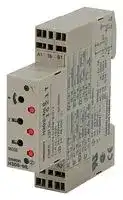


H3DS-MLC
Analogue Timer, Push-in, Multifunctional, DIN Rail, 17.5 mm, 0.1s - 120h, 5 A, 24-48 VDC, 24-230 VAC
- Manufacturer: OMRON INDUSTRIAL AUTOMATION
- Product type: Analogue Timers
- SVHC: To Be Advised
| Delivery and price | |
|---|---|
| Units per pack | 1 |
| Price | 51.71 € |
| Current stock | 10+ |
| Lead time | 30 days |

## **Solid-state Timer H3DS**

## **DIN Track Mounted, Standard 17.5-mm Width Timer Range**

- A wide AC/DC power supply range (24 to 230 VAC/ 24 to 48 VDC) reduces the number of timer models kept in stock. (24 to 230 VAC/VDC with H3DS-XL@)

- Smart Dial/Selector-locking Mechanism: Prevents the dials and selectors on the Timer’s front panel from being inadvertently operated or being operated without authorization. The lock can only be unlocked and locked with an optional pen-type Lock Key.

- Screw-Less Clamp type available. (H3DS-@LC)

- Sticker provided for easy timer identification and management.

- Terminal clamp left open when delivered (screw terminal type).

- Finger protection terminal block to meet VDE0106/P100.

- Enables easy sequence checks through instantaneous outputs for a zero set value at any time range.

- Incorporates environment-friendly, cadmium-free contacts.

- Conforms to EN61812-1 and IEC60664-1 4 kV/2 for Low Voltage, and EMC Directives.

## ■ **Broad Line-up of H3DS Series**

## **H3DS**

**==> picture [450 x 173] intentionally omitted <==**

**----- Start of picture text -----**<br>
H3DS-M/S/A H3DS-F H3DS-G H3DS-X<br>ae 2 P. PS. ia<br>~ oe he act Bry es<br>cs 5 (O65 _ ; W eas<br>E* cs ° ee a0<br>aad = @ SS © kd<br>Standard Timer Twin Timer Star-delta Timer Two-wired Timer<br>H3DS-M (eight multi-modes)  H3DS-F H3DS-G H3DS-X<br>H3DS-S (four multi-modes)<br>H3DS-A (single mode)<br>**----- End of picture text -----**<br>


## **Contents**

## **Solid-state Timer**

|**Solid-state Timer**||
|---|---|
|H3DS-M/-S/-A...........................................................................................|11|
|H3DS-F.....................................................................................................|23|
|H3DS-G....................................................................................................|31|
|H3DS-X ....................................................................................................|39|


## **Common to ALL Timers**

Installation of Screw-Less Clamp Models................................................. 45 Accessories .............................................................................................. 47 Precautions............................................................................................... 48

Solid-state Timer **H3DS**

B-9

B-10 Solid-state Timer **H3DS**

## **Solid-state Multi-functional Timer H3DS-M/-S/-A**

- Eight operating modes (H3DS-M) and four operating modes (H3DS-S) cover a wide range of applications.

- A wide time setting range of 0.10 s to 120 h.

- Two LEDs indicate power and relay status respectively.

## **Model Number Structure**

## ■ **Model Number Legend**

## **H3DS -      L** Ou **1     2     3**

1. M: Multi-function type

   - S: Standard type

   - A: Single-function type

2. L: Smart lock mechanism

3. None:   Screw terminal type

   - Screw-Less Clamp type

## **Orderin Information g**

## ■ **List of Models**

|**Supply voltage**|**Control output**|**Input type**|**Operating mode**<br>**(see note)**|**Model**|**Model**|
|---|---|---|---|---|---|
|||||**Screw terminal**<br>**type**|**Screw-Less**<br>**Clamp type**|
|24 to 230 VAC (50/60Hz)/<br>24 to 48 VDC|Contact output: SPDT<br>(time-limit output SP-<br>DT)|Voltage input|Eight multi-modes: A, B,<br>B2, C, D, E, G, J|H3DS-ML|H3DS-MLC|
|||No-input available|Four multi-modes: A, B2,<br>E, J|H3DS-SL|H3DS-SLC|
||||Single mode: A|H3DS-AL|H3DS-ALC|


**Note:** The operating modes are as follows:

- A: ON-delay

- B: Flicker OFF start

- B2: Flicker ON start

- C: Signal ON/OFF-delay

- D: SIgnal OFF-delay

- E: Interval

- G: Signal ON/OFF-delay

- J: One shot

Solid-state Multi-functional Timer **H3DS-M/-S/-A**

B-11

## ■ **Accessories (Order Separately)**

|**Lock Key**||Y92S-38|
|---|---|---|
|**Mounting Track**|50 cm (l) x 7.3 mm (t)|PFP-50N|
||1 m (l) x 7.3 mm (t)|PFP-100N|
||1 m (l) x 16 mm (t)|PFP-100N2|
|**End Plate**||PFP-M|
|**Spacer**||PEP-S|


Solid-state Multi-functional Timer **H3DS-M/-S/-A**

B-12

## **S ecifications p**

## ■ **General**

|■**General**||||
|---|---|---|---|
|**Item**|**H3DS-ML**@|**H3DS-SL**@|**H3DS-AL**@|
|**Operating mode**|A:<br>ON-delay (Signal or Power)<br>B:<br>Flicker OFF start (Signal or Power)<br>B2: Flicker ON start (Signal or Power)<br>C:<br>Signal ON/OFF-delay<br>D:<br>Signal OFF-delay<br>E:<br>Interval (Signal or Power)<br>G:<br>Signal ON/OFF-delay<br>J:<br>One-shot (Signal or Power)|A:<br>ON-delay<br>B2: Flicker ON start<br>E:<br>Interval<br>J:<br>One-shot|A: ON-delay (fixed)|
|**Input type**|Voltage input|---||
|**Output type**|Relay: SPDT|||
|**External connections**|Screw terminal, Screw-Less Clamp|||
|**Terminal block**|Screw terminal type:<br>Clamps two 2.5-mm2max. bar terminals without sleeves.<br>Screw-Less Clamp type: Clamps two 1.5-mm2max. bar terminals without sleeves.|||
|**Terminal screw**<br>**tightening torque**|0.98 N·m max.|||
|**Mounting method**|DIN track mounting(see note)|||
|**Attachment**|Nameplate label|||
|**Approved standards**|UL508, CSA C22.2 No.14<br>Conforms to EN61812-1, IEC60664-1 4 kV/2, VDE0106/P100<br>Output category according to IEC60947-5-1 (AC-13; 250 V 5 A/AC-14; 250 V 1 A/AC-15; 250 V 1 A/DC-13; 30 V 0.1 A/<br>DC-14; 30 V 0.05 A)|||


**Note:** Can be mounted to 35-mm DIN Track with a plate thickness of 1 to 2.5 mm.

## ■ **Time Ranges**

|**Time scale display**|**Time range**|
|---|---|
|0.1 s|0.1 to 1.2 s|
|1 s|1 to 12 s|
|0.1 m|0.1 to 1.2 min|
|1 m|1 to 12 min|
|0.1 h|0.1 to 1.2 h|
|1 h|1 to 12 h|
|10 h|10 to 120 h|


**Note:** When the time setting dial is set to “0” for any time scale, the output will operate instantaneously.

## ■ **Ratings**

|**Rated supply voltage**<br>**(see notes 1 and 2)**|24 to 230 VAC (50/60 Hz)/24 to 48 VDC|
|---|---|
|**Operating voltage range**|85% to 110% of rated supplyvoltage|
|**Power reset**|Minimum power-off time: 0.1 s|
|**Reset voltage**|2.4 VAC/DC max.|
|**Power consumption (see note 3)**|AC: 32 VA max./3.0 W max. (typical: 30 VA/2.7 W) at 230 VAC<br>14 VA max./2.2 W max. (typical: 13 VA/2.1 W) at 100 to 120 VAC<br>DC: 0.7 W max. (typical: 0.6 W) at 24 VDC<br>1.4 W max. (typical: 1.3 W) at 48 VDC|
|**Voltage input**|Max. permissible capacitance between inputs lines (terminals B1 and A2): 2,000 pF<br>Load connectable in parallel with inputs (terminals B1 and A1).<br>H-level: 20.4 to 253 VAC/20.4 to 52.8 VDC<br>L-level: 0 to 2.4 VAC/DC|
|**Control output**|Contact output: 5 A at 250 VAC with resistive load (cosφ= 1)<br>5 A at 30 VDC with resistive load (cosφ= 1)|
|**Ambient temperature**|Operating: –10°C to 55°C (with no icing)<br>Storage:<br>–25°C to 65°C (with no icing)|
|**Ambient humidity**|Operating: 35% to 85%|


- **Note: 1.** DC ripple rate: 20% max.

   **2.** Since an inrush current of 0.5 A will occur when using the power supply voltage at 24 VDC, pay careful attention when turning on or off the power supply to the Timer with a solid-state output such as a sensor.

   **3.** The power consumption is for mode A after the Timer counts the time-up time and for the AC input at 50 Hz. The power consumption of the H3DS-ML includes the input circuit with the B1 and A1 terminals short-circuited.

Solid-state Multi-functional Timer **H3DS-M/-S/-A** B-13

## ■ **Characteristics**

|**Accuracy of operating time**|±1% max. of FS (±1%±10 ms max. at 1.2-s range)|
|---|---|
|**Setting error**|±10%±50 ms max. of FS|
|**Signal input time**|50 ms min.|
|**Influence of voltage**|±0.7% max. of FS (±0.7%±10 ms max. at 1.2-s range)|
|**Influence of temperature**|±5% max. of FS (±5%±10 ms max. at 1.2-s range)|
|**Insulation resistance**|100 MΩmin. at 500 VDC|
|**Dielectric strength**|Between current-carrying metal parts and exposed non-current-carrying metal parts: 2,000 VAC for 1 min.<br>Between control output terminals and operating circuit: 2,000 VAC for 1 min.<br>Between contacts not located next to each other: 1,000 VAC for 1 min.|
|**Vibration resistance**|Malfunction: 0.5-mm single amplitude at 10 to 55 Hz<br>Destruction: 0.75-mm single amplitude at 10 to 55 Hz|
|**Shock resistance**|Malfunction: 100 m/s23 times each in 6 directions<br>Destruction: 1,000 m/s23 times each in 6 directions|
|**Impulse withstand voltage**|3 kV (between power terminals)<br>4.5 kV (between current-carryingmetal parts and exposed non-current-carryingmetal parts)|
|**Noise immunity**|Square-wave noisegenerated bynoise simulator (pulse width: 100 ns/1µs, 1-ns rise)±1.5 kV|
|**Static immunity**|Malfunction: 4 kV<br>Destruction: 8 kV|
|**Life expectancy**|Mechanical: 10 million operations min. (under no load at 1,800 operations/h)<br>Electrical:<br>100,000 operations min. (5 A at 250 VAC, resistive load at 360 operations/h)<br>(see note)|
|**EMC**|(EMI)<br>EN61812-1<br>Emission Enclosure:<br>EN55011 Group 1 class B<br>Emission AC Mains:<br>EN55011 Group 1 class B<br>Harmonic Current:<br>EN61000-3-2<br>Voltage Fluctuation and Flickering: EN61000-3-3<br>(EMS)<br>EN61812-1<br>Immunity ESD:<br>EN61000-4-2:<br>6 kV contact discharge (level 3)<br>8 kV air discharge (level 3)<br>Immunity RF-interference from AM Radio Waves:<br>EN61000-4-3:<br>10 V/m (80 MHz to 1 GHz) (level 3)<br>Immunity Burst:<br>EN61000-4-4:<br>2 kV power port and output port (level 3)<br>1 kV control port with capacitive clamp (level 3)<br>Immunity Surge:<br>EN61000-4-5:<br>2 kV common mode (level 3)<br>1 kV differential mode (level 3)|
|**Case color**|Lightgray(5Y7/1)|
|**Degree of protection**|IP30 (Terminal block: IP20)|
|**Weight**|Approx. 70g|


**Note:** For reference:

A maximum current of 0.15 A can be switched at 125 VDC (cosφ=1).

A maximum current of 0.1 A can be switched if L/R is 7 ms.

In both cases, a life of 100,000 operations can be expected. The minimum applicable load is 10 mA at 5 VDC (failure level: P).

Solid-state Multi-functional Timer **H3DS-M/-S/-A**

B-14

## **Connections**

## ■ **Block Diagram**

**==> picture [442 x 405] intentionally omitted <==**

**----- Start of picture text -----**<br>
H3DS-ML @<br>AC (DC) input Zero setting detection  Time scale/  Operating<br>unit selectors mode selector<br>circuit<br>Power supply  Oscillation  Counting<br>circuit circuit circuit Output circuit<br>Indicator<br>Start input Input circuit circuit<br>Power-ON  Output<br>indicator indicator<br>H3DS-SL @ /-AL @<br>AC (DC) input Zero setting detection  Time scale/ unit selectors Operating mode selector<br>circuit<br>Power supply  Oscillation  Counting<br>Output circuit<br>circuit circuit circuit<br>Indicator<br>circuit<br>Power-ON  Output<br>indicator indicator<br>**----- End of picture text -----**<br>


## ■ **I/O Functions**

|■**I/O Functions**|■**I/O Functions**|||
|---|---|---|---|
|**Item**||**H3DS-ML**@|**H3DS-SL**@**/-AL**@|
|**Input**|**Start**|Starts operation.|No input is available.|
|**Output**|**Control output**|Outputs are turned ON according to designated out-<br>put mode when preset value is reached.|Outputs are turned ON according to designated out-<br>put mode when preset value is reached.|


Solid-state Multi-functional Timer **H3DS-M/-S/-A**

B-15

## ■ **Terminal Arrangement**

**==> picture [425 x 181] intentionally omitted <==**

**----- Start of picture text -----**<br>
H3DS-MLC H3DS-ML H3DS-SLC/-ALC H3DS-SL/-AL<br>A1 15 B1 A1 15<br>A1 15 B1 A1 15<br>L<br>15 15 15 15<br>18 16 18 16 18 16 18 16<br>18 16 A2 18 16 A2<br>18 16 A2 18 16 A2<br>(see note 1) (see note 1)<br>(DIN notation) (DIN notation)<br>**----- End of picture text -----**<br>


**Note: 1.** DC supply voltage does not require the designation of polarity.

**2.** The contact symbol for the H3DS is indicated with because it offers multiple operating modes and is different from the delayed contact for conventional timers.

## ■ **Input Connections**

The inputs of the H3DS-ML@ are voltage (voltage imposition or open) inputs.

**==> picture [456 x 277] intentionally omitted <==**

**----- Start of picture text -----**<br>
No-contact Input  No-contact Input  Contact Input<br>(Connection to PNP output sensor.) (Connection to NPN output sensor.)<br>Sensor<br>Timer<br>Timer (+) 24 VDC A2 Timer<br>(−)<br>B1 A1<br>(+) B1  A1 B1  A1<br>24 VDC Start Start<br>(−) A2 A2<br>12<br>Operates with PNP transistor ON Sensor<br>Operates with relay ON<br>Operates with NPN transistor ON<br>Voltage Input Signal Levels<br>1. Transistor ON<br>Residual voltage: 1 V max.<br>No-contact  (Voltage between terminals B1 and A2 must be more than the rated "H-level" voltage (20.4 VDC min.).)<br>input<br>2. Transistor OFF<br>Leakage current: 0.01 mA max.<br>(Voltage between terminals B1 and A2 must be less than the rated "L-level" voltage (2.4 VDC max.).)<br>Use contacts that can adequately switch 0.1 mA at each voltage to be imposed. (When the contacts are<br>Contact  ON or OFF, voltage between terminals B1 and A2 must be within the following ranges:<br>input When contacts are ON:  20.4 to 253 VAC/20.4 to 52.8 VDC<br>When contacts are OFF: 0 to 2.4 VAC/DC<br>**----- End of picture text -----**<br>


## **Voltage Input Signal Levels**

Solid-state Multi-functional Timer **H3DS-M/-S/-A**

B-16

## **O eration p**

## ■ **Basic Operation**

## **Setting of Selector**

The selectors can be turned clockwise and counterclockwise to select the desired time scale, or operating mode.

Each selector has a snap mechanism that secures the selector at a given position. Set the selector at a position at which it is secured. Do not set it midway between two securing positions or a malfunction could result from improper setting.

## **Selection of Operating Mode (except - for H3DS AL)**

## **Locking/Unlocking of Selectors and Time Setting Dial**

The time setting dial, time scale selector, and operating mode selector can be locked using the Y92S-38 Lock Key, a special pen type tool that is sold separately. To lock the dial or selectors, insert the Lock Key in the keyhole to the lower right of the dial or selector and turn it clockwise until the dial or selector is completely covered with the red cover. To unlock, turn the Lock Key in the opposite direction.

The H3DS-ML/-SL can be set to any one of the operating modes A to J. Turn the operating mode selector with a screwdriver until the desired operating mode appears in the operating mode display window.

H3DS-ML (8 modes): A, B, B2, C, D, E, G, J (In order of appearance)

H3DS-SL (4 modes): A, E, B2, J, E, E, J, J

(In order of appearance)

**Note:** Letters that appear more than once indicate exactly the same operating mode.

**==> picture [26 x 7] intentionally omitted <==**

**----- Start of picture text -----**<br>
Key hole<br>**----- End of picture text -----**<br>


## **Selection of Time Scale**

The time scale is selected by turning the time scale selector. The time scales will appear in the following order in the time scale display window on the left of the selector:

1 s, 0.1 s, 1 h, 0.1 h, 10 h, 1 h, 1 m, 0.1 m.

**Note:** The time scale “1h” appears twice. Both instances indicate exactly the same time scale.

**==> picture [131 x 76] intentionally omitted <==**

**----- Start of picture text -----**<br>
Time scale display<br>window and selector<br>ZR8  apete<br>Operating mode display<br>window and selector<br>**----- End of picture text -----**<br>


Solid-state Multi-functional Timer **H3DS-M/-S/-A**

B-17

## ■ **Timing Chart**

## **Note: 1.** The minimum power reset time is 0.1 s and the minimum signal input time is 0.05 s.

**2.** The letter “t” in the timing charts stands for the set time and “t–a” means that the period is less than the time set.

**3.** There is no start input for H3DS-SL@/-AL@ models. Operation starts at power-on.

**==> picture [478 x 594] intentionally omitted <==**

**----- Start of picture text -----**<br>
Operating  Timing chart<br>mode<br>A: ON-delay |reI t || | t–a alI = | t |<br>||II||<br>Power (A1 and A2) Basic operation<br>| | iol boy |<br>Start (B1 and A2)  Power<br>(see note) || || in|iol |ly || | * **<br>Start<br>Output relay: NC<br>15 and 16 t<br>ee feel | :<br>Output<br>Output relay: NO<br>(output indicator) 15 and 18 | 14 | | I| *  For power-on operation, impose voltage to the Start input. The Timer starts operating at the<br>| 14 | | | moment the power is turned on.<br>| || I | i ** Start input is invalid while the Timer is in opera -<br>tion.<br>Power indicator<br>B: t t t–a t t t t–a<br>Flicker OFF  |I * i|T lhiay| |Oh| | o || = |<br>start | | I | | I | | |<br>Basic operation<br>Power (A1 and A2) EE Ba a a<br>| | boy ud | | | |<br>Power<br>(see note)Start (B1 and A2)  | | toy | | | | | * **<br>| | boyd | | | | Start E<br>Output relay: NC  | | | t t t t<br>15 and 16<br>Output Sa<br>Output relay: NO (output indicator)  |l L oyiol| | | | | * For power-on operation, impose voltage to the<br>15 and 18 | io | Start input. The Timer starts operating at the<br>| iol | moment the power is turned on.<br>||| ** Start input is invalid while the Timer is in opera -<br>tion.<br>Power indicator<br>B2: | t | t l t–a y | t | t | t | t–a |<br>Flicker ON  I ||I 1 cI| o. |||<br>start<br>Power (A1 and A2)<br>| | | |boy Iyl |I || | | Ld Basic operation<br>Start (B1 and A2)  | | | | | |<br>(see note) Power<br>| | | 1 4! | I | | **<br>*<br>Output relay: NC  Start<br>15 and 16<br>enry | ae eT — f_____ t t t t<br>I | boy gl | } | |<br>Output relay: NO  Output<br>(output indicator) 15 and 18 | rT | I * For power-on operation, impose voltage to the Start input. The Timer starts operating at the<br>Power indicator || | | II ** Start input is invalid while the Timer is in opera -tion.moment the power is turned on.<br>C: | t 1 | t ! t ty t–a I t ry t–a<br>Signal  j| ||| >| -——l — > l | boy |<br>ON/OFF-<br>delay Power (A1 and A2)<br>1d || ly l ; | ] I | I<br>od ll Ly I | l | ly |<br>Start (B1 and A2)  I I lI Basic operation<br>(see note) 1 rod 1 | I | I rT | I<br>od I | 1 I l | ly |<br>Power<br>Output relay: NC<br>15 and 16 od II 1 I ; I ry I *<br>Start<br>Output relay: NO<br>(output indicator)  t t t t<br>15 and 18<br>| I | Output<br>\ l I<br>*  Start input is invalid while the Timer is in opera -<br>Power indicator tion.<br>**----- End of picture text -----**<br>


**Note:** The start input of the H3DS-ML@ model is activated by applying a voltage to B1 and A2 terminals. The voltage can be applied by turning on the contact between B1 and A1 (Refer to _Terminal Arrangement_ ).

Solid-state Multi-functional Timer **H3DS-M/-S/-A**

B-18

**==> picture [480 x 537] intentionally omitted <==**

**----- Start of picture text -----**<br>
Operating  Timing chart<br>mode<br>D: t t–a t–a t t–a<br>Signal  | __| | — || | | 4 |  ____+l | ss ||<br>OFF-delay | |<br>Power (A1 and A2)<br>1 | || | 1 | 14 |<br>al I1! | Lo) Basic operation<br>Start (B1 and A2)<br>(see note)<br>Power<br>Output relay: NC 15 and 16 *<br>Start<br>| | | jot 1 | | —<br>Output relay: NO (output indicator) 15 and 18 EE D E | lS Output rn t<br>| | / |<br>*  Start input is valid and re-triggerable while the<br>Power indicator Timer is in operation.<br>_—yw ee<br>E: Interval t t t–a t–a t<br>J | Io|,__4J| 4]| | | g | —____+]|<br>Power (A1 and A2) } - ! Ld Basic operation<br>Power<br>| Iolo I | | **<br>Start (B1 and A2)  *<br>(see note) || IoIo IotolIotol odod oyoy odod || Start c<br>Output relay: NC  t<br>15 and 16<br>| a ot ply ; | Output<br>Output relay: NO  * For power-on operation, impose voltage to the<br>(output indicator) 15 and 18  a || |IlI II ||| ||| Start input. The Timer starts operating at the moment the power is turned on.<br>** Start input is valid and re-triggerable while the<br>Power indicator Timer is in operation.<br>G:Signal  t t t–a t t t–a t t–a Basic operation<br>ON/OFF-delay Power (AStart (B(see note)Output relay: NC 1 and A1 and A2)  2) tontooT11roti Hi7f Hli Hft1i tomo1 toto71 ‘HHrf Hltottoy1 H1t1 PowerStart *<br>15 and 16Output relay: NO  ‘11 H1 1 H1H i HiH‘H1Hl' t t t t<br>(output indicator) 15 and 18  EEHlH Fe fee eee' Output*   Start input is valid and re-triggerable while the<br>Timer is in operation.<br>Power indicator<br>J: t t t–a t–a t Basic operation<br>One-shot out- | J | | | | | | | Ld<br>put (ON delay) Power (A1 and A2) | boyd a) | Power<br>(see note)Start (B1 and A2)  | loti lol | * **<br>Start<br>Output relay: NC<br>15 and 16<br>] ls lop] I | lo t<br>Approx.  Approx. 1±0.6 s<br>Output relay: NO  || Approx. 1±0.6 s  a l e Approx. 1±0.6 s  aIo] 1I | 1±0.6 s  Le| Output (fixed)<br>(output indicator)  | (fixed)  (fixed)  || ti (fixed)  |<br>15 and 18  I Il Ty | * For power-on operation, impose voltage to the<br>| Il a) | Start input. The Timer starts operating at the<br>moment the power is turned on.<br>Power indicator ** Start input is valid and re-triggerable while the<br>Timer is in operation.<br>**----- End of picture text -----**<br>


**Note:** The start input of the H3DS-ML@ model is activated by applying a voltage to B1 and A2 terminals. The voltage can be applied by turning on the contact between B1 and A1 (Refer to _Terminal Arrangement_ ).

Solid-state Multi-functional Timer **H3DS-M/-S/-A**

B-19

## **Nomenclature**

## **H3DS-ML** @ **/-SL** @

|**H3DS-ML**@**/-SL**@|||||||
|---|---|---|---|---|---|---|
|**H3DS-ML/-SL**|||||**H3DS-MLC/-SLC**||
|Output indicator (orange)<br>(Lit while Timer output is ON.)<br>Set time window<br>Time scale display window and<br>ae]<br>..<br>—_______]*@6<br>g ©<br>| eam||||Time setting dial (set time)<br>Lock for time setting dial|ESiI==<br>Seisle=<br>pre<br>e\<br>-&o<br>©|Wire connection holes|
|selector (select one from 1 s,<br>0.1 s, 1 h, 0.1 h, 10 h, 1 h, 1 m,<br>and 0.1 m)|Ke)<br>omg|||Lock for time scale selector|xm<br>©|Release holes|
||wove<br>(6)|||Lock for operating mode selector|||
|Operating mode display window<br>and selector (select the mode from<br>A, B, B2, C, D, E, G, and J for the<br>H3DS-ML, from A, B2, E, and J for<br>the H3DS-SL)|(Front View)<br>H3DS-M<br>18 16A2]|<br>Be|||Power-ON indicator (green)<br>(Lit while the power is ON.)|18 16 A2<br>omron @<br>H3DS-ML :<br>as<br>AABE|Wire connection holes|
||||||(Front View)||
|**H3DS-AL**@<br>Output indicator (orange)<br>(Lit while Timer output is ON.)<br>Time scale display window and<br>selector (select one from 1 s,<br>0.1 s, 1 h, 0.1 h, 10 h, 1 h, 1 m,<br>and 0.1 m)<br>Set time window<br>Cal<br>—<br>dR<br>é<br>Ke)<br>——__] xm<br>o||||Time setting dial (set time)<br>Lock for time setting dial<br>Lock for time scale selector|**H3DS-ALC**<br>Eeie[==<br>S55<br>oa<br>Goo<br>_©|Wire connection holes<br>Release holes|
||omaon<br>@cp<br>H3DS-A<br>[18 16 A2|||||Power-ON indicator (green)<br>(Lit while the power is ON.)|18 16 A2<br>omron @ 3<br>H3DS-AL :||
||=||||FAABB|Wire connection holes|
||(Front View)||||||
||||||(Front View)||
||f|fea|ea|Attach the enclosed label here as a nameplate.<br>(The label is attached to the Timer's DIN Track<br>hook section at the time of shipment.)<br>~~i~~|||


Solid-state Multi-functional Timer **H3DS-M/-S/-A**

B-20

~~;~~

## **Dimensions**

**==> picture [199 x 370] intentionally omitted <==**

**----- Start of picture text -----**<br>
Surface color:   Light gray 5Y7/1 (OMRON)<br>| |<br>of 4 a0<br>=)<br>= L |<br>= —<br>LI Ld<br>17.5 73<br>45 80<br>2. iz<br>-— 44<br>68<br>**----- End of picture text -----**<br>


**Note:** All units are in millimeters unless otherwise indicated.

## **H3DS-ML/-SL/-AL**

**==> picture [95 x 7] intentionally omitted <==**

**----- Start of picture text -----**<br>
H3DS-MLC/-SLC/-ALC<br>**----- End of picture text -----**<br>


Solid-state Multi-functional Timer **H3DS-M/-S/-A**

B-21

B-22 Solid-state Multi-functional Timer **H3DS-M/-S/-A**

## **Solid-state Twin Timer H3DS-F**

- Operates in flicker-OFF or flicker-ON start mode with one Unit.

- Independent ON- and OFF-time settings. Combinations of long ON- or OFF-time and short OFF- or ONtime setting are possible.

- Long time range from 0.1 s to 12 h for both ON and OFF time settings.

## **Model Number Structure**

## ■ **Model Number Legend**

## **H3DS -F  L** — u **1 2 3**

1. F:   Twin timers

2. L:   Smart lock mechanism

3. None: Screw terminal type

- C:       Screw-Less Clamp type

## **Orderin Information g**

## ■ **List of Models**

|**Operating mode**|**Supply voltage**|**Model**|**Model**|
|---|---|---|---|
|||**Screw terminal type**|**Screw-Less Clamp type**|
|Flicker-OFF/Flicker-ON start|24 to 230 VAC (50/60 Hz)/24 to 48 VDC|H3DS-FL|H3DS-FLC|


## ■ **Accessories (Order Separately)**

|■**Accessories (Order Separately)**|■**Accessories (Order Separately)**||
|---|---|---|
|**Lock Key**||Y92S-38|
|**Mounting Track**|50 cm (l) x 7.3 mm (t)|PFP-50N|
||1 m (l) x 7.3 mm (t)|PFP-100N|
||1 m (l) x 16 mm (t)|PFP-100N2|
|**End Plate**||PFP-M|
|**Spacer**||PEP-S|


Solid-state Twin Timer **H3DS-F** B-23

## **S ecifications p**

## ■ **General**

|■**General**||
|---|---|
|**Item**|**H3DS-F**|
|**Operating mode**|Flicker-OFF/Flicker-ON start|
|**Output type**|Relay: SPDT|
|**External connections**|Screw terminal, Screw-Less Clamp|
|**Terminal block**|Screw terminal type:<br>Clamps two 2.5-mm2max. bar terminals without sleeves.<br>Screw-Less Clamp type: Clamps two 1.5-mm2max. bar terminals without sleeves.|
|**Terminal screw tightening torque**|0.98 N·m max.|
|**Mounting method**|DIN track mounting(see note)|
|**Attachment**|Nameplate label|
|**Approved standards**|UL508, CSA C22.2 No.14<br>Conforms to EN61812-1, IEC60664-1 4 kV/2, VDE0106/P 100<br>Output categoryaccordingto IEC60947-5-1 (AC-13; 250 V 5A/AC-15; 250 V 1 A/DC-13; 30 V 0.1 A)|


**Note:** Can be mounted to 35-mm DIN Track with a plate thickness of 1 to 2.5 mm.

## ■ **Time Ranges**

|■**Time Ranges**||
|---|---|
|**Time scale display**|**Time range**|
|0.1 s|0.1 to 1.2 s|
|1 s|1 to 12 s|
|0.1 m|0.1 to 1.2 min|
|1 m|1 to 12 min|
|0.1 h|0.1 to 1.2 h|
|1 h|1 to 12 h|


**Note:** When the time setting dial is set to “0” for any time scale, the output will operate instantaneously.

## ■ **Ratings**

|■**Ratings**||
|---|---|
|**Rated supply voltage (See note.)**|24 to 230 VAC (50/60 Hz)/24 to 48 VDC|
|**Operating voltage range**|85% to 110% of rated supplyvoltage|
|**Power reset**|Minimum power-off time: 0.1 s|
|**Reset voltage**|2.4 VAC/DC max.|
|**Power consumption**|AC: 33 VA max./2.2 W max. (typical: 31 VA/2.0 W) at 230 VAC<br>11 VA max./1.9 W max. (typical: 9.7 VA/1.7 W) at 100 to 120 VAC<br>DC: 0.7 W max. (typical: 0.6 W) at 24 VDC<br>1.4 W max. (typical: 1.2 W) at 48 VDC|
|**Voltage input**|Max. permissible capacitance between inputs lines (terminals B1 and A2): 2,000 pF<br>Load connectable in parallel with inputs (terminals B1 and A1).<br>H-level: 20.4 to 253 VAC/20.4 to 52.8 VDC<br>L-level: 0 to 2.4 VAC/DC|
|**Control output**|Contact output:<br>5 A at 250 VAC with resistive load (cosφ= 1)<br>5 A at 30 VDC with resistive load (cosφ= 1)|
|**Ambient temperature**|Operating: –10°C to 55°C (with no icing)<br>Storage:<br>–25°C to 65°C (with no icing)|
|**Ambient humidity**|Operating: 35% to 85%|


**Note:** DC ripple rate: 20% max.

Solid-state Twin Timer **H3DS-F**

B-24

## ■ **Characteristics**

|**Accuracy of operating time**|±1% max. of FS (±1%±10 ms max. at 1.2-s range)|
|---|---|
|**Setting error**|±10%±50 ms max. of FS|
|**Influence of voltage**|±0.5% max. of FS (±0.5%±10 ms max. at 1.2-s range)|
|**Influence of temperature**|±5% max. of FS (±5%±10 ms max. at 1.2-s range)|
|**Insulation resistance**|100 MΩmin. at 500 VDC|
|**Dielectric strength**|Between current-carrying metal parts and exposed non-current-carrying metal parts: 2,000 VAC (50/60 Hz) for 1<br>min.<br>Between control output terminals and operating circuit: 2,000 VAC (50/60 Hz) for 1 min.<br>Between contacts not located next to each other: 1,000 VAC (50/60 Hz) for 1 min.|
|**Impulse withstand voltage**|3 kV (between power supply terminals)<br>4.5 kV (between current-carryingmetal parts and exposed non-current-carryingmetal parts)|
|**Noise immunity**|Square-wave noisegenerated bynoise simulator (pulse width: 100 ns/1µs, 1-ns rise)±1.5 kV|
|**Static immunity**|Malfunction: 4 kV<br>Destruction: 8 kV|
|**Vibration resistance**|Malfunction: 0.5-mm single amplitude at 10 to 55 Hz<br>Destruction: 0.75-mm single amplitude at 10 to 55 Hz|
|**Shock resistance**|Malfunction: 200 m/s2, 3 times each in 6 directions<br>Destruction: 300 m/s2, 3 times each in 6 directions|
|**Life expectancy**|Mechanical: 10 million operations min. (under no load at 1,800 operations/h)<br>Electrical:<br>100,000 operations min. (5 A at 250 VAC, resistive load at 360 operations/h) (see note)|
|**EMC**|(EMI)<br>EN61812-1<br>Emission Enclosure:<br>EN55011 Group 1 class B<br>Emission AC Mains:<br>EN55011 Group 1 class B<br>Harmonic Current:<br>EN61000-3-2<br>Voltage Fluctuation and Flickering: EN61000-3-3<br>(EMS)<br>EN61812-1<br>Immunity ESD:<br>EN61000-4-2:<br>6 kV contact discharge (level 3)<br>8 kV air discharge (level 3)<br>Immunity RF-interference from AM Radio Waves:<br>EN61000-4-3:<br>10 V/m (80 MHz to 1 GHz) (level 3)<br>Immunity Burst:<br>EN61000-4-4:<br>2 kV power port and output port (level 3)<br>1 kV control port with capacitive clamp (level 3)<br>Immunity Surge:<br>EN61000-4-5:<br>2 kV common mode (level 3)<br>1 kV differential mode (level 3)|
|**Case color**|Lightgray(5Y7/1)|
|**Degree of protection**|IP30 (IP20 for terminal block)|
|**Weight**|Approx. 70g|


**Note:** For reference:

A maximum current of 0.15 A can be switched at 125 VDC (cosφ=1).

A maximum current of 0.1 A can be switched if L/R is 7 ms. In both cases, a life of 100,000 operations can be expected.

The minimum applicable load is 10 mA at 5 VDC (failure level: P).

Solid-state Twin Timer **H3DS-F** B-25

## **Connections**

## ■ **Block Diagram**

**==> picture [316 x 115] intentionally omitted <==**

**----- Start of picture text -----**<br>
ON  OFF<br>indicator  indicator<br>(Orange) (Green) ON/OFF start<br>selector<br>AC (DC)  Indicator  Time scale<br>input circuit selector<br>ROM RAM Clock<br>Power  One-chip microcomputer Output<br>supply  circuit<br>circuit<br>**----- End of picture text -----**<br>


## ■ **I/O Function**

**Inputs** Flicker-ON start operation begins when inputs are turned ON. **Outputs Control output** Outputs are turned ON/OFF according to the time set by the ON-and OFF-time setting dial. ~~EE~~

## ■ **Terminal Arrangement**

**==> picture [182 x 162] intentionally omitted <==**

**----- Start of picture text -----**<br>
H3DS-FLC H3DS-FL<br>A1 15 B1<br>A1 15 B1<br>L<br>15 15<br>18 16 18 16<br>18 16 A2<br>18 16 A2<br>(See note 2.)<br>**----- End of picture text -----**<br>


- **Note: 1.** If voltage is applied to terminal B1, or if terminals A1 and B1 are shorted, the operating mode is switched to flicker-ON start mode. If these terminals are disconnected, the mode switches to flicker-OFF start mode.

   **2.** DC supply voltage does not require the designation of polarity.

Solid-state Twin Timer **H3DS-F**

B-26

## **O eration p**

## ■ **Basic Operation**

## **Setting of Selector**

The selectors can be turned clockwise and counterclockwise to select the desired time scale, or operating mode.

## **Time Setting**

Use the ON/OFF-time setting dials to set the ON/OFF time.

> Each selector has a snap mechanism that secures the selector at a **Locking/Unlocking of Selectors and** given position. Set the selector at a position at which it is secured. Do

> not set it midway between two securing positions or a malfunction **Time Setting Dial** could result from improper setting.

## **Settings for ON/OFF Start**

If voltage is applied to terminal B1, or if terminals A1 and B1 are shorted, the operating mode is switched to flicker-ON start mode. If these terminals are disconnected, the mode switches to flicker-OFF start mode. The operating mode will not change if the state of the applied voltage changes during timer operation.

The ON/OFF-time setting dials and time scale selectors can be locked using the Y92S-38 Lock Key, a special pen type tool that is sold separately. To lock the dials or selectors, insert the Lock Key in the keyhole to the lower right of the dial or selector and turn it clockwise until the dial or selector is completely covered with the red cover. To unlock, turn the Lock Key in the opposite direction.

## **Selection of Time Scale**

The time scale is selected by turning the ON-time scale selector and OFF-time scale selector. The time scales will appear in the following order in each time scale display window on the left of the selector:

0.1 s, 1 h, 0.1 h, 1 m, 1 s, 0.1 h, 0.1 m, 1 s.

**Note:** The time scales “1 s” and “0.1 h” appear twice. Both instances indicate exactly the same time scale.

**==> picture [25 x 7] intentionally omitted <==**

**----- Start of picture text -----**<br>
Key hole<br>**----- End of picture text -----**<br>


**==> picture [118 x 75] intentionally omitted <==**

**----- Start of picture text -----**<br>
ON-time scale<br>display window<br>and selector rte] |<br>cS hony feag |ye ay<br>S :<br>OFF-time scale display<br>window and selector<br>**----- End of picture text -----**<br>


## ■ **Timing Charts**

**==> picture [426 x 196] intentionally omitted <==**

**----- Start of picture text -----**<br>
Operating  Timing chart<br>mode<br>Flicker-OFF  0.1 s min.<br>start(See note 1.) Power (A1 and A2) ONOFF<br>Output relay: NO 15 and 18   ON<br>(ON indicator) OFF<br>Output relay: NC  ON<br>15 and 16 OFF<br>tON: ON set time<br>ON<br>OFF indicator OFF ee ee oe tOFF: OFF set time<br>Flicker-ON  0.1 s min.<br>start ON<br>(See note 1.) Power (A1 and A2) OFF<br>Signal (B1 and A2) ONOFF<br>Output relay: NO 15 and 18  ON<br>(ON indicator) OFF ' H H 1 ' ria {<br>Output relay: NC  ON<br>15 and 16 OFF<br>H H H ' Ly \ tON: ON set time<br>OFF indicator ONOFF tOFF: OFF set time<br>**----- End of picture text -----**<br>


- **Note: 1.** If voltage is applied to terminal B1, or if terminals A1 and B1 are shorted, the operating mode is switched to flicker-ON start mode. If these terminals are disconnected, the mode switches to flicker-OFF start mode.

   **2.** The reset time requires a minimum of 0.1 s.

   **3.** When power is supplied in flicker-ON start mode, the OFF indicator lights momentarily. This, however, has no effect on the performance of the Timer.

Solid-state Twin Timer **H3DS-F**

B-27

## **Nomenclature**

**H3DS-FL** @

**==> picture [433 x 235] intentionally omitted <==**

**----- Start of picture text -----**<br>
Ee H3DS-FLC<br>Wire connection holes<br>Output ON/OFF indicator<br>are] When the output is ON: Orange  FAS ES<br>When the output is OFF: Green<br>ON-time display window ON-time setting dial<br>n © Lock for ON-time setting dial - ko<br>ON-time scale display window and selector (select one from  x mag) ON ©<br>0.1 s, 1 s, 0.1 m, 1 m, 0.1 h,  Ke) Lock for ON-time scale selector x ragD<br>and 1 h) OFF-time setting dial Release holes<br>OFF-time display window - &O ©<br>or O Lock for OFF-time setting dial © go<br>OFF-time scale display window  x BID OFF ©<br>and selector (select one from  Lock for OFF-time scale selector<br>0.1 s, 1 s, 0.1 m, 1 m, 0.1 h,<br>and 1 h) ee. -,O me 5<br>| 18 16 A2<br>saan<br>AA AEB Wire connection holes<br>(Front View)<br>(Front View)<br>Attach the enclosed label here as a nameplate.<br>(The label is attached to the Timer's DIN Track<br>hook section at the time of shipment.)<br>**----- End of picture text -----**<br>


Solid-state Twin Timer **H3DS-F**

B-28

## **Dimensions**

## **H3DS-FL**

**==> picture [196 x 131] intentionally omitted <==**

**----- Start of picture text -----**<br>
Surface color:   Light gray 5Y7/1 (OMRON)<br>= 17.5 73<br>cee<br>Ge °<br>o. iz 45 80 r<br>° |<br>0<br>J<br>[209} 44<br>68<br>**----- End of picture text -----**<br>


## **H3DS-FLC**

**==> picture [197 x 132] intentionally omitted <==**

**----- Start of picture text -----**<br>
Surface color:   Light gray 5Y7/1 (OMRON)<br>r 17.5 4 73<br>Ges<br>Go” 45 80<br>3°© 1| |<br>oo<br>— 44<br>68<br>**----- End of picture text -----**<br>


Solid-state Twin Timer **H3DS-F**

B-29

B-30 Solid-state Twin Timer **H3DS-F**

## **Solid-state Star-delta Timer H3DS-G**

- A wide star-time range (up to 120 seconds) and star-delta transfer time range (up to 1 second)

## **Model Number Structure**

## ■ **Model Number Legend**

## **H3DS -G  L** oO

**1 2 3**

1. G:  Star-delta timer

2. L:   Smart lock mechanism 3. None:  Screw terminal type

   - C:        Screw-Less Clamp type

## **Orderin Information g**

## ■ **List of Models**

|**Operating mode**|**Supply voltage**|**Model**|**Model**|
|---|---|---|---|
|||**Screw terminal type**|**Screw-Less Clamp type**|
|Star-delta operation|24 to 230 VAC (50/60 Hz)/24 to 48 VDC|H3DS-GL|H3DS-GLC|


## ■ **Accessories (Order Separately)**

|■**Accessories (Order Separately)**|■**Accessories (Order Separately)**||
|---|---|---|
|**Lock Key**||Y92S-38|
|**Mounting Track**|50 cm (l) x 7.3 mm (t)|PFP-50N|
||1 m (l) x 7.3 mm (t)|PFP-100N|
||1 m (l) x 16 mm (t)|PFP-100N2|
|**End Plate**||PFP-M|
|**Spacer**||PEP-S|


Solid-state Star-delta Timer **H3DS-G** B-31

## **S ecifications p**

## ■ **General**

|■**General**||
|---|---|
|**Item**|**H3DS-G**|
|**Operating mode**|Star-delta operation|
|**Operating/Reset method**|Time-limit operation/Self-reset|
|**External connections**|Screw terminal, Screw-Less Clamp|
|**Terminal block**|Screw terminal type:<br>Clamps two 2.5-mm2max. bar terminals without sleeves.<br>Screw-Less Clamp type: Clamps two 1.5-mm2max. bar terminals without sleeves.|
|**Terminal screw tightening torque**|0.98 N·m max.|
|**Output type**|(Star operation circuit) Relay:<br>SPST-NO<br>(Delta operation circuit) Relay: SPST-NO|
|**Mounting method**|DIN track mounting(see note)|
|**Attachment**|Nameplate label|
|**Approved standards**|UL508, CSA C22.2 No.14<br>Conforms to EN61812-1, IEC60664-1 4 kV/2, VDE0106/P100<br>Output categoryaccordingto IEC60947-5-1 (AC-13; 250 V 5A/AC-15; 250 V 1 A/DC-13; 30 V 0.1 A)|


**Note:** Can be mounted to 35-mm DIN Track with a plate thickness of 1 to 2.5 mm.

## ■ **Time Ranges**

|■**Time Ranges**|■**Time Ranges**||
|---|---|---|
|**Time scale**<br>**Star operation time ranges**|||
|**x 1**<br>1 to 12 s|||
|**x 10**<br>10 to 120 s|||
||||
|**Star-delta transfer time**|Programmable at 0.05 s,|0.1 s, 0.5 s, or 1 s|


## ■ **Ratings**

|■**Ratings**||
|---|---|
|**Rated supply voltage (see note)**|24 to 230 VAC (50/60 Hz)/24 to 48 VDC|
|**Operating voltage range**|85% to 110% of rated supplyvoltage|
|**Power reset**|Minimum power-off time: 0.5 s|
|**Reset voltage**|2.4 VAC/DC max.|
|**Power consumption**|AC: 21 VA max./1.7 W max. (typical: 20 VA/1.6 W) at 230 VAC<br>11 VA max./2.0 W max. (typical: 8.6 VA/1.5 W) at 100 to 120 VAC<br>DC: 1.3 W max. (typical: 1.2 W) at 24 VDC<br>0.7 W max. (typical: 0.6 W) at 48 VDC|
|**Control output**|Contact output:<br>5 A at 250 VAC with resistive load (cosφ= 1)<br>5 A at 30 VDC with resistive load (cosφ= 1)|
|**Ambient temperature**|Operating: –10°C to 55°C (with no icing)<br>Storage:<br>–25°C to 65°C (with no icing)|
|**Ambient humidity**|Operating: 35% to 85%|


**Note:** DC ripple rate: 20% max.

Solid-state Star-delta Timer **H3DS-G**

B-32

## ■ **Characteristics**

|**Accuracy of operating time**|±1% max. of FS|
|---|---|
|**Setting error**|±10%±50 ms max. of FS|
|**Total tolerance of transfer**<br>**time**|±(25% FS + 5 ms) max.|
|**Influence of voltage**|±0.5% max. of FS|
|**Influence of temperature**|±5% max. of FS|
|**Insulation resistance**|100 MΩmin. at 500 VDC|
|**Dielectric strength**|Between current-carrying metal parts and exposed non-current-carrying metal parts: 2,000 VAC (50/60 Hz) for 1<br>min.<br>Between control output terminals and operating circuit: 2,000 VAC (50/60 Hz) for 1 min.<br>Between contacts not located next to each other: 1,000 VAC (50/60 Hz) for 1 min.|
|**Impulse withstand voltage**|3 kV (between power supply terminals)<br>4.5 kV (between current-carryingmetal parts and exposed non-current-carryingmetal parts)|
|**Noise immunity**|Square-wave noisegenerated bynoise simulator (pulse width: 100 ns/1µs, 1-ns rise)±1.5 kV|
|**Static immunity**|Malfunction: 4 kV<br>Destruction: 8 kV|
|**Vibration resistance**|Malfunction: 0.5-mm single amplitude at 10 to 55 Hz<br>Destruction: 0.75-mm single amplitude at 10 to 55 Hz|
|**Shock resistance**|Malfunction: 200 m/s2, 3 times each in 6 directions<br>Destruction: 300 m/s2, 3 times each in 6 directions|
|**Life expectancy**|Mechanical: 10 million operations min. (under no load at 1,800 operations/h)<br>Electrical:<br>100,000 operations min. (5 A at 250 VAC, resistive load at 360 operations/h) (see note)|
|**EMC**|(EMI)<br>EN61812-1<br>Emission Enclosure:<br>EN55011 Group 1 class B<br>Emission AC Mains:<br>EN55011 Group 1 class B<br>Harmonic Current:<br>EN61000-3-2<br>Voltage Fluctuation and Flickering: EN61000-3-3<br>(EMS)<br>EN61812-1<br>Immunity ESD:<br>EN61000-4-2:<br>6 kV contact discharge (level 3)<br>8 kV air discharge (level 3)<br>Immunity RF-interference from AM Radio Waves:<br>EN61000-4-3: 10 V/m (80 MHz to 1 GHz) (level 3)<br>Immunity Burst:<br>EN61000-4-4:<br>2 kV power port and output port (level 3)<br>1 kV control port with capacitive clamp (level 3)<br>Immunity Surge:<br>EN61000-4-5:<br>2 kV common mode (level 3)<br>1 kV differential mode (level 3)|
|**Case color**|Lightgray(5Y7/1)|
|**Degree of protection**|IP30 (IP20 for terminal block)|
|**Weight**|Approx. 70g|


**Note:** For reference:

A maximum current of 0.15 A can be switched at 125 VDC (cosφ=1).

A maximum current of 0.1 A can be switched if L/R is 7 ms. In both cases, a life of 100,000 operations can be expected. The minimum applicable load is 10 mA at 5 VDC (failure level: P).

Solid-state Star-delta Timer **H3DS-G** B-33

## **Connections**

## ■ **Block Diagram**

**==> picture [387 x 180] intentionally omitted <==**

**----- Start of picture text -----**<br>
Star  Star-delta<br>AC (DC) input operation  transfer<br>time scale  time<br>selector selection<br>Power supply circuit Star opera -tion time oscillation circuit Star opera -tion time counting circuit Star-delta transfer time oscilla -tion circuit Star-delta transfer time counting circuit Output circuit Star operation<br>Delta operation<br>Indicator<br>circuit<br>Star operation  Delta operation<br>indicator indicator<br>**----- End of picture text -----**<br>


## ■ **I/O Functions**

|■**I/O Functions**|■**I/O Functions**||
|---|---|---|
|**Inputs**||---|
|**Outputs**|**Control output**|Star output is turned OFF when the dial set value is reached and delta output is ON after<br>the preset transfer time elapses|


## ■ **Terminal Arrangement**

**==> picture [168 x 168] intentionally omitted <==**

**----- Start of picture text -----**<br>
H3DS-GLC H3DS-GL<br>A1 17 27<br>A1 17 27<br>17 27 17 27<br>18 28 18 28<br>18 28 A2<br>18 28 A2<br>(see note)<br>**----- End of picture text -----**<br>


**Note:** DC supply voltage does not require the designation of polarity.

Solid-state Star-delta Timer **H3DS-G**

B-34

## **O eration p**

## ■ **Basic Operation**

## **Setting of Selector**

The selectors can be turned clockwise and counterclockwise to select the desired time scale, or operating mode.

Each selector has a snap mechanism that secures the selector at a given position. Set the selector at a position at which it is secured. Do not set it midway between two securing positions or a malfunction could result from improper setting.

## **Selection of Time Unit and Time Scale**

The star-delta transfer time and star operation time scale are set with the same selector. The star-delta transfer time can be set to 0.05, 0.1, 0.5, or 1. The star operation time scale can be set to a multiplication factor of 1 or 10. If the star-delta transfer time is displayed in the display window in white letters, this means that the star operation time scale is “x10”. Refer to the example below.

||**Star-delta transfer time**|**Star-delta transfer time**|**Star-delta transfer time**|**Star operation time scale**|**Star operation time scale**|**Star operation time scale**|
|---|---|---|---|---|---|---|
|||0.05 s||x1|||
||||||||
|||0.1 s|||||
||||||||
|0.5 s<br>1 s<br>0.05 s<br>0.1 s<br>0.5 s<br>1 s<br>~~PL~~<br>~~————~~<br>~~|~~<br>~~os~~||||x10|||
||||||SQ|| °F<br>oa|
||||||ae|a|
|||Star-delta transfer time and|||||
|||star operation time scale<br>display window and selector||“Gs<br>Sola||b|a<br>ligg|


## **Time Setting**

The star operation time of the Timer is set with the time setting dial.

## **Locking/Unlocking of Selectors and Time Setting Dial**

The time setting dial and time scale selector can be locked using the Y92S-38 Lock Key, a special pen type tool that is sold separately. To lock the dial or selectors, insert the Lock Key in the keyhole to the lower right of the dial or selector and turn it clockwise until the dial or selector is completely covered with the red cover. To unlock, turn the Lock Key in the opposite direction.

**==> picture [25 x 7] intentionally omitted <==**

**----- Start of picture text -----**<br>
Key hole<br>**----- End of picture text -----**<br>


## ■ **Timing Charts**

**==> picture [198 x 91] intentionally omitted <==**

**----- Start of picture text -----**<br>
0.5 s<br>Power (A1 and A2) ONOFF<br>Star contact  t1 t2<br>17 and 18   ON<br>(star indicator) OFF<br>Delta contact<br>27 and 28  ON<br>(delta indicator) OFF<br>t1: Star operation time setting<br>t2: Star-delta transfer time<br>**----- End of picture text -----**<br>


**Note:** The reset time requires a maximum of 0.5 s.

Solid-state Star-delta Timer **H3DS-G** B-35

## **Nomenclature**

**==> picture [437 x 246] intentionally omitted <==**

**----- Start of picture text -----**<br>
H3DS-GL @<br>H3DS-GLC<br>Wire connection holes<br>Selstes<br>Delta operation indicator (orange)<br>E am2<br>Set time window Time setting dial (for setting<br>geSs  = star operation time) v @A<br>Star-delta transfer time and  Lock for time setting dial<br>star operation time scale  Lock for star-delta transfer time  Release holes<br>display window and selector and star operation time scale<br>s° z<br>Star operation indicator<br>(green)<br>[rd] 18 28 A2<br>EA ABB Wire connection holes<br>(Front View)<br>(Front View)<br>Attach the enclosed label here as a nameplate.<br>(The label is attached to the Timer's DIN Track<br>hook section at the time of shipment.)<br>**----- End of picture text -----**<br>


Solid-state Star-delta Timer **H3DS-G**

B-36

## **Dimensions**

## **H3DS-GL**

**==> picture [190 x 156] intentionally omitted <==**

**----- Start of picture text -----**<br>
Ltee<br>_—| (T_1) |<br>Surface color:   Light gray 5Y7/1 (OMRON)<br>17.5 73<br>ee a<br>©<br>45 80<br>a<br>=<br>44<br>68<br>**----- End of picture text -----**<br>


## **H3DS-GLC**

**==> picture [195 x 132] intentionally omitted <==**

**----- Start of picture text -----**<br>
Surface color:   Light gray 5Y7/1 (OMRON)<br>P| 17.5 73<br>© 45 80<br>—<br>iil 44<br>68<br>**----- End of picture text -----**<br>


Solid-state Star-delta Timer **H3DS-G** B-37

B-38 Solid-state Star-delta Timer **H3DS-G**

## **Solid-state Two-wired Timer H3DS-X**

- Covers wide range of supply voltage (24 to 230 VAC/VDC).

## **Model Number Structure**

## ■ **Model Number Legend**

## **H3DS -X  L** __U **1 2 3**

1. X:   Two-wired timer

2. L:   Smart lock mechanism

3. None:  Screw terminal type C:        Screw-Less Clamp type

## **Orderin Information g**

## ■ **List of Models**

|**Supply voltage**|**Input type**|**Operating mode**|**Model**|**Model**|
|---|---|---|---|---|
||||**Screw terminal type**|**Screw-Less Clamp**<br>**type**|
|24 to 230 VAC/VDC (50/60 Hz)|No-input available|ON-delay|H3DS-XL|H3DS-XLC|


## ■ **Accessories (Order Separately)**

|■**Accessories (Order Separately)**|■**Accessories (Order Separately)**||
|---|---|---|
|**Lock Key**||Y92S-38|
|**Mounting Track**|50 cm (l) x 7.3 mm (t)|PFP-50N|
||1 m (l) x 7.3 mm (t)|PFP-100N|
||1 m (l) x 16 mm (t)|PFP-100N2|
|**End Plate**||PFP-M|
|**Spacer**||PEP-S|


Solid-state Two-wired Timer **H3DS-X** B-39

## **S ecifications p**

## ■ **General**

|■**General**||
|---|---|
|**Item**|**H3DS-X**|
|**Operating mode**|ON-delay|
|**Operating/Reset method**|Time-limit operation/self-resetting|
|**Output type**|SCR output|
|**External connections**|Screw terminal, Screw-Less Clamp|
|**Terminal block**|Screw terminal type:<br>Clamps two 2.5-mm2max. bar terminals without sleeves.<br>Screw-Less Clamp type: Clamps two 1.5-mm2max. bar terminals without sleeves.|
|**Terminal screw tightening torque**|0.98 N·m max.|
|**Mounting method**|DIN track mounting(see note)|
|**Attachment**|Nameplate label|
|**Approved standards**|UL508, CSA C22.2 No.14<br>Conforms to EN61812-1, IEC60664-1 4 kV/2, VDE0106/P100|


**Note:** Can be mounted to 35-mm DIN Track with a plate thickness of 1 to 2.5 mm.

## ■ **Time Ranges**

|■**Time Ranges**||
|---|---|
|**Time scale display**|**Time range**|
|0.1 s|0.1 to 1.2 s|
|1 s|1 to 12 s|
|0.1 m|0.1 to 1.2 min|
|1 m|1 to 12 min|
|0.1 h|0.1 to 1.2 h|
|1 h|1 to 12 h|
|10 h|10 to 120 h|


**Note:** When the time setting dial is set to “0” for any time scale, the output will operate instantaneously.

## ■ **Ratings**

|**Rated supply voltage (see note)**|24 to 230 VAC/VDC (50/60 Hz)|
|---|---|
|**Operating voltage range**|85% to 110% of rated supplyvoltage|
|**Power reset**|Minimum power-off time: 0.1 s|
|**Reset voltage**|1.0 VAC/VDC max.|
|**Reset current**|5 mA max.|
|**Power consumption**|5 mA max.|
|**Control output**|SCR output:5 mA to 0.7 A|
|**Ambient temperature**|Operating: –10°C to 55°C (with no icing)<br>Storage:<br>–25°C to 65°C (with no icing)|
|**Ambient humidity**|Operating: 35% to 85%|


**Note:** The ripple in DC power supply must be 5% max.

Solid-state Two-wired Timer **H3DS-X**

B-40

## ■ **Characteristics**

|**Accuracy of operating time**|±1% max. of FS (±1%±10 ms max. at 1.2-s range)|
|---|---|
|**Setting error**|±10%±50 ms max. of FS|
|**Reset time**|0.1 s max.|
|**Influence of voltage**|±0.5% max. of FS (±0.5%±10 ms max. at 1.2-s range)|
|**Influence of temperature**|±5% max. of FS (±5%±10 ms max. at 1.2-s range)|
|**Insulation resistance**|100 MΩmin. at 500 VDC|
|**Dielectric strength**|Between current-carryingmetal parts and exposed non-current-carryingmetal parts: 2,000 VAC for 1 min|
|**Impulse withstand voltage**|3 kV (between power supply terminals)<br>4.5 kV (between current-carryingmetal parts and exposed non-current-carryingmetal parts)|
|**Noise immunity**|Square-wave noise generated by noise simulator (pulse width: 100 ns/1µs, 1-ns rise)±1.5 kV (between power<br>supplyterminals)|
|**Static immunity**|Malfunction: 4 kV<br>Destruction: 8 kV|
|**Vibration resistance**|Malfunction: 0.5-mm single amplitude at 10 to 55 Hz<br>Destruction: 0.75-mm single amplitude at 10 to 55 Hz|
|**Shock resistance**|Malfunction: 200 m/s2, 3 times each in 6 directions<br>Destruction: 300 m/s2, 3 times each in 6 directions|
|**EMC**|(EMI)<br>EN61812-1<br>Emission Enclosure:<br>EN55011 Group 1 class B<br>Emission AC Mains:<br>EN55011 Group 1 class B<br>Harmonic Current:<br>EN61000-3-2<br>Voltage Fluctuation and Flickering: EN61000-3-3<br>(EMS)<br>EN61812-1<br>Immunity ESD:<br>EN61000-4-2:<br>6 kV contact discharge (level 3)<br>8 kV air discharge (level 3)<br>Immunity RF-interference from AM Radio Waves:<br>EN61000-4-3:<br>10 V/m (80 MHz to 1 GHz) (level 3)<br>Immunity Burst:<br>EN61000-4-4:<br>2 kV power port and output port (level 3)<br>1 kV control port with capacitive clamp (level 3)<br>Immunity Surge:<br>EN61000-4-5:<br>2 kV common mode (level 3)<br>1 kV differential mode (level 3)|
|**Case color**|Lightgray(5Y7/1)|
|**Degree of protection**|IP30 (IP20 for terminal block)|
|**Weight**|Approx. 70g|


## **Connections**

## ■ **Block Diagram**

**==> picture [340 x 138] intentionally omitted <==**

**----- Start of picture text -----**<br>
Zero setting detection  Time scale/  Indicator<br>circuit unit selectors circuit<br>AC (DC)  Power supply  Oscillation  Counting  Output<br>input circuit circuit circuit circuit<br>**----- End of picture text -----**<br>


## ■ **I/O Functions**

--- **Inputs Outputs Control output** Outputs are turned ON when the preset value is reached.

Solid-state Two-wired Timer **H3DS-X**

B-41

## ■ **Terminal Arrangement**

**==> picture [122 x 8] intentionally omitted <==**

**----- Start of picture text -----**<br>
H3DS-XLC H3DS-XL<br>**----- End of picture text -----**<br>


**==> picture [118 x 143] intentionally omitted <==**

**----- Start of picture text -----**<br>
A1<br>A1<br>TXKX<br>7 7<br>A2<br>A2<br>**----- End of picture text -----**<br>


**Note:** DC supply voltage does not require the designation of polarity.

## **O eration p**

## ■ **Basic Operation**

## **Setting of Selector**

The selectors can be turned clockwise and counterclockwise to select the desired time scale, or operating mode.

Each selector has a snap mechanism that secures the selector at a given position. Set the selector at a position at which it is secured. Do not set it midway between two securing positions or a malfunction could result from improper setting.

## **Selection of Time Scale**

## ~~——~~

The time scale is selected by turning the time scale selector. The time scales will appear in the following order in the time scale display window on the left of the selector:

## **Locking/Unlocking of Selectors and Time Setting Dial**

The time setting dial and time scale selector can be locked using the Y92S-38 Lock Key, a special pen type tool that is sold separately. To lock the dial or selectors, insert the Lock Key in the keyhole to the lower right of the dial or selector and turn it clockwise until the dial or selector is completely covered with the red cover. To unlock, turn the Lock Key in the opposite direction.

1 s, 0.1 s, 1 h, 0.1 h, 10 h, 1 h, 1 m, 0.1 m.

**Note:** The time scale “1h” appears twice. Both instances indicate exactly the same time scale.

**==> picture [25 x 7] intentionally omitted <==**

**----- Start of picture text -----**<br>
Key hole<br>**----- End of picture text -----**<br>


**==> picture [57 x 11] intentionally omitted <==**

**----- Start of picture text -----**<br>
Time scale display<br>window and selector<br>**----- End of picture text -----**<br>


Solid-state Two-wired Timer **H3DS-X**

B-42

■ **Timing Charts**

**==> picture [172 x 103] intentionally omitted <==**

**----- Start of picture text -----**<br>
Rt 0.1 s min.<br>Power<br>(A1 and A2)<br>Output<br>ON<br>Indicator<br>OFF = =<br>L Set time _<br>Rt: Resetting time<br>**----- End of picture text -----**<br>


## **Nomenclature**

**==> picture [404 x 251] intentionally omitted <==**

**----- Start of picture text -----**<br>
H3DS-XL @<br>H3DS-XLC<br>Wire connection holes<br>pee— oeBBB Be<br>Set time window ge Time setting dial (set time)<br>. : Lock for time setting dial Go<br>Time scale display window and  dee<br>selector (select one from 1 s,  Lock for time scale selector ais Release holes<br>0.1 s, 1 h, 0.1 h, 10 h, 1 h, 1 m,<br>and 0.1 m) > 4) ©<br>onnon H3DS-XL @ =<br>A2<br>Power-ON indicator (green)  A2<br>(Lit while the power is ON.)<br>=| H3DS-XL<br>eco aBS BEE Wire connection holes<br>(Front View)<br>(Front View)<br>Attach the enclosed label here as a nameplate.<br>(The label is attached to the Timer's DIN Track<br>hook section at the time of shipment.)<br>**----- End of picture text -----**<br>


Solid-state Two-wired Timer **H3DS-X**

B-43

## **Dimensions**

## **H3DS-XL**

**==> picture [120 x 7] intentionally omitted <==**

**----- Start of picture text -----**<br>
Surface color:   Light gray 5Y7/1 (OMRON)<br>**----- End of picture text -----**<br>


## **H3DS-XLC**

**==> picture [158 x 120] intentionally omitted <==**

**----- Start of picture text -----**<br>
17.5 73<br>7<br>45 80<br>2°<br>i)<br>dE)wlan<br>44<br>LE 68<br>**----- End of picture text -----**<br>


Solid-state Two-wired Timer **H3DS-X**

B-44

## **Installation of Screw-Less Clam Models p**

## ■ **Tools**

A flat-blade screwdriver should be used to mount the cables.

## **Applicable Screwdriver**

- Flat-blade, Parallel-tip, 2.5 mm diameter

**==> picture [92 x 68] intentionally omitted <==**

**----- Start of picture text -----**<br>
• Flat-blade, Parallel-tip<br>2.5 dia.<br>• Flat-blade, Flared-tip<br>**----- End of picture text -----**<br>


**==> picture [73 x 8] intentionally omitted <==**

**----- Start of picture text -----**<br>
Cannot be used.<br>**----- End of picture text -----**<br>


Examples: FACOM AEF.2.5 × 75E VESSEL No. 9900-(-)2.5 × 75 WAGO 210-119 WIHA 260/2.5 × 40

## ■ **Applicable Wires**

## **Applicable Wire Sizes**

0.2 to 1.5 mm[2] , AWG24 to AWG16

## **Applicable Wire Type**

Solid wires, stranded wires, flexible wires, or wires with ferules can be used.

(See note 1) < 1.8 ≤ Diameter D (mm) ≤ 3.0 (see note 2)

Conductor diameter d (mm) or length of sides a and b (mm) ≤ 1.6

**==> picture [74 x 7] intentionally omitted <==**

**----- Start of picture text -----**<br>
Wires with Ferules<br>**----- End of picture text -----**<br>


- **Note: 1.** If the overall diameter of the wire is less than 1.8 mm, do not insert the wire past the conductor. Refer to the following diagrams.

**==> picture [139 x 24] intentionally omitted <==**

**----- Start of picture text -----**<br>
OK NG<br>\\ CoS \\<br>**----- End of picture text -----**<br>


**2.** If the overall diameter of the wire is over 2.8 mm, it will be difficult to use double wiring.

Common to All Timers **H3DS-** @LC

B-45

## ■ **Wiring**

Use wires of the applicable sizes specified above. The length of the exposed conductor should be 6 to 7 mm.

## ■ **Precautions**

Always insert the screwdriver straight into the hole, never at an angle. The clamp spring may be deformed if the screwdriver is not straight.

**==> picture [149 x 43] intentionally omitted <==**

**----- Start of picture text -----**<br>
6 to 7 mm<br>——]<br>**----- End of picture text -----**<br>


## **Fig. 1 Exposed Conductor Length**

Use the following wiring procedure.

**1.** Insert the specified screwdriver into the release hole located beside the wire connection hole where the wire is to be inserted.

**==> picture [33 x 48] intentionally omitted <==**

**----- Start of picture text -----**<br>
Wire<br>connection<br>holes<br>Release<br>holes<br>**----- End of picture text -----**<br>


**==> picture [5 x 91] intentionally omitted <==**

**----- Start of picture text -----**<br>
A<br>A<br>**----- End of picture text -----**<br>


Do not move the screwdriver side to side in the clamp hole. The clamp spring may be deformed if the screwdriver is moved sideways. wr y

**==> picture [191 x 9] intentionally omitted <==**

**----- Start of picture text -----**<br>
Fig. 2 Wire Connection Holes and Release Holes<br>**----- End of picture text -----**<br>


**==> picture [254 x 82] intentionally omitted <==**

**----- Start of picture text -----**<br>
Wire connection hole<br>Release hole<br>Insert<br>\ eee<br>\ [KCWY LO Screwdriver<br>Fig. 3 Section A-A of Fig. 2<br>**----- End of picture text -----**<br>


**2.** Insert the exposed conductor into the wire connection hole.

**==> picture [245 x 136] intentionally omitted <==**

**----- Start of picture text -----**<br>
Insert<br>\N' iC KLIN<br>3. Pull out the screwdriver.<br>TRA SWS<br>Insert<br>Pull out<br>**----- End of picture text -----**<br>


Common to All Timers **H3DS-** @LC

B-46

## **Accessories Order Se aratel ( p y)**

**Note:** All units are in millimeters unless otherwise indicated.

## ■ **Dimensions**

**==> picture [472 x 320] intentionally omitted <==**

**----- Start of picture text -----**<br>
Lock Key<br>Y92S-38<br>6.4<br>100<br>¢<br>Mounting Track<br>PFP-100N, PFP-50N PFP-100N2<br>—— es<br>== ——<br>16<br>7.3±0.15<br>4.5 4.5<br>35±0.3 27±0.15 35±0.3 27 24 29.2<br>Fett 15 25 10 25 1,000 (500)  Lt 25  bt 10 25 15 (5)  1 a 15 25 10 ee 25 1,000 25 10 25 15 1 1.5<br>(see note) (see note)<br>Note:   The values shown in parentheses are for the<br>PFP-50N.<br>**----- End of picture text -----**<br>


**==> picture [441 x 123] intentionally omitted <==**

**----- Start of picture text -----**<br>
End Plate Spacer<br>PFP-M PFP-S<br>16<br>10 5 12<br>6.2 1.8<br>1<br>50 35.5 35.5 34.8<br>1.8 44.3<br>11.5 1.3<br>10 M4 x 8  i 4.8<br>pan head  16.5<br>screw<br>**----- End of picture text -----**<br>


Common to All Timers **H3DS** B-47

## **Precautions**

## ■ **Changing of Setting**

## **Switching Current vs. Ambient Temperature (When Mounting Two or More H3DS - - Units Side by Side)**

~~!Caution~~ Do not change the time scale or operating mode, while the Timer is in operation or malfunction could result.

## ■ **Power Supplies**

The H3DS Series is provided with a transformerless power supply system. An electric shock may be received if the input terminal is touched while power is being supplied.

**•** H3DS-ML@/-SL@/-AL-@

**==> picture [228 x 284] intentionally omitted <==**

**----- Start of picture text -----**<br>
70<br>60 PTT Ty Mounting clearance:  5 mm<br>Maximum range of<br>operating ambient<br>50 temperature<br>Set<br>4030 |PETRStT Mounting clearance:  0 mm<br>aa<br>0 1 2 3 4 5 Load current (A)<br>• H3DS-FL@/-GL@<br>70<br>Mounting clearance:<br>60 PTT Ty 10 mm<br>Maximum range of<br>operating ambient<br>50 temperature<br>_————2<br>Mounting clearance:<br>5 mm<br>40<br>PA<br>Mounting clearance:<br>0 mm<br>30 aaaa<br>0 1 2 3 4 5 Load current (A)<br>C)<br>°<br>Ambient temperature (<br>C)<br>°<br>Ambient temperature (<br>**----- End of picture text -----**<br>


Use the bar terminal for wiring the H3DS. Using a stranded-wire terminal may cause a short-circuit due to a stray wire entering into the Timer.

Both AC and DC power supplies can be connected to the power input terminals without regarding polarity.

With the H3DS only, a DC power supply must be connected to the power input terminals as designated according to the polarity of the terminals.

A DC power supply can be connected if its ripple factor is 20% or less and the mean voltage is within the rated operating voltage range of the Timer.

Make sure that the voltage is applied within the specified range, otherwise the internal elements of the Timer may be damaged.

Connect the power supply voltage through a relay or switch in such a way that the voltage reaches a fixed value at once or the Timer may not be reset or a timer error could result.

Be sure that the capacity of the power supply is large enough, otherwise the Timer may not start due to inrush current (approx. 3 A) that may flow for an instant when the Timer is turned on.

For the power supply of an input device of the H3DS-ML@, use an isolating transformer, of which the primary and secondary windings are mutually isolated and the secondary winding is not grounded.

**==> picture [200 x 134] intentionally omitted <==**

**----- Start of picture text -----**<br>
A1<br>—<br>B1<br>H3DS-ML@ Power supply<br>Start<br>input<br>ron =<br>A2<br>Circuit<br>Po ’ Isolation transformer is required.<br>Rectifier circuit<br>**----- End of picture text -----**<br>


## ■ **Input/Output**

**Relationship between Input and Power Supply Circuits (H3DS-ML** @ **)**

## ■ **Installation**

**==> picture [461 x 174] intentionally omitted <==**

**----- Start of picture text -----**<br>
If the load current is continuously being supplied to the Timer for a<br>long period of time, be sure to provide the mounting clearance as<br>shown in the figure below. If used under the conditions other than B1 A1<br>those specified below (except for the H3DS-XL@), the life of internal AC/DC<br>components may be shortened due to an excessive rise in the inter-nal temperature. power supply Input circuit Power supply circuit<br>A2<br>TOL ==<br>H3DS H3DS H3DS<br>Go Go Go<br>the on/off state of the power supply.<br>DIN track<br>is applied to the input circuit.<br>t t<br>HEFP] Ed qe due to a sneak current to the transformerless power supply.<br>t: Mounting clearance (mm)<br>**----- End of picture text -----**<br>


Since the input circuit and the power supply circuit are configured independently, the input circuit can be turned on or off irrespective of the on/off state of the power supply.

It must be noted that a voltage equivalent to the power supply voltage is applied to the input circuit.

When connecting a relay or a transistor as an external signal input device, pay attention to the following points to prevent short-circuiting due to a sneak current to the transformerless power supply.

Common to All Timers **H3DS**

B-48

If a relay or transistor is connected to two or more Timers, the input terminals of those Timers must be wired properly so that they will not be different in phase or the terminals will be short-circuited to one another (refer to the figures below).

**==> picture [225 x 329] intentionally omitted <==**

**----- Start of picture text -----**<br>
Contact or transistor for<br>external input signal<br>A1<br>B1<br>Incorrect H3DS-ML@ Power supply<br>A2<br>Short-circuit<br>current<br>A1<br>B1<br>H3DS-ML@<br>A2<br>Contact or transistor for<br>external input signal<br>A1<br>B1<br>Correct H3DS-ML@ Power supply<br>A2<br>Short-circuit<br>current<br>A1<br>B1<br>H3DS-ML@<br>A2<br>**----- End of picture text -----**<br>


The H3DS Series is provided with a transformerless power supply system.

## **Input Wires**

The input wires must be as short as possible. If the floating capacity of wires exceeds 2,000 pF (approx. 17 m for cables with 120 pF/m), the operation will be affected. Pay particular attention when using shielded cables.

## ■ **Precautions for EN61812-1 Conformance**

The H3DS as a built-in timer conforms to EN61812-1 provided that the following conditions are satisfied:

The output section of the H3DS is provided only with basic isolation. To ensure reinforced isolation required by the EN61812-1, provide supplementary basic isolation on the load side connected to the output.

The H3DS itself is designed according to the following:

- Overvoltage category III

- Pollution degree 2

On the above basis:

Operation parts on the front and bottom: Reinforced isolation

- With clearance of 5.5 mm and creepage distance of 5.5 mm at 230 VAC

Output: Basic isolation

- With clearance of 3 mm and creepage distance of 3 mm at 230 VAC

## ■ **Environment**

When using the Timer in an area with excess electronic noise, separate the Timer, wiring, and the equipment which generates the input signals as far as possible from the noise sources. It is also recommended to shield the input signal wiring to prevent electronic interference.

Organic solvents (such as paint thinner), as well as very acidic or basic solutions can damage the outer casing of the Timer.

Do not use the Timer in places where it is exposed to dust, corrosive gas, or direct sunlight.

When storing the Timer, make sure that the ambient temperature and humidity are within the rated values. Leave the Timer at room temperature for at least three hours before using the Timer if it has been stored at an ambient temperature of –10°C or below.

Leaving the Timer with outputs ON at a high temperature for a long time may hasten the degradation of internal parts (such as electrolytic capacitors). Therefore, use the product in combination with relays and avoid leaving the product as long as more than 1 month with the output turned ON.

## ■ **Others**

If the Timer is mounted on a control board, dismount the Timer from the control board or short-circuit the circuitry of the power board before carrying out a voltage withstand test between the electric circuitry and non current-carrying metal part of the Timer, in order to prevent the internal circuitry of the Timer from damage.

Common to All Timers **H3DS** B-49

ALL DIMENSIONS SHOWN ARE IN MILLIMETERS.

To convert millimeters into inches, multiply by 0.03937. To convert grams into ounces, multiply by 0.03527. Cat. No. L098-E1-05 In the interest of product improvement, specifications are subject to change without notice.

Common to All Timers **H3DS**

B-50
Updated at April 29, 2026
With a legacy spanning over 80 years, Omron Industrial Automation is a globally recognized leader in the manufacture of advanced industrial control and automation components. Renowned for their reliability and engineering excellence, Omron delivers comprehensive solutions that enhance efficiency, machine safety, and precision across a wide range of manufacturing environments. Our extensive portfolio of Omron products is heavily focused on their industry-leading sensing and switching technologies. We offer a vast selection of sensors, excelling specifically in high-performance proximity sensors, light sensors, and temperature sensors. Complementing this range are robust switching solutions, featuring a deep inventory of power relays, solid-state relays, safety relays, and essential relay accessories designed for demanding operational requirements. Beyond sensing and switching, Omron is highly regarded for its precision automation and process control equipment. Our selection features highly accurate temperature controllers, versatile process controllers, and sophisticated panel displays and instrumentation. To support these fundamental systems, we also supply dependable Omron power supplies, notably AC/DC converters, alongside vital connectivity components like DIN rail terminal blocks to ensure secure, efficient, and complete industrial setups.
About Novapart
Novapart is a B2B electronic component broker specialising in stock shortages and cost reduction. We source hard-to-find parts and identify compliant alternatives across a catalogue of 410,000+ components from 500+ manufacturers.
Learn more →Stock Shortage Specialist
When a component is unavailable, discontinued or has an unacceptable lead time, we tap into our network of vetted European and Asian distributors to source what you need — without compromising on quality or traceability.
Request a quote →Compliant Alternatives
We identify pin-to-pin, electrically equivalent substitutes that meet the same certifications (RoHS, AEC-Q100, REACH) as your original specification — validated against datasheets, not just part numbers. Often at a lower cost.
BOM Analysis service →