
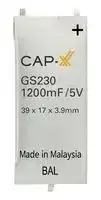
Image not available
Illustrative purposes only

GS203F
Supercapacitor, Dual Cell, 0.27 F, 5 V, Solder, ± 20%
⚠️ Reference pricing provided. In case of supply shortages, we will connect you with our trusted procurement partners to ensure your project's continuity.
- Manufacturer: CAP-XX
- Product type: EDLC - Electric Double Layer Capacitors
- ESR: 0.04ohm
- SVHC: No SVHC (21-Jan-2025)
- Capacitance: 0.27F
- Voltage(DC): 5V
- Lead Spacing: -
- Product Range: GS203 Series
- Product Width: 17mm
- Qualification: -
- Product Height: 2.1mm
- Product Length: 39mm
- Product Diameter: -
- Capacitor Mounting: Surface Mount
- Capacitor Terminals: Solder
- Capacitance Tolerance: ± 20%
- Lifetime @ Temperature: -
- Capacitor Case / Package: SMD
- Operating Temperature Max: 70°C
- Operating Temperature Min: -40°C
| Delivery and price | |
|---|---|
| Units per pack | 1200 |
| Price | 5.88 € |
| Current stock | 500+ |
| Lead time | 30 days |
Datasheet

## **DATASHEET** ## **GS130 / GS230 SUPERCAPACITOR** Revision 4.5, May 2020 ## **Electrical Specifications** The GS130 is a single cell supercapacitor. The GS230 is a dual cell supercapacitor with two GS130 cells in series, so GS230 capacitance = Capacitance of GS130/2 and GS230 ESR = 2 x GS130 ESR. **Table 1: Absolute Maximum Ratings** |**Parameter**|**Name**||**Conditions**|**Min**|**Typical**|**Max**|**Units**| |---|---|---|---|---|---|---|---| |**Terminal**<br>**Voltage**|Vpeak|GS130||0||2.75|V| |||GS230||||5.5|| |**Temperature**|Tmax|||-40||+70|°C| **Table 2: Electrical Characteristics** |**Parameter**|**Name**<br>~~=}~~|~~=}~~|**Conditions**<br>~~=}St~~|**Min**<br>~~St~~|**Typical**<br>~~St~~|**Max**<br>~~St~~|**Units**<br>~~St~~| |---|---|---|---|---|---|---|---| |**Terminal**<br>**Voltage**|Vn<br>~~=}~~<br>~~=}~~|GS130<br>~~a~~<br>~~=}~~|~~=}St~~<br>~~=}St~~|0<br>~~a~~<br>~~St~~|~~St~~|2.5<br>~~St~~|V<br>~~St~~<br>~~St~~| |||GS230<br>~~=}~~<br>~~=}~~||0<br>~~St~~<br>~~St~~|~~St~~<br>~~St~~|5.0<br>~~St~~<br>~~St~~|| |**Capacitance**|C<br>~~=}~~<br>~~=}~~|GS130<br>~~=}~~<br>~~=}~~|DC, 23°C<br>~~=}St~~<br>~~=}St~~|1920<br>~~St~~<br>~~St~~|2400<br>~~St~~<br>~~St~~|2880<br>~~St~~<br>~~St~~|mF<br>~~St~~<br>~~St~~| |||GS230<br>~~=}~~<br>~~=}~~||960<br>~~St~~<br>~~St~~|1200<br>~~St~~<br>~~St~~|1440<br>~~St~~<br>~~St~~|| |**ESR**|ESR<br>~~=}~~<br>~~=}~~<br>~~a~~|GS130<br>~~=}~~<br>~~=}~~|DC, 23°C<br>~~=} St~~<br>~~=}St~~<br>|~~St~~<br>~~St~~|15<br>~~St~~<br>~~St~~|18<br>~~St~~<br>~~St~~|m<br>~~St~~<br>~~St~~<br>~~ee~~<br>| |||GS230<br>~~=}~~<br>||~~St~~<br>|25<br>~~St~~<br>|30<br>~~St~~<br>~~ee~~<br>|| |**Leakage Current**|IL<br>~~=}~~<br>~~a~~<br>~~a~~|~~=}~~<br>~~ee~~<br>|2.3V, 23°C 120hrs<br>~~=} St~~<br>~~ee~~<br>|~~St~~<br>~~ee~~<br>|2.5<br>~~St~~<br>~~ee~~<br>|5<br>~~St~~<br>~~ee~~<br>~~ee~~<br>|µA<br>~~St~~<br>~~ee~~<br>~~ee~~<br>| |**RMS Current**|IRMS<br>~~a~~<br>~~a~~|~~eee~~<br>~~a~~|23°C<br>~~eee~~<br>~~ee~~|~~eee~~<br>~~eee~~|~~eee~~<br>~~eee~~|8<br>~~ee~~<br>~~eee~~<br>~~eee~~|A<br>~~ee~~<br>~~eee~~<br>~~eee~~| |**Peak Current1 **|IP<br>~~a~~|~~a~~|23°C<br>~~ee~~|~~eee~~|~~eee~~|30<br>~~eee~~|A<br>~~eee~~| **Table 3: Thickness** |**GS130F**|**1.9mm**|No adhesive tape on underside<br>of the supercapacitor|**GS130G**|**2.0mm**|Adhesive tape on underside,<br>release tape removed| |---|---|---|---|---|---| |**GS230F**|**3.9mm**||**GS230G**|**4.0mm**|| This datasheet should be read in conjunction with the _CAP-XX Supercapacitor Product Guide_ which contains information common to our product lines. © CAP-XX Pty Limited 2020 | Tel +61 2 9420 0690 | www.cap-xx.com Page **1** of **8** Revision 4.5, May 2020 **GS130 / GS230 DATASHEET** ## **Definition of Terms** In its simplest form, the Equivalent Series Resistance (ESR) of a capacitor is the real part of the complex impedance. In the time domain, it can be found by applying a step discharge current to a charged cell as in Fig. 1. In this figure, the supercapacitor is pre-charged and then discharged with a current pulse, I =1A for duration 0.01 sec. **Figure 1: Effective capacitance, instantaneous capacitance and ESR for a GS230** The ESR is found by dividing the instantaneous voltage step (∆V) by I. In this example = (4.49V - 4.475V)/1A = 15mΩ. The instantaneous capacitance (Ci) can be found by taking the inverse of the derivative of the voltage, and multiplying it by I. The effective capacitance for a pulse of duration tn, Ce(tn) is found by dividing the total charge removed from the capacitor (∆Qn) by the voltage lost by the capacitor (∆Vn). For constant current Ce(tn) = I x tn/Vn. Ce increases as the pulse width increases and tends to the DC capacitance value as the pulse width becomes very long (~10 secs). After 2msecs, Fig 1 shows the voltage drop V2ms = (4.475V – 4.461V) = 14mV. Therefore Ce(2ms) = 1A x 2ms/14mV = 142mF. After 10ms, the voltage drop = 4.475 V – 4.445V = 30mV. Therefore Ce(10ms) = 1 A x 10ms/30mV = 333mF. The DC capacitance of a GS230 = 1.2 F. Note that ∆V, or IR drop, is not included because very little charge is removed from the capacitor during this time. Ce shows the time response of the capacitor and it is useful for predicting circuit behaviour in pulsed applications. © CAP-XX Pty Limited 2020 | Tel +61 2 9420 0690 | www.cap-xx.com Page **2** of **8** Revision 4.5, May 2020 **GS130 / GS230 DATASHEET** ## **Measurement of DC Capacitance** **Fig 2: Measurement of DC Capacitance for a GS230** Fig 2 shows the measurement of DC capacitance by drawing a constant 100mA current from a fully charged supercapacitor and measuring the time taken to discharge from 1.5V to 0.5V for a single cell, or from 3V to 1V for a dual cell supercapacitor. In this case, C = 0.1A x 24.9s /2V = 1245mF, which is well within the 1200mF +/- 20% tolerance for a GS230 cell. ## **Measurement of ESR** **Fig 3: Measurement of ESR for a GS230** Fig 3 shows DC measurement of ESR by applying a step load current to the supercapacitor and measuring the resulting voltage drop. CAP-XX waits for a delay of 50µs after the step current is applied to ensure the voltage and current have settled. In this case the ESR is measured as 20mV/1A = 20mΩ. © CAP-XX Pty Limited 2020 | Tel +61 2 9420 0690 | www.cap-xx.com Page **3** of **8** Revision 4.5, May 2020 **GS130 / GS230 DATASHEET** ## **Effective Capacitance (Ceff)** **Fig 4: Effective Capacitance** Fig 4 shows the effective capacitance for the GS130, GS230 @ 23°C. This shows that for a 1ms PW, you will measure 10% of DC capacitance or 240mF for a GS130 or 120mF for a GS230. At 10ms, you will measure 31% of the DC capacitance, and at 100ms you will measure 72% of DC capacitance. Ceffective is a time domain representation of the supercapacitor's frequency response. If, for example, you were calculating the voltage drop if the supercapacitor was supporting 1A for 10ms, then you would use the Ceff(10msecs) = 31% of DC capacitance = 372mF for a GS230, so Vdrop = 1A x ESR + 1A x duration/C = 1A x 25mΩ + 1A x 10ms / 372mF = 52mV. The next section on pulse response shows how the effective capacitance is sufficient for even short pulse widths. ## **Pulse Response** Fig 5 shows that the GS230 supercapacitor does an excellent job supporting a GPRS class 10 pulse train, drawing 1.8A for 1.1ms at 25% duty cycle. The source is current limited to 0.6A and the supercapacitor provides the 1.2A difference to achieve the peak current. At first glance the freq response of Fig 8 indicates the supercapacitor would not support a 1.1ms pulse, but the Ceff of 132mF coupled with the low ESR supports this pulse train with only ~45mV droop in the supply rail. **Fig 5: GS230 Pulse Response with GPRS Class 10 Pulse Train** © CAP-XX Pty Limited 2020 | Tel +61 2 9420 0690 | www.cap-xx.com Page **4** of **8** Revision 4.5, May 2020 **GS130 / GS230 DATASHEET** ## **Accurate Calculation of Voltage Drop for a Pulse Using Ceff** The combination of the method used by CAP-XX to measure ESR and effective capacitance for a given pulsewidth given in Fig 4 enable the accurate calculation of voltage drop for a pulse with current _I_ and pulsewidth _T_ as Vdrop = _I_ .[ESR + _T_ /Ceff( _T_ )]. Using the pulse train of Fig 5 as an example, _I_ = 1.8A – 0.6A = 1.2A. _T_ = 1.1ms. Nominal DC capacitance = 1200mF, and from Fig 4, Ceff(1.1ms) = 12% x 1200mF = 144mF. Nominal ESR = 24mΩ, so Vdrop = 1.2A[0.024Ω+0.0011s/0.144F] = 38mV. Fig 5 shows a voltage drop = 45mV verifying that the calculation is a good approximation. This avoids the need to run SPICE for a simple calculation. ## **DC Capacitance variation with temperature** **Fig 6: Capacitance change with temperature** Fig 6 shows that DC capacitance is approximately constant with temperature. ## **ESR variation with temperature** **Fig 7: ESR change with temperature** Fig 7 shows that ESR at -40°C is ~2.2 x ESR at room temp, and that ESR at 70ºC is ~0.8 x ESR at room temperature. © CAP-XX Pty Limited 2020 | Tel +61 2 9420 0690 | www.cap-xx.com Page **5** of **8** Revision 4.5, May 2020 **GS130 / GS230 DATASHEET** ## **Frequency Response** **Fig 8: Frequency Response of Impedance (biased at 5V with a 50mV test signal)** **Fig 9: Frequency Response of ESR, Capacitance & Inductance** Fig 8 shows the supercapacitor behaves as an ideal capacitor until approx 3 Hz when the magnitude no longer rolls off proportionally to 1/freq and the phase crosses -45°. Performance of supercapacitors with frequency is complex and the best predictor of performance is Fig 4 showing effective capacitance as a function of pulsewidth. © CAP-XX Pty Limited 2020 | Tel +61 2 9420 0690 | www.cap-xx.com Page **6** of **8** Revision 4.5, May 2020 **GS130 / GS230 DATASHEET** ## **Leakage Current** **Fig 10: Leakage Current** Fig 10 shows the leakage current for GS130 at room temperature. The leakage current decays over time, and the equilibrium value leakage current will be reached after ~120hrs at room temperature. The typical equilibrium leakage current is ~1µA at room temperature. At 70°C leakage current will be ~10µA. ## **Charge Current** **Fig 11: Charging a GS130 with low current** The corollary to the slow decay in leakage currents shown in Fig 10 is that charging a supercapacitor at very low currents takes longer than theory predicts. At higher charge currents, the charge rate is as theory predicts. For example, it should take 2.4F x 2.2V / 0.00002A = 80hrs to charge a 2.4 F supercapacitor to 2.2V at 20µA, but Fig 11 shows it took 115hrs. At 100µA charging occurs at a rate close to the theoretical rate. © CAP-XX Pty Limited 2020 | Tel +61 2 9420 0690 | www.cap-xx.com Page **7** of **8** Revision 4.5, May 2020 **GS130 / GS230 DATASHEET** ## **RMS Current** **Fig 12: Temperature rise in GS230 with RMS current** Continuous current flow into/out of the supercap will cause self heating, which limits the maximum continuous current the supercapacitor can handle. This is measured by a current square wave with 50% duty cycle, charging the supercapacitor to rated voltage at a constant current, then discharging the supercapacitor to half rated voltage at the same constant current value. For a square wave with 50% duty cycle, the RMS current is the same as the current amplitude. Fig 12 shows the increase in temperature as a function of RMS current. From this, the maximum RMS current in an application can be calculated, for example, if the ambient temperature is 40C, and the maximum desired temperature for the supercapacitor is 70C, then the maximum RMS current should be limited to 7A, which causes a 30C temperature increase. ## **CAP-XX Supercapacitors Product Guide** Refer to the package drawings in the CAP-XX Supercapacitors Product Guide for detailed information of the product’s dimensions, PCB landing placements, active areas and electrical connections, as well for information on endurance and shelf life, transportation and storage, assembly and soldering, safety and RoHS/REACH certification. © CAP-XX Pty Limited 2020 | Tel +61 2 9420 0690 | www.cap-xx.com Page **8** of **8**
Updated at April 29, 2026
About Novapart
Novapart is a B2B electronic component broker specialising in stock shortages and cost reduction. We source hard-to-find parts and identify compliant alternatives across a catalogue of 410,000+ components from 500+ manufacturers.
Learn more →Stock Shortage Specialist
When a component is unavailable, discontinued or has an unacceptable lead time, we tap into our network of vetted European and Asian distributors to source what you need — without compromising on quality or traceability.
Request a quote →Compliant Alternatives
We identify pin-to-pin, electrically equivalent substitutes that meet the same certifications (RoHS, AEC-Q100, REACH) as your original specification — validated against datasheets, not just part numbers. Often at a lower cost.
BOM Analysis service →