
Image not available
Illustrative purposes only

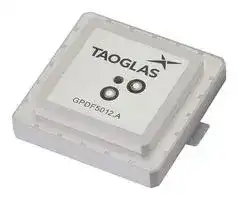
GPDF5012.A
RF Antenna, 1.602GHz, GPS / GNSS / Glonass / Galileo / BeiDou / IRNSS / QZSS / SBAS, 4.44dBi, 50ohm
⚠️ Reference pricing provided. In case of supply shortages, we will connect you with our trusted procurement partners to ensure your project's continuity.
- Manufacturer: TAOGLAS
- Product type:
- Gain: 4.44dBi
- SVHC: No SVHC (23-Jan-2024)
- VSWR: 1.5
- Input Power: -
- Antenna Type: GPS / GNSS / Glonass / Galileo / BeiDou / IRNSS / QZSS / SBAS
- Frequency Max: 1.602GHz
- Frequency Min: -
- Product Range: -
- Input Impedance: 50ohm
- Antenna Mounting: Adhesive / Pin
- Antenna Polarisation: Right Hand Circular
| Delivery and price | |
|---|---|
| Units per pack | 5 |
| Price | 16.86 € |
| Current stock | 100+ |
| Lead time | 30 days |
Datasheet

Qd Y) © + ©

|1.|Introduction|3|
|---|---|---|
|2.|Specifications|4|
|3.|Antenna Characteristics (with hybrid coupler)|6|
|4.|Radiation Patterns|11|
|5.|Field Test Data|17|
|6.|Mechanical Drawing|19|
|7.|Evaluation Board Mechanical Drawing|20|
|8.|Antenna Integration Guide|21|
|9.|Packaging|28|
||Changelog|29|


Taoglas makes no warranties based on the accuracy or completeness of the contents of this document and reserves the right to make changes to specifications and product descriptions at any time without notice. Taoglas reserves all rights to this document and the information contained herein. Reproduction, use or disclosure to third parties without express permission is strictly prohibited.

www.taoglas.com 2

SPE-20-8-103-E

## **1.** Introduction

The Taoglas GPDF5012.A is a high performance, multi-band passive GNSS antenna that has been carefully designed to provide fantastic positional accuracy on the full GNSS spectrum. It covers GPS/QZSS L1/L2/L5, GLONASS G1/G2/G3, Galileo E1/E5a/E5b, BeiDou B1/B2a/B2b, NAVIC L5, as well as SBAS (WAAS/EGNOS/GAGAN/SDCM/SNAS).

Correct implementation of the GPDF5012.A allows the user to achieve higher location accuracy, as well as stability of position tracking in urban environments. The stacked patch construction has excellent performance across the full bandwidth of the antenna. Its design has an even gain across the hemisphere, giving excellent axial ratio, which in turn makes it extremely resilient to multipath rejection and provides excellent phase centre stability.

Typical applications that benefit from high precision capabilities include:

- Autonomous Driving

- Precision Positioning for Robotics

- Precision Agriculture

- Telematics & Container / Asset Tracking

- Timing Accuracy Synchronization

The GPDF5012.A is the latest embedded addition to Taoglas’ product portfolio of high precision GNSS antennas. When used on the base and/or the rover as part of an RTK configuration, the GPDF5012.A can achieve genuine cm-level accuracy with proven results.

Full integration guidelines are contained in Section 8 of this datasheet including the Taoglas HC125.A hybrid coupler that will be required for use for dual pin feed patch integrations. An active version of this antenna, the ADFGP.50A.07.0100C is available and supplied with 100mm cable and I-PEX MHFI connector as standard.

Contact your local Taoglas Customer Services team for more information on any of the products listed above or for support regarding integration.

www.taoglas.com 3

SPE-20-8-103-E

## **2.** Specifications

|**GNSS Frequency Bands Covered**|**GNSS Frequency Bands Covered**|**GNSS Frequency Bands Covered**|**GNSS Frequency Bands Covered**|**GNSS Frequency Bands Covered**|**GNSS Frequency Bands Covered**|**GNSS Frequency Bands Covered**|**GNSS Frequency Bands Covered**|
|---|---|---|---|---|---|---|---|
|**GPS**|L1|L2|L5|||||
||▓|▓|▓|||||
|**GLONASS**|G1|G2|G3|||||
||▓|▓|▓|||||
|**Galileo**|E1|E5a|E5b|E6||||
||▓|▓|▓|□||||
|**BeiDou**|B1|B2a|B2b|B3||||
||▓|▓|▓|□||||
|**QZSS**<br>**(Regional)**|L1|L2C|L5|L6||||
||▓|▓|▓|□||||
|**IRNSS**<br>**(Regional)**|L5|||||||
||▓|||||||
|**SBAS**|L1/E1/B1|L5/B2a/E5a|G1|G2|G3|||
||▓|▓|▓|▓|▓|||


*SBAS systems: WASS(L1/L5), EGNOSS(E1/E5a), SDCM(G1/G2/G3), SNAS(B1,B2a), GAGAN(L1/L5), QZSS(L1/L5), KAZZ(L1/L5).

## GNSS Bands and Constellations

www.taoglas.com

SPE-20-8-103-E

4

## **GNSS Electrical**

|**GNSS Electrical**|**GNSS Electrical**|**GNSS Electrical**|**GNSS Electrical**|**GNSS Electrical**|**GNSS Electrical**|
|---|---|---|---|---|---|
|**Frequency (MHz)**|**1176.45**|**1227.6**|**1561**|**1575.42**|**1602**|
|VSWR (max.)|1.5:1|1.5:1|1.5:1|1.5:1|1.5:1|
|Passive Antenna Efficiency (%)|27.6|30.6|51.2|65.3|68.6|
|Passive Antenna Gain at Zenith (dBi)|0.90|0.92|2.96|4.32|4.44|
|Axial Ratio (dB)|1.46|1.03|1.24|1.08|1.19|
|Group Delay (ns)|2.5|6|3|3|3|
|PCO (cm)|0.9|1.0|1.1|1.1|1.1|
|PCV (cm)|1.0|1.1|1.2|1.2|1.2|
|Polarization|RHCP|||||
|Impedance|50Ω|||||


**Note:  The antenna with Hybrid coupler was tested on a 70X70 mm ground plane The PCO and PCV are calculated using a field of view of 60° elevation from zenith**

## **Mechanical**

|**Mechanical**|**Mechanical**|
|---|---|
|Height|12.5 mm|
|Planner Dimension|50 x 50 mm diameter|
|Weight|86 g|
||**Environmental**|
|Temperature Range|-40°C to 85°C|
|RoHS Compliant|Yes|
|REACH Compliant|Yes|


www.taoglas.com 5

SPE-20-8-103-E

## **3.** Antenna Characteristics(with hybrid coupler)

## **3.1** L2_L5 - Return Loss (From Hybrid Couplers) 7

**==> picture [455 x 283] intentionally omitted <==**

**----- Start of picture text -----**<br>
0<br>-5<br>-10<br>-15<br>-20<br>-25<br>-30<br>-35<br>-40<br>-45<br>-50<br>1000 1050 1100 1150 1200 1250 1300 1350 1400<br>Frequency [MHz]<br>Return Loss [dB]<br>**----- End of picture text -----**<br>


## 4 **3.2** L1 - Return Loss (From Hybrid Couplers)

**==> picture [462 x 268] intentionally omitted <==**

**----- Start of picture text -----**<br>
0<br>-5<br>-10<br>-15<br>-20<br>-25<br>-30<br>-35<br>-40<br>-45<br>-50<br>1400 1450 1500 1550 1600 1650 1700 1750 1800<br>Frequency [MHz]<br>Return Loss [dB]<br>**----- End of picture text -----**<br>


www.taoglas.com

SPE-20-8-103-E

6

## **3.3** L2_L5 - Efficiency 4

**==> picture [454 x 257] intentionally omitted <==**

**----- Start of picture text -----**<br>
100<br>90<br>80<br>70<br>60<br>50<br>40<br>30<br>20<br>10<br>0<br>1000 1050 1100 1150 1200 1250 1300 1350 1400<br>Frequency [MHz]<br>Efficiency[%]<br>**----- End of picture text -----**<br>


## 4 **3.4** L1 – Efficiency

**==> picture [459 x 277] intentionally omitted <==**

**----- Start of picture text -----**<br>
100<br>90<br>80<br>70<br>60<br>50<br>40<br>30<br>20<br>10<br>0<br>1400 1450 1500 1550 1600 1650 1700 1750 1800<br>Frequency [MHz]<br>Efficiency[%]<br>**----- End of picture text -----**<br>


www.taoglas.com 7

SPE-20-8-103-E

## **3.5** L2_L5 - Average Gain 4

**==> picture [454 x 259] intentionally omitted <==**

**----- Start of picture text -----**<br>
0<br>-2<br>-4<br>-6<br>-8<br>-10<br>-12<br>1000 1050 1100 1150 1200 1250 1300 1350 1400<br>Frequency [MHz]<br>Average Gain (dB)<br>**----- End of picture text -----**<br>


## **3.6** L1 – Peak Gain 4

**==> picture [448 x 259] intentionally omitted <==**

**----- Start of picture text -----**<br>
0<br>-2<br>-4<br>-6<br>-8<br>-10<br>-12<br>1400 1450 1500 1550 1600 1650 1700 1750 1800<br>Frequency [MHz]<br>Average Gain (dB)<br>**----- End of picture text -----**<br>


www.taoglas.com 8

SPE-20-8-103-E

## **3.7** L2_L5 -  Peak Gain 4

**==> picture [448 x 257] intentionally omitted <==**

**----- Start of picture text -----**<br>
10<br>8<br>6<br>4<br>2<br>0<br>-2<br>-4<br>-6<br>-8<br>-10<br>1000 1050 1100 1150 1200 1250 1300 1350 1400<br>Frequency [MHz]<br>Peak Gain [dBi]<br>**----- End of picture text -----**<br>


## **3.8** L1 - Peak Gain 4

**==> picture [456 x 287] intentionally omitted <==**

**----- Start of picture text -----**<br>
10<br>8<br>6<br>4<br>2<br>0<br>-2<br>-4<br>-6<br>-8<br>-10<br>1400 1450 1500 1550 1600 1650 1700 1750 1800<br>Frequency [MHz]<br>Peak Gain [dBi]<br>**----- End of picture text -----**<br>


www.taoglas.com 9

SPE-20-8-103-E

## **3.9** Axial Ratio

**==> picture [470 x 384] intentionally omitted <==**

**----- Start of picture text -----**<br>
20<br>L1<br>18<br>L2_L5<br>16<br>14<br>12<br>10<br>8<br>6<br>4<br>2<br>0<br>1000 1100 1200 1300 1400 1500 1600 1700 1800<br>Frequency [MHz]<br>Phi=0  Phi=90<br>|WTotaT TooRHIOroTyooo<br>00 1 esee EAMLLIA|<br>\ | SE A a i | 1} AY<br>AIEEE SIRES<br>| Si<br>Axial Ratio [dB]<br>**----- End of picture text -----**<br>


www.taoglas.com 10

SPE-20-8-103-E

## **4.** Radiation Patterns

**4.**

## **4.1** Test Setup

www.taoglas.com 11

SPE-20-8-103-E

## **4.2** GNSS L1 Band 3D and 2D Radiation Patterns

Gain total, 1560MHz

## XY Plane

## XZ Plane YZ Plane

www.taoglas.com 12

SPE-20-8-103-E

## Gain total, 1575.42MHz

## XY Plane

## XZ Plane

## YZ Plane

www.taoglas.com 13

SPE-20-8-103-E

## Gain total, 1600MHz

## XY Plane

## XZ Plane

## YZ Plane

www.taoglas.com 14

SPE-20-8-103-E

## **4.3** GNSS L2 L5 Band 3D and 2D Radiation Patterns

Gain total, 1177MHz

## XY Plane

## XZ Plane

## YZ Plane

www.taoglas.com 15

SPE-20-8-103-E

## Gain total, 1228MHz

## XY Plane

## XZ Plane

## YZ Plane

www.taoglas.com 16

SPE-20-8-103-E

## **5.** Field Test Results

This section outlines the field test result for GPDF5012.A antenna. The test was performed when the antenna was mounted on a static rooftop test set up in an open sky environment for a minimum of 6 hours.

Taoglas will show the field test results using the following receivers:

## **5.1** Ublox ZED-F9P-0XB

## Receiver features:

- Multi-band GNSS: 184-channel GPS L1C/A L2C, GLONASS: L1OF L2OF, Galileo: E1B/C E5b, BeiDou: B1I B2I, QZSS: L1C/A L2C

- Multi ‑ band RTK with fast convergence times and reliable performance

- Nav. update rate RTK up to 20 Hz

- Position accuracy = RTK 0.01 m + 1 ppm CEP

|**Positioning Accuracy Table(2D Accuracy)**<br>~~ee~~|**Positioning Accuracy Table(2D Accuracy)**<br>~~ee~~|**Positioning Accuracy Table(2D Accuracy)**<br>~~ee~~|**Positioning Accuracy Table(2D Accuracy)**<br>~~ee~~|**Positioning Accuracy Table(2D Accuracy)**<br>~~ee~~|**Positioning Accuracy Table(2D Accuracy)**<br>~~ee~~|
|---|---|---|---|---|---|
|**Test**<br>**Condition**<br>~~ee~~|**DRMS(cm)**<br>~~ee~~|**CEP (50%)**<br>~~ee~~|**DRMS (68%)**<br>~~ee~~|**2DRMS (95-98.2%)**<br>~~ee~~|**TTFF (sec)**<br>~~ee~~|
|**70x70mm**<br>**Ground**<br>**Plane**|RTK DISABLED|46.6|56.4|112.8|32|
||RTK ENABLED|1.0|1.2|2.4|32|


RTK Availability 70x70 mm ground plane

**==> picture [36 x 50] intentionally omitted <==**

**----- Start of picture text -----**<br>
No RTK<br>Float<br>Fixed<br>**----- End of picture text -----**<br>


www.taoglas.com 17

SPE-20-8-103-E

## **5.2** Ublox NEO-F9P-15B

## Receiver features:

- Multi-band GNSS: GPS / QZSS (L1C/A, L5) GLONASS (L1OF) Galileo (E1-B/C, E5a) BeiDou (B1I, B2a) NavIC (SPS-L5)

- Multi ‑ band PPP-RTK with fast convergence times and reliable performance

- Nav. update rate RTK up to 25 Hz

-

- Position accuracy = RTK 0.01 m + 1 ppm CEP

|**Positioning Accuracy Table(2D Accuracy)**|**Positioning Accuracy Table(2D Accuracy)**|**Positioning Accuracy Table(2D Accuracy)**|**Positioning Accuracy Table(2D Accuracy)**|**Positioning Accuracy Table(2D Accuracy)**|**Positioning Accuracy Table(2D Accuracy)**|
|---|---|---|---|---|---|
|**Test**<br>**Condition**|**DRMS(cm)**|**CEP (50%)**|**DRMS (68%)**|**2DRMS (95-98.2%)**|**TTFF (sec)**|
|**70x70mm**<br>**Ground**<br>**Plane**|PPP-RTK<br>DISABLED|103.19|123.52|247.06|27|
||PPP-RTK<br>ENABLED|16.7|20.04|40.08|33|


*The RTK correction service used in previous measurements provides superior corrections compared to the PPP-RTK service used for measurements on the NEO-F9P.

PPP-RTK Availability 70x70 mm ground plane

**==> picture [204 x 121] intentionally omitted <==**

**----- Start of picture text -----**<br>
6%<br>No PPP-RTK<br>/<br>: PPP-RTK Float<br>a PPP-RTK Fixed<br>94%<br>**----- End of picture text -----**<br>


www.taoglas.com 18

SPE-20-8-103-E

## **6.** Mechanical Drawing (Units: mm)

www.taoglas.com 19

SPE-20-8-103-E

## **78.** Packaging Evaluation Board Drawing (Units: mm)

www.taoglas.com 20

SPE-20-8-103-E

## **8.** Packaging Antenna Integration Guide

www.taoglas.com 21

SPE-20-8-103-E

## **8.1** Schematic Symbol and Pin Definitions 4

The circuit symbol for the antenna is shown below. The antenna has 4 pins as indicated below. The L1P1 and L1P2 (Pin 1 and 2) represent the higher GNSS frequency bands at 1559 - 1610MHz and the L2P1 and L2P2 (Pin 3 and 4) represent the lower GNSS frequency bands at 1164 - 1300MHz, including L5, E5a and E5b bands.

|**Pin**<br>~~Lo~~|**Description**<br>~~Lo~~|
|---|---|
|**1**|L1P1 (0˚)|
|**2**|L1P2 (-90˚)|
|**3**|L2P1 (0˚)|
|**4**|L2P2 (-90˚)|


**==> picture [146 x 56] intentionally omitted <==**

**----- Start of picture text -----**<br>
‘Al<br>**----- End of picture text -----**<br>


www.taoglas.com 22

SPE-20-8-103-E

## **8.2** Antenna Integration

The antenna should be placed at the center of the PCB, in our integration we have used a 70mm X 70mm PCB evaluation board. Maintaining a symmetric ground plane shape and symmetric environment around the antenna is critical to maintaining the excellent axial ratio and phase center performance shown in this datasheet. The opposite side of the PCB from the antenna may be used for device electronics and does not need to maintain symmetry.

www.taoglas.com 23

SPE-20-8-103-E

## **8.3** PCB Layout

The footprint and clearance on the PCB must comply with the antenna specification. The PCB layout shown in the diagram below demonstrates the antenna footprint.

Note that the hybrid couplers may be placed closer to the antenna pins. It is important that the trace length from the antenna pins are equal to their respected hybrid coupler. This is necessary to maintain the integrity of the phase in the signal.

www.taoglas.com 24

SPE-20-8-103-E

**8.4** Eval Board

www.taoglas.com 25

SPE-20-8-103-E

## **8.5** Matching Circuit

Each patch element uses two orthogonal feeds that need to be combined in a hybrid coupler to ensure optimal axial ratio. Taoglas recommends our HC125.A, a high-performance hybrid coupler specifically engineered for use with our multi feed patches.

Two HC125.A’s are required for this antenna, one for the high GNSS band of operation (1559-1610MHz) and another for the low GNSS band (1164MHz – 1300MHz). These hybrid couplers should be placed close to the antenna pins and terminated correctly using 2x 100ohm resistors in parallel.

The output of each of the hybrid couplers can feed into separate paths for high and low band GNSS filtering and amplification.

|**Designator**|**Type**|**Value**|**Manufacturer**|**Manufacturer Part Number**|
|---|---|---|---|---|
|R1, R2, R3, R4|Resistor|100Ω (1%)|Vishay|CRCW0603100RFKEC|


www.taoglas.com 26

SPE-20-8-103-E

**==> picture [97 x 12] intentionally omitted <==**

**----- Start of picture text -----**<br>
8.6 Footprint<br>**----- End of picture text -----**<br>


www.taoglas.com 27

SPE-20-8-103-E

**8.9 Packaging**

8pcs GPDF5012.A per Tray Weight: 690g

32pcs GPDF5012.A per Inner Carton Dimensions: 263*154*96 mm Weight: 3Kg

128pcs GPDF5012.A per Inner Carton Dimensions: 327*280*218 mm Weight: 12.5Kg

www.taoglas.com 28

SPE-20-8-103-E

Changelog for the datasheet **SPE-20-8-103 – GPDF5012.A Revision: E (Current Version)** Date: 2023-07-25 Notes: Updated Antenna Field Testing Author: Gary West

## **Previous Revisions**

**Revision: D** Date: 2023-05-16 Notes: Updated test data Author: Gary West **Revision: C** Date: 2022-01-11 Notes: Added integration guide Author: Gary West **Revision: B** Date: 2022-01-11 Notes: Added integration guide Author: Gary West **Revision: A (Original First Release)** Date: 2020-10-14 Notes: Initial Release Author: Jack Conroy

www.taoglas.com 29

SPE-20-8-103-E

www.taoglas.com

www.taoglas.com © Taoglas 30

SPE-20-8-103-E
Updated at June 9, 2026
About Novapart
Novapart is a B2B electronic component broker specialising in stock shortages and cost reduction. We source hard-to-find parts and identify compliant alternatives across a catalogue of 410,000+ components from 500+ manufacturers.
Learn more →Stock Shortage Specialist
When a component is unavailable, discontinued or has an unacceptable lead time, we tap into our network of vetted European and Asian distributors to source what you need — without compromising on quality or traceability.
Request a quote →Compliant Alternatives
We identify pin-to-pin, electrically equivalent substitutes that meet the same certifications (RoHS, AEC-Q100, REACH) as your original specification — validated against datasheets, not just part numbers. Often at a lower cost.
BOM Analysis service →