
Image not available
Illustrative purposes only

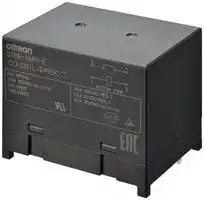
G7EB-1AP1-E-DC12
Power Relay, G7EB Series
⚠️ Reference pricing provided. In case of supply shortages, we will connect you with our trusted procurement partners to ensure your project's continuity.
- Manufacturer: OMRON / PARTNER STOCK
- Product type: Power Relays
- SVHC: To Be Advised
- Product Range: G7EB Series
| Delivery and price | |
|---|---|
| Units per pack | 6 |
| Price | 50.9 € |
| Current stock | 100+ |
| Lead time | 30 days |
Datasheet

G 7 E B ## G7EB PCB Power Relays ## **High Power and High Temperature Type Power Relay with 480 VAC 100 A Current** - 480 VAC/100 A high current switching - 60 VDC/100 A for normal/reverse direction switching - Ambient temperature 85°C - High impulse withstand voltage, 10 kV - Contact gap ≥3.6 mm (Applied to VDE0126) - Low initial contact resistance ≤5 m Ω ## **Model Number Legend** **G7EB-** 1 2 3 4 1. Number of Poles 2. Contact Form 3. Terminal Shape 1: 1-pole A: SPST-NO (1a) None: Standard type P1: Special terminal type 4. Special Functions None: Standard type E: High-capacity type ## **Application Examples** - Power conditioner inverter - Industrial inverter - UPS ## **Ordering Information** |Category|Category|Contact form|Enclosure rating|Model|Rated coil voltage (V)|Minimum packing unit| |---|---|---|---|---|---|---| |Standard|Standard terminals|SPST-NO (1a)|Flux protection|G7EB-1A|12 VDC<br>24 VDC|60pcs/box| ||Special terminals|||G7EB-1AP1||| |High-capacity type|Standard terminals|||G7EB-1A-E||| ||Special terminals|||G7EB-1AP1-E||| Note. When ordering, add the rated coil voltage to the model number. Example: G7EB-1A DC12 Rated coil voltage Both the coil voltage on the product case and the packing will be marked as VDC. ## **Ratings** ## **Coil** |Rated voltage|Rated current<br>(mA)|Coil resistance<br>(Ω)|Must operate voltage<br>(V)|Must release voltage<br>(V)|Max. voltage<br>(V)|Power consumption<br>(mW)| |---|---|---|---|---|---|---| ||||% of rated voltage|||| |12 VDC|Approx. 235.3|51|75% max. (Note 5.)|5 to 32%|135%<br>(at 23°C)|Approx. 2,800<br>Approx. 575 (Note 4.)| |24 VDC|Approx. 116.5|206||||| Note 1. The rated current and resistance are measured at a coil temperature of 23°C with a tolerance of ±10%. Note 2. The operating characteristics are measured at a coil temperature of 23°C. Note 3. The maximum permissible voltage is the maximum value of the fluctuation range for the relay coil operating power supply and was measured at an ambient temperature of 23°C. Note 4. Use this relay with coil voltage reduction. For details, please refer to ●Relay Operation and Coil Voltage Reduction (Holding Voltage) on page 5. Note 5. Do not use in any direction other than the specified direction. For details, please refer to ●Mounting Direction on page 5. For contact terminals mounted in the downward direction, the operating voltage will be at most 80% of the rated voltage. (Contact terminals downward direction: The direction in which the marked surface faces the ground) **1** G7EB **PCB Power Relays** G 7 E B ## **Contacts** |Item|G7EB-1A<br>G7EB-1AP1|G7EB-1A-E<br>G7EB-1AP1-E| |---|---|---| |Contact type|Double|| |Contact material|Ag Alloy (Cd free)|| |Rated load|100 A at 480 VAC, 40A at 800 VAC<br>100 A at 60 VDC, 50 A at 60 VDC, 40 A at 60 VDC|| |Rated carry current|100 A|120 A| |Max. switching voltage|800 VAC, 60 VDC|| |Max. switching current|100 A|| ## Characteristics |Item<br>Model|Item<br>Model|G7EB-1A<br>G7EB-1AP1|G7EB-1A-E<br>G7EB-1AP1-E| |---|---|---|---| |Contact resistance *1||5 mΩmax.|| |Operate time *2||30 ms max.|| |Release time *2||10 ms max.|| |Insulation resistance *3||1,000 MΩmin.|| |Dielectric strength|Between coil and contacts|5,000 VAC, 50/60 Hz for 1 min|| ||Between contacts of the<br>same polarity|2,000 VAC, 50/60 Hz for 1 min|| |Impulse withstand voltage||Between coil and contacts 10 kV (1.2 × 50μs)|| |Vibration resistance|Destruction|10 to 55 to 10 Hz, 0.75 mm single amplitude (1.5 mm double amplitude)|| ||Malfunction|Excitation:<br>10 to 55 to 10 Hz, 0.75 mm single amplitude (1.5 mm double amplitude)<br>No excitation: 10 to 55 to 10 Hz, 0.15 mm single amplitude (0.3 mm double amplitude)|| |Shock resistance|Destruction|1,000 m/s2|| ||Malfunction|Excitation:<br>100 m/s2<br>No excitation: 50 m/s2|| |Durability|Mechanical|1,000,000 operations min. (at 10,800 operations/h)|| ||Electrical (Resistive) *4|(1) 480 VAC 100 A 300 operations min.<br>(2) 800 VAC 40 A switch on, 100 A carry current, 40 A<br>switch off; 30,000 operations min.<br>(3) 60 VDC 100 A 400 operations min.<br>(4) 60 VDC 50 A 1,000 operations min.<br>(5) 60 VDC 40 A 6,000 operations min.<br>(Switching frequency: 1 second ON - 9 seconds<br>OFF at 85°C)|(1) 480 VAC 100 A 300 operations min.<br>(2) 800 VAC 40 A switch on, 100 A carry current, 40 A<br>switch off; 30,000 operations min.<br>(3) 60 VDC 100 A 400 operations min.<br>(4) 60 VDC 50 A 1,000 operations min.<br>(5) 60 VDC 40 A 6,000 operations min.<br>(6) 800 VAC 40 A switch on, 120 A carry current, 40 A<br>switch off; 30,000 operations min.<br>(Switching frequency: 1 second ON - 9 seconds<br>OFF at 85°C)| |Failure rate (P level) (Reference value) *5||1 A at 5 VDC|| |Use conditions|Coil holding voltage *6|45% to 65% of rated coil voltage|| ||Ambient operating<br>temperature|-40°C to 85°C (with no icing or condensation)|| ||Ambient operating humidity|5% to 85%|| |Weight||Approx. 100 g|| Note. The values given above are initial values at 23°C. (Except Electrical Durability) *1. Measurement conditions: 6 VDC, 20 A (after 5 seconds) voltage drop method. *2. Measurement conditions: Applied rated coil voltage, no contact bouncing. *3. Measurement conditions: Measured with a 1,000 VDC megohmmeter at the same point as the dielectric strength was measured. *4. This specification is when diode and zener diode are used. For relay coil, please connect diode and zener diode. For more detail, please refer to Diode Connection for Operating Coil on page 5. - *5. The value was measured at a switching frequency of 180 operations/ minute. - *6. For the detail regarding holding voltage usage, please refer to Relay Operation and Coil Voltage Reduction (Holding Voltage) on page 5. **2** G7EB **PCB Power Relays** G 7 E B ## Malfunction shock resistance **==> picture [176 x 148] intentionally omitted <==** **----- Start of picture text -----**<br> X+ Excitation<br>1,000 No Excitation<br>800<br>600<br>Z- X-<br>1,000 400 1,000<br>200<br>0 60<br>1,000 1,000<br>Z+ Y+<br>1,000<br>Y-<br>**----- End of picture text -----**<br> Measurement: Measure the value of contact malfunction happening by applying 3 axes with 6 direction 3 times each. The energized voltage is within the range of the rated holding voltage. Standard value: Excitation 100 m/s[2] No excitation 50 m/s[2] **==> picture [143 x 134] intentionally omitted <==** **----- Start of picture text -----**<br> Z+<br>x+<br>Y+<br>Y-<br>x-<br>Contact terminal<br>Coil terminal Z-<br>**----- End of picture text -----**<br> **==> picture [59 x 7] intentionally omitted <==** **----- Start of picture text -----**<br> Shock direction<br>**----- End of picture text -----**<br> ## **Dimensions** Please visit our website, which is noted on the last page. **(Unit:mm)** ## **Standard type G7EB-1A, G7EB-1A-E** **==> picture [384 x 123] intentionally omitted <==** **----- Start of picture text -----**<br> PCB Mounting Holes Terminal Arrangement/<br>Internal Connections<br>(BOTTOM VIEW) (BOTTOM VIEW)<br>4-3.8×3.1<br>25.9<br>40.5 MAX. 16-R0.5 MIN. 1.7 1.7<br>(40.2) * 3 4<br>6.4<br>4 18.75<br>1 2<br>2 2 0.8 2.7<br>(No coil polarity)<br>37.0 MAX. 50.5 MAX.<br>(36.7) * (50) * 2-1.5×3.2<br>40<br>*Average value 8-R0.5 MIN. Tolerance ±0.1 CAD Data<br>**----- End of picture text -----**<br> ## **Special terminal type G7EB-1AP1, G7EB-1AP1-E** **==> picture [383 x 131] intentionally omitted <==** **----- Start of picture text -----**<br> PCB Mounting Holes Terminal Arrangement/<br>Internal Connections<br>(BOTTOM VIEW) (BOTTOM VIEW)<br>40.5 MAX. 2-12×2.7<br>(40.2) * 8-R0.5 MIN. 20 3 4<br>4<br>6.8 1 2<br>2 1.2 0.8 9.5 19.2<br>(No coil polarity)<br>37.0 MAX. 50.5 MAX.<br>(36.7) * (50) *<br>2-1.5×3.2<br>* Average value 40<br>8-R0.5 MIN. Tolerance ±0.1 CAD Data<br>**----- End of picture text -----**<br> **3** G7EB **PCB Power Relays** G 7 E B ## **Approval Standard** **UL Recognized: (File No. E41515)** |Model|Contact form|Coil ratings|Contact ratings|Number of test operations| |---|---|---|---|---| |G7EB-1A<br>G7EB-1AP1<br>G7EB-1A-E<br>G7EB-1AP1-E|SPST-NO(1a)|12, 24 VDC|800 VAC 55 A (Resistive)|6,000| ||||800 VAC Making and Breaking 40 A,<br>Carrying 100 A (Resistive)|30,000| ||||60 VDC 40 A (Resistive)|6,000| ||||60 VDC 100 A (Resistive)|400| |G7EB-1A-E<br>G7EB-1AP1-E|||800 VAC Making and Breaking 40 A,<br>Carrying 120 A (Resistive)|30,000| **EN/IEC, TÜV Certificated: (Certificate No. R50416743)** |Model|Contact form|Coil ratings|Contact ratings|Number of test operations| |---|---|---|---|---| |G7EB-1A<br>G7EB-1AP1<br>G7EB-1A-E<br>G7EB-1AP1-E|SPST-NO(1a)|12, 24 VDC|800 VAC, 100 A (Resistive)|200| ||||60 VDC 40 A (Resistive)|6,000| ||||60 VDC 50 A (Resistive)|1,000| ||||60 VDC 100 A (Resistive)|400| |G7EB-1A-E<br>G7EB-1AP1-E|||800 VAC Making and Breaking 40 A,<br>Carrying 120 A (Resistive)|30,000| ## **CQC Certificated: (Certificate No. CQC18002207225)** |Model|Contact form|Coil ratings|Contact ratings|Number of test operations| |---|---|---|---|---| |G7EB-1A<br>G7EB-1AP1<br>G7EB-1A-E<br>G7EB-1AP1-E|SPST-NO(1a)|12, 24 VDC|800 VAC, 100 A (Resistive)|200| ||||60 VDC 100 A (Resistive)|400| |G7EB-1A-E<br>G7EB-1AP1-E|||800 VAC Making and Breaking 40 A,<br>Carrying 120 A (Resistive)|30,000| |Creepage distance|Creepage distance|12.5 mm min.| |---|---|---| |Clearance||8 mm min.| |Insulation material group||III| |Type of insulation|coil-contact circuit|Basic (800 V, OV-cat, III, up to 2,000 m above sea level)<br>Basic (800 V, OV-cat, II, up to 4,000 m above sea level)| ||open contact circuit|Micro disconnection| |Rated insulation voltage||800 V| |Pollution degree||3| |Rated voltage system||800 V| |Category of protection (IEC61810-1)||RT II| |Flammability class (UL94)||V-0| |Coil insulation system (UL)||Class F| **4** G7EB **PCB Power Relays** **Diode Connection for Operating Coil** Connect diode or Zener diode (or Varistor) to the coil (refer to the picture below). G Diode is for coil surge absorption. Ensure to include Zener a 7 diode as there is a possibility of any influence for switching E B capability when only using diodes. ## **Precautions** ## **Please refer to www.fa.omron.co.jp/ for the "PCB Relays Common Precautions".** ## Warning As this relay is a high-voltage and high-current type, there is a risk of abnormal heat generation, smoke generation or fire if you use the relay with a contact voltage, current, or for a number of times beyond the specified range. Use only within the specified ranges. If the power is switched on when the connections are insufficient, there is a risk of abnormal heat generation. Do not connect and use clips and sockets on individual relays. If the power is switched on when the connections are insufficient, there is a risk of abnormal heat generation. Please install and use relays under recommended conditions. Precautions for Safe Use ~~OY~~ ## **Drop** - Do not use relays that have been dropped as they may not function properly. ~~CT~~ Precautions for Correct Use - **Mounting Direction** - The relay is limited for mounting direction due to the specification of operation voltage and electrical durability. Do not use in any other direction except as indicated in below chart. There is a risk of reduced operational lifetime for failure to observe this warning. **==> picture [222 x 223] intentionally omitted <==** **----- Start of picture text -----**<br> (a) (c)<br>Upper side<br>Contact<br>terminal<br>Coil<br>terminal<br>(b) (d)<br>(e) Coil<br>terminal<br>Contact<br>terminal<br>7s<br>(Note 1.)<br>**----- End of picture text -----**<br> ## **Relay Operation and Coil Voltage Reduction (Holding Voltage)** - Use this relay with coil voltage reduction. - Use in the applied voltage and time ranges indicated in the figure below. Do not exceed this range due to coil voltage change and so on. **==> picture [217 x 86] intentionally omitted <==** **----- Start of picture text -----**<br> 100 to 120%<br>125 to 135%<br>(Note 2.)<br>45 to 65%<br>(Holding voltage)<br>0.1 to 3 seconds<br>Note 2. For contact terminals mounted in the downward direction (e),<br>the applied coil voltage will be 125% to 135%.<br>**----- End of picture text -----**<br> ## **Diode Connection for Operating Coil** - Connect diode or Zener diode (or Varistor) to the coil (refer to the picture below). - Coil has no polarity. Connect the diodes in the reverse polarity of the voltage applied to the coil. - The recommended Zener diode voltage is 3 times that of the rated coil voltage. - Use diodes with reverse dielectric strength 10 times or more that of coil rated voltage, and with forward current more than coil rated current. **==> picture [104 x 20] intentionally omitted <==** **----- Start of picture text -----**<br> Diode<br>Relay coil<br>Zenner diode<br>**----- End of picture text -----**<br> ## **PCB Terminal soldering** - Solder at 290°C for 20 seconds (max.) in soldering bath. - It is not possible to wash relay as this is not fully sealed type. ## **Assembly** - To reduce the risk of specification deterioration, assemble relays in a dust free, low humidity and non-corrosive gas environment. - Take care when mounting relays to utilize adequate anchorage on both sides of PCB to optimize heat transfer and reduce risk for both heat and mechanical stress. - This product weight is about 100 g. Be careful of the strength of PCB. To reduce soldering crack due to heat stress, use both sides through hole PCB. Note 1. The operating voltage differs from the applied coil voltage for contact terminals mounted in the downward direction (e). Please refer to Coil on page 1 and ●Relay Operation and Coil Voltage Reduction (Holding Voltage). **5** **PCB Power Relays** G 7 E B ## G7EB ## **Electrical Endurance** - This relay's electrical endurance specification is based on our company's standard test procedure with resistive loads. Relays intended for use with remove; types of drive circuits PWM, capacitive, resistive dropper etc.), types of loads (e.g. capacitive or inductive), and switching cycles (duty and operation timing) must be tested to confirm suitability to the actual intended application. ## **Micro load** - This is a power relay for high power switching. Do not use for micro loads such as signal switching. - The final failure mode is failure to break the circuit. In such a case, burning may extend to surrounding components. Implement safety circuits and other measures to minimize the risk of mechanical failure. Please check each region's Terms & Conditions by region website. ## **OMRON Corporation** ## **Device & Module Solutions Company** ## **Regional Contact** **Americas Europe** https://components.omron.com/us https://components.omron.com/eu **Asia-Pacific China** https://components.omron.com/ap https://components.omron.com.cn **Korea Japan** https://components.omron.com/kr https://components.omron.com/jp © OMRON Corporation 2019-2023 All Rights Reserved. In the interest of product improvement, specifications are subject to change without notice. **Cat. No. J236-E1-10** 0323 (1019) **6**
Updated at June 4, 2026
About Novapart
Novapart is a B2B electronic component broker specialising in stock shortages and cost reduction. We source hard-to-find parts and identify compliant alternatives across a catalogue of 410,000+ components from 500+ manufacturers.
Learn more →Stock Shortage Specialist
When a component is unavailable, discontinued or has an unacceptable lead time, we tap into our network of vetted European and Asian distributors to source what you need — without compromising on quality or traceability.
Request a quote →Compliant Alternatives
We identify pin-to-pin, electrically equivalent substitutes that meet the same certifications (RoHS, AEC-Q100, REACH) as your original specification — validated against datasheets, not just part numbers. Often at a lower cost.
BOM Analysis service →